FCE speaking part 2
 Scan the picture and identify the topic: 
 Sometimes there is a title or sentence that 
helps you
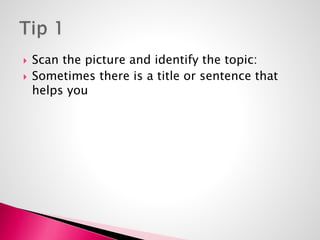
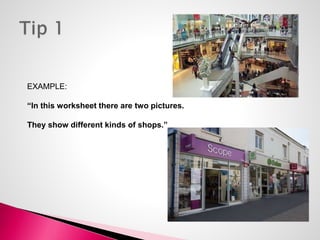
EXAMPLE: 
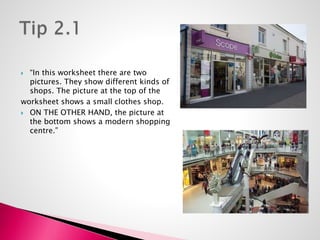
“In this worksheet there are two pictures. 
They show different kinds of shops.”
Talking about photos
 Locate them within the worksheet: Say which 
picture you are going to talk about. 
 Don’t point at the picture!
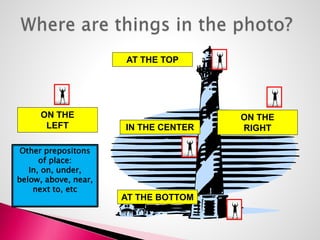
AT THE TOP 
IN THE CENTER 
AT THE BOTTOM 
ON THE 
LEFT 
ON THE 
RIGHT 
Other prepositons 
of place: 
In, on, under, 
below, above, near, 
next to, etc
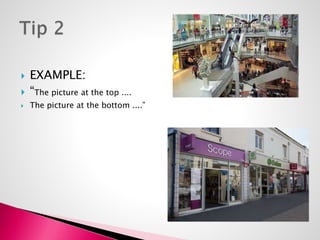
 EXAMPLE: 
 “The picture at the top .... 
 The picture at the bottom ....”
 Talk briefly about each of the pictures on 
the worksheet: 
 Describe, compare or contrast the pictures
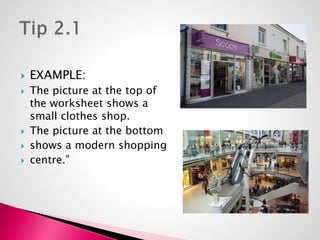
 EXAMPLE: 
 The picture at the top of 
the worksheet shows a 
small clothes shop. 
 The picture at the bottom 
 shows a modern shopping 
 centre.”
 To describe, compare or contrast the 
 pictures, use DIFFERENT EXPRESSIONS & 
 LINKING WORDS
 The photo shows… 
 In the picture we can see… 
 In this picture there is/are… 
 In the foreground there is/are… 
 In the background there is/are…
 whereas 
 instead of 
 on the other hand 
 similar to 
 the same as 
 like 
 in the same way
 “In this worksheet there are two 
pictures. They show different kinds of 
shops. The picture at the top of the 
worksheet shows a small clothes shop. 
 ON THE OTHER HAND, the picture at 
the bottom shows a modern shopping 
centre.”
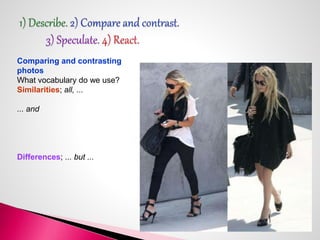
Comparing and contrasting 
photos 
What vocabulary do we use? 
Similarities; all, ... 
... and 
Differences; ... but ...
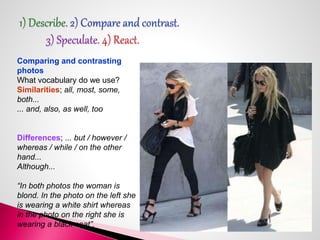
Comparing and contrasting 
photos 
What vocabulary do we use? 
Similarities; all, most, some, 
both... 
... and, also, as well, too 
Differences; ... but / however / 
whereas / while / on the other 
hand... 
Although... 
“In both photos the woman is 
blond. In the photo on the left she 
is wearing a white shirt whereas 
in the photo on the right she is 
wearing a black coat”.
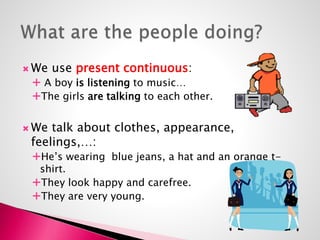
We use present continuous: 
 A boy is listening to music… 
The girls are talking to each other. 
We talk about clothes, appearance, 
feelings,…: 
He’s wearing blue jeans, a hat and an orange t-shirt. 
They look happy and carefree. 
They are very young.
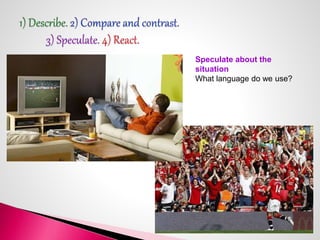
Speculate about the 
situation 
What language do we use?
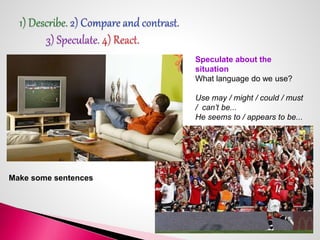
Speculate about the 
situation 
What language do we use? 
Use may / might / could / must 
/ can’t be... 
He seems to / appears to be... 
Make some sentences
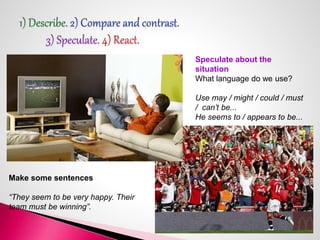
Speculate about the 
situation 
What language do we use? 
Use may / might / could / must 
/ can’t be... 
He seems to / appears to be... 
Make some sentences 
“They seem to be very happy. Their 
team must be winning”.
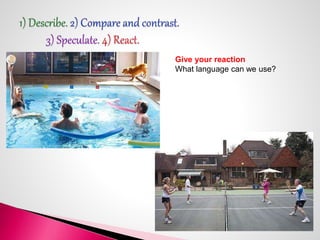
Give your reaction 
What language can we use?
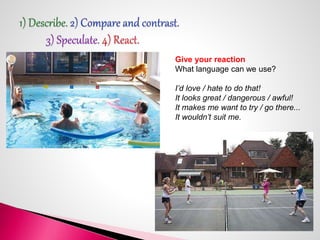
Give your reaction 
What language can we use? 
I’d love / hate to do that! 
It looks great / dangerous / awful! 
It makes me want to try / go there... 
It wouldn’t suit me.
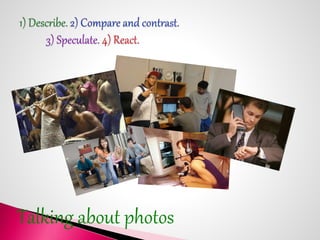
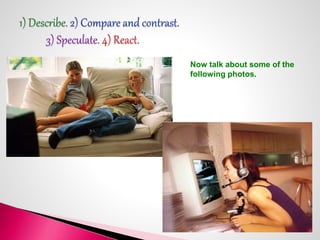
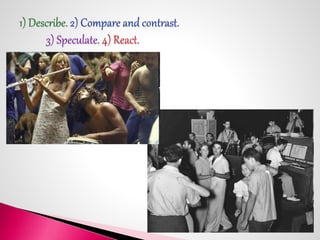
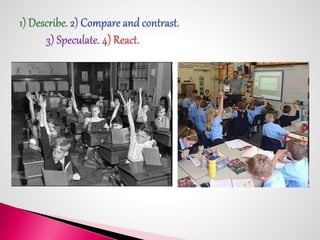
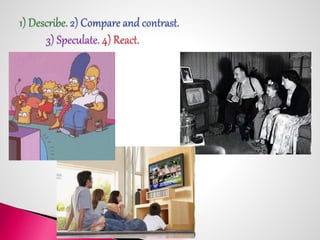
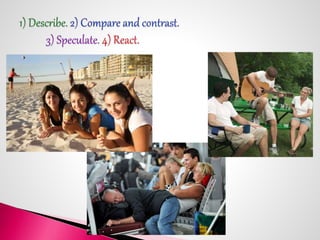
Now talk about some of the 
following photos.
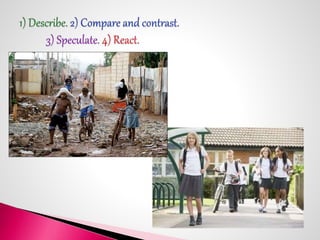
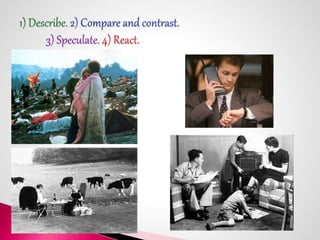
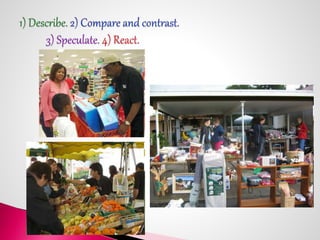
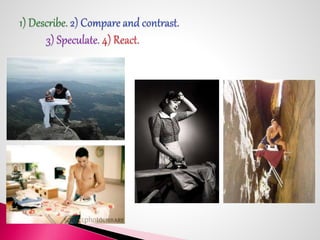
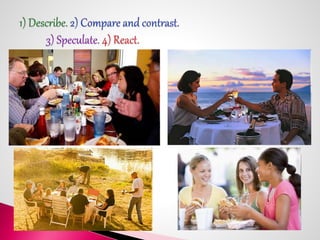
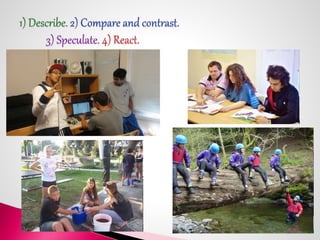
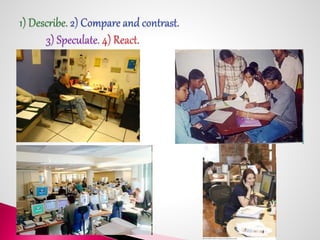
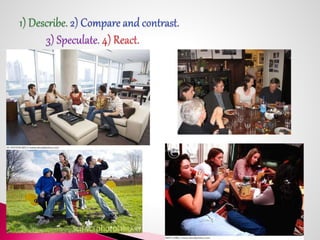
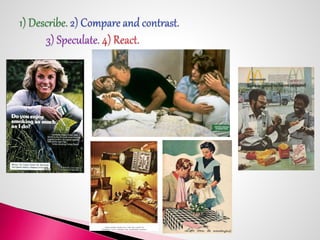
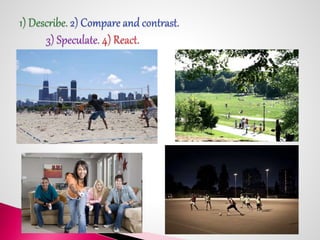
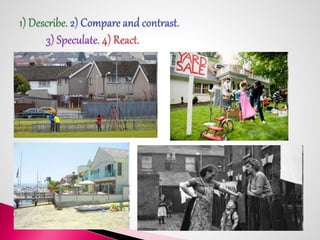
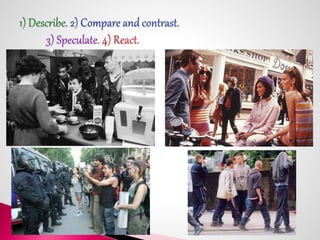
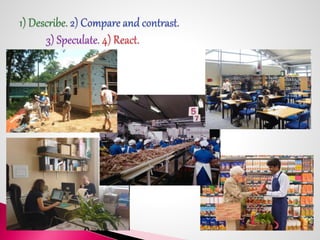
1) Describe the photo. 
• Describe what you can see and what 
is happening in the photos. 
• Say where it’s happening; ie on the 
right / left, at the bottom / top, in the 
middle, behind, in front... 
• Use Present Continuous. What are 
they doing? 
• What clothes are they wearing 
• What’s the weather like? 
• Are they inside or outside? 
• Use adjectives. Do they look happy, 
sad, angry, bored, tired..? 
• How does the photo make you feel? 
• Would you like to be there? Why / 
Why not? 
2) Comparing and 
contrasting photos 
Similarities; all, most, some, 
both... 
... also, as well, too. 
Differences; ... but / however / 
whereas / while / on the other 
hand... 
Although... 
3) Speculate about the 
situation 
Use may / might / could / must / 
can’t be... 
He seems to / appears to be... 
4) Give your reaction 
I’d love / hate to do that! 
It looks great / dangerous / awful! 
It makes me want to try / go there... 
It wouldn’t suit me.
Fce speaking 2
Fce speaking 2
Fce speaking 2
Fce speaking 2
Fce speaking 2

Fce speaking 2

  • 1.
  • 2.
     Scan thepicture and identify the topic:  Sometimes there is a title or sentence that helps you
  • 3.
    EXAMPLE: “In thisworksheet there are two pictures. They show different kinds of shops.”
  • 4.
  • 5.
     Locate themwithin the worksheet: Say which picture you are going to talk about.  Don’t point at the picture!
  • 6.
    AT THE TOP IN THE CENTER AT THE BOTTOM ON THE LEFT ON THE RIGHT Other prepositons of place: In, on, under, below, above, near, next to, etc
  • 7.
     EXAMPLE: “The picture at the top ....  The picture at the bottom ....”
  • 8.
     Talk brieflyabout each of the pictures on the worksheet:  Describe, compare or contrast the pictures
  • 9.
     EXAMPLE: The picture at the top of the worksheet shows a small clothes shop.  The picture at the bottom  shows a modern shopping  centre.”
  • 10.
     To describe,compare or contrast the  pictures, use DIFFERENT EXPRESSIONS &  LINKING WORDS
  • 11.
     The photoshows…  In the picture we can see…  In this picture there is/are…  In the foreground there is/are…  In the background there is/are…
  • 12.
     whereas instead of  on the other hand  similar to  the same as  like  in the same way
  • 13.
     “In thisworksheet there are two pictures. They show different kinds of shops. The picture at the top of the worksheet shows a small clothes shop.  ON THE OTHER HAND, the picture at the bottom shows a modern shopping centre.”
  • 14.
    Comparing and contrasting photos What vocabulary do we use? Similarities; all, ... ... and Differences; ... but ...
  • 15.
    Comparing and contrasting photos What vocabulary do we use? Similarities; all, most, some, both... ... and, also, as well, too Differences; ... but / however / whereas / while / on the other hand... Although... “In both photos the woman is blond. In the photo on the left she is wearing a white shirt whereas in the photo on the right she is wearing a black coat”.
  • 16.
    We use presentcontinuous:  A boy is listening to music… The girls are talking to each other. We talk about clothes, appearance, feelings,…: He’s wearing blue jeans, a hat and an orange t-shirt. They look happy and carefree. They are very young.
  • 17.
    Speculate about the situation What language do we use?
  • 18.
    Speculate about the situation What language do we use? Use may / might / could / must / can’t be... He seems to / appears to be... Make some sentences
  • 19.
    Speculate about the situation What language do we use? Use may / might / could / must / can’t be... He seems to / appears to be... Make some sentences “They seem to be very happy. Their team must be winning”.
  • 20.
    Give your reaction What language can we use?
  • 21.
    Give your reaction What language can we use? I’d love / hate to do that! It looks great / dangerous / awful! It makes me want to try / go there... It wouldn’t suit me.
  • 22.
    Now talk aboutsome of the following photos.
  • 40.
    1) Describe thephoto. • Describe what you can see and what is happening in the photos. • Say where it’s happening; ie on the right / left, at the bottom / top, in the middle, behind, in front... • Use Present Continuous. What are they doing? • What clothes are they wearing • What’s the weather like? • Are they inside or outside? • Use adjectives. Do they look happy, sad, angry, bored, tired..? • How does the photo make you feel? • Would you like to be there? Why / Why not? 2) Comparing and contrasting photos Similarities; all, most, some, both... ... also, as well, too. Differences; ... but / however / whereas / while / on the other hand... Although... 3) Speculate about the situation Use may / might / could / must / can’t be... He seems to / appears to be... 4) Give your reaction I’d love / hate to do that! It looks great / dangerous / awful! It makes me want to try / go there... It wouldn’t suit me.