Industrial Hygiene and Environmental Sampling
Challenges Globally
(Limited reference to South Africa, Kenya, Nigeria)
ORCHSE Strategies, LLC Meeting,
Washington DC
November 11, 2016
Maharshi Mehta, CSP, CIH
International Safety Systems, Inc.,
Washingtonville New York, USA
+1 203 685 8808, www.issehs.com
USA (New York, Houston), Mexico, Brazil, India (New Delhi, Baroda,
Bangalore, Hyderabad), China (Shanghai)
Agenda
 Sources of presentation
 Industrial Hygiene Sampling Challenges
– Chemical Agents
– Physical Agents
– Biological Agents
 Environmental sampling challenges
 Addressing challenges
 Control banding
 Statistical analysis of data
 Industrial hygiene sampling – future
 Limited Occupational Hygiene framework – South Africa, Nigeria,
Kenya
 Summary
©International Safety Systems, Inc.
www.issehs.com
Sources
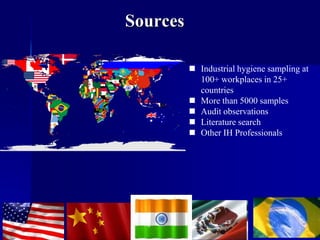
 Industrial hygiene sampling at
100+ workplaces in 25+
countries
 More than 5000 samples
 Audit observations
 Literature search
 Other IH Professionals
Industrial Hygiene Sampling and
Ethics
 Life of working people depends on monitoring
results
 Ethics is challenged invariably
 Strict adherence to ethics – quality assurance is
critical
– Reliable, Representative and Reproducible Results
 Human impact of high exposures identified as
low exposures due to wrong methods and vice
versa
©International Safety Systems, Inc.
www.issehs.com
Qualitative Exposure Assessment (QLEA),
Quantitative Exposure Assessment (QNEA)
 Essential before sampling begins
– Case studies – Consultant determined number of
samples to be collected
 Cost savings in QNEA
– Without QLEA, 10 times more
 Ingredients and %
– EnSolve 5408 contains?
 Other benefits
©International Safety Systems, Inc.
www.issehs.com
Reliable
 Validated method
 Calibration – before after – With rotameter?
 Calibration of calibrator
 Is sampling time exact or ends with 0 and 5 (e.g., 8:05 am, 8:10 am)
 Analytical laboratory
– AIHA accredited – Questionable results
– Countries with no IH accreditation
 Country specific requirements
– Only area sampling
– One hour sampling
©International Safety Systems, Inc.
www.issehs.com
Sampling Method -
Pharmaceuticals
 IOM or conventional cassette
 Task based or full shift-interpretation of results
 Limited compounds with validated methods
 Limited compounds with OEL
– Especially intermediates
 LOQ for high potent compounds
 “Our lab does product analysis so they can do
exposure sample analysis also”
©International Safety Systems, Inc.
www.issehs.com
Representative
 Sampling duration
– Work started at 6 am, when did sampling start?
– Missed beginning and end of shift?
 Was the work normal? Spill leaks?
– Case study – call operators in canteen, place sampling
pumps and have them deliver at 3 pm
 Is night shift exposure similar to day shift?
©International Safety Systems, Inc.
www.issehs.com
Reproducible
 Number of samples for each SEG
– Six?
– Three?
– One?
 Statistically significant
 Statistical analysis
– Of the three samples one above OEL and two below
OEL
– All 3 samples >50% of OEL <OEL
 Minimum three samples and stat analysis
©International Safety Systems, Inc.
www.issehs.com
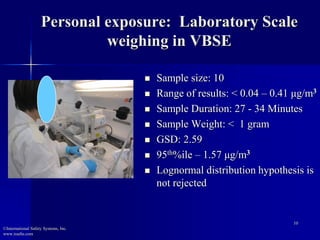
Personal exposure: Laboratory Scale
weighing in VBSE
 Sample size: 10
 Range of results: < 0.04 – 0.41 μg/m3
 Sample Duration: 27 - 34 Minutes
 Sample Weight: < 1 gram
 GSD: 2.59
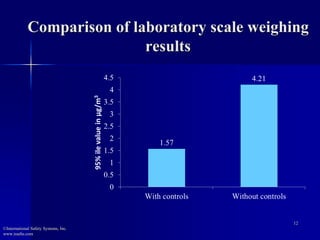
 95th%ile – 1.57 μg/m3
 Lognormal distribution hypothesis is
not rejected
10
©International Safety Systems, Inc.
www.issehs.com
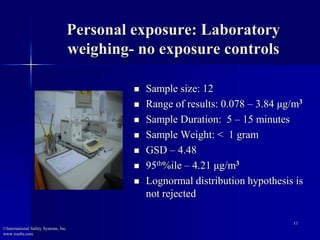
Personal exposure: Laboratory
weighing- no exposure controls
 Sample size: 12
 Range of results: 0.078 – 3.84 μg/m3
 Sample Duration: 5 – 15 minutes
 Sample Weight: < 1 gram
 GSD – 4.48
 95th%ile – 4.21 μg/m3
 Lognormal distribution hypothesis is
not rejected
11
©International Safety Systems, Inc.
www.issehs.com
Comparison of laboratory scale weighing
results
12
©International Safety Systems, Inc.
www.issehs.com
Report
 50 pages? 2 pages?
 Key Report Content
– Activity descriptions
– Results and result interpretation
– Contributory factors
– Recommendations
– Limitations
©International Safety Systems, Inc.
www.issehs.com
OEL challenges
 Difficulty in achieving OELs with process controls
– Hexavalent chromium, strontium chromate
– Cadmium
– Potent pharma compounds
 Changing OEL
– Benzene
– Isopropanol
 Uncertainty
– Metal working fluid
©International Safety Systems, Inc.
www.issehs.com
Control Bands – Example ( Chemicals by
Inhalation)
 Band 1 – Use good industrial hygiene practice &
general ventilation
 Band 2 – Use local exhaust ventilation
 Band 3 – Enclose the process
 Band 4 – Seek expert help
Systems Currently in Place or Under
Development
 HSE (UK) COSHH Essentials
 ILO Chemical Control Tool kit
 Systems currently being developed in:
– Belgium (REGETOX)
– Netherlands (Stoffenmanager)
– Norway (KjemiRisk)
 Occupational Exposure Banding in
Pharmaceutical Industries
Reconcile Country Regulations
and Quality Assurance
 Conduct limited monitoring required by a country
regulation
– China Case study
 Conduct comprehensive and robust monitoring using
validated methods that meets QA standards
 Country Certified Professionals
– Malesia case Study
– Kenya
 Have country certified professional do monitoring under
the guidance of CIH
©International Safety Systems, Inc.
www.issehs.com
Managing with limited resources
 Qualified service providers
– Corporate qualified
– Discussions with procurement not to go for lowest
bidder
– Periodically monitor “experts”
 Develop in-house IH 101 capabilities
– EHS, maintenance and line managers
 Internal laboratory approval process
– NIOSH PAT and Round Robin Test Participation
©International Safety Systems, Inc.
www.issehs.com
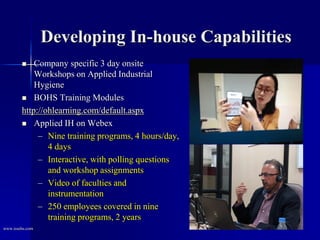
Developing In-house Capabilities
 Company specific 3 day onsite
Workshops on Applied Industrial
Hygiene
 BOHS Training Modules
http://ohlearning.com/default.aspx
 Applied IH on Webex
– Nine training programs, 4 hours/day,
4 days
– Interactive, with polling questions
and workshop assignments
– Video of faculties and
instrumentation
– 250 employees covered in nine
training programs, 2 years
www.issehs.com
South Africa
 Occupational Hygiene Regulations in South Africa
– http://www.saioh.co.za/?page=Legislation
 Regulations for:
– Hazardous Chemicals and biological agents
– Noise
– Asbestos
– Lead
– Indoor air quality (reference ASHRAE standard)
 Refers to NIOSH manual of analytical methods
 Specific and detailed
– Illumination
– Vibration
 Compliance with reference and regulation seem to meet QA
requirements
©International Safety Systems, Inc.
www.issehs.com
Kenya
 Directorate of Occupational Health and Safety
Services
http://www.labour.go.ke/2016-04-14-11-48-
28/directorate-of-occupational-safety-and-health-
services-doshs.html
 Occupational Health and Safety Act of 2007-
Similar to UK Factories Act
– Permissible exposure limits are specified
 Hazardous Substances Rules LN 60/2007
 List of approved Air Quality Monitors
©International Safety Systems, Inc.
www.issehs.com
Nigeria
 Federal Ministry of Labor and Employment
– Factories Act CAP F1 LFN, 2004
– http://www.labour.gov.ng/index.php?option=com_co
ntent&view=article&id=41&Itemid=157
 Ratified ILO conventions
– C155- Occupational Safety and Health Convention
1981
©International Safety Systems, Inc.
www.issehs.com
Summary
 Credibility of exposure monitoring outcome is
questionable globally, more so in emerging economies
 Systematic approach of developing internal exposure
assessment tool and implementing globally is viable
option
 Approaches have been successfully implemented to build
resources, work with qualified service providers, address
country specific sampling requirements and maintain QA
 Statistical analysis of globally available sampling results
would greatly assist in identifying and controlling
potential health risk with minimal resources
©International Safety Systems, Inc.
www.issehs.com

Environmental and iIH sampling challenges - Washington DC 2016

  • 1.
    Industrial Hygiene andEnvironmental Sampling Challenges Globally (Limited reference to South Africa, Kenya, Nigeria) ORCHSE Strategies, LLC Meeting, Washington DC November 11, 2016 Maharshi Mehta, CSP, CIH International Safety Systems, Inc., Washingtonville New York, USA +1 203 685 8808, www.issehs.com USA (New York, Houston), Mexico, Brazil, India (New Delhi, Baroda, Bangalore, Hyderabad), China (Shanghai)
  • 2.
    Agenda  Sources ofpresentation  Industrial Hygiene Sampling Challenges – Chemical Agents – Physical Agents – Biological Agents  Environmental sampling challenges  Addressing challenges  Control banding  Statistical analysis of data  Industrial hygiene sampling – future  Limited Occupational Hygiene framework – South Africa, Nigeria, Kenya  Summary ©International Safety Systems, Inc. www.issehs.com
  • 3.
    Sources  Industrial hygienesampling at 100+ workplaces in 25+ countries  More than 5000 samples  Audit observations  Literature search  Other IH Professionals
  • 4.
    Industrial Hygiene Samplingand Ethics  Life of working people depends on monitoring results  Ethics is challenged invariably  Strict adherence to ethics – quality assurance is critical – Reliable, Representative and Reproducible Results  Human impact of high exposures identified as low exposures due to wrong methods and vice versa ©International Safety Systems, Inc. www.issehs.com
  • 5.
    Qualitative Exposure Assessment(QLEA), Quantitative Exposure Assessment (QNEA)  Essential before sampling begins – Case studies – Consultant determined number of samples to be collected  Cost savings in QNEA – Without QLEA, 10 times more  Ingredients and % – EnSolve 5408 contains?  Other benefits ©International Safety Systems, Inc. www.issehs.com
  • 6.
    Reliable  Validated method Calibration – before after – With rotameter?  Calibration of calibrator  Is sampling time exact or ends with 0 and 5 (e.g., 8:05 am, 8:10 am)  Analytical laboratory – AIHA accredited – Questionable results – Countries with no IH accreditation  Country specific requirements – Only area sampling – One hour sampling ©International Safety Systems, Inc. www.issehs.com
  • 7.
    Sampling Method - Pharmaceuticals IOM or conventional cassette  Task based or full shift-interpretation of results  Limited compounds with validated methods  Limited compounds with OEL – Especially intermediates  LOQ for high potent compounds  “Our lab does product analysis so they can do exposure sample analysis also” ©International Safety Systems, Inc. www.issehs.com
  • 8.
    Representative  Sampling duration –Work started at 6 am, when did sampling start? – Missed beginning and end of shift?  Was the work normal? Spill leaks? – Case study – call operators in canteen, place sampling pumps and have them deliver at 3 pm  Is night shift exposure similar to day shift? ©International Safety Systems, Inc. www.issehs.com
  • 9.
    Reproducible  Number ofsamples for each SEG – Six? – Three? – One?  Statistically significant  Statistical analysis – Of the three samples one above OEL and two below OEL – All 3 samples >50% of OEL <OEL  Minimum three samples and stat analysis ©International Safety Systems, Inc. www.issehs.com
  • 10.
    Personal exposure: LaboratoryScale weighing in VBSE  Sample size: 10  Range of results: < 0.04 – 0.41 μg/m3  Sample Duration: 27 - 34 Minutes  Sample Weight: < 1 gram  GSD: 2.59  95th%ile – 1.57 μg/m3  Lognormal distribution hypothesis is not rejected 10 ©International Safety Systems, Inc. www.issehs.com
  • 11.
    Personal exposure: Laboratory weighing-no exposure controls  Sample size: 12  Range of results: 0.078 – 3.84 μg/m3  Sample Duration: 5 – 15 minutes  Sample Weight: < 1 gram  GSD – 4.48  95th%ile – 4.21 μg/m3  Lognormal distribution hypothesis is not rejected 11 ©International Safety Systems, Inc. www.issehs.com
  • 12.
    Comparison of laboratoryscale weighing results 12 ©International Safety Systems, Inc. www.issehs.com
  • 13.
    Report  50 pages?2 pages?  Key Report Content – Activity descriptions – Results and result interpretation – Contributory factors – Recommendations – Limitations ©International Safety Systems, Inc. www.issehs.com
  • 14.
    OEL challenges  Difficultyin achieving OELs with process controls – Hexavalent chromium, strontium chromate – Cadmium – Potent pharma compounds  Changing OEL – Benzene – Isopropanol  Uncertainty – Metal working fluid ©International Safety Systems, Inc. www.issehs.com
  • 15.
    Control Bands –Example ( Chemicals by Inhalation)  Band 1 – Use good industrial hygiene practice & general ventilation  Band 2 – Use local exhaust ventilation  Band 3 – Enclose the process  Band 4 – Seek expert help
  • 16.
    Systems Currently inPlace or Under Development  HSE (UK) COSHH Essentials  ILO Chemical Control Tool kit  Systems currently being developed in: – Belgium (REGETOX) – Netherlands (Stoffenmanager) – Norway (KjemiRisk)  Occupational Exposure Banding in Pharmaceutical Industries
  • 17.
    Reconcile Country Regulations andQuality Assurance  Conduct limited monitoring required by a country regulation – China Case study  Conduct comprehensive and robust monitoring using validated methods that meets QA standards  Country Certified Professionals – Malesia case Study – Kenya  Have country certified professional do monitoring under the guidance of CIH ©International Safety Systems, Inc. www.issehs.com
  • 18.
    Managing with limitedresources  Qualified service providers – Corporate qualified – Discussions with procurement not to go for lowest bidder – Periodically monitor “experts”  Develop in-house IH 101 capabilities – EHS, maintenance and line managers  Internal laboratory approval process – NIOSH PAT and Round Robin Test Participation ©International Safety Systems, Inc. www.issehs.com
  • 19.
    Developing In-house Capabilities Company specific 3 day onsite Workshops on Applied Industrial Hygiene  BOHS Training Modules http://ohlearning.com/default.aspx  Applied IH on Webex – Nine training programs, 4 hours/day, 4 days – Interactive, with polling questions and workshop assignments – Video of faculties and instrumentation – 250 employees covered in nine training programs, 2 years www.issehs.com
  • 20.
    South Africa  OccupationalHygiene Regulations in South Africa – http://www.saioh.co.za/?page=Legislation  Regulations for: – Hazardous Chemicals and biological agents – Noise – Asbestos – Lead – Indoor air quality (reference ASHRAE standard)  Refers to NIOSH manual of analytical methods  Specific and detailed – Illumination – Vibration  Compliance with reference and regulation seem to meet QA requirements ©International Safety Systems, Inc. www.issehs.com
  • 21.
    Kenya  Directorate ofOccupational Health and Safety Services http://www.labour.go.ke/2016-04-14-11-48- 28/directorate-of-occupational-safety-and-health- services-doshs.html  Occupational Health and Safety Act of 2007- Similar to UK Factories Act – Permissible exposure limits are specified  Hazardous Substances Rules LN 60/2007  List of approved Air Quality Monitors ©International Safety Systems, Inc. www.issehs.com
  • 22.
    Nigeria  Federal Ministryof Labor and Employment – Factories Act CAP F1 LFN, 2004 – http://www.labour.gov.ng/index.php?option=com_co ntent&view=article&id=41&Itemid=157  Ratified ILO conventions – C155- Occupational Safety and Health Convention 1981 ©International Safety Systems, Inc. www.issehs.com
  • 23.
    Summary  Credibility ofexposure monitoring outcome is questionable globally, more so in emerging economies  Systematic approach of developing internal exposure assessment tool and implementing globally is viable option  Approaches have been successfully implemented to build resources, work with qualified service providers, address country specific sampling requirements and maintain QA  Statistical analysis of globally available sampling results would greatly assist in identifying and controlling potential health risk with minimal resources ©International Safety Systems, Inc. www.issehs.com