Caribbean Leadership and
Transformation Forum
18-19 September 2017
Director of Development,
Office of the Vice
Chancellor, The University
of the West Indies
Caribbean Leadership and Transformation Forum
18-19 September 2017
Stacy Richards-Kennedy
Director of Development
The University of The West Indies
Strengthening Development Effectiveness
in the Caribbean
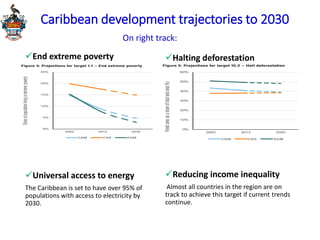
Caribbean development trajectories to 2030
End extreme poverty
Universal access to energy
The Caribbean is set to have over 95% of
populations with access to electricity by
2030.
Halting deforestation
Reducing income inequality
Almost all countries in the region are on
track to achieve this target if current trends
continue.
On right track:
Caribbean development trajectories to 2030
Right direction but need significant
progress:
Trend going in wrong direction:
• Reducing slum populations
• Combating climate change
• Marine conservation
• Reducing violent deaths
 Universal access to sanitation
 End hunger
 Reduce maternal mortality
 Universal secondary education
 End child marriage
 Strengthen domestic-resource
mobilisation
The extent to which an
intervention (or an
institution) has achieved
its stated objectives and
has contributed to
bringing about positive
change in the lives of its
target beneficiaries.
What is
development
effectiveness?
It emphasizes…
Results Based Management
Accountability &
Transparency
Responsible government
Implementation
Monitoring & Evaluation
What does
development
effectiveness
entail?
Key Principles:
 Institutionalizing the practice
of evaluating projects to
support evidence-based
decision making
 Regular performance
monitoring with a timely focus
on improvement
 Building resilience by
mitigating implementation
risks
 Strengthening data collection,
sharing and analysis
Strengthening
Development
Effectiveness
• What actions will we take to
ensure that we bring about the
transformation that this region
needs?
• How will we go about
institutionalizing processes that
build robust systems of
accountability and transparency?
• How will we transform the work
culture in our institutions to one
that is more efficient and results-
driven, while preserving that
warm, caring, fun-loving
Caribbean spirit?
• Do our leaders (at all levels) have
the political will to walk the talk
of transformational leadership,
accountability, transparency and
results?
What will it take for
the Caribbean to
cure its
implementation
deficit disorder?
• UWI’s Strategic Plan 2017-2021:
Access, Alignment and Agility
• UWI MOU with PEMANDU Associates
• Online course (roll-out Oct 2017):
Transformational Leadership to
Achieve the SDGs in Developing
States
How is the UWI
supporting
stronger
development
effectiveness?
Thank You
Stacy Richards-Kennedy
Director of Development
Office of the Vice Chancellor
The University of the West Indies
Tel: (868) 662-2002 ext. 82043
Email: stacy.kennedy@sta.uwi.edu

Strengthening Development Effectiveness in the Caribbean

  • 1.
    Caribbean Leadership and TransformationForum 18-19 September 2017 Director of Development, Office of the Vice Chancellor, The University of the West Indies Caribbean Leadership and Transformation Forum 18-19 September 2017 Stacy Richards-Kennedy Director of Development The University of The West Indies Strengthening Development Effectiveness in the Caribbean
  • 2.
    Caribbean development trajectoriesto 2030 End extreme poverty Universal access to energy The Caribbean is set to have over 95% of populations with access to electricity by 2030. Halting deforestation Reducing income inequality Almost all countries in the region are on track to achieve this target if current trends continue. On right track:
  • 3.
    Caribbean development trajectoriesto 2030 Right direction but need significant progress: Trend going in wrong direction: • Reducing slum populations • Combating climate change • Marine conservation • Reducing violent deaths  Universal access to sanitation  End hunger  Reduce maternal mortality  Universal secondary education  End child marriage  Strengthen domestic-resource mobilisation
  • 4.
    The extent towhich an intervention (or an institution) has achieved its stated objectives and has contributed to bringing about positive change in the lives of its target beneficiaries. What is development effectiveness?
  • 5.
    It emphasizes… Results BasedManagement Accountability & Transparency Responsible government Implementation Monitoring & Evaluation What does development effectiveness entail?
  • 6.
    Key Principles:  Institutionalizingthe practice of evaluating projects to support evidence-based decision making  Regular performance monitoring with a timely focus on improvement  Building resilience by mitigating implementation risks  Strengthening data collection, sharing and analysis Strengthening Development Effectiveness
  • 7.
    • What actionswill we take to ensure that we bring about the transformation that this region needs? • How will we go about institutionalizing processes that build robust systems of accountability and transparency? • How will we transform the work culture in our institutions to one that is more efficient and results- driven, while preserving that warm, caring, fun-loving Caribbean spirit? • Do our leaders (at all levels) have the political will to walk the talk of transformational leadership, accountability, transparency and results? What will it take for the Caribbean to cure its implementation deficit disorder?
  • 8.
    • UWI’s StrategicPlan 2017-2021: Access, Alignment and Agility • UWI MOU with PEMANDU Associates • Online course (roll-out Oct 2017): Transformational Leadership to Achieve the SDGs in Developing States How is the UWI supporting stronger development effectiveness?
  • 9.
    Thank You Stacy Richards-Kennedy Directorof Development Office of the Vice Chancellor The University of the West Indies Tel: (868) 662-2002 ext. 82043 Email: stacy.kennedy@sta.uwi.edu