




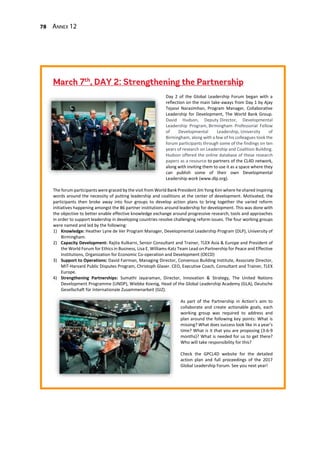
The Collaborative Leadership for Development Approach
LEADERSHIP
DEVELOPMENT
PUTTING
CENTER OF
AT THE
© 2016 The World Bank Group
1818 H Street, NW
Washington, DC 20433 USA
www.worldbank.org/
All rights reserved.
This work is a product of the staff of The World Bank with external contributions. The findings,
interpretations, and conclusions expressed in this work do not necessarily reflect the views of The
World Bank, its Board of Executive Directors, or the governments they represent. The World Bank does
not guarantee the accuracy of the data included in this work. Nothing herein shall constitute or be
considered to be a limitation upon or waiver of the privileges and immunities of The World Bank, all of
which are specifically reserved.
Contents
Foreword..........................................................................................................................v
Preface...........................................................................................................................vii
Part I. Overview and Approach............................................................................................1
The CL4DTheory of Change and Adaptive Leadership Framework..........................................................................2
Evolution.....................................................................................................................................................................7
The CL4D Process......................................................................................................................................................10
Part 2. Experience and Learning.......................................................................................19
Program Description.................................................................................................................................................20
Key Insights ..............................................................................................................................................................22
An Unpredictable Journey........................................................................................................................................30
Part 3. Going forward.......................................................................................................31
Challenges................................................................................................................................................................33
Solutions...................................................................................................................................................................33
Conclusion.................................................................................................................................................................35
Annex 1. Collaborative Leadership for Development:Theory of Change ..............................37
Annex 2. Adaptive Leadership...........................................................................................41
Annex 3. Collective Action................................................................................................43
Annex 4. Rapid Results Approach......................................................................................45
Annex 5. Phases of Rapid Results Initiatives ......................................................................47
Annex 6.The Delivery Partners Development Program.......................................................50
Annex 7. Summary of Country Engagements.....................................................................52
Annex 8.The Client-Partner Dialogues..............................................................................54
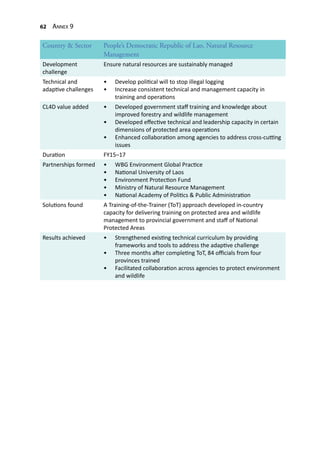
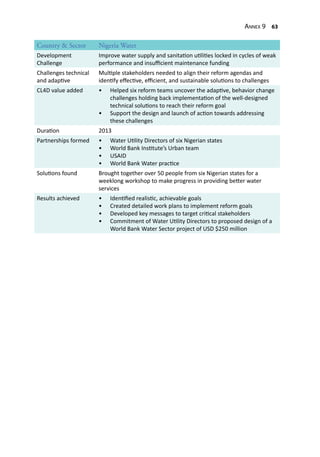
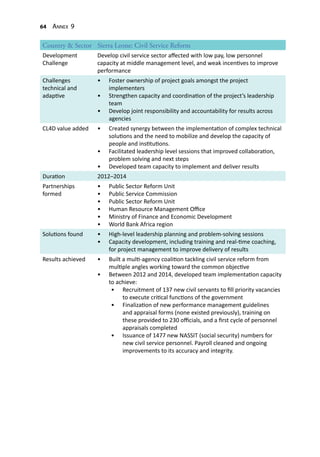
Annex 9. Selected Country Case studies.............................................................................56
Annex 10.The Global Partnership on Collaborative Leadership for Development .................65
Annex 11. 2016 Global Leadership Forum Round-Up...........................................................66
Annex 12. 2017 Global Leadership Forum Highlights..........................................................71
Foreword v
Foreword
Leadership plays an important role in development and is a complement to
financing and technical solutions. The 2017 World Development Report on Governance and
the Law has highlighted how increased commitment, coordination, and cooperation increases
effectiveness of policies and the delivery of services to citizens. It also demonstrated how
power asymmetries can undermine implementation of policy reform given that those with
power can exclude critical stakeholders from a change process.
The World Bank’s Collaborative Leadership for Development (CL4D) program is
dedicated to providing support to Bank-financed operations by strengthening the capacity
of government counterparts to work as effective teams and by helping to build coalitions for
change among different actors in society. The CL4D approach strengthens government teams
engaged in Bank-financed operations to more effectively manage risks, overcome political
economy obstacles, and achieve tangible results.
In order to achieve the World Bank’s goals of ending extreme poverty and promoting
shared prosperity, it is essential that we collaborate by pooling our knowledge and efforts in
many areas, including the support of leadership in countries.
Supporting stakeholders to engage and work differently to smooth project
implementation and accelerate progress toward development results is the purpose of the
CL4D program. The CL4D approach is embedded in Bank-financed operations and currently
supports more than 50 initiatives across various sectors world-wide. It is problem-driven,
solution-focused, hands-on work with multi-stakeholder teams that supports deeper analysis
and experimentation.
This report documents the experience and insights of the CL4D program. I hope it will
serve as a valuable reference document that will help us take on the challenge of enhancing
collaborative leadership actions and results that will contribute to the achievement of our
development goals.
Jan Walliser
Vice President
Equitable Growth, Finance and Institutions
The World Bank Group
Preface vii
Preface
I still recall the excitement on the faces of the individuals who had gathered in
Obudu for the Greater Than Leadership program to support Water Utility Reform in Nigeria in
September 2013. We had just spent four and a half days together with nearly 60 individuals
from six states across the country. They came from the government, private sector, civil
society, religious and traditional leaders, parliament, and the media. The teams wrestled with
the difficult questions involved in moving the reform forward, making the utilities financially
sustainable, and delivering quality services to citizens. At the end of the workshop, the newly
formed multi-stakeholder teams shared their excitement and confidence at being able to
systematically work to take on the constraints and barriers that had been holding them back,
and also build coalitions to further their efforts. This was the first time the government teams
had sat with their clients and other key actors and had developed a comprehensive action plan
to take on the myriad challenges in front of them. It was incredible to see how they had come
together as a team. A month later, I was pleased to learn that a long-pending water reform bill
that the teams had discussed had passed and would fillip the reform efforts. Bringing together
the parliamentarians with the government officials and the citizens had helped build an
understanding of different viewpoints and promote ownership of a jointly developed solution.
And it paved the way for one of the first steps on the road to reform.
The challenges faced by development practitioners today are more complex and
interwoven in the political economy of countries than at any point in the past.The complexities
are such that no single stakeholder can hope to sustainably change the status quo. It is
necessary, therefore, to bringing together broad-based coalitions for reform, and address the
question of the“how”of reform. This was the basic question that spurred the journey that we
have found ourselves on at the Collaborative Leadership for Development (CL4D) program.
The World Bank probably has the best analytical tools and instruments in the
development arena. It is also one of the premier international financial institutions. Despite
these advantages, the development projects it supports have a mixed track record of success.
Based on experience, we have reason to believe that collaborative leadership and coalition
building are key ingredients—the "special sauce"—in the recipe for sustainable development.
Over the years, the CL4D program has evolved from a “training” mindset to more of a
“facilitated action-learning”approach—one that seeks to develop the capacity of government
officials to work as effective teams, and helps lay the foundation for building reform coalitions
to sustain the efforts. The focus has also been on how to make this approach more embedded
in World Bank Group operations. Several case stories and other resource materials have
been developed over the years, including a process guide, an indicative roadmap, toolboxes,
animations, and booklets capturing lessons learned through engagement with partners and
clients. This document seeks to bring together the team's learning and experience of the past
years and also lays the foundation for the future of this work. It also seeks to contextualize the
materials developed so far.
Today, the program is at a crossroads. With a high degree of appreciation by WBG
operations and clients alike, and with the intention of fully mainstreaming the approach, the
program has been moved to the Equitable Growth, Finance and Institutions Vice Presidency.
The ongoing effort is to further refine the model so that it becomes an integral part of World
Bank operations over the years to come. The program has also embarked on an ambitious
effort to broaden the space for the work on leadership and coalitions by launching a global
partnership on collaborative leadership for development. Exciting times lay ahead!
While I have personally led the production of this document, I would like to acknowledge
Najma Siddiqi who helped to develop the idea and provided guidance for the structure and
content as an e-book. I thank Denson Catindoy as the project manager, and KayWinning for her
contributions to the section on current experience. I appreciate the whole CL4D team for their
contributions and for sharing their experiences and lessons for this work going forward.Thank
you to Roby Senderowitsch for his support and for requesting a document that captured the
evolution, experience, and future direction of the CL4D approach, and to Abha Joshi-Ghani for
her encouragement and support. Thank you as well to Jan Walliser and Edward Olowo-Okere.
Most of all, thanks to our consultant Kris Rusch, who took up the challenge, developed the
text, designed, and presented the content of this e-book in a highly consultative and creative
manner, resulting in a product that is substantive, informative, and accessible.
Ajay Tejasvi Narasimhan
Program Manager
Collaborative Leadership for
Development Program
The World Bank Group
Ajay Tejasvi
Benjamina Randrianarivelo
Ceren Ozer
Denson Catindoy
Donghui Park
Eva Schiffer
Hirut M’cleod
Kay Winning
Lili Sisombat
Manuel Contreras
Marielle Wessin
Najma Siddiqi
Sue Harding
Team CL4D
Overview and Approach 1
A growing body of literature is documenting what development practitioners
have observed for some time: the most critically needed, well-conceived, and technically
sophisticated interventions can be undone by what Campos and Syquia call “the politics
of change.”1
In some reform efforts, widespread support for the substance and method of
development projects generates harmonious collective action and successful implementation.
In other cases, sewage systems fail because residents aren’t vested in paying taxes to maintain
them, government employees resist adapting Financial Management Information Systems
because they like the old system better, government procurement rules seem fine on paper
yet the practice is rife with bribery and collusion. The politics of change is a factor in every
reform effort. But when government dysfunction, corruption, political rivalry, weak rule of
law, top-down processes, and numerous other interpersonal and institutional vulnerabilities
stall development activities, the harms extend beyond the project. Missed milestones mean
development funds sit undispersed, projects may be restructured and gains to date are lost,
alliances dwindle, and cynicism becomes more entrenched. On the ground, poverty continues
to exact its daily toll from the world’s most vulnerable people.
The Bank has some of the world’s most sophisticated operational knowledge and
technical tools at its disposal. Yet, when political and interpersonal complexities hinder
development, technical expertise alone is powerless to get projects back on track. Moving
from the status quo to the desired state of reform requires infusing implementation teams
with a special set of information and skills that equips them to negotiate their unique political
economies and mobilize groups to overcome the barriers to reform. One of the World Bank
Group’s key resources for strengthening intervention teams is the Collaborative Leadership for
Development (CL4D) approach.
1.  J. Edgardo Campos and Jose Luis Syquia, Managing the Politics of Reform: Overhauling the Legal
Infrastructure of Public Procurement in the Philippines (Washington, DC: The World Bank: 2006), 2.
Part I
Overview and Approach
2 Overview and Approach
The CL4D Theory of Change and Adaptive
Leadership Framework
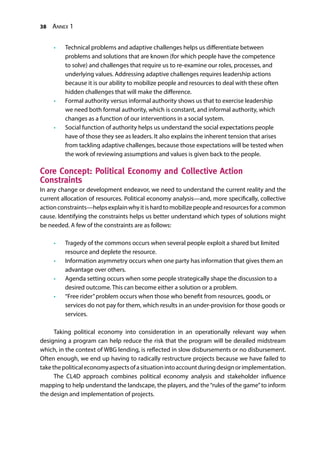
The CL4D theory of change posits that between a stalled project’s current status and the
desired state of reform is a complex and tenacious culture of assumptions, mindsets, systems,
incentives, and behaviors that must be examined and transformed for reform to take root.
Although the current state has elements that hinder development, it is difficult to change
because, as Heifetz, Linsky, and Grashow note, the system of mindsets, assumptions, and
behaviors that make up the status quo“functions elegantly to solve a stream of problems and
opportunities for which it has already evolved.”2
Because the status quo rewards conformity
to its own norms and “rules of the game,” moving development projects to the desired state
requires implementation partners to deeply understand the current context and their own
relationship to it so that they can strategically transform it. In the CL4D theory of change,
people must be willing not only to transform systems and institutions, but also to transform
themselves.This process takes time and focus, requires a taste for experimentation (particularly
during the implementation stage) and demands group learning and adaptation. (See Annex 1
for the CL4D Theory of Change.)
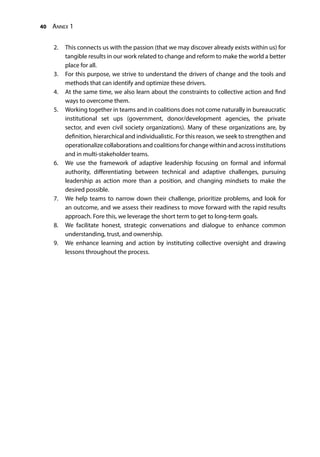
Adaptive leadership provides CL4D’s theoretical framework for bringing about such
change. (See Annex 2.) In the CL4D approach, leading means mobilizing a group of people to
achieve a common good. Adaptive leadership posits that leadership is an activity, not merely
a formal title or a high position in an organizational hierarchy.
Adaptive leadership is a model for developing “process expertise” to apply to collective
challenges.3
Three key concepts from adaptive leadership help implementing teams see—and
do—things differently. These concepts are:
•	 Adaptive challenges vs. technical problems
•	 Informal vs. formal authority
•	 Social function of authority
Adaptive Challenges vs. Technical Problems
Adaptive leadership applies to adaptive—as opposed to technical—problems.
What are the differences? In short, technical challenges can be solved with technical
expertise. Technical challenges tend to be rational, finite, and clearly defined; they are
based on facts or reason, tied to existing protocol or procedures, and are resolvable
with existing knowledge and means. Most technical solutions can be implemented
relatively quickly, and their success is associated with compliance, not commitment.
2. Ronald Heifetz, Alexander Grashow, and Marty Linsky, The Practice of Adaptive Leadership: Tools and
Tactics for Changing Your Organization and the World, (Harvard Business School Press: 2009), 49. 
3.  Heifetz, Grashow and Linsky, 2.
Overview and Approach 3
In contrast, adaptive challenges are complex, persistent, and systemic, often deeply
embedded in culture or social norms. Therefore, addressing adaptive barriers to development
requires people to examine their social paradigms, mindsets, values, and behaviors and to
change in deeply significant ways that they may initially resist. Implementing solutions to
adaptive challenges calls for a willingness to change systems, a spirit of experimentation, an
ability to take risks and make honest appraisals of their effects, and to accept new, unexpected
discoveries. This experimental, learn-as-you-go approach inherent to adaptive solutions also
means that adaptive approaches may take longer to fully implement. Hence, people are
generally more enthused by technical solutions and may want to focus on them exclusively,
even when faced with a situation complicated by adaptive challenges. In the development
context, for example, a shortage of medicines is a technical problem. A belief that poor health
is“normal”so there is no value in seeking health services except in emergencies is an adaptive
challenge that is much more difficult to change.
Adaptive Challenges to Water Reform
Distinguishing technical from adaptive challenges was a crucial component of addressing water
reform in Nigeria. Nigeria’s high water table makes it relatively easy for individuals to dig their own
wells, whereas others may tap into purified water lines to divert water for their own use or to sell it
to others. The relatively large supply of water available through informal markets made it difficult
for the government to collect the fees and tariffs needed to pay for water service to citizens and
infrastructure maintenance. CL4D was invited to hold a weeklong workshop in Obudu with six
reform teams comprising more than 50 engineers and water commissioners from Bauchi, Cross
River, Ebonyi, Ekiti, Lagos, and Rivers.
	 Participants came to the workshop with various ideas for technical solutions, such as increasing
tariffs and installing new water meters. CL4D exercises helped them see those solutions as technical
in nature, while providing opportunities for them to master the skill of differentiating technical from
adaptive challenges. Participants soon saw that adaptive challenges remained regardless of the
technical solution adapted: How would water authorities ensure residents actually paid for water?
What would prevent continued diversion of water for private gain? By the end of the workshop,
participants not only had the skills to distinguish technical from adaptive elements of their challenge,
all six teams had (1) established 11-month goals, (2) created detailed work plans to implement those
goals, and (3) developed key messages that targeted stakeholders.
	 This initial workshop laid the groundwork for a follow-up workshop involving the original teams,
plus teams from five other areas in Nigeria working on water utility reform. The Force-Field Analysis
and other tools now in the CL4D Toolbox (described below) assisted participants as they analyzed
the political-economic context and developed RRIs to incrementally bring about their desired states.
	 Once the World Bank Country Director for Nigeria Marie-Francois Marie-Nelly saw the level of
engagement and traction these workshops sustained, she asked CL4D to support not just a project
or sector, but the entire portfolio.
4 Overview and Approach
Informal vs. Formal Authority
Formal authority is conferred by a title; the informal authority at the core of adaptive leadership
is derived from one’s ability to inspire trust and commitment in others to advance the initiative.
To exercise leadership, we need both formal authority, which is constant, as well as informal
authority, which changes as a function of our interventions in a social system. In the process
of development, anyone can take leadership action, or exercise authority. In fact, encouraging
numerous, cohesive leadership actions within an engagement is a hallmark of the collective
leadership approach. Although formal authority figures may hold a role or job title for years,
informal authority changes and fluctuates depending on the project’s needs and participant
skillsets.
Social Function of Authority
Borrowing another concept from adaptive leadership, CL4D views authority as conferred
power to perform a service. It is given and can be taken away. The social functions of authority
are to help provide a sense of purpose and direction, to maintain order, and provide protection.
The exercise of leadership calls for the use of both formal and informal authority by change
agents on the ground. Societies have expectations for people they view as formal leaders, and
these expectations and assumptions may be particularly important for public sector leaders
whose conduct has a major impact on the lives of average citizens.
CL4D uses the adaptive leadership framework to prepare implementation teams to
mobilize people, ideas, and resources to make progress toward shared objectives. The
CL4D program seeks to help influence the behavior of public sector authorities and other
change agents by challenging their traditional notions of leadership, formal and informal
authority, and the social functions of authority, thus setting the stage for multiple actors to
begin collaborating around common challenges and goals. Principles and practices of CL4D
(discussed below) help diffuse potentially competing interests and tensions among actors,
and mobilize them to collectively move projects forward.
Analyzing Constraints to Collective Action
Although the“desired state”of development projects implies an improvement over the current
state,mobilizingpeopleandresourcestobringaboutadesiredoutcomeisnotstraightforward.
Collective action toward a public good is frequently hindered by conflicts of interest—
frequently, self-interest is in conflict with the greater community interests. (See Annex 3.)
Because adaptive challenges are deeply rooted in the current political economy, analyzing
and understanding the political economy is critical to understanding how to progress toward
the desired state. According to Corduneanu-Huci, Hamilton, and Ferrer (2013), a political–
economic analysis is crucial to overcoming barriers to reform because
The diagnostics and tools of political economy help focus analyses on the actors,
their potential for collective action, the costs and benefits of reform, and the
relevant institutions and incentives. They also provide a navigational compass for
Overview and Approach 5
reformers. Political-economy analysis helps explain why suboptimal development
outcomes occur.4
Following a careful analysis, it is not uncommon to find that many implementation
problems, although they are diverse on the surface, in fact share similar incentive structures.
Concepts from political-economic analysis provide the frames for understanding constraints
to collective action. Some of these concepts include the following:
“Freerider”problem:individualsororganizationsconsumemorethantheirfairshare
of a public resource or shoulder less than a fair share of the costs of its production.
Information Asymmetry: one party has more or better information than the other,
leading to an imbalance of power.
Credible Commitment: any arrangement or mechanism that makes it very costly for
someone to go back on a promise.
Tragedy of the Commons: a situation in which an individual or group exploits
common resources, like water, but in so doing contributes to the depletion of such
a good.
Agenda Setting: the strategic use of rules and procedures to influence a decision
toward a favorable outcome.
CL4D tools and processes help development partners understand the true nature of the
challenges they confront.
4.  Corduneanu-Huci, Hamilton, and Ferrer, 2013, 15.
Tragedy of the Commons in Lao
More than half of Lao’s total national wealth lies in its natural resources, including its forests. Yet
illegal logging is rampant. Through a CL4D engagement, the implementation team learned that
skewed incentives were a key challenge.The high profits from illegally harvested timber encouraged
rent-seeking and willful lack of law enforcement. In addition, there was little collaboration among
ministries and also between ministries and the army, police, and customs, which made it difficult
to address the issue. Underlying all was a widespread belief that it would be impossible to
fundamentally change the situation.
	 CL4D’s assessment suggested a Training of Trainers approach through key institutions such as the
National University of Laos, the Environment Protection Fund, and the National Academy of Politics
and Public Administration, among others. Those who received the training then are expected to
train at least 720 provincial and local government officials on protected area management in two-
week workshops in the provinces over a four-year period.
6 Overview and Approach
A Focus on Rapid Results
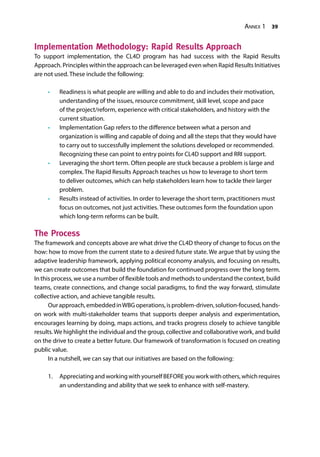
Achievingdevelopmentgoalstakestime—years—butgovernmentsoftenneedtoshowresults
in a timely manner to prove credibility or earn the public’s trust. A Rapid Results Approach
(RRA) is CL4D’s instrument for helping implementation teams achieve measurable progress
toward the desired state in a timely fashion. Specifically, implementation teams use the RRA to
break a large development objective into a series of projects known as Rapid Results Initiatives
(RRIs) that teams strive to achieve within 100 days. (See Annexes 4 and 5.) These projects can
be launched one at a time or in waves of projects to bring about large-scale change.
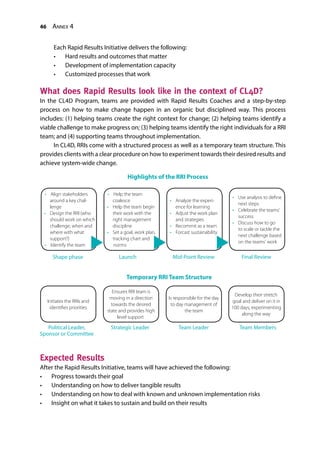
In the CL4D approach, teams are provided with Rapid Results Coaches and a step-by-step
process on how to effect change in an organic but disciplined way. This process includes: (1)
helping teams create the right context for change; (2) helping teams identify a viable challenge
to make progress on; (3) helping teams identify the right individuals for a RRI team; and (4)
supporting teams throughout implementation. RRIs have a structured process as well as a
temporary team structure. This provides clients with a clear procedure on how to experiment
towards their desired results and achieve system-wide change.
RRIsinjectasenseofurgencyintodevelopmentprojects.Theinitiativestargetmeaningful
results that are challenging to achieve; their success is never guaranteed. Instead, success
depends on—and rallies—the commitment of leaders to engage in new ways of doing
business. Implementation teams must be willing to“learn by doing”an RRI, which comes with
a certain amount of risk. At the same time, according to Campos and colleagues:
Through an RRI, the risk of failure is reduced considerably—what is the worst that
can happen in a 100 days? But if implemented effectively, it produces tangible
results that a decision maker can point to (and claim credit for) and demonstrates
how tangible results can be achieved systematically on a wider scale (and which
minimizes risk), i.e., it helps the decision maker meet his or her delivery “score card”
and,forpoliticians,enhancetheirre-electability.Thiscreatesincentivestoconsider
the RRA and support the conduct of RRIs.5
CL4D frequently pairs RRIs with implementation retreats so that learning can be shared
in a structured way and achievements celebrated. The approach is particularly useful when
bringing together disparate stakeholders that need to perform as high functioning teams.
Teams complete RRIs having achieved
•	 Progress towards their goal
•	 Understanding on how to deliver tangible results
•	 Understanding on how to deal with known and unknown implementation risks
•	 Insight on what it takes to sustain and build on their results
5.  J. Edgardo Campos, Benjamina Randrianarivelo, and Kay Winning, Escaping the “Capability Trap”:
Turning “Small” Development into “Big” Development, International Public Management Review 16(1), 2015, 12.
Overview and Approach 7
Evolution
CL4D has its roots in a leadership roundtable hosted by the Leadership and Governance Practice
of the World Bank Institute in September 2009. Observing that the carrot (funding) and stick
(conditionality) approach to development had not aptly facilitated implementation, thought
leaders and practitioners met to explore ideas about more effective approaches. Roundtable
participants identified adaptive leadership as a promising model to help implementers think
beyond what needs to be done and to also consider how to engage multiple stakeholders to
get projects completed on time. The Leadership Practice began to design a practical, hands-on
program that utilized the adaptive leadership approach to involve multiple stakeholders.
The following year, the practice offered a pilot program named“Collaborative Leadership
for Development Impact”for 19 participants from six fragile states. The curriculum addressed
political economy analysis, strategic communication, self-mastery, network analysis, adaptive
leadership, and rapid results, which remain integral to the CL4D approach. The pilot program
made clear the need to develop teams and to tackle complex implementation challenges with
both technical and adaptive interventions.
In 2011, the practice launched the Decisions. Actions. Results (DARE) program with the
explicit intention of training and operationalizing leadership groups. DARE, partnering with
the Lee Kuan Yew School of Public Policy, offered a 10-day capacity development program to
teams from five cities in the East Asia and Pacific Region, focusing on urban river waterfront
RRIs are
Results oriented – the work is focused on achieving tangible, measureable, bottom-line results
(instead of activities, preparations, or recommendations)
Fast – project duration is 100 days or less
Experimental – the approach fosters innovation and learning, allowing teams to test large-scale
change in low-risk ways
Stimulating– teams gain new insights on implementation challenges and risks, increasing a sense
of purpose, urgency, collaboration, and accountability
Empowering – teams set their own goals and are expected to actively pursue it, building capacity
and confidence
Cross-functional– teams bring together individuals who have frontline knowledge of the challenge
at hand
Visible – projects are actively supported and valued by a sponsor, which typically comes from a
senior-level manager
Supported by coaches – teams are provided with a trained RRI Coach to guide the process and to
ensure that progress is being made in a disciplined way
8 Overview and Approach
development. World-class faculty trained the teams on both technical and leadership issues.
CL4D also partnered with the University of Cape Town to train eight metropolitan teams
from across South Africa focusing on urban resettlements. These engagements focused on
developing leadership—not leaders—and drove home the importance of participatory
learning, follow-up, and ensuring relevance to WBG operations.
In 2012, the practice transformed the DARE program into Greater Than Leadership
(GTL) and the Leadership for Results (L4R) programs. GTL aimed to prepare client teams for
the “unpredictable journey” of implementation, to adapt a more "learn-as-you-go" approach
to their project’s success and sustainability. GTL was envisioned as a year-long program
that began with client team consultations and a six-day intensive, hands-on workshop that
focused on identifying problems and their solutions. GTL aimed to prepare implementation
teams to strategically confront the leadership challenges they would face in the year ahead.
GTL participants received intensive training during their workshop on adaptive leadership
and other elements that were incorporated into the CL4D approach: self-mastery, network
mapping, constraints to collective action, and strategic communication. They completed the
training with an 11-month results goal and implementation plan, and an understanding of
how they could leverage a Rapid Results Approach. L4R addressed the need for long-term
engagements to support development initiatives confronting adaptive challenges. Together,
GTL and L4R supported more than 100 teams and were the largest programs of the Leadership
Practice. However, to improve impact, both these initiatives required more upfront preparation
as well as more follow-up support and hands-on engagements with clients.
In2011,aGlobalFacultyDevelopmentWorkshopwasofferedtomorethan20practitioners
as potential faculty. In 2012, there were several micro-teaching sessions and a three-week
summer training course for faculty, including tutorials, immersion, and practice sessions.
Teaching effectiveness and adult-learning pedagogies were integrated into these sessions.
In 2013, the Delivery Partners Development Program (DPDP) was created specifically to help
the GTL and L4R scale up (see Annex 6). DPDP convened four different groups of seasoned
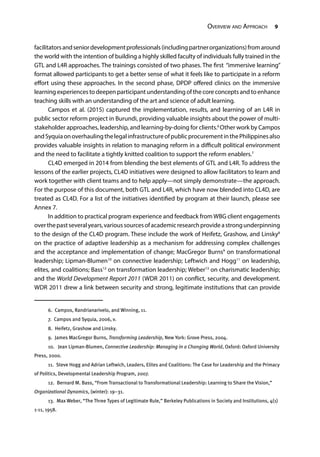
An analytical approach to governance and
the political-economic environment that
accounts for these complex interactions is
essential to understanding root problems,
why they persist, and how they can be
changed.
—Corduneanu-Huci, Hamilton, and Ferrer
“	 ”
Overview and Approach 9
facilitatorsandseniordevelopmentprofessionals(includingpartnerorganizations)fromaround
the world with the intention of building a highly skilled faculty of individuals fully trained in the
GTL and L4R approaches. The trainings consisted of two phases. The first “immersive learning”
format allowed participants to get a better sense of what it feels like to participate in a reform
effort using these approaches. In the second phase, DPDP offered clinics on the immersive
learning experiences to deepen participant understanding of the core concepts and to enhance
teaching skills with an understanding of the art and science of adult learning.
Campos et al. (2015) captured the implementation, results, and learning of an L4R in
public sector reform project in Burundi, providing valuable insights about the power of multi-
stakeholder approaches, leadership, and learning-by-doing for clients.6
Other work by Campos
andSyquiaonoverhaulingthelegalinfrastructureofpublicprocurementinthePhilippinesalso
provides valuable insights in relation to managing reform in a difficult political environment
and the need to facilitate a tightly knitted coalition to support the reform enablers.7
CL4D emerged in 2014 from blending the best elements of GTL and L4R. To address the
lessons of the earlier projects, CL4D initiatives were designed to allow facilitators to learn and
work together with client teams and to help apply—not simply demonstrate—the approach.
For the purpose of this document, both GTL and L4R, which have now blended into CL4D, are
treated as CL4D. For a list of the initiatives identified by program at their launch, please see
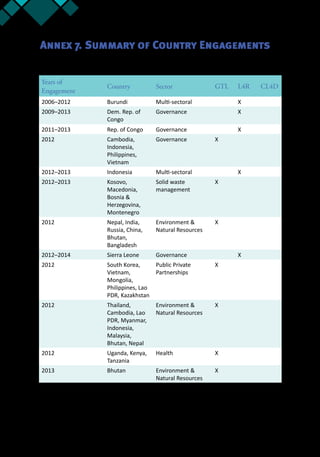
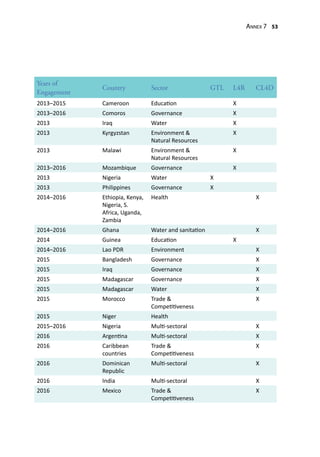
Annex 7.
In addition to practical program experience and feedback from WBG client engagements
overthepastseveralyears,varioussourcesofacademicresearchprovideastrongunderpinning
to the design of the CL4D program. These include the work of Heifetz, Grashow, and Linsky8
on the practice of adaptive leadership as a mechanism for addressing complex challenges
and the acceptance and implementation of change; MacGregor Burns9
on transformational
leadership; Lipman-Blumen10
on connective leadership; Leftwich and Hogg11
on leadership,
elites, and coalitions; Bass12
on transformation leadership; Weber13
on charismatic leadership;
and the World Development Report 2011 (WDR 2011) on conflict, security, and development.
WDR 2011 drew a link between security and strong, legitimate institutions that can provide
6.  Campos, Randrianarivelo, and Winning, 11.
7.  Campos and Syquia, 2006, v.
8.  Heifetz, Grashow and Linsky.
9.  James MacGregor Burns, Transforming Leadership, New York: Grove Press, 2004.
10.  Jean Lipman-Blumen, Connective Leadership: Managing in a Changing World, Oxford: Oxford University
Press, 2000.
11.  Steve Hogg and Adrian Leftwich, Leaders, Elites and Coalitions: The Case for Leadership and the Primacy
of Politics, Developmental Leadership Program, 2007.
12.  Bernard M. Bass, “From Transactional to Transformational Leadership: Learning to Share the Vision,”
Organizational Dynamics, (winter): 19–31.
13.  Max Weber, “The Three Types of Legitimate Rule,” Berkeley Publications in Society and Institutions, 4(1)
1-11, 1958.
10 Overview and Approach
adequate services and markets for its residents.14
More recently, World Development Report
2015, Mind, Society, and Behavior,15
looked at the role of the psychological perspectives on
development and the role behavioral sciences might play. A full chapter was devoted to
adaptive interventions of the sort implemented for many years by CL4D and its predecessors.
Cumulatively, this research covers a broad range of players in the development field
(multilateral institutions, bi-lateral institutions and academic institutions), and thus provides a
solid base that supports and endorses the foundations of the CL4D approach.
In 2015, the CL4D program convened two Client–Partner Dialogues (CPDs) for a week of
engagement to learn from experience with main stakeholder groups such as the government
clients,WBGTTLs, and facilitation partners. (See Annex 8.)The first of these gatherings of clients
and development professionals was held in Istanbul, Turkey, in April 2015, and the second was
held in Colombo, Sri Lanka, in November 2015.16
Participants represented four constituency
groups: client governments, coaches and facilitators, members of training institutions and
academies, and World Bank Group task team leads. The purpose of the Dialogues was to bring
clients and partners together to discuss in detail the CL4D approach, share knowledge, and
experience of CL4D and similar approaches, and explore ways to collaborate and enhance the
program’s capacity moving forward. Each day of the Dialogues, participants were introduced
to key CL4D concepts and practices through discussions and hands-on exercises in the CL4D
tools and methods. These were not training workshops. As distinct from training events, these
events focused on substantive engagement with the main stakeholder groups to appreciate
their perspectives and experiences, while also offering an immersion in the CL4D approach in
the spirit of collaborative exploration.
The CL4D Process
The path from the status quo to the desired state, as Ian A. Goldin remarked, “is littered
with uncertainty,”17
so CL4D has developed a roadmap and toolkit to help implementation
teams keep move through uncertainty. The CL4D process is team-based, solution-focused,
and results-oriented approach that enables clients and their implementation teams to focus
on their long-term reform targets while defining and achieving incremental results. The
methodology is designed to enhance the space for innovation and includes regular review
points for evaluation and course correction.
14.  World Bank, World Development Report 2011: Conflict Security and Development, Washington, DC: World
Bank Group, 2011.
15.  World Bank, World Development Report 2015: Mind, Society, and Behavior, Washington, DC: World Bank
Group, 2015.
16.  Highlights of and insights gleaned from the dialogues may be seen in The Istanbul Dialogue: Building
a Community of Practice, Washington, DC: World Bank Group, 2015, and The Colombo Dialogue: Strategies for
Change, Washington, DC: World Bank Group, 2016.
17.  Campos and Syquia, 2006, v.
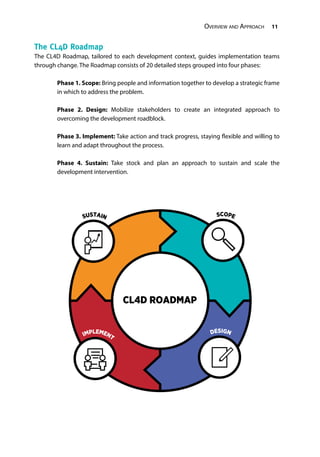
CL4D ROADMAP
IMPLEMENT
DESIGN
SCOPESUSTAIN
Overview and Approach 11
The CL4D Roadmap
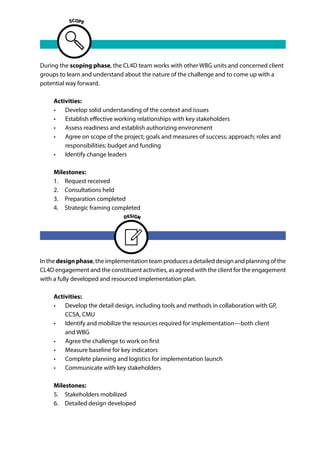
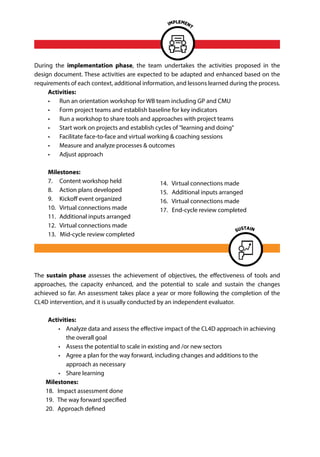
The CL4D Roadmap, tailored to each development context, guides implementation teams
through change. The Roadmap consists of 20 detailed steps grouped into four phases:
Phase 1. Scope: Bring people and information together to develop a strategic frame
in which to address the problem.
Phase 2. Design: Mobilize stakeholders to create an integrated approach to
overcoming the development roadblock.
Phase 3. Implement: Take action and track progress, staying flexible and willing to
learn and adapt throughout the process.
Phase 4. Sustain: Take stock and plan an approach to sustain and scale the
development intervention.
During the scoping phase, the CL4D team works with other WBG units and concerned client
groups to learn and understand about the nature of the challenge and to come up with a
potential way forward.
Activities:
•	 Develop solid understanding of the context and issues
•	 Establish effective working relationships with key stakeholders
•	 Assess readiness and establish authorizing environment
•	 Agree on scope of the project; goals and measures of success; approach; roles and
responsibilities; budget and funding
•	 Identify change leaders
Milestones:
1. 	 Request received
2. 	 Consultations held
3. 	 Preparation completed
4. 	 Strategic framing completed
In the design phase, the implementation team produces a detailed design and planning of the
CL4D engagement and the constituent activities, as agreed with the client for the engagement
with a fully developed and resourced implementation plan.
Activities:
•	 Develop the detail design, including tools and methods in collaboration with GP,
CCSA, CMU
•	 Identify and mobilize the resources required for implementation—both client
and WBG
•	 Agree the challenge to work on first
•	 Measure baseline for key indicators
•	 Complete planning and logistics for implementation launch
•	 Communicate with key stakeholders
Milestones:
5. 	 Stakeholders mobilized
6. 	 Detailed design developed
During the implementation phase, the team undertakes the activities proposed in the
design document. These activities are expected to be adapted and enhanced based on the
requirements of each context, additional information, and lessons learned during the process.
Activities:
•	 Run an orientation workshop for WB team including GP and CMU
•	 Form project teams and establish baseline for key indicators
•	 Run a workshop to share tools and approaches with project teams
•	 Start work on projects and establish cycles of "learning and doing"
•	 Facilitate face-to-face and virtual working & coaching sessions
•	 Measure and analyze processes & outcomes
•	 Adjust approach
Milestones:
7.	 Content workshop held
8. 	 Action plans developed
9. 	 Kickoff event organized
10. 	Virtual connections made
11. 	Additional inputs arranged
12. 	Virtual connections made
13. Mid-cycle review completed
The sustain phase assesses the achievement of objectives, the effectiveness of tools and
approaches, the capacity enhanced, and the potential to scale and sustain the changes
achieved so far. An assessment takes place a year or more following the completion of the
CL4D intervention, and it is usually conducted by an independent evaluator.
Activities:
•	 Analyze data and assess the effective impact of the CL4D approach in achieving
the overall goal
•	 Assess the potential to scale in existing and /or new sectors
•	 Agree a plan for the way forward, including changes and additions to the
approach as necessary
•	 Share learning
Milestones:
18. Impact assessment done
19. The way forward specified
20. Approach defined
14. Virtual connections made
15. Additional inputs arranged
16. Virtual connections made
17. End-cycle review completed
14 Overview and Approach
Toolbox
CL4D ensures that implementing teams are equipped with the tools they need to effectively
take on development challenges. The CL4D Toolbox is the product of more than five years of
developing and experimenting with exercises that help development professionals facilitate
behavioral change. It is essential to open the Toolbox with an understanding that it is not a
collection of feel-good, group activities; it is a distillation of experience and adaptations meant
to help create meaningful—often breakthrough—experiences.
Like the CL4D approach itself, the Toolbox evolves, with new tools being considered,
tested, and added as practitioners discuss experiences and needs. To create the first CL4D
Toolbox, the program looked at the tools used most frequently and found most effective by
team members. CL4D interviewed the author of the tools as well as users to understand the
intention and the range of user experiences with the tools. These interviews also captured
practical tips on how to avoid pitfalls and create a successful experience for users. The
information thus collected is presented in a common structure to facilitate the use of tools.
The first stage of the Toolbox contained 22 tools.
CL4D brought this initial toolkit to it 2015 Dialogues in Istanbul and Colombo.18
Dialogue
participants, several of whom were or had been CL4D implementing partners, learned
about and used several tools and were asked to share their views for how the Toolkit could
be improved. Incorporating this and other feedback, CL4D produced a second (Spring 2016)
iteration of the Toolbox. New tools have been added, and the toolbox clusters have been
reorganized. Toolkits 1 and 2 now have a total of 46 dynamic tools and methods that CL4D
facilitators use to help their clients navigate the complex challenges of reform.
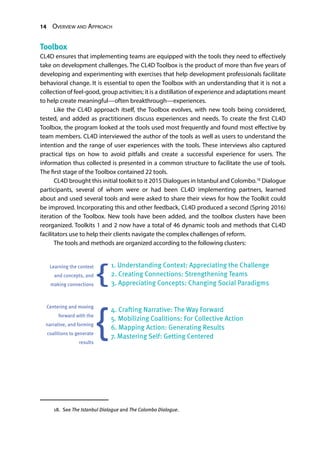
The tools and methods are organized according to the following clusters:
18. See The Istanbul Dialogue and The Colombo Dialogue.
1. Understanding Context: Appreciating the Challenge
2. Creating Connections: Strengthening Teams
3. Appreciating Concepts: Changing Social Paradigms
4. Crafting Narrative: The Way Forward
5. Mobilizing Coalitions: For Collective Action
6. Mapping Action: Generating Results
7. Mastering Self: Getting Centered
{
{
Learning the context
and concepts, and
making connections
Centering and moving
forward with the
narrative, and forming
coalitions to generate
results
Overview and Approach 15
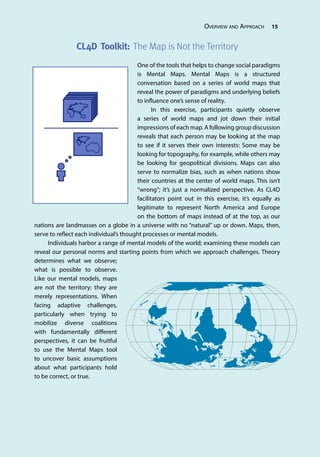
CL4D Toolkit: The Map is Not the Territory
One of the tools that helps to change social paradigms
is Mental Maps. Mental Maps is a structured
conversation based on a series of world maps that
reveal the power of paradigms and underlying beliefs
to influence one’s sense of reality.
In this exercise, participants quietly observe
a series of world maps and jot down their initial
impressions of each map. A following group discussion
reveals that each person may be looking at the map
to see if it serves their own interests: Some may be
looking for topography, for example, while others may
be looking for geopolitical divisions. Maps can also
serve to normalize bias, such as when nations show
their countries at the center of world maps. This isn’t
“wrong”; it’s just a normalized perspective. As CL4D
facilitators point out in this exercise, it’s equally as
legitimate to represent North America and Europe
on the bottom of maps instead of at the top, as our
nations are landmasses on a globe in a universe with no “natural” up or down. Maps, then,
serve to reflect each individual’s thought processes or mental models.
Individuals harbor a range of mental models of the world; examining these models can
reveal our personal norms and starting points from which we approach challenges. Theory
determines what we observe;
what is possible to observe.
Like our mental models, maps
are not the territory; they are
merely representations. When
facing adaptive challenges,
particularly when trying to
mobilize diverse coalitions
with fundamentally different
perspectives, it can be fruitful
to use the Mental Maps tool
to uncover basic assumptions
about what participants hold
to be correct, or true.
16 Overview and Approach
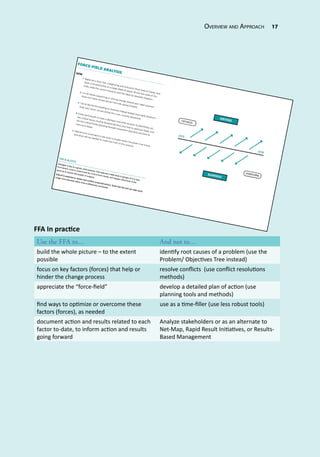
The Force Field Analysis (FFA) is used to create a structured visual representation of the
current context describing in detail the drivers of change and the expected barriers to
change. This framework for identifying and examining forces that support or block change,
was developed by Kurt Lewin (1890–1947), a pioneer in social and applied psychology. FFA
provides an overview of the political climate and is considered an excellent first tool to use in
a comprehensive political economy analysis.
The FFA tool used by CL4D builds on this framework and is an adaptation aimed at
understanding and responding to forces that influence a social, organizational context—either
supporting/driving or hindering/blocking a change or reform process. It is used to initiate,
inform, and track change processes. It can be used to reach different depths of analysis and to
determine the types and directions for action in response to such analysis.
It is a simple tool that can facilitate drawing up a more complete picture of any given
context by
•	 describing the current and desired states at given points on a timeline;
•	 identifying the barriers and drivers related to achieving the end result or the desired
state; and,
•	 proposing actions to optimize and to overcome the drivers and barriers, respectively.
The FFA works best when
•	 participants are informed of the subject under discussion.
•	 facilitators are experienced and effective in guiding the process.
•	 diverse perspectives are brought to the discussion.
•	 ample time is allowed for a rich, productive conversation.
•	 participants express themselves in an uninhibited manner.
•	 proceedings are documented to facilitate making decisions and proposing actions.
•	 participants keep the exercise grounded by contributing experienced (rather than
imagined or romanticized) reality.
CL4D Toolkit: Opposing Forces
An issue is held in balance by the
interaction of two opposing sets of forces:
those seeking to promote change (driving
forces) and those attempting to maintain
the status quo (restraining forces).
—Kurt Lewin
“	 ”
Use the FFA to… And not to…
build the whole picture – to the extent
possible
identify root causes of a problem (use the
Problem/ Objectives Tree instead)
focus on key factors (forces) that help or
hinder the change process
resolve conflicts (use conflict resolutions
methods)
appreciate the “force-field” develop a detailed plan of action (use
planning tools and methods)
find ways to optimize or overcome these
factors (forces), as needed
use as a time-filler (use less robust tools)
document action and results related to each
factor to-date, to inform action and results
going forward
Analyze stakeholders or as an alternate to
Net-Map, Rapid Result Initiatives, or Results-
Based Management
FFA In practice
Overview and Approach 17
18 Overview and Approach
“	 ”
The gap between the current state and the
desired state is the space within which to
exercise leadership actions.
–Najma Siddiqi
CL4D Experience and Learning 19
Part 2
Experience and Learning
Thecrucialneedfor legitimate public institutions to be viewed as trustworthy in the eyes
of citizens was the fundamental message of the 2011 World Development Report.19
Focused
on the global, recurring nature of 21st century violence and conflict, WDR 2011 conveyed the
urgent need to strengthen government capacity to provide its citizens with security, justice,
and jobs. Without such institutional capacity and the trust it engenders, nations remain
vulnerable to conflict and the increased levels of stalled development and poverty that follow.
Development is never a linear process and progress is expected to be slow. Nevertheless,
the glacially slow pace of measurable progress in some sectors combined with setbacks in
others can, over decades, precipitate a rethink in approach. Such a shift is now underway at
the WBG and elsewhere, as acknowledgement grows that the political-economic context in
which development projects are implemented are as relevant to success as the soundness of
the technical approach itself. Personal, interpersonal, political, and cultural factors are always
at play, whether they are recognized by or not. Recently, the WBG has stressed the importance
of looking at these individual and interpersonal factors. World Development Report 2015:
Mind, Society, and Behavior explicitly reminded readers that “individuals are not calculating
automatons. Rather, people are malleable and emotional actors whose decision making is
influenced by contextual cues, local social networks and social norms, and shared mental
models.”20
WDR 2015 was explicitly devoted to encouraging researchers and practitioners
to “help advance a new set of development approaches based on a fuller consideration of
psychological and social influences.”21
Since 2009, CL4D has been developing WBG capacity to do just that. As institutional
awareness grows about the need to address implementation challenges with more than
19.  WDR 2011.
20.  WDR 2015, 3.
21.  WDR 2015, 2.
20 CL4D Experience and Learning
technical know-how continues to grow, the CL4D approach becomes more relevant than ever
to Bank operations.
Program Description
CL4D seeks to accelerate the reduction of global poverty by helping WBG clients to deliver
on their commitment to provide public value. Working closely with WBG project teams, CL4D
compliments the technical“what”of reform by addressing the“how”of implementation. CL4D
doesn’t solve client problems for them. Instead, CL4D works deliberately to increase client
capacities to identify and solve complex problems and to bring about the behavioral and
institutional changes that allow for sustained results.
CL4D works with partners to address implementation challenges, to learn from them,
and to adapt quickly and accordingly. Working closely with WBG project teams, CL4D puts
together a team of specialists whose experiences and skills meet the needs of each specific
engagement. On the ground, the CL4D team helps the implementation team demonstrate the
benefit of the CL4D approach to projects and clients; expand the demonstration to scale; and
institutionalize the approach, tools, and methods so that capacity can continue to grow in the
client country.
CL4D teams have partnered with more than 100 project implementation teams across
numerous sectors, including education, electricity, land and gender, governance, health,
public financial management, solid waste management, urban sector, and water & sanitation.
(See Annex 10 for more details on selected cases.)
To date, on-the-ground experiences reveal three key development insights:
•	 Sustainable development is not possible without collaborative leadership.
•	 Strengthening the leadership capacity of government organizations to work
together is fundamental to a well-run public sector.
•	 Establishing coalitions for reform can build trust in public institutions.
In the sections that follow, these insights are illustrated by looking at select engagements.
2009–2016 CL4D supported
•	 435 coalitions
•	 100 project implementation teams
•	 25 countries
•	 9 sectors
Kazakhstan
Russia
CL4D Client engagements, 2010–2016.
Malaysia
Philippines
S. Africa
Uganda
Mozambique
Niger
Argentina
Mexico
Kyrgyzstan
Morocco
Guinea
Sierra
Leone
The
Caribbean
Dominican
Republic
Bosnia &
Herzegovina
Malawi
S. Korea
Nepal
Vietnam
Kenya
Kosovo
Cambodia
China
PDR
Lao
Mongolia
Bangladesh
Bhutan
ThailandIndia
Indonesia
Macedonia
Montenegro
Cameroon
Nigeria
Ghana
Ethiopia
Iraq
Burundi
Rep. of
Congo
Zambia
Tanzania
Madagascar
Comoros
22 CL4D Experience and Learning
Key Insights
Insight: Sustainable development is not possible without
collaborative leadership.
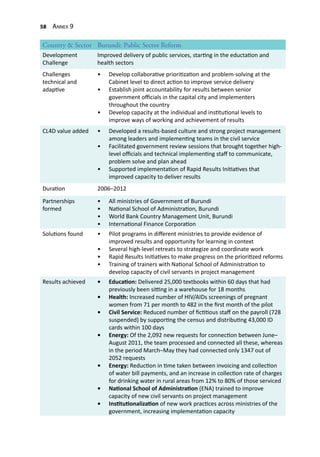
Before the war in Iraq, the Baghdad’s water and sewerage systems functioned well. Fifteen
years after the war, however, they were failing. In the 1990s, the water and sewerage systems
served 95 percent of urban households and about 75 percent of households in rural areas.
But war, economic sanctions, and worsening security took a toll. By 2005, less than half the
country had water services. By 2011, sewer backups were a way of life throughout the city.
Citizens, understandably, were reluctant to pay for water services. Some didn’t understand
how much they needed to pay, and many resented being asked to pay for poor services when
they were never required to pay when service was good. There was a longstanding need to
improve sewage system maintenance and to address issues such as illegal water diversion,
which was straining the system. However, no maintenance had been done in some areas of the
city in more than 15 years, despite rapid growth in the city’s population over that period. As
a result, Baghdad citizens were frequently subjected to clogged sewage pipes, flooding, and
disruptions to water supply. Under such circumstances, utilities personnel were not engaging
with citizenry; customer service was poor.
With over 7 million residents and a high population growth rate in the city, Baghdad is the
second most crowded city in the Arab world. The Mayoralty of Baghdad was under increased
pressure from a growing population the to improve its public services, particularly the
sewerage system. Seeking to address the challenge, in 2013, the Deputy Mayor for Technical
Affairs launched an initiative to serve all citizens of Baghdad with reliable sewerage services
by 2017.
Challenges included but were not limited to a demand for services that exceed supply,
insufficient investment to maintain aging infrastructure, and a lack of coordination between
those involved in service provision and systems maintenance. These had technical solutions.
But finger pointing between the Mayoralty and its 14 municipalities over decentralization and
a dissatisfied, vocal public indicated adaptive challenges were also an issue.
Weak institutional capacity is a large challenge for post-conflict states, and one that
cannot be ignored without substantial risks.22
But there is also risk for public officials if they
fail to bring about an important change. CL4D’s focus on building capacity for collaborative
leadership takes the pressure off individuals with certain positions or titles to have all the
answers to complex problems. Instead, CL4D develops the capacity for leadership actions to
occur throughout institutions and systems. Collectively, stakeholders see that they have the
skills to address challenges if they work together.
When the Deputy Mayor and project champion had to travel out of the country, his ability
to oversee the project was hindered, but the effort didn’t slow down. A steering committee was
formed to support the project and keep the initiatives on track. In contrast to the existing top-
22.  WDR 2011.
CL4D Experience and Learning 23
down approach to problem solving, the CL4D team in Baghdad worked with formal leaders
and others to increase the number of people involved in designing solutions to address the
problem.
The Baghdad Water Authority (BWA) and Baghdad Sewerage Directorate (BSD) set RRI
goals to address inadequate sewer maintenance and inefficient water billing. Using the Net-
Map tool, CL4D helped implementation teams better understand the interests and influences
of various stakeholders, including NGOs, the private sector, households, the BWA and BSD, as
well as the Municipalities. This information helped the teams set specific performance goals
for a Rapid Results Approach.
The sewerage team’s initial goal was to reduce the number of blockages and overflows
in targeted areas by 50 percent in 90 days. There had been no maintenance in the target area
for 15 years. Project objectives were (1) high-level commitment to the objectives; (2) creation
of functioning multi-stakeholder teams; (3) creation of platforms for two-way communication
with citizens, and (4) maintaining success.
The water team’s initial goal was to increase collections by 10 percent (compared with the
same period the prior year) among a sample of 200 households. The team sought to achieve
this goal by educating consumers about how their bills were calculated and how much their
water use was subsidized.
The implementation teams developed a broad, multi-stakeholder coalition dedicated
to making progress. Over the course of the six-month intervention, this coalition expanded
to include nontechnical members (from the city’s media and cleaning departments) whose
perspectives reflected greater concern for the experience of end users of the sewage system.
In addition, the implementation team deepened its responsiveness to and interaction
with the community by working with the neighborhood council (representing the target area
during this 6-month period) to survey citizens to learn about their experiences and gauge
Mayoralty of Baghdad Project Goal
Improve water and sewerage infrastructure and services and increase collection of payments for
services.
Project Partners
•	 Deputy Mayor of Baghdad in charge of technical affairs
•	 Director General of the Baghdad Water Authority
•	 Deputy General of the Baghdad Sewage Department
•	 Citizens of Baghdad
•	 Water Global Practice, World Bank
•	 Iraq Country Management Unit, World Bank
24 CL4D Experience and Learning
their satisfaction as the project advanced. This was the first time that the city government
had directly asked citizens for their input on the design and management of an infrastructure
project.
Finally, the Mayoralty institutionalized better communication with citizen stakeholders
by activating a hotline and adding two cell phone lines to receive citizen complaints about the
sewage system; a user-friendly water billing system was also designed.
The two teams reached their goals to increase bill collection for water and to end
complaints of blockages and overflows related to sewerage services in the selected localities.
The water team increased collections by 13 percent, an impressive amount above the target.
The sewerage team also completed sewer cleaning, which eliminated resident complaints
about blockages and overflows. Among numerous other improvements, a communications
system was established with citizens to ensure regular feedback on the sewerage system
improvements. This gave stakeholders a sense of ownership and responsibility regarding
sanitation to effected households. The project produced scalable outcomes within 6 months,
which meant that the process could be implemented in the city’s other districts.The Mayoralty
gained credibility as a result. Citizens were thrilled with the“amazing”work, and municipalities
also won. One Deputy Head said of the new water bill guide, “I support you 100 percent. This
should have been done long ago!”23
Participants in this successful initiative took away the fact that system reform requires
sustained collective leadership. Several leaders “owned” the RRIs and created an authorizing
environment that empowered teams to make needed changes to budgets, processes, and
other practices that allowed for significant change.
23.  E. Cuvillier, N. Mofid, S. Al-Maroof, F. Al-Attia, B. Randrianarivel, N. Siddiqi et al. MENA Knowledge and
Learning Quick Notes Series, Sept. 13, no. 104, 3.
International assistance needs also differ
in fragile situations. The requirement to
generate rapid confidence-building results
puts a particular premium on speed.
—WDR 2011, p. 16
“	 ”
CL4D Experience and Learning 25
Insight: Strengthening the leadership capacity of government
organizations to work together is fundamental to a well-run public
sector.
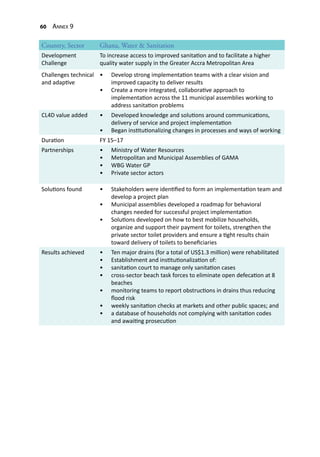
The WBG had been engaged in four previous sanitation projects in the Greater Accra
Metropolitan Area (GAMA) before the CL4D team joined the effort to increase access to
sanitation and water. Previous engagements focused on technical challenges and involved
cycles of identifying need, building infrastructure to improve the situation, improperly
managing infrastructure leading to dilapidation and failure, resulting in requests for more
infrastructure.
The GAMA has multiple authorizing subsystems. Each of the 11 Municipal and
Metropolitan Assemblies (MMAs) are responsible for sanitation implementation, while the
Ministry of Local Government and Rural Development (MLGRD), which oversee the MMAs,
make policy decisions. The MMA Chief Executives (MCEs) and the Minister of the MLGRD are
named directly by the President. Each MMA had its own political economy and readiness for
working on specific issues. The CL4D implementation team sought to help lay the foundation
for a coordinated approach for the provision of sanitation and water supply services to low-
income urban areas and the development of environmental master plans for the GAMA using
existing institutions.
Several adaptive challenges were evident. The MMAs often did not cooperate or
collaborate to resolve the sanitation problem. There was a top-down leadership style within
the MMAs, in which staff were told what to do rather than be provided results to which they
should aspire. Skewed incentive systems in the organization discouraged monitoring and
enforcement of bylaws. Sanitation efforts lacked a results-orientation and accountability. In
addition, during election years, there are pressures on the MCEs to show visible results, such
as new infrastructure, and to avoid actions that might anger the electorate, such as enforcing
sanitation bylaws.
CL4D focused on the sphere of influence of MMAs. CL4D aimed to develop a strong
implementation team with a clear vision and improved implementation capacity results for the
GAMA project. They also sought to develop a more integrated approach to implementation in
GAMA Project Goal
To increase access to improved sanitation and to facilitate a higher quality water supply in the
Greater Accra Metropolitan Area.
Project Partners
•	 Ministry of Water Resources
•	 Metropolitan and Municipal Assemblies of GAMA
•	 WBG Water GP
•	 Private sector actors
26 CL4D Experience and Learning
the MMAs, where those people who own the problem and those who can help move forward
on it are involved in the work, thereby extending the responsibility for achieving results in the
sanitation sector beyond the core GAMA team. In an effort to demonstrate that success in this
space is possible, the CL4D team provided project partners in the Ministry with the space and
guidance to experiment with new ways of engaging the MMAs while increasingly challenging
and supporting them.
CL4D worked with the implementation team to analyze project challenges, and
uncovered a specific need and desire to improve leadership qualities on all levels. To this end,
two rounds of RRIs were embedded in a larger framework of improving leadership and results
orientation. Leadership training was interwoven with each intervention.
The first round of RRIs supported project planning, and the results were shared with
the public. The second round of RRIs sought to operationalize changes, which included
communicating with the public; working with the private sector on pricing, technological
innovation, and capacity to deliver at scale; quality assurance and M&E by the MMA; and
improving enforcement of by-laws and informal rules.
Concrete results included the rehabilitation of 10 major drains, and institutionalizing
changes that improve sanitation services and sustain them. For instance, a task force was
formed to focus solely on sanitation cases, monitoring teams report obstructions and reduce
flood risk, and weekly sanitation inspections of public spaces and markets were implemented,
among others. Hon. Sam Atukwei Quaye, Municipal Chief Executive, Ga West Municipal
Assembly, said, "being an adaptive leader … you can motivate the people, you can give back
… and mobilize people to effect change in our community … My life will not be the same after
this workshop.”
Where there had been a deeply entrenched belief that change was not possible, now, a
CL4D team member observed, the“culture of impossibility has been greatly improved.”
Simply fulfilling your responsibilities
does not constitute leadership according to
this framework.
—Ajay Tejasvi
“	 ”
CL4D Experience and Learning 27
Burundi Project Goal
Improved delivery of public services, starting in the eductation and health sectors
Project Partners
•	 All ministries of Government of Burundi
•	 National School of Administration, Burundi
•	 World Bank Country Management Unit, Burundi
•	 International Finance Corporation
Insight: Establishing coalitions for reform can build trust in public
institutions.
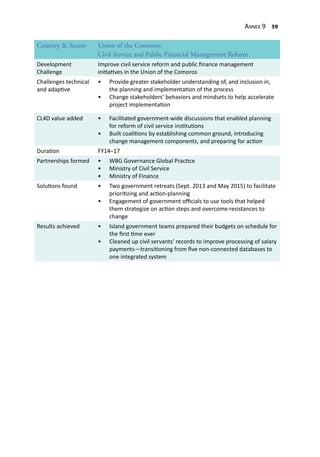
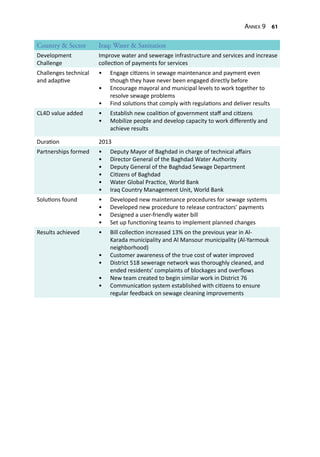
As Burundi was emerging from a 12-year civil war, among its many challenges was how to
deliver services to citizens given its loss of infrastructure, limited resources, and low human
capacity, including high levels of turnover at all levels of government and inexperienced
remaining staff. As a fragile, post-conflict state, the political economy was also dismal:
The government was largely unaccountable to citizens, corruption remained a concern,
communication among ministries was dysfunctional, rules were inefficient, and policies were
outdated. The newly elected government sought to deliver services to gain citizen’s trust,
establish stability, and help the country move forward. CL4D was invited to collaborate with
the government to improve public service delivery in meaningful ways in the short-term, while
over time, strengthening public sector leadership capacity to manage development.
The CL4D approach was structured around cycles of RRIs combined with high-level
government retreats. The RRI functioned to stretch the assumptions of public servants and
to deliver results within a relatively short time frame. The series of cabinet retreats with
government ministers and other senior officials was selected as a way to showcase results
of the RRIs and to obtain buy-in for expanded initiatives. The RRIs, which empowered and
upskilled local officials, combined with the retreats, served to incrementally increase the
capacity of government leaders at all levels. A key change agent was the secondVice President,
who headed a steering committee to support the program. This level of support, combined
with the collaborative planning and buy-in among officials that occurred at Cabinet retreats,
created a solid authorizing environment for the program.
Addressing the president’s campaign pledges was an important way to earn public trust
so the steering committee looked to make advances in the health and education sectors. The
implementation team began by launching two pilot RRIs. One project aimed to increase HIV/
AIDS screening among pregnant women. In the first month of the pilot, the Ministry of Health
increased number of HIV/AIDS screenings in pregnant women from 71 to 482, far exceeding
expectations.
28 CL4D Experience and Learning
The second of the pilot projects aimed to deliver 25,000 textbooks to schools in Bubanza
province within 100 days. The books had been sitting in a warehouse for a year and a half.
Under normal circumstances, it took a year to deliver textbooks, but the pilot project delivered
the books in less than two months. What made these successes possible? A closer look at the
education pilot suggests answers.
Several systems had collapsed during the war, including systems that would ensure
childrenhadtextbooks,whichwerealreadyinshortsupplyinBurundi.TheCL4Dprojecthelped
provincial education officials undertake a results-focused project that was instrumental in
shifting mindsets and mobilizing local governments and citizens to overcome the challenges
inherent in moving a large number of books to remote provinces.
As a part of the solution, the Director General was able to negotiate reduced rates with
transport companies to ship books to the province. Another part of the solution involved the
Provincial Director of Education working with the governor of the province. The governor
oversaw service delivery and was in a position to highlight the problem and call for stakeholder
assistance. The governor initiated a town hall meeting to mobilize development NGOs, local
governmentstaff—includingprovincialdirectorsfromagriculture,publicworks,transport,and
education—and residents of the province to move books from the province to villages. He also
obtained buy-in from smaller (i.e., communal) administrations, ensuring there was awareness
and buy-in throughout the new supply chain. Commune-level administrators mobilized
volunteers to transport books from the communes to the villages and with school directors
and village chiefs, who supported the initiative and also mobilized volunteers through the
Parent–Teacher Association. In turn, the PTA relied on an existing Saturday morning volunteer
program to carry the textbooks by foot, wheelbarrows, or bikes to the schools. In this way, the
cross-sector coalitions delivered 25,000 textbooks within 60 days.
Campos and colleagues noted that, although the initial pilot projects were miniscule
in the whole scheme of things, they enabled the respective teams to learn what works and
what does not in attaining key service delivery priorities involving the complete chain of
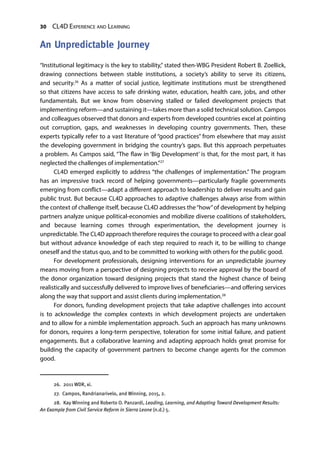
actors required for implementation—textbook delivery in the case of education, and HIV/
AIDs screening of pregnant women in the case of health. The pilots demonstrated solutions to
overcome long-standing constraints to implementation in two priority sectors, jumpstarting
“	 ”
Effective visions have accuracy and not just
imagination and appeal.
—Heifetz, Grashow, and Linsky, 2009
CL4D Experience and Learning 29
results beyond expectations.24
Cabinetmeetingswereanimportantwaytoshiftsmindsetstobelievingthatlongstanding
problems could be overcome with collaborative effort. Cabinet retreats offered an opportunity
to showcase successes and exchange knowledge about setting and reaching objectives.
Participants had an opportunity to feel good about their accomplishments, understand why
they worked, and to look ahead together to set new goals.
In 2011 President Pierre Nkurunziza said,
To sustain economic performance, we must demand greater efficiency, and we
expect results from all sectors ... In this regard, we have already motivated people
towards improved accountability, planning, and performance using the Rapid
Results Approach. We are confident that this improved performance is proof that
sound management means the needs of the public become reality.25
The Government of Burundi in fact launched numerous RRIs over the following years
involving several ministries using the same approach to make many incremental changes
toward long-term goals. The two initial RRIs in 2006 became 246 RRIs by 2012, and all 21
ministries were implementing RRIs by 2010 (see figure 1).
24.  Campos, Randrianarivelo, and Winning, 2015, 5.
25.  Leadership Program Data and Testimonies, Feb. 2, 2016. Internal document.
Figure 1. Percentage of 21 ministries in Burundi implementing RRIs, 2006–2012
30 CL4D Experience and Learning
An Unpredictable Journey
“Institutional legitimacy is the key to stability,” stated then-WBG President Robert B. Zoellick,
drawing connections between stable institutions, a society’s ability to serve its citizens,
and security.26
As a matter of social justice, legitimate institutions must be strengthened
so that citizens have access to safe drinking water, education, health care, jobs, and other
fundamentals. But we know from observing stalled or failed development projects that
implementing reform—and sustaining it—takes more than a solid technical solution. Campos
and colleagues observed that donors and experts from developed countries excel at pointing
out corruption, gaps, and weaknesses in developing country governments. Then, these
experts typically refer to a vast literature of “good practices” from elsewhere that may assist
the developing government in bridging the country’s gaps. But this approach perpetuates
a problem. As Campos said, “The flaw in ‘Big Development’ is that, for the most part, it has
neglected the challenges of implementation.”27
CL4D emerged explicitly to address “the challenges of implementation.” The program
has an impressive track record of helping governments—particularly fragile governments
emerging from conflict—adapt a different approach to leadership to deliver results and gain
public trust. But because CL4D approaches to adaptive challenges always arise from within
the context of challenge itself, because CL4D addresses the“how”of development by helping
partners analyze unique political-economies and mobilize diverse coalitions of stakeholders,
and because learning comes through experimentation, the development journey is
unpredictable.The CL4D approach therefore requires the courage to proceed with a clear goal
but without advance knowledge of each step required to reach it, to be willing to change
oneself and the status quo, and to be committed to working with others for the public good.
For development professionals, designing interventions for an unpredictable journey
means moving from a perspective of designing projects to receive approval by the board of
the donor organization toward designing projects that stand the highest chance of being
realistically and successfully delivered to improve lives of beneficiaries—and offering services
along the way that support and assist clients during implementation.28
For donors, funding development projects that take adaptive challenges into account
is to acknowledge the complex contexts in which development projects are undertaken
and to allow for a nimble implementation approach. Such an approach has many unknowns
for donors, requires a long-term perspective, toleration for some initial failure, and patient
engagements. But a collaborative learning and adapting approach holds great promise for
building the capacity of government partners to become change agents for the common
good.
26.  2011 WDR, xi.
27.  Campos, Randrianarivelo, and Winning, 2015, 2.
28.  Kay Winning and Roberto O. Panzardi, Leading, Learning, and Adapting Toward Development Results:
An Example from Civil Service Reform in Sierra Leone (n.d.) 5.
Going Forward 31
Part 3
Going forward
Over the past seven years, the Leadership Practice has evolved in its thinking and
approach. The evolution has been driven from the ongoing changes in our operational
landscape, and also from the insights and learning gained from our experience in working
with 365 teams across more than 42 countries.
The challenges facing the world today are increasing in number and complexity. It
has been widely acknowledged in the development community and the World Bank Group
that we cannot reach our twin goals of ending poverty and boosting shared prosperity by
doing business as usual any longer. The context in which we are operating today is changing;
collectively, we face increasing pressures. Promoting sustainable growth and creating jobs,
particularly for youth, is a formidable task across the World.
We have learned that a key to success in challenging circumstances is identifying the root
causes of the problem, tackling some of our underlying attitudes and mental models that form
our sense of reality and drive behavior. Solutions that merely address technical issues are seen
to result in shifting the problem from one part of a system to another.
We have also learned that our most effective solutions come from a combination of
strategies.Itisthefinanceweprovide,thetechnicalsolutionswebringtothetable,thecapacity
building and knowledge we have gained through years of experience, and the leadership skills
we can activate to build stronger teams for implementation and reform coalitions to sustain
progress.
The Collaborative Leadership for Development Program has attempted to codify and
systematize the WBG’s work on leadership and coalition building so that development teams
can apply it adeptly to actual problems on the ground. In essence, by fostering a greater
understanding of the many implementing challenges and political economy problems, we
help create stronger teams that can build coalitions for reform and achieve strong, lasting
results.
We have learned that development is not a clear-cut, linear process. Our learning is
similar to the observation made by Peter Senge in The Fifth Discipline, in which he notes that
“cause and effect are not closely related in time and space.”29
He goes on to emphasize that
the systems in which we operate are extremely complex, and it takes significant time for some
of the behavioral changes to manifest as tangible outcomes of development interventions.
An additional insight of the CL4D program is that development interventions take time,
and often there are extraneous factors that play out over the course of the engagement.
Taking into consideration some of the above insights, the CL4D program has evolved from a
29.  Peter M. Senge, The Fifth Discipline, New York: Doubleday, 2009, 63.
32 Going Forward
primarily weeklong action-learning program into a longer, hands-on support program, with
customized interventions at regular periods of time. Since the beginning, the program has
sought to complement the technical contributions of Bank operations. In line with this effort,
the CL4D team has focused on working with the project team to help identify obstacles and
working with the implementation teams to unblock the challenges that impede progress. The
support intervention itself is closely interwoven into the World Bank Group’s project cycle and
seeks to support operational teams and government clients think through political economy
challenges from the beginning, as well as support projects that are stuck.
Our goal is to mainstream the program into the overall operations of the WBG. CL4D is
now actively engaging with operational teams to embed leadership and change management
support for projects in the Project Appraisal Document (PAD) itself. This enables project teams
to think through the design so as to help government agencies better align and coordinate
their work. It also helps set the stage and context for thinking about the reform coalition that
will be required to sustain changes.
In“Possible or Impossible,”one of the tools used to begin a leadership intervention, three key
leadership principles are emphasized as foundational in the efforts to build coalitions. They
are:
1.	 Widen the base of support by articulating a clear vision and strategy.
2.	 Create alignment among stakeholders through a shared sense of purpose.
3.	 Balance stakeholder interests to sustain the momentum forward.
We believe that the positive momentum generated by the CL4D interventions so far can
be sustained only by expanding the space in this frontier area of leadership and coalitions for
development.
“	 ”
The implicit assumption is that one needs
to wait for political will to "appear" before
any real change can take place. But, in fact,
political will can be engendered.
—Campos, Randrianarivelo, and Winning, 2015
Going Forward 33
Challenges
While there is emerging consensus on the need to put leadership and coalitions at the
center of the development agenda, a number of challenges remain. First, there is a wide
range of actors with varying degrees of exposure and experience in this field, including
bilateral development agencies, academic institutions, research, training, and other private
organizations and individual practitioners. This wealth of knowledge is dispersed and remains
fragmented among leadership and change management practitioners and experts, and it is
difficult to access in real time. Second, the fragmented, disconnected agendas among actors
hampers the possibility for effective coordination in coming up with solutions to development
challenges. Third, many development organizations lack the necessary instruments to
integrate knowledge-sharing tools into their financial and technical support interventions.
Finally, although many development actors agree with the need to include leadership and
coalitionbuildingasimportantaspectsofaddressingcomplexchallenges,inadequatecapacity
continues to undermine the integration of these aspects in implementation.
Solutions
Taking all this into consideration, the CL4D program has initiated the establishment of the
Global Partnership on Collaborative Leadership for Development. (See Annex 10.) The Global
Partnership seeks to put leadership and coalitions at the center of development by continually
enhancing the know-how around practical approaches to find sustainable solutions to
complex problems.The Global Partnership brings a vision to become the preferred destination
for meaningful collaboration, knowledge exchange, and cutting-edge research on tools and
methods in order to support leadership in countries that need to overcome“wicked problems”
facing most societies today.
Taking on the above-mentioned challenges, the Global Partnership was established on
four pillars. They are:
1. Generating & Curating Knowledge: Knowledge in the leadership and coalition-
building arena is fragmented and dispersed across a number of actors globally. Many
actors have done substantive work that is not available to others who could learn
and adapt the knowledge to their own contexts. This first pillar therefore focuses on
the development of an integrated platform that allows actors to share and exchange
information in real time and supports the development of an empirical evidence
base. It could potentially a focus on specific challenges that we are trying to solve as
a development community, bringing together knowledge from across the spectrum
of development actors. Another important function of this pillar would be to support
the generation and curation of knowledge in the form of case notes, research papers,
videos, and interactive tools that the community at large can use. These efforts will add
to tools and materials currently in use. The focus will also be on continuation of efforts
to support and legitimize the role of leadership and coalitions through empirical studies
34 Going Forward
thus also strengthening the evidence base for leadership for development. In terms of
dissemination of the knowledge, it is envisioned that the Partnership would organize and
support regular outreach events like short seminars, learning events, and special themed
events on youth leadership, leadership in fragile contexts, etc., to showcase the work of
leadership.
2. Developing Strong Partnerships: This pillar would focus on building on current
initiatives, as well as systematically bringing together existing donor partners and
other development organizations to coordinate efforts on learning from a variety of
different approaches. We envision that the work here could potentially support the
joint conceptualization and production of leadership forums (Annex 11) as well as
collaboration on the development of leadership programs and knowledge materials.
3. Enhancing Leadership Capacity: This pillar envisions supporting the evolution and
development of dynamic, action-learning programs to support capacity development
of change agents and to institutionalize the CL4D approach, with a focus on enabling
behavior change for development. The thinking is that this will be a step forward from
training programs aimed at specific projects or at individual or team development.
In partnership with regional and national institutions, the Global Partnership could
collaborate on leadership workshops and other similar activities for government leaders
and change agents on the ground. Taking this line of thinking forward, the Partnership
could also conduct Training of trainer (ToT) programs for regional institutions (such as
National Academies of Administration) to train their faculty on collaborative leadership
programs focused on enabling behavior change in constituents.
4. Providing Implementation Support: The fourth pillar supports implementation of
projects on the ground. The idea is for leadership and change management approaches,
tools, and methodologies to be incorporated in operational work to help strengthen
government implementation teams to overcome obstacles to implementation and
accelerate the achievement of development results. As part of a continuation of existing
programs, the Partnership could also explore how it could collaborate in terms of
providing leadership support to Cabinets for national- or state-level strategic planning
and coordination. Another area of collaboration could include supporting client teams in
the mobilization of multi-stakeholder coalitions for sustaining reforms.
The Global Partnership would thus contribute substantively and significantly to the
growing of the arena for change. Some outputs could potentially include:
•	 Integrated platform that allows actors to share information in real time and support
development of an empirical evidence base that can enhance learning and inform
CL4D Experience and Learning 35
future action
•	 Dynamic, action learning programs to support capacity development of change
agents, with a focus on enabling behavior change and results
•	 A range of options to support to implementation teams to successfully overcome
obstacles and accelerate progress
•	 Coordinated, mutual reinforcement of efforts by partners in the field of leadership
and coalition building, including exploration of funding mechanisms to sustain
efforts in this field.
Several of the above mentioned themes directly support the work that the CL4D program
has expanded into over the past years. The future of the CL4D program is closely tied to both
the Global Partnership and the successful ability of team members to embed the approach
within the operations of the WBG.The ultimate aim is for the collaborative approach espoused
by the CL4D program to be adopted as part of routine operations of the WBG, thereby making
a big impact on the way development is done.
Conclusion
The CL4D program has demonstrated value in bringing together a range of perspectives and
experiences to sharpen the challenge and identify root causes. It has consistently sought to
surfacesolutionsfromconcernedclientsandpartnerstoenhanceownershipandengagement.
It has helped clients to collectively learn to look at things differently and mobilized them to
act differently for different results. In today’s complex world, such an approach is essential in
enhancing and accelerating progress in achieving results.
36 Contents
“	 ”
The path from the status quo to the desired
state is littered with uncertainty. What
is needed are mechanisms that enable
reformers to deal with this uncertainty
on a day-to-day basis. This goes beyond
the basic adage of forming a coalition
to support a reform effort. It means that
members of that coalition have to be
knitted tightly into a well-coordinated
team that can develop and implement
strategy as events unfold.
–Ian Goldinn, in Campos and Syquia, 2006
Annex 1 37
Annex 1. Collaborative Leadership for
Development: Theory of Change
There exists a gap between where projects are (current state) and where we want them to
be (desired state).30
The current state is the result of a particular way of doing things. Existing
mindsets, organizational structures, and incentives account for the status quo. Moving toward
the desired state requires change. Assumptions, mental models, and behaviors will have to be
reviewed and modified. Reducing the gap between the current and desired state is therefore a
unique leadership challenge. Why? Because, in order to do so, a complex array of stakeholders
will have to be mobilized to review their assumptions and mental models and modify their
behaviors to align with reaching the desired state. Ultimately, stakeholders need to see, think,
and behave differently.
Development problems are more complex than generally assumed. The predominant
view is that to“solve”them we need to apply technical solutions—solutions that can be found
elsewhere—and that technically competent personnel can bring to bear their expertise on
the problem to “solve” it. Complex development problems also have another dimension. We
call this dimension “adaptive challenges.” These challenges require that the people with the
problem acquire new ways of doing things, that they review their values and learn to do better.
This is a process that takes time and focus, requires experimenting during implementation,
and demands group learning and adaptation. It is an iterative process.
Collaborative Leadership for Development (CL4D) offers frameworks and tools to
help teams address complex, intractable, or new challenges, where existing approaches do
not provide an answer. It does so by enabling a transition toward more reflective thinking,
reviewing assumptions and mental maps, and collectively constructing a different way of
seeing, thinking, and working in order to get different outcomes from the ones at hand. The
approach seeks to contribute to WBG operations and country project teams to make progress
in addressing their complex challenges and getting results on the ground to advance the
Project Development Objectives.
The Framework: Adaptive Leadership
Adaptive Leadership provides the theoretical framework for our program. It posits that
leadership is largely about actions, not just about the position that one holds. Leadership is the
ability to mobilize people and resources for the common good. Key distinctions and concepts
form the core of the Adaptive Leadership framework:
30.  This piece was developed by Manuel Contreras, Najma Siddiqi, and Ajay Tejasvi as background material
for the CL4D Clinics, 2015.
38 Annex 1
•	 Technical problems and adaptive challenges helps us differentiate between
problems and solutions that are known (for which people have the competence
to solve) and challenges that require us to re-examine our roles, processes, and
underlying values. Addressing adaptive challenges requires leadership actions
because it is our ability to mobilize people and resources to deal with these often
hidden challenges that will make the difference.
•	 Formal authority versus informal authority shows us that to exercise leadership
we need both formal authority, which is constant, and informal authority, which
changes as a function of our interventions in a social system.
•	 Social function of authority helps us understand the social expectations people
have of those they see as leaders. It also explains the inherent tension that arises
from tackling adaptive challenges, because those expectations will be tested when
the work of reviewing assumptions and values is given back to the people.
Core Concept: Political Economy and Collective Action
Constraints
In any change or development endeavor, we need to understand the current reality and the
current allocation of resources. Political economy analysis—and, more specifically, collective
actionconstraints—helpsexplainwhyitishardtomobilizepeopleandresourcesforacommon
cause. Identifying the constraints helps us better understand which types of solutions might
be needed. A few of the constraints are as follows:
•	 Tragedy of the commons occurs when several people exploit a shared but limited
resource and deplete the resource.
•	 Information asymmetry occurs when one party has information that gives them an
advantage over others.
•	 Agenda setting occurs when some people strategically shape the discussion to a
desired outcome. This can become either a solution or a problem.
•	 “Free rider”problem occurs when those who benefit from resources, goods, or
services do not pay for them, which results in an under-provision for those goods or
services.
Taking political economy into consideration in an operationally relevant way when
designing a program can help reduce the risk that the program will be derailed midstream
which, in the context of WBG lending, is reflected in slow disbursements or no disbursement.
Often enough, we end up having to radically restructure projects because we have failed to
takethepoliticaleconomyaspectsofasituationintoaccountduringdesignorimplementation.
The CL4D approach combines political economy analysis and stakeholder influence
mapping to help understand the landscape, the players, and the“rules of the game”to inform
the design and implementation of projects.
Annex 1 39
Implementation Methodology: Rapid Results Approach
To support implementation, the CL4D program has had success with the Rapid Results
Approach. Principles within the approach can be leveraged even when Rapid Results Initiatives
are not used. These include the following:
•	 Readiness is what people are willing and able to do and includes their motivation,
understanding of the issues, resource commitment, skill level, scope and pace
of the project/reform, experience with critical stakeholders, and history with the
current situation.
•	 Implementation Gap refers to the difference between what a person and
organization is willing and capable of doing and all the steps that they would have
to carry out to successfully implement the solutions developed or recommended.
Recognizing these can point to entry points for CL4D support and RRI support.
•	 Leveraging the short term. Often people are stuck because a problem is large and
complex. The Rapid Results Approach teaches us how to leverage to short term
to deliver outcomes, which can help stakeholders learn how to tackle their larger
problem.
•	 Results instead of activities. In order to leverage the short term, practitioners must
focus on outcomes, not just activities. These outcomes form the foundation upon
which long-term reforms can be built.
The Process
The framework and concepts above are what drive the CL4D theory of change to focus on the
how: how to move from the current state to a desired future state. We argue that by using the
adaptive leadership framework, applying political economy analysis, and focusing on results,
we can create outcomes that build the foundation for continued progress over the long term.
In this process, we use a number of flexible tools and methods to understand the context, build
teams, create connections, and change social paradigms, to find the way forward, stimulate
collective action, and achieve tangible results.
Ourapproach,embeddedinWBGoperations,isproblem-driven,solution-focused,hands-
on work with multi-stakeholder teams that supports deeper analysis and experimentation,
encourages learning by doing, maps actions, and tracks progress closely to achieve tangible
results. We highlight the individual and the group, collective and collaborative work, and build
on the drive to create a better future. Our framework of transformation is focused on creating
public value.
In a nutshell, we can say that our initiatives are based on the following:
1.	 AppreciatingandworkingwithyourselfBEFOREyouworkwithothers,whichrequires
an understanding and ability that we seek to enhance with self-mastery.
40 Annex 1
2.	 This connects us with the passion (that we may discover already exists within us) for
tangible results in our work related to change and reform to make the world a better
place for all.
3.	 For this purpose, we strive to understand the drivers of change and the tools and
methods that can identify and optimize these drivers.
4.	 At the same time, we also learn about the constraints to collective action and find
ways to overcome them.
5.	 Working together in teams and in coalitions does not come naturally in bureaucratic
institutional set ups (government, donor/development agencies, the private
sector, and even civil society organizations). Many of these organizations are, by
definition, hierarchical and individualistic. For this reason, we seek to strengthen and
operationalize collaborations and coalitions for change within and across institutions
and in multi-stakeholder teams.
6.	 We use the framework of adaptive leadership focusing on formal and informal
authority, differentiating between technical and adaptive challenges, pursuing
leadership as action more than a position, and changing mindsets to make the
desired possible.
7.	 We help teams to narrow down their challenge, prioritize problems, and look for
an outcome, and we assess their readiness to move forward with the rapid results
approach. Fore this, we leverage the short term to get to long-term goals.
8.	 We facilitate honest, strategic conversations and dialogue to enhance common
understanding, trust, and ownership.
9.	 We enhance learning and action by instituting collective oversight and drawing
lessons throughout the process.
 
Annex 2 41
What is Adaptive Leadership?
Adaptive leadership is a framework that the Collaborative Leadership for Development (CL4D)
Program uses to help teams adapt and succeed in challenging environments.31
Specifically,
adaptive leadership is defined as the process of mobilizing people to tackle tough challenges
and attain shared objectives. Here, mobilization implies the ability to motivate, organize,
orient and focus attention.
Adaptive leadership is about change that enables a group’s capacity to thrive. This
framework challenges our clients’expectations of what leadership means. It helps clients look
at leadership as an activity that everyone can exercise, rather than a heroic role or position that
only a single individual plays (generally when that individual has formal authority).
At the heart of understanding adaptive leadership are adaptive challenges. An adaptive
challenge is a complex problem that a group faces without having an adequate or definitive
solution to that problem. These challenges require the group to do the hard work of learning
new ways of being. They are fundamentally different from technical problems, where solutions
are known and authority figures can provide definitive answers.
Adaptive challenges require:
•	 Taking responsibility for your part of the mess—a willingness to accept that you are
part of the problem and must be part of the solution
•	 Changesinmindset—ashiftinpeople’sdeeplyheldpriorities,beliefs,habits,andloyalties
•	 Experimentation and learning—a willingness to do something in a new way and to
improvise as you go, learning from the outcomes and re-calibrating as needed
•	 Diagnostic abilities—an ability to understand the complexity of the problem while at
the same time simplifying it and making it actionable
•	 Persistence—a determination to stay in the game, even under tremendously difficult and
strenuous circumstances
•	 An iterative process—a capacity to observe events and patterns, interpret these
observations, and design interventions based on observations and interpretations
Why Adaptive Leadership?
L4D chose adaptive leadership as its framework because teams require new strategies and
abilities to address their complex development challenges. Our clients also need the capacity
to mobilize stakeholders to do the adaptive work to make progress happen.
This approach encourages our clients to use leadership interventions to challenge
themselvesandtheirstakeholders. Teamslearnhowtoquestiontheirownbehaviors,mindsets,
31.  This framework is based on the work of Ronald Heifetz and Marty Linsky, Kennedy School of
Government, Harvard University. This brief was developed by Christiane Farqui with inputs from respective
content leads.
Annex 2. adaptive leadership
42 Annex 2
and values—as well as those of their stakeholders—to then start the process of changing
them. This framework also helps clients be more comfortable with a state of disequilibrium
and the unknown circumstances that they often face when implementing their projects.
Furthermore, adaptive leadership was developed from the public sector and for the
public sector. This framework comes from leadership scholars and practitioners who have
spent more than 30 years examining and teaching leadership at Harvard University’s Kennedy
School of Government and working with hundreds of public managers from all over the world.
What does Adaptive Leadership look like in the context of
CL4D?
Adaptive leadership introduces the CL4D program and sets the foundation for the other
program components, which include (1) Net-Mapping, (2) Constraints to Collective Action, (3)
Strategic Communication, (4) Rapid Results, and (5) Self-Mastery.
A key characteristic of the adaptive leadership session is the case-in-point methodology.
With this approach, the facilitator challenges clients to think for themselves and to become
aware of the effects of their interventions in the “social system” that is unfolding before their
very eyes in the actual session. The facilitator then demonstrates how this methodology
relates to adaptive leadership and other program components.
In addition to the case-in-point approach, the facilitator also guides reform teams
through different experiential learning activities and engages the group in more traditional
lecture-style learning. Here, teams are challenged to think about leadership in a new way,
specifically as it relates to both formal and informal authority.
Expected Results
By the end of the adaptive leadership session, reform teams are able to:
•	 Experience how they can work together to achieve what seems to be an“impossible”
task
•	 Distinguish formal and informal authority, with practical examples
•	 Recognize a technical problem as distinct from an adaptive one and be able to apply
these distinctions to their development projects
•	 Be aware of the interventions they make and how these affect the social system and
their own informal authority
Annex 3 43
What is Collective Action?
Change is often stymied because relevant parties face certain constraints to collective action
that limit their ability to connect and collaborate with one another.32
We define collective
action as any action enacted by a representative of a group aiming at improving that group’s
condition (such as status or power). It is a term that has roots in many areas of the social
sciences including psychology, sociology, political science and economics.
Collective action issues are at the very heart of development. When properly understood
and used effectively, collective action has the power to reach better development outcomes.
Common issues in collective action include:
•	 Free rider—a situation in which individuals or organizations consume more than
their fair share of a resource or shoulder less than a fair share of the costs of its
production
•	 Information Asymmetry—one party has more or better information than the other,
leading to an imbalance of power
•	 Credible Commitment—any arrangement or mechanism that makes it very costly
for someone to go back on a promise
•	 Tragedy of the Commons—when an actor exploits common resources, like water,
but in so doing contributes to the depletion of such a good
•	 Agenda Setting—the strategic use of rules and procedures by an individual or
group to influence a decision toward an outcome that is more favorable to them
Why Collective Action?
Many of the challenges our clients face in pushing their projects forward revolve around
collective action constraints. The challenges are typically characterized by situations in which
individual self-interest is not well aligned with the greater good of the group, community, or
the like. Given this reality, teams are introduced to basic concepts in microeconomics (such
as game theory) that are useful in understanding and formulating remedies to constraints in
collective action.
Our clients quickly discover that problems that appear wildly dissimilar share incentive
structures that are remarkably alike. And with an improved understanding of the real nature
of the problem they confront, teams are able to better develop strategies and translate these
into action, which helps to increase their confidence in making progress on implementing
their projects.
32.  This brief was developed by Christiane Farqui with inputs from respective content leads.
WORLD BANK: COLLABORATIVE LEADERSHIP FOR DEVELOPMENT PROGRAMCollective Action Annex 3. Collective action
44 Annex 3
What does Collective Action look like in the context of
CL4D?
Our work with clients on collective action is divided into two parts. The first part introduces
clients to key concepts, using a case study to ground the discussion. The second part engages
teams in actual problem solving.
Each team has two tasks:
•	 First, they identify a problem in collective action that needs to be addressed in order
for the group to press forward on their project or program.
•	 Second, they outline a possible solution to mitigate or overcome the problem.
The presumption is that clients will have already done an analysis of their stakeholders
by using Net-Map (a stakeholder influence mapping tool). By having done the analysis,
clients will have a potential pool of collective action problems to choose from (as
imbedded or reflected in their maps).
Expected Results
By the end of the collective action session, teams will be able to:
•	 Have an improved understanding of the real nature of the problems they confront.
•	 Use collective action insights and strategies as they develop work plans to effectively
implement their projects.
Annex 4 45
What is the Rapid Results Approach?
Rapid Results is a structured process that mobilizes teams to achieve tangible results within
100 days or less.33
This approach is used when change efforts need to get unstuck, accelerated,
and injected with a sense of urgency. Rapid Results are particularly useful when bringing
together disparate stakeholders that need to perform as high functioning teams.
Rapid Results focus on adaptive challenges through disciplined experimentation and
learning, allowing teams to develop the skills and confidence needed to achieve ‘stretch’
results. Specifically, Rapid Results are structured into a series of projects known as Rapid
Results Initiatives (RRIs) that help teams make progress towards their goals. These projects can
be launched one at a time or in waves of projects for larger-scale change efforts.
RRIs have the following set of key attributes:
•	 Results oriented—the work is focused on achieving tangible, measureable, bottom-
line results (instead of activities, preparations, or recommendations)
•	 Fast – project duration is 100 days or less
•	 Experimental—the approach fosters innovation and learning, allowing teams to
test large-scale change in low-risk ways
•	 Stimulating—teams gain new insights on implementation challenges and risks,
increasing a sense of purpose, urgency, collaboration, and accountability
•	 Empowering—teams set their own goals and are expected to actively pursue it,
building capacity and confidence
•	 Cross-functional—teams bring together individuals who have frontline knowledge
of the challenge at hand
•	 Visible—projects are actively supported and valued by a sponsor, which typically
comes from a senior-level manager
Supported by coaches – teams are provided with a trained RRI Coach to guide the process
and to ensure that progress is being made in a disciplined way
Why Rapid Results?
Rapid Results offer teams an approach for advancing long-term goals through short-term
results. This provides project planners and implementers with a mechanism for creating a
results-based feedback loop that can be leveraged to advance complex projects iteratively or
simply to improve the quality of their project design.
33.  The RR approach was develop by Schaffer Consulting. This brief was developed by Christiane Farqui
with inputs from respective content leads.
Annex 4. rapid results approach
Temporary RRI Team Structure
Initiates the RRIs and
identifies priorities
Ensures RRI team is
moving in a direction
towards the desired
state and provides high
level support
Is responsible for the day
to day management of
the team
Develop their stretch
goal and deliver on it in
100 days, experimenting
along the way
Political Leader,
Sponsor or Committee
Strategic Leader Team Leader Team Members
Highlights of the RRI Process
•	 Align stakeholders
around a key chal-
lenge
•	 Design the RRI (who
should work on which
challenge, when and
where with what
support?)
•	 Identify the team
•	 Help the team
coalesce
•	 Help the team begin
their work with the
right management
discipline
•	 Set a goal, work plan,
tracking chart and
norms
•	 Analyze the experi-
ence for learning
•	 Adjust the work plan
and strategies
•	 Recommit as a team
•	 Forcast sustainability
•	 Use analysis to define
next steps
•	 Celebrate the teams'
success
•	 Discuss how to go
to scale or tackle the
next challenge based
on the teams' work
Shape phase Launch Mid-Point Review Final Review
46 Annex 4
Each Rapid Results Initiative delivers the following:
•	 Hard results and outcomes that matter
•	 Development of implementation capacity
•	 Customized processes that work
What does Rapid Results look like in the context of CL4D?
In the CL4D Program, teams are provided with Rapid Results Coaches and a step-by-step
process on how to make change happen in an organic but disciplined way. This process
includes: (1) helping teams create the right context for change; (2) helping teams identify a
viable challenge to make progress on; (3) helping teams identify the right individuals for a RRI
team; and (4) supporting teams throughout implementation.
In CL4D, RRIs come with a structured process as well as a temporary team structure. This
provides clients with a clear procedure on how to experiment towards their desired results and
achieve system-wide change.
Expected Results
After the Rapid Results Initiative, teams will have achieved the following:
•	 Progress towards their goal
•	 Understanding on how to deliver tangible results
•	 Understanding on how to deal with known and unknown implementation risks
•	 Insight on what it takes to sustain and build on their results
Annex 5 47
Annex 5. Phases of Rapid Results Initiatives
The main phases in implementing a RRI are shaping, implementing, and scaling/
institutionalization.34
Shaping Phase
1. Framing the Focus:
•	 Clarification of the overall policies and strategies in which the RRI will be situated.
•	 Affirmation that the RRI goal will generate a result which will contribute to the
attainment of the desired outcomes of these policies and strategies.
•	 Assuring commitment and engagement of highest level of leadership.
•	 Identifying an appropriate local sponsor of the RRIs. This person can, for example,
be the Minister of the relevant ministry under which the RRI will be launched.
The sponsor is normally a person whose role is: (i) to identify the priority area of
strategic importance to which RRIs may contribute; (ii) develop the initial strategy;
(iii) to help people learn, develop skills, and exercise leadership all along the RRI
cycle; (iv) to review the results of the RRI team at the final review session, and (v)
begin to lay out plans for the next steps.
•	 Identifying a Strategic Leader for the RRI.This person can be, for example, a Deputy
Minister of or a Director General within the relevant ministry in which the RRI(s)
will be launched. The Strategic Leader is normally a person whose role is: (i) to
identify the desired outcome (within the priority areas identified by the sponsor)
to which the RRI will contribute; (ii) to be an initial point of contact for supporting
the RRI team (including freeing up resources) and alleviating blockages to their
success; (iii) to mobilize and influence actors concerned by the RRI throughout
the RRI cycle; (iv) to review the results of the RRI team at the mid-point and final
reviews; (v) to collaborate with the sponsor on how the RRI team may move ahead
in the next cycle and facilitate a smoother work environment for them to succeed,
based upon lessons learnt from the previous RRI cycle.
2. Orientation and Prioritization Workshop: A large group of stakeholders are brought
together to agree upon initial priority areas for action in which RRIs may be useful to
jumpstart implementation and accelerate achievement of results. The areas identified by
these stakeholders are ideally those around which there is a readiness and urgency to act and
improve upon the current situation (what keeps them awake at night?).
3. Training of Rapid Results Coaches: A workshop to train local rapid results coaches. The
local coaches support rapid results teams on the process of applying the principles of Rapid
Results.
34.  Developed by Hirut M'cleod and Benjamina Radrianarivelo for the CL4D process guide.
48 Annex 5
4. OrientationWork Sessions: These sessions are designed to help Rapid Results team leaders
and strategic leaders to think strategically on how RRIs can contribute to the achievement of
the overarching policies and strategies, and to decide upon priority areas for which RRIs can
show initial concrete results. This is a necessary prior step to the launch workshop in terms of
providing guidance to RRI teams during the launch workshop when they will design their RRI
goal and work-plan. It helps ensure alignment between overarching strategies and desired
outcomes, and the goal of the RRI team as a smaller part contributing to their achievement.
Implementation Phase
5. Workshop to Launch Rapid Results Initiatives: The Rapid Results team leader and
members identify their 100-day RRI goals and develop there work plans to accomplish these
goals. The launch is the event, which marks the effective start date of the RRI. The RRI goal
fixed by the team and aligned with priorities defined by leaders must be challenging but
achievable, clearly specified, measurable, meaningful value for the beneficiaries. Most of all
the team must be excited and proud, be prepared to work very hard and solve problems rather
than succumbing to them. The work plan outlines the respective responsibilities of each team
member.
6. Progress Management and Monitoring: The team must ensure that it executes its work
plan, and so it implements monitoring mechanisms which allow it to adjust its actions, if
necessary, either in terms of operations between the team members, or in terms of more
complex matters such as milestones towards the RRI goal, or revision of the RRI goal itselfTools
such as tracking charts, individual follow-ups by the coach and team meetings are introduced
and utilized to assist in monitoring progress.
7. Reviews: Mid-Term and Final: The reviews constitute major events at which the progress
of the RRI team towards achievement of their RRI goals are reviewed by the Strategic Leader
and sponsor. These events are also, and almost more importantly, an opportunity to review
the changes and improvements in work methods, communications and team behaviors that
may have been fostered through operating under a new culture of focusing upon results and
which have been adopted during the RRI process. This is significant in terms of changes within
individual team members, within RRI teams, and over time can have implications for positive
changes at the institutional level.
Scaling Up/Institutionalization Phase
If the government judges the initial set of pilot initiatives as valuable, the process can be scaled
up within a sector, across sectors, or sub-nationally, whichever is relevant. If scaling up is to
succeed, top-level engagement is a necessary condition. In some countries this takes the form
of a formal endorsement of the approach from the head of state as a demonstration of his
commitment to achieving results on national priorities. In other countries it takes the form of
Annex 5 49
a decree from the council of ministers, or even the setting up of a special cross-ministerial unit,
sometimes in the presidency.
In most cases the appointment of a steering group at the ministerial, head of organization
level (sometimes represented by proxies) is an important step for sustained operational
effectiveness.Theirroleistoendorseinitiatives,monitorimplementationstatusacrossmultiple
initiatives, address critical obstacles, and share innovative solutions. Most importantly, they
are expected to appraise the head of state of key breakthroughs and important institutional
changes taking place. To expand interest, they can sponsor workshops to share lessons across
ministries, which in many contexts have proven to be considerably valuable.
50 Annex 6
Annex 6. The Delivery Partners Development
Program
Purpose
As the leadership programs being offered by the World Bank’s Collaborative Leadership for
Development program (then known as the Leadership for Development program comprising
of the Greater Than Leadership and Leadership for Results programs) started showing results
and getting more traction with operations, the demand for these programs also increased
significantly.35
The Delivery Partners Development Program (DPDP) sought to develop a cadre
of partner facilitators globally (both individuals and partner institutions) who could help in the
delivery of the above mentioned programs.
What Did It Involve?
TheDPDPusedanumberofcriteriatoselectpartnerinstitutionsandindividuals.Carewastaken
to ensure that the institutions had a regional reputation of learning excellence, a presence that
would accommodate local program delivery, along with the capacity to deliver the programs.
In terms of individuals, criteria included experience in facilitation of workshops with senior
government officials, and familiarity with adult learning approaches and pedagogical tools
that are non-lecture based among others.
TheDeliveryPartner’sDevelopmentProgramenvisagedthetrainingofpartnerfacilitators
through the following phases:
Phase 1: 	 Immersive Learning (7 days)
Phase 2: 	 Clinics and Teaching Effectiveness (7 days)
Phase 3: 	 Apprenticeship (observing the delivery of one GTL in its entirety)
Phase 4:	 Mentorship (facilitation and leading of the delivery of one GTL, along with
the supervision of one WBI GTL faculty member)
More specifically, week One of DPDP focused on Immersive Learning that helped
participants to better understand and appreciate the program through the use of immersive
learning pedagogies.The sessions were interactive and covered the following topics: Adaptive
Leadership, Constraints to Collective Action, Stakeholder Influence Mapping, Self-Mastery, the
Rapid Results Approach, and Mobilizing Stakeholders through Strategic Communication.
Week two focused on Clinics and Teaching Effectiveness where participants worked
closely with module leads in order to understand the concepts taught in week one in greater
depth, as well as to clarify any content or pedagogy related questions. The latter half of the
week focused on teaching effectiveness as well as adult learning pedagogies.
35.  Written by Ajay Tejasvi for CL4D.
Annex 6 51
The expectation was that by the end of the two weeks, participants would have a
thorough understanding of how to facilitate and deliver a GTL workshop. Participants would
have completed the Immersive Learning, Clinics, and Teaching Effectiveness phases of the
program.
Thereafter, participants would be contacted by CL4D staff to schedule their participation
in Phases 3 and 4, based on the overall GTL schedule and requirement of faculty.
On completion of all four phases, participants would be certified to teach the GTL / L4R
program for a period of three years. The certification would be renewed based on faculty
evaluations and feedback
What Did It Achieve?
The DPDP offered four workshops over a period of three years, including the Global Faculty
DevelopmentWorkshop.These were attended by 70 participants including those from partner
institutions such as the ATENEO School of Government in the Philippines, Indonesia’s National
Institute of Public Administration, Ghana Institute of Public Administration, and Kenya School
of Government. As a result of the DPDPs, more facilitators were available to support the
delivery of additional programs. In many cases, especially those of regional institutions, local
partners adapted the approach to their own contexts and needs. The DPDP also helped the
CL4D team think through how it would share its program and approach so that it would be
able to scale up the efforts.
How Are We Taking It Forward?
The work initiated by the DPDP is important to help scale up the efforts to create a global
cadre of leadership and change management facilitators for development projects. Though
the offerings of the CL4D have evolved beyond the basic workshops that chiefly comprised
the GTL program, the core concepts and framework remains the same. Hence, it is still relevant.
This work and experience also takes significance given that one of the pillars of the Global
Partnership on Collaborative Leadership for Development is around Leadership Capacity
Development. This involves working with regional institutions to help their faculty members
deliver programs that emphasize collaborative approaches to leadership and implementation.
One such example is the work being done with the National University of Laos in strengthening
the capacity of the faculty at the School of Forestry to train National Forestry officials in multi-
stakeholder approaches to environmental protection and conservation.
52 Annex 7
Years of
Engagement
Country Sector GTL L4R CL4D
2006–2012 Burundi Multi-sectoral X
2009–2013 Dem. Rep. of
Congo
Governance X
2011–2013 Rep. of Congo Governance X
2012 Cambodia,
Indonesia,
Philippines,
Vietnam
Governance X
2012–2013 Indonesia Multi-sectoral X
2012–2013 Kosovo,
Macedonia,
Bosnia &
Herzegovina,
Montenegro
Solid waste
management
X
2012 Nepal, India,
Russia, China,
Bhutan,
Bangladesh
Environment &
Natural Resources
X
2012–2014 Sierra Leone Governance X
2012 South Korea,
Vietnam,
Mongolia,
Philippines, Lao
PDR, Kazakhstan
Public Private
Partnerships
X
2012 Thailand,
Cambodia, Lao
PDR, Myanmar,
Indonesia,
Malaysia,
Bhutan, Nepal
Environment &
Natural Resources
X
2012 Uganda, Kenya,
Tanzania
Health X
2013 Bhutan Environment &
Natural Resources
X
Annex 7. Summary of Country Engagements
Developed by Kay Winning and Denson Catindoy.
Annex 7 53
Years of
Engagement
Country Sector GTL L4R CL4D
2013–2015 Cameroon Education X
2013–2016 Comoros Governance X
2013 Iraq Water X
2013 Kyrgyzstan Environment &
Natural Resources
X
2013 Malawi Environment &
Natural Resources
X
2013–2016 Mozambique Governance X
2013 Nigeria Water X
2013 Philippines Governance X
2014–2016 Ethiopia, Kenya,
Nigeria, S.
Africa, Uganda,
Zambia
Health X
2014–2016 Ghana Water and sanitation X
2014 Guinea Education X
2014–2016 Lao PDR Environment X
2015 Bangladesh Governance X
2015 Iraq Governance X
2015 Madagascar Governance X
2015 Madagascar Water X
2015 Morocco Trade &
Competitiveness
X
2015 Niger Health
2015–2016 Nigeria Multi-sectoral X
2016 Argentina Multi-sectoral X
2016 Caribbean
countries
Trade &
Competitiveness
X
2016 Dominican
Republic
Multi-sectoral X
2016 India Multi-sectoral X
2016 Mexico Trade &
Competitiveness
X
54 Annex 8
Annex 8. The Client-Partner Dialogues
Purpose
The Client-Partner Dialogues were envisioned as a way to learn from partners' and local
facilitators’ knowledge and hands-on experience in in our Greater than Leadership (GTL),
Leadership for Results (L4R), Collaborative Leadership for Development (CL4D) or other
programs.36
The Dialogues were also seen as a way to get partners familiar with CL4D program,
approach, tools, processes, tracking, and achievement of results. The week long dialogue also
sought to get partners to engage and learn directly from WBG clients and local facilitators,
as well as get clarification of roles and accountabilities of partner/contractors. Given that the
DPDPs had trained a number of global facilitators, the Dialogue also looked to develop a plan
of deployment and clarify upcoming potential assignments.
What Did It Involve?
The CL4D team invited partner facilitators, WBG Task Team Leads, and government officials
who had participated in the GTL, L4R, or CL4D programs. Over the course of the week, the
team sought to systematically learn from the collective experience of the group, as well as
share and shape the CL4D approach going forward. In terms of a snap-shot, the following
elements were common to the two Dialogues.
•	 Setting the stage—clarify respective goals, understand the context, and develop
some basic rules of working together
•	 Creating social connections—be comfortable, build trust, share experiences
•	 Encouraging ownership—engage, be open to learning, get a sense of personal
value, hence also responsibility
•	 Appreciating & shaping the CL4D approach—history, current status, moving forward
What Did It Achieve?
The Client-Partner Dialogues provided a number of insights to all the attendees. Across the
two Dialogues, participants identified and clustered some key challenges that reformers
and change agents are facing during implementation especially when applying a leadership
program approach (such as CL4D). These clusters were then categorized as related to issues of
teams and coalitions, and issues related to the application of CL4D:
Issues related to teams and coalitions:
•	 Lack of ownership at all levels
•	 Missing trust within teams
•	 Various interests against change
•	 Lack of Alignment at all levels (political vs. technical; government vs. WBG; recipients
vs. donors)
•	 Weak Analysis of issues
36.  Written by Ajay Tejasvi for CL4D.
Annex 8 55
Application of a Leadership program approach:
•	 Difficulty to communicate the value of CL4D
•	 Difficulty in tracking and measuring change
•	 No real change happens; business as usual
•	 Weak capacity to go to scale
Participants also developed some possible solutions for addressing these issues in
implementing reforms, mainly as:
•	 Broadening the scope of analysis and action by understanding culture and context
and taking into account the existing political situation. This matters a lot to what
CL4D is trying to help achieve.
•	 Adopting a customized and focused approach when dealing with stakeholders,
to ensure inclusion of different stakeholders; develop trust when convening
stakeholders; push stakeholders to go beyond their comfort zone. This ‘push’ will
need to be made knowing how to do it without creating a backlash.
•	 Managing the overall process, learning continuously, and communicating to client
through experiential stories; bearing in mind that scale is the ultimate objective; and
acknowledging the importance of developing an exit strategy.
Participants also got to know CL4D as a tried and tested approach to address complex
challenges, exploring solutions and supporting the collective, based on multi-stakeholder
approach, using leadership interventions to build stronger teams and reform coalitions,
addressing both technical and adaptive challenges, tightly focused on results, and embedded
in WBG Operations.
Drivers to success with CL4D: Participants learned that the main factors for improving
the achievement of results with CL4D are (1) getting government buy-in and WB support; (2)
having internal committed champions/agents of change within government and the WBG; (3)
providing compelling stories of success and recovery; and (iv) developing a model for scaling-
up with low risks and low transaction costs.
A more detailed discussion of the learning and insights from the Client-Partner Dialogues
is available in two booklets developed by the team titled “The Istanbul Dialogue” and “The
Colombo Dialogue.”
How Are We Taking It Forward?
A number of recommendations from the Dialogues have already been implemented. One
of the requests was the sharing of the proceedings of the dialogues with a focus on the
insights and lessons, which has been done through the development of two booklets. The
other recommendation included the initiation of a space where partners would be able to
collaborate, learn, and support each other.This is being done through the launch of the Global
Partnership on Collaborative Leadership for Development, which has been discussed in the
preceding sections.
56 Annex 9
Country & Sector Albania, Philippines, Vietnam—Public Financial Management
Development
Challenge
Adjust to new and improved financial management information
systems (FMIS) to enhance monitoring and increase accountability
Challenges technical
and adaptive
•	 Identify the resistances to change of system actors and develop
solutions to address these
•	 Trust-building between the project implementers and other
national government agencies to use new systems
•	 Reach agreement amongst leadership on system specifications
and standards
CL4D value added •	 Helped three reform teams think beyond their technical software
and identify and address behavioral shifts that needed to occur
for progress to be made.
•	 Support collaboration and trust-building activities between
ministries to help teams implement components of their FMIS
systems.
Duration 2012–2013
Solutions found •	 Team formation around an identified reform area
•	 One-week capacity development workshop
•	 Implementation support and knowledge exchange across the
three countries
Results achieved •	 Albania formalized an agreement on FMIS system design
between all national agencies and finalized bidding specifications
•	 The Philippines designed a training program for all levels of
agency staff to enable smooth adoption of the new system
•	 The Philippines also set up a unified accounts code structure and
was able to shift to a software-based system by the next fiscal
year
•	 Vietnam created a plan to manage post-implementation issues,
including system maintenance and reduction of a parallel
adoption period
Annex 9. Selected Country Case studies
Annex 9 was developed by Kay Winning with inputs from TTLs.
Annex 9 57
Country & Sector Balkans: Solid Waste Management
Development
Challenge
Improve the value of municipal services, specifically solid waste
management (SWM), for citizens in South East Europe
Challenges technical
and adaptive
Help stakeholders build trust and increase collaboration between the
municipality, collection utility, transport utility and dumpsite utility to
improve the financial viability of their SWM systems
CL4D value added •	 Helped five reform teams build coalitions that took on politically
difficult issues: implementing solutions in new ways, increasing
SWM fees, and building capacity to deliver improved results
•	 Closer collaboration between municipalities and utilities to
address reforms
Duration FY12
Solutions found •	 Strengthened cadre of reform-minded local, regional and
national-level government officials, and civil society members
to improve SWM coverage through collaborative leadership
strategies that mobilized stakeholders to make progress
•	 Formed teams around a challenge, facilitated one-week
workshop, provided implementation support and a knowledge
exchange phase
Results achieved •	 Increased coverage of waste collection and increased fee
collection to all households in Brijesnica village
•	 Established a functional and precise database system for
households in Stefana Decanskog Street and its associated side
streets
58 Annex 9
Country & Sector Burundi: Public Sector Reform
Development
Challenge
Improved delivery of public services, starting in the eductation and
health sectors
Challenges
technical and
adaptive
•	 Develop collaborative prioritization and problem-solving at the
Cabinet level to direct action to improve service delivery
•	 Establish joint accountability for results between senior
government officials in the capital city and implementers
throughout the country
•	 Develop capacity at the individual and institutional levels to
improve ways of working and achievement of results
CL4D value added •	 Developed a results-based culture and strong project management
among leaders and implementing teams in the civil service
•	 Facilitated government review sessions that brought together high-
level officials and technical implementing staff to communicate,
problem solve and plan ahead
•	 Supported implementation of Rapid Results Initiatives that
improved capacity to deliver results
Duration 2006–2012
Partnerships
formed
•	 All ministries of Government of Burundi
•	 National School of Administration, Burundi
•	 World Bank Country Management Unit, Burundi
•	 International Finance Corporation
Solutions found •	 Pilot programs in different ministries to provide evidence of
improved results and opportunity for learning in context
•	 Several high-level retreats to strategize and coordinate work
•	 Rapid Results Initiatives to make progress on the prioritized reforms
•	 Training of trainers with National School of Administration to
develop capacity of civil servants in project management
Results achieved •	 Education: Delivered 25,000 textbooks within 60 days that had
previously been sitting in a warehouse for 18 months
•	 Health: Increased number of HIV/AIDs screenings of pregnant
women from 71 per month to 482 in the first month of the pilot
•	 Civil Service: Reduced number of fictitious staff on the payroll (728
suspended) by supporting the census and distributing 43,000 ID
cards within 100 days
•	 Energy: Of the 2,092 new requests for connection between June–
August 2011, the team processed and connected all these, whereas
in the period March–May they had connected only 1347 out of
2052 requests
•	 Energy: Reduction in time taken between invoicing and collection
of water bill payments, and an increase in collection rate of charges
for drinking water in rural areas from 12% to 80% of those serviced
•	 National School of Administration (ENA) trained to improve
capacity of new civil servants on project management
•	 Institutionalization of new work practices across ministries of the
government, increasing implementation capacity
Annex 9 59
Country & Sector Union of the Comoros:
Civil Service and Public Financial Management Reform
Development
Challenge
Improve civil service reform and public finance management
initiatives in the Union of the Comoros
Challenges technical
and adaptive
•	 Provide greater stakeholder understanding of, and inclusion in,
the planning and implementation of the process
•	 Change stakeholders’ behaviors and mindsets to help accelerate
project implementation
CL4D value added •	 Facilitated government-wide discussions that enabled planning
for reform of civil service institutions
•	 Built coalitions by establishing common ground, introducing
change management components, and preparing for action
Duration FY14–17
Partnerships formed •	 WBG Governance Global Practice
•	 Ministry of Civil Service
•	 Ministry of Finance
Solutions found •	 Two government retreats (Sept. 2013 and May 2015) to facilitate
prioritizing and action-planning
•	 Engagement of government officials to use tools that helped
them strategize on action steps and overcome resistances to
change
Results achieved •	 Island government teams prepared their budgets on schedule for
the first time ever
•	 Cleaned up civil servants’ records to improve processing of salary
payments—transitioning from five non-connected databases to
one integrated system
60 Annex 9
Country, Sector Ghana, Water & Sanitation
Development
Challenge
To increase access to improved sanitation and to facilitate a higher
quality water supply in the Greater Accra Metropolitan Area
Challenges technical
and adaptive
•	 Develop strong implementation teams with a clear vision and
improved capacity to deliver results
•	 Create a more integrated, collaborative approach to
implementation across the 11 municipal assemblies working to
address sanitation problems
CL4D value added •	 Developed knowledge and solutions around communications,
delivery of service and project implementation
•	 Began institutionalizing changes in processes and ways of working
Duration FY 15–17
Partnerships •	 Ministry of Water Resources
•	 Metropolitan and Municipal Assemblies of GAMA
•	 WBG Water GP
•	 Private sector actors
Solutions found •	 Stakeholders were identified to form an implementation team and
develop a project plan
•	 Municipal assemblies developed a roadmap for behavioral
changes needed for successful project implementation 
•	 Solutions developed on how to best mobilize households,
organize and support their payment for toilets, strengthen the
private sector toilet providers and ensure a tight results chain
toward delivery of toilets to beneficiaries
Results achieved •	 Ten major drains (for a total of US$1.3 million) were rehabilitated
•	 Establishment and institutionalization of:
•	 sanitation court to manage only sanitation cases
•	 cross-sector beach task forces to eliminate open defecation at 8
beaches
•	 monitoring teams to report obstructions in drains thus reducing
flood risk
•	 weekly sanitation checks at markets and other public spaces; and
•	 a database of households not complying with sanitation codes
and awaiting prosecution
Annex 9 61
Country & Sector Iraq: Water & Sanitation
Development
Challenge
Improve water and sewerage infrastructure and services and increase
collection of payments for services
Challenges technical
and adaptive
•	 Engage citizens in sewage maintenance and payment even
though they have never been engaged directly before
•	 Encourage mayoral and municipal levels to work together to
resolve sewage problems
•	 Find solutions that comply with regulations and deliver results
CL4D value added •	 Establish new coalition of government staff and citizens
•	 Mobilize people and develop capacity to work differently and
achieve results
Duration 2013
Partnerships formed •	 Deputy Mayor of Baghdad in charge of technical affairs
•	 Director General of the Baghdad Water Authority
•	 Deputy General of the Baghdad Sewage Department
•	 Citizens of Baghdad
•	 Water Global Practice, World Bank
•	 Iraq Country Management Unit, World Bank
Solutions found •	 Developed new maintenance procedures for sewage systems
•	 Developed new procedure to release contractors’ payments
•	 Designed a user-friendly water bill
•	 Set up functioning teams to implement planned changes
Results achieved •	 Bill collection increased 13% on the previous year in Al-
Karada municipality and Al Mansour municipality (Al-Yarmouk
neighborhood)
•	 Customer awareness of the true cost of water improved
•	 District 518 sewerage network was thoroughly cleaned, and
ended residents’ complaints of blockages and overflows
•	 New team created to begin similar work in District 76
•	 Communication system established with citizens to ensure
regular feedback on sewage cleaning improvements
62 Annex 9
Country & Sector People’s Democratic Republic of Lao, Natural Resource
Management
Development
challenge
Ensure natural resources are sustainably managed
Technical and
adaptive challenges
•	 Develop political will to stop illegal logging
•	 Increase consistent technical and management capacity in
training and operations
CL4D value added •	 Developed government staff training and knowledge about
improved forestry and wildlife management
•	 Developed effective technical and leadership capacity in certain
dimensions of protected area operations
•	 Enhanced collaboration among agencies to address cross-cutting
issues
Duration FY15–17
Partnerships formed •	 WBG Environment Global Practice
•	 National University of Laos
•	 Environment Protection Fund
•	 Ministry of Natural Resource Management
•	 National Academy of Politics & Public Administration
Solutions found A Training-of-the-Trainer (ToT) approach developed in-country
capacity for delivering training on protected area and wildlife
management to provincial government and staff of National
Protected Areas
Results achieved •	 Strengthened existing technical curriculum by providing
frameworks and tools to address the adaptive challenge
•	 Three months after completing ToT, 84 officials from four
provinces trained
•	 Facilitated collaboration across agencies to protect environment
and wildlife
Annex 9 63
Country & Sector Nigeria Water
Development
Challenge
Improve water supply and sanitation utilities locked in cycles of weak
performance and insufficient maintenance funding
Challenges technical
and adaptive
Multiple stakeholders needed to align their reform agendas and
identify effective, efficient, and sustainable solutions to challenges
CL4D value added •	 Helped six reform teams uncover the adaptive, behavior change
challenges holding back implementation of the well-designed
technical solutions to reach their reform goal
•	 Support the design and launch of action towards addressing
these challenges
Duration 2013
Partnerships formed •	 Water Utility Directors of six Nigerian states
•	 World Bank Institute’s Urban team
•	 USAID
•	 World Bank Water practice
Solutions found Brought together over 50 people from six Nigerian states for a
weeklong workshop to make progress in providing better water
services
Results achieved •	 Identified realistic, achievable goals
•	 Created detailed work plans to implement reform goals
•	 Developed key messages to target critical stakeholders
•	 Commitment of Water Utility Directors to proposed design of a
World Bank Water Sector project of USD $250 million
64 Annex 9
Country & Sector Sierra Leone: Civil Service Reform
Development
Challenge
Develop civil service sector affected with low pay, low personnel
capacity at middle management level, and weak incentives to improve
performance
Challenges
technical and
adaptive
•	 Foster ownership of project goals amongst the project
implementers
•	 Strengthen capacity and coordination of the project’s leadership
team
•	 Develop joint responsibility and accountability for results across
agencies
CL4D value added •	 Created synergy between the implementation of complex technical
solutions and the need to mobilize and develop the capacity of
people and institutions.
•	 Facilitated leadership level sessions that improved collaboration,
problem solving and next steps
•	 Developed team capacity to implement and deliver results
Duration 2012–2014
Partnerships
formed
•	 Public Sector Reform Unit
•	 Public Service Commission
•	 Public Sector Reform Unit
•	 Human Resource Management Office
•	 Ministry of Finance and Economic Development
•	 World Bank Africa region
Solutions found •	 High-level leadership planning and problem-solving sessions
•	 Capacity development, including training and real-time coaching,
for project management to improve delivery of results
Results achieved •	 Built a multi-agency coalition tackling civil service reform from
multiple angles working toward the common objective
•	 Between 2012 and 2014, developed team implementation capacity
to achieve:
•	 Recruitment of 137 new civil servants to fill priority vacancies
to execute critical functions of the government
•	 Finalization of new performance management guidelines
and appraisal forms (none existed previously), training on
these provided to 230 officials, and a first cycle of personnel
appraisals completed
•	 Issuance of 1477 new NASSIT (social security) numbers for
new civil service personnel. Payroll cleaned and ongoing
improvements to its accuracy and integrity.
Annex 10 65
Annex 10. The Global Partnership on
Collaborative Leadership for Development
Purpose
The Global Partnership on Collaborative Leadership for development seeks to put leadership
and coalitions at the center of development by continuously enhancing the knowledge around
practical approaches to find sustainable solutions to complex problems.37
The Partnership
brings a vision to become the preferred destination for meaningful collaboration, knowledge-
exchange, and cutting-edge research on tools and methods, to support leadership in countries
overcome wicked problems.
What Does It Involve?
The partnership is organized around four pillars primarily. They are generating and curating
knowledge, leadership capacity development, providing support to implementation, and
developing strong partnerships. As of June 2016, 76 partners had signed on to the partnership
to explore ways of achieving the stated goals.The Partnership will also host an annual partners’
Forum that will bring together the partners to discuss the latest developments in the field of
leadership and coalitions, as well as to take stock of progress on the different pillars.
What Does It Seek To Achieve?
Through the efforts of the partners, the Partnership will have brought together an integrated
platform that allows actors to share information in real time and supports development of an
empirical evidence base for leadership in development. The Partnership would like to support
the identification / development of dynamic action learning programs that support capacity
development of change agents, with a focus on behavior change and achievement of tangible
results. There is also the overall focus to provide support to implementation of both WBG
operations and other reform efforts on the ground. Through the efforts of the Partnership, it is
envisioned that there will be coordination and mutual reinforcement of efforts by partners in
the field of Leadership and Coalition Building.
How Are We Taking It Forward?
Over the past six months, the CL4D team has convened 76 international partners including
multilateral and bilateral donors, academic institutions, civil society organizations, and the
private sector.The 2016 Global Leadership Forum brought together more than 250 individuals
(both existing and potential partners) to create awareness and agreement on the importance
of exercising leadership to bring together diverse stakeholders to achieve results. It also sought
to lay the foundation for how partners could work together to pursue the development of
leadership interventions and coalition building for better development outcomes.
37.  Written by Ajay Tejasvi for CL4D.
66 Annex 11
Annex 11. 2016 Global Leadership Forum
Round-Up
2016 Global Leadership Forum Round-Up
Thank You for Attending the Global Leadership Forum on June 1-3, 2016!
We had a great time and hope that you did too. We were pleased to host you at World Bank Group headquarters
and we look forward to your future participation as we go about the work of putting leadership and coalitions at
the center of development.
With the three days packed with exceptional speakers and dynamic sessions, stay tuned as we continue to
update our website (http://leadfordev.org) with videos, presentations and resources from the Forum.
Please take a moment and give us your feedback. This will help us improve next year’s Global Partners’ Forum.
See here for the one minute Forum survey: http://goo.gl/forms/
You can find video recordings of the plenary sessions here:
Day 1: http://streaming2.worldbank.org:8080/vvflash/GGO20160601/
Day 2: http://streaming2.worldbank.org:8080/vvflash/GGO20160602/
Official photos of the Forum are on the website: http://leadfordev.org
Have photos to share? Please send to: Lead4Dev@worldbank.org and they’ll be added to the Forum page.
Thank you for your attendance at the 2016 Global Leadership Forum!
Annex 11 67
Day 1 Highlights
Launching the Ed Campos Leadership Awards
World Bank Group President Jim Yong Kim described his experiences in exercising
collaborative leadership and underscored its importance in tackling development
challenges. He then launched the Jose Edgardo Campos Collaborative Leadership Awards
for outstanding contribution in the area of leadership and coalition building. The awards
are in honor and memory of Ed Campos, former manager of the WBG’s leadership
practice.
Thriving in Challenging Environments
Keynote speaker, Ronald Heifetz of the John F. Kennedy School of
Government at Harvard University, and Hartwig Schafer, Vice
President for Operational Policy and Country Services, discussed the
Adaptive Leadership framework in the context of operational services
and the need to practice leadership across boundaries and coordinate
the leadership practices of multiple stakeholders. Heifetz makes a
distinction between ‘Leadership’ and ‘Authority’, and a person’s ability
to learn Adaptive Leadership approaches when facing new
environments and building new capacities to cope with change.
Breaking Barriers to Improve Policy Implementation
Francis Fukuyama, Director of the Center of Democracy,
Development and the Rule of Law at Stanford University was
joined on stage by Junaid Kamal Ahmad, World Bank Group
President’s Chief of Staff in a keynote that addressed the political
economy of leadership. Fukuyama observed that no external
donor can generate the kind of political power that’s necessary to
neutralize entrenched stakeholders in corrupt systems. He also
noted that “outsiders can give advice and training but they
cannot take the lead.” Ahmad remarked that he believes the
World Bank Group’s future will be driven by whether it can work across its comparative advantages and fully
exploit its expertise in a collaborative manner.
Other Day 1 activities included Sessions on: Challenges in Exercising Leadership for Sustainable Development; A
Musical Perspective on Leadership; Leadership Interventions in Development Projects; Reflections from the
Balcony: The Role of Leadership in Development,
To view all Day 1 highlights, visit http://leadfordev.org
68 Annex 11
Days 2 & 3 Highlights
Reform through Coalitions
Political barriers to reforms are far more complex than just
corruption and other traditional notions, said Heather
Marquette, Director of Research of the Developmental
Leadership Program and moderator of this session. Rakiatou
Christelle Kaffa Jackou, Minister for Population, Republic of
Niger, characterized the challenges she faces while trying to
reduce the birthrate in Niger. Similarly, Rolland Justet Rabeson,
General Secretary, Ministry of National Education, The Republic
of Madagascar, explained how the first educational reform
failed in 2008 but a more collaborative and holistic agreement
among stakeholders succeeded later on. Helene Davis Whyte, Vice President of the Jamaica Confederation of
Trade Unions, emphasized the importance of making reforms sustainable after speaking about her experience
with the tripartite agreement in Jamaica in 2012. Neil Levine, Co-Chair of the Effective Institution Platform Project
and Director of the Center for Excellence on Democracy, Rights and Governance at USAID, explained how USAID
is providing a safe space for multi-stakeholder conversations and learning, including peer to peer leadership
learning.
Linking Leadership and Results
Melanie Walker, Senior Advisor to the President, Director of the
World Bank Group’s Delivery Unit, moderated the discussion and
noted that there is no substitute for good leadership when
needing to mobilize people. Panelists reflected on the missing link
between planning and implementation that results in achieving
the desired impact. Robert Schaffer, Founder of Schaffer
Consulting, offered “the best way to achieve improvement is to
seek measurable, tangible results now, and then celebrate them
when achieved.” Tengku Azian Shahriman, Director of Education
and Human Capital Development, Prime Minister's Department, Malaysia, discussed how her government’s
economic transformation plans began with a 1000-person workshop and resulted in 12 action plans. And Maria
Gonzalez de Asis who leads the World Bank Group’s Science of Delivery Unit shared her team’s role in connecting
experts to one another in order to bring together their cumulative knowledge.
Strengthening Individuals and Institutions
So, how does a person’s individual qualities
influence effective institutional leadership? Sekou
Kourauma, Minister of Public Service, State Reform
and Modernization of the Administration of the
Republic of Guinea, described a Human Resources
Biometric program that has helped his government
increase management and monitoring capacity and
greatly reduce the € 24 million annual losses due to
system abuses. Collins Dauda, Minister of Public Service and Rural Development of the Republic of Ghana,
remarked, “If we have a leader who believes in the institutions he will develop them.” Other participants spoke
on the importance of creating ‘safe places’ for institutional reformers and taking into account cultural norms.
Annex 11 69
Mobilizing for Collective Action
U Thaung Tin, former Deputy Minister of Transport and
Telecommunications for the Republic of the Union of Myanmar,
who led the sector reform efforts, remarked that “even an
informal coalition without any proper agenda can bring a
success.” The coalition helped reduced the cost of a SIMCARD
from US$1500 to US$1.5 (2011-2014) and increased
telecommunications coverage from 4% to 50%. Niels Kristensen
of the Confederation of Danish Industry, described DIs support
to collective action in the MENA region and concluded, “It may
take much more time to build trust while there’s an imperative to deliver results.” David Fairman, Director of the
Collective Building Institute and Associate Director of the MIT-Harvard Public Disputes Program emphasized,
“Building trust and creating a safe space for dialogue increases credibility that is required for enhancing
authority,” as evidenced by his work in Nigeria.
Institutional Approaches to Strengthening
Leadership Capacity
The discussion provided insights on how to instill leadership
capabilities into institutional cultures by cultivating individual
leadership abilities. “Management is getting things done through
others, leadership is inspiring people and connecting them with
others,” said Rich Braaten, Global Faculty Director, General
Electric. Jean Lipman-Blumen made us aware of the need for
connective leaders; the ones who are able to recognize the
overlap of seemingly conflicting individual agendas. And Wiebke Koenig reminded us to include those who are
not yet convinced about the role of collaborative leadership approaches in the conversation.
Activating Leadership for Results
Originated by the Tech industry in Silicon Valley, the
‘Hackathon’ had afternoon participants involved in an
interactive session meant to crack challenging issues
by generating large numbers of ideas around a single
issue, and then collectively identifying actionable
ideas. Ten challenges, such as how might we get the
private sector to engage in the Sustainable
Development Goals? were identified and then
collectively discussed in small groups. The discussion
was carried over to the next day as participants
discussed the role of the Global Partnership on Collaborative Leadership
for Development (GPLC4D) in addressing these challenges.
Personal Perspectives on Day 2
Three volunteers offered their personal perspectives on the Forum’s
first two days, followed by closing remarks by Edward Olowo-Okere,
Senior Advisor to the Vice President for Equitable Growth, Finance and
Institutions. Olowo-Okere highlighted the important interplay between
change agents and institutional cultural transformation and how “an
70 Annex 11
individual person can influence the culture of an institution for sustainable change.”
Shaping the Partnership
Two partners of the GPCL4D, moderated the session in a
collaborative manner to allow all partners to shape the
partnership. After an exchange of ideas, participants broke
into four thematic groups: Knowledge, Leadership Capacity
Development, Implementation Support and Operational
Teams and Financing the Partnership. Some ideas that
emerged were: build a matchmaking platform that would be
the ‘Uber’ or ‘Air BnB’ of collaborative leadership; directly contribute to SDG # 17 on strengthening the means of
implementation and revitalizing the global partnership for sustainable development; curate knowledge on
collaborative leadership; and integrate components on leadership and coalitions into World Bank Group
operational projects.
Going Forward
‘Happy,’ ‘dynamic,’ ‘refreshing,’ ‘practical,’ ‘mind-boggling,’ ‘co-creating,’ ‘challenging,’ and ‘humbling’ was some
of the feedback provided by participants to the forum. To continue shaping the partnership and starting the
implementation. Let’s collaborate on http://leadfordev.org
A join initiative by Leadership, Learning, and Innovation and Equitable Growth, Finance, and Institutions vice presidencies.
Annex 12 71
Annex 12. 2017 Global Leadership Forum
Highlights
200 participants
21,000 online participants
55 countries
86 Global Partnership Partners
5 awardees of the Ed Campos Collaborative Leadership Awards
Opening the forum organized by the Leadership, Learning and
Innovation (LLI) unit of the Equitable Growth, Finance and
Institutions (EFI) vice presidency of the World Bank Group was
Roby Senderowitsch, Manager of LLI and Jan Walliser, Vice
President of EFI. Both Senderowitsch and Walliser welcomed
the 200 plus forum attendees as well as more than 9,000 were
engaged via social media to the 2017 Global Leadership Forum.
Live and virtual guests alike had gathered from 55 countries
across the globe, representing government, civil society,
foundations, private sector, academia and other development
organizations, a number of whom comprised of the 86 partners
of the Global Partnership on Collaborative Leadership for
Development. The driving focus and theme of the forum was
‘Building Leadership for Reform in Divided Societies.’
72 Annex 12
Moderated by David Hudson, Deputy
Director, Developmental Leadership
Program, Birmingham Professorial
Fellow of Developmental Leadership,
University of Birmingham, the four
panelists discussed the challenges they
have encountered in employing
effectual leadership when confronted
with division and opposition. The
panelists were Mayor Nacianceno
Mejos Pacalioga, Dumingag
Municipality, Zamboanga del Sur, The
Philippines, Winner of the 2016 Jose
Edgardo Campos Collaborative
Leadership Award for Lifetime
Achievement; Juan Londono, Director
of the Centre for Analysis and Public Affairs, former Deputy Interior Minister, Colombia; Muhammad Musa,
Executive Director, & Representative for Sir Fazle Abed, founder and chairman of BRAC, Winner of 2016 Jose
Edgardo Campos Collaborative Leadership Award for South Asia and Francesca Recanatini, Senior Public Sector
Specialist, The World Bank Group. The exchange of the panelists’ experiences was done against the framework
of the research that has been conducted on both the causes as well as the outcomes of division within societies,
as well as the part that institutions play in building or lessening citizen trust and thereby directly influencing
The necessity of trust (a reoccurring theme throughout the
day) in conflict resolution and peace-building was unpacked
between His Excellency Sir Festus Mogae, the Former
President of the Republic of Botswana, Chairman of The
Coalition for Dialogue on Africa and current chair of the South
Sudan Joint Monitoring and Evaluation Commission as well as
Frank Pearl Gonzalez, Chief Negotiator for the Peace Talks,
Former Minister of State, Colombia. Moderated by Annette
Dixon, Regional Vice-President, South Asia, The World Bank
Group, the two peace-makers shared their experiences, not
only providing forum participants with a better
understanding of the regions in which they have, and
continue to fight for peace, namely South Sudan and
Columbia, but also shedding light on the complexities
involved in working to reconcile the consequences of deep
distrust between opposing groups, institutions and leaders.
Sir Festus reflected that leaders “must be willing to
compromise” in order to achieve trust. Gonzalez advised
leaders that sometimes its “important to break rules, but not
break ethics” as that can allow for opposing sides to begin to
“recognize the other as human” which can then help
transform “rage to compassion, fear to hope”.
Annex 12 73
opportunities for reconciliation and peace. Recanatini summarized all the panelists’ valuable contributions
saying that “you can’t have a conversation on implementation if the people who need to implement (the
reform) don’t trust one another – this can come from leaders – they can set the example of trusting across
parties.”
Panelists Marcelo M. Giugale,
Director of the Financial
Advisory and Banking
Department in the World
Bank’s Treasury; Sofiane Ben
Mohammed Sahraoui,
Founder, Middle East & North
Africa Public Administration
Research, Tunisia, Winner of
the 2016 Jose Edgardo Campos
Collaborative Leadership Award
for Middle-East and North
Africa and Emeline Siale
Ilolahia, Civil Society Forum of
Tonga, Winner of 2016 Ed
Campos Collaborative
Leadership Award for East Asia
and the Pacific analyzed
different leadership styles, with particular emphasis of leading in a manner that is constructive versus toxic.
Moderator Prof. Jean Lipman-Blumen, Thornton F. Bradshaw Professor of Public Policy and Professor of
Organizational Behavior Drucker School of Management, Claremont Graduate University guided the panelists
towards discussing the fact that toxic leaders only exist because they have followers who either allow for, or in
some cases enable their toxic behavior. This then led the panelists to further explore why this occurs and how
it can be addressed. It was then observed that those in opposition of toxic leaders often have to unify and work
somewhat surreptitiously, yet collaboratively in the background. Touching on their own experiences, the
panelists suggested a few pragmatic tactics by which to work to re-establish stakeholder trust in an
environment infected with toxic leadership. Interestingly, Giugale advised those working with toxic leaders to
“abandon judgment of their history and to give them a chance and start with a blank slate”, by citing examples
where doing so surprisingly remedied a toxic situation.
74 Annex 12
The World Development Report
(WDR) 2017 was discussed by
Lindsay Coates, President,
InterAction; Clare Lockhart,
Director, Institute for State
Effectiveness and Luis-Felipe
Lopez-Calva, Practice Manager,
Europe and Central Asia (ECA),
Poverty & Equity Global
Practice, The World Bank
Group, moderated by Deborah
Wetzel, Senior Director,
Governance Global Practice,
The World Bank Group. The
WDR is written from the
premise that all nations have
commonalities around certain development objectives that pertain to shared basic human rights relating to
issues of economic growth, equity and peace keeping. However, as expressed by all the panelists, oftentimes
there is a disconnect between the theory and the practice of a reform initiative. The report purports that the
creation of policy and its implementation cannot and should not occur in isolation of one another, particularly
since both often occur in socio-political contexts that are complex in nature. All the panelists provided
interesting reform examples illustrating how despite the fact that trust in institutions is declining globally, when
supported by government, citizen engagement can jumpstart change, Wetzel encouraged the WDR to be used
by policy makers and development practitioners as a guide by which to traverse a country’s specific political
climate and its social dynamics as well as to cultivate an electorate who can back a reform that can yield
opportunities for large-scale entry to change. Because as Coates aptly said “leaders need to recognize all
stakeholders as assets.”
The main focus of this session’s
discussion was to ask the hard
questions around why the
conventional methods long used to
support local leadership in unstable
and divided societies have had
minimal success. Panelists Paula
Gaviria Betancur Presidential High
Counsellor for Human Rights,
Colombia, Winner of the 2016 Jose
Edgardo Campos Collaborative
Leadership Award for Latin America
and the Caribbean; Sarmad Khan,
Team Leader and Policy Adviser,
Leadership Development, United
Nations Development Operations
Coordination Office; Herman
Brouwer, Senior Advisor, Multi-
Stakeholder Partnerships -
Wageningen University & Research,
Annex 12 75
Centre for Development Innovation and Michael Woolcock, Lead Social Development Specialist, The World
Bank Group all attributed this to the lack of strong institutional presence and support. Moderator Jim Brumby,
Director, Public Sector and Institutions, Governance Global Practice, The World Bank Group prompted the
panelists to resolve this common dilemma by suggesting practical actionable solutions that civil society, reform-
oriented government representatives and development organizations can employ to generate collective and
collaborative action towards realizing sustainable development targets. Coming back to the theme of the
importance of trust, Brouwer referred to a Dutch proverb; “trust comes by foot, but it leaves by horseback” to
underscore Woolcock’s urging of leaders to take into account the fragility of trust when identifying reform
solutions by incorporating what communities are already doing on the ground and thereby “legitimate (a
solution) to the people who are most affected by it”.
In recognition of the wealth of
collective knowledge in the room,
this session required the forum
participants to select and gather
together with one of the following
groups, namely; Group 1: Securing
the Authorizing Environment,
Group 2: Do’s and Don’ts in
Coalition Building, Group 3: Conflict
Resolution and Consensus Building,
Group 4: Getting Things Done. The
groups were facilitated by Sumathi
Jayaraman, Director, Strategy and
Innovation, UNDP (Group 1),
Heather Lyne de Ver, Program
Manager, Developmental
Leadership Program, University of
Birmingham (Group 2), David Fairman, Managing Director at the
Consensus Building Institute, Associate Director of the MIT-Harvard
Public Disputes Program (Group 3) and Lisa Williams, Team Lead on
Partnerships for Peace and Effective Institutions, Organization for
Economic Co-operation and Development (Group 4). Each group was
requested to collaboratively create both a checklist as well as two
case studies in 90 minutes. The checklists had to contain a maximum
of 20 main points, along with website links and listed resources for
reform practitioners to use. An additional purpose was to draw upon
and combine the best of the participant’s expertise in order to
generate new ideas, new partnerships and new approaches to
implementing reform initiatives. The two mini-case studies were
developed by the groups as according to their group theme. Each
case study looked at a different reform challenge, unpacking what
the leadership issue was, how it was resolved, who was involved,
who was affected, as well as whether the outcome was deemed a
reform success or failure.
76 Annex 12
Wrapping up a thought-provoking and enlightening day, forum participants
socialized in the grand James D. Wolfensohn Atrium. Edward Olowo-Okere,
Director, Financial Accountability and Reporting, Governance Global Practice, The
World Bank Group addressed the forum attendees, thanking them for their
participation and valued input as well as highlighting some of the main insights
from the day.
In reflection of the day Stefan Koeberle, Director, Operational Policy Strategy
Results and Risks, The World Bank Group summarized the key points. He briefly
touched on the multitude of approaches that were discussed as ways in which to
bridge the divide between polarized groups as well as the role that institutions
play in that process. He also included the numerous references made to the
necessity of engaging stakeholders, especially those on the ground, while
emphasizing the recurring message of the day - that establishing trust is the
fundamental component to reform success.
Annex 12 77
Jan Walliser, Vice President, Equitable
Growth, Finance and Institutions, the
World Bank Group presented the Jose
Edgardo Campos Collaborative
Leadership Award to five awardees,
with Mr. Campos’ widow and children
present. The award recognizes the work
done by exceptional people in the field
of collaborative leadership and coalition
building in developing countries. The
award was launched by World Bank
Group President, Jim Yong Kim in 2016
in memory of Jose Edgardo Campos,
who used collaborative leadership to
propel effective reform initiatives, including in his country of birth, the Philippines. Mr. Campos was the
Manager for the Leadership and Governance Practice at the World Bank Institute and passed away in 2014.
The recipient the 2016 Lifetime Achievement Award is Mayor Nacianceno Mejos Pacalioga, Dumingag
Municipality, Zamboanga del Sur, from The Philippines, for his work as a pioneering public servant. The 2017
Regional Awards were presented to:
 Founder and Chairman of BRAC, Bangladesh (Regional
Award for South Asia), for his work on his leadership role in Bangladesh’s
development, and specifically in reducing infant mortality and
accomplishing universal access to primary education.
 , Presidential High Counsellor for Human Rights,
Colombia (Regional Award for Latin America and the Caribbean) for her
contributions to the peace and development agenda in Colombia, and
especially her leadership in the development of the Victim’s Unit, and her
contributions to the peace accord between the Government of Colombia
and the Revolutionary Armed Forces of Colombia.
 , Civil Society Forum of Tonga, (Regional Award for
East Asia and the Pacific) for her efforts in building and supporting coalitions
for change in Tonga with a particular focus on empowerment of women.
 , Founder, Middle East & North Africa
Public Administration Research, Tunisia, (Regional Award for Middle-East
and North Africa), for his work on the establishment of a groundbreaking
research network – the Middle East & North Africa Public Administration
Research (MENAPAR) with a focus on improving public administration.
78 Annex 12
Day 2 of the Global Leadership Forum began with a
reflection on the main take-aways from Day 1 by Ajay
Tejasvi Narasimhan, Program Manager, Collaborative
Leadership for Development, The World Bank Group.
David Hudson, Deputy Director, Developmental
Leadership Program, Birmingham Professorial Fellow
of Developmental Leadership, University of
Birmingham, along with a few of his colleagues took the
forum participants through some of the findings on ten
years of research on Leadership and Coalition Building.
Hudson offered the online database of these research
papers as a resource to partners of the CL4D network,
along with inviting them to use it as a space where they
can publish some of their own Developmental
Leadership work (www.dlp.org).
The forum participants were graced by the visit from World Bank President Jim Yong Kim where he shared inspiring
words around the necessity of putting leadership and coalitions at the center of development. Motivated, the
participants then broke away into four groups to develop action plans to bring together the varied reform
initiatives happening amongst the 86 partner institutions around leadership for development. This was done with
the objective to better enable effective knowledge exchange around progressive research, tools and approaches
in order to support leadership in developing countries resolve challenging reform issues. The four working groups
were named and led by the following:
1) Knowledge: Heather Lyne de Ver Program Manager, Developmental Leadership Program (DLP), University of
Birmingham.
2) Capacity Development: Rajita Kulkarni, Senior Consultant and Trainer, TLEX Asia & Europe and President of
the World Forum for Ethics in Business, Lisa E. Williams-Katz Team Lead on Partnership for Peace and Effective
Institutions, Organization for Economic Co-operation and Development (OECD)
3) Support to Operations: David Fairman, Managing Director, Consensus Building Institute, Associate Director,
MIT-Harvard Public Disputes Program, Christoph Glaser. CEO, Executive Coach, Consultant and Trainer, TLEX
Europe.
4) Strengthening Partnerships: Sumathi Jayaraman, Director, Innovation & Strategy, The United Nations
Development Programme (UNDP), Wiebke Koenig, Head of the Global Leadership Academy (GLA), Deutsche
Gesellschaft für Internationale Zusammenarbeit (GIZ).
As part of the Partnership in Action’s aim to
collaborate and create actionable goals, each
working group was required to address and
plan around the following key points: What is
missing? What does success look like in a year’s
time? What is it that you are proposing (3-6-9
months)? What is needed for us to get there?
Who will take responsibility for this?
Check the GPCL4D website for the detailed
action plan and full proceedings of the 2017
Global Leadership Forum. See you next year!
Annex 12 79
Lead4Dev.org

The Collaborative Leadership for Development Approach

  • 1.
    The Collaborative Leadershipfor Development Approach LEADERSHIP DEVELOPMENT PUTTING CENTER OF AT THE
  • 2.
    © 2016 TheWorld Bank Group 1818 H Street, NW Washington, DC 20433 USA www.worldbank.org/ All rights reserved. This work is a product of the staff of The World Bank with external contributions. The findings, interpretations, and conclusions expressed in this work do not necessarily reflect the views of The World Bank, its Board of Executive Directors, or the governments they represent. The World Bank does not guarantee the accuracy of the data included in this work. Nothing herein shall constitute or be considered to be a limitation upon or waiver of the privileges and immunities of The World Bank, all of which are specifically reserved.
  • 3.
    Contents Foreword..........................................................................................................................v Preface...........................................................................................................................vii Part I. Overviewand Approach............................................................................................1 The CL4DTheory of Change and Adaptive Leadership Framework..........................................................................2 Evolution.....................................................................................................................................................................7 The CL4D Process......................................................................................................................................................10 Part 2. Experience and Learning.......................................................................................19 Program Description.................................................................................................................................................20 Key Insights ..............................................................................................................................................................22 An Unpredictable Journey........................................................................................................................................30 Part 3. Going forward.......................................................................................................31 Challenges................................................................................................................................................................33 Solutions...................................................................................................................................................................33 Conclusion.................................................................................................................................................................35 Annex 1. Collaborative Leadership for Development:Theory of Change ..............................37 Annex 2. Adaptive Leadership...........................................................................................41 Annex 3. Collective Action................................................................................................43 Annex 4. Rapid Results Approach......................................................................................45 Annex 5. Phases of Rapid Results Initiatives ......................................................................47 Annex 6.The Delivery Partners Development Program.......................................................50 Annex 7. Summary of Country Engagements.....................................................................52 Annex 8.The Client-Partner Dialogues..............................................................................54 Annex 9. Selected Country Case studies.............................................................................56 Annex 10.The Global Partnership on Collaborative Leadership for Development .................65 Annex 11. 2016 Global Leadership Forum Round-Up...........................................................66 Annex 12. 2017 Global Leadership Forum Highlights..........................................................71
  • 5.
    Foreword v Foreword Leadership playsan important role in development and is a complement to financing and technical solutions. The 2017 World Development Report on Governance and the Law has highlighted how increased commitment, coordination, and cooperation increases effectiveness of policies and the delivery of services to citizens. It also demonstrated how power asymmetries can undermine implementation of policy reform given that those with power can exclude critical stakeholders from a change process. The World Bank’s Collaborative Leadership for Development (CL4D) program is dedicated to providing support to Bank-financed operations by strengthening the capacity of government counterparts to work as effective teams and by helping to build coalitions for change among different actors in society. The CL4D approach strengthens government teams engaged in Bank-financed operations to more effectively manage risks, overcome political economy obstacles, and achieve tangible results. In order to achieve the World Bank’s goals of ending extreme poverty and promoting shared prosperity, it is essential that we collaborate by pooling our knowledge and efforts in many areas, including the support of leadership in countries. Supporting stakeholders to engage and work differently to smooth project implementation and accelerate progress toward development results is the purpose of the CL4D program. The CL4D approach is embedded in Bank-financed operations and currently supports more than 50 initiatives across various sectors world-wide. It is problem-driven, solution-focused, hands-on work with multi-stakeholder teams that supports deeper analysis and experimentation. This report documents the experience and insights of the CL4D program. I hope it will serve as a valuable reference document that will help us take on the challenge of enhancing collaborative leadership actions and results that will contribute to the achievement of our development goals. Jan Walliser Vice President Equitable Growth, Finance and Institutions The World Bank Group
  • 7.
    Preface vii Preface I stillrecall the excitement on the faces of the individuals who had gathered in Obudu for the Greater Than Leadership program to support Water Utility Reform in Nigeria in September 2013. We had just spent four and a half days together with nearly 60 individuals from six states across the country. They came from the government, private sector, civil society, religious and traditional leaders, parliament, and the media. The teams wrestled with the difficult questions involved in moving the reform forward, making the utilities financially sustainable, and delivering quality services to citizens. At the end of the workshop, the newly formed multi-stakeholder teams shared their excitement and confidence at being able to systematically work to take on the constraints and barriers that had been holding them back, and also build coalitions to further their efforts. This was the first time the government teams had sat with their clients and other key actors and had developed a comprehensive action plan to take on the myriad challenges in front of them. It was incredible to see how they had come together as a team. A month later, I was pleased to learn that a long-pending water reform bill that the teams had discussed had passed and would fillip the reform efforts. Bringing together the parliamentarians with the government officials and the citizens had helped build an understanding of different viewpoints and promote ownership of a jointly developed solution. And it paved the way for one of the first steps on the road to reform. The challenges faced by development practitioners today are more complex and interwoven in the political economy of countries than at any point in the past.The complexities are such that no single stakeholder can hope to sustainably change the status quo. It is necessary, therefore, to bringing together broad-based coalitions for reform, and address the question of the“how”of reform. This was the basic question that spurred the journey that we have found ourselves on at the Collaborative Leadership for Development (CL4D) program. The World Bank probably has the best analytical tools and instruments in the development arena. It is also one of the premier international financial institutions. Despite these advantages, the development projects it supports have a mixed track record of success.
  • 8.
    Based on experience,we have reason to believe that collaborative leadership and coalition building are key ingredients—the "special sauce"—in the recipe for sustainable development. Over the years, the CL4D program has evolved from a “training” mindset to more of a “facilitated action-learning”approach—one that seeks to develop the capacity of government officials to work as effective teams, and helps lay the foundation for building reform coalitions to sustain the efforts. The focus has also been on how to make this approach more embedded in World Bank Group operations. Several case stories and other resource materials have been developed over the years, including a process guide, an indicative roadmap, toolboxes, animations, and booklets capturing lessons learned through engagement with partners and clients. This document seeks to bring together the team's learning and experience of the past years and also lays the foundation for the future of this work. It also seeks to contextualize the materials developed so far. Today, the program is at a crossroads. With a high degree of appreciation by WBG operations and clients alike, and with the intention of fully mainstreaming the approach, the program has been moved to the Equitable Growth, Finance and Institutions Vice Presidency. The ongoing effort is to further refine the model so that it becomes an integral part of World Bank operations over the years to come. The program has also embarked on an ambitious effort to broaden the space for the work on leadership and coalitions by launching a global partnership on collaborative leadership for development. Exciting times lay ahead! While I have personally led the production of this document, I would like to acknowledge Najma Siddiqi who helped to develop the idea and provided guidance for the structure and content as an e-book. I thank Denson Catindoy as the project manager, and KayWinning for her contributions to the section on current experience. I appreciate the whole CL4D team for their contributions and for sharing their experiences and lessons for this work going forward.Thank you to Roby Senderowitsch for his support and for requesting a document that captured the evolution, experience, and future direction of the CL4D approach, and to Abha Joshi-Ghani for her encouragement and support. Thank you as well to Jan Walliser and Edward Olowo-Okere. Most of all, thanks to our consultant Kris Rusch, who took up the challenge, developed the text, designed, and presented the content of this e-book in a highly consultative and creative manner, resulting in a product that is substantive, informative, and accessible. Ajay Tejasvi Narasimhan Program Manager Collaborative Leadership for Development Program The World Bank Group Ajay Tejasvi Benjamina Randrianarivelo Ceren Ozer Denson Catindoy Donghui Park Eva Schiffer Hirut M’cleod Kay Winning Lili Sisombat Manuel Contreras Marielle Wessin Najma Siddiqi Sue Harding Team CL4D
  • 9.
    Overview and Approach1 A growing body of literature is documenting what development practitioners have observed for some time: the most critically needed, well-conceived, and technically sophisticated interventions can be undone by what Campos and Syquia call “the politics of change.”1 In some reform efforts, widespread support for the substance and method of development projects generates harmonious collective action and successful implementation. In other cases, sewage systems fail because residents aren’t vested in paying taxes to maintain them, government employees resist adapting Financial Management Information Systems because they like the old system better, government procurement rules seem fine on paper yet the practice is rife with bribery and collusion. The politics of change is a factor in every reform effort. But when government dysfunction, corruption, political rivalry, weak rule of law, top-down processes, and numerous other interpersonal and institutional vulnerabilities stall development activities, the harms extend beyond the project. Missed milestones mean development funds sit undispersed, projects may be restructured and gains to date are lost, alliances dwindle, and cynicism becomes more entrenched. On the ground, poverty continues to exact its daily toll from the world’s most vulnerable people. The Bank has some of the world’s most sophisticated operational knowledge and technical tools at its disposal. Yet, when political and interpersonal complexities hinder development, technical expertise alone is powerless to get projects back on track. Moving from the status quo to the desired state of reform requires infusing implementation teams with a special set of information and skills that equips them to negotiate their unique political economies and mobilize groups to overcome the barriers to reform. One of the World Bank Group’s key resources for strengthening intervention teams is the Collaborative Leadership for Development (CL4D) approach. 1.  J. Edgardo Campos and Jose Luis Syquia, Managing the Politics of Reform: Overhauling the Legal Infrastructure of Public Procurement in the Philippines (Washington, DC: The World Bank: 2006), 2. Part I Overview and Approach
  • 10.
    2 Overview andApproach The CL4D Theory of Change and Adaptive Leadership Framework The CL4D theory of change posits that between a stalled project’s current status and the desired state of reform is a complex and tenacious culture of assumptions, mindsets, systems, incentives, and behaviors that must be examined and transformed for reform to take root. Although the current state has elements that hinder development, it is difficult to change because, as Heifetz, Linsky, and Grashow note, the system of mindsets, assumptions, and behaviors that make up the status quo“functions elegantly to solve a stream of problems and opportunities for which it has already evolved.”2 Because the status quo rewards conformity to its own norms and “rules of the game,” moving development projects to the desired state requires implementation partners to deeply understand the current context and their own relationship to it so that they can strategically transform it. In the CL4D theory of change, people must be willing not only to transform systems and institutions, but also to transform themselves.This process takes time and focus, requires a taste for experimentation (particularly during the implementation stage) and demands group learning and adaptation. (See Annex 1 for the CL4D Theory of Change.) Adaptive leadership provides CL4D’s theoretical framework for bringing about such change. (See Annex 2.) In the CL4D approach, leading means mobilizing a group of people to achieve a common good. Adaptive leadership posits that leadership is an activity, not merely a formal title or a high position in an organizational hierarchy. Adaptive leadership is a model for developing “process expertise” to apply to collective challenges.3 Three key concepts from adaptive leadership help implementing teams see—and do—things differently. These concepts are: • Adaptive challenges vs. technical problems • Informal vs. formal authority • Social function of authority Adaptive Challenges vs. Technical Problems Adaptive leadership applies to adaptive—as opposed to technical—problems. What are the differences? In short, technical challenges can be solved with technical expertise. Technical challenges tend to be rational, finite, and clearly defined; they are based on facts or reason, tied to existing protocol or procedures, and are resolvable with existing knowledge and means. Most technical solutions can be implemented relatively quickly, and their success is associated with compliance, not commitment. 2. Ronald Heifetz, Alexander Grashow, and Marty Linsky, The Practice of Adaptive Leadership: Tools and Tactics for Changing Your Organization and the World, (Harvard Business School Press: 2009), 49.  3.  Heifetz, Grashow and Linsky, 2.
  • 11.
    Overview and Approach3 In contrast, adaptive challenges are complex, persistent, and systemic, often deeply embedded in culture or social norms. Therefore, addressing adaptive barriers to development requires people to examine their social paradigms, mindsets, values, and behaviors and to change in deeply significant ways that they may initially resist. Implementing solutions to adaptive challenges calls for a willingness to change systems, a spirit of experimentation, an ability to take risks and make honest appraisals of their effects, and to accept new, unexpected discoveries. This experimental, learn-as-you-go approach inherent to adaptive solutions also means that adaptive approaches may take longer to fully implement. Hence, people are generally more enthused by technical solutions and may want to focus on them exclusively, even when faced with a situation complicated by adaptive challenges. In the development context, for example, a shortage of medicines is a technical problem. A belief that poor health is“normal”so there is no value in seeking health services except in emergencies is an adaptive challenge that is much more difficult to change. Adaptive Challenges to Water Reform Distinguishing technical from adaptive challenges was a crucial component of addressing water reform in Nigeria. Nigeria’s high water table makes it relatively easy for individuals to dig their own wells, whereas others may tap into purified water lines to divert water for their own use or to sell it to others. The relatively large supply of water available through informal markets made it difficult for the government to collect the fees and tariffs needed to pay for water service to citizens and infrastructure maintenance. CL4D was invited to hold a weeklong workshop in Obudu with six reform teams comprising more than 50 engineers and water commissioners from Bauchi, Cross River, Ebonyi, Ekiti, Lagos, and Rivers. Participants came to the workshop with various ideas for technical solutions, such as increasing tariffs and installing new water meters. CL4D exercises helped them see those solutions as technical in nature, while providing opportunities for them to master the skill of differentiating technical from adaptive challenges. Participants soon saw that adaptive challenges remained regardless of the technical solution adapted: How would water authorities ensure residents actually paid for water? What would prevent continued diversion of water for private gain? By the end of the workshop, participants not only had the skills to distinguish technical from adaptive elements of their challenge, all six teams had (1) established 11-month goals, (2) created detailed work plans to implement those goals, and (3) developed key messages that targeted stakeholders. This initial workshop laid the groundwork for a follow-up workshop involving the original teams, plus teams from five other areas in Nigeria working on water utility reform. The Force-Field Analysis and other tools now in the CL4D Toolbox (described below) assisted participants as they analyzed the political-economic context and developed RRIs to incrementally bring about their desired states. Once the World Bank Country Director for Nigeria Marie-Francois Marie-Nelly saw the level of engagement and traction these workshops sustained, she asked CL4D to support not just a project or sector, but the entire portfolio.
  • 12.
    4 Overview andApproach Informal vs. Formal Authority Formal authority is conferred by a title; the informal authority at the core of adaptive leadership is derived from one’s ability to inspire trust and commitment in others to advance the initiative. To exercise leadership, we need both formal authority, which is constant, as well as informal authority, which changes as a function of our interventions in a social system. In the process of development, anyone can take leadership action, or exercise authority. In fact, encouraging numerous, cohesive leadership actions within an engagement is a hallmark of the collective leadership approach. Although formal authority figures may hold a role or job title for years, informal authority changes and fluctuates depending on the project’s needs and participant skillsets. Social Function of Authority Borrowing another concept from adaptive leadership, CL4D views authority as conferred power to perform a service. It is given and can be taken away. The social functions of authority are to help provide a sense of purpose and direction, to maintain order, and provide protection. The exercise of leadership calls for the use of both formal and informal authority by change agents on the ground. Societies have expectations for people they view as formal leaders, and these expectations and assumptions may be particularly important for public sector leaders whose conduct has a major impact on the lives of average citizens. CL4D uses the adaptive leadership framework to prepare implementation teams to mobilize people, ideas, and resources to make progress toward shared objectives. The CL4D program seeks to help influence the behavior of public sector authorities and other change agents by challenging their traditional notions of leadership, formal and informal authority, and the social functions of authority, thus setting the stage for multiple actors to begin collaborating around common challenges and goals. Principles and practices of CL4D (discussed below) help diffuse potentially competing interests and tensions among actors, and mobilize them to collectively move projects forward. Analyzing Constraints to Collective Action Although the“desired state”of development projects implies an improvement over the current state,mobilizingpeopleandresourcestobringaboutadesiredoutcomeisnotstraightforward. Collective action toward a public good is frequently hindered by conflicts of interest— frequently, self-interest is in conflict with the greater community interests. (See Annex 3.) Because adaptive challenges are deeply rooted in the current political economy, analyzing and understanding the political economy is critical to understanding how to progress toward the desired state. According to Corduneanu-Huci, Hamilton, and Ferrer (2013), a political– economic analysis is crucial to overcoming barriers to reform because The diagnostics and tools of political economy help focus analyses on the actors, their potential for collective action, the costs and benefits of reform, and the relevant institutions and incentives. They also provide a navigational compass for
  • 13.
    Overview and Approach5 reformers. Political-economy analysis helps explain why suboptimal development outcomes occur.4 Following a careful analysis, it is not uncommon to find that many implementation problems, although they are diverse on the surface, in fact share similar incentive structures. Concepts from political-economic analysis provide the frames for understanding constraints to collective action. Some of these concepts include the following: “Freerider”problem:individualsororganizationsconsumemorethantheirfairshare of a public resource or shoulder less than a fair share of the costs of its production. Information Asymmetry: one party has more or better information than the other, leading to an imbalance of power. Credible Commitment: any arrangement or mechanism that makes it very costly for someone to go back on a promise. Tragedy of the Commons: a situation in which an individual or group exploits common resources, like water, but in so doing contributes to the depletion of such a good. Agenda Setting: the strategic use of rules and procedures to influence a decision toward a favorable outcome. CL4D tools and processes help development partners understand the true nature of the challenges they confront. 4.  Corduneanu-Huci, Hamilton, and Ferrer, 2013, 15. Tragedy of the Commons in Lao More than half of Lao’s total national wealth lies in its natural resources, including its forests. Yet illegal logging is rampant. Through a CL4D engagement, the implementation team learned that skewed incentives were a key challenge.The high profits from illegally harvested timber encouraged rent-seeking and willful lack of law enforcement. In addition, there was little collaboration among ministries and also between ministries and the army, police, and customs, which made it difficult to address the issue. Underlying all was a widespread belief that it would be impossible to fundamentally change the situation. CL4D’s assessment suggested a Training of Trainers approach through key institutions such as the National University of Laos, the Environment Protection Fund, and the National Academy of Politics and Public Administration, among others. Those who received the training then are expected to train at least 720 provincial and local government officials on protected area management in two- week workshops in the provinces over a four-year period.
  • 14.
    6 Overview andApproach A Focus on Rapid Results Achievingdevelopmentgoalstakestime—years—butgovernmentsoftenneedtoshowresults in a timely manner to prove credibility or earn the public’s trust. A Rapid Results Approach (RRA) is CL4D’s instrument for helping implementation teams achieve measurable progress toward the desired state in a timely fashion. Specifically, implementation teams use the RRA to break a large development objective into a series of projects known as Rapid Results Initiatives (RRIs) that teams strive to achieve within 100 days. (See Annexes 4 and 5.) These projects can be launched one at a time or in waves of projects to bring about large-scale change. In the CL4D approach, teams are provided with Rapid Results Coaches and a step-by-step process on how to effect change in an organic but disciplined way. This process includes: (1) helping teams create the right context for change; (2) helping teams identify a viable challenge to make progress on; (3) helping teams identify the right individuals for a RRI team; and (4) supporting teams throughout implementation. RRIs have a structured process as well as a temporary team structure. This provides clients with a clear procedure on how to experiment towards their desired results and achieve system-wide change. RRIsinjectasenseofurgencyintodevelopmentprojects.Theinitiativestargetmeaningful results that are challenging to achieve; their success is never guaranteed. Instead, success depends on—and rallies—the commitment of leaders to engage in new ways of doing business. Implementation teams must be willing to“learn by doing”an RRI, which comes with a certain amount of risk. At the same time, according to Campos and colleagues: Through an RRI, the risk of failure is reduced considerably—what is the worst that can happen in a 100 days? But if implemented effectively, it produces tangible results that a decision maker can point to (and claim credit for) and demonstrates how tangible results can be achieved systematically on a wider scale (and which minimizes risk), i.e., it helps the decision maker meet his or her delivery “score card” and,forpoliticians,enhancetheirre-electability.Thiscreatesincentivestoconsider the RRA and support the conduct of RRIs.5 CL4D frequently pairs RRIs with implementation retreats so that learning can be shared in a structured way and achievements celebrated. The approach is particularly useful when bringing together disparate stakeholders that need to perform as high functioning teams. Teams complete RRIs having achieved • Progress towards their goal • Understanding on how to deliver tangible results • Understanding on how to deal with known and unknown implementation risks • Insight on what it takes to sustain and build on their results 5.  J. Edgardo Campos, Benjamina Randrianarivelo, and Kay Winning, Escaping the “Capability Trap”: Turning “Small” Development into “Big” Development, International Public Management Review 16(1), 2015, 12.
  • 15.
    Overview and Approach7 Evolution CL4D has its roots in a leadership roundtable hosted by the Leadership and Governance Practice of the World Bank Institute in September 2009. Observing that the carrot (funding) and stick (conditionality) approach to development had not aptly facilitated implementation, thought leaders and practitioners met to explore ideas about more effective approaches. Roundtable participants identified adaptive leadership as a promising model to help implementers think beyond what needs to be done and to also consider how to engage multiple stakeholders to get projects completed on time. The Leadership Practice began to design a practical, hands-on program that utilized the adaptive leadership approach to involve multiple stakeholders. The following year, the practice offered a pilot program named“Collaborative Leadership for Development Impact”for 19 participants from six fragile states. The curriculum addressed political economy analysis, strategic communication, self-mastery, network analysis, adaptive leadership, and rapid results, which remain integral to the CL4D approach. The pilot program made clear the need to develop teams and to tackle complex implementation challenges with both technical and adaptive interventions. In 2011, the practice launched the Decisions. Actions. Results (DARE) program with the explicit intention of training and operationalizing leadership groups. DARE, partnering with the Lee Kuan Yew School of Public Policy, offered a 10-day capacity development program to teams from five cities in the East Asia and Pacific Region, focusing on urban river waterfront RRIs are Results oriented – the work is focused on achieving tangible, measureable, bottom-line results (instead of activities, preparations, or recommendations) Fast – project duration is 100 days or less Experimental – the approach fosters innovation and learning, allowing teams to test large-scale change in low-risk ways Stimulating– teams gain new insights on implementation challenges and risks, increasing a sense of purpose, urgency, collaboration, and accountability Empowering – teams set their own goals and are expected to actively pursue it, building capacity and confidence Cross-functional– teams bring together individuals who have frontline knowledge of the challenge at hand Visible – projects are actively supported and valued by a sponsor, which typically comes from a senior-level manager Supported by coaches – teams are provided with a trained RRI Coach to guide the process and to ensure that progress is being made in a disciplined way
  • 16.
    8 Overview andApproach development. World-class faculty trained the teams on both technical and leadership issues. CL4D also partnered with the University of Cape Town to train eight metropolitan teams from across South Africa focusing on urban resettlements. These engagements focused on developing leadership—not leaders—and drove home the importance of participatory learning, follow-up, and ensuring relevance to WBG operations. In 2012, the practice transformed the DARE program into Greater Than Leadership (GTL) and the Leadership for Results (L4R) programs. GTL aimed to prepare client teams for the “unpredictable journey” of implementation, to adapt a more "learn-as-you-go" approach to their project’s success and sustainability. GTL was envisioned as a year-long program that began with client team consultations and a six-day intensive, hands-on workshop that focused on identifying problems and their solutions. GTL aimed to prepare implementation teams to strategically confront the leadership challenges they would face in the year ahead. GTL participants received intensive training during their workshop on adaptive leadership and other elements that were incorporated into the CL4D approach: self-mastery, network mapping, constraints to collective action, and strategic communication. They completed the training with an 11-month results goal and implementation plan, and an understanding of how they could leverage a Rapid Results Approach. L4R addressed the need for long-term engagements to support development initiatives confronting adaptive challenges. Together, GTL and L4R supported more than 100 teams and were the largest programs of the Leadership Practice. However, to improve impact, both these initiatives required more upfront preparation as well as more follow-up support and hands-on engagements with clients. In2011,aGlobalFacultyDevelopmentWorkshopwasofferedtomorethan20practitioners as potential faculty. In 2012, there were several micro-teaching sessions and a three-week summer training course for faculty, including tutorials, immersion, and practice sessions. Teaching effectiveness and adult-learning pedagogies were integrated into these sessions. In 2013, the Delivery Partners Development Program (DPDP) was created specifically to help the GTL and L4R scale up (see Annex 6). DPDP convened four different groups of seasoned An analytical approach to governance and the political-economic environment that accounts for these complex interactions is essential to understanding root problems, why they persist, and how they can be changed. —Corduneanu-Huci, Hamilton, and Ferrer “ ”
  • 17.
    Overview and Approach9 facilitatorsandseniordevelopmentprofessionals(includingpartnerorganizations)fromaround the world with the intention of building a highly skilled faculty of individuals fully trained in the GTL and L4R approaches. The trainings consisted of two phases. The first “immersive learning” format allowed participants to get a better sense of what it feels like to participate in a reform effort using these approaches. In the second phase, DPDP offered clinics on the immersive learning experiences to deepen participant understanding of the core concepts and to enhance teaching skills with an understanding of the art and science of adult learning. Campos et al. (2015) captured the implementation, results, and learning of an L4R in public sector reform project in Burundi, providing valuable insights about the power of multi- stakeholder approaches, leadership, and learning-by-doing for clients.6 Other work by Campos andSyquiaonoverhaulingthelegalinfrastructureofpublicprocurementinthePhilippinesalso provides valuable insights in relation to managing reform in a difficult political environment and the need to facilitate a tightly knitted coalition to support the reform enablers.7 CL4D emerged in 2014 from blending the best elements of GTL and L4R. To address the lessons of the earlier projects, CL4D initiatives were designed to allow facilitators to learn and work together with client teams and to help apply—not simply demonstrate—the approach. For the purpose of this document, both GTL and L4R, which have now blended into CL4D, are treated as CL4D. For a list of the initiatives identified by program at their launch, please see Annex 7. In addition to practical program experience and feedback from WBG client engagements overthepastseveralyears,varioussourcesofacademicresearchprovideastrongunderpinning to the design of the CL4D program. These include the work of Heifetz, Grashow, and Linsky8 on the practice of adaptive leadership as a mechanism for addressing complex challenges and the acceptance and implementation of change; MacGregor Burns9 on transformational leadership; Lipman-Blumen10 on connective leadership; Leftwich and Hogg11 on leadership, elites, and coalitions; Bass12 on transformation leadership; Weber13 on charismatic leadership; and the World Development Report 2011 (WDR 2011) on conflict, security, and development. WDR 2011 drew a link between security and strong, legitimate institutions that can provide 6.  Campos, Randrianarivelo, and Winning, 11. 7.  Campos and Syquia, 2006, v. 8.  Heifetz, Grashow and Linsky. 9.  James MacGregor Burns, Transforming Leadership, New York: Grove Press, 2004. 10.  Jean Lipman-Blumen, Connective Leadership: Managing in a Changing World, Oxford: Oxford University Press, 2000. 11.  Steve Hogg and Adrian Leftwich, Leaders, Elites and Coalitions: The Case for Leadership and the Primacy of Politics, Developmental Leadership Program, 2007. 12.  Bernard M. Bass, “From Transactional to Transformational Leadership: Learning to Share the Vision,” Organizational Dynamics, (winter): 19–31. 13.  Max Weber, “The Three Types of Legitimate Rule,” Berkeley Publications in Society and Institutions, 4(1) 1-11, 1958.
  • 18.
    10 Overview andApproach adequate services and markets for its residents.14 More recently, World Development Report 2015, Mind, Society, and Behavior,15 looked at the role of the psychological perspectives on development and the role behavioral sciences might play. A full chapter was devoted to adaptive interventions of the sort implemented for many years by CL4D and its predecessors. Cumulatively, this research covers a broad range of players in the development field (multilateral institutions, bi-lateral institutions and academic institutions), and thus provides a solid base that supports and endorses the foundations of the CL4D approach. In 2015, the CL4D program convened two Client–Partner Dialogues (CPDs) for a week of engagement to learn from experience with main stakeholder groups such as the government clients,WBGTTLs, and facilitation partners. (See Annex 8.)The first of these gatherings of clients and development professionals was held in Istanbul, Turkey, in April 2015, and the second was held in Colombo, Sri Lanka, in November 2015.16 Participants represented four constituency groups: client governments, coaches and facilitators, members of training institutions and academies, and World Bank Group task team leads. The purpose of the Dialogues was to bring clients and partners together to discuss in detail the CL4D approach, share knowledge, and experience of CL4D and similar approaches, and explore ways to collaborate and enhance the program’s capacity moving forward. Each day of the Dialogues, participants were introduced to key CL4D concepts and practices through discussions and hands-on exercises in the CL4D tools and methods. These were not training workshops. As distinct from training events, these events focused on substantive engagement with the main stakeholder groups to appreciate their perspectives and experiences, while also offering an immersion in the CL4D approach in the spirit of collaborative exploration. The CL4D Process The path from the status quo to the desired state, as Ian A. Goldin remarked, “is littered with uncertainty,”17 so CL4D has developed a roadmap and toolkit to help implementation teams keep move through uncertainty. The CL4D process is team-based, solution-focused, and results-oriented approach that enables clients and their implementation teams to focus on their long-term reform targets while defining and achieving incremental results. The methodology is designed to enhance the space for innovation and includes regular review points for evaluation and course correction. 14.  World Bank, World Development Report 2011: Conflict Security and Development, Washington, DC: World Bank Group, 2011. 15.  World Bank, World Development Report 2015: Mind, Society, and Behavior, Washington, DC: World Bank Group, 2015. 16.  Highlights of and insights gleaned from the dialogues may be seen in The Istanbul Dialogue: Building a Community of Practice, Washington, DC: World Bank Group, 2015, and The Colombo Dialogue: Strategies for Change, Washington, DC: World Bank Group, 2016. 17.  Campos and Syquia, 2006, v.
  • 19.
    CL4D ROADMAP IMPLEMENT DESIGN SCOPESUSTAIN Overview andApproach 11 The CL4D Roadmap The CL4D Roadmap, tailored to each development context, guides implementation teams through change. The Roadmap consists of 20 detailed steps grouped into four phases: Phase 1. Scope: Bring people and information together to develop a strategic frame in which to address the problem. Phase 2. Design: Mobilize stakeholders to create an integrated approach to overcoming the development roadblock. Phase 3. Implement: Take action and track progress, staying flexible and willing to learn and adapt throughout the process. Phase 4. Sustain: Take stock and plan an approach to sustain and scale the development intervention.
  • 20.
    During the scopingphase, the CL4D team works with other WBG units and concerned client groups to learn and understand about the nature of the challenge and to come up with a potential way forward. Activities: • Develop solid understanding of the context and issues • Establish effective working relationships with key stakeholders • Assess readiness and establish authorizing environment • Agree on scope of the project; goals and measures of success; approach; roles and responsibilities; budget and funding • Identify change leaders Milestones: 1. Request received 2. Consultations held 3. Preparation completed 4. Strategic framing completed In the design phase, the implementation team produces a detailed design and planning of the CL4D engagement and the constituent activities, as agreed with the client for the engagement with a fully developed and resourced implementation plan. Activities: • Develop the detail design, including tools and methods in collaboration with GP, CCSA, CMU • Identify and mobilize the resources required for implementation—both client and WBG • Agree the challenge to work on first • Measure baseline for key indicators • Complete planning and logistics for implementation launch • Communicate with key stakeholders Milestones: 5. Stakeholders mobilized 6. Detailed design developed
  • 21.
    During the implementationphase, the team undertakes the activities proposed in the design document. These activities are expected to be adapted and enhanced based on the requirements of each context, additional information, and lessons learned during the process. Activities: • Run an orientation workshop for WB team including GP and CMU • Form project teams and establish baseline for key indicators • Run a workshop to share tools and approaches with project teams • Start work on projects and establish cycles of "learning and doing" • Facilitate face-to-face and virtual working & coaching sessions • Measure and analyze processes & outcomes • Adjust approach Milestones: 7. Content workshop held 8. Action plans developed 9. Kickoff event organized 10. Virtual connections made 11. Additional inputs arranged 12. Virtual connections made 13. Mid-cycle review completed The sustain phase assesses the achievement of objectives, the effectiveness of tools and approaches, the capacity enhanced, and the potential to scale and sustain the changes achieved so far. An assessment takes place a year or more following the completion of the CL4D intervention, and it is usually conducted by an independent evaluator. Activities: • Analyze data and assess the effective impact of the CL4D approach in achieving the overall goal • Assess the potential to scale in existing and /or new sectors • Agree a plan for the way forward, including changes and additions to the approach as necessary • Share learning Milestones: 18. Impact assessment done 19. The way forward specified 20. Approach defined 14. Virtual connections made 15. Additional inputs arranged 16. Virtual connections made 17. End-cycle review completed
  • 22.
    14 Overview andApproach Toolbox CL4D ensures that implementing teams are equipped with the tools they need to effectively take on development challenges. The CL4D Toolbox is the product of more than five years of developing and experimenting with exercises that help development professionals facilitate behavioral change. It is essential to open the Toolbox with an understanding that it is not a collection of feel-good, group activities; it is a distillation of experience and adaptations meant to help create meaningful—often breakthrough—experiences. Like the CL4D approach itself, the Toolbox evolves, with new tools being considered, tested, and added as practitioners discuss experiences and needs. To create the first CL4D Toolbox, the program looked at the tools used most frequently and found most effective by team members. CL4D interviewed the author of the tools as well as users to understand the intention and the range of user experiences with the tools. These interviews also captured practical tips on how to avoid pitfalls and create a successful experience for users. The information thus collected is presented in a common structure to facilitate the use of tools. The first stage of the Toolbox contained 22 tools. CL4D brought this initial toolkit to it 2015 Dialogues in Istanbul and Colombo.18 Dialogue participants, several of whom were or had been CL4D implementing partners, learned about and used several tools and were asked to share their views for how the Toolkit could be improved. Incorporating this and other feedback, CL4D produced a second (Spring 2016) iteration of the Toolbox. New tools have been added, and the toolbox clusters have been reorganized. Toolkits 1 and 2 now have a total of 46 dynamic tools and methods that CL4D facilitators use to help their clients navigate the complex challenges of reform. The tools and methods are organized according to the following clusters: 18. See The Istanbul Dialogue and The Colombo Dialogue. 1. Understanding Context: Appreciating the Challenge 2. Creating Connections: Strengthening Teams 3. Appreciating Concepts: Changing Social Paradigms 4. Crafting Narrative: The Way Forward 5. Mobilizing Coalitions: For Collective Action 6. Mapping Action: Generating Results 7. Mastering Self: Getting Centered { { Learning the context and concepts, and making connections Centering and moving forward with the narrative, and forming coalitions to generate results
  • 23.
    Overview and Approach15 CL4D Toolkit: The Map is Not the Territory One of the tools that helps to change social paradigms is Mental Maps. Mental Maps is a structured conversation based on a series of world maps that reveal the power of paradigms and underlying beliefs to influence one’s sense of reality. In this exercise, participants quietly observe a series of world maps and jot down their initial impressions of each map. A following group discussion reveals that each person may be looking at the map to see if it serves their own interests: Some may be looking for topography, for example, while others may be looking for geopolitical divisions. Maps can also serve to normalize bias, such as when nations show their countries at the center of world maps. This isn’t “wrong”; it’s just a normalized perspective. As CL4D facilitators point out in this exercise, it’s equally as legitimate to represent North America and Europe on the bottom of maps instead of at the top, as our nations are landmasses on a globe in a universe with no “natural” up or down. Maps, then, serve to reflect each individual’s thought processes or mental models. Individuals harbor a range of mental models of the world; examining these models can reveal our personal norms and starting points from which we approach challenges. Theory determines what we observe; what is possible to observe. Like our mental models, maps are not the territory; they are merely representations. When facing adaptive challenges, particularly when trying to mobilize diverse coalitions with fundamentally different perspectives, it can be fruitful to use the Mental Maps tool to uncover basic assumptions about what participants hold to be correct, or true.
  • 24.
    16 Overview andApproach The Force Field Analysis (FFA) is used to create a structured visual representation of the current context describing in detail the drivers of change and the expected barriers to change. This framework for identifying and examining forces that support or block change, was developed by Kurt Lewin (1890–1947), a pioneer in social and applied psychology. FFA provides an overview of the political climate and is considered an excellent first tool to use in a comprehensive political economy analysis. The FFA tool used by CL4D builds on this framework and is an adaptation aimed at understanding and responding to forces that influence a social, organizational context—either supporting/driving or hindering/blocking a change or reform process. It is used to initiate, inform, and track change processes. It can be used to reach different depths of analysis and to determine the types and directions for action in response to such analysis. It is a simple tool that can facilitate drawing up a more complete picture of any given context by • describing the current and desired states at given points on a timeline; • identifying the barriers and drivers related to achieving the end result or the desired state; and, • proposing actions to optimize and to overcome the drivers and barriers, respectively. The FFA works best when • participants are informed of the subject under discussion. • facilitators are experienced and effective in guiding the process. • diverse perspectives are brought to the discussion. • ample time is allowed for a rich, productive conversation. • participants express themselves in an uninhibited manner. • proceedings are documented to facilitate making decisions and proposing actions. • participants keep the exercise grounded by contributing experienced (rather than imagined or romanticized) reality. CL4D Toolkit: Opposing Forces An issue is held in balance by the interaction of two opposing sets of forces: those seeking to promote change (driving forces) and those attempting to maintain the status quo (restraining forces). —Kurt Lewin “ ”
  • 25.
    Use the FFAto… And not to… build the whole picture – to the extent possible identify root causes of a problem (use the Problem/ Objectives Tree instead) focus on key factors (forces) that help or hinder the change process resolve conflicts (use conflict resolutions methods) appreciate the “force-field” develop a detailed plan of action (use planning tools and methods) find ways to optimize or overcome these factors (forces), as needed use as a time-filler (use less robust tools) document action and results related to each factor to-date, to inform action and results going forward Analyze stakeholders or as an alternate to Net-Map, Rapid Result Initiatives, or Results- Based Management FFA In practice Overview and Approach 17
  • 26.
    18 Overview andApproach “ ” The gap between the current state and the desired state is the space within which to exercise leadership actions. –Najma Siddiqi
  • 27.
    CL4D Experience andLearning 19 Part 2 Experience and Learning Thecrucialneedfor legitimate public institutions to be viewed as trustworthy in the eyes of citizens was the fundamental message of the 2011 World Development Report.19 Focused on the global, recurring nature of 21st century violence and conflict, WDR 2011 conveyed the urgent need to strengthen government capacity to provide its citizens with security, justice, and jobs. Without such institutional capacity and the trust it engenders, nations remain vulnerable to conflict and the increased levels of stalled development and poverty that follow. Development is never a linear process and progress is expected to be slow. Nevertheless, the glacially slow pace of measurable progress in some sectors combined with setbacks in others can, over decades, precipitate a rethink in approach. Such a shift is now underway at the WBG and elsewhere, as acknowledgement grows that the political-economic context in which development projects are implemented are as relevant to success as the soundness of the technical approach itself. Personal, interpersonal, political, and cultural factors are always at play, whether they are recognized by or not. Recently, the WBG has stressed the importance of looking at these individual and interpersonal factors. World Development Report 2015: Mind, Society, and Behavior explicitly reminded readers that “individuals are not calculating automatons. Rather, people are malleable and emotional actors whose decision making is influenced by contextual cues, local social networks and social norms, and shared mental models.”20 WDR 2015 was explicitly devoted to encouraging researchers and practitioners to “help advance a new set of development approaches based on a fuller consideration of psychological and social influences.”21 Since 2009, CL4D has been developing WBG capacity to do just that. As institutional awareness grows about the need to address implementation challenges with more than 19.  WDR 2011. 20.  WDR 2015, 3. 21.  WDR 2015, 2.
  • 28.
    20 CL4D Experienceand Learning technical know-how continues to grow, the CL4D approach becomes more relevant than ever to Bank operations. Program Description CL4D seeks to accelerate the reduction of global poverty by helping WBG clients to deliver on their commitment to provide public value. Working closely with WBG project teams, CL4D compliments the technical“what”of reform by addressing the“how”of implementation. CL4D doesn’t solve client problems for them. Instead, CL4D works deliberately to increase client capacities to identify and solve complex problems and to bring about the behavioral and institutional changes that allow for sustained results. CL4D works with partners to address implementation challenges, to learn from them, and to adapt quickly and accordingly. Working closely with WBG project teams, CL4D puts together a team of specialists whose experiences and skills meet the needs of each specific engagement. On the ground, the CL4D team helps the implementation team demonstrate the benefit of the CL4D approach to projects and clients; expand the demonstration to scale; and institutionalize the approach, tools, and methods so that capacity can continue to grow in the client country. CL4D teams have partnered with more than 100 project implementation teams across numerous sectors, including education, electricity, land and gender, governance, health, public financial management, solid waste management, urban sector, and water & sanitation. (See Annex 10 for more details on selected cases.) To date, on-the-ground experiences reveal three key development insights: • Sustainable development is not possible without collaborative leadership. • Strengthening the leadership capacity of government organizations to work together is fundamental to a well-run public sector. • Establishing coalitions for reform can build trust in public institutions. In the sections that follow, these insights are illustrated by looking at select engagements. 2009–2016 CL4D supported • 435 coalitions • 100 project implementation teams • 25 countries • 9 sectors
  • 29.
    Kazakhstan Russia CL4D Client engagements,2010–2016. Malaysia Philippines S. Africa Uganda Mozambique Niger Argentina Mexico Kyrgyzstan Morocco Guinea Sierra Leone The Caribbean Dominican Republic Bosnia & Herzegovina Malawi S. Korea Nepal Vietnam Kenya Kosovo Cambodia China PDR Lao Mongolia Bangladesh Bhutan ThailandIndia Indonesia Macedonia Montenegro Cameroon Nigeria Ghana Ethiopia Iraq Burundi Rep. of Congo Zambia Tanzania Madagascar Comoros
  • 30.
    22 CL4D Experienceand Learning Key Insights Insight: Sustainable development is not possible without collaborative leadership. Before the war in Iraq, the Baghdad’s water and sewerage systems functioned well. Fifteen years after the war, however, they were failing. In the 1990s, the water and sewerage systems served 95 percent of urban households and about 75 percent of households in rural areas. But war, economic sanctions, and worsening security took a toll. By 2005, less than half the country had water services. By 2011, sewer backups were a way of life throughout the city. Citizens, understandably, were reluctant to pay for water services. Some didn’t understand how much they needed to pay, and many resented being asked to pay for poor services when they were never required to pay when service was good. There was a longstanding need to improve sewage system maintenance and to address issues such as illegal water diversion, which was straining the system. However, no maintenance had been done in some areas of the city in more than 15 years, despite rapid growth in the city’s population over that period. As a result, Baghdad citizens were frequently subjected to clogged sewage pipes, flooding, and disruptions to water supply. Under such circumstances, utilities personnel were not engaging with citizenry; customer service was poor. With over 7 million residents and a high population growth rate in the city, Baghdad is the second most crowded city in the Arab world. The Mayoralty of Baghdad was under increased pressure from a growing population the to improve its public services, particularly the sewerage system. Seeking to address the challenge, in 2013, the Deputy Mayor for Technical Affairs launched an initiative to serve all citizens of Baghdad with reliable sewerage services by 2017. Challenges included but were not limited to a demand for services that exceed supply, insufficient investment to maintain aging infrastructure, and a lack of coordination between those involved in service provision and systems maintenance. These had technical solutions. But finger pointing between the Mayoralty and its 14 municipalities over decentralization and a dissatisfied, vocal public indicated adaptive challenges were also an issue. Weak institutional capacity is a large challenge for post-conflict states, and one that cannot be ignored without substantial risks.22 But there is also risk for public officials if they fail to bring about an important change. CL4D’s focus on building capacity for collaborative leadership takes the pressure off individuals with certain positions or titles to have all the answers to complex problems. Instead, CL4D develops the capacity for leadership actions to occur throughout institutions and systems. Collectively, stakeholders see that they have the skills to address challenges if they work together. When the Deputy Mayor and project champion had to travel out of the country, his ability to oversee the project was hindered, but the effort didn’t slow down. A steering committee was formed to support the project and keep the initiatives on track. In contrast to the existing top- 22.  WDR 2011.
  • 31.
    CL4D Experience andLearning 23 down approach to problem solving, the CL4D team in Baghdad worked with formal leaders and others to increase the number of people involved in designing solutions to address the problem. The Baghdad Water Authority (BWA) and Baghdad Sewerage Directorate (BSD) set RRI goals to address inadequate sewer maintenance and inefficient water billing. Using the Net- Map tool, CL4D helped implementation teams better understand the interests and influences of various stakeholders, including NGOs, the private sector, households, the BWA and BSD, as well as the Municipalities. This information helped the teams set specific performance goals for a Rapid Results Approach. The sewerage team’s initial goal was to reduce the number of blockages and overflows in targeted areas by 50 percent in 90 days. There had been no maintenance in the target area for 15 years. Project objectives were (1) high-level commitment to the objectives; (2) creation of functioning multi-stakeholder teams; (3) creation of platforms for two-way communication with citizens, and (4) maintaining success. The water team’s initial goal was to increase collections by 10 percent (compared with the same period the prior year) among a sample of 200 households. The team sought to achieve this goal by educating consumers about how their bills were calculated and how much their water use was subsidized. The implementation teams developed a broad, multi-stakeholder coalition dedicated to making progress. Over the course of the six-month intervention, this coalition expanded to include nontechnical members (from the city’s media and cleaning departments) whose perspectives reflected greater concern for the experience of end users of the sewage system. In addition, the implementation team deepened its responsiveness to and interaction with the community by working with the neighborhood council (representing the target area during this 6-month period) to survey citizens to learn about their experiences and gauge Mayoralty of Baghdad Project Goal Improve water and sewerage infrastructure and services and increase collection of payments for services. Project Partners • Deputy Mayor of Baghdad in charge of technical affairs • Director General of the Baghdad Water Authority • Deputy General of the Baghdad Sewage Department • Citizens of Baghdad • Water Global Practice, World Bank • Iraq Country Management Unit, World Bank
  • 32.
    24 CL4D Experienceand Learning their satisfaction as the project advanced. This was the first time that the city government had directly asked citizens for their input on the design and management of an infrastructure project. Finally, the Mayoralty institutionalized better communication with citizen stakeholders by activating a hotline and adding two cell phone lines to receive citizen complaints about the sewage system; a user-friendly water billing system was also designed. The two teams reached their goals to increase bill collection for water and to end complaints of blockages and overflows related to sewerage services in the selected localities. The water team increased collections by 13 percent, an impressive amount above the target. The sewerage team also completed sewer cleaning, which eliminated resident complaints about blockages and overflows. Among numerous other improvements, a communications system was established with citizens to ensure regular feedback on the sewerage system improvements. This gave stakeholders a sense of ownership and responsibility regarding sanitation to effected households. The project produced scalable outcomes within 6 months, which meant that the process could be implemented in the city’s other districts.The Mayoralty gained credibility as a result. Citizens were thrilled with the“amazing”work, and municipalities also won. One Deputy Head said of the new water bill guide, “I support you 100 percent. This should have been done long ago!”23 Participants in this successful initiative took away the fact that system reform requires sustained collective leadership. Several leaders “owned” the RRIs and created an authorizing environment that empowered teams to make needed changes to budgets, processes, and other practices that allowed for significant change. 23.  E. Cuvillier, N. Mofid, S. Al-Maroof, F. Al-Attia, B. Randrianarivel, N. Siddiqi et al. MENA Knowledge and Learning Quick Notes Series, Sept. 13, no. 104, 3. International assistance needs also differ in fragile situations. The requirement to generate rapid confidence-building results puts a particular premium on speed. —WDR 2011, p. 16 “ ”
  • 33.
    CL4D Experience andLearning 25 Insight: Strengthening the leadership capacity of government organizations to work together is fundamental to a well-run public sector. The WBG had been engaged in four previous sanitation projects in the Greater Accra Metropolitan Area (GAMA) before the CL4D team joined the effort to increase access to sanitation and water. Previous engagements focused on technical challenges and involved cycles of identifying need, building infrastructure to improve the situation, improperly managing infrastructure leading to dilapidation and failure, resulting in requests for more infrastructure. The GAMA has multiple authorizing subsystems. Each of the 11 Municipal and Metropolitan Assemblies (MMAs) are responsible for sanitation implementation, while the Ministry of Local Government and Rural Development (MLGRD), which oversee the MMAs, make policy decisions. The MMA Chief Executives (MCEs) and the Minister of the MLGRD are named directly by the President. Each MMA had its own political economy and readiness for working on specific issues. The CL4D implementation team sought to help lay the foundation for a coordinated approach for the provision of sanitation and water supply services to low- income urban areas and the development of environmental master plans for the GAMA using existing institutions. Several adaptive challenges were evident. The MMAs often did not cooperate or collaborate to resolve the sanitation problem. There was a top-down leadership style within the MMAs, in which staff were told what to do rather than be provided results to which they should aspire. Skewed incentive systems in the organization discouraged monitoring and enforcement of bylaws. Sanitation efforts lacked a results-orientation and accountability. In addition, during election years, there are pressures on the MCEs to show visible results, such as new infrastructure, and to avoid actions that might anger the electorate, such as enforcing sanitation bylaws. CL4D focused on the sphere of influence of MMAs. CL4D aimed to develop a strong implementation team with a clear vision and improved implementation capacity results for the GAMA project. They also sought to develop a more integrated approach to implementation in GAMA Project Goal To increase access to improved sanitation and to facilitate a higher quality water supply in the Greater Accra Metropolitan Area. Project Partners • Ministry of Water Resources • Metropolitan and Municipal Assemblies of GAMA • WBG Water GP • Private sector actors
  • 34.
    26 CL4D Experienceand Learning the MMAs, where those people who own the problem and those who can help move forward on it are involved in the work, thereby extending the responsibility for achieving results in the sanitation sector beyond the core GAMA team. In an effort to demonstrate that success in this space is possible, the CL4D team provided project partners in the Ministry with the space and guidance to experiment with new ways of engaging the MMAs while increasingly challenging and supporting them. CL4D worked with the implementation team to analyze project challenges, and uncovered a specific need and desire to improve leadership qualities on all levels. To this end, two rounds of RRIs were embedded in a larger framework of improving leadership and results orientation. Leadership training was interwoven with each intervention. The first round of RRIs supported project planning, and the results were shared with the public. The second round of RRIs sought to operationalize changes, which included communicating with the public; working with the private sector on pricing, technological innovation, and capacity to deliver at scale; quality assurance and M&E by the MMA; and improving enforcement of by-laws and informal rules. Concrete results included the rehabilitation of 10 major drains, and institutionalizing changes that improve sanitation services and sustain them. For instance, a task force was formed to focus solely on sanitation cases, monitoring teams report obstructions and reduce flood risk, and weekly sanitation inspections of public spaces and markets were implemented, among others. Hon. Sam Atukwei Quaye, Municipal Chief Executive, Ga West Municipal Assembly, said, "being an adaptive leader … you can motivate the people, you can give back … and mobilize people to effect change in our community … My life will not be the same after this workshop.” Where there had been a deeply entrenched belief that change was not possible, now, a CL4D team member observed, the“culture of impossibility has been greatly improved.” Simply fulfilling your responsibilities does not constitute leadership according to this framework. —Ajay Tejasvi “ ”
  • 35.
    CL4D Experience andLearning 27 Burundi Project Goal Improved delivery of public services, starting in the eductation and health sectors Project Partners • All ministries of Government of Burundi • National School of Administration, Burundi • World Bank Country Management Unit, Burundi • International Finance Corporation Insight: Establishing coalitions for reform can build trust in public institutions. As Burundi was emerging from a 12-year civil war, among its many challenges was how to deliver services to citizens given its loss of infrastructure, limited resources, and low human capacity, including high levels of turnover at all levels of government and inexperienced remaining staff. As a fragile, post-conflict state, the political economy was also dismal: The government was largely unaccountable to citizens, corruption remained a concern, communication among ministries was dysfunctional, rules were inefficient, and policies were outdated. The newly elected government sought to deliver services to gain citizen’s trust, establish stability, and help the country move forward. CL4D was invited to collaborate with the government to improve public service delivery in meaningful ways in the short-term, while over time, strengthening public sector leadership capacity to manage development. The CL4D approach was structured around cycles of RRIs combined with high-level government retreats. The RRI functioned to stretch the assumptions of public servants and to deliver results within a relatively short time frame. The series of cabinet retreats with government ministers and other senior officials was selected as a way to showcase results of the RRIs and to obtain buy-in for expanded initiatives. The RRIs, which empowered and upskilled local officials, combined with the retreats, served to incrementally increase the capacity of government leaders at all levels. A key change agent was the secondVice President, who headed a steering committee to support the program. This level of support, combined with the collaborative planning and buy-in among officials that occurred at Cabinet retreats, created a solid authorizing environment for the program. Addressing the president’s campaign pledges was an important way to earn public trust so the steering committee looked to make advances in the health and education sectors. The implementation team began by launching two pilot RRIs. One project aimed to increase HIV/ AIDS screening among pregnant women. In the first month of the pilot, the Ministry of Health increased number of HIV/AIDS screenings in pregnant women from 71 to 482, far exceeding expectations.
  • 36.
    28 CL4D Experienceand Learning The second of the pilot projects aimed to deliver 25,000 textbooks to schools in Bubanza province within 100 days. The books had been sitting in a warehouse for a year and a half. Under normal circumstances, it took a year to deliver textbooks, but the pilot project delivered the books in less than two months. What made these successes possible? A closer look at the education pilot suggests answers. Several systems had collapsed during the war, including systems that would ensure childrenhadtextbooks,whichwerealreadyinshortsupplyinBurundi.TheCL4Dprojecthelped provincial education officials undertake a results-focused project that was instrumental in shifting mindsets and mobilizing local governments and citizens to overcome the challenges inherent in moving a large number of books to remote provinces. As a part of the solution, the Director General was able to negotiate reduced rates with transport companies to ship books to the province. Another part of the solution involved the Provincial Director of Education working with the governor of the province. The governor oversaw service delivery and was in a position to highlight the problem and call for stakeholder assistance. The governor initiated a town hall meeting to mobilize development NGOs, local governmentstaff—includingprovincialdirectorsfromagriculture,publicworks,transport,and education—and residents of the province to move books from the province to villages. He also obtained buy-in from smaller (i.e., communal) administrations, ensuring there was awareness and buy-in throughout the new supply chain. Commune-level administrators mobilized volunteers to transport books from the communes to the villages and with school directors and village chiefs, who supported the initiative and also mobilized volunteers through the Parent–Teacher Association. In turn, the PTA relied on an existing Saturday morning volunteer program to carry the textbooks by foot, wheelbarrows, or bikes to the schools. In this way, the cross-sector coalitions delivered 25,000 textbooks within 60 days. Campos and colleagues noted that, although the initial pilot projects were miniscule in the whole scheme of things, they enabled the respective teams to learn what works and what does not in attaining key service delivery priorities involving the complete chain of actors required for implementation—textbook delivery in the case of education, and HIV/ AIDs screening of pregnant women in the case of health. The pilots demonstrated solutions to overcome long-standing constraints to implementation in two priority sectors, jumpstarting “ ” Effective visions have accuracy and not just imagination and appeal. —Heifetz, Grashow, and Linsky, 2009
  • 37.
    CL4D Experience andLearning 29 results beyond expectations.24 Cabinetmeetingswereanimportantwaytoshiftsmindsetstobelievingthatlongstanding problems could be overcome with collaborative effort. Cabinet retreats offered an opportunity to showcase successes and exchange knowledge about setting and reaching objectives. Participants had an opportunity to feel good about their accomplishments, understand why they worked, and to look ahead together to set new goals. In 2011 President Pierre Nkurunziza said, To sustain economic performance, we must demand greater efficiency, and we expect results from all sectors ... In this regard, we have already motivated people towards improved accountability, planning, and performance using the Rapid Results Approach. We are confident that this improved performance is proof that sound management means the needs of the public become reality.25 The Government of Burundi in fact launched numerous RRIs over the following years involving several ministries using the same approach to make many incremental changes toward long-term goals. The two initial RRIs in 2006 became 246 RRIs by 2012, and all 21 ministries were implementing RRIs by 2010 (see figure 1). 24.  Campos, Randrianarivelo, and Winning, 2015, 5. 25.  Leadership Program Data and Testimonies, Feb. 2, 2016. Internal document. Figure 1. Percentage of 21 ministries in Burundi implementing RRIs, 2006–2012
  • 38.
    30 CL4D Experienceand Learning An Unpredictable Journey “Institutional legitimacy is the key to stability,” stated then-WBG President Robert B. Zoellick, drawing connections between stable institutions, a society’s ability to serve its citizens, and security.26 As a matter of social justice, legitimate institutions must be strengthened so that citizens have access to safe drinking water, education, health care, jobs, and other fundamentals. But we know from observing stalled or failed development projects that implementing reform—and sustaining it—takes more than a solid technical solution. Campos and colleagues observed that donors and experts from developed countries excel at pointing out corruption, gaps, and weaknesses in developing country governments. Then, these experts typically refer to a vast literature of “good practices” from elsewhere that may assist the developing government in bridging the country’s gaps. But this approach perpetuates a problem. As Campos said, “The flaw in ‘Big Development’ is that, for the most part, it has neglected the challenges of implementation.”27 CL4D emerged explicitly to address “the challenges of implementation.” The program has an impressive track record of helping governments—particularly fragile governments emerging from conflict—adapt a different approach to leadership to deliver results and gain public trust. But because CL4D approaches to adaptive challenges always arise from within the context of challenge itself, because CL4D addresses the“how”of development by helping partners analyze unique political-economies and mobilize diverse coalitions of stakeholders, and because learning comes through experimentation, the development journey is unpredictable.The CL4D approach therefore requires the courage to proceed with a clear goal but without advance knowledge of each step required to reach it, to be willing to change oneself and the status quo, and to be committed to working with others for the public good. For development professionals, designing interventions for an unpredictable journey means moving from a perspective of designing projects to receive approval by the board of the donor organization toward designing projects that stand the highest chance of being realistically and successfully delivered to improve lives of beneficiaries—and offering services along the way that support and assist clients during implementation.28 For donors, funding development projects that take adaptive challenges into account is to acknowledge the complex contexts in which development projects are undertaken and to allow for a nimble implementation approach. Such an approach has many unknowns for donors, requires a long-term perspective, toleration for some initial failure, and patient engagements. But a collaborative learning and adapting approach holds great promise for building the capacity of government partners to become change agents for the common good. 26.  2011 WDR, xi. 27.  Campos, Randrianarivelo, and Winning, 2015, 2. 28.  Kay Winning and Roberto O. Panzardi, Leading, Learning, and Adapting Toward Development Results: An Example from Civil Service Reform in Sierra Leone (n.d.) 5.
  • 39.
    Going Forward 31 Part3 Going forward Over the past seven years, the Leadership Practice has evolved in its thinking and approach. The evolution has been driven from the ongoing changes in our operational landscape, and also from the insights and learning gained from our experience in working with 365 teams across more than 42 countries. The challenges facing the world today are increasing in number and complexity. It has been widely acknowledged in the development community and the World Bank Group that we cannot reach our twin goals of ending poverty and boosting shared prosperity by doing business as usual any longer. The context in which we are operating today is changing; collectively, we face increasing pressures. Promoting sustainable growth and creating jobs, particularly for youth, is a formidable task across the World. We have learned that a key to success in challenging circumstances is identifying the root causes of the problem, tackling some of our underlying attitudes and mental models that form our sense of reality and drive behavior. Solutions that merely address technical issues are seen to result in shifting the problem from one part of a system to another. We have also learned that our most effective solutions come from a combination of strategies.Itisthefinanceweprovide,thetechnicalsolutionswebringtothetable,thecapacity building and knowledge we have gained through years of experience, and the leadership skills we can activate to build stronger teams for implementation and reform coalitions to sustain progress. The Collaborative Leadership for Development Program has attempted to codify and systematize the WBG’s work on leadership and coalition building so that development teams can apply it adeptly to actual problems on the ground. In essence, by fostering a greater understanding of the many implementing challenges and political economy problems, we help create stronger teams that can build coalitions for reform and achieve strong, lasting results. We have learned that development is not a clear-cut, linear process. Our learning is similar to the observation made by Peter Senge in The Fifth Discipline, in which he notes that “cause and effect are not closely related in time and space.”29 He goes on to emphasize that the systems in which we operate are extremely complex, and it takes significant time for some of the behavioral changes to manifest as tangible outcomes of development interventions. An additional insight of the CL4D program is that development interventions take time, and often there are extraneous factors that play out over the course of the engagement. Taking into consideration some of the above insights, the CL4D program has evolved from a 29.  Peter M. Senge, The Fifth Discipline, New York: Doubleday, 2009, 63.
  • 40.
    32 Going Forward primarilyweeklong action-learning program into a longer, hands-on support program, with customized interventions at regular periods of time. Since the beginning, the program has sought to complement the technical contributions of Bank operations. In line with this effort, the CL4D team has focused on working with the project team to help identify obstacles and working with the implementation teams to unblock the challenges that impede progress. The support intervention itself is closely interwoven into the World Bank Group’s project cycle and seeks to support operational teams and government clients think through political economy challenges from the beginning, as well as support projects that are stuck. Our goal is to mainstream the program into the overall operations of the WBG. CL4D is now actively engaging with operational teams to embed leadership and change management support for projects in the Project Appraisal Document (PAD) itself. This enables project teams to think through the design so as to help government agencies better align and coordinate their work. It also helps set the stage and context for thinking about the reform coalition that will be required to sustain changes. In“Possible or Impossible,”one of the tools used to begin a leadership intervention, three key leadership principles are emphasized as foundational in the efforts to build coalitions. They are: 1. Widen the base of support by articulating a clear vision and strategy. 2. Create alignment among stakeholders through a shared sense of purpose. 3. Balance stakeholder interests to sustain the momentum forward. We believe that the positive momentum generated by the CL4D interventions so far can be sustained only by expanding the space in this frontier area of leadership and coalitions for development. “ ” The implicit assumption is that one needs to wait for political will to "appear" before any real change can take place. But, in fact, political will can be engendered. —Campos, Randrianarivelo, and Winning, 2015
  • 41.
    Going Forward 33 Challenges Whilethere is emerging consensus on the need to put leadership and coalitions at the center of the development agenda, a number of challenges remain. First, there is a wide range of actors with varying degrees of exposure and experience in this field, including bilateral development agencies, academic institutions, research, training, and other private organizations and individual practitioners. This wealth of knowledge is dispersed and remains fragmented among leadership and change management practitioners and experts, and it is difficult to access in real time. Second, the fragmented, disconnected agendas among actors hampers the possibility for effective coordination in coming up with solutions to development challenges. Third, many development organizations lack the necessary instruments to integrate knowledge-sharing tools into their financial and technical support interventions. Finally, although many development actors agree with the need to include leadership and coalitionbuildingasimportantaspectsofaddressingcomplexchallenges,inadequatecapacity continues to undermine the integration of these aspects in implementation. Solutions Taking all this into consideration, the CL4D program has initiated the establishment of the Global Partnership on Collaborative Leadership for Development. (See Annex 10.) The Global Partnership seeks to put leadership and coalitions at the center of development by continually enhancing the know-how around practical approaches to find sustainable solutions to complex problems.The Global Partnership brings a vision to become the preferred destination for meaningful collaboration, knowledge exchange, and cutting-edge research on tools and methods in order to support leadership in countries that need to overcome“wicked problems” facing most societies today. Taking on the above-mentioned challenges, the Global Partnership was established on four pillars. They are: 1. Generating & Curating Knowledge: Knowledge in the leadership and coalition- building arena is fragmented and dispersed across a number of actors globally. Many actors have done substantive work that is not available to others who could learn and adapt the knowledge to their own contexts. This first pillar therefore focuses on the development of an integrated platform that allows actors to share and exchange information in real time and supports the development of an empirical evidence base. It could potentially a focus on specific challenges that we are trying to solve as a development community, bringing together knowledge from across the spectrum of development actors. Another important function of this pillar would be to support the generation and curation of knowledge in the form of case notes, research papers, videos, and interactive tools that the community at large can use. These efforts will add to tools and materials currently in use. The focus will also be on continuation of efforts to support and legitimize the role of leadership and coalitions through empirical studies
  • 42.
    34 Going Forward thusalso strengthening the evidence base for leadership for development. In terms of dissemination of the knowledge, it is envisioned that the Partnership would organize and support regular outreach events like short seminars, learning events, and special themed events on youth leadership, leadership in fragile contexts, etc., to showcase the work of leadership. 2. Developing Strong Partnerships: This pillar would focus on building on current initiatives, as well as systematically bringing together existing donor partners and other development organizations to coordinate efforts on learning from a variety of different approaches. We envision that the work here could potentially support the joint conceptualization and production of leadership forums (Annex 11) as well as collaboration on the development of leadership programs and knowledge materials. 3. Enhancing Leadership Capacity: This pillar envisions supporting the evolution and development of dynamic, action-learning programs to support capacity development of change agents and to institutionalize the CL4D approach, with a focus on enabling behavior change for development. The thinking is that this will be a step forward from training programs aimed at specific projects or at individual or team development. In partnership with regional and national institutions, the Global Partnership could collaborate on leadership workshops and other similar activities for government leaders and change agents on the ground. Taking this line of thinking forward, the Partnership could also conduct Training of trainer (ToT) programs for regional institutions (such as National Academies of Administration) to train their faculty on collaborative leadership programs focused on enabling behavior change in constituents. 4. Providing Implementation Support: The fourth pillar supports implementation of projects on the ground. The idea is for leadership and change management approaches, tools, and methodologies to be incorporated in operational work to help strengthen government implementation teams to overcome obstacles to implementation and accelerate the achievement of development results. As part of a continuation of existing programs, the Partnership could also explore how it could collaborate in terms of providing leadership support to Cabinets for national- or state-level strategic planning and coordination. Another area of collaboration could include supporting client teams in the mobilization of multi-stakeholder coalitions for sustaining reforms. The Global Partnership would thus contribute substantively and significantly to the growing of the arena for change. Some outputs could potentially include: • Integrated platform that allows actors to share information in real time and support development of an empirical evidence base that can enhance learning and inform
  • 43.
    CL4D Experience andLearning 35 future action • Dynamic, action learning programs to support capacity development of change agents, with a focus on enabling behavior change and results • A range of options to support to implementation teams to successfully overcome obstacles and accelerate progress • Coordinated, mutual reinforcement of efforts by partners in the field of leadership and coalition building, including exploration of funding mechanisms to sustain efforts in this field. Several of the above mentioned themes directly support the work that the CL4D program has expanded into over the past years. The future of the CL4D program is closely tied to both the Global Partnership and the successful ability of team members to embed the approach within the operations of the WBG.The ultimate aim is for the collaborative approach espoused by the CL4D program to be adopted as part of routine operations of the WBG, thereby making a big impact on the way development is done. Conclusion The CL4D program has demonstrated value in bringing together a range of perspectives and experiences to sharpen the challenge and identify root causes. It has consistently sought to surfacesolutionsfromconcernedclientsandpartnerstoenhanceownershipandengagement. It has helped clients to collectively learn to look at things differently and mobilized them to act differently for different results. In today’s complex world, such an approach is essential in enhancing and accelerating progress in achieving results.
  • 44.
    36 Contents “ ” Thepath from the status quo to the desired state is littered with uncertainty. What is needed are mechanisms that enable reformers to deal with this uncertainty on a day-to-day basis. This goes beyond the basic adage of forming a coalition to support a reform effort. It means that members of that coalition have to be knitted tightly into a well-coordinated team that can develop and implement strategy as events unfold. –Ian Goldinn, in Campos and Syquia, 2006
  • 45.
    Annex 1 37 Annex1. Collaborative Leadership for Development: Theory of Change There exists a gap between where projects are (current state) and where we want them to be (desired state).30 The current state is the result of a particular way of doing things. Existing mindsets, organizational structures, and incentives account for the status quo. Moving toward the desired state requires change. Assumptions, mental models, and behaviors will have to be reviewed and modified. Reducing the gap between the current and desired state is therefore a unique leadership challenge. Why? Because, in order to do so, a complex array of stakeholders will have to be mobilized to review their assumptions and mental models and modify their behaviors to align with reaching the desired state. Ultimately, stakeholders need to see, think, and behave differently. Development problems are more complex than generally assumed. The predominant view is that to“solve”them we need to apply technical solutions—solutions that can be found elsewhere—and that technically competent personnel can bring to bear their expertise on the problem to “solve” it. Complex development problems also have another dimension. We call this dimension “adaptive challenges.” These challenges require that the people with the problem acquire new ways of doing things, that they review their values and learn to do better. This is a process that takes time and focus, requires experimenting during implementation, and demands group learning and adaptation. It is an iterative process. Collaborative Leadership for Development (CL4D) offers frameworks and tools to help teams address complex, intractable, or new challenges, where existing approaches do not provide an answer. It does so by enabling a transition toward more reflective thinking, reviewing assumptions and mental maps, and collectively constructing a different way of seeing, thinking, and working in order to get different outcomes from the ones at hand. The approach seeks to contribute to WBG operations and country project teams to make progress in addressing their complex challenges and getting results on the ground to advance the Project Development Objectives. The Framework: Adaptive Leadership Adaptive Leadership provides the theoretical framework for our program. It posits that leadership is largely about actions, not just about the position that one holds. Leadership is the ability to mobilize people and resources for the common good. Key distinctions and concepts form the core of the Adaptive Leadership framework: 30.  This piece was developed by Manuel Contreras, Najma Siddiqi, and Ajay Tejasvi as background material for the CL4D Clinics, 2015.
  • 46.
    38 Annex 1 • Technical problems and adaptive challenges helps us differentiate between problems and solutions that are known (for which people have the competence to solve) and challenges that require us to re-examine our roles, processes, and underlying values. Addressing adaptive challenges requires leadership actions because it is our ability to mobilize people and resources to deal with these often hidden challenges that will make the difference. • Formal authority versus informal authority shows us that to exercise leadership we need both formal authority, which is constant, and informal authority, which changes as a function of our interventions in a social system. • Social function of authority helps us understand the social expectations people have of those they see as leaders. It also explains the inherent tension that arises from tackling adaptive challenges, because those expectations will be tested when the work of reviewing assumptions and values is given back to the people. Core Concept: Political Economy and Collective Action Constraints In any change or development endeavor, we need to understand the current reality and the current allocation of resources. Political economy analysis—and, more specifically, collective actionconstraints—helpsexplainwhyitishardtomobilizepeopleandresourcesforacommon cause. Identifying the constraints helps us better understand which types of solutions might be needed. A few of the constraints are as follows: • Tragedy of the commons occurs when several people exploit a shared but limited resource and deplete the resource. • Information asymmetry occurs when one party has information that gives them an advantage over others. • Agenda setting occurs when some people strategically shape the discussion to a desired outcome. This can become either a solution or a problem. • “Free rider”problem occurs when those who benefit from resources, goods, or services do not pay for them, which results in an under-provision for those goods or services. Taking political economy into consideration in an operationally relevant way when designing a program can help reduce the risk that the program will be derailed midstream which, in the context of WBG lending, is reflected in slow disbursements or no disbursement. Often enough, we end up having to radically restructure projects because we have failed to takethepoliticaleconomyaspectsofasituationintoaccountduringdesignorimplementation. The CL4D approach combines political economy analysis and stakeholder influence mapping to help understand the landscape, the players, and the“rules of the game”to inform the design and implementation of projects.
  • 47.
    Annex 1 39 ImplementationMethodology: Rapid Results Approach To support implementation, the CL4D program has had success with the Rapid Results Approach. Principles within the approach can be leveraged even when Rapid Results Initiatives are not used. These include the following: • Readiness is what people are willing and able to do and includes their motivation, understanding of the issues, resource commitment, skill level, scope and pace of the project/reform, experience with critical stakeholders, and history with the current situation. • Implementation Gap refers to the difference between what a person and organization is willing and capable of doing and all the steps that they would have to carry out to successfully implement the solutions developed or recommended. Recognizing these can point to entry points for CL4D support and RRI support. • Leveraging the short term. Often people are stuck because a problem is large and complex. The Rapid Results Approach teaches us how to leverage to short term to deliver outcomes, which can help stakeholders learn how to tackle their larger problem. • Results instead of activities. In order to leverage the short term, practitioners must focus on outcomes, not just activities. These outcomes form the foundation upon which long-term reforms can be built. The Process The framework and concepts above are what drive the CL4D theory of change to focus on the how: how to move from the current state to a desired future state. We argue that by using the adaptive leadership framework, applying political economy analysis, and focusing on results, we can create outcomes that build the foundation for continued progress over the long term. In this process, we use a number of flexible tools and methods to understand the context, build teams, create connections, and change social paradigms, to find the way forward, stimulate collective action, and achieve tangible results. Ourapproach,embeddedinWBGoperations,isproblem-driven,solution-focused,hands- on work with multi-stakeholder teams that supports deeper analysis and experimentation, encourages learning by doing, maps actions, and tracks progress closely to achieve tangible results. We highlight the individual and the group, collective and collaborative work, and build on the drive to create a better future. Our framework of transformation is focused on creating public value. In a nutshell, we can say that our initiatives are based on the following: 1. AppreciatingandworkingwithyourselfBEFOREyouworkwithothers,whichrequires an understanding and ability that we seek to enhance with self-mastery.
  • 48.
    40 Annex 1 2. This connects us with the passion (that we may discover already exists within us) for tangible results in our work related to change and reform to make the world a better place for all. 3. For this purpose, we strive to understand the drivers of change and the tools and methods that can identify and optimize these drivers. 4. At the same time, we also learn about the constraints to collective action and find ways to overcome them. 5. Working together in teams and in coalitions does not come naturally in bureaucratic institutional set ups (government, donor/development agencies, the private sector, and even civil society organizations). Many of these organizations are, by definition, hierarchical and individualistic. For this reason, we seek to strengthen and operationalize collaborations and coalitions for change within and across institutions and in multi-stakeholder teams. 6. We use the framework of adaptive leadership focusing on formal and informal authority, differentiating between technical and adaptive challenges, pursuing leadership as action more than a position, and changing mindsets to make the desired possible. 7. We help teams to narrow down their challenge, prioritize problems, and look for an outcome, and we assess their readiness to move forward with the rapid results approach. Fore this, we leverage the short term to get to long-term goals. 8. We facilitate honest, strategic conversations and dialogue to enhance common understanding, trust, and ownership. 9. We enhance learning and action by instituting collective oversight and drawing lessons throughout the process.  
  • 49.
    Annex 2 41 Whatis Adaptive Leadership? Adaptive leadership is a framework that the Collaborative Leadership for Development (CL4D) Program uses to help teams adapt and succeed in challenging environments.31 Specifically, adaptive leadership is defined as the process of mobilizing people to tackle tough challenges and attain shared objectives. Here, mobilization implies the ability to motivate, organize, orient and focus attention. Adaptive leadership is about change that enables a group’s capacity to thrive. This framework challenges our clients’expectations of what leadership means. It helps clients look at leadership as an activity that everyone can exercise, rather than a heroic role or position that only a single individual plays (generally when that individual has formal authority). At the heart of understanding adaptive leadership are adaptive challenges. An adaptive challenge is a complex problem that a group faces without having an adequate or definitive solution to that problem. These challenges require the group to do the hard work of learning new ways of being. They are fundamentally different from technical problems, where solutions are known and authority figures can provide definitive answers. Adaptive challenges require: • Taking responsibility for your part of the mess—a willingness to accept that you are part of the problem and must be part of the solution • Changesinmindset—ashiftinpeople’sdeeplyheldpriorities,beliefs,habits,andloyalties • Experimentation and learning—a willingness to do something in a new way and to improvise as you go, learning from the outcomes and re-calibrating as needed • Diagnostic abilities—an ability to understand the complexity of the problem while at the same time simplifying it and making it actionable • Persistence—a determination to stay in the game, even under tremendously difficult and strenuous circumstances • An iterative process—a capacity to observe events and patterns, interpret these observations, and design interventions based on observations and interpretations Why Adaptive Leadership? L4D chose adaptive leadership as its framework because teams require new strategies and abilities to address their complex development challenges. Our clients also need the capacity to mobilize stakeholders to do the adaptive work to make progress happen. This approach encourages our clients to use leadership interventions to challenge themselvesandtheirstakeholders. Teamslearnhowtoquestiontheirownbehaviors,mindsets, 31.  This framework is based on the work of Ronald Heifetz and Marty Linsky, Kennedy School of Government, Harvard University. This brief was developed by Christiane Farqui with inputs from respective content leads. Annex 2. adaptive leadership
  • 50.
    42 Annex 2 andvalues—as well as those of their stakeholders—to then start the process of changing them. This framework also helps clients be more comfortable with a state of disequilibrium and the unknown circumstances that they often face when implementing their projects. Furthermore, adaptive leadership was developed from the public sector and for the public sector. This framework comes from leadership scholars and practitioners who have spent more than 30 years examining and teaching leadership at Harvard University’s Kennedy School of Government and working with hundreds of public managers from all over the world. What does Adaptive Leadership look like in the context of CL4D? Adaptive leadership introduces the CL4D program and sets the foundation for the other program components, which include (1) Net-Mapping, (2) Constraints to Collective Action, (3) Strategic Communication, (4) Rapid Results, and (5) Self-Mastery. A key characteristic of the adaptive leadership session is the case-in-point methodology. With this approach, the facilitator challenges clients to think for themselves and to become aware of the effects of their interventions in the “social system” that is unfolding before their very eyes in the actual session. The facilitator then demonstrates how this methodology relates to adaptive leadership and other program components. In addition to the case-in-point approach, the facilitator also guides reform teams through different experiential learning activities and engages the group in more traditional lecture-style learning. Here, teams are challenged to think about leadership in a new way, specifically as it relates to both formal and informal authority. Expected Results By the end of the adaptive leadership session, reform teams are able to: • Experience how they can work together to achieve what seems to be an“impossible” task • Distinguish formal and informal authority, with practical examples • Recognize a technical problem as distinct from an adaptive one and be able to apply these distinctions to their development projects • Be aware of the interventions they make and how these affect the social system and their own informal authority
  • 51.
    Annex 3 43 Whatis Collective Action? Change is often stymied because relevant parties face certain constraints to collective action that limit their ability to connect and collaborate with one another.32 We define collective action as any action enacted by a representative of a group aiming at improving that group’s condition (such as status or power). It is a term that has roots in many areas of the social sciences including psychology, sociology, political science and economics. Collective action issues are at the very heart of development. When properly understood and used effectively, collective action has the power to reach better development outcomes. Common issues in collective action include: • Free rider—a situation in which individuals or organizations consume more than their fair share of a resource or shoulder less than a fair share of the costs of its production • Information Asymmetry—one party has more or better information than the other, leading to an imbalance of power • Credible Commitment—any arrangement or mechanism that makes it very costly for someone to go back on a promise • Tragedy of the Commons—when an actor exploits common resources, like water, but in so doing contributes to the depletion of such a good • Agenda Setting—the strategic use of rules and procedures by an individual or group to influence a decision toward an outcome that is more favorable to them Why Collective Action? Many of the challenges our clients face in pushing their projects forward revolve around collective action constraints. The challenges are typically characterized by situations in which individual self-interest is not well aligned with the greater good of the group, community, or the like. Given this reality, teams are introduced to basic concepts in microeconomics (such as game theory) that are useful in understanding and formulating remedies to constraints in collective action. Our clients quickly discover that problems that appear wildly dissimilar share incentive structures that are remarkably alike. And with an improved understanding of the real nature of the problem they confront, teams are able to better develop strategies and translate these into action, which helps to increase their confidence in making progress on implementing their projects. 32.  This brief was developed by Christiane Farqui with inputs from respective content leads. WORLD BANK: COLLABORATIVE LEADERSHIP FOR DEVELOPMENT PROGRAMCollective Action Annex 3. Collective action
  • 52.
    44 Annex 3 Whatdoes Collective Action look like in the context of CL4D? Our work with clients on collective action is divided into two parts. The first part introduces clients to key concepts, using a case study to ground the discussion. The second part engages teams in actual problem solving. Each team has two tasks: • First, they identify a problem in collective action that needs to be addressed in order for the group to press forward on their project or program. • Second, they outline a possible solution to mitigate or overcome the problem. The presumption is that clients will have already done an analysis of their stakeholders by using Net-Map (a stakeholder influence mapping tool). By having done the analysis, clients will have a potential pool of collective action problems to choose from (as imbedded or reflected in their maps). Expected Results By the end of the collective action session, teams will be able to: • Have an improved understanding of the real nature of the problems they confront. • Use collective action insights and strategies as they develop work plans to effectively implement their projects.
  • 53.
    Annex 4 45 Whatis the Rapid Results Approach? Rapid Results is a structured process that mobilizes teams to achieve tangible results within 100 days or less.33 This approach is used when change efforts need to get unstuck, accelerated, and injected with a sense of urgency. Rapid Results are particularly useful when bringing together disparate stakeholders that need to perform as high functioning teams. Rapid Results focus on adaptive challenges through disciplined experimentation and learning, allowing teams to develop the skills and confidence needed to achieve ‘stretch’ results. Specifically, Rapid Results are structured into a series of projects known as Rapid Results Initiatives (RRIs) that help teams make progress towards their goals. These projects can be launched one at a time or in waves of projects for larger-scale change efforts. RRIs have the following set of key attributes: • Results oriented—the work is focused on achieving tangible, measureable, bottom- line results (instead of activities, preparations, or recommendations) • Fast – project duration is 100 days or less • Experimental—the approach fosters innovation and learning, allowing teams to test large-scale change in low-risk ways • Stimulating—teams gain new insights on implementation challenges and risks, increasing a sense of purpose, urgency, collaboration, and accountability • Empowering—teams set their own goals and are expected to actively pursue it, building capacity and confidence • Cross-functional—teams bring together individuals who have frontline knowledge of the challenge at hand • Visible—projects are actively supported and valued by a sponsor, which typically comes from a senior-level manager Supported by coaches – teams are provided with a trained RRI Coach to guide the process and to ensure that progress is being made in a disciplined way Why Rapid Results? Rapid Results offer teams an approach for advancing long-term goals through short-term results. This provides project planners and implementers with a mechanism for creating a results-based feedback loop that can be leveraged to advance complex projects iteratively or simply to improve the quality of their project design. 33.  The RR approach was develop by Schaffer Consulting. This brief was developed by Christiane Farqui with inputs from respective content leads. Annex 4. rapid results approach
  • 54.
    Temporary RRI TeamStructure Initiates the RRIs and identifies priorities Ensures RRI team is moving in a direction towards the desired state and provides high level support Is responsible for the day to day management of the team Develop their stretch goal and deliver on it in 100 days, experimenting along the way Political Leader, Sponsor or Committee Strategic Leader Team Leader Team Members Highlights of the RRI Process • Align stakeholders around a key chal- lenge • Design the RRI (who should work on which challenge, when and where with what support?) • Identify the team • Help the team coalesce • Help the team begin their work with the right management discipline • Set a goal, work plan, tracking chart and norms • Analyze the experi- ence for learning • Adjust the work plan and strategies • Recommit as a team • Forcast sustainability • Use analysis to define next steps • Celebrate the teams' success • Discuss how to go to scale or tackle the next challenge based on the teams' work Shape phase Launch Mid-Point Review Final Review 46 Annex 4 Each Rapid Results Initiative delivers the following: • Hard results and outcomes that matter • Development of implementation capacity • Customized processes that work What does Rapid Results look like in the context of CL4D? In the CL4D Program, teams are provided with Rapid Results Coaches and a step-by-step process on how to make change happen in an organic but disciplined way. This process includes: (1) helping teams create the right context for change; (2) helping teams identify a viable challenge to make progress on; (3) helping teams identify the right individuals for a RRI team; and (4) supporting teams throughout implementation. In CL4D, RRIs come with a structured process as well as a temporary team structure. This provides clients with a clear procedure on how to experiment towards their desired results and achieve system-wide change. Expected Results After the Rapid Results Initiative, teams will have achieved the following: • Progress towards their goal • Understanding on how to deliver tangible results • Understanding on how to deal with known and unknown implementation risks • Insight on what it takes to sustain and build on their results
  • 55.
    Annex 5 47 Annex5. Phases of Rapid Results Initiatives The main phases in implementing a RRI are shaping, implementing, and scaling/ institutionalization.34 Shaping Phase 1. Framing the Focus: • Clarification of the overall policies and strategies in which the RRI will be situated. • Affirmation that the RRI goal will generate a result which will contribute to the attainment of the desired outcomes of these policies and strategies. • Assuring commitment and engagement of highest level of leadership. • Identifying an appropriate local sponsor of the RRIs. This person can, for example, be the Minister of the relevant ministry under which the RRI will be launched. The sponsor is normally a person whose role is: (i) to identify the priority area of strategic importance to which RRIs may contribute; (ii) develop the initial strategy; (iii) to help people learn, develop skills, and exercise leadership all along the RRI cycle; (iv) to review the results of the RRI team at the final review session, and (v) begin to lay out plans for the next steps. • Identifying a Strategic Leader for the RRI.This person can be, for example, a Deputy Minister of or a Director General within the relevant ministry in which the RRI(s) will be launched. The Strategic Leader is normally a person whose role is: (i) to identify the desired outcome (within the priority areas identified by the sponsor) to which the RRI will contribute; (ii) to be an initial point of contact for supporting the RRI team (including freeing up resources) and alleviating blockages to their success; (iii) to mobilize and influence actors concerned by the RRI throughout the RRI cycle; (iv) to review the results of the RRI team at the mid-point and final reviews; (v) to collaborate with the sponsor on how the RRI team may move ahead in the next cycle and facilitate a smoother work environment for them to succeed, based upon lessons learnt from the previous RRI cycle. 2. Orientation and Prioritization Workshop: A large group of stakeholders are brought together to agree upon initial priority areas for action in which RRIs may be useful to jumpstart implementation and accelerate achievement of results. The areas identified by these stakeholders are ideally those around which there is a readiness and urgency to act and improve upon the current situation (what keeps them awake at night?). 3. Training of Rapid Results Coaches: A workshop to train local rapid results coaches. The local coaches support rapid results teams on the process of applying the principles of Rapid Results. 34.  Developed by Hirut M'cleod and Benjamina Radrianarivelo for the CL4D process guide.
  • 56.
    48 Annex 5 4.OrientationWork Sessions: These sessions are designed to help Rapid Results team leaders and strategic leaders to think strategically on how RRIs can contribute to the achievement of the overarching policies and strategies, and to decide upon priority areas for which RRIs can show initial concrete results. This is a necessary prior step to the launch workshop in terms of providing guidance to RRI teams during the launch workshop when they will design their RRI goal and work-plan. It helps ensure alignment between overarching strategies and desired outcomes, and the goal of the RRI team as a smaller part contributing to their achievement. Implementation Phase 5. Workshop to Launch Rapid Results Initiatives: The Rapid Results team leader and members identify their 100-day RRI goals and develop there work plans to accomplish these goals. The launch is the event, which marks the effective start date of the RRI. The RRI goal fixed by the team and aligned with priorities defined by leaders must be challenging but achievable, clearly specified, measurable, meaningful value for the beneficiaries. Most of all the team must be excited and proud, be prepared to work very hard and solve problems rather than succumbing to them. The work plan outlines the respective responsibilities of each team member. 6. Progress Management and Monitoring: The team must ensure that it executes its work plan, and so it implements monitoring mechanisms which allow it to adjust its actions, if necessary, either in terms of operations between the team members, or in terms of more complex matters such as milestones towards the RRI goal, or revision of the RRI goal itselfTools such as tracking charts, individual follow-ups by the coach and team meetings are introduced and utilized to assist in monitoring progress. 7. Reviews: Mid-Term and Final: The reviews constitute major events at which the progress of the RRI team towards achievement of their RRI goals are reviewed by the Strategic Leader and sponsor. These events are also, and almost more importantly, an opportunity to review the changes and improvements in work methods, communications and team behaviors that may have been fostered through operating under a new culture of focusing upon results and which have been adopted during the RRI process. This is significant in terms of changes within individual team members, within RRI teams, and over time can have implications for positive changes at the institutional level. Scaling Up/Institutionalization Phase If the government judges the initial set of pilot initiatives as valuable, the process can be scaled up within a sector, across sectors, or sub-nationally, whichever is relevant. If scaling up is to succeed, top-level engagement is a necessary condition. In some countries this takes the form of a formal endorsement of the approach from the head of state as a demonstration of his commitment to achieving results on national priorities. In other countries it takes the form of
  • 57.
    Annex 5 49 adecree from the council of ministers, or even the setting up of a special cross-ministerial unit, sometimes in the presidency. In most cases the appointment of a steering group at the ministerial, head of organization level (sometimes represented by proxies) is an important step for sustained operational effectiveness.Theirroleistoendorseinitiatives,monitorimplementationstatusacrossmultiple initiatives, address critical obstacles, and share innovative solutions. Most importantly, they are expected to appraise the head of state of key breakthroughs and important institutional changes taking place. To expand interest, they can sponsor workshops to share lessons across ministries, which in many contexts have proven to be considerably valuable.
  • 58.
    50 Annex 6 Annex6. The Delivery Partners Development Program Purpose As the leadership programs being offered by the World Bank’s Collaborative Leadership for Development program (then known as the Leadership for Development program comprising of the Greater Than Leadership and Leadership for Results programs) started showing results and getting more traction with operations, the demand for these programs also increased significantly.35 The Delivery Partners Development Program (DPDP) sought to develop a cadre of partner facilitators globally (both individuals and partner institutions) who could help in the delivery of the above mentioned programs. What Did It Involve? TheDPDPusedanumberofcriteriatoselectpartnerinstitutionsandindividuals.Carewastaken to ensure that the institutions had a regional reputation of learning excellence, a presence that would accommodate local program delivery, along with the capacity to deliver the programs. In terms of individuals, criteria included experience in facilitation of workshops with senior government officials, and familiarity with adult learning approaches and pedagogical tools that are non-lecture based among others. TheDeliveryPartner’sDevelopmentProgramenvisagedthetrainingofpartnerfacilitators through the following phases: Phase 1: Immersive Learning (7 days) Phase 2: Clinics and Teaching Effectiveness (7 days) Phase 3: Apprenticeship (observing the delivery of one GTL in its entirety) Phase 4: Mentorship (facilitation and leading of the delivery of one GTL, along with the supervision of one WBI GTL faculty member) More specifically, week One of DPDP focused on Immersive Learning that helped participants to better understand and appreciate the program through the use of immersive learning pedagogies.The sessions were interactive and covered the following topics: Adaptive Leadership, Constraints to Collective Action, Stakeholder Influence Mapping, Self-Mastery, the Rapid Results Approach, and Mobilizing Stakeholders through Strategic Communication. Week two focused on Clinics and Teaching Effectiveness where participants worked closely with module leads in order to understand the concepts taught in week one in greater depth, as well as to clarify any content or pedagogy related questions. The latter half of the week focused on teaching effectiveness as well as adult learning pedagogies. 35.  Written by Ajay Tejasvi for CL4D.
  • 59.
    Annex 6 51 Theexpectation was that by the end of the two weeks, participants would have a thorough understanding of how to facilitate and deliver a GTL workshop. Participants would have completed the Immersive Learning, Clinics, and Teaching Effectiveness phases of the program. Thereafter, participants would be contacted by CL4D staff to schedule their participation in Phases 3 and 4, based on the overall GTL schedule and requirement of faculty. On completion of all four phases, participants would be certified to teach the GTL / L4R program for a period of three years. The certification would be renewed based on faculty evaluations and feedback What Did It Achieve? The DPDP offered four workshops over a period of three years, including the Global Faculty DevelopmentWorkshop.These were attended by 70 participants including those from partner institutions such as the ATENEO School of Government in the Philippines, Indonesia’s National Institute of Public Administration, Ghana Institute of Public Administration, and Kenya School of Government. As a result of the DPDPs, more facilitators were available to support the delivery of additional programs. In many cases, especially those of regional institutions, local partners adapted the approach to their own contexts and needs. The DPDP also helped the CL4D team think through how it would share its program and approach so that it would be able to scale up the efforts. How Are We Taking It Forward? The work initiated by the DPDP is important to help scale up the efforts to create a global cadre of leadership and change management facilitators for development projects. Though the offerings of the CL4D have evolved beyond the basic workshops that chiefly comprised the GTL program, the core concepts and framework remains the same. Hence, it is still relevant. This work and experience also takes significance given that one of the pillars of the Global Partnership on Collaborative Leadership for Development is around Leadership Capacity Development. This involves working with regional institutions to help their faculty members deliver programs that emphasize collaborative approaches to leadership and implementation. One such example is the work being done with the National University of Laos in strengthening the capacity of the faculty at the School of Forestry to train National Forestry officials in multi- stakeholder approaches to environmental protection and conservation.
  • 60.
    52 Annex 7 Yearsof Engagement Country Sector GTL L4R CL4D 2006–2012 Burundi Multi-sectoral X 2009–2013 Dem. Rep. of Congo Governance X 2011–2013 Rep. of Congo Governance X 2012 Cambodia, Indonesia, Philippines, Vietnam Governance X 2012–2013 Indonesia Multi-sectoral X 2012–2013 Kosovo, Macedonia, Bosnia & Herzegovina, Montenegro Solid waste management X 2012 Nepal, India, Russia, China, Bhutan, Bangladesh Environment & Natural Resources X 2012–2014 Sierra Leone Governance X 2012 South Korea, Vietnam, Mongolia, Philippines, Lao PDR, Kazakhstan Public Private Partnerships X 2012 Thailand, Cambodia, Lao PDR, Myanmar, Indonesia, Malaysia, Bhutan, Nepal Environment & Natural Resources X 2012 Uganda, Kenya, Tanzania Health X 2013 Bhutan Environment & Natural Resources X Annex 7. Summary of Country Engagements Developed by Kay Winning and Denson Catindoy.
  • 61.
    Annex 7 53 Yearsof Engagement Country Sector GTL L4R CL4D 2013–2015 Cameroon Education X 2013–2016 Comoros Governance X 2013 Iraq Water X 2013 Kyrgyzstan Environment & Natural Resources X 2013 Malawi Environment & Natural Resources X 2013–2016 Mozambique Governance X 2013 Nigeria Water X 2013 Philippines Governance X 2014–2016 Ethiopia, Kenya, Nigeria, S. Africa, Uganda, Zambia Health X 2014–2016 Ghana Water and sanitation X 2014 Guinea Education X 2014–2016 Lao PDR Environment X 2015 Bangladesh Governance X 2015 Iraq Governance X 2015 Madagascar Governance X 2015 Madagascar Water X 2015 Morocco Trade & Competitiveness X 2015 Niger Health 2015–2016 Nigeria Multi-sectoral X 2016 Argentina Multi-sectoral X 2016 Caribbean countries Trade & Competitiveness X 2016 Dominican Republic Multi-sectoral X 2016 India Multi-sectoral X 2016 Mexico Trade & Competitiveness X
  • 62.
    54 Annex 8 Annex8. The Client-Partner Dialogues Purpose The Client-Partner Dialogues were envisioned as a way to learn from partners' and local facilitators’ knowledge and hands-on experience in in our Greater than Leadership (GTL), Leadership for Results (L4R), Collaborative Leadership for Development (CL4D) or other programs.36 The Dialogues were also seen as a way to get partners familiar with CL4D program, approach, tools, processes, tracking, and achievement of results. The week long dialogue also sought to get partners to engage and learn directly from WBG clients and local facilitators, as well as get clarification of roles and accountabilities of partner/contractors. Given that the DPDPs had trained a number of global facilitators, the Dialogue also looked to develop a plan of deployment and clarify upcoming potential assignments. What Did It Involve? The CL4D team invited partner facilitators, WBG Task Team Leads, and government officials who had participated in the GTL, L4R, or CL4D programs. Over the course of the week, the team sought to systematically learn from the collective experience of the group, as well as share and shape the CL4D approach going forward. In terms of a snap-shot, the following elements were common to the two Dialogues. • Setting the stage—clarify respective goals, understand the context, and develop some basic rules of working together • Creating social connections—be comfortable, build trust, share experiences • Encouraging ownership—engage, be open to learning, get a sense of personal value, hence also responsibility • Appreciating & shaping the CL4D approach—history, current status, moving forward What Did It Achieve? The Client-Partner Dialogues provided a number of insights to all the attendees. Across the two Dialogues, participants identified and clustered some key challenges that reformers and change agents are facing during implementation especially when applying a leadership program approach (such as CL4D). These clusters were then categorized as related to issues of teams and coalitions, and issues related to the application of CL4D: Issues related to teams and coalitions: • Lack of ownership at all levels • Missing trust within teams • Various interests against change • Lack of Alignment at all levels (political vs. technical; government vs. WBG; recipients vs. donors) • Weak Analysis of issues 36.  Written by Ajay Tejasvi for CL4D.
  • 63.
    Annex 8 55 Applicationof a Leadership program approach: • Difficulty to communicate the value of CL4D • Difficulty in tracking and measuring change • No real change happens; business as usual • Weak capacity to go to scale Participants also developed some possible solutions for addressing these issues in implementing reforms, mainly as: • Broadening the scope of analysis and action by understanding culture and context and taking into account the existing political situation. This matters a lot to what CL4D is trying to help achieve. • Adopting a customized and focused approach when dealing with stakeholders, to ensure inclusion of different stakeholders; develop trust when convening stakeholders; push stakeholders to go beyond their comfort zone. This ‘push’ will need to be made knowing how to do it without creating a backlash. • Managing the overall process, learning continuously, and communicating to client through experiential stories; bearing in mind that scale is the ultimate objective; and acknowledging the importance of developing an exit strategy. Participants also got to know CL4D as a tried and tested approach to address complex challenges, exploring solutions and supporting the collective, based on multi-stakeholder approach, using leadership interventions to build stronger teams and reform coalitions, addressing both technical and adaptive challenges, tightly focused on results, and embedded in WBG Operations. Drivers to success with CL4D: Participants learned that the main factors for improving the achievement of results with CL4D are (1) getting government buy-in and WB support; (2) having internal committed champions/agents of change within government and the WBG; (3) providing compelling stories of success and recovery; and (iv) developing a model for scaling- up with low risks and low transaction costs. A more detailed discussion of the learning and insights from the Client-Partner Dialogues is available in two booklets developed by the team titled “The Istanbul Dialogue” and “The Colombo Dialogue.” How Are We Taking It Forward? A number of recommendations from the Dialogues have already been implemented. One of the requests was the sharing of the proceedings of the dialogues with a focus on the insights and lessons, which has been done through the development of two booklets. The other recommendation included the initiation of a space where partners would be able to collaborate, learn, and support each other.This is being done through the launch of the Global Partnership on Collaborative Leadership for Development, which has been discussed in the preceding sections.
  • 64.
    56 Annex 9 Country& Sector Albania, Philippines, Vietnam—Public Financial Management Development Challenge Adjust to new and improved financial management information systems (FMIS) to enhance monitoring and increase accountability Challenges technical and adaptive • Identify the resistances to change of system actors and develop solutions to address these • Trust-building between the project implementers and other national government agencies to use new systems • Reach agreement amongst leadership on system specifications and standards CL4D value added • Helped three reform teams think beyond their technical software and identify and address behavioral shifts that needed to occur for progress to be made. • Support collaboration and trust-building activities between ministries to help teams implement components of their FMIS systems. Duration 2012–2013 Solutions found • Team formation around an identified reform area • One-week capacity development workshop • Implementation support and knowledge exchange across the three countries Results achieved • Albania formalized an agreement on FMIS system design between all national agencies and finalized bidding specifications • The Philippines designed a training program for all levels of agency staff to enable smooth adoption of the new system • The Philippines also set up a unified accounts code structure and was able to shift to a software-based system by the next fiscal year • Vietnam created a plan to manage post-implementation issues, including system maintenance and reduction of a parallel adoption period Annex 9. Selected Country Case studies Annex 9 was developed by Kay Winning with inputs from TTLs.
  • 65.
    Annex 9 57 Country& Sector Balkans: Solid Waste Management Development Challenge Improve the value of municipal services, specifically solid waste management (SWM), for citizens in South East Europe Challenges technical and adaptive Help stakeholders build trust and increase collaboration between the municipality, collection utility, transport utility and dumpsite utility to improve the financial viability of their SWM systems CL4D value added • Helped five reform teams build coalitions that took on politically difficult issues: implementing solutions in new ways, increasing SWM fees, and building capacity to deliver improved results • Closer collaboration between municipalities and utilities to address reforms Duration FY12 Solutions found • Strengthened cadre of reform-minded local, regional and national-level government officials, and civil society members to improve SWM coverage through collaborative leadership strategies that mobilized stakeholders to make progress • Formed teams around a challenge, facilitated one-week workshop, provided implementation support and a knowledge exchange phase Results achieved • Increased coverage of waste collection and increased fee collection to all households in Brijesnica village • Established a functional and precise database system for households in Stefana Decanskog Street and its associated side streets
  • 66.
    58 Annex 9 Country& Sector Burundi: Public Sector Reform Development Challenge Improved delivery of public services, starting in the eductation and health sectors Challenges technical and adaptive • Develop collaborative prioritization and problem-solving at the Cabinet level to direct action to improve service delivery • Establish joint accountability for results between senior government officials in the capital city and implementers throughout the country • Develop capacity at the individual and institutional levels to improve ways of working and achievement of results CL4D value added • Developed a results-based culture and strong project management among leaders and implementing teams in the civil service • Facilitated government review sessions that brought together high- level officials and technical implementing staff to communicate, problem solve and plan ahead • Supported implementation of Rapid Results Initiatives that improved capacity to deliver results Duration 2006–2012 Partnerships formed • All ministries of Government of Burundi • National School of Administration, Burundi • World Bank Country Management Unit, Burundi • International Finance Corporation Solutions found • Pilot programs in different ministries to provide evidence of improved results and opportunity for learning in context • Several high-level retreats to strategize and coordinate work • Rapid Results Initiatives to make progress on the prioritized reforms • Training of trainers with National School of Administration to develop capacity of civil servants in project management Results achieved • Education: Delivered 25,000 textbooks within 60 days that had previously been sitting in a warehouse for 18 months • Health: Increased number of HIV/AIDs screenings of pregnant women from 71 per month to 482 in the first month of the pilot • Civil Service: Reduced number of fictitious staff on the payroll (728 suspended) by supporting the census and distributing 43,000 ID cards within 100 days • Energy: Of the 2,092 new requests for connection between June– August 2011, the team processed and connected all these, whereas in the period March–May they had connected only 1347 out of 2052 requests • Energy: Reduction in time taken between invoicing and collection of water bill payments, and an increase in collection rate of charges for drinking water in rural areas from 12% to 80% of those serviced • National School of Administration (ENA) trained to improve capacity of new civil servants on project management • Institutionalization of new work practices across ministries of the government, increasing implementation capacity
  • 67.
    Annex 9 59 Country& Sector Union of the Comoros: Civil Service and Public Financial Management Reform Development Challenge Improve civil service reform and public finance management initiatives in the Union of the Comoros Challenges technical and adaptive • Provide greater stakeholder understanding of, and inclusion in, the planning and implementation of the process • Change stakeholders’ behaviors and mindsets to help accelerate project implementation CL4D value added • Facilitated government-wide discussions that enabled planning for reform of civil service institutions • Built coalitions by establishing common ground, introducing change management components, and preparing for action Duration FY14–17 Partnerships formed • WBG Governance Global Practice • Ministry of Civil Service • Ministry of Finance Solutions found • Two government retreats (Sept. 2013 and May 2015) to facilitate prioritizing and action-planning • Engagement of government officials to use tools that helped them strategize on action steps and overcome resistances to change Results achieved • Island government teams prepared their budgets on schedule for the first time ever • Cleaned up civil servants’ records to improve processing of salary payments—transitioning from five non-connected databases to one integrated system
  • 68.
    60 Annex 9 Country,Sector Ghana, Water & Sanitation Development Challenge To increase access to improved sanitation and to facilitate a higher quality water supply in the Greater Accra Metropolitan Area Challenges technical and adaptive • Develop strong implementation teams with a clear vision and improved capacity to deliver results • Create a more integrated, collaborative approach to implementation across the 11 municipal assemblies working to address sanitation problems CL4D value added • Developed knowledge and solutions around communications, delivery of service and project implementation • Began institutionalizing changes in processes and ways of working Duration FY 15–17 Partnerships • Ministry of Water Resources • Metropolitan and Municipal Assemblies of GAMA • WBG Water GP • Private sector actors Solutions found • Stakeholders were identified to form an implementation team and develop a project plan • Municipal assemblies developed a roadmap for behavioral changes needed for successful project implementation  • Solutions developed on how to best mobilize households, organize and support their payment for toilets, strengthen the private sector toilet providers and ensure a tight results chain toward delivery of toilets to beneficiaries Results achieved • Ten major drains (for a total of US$1.3 million) were rehabilitated • Establishment and institutionalization of: • sanitation court to manage only sanitation cases • cross-sector beach task forces to eliminate open defecation at 8 beaches • monitoring teams to report obstructions in drains thus reducing flood risk • weekly sanitation checks at markets and other public spaces; and • a database of households not complying with sanitation codes and awaiting prosecution
  • 69.
    Annex 9 61 Country& Sector Iraq: Water & Sanitation Development Challenge Improve water and sewerage infrastructure and services and increase collection of payments for services Challenges technical and adaptive • Engage citizens in sewage maintenance and payment even though they have never been engaged directly before • Encourage mayoral and municipal levels to work together to resolve sewage problems • Find solutions that comply with regulations and deliver results CL4D value added • Establish new coalition of government staff and citizens • Mobilize people and develop capacity to work differently and achieve results Duration 2013 Partnerships formed • Deputy Mayor of Baghdad in charge of technical affairs • Director General of the Baghdad Water Authority • Deputy General of the Baghdad Sewage Department • Citizens of Baghdad • Water Global Practice, World Bank • Iraq Country Management Unit, World Bank Solutions found • Developed new maintenance procedures for sewage systems • Developed new procedure to release contractors’ payments • Designed a user-friendly water bill • Set up functioning teams to implement planned changes Results achieved • Bill collection increased 13% on the previous year in Al- Karada municipality and Al Mansour municipality (Al-Yarmouk neighborhood) • Customer awareness of the true cost of water improved • District 518 sewerage network was thoroughly cleaned, and ended residents’ complaints of blockages and overflows • New team created to begin similar work in District 76 • Communication system established with citizens to ensure regular feedback on sewage cleaning improvements
  • 70.
    62 Annex 9 Country& Sector People’s Democratic Republic of Lao, Natural Resource Management Development challenge Ensure natural resources are sustainably managed Technical and adaptive challenges • Develop political will to stop illegal logging • Increase consistent technical and management capacity in training and operations CL4D value added • Developed government staff training and knowledge about improved forestry and wildlife management • Developed effective technical and leadership capacity in certain dimensions of protected area operations • Enhanced collaboration among agencies to address cross-cutting issues Duration FY15–17 Partnerships formed • WBG Environment Global Practice • National University of Laos • Environment Protection Fund • Ministry of Natural Resource Management • National Academy of Politics & Public Administration Solutions found A Training-of-the-Trainer (ToT) approach developed in-country capacity for delivering training on protected area and wildlife management to provincial government and staff of National Protected Areas Results achieved • Strengthened existing technical curriculum by providing frameworks and tools to address the adaptive challenge • Three months after completing ToT, 84 officials from four provinces trained • Facilitated collaboration across agencies to protect environment and wildlife
  • 71.
    Annex 9 63 Country& Sector Nigeria Water Development Challenge Improve water supply and sanitation utilities locked in cycles of weak performance and insufficient maintenance funding Challenges technical and adaptive Multiple stakeholders needed to align their reform agendas and identify effective, efficient, and sustainable solutions to challenges CL4D value added • Helped six reform teams uncover the adaptive, behavior change challenges holding back implementation of the well-designed technical solutions to reach their reform goal • Support the design and launch of action towards addressing these challenges Duration 2013 Partnerships formed • Water Utility Directors of six Nigerian states • World Bank Institute’s Urban team • USAID • World Bank Water practice Solutions found Brought together over 50 people from six Nigerian states for a weeklong workshop to make progress in providing better water services Results achieved • Identified realistic, achievable goals • Created detailed work plans to implement reform goals • Developed key messages to target critical stakeholders • Commitment of Water Utility Directors to proposed design of a World Bank Water Sector project of USD $250 million
  • 72.
    64 Annex 9 Country& Sector Sierra Leone: Civil Service Reform Development Challenge Develop civil service sector affected with low pay, low personnel capacity at middle management level, and weak incentives to improve performance Challenges technical and adaptive • Foster ownership of project goals amongst the project implementers • Strengthen capacity and coordination of the project’s leadership team • Develop joint responsibility and accountability for results across agencies CL4D value added • Created synergy between the implementation of complex technical solutions and the need to mobilize and develop the capacity of people and institutions. • Facilitated leadership level sessions that improved collaboration, problem solving and next steps • Developed team capacity to implement and deliver results Duration 2012–2014 Partnerships formed • Public Sector Reform Unit • Public Service Commission • Public Sector Reform Unit • Human Resource Management Office • Ministry of Finance and Economic Development • World Bank Africa region Solutions found • High-level leadership planning and problem-solving sessions • Capacity development, including training and real-time coaching, for project management to improve delivery of results Results achieved • Built a multi-agency coalition tackling civil service reform from multiple angles working toward the common objective • Between 2012 and 2014, developed team implementation capacity to achieve: • Recruitment of 137 new civil servants to fill priority vacancies to execute critical functions of the government • Finalization of new performance management guidelines and appraisal forms (none existed previously), training on these provided to 230 officials, and a first cycle of personnel appraisals completed • Issuance of 1477 new NASSIT (social security) numbers for new civil service personnel. Payroll cleaned and ongoing improvements to its accuracy and integrity.
  • 73.
    Annex 10 65 Annex10. The Global Partnership on Collaborative Leadership for Development Purpose The Global Partnership on Collaborative Leadership for development seeks to put leadership and coalitions at the center of development by continuously enhancing the knowledge around practical approaches to find sustainable solutions to complex problems.37 The Partnership brings a vision to become the preferred destination for meaningful collaboration, knowledge- exchange, and cutting-edge research on tools and methods, to support leadership in countries overcome wicked problems. What Does It Involve? The partnership is organized around four pillars primarily. They are generating and curating knowledge, leadership capacity development, providing support to implementation, and developing strong partnerships. As of June 2016, 76 partners had signed on to the partnership to explore ways of achieving the stated goals.The Partnership will also host an annual partners’ Forum that will bring together the partners to discuss the latest developments in the field of leadership and coalitions, as well as to take stock of progress on the different pillars. What Does It Seek To Achieve? Through the efforts of the partners, the Partnership will have brought together an integrated platform that allows actors to share information in real time and supports development of an empirical evidence base for leadership in development. The Partnership would like to support the identification / development of dynamic action learning programs that support capacity development of change agents, with a focus on behavior change and achievement of tangible results. There is also the overall focus to provide support to implementation of both WBG operations and other reform efforts on the ground. Through the efforts of the Partnership, it is envisioned that there will be coordination and mutual reinforcement of efforts by partners in the field of Leadership and Coalition Building. How Are We Taking It Forward? Over the past six months, the CL4D team has convened 76 international partners including multilateral and bilateral donors, academic institutions, civil society organizations, and the private sector.The 2016 Global Leadership Forum brought together more than 250 individuals (both existing and potential partners) to create awareness and agreement on the importance of exercising leadership to bring together diverse stakeholders to achieve results. It also sought to lay the foundation for how partners could work together to pursue the development of leadership interventions and coalition building for better development outcomes. 37.  Written by Ajay Tejasvi for CL4D.
  • 74.
    66 Annex 11 Annex11. 2016 Global Leadership Forum Round-Up 2016 Global Leadership Forum Round-Up Thank You for Attending the Global Leadership Forum on June 1-3, 2016! We had a great time and hope that you did too. We were pleased to host you at World Bank Group headquarters and we look forward to your future participation as we go about the work of putting leadership and coalitions at the center of development. With the three days packed with exceptional speakers and dynamic sessions, stay tuned as we continue to update our website (http://leadfordev.org) with videos, presentations and resources from the Forum. Please take a moment and give us your feedback. This will help us improve next year’s Global Partners’ Forum. See here for the one minute Forum survey: http://goo.gl/forms/ You can find video recordings of the plenary sessions here: Day 1: http://streaming2.worldbank.org:8080/vvflash/GGO20160601/ Day 2: http://streaming2.worldbank.org:8080/vvflash/GGO20160602/ Official photos of the Forum are on the website: http://leadfordev.org Have photos to share? Please send to: Lead4Dev@worldbank.org and they’ll be added to the Forum page. Thank you for your attendance at the 2016 Global Leadership Forum!
  • 75.
    Annex 11 67 Day1 Highlights Launching the Ed Campos Leadership Awards World Bank Group President Jim Yong Kim described his experiences in exercising collaborative leadership and underscored its importance in tackling development challenges. He then launched the Jose Edgardo Campos Collaborative Leadership Awards for outstanding contribution in the area of leadership and coalition building. The awards are in honor and memory of Ed Campos, former manager of the WBG’s leadership practice. Thriving in Challenging Environments Keynote speaker, Ronald Heifetz of the John F. Kennedy School of Government at Harvard University, and Hartwig Schafer, Vice President for Operational Policy and Country Services, discussed the Adaptive Leadership framework in the context of operational services and the need to practice leadership across boundaries and coordinate the leadership practices of multiple stakeholders. Heifetz makes a distinction between ‘Leadership’ and ‘Authority’, and a person’s ability to learn Adaptive Leadership approaches when facing new environments and building new capacities to cope with change. Breaking Barriers to Improve Policy Implementation Francis Fukuyama, Director of the Center of Democracy, Development and the Rule of Law at Stanford University was joined on stage by Junaid Kamal Ahmad, World Bank Group President’s Chief of Staff in a keynote that addressed the political economy of leadership. Fukuyama observed that no external donor can generate the kind of political power that’s necessary to neutralize entrenched stakeholders in corrupt systems. He also noted that “outsiders can give advice and training but they cannot take the lead.” Ahmad remarked that he believes the World Bank Group’s future will be driven by whether it can work across its comparative advantages and fully exploit its expertise in a collaborative manner. Other Day 1 activities included Sessions on: Challenges in Exercising Leadership for Sustainable Development; A Musical Perspective on Leadership; Leadership Interventions in Development Projects; Reflections from the Balcony: The Role of Leadership in Development, To view all Day 1 highlights, visit http://leadfordev.org
  • 76.
    68 Annex 11 Days2 & 3 Highlights Reform through Coalitions Political barriers to reforms are far more complex than just corruption and other traditional notions, said Heather Marquette, Director of Research of the Developmental Leadership Program and moderator of this session. Rakiatou Christelle Kaffa Jackou, Minister for Population, Republic of Niger, characterized the challenges she faces while trying to reduce the birthrate in Niger. Similarly, Rolland Justet Rabeson, General Secretary, Ministry of National Education, The Republic of Madagascar, explained how the first educational reform failed in 2008 but a more collaborative and holistic agreement among stakeholders succeeded later on. Helene Davis Whyte, Vice President of the Jamaica Confederation of Trade Unions, emphasized the importance of making reforms sustainable after speaking about her experience with the tripartite agreement in Jamaica in 2012. Neil Levine, Co-Chair of the Effective Institution Platform Project and Director of the Center for Excellence on Democracy, Rights and Governance at USAID, explained how USAID is providing a safe space for multi-stakeholder conversations and learning, including peer to peer leadership learning. Linking Leadership and Results Melanie Walker, Senior Advisor to the President, Director of the World Bank Group’s Delivery Unit, moderated the discussion and noted that there is no substitute for good leadership when needing to mobilize people. Panelists reflected on the missing link between planning and implementation that results in achieving the desired impact. Robert Schaffer, Founder of Schaffer Consulting, offered “the best way to achieve improvement is to seek measurable, tangible results now, and then celebrate them when achieved.” Tengku Azian Shahriman, Director of Education and Human Capital Development, Prime Minister's Department, Malaysia, discussed how her government’s economic transformation plans began with a 1000-person workshop and resulted in 12 action plans. And Maria Gonzalez de Asis who leads the World Bank Group’s Science of Delivery Unit shared her team’s role in connecting experts to one another in order to bring together their cumulative knowledge. Strengthening Individuals and Institutions So, how does a person’s individual qualities influence effective institutional leadership? Sekou Kourauma, Minister of Public Service, State Reform and Modernization of the Administration of the Republic of Guinea, described a Human Resources Biometric program that has helped his government increase management and monitoring capacity and greatly reduce the € 24 million annual losses due to system abuses. Collins Dauda, Minister of Public Service and Rural Development of the Republic of Ghana, remarked, “If we have a leader who believes in the institutions he will develop them.” Other participants spoke on the importance of creating ‘safe places’ for institutional reformers and taking into account cultural norms.
  • 77.
    Annex 11 69 Mobilizingfor Collective Action U Thaung Tin, former Deputy Minister of Transport and Telecommunications for the Republic of the Union of Myanmar, who led the sector reform efforts, remarked that “even an informal coalition without any proper agenda can bring a success.” The coalition helped reduced the cost of a SIMCARD from US$1500 to US$1.5 (2011-2014) and increased telecommunications coverage from 4% to 50%. Niels Kristensen of the Confederation of Danish Industry, described DIs support to collective action in the MENA region and concluded, “It may take much more time to build trust while there’s an imperative to deliver results.” David Fairman, Director of the Collective Building Institute and Associate Director of the MIT-Harvard Public Disputes Program emphasized, “Building trust and creating a safe space for dialogue increases credibility that is required for enhancing authority,” as evidenced by his work in Nigeria. Institutional Approaches to Strengthening Leadership Capacity The discussion provided insights on how to instill leadership capabilities into institutional cultures by cultivating individual leadership abilities. “Management is getting things done through others, leadership is inspiring people and connecting them with others,” said Rich Braaten, Global Faculty Director, General Electric. Jean Lipman-Blumen made us aware of the need for connective leaders; the ones who are able to recognize the overlap of seemingly conflicting individual agendas. And Wiebke Koenig reminded us to include those who are not yet convinced about the role of collaborative leadership approaches in the conversation. Activating Leadership for Results Originated by the Tech industry in Silicon Valley, the ‘Hackathon’ had afternoon participants involved in an interactive session meant to crack challenging issues by generating large numbers of ideas around a single issue, and then collectively identifying actionable ideas. Ten challenges, such as how might we get the private sector to engage in the Sustainable Development Goals? were identified and then collectively discussed in small groups. The discussion was carried over to the next day as participants discussed the role of the Global Partnership on Collaborative Leadership for Development (GPLC4D) in addressing these challenges. Personal Perspectives on Day 2 Three volunteers offered their personal perspectives on the Forum’s first two days, followed by closing remarks by Edward Olowo-Okere, Senior Advisor to the Vice President for Equitable Growth, Finance and Institutions. Olowo-Okere highlighted the important interplay between change agents and institutional cultural transformation and how “an
  • 78.
    70 Annex 11 individualperson can influence the culture of an institution for sustainable change.” Shaping the Partnership Two partners of the GPCL4D, moderated the session in a collaborative manner to allow all partners to shape the partnership. After an exchange of ideas, participants broke into four thematic groups: Knowledge, Leadership Capacity Development, Implementation Support and Operational Teams and Financing the Partnership. Some ideas that emerged were: build a matchmaking platform that would be the ‘Uber’ or ‘Air BnB’ of collaborative leadership; directly contribute to SDG # 17 on strengthening the means of implementation and revitalizing the global partnership for sustainable development; curate knowledge on collaborative leadership; and integrate components on leadership and coalitions into World Bank Group operational projects. Going Forward ‘Happy,’ ‘dynamic,’ ‘refreshing,’ ‘practical,’ ‘mind-boggling,’ ‘co-creating,’ ‘challenging,’ and ‘humbling’ was some of the feedback provided by participants to the forum. To continue shaping the partnership and starting the implementation. Let’s collaborate on http://leadfordev.org A join initiative by Leadership, Learning, and Innovation and Equitable Growth, Finance, and Institutions vice presidencies.
  • 79.
    Annex 12 71 Annex12. 2017 Global Leadership Forum Highlights 200 participants 21,000 online participants 55 countries 86 Global Partnership Partners 5 awardees of the Ed Campos Collaborative Leadership Awards Opening the forum organized by the Leadership, Learning and Innovation (LLI) unit of the Equitable Growth, Finance and Institutions (EFI) vice presidency of the World Bank Group was Roby Senderowitsch, Manager of LLI and Jan Walliser, Vice President of EFI. Both Senderowitsch and Walliser welcomed the 200 plus forum attendees as well as more than 9,000 were engaged via social media to the 2017 Global Leadership Forum. Live and virtual guests alike had gathered from 55 countries across the globe, representing government, civil society, foundations, private sector, academia and other development organizations, a number of whom comprised of the 86 partners of the Global Partnership on Collaborative Leadership for Development. The driving focus and theme of the forum was ‘Building Leadership for Reform in Divided Societies.’
  • 80.
    72 Annex 12 Moderatedby David Hudson, Deputy Director, Developmental Leadership Program, Birmingham Professorial Fellow of Developmental Leadership, University of Birmingham, the four panelists discussed the challenges they have encountered in employing effectual leadership when confronted with division and opposition. The panelists were Mayor Nacianceno Mejos Pacalioga, Dumingag Municipality, Zamboanga del Sur, The Philippines, Winner of the 2016 Jose Edgardo Campos Collaborative Leadership Award for Lifetime Achievement; Juan Londono, Director of the Centre for Analysis and Public Affairs, former Deputy Interior Minister, Colombia; Muhammad Musa, Executive Director, & Representative for Sir Fazle Abed, founder and chairman of BRAC, Winner of 2016 Jose Edgardo Campos Collaborative Leadership Award for South Asia and Francesca Recanatini, Senior Public Sector Specialist, The World Bank Group. The exchange of the panelists’ experiences was done against the framework of the research that has been conducted on both the causes as well as the outcomes of division within societies, as well as the part that institutions play in building or lessening citizen trust and thereby directly influencing The necessity of trust (a reoccurring theme throughout the day) in conflict resolution and peace-building was unpacked between His Excellency Sir Festus Mogae, the Former President of the Republic of Botswana, Chairman of The Coalition for Dialogue on Africa and current chair of the South Sudan Joint Monitoring and Evaluation Commission as well as Frank Pearl Gonzalez, Chief Negotiator for the Peace Talks, Former Minister of State, Colombia. Moderated by Annette Dixon, Regional Vice-President, South Asia, The World Bank Group, the two peace-makers shared their experiences, not only providing forum participants with a better understanding of the regions in which they have, and continue to fight for peace, namely South Sudan and Columbia, but also shedding light on the complexities involved in working to reconcile the consequences of deep distrust between opposing groups, institutions and leaders. Sir Festus reflected that leaders “must be willing to compromise” in order to achieve trust. Gonzalez advised leaders that sometimes its “important to break rules, but not break ethics” as that can allow for opposing sides to begin to “recognize the other as human” which can then help transform “rage to compassion, fear to hope”.
  • 81.
    Annex 12 73 opportunitiesfor reconciliation and peace. Recanatini summarized all the panelists’ valuable contributions saying that “you can’t have a conversation on implementation if the people who need to implement (the reform) don’t trust one another – this can come from leaders – they can set the example of trusting across parties.” Panelists Marcelo M. Giugale, Director of the Financial Advisory and Banking Department in the World Bank’s Treasury; Sofiane Ben Mohammed Sahraoui, Founder, Middle East & North Africa Public Administration Research, Tunisia, Winner of the 2016 Jose Edgardo Campos Collaborative Leadership Award for Middle-East and North Africa and Emeline Siale Ilolahia, Civil Society Forum of Tonga, Winner of 2016 Ed Campos Collaborative Leadership Award for East Asia and the Pacific analyzed different leadership styles, with particular emphasis of leading in a manner that is constructive versus toxic. Moderator Prof. Jean Lipman-Blumen, Thornton F. Bradshaw Professor of Public Policy and Professor of Organizational Behavior Drucker School of Management, Claremont Graduate University guided the panelists towards discussing the fact that toxic leaders only exist because they have followers who either allow for, or in some cases enable their toxic behavior. This then led the panelists to further explore why this occurs and how it can be addressed. It was then observed that those in opposition of toxic leaders often have to unify and work somewhat surreptitiously, yet collaboratively in the background. Touching on their own experiences, the panelists suggested a few pragmatic tactics by which to work to re-establish stakeholder trust in an environment infected with toxic leadership. Interestingly, Giugale advised those working with toxic leaders to “abandon judgment of their history and to give them a chance and start with a blank slate”, by citing examples where doing so surprisingly remedied a toxic situation.
  • 82.
    74 Annex 12 TheWorld Development Report (WDR) 2017 was discussed by Lindsay Coates, President, InterAction; Clare Lockhart, Director, Institute for State Effectiveness and Luis-Felipe Lopez-Calva, Practice Manager, Europe and Central Asia (ECA), Poverty & Equity Global Practice, The World Bank Group, moderated by Deborah Wetzel, Senior Director, Governance Global Practice, The World Bank Group. The WDR is written from the premise that all nations have commonalities around certain development objectives that pertain to shared basic human rights relating to issues of economic growth, equity and peace keeping. However, as expressed by all the panelists, oftentimes there is a disconnect between the theory and the practice of a reform initiative. The report purports that the creation of policy and its implementation cannot and should not occur in isolation of one another, particularly since both often occur in socio-political contexts that are complex in nature. All the panelists provided interesting reform examples illustrating how despite the fact that trust in institutions is declining globally, when supported by government, citizen engagement can jumpstart change, Wetzel encouraged the WDR to be used by policy makers and development practitioners as a guide by which to traverse a country’s specific political climate and its social dynamics as well as to cultivate an electorate who can back a reform that can yield opportunities for large-scale entry to change. Because as Coates aptly said “leaders need to recognize all stakeholders as assets.” The main focus of this session’s discussion was to ask the hard questions around why the conventional methods long used to support local leadership in unstable and divided societies have had minimal success. Panelists Paula Gaviria Betancur Presidential High Counsellor for Human Rights, Colombia, Winner of the 2016 Jose Edgardo Campos Collaborative Leadership Award for Latin America and the Caribbean; Sarmad Khan, Team Leader and Policy Adviser, Leadership Development, United Nations Development Operations Coordination Office; Herman Brouwer, Senior Advisor, Multi- Stakeholder Partnerships - Wageningen University & Research,
  • 83.
    Annex 12 75 Centrefor Development Innovation and Michael Woolcock, Lead Social Development Specialist, The World Bank Group all attributed this to the lack of strong institutional presence and support. Moderator Jim Brumby, Director, Public Sector and Institutions, Governance Global Practice, The World Bank Group prompted the panelists to resolve this common dilemma by suggesting practical actionable solutions that civil society, reform- oriented government representatives and development organizations can employ to generate collective and collaborative action towards realizing sustainable development targets. Coming back to the theme of the importance of trust, Brouwer referred to a Dutch proverb; “trust comes by foot, but it leaves by horseback” to underscore Woolcock’s urging of leaders to take into account the fragility of trust when identifying reform solutions by incorporating what communities are already doing on the ground and thereby “legitimate (a solution) to the people who are most affected by it”. In recognition of the wealth of collective knowledge in the room, this session required the forum participants to select and gather together with one of the following groups, namely; Group 1: Securing the Authorizing Environment, Group 2: Do’s and Don’ts in Coalition Building, Group 3: Conflict Resolution and Consensus Building, Group 4: Getting Things Done. The groups were facilitated by Sumathi Jayaraman, Director, Strategy and Innovation, UNDP (Group 1), Heather Lyne de Ver, Program Manager, Developmental Leadership Program, University of Birmingham (Group 2), David Fairman, Managing Director at the Consensus Building Institute, Associate Director of the MIT-Harvard Public Disputes Program (Group 3) and Lisa Williams, Team Lead on Partnerships for Peace and Effective Institutions, Organization for Economic Co-operation and Development (Group 4). Each group was requested to collaboratively create both a checklist as well as two case studies in 90 minutes. The checklists had to contain a maximum of 20 main points, along with website links and listed resources for reform practitioners to use. An additional purpose was to draw upon and combine the best of the participant’s expertise in order to generate new ideas, new partnerships and new approaches to implementing reform initiatives. The two mini-case studies were developed by the groups as according to their group theme. Each case study looked at a different reform challenge, unpacking what the leadership issue was, how it was resolved, who was involved, who was affected, as well as whether the outcome was deemed a reform success or failure.
  • 84.
    76 Annex 12 Wrappingup a thought-provoking and enlightening day, forum participants socialized in the grand James D. Wolfensohn Atrium. Edward Olowo-Okere, Director, Financial Accountability and Reporting, Governance Global Practice, The World Bank Group addressed the forum attendees, thanking them for their participation and valued input as well as highlighting some of the main insights from the day. In reflection of the day Stefan Koeberle, Director, Operational Policy Strategy Results and Risks, The World Bank Group summarized the key points. He briefly touched on the multitude of approaches that were discussed as ways in which to bridge the divide between polarized groups as well as the role that institutions play in that process. He also included the numerous references made to the necessity of engaging stakeholders, especially those on the ground, while emphasizing the recurring message of the day - that establishing trust is the fundamental component to reform success.
  • 85.
    Annex 12 77 JanWalliser, Vice President, Equitable Growth, Finance and Institutions, the World Bank Group presented the Jose Edgardo Campos Collaborative Leadership Award to five awardees, with Mr. Campos’ widow and children present. The award recognizes the work done by exceptional people in the field of collaborative leadership and coalition building in developing countries. The award was launched by World Bank Group President, Jim Yong Kim in 2016 in memory of Jose Edgardo Campos, who used collaborative leadership to propel effective reform initiatives, including in his country of birth, the Philippines. Mr. Campos was the Manager for the Leadership and Governance Practice at the World Bank Institute and passed away in 2014. The recipient the 2016 Lifetime Achievement Award is Mayor Nacianceno Mejos Pacalioga, Dumingag Municipality, Zamboanga del Sur, from The Philippines, for his work as a pioneering public servant. The 2017 Regional Awards were presented to:  Founder and Chairman of BRAC, Bangladesh (Regional Award for South Asia), for his work on his leadership role in Bangladesh’s development, and specifically in reducing infant mortality and accomplishing universal access to primary education.  , Presidential High Counsellor for Human Rights, Colombia (Regional Award for Latin America and the Caribbean) for her contributions to the peace and development agenda in Colombia, and especially her leadership in the development of the Victim’s Unit, and her contributions to the peace accord between the Government of Colombia and the Revolutionary Armed Forces of Colombia.  , Civil Society Forum of Tonga, (Regional Award for East Asia and the Pacific) for her efforts in building and supporting coalitions for change in Tonga with a particular focus on empowerment of women.  , Founder, Middle East & North Africa Public Administration Research, Tunisia, (Regional Award for Middle-East and North Africa), for his work on the establishment of a groundbreaking research network – the Middle East & North Africa Public Administration Research (MENAPAR) with a focus on improving public administration.
  • 86.
    78 Annex 12 Day2 of the Global Leadership Forum began with a reflection on the main take-aways from Day 1 by Ajay Tejasvi Narasimhan, Program Manager, Collaborative Leadership for Development, The World Bank Group. David Hudson, Deputy Director, Developmental Leadership Program, Birmingham Professorial Fellow of Developmental Leadership, University of Birmingham, along with a few of his colleagues took the forum participants through some of the findings on ten years of research on Leadership and Coalition Building. Hudson offered the online database of these research papers as a resource to partners of the CL4D network, along with inviting them to use it as a space where they can publish some of their own Developmental Leadership work (www.dlp.org). The forum participants were graced by the visit from World Bank President Jim Yong Kim where he shared inspiring words around the necessity of putting leadership and coalitions at the center of development. Motivated, the participants then broke away into four groups to develop action plans to bring together the varied reform initiatives happening amongst the 86 partner institutions around leadership for development. This was done with the objective to better enable effective knowledge exchange around progressive research, tools and approaches in order to support leadership in developing countries resolve challenging reform issues. The four working groups were named and led by the following: 1) Knowledge: Heather Lyne de Ver Program Manager, Developmental Leadership Program (DLP), University of Birmingham. 2) Capacity Development: Rajita Kulkarni, Senior Consultant and Trainer, TLEX Asia & Europe and President of the World Forum for Ethics in Business, Lisa E. Williams-Katz Team Lead on Partnership for Peace and Effective Institutions, Organization for Economic Co-operation and Development (OECD) 3) Support to Operations: David Fairman, Managing Director, Consensus Building Institute, Associate Director, MIT-Harvard Public Disputes Program, Christoph Glaser. CEO, Executive Coach, Consultant and Trainer, TLEX Europe. 4) Strengthening Partnerships: Sumathi Jayaraman, Director, Innovation & Strategy, The United Nations Development Programme (UNDP), Wiebke Koenig, Head of the Global Leadership Academy (GLA), Deutsche Gesellschaft für Internationale Zusammenarbeit (GIZ). As part of the Partnership in Action’s aim to collaborate and create actionable goals, each working group was required to address and plan around the following key points: What is missing? What does success look like in a year’s time? What is it that you are proposing (3-6-9 months)? What is needed for us to get there? Who will take responsibility for this? Check the GPCL4D website for the detailed action plan and full proceedings of the 2017 Global Leadership Forum. See you next year!
  • 87.
  • 88.