The Journal of Open Archaeology Data and
PRIME: Incentivising Open Data Archiving


Brian Hole (UP & UCL)
WAC7, Jordan, 18 January 2013


         brian.hole@ubiquitypress.com   www.ubiquitypress.com / @ubiquitypress
Overview: why, how, where

                        1. Why share data?

                        2. How to enable and incentivise sharing:
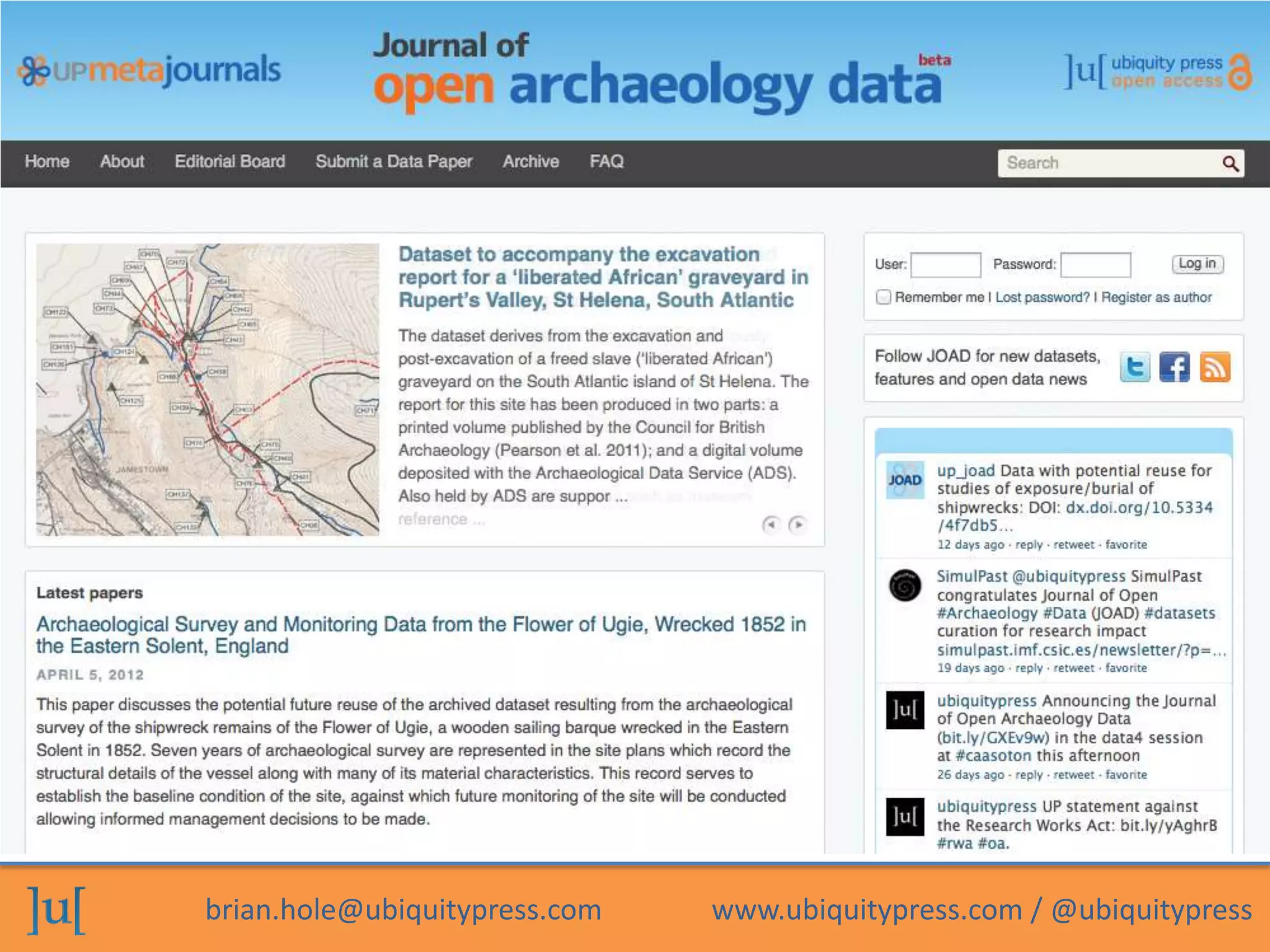
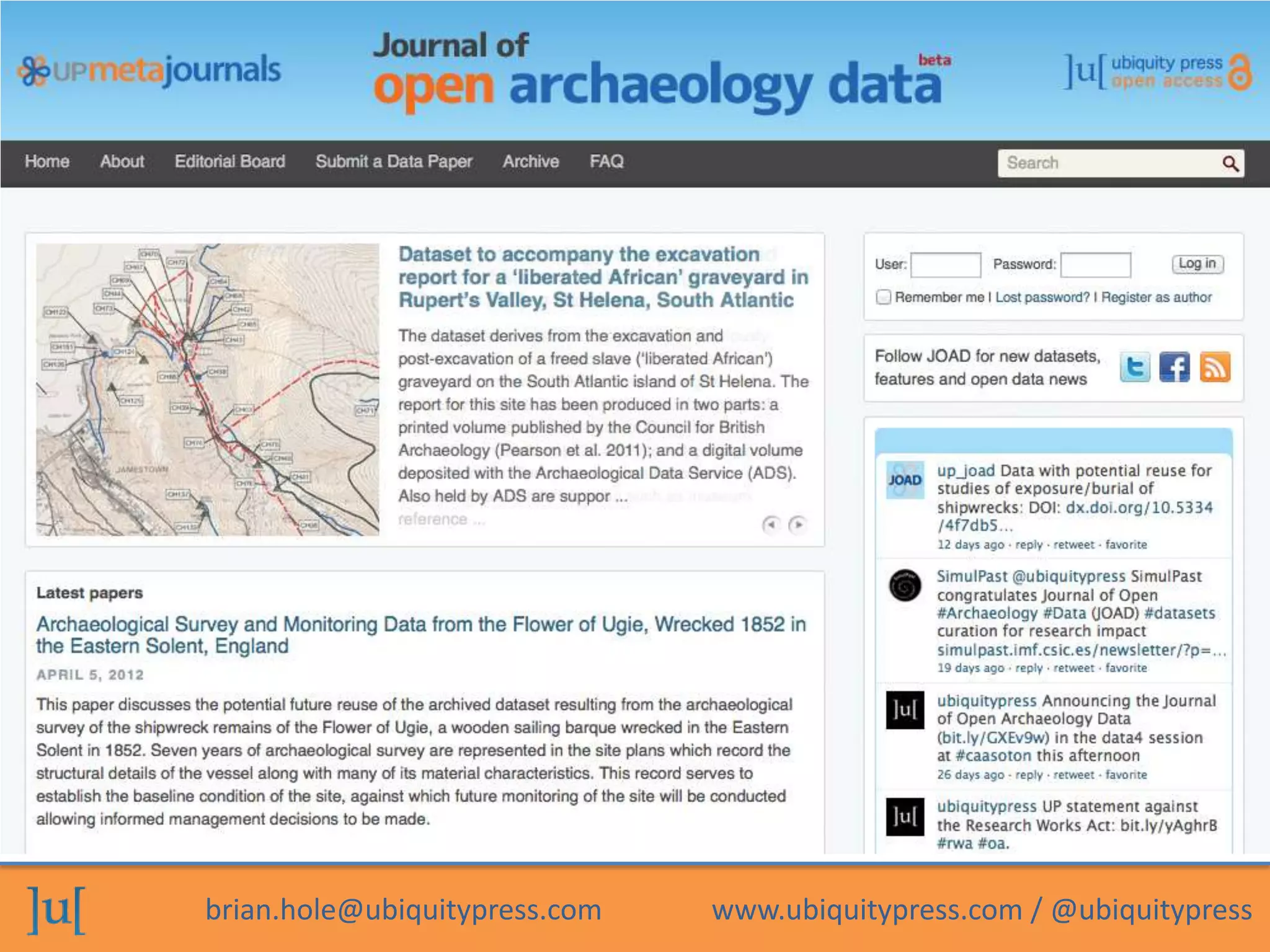
                           The Journal of Open Archaeology Data
                        3. Where: The PRIME project


    brian.hole@ubiquitypress.com       www.ubiquitypress.com / @ubiquitypress
brian.hole@ubiquitypress.com   www.ubiquitypress.com / @ubiquitypress
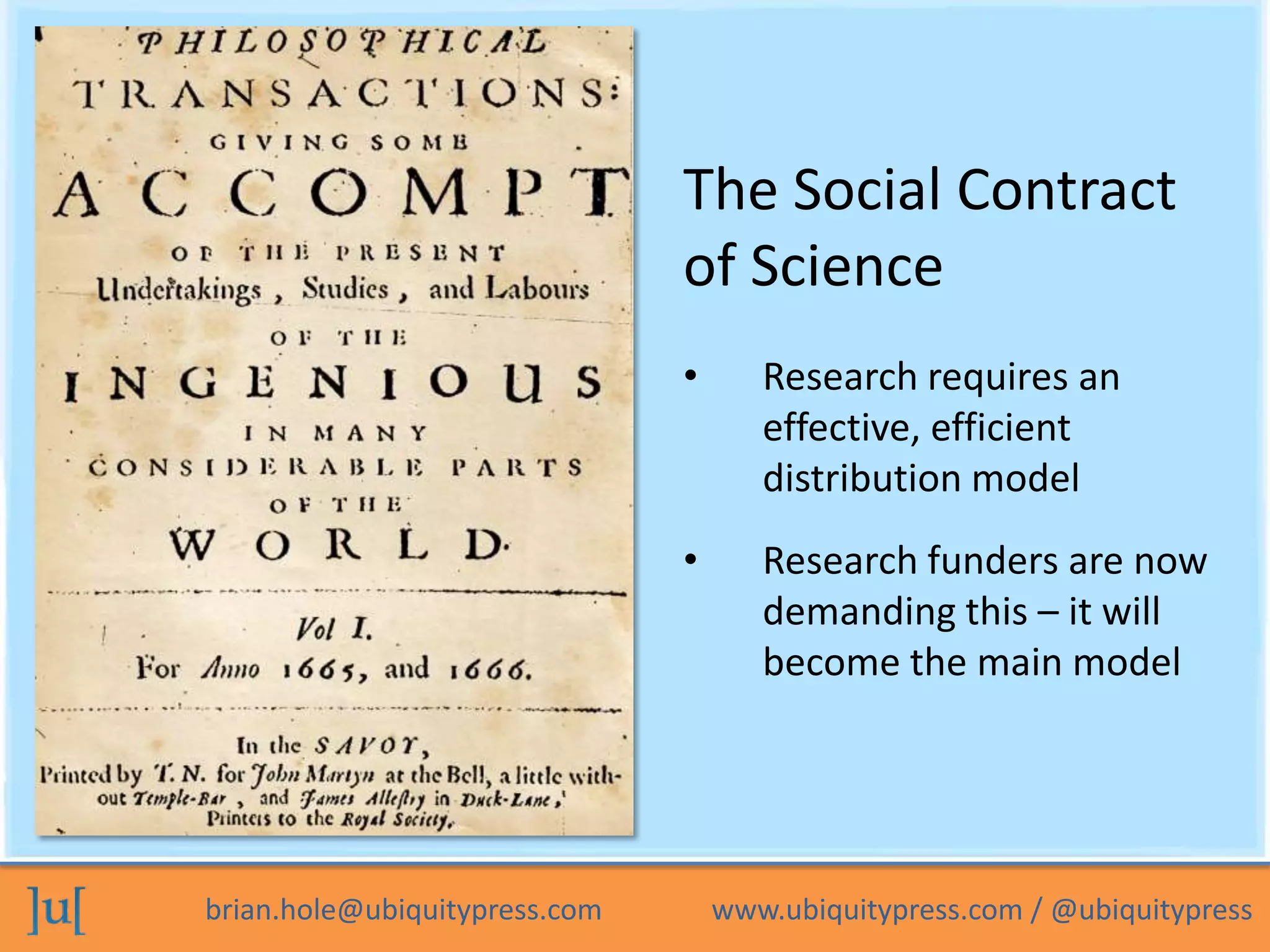
The Social Contract
                               of Science
                               •      Research requires an
                                      effective, efficient
                                      distribution model
                               •      Research funders are now
                                      demanding this – it will
                                      become the main model


brian.hole@ubiquitypress.com       www.ubiquitypress.com / @ubiquitypress
brian.hole@ubiquitypress.com   www.ubiquitypress.com / @ubiquitypress
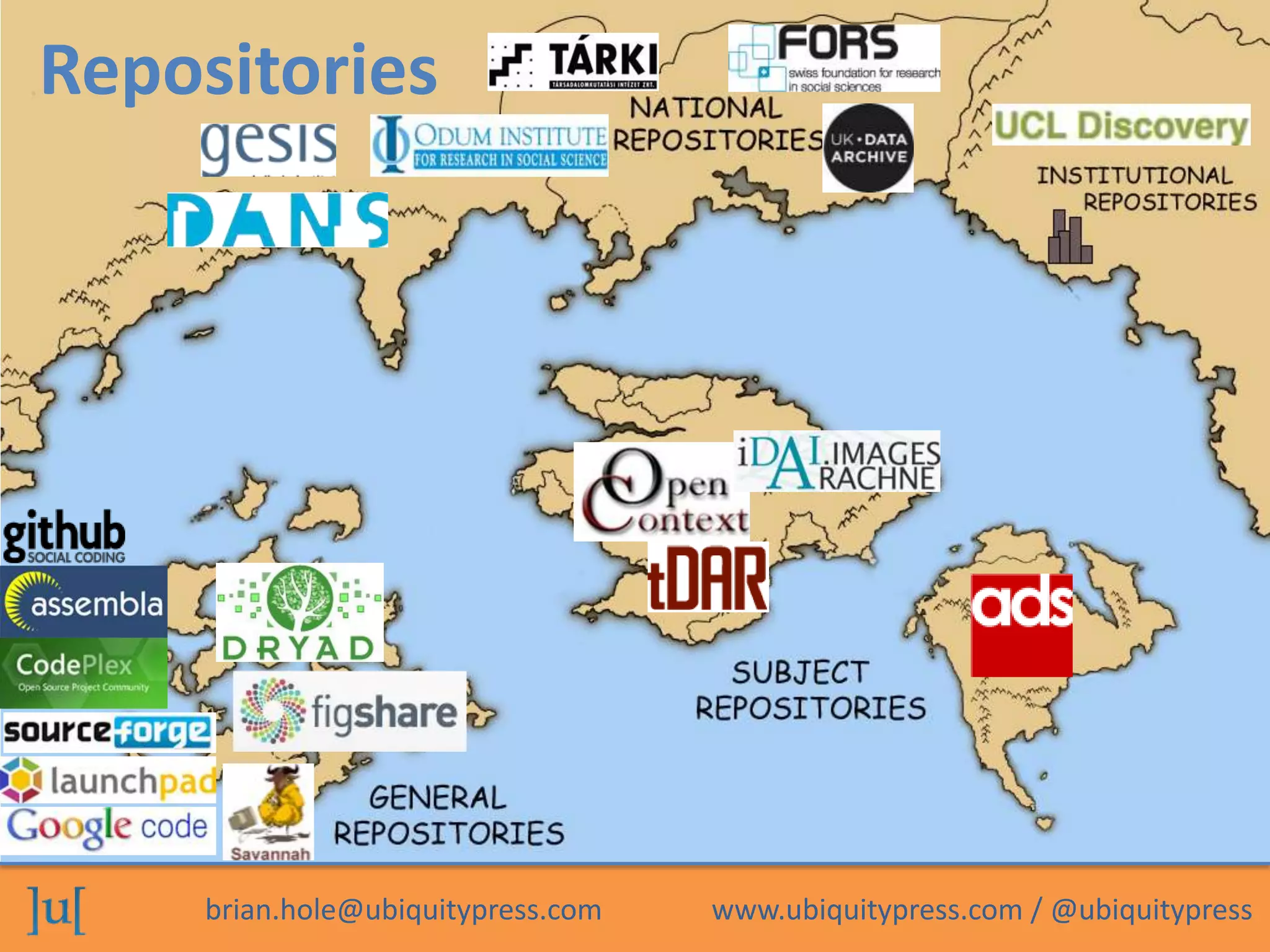
Repositories


    brian.hole@ubiquitypress.com   www.ubiquitypress.com / @ubiquitypress
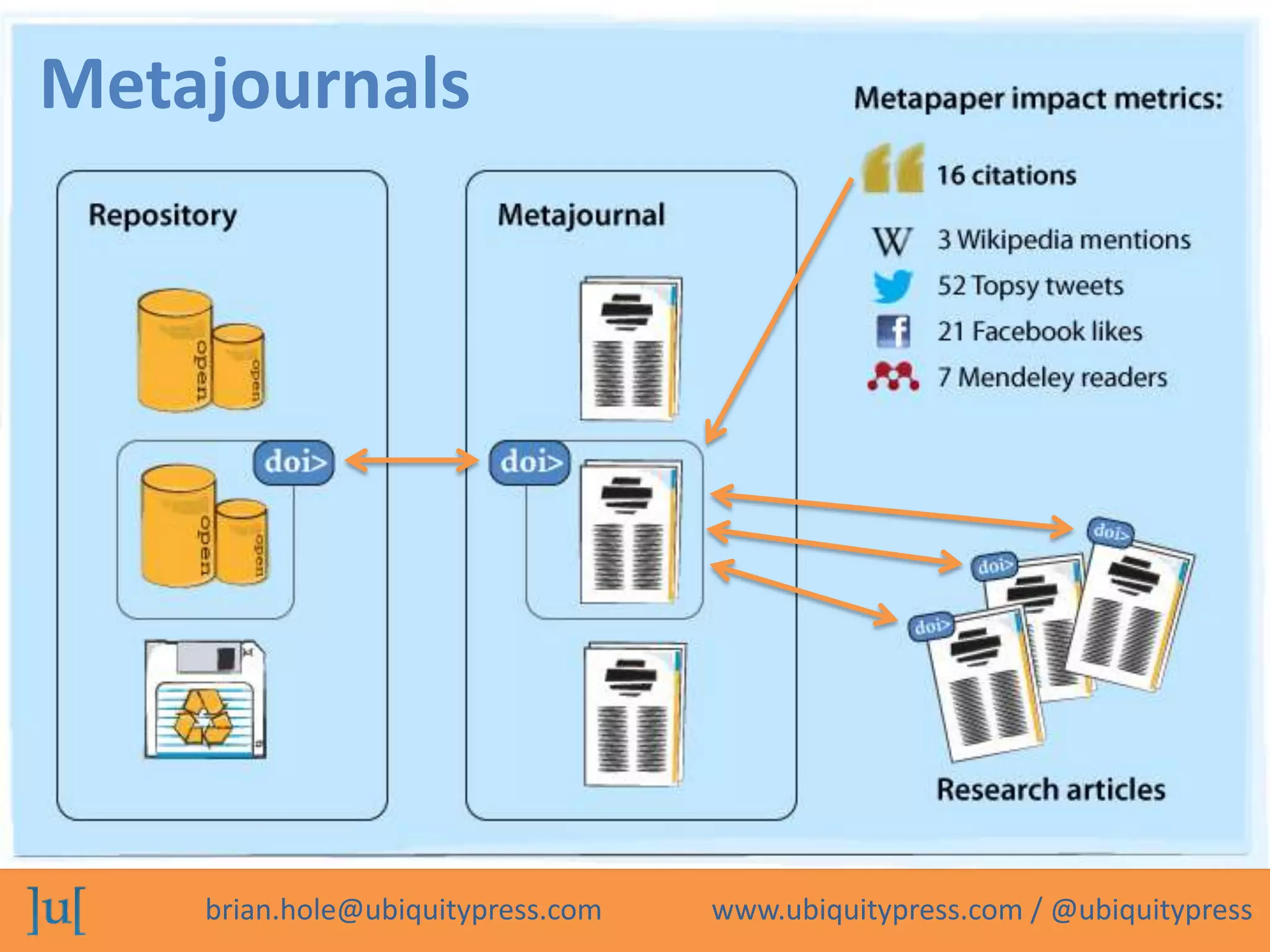
Metajournals


    brian.hole@ubiquitypress.com   www.ubiquitypress.com / @ubiquitypress
Data journals
                              • Data is already citable (e.g.
                                with DataCite DOIs) but this is
                                not something researchers
                                are familiar with doing.
                              • Even when used, DataCite
                                DOIs cannot currently be used
                                for citation tracking.


     brian.hole@ubiquitypress.com    www.ubiquitypress.com / @ubiquitypress
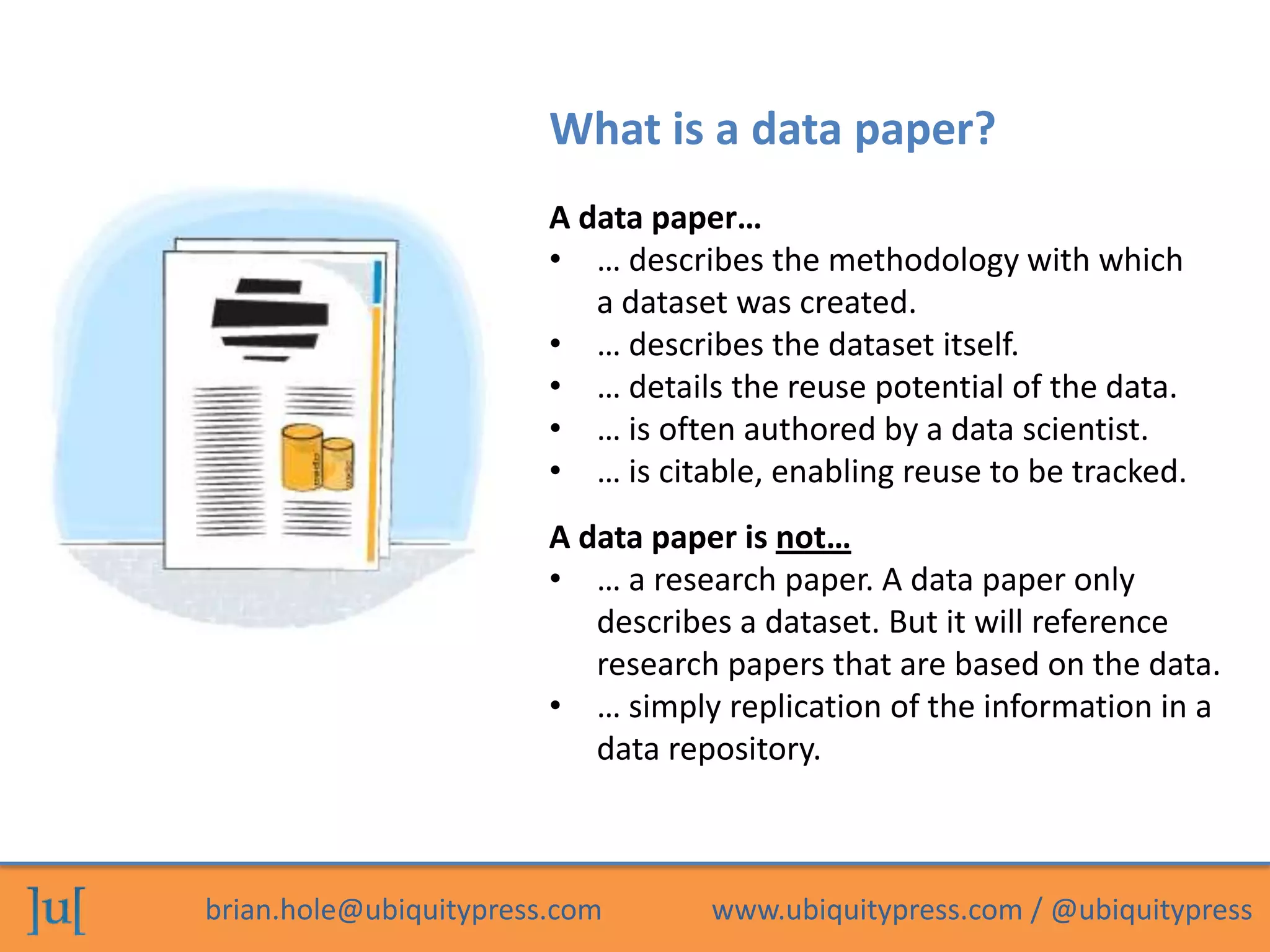
What is a data paper?
                        A data paper…
                        • … describes the methodology with which
                           a dataset was created.
                        • … describes the dataset itself.
                        • … details the reuse potential of the data.
                        • … is often authored by a data scientist.
                        • … is citable, enabling reuse to be tracked.
                        A data paper is not…
                        • … a research paper. A data paper only
                           describes a dataset. But it will reference
                           research papers that are based on the data.
                        • … simply replication of the information in a
                           data repository.


brian.hole@ubiquitypress.com       www.ubiquitypress.com / @ubiquitypress
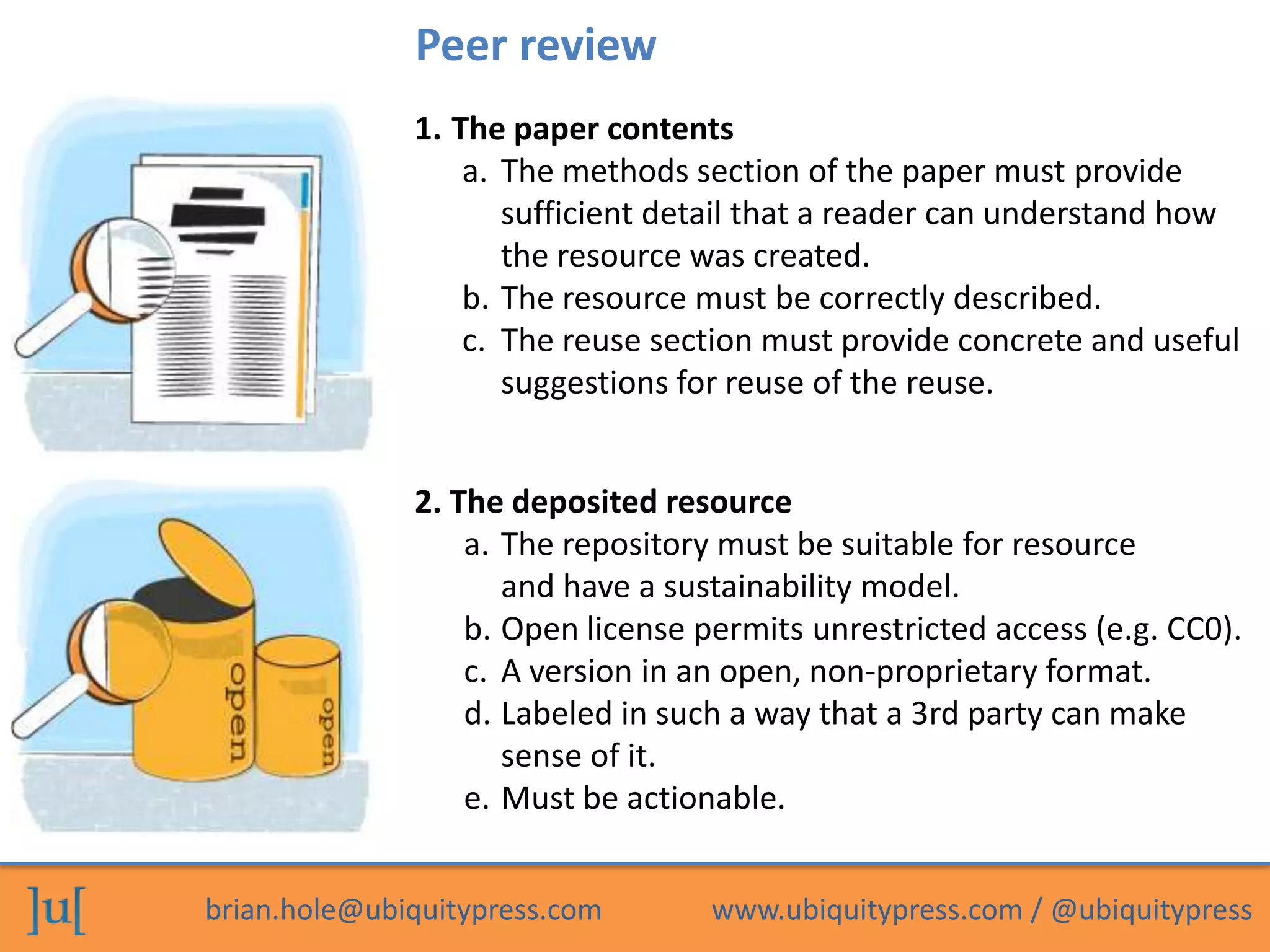
Peer review
              1. The paper contents
                  a. The methods section of the paper must provide
                     sufficient detail that a reader can understand how
                     the resource was created.
                  b. The resource must be correctly described.
                  c. The reuse section must provide concrete and useful
                     suggestions for reuse of the reuse.


              2. The deposited resource
                  a. The repository must be suitable for resource
                     and have a sustainability model.
                  b. Open license permits unrestricted access (e.g. CC0).
                  c. A version in an open, non-proprietary format.
                  d. Labeled in such a way that a 3rd party can make
                     sense of it.
                  e. Must be actionable.


brian.hole@ubiquitypress.com       www.ubiquitypress.com / @ubiquitypress
brian.hole@ubiquitypress.com   www.ubiquitypress.com / @ubiquitypress
PRIME
Publisher, Repository and Institutional Metadata Exchange
UCL LIBRARY SERVICES
                                               INSTITUTE OF ARCHAEOLOGY
                                                                            2012
                                               75 YEARS OF LEADING GLOBAL ARCHAEOLOGY


                brian.hole@ubiquitypress.com                  www.ubiquitypress.com / @ubiquitypress
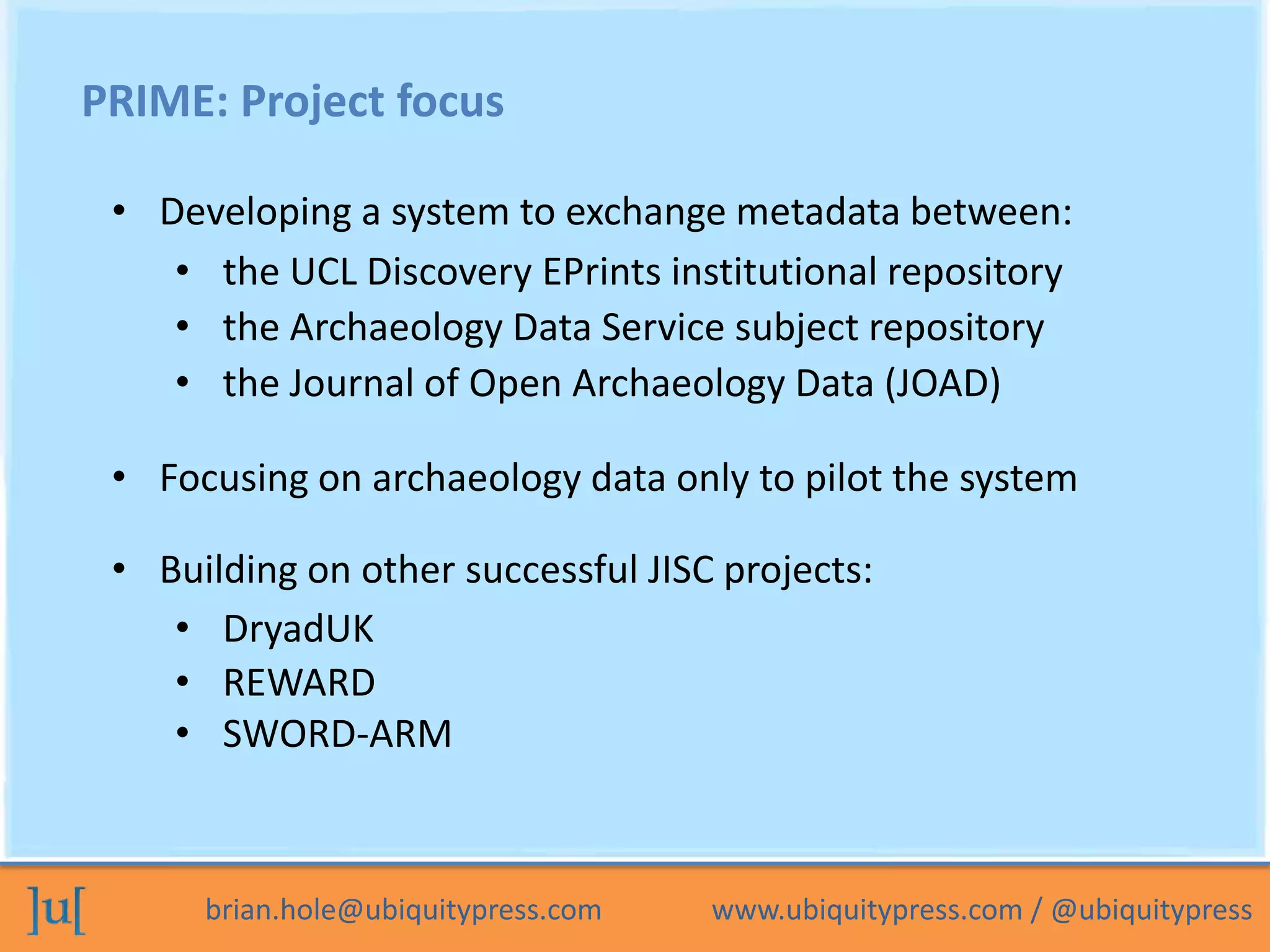
PRIME: Project focus

 • Developing a system to exchange metadata between:
    • the UCL Discovery EPrints institutional repository
    • the Archaeology Data Service subject repository
    • the Journal of Open Archaeology Data (JOAD)

 • Focusing on archaeology data only to pilot the system

 • Building on other successful JISC projects:
    • DryadUK
    • REWARD
    • SWORD-ARM


      brian.hole@ubiquitypress.com   www.ubiquitypress.com / @ubiquitypress
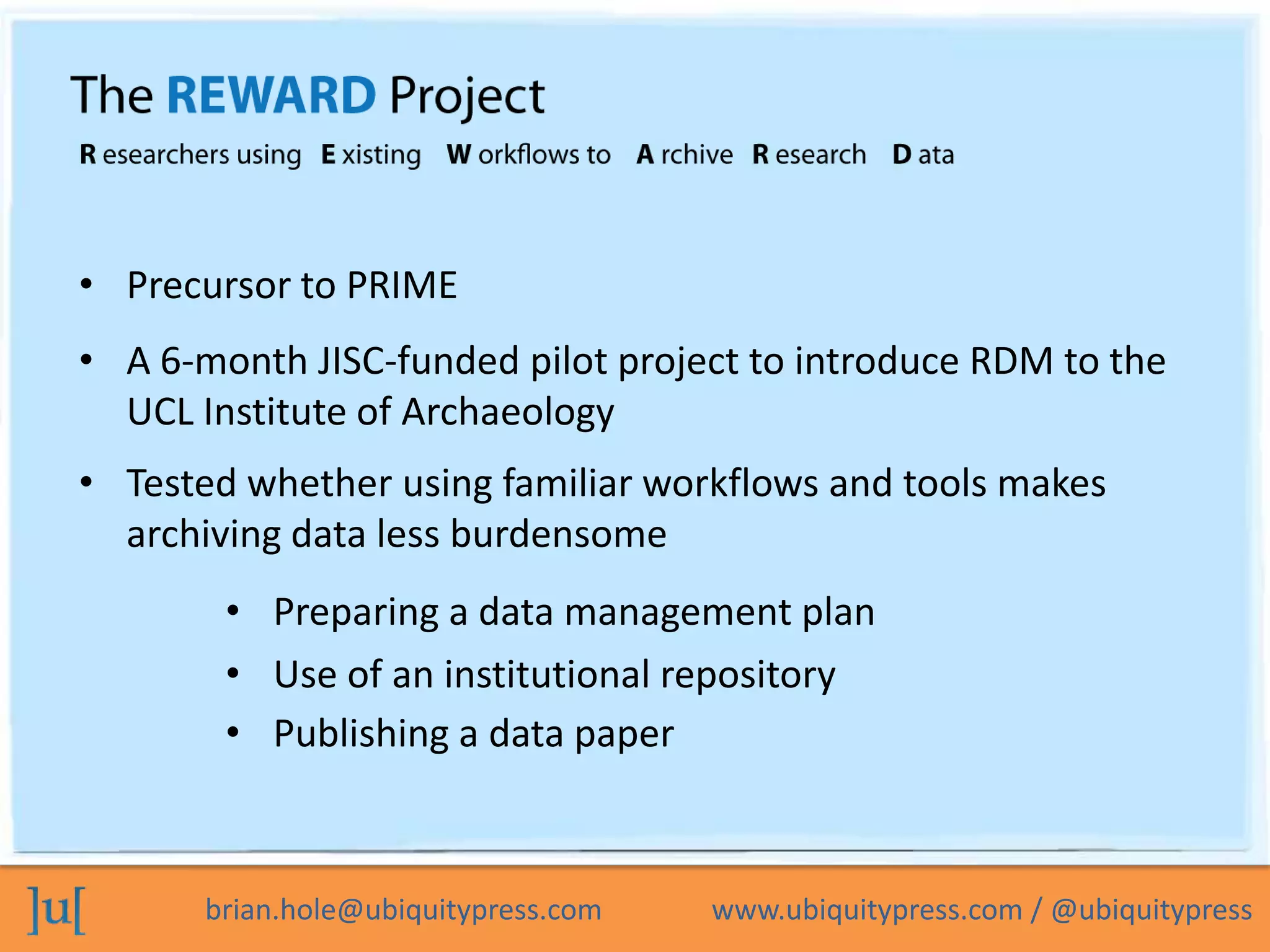
• Precursor to PRIME
• A 6-month JISC-funded pilot project to introduce RDM to the
  UCL Institute of Archaeology
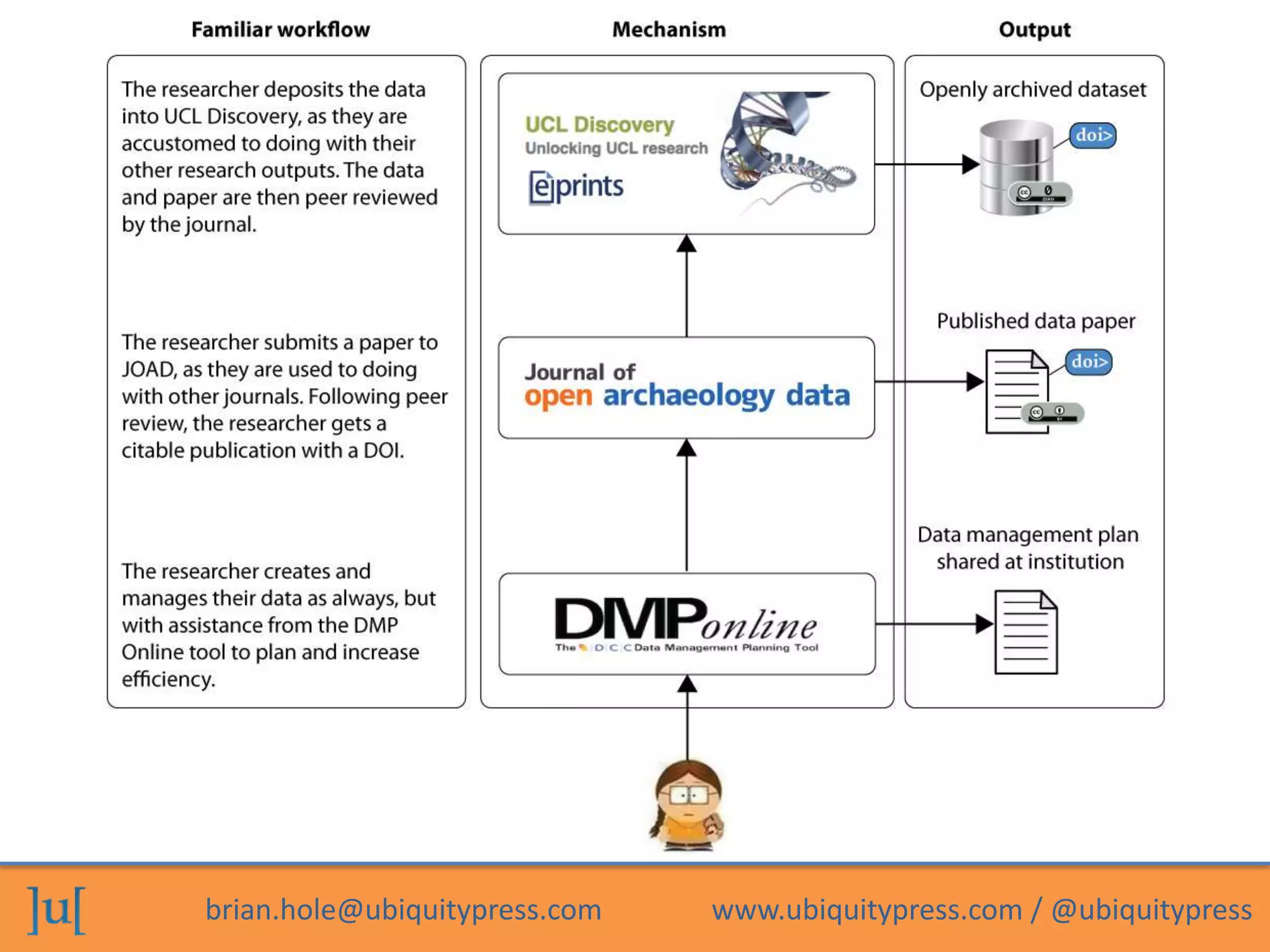
• Tested whether using familiar workflows and tools makes
  archiving data less burdensome
        • Preparing a data management plan
        • Use of an institutional repository
        • Publishing a data paper


       brian.hole@ubiquitypress.com   www.ubiquitypress.com / @ubiquitypress
brian.hole@ubiquitypress.com   www.ubiquitypress.com / @ubiquitypress
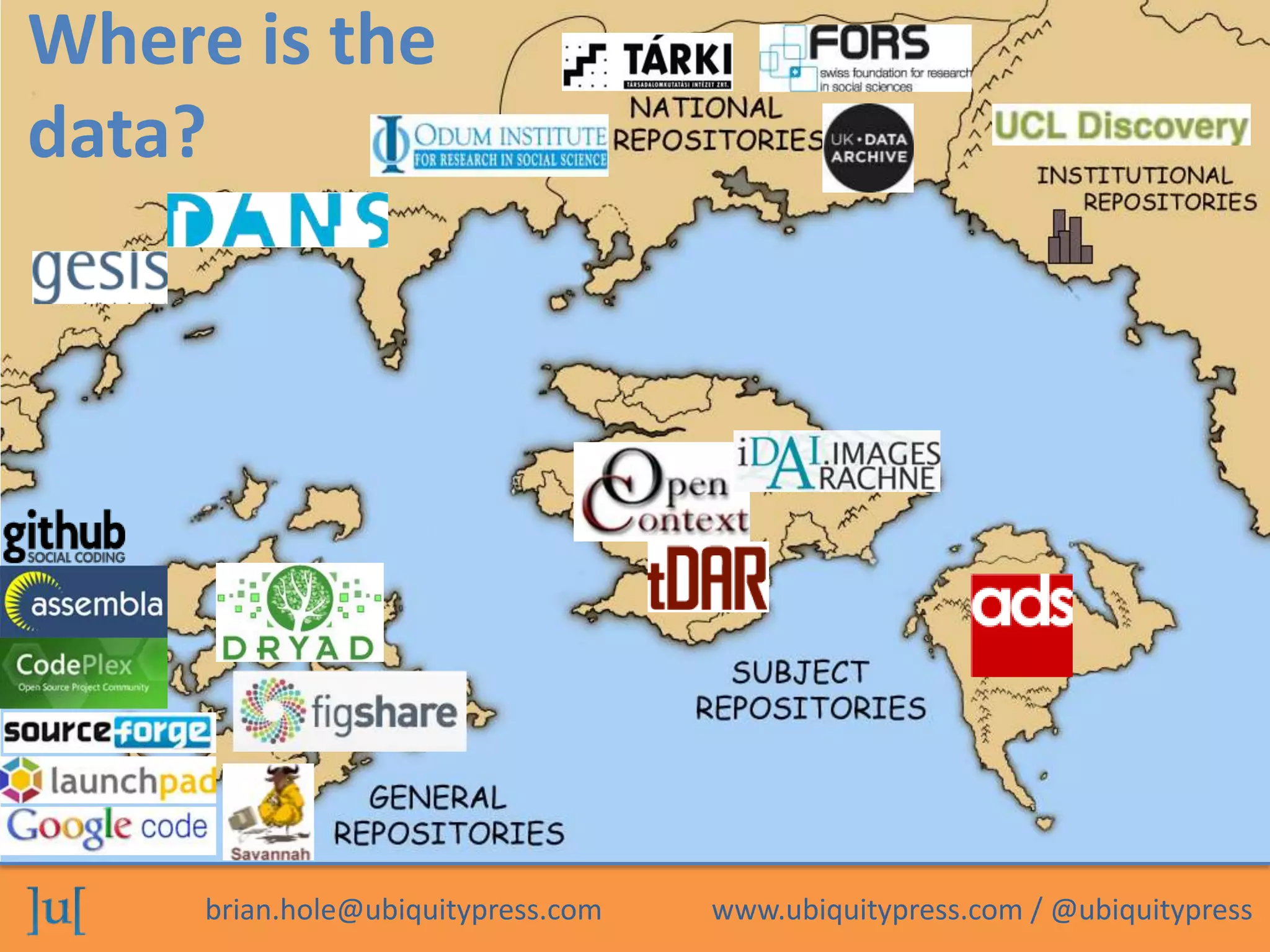
Where is the
data?


     brian.hole@ubiquitypress.com   www.ubiquitypress.com / @ubiquitypress
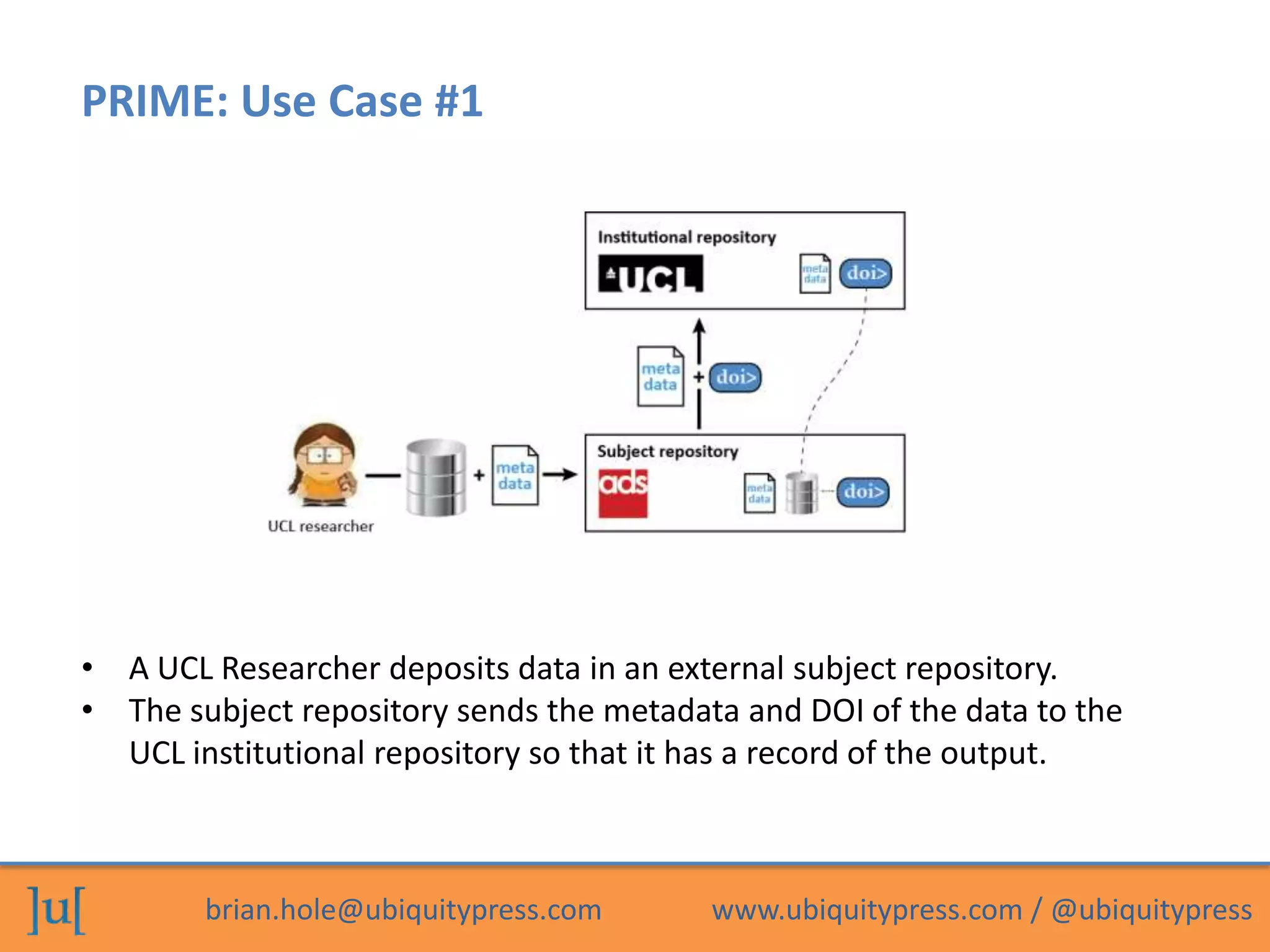
PRIME: Use Case #1


• A UCL Researcher deposits data in an external subject repository.
• The subject repository sends the metadata and DOI of the data to the
  UCL institutional repository so that it has a record of the output.


        brian.hole@ubiquitypress.com      www.ubiquitypress.com / @ubiquitypress
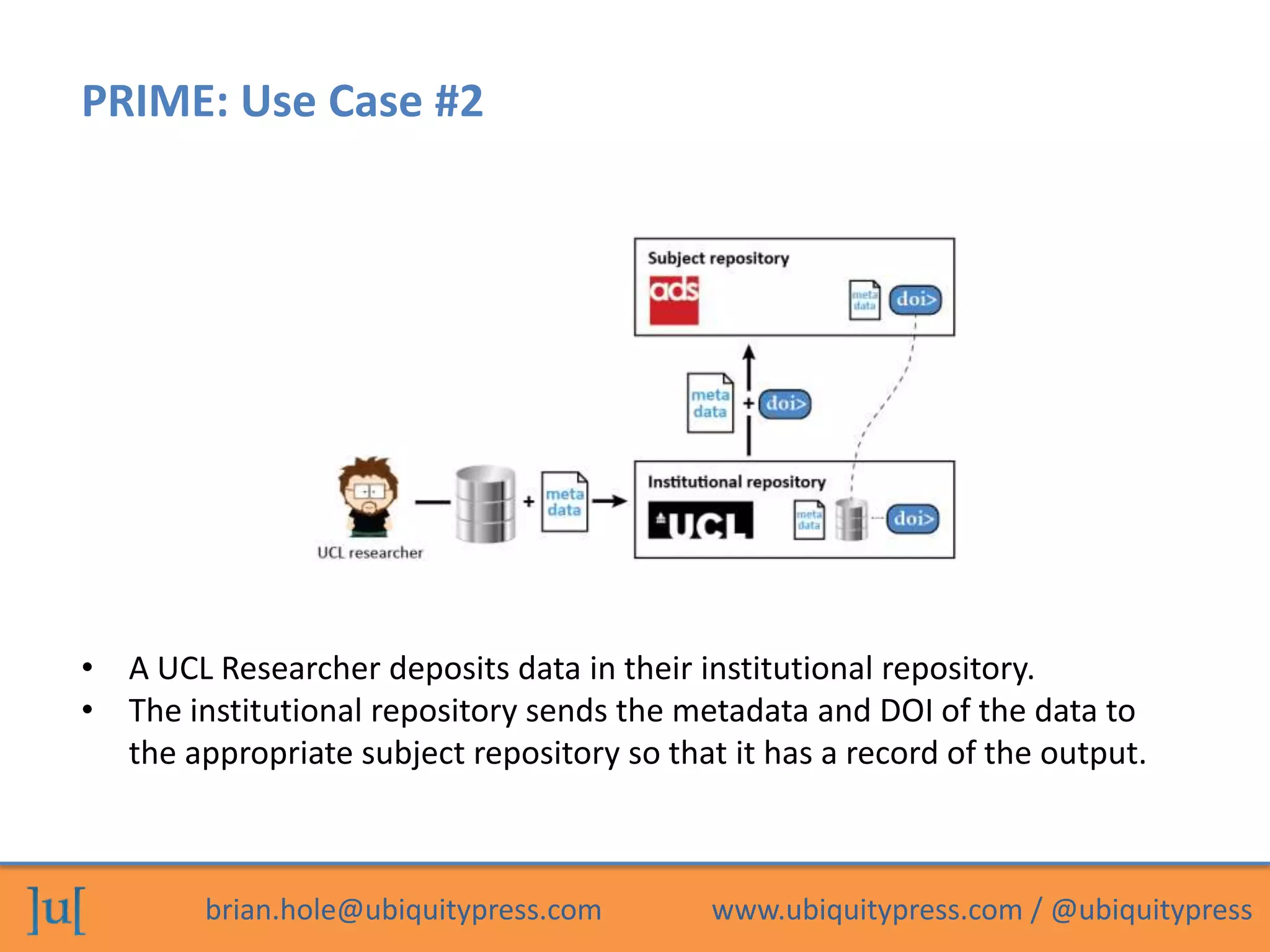
PRIME: Use Case #2


• A UCL Researcher deposits data in their institutional repository.
• The institutional repository sends the metadata and DOI of the data to
  the appropriate subject repository so that it has a record of the output.


        brian.hole@ubiquitypress.com        www.ubiquitypress.com / @ubiquitypress
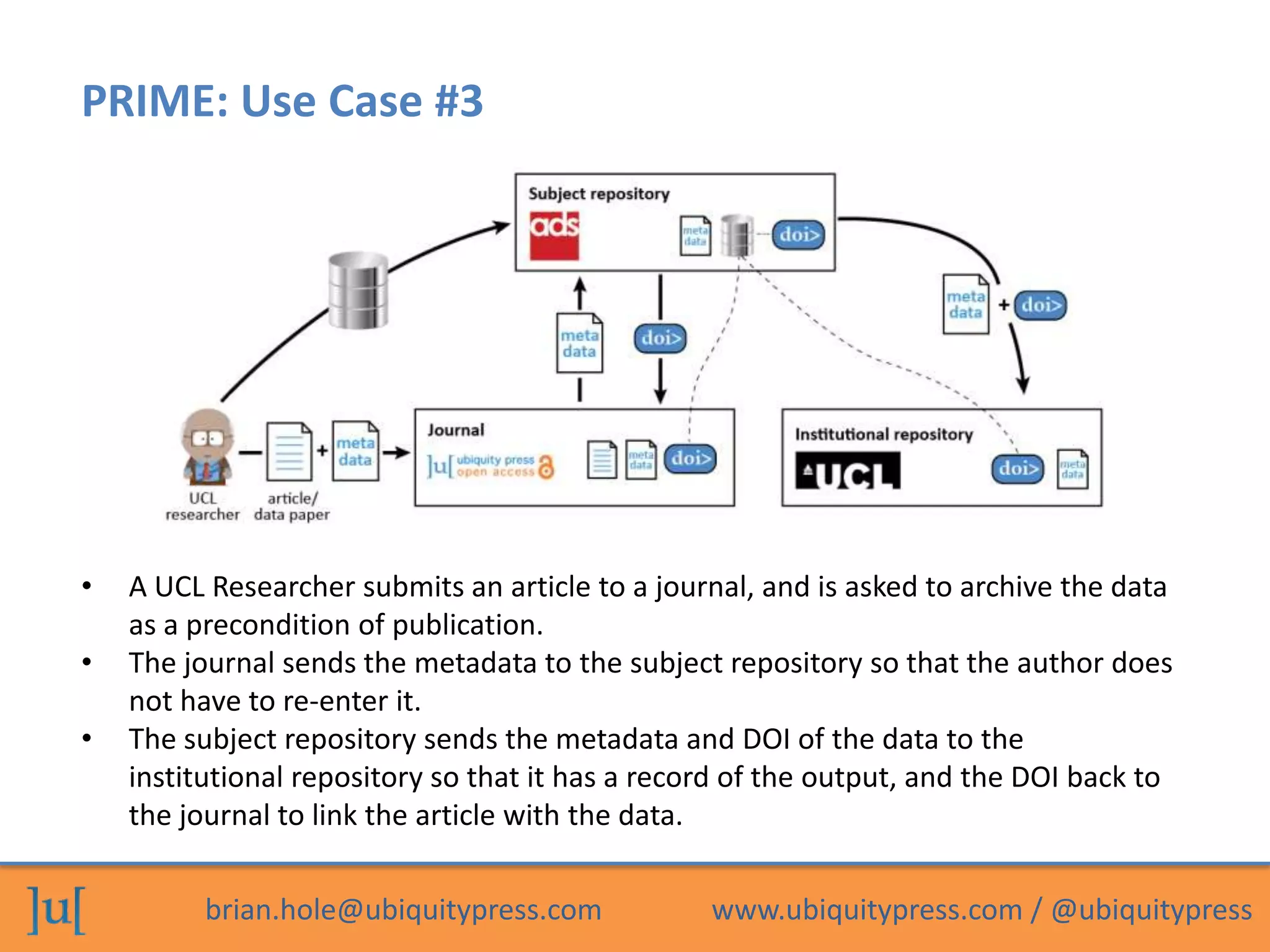
PRIME: Use Case #3


•   A UCL Researcher submits an article to a journal, and is asked to archive the data
    as a precondition of publication.
•   The journal sends the metadata to the subject repository so that the author does
    not have to re-enter it.
•   The subject repository sends the metadata and DOI of the data to the
    institutional repository so that it has a record of the output, and the DOI back to
    the journal to link the article with the data.

          brian.hole@ubiquitypress.com            www.ubiquitypress.com / @ubiquitypress
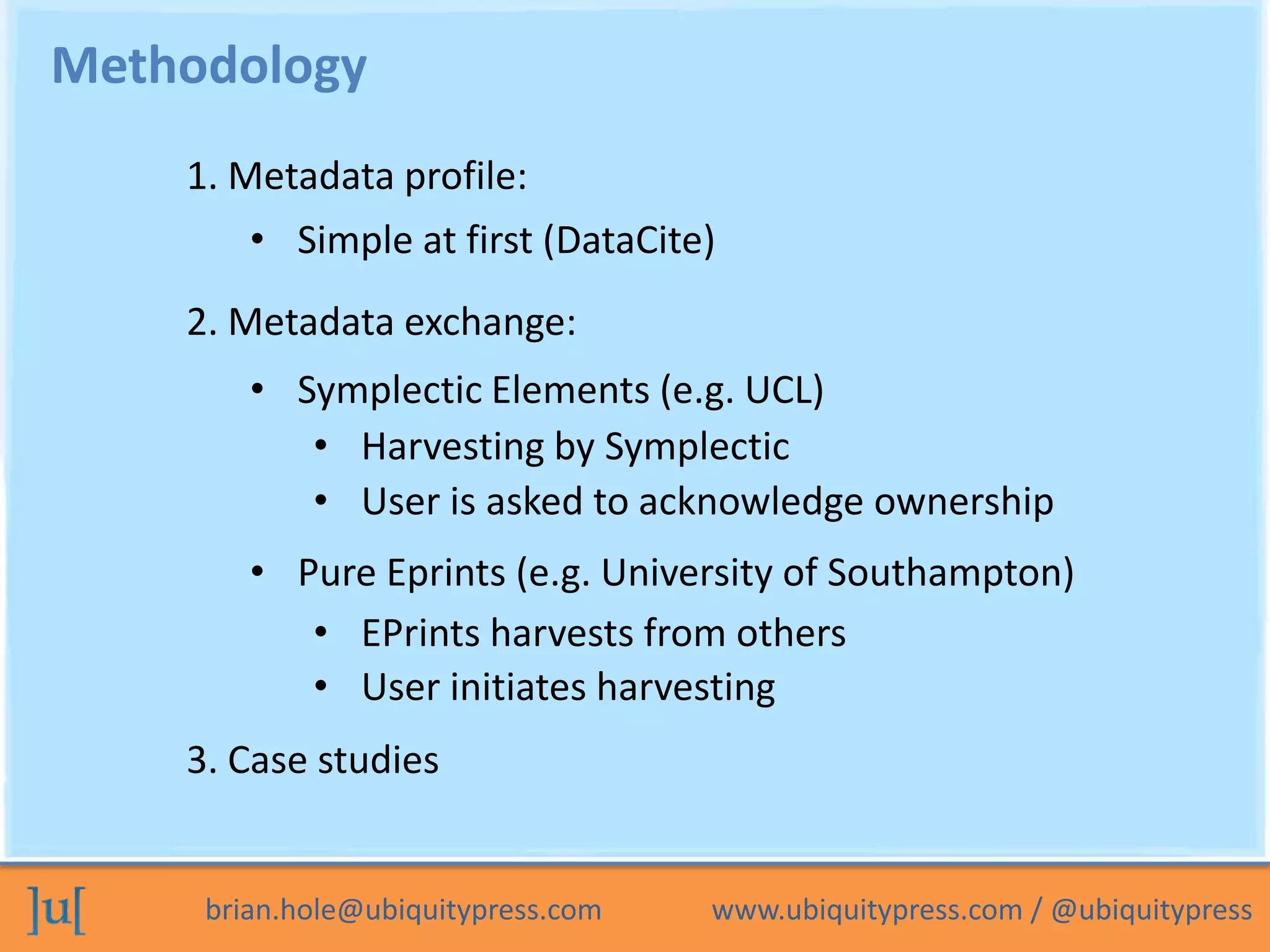
Methodology
    1. Metadata profile:
        • Simple at first (DataCite)
    2. Metadata exchange:
        • Symplectic Elements (e.g. UCL)
           • Harvesting by Symplectic
           • User is asked to acknowledge ownership
        • Pure Eprints (e.g. University of Southampton)
           • EPrints harvests from others
           • User initiates harvesting
    3. Case studies


     brian.hole@ubiquitypress.com   www.ubiquitypress.com / @ubiquitypress
Questions?


Links
  http://www.openarchaeologydata.metajnl.com
  http://www.ucl.ac.uk/prime
  http://www.ucl.ac.uk/reward
  http://www.metajnl.com


        brian.hole@ubiquitypress.com      www.ubiquitypress.com / @ubiquitypress

The Journal of Open Archaeology Data and PRIME: Incentivising Open Data Archiving

  • 1.
    The Journal ofOpen Archaeology Data and PRIME: Incentivising Open Data Archiving Brian Hole (UP & UCL) WAC7, Jordan, 18 January 2013 brian.hole@ubiquitypress.com www.ubiquitypress.com / @ubiquitypress
  • 2.
    Overview: why, how,where 1. Why share data? 2. How to enable and incentivise sharing: The Journal of Open Archaeology Data 3. Where: The PRIME project brian.hole@ubiquitypress.com www.ubiquitypress.com / @ubiquitypress
  • 3.
    brian.hole@ubiquitypress.com www.ubiquitypress.com / @ubiquitypress
  • 4.
    brian.hole@ubiquitypress.com www.ubiquitypress.com / @ubiquitypress
  • 5.
    The Social Contract of Science • Research requires an effective, efficient distribution model • Research funders are now demanding this – it will become the main model brian.hole@ubiquitypress.com www.ubiquitypress.com / @ubiquitypress
  • 6.
    brian.hole@ubiquitypress.com www.ubiquitypress.com / @ubiquitypress
  • 7.
    Repositories brian.hole@ubiquitypress.com www.ubiquitypress.com / @ubiquitypress
  • 8.
    Metajournals brian.hole@ubiquitypress.com www.ubiquitypress.com / @ubiquitypress
  • 9.
    Data journals • Data is already citable (e.g. with DataCite DOIs) but this is not something researchers are familiar with doing. • Even when used, DataCite DOIs cannot currently be used for citation tracking. brian.hole@ubiquitypress.com www.ubiquitypress.com / @ubiquitypress
  • 10.
    What is adata paper? A data paper… • … describes the methodology with which a dataset was created. • … describes the dataset itself. • … details the reuse potential of the data. • … is often authored by a data scientist. • … is citable, enabling reuse to be tracked. A data paper is not… • … a research paper. A data paper only describes a dataset. But it will reference research papers that are based on the data. • … simply replication of the information in a data repository. brian.hole@ubiquitypress.com www.ubiquitypress.com / @ubiquitypress
  • 11.
    Peer review 1. The paper contents a. The methods section of the paper must provide sufficient detail that a reader can understand how the resource was created. b. The resource must be correctly described. c. The reuse section must provide concrete and useful suggestions for reuse of the reuse. 2. The deposited resource a. The repository must be suitable for resource and have a sustainability model. b. Open license permits unrestricted access (e.g. CC0). c. A version in an open, non-proprietary format. d. Labeled in such a way that a 3rd party can make sense of it. e. Must be actionable. brian.hole@ubiquitypress.com www.ubiquitypress.com / @ubiquitypress
  • 12.
    brian.hole@ubiquitypress.com www.ubiquitypress.com / @ubiquitypress
  • 13.
    PRIME Publisher, Repository andInstitutional Metadata Exchange UCL LIBRARY SERVICES INSTITUTE OF ARCHAEOLOGY 2012 75 YEARS OF LEADING GLOBAL ARCHAEOLOGY brian.hole@ubiquitypress.com www.ubiquitypress.com / @ubiquitypress
  • 14.
    PRIME: Project focus • Developing a system to exchange metadata between: • the UCL Discovery EPrints institutional repository • the Archaeology Data Service subject repository • the Journal of Open Archaeology Data (JOAD) • Focusing on archaeology data only to pilot the system • Building on other successful JISC projects: • DryadUK • REWARD • SWORD-ARM brian.hole@ubiquitypress.com www.ubiquitypress.com / @ubiquitypress
  • 15.
    • Precursor toPRIME • A 6-month JISC-funded pilot project to introduce RDM to the UCL Institute of Archaeology • Tested whether using familiar workflows and tools makes archiving data less burdensome • Preparing a data management plan • Use of an institutional repository • Publishing a data paper brian.hole@ubiquitypress.com www.ubiquitypress.com / @ubiquitypress
  • 16.
    brian.hole@ubiquitypress.com www.ubiquitypress.com / @ubiquitypress
  • 17.
    Where is the data? brian.hole@ubiquitypress.com www.ubiquitypress.com / @ubiquitypress
  • 18.
    PRIME: Use Case#1 • A UCL Researcher deposits data in an external subject repository. • The subject repository sends the metadata and DOI of the data to the UCL institutional repository so that it has a record of the output. brian.hole@ubiquitypress.com www.ubiquitypress.com / @ubiquitypress
  • 19.
    PRIME: Use Case#2 • A UCL Researcher deposits data in their institutional repository. • The institutional repository sends the metadata and DOI of the data to the appropriate subject repository so that it has a record of the output. brian.hole@ubiquitypress.com www.ubiquitypress.com / @ubiquitypress
  • 20.
    PRIME: Use Case#3 • A UCL Researcher submits an article to a journal, and is asked to archive the data as a precondition of publication. • The journal sends the metadata to the subject repository so that the author does not have to re-enter it. • The subject repository sends the metadata and DOI of the data to the institutional repository so that it has a record of the output, and the DOI back to the journal to link the article with the data. brian.hole@ubiquitypress.com www.ubiquitypress.com / @ubiquitypress
  • 21.
    Methodology 1. Metadata profile: • Simple at first (DataCite) 2. Metadata exchange: • Symplectic Elements (e.g. UCL) • Harvesting by Symplectic • User is asked to acknowledge ownership • Pure Eprints (e.g. University of Southampton) • EPrints harvests from others • User initiates harvesting 3. Case studies brian.hole@ubiquitypress.com www.ubiquitypress.com / @ubiquitypress
  • 22.
    Questions? Links http://www.openarchaeologydata.metajnl.com http://www.ucl.ac.uk/prime http://www.ucl.ac.uk/reward http://www.metajnl.com brian.hole@ubiquitypress.com www.ubiquitypress.com / @ubiquitypress