brian.hole@ubiquitypress.com | www.ubiquitypress.com| @ubiquitypress
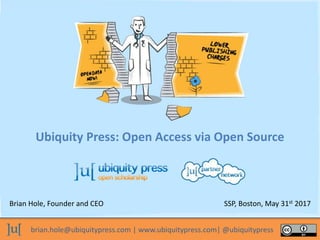
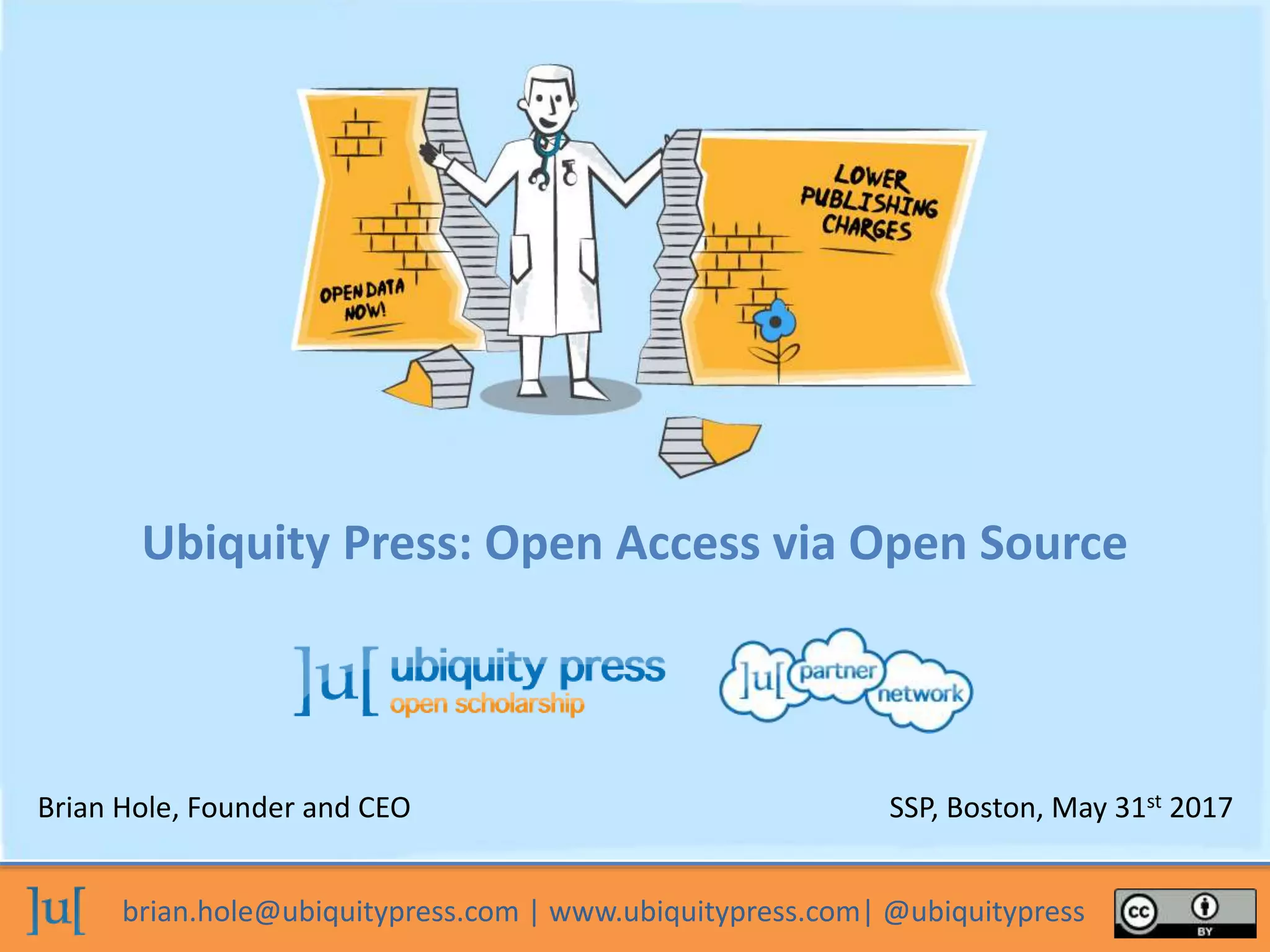
Ubiquity Press: Open Access via Open Source
Brian Hole, Founder and CEO SSP, Boston, May 31st 2017
brian.hole@ubiquitypress.com | www.ubiquitypress.com| @ubiquitypress
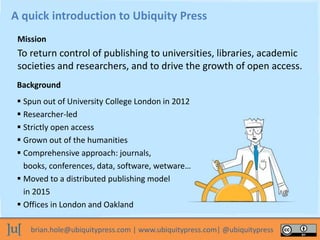
To return control of publishing to universities, libraries, academic
societies and researchers, and to drive the growth of open access.
A quick introduction to Ubiquity Press
Background
Mission
 Spun out of University College London in 2012
 Researcher-led
 Strictly open access
 Grown out of the humanities
 Comprehensive approach: journals,
books, conferences, data, software, wetware…
 Moved to a distributed publishing model
in 2015
 Offices in London and Oakland
brian.hole@ubiquitypress.com | www.ubiquitypress.com| @ubiquitypress
Our genesis
brian.hole@ubiquitypress.com | www.ubiquitypress.com| @ubiquitypress
Looked for a professional, affordable platform, especially for
the humanities and developing world
Went with OS, and a lean, low-cost approach from the start
Legacy publishers not providing this, nor willing to go OS
Decided therefore to run our own
Didn’t want to build one: high risk, difficult
Cheapest commercial provider we could find was $20-30K for
one small journal
Not overcharging the research community: a core principle
Initial considerations
brian.hole@ubiquitypress.com | www.ubiquitypress.com| @ubiquitypress
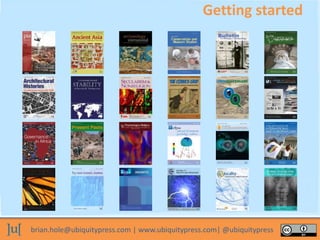
Getting started
brian.hole@ubiquitypress.com | www.ubiquitypress.com| @ubiquitypress
Started having scaling issues at 10-20 journals on OJS
System was not being used to the full extent by any users, so
had some bugs and gaps
Adding features for larger-scale journals
Had to build own front-end: more professional and
competitive
Spent a lot of time fixing bugs
Scaling issues
The need to stay several versions behind to ensure platform
stability has often meant we couldn’t contribute as much
code back as we’d have liked to
brian.hole@ubiquitypress.com | www.ubiquitypress.com| @ubiquitypress
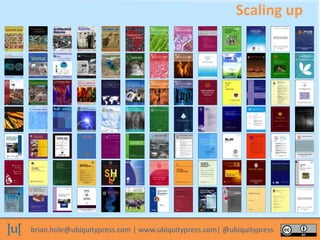
Scaling up
brian.hole@ubiquitypress.com | www.ubiquitypress.com| @ubiquitypress
and up
brian.hole@ubiquitypress.com | www.ubiquitypress.com| @ubiquitypress
Found not all OSS products to be as reliable as we’d hoped
Were forced to produce our own books platform to meet
customer obligations
Had to build our own back-end system to efficiently manage a
large collection of journals and other content
Scaling issues (2)
Needed to provide alternative options to customers, e.g.
different editorial systems. Not all OSS.
New architecture means we can now focus more on:
Front end
Publishing services
Innovation, not being locked in to any one system
brian.hole@ubiquitypress.com | www.ubiquitypress.com| @ubiquitypress
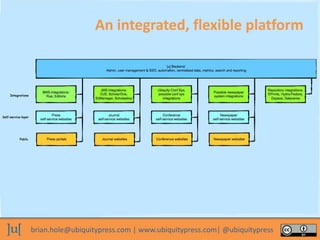
An integrated, flexible platform
brian.hole@ubiquitypress.com | www.ubiquitypress.com| @ubiquitypress
Committed to making our platform fully OSS in early 2018
Have started with our books platform, Rua
Some modules (e.g. Rua) can run standalone, but the greater
platform OSS code will be of more use for integrations etc.
OSS is still core to our future
Beginning an OSS book metrics project now: HIRMEOS
Maintain compatibility with key OSS systems, to prevent
client lock in
Continue integrating other OSS products, e.g. CKF PubSweet,
Editoria
Strong preference for community-maintained OSS
Key is developing a stronger internal OSS culture, and
becoming active contributors to all OSS software we use

Open Access via Open Source

  • 1.
    brian.hole@ubiquitypress.com | www.ubiquitypress.com|@ubiquitypress Ubiquity Press: Open Access via Open Source Brian Hole, Founder and CEO SSP, Boston, May 31st 2017
  • 2.
    brian.hole@ubiquitypress.com | www.ubiquitypress.com|@ubiquitypress To return control of publishing to universities, libraries, academic societies and researchers, and to drive the growth of open access. A quick introduction to Ubiquity Press Background Mission  Spun out of University College London in 2012  Researcher-led  Strictly open access  Grown out of the humanities  Comprehensive approach: journals, books, conferences, data, software, wetware…  Moved to a distributed publishing model in 2015  Offices in London and Oakland
  • 3.
  • 4.
    brian.hole@ubiquitypress.com | www.ubiquitypress.com|@ubiquitypress Looked for a professional, affordable platform, especially for the humanities and developing world Went with OS, and a lean, low-cost approach from the start Legacy publishers not providing this, nor willing to go OS Decided therefore to run our own Didn’t want to build one: high risk, difficult Cheapest commercial provider we could find was $20-30K for one small journal Not overcharging the research community: a core principle Initial considerations
  • 5.
  • 6.
    brian.hole@ubiquitypress.com | www.ubiquitypress.com|@ubiquitypress Started having scaling issues at 10-20 journals on OJS System was not being used to the full extent by any users, so had some bugs and gaps Adding features for larger-scale journals Had to build own front-end: more professional and competitive Spent a lot of time fixing bugs Scaling issues The need to stay several versions behind to ensure platform stability has often meant we couldn’t contribute as much code back as we’d have liked to
  • 7.
  • 8.
  • 9.
    brian.hole@ubiquitypress.com | www.ubiquitypress.com|@ubiquitypress Found not all OSS products to be as reliable as we’d hoped Were forced to produce our own books platform to meet customer obligations Had to build our own back-end system to efficiently manage a large collection of journals and other content Scaling issues (2) Needed to provide alternative options to customers, e.g. different editorial systems. Not all OSS. New architecture means we can now focus more on: Front end Publishing services Innovation, not being locked in to any one system
  • 10.
    brian.hole@ubiquitypress.com | www.ubiquitypress.com|@ubiquitypress An integrated, flexible platform
  • 11.
    brian.hole@ubiquitypress.com | www.ubiquitypress.com|@ubiquitypress Committed to making our platform fully OSS in early 2018 Have started with our books platform, Rua Some modules (e.g. Rua) can run standalone, but the greater platform OSS code will be of more use for integrations etc. OSS is still core to our future Beginning an OSS book metrics project now: HIRMEOS Maintain compatibility with key OSS systems, to prevent client lock in Continue integrating other OSS products, e.g. CKF PubSweet, Editoria Strong preference for community-maintained OSS Key is developing a stronger internal OSS culture, and becoming active contributors to all OSS software we use

Editor's Notes

  • #3 A very quick overview of who we are for those who don’t know us
  • #11 OA still has a long way to go to reach its potential It needs to be affordable, not only in the dev world, but here too It needs to be available in the humanities and social sciences, as well as STEM It needs to include a full range of research outputs Large legacy publishers are actively opposing