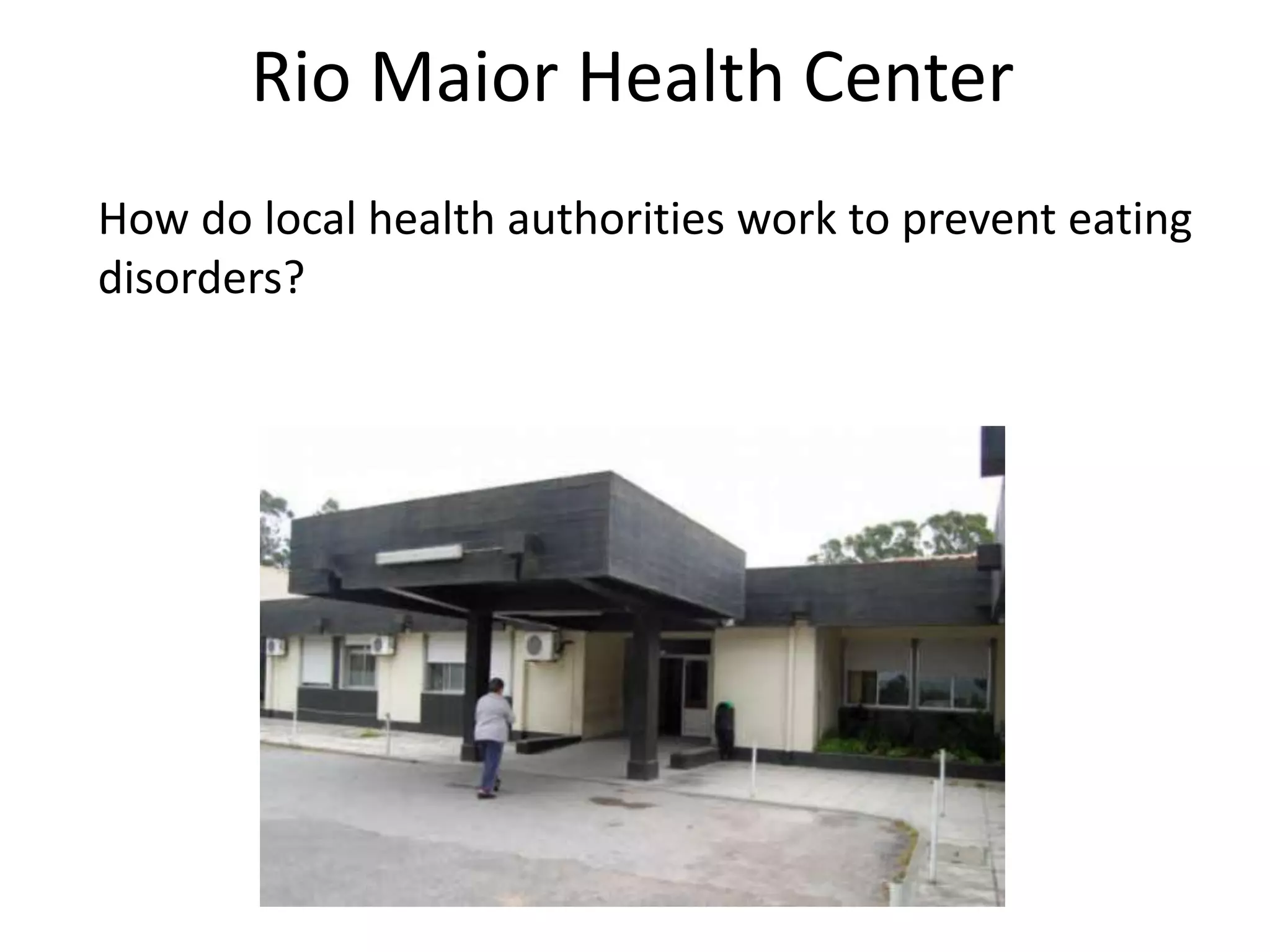
Rio Maior Health Center
How do local health authorities work to prevent eating
disorders?
Rio Maior Health Center
Our school has a health office where nurses from the
health center are available to serve students.
If they detect students with eating disorders, ask
parents to make an appointment with the family
doctor in the Rio Maior Health Center.
Rio Maior Health Center
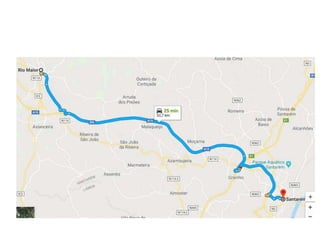
• Doctors can do two things:
• cases of overweight are referred to the
nutritionist's office in the Hospital District of
Santarém (unfortunately the Rio Maior Health
Center does not have a nutritionist);
• Other eating disorders, such as anorexia or
bulimia, may have psychology consultation at the
Rio Maior Health Center, but are usually referred
to the Hospital District of Santarém.
Rio Maior Health Center
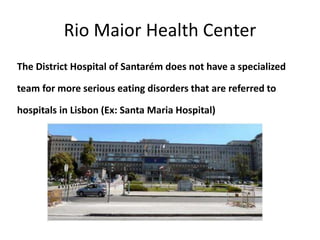
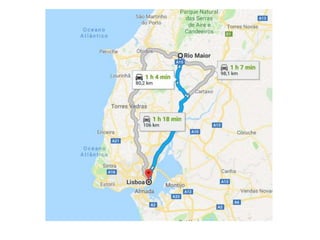
The District Hospital of Santarém does not have a specialized
team for more serious eating disorders that are referred to
hospitals in Lisbon (Ex: Santa Maria Hospital)
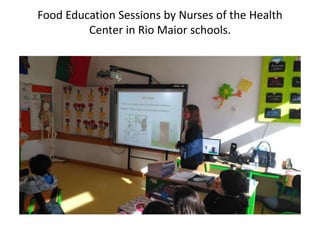
Food Education Sessions by Nurses of the Health
Center in Rio Maior schools.
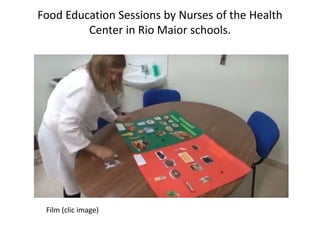
Food Education Sessions by Nurses of the Health
Center in Rio Maior schools.
Film (clic image)
Food Education Sessions by Nurses of the Health
Center in Rio Maior schools.
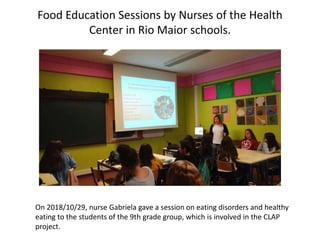
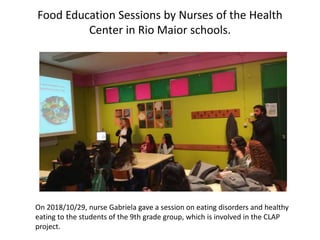
On 2018/10/29, nurse Gabriela gave a session on eating disorders and healthy
eating to the students of the 9th grade group, which is involved in the CLAP
project.
Food Education Sessions by Nurses of the Health
Center in Rio Maior schools.
On 2018/10/29, nurse Gabriela gave a session on eating disorders and healthy
eating to the students of the 9th grade group, which is involved in the CLAP
project.
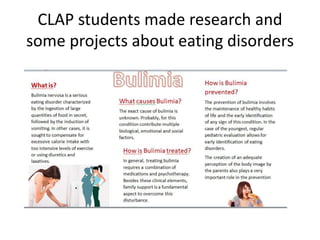
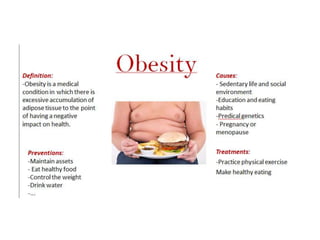
CLAP students made research and
some projects about eating disorders
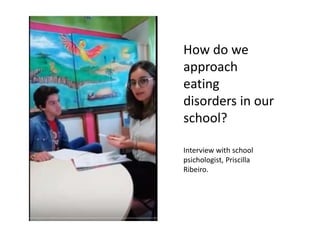
How do we
approach
eating
disorders in our
school?
Interview with school
psichologist, Priscilla
Ribeiro.
What about school canteens and
buffet?
• The City Hall has a nutritionist who is
responsible for ascertaining whether the
companies serving the meals, and the school
buffet offers only choices according to the law.
School Feeding as a strategy for the
prevention of food-borne diseases
In Portugal, one in three children is overweight and 10% are
obese. Diseases such as high cholesterol, pre-diabetes, high
blood pressure and fatty liver are increasing in obese children
and adolescents.
Schools being the place where children and adolescents spend
most of their time and where they ingest a considerable portion
of daily food (about 35 to 50% of the daily), they play a decisive
role in the prevention and reversal of this scenario
School Feeding as a strategy for the
prevention of food-borne diseases
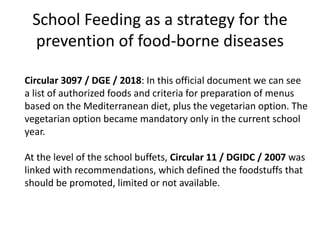
Circular 3097 / DGE / 2018: In this official document we can see
a list of authorized foods and criteria for preparation of menus
based on the Mediterranean diet, plus the vegetarian option. The
vegetarian option became mandatory only in the current school
year.
At the level of the school buffets, Circular 11 / DGIDC / 2007 was
linked with recommendations, which defined the foodstuffs that
should be promoted, limited or not available.
School Feeding as a strategy for the
prevention of food-borne diseases
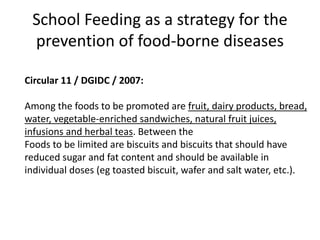
Circular 11 / DGIDC / 2007:
Among the foods to be promoted are fruit, dairy products, bread,
water, vegetable-enriched sandwiches, natural fruit juices,
infusions and herbal teas. Between the
Foods to be limited are biscuits and biscuits that should have
reduced sugar and fat content and should be available in
individual doses (eg toasted biscuit, wafer and salt water, etc.).
School Feeding as a strategy for the
prevention of food-borne diseases
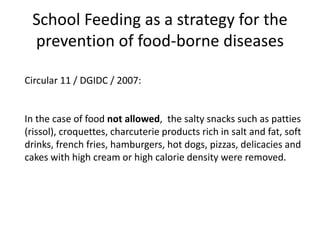
Circular 11 / DGIDC / 2007:
In the case of food not allowed, the salty snacks such as patties
(rissol), croquettes, charcuterie products rich in salt and fat, soft
drinks, french fries, hamburgers, hot dogs, pizzas, delicacies and
cakes with high cream or high calorie density were removed.
School Feeding as a strategy for the
prevention of food-borne diseases
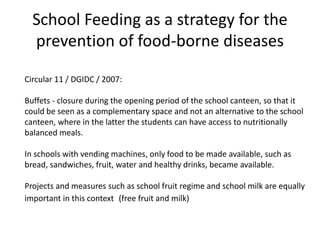
Circular 11 / DGIDC / 2007:
Buffets - closure during the opening period of the school canteen, so that it
could be seen as a complementary space and not an alternative to the school
canteen, where in the latter the students can have access to nutritionally
balanced meals.
In schools with vending machines, only food to be made available, such as
bread, sandwiches, fruit, water and healthy drinks, became available.
Projects and measures such as school fruit regime and school milk are equally
important in this context (free fruit and milk)

Eating disorders in Rio Maior

  • 1.
    Rio Maior HealthCenter How do local health authorities work to prevent eating disorders?
  • 2.
    Rio Maior HealthCenter Our school has a health office where nurses from the health center are available to serve students. If they detect students with eating disorders, ask parents to make an appointment with the family doctor in the Rio Maior Health Center.
  • 3.
    Rio Maior HealthCenter • Doctors can do two things: • cases of overweight are referred to the nutritionist's office in the Hospital District of Santarém (unfortunately the Rio Maior Health Center does not have a nutritionist); • Other eating disorders, such as anorexia or bulimia, may have psychology consultation at the Rio Maior Health Center, but are usually referred to the Hospital District of Santarém.
  • 5.
    Rio Maior HealthCenter The District Hospital of Santarém does not have a specialized team for more serious eating disorders that are referred to hospitals in Lisbon (Ex: Santa Maria Hospital)
  • 7.
    Food Education Sessionsby Nurses of the Health Center in Rio Maior schools.
  • 8.
    Food Education Sessionsby Nurses of the Health Center in Rio Maior schools. Film (clic image)
  • 9.
    Food Education Sessionsby Nurses of the Health Center in Rio Maior schools. On 2018/10/29, nurse Gabriela gave a session on eating disorders and healthy eating to the students of the 9th grade group, which is involved in the CLAP project.
  • 10.
    Food Education Sessionsby Nurses of the Health Center in Rio Maior schools. On 2018/10/29, nurse Gabriela gave a session on eating disorders and healthy eating to the students of the 9th grade group, which is involved in the CLAP project.
  • 11.
    CLAP students maderesearch and some projects about eating disorders
  • 14.
    How do we approach eating disordersin our school? Interview with school psichologist, Priscilla Ribeiro.
  • 15.
    What about schoolcanteens and buffet? • The City Hall has a nutritionist who is responsible for ascertaining whether the companies serving the meals, and the school buffet offers only choices according to the law.
  • 16.
    School Feeding asa strategy for the prevention of food-borne diseases In Portugal, one in three children is overweight and 10% are obese. Diseases such as high cholesterol, pre-diabetes, high blood pressure and fatty liver are increasing in obese children and adolescents. Schools being the place where children and adolescents spend most of their time and where they ingest a considerable portion of daily food (about 35 to 50% of the daily), they play a decisive role in the prevention and reversal of this scenario
  • 17.
    School Feeding asa strategy for the prevention of food-borne diseases Circular 3097 / DGE / 2018: In this official document we can see a list of authorized foods and criteria for preparation of menus based on the Mediterranean diet, plus the vegetarian option. The vegetarian option became mandatory only in the current school year. At the level of the school buffets, Circular 11 / DGIDC / 2007 was linked with recommendations, which defined the foodstuffs that should be promoted, limited or not available.
  • 18.
    School Feeding asa strategy for the prevention of food-borne diseases Circular 11 / DGIDC / 2007: Among the foods to be promoted are fruit, dairy products, bread, water, vegetable-enriched sandwiches, natural fruit juices, infusions and herbal teas. Between the Foods to be limited are biscuits and biscuits that should have reduced sugar and fat content and should be available in individual doses (eg toasted biscuit, wafer and salt water, etc.).
  • 19.
    School Feeding asa strategy for the prevention of food-borne diseases Circular 11 / DGIDC / 2007: In the case of food not allowed, the salty snacks such as patties (rissol), croquettes, charcuterie products rich in salt and fat, soft drinks, french fries, hamburgers, hot dogs, pizzas, delicacies and cakes with high cream or high calorie density were removed.
  • 20.
    School Feeding asa strategy for the prevention of food-borne diseases Circular 11 / DGIDC / 2007: Buffets - closure during the opening period of the school canteen, so that it could be seen as a complementary space and not an alternative to the school canteen, where in the latter the students can have access to nutritionally balanced meals. In schools with vending machines, only food to be made available, such as bread, sandwiches, fruit, water and healthy drinks, became available. Projects and measures such as school fruit regime and school milk are equally important in this context (free fruit and milk)