Dual Write Strategies for
Microservices
Bilgin Ibryam
@bibryam
Product Manager
Red Hat
About me
2
▸ Product Manager at Red Hat
▸ Former Principal Architect
▸ Committer at Apache Camel
▸ Author
・ Camel Design Patterns
・ Kubernetes Patterns
▸ @ bibryam
▸ https://www.ofbizian.com
There is a catch
3
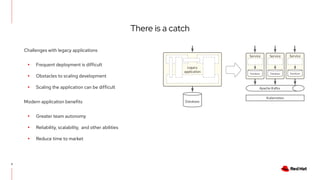
Challenges with legacy applications
▸ Frequent deployment is difficult
▸ Obstacles to scaling development
▸ Scaling the application can be difficult
Modern application benefits
▸ Greater team autonomy
▸ Reliability, scalability, and other abilities
▸ Reduce time to market
The dual-write problem
4
Dual-write challenge behind the scene
▸ Updating more than one resources
▸ Reliable inter-service communication
▸ Coordinating long-running, business transactions
▸ Recovery from failed distributed transaction
▸ Implementing idempotent operations
▸ Scaling with increasing data volume
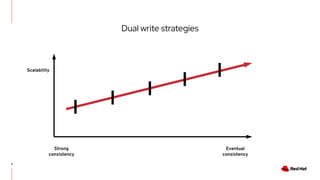
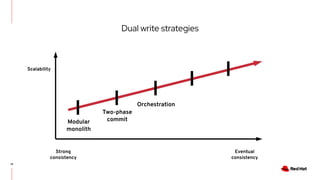
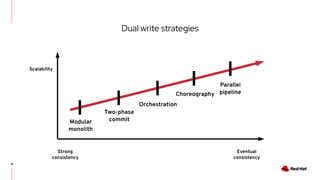
Dual write strategies
5
▸
Modular monolith
Modular monolith
7
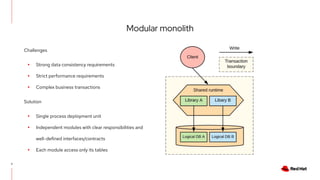
Challenges
▸ Strong data consistency requirements
▸ Strict performance requirements
▸ Complex business transactions
Solution
▸ Single process deployment unit
▸ Independent modules with clear responsibilities and
well-defined interfaces/contracts
▸ Each module access only its tables
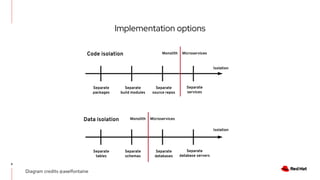
Implementation options
8
Diagram credits @axelfontaine
Modular monolith
9
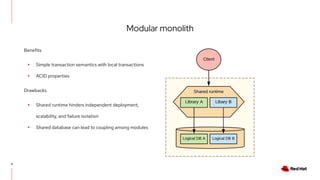
Benefits
▸ Simple transaction semantics with local transactions
▸ ACID properties
Drawbacks
▸ Shared runtime hinders independent deployment,
scalability, and failure isolation
▸ Shared database can lead to coupling among modules
Two-phase
commit
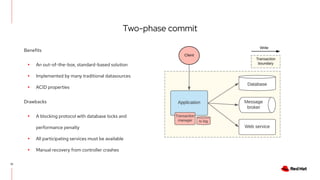
Two-phase commit
11
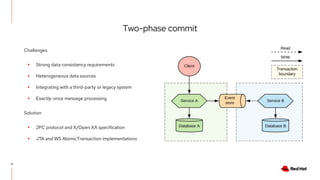
Challenges
▸ Strong data consistency requirements
▸ Heterogeneous data sources
▸ Integrating with a third-party or legacy system
▸ Exactly-once message processing
Solution
▸ 2PC protocol and X/Open XA specification
▸ JTA and WS AtomicTransaction implementations
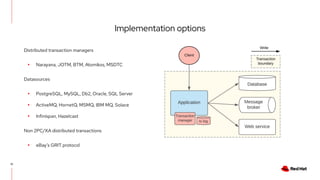
Implementation options
12
Distributed transaction managers
▸ Narayana, JOTM, BTM, Atomikos, MSDTC
Datasources
▸ PostgreSQL, MySQL, Db2, Oracle, SQL Server
▸ ActiveMQ, HornetQ, MSMQ, IBM MQ, Solace
▸ Infinispan, Hazelcast
Non 2PC/XA distributed transactions
▸ eBay’s GRIT protocol
Two-phase commit
13
Benefits
▸ An out-of-the-box, standard-based solution
▸ Implemented by many traditional datasources
▸ ACID properties
Drawbacks
▸ A blocking protocol with database locks and
performance penalty
▸ All participating services must be available
▸ Manual recovery from controller crashes
Dual write strategies
14
Orchestration
based Saga
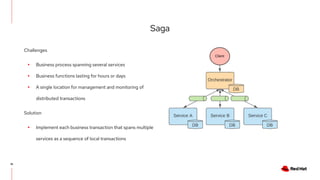
Challenges
▸ Business process spanning several services
▸ Business functions lasting for hours or days
▸ A single location for management and monitoring of
distributed transactions
Solution
▸ Implement each business transaction that spans multiple
services as a sequence of local transactions
Saga
16
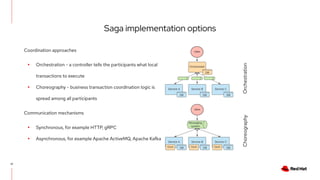
Saga implementation options
17
Coordination approaches
▸ Orchestration - a controller tells the participants what local
transactions to execute
▸ Choreography - business transaction coordination logic is
spread among all participants
Communication mechanisms
▸ Synchronous, for example HTTP, gRPC
▸ Asynchronous, for example Apache ActiveMQ, Apache Kafka
Orchestration
Choreography
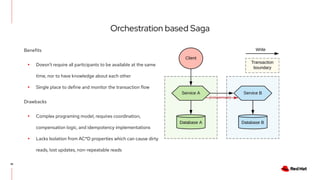
Orchestration based Saga
18
Benefits
▸ Doesn’t require all participants to be available at the same
time, nor to have knowledge about each other
▸ Single place to define and monitor the transaction flow
Drawbacks
▸ Complex programing model, requires coordination,
compensation logic, and idempotency implementations
▸ Lacks Isolation from AC*D properties which can cause dirty
reads, lost updates, non-repeatable reads
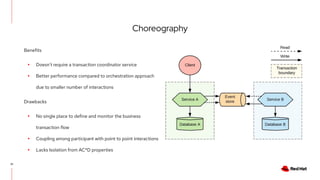
Choreography
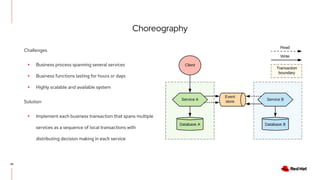
Choreography
20
Challenges
▸ Business process spanning several services
▸ Business functions lasting for hours or days
▸ Highly scalable and available system
Solution
▸ Implement each business transaction that spans multiple
services as a sequence of local transactions with
distributing decision making in each service
Choreography
21
Benefits
▸ Doesn't require a transaction coordinator service
▸ Better performance compared to orchestration approach
due to smaller number of interactions
Drawbacks
▸ No single place to define and monitor the business
transaction flow
▸ Coupling among participant with point to point interactions
▸ Lacks Isolation from AC*D properties
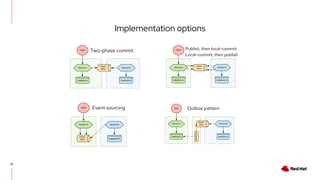
Implementation options
22
Publish, then local-commit
Local-commit, then publish
Event sourcing Outbox pattern
Two-phase commit
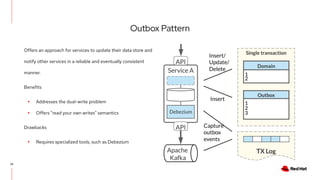
Outbox Pattern
23
Offers an approach for services to update their data store and
notify other services in a reliable and eventually consistent
manner.
Benefits
▸ Addresses the dual-write problem
▸ Offers “read your own writes" semantics
Drawbacks
▸ Requires specialized tools, such as Debezium
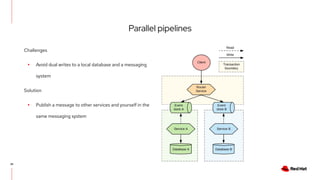
Parallel pipeline
Parallel pipelines
25
Challenges
▸ Avoid dual writes to a local database and a messaging
system
Solution
▸ Publish a message to other services and yourself in the
same messaging system
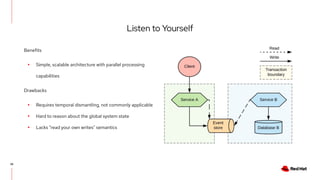
Listen to Yourself
26
Benefits
▸ Simple, scalable architecture with parallel processing
capabilities
Drawbacks
▸ Requires temporal dismantling, not commonly applicable
▸ Hard to reason about the global system state
▸ Lacks “read your own writes" semantics
Summary
Dual write strategies
28
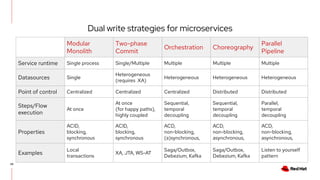
Dual write strategies for microservices
29
Modular
Monolith
Two-phase
Commit
Orchestration Choreography
Parallel
Pipeline
Service runtime Single process Single/Multiple Multiple Multiple Multiple
Datasources Single
Heterogeneous
(requires XA)
Heterogeneous Heterogeneous Heterogeneous
Point of control Centralized Centralized Centralized Distributed Distributed
Steps/Flow
execution
At once
At once
(for happy paths),
highly coupled
Sequential,
temporal
decoupling
Sequential,
temporal
decoupling
Parallel,
temporal
decoupling
Properties
ACID,
blocking,
synchronous
ACID,
blocking,
synchronous
ACD,
non-blocking,
(a)synchronous,
ACD,
non-blocking,
asynchronous,
ACD,
non-blocking,
asynchronous,
Examples
Local
transactions
XA, JTA, WS-AT
Saga/Outbox,
Debezium, Kafka
Saga/Outbox,
Debezium, Kafka
Listen to yourself
pattern
30
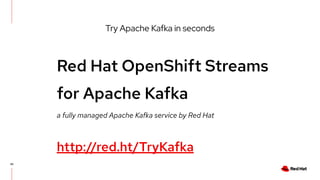
Red Hat OpenShift Streams
for Apache Kafka
a fully managed Apache Kafka service by Red Hat
http://red.ht/TryKafka
Try Apache Kafka in seconds
Dual write strategies for microservices

Dual write strategies for microservices

  • 1.
    Dual Write Strategiesfor Microservices Bilgin Ibryam @bibryam Product Manager Red Hat
  • 2.
    About me 2 ▸ ProductManager at Red Hat ▸ Former Principal Architect ▸ Committer at Apache Camel ▸ Author ・ Camel Design Patterns ・ Kubernetes Patterns ▸ @ bibryam ▸ https://www.ofbizian.com
  • 3.
    There is acatch 3 Challenges with legacy applications ▸ Frequent deployment is difficult ▸ Obstacles to scaling development ▸ Scaling the application can be difficult Modern application benefits ▸ Greater team autonomy ▸ Reliability, scalability, and other abilities ▸ Reduce time to market
  • 4.
    The dual-write problem 4 Dual-writechallenge behind the scene ▸ Updating more than one resources ▸ Reliable inter-service communication ▸ Coordinating long-running, business transactions ▸ Recovery from failed distributed transaction ▸ Implementing idempotent operations ▸ Scaling with increasing data volume
  • 5.
  • 6.
  • 7.
    Modular monolith 7 Challenges ▸ Strongdata consistency requirements ▸ Strict performance requirements ▸ Complex business transactions Solution ▸ Single process deployment unit ▸ Independent modules with clear responsibilities and well-defined interfaces/contracts ▸ Each module access only its tables
  • 8.
  • 9.
    Modular monolith 9 Benefits ▸ Simpletransaction semantics with local transactions ▸ ACID properties Drawbacks ▸ Shared runtime hinders independent deployment, scalability, and failure isolation ▸ Shared database can lead to coupling among modules
  • 10.
  • 11.
    Two-phase commit 11 Challenges ▸ Strongdata consistency requirements ▸ Heterogeneous data sources ▸ Integrating with a third-party or legacy system ▸ Exactly-once message processing Solution ▸ 2PC protocol and X/Open XA specification ▸ JTA and WS AtomicTransaction implementations
  • 12.
    Implementation options 12 Distributed transactionmanagers ▸ Narayana, JOTM, BTM, Atomikos, MSDTC Datasources ▸ PostgreSQL, MySQL, Db2, Oracle, SQL Server ▸ ActiveMQ, HornetQ, MSMQ, IBM MQ, Solace ▸ Infinispan, Hazelcast Non 2PC/XA distributed transactions ▸ eBay’s GRIT protocol
  • 13.
    Two-phase commit 13 Benefits ▸ Anout-of-the-box, standard-based solution ▸ Implemented by many traditional datasources ▸ ACID properties Drawbacks ▸ A blocking protocol with database locks and performance penalty ▸ All participating services must be available ▸ Manual recovery from controller crashes
  • 14.
  • 15.
  • 16.
    Challenges ▸ Business processspanning several services ▸ Business functions lasting for hours or days ▸ A single location for management and monitoring of distributed transactions Solution ▸ Implement each business transaction that spans multiple services as a sequence of local transactions Saga 16
  • 17.
    Saga implementation options 17 Coordinationapproaches ▸ Orchestration - a controller tells the participants what local transactions to execute ▸ Choreography - business transaction coordination logic is spread among all participants Communication mechanisms ▸ Synchronous, for example HTTP, gRPC ▸ Asynchronous, for example Apache ActiveMQ, Apache Kafka Orchestration Choreography
  • 18.
    Orchestration based Saga 18 Benefits ▸Doesn’t require all participants to be available at the same time, nor to have knowledge about each other ▸ Single place to define and monitor the transaction flow Drawbacks ▸ Complex programing model, requires coordination, compensation logic, and idempotency implementations ▸ Lacks Isolation from AC*D properties which can cause dirty reads, lost updates, non-repeatable reads
  • 19.
  • 20.
    Choreography 20 Challenges ▸ Business processspanning several services ▸ Business functions lasting for hours or days ▸ Highly scalable and available system Solution ▸ Implement each business transaction that spans multiple services as a sequence of local transactions with distributing decision making in each service
  • 21.
    Choreography 21 Benefits ▸ Doesn't requirea transaction coordinator service ▸ Better performance compared to orchestration approach due to smaller number of interactions Drawbacks ▸ No single place to define and monitor the business transaction flow ▸ Coupling among participant with point to point interactions ▸ Lacks Isolation from AC*D properties
  • 22.
    Implementation options 22 Publish, thenlocal-commit Local-commit, then publish Event sourcing Outbox pattern Two-phase commit
  • 23.
    Outbox Pattern 23 Offers anapproach for services to update their data store and notify other services in a reliable and eventually consistent manner. Benefits ▸ Addresses the dual-write problem ▸ Offers “read your own writes" semantics Drawbacks ▸ Requires specialized tools, such as Debezium
  • 24.
  • 25.
    Parallel pipelines 25 Challenges ▸ Avoiddual writes to a local database and a messaging system Solution ▸ Publish a message to other services and yourself in the same messaging system
  • 26.
    Listen to Yourself 26 Benefits ▸Simple, scalable architecture with parallel processing capabilities Drawbacks ▸ Requires temporal dismantling, not commonly applicable ▸ Hard to reason about the global system state ▸ Lacks “read your own writes" semantics
  • 27.
  • 28.
  • 29.
    Dual write strategiesfor microservices 29 Modular Monolith Two-phase Commit Orchestration Choreography Parallel Pipeline Service runtime Single process Single/Multiple Multiple Multiple Multiple Datasources Single Heterogeneous (requires XA) Heterogeneous Heterogeneous Heterogeneous Point of control Centralized Centralized Centralized Distributed Distributed Steps/Flow execution At once At once (for happy paths), highly coupled Sequential, temporal decoupling Sequential, temporal decoupling Parallel, temporal decoupling Properties ACID, blocking, synchronous ACID, blocking, synchronous ACD, non-blocking, (a)synchronous, ACD, non-blocking, asynchronous, ACD, non-blocking, asynchronous, Examples Local transactions XA, JTA, WS-AT Saga/Outbox, Debezium, Kafka Saga/Outbox, Debezium, Kafka Listen to yourself pattern
  • 30.
    30 Red Hat OpenShiftStreams for Apache Kafka a fully managed Apache Kafka service by Red Hat http://red.ht/TryKafka Try Apache Kafka in seconds