The Coming Firmware
Revolution
Bryan Cantrill
Oxide Computer Company
OXIDE
Revolutions past
• The software revolutions of the past three decades:
○ The Internet
○ Distributed version control
○ Open source
• And of course, Moore’s Law dominated hardware
• Aside: revolutions like cloud computing are the confluence of all of these
OXIDE
Hardware: The End of Moore’s Law
• When phrases exclusively as increased transistor density, Moore’s Law
holds at a greatly slowed pace — but at outsized cost
• Moore’s Law has ceased to exist as an economic law
• But is there another way of looking at it?
OXIDE
Wright’s Law?
• In 1936, Theodore Wright studied the costs of aircraft manufacturing,
finding that the cost dropped with experience
• Over time, when volume doubled, unit costs dropped by 10-15%
• This phenomenon has been observed in other technological domains
• In 2013, Jessika Trancik et al. found Wright’s Law to hold better
predictive power for transistor cost than Moore’s Law!
• Wright’s Law seems to hold, especially for older process nodes
OXIDE
Wright’s Law: Ramifications
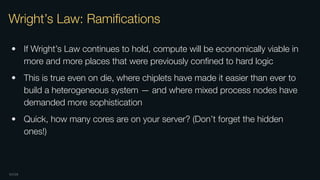
• If Wright’s Law continues to hold, compute will be economically viable in
more and more places that were previously confined to hard logic
• This is true even on die, where chiplets have made it easier than ever to
build a heterogeneous system — and where mixed process nodes have
demanded more sophistication
• Quick, how many cores are on your server? (Don’t forget the hidden
ones!)
OXIDE
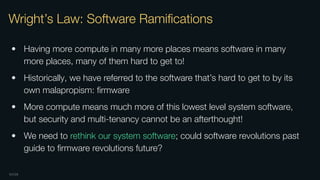
Wright’s Law: Software Ramifications
• Having more compute in many more places means software in many
more places, many of them hard to get to!
• Historically, we have referred to the software that’s hard to get to by its
own malapropism: firmware
• More compute means much more of this lowest level system software,
but security and multi-tenancy cannot be an afterthought!
• We need to rethink our system software; could software revolutions past
guide to firmware revolutions future?
OXIDE
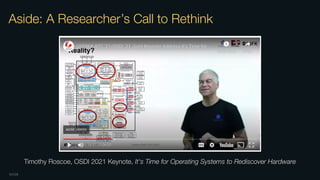
Aside: A Researcher’s Call to Rethink
Timothy Roscoe, OSDI 2021 Keynote, It's Time for Operating Systems to Rediscover Hardware
OXIDE
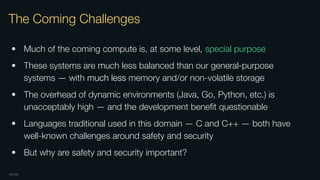
The Coming Challenges
• Much of the coming compute is, at some level, special purpose
• These systems are much less balanced than our general-purpose
systems — with much less memory and/or non-volatile storage
• The overhead of dynamic environments (Java, Go, Python, etc.) is
unacceptably high — and the development benefit questionable
• Languages traditional used in this domain — C and C++ — both have
well-known challenges around safety and security
• But why are safety and security important?
OXIDE
The Needed Software Revolution
• Safety and security are necessary for composability!
• Composability fuels open source: when composability is absent, source
code may serve as blueprint and literature -- but not building block
• Open source is itself the most important coming revolution in firmware...
• But for the open source revolution to gain purchase within firmware, we
must have open, safe, secure, composable components
• Enter Rust, and its killer feature...
OXIDE
Rust: no_std
• Rust is a revolutionary language in many respects, but one that may be
underappreciated is its ability to not depend on its own standard library
• Much of what is valuable about the language — sum types, ownership
model, traits, hygienic macros — is in core, not the standard library
• Crates marked “no_std” will not perform any heap allocations — and
any such allocation is a compile-time error!
• But no_std crates can depend on other no_std crates — lending real
composability to a domain for whom it has been entirely deprived
OXIDE
Rust: no_std binaries
• Rust no_std binaries are stunningly small
○ E.g., at Oxide, we are developing a message-passing, memory
protected system entirely in Rust (Rust microkernel, Rust tasks);
minimal systems are 30K — and entirely realistic ones are < 200K!
• no_std is without real precedent in other languages or environments; it
allows Rust to be put in essentially arbitrarily confined contexts
• Rust is the first language since C to meaningfully exist at the boundary
of hardware and systems software!
OXIDE
The Coming Firmware Revolution
• Wright’s Law will continue to hold, resulting in more compute in more
places — bringing with it more firmware!
• We know from the last three decades that open source is essential --
but it needs composability to become non-linear
• Rust brings new levels of composability to firmware
• We fully expect many more open source, de novo hardware-facing
Rust-based systems — and thanks to no_std they will be able to
leverage one another, greatly accelerating open source firmware!

The Coming Firmware Revolution

  • 1.
    The Coming Firmware Revolution BryanCantrill Oxide Computer Company
  • 2.
    OXIDE Revolutions past • Thesoftware revolutions of the past three decades: ○ The Internet ○ Distributed version control ○ Open source • And of course, Moore’s Law dominated hardware • Aside: revolutions like cloud computing are the confluence of all of these
  • 3.
    OXIDE Hardware: The Endof Moore’s Law • When phrases exclusively as increased transistor density, Moore’s Law holds at a greatly slowed pace — but at outsized cost • Moore’s Law has ceased to exist as an economic law • But is there another way of looking at it?
  • 4.
    OXIDE Wright’s Law? • In1936, Theodore Wright studied the costs of aircraft manufacturing, finding that the cost dropped with experience • Over time, when volume doubled, unit costs dropped by 10-15% • This phenomenon has been observed in other technological domains • In 2013, Jessika Trancik et al. found Wright’s Law to hold better predictive power for transistor cost than Moore’s Law! • Wright’s Law seems to hold, especially for older process nodes
  • 5.
    OXIDE Wright’s Law: Ramifications •If Wright’s Law continues to hold, compute will be economically viable in more and more places that were previously confined to hard logic • This is true even on die, where chiplets have made it easier than ever to build a heterogeneous system — and where mixed process nodes have demanded more sophistication • Quick, how many cores are on your server? (Don’t forget the hidden ones!)
  • 6.
    OXIDE Wright’s Law: SoftwareRamifications • Having more compute in many more places means software in many more places, many of them hard to get to! • Historically, we have referred to the software that’s hard to get to by its own malapropism: firmware • More compute means much more of this lowest level system software, but security and multi-tenancy cannot be an afterthought! • We need to rethink our system software; could software revolutions past guide to firmware revolutions future?
  • 7.
    OXIDE Aside: A Researcher’sCall to Rethink Timothy Roscoe, OSDI 2021 Keynote, It's Time for Operating Systems to Rediscover Hardware
  • 8.
    OXIDE The Coming Challenges •Much of the coming compute is, at some level, special purpose • These systems are much less balanced than our general-purpose systems — with much less memory and/or non-volatile storage • The overhead of dynamic environments (Java, Go, Python, etc.) is unacceptably high — and the development benefit questionable • Languages traditional used in this domain — C and C++ — both have well-known challenges around safety and security • But why are safety and security important?
  • 9.
    OXIDE The Needed SoftwareRevolution • Safety and security are necessary for composability! • Composability fuels open source: when composability is absent, source code may serve as blueprint and literature -- but not building block • Open source is itself the most important coming revolution in firmware... • But for the open source revolution to gain purchase within firmware, we must have open, safe, secure, composable components • Enter Rust, and its killer feature...
  • 10.
    OXIDE Rust: no_std • Rustis a revolutionary language in many respects, but one that may be underappreciated is its ability to not depend on its own standard library • Much of what is valuable about the language — sum types, ownership model, traits, hygienic macros — is in core, not the standard library • Crates marked “no_std” will not perform any heap allocations — and any such allocation is a compile-time error! • But no_std crates can depend on other no_std crates — lending real composability to a domain for whom it has been entirely deprived
  • 11.
    OXIDE Rust: no_std binaries •Rust no_std binaries are stunningly small ○ E.g., at Oxide, we are developing a message-passing, memory protected system entirely in Rust (Rust microkernel, Rust tasks); minimal systems are 30K — and entirely realistic ones are < 200K! • no_std is without real precedent in other languages or environments; it allows Rust to be put in essentially arbitrarily confined contexts • Rust is the first language since C to meaningfully exist at the boundary of hardware and systems software!
  • 12.
    OXIDE The Coming FirmwareRevolution • Wright’s Law will continue to hold, resulting in more compute in more places — bringing with it more firmware! • We know from the last three decades that open source is essential -- but it needs composability to become non-linear • Rust brings new levels of composability to firmware • We fully expect many more open source, de novo hardware-facing Rust-based systems — and thanks to no_std they will be able to leverage one another, greatly accelerating open source firmware!