UNIBA: Super Sense Tagging at EVALITA 2011

                                           Pierpaolo Basile

                                           basilepp@di.uniba.it
                                    Department of Computer Science
                                  University of Bari “A. Moro” (ITALY)


                                   EVALITA 2011, Rome, 24-25 January 2012


Pierpaolo Basile (basilepp@di.uniba.it)         SST Uniba                24/01/2012   1 / 12
Motivation


Motivation


         Super Sense Tagging as sequence labelling problem [1]
         Supervised approach
                 lexical/linguistic features
                 distributional features
         Main motivation: tackle the data sparseness problem using word
         similarity in a WordSpace


Pierpaolo Basile (basilepp@di.uniba.it)         SST Uniba        24/01/2012   2 / 12
WordSpace


WordSpace


                You shall know a word
                by the company it
                keeps! [5]
                Words are represented as
                points in a geometric
                space
                Words are related if they
                are close in that space


Pierpaolo Basile (basilepp@di.uniba.it)         SST Uniba   24/01/2012   3 / 12
WordSpace   Random Indexing


WordSpace: Random Indexing


Random Indexing [4]
         builds WordSpace using document as context
         no matrix factorization required
         word-vectors are inferred using an incremental strategy
            1    a random vector is assigned to each context
                         sparse, high-dimensional and ternary ({-1, 0, 1})
                         a small number of randomly distributed non-zero elements
            2    random vectors are accumulated incrementally by analyzing contexts in
                 which terms occur
                         word-vector assigned to each word is the sum of the random vectors of
                         the contexts in which the term occur


Pierpaolo Basile (basilepp@di.uniba.it)         SST Uniba                      24/01/2012   4 / 12
WordSpace   Random Indexing


WordSpace: Random Indexing

Formally Random Indexing is based on Random Projection [2]

                                          An,m · R m,k = B n,k      k<m                    (1)

where An,m is, for example, a term-doc matrix


After projection the distance between points is preserved: d = c· dr

Pierpaolo Basile (basilepp@di.uniba.it)               SST Uniba               24/01/2012   5 / 12
WordSpace     Random Indexing


WordSpace: context

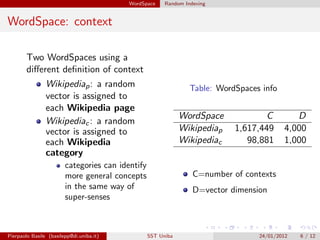
        Two WordSpaces using a
        different definition of context
                Wikipediap : a random                            Table: WordSpaces info
                vector is assigned to
                each Wikipedia page
                                                              WordSpace            C         D
                Wikipediac : a random
                vector is assigned to                         Wikipediap    1,617,449     4,000
                each Wikipedia                                Wikipediac       98,881     1,000
                category
                        categories can identify
                        more general concepts                     C=number of contexts
                        in the same way of                        D=vector dimension
                        super-senses


Pierpaolo Basile (basilepp@di.uniba.it)           SST Uniba                       24/01/2012   6 / 12
Methodology


Methodology


         Learning method: LIBLINEAR (SVM) [3]
         Features
            1    word, lemma, PoS-tag, the first letter of the PoS-tag
            2    the super-sense assigned to the most frequent sense of the word
                 computed according to sense frequency in MultiSemCor
            3    word starts with an upper-case character
            4    grammatical conjugation (e.g. -are, -ere and -ire for Italian verbs)
            5    distributional features: word-vector in the WordSpace


Pierpaolo Basile (basilepp@di.uniba.it)           SST Uniba                 24/01/2012   7 / 12
Evaluation


Evaluation


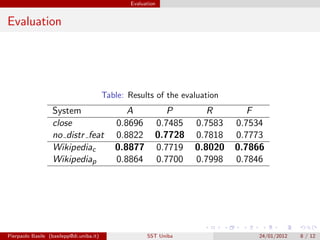
                                          Table: Results of the evaluation
                   System                       A             P        R        F
                   close                     0.8696        0.7485   0.7583   0.7534
                   no distr feat             0.8822        0.7728   0.7818   0.7773
                   Wikipediac                0.8877        0.7719   0.8020   0.7866
                   Wikipediap                0.8864        0.7700   0.7998   0.7846


Pierpaolo Basile (basilepp@di.uniba.it)                 SST Uniba                24/01/2012   8 / 12
Final Remarks


Final Remarks


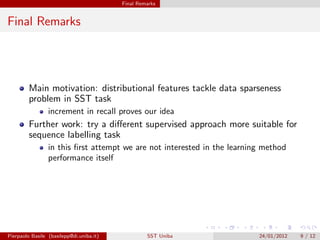
         Main motivation: distributional features tackle data sparseness
         problem in SST task
                 increment in recall proves our idea
         Further work: try a different supervised approach more suitable for
         sequence labelling task
                 in this first attempt we are not interested in the learning method
                 performance itself


Pierpaolo Basile (basilepp@di.uniba.it)            SST Uniba              24/01/2012   9 / 12
Final Remarks


                               That’s all folks!


Pierpaolo Basile (basilepp@di.uniba.it)            SST Uniba   24/01/2012   10 / 12
Final Remarks


For Further Reading I


        Ciaramita, M., Altun, Y.: Broad-coverage sense disambiguation and
        information extraction with a supersense sequence tagger. In:
        Proceedings of the 2006 Conference on Empirical Methods in Natural
        Language Processing. pp. 594–602. Association for Computational
        Linguistics (2006)
        Dasgupta, S., Gupta, A.: An elementary proof of a theorem of
        Johnson and Lindenstrauss. Random Structures & Algorithms 22(1),
        60–65 (2003)
        Fan, R., Chang, K., Hsieh, C., Wang, X., Lin, C.: Liblinear: A library
        for large linear classification. The Journal of Machine Learning
        Research 9, 1871–1874 (2008)


Pierpaolo Basile (basilepp@di.uniba.it)            SST Uniba     24/01/2012   11 / 12
Final Remarks


For Further Reading II


        Sahlgren, M.: An introduction to random indexing. In: Methods and
        Applications of Semantic Indexing Workshop at the 7th International
        Conference on Terminology and Knowledge Engineering, TKE. vol. 5
        (2005)
        Sahlgren, M.: The Word-Space Model: Using distributional analysis to
        represent syntagmatic and paradigmatic relations between words in
        high-dimensional vector spaces. Ph.D. thesis, Stockholm: Stockholm
        University, Faculty of Humanities, Department of Linguistics (2006)


Pierpaolo Basile (basilepp@di.uniba.it)            SST Uniba   24/01/2012   12 / 12

Sst evalita2011 basile_pierpaolo

  • 1.
    UNIBA: Super SenseTagging at EVALITA 2011 Pierpaolo Basile basilepp@di.uniba.it Department of Computer Science University of Bari “A. Moro” (ITALY) EVALITA 2011, Rome, 24-25 January 2012 Pierpaolo Basile (basilepp@di.uniba.it) SST Uniba 24/01/2012 1 / 12
  • 2.
    Motivation Motivation Super Sense Tagging as sequence labelling problem [1] Supervised approach lexical/linguistic features distributional features Main motivation: tackle the data sparseness problem using word similarity in a WordSpace Pierpaolo Basile (basilepp@di.uniba.it) SST Uniba 24/01/2012 2 / 12
  • 3.
    WordSpace WordSpace You shall know a word by the company it keeps! [5] Words are represented as points in a geometric space Words are related if they are close in that space Pierpaolo Basile (basilepp@di.uniba.it) SST Uniba 24/01/2012 3 / 12
  • 4.
    WordSpace Random Indexing WordSpace: Random Indexing Random Indexing [4] builds WordSpace using document as context no matrix factorization required word-vectors are inferred using an incremental strategy 1 a random vector is assigned to each context sparse, high-dimensional and ternary ({-1, 0, 1}) a small number of randomly distributed non-zero elements 2 random vectors are accumulated incrementally by analyzing contexts in which terms occur word-vector assigned to each word is the sum of the random vectors of the contexts in which the term occur Pierpaolo Basile (basilepp@di.uniba.it) SST Uniba 24/01/2012 4 / 12
  • 5.
    WordSpace Random Indexing WordSpace: Random Indexing Formally Random Indexing is based on Random Projection [2] An,m · R m,k = B n,k k<m (1) where An,m is, for example, a term-doc matrix After projection the distance between points is preserved: d = c· dr Pierpaolo Basile (basilepp@di.uniba.it) SST Uniba 24/01/2012 5 / 12
  • 6.
    WordSpace Random Indexing WordSpace: context Two WordSpaces using a different definition of context Wikipediap : a random Table: WordSpaces info vector is assigned to each Wikipedia page WordSpace C D Wikipediac : a random vector is assigned to Wikipediap 1,617,449 4,000 each Wikipedia Wikipediac 98,881 1,000 category categories can identify more general concepts C=number of contexts in the same way of D=vector dimension super-senses Pierpaolo Basile (basilepp@di.uniba.it) SST Uniba 24/01/2012 6 / 12
  • 7.
    Methodology Methodology Learning method: LIBLINEAR (SVM) [3] Features 1 word, lemma, PoS-tag, the first letter of the PoS-tag 2 the super-sense assigned to the most frequent sense of the word computed according to sense frequency in MultiSemCor 3 word starts with an upper-case character 4 grammatical conjugation (e.g. -are, -ere and -ire for Italian verbs) 5 distributional features: word-vector in the WordSpace Pierpaolo Basile (basilepp@di.uniba.it) SST Uniba 24/01/2012 7 / 12
  • 8.
    Evaluation Evaluation Table: Results of the evaluation System A P R F close 0.8696 0.7485 0.7583 0.7534 no distr feat 0.8822 0.7728 0.7818 0.7773 Wikipediac 0.8877 0.7719 0.8020 0.7866 Wikipediap 0.8864 0.7700 0.7998 0.7846 Pierpaolo Basile (basilepp@di.uniba.it) SST Uniba 24/01/2012 8 / 12
  • 9.
    Final Remarks Final Remarks Main motivation: distributional features tackle data sparseness problem in SST task increment in recall proves our idea Further work: try a different supervised approach more suitable for sequence labelling task in this first attempt we are not interested in the learning method performance itself Pierpaolo Basile (basilepp@di.uniba.it) SST Uniba 24/01/2012 9 / 12
  • 10.
    Final Remarks That’s all folks! Pierpaolo Basile (basilepp@di.uniba.it) SST Uniba 24/01/2012 10 / 12
  • 11.
    Final Remarks For FurtherReading I Ciaramita, M., Altun, Y.: Broad-coverage sense disambiguation and information extraction with a supersense sequence tagger. In: Proceedings of the 2006 Conference on Empirical Methods in Natural Language Processing. pp. 594–602. Association for Computational Linguistics (2006) Dasgupta, S., Gupta, A.: An elementary proof of a theorem of Johnson and Lindenstrauss. Random Structures & Algorithms 22(1), 60–65 (2003) Fan, R., Chang, K., Hsieh, C., Wang, X., Lin, C.: Liblinear: A library for large linear classification. The Journal of Machine Learning Research 9, 1871–1874 (2008) Pierpaolo Basile (basilepp@di.uniba.it) SST Uniba 24/01/2012 11 / 12
  • 12.
    Final Remarks For FurtherReading II Sahlgren, M.: An introduction to random indexing. In: Methods and Applications of Semantic Indexing Workshop at the 7th International Conference on Terminology and Knowledge Engineering, TKE. vol. 5 (2005) Sahlgren, M.: The Word-Space Model: Using distributional analysis to represent syntagmatic and paradigmatic relations between words in high-dimensional vector spaces. Ph.D. thesis, Stockholm: Stockholm University, Faculty of Humanities, Department of Linguistics (2006) Pierpaolo Basile (basilepp@di.uniba.it) SST Uniba 24/01/2012 12 / 12