WHAT THE
RESEARCH SAYS
Mid-Winter Conference
February 2018
Brought to you by your ACTEAZ
Love
indicators
• Media mentions of CTE have quadrupled
In 2016, 42 states carried out a total of 139 policy actions relevant to
CTE
• ESSA –49 states included at least one strategy to expand career
readiness. 35 states incorporated a career-ready focused measure
in high school accountability and 20 state identified career readiness
as an explicit priority
• 91% of parents of students in CTE believe their child is getting a leg
up on their career, compared to only 44% of prospective parents
• 82% of CTE students are satisfied with their ability to learn real world
skills in school, compared to only 51% of non-CTE students
• House passage of Strengthening CTE for the 21st Century—sponsored
by 29 Republicans and 11 Democrats
• The only topic agreed upon by Donald Trump, Betsy DeVos, Randi
Weingarten and Al Franken
Everyone is talking about Career
Literacy
■ 54% of American companies report having vacancies for which they cannot find
qualified workers 1
■ 55% of the job seekers surveyed blame gaps in their education for their lack of
skills 2
■ 42% attribute the problem to a lack of knowledge about potential career
opportunities 2
■ Only 25% of job seekers report receiving career path counseling in high school 2
■ 41% say they wish they had received more career guidance 2
■ 87% of Americans believe students should have more education about career
choices 3
The Downside to Career and
Technical Education
The Atlantic
“Yet new international research points to a significant downside of such programs:
Students may benefit early in their careers, but are harmed later in life as the
economy changes and they lack the general skills necessary to adapt.”
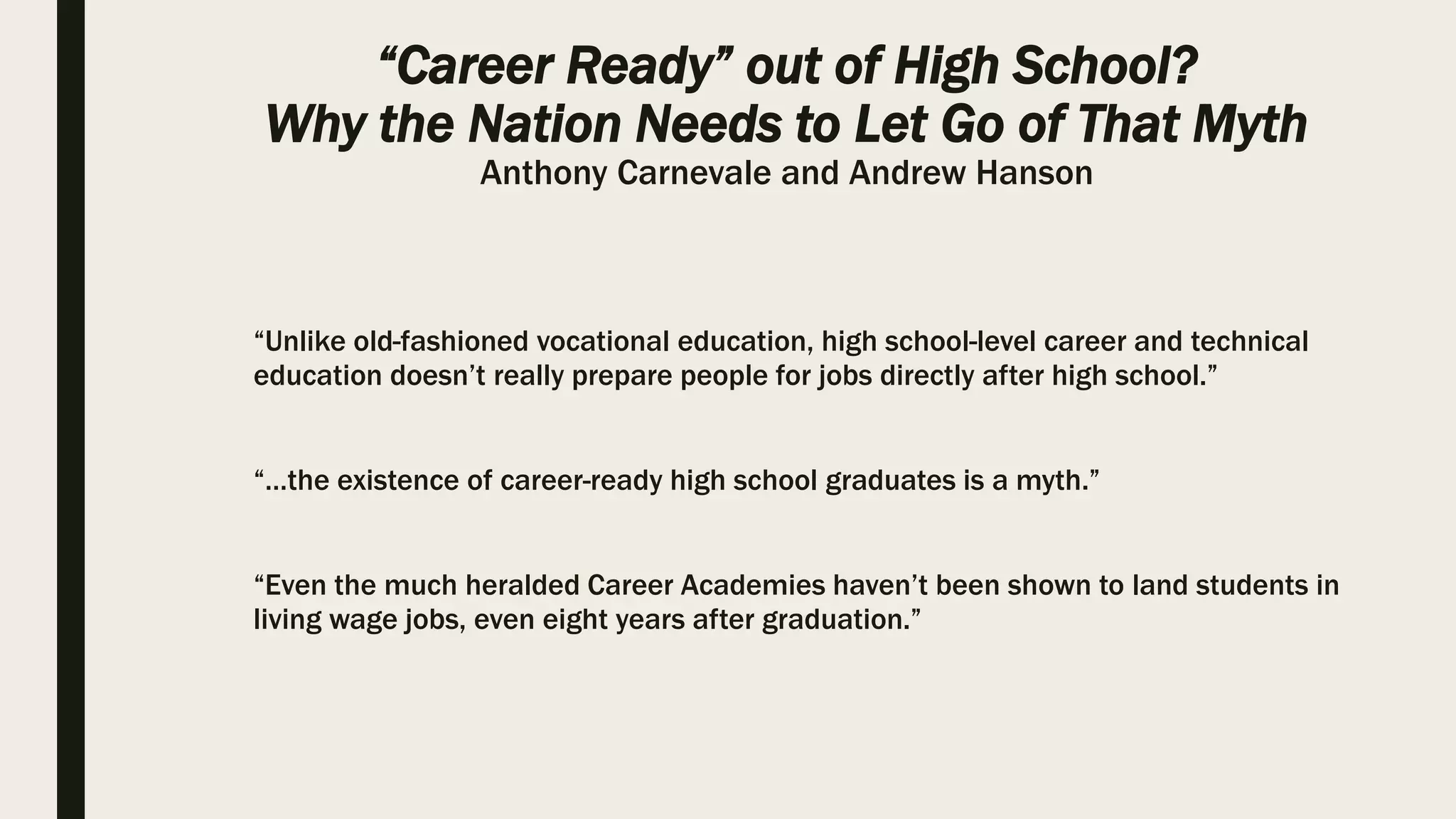
“Career Ready” out of High School?
Why the Nation Needs to Let Go of That Myth
Anthony Carnevale and Andrew Hanson
“Unlike old-fashioned vocational education, high school-level career and technical
education doesn’t really prepare people for jobs directly after high school.”
“…the existence of career-ready high school graduates is a myth.”
“Even the much heralded Career Academies haven’t been shown to land students in
living wage jobs, even eight years after graduation.”
Not All Career and Technical Education
Programs Are Created Equal
Jenny Abamu
“There is a significant difference between the quality of CTE programs.”
“If students get into programs that are not challenging and don’t lead to postsecondary
opportunities, that is a risk.”
“The three components of a high-quality CTE offering include work-based learning…student
organizations…and an integrated, standards-aligned curriculum.”
CTE Revamp Squeezes Out the
Disadvantaged
Catherine Gewertz
“For years, CTE advocates have worked hard to shake the holdovers of previous
generations’ ‘vocational education.’”
“More recently, the top priority of CTE has been building academic rigor into its
programs.”
“But, a painful byproduct of that push, in some cases, has been to marginalize low-
income and minority students.”
Increased scrutiny of CTE in Arizona
■ Legislative changes: 2016--HB 1525; 2017—HB 2229
■ A-F
– College and Career Readiness Rubric
But, there is still far more love
than “other”
CTE works!
■ It is learning that works
ENGAGEMENT
Getting kids to school and graduating on time
National Statistics
■ The graduation rate for CTE concentrators is about 93%, approximately 10
percentage points higher than the national average.1
■ A 2016 study in Arkansas found that students who concentrated in CTE programs
were 21 percentage points more likely to graduate from high school than their
peers. 2
2015-16 Arizona CTE Concentrator
■ Four year graduation rate is 99%
ACHIEVEMENT
Achievement
■ According to the College Board, the data show that
reading and math scores of CTE students are above
those of students overall, as well as their graduation
and placement rates.
■ According to the National Center for Education
Statistics students who participate in CTE programs
of study definitely outperform peers. CTE students
enrolled in science or STEM-centric fields of study—
including agriculture, IT and engineering technology
scored at and above average on the 12th grade NAEP.
In fact, the highest 12th grade NAEP scores in science
were earned by CTE concentrators in agriculture, IT
and engineering technology. 1
■ In Indiana CTE concentrators performed 10
percentage points higher on Algebra exams than non-
CTE students.2
TRANSITION
Sending them on to worthy post secondary destinations
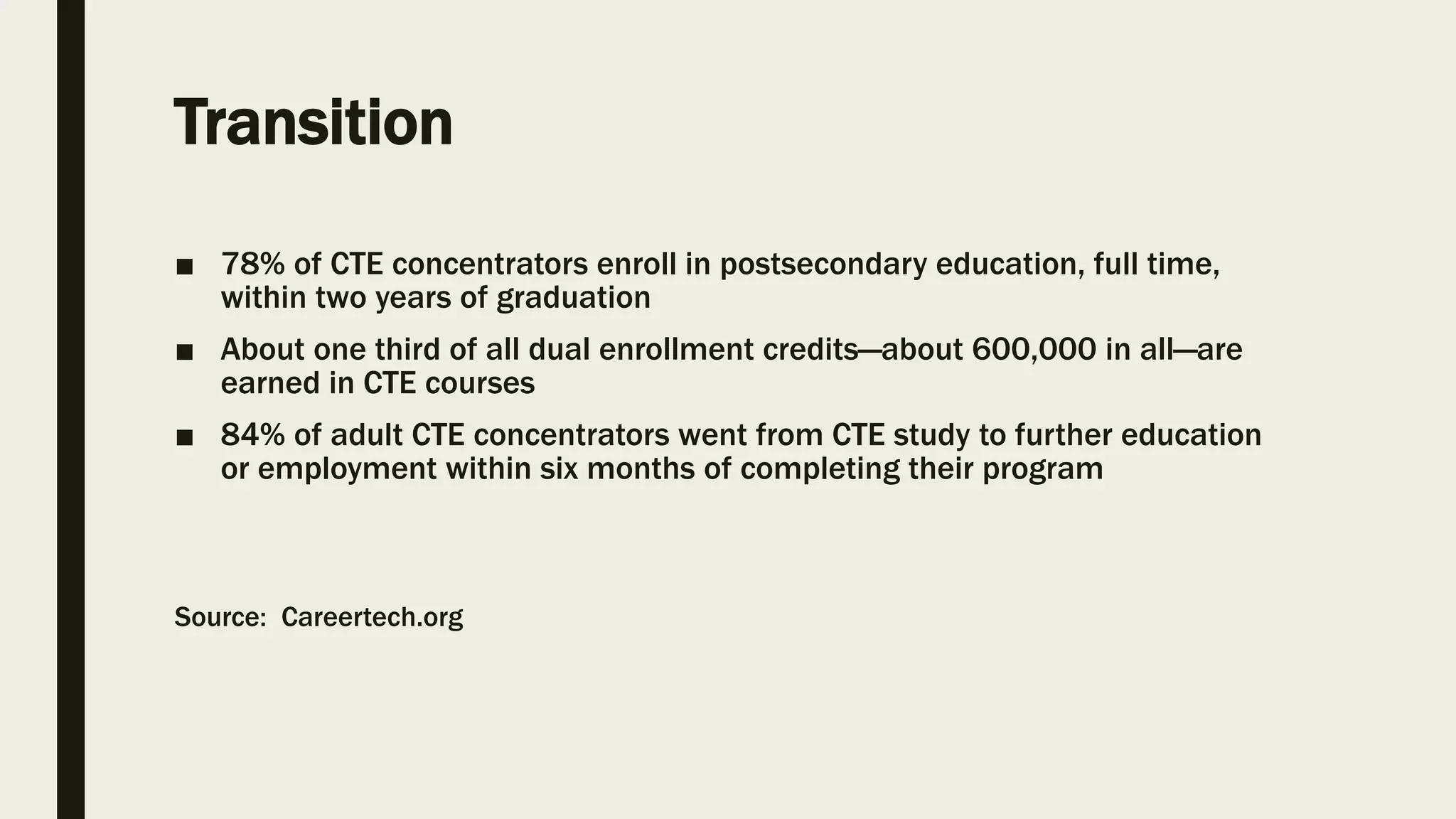
Transition
■ 78% of CTE concentrators enroll in postsecondary education, full time,
within two years of graduation
■ About one third of all dual enrollment credits—about 600,000 in all—are
earned in CTE courses
■ 84% of adult CTE concentrators went from CTE study to further education
or employment within six months of completing their program
Source: Careertech.org
Fordham Institute report on CTE--
2016
■ Students with greater exposure to CTE are more likely to graduate from
high school, enroll in a two-year college, be employed, and earn higher
wages.
■ CTE is not a path away from college: Students taking more CTE classes are
just as likely to pursue a four-year degree as their peers.
■ Students who focus their CTE coursework are more likely to graduate high
school by twenty-one percentage points compared to otherwise similar
students (and they see a positive impact on other outcomes as well).
■ CTE provides the greatest boost to the kids who need it most—boys, and
students from low-income families.
MAJOR THEMES
Middle Skill Jobs
■ 47% of all new jobs 2010-20 are middle skills jobs1
■ 48% of current labor force are middle skill jobs1
■ 86% of companies have experienced labor
shortages….up from 53% in 20131
■ 52% of Arizona jobs are middle skill2
Source: Harvard Business Review
Who Can Fix the Middle-Skills Gap? January 2015
Middle Skill jobs…called New Collar Jobs by
some….are where significant opportunity lies.
These are jobs requiring more than a high
school diploma but less than a baccalaureate
degree
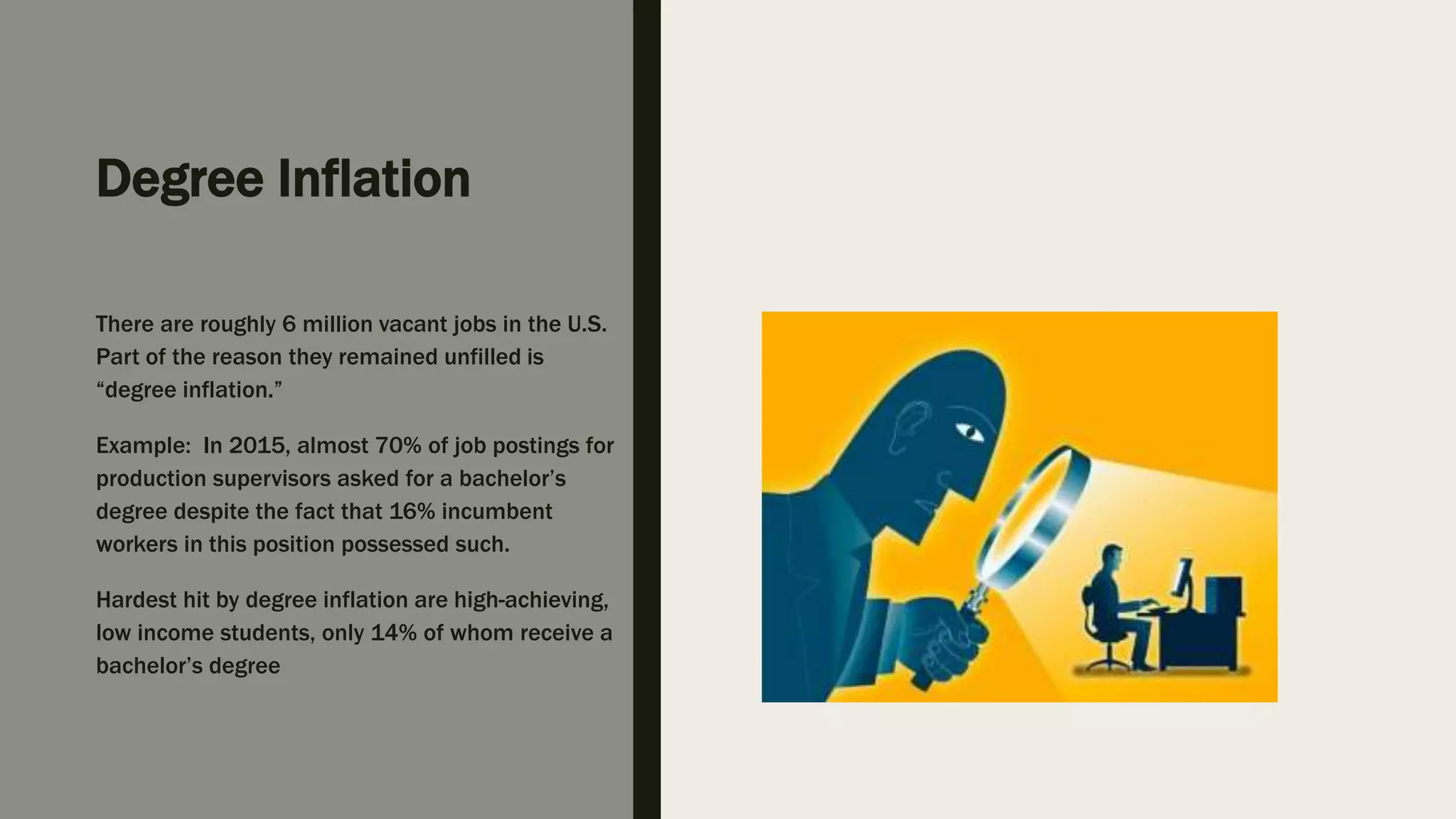
Degree Inflation
There are roughly 6 million vacant jobs in the U.S.
Part of the reason they remained unfilled is
“degree inflation.”
Example: In 2015, almost 70% of job postings for
production supervisors asked for a bachelor’s
degree despite the fact that 16% incumbent
workers in this position possessed such.
Hardest hit by degree inflation are high-achieving,
low income students, only 14% of whom receive a
bachelor’s degree
Degrees of
OpportunityMark Schneider and Rooney
Columbus
■ Many associates degrees and certificate
programs offer valuable routes into the
middle class—28% of workers with
associates earn more than median
earnings for workers with bachelor’s
degrees
■ Majors matter greatly with respect to post-
secondary earnings—no matter the degree
level—and skills-oriented programs in
health, engineering and other technical
fields are more remunerative
■ While state flagship universities offer many
opportunities for employment with high
earnings, there are many high-return
programs at regional universities and
community colleges
■ Beware of the ROI…..
Skills vs.
Degrees
Entering a “prove it” economy
Credentials are increasingly the storage
unit for skills
Temporal structure of life—get your
learning, then get your job—is no longer
linear; it is looped.
Focus in job screening needs to be skill-
based rather than degree-based.
The
Credential
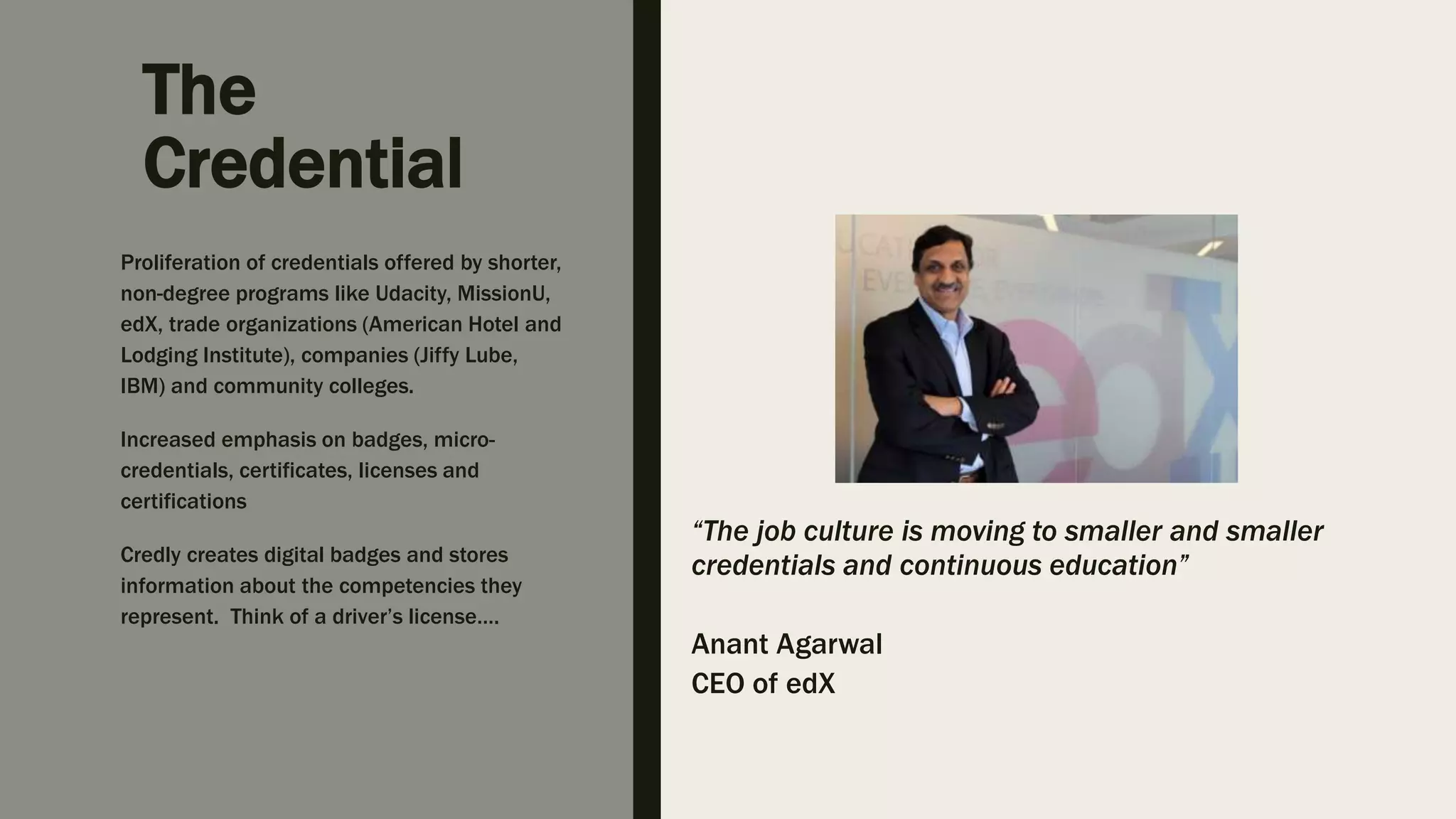
“The job culture is moving to smaller and smaller
credentials and continuous education”
Anant Agarwal
CEO of edX
Proliferation of credentials offered by shorter,
non-degree programs like Udacity, MissionU,
edX, trade organizations (American Hotel and
Lodging Institute), companies (Jiffy Lube,
IBM) and community colleges.
Increased emphasis on badges, micro-
credentials, certificates, licenses and
certifications
Credly creates digital badges and stores
information about the competencies they
represent. Think of a driver’s license….
Bringing
order to the
chaos
Determining what credential mean is a
challenge to students and employers.
Many efforts are underway to make sense of it
all.
Credential Transparency Initiative has become
Credential Engine
Look for an app this summer called “Workit”
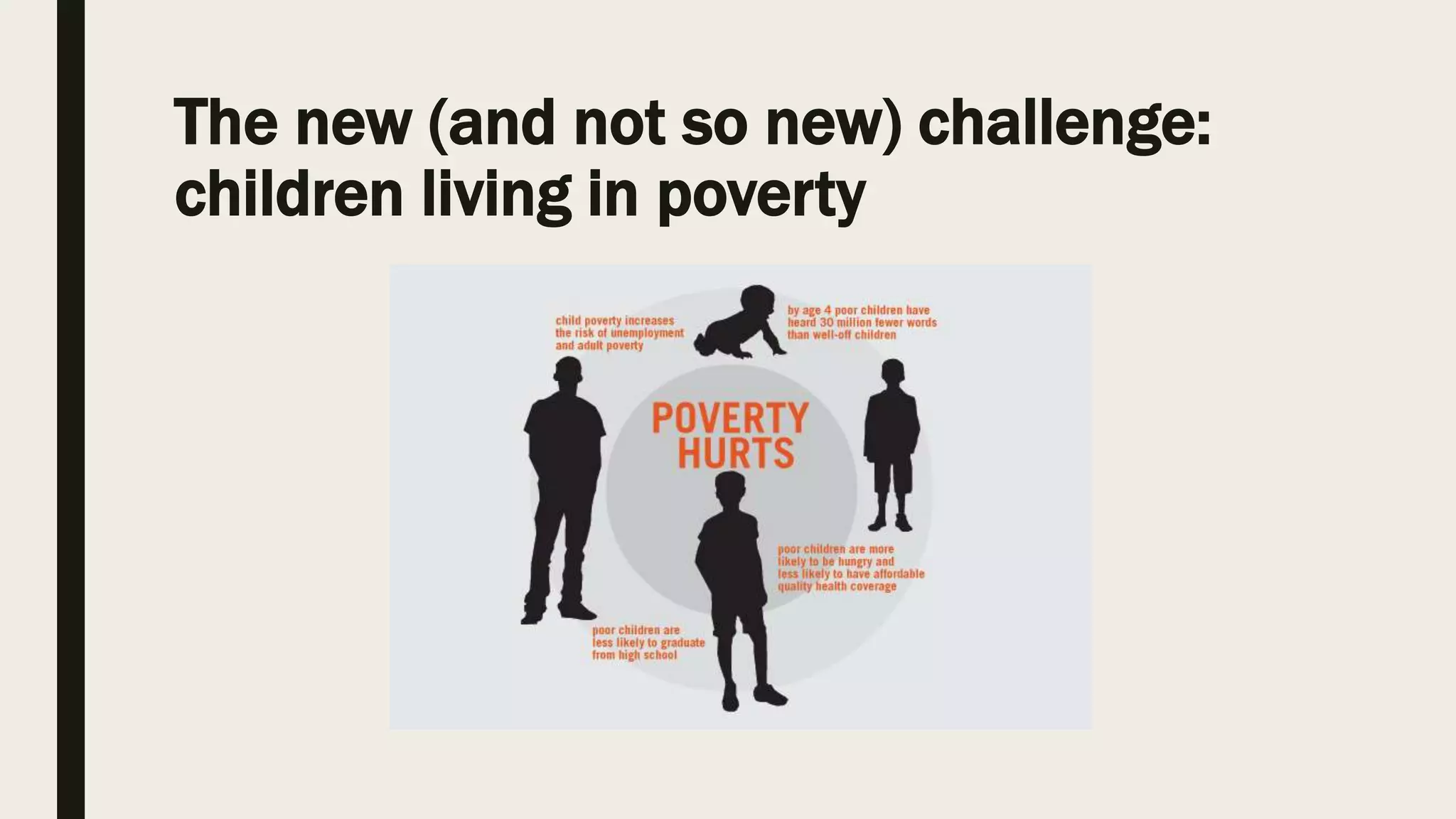
The new (and not so new) challenge:
children living in poverty
The Social mobility escalator is
broken
■ For the first time in 50 years, a
majority of U.S. public school
students come from low income
families.
Youth Poverty is a Huge Challenge
Labor Force by Age
Disconnected Youth-Ages 16-24: 2016
9.0
9.1
9.2
10.6
11.4
12.2
12.2
12.5
12.8
13.1
13.5
13.5
14.0
14.0
14.2
14.5
15.0
15.2
15.4
17.2
Nebraska
Wyoming
North Dakota
South Dakota
Colorado
Kansas
Utah
Montana
Oregon
Washington
California
Western Region
Idaho
Hawaii
Texas
Nevada
New Mexico
Arizona
Oklahoma
Alaska
Source: Opportunity Nation, 2016
Economic Trends
YOUNG ADULTS ARE FALLING BEHIND: Youth Labor Force Participation has been
falling, and roughly one-out-of-seven youth (16-24) are not in school or at work.
PROLIFERATION OF LOW PAID JOBS: Of the ten occupations that will create the most
jobs in the West, nine pay less than $33,000 a year
EDUCATION IS CRITICAL: Those with a high school degree or less have lost millions of
jobs since 2008. Job gains have gone to those with at least some post-secondary
education.
The
Challenge
Less than half of young adults earn a
bachelor’s degree, associate’s degree or
industry-recognized credential by the age of
30.
“There is no end to the good we can do.”
Career and Technical Education
Suggested Reading:
■ Doughtery, Shaun. “Career and Technical Education in High School: Does It Improve
Student Outcomes.” Fordham. April 2016.
■ Catellano, Sundell and Richardson. “Achievement Outcomes Among High School
Graudates in College and Career Readiness Programs of Study.” Peabody Journal of
Education. Volume 92, 2017. Issue 2
■ Pappano, Laura. “Is the College Degree Outdated?” Higher Education. April 27, 2017.
■ Stringfield and Stone. “The Labor Market Imperative for CTE: Changes and Challenges
for the 21st Century.” Peabody Journal of Education. Volume 92, 2017. Issue 2.
■ Stone. “Introduction to Pathways to a Productive Adulthood: The Role of CTE in the
American High School.” Peabody Journal of Education. Volume 92, 2017. Issue 2.
■ Carnevale, Smith and Strohl. “Recovery: Job Growth and Education Requirements
Through 2020.” Georgetown University Public Policy Institute. 2013.
Need more information?
For more CTE research visit:
• The CTE Research Clearinghouse at
http://www.acteonline.org/clearinghouse.aspx
• The National Research Center for CTE at www.nrccte.org
• Association for Career and Technical Education www.acteonline.org
• Advance CTE at www.careertech.org
What The Research Says - 2018

What The Research Says - 2018

  • 1.
    WHAT THE RESEARCH SAYS Mid-WinterConference February 2018 Brought to you by your ACTEAZ
  • 2.
    Love indicators • Media mentionsof CTE have quadrupled In 2016, 42 states carried out a total of 139 policy actions relevant to CTE • ESSA –49 states included at least one strategy to expand career readiness. 35 states incorporated a career-ready focused measure in high school accountability and 20 state identified career readiness as an explicit priority • 91% of parents of students in CTE believe their child is getting a leg up on their career, compared to only 44% of prospective parents • 82% of CTE students are satisfied with their ability to learn real world skills in school, compared to only 51% of non-CTE students • House passage of Strengthening CTE for the 21st Century—sponsored by 29 Republicans and 11 Democrats • The only topic agreed upon by Donald Trump, Betsy DeVos, Randi Weingarten and Al Franken
  • 3.
    Everyone is talkingabout Career Literacy ■ 54% of American companies report having vacancies for which they cannot find qualified workers 1 ■ 55% of the job seekers surveyed blame gaps in their education for their lack of skills 2 ■ 42% attribute the problem to a lack of knowledge about potential career opportunities 2 ■ Only 25% of job seekers report receiving career path counseling in high school 2 ■ 41% say they wish they had received more career guidance 2 ■ 87% of Americans believe students should have more education about career choices 3
  • 6.
    The Downside toCareer and Technical Education The Atlantic “Yet new international research points to a significant downside of such programs: Students may benefit early in their careers, but are harmed later in life as the economy changes and they lack the general skills necessary to adapt.”
  • 7.
    “Career Ready” outof High School? Why the Nation Needs to Let Go of That Myth Anthony Carnevale and Andrew Hanson “Unlike old-fashioned vocational education, high school-level career and technical education doesn’t really prepare people for jobs directly after high school.” “…the existence of career-ready high school graduates is a myth.” “Even the much heralded Career Academies haven’t been shown to land students in living wage jobs, even eight years after graduation.”
  • 8.
    Not All Careerand Technical Education Programs Are Created Equal Jenny Abamu “There is a significant difference between the quality of CTE programs.” “If students get into programs that are not challenging and don’t lead to postsecondary opportunities, that is a risk.” “The three components of a high-quality CTE offering include work-based learning…student organizations…and an integrated, standards-aligned curriculum.”
  • 9.
    CTE Revamp SqueezesOut the Disadvantaged Catherine Gewertz “For years, CTE advocates have worked hard to shake the holdovers of previous generations’ ‘vocational education.’” “More recently, the top priority of CTE has been building academic rigor into its programs.” “But, a painful byproduct of that push, in some cases, has been to marginalize low- income and minority students.”
  • 11.
    Increased scrutiny ofCTE in Arizona ■ Legislative changes: 2016--HB 1525; 2017—HB 2229 ■ A-F – College and Career Readiness Rubric
  • 12.
    But, there isstill far more love than “other”
  • 13.
    CTE works! ■ Itis learning that works
  • 14.
    ENGAGEMENT Getting kids toschool and graduating on time
  • 15.
    National Statistics ■ Thegraduation rate for CTE concentrators is about 93%, approximately 10 percentage points higher than the national average.1 ■ A 2016 study in Arkansas found that students who concentrated in CTE programs were 21 percentage points more likely to graduate from high school than their peers. 2
  • 16.
    2015-16 Arizona CTEConcentrator ■ Four year graduation rate is 99%
  • 17.
  • 18.
    Achievement ■ According tothe College Board, the data show that reading and math scores of CTE students are above those of students overall, as well as their graduation and placement rates. ■ According to the National Center for Education Statistics students who participate in CTE programs of study definitely outperform peers. CTE students enrolled in science or STEM-centric fields of study— including agriculture, IT and engineering technology scored at and above average on the 12th grade NAEP. In fact, the highest 12th grade NAEP scores in science were earned by CTE concentrators in agriculture, IT and engineering technology. 1 ■ In Indiana CTE concentrators performed 10 percentage points higher on Algebra exams than non- CTE students.2
  • 19.
    TRANSITION Sending them onto worthy post secondary destinations
  • 20.
    Transition ■ 78% ofCTE concentrators enroll in postsecondary education, full time, within two years of graduation ■ About one third of all dual enrollment credits—about 600,000 in all—are earned in CTE courses ■ 84% of adult CTE concentrators went from CTE study to further education or employment within six months of completing their program Source: Careertech.org
  • 21.
    Fordham Institute reporton CTE-- 2016 ■ Students with greater exposure to CTE are more likely to graduate from high school, enroll in a two-year college, be employed, and earn higher wages. ■ CTE is not a path away from college: Students taking more CTE classes are just as likely to pursue a four-year degree as their peers. ■ Students who focus their CTE coursework are more likely to graduate high school by twenty-one percentage points compared to otherwise similar students (and they see a positive impact on other outcomes as well). ■ CTE provides the greatest boost to the kids who need it most—boys, and students from low-income families.
  • 22.
  • 23.
    Middle Skill Jobs ■47% of all new jobs 2010-20 are middle skills jobs1 ■ 48% of current labor force are middle skill jobs1 ■ 86% of companies have experienced labor shortages….up from 53% in 20131 ■ 52% of Arizona jobs are middle skill2 Source: Harvard Business Review Who Can Fix the Middle-Skills Gap? January 2015 Middle Skill jobs…called New Collar Jobs by some….are where significant opportunity lies. These are jobs requiring more than a high school diploma but less than a baccalaureate degree
  • 24.
    Degree Inflation There areroughly 6 million vacant jobs in the U.S. Part of the reason they remained unfilled is “degree inflation.” Example: In 2015, almost 70% of job postings for production supervisors asked for a bachelor’s degree despite the fact that 16% incumbent workers in this position possessed such. Hardest hit by degree inflation are high-achieving, low income students, only 14% of whom receive a bachelor’s degree
  • 25.
    Degrees of OpportunityMark Schneiderand Rooney Columbus ■ Many associates degrees and certificate programs offer valuable routes into the middle class—28% of workers with associates earn more than median earnings for workers with bachelor’s degrees ■ Majors matter greatly with respect to post- secondary earnings—no matter the degree level—and skills-oriented programs in health, engineering and other technical fields are more remunerative ■ While state flagship universities offer many opportunities for employment with high earnings, there are many high-return programs at regional universities and community colleges ■ Beware of the ROI…..
  • 26.
    Skills vs. Degrees Entering a“prove it” economy Credentials are increasingly the storage unit for skills Temporal structure of life—get your learning, then get your job—is no longer linear; it is looped. Focus in job screening needs to be skill- based rather than degree-based.
  • 27.
    The Credential “The job cultureis moving to smaller and smaller credentials and continuous education” Anant Agarwal CEO of edX Proliferation of credentials offered by shorter, non-degree programs like Udacity, MissionU, edX, trade organizations (American Hotel and Lodging Institute), companies (Jiffy Lube, IBM) and community colleges. Increased emphasis on badges, micro- credentials, certificates, licenses and certifications Credly creates digital badges and stores information about the competencies they represent. Think of a driver’s license….
  • 28.
    Bringing order to the chaos Determiningwhat credential mean is a challenge to students and employers. Many efforts are underway to make sense of it all. Credential Transparency Initiative has become Credential Engine Look for an app this summer called “Workit”
  • 29.
    The new (andnot so new) challenge: children living in poverty
  • 30.
    The Social mobilityescalator is broken ■ For the first time in 50 years, a majority of U.S. public school students come from low income families.
  • 31.
    Youth Poverty isa Huge Challenge
  • 32.
  • 33.
    Disconnected Youth-Ages 16-24:2016 9.0 9.1 9.2 10.6 11.4 12.2 12.2 12.5 12.8 13.1 13.5 13.5 14.0 14.0 14.2 14.5 15.0 15.2 15.4 17.2 Nebraska Wyoming North Dakota South Dakota Colorado Kansas Utah Montana Oregon Washington California Western Region Idaho Hawaii Texas Nevada New Mexico Arizona Oklahoma Alaska Source: Opportunity Nation, 2016
  • 34.
    Economic Trends YOUNG ADULTSARE FALLING BEHIND: Youth Labor Force Participation has been falling, and roughly one-out-of-seven youth (16-24) are not in school or at work. PROLIFERATION OF LOW PAID JOBS: Of the ten occupations that will create the most jobs in the West, nine pay less than $33,000 a year EDUCATION IS CRITICAL: Those with a high school degree or less have lost millions of jobs since 2008. Job gains have gone to those with at least some post-secondary education.
  • 35.
    The Challenge Less than halfof young adults earn a bachelor’s degree, associate’s degree or industry-recognized credential by the age of 30. “There is no end to the good we can do.”
  • 36.
  • 39.
    Suggested Reading: ■ Doughtery,Shaun. “Career and Technical Education in High School: Does It Improve Student Outcomes.” Fordham. April 2016. ■ Catellano, Sundell and Richardson. “Achievement Outcomes Among High School Graudates in College and Career Readiness Programs of Study.” Peabody Journal of Education. Volume 92, 2017. Issue 2 ■ Pappano, Laura. “Is the College Degree Outdated?” Higher Education. April 27, 2017. ■ Stringfield and Stone. “The Labor Market Imperative for CTE: Changes and Challenges for the 21st Century.” Peabody Journal of Education. Volume 92, 2017. Issue 2. ■ Stone. “Introduction to Pathways to a Productive Adulthood: The Role of CTE in the American High School.” Peabody Journal of Education. Volume 92, 2017. Issue 2. ■ Carnevale, Smith and Strohl. “Recovery: Job Growth and Education Requirements Through 2020.” Georgetown University Public Policy Institute. 2013.
  • 40.
    Need more information? Formore CTE research visit: • The CTE Research Clearinghouse at http://www.acteonline.org/clearinghouse.aspx • The National Research Center for CTE at www.nrccte.org • Association for Career and Technical Education www.acteonline.org • Advance CTE at www.careertech.org

Editor's Notes

  • #3 The Value and Promise o CTE Fact Sheet. Advance CTE State Policies Impacting CTE: 2016 in Review. Advance CTE
  • #4 Career Builder commissioned study, conducted online by Harris Poll, on hard-to-fill jobs, June 2013 Career Builder, “The Shocking Truth about the Skills Gap,” http://careerbuildercommunications.com/skillsgapstudy2014, released March 2014. PDK/Gallup Poll. Retrieved from: www.pdkmembers.org/members_online/publication/GallupPoll/lpoll_pdfs/pdkpoll46_2014.pdf
  • #7 The Downside of Career and Technical Education. The Atlantic. June 6, 2017
  • #8 ‘Career ready’ out of high school? Why the nation needs to let go of that myth. January 1, 2018. https://the conversation.com/career-ready-ou-of-high-school-why-the-nation-needs-to-let-go-of-that-myth.88288 Carnevale—while a supporter of CTE—points out that CTE has been crowded out of the high school curriculum. On average, CTE courses comprise just 2.5 out of the 26 credits high school student earn in most cases. At least 22 credits, on average, are taken up by courses required for high school graduation.
  • #9 Not All Career and Technical Education Programs are Created Equal. August 1, 2017. https://www.edsurge.com/news/2017-08-01-not-all-career-and-technical-education-programs-are-created-equal See also: Pruning Dead-End Pathways in Career and Technical Ed. May 9, 2017. https://www.edweek
  • #10 CTE Revamp Squeezes Out the Disadvantaged. Catherin Gewertz in Education Week. May 17, 2017
  • #16 https://s3amazonaws.com/PCRN/uploads/Perkins RTC 2013-14pdf https://edexcellence.net/publications/career-and-technical-education-in-high-school-does-it-improve-student-outcomes
  • #17 Arizona Department of Education CTE Data Snapshot, February 2016 Nationally, the high school graduation rate for CTE concentrators is about 90 percent, approximately 10% higher than the national average. Advance CTE
  • #19 1. http://nces.ed.gov/pubs2010/2010021.pdf 2. http://www.doe.in.gov/sites/default/files/cte/2015-cte-data-analysis-report-final-6.23.2015.pdf
  • #21 Sources: http://cte.ed.gov/docs/NACTE Final Report2014pdf http://nces.ed.gov/pubs2013/2013001.pdf
  • #22 Source: Dougherty, Shaun M. Career and Technical Education in High School: Does it Improve Student Outcomes. Thomas Fordham Institute. April 2016
  • #24 Harvard Business Review. Who Can Fix the Middle-Skills Gay? January 2015 Middle-Skill Jobs State by State Arizona. https://www.nationalskillscoalition.org/resources/publications/2017-middle-skills-fact-sheets/file/Arizona-MiddleSkills.pdf
  • #25 Employers Are Looking for Job Candidates in the Wrong Places in The Atlantic. December 25, 2017. https://www.theatlantic.com/education/archive/2017/12/employers-are-looking-for-job-candidates-in-the-wrong-places/549080/
  • #26 Degrees of Opportunity. Mark Schneider and Rooney Columbus. American Enterprise Institute. October 2017. http://www.aei.org/wp-content/uploads/2017/10/Degrees-of-Opportunities.pdf The long term return on investment—which takes into account future earnings and the time, and cost, of attending college—from bachelor’s degree in business at the University of Texas—Austin is $1.6 million. But a job that needs only an associate degree—fire protection—has a return-on-investment that’s close: $1.4 million.
  • #27 Is the college degree outdated? How small-bite credentials may trump college learning. Laura Pappano. Higher Education. (Story also appears in the Atlantic) April 27, 2017. http://hechingerreport.org/college-degree-outdated/ U.S. Education Needs to Move Past Its “fixation on the Bachelor’s Degree.” Catherine Gewertz. Education Week. October 29, 2017 See the work of Skillful. Launched in 2016, Skillful seeks to facilitate a shift toward skills-based screening by mining extensive data on job, education experience and job-seekers gathered by LinkedIn and identifying the true skills needed for each position.
  • #28 Some have interesting models like paying for them after the fact with a percentage of your income. MissionU takes 15% of your income for three years once they hit $50,000 20 community colleges are engaged in credentialing innovations through Right Signals Initiative, a pilot project to break up learning into smaller pieces that earn students “short term credentials.”
  • #29 Credential Engine is funded by the Lumina Foundation and is led by three groups: George Washington University’s Institute of Public Policy, Workcred (Affiliated with the American National Standards Institute and Southern Illinois University—Carbondale’s Center for Workforce Development. More than 90 employers, trade groups and educational institutions have signed on.
  • #31 The Washington Post: The Majority of U.S. Public School Students Live in Poverty. http://www.washingtonpost.com/local/education/majority-of-us-public-school-students-are-in-poverty/2015/01/15/df7171d0-9ce9-11e4-a7ee-526210d665b4_story.html CTE can fix the “mobility escalator”
  • #32 Slide courtesy of Dan Jesse, Senior Research Associate, RMC Research Corporation. Students in poverty. This map shows where they are in terms of eligibility for free and reduced price lunch. Notice where the Native Americans are and where the poverty is most intense. Urban poverty is considered by some to be different than rural poverty (Gurley 2016). While some have sympathy for those in urban poverty, rural poverty is met with some disdain because of the belief that it is white poverty. In reality, many minority group members in rural areas are also in poverty such as AI/AN students.
  • #33 Slide courtesy of Dan Jesse, Senior Research Associate, RMC Research Corporation As you can see, the participation rate for persons aged 16 to 24 has dropped substantially since 2000, while participation of those persons 65 and older has increased. Labor force participation has dropped more than any other group in the population.
  • #34 Slide courtesy of Dan Jesse, Senior Research Associate, RMC Research Corporation Source: Opportunity Nation 2016 Young People not in School and Not working. (% ages 16-24). Retrieved from http://opportunityindex.org/opportunity-index-rankings/?indicator=inclusion Add the west average 13.5% on this same chart.
  • #35 Slide courtesy of Dan Jesse, Senior Research Associate, RMC Research Corporation