Evolution of Work
Andrew Ysursa
Strategic Planning
Salesforce
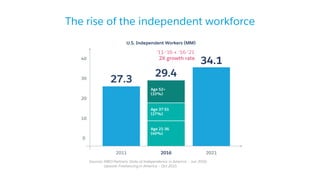
The rise of the independent workforce
Sources: MBO Partners: State of Independence in America – Jun 2016;
Upwork: Freelancing in America – Oct 2015
‘11-‘16 < ‘16-‘21
2X growth rate
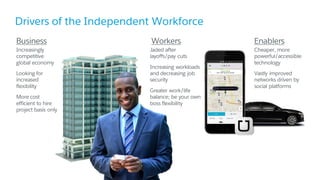
Drivers of the Independent Workforce
Business
Increasingly
competitive
global economy
Looking for
increased
flexibility
More cost
efficient to hire
project basis only
Workers
Jaded after
layoffs/pay cuts
Increasing workloads
and decreasing job
security
Greater work/life
balance; be your own
boss flexibility
Enablers
Cheaper, more
powerful/accessible
technology
Vastly improved
networks driven by
social platforms
The Peer Economy
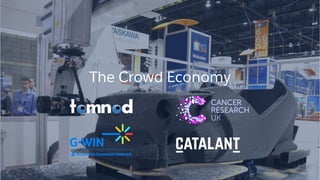
The Crowd Economy
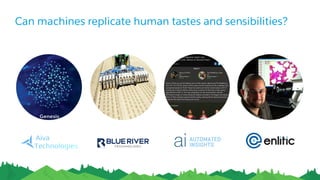
Can machines replicate human tastes and sensibilities?
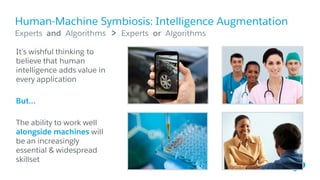
Human-Machine Symbiosis: Intelligence Augmentation
​It’s wishful thinking to
believe that human
intelligence adds value in
every application
​But…
​The ability to work well
alongside machines will
be an increasingly
essential & widespread
skillset
​Experts and Algorithms > Experts or Algorithms
Implications of
AI & Automation
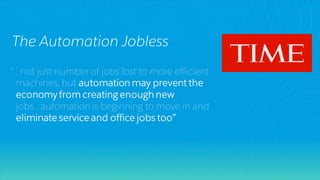
“…not just number of jobs lost to more efficient
machines, but automation may prevent the
economy from creating enough new
jobs…automation is beginning to move in and
eliminate service and office jobs too”
The Automation Jobless
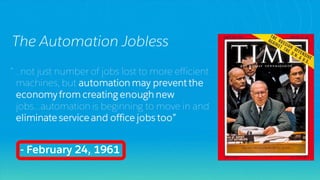
“…not just number of jobs lost to more efficient
machines, but automation may prevent the
economy from creating enough new
jobs…automation is beginning to move in and
eliminate service and office jobs too”
The Automation Jobless
- February 24, 1961
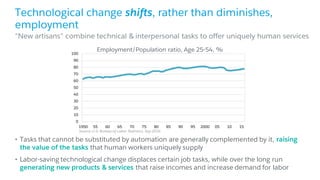
Technological change shifts, rather than diminishes,
employment
• Tasks that cannot be substituted by automation are generally complemented by it, raising
the value of the tasks that human workers uniquely supply
• Labor-saving technological change displaces certain job tasks, while over the long run
generating new products & services that raise incomes and increase demand for labor
​“New artisans” combine technical & interpersonal tasks to offer uniquely human services
0
10
20
30
40
50
60
70
80
90
100
1950 55 60 65 70 75 80 85 90 95 2000 05 10 15
Employment/Population ratio, Age 25-54, %
Source: U.S. Bureau of Labor Statistics, Sep 2016
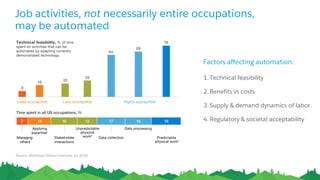
Job activities, not necessarily entire occupations,
may be automated
Source: McKinsey Global Institute, Jul 2016
v
1.Technical feasibility
2.Benefits vs costs
3.Supply & demand dynamics of labor
4.Regulatory & societal acceptability
Factors affecting automation:
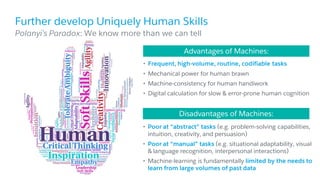
Further develop Uniquely Human Skills
• Frequent, high-volume, routine, codifiable tasks
• Mechanical power for human brawn
• Machine-consistency for human handiwork
• Digital calculation for slow & error-prone human cognition
​Polanyi’s Paradox: We know more than we can tell
Advantages of Machines:
Disadvantages of Machines:
• Poor at “abstract” tasks (e.g. problem-solving capabilities,
intuition, creativity, and persuasion)
• Poor at “manual” tasks (e.g. situational adaptability, visual
& language recognition, interpersonal interactions)
• Machine-learning is fundamentally limited by the needs to
learn from large volumes of past data
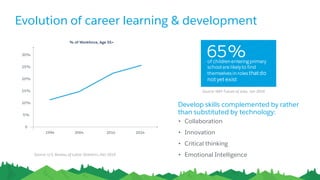
Evolution of career learning & development
Source: U.S. Bureau of Labor Statistics, Dec 2015
Source: WEF Future of Jobs, Jan 2016
65%of children entering primary
school are likely to find
themselves in roles that do
not yet exist
• Collaboration
• Innovation
• Critical thinking
• Emotional Intelligence
Develop skills complemented by rather
than substituted by technology:
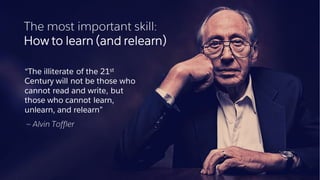
The most important skill:
How to learn (and relearn)
​“The illiterate of the 21st
Century will not be those who
cannot read and write, but
those who cannot learn,
unlearn, and relearn”
​— Alvin Toffler
New sources of learning
Future of Work
Scenarios
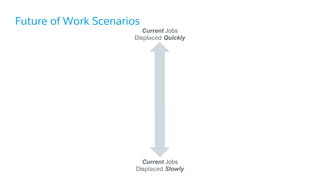
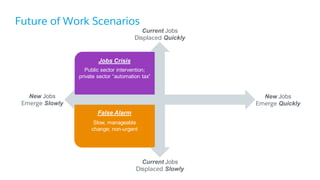
Future of Work Scenarios
Current Jobs
Displaced Quickly
Current Jobs
Displaced Slowly
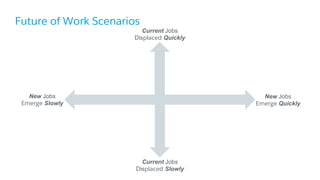
Future of Work Scenarios
Current Jobs
Displaced Quickly
Current Jobs
Displaced Slowly
New Jobs
Emerge Quickly
New Jobs
Emerge Slowly
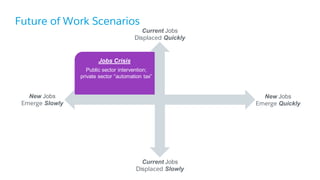
Future of Work Scenarios
Current Jobs
Displaced Quickly
Current Jobs
Displaced Slowly
New Jobs
Emerge Quickly
New Jobs
Emerge Slowly
Jobs Crisis
Focused investment in
training/re-training
Public sector intervention;
private sector “automation tax”
Future of Work Scenarios
Current Jobs
Displaced Quickly
Current Jobs
Displaced Slowly
New Jobs
Emerge Quickly
New Jobs
Emerge Slowly
False Alarm
Jobs Crisis
Slow, manageable
change; non-urgent
Focused investment in
training/re-training
Public sector intervention;
private sector “automation tax”
Future of Work Scenarios
Current Jobs
Displaced Quickly
Current Jobs
Displaced Slowly
New Jobs
Emerge Quickly
New Jobs
Emerge Slowly
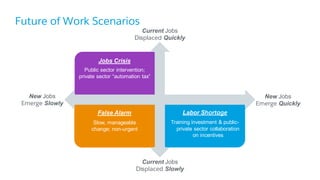
False Alarm Labor Shortage
Jobs Crisis
Slow, manageable
change; non-urgent
Training investment & public-
private sector collaboration
on incentives
Focused investment in
training/re-training
Public sector intervention;
private sector “automation tax”
Future of Work Scenarios
Current Jobs
Displaced Quickly
Current Jobs
Displaced Slowly
New Jobs
Emerge Quickly
New Jobs
Emerge Slowly
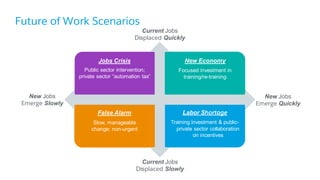
New Economy
False Alarm Labor Shortage
Jobs Crisis
Slow, manageable
change; non-urgent
Training investment & public-
private sector collaboration
on incentives
Focused investment in
training/re-training
Public sector intervention;
private sector “automation tax”
Thank Y u
​Andrew Ysursa
​Strategic Planning
​Salesforce

Evolution of Work

  • 1.
    Evolution of Work AndrewYsursa Strategic Planning Salesforce
  • 2.
    The rise ofthe independent workforce Sources: MBO Partners: State of Independence in America – Jun 2016; Upwork: Freelancing in America – Oct 2015 ‘11-‘16 < ‘16-‘21 2X growth rate
  • 3.
    Drivers of theIndependent Workforce Business Increasingly competitive global economy Looking for increased flexibility More cost efficient to hire project basis only Workers Jaded after layoffs/pay cuts Increasing workloads and decreasing job security Greater work/life balance; be your own boss flexibility Enablers Cheaper, more powerful/accessible technology Vastly improved networks driven by social platforms
  • 4.
  • 5.
  • 6.
    Can machines replicatehuman tastes and sensibilities?
  • 7.
    Human-Machine Symbiosis: IntelligenceAugmentation ​It’s wishful thinking to believe that human intelligence adds value in every application ​But… ​The ability to work well alongside machines will be an increasingly essential & widespread skillset ​Experts and Algorithms > Experts or Algorithms
  • 8.
  • 9.
    “…not just numberof jobs lost to more efficient machines, but automation may prevent the economy from creating enough new jobs…automation is beginning to move in and eliminate service and office jobs too” The Automation Jobless
  • 10.
    “…not just numberof jobs lost to more efficient machines, but automation may prevent the economy from creating enough new jobs…automation is beginning to move in and eliminate service and office jobs too” The Automation Jobless - February 24, 1961
  • 11.
    Technological change shifts,rather than diminishes, employment • Tasks that cannot be substituted by automation are generally complemented by it, raising the value of the tasks that human workers uniquely supply • Labor-saving technological change displaces certain job tasks, while over the long run generating new products & services that raise incomes and increase demand for labor ​“New artisans” combine technical & interpersonal tasks to offer uniquely human services 0 10 20 30 40 50 60 70 80 90 100 1950 55 60 65 70 75 80 85 90 95 2000 05 10 15 Employment/Population ratio, Age 25-54, % Source: U.S. Bureau of Labor Statistics, Sep 2016
  • 12.
    Job activities, notnecessarily entire occupations, may be automated Source: McKinsey Global Institute, Jul 2016 v 1.Technical feasibility 2.Benefits vs costs 3.Supply & demand dynamics of labor 4.Regulatory & societal acceptability Factors affecting automation:
  • 13.
    Further develop UniquelyHuman Skills • Frequent, high-volume, routine, codifiable tasks • Mechanical power for human brawn • Machine-consistency for human handiwork • Digital calculation for slow & error-prone human cognition ​Polanyi’s Paradox: We know more than we can tell Advantages of Machines: Disadvantages of Machines: • Poor at “abstract” tasks (e.g. problem-solving capabilities, intuition, creativity, and persuasion) • Poor at “manual” tasks (e.g. situational adaptability, visual & language recognition, interpersonal interactions) • Machine-learning is fundamentally limited by the needs to learn from large volumes of past data
  • 14.
    Evolution of careerlearning & development Source: U.S. Bureau of Labor Statistics, Dec 2015 Source: WEF Future of Jobs, Jan 2016 65%of children entering primary school are likely to find themselves in roles that do not yet exist • Collaboration • Innovation • Critical thinking • Emotional Intelligence Develop skills complemented by rather than substituted by technology:
  • 15.
    The most importantskill: How to learn (and relearn) ​“The illiterate of the 21st Century will not be those who cannot read and write, but those who cannot learn, unlearn, and relearn” ​— Alvin Toffler
  • 16.
  • 17.
  • 18.
    Future of WorkScenarios Current Jobs Displaced Quickly Current Jobs Displaced Slowly
  • 19.
    Future of WorkScenarios Current Jobs Displaced Quickly Current Jobs Displaced Slowly New Jobs Emerge Quickly New Jobs Emerge Slowly
  • 20.
    Future of WorkScenarios Current Jobs Displaced Quickly Current Jobs Displaced Slowly New Jobs Emerge Quickly New Jobs Emerge Slowly Jobs Crisis Focused investment in training/re-training Public sector intervention; private sector “automation tax”
  • 21.
    Future of WorkScenarios Current Jobs Displaced Quickly Current Jobs Displaced Slowly New Jobs Emerge Quickly New Jobs Emerge Slowly False Alarm Jobs Crisis Slow, manageable change; non-urgent Focused investment in training/re-training Public sector intervention; private sector “automation tax”
  • 22.
    Future of WorkScenarios Current Jobs Displaced Quickly Current Jobs Displaced Slowly New Jobs Emerge Quickly New Jobs Emerge Slowly False Alarm Labor Shortage Jobs Crisis Slow, manageable change; non-urgent Training investment & public- private sector collaboration on incentives Focused investment in training/re-training Public sector intervention; private sector “automation tax”
  • 23.
    Future of WorkScenarios Current Jobs Displaced Quickly Current Jobs Displaced Slowly New Jobs Emerge Quickly New Jobs Emerge Slowly New Economy False Alarm Labor Shortage Jobs Crisis Slow, manageable change; non-urgent Training investment & public- private sector collaboration on incentives Focused investment in training/re-training Public sector intervention; private sector “automation tax”
  • 24.
    Thank Y u ​AndrewYsursa ​Strategic Planning ​Salesforce