Change Practitioner Groups:
Achieving Positive Change in
Constrained and Regulated
Environments
Simon Williams
Agenda
 Introduction
 Overview of each Group’s key findings:
– Public Services
– Transport
– Utilities
 Summary of Key Themes
 Interactive Debate
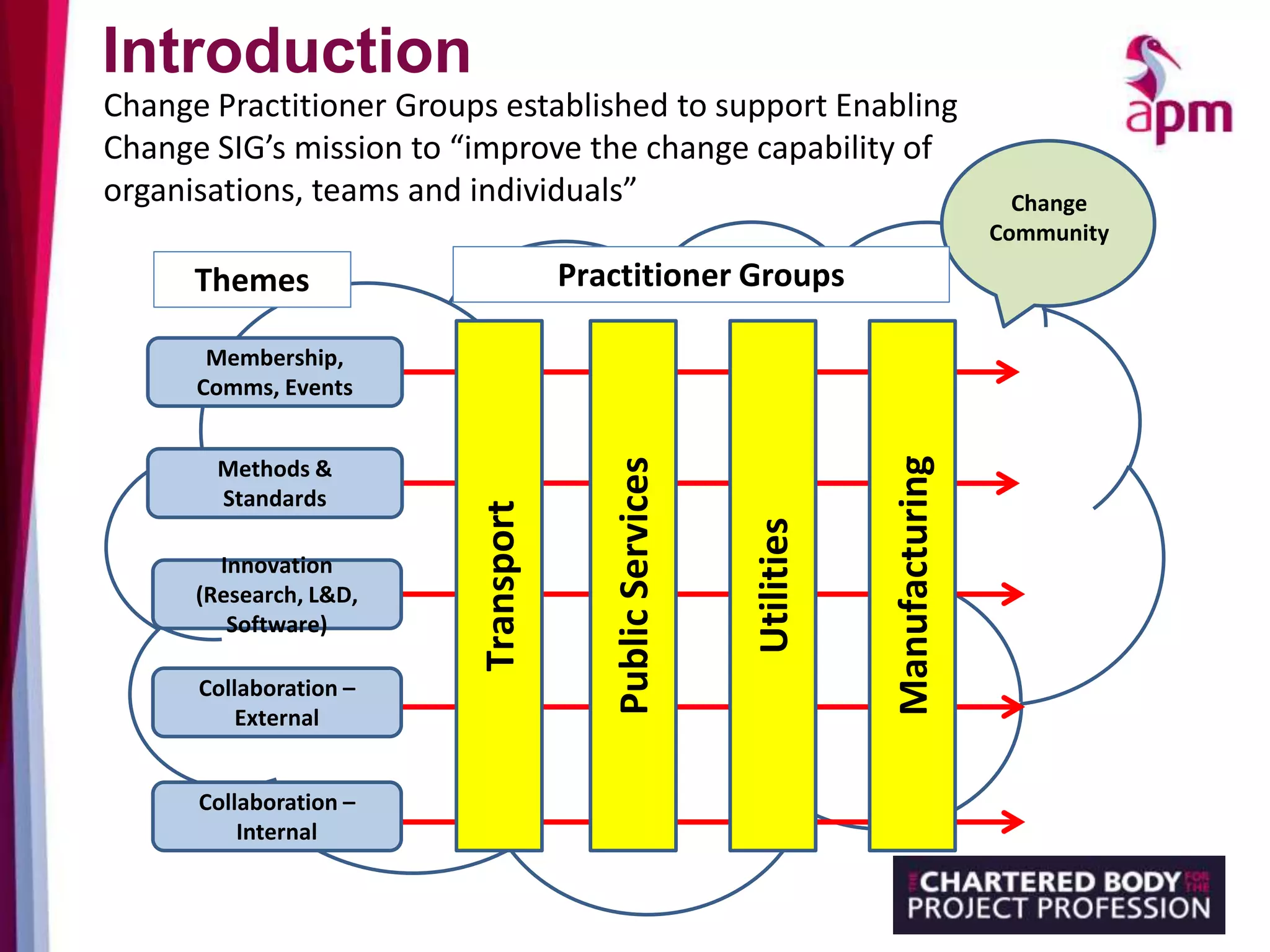
Membership,
Comms, Events
Methods &
Standards
Collaboration –
External
Innovation
(Research, L&D,
Software)
Collaboration –
Internal
Transport
PublicServices
Utilities
Change
Community
Manufacturing
Practitioner GroupsThemes
Introduction
Change Practitioner Groups established to support Enabling
Change SIG’s mission to “improve the change capability of
organisations, teams and individuals”
Public Services
Public Services Group Overview
 First formed April 2015, an evolving group
 Objectives in Terms of Reference include:
– Develop better understanding of change management (CM)
– Influence CM in the public services context: Innovation/Constraints
– Provide thought leadership and best practice in CM
– Forum for CM practitioners in discussion and validation of issues
– Encourage alignment between PPM and CM theory and practice
 Series of qualitative interviews undertaken during 2016
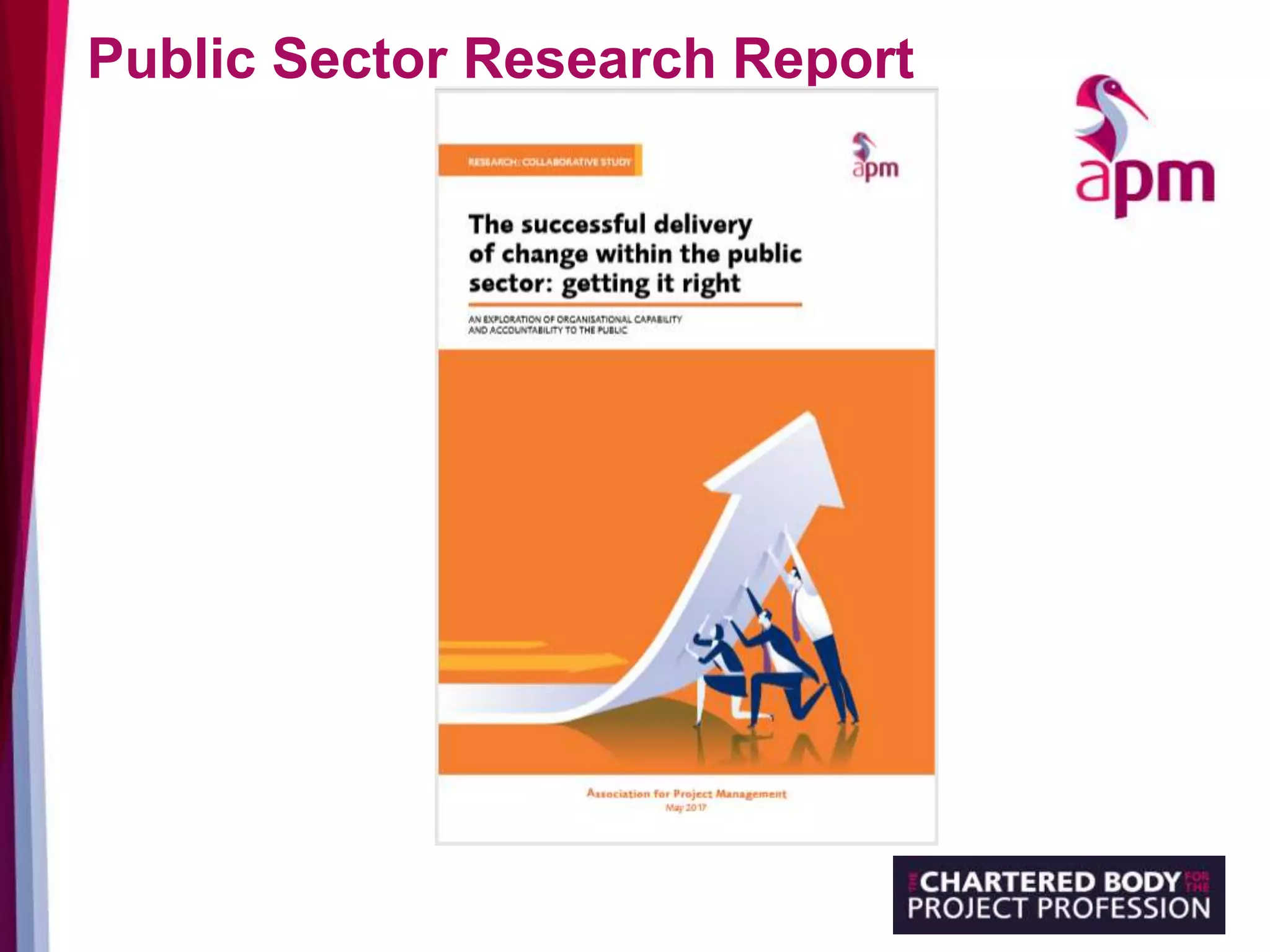
 Group’s Research Report published May 2017: The Successful
Delivery of Change Within the Public Sector: Getting It Right
 Insights shared in blogs during Summer 2017 and webinar in
February 2018 focusing on report’s case study: Staffordshire Fire
and Rescue Service, led by Becci Bryant, the CFO/CEO
 Group Membership / Changes - relaunched in March 2018.
Public Sector Challenges
 Wide spectrum of complexity and change capability
 Political complexity and often a regulatory environment
 Speed/Fluidity of change vs. long lead times for BC approvals
 Rising customer expectations for delivery and decision-making
 Public scrutiny, press interest, social media, Parliament,
austerity, “spending tax-payers’ money”, etc.
 Multiple stakeholders, plus the PMO, audit and assurance …
 Public good – considerations of ‘value’ and ‘capability’ are critical
 Fast pace of change – the move to agile and smart working
 Innovation and new or emerging technologies
 Debate around methodologies and best practice is important.
Public Sector Research Report
Report Recommendation Themes
Two public sector dimensions:
 Developing Organisational Capability
1. Maintaining strong and consistent leadership
2. Communicating a coherent vision and a clear goal
3. Embracing a culture of disciplined planning/realistic timelines
4. Establishing sufficient investment for end to end change.
 Accountability to the public
1. Engaging stakeholders early and throughout the change
2. Ensuring sustainability beyond the life of the change project
Example: Staffordshire Fire & Rescue Service.
Transport
Transportation Group Overview
 Formed January 2015 under Chatham House Rules
 Objectives include:
– thought leadership
– knowledge sharing
– identifying and understanding issues and constraints
– advancing practical solutions
 Produced map of sector challenges
 Shared insights re good and bad practice via case studies
 Exchanged research and frameworks
 Prepared report presented to APM October 2016
 Knowledge sharing event in June 2017 hosted by British Airways
 2018 work focusing on:
– Good practice in developing “big picture” business architecture of change
– Definition of change management for transport sector
– Requirements and stakeholder involvement
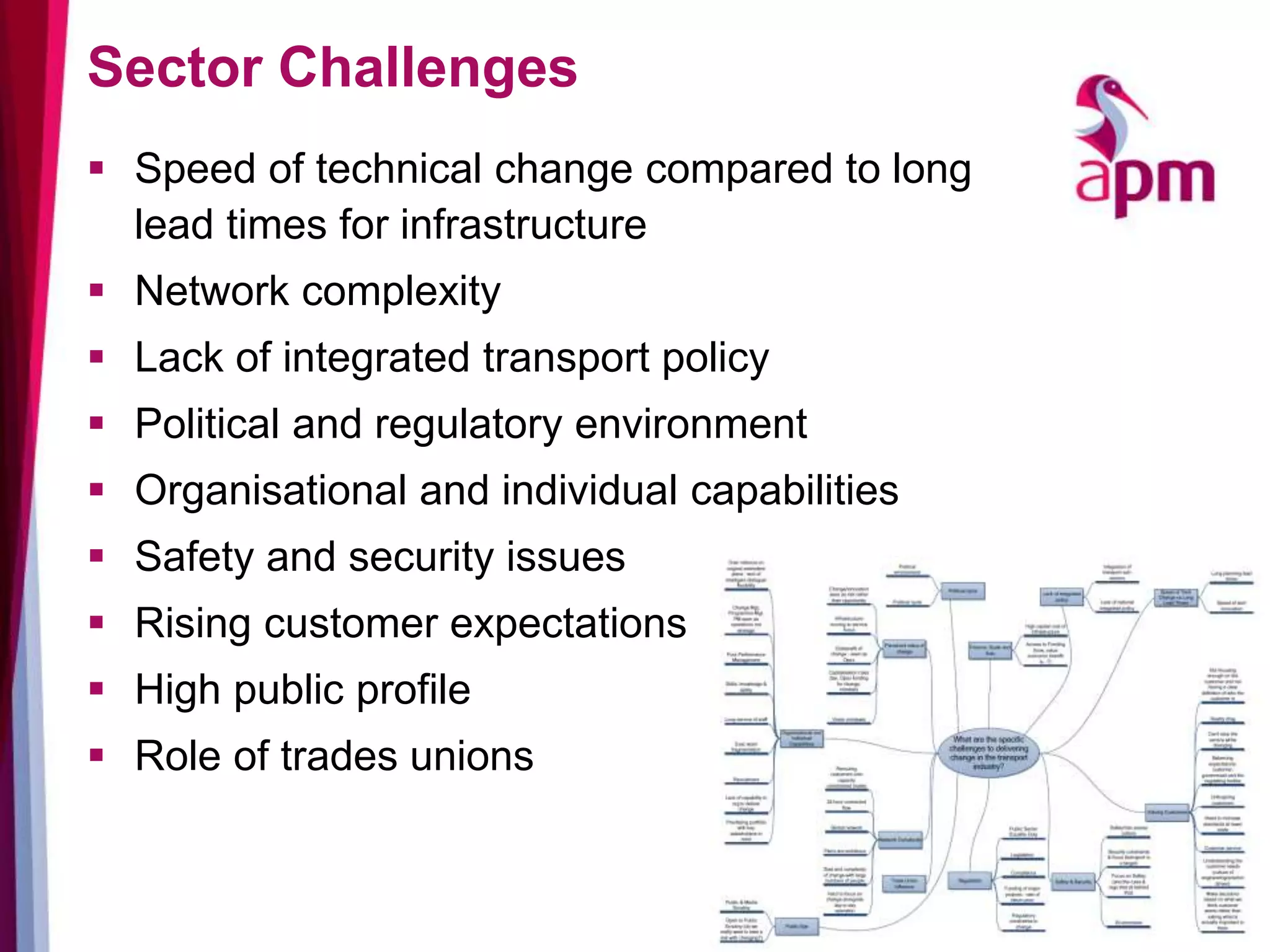
Sector Challenges
 Speed of technical change compared to long
lead times for infrastructure
 Network complexity
 Lack of integrated transport policy
 Political and regulatory environment
 Organisational and individual capabilities
 Safety and security issues
 Rising customer expectations
 High public profile
 Role of trades unions
Report Recommendation Themes
 Many common themes which organisations are addressing
independently – opportunities to collectively share best
practice and influence policy makers more effectively
1. Competence, Roles and Training
2. Methods, Tools and Terminology
3. Business Cases and Measures
4. Stakeholders and Requirements
Utilities
Utilities Group Overview
 Group initiated some time ago but formed more
cohesively in 2017 and additional members actively
joining
 Range of analysis undertaken to understand “as is”
position and potential work priorities:
– Mind Maps
– Ansoff Diagram
– Stakeholder analysis
– SWOT analysis
 Key common challenges around regulation directly
influencing business priorities, financial position and
need for change
 Survey issued recently to understand change
approaches and tools used by member organisations
– Extended to non-members as a comparator
 Proposed to publish note on key findings
Summary of Key Themes
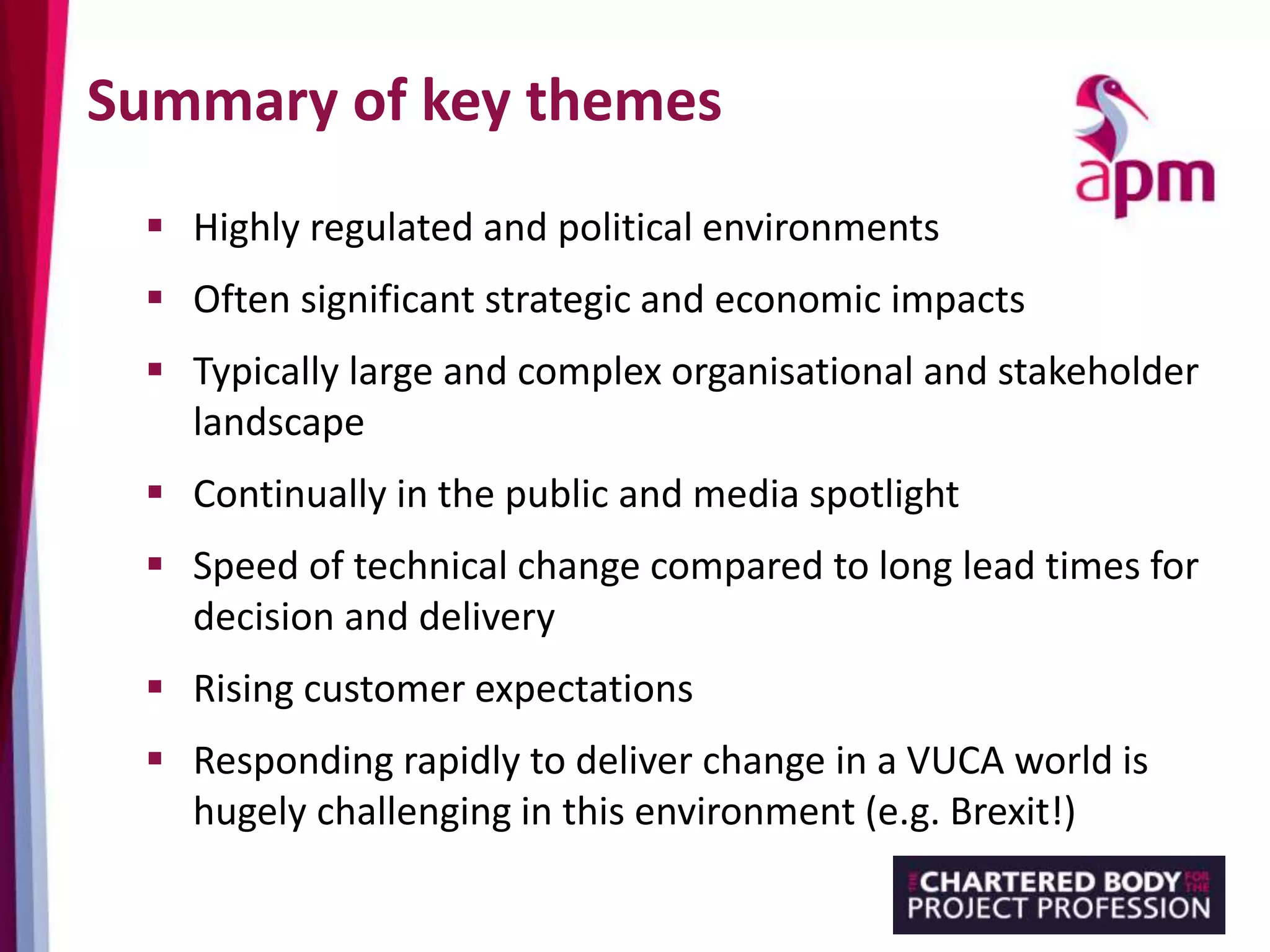
Summary of key themes
 Highly regulated and political environments
 Often significant strategic and economic impacts
 Typically large and complex organisational and stakeholder
landscape
 Continually in the public and media spotlight
 Speed of technical change compared to long lead times for
decision and delivery
 Rising customer expectations
 Responding rapidly to deliver change in a VUCA world is
hugely challenging in this environment (e.g. Brexit!)
Interactive Debate
Interactive Debate
1. How does regulation and uncertainty affect
change?
2. How do you best achieve positive change in a
constrained/regulated environment? Are there
differences between industry sectors?
3. What type of methodology works best in a
constrained/regulated environment? What
role can agile play?
Conclusion

Key findings from public services and transportation change practitioner groups - Simon Williams

  • 1.
    Change Practitioner Groups: AchievingPositive Change in Constrained and Regulated Environments Simon Williams
  • 2.
    Agenda  Introduction  Overviewof each Group’s key findings: – Public Services – Transport – Utilities  Summary of Key Themes  Interactive Debate
  • 3.
    Membership, Comms, Events Methods & Standards Collaboration– External Innovation (Research, L&D, Software) Collaboration – Internal Transport PublicServices Utilities Change Community Manufacturing Practitioner GroupsThemes Introduction Change Practitioner Groups established to support Enabling Change SIG’s mission to “improve the change capability of organisations, teams and individuals”
  • 4.
  • 5.
    Public Services GroupOverview  First formed April 2015, an evolving group  Objectives in Terms of Reference include: – Develop better understanding of change management (CM) – Influence CM in the public services context: Innovation/Constraints – Provide thought leadership and best practice in CM – Forum for CM practitioners in discussion and validation of issues – Encourage alignment between PPM and CM theory and practice  Series of qualitative interviews undertaken during 2016  Group’s Research Report published May 2017: The Successful Delivery of Change Within the Public Sector: Getting It Right  Insights shared in blogs during Summer 2017 and webinar in February 2018 focusing on report’s case study: Staffordshire Fire and Rescue Service, led by Becci Bryant, the CFO/CEO  Group Membership / Changes - relaunched in March 2018.
  • 6.
    Public Sector Challenges Wide spectrum of complexity and change capability  Political complexity and often a regulatory environment  Speed/Fluidity of change vs. long lead times for BC approvals  Rising customer expectations for delivery and decision-making  Public scrutiny, press interest, social media, Parliament, austerity, “spending tax-payers’ money”, etc.  Multiple stakeholders, plus the PMO, audit and assurance …  Public good – considerations of ‘value’ and ‘capability’ are critical  Fast pace of change – the move to agile and smart working  Innovation and new or emerging technologies  Debate around methodologies and best practice is important.
  • 7.
  • 8.
    Report Recommendation Themes Twopublic sector dimensions:  Developing Organisational Capability 1. Maintaining strong and consistent leadership 2. Communicating a coherent vision and a clear goal 3. Embracing a culture of disciplined planning/realistic timelines 4. Establishing sufficient investment for end to end change.  Accountability to the public 1. Engaging stakeholders early and throughout the change 2. Ensuring sustainability beyond the life of the change project Example: Staffordshire Fire & Rescue Service.
  • 9.
  • 10.
    Transportation Group Overview Formed January 2015 under Chatham House Rules  Objectives include: – thought leadership – knowledge sharing – identifying and understanding issues and constraints – advancing practical solutions  Produced map of sector challenges  Shared insights re good and bad practice via case studies  Exchanged research and frameworks  Prepared report presented to APM October 2016  Knowledge sharing event in June 2017 hosted by British Airways  2018 work focusing on: – Good practice in developing “big picture” business architecture of change – Definition of change management for transport sector – Requirements and stakeholder involvement
  • 11.
    Sector Challenges  Speedof technical change compared to long lead times for infrastructure  Network complexity  Lack of integrated transport policy  Political and regulatory environment  Organisational and individual capabilities  Safety and security issues  Rising customer expectations  High public profile  Role of trades unions
  • 12.
    Report Recommendation Themes Many common themes which organisations are addressing independently – opportunities to collectively share best practice and influence policy makers more effectively 1. Competence, Roles and Training 2. Methods, Tools and Terminology 3. Business Cases and Measures 4. Stakeholders and Requirements
  • 13.
  • 14.
    Utilities Group Overview Group initiated some time ago but formed more cohesively in 2017 and additional members actively joining  Range of analysis undertaken to understand “as is” position and potential work priorities: – Mind Maps – Ansoff Diagram – Stakeholder analysis – SWOT analysis  Key common challenges around regulation directly influencing business priorities, financial position and need for change  Survey issued recently to understand change approaches and tools used by member organisations – Extended to non-members as a comparator  Proposed to publish note on key findings
  • 15.
  • 16.
    Summary of keythemes  Highly regulated and political environments  Often significant strategic and economic impacts  Typically large and complex organisational and stakeholder landscape  Continually in the public and media spotlight  Speed of technical change compared to long lead times for decision and delivery  Rising customer expectations  Responding rapidly to deliver change in a VUCA world is hugely challenging in this environment (e.g. Brexit!)
  • 17.
  • 18.
    Interactive Debate 1. Howdoes regulation and uncertainty affect change? 2. How do you best achieve positive change in a constrained/regulated environment? Are there differences between industry sectors? 3. What type of methodology works best in a constrained/regulated environment? What role can agile play?
  • 19.