Community Resilience: Modeling, Field Studies,
and Implementation
Welcome!
1
2
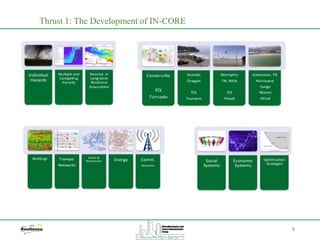
Thrust 1: A Multidisciplinary computational environment with
fully integrated supporting databases: “The Interconnected
Networked - Community Resilience Modeling Environment”.
Thrust 2: “Data management tools for community resilience
systems”: A standardized data ontology, robust data
architecture, and effective tools to support IN-CORE.
Thrust 3: Resilience Data Architecture Validation Studies:
Hindcasts and forecasts to test the data collection process and
its integration into IN-CORE. Validate risk-informed intelligent
search and decision algorithms; field studies.
The Center Thrusts
3
• Quantitative tools and metrics for assessing community
resilience either are in a rudimentary state of development or
are not available.
• Multiple hazards, interconnected and inter-dependent systems
must be considered.
• Uncertainties, both aleatory and epistemic, must be included for
the resilience assessment and decision process to be risk-
informed.
• Community resilience plans and guidance are needed.
• Existing building and infrastructure systems, as well as new
construction, must be considered.
• Codes, standards and regulatory documents must contain
consistent performance goals.
Center research Issues
4
How can community leaders know how
resilient their community is?
How can they know if their decisions and
investments to improve resilience are making a
significant difference?
How can they deal with uncertainty and risk?
Research and Implementation Questions
5
Thrust 1: The Development of IN-CORE
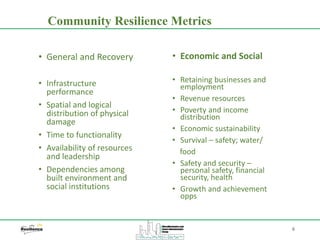
6
• General and Recovery
• Infrastructure
performance
• Spatial and logical
distribution of physical
damage
• Time to functionality
• Availability of resources
and leadership
• Dependencies among
built environment and
social institutions
Community Resilience Metrics
• Economic and Social
• Retaining businesses and
employment
• Revenue resources
• Poverty and income
distribution
• Economic sustainability
• Survival – safety; water/
food
• Safety and security –
personal safety, financial
security, health
• Growth and achievement
opps
7
• User requirements/Stakeholder Alignment
‒ Support for new data types being developed
‒ Building taxonomies for all hazards
• Standardized Data Ontology
‒ Defining new data types such as need for CGE
development
‒ Review of schema and metadata
• Development of Data management Tools
‒ GEM taxonomy, DDI Codebook, lifecycle
Thrust 2: A Robust Data Architecture
8
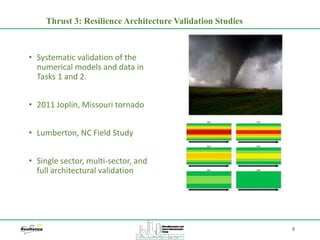
• Systematic validation of the
numerical models and data in
Tasks 1 and 2.
• 2011 Joplin, Missouri tornado
• Lumberton, NC Field Study
• Single sector, multi-sector, and
full architectural validation
Thrust 3: Resilience Architecture Validation Studies
9
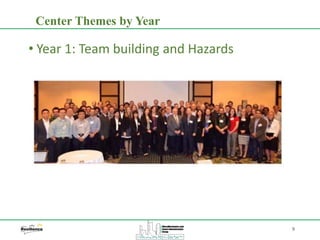
• Year 1: Team building and Hazards
Center Themes by Year
10
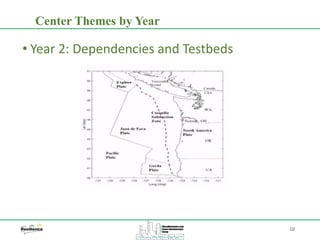
• Year 2: Dependencies and Testbeds
Center Themes by Year
11
• Year 3: Recovery modeling with full
interdependencies
• Year 4: Risk-Informed Decision-Making
• Year 5: Technical outreach including user
workshops
Center Themes by Year
Thank you
13
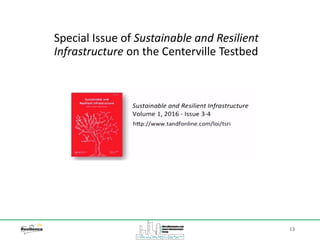
Special Issue of Sustainable and Resilient
Infrastructure on the Centerville Testbed
14
Several testbeds have been initiated since the beginning of the Center. The testbeds
have been designed to
1. allow Center research teams to initiate, test, and modify essential community
resilience assessment models and algorithms before the IN-CORE platform
becomes fully operational
2. stress these assessment models in a controlled manner
3. examine varying degrees of dependency between physical, social, and economic
infrastructure systems
4. facilitate the interdisciplinary collaborations and approaches to community
resilience assessment that will be essential for the Center to achieve its ultimate
goal
Background
15
 A special issue of the journal Sustainable and Resilient Infrastructure (volume 1, 2016 –
Issue 3-4) has been devoted to the first of these testbeds namely the Centerville Virtual
Community
 Sustainable and Resilient Infrastructure is
and interdisciplinary journal published by
Taylor and Francis that focuses specifically
on the sustainable development of resilient
communities
Special issue on the Centerville Virtual Community
16
 The Centerville Virtual Community: A fully integrated decision model of interacting physical and social
infrastructure systems
Bruce R. Ellingwood, Harvey Culter, Paolo gardoni, Walter gills Peacock, john W. van de Lindt & Naiyu Wang
 Building portfolio fragility functions to support scalable community resilience assessment
Peihui Lin & Naiyu Wang
 A multi-objective optimization model for retrofit strategies to mitigate direct economic loss and
population dislocation
Weili Zhang & Charles Nicholson
 Probabilistic framework for performance assessment of electrical power networks to tornadoes
Vipin U. Unnikrishnan & John W. van de Lindt
 Modeling the resilience of critical infrastructure: The role of network dependencies
Roberto Guidotti, hana Chmielewski, Vipin U. Unnikrishnan , Paolo Gardoni, Therese McAllister & John van de Lindt
 Integrating engineering outputs from natural disaster models into a dynamic spatial computable
general equilibrium model of Centerville
Harvey Cutler, Martin Shields, Daniele Tavani & Sammy Zahran
In orange the names of the presenting authors
The special issue includes the following contributions
The Centerville Virtual Community:
A Fully Integrated Decision Model of
Interacting Physical and Social Infrastructure
Systems
Bruce R. Ellingwood, Harvey Cutler, Paolo Gardoni, walter
Gills Peacock, John W. van de Lindt and Naiyu Wang
17
COE Semiannual Meeting
04/26/2017
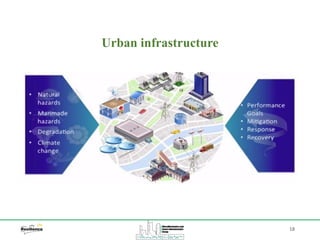
Urban infrastructure
18
19
The Centerville Testbed
Motivation
• A simple community model with essential physical, social and
economic infrastructure components and systems and
interdependencies
• Software developers at NCSA can begin coding IN-CORE
modules while awaiting for more realistic and complex algorithms
and datasets
• The common community model requires engineers, economists
and sociologists to begin working together immediately.
Sustainable and Resilient Infrastructure, Vol. 1, Nos. 3-4, Sept-Dec, 2016.
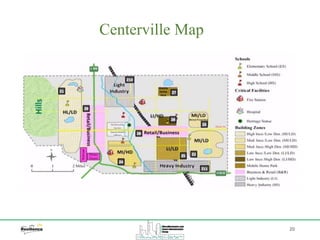
Centerville Map
20
21
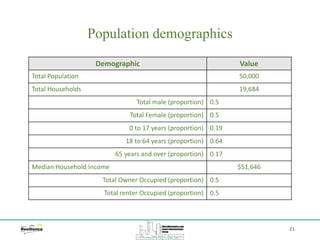
Population demographics
Demographic Value
Total Population 50,000
Total Households 19,684
Total male (proportion) 0.5
Total Female (proportion) 0.5
0 to 17 years (proportion) 0.19
18 to 64 years (proportion) 0.64
65 years and over (proportion) 0.17
Median Household Income $51,646
Total Owner Occupied (proportion) 0.5
Total renter Occupied (proportion) 0.5
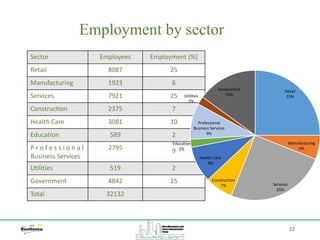
Employment by sector
22
Sector Employees Employment (%)
Retail 8087 25
Manufacturing 1923 6
Services 7921 25
Construction 2375 7
Health Care 3081 10
Education 589 2
P r o f e s s i o n a l
Business Services
2795 9
Utilities 519 2
Government 4842 15
Total 32132
Health Care
9%
Retail
25%
Manufacturing
6%
Services
25%
Construction
7%
Education
2%
Professional
Business Services
9%
Utilities
2%
Government
15%
23
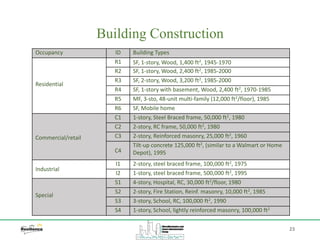
Building Construction
Occupancy ID Building Types
Residential
R1 SF, 1-story, Wood, 1,400 ft2, 1945-1970
R2 SF, 1-story, Wood, 2,400 ft2, 1985-2000
R3 SF, 2-story, Wood, 3,200 ft2, 1985-2000
R4 SF, 1-story with basement, Wood, 2,400 ft2, 1970-1985
R5 MF, 3-sto, 48-unit multi-family (12,000 ft2/floor), 1985
R6 SF, Mobile home
Commercial/retail
C1 1-story, Steel Braced frame, 50,000 ft2, 1980
C2 2-story, RC frame, 50,000 ft2, 1980
C3 2-story, Reinforced masonry, 25,000 ft2, 1960
C4
Tilt-up concrete 125,000 ft2, (similar to a Walmart or Home
Depot), 1995
Industrial
I1 2-story, steel braced frame, 100,000 ft2, 1975
I2 1-story, steel braced frame, 500,000 ft2, 1995
Special
S1 4-story, Hospital, RC, 30,000 ft2/floor, 1980
S2 2-story, Fire Station, Reinf. masonry, 10,000 ft2, 1985
S3 3-story, School, RC, 100,000 ft2, 1990
S4 1-story, School, lightly reinforced masonry, 100,000 ft2
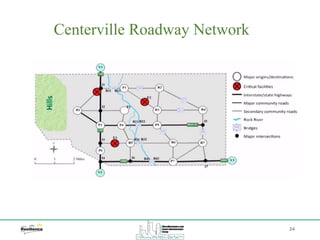
Centerville Roadway Network
24
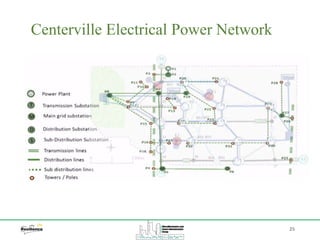
Centerville Electrical Power Network
25
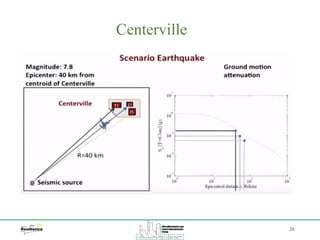
Centerville
26
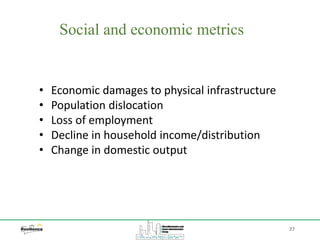
Social and economic metrics
27
• Economic damages to physical infrastructure
• Population dislocation
• Loss of employment
• Decline in household income/distribution
• Change in domestic output
Peihui Lin
Naiyu Wang, Ph.D.
University of Oklahoma
COE Semiannual Meeting
04/27/2017
Building Portfolio Analysis
28
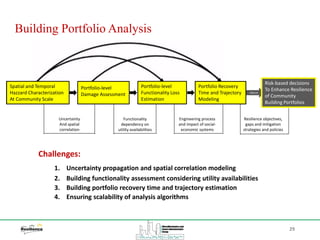
Building Portfolio Analysis
29
Spatial and Temporal
Hazzard Characterization
At Community Scale
Portfolio-level
Damage Assessment
Portfolio-level
Functionality Loss
Estimation
Portfolio Recovery
Time and Trajectory
Modeling
Risk-based decisions
To Enhance Resilience
of Community
Building Portfolios
inform
Uncertainty
And spatial
correlation
Functionality
dependency on
utility availabilities
Engineering process
and impact of social-
economic systems
Resilience objectives,
gaps and mitigation
strategies and policies
Spatial and Temporal
Hazzard Characterization
At Community Scale
Portfolio-level
Damage Assessment
Portfolio-level
Functionality Loss
Estimation
Portfolio Recovery
Time and Trajectory
Modeling
Challenges:
1. Uncertainty propagation and spatial correlation modeling
2. Building functionality assessment considering utility availabilities
3. Building portfolio recovery time and trajectory estimation
4. Ensuring scalability of analysis algorithms
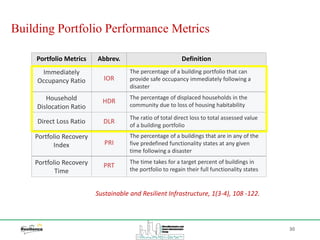
Building Portfolio Performance Metrics
30
Portfolio Metrics Abbrev. Definition
Immediately
Occupancy Ratio IOR
The percentage of a building portfolio that can
provide safe occupancy immediately following a
disaster
Household
Dislocation Ratio
HDR
The percentage of displaced households in the
community due to loss of housing habitability
Direct Loss Ratio DLR
The ratio of total direct loss to total assessed value
of a building portfolio
Portfolio Recovery
Index PRI
The percentage of a buildings that are in any of the
five predefined functionality states at any given
time following a disaster
Portfolio Recovery
Time
PRT
The time takes for a target percent of buildings in
the portfolio to regain their full functionality states
Sustainable and Resilient Infrastructure, 1(3-4), 108 -122.
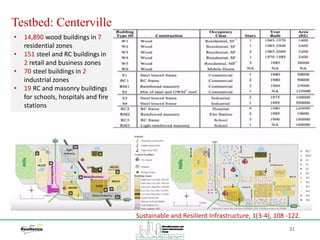
Testbed: Centerville
31
• 14,890 wood buildings in 7
residential zones
• 151 steel and RC buildings in
2 retail and business zones
• 70 steel buildings in 2
industrial zones
• 19 RC and masonry buildings
for schools, hospitals and fire
stations
Sustainable and Resilient Infrastructure, 1(3-4), 108 -122.
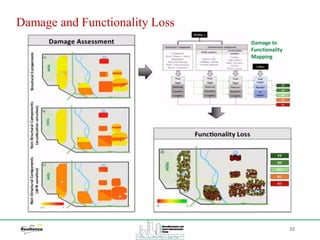
Damage and Functionality Loss
32
Damage to
Functionality
Mapping
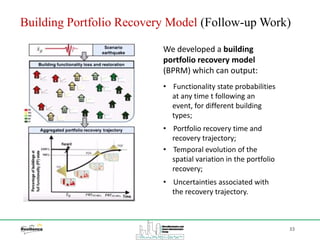
Building Portfolio Recovery Model (Follow-up Work)
33
We developed a building
portfolio recovery model
(BPRM) which can output:
• Functionality state probabilities
at any time t following an
event, for different building
types;
• Portfolio recovery time and
recovery trajectory;
• Uncertainties associated with
the recovery trajectory.
• Temporal evolution of the
spatial variation in the portfolio
recovery;
34
Special Issue of Sustainable and Resilient
Infrastructure on the Centerville Testbed
Mitigation Resource Allocation
35
Sustainable and Resilient Infrastructure, 1(3-4), 123 -126.
Allocate limited resources to retrofit building types in
each zone, to specific code levels w.r.t. competing
objectives:
‐ minimize economic loss (i.e., structure, non-
structure, and content loss, provided by the Building
team)
‐ minimize total dislocation (OLS model provided by
the Social Science team)
Requirement:
‐ Overall disparity in the dislocation rates by socio-
economic status does not increase
Baseline
36
Sustainable and Resilient Infrastructure, 1(3-4), 123 -126.
• Heterogeneous building types, code levels
• Ideal budget ($346M) is sufficient to improve all buildings
to highest code level
• Magnitude 7.8 earthquake, 35km to southwest
‐ Total direct economic loss: $856M
‐ Total dislocation: 3,203 HH
Evaluation of optimization results under three budget levels:
‐ Low: 15% of ideal budget
‐ Medium: 30% of ideal budget
‐ High: 60% of the ideal budget
Pareto Optimality
37
Sustainable and Resilient Infrastructure, 1(3-4), 123 -126.
Budget Level: 15% ($52M)
Policy I reduces expected loss by $80M
and reduces dislocation by about 700 HH
from baseline
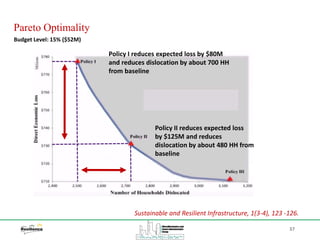
Policy II reduces expected loss
by $125M and reduces
dislocation by about 480 HH from
baseline
38
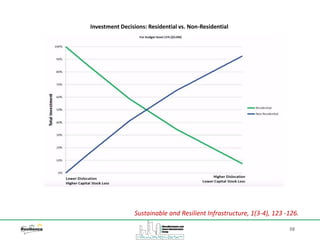
Investment Decisions: Residential vs. Non-Residential
Sustainable and Resilient Infrastructure, 1(3-4), 123 -126.
39
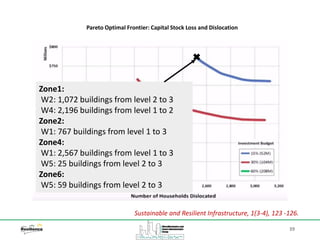
Pareto Optimal Frontier: Capital Stock Loss and Dislocation
Sustainable and Resilient Infrastructure, 1(3-4), 123 -126.
Zone1:
W2: 1,072 buildings from level 2 to 3
W4: 2,196 buildings from level 1 to 2
Zone2:
W1: 767 buildings from level 1 to 3
Zone4:
W1: 2,567 buildings from level 1 to 3
W5: 25 buildings from level 2 to 3
Zone6:
W5: 59 buildings from level 2 to 3
40
Special Issue of Sustainable and Resilient
Infrastructure on the Centerville Testbed
41
 It proposes a unified methodology for modeling dependent infrastructure
networks and uses a 6-step probabilistic procedure to assess system resilience.
 To estimate system recovery as a function of time at a community scale, the
proposed methodology simulates direct physical damage, cascading effects due
to dependencies, and recovery levels of network functionality.
 The methodology for infrastructure resilience assessment is general, can be
applied to other infrastructure networks and hazards, and can model different
types of dependencies between networks.
 As an illustration, the paper presents the direct physical effects of seismic events
on the functionality of a potable water distribution network (WN) and the
cascading effects of a damaged electric power network (EPN) on the WN.
The paper makes the following contributions
42
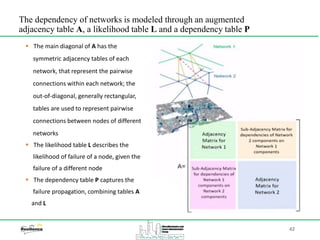
 The main diagonal of A has the
symmetric adjacency tables of each
network, that represent the pairwise
connections within each network; the
out-of-diagonal, generally rectangular,
tables are used to represent pairwise
connections between nodes of different
networks
 The likelihood table L describes the
likelihood of failure of a node, given the
failure of a different node
 The dependency table P captures the
failure propagation, combining tables A
and L
The dependency of networks is modeled through an augmented
adjacency table A, a likelihood table L and a dependency table P
43
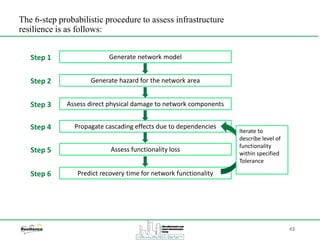
The 6-step probabilistic procedure to assess infrastructure
resilience is as follows:
Generate network modelStep 1
Generate hazard for the network areaStep 2
Assess direct physical damage to network componentsStep 3
Propagate cascading effects due to dependenciesStep 4
Assess functionality lossStep 5
Predict recovery time for network functionalityStep 6
Iterate to
describe level of
functionality
within specified
Tolerance
44
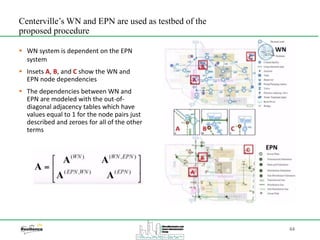
 WN system is dependent on the EPN
system
 Insets A, B, and C show the WN and
EPN node dependencies
 The dependencies between WN and
EPN are modeled with the out-of-
diagonal adjacency tables which have
values equal to 1 for the node pairs just
described and zeroes for all of the other
terms
Centerville’s WN and EPN are used as testbed of the
proposed procedure
45
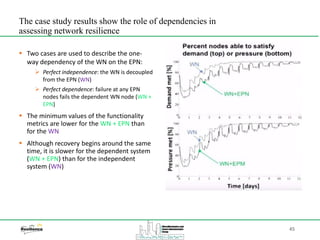
 Two cases are used to describe the one-
way dependency of the WN on the EPN:
 Perfect independence: the WN is decoupled
from the EPN (WN)
 Perfect dependence: failure at any EPN
nodes fails the dependent WN node (WN +
EPN)
 The minimum values of the functionality
metrics are lower for the WN + EPN than
for the WN
 Although recovery begins around the same
time, it is slower for the dependent system
(WN + EPN) than for the independent
system (WN)
The case study results show the role of dependencies in
assessing network resilience
46
 The loss of functionality and delay in the recovery process for network
dependency can be quantified.
 Simulating the dependency between networks can be important in
estimating the resilience of critical infrastructure.
 The cascading failures in the WN due to EPN failures can lead to
increased recovery times or increased extent of functionality loss.
 The modularity of the proposed methodology provides flexibility and
allows the user to update fragilities, component and network models,
hazards, and repair rates.
Concluding Remarks
47
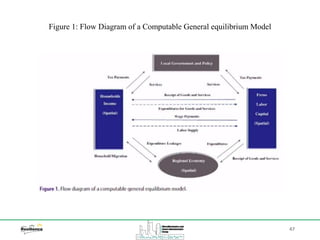
Figure 1: Flow Diagram of a Computable General equilibrium Model
48
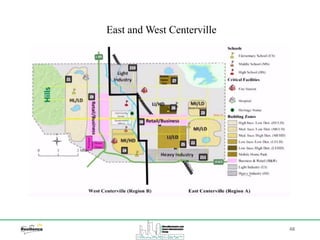
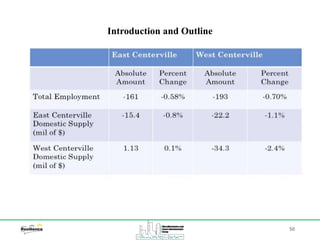
East and West Centerville
49
Restrict the earthquake shock to hit East and West Centerville
separately
• Damages commercial and residential buildings
• Understand the value of the spatial CGE model
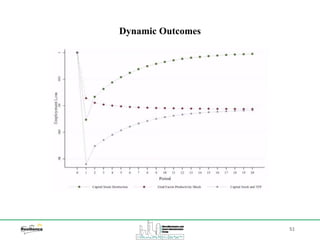
Dynamic outcomes
• Allow the earthquake to hit both sides of Centerville
simultaneously
• Damages to
‐ Buildings and transportation network
‐ Workers and shoppers have to use alternative routes
Motivation
50
Introduction and Outline
51
Dynamic Outcomes
52
• Spatial characteristics are important
• Commuting in and out (Joplin)
• Dynamic estimates will be used to model recovery
53
• Building portfolio analysis (Earthquake)
• Electric Power Network (EPN) damage
analysis (Tornado)
• Water network recovery analysis with EPN
dependency (Earthquake)
• Mitigation Resources Allocation (MRA)
analysis
• Computable General Equilibrium (CGE)
analysis
IN-CORE v1 Demo for Centerville Analyses
54
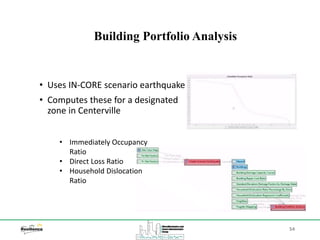
• Uses IN-CORE scenario earthquake
• Computes these for a designated
zone in Centerville
Building Portfolio Analysis
• Immediately Occupancy
Ratio
• Direct Loss Ratio
• Household Dislocation
Ratio
55
Demo of Software!!!
56
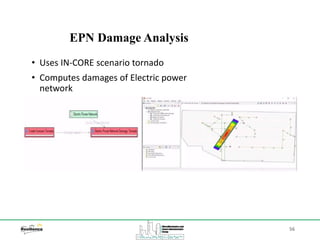
• Uses IN-CORE scenario tornado
• Computes damages of Electric power
network
EPN Damage Analysis
57
Demo of Software!!!
58
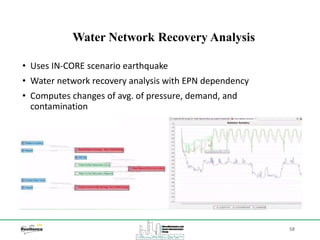
• Uses IN-CORE scenario earthquake
• Water network recovery analysis with EPN dependency
• Computes changes of avg. of pressure, demand, and
contamination
Water Network Recovery Analysis
59
Demo of Software!!!
60
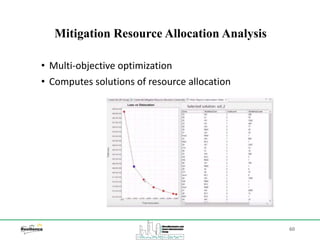
• Multi-objective optimization
• Computes solutions of resource allocation
Mitigation Resource Allocation Analysis
61
Demo of Software!!!
62
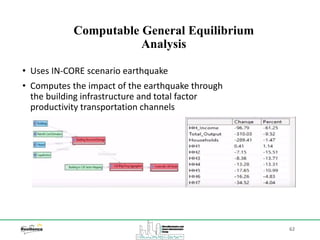
• Uses IN-CORE scenario earthquake
• Computes the impact of the earthquake through
the building infrastructure and total factor
productivity transportation channels
Computable General Equilibrium
Analysis
63
Demo of Software!!!
64
Contributors
65
Outline
• 2011 Joplin MO Tornado
• Field Study Data Collection & Mapping
• Single Sector Validation: Electric Power Network
• Single Sector Validation: Buildings
• Multisector Validation: Buildings-EPN
• Post-Disaster Functionality Methodology
• Business Interruption
• Socially Vulnerable Populations
• Population Dislocation
• Future Plans
66
Hindcasting
Hindcasting is a systematic process by which we check the
accuracy of mathematical (and other) models using a past
event. For Joplin, this will be accomplished through a
robust series of checks and hindcasts ranging from the
single building or infrastructure component level,
economic component, to single infrastructure sector
validation – this will be done at points in time to validate
damage modeling, loss estimation, population dislocation,
and functionality and recovery models.
67
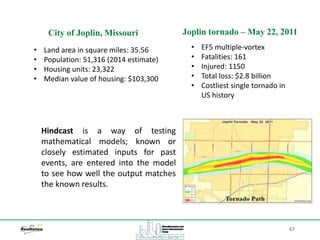
City of Joplin, Missouri
Hindcast is a way of testing
mathematical models; known or
closely estimated inputs for past
events, are entered into the model
to see how well the output matches
the known results.
• Land area in square miles: 35.56
• Population: 51,316 (2014 estimate)
• Housing units: 23,322
• Median value of housing: $103,300
Joplin tornado – May 22, 2011
• EF5 multiple-vortex
• Fatalities: 161
• Injured: 1150
• Total loss: $2.8 billion
• Costliest single tornado in
US history
68
2011 Joplin Tornado Overview
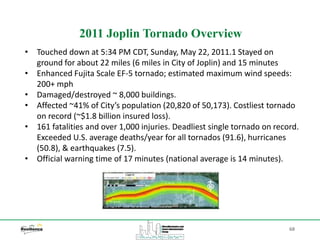
• Touched down at 5:34 PM CDT, Sunday, May 22, 2011.1 Stayed on
ground for about 22 miles (6 miles in City of Joplin) and 15 minutes
• Enhanced Fujita Scale EF-5 tornado; estimated maximum wind speeds:
200+ mph
• Damaged/destroyed ~ 8,000 buildings.
• Affected ~41% of City’s population (20,820 of 50,173). Costliest tornado
on record (~$1.8 billion insured loss).
• 161 fatalities and over 1,000 injuries. Deadliest single tornado on record.
Exceeded U.S. average deaths/year for all tornados (91.6), hurricanes
(50.8), & earthquakes (7.5).
• Official warning time of 17 minutes (national average is 14 minutes).
69
NIST Objectives
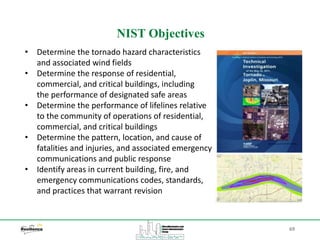
• Determine the tornado hazard characteristics
and associated wind fields
• Determine the response of residential,
commercial, and critical buildings, including
the performance of designated safe areas
• Determine the performance of lifelines relative
to the community of operations of residential,
commercial, and critical buildings
• Determine the pattern, location, and cause of
fatalities and injuries, and associated emergency
communications and public response
• Identify areas in current building, fire, and
emergency communications codes, standards,
and practices that warrant revision
70
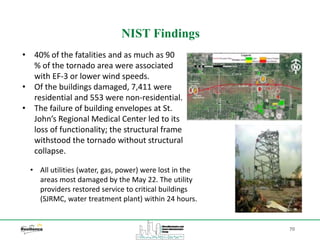
NIST Findings
• 40% of the fatalities and as much as 90
% of the tornado area were associated
with EF-3 or lower wind speeds.
• Of the buildings damaged, 7,411 were
residential and 553 were non-residential.
• The failure of building envelopes at St.
John’s Regional Medical Center led to its
loss of functionality; the structural frame
withstood the tornado without structural
collapse.
• All utilities (water, gas, power) were lost in the
areas most damaged by the May 22. The utility
providers restored service to critical buildings
(SJRMC, water treatment plant) within 24 hours.
71
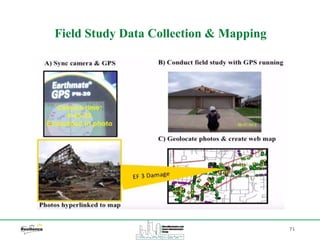
Field Study Data Collection & Mapping
72
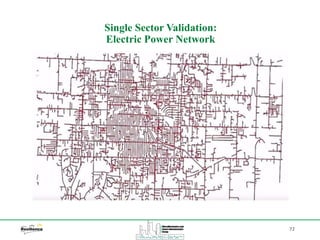
Single Sector Validation:
Electric Power Network
73
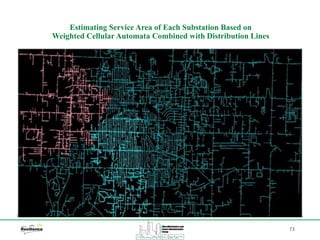
Estimating Service Area of Each Substation Based on
Weighted Cellular Automata Combined with Distribution Lines
74
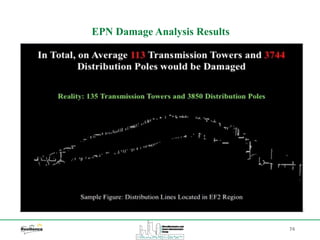
EPN Damage Analysis Results
75
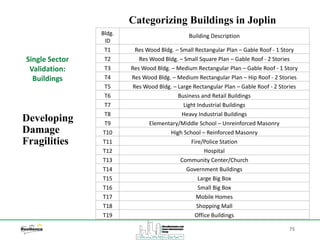
Categorizing Buildings in Joplin
Single Sector
Validation:
Buildings
Developing
Damage
Fragilities
Bldg.
ID
Building Description
T1 Res Wood Bldg. – Small Rectangular Plan – Gable Roof - 1 Story
T2 Res Wood Bldg. – Small Square Plan – Gable Roof - 2 Stories
T3 Res Wood Bldg. – Medium Rectangular Plan – Gable Roof - 1 Story
T4 Res Wood Bldg. – Medium Rectangular Plan – Hip Roof - 2 Stories
T5 Res Wood Bldg. – Large Rectangular Plan – Gable Roof - 2 Stories
T6 Business and Retail Buildings
T7 Light Industrial Buildings
T8 Heavy Industrial Buildings
T9 Elementary/Middle School – Unreinforced Masonry
T10 High School – Reinforced Masonry
T11 Fire/Police Station
T12 Hospital
T13 Community Center/Church
T14 Government Buildings
T15 Large Big Box
T16 Small Big Box
T17 Mobile Homes
T18 Shopping Mall
T19 Office Buildings
76
Building Taxonomy for Tornado Hazard
Derivation Resources:
a) Building Attributes Affecting Structural Response
[GEM Building Taxonomy (2013)]
a) Building Attributes Affecting Wind Load Intensity
[ASCE7-10 chapters 26 to 31]
77
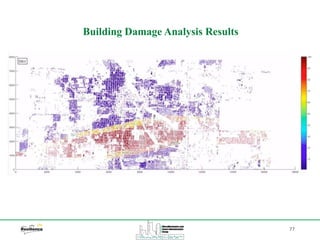
Building Damage Analysis Results
78
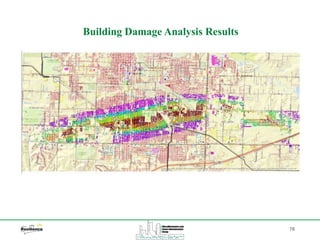
Building Damage Analysis Results
79
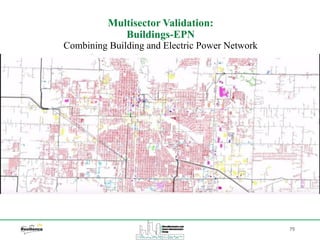
Multisector Validation:
Buildings-EPN
Combining Building and Electric Power Network
80
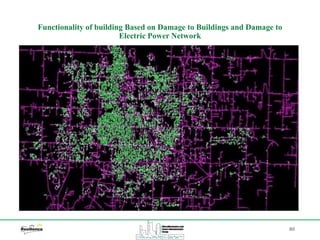
Functionality of building Based on Damage to Buildings and Damage to
Electric Power Network
81
Post-Disaster Functionality Methodology
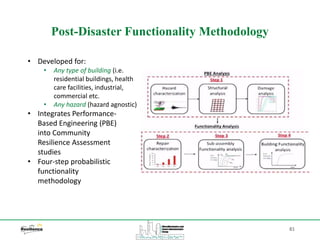
• Developed for:
• Any type of building (i.e.
residential buildings, health
care facilities, industrial,
commercial etc.
• Any hazard (hazard agnostic)
• Integrates Performance-
Based Engineering (PBE)
into Community
Resilience Assessment
studies
• Four-step probabilistic
functionality
methodology
82
Post-Disaster Functionality Methodology
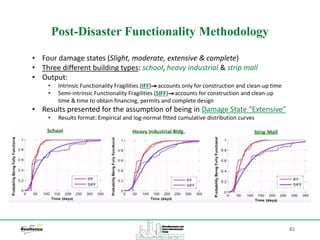
• Four damage states (Slight, moderate, extensive & complete)
• Three different building types: school, heavy industrial & strip mall
• Output:
• Intrinsic Functionality Fragilities (IFF) accounts only for construction and clean-up time
• Semi-intrinsic Functionality Fragilities (SIFF) accounts for construction and clean-up
time & time to obtain financing, permits and complete design
• Results presented for the assumption of being in Damage State “Extensive”
• Results format: Empirical and log-normal fitted cumulative distribution curves
83
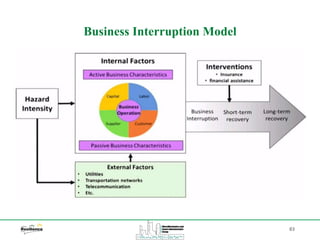
Business Interruption Model
84
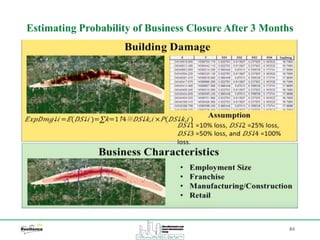
Estimating Probability of Business Closure After 3 Months
85
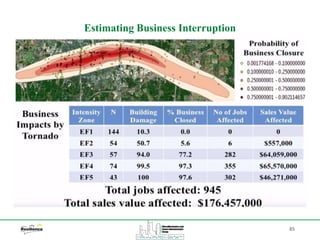
Estimating Business Interruption
86
Influences of the Event on Economic Factors
• A social accounting matrix (SAM) summarizes the data that
reflects the intersection between households, firms and the
government.
• SAMs will be constructed for 2010, 2011 and 2012 for Joplin
• CGE model for 2010 and then use it to forecast future SAM
values and compare these forecasts to the values in the 2011
and 2012 SAMs.
• The forecast errors (Actual – Forecast) will determine initial
ability to forecast the impacts of a tornado.
87
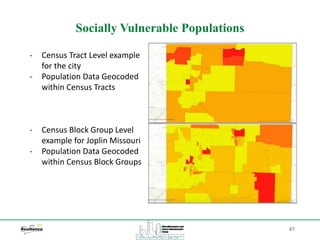
Socially Vulnerable Populations
‐ Census Tract Level example
for the city
‐ Population Data Geocoded
within Census Tracts
‐ Census Block Group Level
example for Joplin Missouri
‐ Population Data Geocoded
within Census Block Groups
88
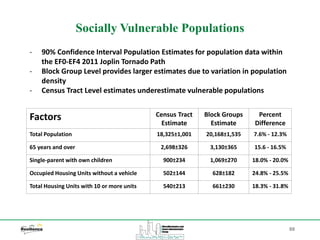
Socially Vulnerable Populations
‐ 90% Confidence Interval Population Estimates for population data within
the EF0-EF4 2011 Joplin Tornado Path
‐ Block Group Level provides larger estimates due to variation in population
density
‐ Census Tract Level estimates underestimate vulnerable populations
Factors Census Tract
Estimate
Block Groups
Estimate
Percent
Difference
Total Population 18,325Âą1,001 20,168Âą1,535 7.6% - 12.3%
65 years and over 2,698Âą326 3,130Âą365 15.6 - 16.5%
Single-parent with own children 900Âą234 1,069Âą270 18.0% - 20.0%
Occupied Housing Units without a vehicle 502Âą144 628Âą182 24.8% - 25.5%
Total Housing Units with 10 or more units 540Âą213 661Âą230 18.3% - 31.8%
89
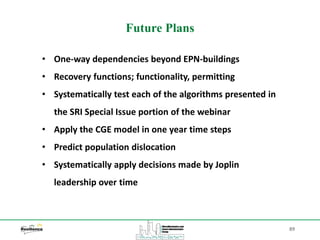
Future Plans
• One-way dependencies beyond EPN-buildings
• Recovery functions; functionality, permitting
• Systematically test each of the algorithms presented in
the SRI Special Issue portion of the webinar
• Apply the CGE model in one year time steps
• Predict population dislocation
• Systematically apply decisions made by Joplin
leadership over time
90
91
Field Studies Thrust in the CoE
• In order to measure a community’s resilience, the CoE will collect practical
metrics that can be divided into two categories:
1) Metrics that require field study data:
a) Population dislocation: Households displaced
b) Business interruption: Business closed
c) Employee dislocation: Employees failing to report to work
d) Critical facilities impact: Critical facilities closed
e) Housing loss: Units lost
2) Metrics that support (but do not require) field study data:
a) Physical and mental morbidity
b) Mortality
c) Fiscal impact: Loss of property tax and sales tax
• The community dimensions that are described in NIST GCR 16-001 are
embedded into these metrics
‐ Dimensions include: sustenance, health, housing and shelter, education and
personal development, security and safety, culture and identity, and belonging
and relationships
92
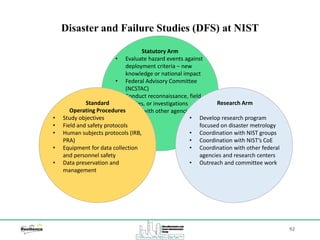
Disaster and Failure Studies (DFS) at NIST
Statutory Arm
• Evaluate hazard events against
deployment criteria – new
knowledge or national impact
• Federal Advisory Committee
(NCSTAC)
• Conduct reconnaissance, field
studies, or investigations
• MOUs with other agencies
Standard
Operating Procedures
• Study objectives
• Field and safety protocols
• Human subjects protocols (IRB,
PRA)
• Equipment for data collection
and personnel safety
• Data preservation and
management
Research Arm
• Develop research program
focused on disaster metrology
• Coordination with NIST groups
• Coordination with NIST’s CoE
• Coordination with other federal
agencies and research centers
• Outreach and committee work
93
CoE/NIST Collaborative Field Studies
• Data collection
‐ collect data and establish likely technical factors responsible for
poor/successful performance of buildings and infrastructure in the
aftermath of disasters.
‐ collect data related to community impact and recovery.
‐ collect data to validate models under development.
• Field methods
‐ test new field sampling protocols.
‐ assess new field equipment.
• Findings
‐ recommend frequency of data collection to capture community
functioning over time.
‐ recommend, as necessary, specific improvements to standards,
codes, and practices based on field studies.
94
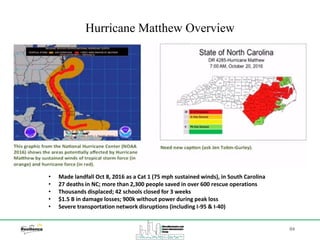
Hurricane Matthew Overview
• Made landfall Oct 8, 2016 as a Cat 1 (75 mph sustained winds), in South Carolina
• 27 deaths in NC; more than 2,300 people saved in over 600 rescue operations
• Thousands displaced; 42 schools closed for 3 weeks
• $1.5 B in damage losses; 900k without power during peak loss
• Severe transportation network disruptions (including I-95 & I-40)
95
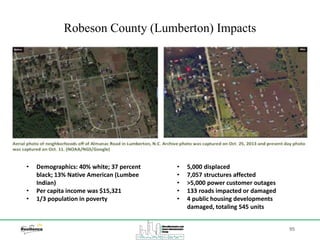
Robeson County (Lumberton) Impacts
• Demographics: 40% white; 37 percent
black; 13% Native American (Lumbee
Indian)
• Per capita income was $15,321
• 1/3 population in poverty
• 5,000 displaced
• 7,057 structures affected
• >5,000 power customer outages
• 133 roads impacted or damaged
• 4 public housing developments
damaged, totaling 545 units
96
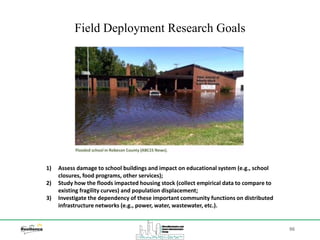
Field Deployment Research Goals
1) Assess damage to school buildings and impact on educational system (e.g., school
closures, food programs, other services);
2) Study how the floods impacted housing stock (collect empirical data to compare to
existing fragility curves) and population displacement;
3) Investigate the dependency of these important community functions on distributed
infrastructure networks (e.g., power, water, wastewater, etc.).
97
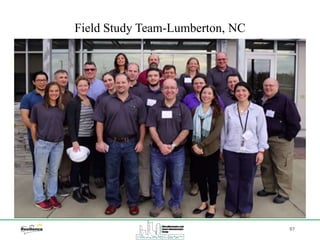
Field Study Team-Lumberton, NC
98
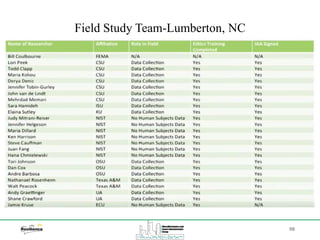
Field Study Team-Lumberton, NC
99
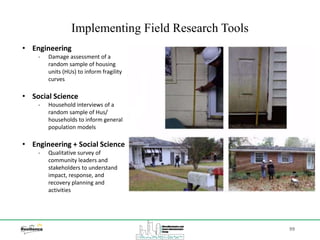
Implementing Field Research Tools
• Engineering
‐ Damage assessment of a
random sample of housing
units (HUs) to inform fragility
curves
• Social Science
‐ Household interviews of a
random sample of Hus/
households to inform general
population models
• Engineering + Social Science
‐ Qualitative survey of
community leaders and
stakeholders to understand
impact, response, and
recovery planning and
activities
100
IRB Field Study Protocol
• Institutional Review Board (IRB) approval from all
participating Universities
‐ Develop protocols for semi-structured and structured
interviews, damage assessment, and photography
• Recruitment of interviewees
• Informed consent
• Data collection methodologies and instruments
• Types of data collected
• Photography: publically viewable versus internal photos and
release statements
101
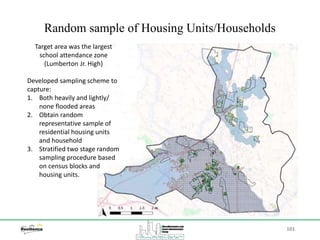
Random sample of Housing Units/Households
Target area was the largest
school attendance zone
(Lumberton Jr. High)
Developed sampling scheme to
capture:
1. Both heavily and lightly/
none flooded areas
2. Obtain random
representative sample of
residential housing units
and household
3. Stratified two stage random
sampling procedure based
on census blocks and
housing units.
102
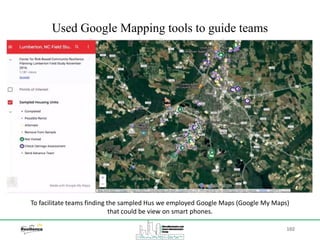
Used Google Mapping tools to guide teams
To facilitate teams finding the sampled Hus we employed Google Maps (Google My Maps)
that could be view on smart phones.
103
Used Google Mapping tools to guide teams
The sample linked to a Google Doc Spreadsheet – providing information on each HU and
updated each evening on status of damage assessment and HH interview.
104
Daily Activities
• Briefing on the day’s activities and
goals
• Division into qualitative and
survey sampling teams
• Assignments of areas or
stakeholders/meetings to be
attended
• Lunch time check in, update, and
assessment
• Evening check in:
• Debriefing
• update of sample/survey
activities
• initial development of next day’s
activities and assignments
• Set-up for next day
105
Damage Assessment Data
• Most of the damaged homes are wood light-frame structures
(many with brick veneer).
• Average quality and typically one to two stories.
• Almost two-thirds have crawlspaces.
• Generally single floor
• Majority single family: multi-family often duplexes or triplexes.
Foundation Type
(with Number of
Buildings)
Building
Type
Distribution
of Buildings
(%)
Distribution of
Number of Stories
(%)
Distribution of Construction
Type (%)
One Two Wood Masonry Both
Crawlspace
(273)
Single 96.3 90.1 8.4 60.0 28.1 8.0
Multi 1.8 100 0.0 80.0 0.0 20.0
Slab
(116)
Single 33.6 89.7 10.3 56.4 25.6 15.4
Multi 64.7 86.7 12.0 41.3 29.3 18.7
106
Damage Assessment Data
DS
Level
Description
0 No damage although water enters crawlspace or touches foundation (crawlspace or slab on
grade). No contact to electrical or plumbing, etc. in crawlspace. No contact with floor
joists. No sewer backup into living area.
1 Minor water enters house; damage to carpets, pads, baseboards, flooring. Approximately
1”, but no drywall damage. Touches joists. Could have some mold on subfloor above
crawlspace. Could have minor sewer backup and/or minor mold issues.
2 Drywall damage up to approximately 2 feet and electrical damage, heater and furnace and
other major equipment on floor damaged. Lower bathroom and kitchen cabinets damaged.
Doors or windows need replacement. Could have major sewer backup and/or major mold
issues.
3 Substantial drywall damage, electrical panel destroyed, bathroom/kitchen cabinets and
appliances damaged; lighting fixtures on walls destroyed; ceiling lighting may be ok.
Studs reusable; some may be damaged. Could have major sewer backup and/or major
mold issues.
4 Significant structural damage present; all drywall, appliances, cabinets etc. destroyed.
Could be floated off foundation. Building must be demolished or potentially replaced.
107
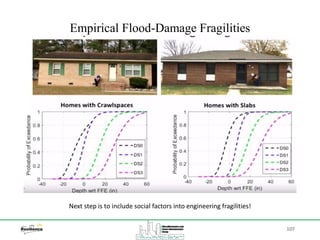
Empirical Flood-Damage Fragilities
Next step is to include social factors into engineering fragilities!
108
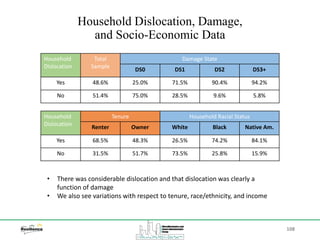
Household Dislocation, Damage,
and Socio-Economic Data
• There was considerable dislocation and that dislocation was clearly a
function of damage
• We also see variations with respect to tenure, race/ethnicity, and income
Household
Dislocation
Total
Sample
Damage State
DS0 DS1 DS2 DS3+
Yes 48.6% 25.0% 71.5% 90.4% 94.2%
No 51.4% 75.0% 28.5% 9.6% 5.8%
Household
Dislocation
Tenure Household Racial Status
Renter Owner White Black Native Am.
Yes 68.5% 48.3% 26.5% 74.2% 84.1%
No 31.5% 51.7% 73.5% 25.8% 15.9%
109
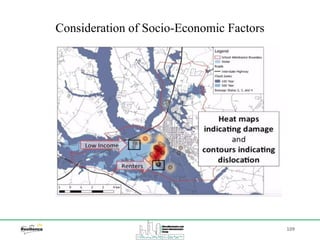
Consideration of Socio-Economic Factors
110
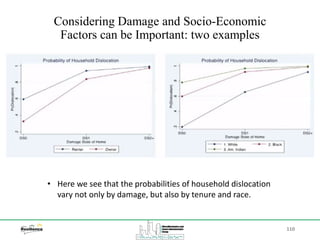
Considering Damage and Socio-Economic
Factors can be Important: two examples
• Here we see that the probabilities of household dislocation
vary not only by damage, but also by tenure and race.
111
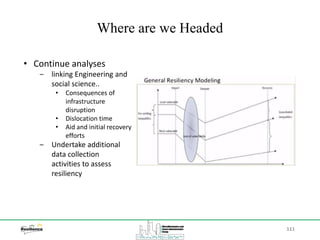
Where are we Headed
• Continue analyses
‒ linking Engineering and
social science..
• Consequences of
infrastructure
disruption
• Dislocation time
• Aid and initial recovery
efforts
‒ Undertake additional
data collection
activities to assess
resiliency
Thank You

Community resilience modeling, field studies and implementation

  • 1.
    Community Resilience: Modeling,Field Studies, and Implementation Welcome! 1
  • 2.
    2 Thrust 1: AMultidisciplinary computational environment with fully integrated supporting databases: “The Interconnected Networked - Community Resilience Modeling Environment”. Thrust 2: “Data management tools for community resilience systems”: A standardized data ontology, robust data architecture, and effective tools to support IN-CORE. Thrust 3: Resilience Data Architecture Validation Studies: Hindcasts and forecasts to test the data collection process and its integration into IN-CORE. Validate risk-informed intelligent search and decision algorithms; field studies. The Center Thrusts
  • 3.
    3 • Quantitative toolsand metrics for assessing community resilience either are in a rudimentary state of development or are not available. • Multiple hazards, interconnected and inter-dependent systems must be considered. • Uncertainties, both aleatory and epistemic, must be included for the resilience assessment and decision process to be risk- informed. • Community resilience plans and guidance are needed. • Existing building and infrastructure systems, as well as new construction, must be considered. • Codes, standards and regulatory documents must contain consistent performance goals. Center research Issues
  • 4.
    4 How can communityleaders know how resilient their community is? How can they know if their decisions and investments to improve resilience are making a significant difference? How can they deal with uncertainty and risk? Research and Implementation Questions
  • 5.
    5 Thrust 1: TheDevelopment of IN-CORE
  • 6.
    6 • General andRecovery • Infrastructure performance • Spatial and logical distribution of physical damage • Time to functionality • Availability of resources and leadership • Dependencies among built environment and social institutions Community Resilience Metrics • Economic and Social • Retaining businesses and employment • Revenue resources • Poverty and income distribution • Economic sustainability • Survival – safety; water/ food • Safety and security – personal safety, financial security, health • Growth and achievement opps
  • 7.
    7 • User requirements/StakeholderAlignment ‒ Support for new data types being developed ‒ Building taxonomies for all hazards • Standardized Data Ontology ‒ Defining new data types such as need for CGE development ‒ Review of schema and metadata • Development of Data management Tools ‒ GEM taxonomy, DDI Codebook, lifecycle Thrust 2: A Robust Data Architecture
  • 8.
    8 • Systematic validationof the numerical models and data in Tasks 1 and 2. • 2011 Joplin, Missouri tornado • Lumberton, NC Field Study • Single sector, multi-sector, and full architectural validation Thrust 3: Resilience Architecture Validation Studies
  • 9.
    9 • Year 1:Team building and Hazards Center Themes by Year
  • 10.
    10 • Year 2:Dependencies and Testbeds Center Themes by Year
  • 11.
    11 • Year 3:Recovery modeling with full interdependencies • Year 4: Risk-Informed Decision-Making • Year 5: Technical outreach including user workshops Center Themes by Year
  • 12.
  • 13.
    13 Special Issue ofSustainable and Resilient Infrastructure on the Centerville Testbed
  • 14.
    14 Several testbeds havebeen initiated since the beginning of the Center. The testbeds have been designed to 1. allow Center research teams to initiate, test, and modify essential community resilience assessment models and algorithms before the IN-CORE platform becomes fully operational 2. stress these assessment models in a controlled manner 3. examine varying degrees of dependency between physical, social, and economic infrastructure systems 4. facilitate the interdisciplinary collaborations and approaches to community resilience assessment that will be essential for the Center to achieve its ultimate goal Background
  • 15.
    15  A specialissue of the journal Sustainable and Resilient Infrastructure (volume 1, 2016 – Issue 3-4) has been devoted to the first of these testbeds namely the Centerville Virtual Community  Sustainable and Resilient Infrastructure is and interdisciplinary journal published by Taylor and Francis that focuses specifically on the sustainable development of resilient communities Special issue on the Centerville Virtual Community
  • 16.
    16  The CentervilleVirtual Community: A fully integrated decision model of interacting physical and social infrastructure systems Bruce R. Ellingwood, Harvey Culter, Paolo gardoni, Walter gills Peacock, john W. van de Lindt & Naiyu Wang  Building portfolio fragility functions to support scalable community resilience assessment Peihui Lin & Naiyu Wang  A multi-objective optimization model for retrofit strategies to mitigate direct economic loss and population dislocation Weili Zhang & Charles Nicholson  Probabilistic framework for performance assessment of electrical power networks to tornadoes Vipin U. Unnikrishnan & John W. van de Lindt  Modeling the resilience of critical infrastructure: The role of network dependencies Roberto Guidotti, hana Chmielewski, Vipin U. Unnikrishnan , Paolo Gardoni, Therese McAllister & John van de Lindt  Integrating engineering outputs from natural disaster models into a dynamic spatial computable general equilibrium model of Centerville Harvey Cutler, Martin Shields, Daniele Tavani & Sammy Zahran In orange the names of the presenting authors The special issue includes the following contributions
  • 17.
    The Centerville VirtualCommunity: A Fully Integrated Decision Model of Interacting Physical and Social Infrastructure Systems Bruce R. Ellingwood, Harvey Cutler, Paolo Gardoni, walter Gills Peacock, John W. van de Lindt and Naiyu Wang 17 COE Semiannual Meeting 04/26/2017
  • 18.
  • 19.
    19 The Centerville Testbed Motivation •A simple community model with essential physical, social and economic infrastructure components and systems and interdependencies • Software developers at NCSA can begin coding IN-CORE modules while awaiting for more realistic and complex algorithms and datasets • The common community model requires engineers, economists and sociologists to begin working together immediately. Sustainable and Resilient Infrastructure, Vol. 1, Nos. 3-4, Sept-Dec, 2016.
  • 20.
  • 21.
    21 Population demographics Demographic Value TotalPopulation 50,000 Total Households 19,684 Total male (proportion) 0.5 Total Female (proportion) 0.5 0 to 17 years (proportion) 0.19 18 to 64 years (proportion) 0.64 65 years and over (proportion) 0.17 Median Household Income $51,646 Total Owner Occupied (proportion) 0.5 Total renter Occupied (proportion) 0.5
  • 22.
    Employment by sector 22 SectorEmployees Employment (%) Retail 8087 25 Manufacturing 1923 6 Services 7921 25 Construction 2375 7 Health Care 3081 10 Education 589 2 P r o f e s s i o n a l Business Services 2795 9 Utilities 519 2 Government 4842 15 Total 32132 Health Care 9% Retail 25% Manufacturing 6% Services 25% Construction 7% Education 2% Professional Business Services 9% Utilities 2% Government 15%
  • 23.
    23 Building Construction Occupancy IDBuilding Types Residential R1 SF, 1-story, Wood, 1,400 ft2, 1945-1970 R2 SF, 1-story, Wood, 2,400 ft2, 1985-2000 R3 SF, 2-story, Wood, 3,200 ft2, 1985-2000 R4 SF, 1-story with basement, Wood, 2,400 ft2, 1970-1985 R5 MF, 3-sto, 48-unit multi-family (12,000 ft2/floor), 1985 R6 SF, Mobile home Commercial/retail C1 1-story, Steel Braced frame, 50,000 ft2, 1980 C2 2-story, RC frame, 50,000 ft2, 1980 C3 2-story, Reinforced masonry, 25,000 ft2, 1960 C4 Tilt-up concrete 125,000 ft2, (similar to a Walmart or Home Depot), 1995 Industrial I1 2-story, steel braced frame, 100,000 ft2, 1975 I2 1-story, steel braced frame, 500,000 ft2, 1995 Special S1 4-story, Hospital, RC, 30,000 ft2/floor, 1980 S2 2-story, Fire Station, Reinf. masonry, 10,000 ft2, 1985 S3 3-story, School, RC, 100,000 ft2, 1990 S4 1-story, School, lightly reinforced masonry, 100,000 ft2
  • 24.
  • 25.
  • 26.
  • 27.
    Social and economicmetrics 27 • Economic damages to physical infrastructure • Population dislocation • Loss of employment • Decline in household income/distribution • Change in domestic output
  • 28.
    Peihui Lin Naiyu Wang,Ph.D. University of Oklahoma COE Semiannual Meeting 04/27/2017 Building Portfolio Analysis 28
  • 29.
    Building Portfolio Analysis 29 Spatialand Temporal Hazzard Characterization At Community Scale Portfolio-level Damage Assessment Portfolio-level Functionality Loss Estimation Portfolio Recovery Time and Trajectory Modeling Risk-based decisions To Enhance Resilience of Community Building Portfolios inform Uncertainty And spatial correlation Functionality dependency on utility availabilities Engineering process and impact of social- economic systems Resilience objectives, gaps and mitigation strategies and policies Spatial and Temporal Hazzard Characterization At Community Scale Portfolio-level Damage Assessment Portfolio-level Functionality Loss Estimation Portfolio Recovery Time and Trajectory Modeling Challenges: 1. Uncertainty propagation and spatial correlation modeling 2. Building functionality assessment considering utility availabilities 3. Building portfolio recovery time and trajectory estimation 4. Ensuring scalability of analysis algorithms
  • 30.
    Building Portfolio PerformanceMetrics 30 Portfolio Metrics Abbrev. Definition Immediately Occupancy Ratio IOR The percentage of a building portfolio that can provide safe occupancy immediately following a disaster Household Dislocation Ratio HDR The percentage of displaced households in the community due to loss of housing habitability Direct Loss Ratio DLR The ratio of total direct loss to total assessed value of a building portfolio Portfolio Recovery Index PRI The percentage of a buildings that are in any of the five predefined functionality states at any given time following a disaster Portfolio Recovery Time PRT The time takes for a target percent of buildings in the portfolio to regain their full functionality states Sustainable and Resilient Infrastructure, 1(3-4), 108 -122.
  • 31.
    Testbed: Centerville 31 • 14,890wood buildings in 7 residential zones • 151 steel and RC buildings in 2 retail and business zones • 70 steel buildings in 2 industrial zones • 19 RC and masonry buildings for schools, hospitals and fire stations Sustainable and Resilient Infrastructure, 1(3-4), 108 -122.
  • 32.
    Damage and FunctionalityLoss 32 Damage to Functionality Mapping
  • 33.
    Building Portfolio RecoveryModel (Follow-up Work) 33 We developed a building portfolio recovery model (BPRM) which can output: • Functionality state probabilities at any time t following an event, for different building types; • Portfolio recovery time and recovery trajectory; • Uncertainties associated with the recovery trajectory. • Temporal evolution of the spatial variation in the portfolio recovery;
  • 34.
    34 Special Issue ofSustainable and Resilient Infrastructure on the Centerville Testbed
  • 35.
    Mitigation Resource Allocation 35 Sustainableand Resilient Infrastructure, 1(3-4), 123 -126. Allocate limited resources to retrofit building types in each zone, to specific code levels w.r.t. competing objectives: ‐ minimize economic loss (i.e., structure, non- structure, and content loss, provided by the Building team) ‐ minimize total dislocation (OLS model provided by the Social Science team) Requirement: ‐ Overall disparity in the dislocation rates by socio- economic status does not increase
  • 36.
    Baseline 36 Sustainable and ResilientInfrastructure, 1(3-4), 123 -126. • Heterogeneous building types, code levels • Ideal budget ($346M) is sufficient to improve all buildings to highest code level • Magnitude 7.8 earthquake, 35km to southwest ‐ Total direct economic loss: $856M ‐ Total dislocation: 3,203 HH Evaluation of optimization results under three budget levels: ‐ Low: 15% of ideal budget ‐ Medium: 30% of ideal budget ‐ High: 60% of the ideal budget
  • 37.
    Pareto Optimality 37 Sustainable andResilient Infrastructure, 1(3-4), 123 -126. Budget Level: 15% ($52M) Policy I reduces expected loss by $80M and reduces dislocation by about 700 HH from baseline Policy II reduces expected loss by $125M and reduces dislocation by about 480 HH from baseline
  • 38.
    38 Investment Decisions: Residentialvs. Non-Residential Sustainable and Resilient Infrastructure, 1(3-4), 123 -126.
  • 39.
    39 Pareto Optimal Frontier:Capital Stock Loss and Dislocation Sustainable and Resilient Infrastructure, 1(3-4), 123 -126. Zone1: W2: 1,072 buildings from level 2 to 3 W4: 2,196 buildings from level 1 to 2 Zone2: W1: 767 buildings from level 1 to 3 Zone4: W1: 2,567 buildings from level 1 to 3 W5: 25 buildings from level 2 to 3 Zone6: W5: 59 buildings from level 2 to 3
  • 40.
    40 Special Issue ofSustainable and Resilient Infrastructure on the Centerville Testbed
  • 41.
    41  It proposesa unified methodology for modeling dependent infrastructure networks and uses a 6-step probabilistic procedure to assess system resilience.  To estimate system recovery as a function of time at a community scale, the proposed methodology simulates direct physical damage, cascading effects due to dependencies, and recovery levels of network functionality.  The methodology for infrastructure resilience assessment is general, can be applied to other infrastructure networks and hazards, and can model different types of dependencies between networks.  As an illustration, the paper presents the direct physical effects of seismic events on the functionality of a potable water distribution network (WN) and the cascading effects of a damaged electric power network (EPN) on the WN. The paper makes the following contributions
  • 42.
    42  The maindiagonal of A has the symmetric adjacency tables of each network, that represent the pairwise connections within each network; the out-of-diagonal, generally rectangular, tables are used to represent pairwise connections between nodes of different networks  The likelihood table L describes the likelihood of failure of a node, given the failure of a different node  The dependency table P captures the failure propagation, combining tables A and L The dependency of networks is modeled through an augmented adjacency table A, a likelihood table L and a dependency table P
  • 43.
    43 The 6-step probabilisticprocedure to assess infrastructure resilience is as follows: Generate network modelStep 1 Generate hazard for the network areaStep 2 Assess direct physical damage to network componentsStep 3 Propagate cascading effects due to dependenciesStep 4 Assess functionality lossStep 5 Predict recovery time for network functionalityStep 6 Iterate to describe level of functionality within specified Tolerance
  • 44.
    44  WN systemis dependent on the EPN system  Insets A, B, and C show the WN and EPN node dependencies  The dependencies between WN and EPN are modeled with the out-of- diagonal adjacency tables which have values equal to 1 for the node pairs just described and zeroes for all of the other terms Centerville’s WN and EPN are used as testbed of the proposed procedure
  • 45.
    45  Two casesare used to describe the one- way dependency of the WN on the EPN:  Perfect independence: the WN is decoupled from the EPN (WN)  Perfect dependence: failure at any EPN nodes fails the dependent WN node (WN + EPN)  The minimum values of the functionality metrics are lower for the WN + EPN than for the WN  Although recovery begins around the same time, it is slower for the dependent system (WN + EPN) than for the independent system (WN) The case study results show the role of dependencies in assessing network resilience
  • 46.
    46  The lossof functionality and delay in the recovery process for network dependency can be quantified.  Simulating the dependency between networks can be important in estimating the resilience of critical infrastructure.  The cascading failures in the WN due to EPN failures can lead to increased recovery times or increased extent of functionality loss.  The modularity of the proposed methodology provides flexibility and allows the user to update fragilities, component and network models, hazards, and repair rates. Concluding Remarks
  • 47.
    47 Figure 1: FlowDiagram of a Computable General equilibrium Model
  • 48.
    48 East and WestCenterville
  • 49.
    49 Restrict the earthquakeshock to hit East and West Centerville separately • Damages commercial and residential buildings • Understand the value of the spatial CGE model Dynamic outcomes • Allow the earthquake to hit both sides of Centerville simultaneously • Damages to ‐ Buildings and transportation network ‐ Workers and shoppers have to use alternative routes Motivation
  • 50.
  • 51.
  • 52.
    52 • Spatial characteristicsare important • Commuting in and out (Joplin) • Dynamic estimates will be used to model recovery
  • 53.
    53 • Building portfolioanalysis (Earthquake) • Electric Power Network (EPN) damage analysis (Tornado) • Water network recovery analysis with EPN dependency (Earthquake) • Mitigation Resources Allocation (MRA) analysis • Computable General Equilibrium (CGE) analysis IN-CORE v1 Demo for Centerville Analyses
  • 54.
    54 • Uses IN-COREscenario earthquake • Computes these for a designated zone in Centerville Building Portfolio Analysis • Immediately Occupancy Ratio • Direct Loss Ratio • Household Dislocation Ratio
  • 55.
  • 56.
    56 • Uses IN-COREscenario tornado • Computes damages of Electric power network EPN Damage Analysis
  • 57.
  • 58.
    58 • Uses IN-COREscenario earthquake • Water network recovery analysis with EPN dependency • Computes changes of avg. of pressure, demand, and contamination Water Network Recovery Analysis
  • 59.
  • 60.
    60 • Multi-objective optimization •Computes solutions of resource allocation Mitigation Resource Allocation Analysis
  • 61.
  • 62.
    62 • Uses IN-COREscenario earthquake • Computes the impact of the earthquake through the building infrastructure and total factor productivity transportation channels Computable General Equilibrium Analysis
  • 63.
  • 64.
  • 65.
    65 Outline • 2011 JoplinMO Tornado • Field Study Data Collection & Mapping • Single Sector Validation: Electric Power Network • Single Sector Validation: Buildings • Multisector Validation: Buildings-EPN • Post-Disaster Functionality Methodology • Business Interruption • Socially Vulnerable Populations • Population Dislocation • Future Plans
  • 66.
    66 Hindcasting Hindcasting is asystematic process by which we check the accuracy of mathematical (and other) models using a past event. For Joplin, this will be accomplished through a robust series of checks and hindcasts ranging from the single building or infrastructure component level, economic component, to single infrastructure sector validation – this will be done at points in time to validate damage modeling, loss estimation, population dislocation, and functionality and recovery models.
  • 67.
    67 City of Joplin,Missouri Hindcast is a way of testing mathematical models; known or closely estimated inputs for past events, are entered into the model to see how well the output matches the known results. • Land area in square miles: 35.56 • Population: 51,316 (2014 estimate) • Housing units: 23,322 • Median value of housing: $103,300 Joplin tornado – May 22, 2011 • EF5 multiple-vortex • Fatalities: 161 • Injured: 1150 • Total loss: $2.8 billion • Costliest single tornado in US history
  • 68.
    68 2011 Joplin TornadoOverview • Touched down at 5:34 PM CDT, Sunday, May 22, 2011.1 Stayed on ground for about 22 miles (6 miles in City of Joplin) and 15 minutes • Enhanced Fujita Scale EF-5 tornado; estimated maximum wind speeds: 200+ mph • Damaged/destroyed ~ 8,000 buildings. • Affected ~41% of City’s population (20,820 of 50,173). Costliest tornado on record (~$1.8 billion insured loss). • 161 fatalities and over 1,000 injuries. Deadliest single tornado on record. Exceeded U.S. average deaths/year for all tornados (91.6), hurricanes (50.8), & earthquakes (7.5). • Official warning time of 17 minutes (national average is 14 minutes).
  • 69.
    69 NIST Objectives • Determinethe tornado hazard characteristics and associated wind fields • Determine the response of residential, commercial, and critical buildings, including the performance of designated safe areas • Determine the performance of lifelines relative to the community of operations of residential, commercial, and critical buildings • Determine the pattern, location, and cause of fatalities and injuries, and associated emergency communications and public response • Identify areas in current building, fire, and emergency communications codes, standards, and practices that warrant revision
  • 70.
    70 NIST Findings • 40%of the fatalities and as much as 90 % of the tornado area were associated with EF-3 or lower wind speeds. • Of the buildings damaged, 7,411 were residential and 553 were non-residential. • The failure of building envelopes at St. John’s Regional Medical Center led to its loss of functionality; the structural frame withstood the tornado without structural collapse. • All utilities (water, gas, power) were lost in the areas most damaged by the May 22. The utility providers restored service to critical buildings (SJRMC, water treatment plant) within 24 hours.
  • 71.
    71 Field Study DataCollection & Mapping
  • 72.
  • 73.
    73 Estimating Service Areaof Each Substation Based on Weighted Cellular Automata Combined with Distribution Lines
  • 74.
  • 75.
    75 Categorizing Buildings inJoplin Single Sector Validation: Buildings Developing Damage Fragilities Bldg. ID Building Description T1 Res Wood Bldg. – Small Rectangular Plan – Gable Roof - 1 Story T2 Res Wood Bldg. – Small Square Plan – Gable Roof - 2 Stories T3 Res Wood Bldg. – Medium Rectangular Plan – Gable Roof - 1 Story T4 Res Wood Bldg. – Medium Rectangular Plan – Hip Roof - 2 Stories T5 Res Wood Bldg. – Large Rectangular Plan – Gable Roof - 2 Stories T6 Business and Retail Buildings T7 Light Industrial Buildings T8 Heavy Industrial Buildings T9 Elementary/Middle School – Unreinforced Masonry T10 High School – Reinforced Masonry T11 Fire/Police Station T12 Hospital T13 Community Center/Church T14 Government Buildings T15 Large Big Box T16 Small Big Box T17 Mobile Homes T18 Shopping Mall T19 Office Buildings
  • 76.
    76 Building Taxonomy forTornado Hazard Derivation Resources: a) Building Attributes Affecting Structural Response [GEM Building Taxonomy (2013)] a) Building Attributes Affecting Wind Load Intensity [ASCE7-10 chapters 26 to 31]
  • 77.
  • 78.
  • 79.
  • 80.
    80 Functionality of buildingBased on Damage to Buildings and Damage to Electric Power Network
  • 81.
    81 Post-Disaster Functionality Methodology •Developed for: • Any type of building (i.e. residential buildings, health care facilities, industrial, commercial etc. • Any hazard (hazard agnostic) • Integrates Performance- Based Engineering (PBE) into Community Resilience Assessment studies • Four-step probabilistic functionality methodology
  • 82.
    82 Post-Disaster Functionality Methodology •Four damage states (Slight, moderate, extensive & complete) • Three different building types: school, heavy industrial & strip mall • Output: • Intrinsic Functionality Fragilities (IFF) accounts only for construction and clean-up time • Semi-intrinsic Functionality Fragilities (SIFF) accounts for construction and clean-up time & time to obtain financing, permits and complete design • Results presented for the assumption of being in Damage State “Extensive” • Results format: Empirical and log-normal fitted cumulative distribution curves
  • 83.
  • 84.
    84 Estimating Probability ofBusiness Closure After 3 Months
  • 85.
  • 86.
    86 Influences of theEvent on Economic Factors • A social accounting matrix (SAM) summarizes the data that reflects the intersection between households, firms and the government. • SAMs will be constructed for 2010, 2011 and 2012 for Joplin • CGE model for 2010 and then use it to forecast future SAM values and compare these forecasts to the values in the 2011 and 2012 SAMs. • The forecast errors (Actual – Forecast) will determine initial ability to forecast the impacts of a tornado.
  • 87.
    87 Socially Vulnerable Populations ‐Census Tract Level example for the city ‐ Population Data Geocoded within Census Tracts ‐ Census Block Group Level example for Joplin Missouri ‐ Population Data Geocoded within Census Block Groups
  • 88.
    88 Socially Vulnerable Populations ‐90% Confidence Interval Population Estimates for population data within the EF0-EF4 2011 Joplin Tornado Path ‐ Block Group Level provides larger estimates due to variation in population density ‐ Census Tract Level estimates underestimate vulnerable populations Factors Census Tract Estimate Block Groups Estimate Percent Difference Total Population 18,325±1,001 20,168±1,535 7.6% - 12.3% 65 years and over 2,698±326 3,130±365 15.6 - 16.5% Single-parent with own children 900±234 1,069±270 18.0% - 20.0% Occupied Housing Units without a vehicle 502±144 628±182 24.8% - 25.5% Total Housing Units with 10 or more units 540±213 661±230 18.3% - 31.8%
  • 89.
    89 Future Plans • One-waydependencies beyond EPN-buildings • Recovery functions; functionality, permitting • Systematically test each of the algorithms presented in the SRI Special Issue portion of the webinar • Apply the CGE model in one year time steps • Predict population dislocation • Systematically apply decisions made by Joplin leadership over time
  • 90.
  • 91.
    91 Field Studies Thrustin the CoE • In order to measure a community’s resilience, the CoE will collect practical metrics that can be divided into two categories: 1) Metrics that require field study data: a) Population dislocation: Households displaced b) Business interruption: Business closed c) Employee dislocation: Employees failing to report to work d) Critical facilities impact: Critical facilities closed e) Housing loss: Units lost 2) Metrics that support (but do not require) field study data: a) Physical and mental morbidity b) Mortality c) Fiscal impact: Loss of property tax and sales tax • The community dimensions that are described in NIST GCR 16-001 are embedded into these metrics ‐ Dimensions include: sustenance, health, housing and shelter, education and personal development, security and safety, culture and identity, and belonging and relationships
  • 92.
    92 Disaster and FailureStudies (DFS) at NIST Statutory Arm • Evaluate hazard events against deployment criteria – new knowledge or national impact • Federal Advisory Committee (NCSTAC) • Conduct reconnaissance, field studies, or investigations • MOUs with other agencies Standard Operating Procedures • Study objectives • Field and safety protocols • Human subjects protocols (IRB, PRA) • Equipment for data collection and personnel safety • Data preservation and management Research Arm • Develop research program focused on disaster metrology • Coordination with NIST groups • Coordination with NIST’s CoE • Coordination with other federal agencies and research centers • Outreach and committee work
  • 93.
    93 CoE/NIST Collaborative FieldStudies • Data collection ‐ collect data and establish likely technical factors responsible for poor/successful performance of buildings and infrastructure in the aftermath of disasters. ‐ collect data related to community impact and recovery. ‐ collect data to validate models under development. • Field methods ‐ test new field sampling protocols. ‐ assess new field equipment. • Findings ‐ recommend frequency of data collection to capture community functioning over time. ‐ recommend, as necessary, specific improvements to standards, codes, and practices based on field studies.
  • 94.
    94 Hurricane Matthew Overview •Made landfall Oct 8, 2016 as a Cat 1 (75 mph sustained winds), in South Carolina • 27 deaths in NC; more than 2,300 people saved in over 600 rescue operations • Thousands displaced; 42 schools closed for 3 weeks • $1.5 B in damage losses; 900k without power during peak loss • Severe transportation network disruptions (including I-95 & I-40)
  • 95.
    95 Robeson County (Lumberton)Impacts • Demographics: 40% white; 37 percent black; 13% Native American (Lumbee Indian) • Per capita income was $15,321 • 1/3 population in poverty • 5,000 displaced • 7,057 structures affected • >5,000 power customer outages • 133 roads impacted or damaged • 4 public housing developments damaged, totaling 545 units
  • 96.
    96 Field Deployment ResearchGoals 1) Assess damage to school buildings and impact on educational system (e.g., school closures, food programs, other services); 2) Study how the floods impacted housing stock (collect empirical data to compare to existing fragility curves) and population displacement; 3) Investigate the dependency of these important community functions on distributed infrastructure networks (e.g., power, water, wastewater, etc.).
  • 97.
  • 98.
  • 99.
    99 Implementing Field ResearchTools • Engineering ‐ Damage assessment of a random sample of housing units (HUs) to inform fragility curves • Social Science ‐ Household interviews of a random sample of Hus/ households to inform general population models • Engineering + Social Science ‐ Qualitative survey of community leaders and stakeholders to understand impact, response, and recovery planning and activities
  • 100.
    100 IRB Field StudyProtocol • Institutional Review Board (IRB) approval from all participating Universities ‐ Develop protocols for semi-structured and structured interviews, damage assessment, and photography • Recruitment of interviewees • Informed consent • Data collection methodologies and instruments • Types of data collected • Photography: publically viewable versus internal photos and release statements
  • 101.
    101 Random sample ofHousing Units/Households Target area was the largest school attendance zone (Lumberton Jr. High) Developed sampling scheme to capture: 1. Both heavily and lightly/ none flooded areas 2. Obtain random representative sample of residential housing units and household 3. Stratified two stage random sampling procedure based on census blocks and housing units.
  • 102.
    102 Used Google Mappingtools to guide teams To facilitate teams finding the sampled Hus we employed Google Maps (Google My Maps) that could be view on smart phones.
  • 103.
    103 Used Google Mappingtools to guide teams The sample linked to a Google Doc Spreadsheet – providing information on each HU and updated each evening on status of damage assessment and HH interview.
  • 104.
    104 Daily Activities • Briefingon the day’s activities and goals • Division into qualitative and survey sampling teams • Assignments of areas or stakeholders/meetings to be attended • Lunch time check in, update, and assessment • Evening check in: • Debriefing • update of sample/survey activities • initial development of next day’s activities and assignments • Set-up for next day
  • 105.
    105 Damage Assessment Data •Most of the damaged homes are wood light-frame structures (many with brick veneer). • Average quality and typically one to two stories. • Almost two-thirds have crawlspaces. • Generally single floor • Majority single family: multi-family often duplexes or triplexes. Foundation Type (with Number of Buildings) Building Type Distribution of Buildings (%) Distribution of Number of Stories (%) Distribution of Construction Type (%) One Two Wood Masonry Both Crawlspace (273) Single 96.3 90.1 8.4 60.0 28.1 8.0 Multi 1.8 100 0.0 80.0 0.0 20.0 Slab (116) Single 33.6 89.7 10.3 56.4 25.6 15.4 Multi 64.7 86.7 12.0 41.3 29.3 18.7
  • 106.
    106 Damage Assessment Data DS Level Description 0No damage although water enters crawlspace or touches foundation (crawlspace or slab on grade). No contact to electrical or plumbing, etc. in crawlspace. No contact with floor joists. No sewer backup into living area. 1 Minor water enters house; damage to carpets, pads, baseboards, flooring. Approximately 1”, but no drywall damage. Touches joists. Could have some mold on subfloor above crawlspace. Could have minor sewer backup and/or minor mold issues. 2 Drywall damage up to approximately 2 feet and electrical damage, heater and furnace and other major equipment on floor damaged. Lower bathroom and kitchen cabinets damaged. Doors or windows need replacement. Could have major sewer backup and/or major mold issues. 3 Substantial drywall damage, electrical panel destroyed, bathroom/kitchen cabinets and appliances damaged; lighting fixtures on walls destroyed; ceiling lighting may be ok. Studs reusable; some may be damaged. Could have major sewer backup and/or major mold issues. 4 Significant structural damage present; all drywall, appliances, cabinets etc. destroyed. Could be floated off foundation. Building must be demolished or potentially replaced.
  • 107.
    107 Empirical Flood-Damage Fragilities Nextstep is to include social factors into engineering fragilities!
  • 108.
    108 Household Dislocation, Damage, andSocio-Economic Data • There was considerable dislocation and that dislocation was clearly a function of damage • We also see variations with respect to tenure, race/ethnicity, and income Household Dislocation Total Sample Damage State DS0 DS1 DS2 DS3+ Yes 48.6% 25.0% 71.5% 90.4% 94.2% No 51.4% 75.0% 28.5% 9.6% 5.8% Household Dislocation Tenure Household Racial Status Renter Owner White Black Native Am. Yes 68.5% 48.3% 26.5% 74.2% 84.1% No 31.5% 51.7% 73.5% 25.8% 15.9%
  • 109.
  • 110.
    110 Considering Damage andSocio-Economic Factors can be Important: two examples • Here we see that the probabilities of household dislocation vary not only by damage, but also by tenure and race.
  • 111.
    111 Where are weHeaded • Continue analyses ‒ linking Engineering and social science.. • Consequences of infrastructure disruption • Dislocation time • Aid and initial recovery efforts ‒ Undertake additional data collection activities to assess resiliency
  • 112.