SLIDESMANIA.
Group 3
SLIDESMANIA.
1. Define copy reading
and heading
2. Enumerate the
responsibilities of a
copy reader.
3. Familiarize with copy
reading symbols
4. Identify the
guidelines in
headline writing.
SLIDESMANIA.
A. COPYREADING
SLIDESMANIA.
a.) What is Copy Reading?
• It is the art of arranging, correcting,
and selecting the quality and type of
news.
• It is also called copyediting.
• One who edits copies is called a
copyreader or copyeditor.
SLIDESMANIA.
THE COPY
• Material for a newspaper
or magazine article.
• The text as written by the
author.
SLIDESMANIA.
b.) Responsibilities of a
copyreader/copyeditor
The copyreader – is a very important
person on the newspaper job, etc.
• Edits errors on grammar (spelling, tenses,
agreement, etc.)
• Edits errors of fact (accuracy check)
• Edits verbose copy
• Deletes opinion or slant and libelous statements
• Writes the headline
SLIDESMANIA.
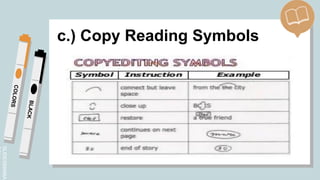
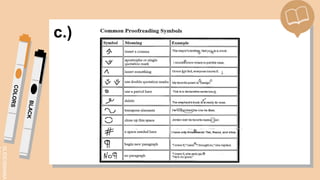
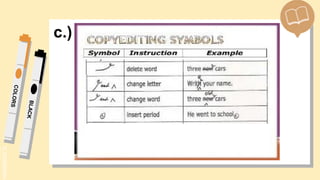
c.) Copy Reading Symbols
SLIDESMANIA.
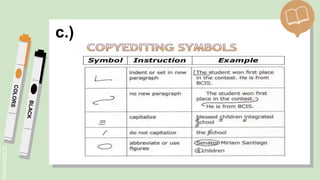
c.)
SLIDESMANIA.
c.)
SLIDESMANIA.
c.)
SLIDESMANIA.
B. HEADLINING
SLIDESMANIA.
a.) What is Headline?
A headline is the title of a
newspaper story, printed in a large
letter at the top of the story,
especially on the front page
SLIDESMANIA.
b.) Functions of a Headline
• Communicate Story Importance
• Concisely convey essence of
story
• Grab attention
• Convey tone of publication
SLIDESMANIA.
c.) Guidelines in headline writing
1. Best headline writers are spontaneous and creative; the
best headlines instantly come to you.
2. Headline writers have to be the best writers at the
newspaper.
3. Many times, the best headlines you come up with
cannot be printed!
4. Continuity leads to better headlines; one must write
them day after day to get good at it.
5. Read others' headlines to get ideas, but doing so isn't
necessarily going to make you a better headline writer.
SLIDESMANIA.
c.) Guidelines in headline writing
6. The most-effective headlines are those that give an old
cliché a new twist; readers are familiar with the cliché,
but something different about it will reel them in.
7. The more conversational the headline, the more the
readers will like it.
8. Don't be so quick to abandon using articles such as "a,"
"and" and "the"; sometimes these words are needed
for clarity. Also, headline styles changeover time.
9. Don't repeat the lead in a headline.
SLIDESMANIA.
c.) Guidelines in headline writing
10. Write a better headline than the lead. And don't give
away the punch line of a feature story that has a
surprise ending.
11. Be aware of any unintended double meanings.
12. Avoid Bad Breaks at the end of lines, such as dangling
prepositions or conjunctions.
13. Don't get into the habit of relying on squeezing or
stretching the headline type to fit the space.
SLIDESMANIA.
Dos and Don’ts in Writing
Traditional Headlines
SLIDESMANIA.
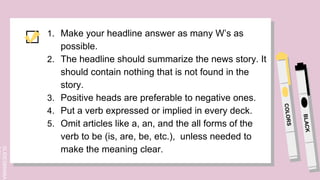
1. Make your headline answer as many W’s as
possible.
2. The headline should summarize the news story. It
should contain nothing that is not found in the
story.
3. Positive heads are preferable to negative ones.
4. Put a verb expressed or implied in every deck.
5. Omit articles like a, an, and the all forms of the
verb to be (is, are, be, etc.), unless needed to
make the meaning clear.
SLIDESMANIA.
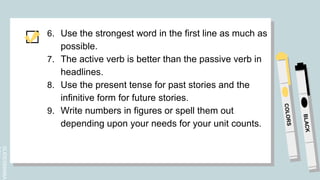
6. Use the strongest word in the first line as much as
possible.
7. The active verb is better than the passive verb in
headlines.
8. Use the present tense for past stories and the
infinitive form for future stories.
9. Write numbers in figures or spell them out
depending upon your needs for your unit counts.
SLIDESMANIA.
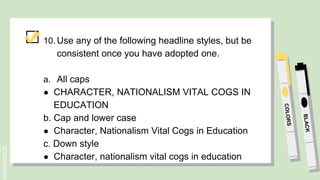
10. Use any of the following headline styles, but be
consistent once you have adopted one.
a. All caps
● CHARACTER, NATIONALISM VITAL COGS IN
EDUCATION
b. Cap and lower case
● Character, Nationalism Vital Cogs in Education
c. Down style
● Character, nationalism vital cogs in education
SLIDESMANIA.
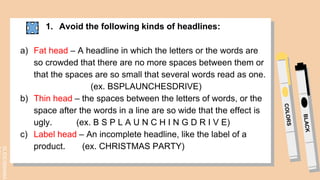
1. Avoid the following kinds of headlines:
a) Fat head – A headline in which the letters or the words are
so crowded that there are no more spaces between them or
that the spaces are so small that several words read as one.
(ex. BSPLAUNCHESDRIVE)
b) Thin head – the spaces between the letters of words, or the
space after the words in a line are so wide that the effect is
ugly. (ex. B S P L A U N C H I N G D R I V E)
c) Label head – An incomplete headline, like the label of a
product. (ex. CHRISTMAS PARTY)
SLIDESMANIA.
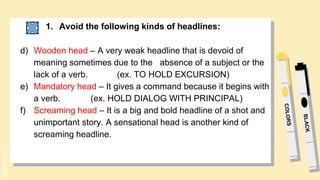
1. Avoid the following kinds of headlines:
d) Wooden head – A very weak headline that is devoid of
meaning sometimes due to the absence of a subject or the
lack of a verb. (ex. TO HOLD EXCURSION)
e) Mandatory head – It gives a command because it begins with
a verb. (ex. HOLD DIALOG WITH PRINCIPAL)
f) Screaming head – It is a big and bold headline of a shot and
unimportant story. A sensational head is another kind of
screaming headline.
SLIDESMANIA.
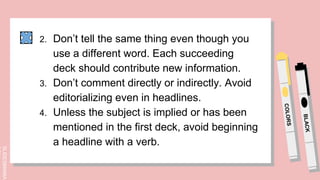
2. Don’t tell the same thing even though you
use a different word. Each succeeding
deck should contribute new information.
3. Don’t comment directly or indirectly. Avoid
editorializing even in headlines.
4. Unless the subject is implied or has been
mentioned in the first deck, avoid beginning
a headline with a verb.
SLIDESMANIA.
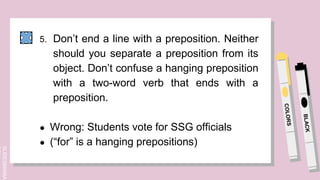
5. Don’t end a line with a preposition. Neither
should you separate a preposition from its
object. Don’t confuse a hanging preposition
with a two-word verb that ends with a
preposition.
● Wrong: Students vote for SSG officials
● (“for” is a hanging prepositions)
SLIDESMANIA.
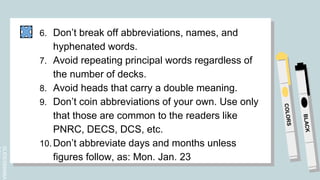
6. Don’t break off abbreviations, names, and
hyphenated words.
7. Avoid repeating principal words regardless of
the number of decks.
8. Avoid heads that carry a double meaning.
9. Don’t coin abbreviations of your own. Use only
that those are common to the readers like
PNRC, DECS, DCS, etc.
10. Don’t abbreviate days and months unless
figures follow, as: Mon. Jan. 23
SLIDESMANIA.
Thank you!
Keep Safe and GodBless!
SLIDESMANIA.
Group 3
Obejero, Ariane M.
Butor, Allma Lynn L.
Alamag, Carlene C.
Galit, Laidelyn C.
Lomongo, Jhon Carlo

CopyReading & Headlining.pdf

  • 1.
  • 2.
    SLIDESMANIA. 1. Define copyreading and heading 2. Enumerate the responsibilities of a copy reader. 3. Familiarize with copy reading symbols 4. Identify the guidelines in headline writing.
  • 3.
  • 4.
    SLIDESMANIA. a.) What isCopy Reading? • It is the art of arranging, correcting, and selecting the quality and type of news. • It is also called copyediting. • One who edits copies is called a copyreader or copyeditor.
  • 5.
    SLIDESMANIA. THE COPY • Materialfor a newspaper or magazine article. • The text as written by the author.
  • 6.
    SLIDESMANIA. b.) Responsibilities ofa copyreader/copyeditor The copyreader – is a very important person on the newspaper job, etc. • Edits errors on grammar (spelling, tenses, agreement, etc.) • Edits errors of fact (accuracy check) • Edits verbose copy • Deletes opinion or slant and libelous statements • Writes the headline
  • 7.
  • 8.
  • 9.
  • 10.
  • 11.
  • 12.
    SLIDESMANIA. a.) What isHeadline? A headline is the title of a newspaper story, printed in a large letter at the top of the story, especially on the front page
  • 13.
    SLIDESMANIA. b.) Functions ofa Headline • Communicate Story Importance • Concisely convey essence of story • Grab attention • Convey tone of publication
  • 14.
    SLIDESMANIA. c.) Guidelines inheadline writing 1. Best headline writers are spontaneous and creative; the best headlines instantly come to you. 2. Headline writers have to be the best writers at the newspaper. 3. Many times, the best headlines you come up with cannot be printed! 4. Continuity leads to better headlines; one must write them day after day to get good at it. 5. Read others' headlines to get ideas, but doing so isn't necessarily going to make you a better headline writer.
  • 15.
    SLIDESMANIA. c.) Guidelines inheadline writing 6. The most-effective headlines are those that give an old cliché a new twist; readers are familiar with the cliché, but something different about it will reel them in. 7. The more conversational the headline, the more the readers will like it. 8. Don't be so quick to abandon using articles such as "a," "and" and "the"; sometimes these words are needed for clarity. Also, headline styles changeover time. 9. Don't repeat the lead in a headline.
  • 16.
    SLIDESMANIA. c.) Guidelines inheadline writing 10. Write a better headline than the lead. And don't give away the punch line of a feature story that has a surprise ending. 11. Be aware of any unintended double meanings. 12. Avoid Bad Breaks at the end of lines, such as dangling prepositions or conjunctions. 13. Don't get into the habit of relying on squeezing or stretching the headline type to fit the space.
  • 17.
    SLIDESMANIA. Dos and Don’tsin Writing Traditional Headlines
  • 18.
    SLIDESMANIA. 1. Make yourheadline answer as many W’s as possible. 2. The headline should summarize the news story. It should contain nothing that is not found in the story. 3. Positive heads are preferable to negative ones. 4. Put a verb expressed or implied in every deck. 5. Omit articles like a, an, and the all forms of the verb to be (is, are, be, etc.), unless needed to make the meaning clear.
  • 19.
    SLIDESMANIA. 6. Use thestrongest word in the first line as much as possible. 7. The active verb is better than the passive verb in headlines. 8. Use the present tense for past stories and the infinitive form for future stories. 9. Write numbers in figures or spell them out depending upon your needs for your unit counts.
  • 20.
    SLIDESMANIA. 10. Use anyof the following headline styles, but be consistent once you have adopted one. a. All caps ● CHARACTER, NATIONALISM VITAL COGS IN EDUCATION b. Cap and lower case ● Character, Nationalism Vital Cogs in Education c. Down style ● Character, nationalism vital cogs in education
  • 21.
    SLIDESMANIA. 1. Avoid thefollowing kinds of headlines: a) Fat head – A headline in which the letters or the words are so crowded that there are no more spaces between them or that the spaces are so small that several words read as one. (ex. BSPLAUNCHESDRIVE) b) Thin head – the spaces between the letters of words, or the space after the words in a line are so wide that the effect is ugly. (ex. B S P L A U N C H I N G D R I V E) c) Label head – An incomplete headline, like the label of a product. (ex. CHRISTMAS PARTY)
  • 22.
    SLIDESMANIA. 1. Avoid thefollowing kinds of headlines: d) Wooden head – A very weak headline that is devoid of meaning sometimes due to the absence of a subject or the lack of a verb. (ex. TO HOLD EXCURSION) e) Mandatory head – It gives a command because it begins with a verb. (ex. HOLD DIALOG WITH PRINCIPAL) f) Screaming head – It is a big and bold headline of a shot and unimportant story. A sensational head is another kind of screaming headline.
  • 23.
    SLIDESMANIA. 2. Don’t tellthe same thing even though you use a different word. Each succeeding deck should contribute new information. 3. Don’t comment directly or indirectly. Avoid editorializing even in headlines. 4. Unless the subject is implied or has been mentioned in the first deck, avoid beginning a headline with a verb.
  • 24.
    SLIDESMANIA. 5. Don’t enda line with a preposition. Neither should you separate a preposition from its object. Don’t confuse a hanging preposition with a two-word verb that ends with a preposition. ● Wrong: Students vote for SSG officials ● (“for” is a hanging prepositions)
  • 25.
    SLIDESMANIA. 6. Don’t breakoff abbreviations, names, and hyphenated words. 7. Avoid repeating principal words regardless of the number of decks. 8. Avoid heads that carry a double meaning. 9. Don’t coin abbreviations of your own. Use only that those are common to the readers like PNRC, DECS, DCS, etc. 10. Don’t abbreviate days and months unless figures follow, as: Mon. Jan. 23
  • 26.
  • 27.
    SLIDESMANIA. Group 3 Obejero, ArianeM. Butor, Allma Lynn L. Alamag, Carlene C. Galit, Laidelyn C. Lomongo, Jhon Carlo