1926 – ‘Talkies’ allowed many
musical short films to be
produced. A Vitaphone, also
known as a sound film system was
produced and Warner Bros
started to use it for Vitaphone
shorts, which featured many
bands, singers, vocalists and on
someoccasion’s dancers. Max
Fleischer was an animation artist
who created a series of cartoons
that had songs in the back ground.
This was known as Screen Songs,
which allowed the audience to
sing along, this is now known as a
karaoke machine.
1930 – Cartoons featured popular
musicians performing their current
hit songs on camera in live action
segments throughout the cartoons.
Walt Disney used this, in Fantasia,
it featured several interpretations
of classical pieces, which were built
around the music. The Warner
Bros cartoons were shaped around
specific songs from their musical
films.Live action musical shorts,
who featured popular
performances, were also
distributed to local theatres. Such
performers as Bessie Smith a blues
singer and Cab Calloway along
with numerous other musicians
appeared in the short musical
events during this time.
1940-1947 - In the mid-
1940s, musician Louis
Jordan made short films
for his songs, someof
these short films for his
songs would feature in
somefilms such as
‘Lookout Sister’.
Soundies were produced
and released into
musical films that would
most likely include a
dance routine.
1950- Musicals from the early
1950s led to the creation of
music videos. Tony Bennett
claims to have created "...the
first music video". His music
video included someone filming
him walking along the
Serpentine in Hyde Park,
London in 1956, this video was
then put on top of the
soundtrack of his song
"Stranger in Paradise". The
clip was sent to UK and US
television stations and aired on
shows.
Late 1950s- A visual jukebox
was invented in france and
short films were shown on this
by French artists. When the
word spread many other
countries created similar
machines. Italy made the
Cinebox, USA made the Color-
Sonic.
1965 –
Promotional
clips were used
by such artists
like the Beatles,
to help with the
distribution
and broadcast.
1966 - Nancy Sinatra
filmed a music video
for her song These
Boots Are Made for
Walkin'. In June 1968,
Elvis Presley recorded
music videos again, in
recording studios, in
order to promote their
new albums, making
videos where famous
stars If I Can Dream
and Trouble/Guitar
Man.
1974 – The Australian
TV was created to
show the significance
in popularizing the
music video genre in
countries.
1970s – Top Of The
Pops. BBC placed strict
limits on the number of
music videos and the
music videos that were
played on Top Of The
Pops.
1981 – USA MTV channel
was launched. The first
video they launched was
‘Video Killed the Radio
Star’. This was the
beginning of a 24 hour
daily music channel.
1992 – MTV started listing directors
with the artist and song credits. The
directors that were first listed were
people like; Chris Cunningham,
Michel Gondry, Spike Jonze and
many more.
1997- iFlim
hosted short
videos,
including music
videos. This
enabled users
to share video
files, for
example music
videos.
2000 – MTV and many
other channels stop
showing music videos
and started showing
reality TV shoes which
became more popular
with MTVs audience.
Therefore MTV realised
that showing reality to
the public was more
entertaining than music
videos.

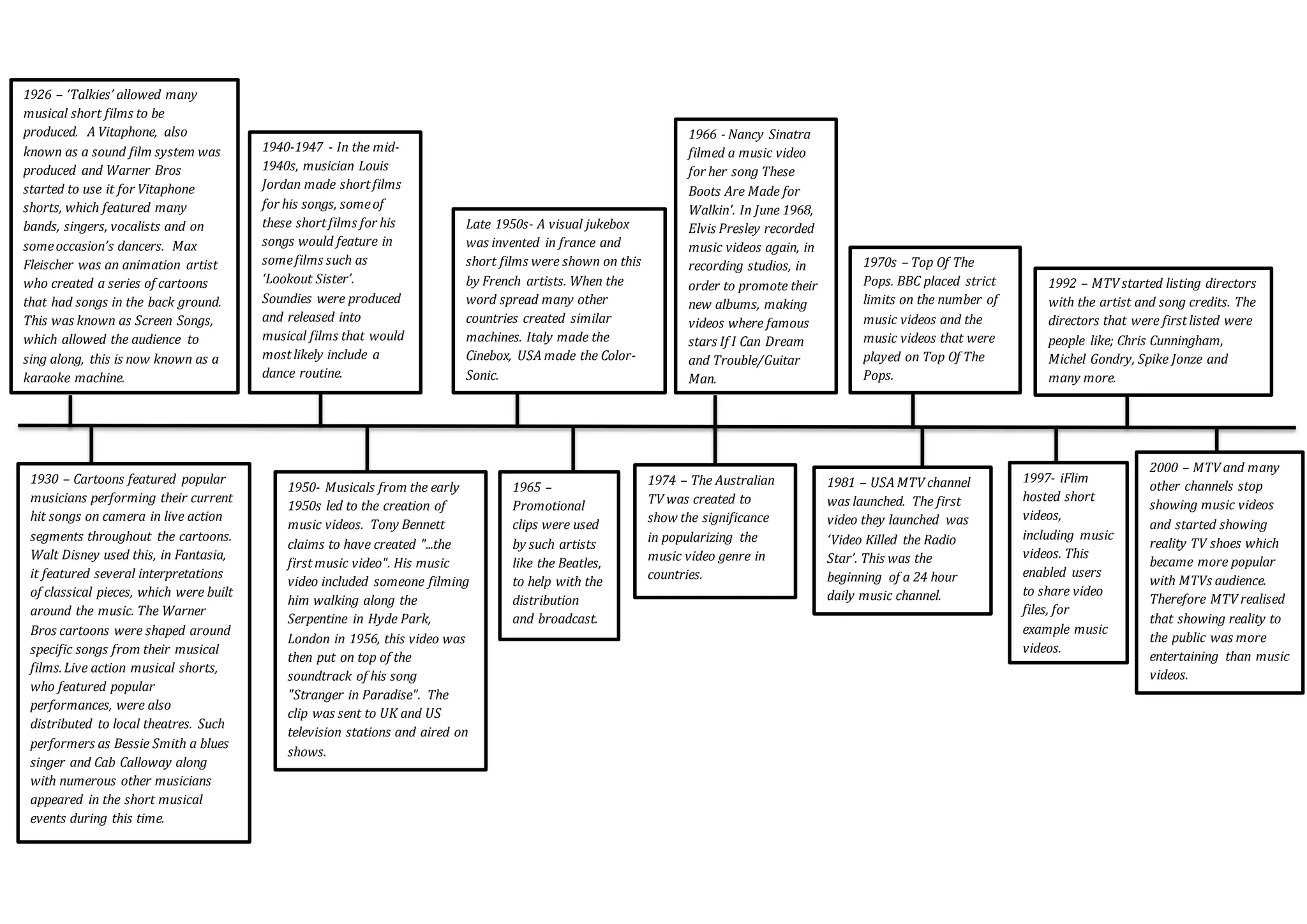
Music Video TimeLine

  • 1.
    1926 – ‘Talkies’allowed many musical short films to be produced. A Vitaphone, also known as a sound film system was produced and Warner Bros started to use it for Vitaphone shorts, which featured many bands, singers, vocalists and on someoccasion’s dancers. Max Fleischer was an animation artist who created a series of cartoons that had songs in the back ground. This was known as Screen Songs, which allowed the audience to sing along, this is now known as a karaoke machine. 1930 – Cartoons featured popular musicians performing their current hit songs on camera in live action segments throughout the cartoons. Walt Disney used this, in Fantasia, it featured several interpretations of classical pieces, which were built around the music. The Warner Bros cartoons were shaped around specific songs from their musical films.Live action musical shorts, who featured popular performances, were also distributed to local theatres. Such performers as Bessie Smith a blues singer and Cab Calloway along with numerous other musicians appeared in the short musical events during this time. 1940-1947 - In the mid- 1940s, musician Louis Jordan made short films for his songs, someof these short films for his songs would feature in somefilms such as ‘Lookout Sister’. Soundies were produced and released into musical films that would most likely include a dance routine. 1950- Musicals from the early 1950s led to the creation of music videos. Tony Bennett claims to have created "...the first music video". His music video included someone filming him walking along the Serpentine in Hyde Park, London in 1956, this video was then put on top of the soundtrack of his song "Stranger in Paradise". The clip was sent to UK and US television stations and aired on shows. Late 1950s- A visual jukebox was invented in france and short films were shown on this by French artists. When the word spread many other countries created similar machines. Italy made the Cinebox, USA made the Color- Sonic. 1965 – Promotional clips were used by such artists like the Beatles, to help with the distribution and broadcast. 1966 - Nancy Sinatra filmed a music video for her song These Boots Are Made for Walkin'. In June 1968, Elvis Presley recorded music videos again, in recording studios, in order to promote their new albums, making videos where famous stars If I Can Dream and Trouble/Guitar Man. 1974 – The Australian TV was created to show the significance in popularizing the music video genre in countries. 1970s – Top Of The Pops. BBC placed strict limits on the number of music videos and the music videos that were played on Top Of The Pops. 1981 – USA MTV channel was launched. The first video they launched was ‘Video Killed the Radio Star’. This was the beginning of a 24 hour daily music channel. 1992 – MTV started listing directors with the artist and song credits. The directors that were first listed were people like; Chris Cunningham, Michel Gondry, Spike Jonze and many more. 1997- iFlim hosted short videos, including music videos. This enabled users to share video files, for example music videos. 2000 – MTV and many other channels stop showing music videos and started showing reality TV shoes which became more popular with MTVs audience. Therefore MTV realised that showing reality to the public was more entertaining than music videos.