A2 MEDIA EVALUATIONS
SECTION A
When focusing on my finished product, “Delirium”, there are many techniques, conventions and styles that my group embedded into the
trailer that link with real media products.The horror genre has many sub-genres linked with it to satisfy each individual audience. In our
group, we primarily chose the sub-genre psychological, however we added hints of body horror to hybridize our trailer. Thomas
Schatz, a media theorist who believes that the best way to analyse films is through genre is the main critic behind "genre theory".With
him in mind, my group established what kind of generic features that would appeal to our hybrid psychological/gory horror audience.
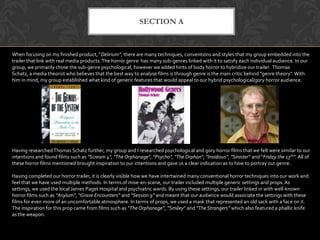
Having researchedThomas Schatz further, my group and I researched psychological and gory horror films that we felt were similar to our
intentions and found films such as "Scream 4", "The Orphanage", "Psycho", "The Orphan", "Insidious", "Sinister" and “Friday the 13th”. All of
these horror films mentioned brought inspiration to our intentions and gave us a clear indication as to how to portray our genre.
Having completed our horror trailer, it is clearly visible how we have intertwined many conventional horror techniques into our work and
feel that we have used multiple methods. In terms of mise-en-scene, our trailer included multiple generic settings and props. As
settings, we used the local James Paget Hospital and psychiatric wards. By using these settings, our trailer linked in with well-known
horror films such as “Asylum”, “Grave Encounters” and “Session 9” and meant that our audience would associate the settings with these
films for even more of an uncomfortable atmosphere. In terms of props, we used a mask that represented an old sack with a face on it.
The inspiration for this prop came from films such as “The Orphanage”, “Smiley” and “The Strangers” which also featured a phallic knife
as the weapon.
SECTION A
(CONT)
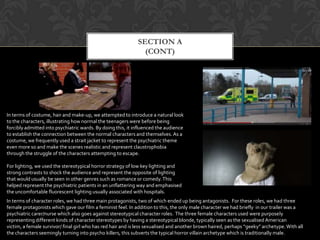
In terms of costume, hair and make-up, we attempted to introduce a natural look
to the characters, illustrating how normal the teenagers were before being
forcibly admitted into psychiatric wards. By doing this, it influenced the audience
to establish the connection between the normal characters and themselves. As a
costume, we frequently used a strait jacket to represent the psychiatric theme
even more so and make the scenes realistic and represent claustrophobia
through the struggle of the characters attempting to escape.
For lighting, we used the stereotypical horror strategy of low key lighting and
strong contrasts to shock the audience and represent the opposite of lighting
that would usually be seen in other genres such as romance or comedy.This
helped represent the psychiatric patients in an unflattering way and emphasised
the uncomfortable fluorescent lighting usually associated with hospitals.
In terms of character roles, we had three main protagonists, two of which ended up being antagonists. For these roles, we had three
female protagonists which gave our film a feminist feel. In addition to this, the only male character we had briefly in our trailer was a
psychiatric carer/nurse which also goes against stereotypical character roles. The three female characters used were purposely
representing different kinds of character stereotypes by having a stereotypical blonde, typically seen as the sexualised American
victim, a female survivor/ final girl who has red hair and is less sexualised and another brown haired, perhaps “geeky” archetype.With all
the characters seemingly turning into psycho killers, this subverts the typical horror villain archetype which is traditionally male.
SECTION B
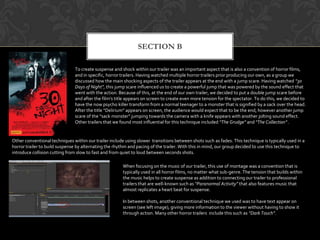
To create suspense and shock within our trailer was an important aspect that is also a convention of horror films,
and in specific, horror trailers. Having watched multiple horror trailers prior producing our own, as a group we
discussed how the main shocking aspects of the trailer appears at the end with a jump scare. Having watched “30
Days of Night”, this jump scare influenced us to create a powerful jump that was powered by the sound effect that
went with the action. Because of this, at the end of our own trailer, we decided to put a double jump scare before
and after the film’s title appears on screen to create even more tension for the spectator. To do this, we decided to
have the now psycho killer transform from a normal teenager to a monster that is signified by a sack over the head.
After the title “Delirium” appears on screen, the audience would expect that to be the end, however another jump
scare of the “sack monster” jumping towards the camera with a knife appears with another jolting sound effect.
Other trailers that we found most influential for this technique included “The Grudge” and “The Collection” .
Other conventional techniques within our trailer include using slower transitions between shots such as fades. This technique is typically used in a
horror trailer to build suspense by alternating the rhythm and pacing of the trailer. With this in mind, our group decided to use this technique to
introduce collision cutting from slow to fast and from quiet to loud between seconds shots.
When focusing on the music of our trailer, this use of montage was a convention that is
typically used in all horror films, no matter what sub-genre. The tension that builds within
the music helps to create suspense as addition to connecting our trailer to professional
trailers that are well-known such as “Paranormal Activity” that also features music that
almost replicates a heart beat for suspense.
In between shots, another conventional technique we used was to have text appear on
screen (see left image), giving more information to the viewer without having to show it
through action. Many other horror trailers include this such as “Dark Touch”.
SECTION C
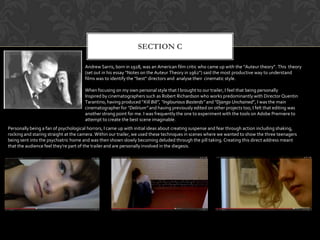
Andrew Sarris, born in 1928, was an American film critic who came up with the “Auteur theory”. This theory
(set out in his essay “Notes on the Auteur Theory in 1962”) said the most productive way to understand
films was to identify the “best” directors and analyse their cinematic style.
When focusing on my own personal style that I brought to our trailer, I feel that being personally
Inspired by cinematographers such as Robert Richardson who works predominantly with Director Quentin
Tarantino, having produced “Kill Bill”, “Inglourious Basterds” and “Django Unchained”, I was the main
cinematographer for “Delirium” and having previously edited on other projects too, I felt that editing was
another strong point for me. I was frequently the one to experiment with the tools on Adobe Premiere to
attempt to create the best scene imaginable.
Personally being a fan of psychological horrors, I came up with initial ideas about creating suspense and fear through action including shaking,
rocking and staring straight at the camera. Within our trailer, we used these techniques in scenes where we wanted to show the three teenagers
being sent into the psychiatric home and was then shown slowly becoming deluded through the pill taking. Creating this direct address meant
that the audience feel they’re part of the trailer and are personally involved in the diegesis.
SECTION C
(CONT)
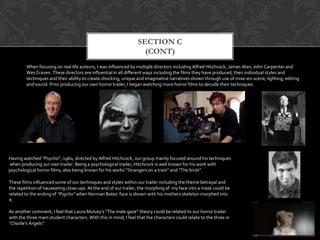
When focusing on real life auteurs, I was influenced by multiple directors including Alfred Hitchcock, James Wan, John Carpenter and
Wes Craven. These directors are influential in all different ways including the films they have produced, their individual styles and
techniques and their ability to create shocking, unique and imaginative narratives shown through use of mise-en-scene, lighting, editing
and sound. Prior producing our own horror trailer, I began watching more horror films to decode their techniques.
Having watched “Psycho”, 1960, directed by Alfred Hitchcock, our group mainly focused around his techniques
when producing our own trailer. Being a psychological trailer, Hitchcock is well known for his work with
psychological horror films, also being known for his works “Strangers on a train” and “The birds”.
These films influenced some of our techniques and styles within our trailer including the theme betrayal and
the repetition of nauseating close-ups. At the end of our trailer, the morphing of my face into a mask could be
related to the ending of “Psycho” when Norman Bates’ face is shown with his mothers skeleton morphed into
it.
As another comment, I feel that Laura Mulvey’s “The male gaze” theory could be related to our horror trailer
with the three main student characters. With this in mind, I feel that the characters could relate to the three in
“Charlie’s Angels”.

A2 media evaluations

  • 1.
  • 2.
    SECTION A When focusingon my finished product, “Delirium”, there are many techniques, conventions and styles that my group embedded into the trailer that link with real media products.The horror genre has many sub-genres linked with it to satisfy each individual audience. In our group, we primarily chose the sub-genre psychological, however we added hints of body horror to hybridize our trailer. Thomas Schatz, a media theorist who believes that the best way to analyse films is through genre is the main critic behind "genre theory".With him in mind, my group established what kind of generic features that would appeal to our hybrid psychological/gory horror audience. Having researchedThomas Schatz further, my group and I researched psychological and gory horror films that we felt were similar to our intentions and found films such as "Scream 4", "The Orphanage", "Psycho", "The Orphan", "Insidious", "Sinister" and “Friday the 13th”. All of these horror films mentioned brought inspiration to our intentions and gave us a clear indication as to how to portray our genre. Having completed our horror trailer, it is clearly visible how we have intertwined many conventional horror techniques into our work and feel that we have used multiple methods. In terms of mise-en-scene, our trailer included multiple generic settings and props. As settings, we used the local James Paget Hospital and psychiatric wards. By using these settings, our trailer linked in with well-known horror films such as “Asylum”, “Grave Encounters” and “Session 9” and meant that our audience would associate the settings with these films for even more of an uncomfortable atmosphere. In terms of props, we used a mask that represented an old sack with a face on it. The inspiration for this prop came from films such as “The Orphanage”, “Smiley” and “The Strangers” which also featured a phallic knife as the weapon.
  • 3.
    SECTION A (CONT) In termsof costume, hair and make-up, we attempted to introduce a natural look to the characters, illustrating how normal the teenagers were before being forcibly admitted into psychiatric wards. By doing this, it influenced the audience to establish the connection between the normal characters and themselves. As a costume, we frequently used a strait jacket to represent the psychiatric theme even more so and make the scenes realistic and represent claustrophobia through the struggle of the characters attempting to escape. For lighting, we used the stereotypical horror strategy of low key lighting and strong contrasts to shock the audience and represent the opposite of lighting that would usually be seen in other genres such as romance or comedy.This helped represent the psychiatric patients in an unflattering way and emphasised the uncomfortable fluorescent lighting usually associated with hospitals. In terms of character roles, we had three main protagonists, two of which ended up being antagonists. For these roles, we had three female protagonists which gave our film a feminist feel. In addition to this, the only male character we had briefly in our trailer was a psychiatric carer/nurse which also goes against stereotypical character roles. The three female characters used were purposely representing different kinds of character stereotypes by having a stereotypical blonde, typically seen as the sexualised American victim, a female survivor/ final girl who has red hair and is less sexualised and another brown haired, perhaps “geeky” archetype.With all the characters seemingly turning into psycho killers, this subverts the typical horror villain archetype which is traditionally male.
  • 4.
    SECTION B To createsuspense and shock within our trailer was an important aspect that is also a convention of horror films, and in specific, horror trailers. Having watched multiple horror trailers prior producing our own, as a group we discussed how the main shocking aspects of the trailer appears at the end with a jump scare. Having watched “30 Days of Night”, this jump scare influenced us to create a powerful jump that was powered by the sound effect that went with the action. Because of this, at the end of our own trailer, we decided to put a double jump scare before and after the film’s title appears on screen to create even more tension for the spectator. To do this, we decided to have the now psycho killer transform from a normal teenager to a monster that is signified by a sack over the head. After the title “Delirium” appears on screen, the audience would expect that to be the end, however another jump scare of the “sack monster” jumping towards the camera with a knife appears with another jolting sound effect. Other trailers that we found most influential for this technique included “The Grudge” and “The Collection” . Other conventional techniques within our trailer include using slower transitions between shots such as fades. This technique is typically used in a horror trailer to build suspense by alternating the rhythm and pacing of the trailer. With this in mind, our group decided to use this technique to introduce collision cutting from slow to fast and from quiet to loud between seconds shots. When focusing on the music of our trailer, this use of montage was a convention that is typically used in all horror films, no matter what sub-genre. The tension that builds within the music helps to create suspense as addition to connecting our trailer to professional trailers that are well-known such as “Paranormal Activity” that also features music that almost replicates a heart beat for suspense. In between shots, another conventional technique we used was to have text appear on screen (see left image), giving more information to the viewer without having to show it through action. Many other horror trailers include this such as “Dark Touch”.
  • 5.
    SECTION C Andrew Sarris,born in 1928, was an American film critic who came up with the “Auteur theory”. This theory (set out in his essay “Notes on the Auteur Theory in 1962”) said the most productive way to understand films was to identify the “best” directors and analyse their cinematic style. When focusing on my own personal style that I brought to our trailer, I feel that being personally Inspired by cinematographers such as Robert Richardson who works predominantly with Director Quentin Tarantino, having produced “Kill Bill”, “Inglourious Basterds” and “Django Unchained”, I was the main cinematographer for “Delirium” and having previously edited on other projects too, I felt that editing was another strong point for me. I was frequently the one to experiment with the tools on Adobe Premiere to attempt to create the best scene imaginable. Personally being a fan of psychological horrors, I came up with initial ideas about creating suspense and fear through action including shaking, rocking and staring straight at the camera. Within our trailer, we used these techniques in scenes where we wanted to show the three teenagers being sent into the psychiatric home and was then shown slowly becoming deluded through the pill taking. Creating this direct address meant that the audience feel they’re part of the trailer and are personally involved in the diegesis.
  • 6.
    SECTION C (CONT) When focusingon real life auteurs, I was influenced by multiple directors including Alfred Hitchcock, James Wan, John Carpenter and Wes Craven. These directors are influential in all different ways including the films they have produced, their individual styles and techniques and their ability to create shocking, unique and imaginative narratives shown through use of mise-en-scene, lighting, editing and sound. Prior producing our own horror trailer, I began watching more horror films to decode their techniques. Having watched “Psycho”, 1960, directed by Alfred Hitchcock, our group mainly focused around his techniques when producing our own trailer. Being a psychological trailer, Hitchcock is well known for his work with psychological horror films, also being known for his works “Strangers on a train” and “The birds”. These films influenced some of our techniques and styles within our trailer including the theme betrayal and the repetition of nauseating close-ups. At the end of our trailer, the morphing of my face into a mask could be related to the ending of “Psycho” when Norman Bates’ face is shown with his mothers skeleton morphed into it. As another comment, I feel that Laura Mulvey’s “The male gaze” theory could be related to our horror trailer with the three main student characters. With this in mind, I feel that the characters could relate to the three in “Charlie’s Angels”.