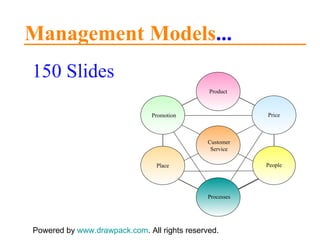
Management Models ... 150 Slides Powered by  www.drawpack.com . All rights reserved. Product Price People Processes Place Promotion Customer Service
Key Words ... Break-even  –  Financing Life Cycle  –  Economies of Scale  –  Elasticity  –  Sales Cycles  –  Market Potential  –  Portfolio Matrix  –  Product Model  –  Four P’s  –  Push/Pull Strategy  –  Marketing Mix  –  PDCA Cycle  –  SWOT   –  Value Chain  –  Ansoff Matrix  –  BCG Matrix  –  7-S Model  –  Core Competencies  –  GE Business Screen  –  Nine Cell Industry  –  Risk/Reward Diagram  –  Porter’s Five Forces  –  Industry Competition  –  Generic Strategies  –  Geobusiness Model  –  Porter’s Diamond  –  Matrix Design  –  PIMS  –  Leavitt’s Diamond  –  Belbin’s Team Roles  –  Theory X/Y  –  Maslow’s Hierarchy  –  Herzberg’s Theory  –  Cultural Web  –  Pareto Curve  –  CIM Concept  –  Value Drivers
Markets and Structure of Flow Government markets Middlemen markets Resource markets Manufacturer markets Services, money Resources Money Taxes, goods Goods and services Services, money Taxes, goods Money Consumer markets Services Resources Money Taxes Money Goods and services Taxes, goods Services, money
A Company‘s Macroenvironment COMPANY Substitute Buyers New Entrants Rival Firms Suppliers IMMEDIATE INDUSTRY  & COMPETITVE ENVIRONMENT MACROENVIRONMENT The Economy at large Social Values and Lifestyles Population demographics Technology Legislation and regulations
Break-even Point Value $ Units sold Break-even Point Variable costs Fixed costs Profit Total costs Sales 0 0 Current sales level
Break-even Chart Sales Volume in Units (in thousands) Total cost Total revenue Target profit Fixed cost Dollars (in thousands) 10 30 20 50 40 0 200 800 600 400 1200 1000
Break-even Volume Total Revenue Total Costs Fixed Expenses* * Fixed Expenses = Marketing Expenses and Other Direct Expenses $ Millions 15 30 35 20 10 25 5 0 50 150 100 Break-even Volume (90,000) 200 Units Sold (‘000) Profit Loss
Break-even Regions P&L break-even Cash flow breakeven Returned capital break-even Cash flow Cumulative revenue EVA break-even Opportunity cost based on capital risk assumed $
Financing Life Cycle Valley of Death Enterprise Cash Flow Enterprise Financing Time Break-even point Emerging Growth FFF & Angels Venture Capitalist Investment Banks & Banks Seed Capital & Early Stage Early Growth Later Growth Public Market Initial Public Offering Mezzanine 1st 2nd 3rd
Demand and Supply Price Quantity 0 G B E D F S A D S
Economies of Scale *Long-run average costs (LACs) Increasing returns to scale, or economies of scale Average cost Output LACs*
Elasticity Demand is elastic and expenditure increases when price falls from P1 to P2 (-) (+) Price P 1 P 2 0 Quantity Demand is inelastic and expenditure increases when price falls from P1 to P2 (+) (-) Price P 2 P 1 0 Quantity e = 0 Quantity Price e = 0 e = -  (total inelastic  demand) (total elastic  demand) 8 Quantity Price e = -  8 e > - 1 e = - 1 e < - 1
Inelastic and Elastic Demand Price Quantity Demanded per Period (a) Inelastic demand Quantity Demanded per Period (b) Elastic demand P 1 P’ 1 P’ 2 Q’ 2 Q 2 Q’ 1 Q 1 P 2
Sales and Profit Life Cycles Sales and Profits ($) Time Profit Sales Maturity Growth Introduction Decline
Market Potential, Market Volume,  Market Share Volume or value Time Market potential Market volume Market share
The Product Life Cycle I Sales over profits Stages over Time Introduction  Growth  Maturiy  Shake-out  Decline Sales Profits
The Product Life Cycle II Introduction Growth Maturity Commodity or Decline Time Unit Sales Volume Note: A = Moderate Growth, B = Commodity, C = Decline A B C
The Life Cycle Portfolio Matrix C A Strong Average Weak Development Growth Competitive shakeout Maturity Decline Saturation THE BUSINESS UNIT‘S COMPETITIVE POSITION THE INDUSTRY‘S STAGE IN THE EVOLUTIONARY LIFE CYCLE E F D B H G
Patterns of Strategic Change Continuity  Incremental  Flux  Global
The Whole Product Model Generic Product Expected Product Augmented Product Potential Product
The Product-Positioning Map High price Low quality High quality Low price C D E A B
The Four P‘s of McCarthy I Product Place Promotion Price Environment Environment Environment Environment
The Four P‘s of McCarthy II Low quality High quality Target Market Product variety Quality Design Features Brand name Packaging Sizes Services Warranties Returns Product Channels Coverage Assortments Locations Inventory Transport Promotion Sales promotion Advertising Salesforce Public relations Direct marketing Place Price List price Discounts Allowances Payment period Credit terms Marketing Mix
Push versus Pull Strategy Push Strategy Manufacturer Intermediaries Demand Marketing activities Demand End users Pull Strategy Manufacturer Intermediaries Demand Marketing activities Demand End users
The Expanded Marketing Mix Product Price People Processes Place Promotion Customer Service
The 6 – Step Marketing Plan 1 2 3 budget allocation product promotion price distribution 4 5 6 Action plan Forecasts Control quantify: costs sales profits market share organization structure measurement tools check frequency => Corrective actions firm market industry competition environment Situation (SWOT) Objectives Strategy sales market share market expansion leadership satisfaction segment – target price / quality product positioning differentiation diversification Marketing Plan
The PDCA Cycle Performance Time Path of continous improvement Check Do Act Plan
Enterprise Management Process Decision Process Enterprise Structure Mission & Strategy Enterprise Learning Value Improvement Customer Satisfaction Benchmarking
SWOT Analysis Diagram Substantial internal strengths Critical internal weaknesses Numerous environmental opportunities Major environmental threats Cell 1:  Supports an aggressive strategy Cell 2:  Supports an diversification strategy Cell 3:  Supports a turnaround- oriented strategy Cell 4:  Supports a defensive strategy
SWOT Analysis I Strengths Opportunities Threats Weaknesses
SWOT Analysis II Market share Key account share Growth rate Supply diversity Influence On market Purchasing / selling deadline New products cycles Negotiation power - firm suppliers - customers STRENGTHS / WEAKNESSES Firm, Organization OPPORTUNITIES / THREATS Environment, Market, Industry Market size Key account size Annual growth rate Market diversity Price sensitivity Seasonality Cycles Negotiation power - suppliers - consumers Competitor types Concentration level Intrants / extrants Market share evolution Vertical / horizontal integration Technology substitution Firm competitivity - Product, service - Profitability, H.R., … Segments invested in Firm’s integration level High-tech vulnerability MARKET COMPETITION
SWOT Analysis III Firm margins Economies of scale Barriers Production capacity level STRENGTHS / WEAKNESSES Firm, Organization OPPORTUNITIES / THREATS Environment, Market, Industry FINANCE / BUSINESS TECHNOLOGY SOCIO - POLITICAL Reactivity / Flexibility level Adaptability Agressiveness Working relationships Attitudes / Social trends Laws and regulations Pressure groups Trade union activities Adaptability to change Expertise / Know-How Patent ownership Production technology Maturity / volatility Complexity Differentiation Patents and copyrights Production technology Global benefits Economies of scale Barriers Production capacity level
The Generic  Value Chain I Support  activities Service Margin Margin Firm infrastructure Human resource management Technology development Procurement Primary activities Inbound logistics Operations Outbound logistics Marketing and sales
The Generic Value Chain II Marketing Management Advertising Sales Force Administration Sales Force Operations Technical Literature Promotion INBOUND LOGISTICS OPERATIONS OUTBOUND LOGISTICS MARKETING & SALES SERVICE TECHNOLOGY DEVELOPMENT PROCUREMENT HUMAN RESOURCES MANAGEMENT FIRM INFRASTRUCTURE MARGIN
The Generic Value Chain III Inbound logistics Outbound logistics Operations Marketing and sales Service Primary Activities Procurement Technology development Human resources management Firm infrastructure Margin Margin
The Ansoff Matrix I Current Markets New Markets New Products Current Products Market penetration Market development Diversification Product development
The Ansoff Matrix II Existing New Existing New New product development Market development Market penetration Diversification PRODUCTS AND/OR SERVICES MARKETS
The Customer Growth Matrix Existing New Existing New Customer extension Customer acquisition Customer loyalty Customer diversification PRODUCTS AND/OR SERVICES CUSTOMERS
Product-Market Diversification Market Diversification Broad Product Diversification Narrow Moderate Moderate Broad Narrow
BCG’s Growth-Share Matrix I High Low Low High MARKET GROWTH RATE RELATIVE MARKET SHARE Star Cash Cow Dog Question Mark
BCG’s Growth-Share Matrix II High Low High Low RELATIVE MARKET SHARE MARKET  GROWTH  RATE A B C E D F G Divest Divest Dog Cash Cows Question Mark Star Targeted future position in the corporate portfolio Present position in the corporate portfolio
BCG’s Growth-Share Matrix III Low High High Low Question marks Cash generating businesses Star businesses Dog businesses RELATIVE MARKET SHARE MARKET GROWTH RATE 10x 1.0x 0.1x 10%
BCG‘s Growth-Share Matrix IV 7 3 2 1 4 6 Market Growth Rate Relative Market Share Dogs Stars Question Marks Cash Cows 0.1 x 1 x 10 x 8 2% 8% 6% 4% 12% 10% 20% 18% 16% 14% 22% 5
The New BCG Matrix SIZE OF ADVANTAGES Many Fragmented Stalemate Volume Specialization Small Large Few NUMBER OF  APPROACHES TO ACHIEVE ADVANTAGE
Underlying Relationship Between ROI and Market Share in the New BCG Matrix Few Many Small Large SIZE OF THE ADVANTAGE NUMBER OF WAYS TO ACHIEVE  COMPETITVE  ADVANTAGE Market share Market share Volume Stalemate Specialization Fragmented Market share Market share ROI ROI ROI ROI
McKinsey‘s Seven ‚S‘s Framework Superordinate Goals Structure Staff Strategy Systems Style Skills
Disruption and the New 7-S’s Vision for Disruption Identifying and creating opportunities for  temporary advantage through understanding Stakeholder Satisfaction Strategic Soothsaying directed at identifying new ways to serve existing customers better or new customers that no one else serves now. Tactics for Disruption Seizing the initiative to gain advantage by Shifting the Rules Signaling Simultaneous and Sequential Strategic Thrusts with actions that shape, mold, or influence the direction or nature of the competitors‘ responses. Capability for Disruption Sustaining for momentum by developing flexible capacities for Speed Surprise that can be applied across many actions to build a series of temporary advantages Market  Disruption VISION PLANNING RESOURCE  PLANNING PUNCH-COUNTERPUNCH  PLANNING
Core Competencies I Banner Brand Business Units Core Products (Platforms) Core Competencies
Core Competencies II Processes Capabilities Technologies Core Competencies
Core Competencies III Low  Company View  High Low  Market View  High Competency 5 Competency 3 Competency 4 Competency 1 Competency 6 Competency 2
The General Electric Business Screen Low High Medium Strong Average Weak COMPETITIVE POSITION INDUSTRY ATTRACITVENESS
Attractiveness/Competitive Position Strategies High Grow Seek dominance Maximize investment Evaluate potential for  leadership via Segmentation Identify  weaknesses Build strengths Specialize Seek niches Consider   acquisitions Identify   growth   segments Invest strongly Maintain   position   elsewhere Identify growth   segments Specialize Invest   selectively Specialize Seek niches Consider exit Maintain   overall   position Seek cash flow Invest at    maintenance   levels Prune lines Minimize   investment Position to   divest Trust leader‘s   statesmanship Sic on   competitor‘s   cash generators Time exit and   divest Medium Low Strong Average Weak COMPETITIVE POSITION INDUSTRY ATTRACTIVENESS
Company Position/Industry Attractiveness Screen HOLD HARVEST HARVEST BUILD BUILD HARVEST HOLD HOLD BUILD Industry attractiveness Medium Low High Low Medium High Business unit strengths
A Representative Nine-Cell Industry Attractiveness-Competitive Strength Matrix Business C Business E Strong Average High Low Business F Business A Business B Business D Weak Medium Low priority for investment Medium priority for investment High priority for investment COMPETITIVE STRENGTHS/BUSINESS POSITION LONG-TERM INDUSTRY ATTRACTIVENESS
GE / McKinsey Multifactor Portfolio Matrix INDUSTRY ATTRACTIVENESS BUSINESS STRENGTH Invest Manage Selectively for Earnings Invest Invest Manage Selectively for Earnings Manage Selectively for Earnings Harvest or Divest Harvest or Divest Harvest or Divest
Portfolio Positions and Defensive Strategic Market Plans Very Attractive Market Attractiveness Very Unattractive Very Strong Very Weak Competitive Advantage Harvest or Divest Protect Protect or Harvest Harvest or Divest Protect or Harvest Protect or Focus Protect or Focus Protect
Market Attractiveness – Portfolio Classification and Strategies MARKET ATTRACTIVENESS Medium Weak 5.00 3.67 2.33 1.00 Strong Joints Hydraulic Pumps Clutches BUSINESS STRENGHT Low Medium High (a) Classification Aerospace Fittings Relief Valves Fuel Pumps Flexible Diaphragms 2.33 3.67 5.00 1.00 Invest / grow Harvest / divest Selectivity / earnings
The Risk-Reward Diagrams High Low Low High REWARD (NPV) RISK
Contrasting Characteristics of Upstream and Downstream Companies  Raw  Primary   Product  Consumer materials   manufacturer  Fabricator  producer  marketer  Retail Supply flow UPSTREAM ORGANIZATIONS DOWNSTREAM ORGANIZATIONS Centre of gravity of a manufacturing  industry Consumer Contrasting characteristics of upstream and downstream companies Upstream Commodity Standardize Maximize end users Low-cost producers Sales push Line-driven organization Process innovation Capital budget Capital-intensive Technological know-how Supply and trading/manufacturing and engineering Downstream Proprietary Customize Target end users High margins Marketing pull Line/staff Product innovation R & D/advertising budget People-intensive Marketing skills Product development/marketing Supply stages in a manufaturing industry (supply chain)
Porter‘s Five Forces I Potential Entrants Substitutes Buyers Suppliers Industry competitors Rivalry among existing firms Threat of substitute products Threat new entrants Bargaining power of suppliers Bargaining power of buyers
Porter‘s Five Forces II RIVALRY AMONG COMPETING SELLERS Potential  New Entrants Buyers Suppliers of raw materials, parts,  components or  other resource inputs Firms in other industries offering  Substitute Products
Forces Driving Industry Competition Potential Entrants Industry competitors Rivalry among existing firms Substitutes Buyers Suppliers Threat of substitute products or services Bargaining power of suppliers Bargaining power of buyers Threat of new entrants
Barriers and Profitability Low High High Low ENTRY BARRIERS EXIT BARRIERS PROFITS=LOW RETURNS=STABLE PROFITS=HIGH RETURNS=STABLE PROFITS=HIGH RETURNS=RISKY PROFITS=LOW RETURNS=RISKY
Four Routes to Strategic Advantage KFS Intensify funtional differentiation Relative superiority Exploit competitor‘s weakness Strategic degrees of Freedom Maximize user benefit Aggressive initiatives Ask „why-why‘s“ Compete (wisely) Route 1 Avoid head-on competition Route 2 Route 4 Route 3 Business/Product Offered Old/Existing  New/Creative
The Generic Strategies I D ifferentiation  C ost  L eadership F ocus
The Generic Strategies II Cost Leadership Differentiation Cost Focus Differentiation Focus Broad Target Narrow Target Lower Cost Differentiation COMPETITIVE ADVANTAGE COMPETITIVE SCOPE
Five Modified Competitive Strategies Overall Low-Cost Leadership Strategy Broad Differentiation Strategy Focused Low-Cost Strategy Focused Differentiation Strategy Best-Cost Provider Strategy A Narrow Buyer-Segment (or Market Niche) A Broad Cross-Section of Buyers Lower Cost Differentiation TYPE OF COMPETITVE ADVANTAGE BEING PURSUED MARKET  TARGET
Sweeney‘s Generic Strategies Marketer Emphasizes Quality Dependability Range Innovator Emphasizes Quality Product/service Performance Speed New product/service Development Caretaker Emphasizes Price/ cost Dependability Quality Innovator Emphasizes Quality Product/service Performance Flexibility Speed Traditional Enhanced Enhanced Basic Customer service criteria Strategic change involves enhancing the operation‘s infrastructure Strategic change involves enhancing The operation‘s structure
Geobusiness Model CONDITIONING VARIABLES CONTROL VARIABLES MOTIVATION VARIABLES
Porter‘s Diamond RELATED AND SUPPORTING INDUSTRIES FIRM STRATEGY, STRUCTURE AND RIVALRY FACTOR CONDITIONS DEMAND CONDITIONS
Resource Allocation at Corporate Level Low High High Low EXTENT OF CENTRAL DIRECTION PERCEIVED NEED FOR CHANGE Free bargaining Open competition Imposed priorities „ Formula“
PIMS Competitive Strategy Paradigm Market differentiation Market growth rate Entry conditions Unionization Capital intensity Purchase amount Relative perceived quality Relative market share Relative capital intensity Relative cost Pricing R & D spending New product introduction Change in relative quality and variety of products/services Marketing expenses Distribution channels Relative vertical integration Workforce productivity Profitability (ROS, ROI, etc.) Growth Cash flow Value enhancement Stock (share) price Market structure  Strategy and tactics  Performance Competitive position
International Strategy Options Export Licensing/ Foreign subsidiary Joint venture Licensing/ Joint venture Foreign branch Joint venture Foreign branch High Low Low High PRODUCT DIVERSITY MARKET COMPLEXITY
The Wheel of Competitive Strategy Product Line Target Market Marketing Sales Distribution Manufacturing Labor Purchasing R & D Finance and Control GOALS Definition of  how the business is  going to  compete Objectives for profitability, growth, market share, social responsiveness etc.
Generic Competitive Strategies Return on  Investment Market Share
The Strategic Triangle I Customers Competitors Corporation Multiple market segments Target segments Value Value Cost Product/service differentiation
The Strategic Triangle II Needs seeking benefits at acceptable prices Customers Competitor Company Value Value Cost differentials Assets and utilization Assets and utilization
Trilogy Strategy - Culture - Structure Strategy Culture Structure Environment Environment Environment Environment
Optimum Degree of Formal Organization Degree of formal organization Organizational effectiveness
The Flow of Formal Authority
Functional, Divisional, Multidivisional Structures Logistics Manufacturing Sales Finance CEO CEO Cement Concrete Chemicals R&D Controlling CEO Europe Asia Motor Marine North America Motor Marine Fire Motor Marine Fire CEO Europe North America Asia Cement Concrete Chemicals
A Matrix Design Marketing Department Manager Research and Development Department Manager Purchasing Department Manager Production Department Manager FUNCTIONAL DEPARTMENTALIZATION PROJECT DEPARTMENTALIZATION Alpha Project Project Leader Beta Project Project Leader Gamma Project Project Leader E E E E E E E E E E E E
Models of Virtuality The Virtual Face Co-alliance Model Star-alliance Model Value-alliance Model
Leavitt‘s Diamond: The Interaction of Social Forces in an Organization Task Technology People Structure
Action-centred Leadership GROUP NEEDS INDIVIDUAL NEEDS TASK NEEDS
Belbin‘s Team Roles Company Worker Plant Shaper Finisher Resource-Investigator Team Worker Monitor-Evaluator Chairman TEAM
Group Development Stage V Adjourning Stage IV Performing Stage III Norming Stage II Storming Stage I Forming Group effectiveness Time
Theory X and Theory Y Theory X no responsability,  no Initiative passive work  attitude strong rules  and control confirms following leads to leads to V icious circle  of theory X   Theory Y no responsability,  no Initiative passive work  attitude strong rules  and control strenghten following allow leads to Strenghten effect of Theory Y
Maslow‘s Hierarchy of Human Needs I Esteem Needs (self-esteem, recognition, status) Self-Actualization Needs (self-development and realization) Social Needs (sense of belonging, love) Safety Needs (security, protection) Physiological Needs (hunger, thirst)
Maslow‘s Hierarchy of Human Needs II Self- Actualization Needs Esteem Needs Belongingness Needs Security Needs Physiological Needs GENERAL EXAMPLES ORGANIZATIONAL EXAMPLES Challenging Job Job Title Friends in Work Group Pension Plan Base Salary Achievement Status Friendship Stability Shelter
Herzberg‘s Motivator-Hygiene Theory SALARY ADMINISTRATION SUPEVISION COMPANY POLICY STATUS WORKING CONDITIONS ACHIEVEMENT RECOGNITION RESPONSIBILITY ADVANCEMENT NATURE OF WORK HYGIENE FACTORS  MOTIVATORS
Parallels Among Need Theories of Motivation Achievement Work Itself Responsibility Advancement and Growth Recognition Supervision Interpersonal Relations Security Company Policies Pay Working Conditions Self-Actualization Needs Self-Esteem Esteem Needs Respect of Others Belongingness Needs Interpersonal Security Security Needs Physical Security Physiological Needs Growth Needs Relatedness Needs Existence Needs Need for Affiliation Need for Power Need for Achievement Herzberg‘s Two-Factor Theory Maslow‘s Hierarchy of Needs Alderfer‘s ERG Theory Other Key Needs Motivation Factors Hygiene Factors
Managerial Grid 1  2  3  4  5  6  7  8  9 1  2  3  4  5  6  7  8  9 Concern for production Concern for people Country Club Management (1,9) Production is incidental to lack of conflict and „ good fellowship“ Team management (9,9) Production is from integration of task and human requirements Dampened Pendulum (5,5) (Middle of the road.) Push for production but don‘t go „all out“. Give some but not all all: „be fair but firm“ Task Management (9,1) Men are a commodity just as machines. A manager‘s responsibility is to plan, direct and control the work of those subordinate to him Impoverished Management (1,1) Effective production is unobtainable becaus people are lazy, apathetic and indifferent. Sound and mature relationships are difficult to achieve because, (human nature being what it is) conflict is inevitable
Situational Leadership R4 Able and Willing or Confident R3 Able but Unwilling or Insecure R2 Unable but Willing or Confident R1 Unable and Unwilling or Insecure FOLLOWER READINESS MODERATE LOW HIGH FOLLOWER DIRECTED LEADER DIRECTED Share ideas and facilitate in decision- making Explain decisions and provide opportunity for clarification Turn over responsibility for decisions and implementation Provide specific instructions and closely supervise performance S3  S2 S4  S1 LEADER BEHAVIOUR TASK BEHAVIOUR (Guidance) (HIGH) (LOW) (Supportive Behaviour) RELATIONSHIP BEHAVIOUR PARTICIPATING SELLING TELLING DELEGATING
Cultural Web THE PARADIGM Power structures Control systems Rituals and  routines Symbols Stories Organizational structures
Dynamics of Paradigm Change The paradigm Development of strategy Corporate Performance Implementation Step 1 Tighter controls Step 2 Reconstruct or develop new strategy Step 3 Abandon paradigm and adopt new one if unsatisfactory
Four Organizational Cultures Power Culture Task Culture Role Culture Person Culture
Integrated Model of Strategic Management Vision, values, and expectations Mission Goals, objectives Strategy formulation Alternatives Evaluation and choice Policies and procedures Situation analysis Enviromental opportunities/ threats Organizational resources and competences Strategy implementation and planning Strategic control Why?  What?  How?  Guidelines
M-O-S-T Mission Objectives Strategy Tactics WHAT  an organization is seeking to do HOW  an organization will achieve it
Network Analysis, PERT, CPA 1 0 0 3 4 4 5 9 9 6 12 12 2 5 6 4 7 8 A 5 C 2 G 4 E 5 H 3 F 5 D 1 B 4 KEY: Activity Critical path Event Event number Earliest event time Latest event time
The Five Phases of Growth Large Small SIZE OF ORGANIZATION AGE OF ORGANIZATION Young Mature creativity direction delegation coordination collaboration leadership autonomy control red tape &quot;?&quot; evolution: stages of  growth revolution: stages of crisis
The Chasm Technology Enthusiasts Visionaries Pragmatists Conservatives Skeptics The Chasm The Mainstream Market The Early Market
Inventory Profile Order quantity Q Time Inventory level Steady and predictable demand (D) Slope = demand rate Average inventory = Q / 2 Instantaneous deliveries at rate of D / Q per period Q / D
Economic Order Quantity Costs Order quantity Order costs Economic order quantity (EOQ) Total costs Holding costs
Pareto Curve for ABC-Products Cumulative % of total value % of total number of items Class C items Class A items Class B items
CIM-Concept CAD/CAM CAD CAP CAM C A D PPS Production Programm Planning Quantity Planning Time and Capacity Planning Place Order Control Order CIM
The Business Process Re-engineering Approach Function 1 Function 2 Function 3 Function 4 Micro operations Customer needs fulfilled Business processes Customer needs Business processes Customer needs fulfilled Customer needs Micro operations Activity 1 Activity 2 Activity 3 Activity 4
Total Quality Management Whole operation involved Quality srategy Teamwork Staff empowerment Involves customers and suppliers Quality systems Quality costing Problem solving Quality planning Statistical methods Process performance Quality standards Error detection Rectification Inspection Total quality management Quality control Quality assurance
Supply Chain Management The Operation Second-tier suppliers First-tier suppliers First-tier customers Second-tier customers Supply side Demand side Purchasing and supply management Physical distribution management Logistics Materials management Supply chain management
Internal Rate of Return (IRR) R eturn on  I nvestment ROI P ay  B ack D iscounted  C ash  F low (DCF) Main methods of capital expenditure appraisal Net Present Value (NPV) Internal Rate of Return (IRR)
Net Present Value (NPV) R eturn on  I nvestment (ROI) P ay  B ack I nternal  R ate of  R eturn (IRR) N et  P resent  V alue (NPV) D iscounted  C as h   F low (DCF) Main methods of capital expenditure appraisal
Variance Analysis Materials Usage Variance Wage Rate Variance Labour Efficiency Variance Materials Price Variance Materials Price Variance Labour Variance Variable Overhead Variance Fixed Overhead Variance Total Cost Variance Sales Volume Variance Sales Price Variance Total Sales Variance Profit Variance
The Link Between the Balance Sheets and the Income Statement Assets $170 Liabilities $100 Owner‘s equity $70 Revenues $480 Expenses $469.8 Net Profit $10.2 Assets $190 Liabilities $113 Owner‘s equity $77 Retained earnings $7 Dividends $3.2 Balance Sheet December 31, 2002 Income Statement Year 2002 Balance Sheet December 31, 2001
Working Capital Simple cycle of operations Cash Finished goods inventory Receivables Raw materials inventory
Financial Strategy Framework Due dilligence process Investor Investment strategy Alternative Investments Time to close deal Risk/Reward Space Financial Strategy Opportunity Time to out of cash Entrepreneurial concerns Future alternatives Sources and Deal Structure Debt Equity Other Business Strategy Technological Strategy Market Strategy Financial Requirements Asset Requirement Burn Rate Operating Requirements Working Capital
Investor Perceived Risk-Return Space High Moderate Low Low Moderate High PERCEIVED RETURN PERCEIVED RISK Banks FFF Entrepreneur Angels VCs Realistic Investors
Du Pont Scheme Return on equity ROE =  Earnings after tax Owner‘s equity Financial leverage mul ti plier Tax effects Return on invested capital ROIC =  Earnings before interest and tax Invested capital Operating profit margin Earnings before interest and tax Sales Capital turnover Sales Invested capital Financial structure ratio Invested capital Owner‘s equity Financial cost ratio Earnings before tax Earnings before interest and tax Tax effect ratio Earnings after tax Earnings before tax Sales Operating costs Invested capital Owner‘s equity Cost of debt Tax rate Cash Working Capital requirement Fixed assets
The Drivers of Value Creation Operating margin =  EBIT Sales Capital turnover =  Sales Invested capital Tax effect = (1 – Taxe rate) Aftertax cost of debt Estimated cost of equity Economic, political, and social environments Market structure Competitive advantages and core competencies EBIT Invested capital (pretax ROIC) Expected after   tax ROIC Return spread (ROIC – WACC) Percent of debt financing Percent of equity financing Weighted average cost of capital WACC Sustainability of growth Market Value Added (MVA) If the present value of the future stream of expected return spreads is positive, MVA is positive and the higher the growth, the more value created. If the present value of the future stream of expected return spreads is negative, MVA is negative and the higher the growth, the more value destroyed.
Business Design Process What are my choices now? In the future? What are the key assumptions About customers and economics? What‘s important to customers? How can profit be made? What dimensions matter the most? How can I prepare for ongoing redesign? Which ones are best? Are the best choices internally consistens integratable? What‘s my best business design? How long will this design be valid? Economics Changing Customer Priorities Technology
The Company Center of Gravity The Company The Customers The center of gravity The Company The Customers The Center of Gravity The Company The Customers The Center of Gravity The Entrepreneurial Phase  The Growth Phase  The Success Phase
The Traditional Value Chain The Traditional Value Chain Start with Assets, Core Competencies Assets/ Core Competencies Inputs, Raw Material The Customer Channels Product/ Service Offering The Modern Value Chain Start with the Customer The Customer Channels Assets/ Core Competencies Inputs, Raw Material Offering
The Modern Value Chain Truly Understanding the Customer Customer Priorities Channels Assets/ Core Competencies Inputs, Raw Material Offering Purchase Criteria Customer Anger Preferences Power Decision-Making Process Buyer Behavior Functional Needs Systems Economics Purchase Occasion
Customer Solutions Profit Profit 0
Product Pyramid Profit Volume Price
Multicomponent Profit Base Business Other Components
Switchboard Profit Buyers Sellers
Time Profit Cost Price $/Unit Time
Blockbuster Profit Cost Revenue $/Project Project Type
Profit Multiplier Model Key Asset Other Forms
Entrepreneurial Profit Base Business Spin-Outs
Specialization Profit Return on Sales Generalist  Specialist
Installed Base Profit Profit Margin Hardware/Base Product Consumables/ Follow-on Product
De Facto Standard Profit Market Share Profit Margin
Brand Profit Price/Unit Market Price Brand Price
Specialty Product Profit Revenue Five Years Ago Today S C S C 100 %
Local Leadership Profit Profitability by Region Local Market Share 0
Transaction Scale Profit Cost Revenue $/Unit Size of Transaction
Value Chain Position Profit
Cycle Profit $/Unit Utilization Cost Price
After-Sale Profit Follow-on Products/Services Base Product
New Product Profit Time
Relative Market Share Profit Relative Market Share Return on Sales
Experience Curve Profit Cumulative Experience Cost/Unit
Low-Cost Business Design Profit $/Unit Conventional Business Design Low Cost Business Design
GE's Business Design: „Sell the Solution, Not Just the Box“ The Profit Zone Sell the Box, or ... Product ... Sell the Whole Solution Product Options Accessories Services Financing
The SMH Product Pyramid The Profit Zone Omega, Longines, Rado Tissot, Certina, Mido, Pierre Balmain, Hamilton, Calvin Klein Swatch, Flik Flak Endura Lanco Blancpain
Coca-Cola's Business Design: Manage the Value Chain Consumer Syrup Vending Fountain Bottling Logistics Grocery Distribution Coca-Cola Brand 1980 The Profit Zone Consumer Syrup Vending Fountain Bottling Logistics Grocery Distribution Coca-Cola Mega Brand Coca-Cola, diet Coca- Cola, Caff. Free, diet Caff. Free, Cherry, Diet Cherry 1996 Coca-Cola‘s participation, influence no participation
The Charles Schwab &quot;Switchboard&quot; The Profit Zone Investors Mutual Fund Companies Schwab One Source Investors Mutual Fund Companies
Intel's Business Design: „Two Steps Ahead“ The Profit Zone Cost Price $/Unit Quarters Post-Launch Q2  Q4  Q6  Q8  Q10  Intel AMD
Disney‘s Business Design Reinvention The Profit Zone The Value Capture Cruises Publishing Videocassette Merchandise Hotels Retail Television Music Theme Parks Animated and Live-Action Films The Foundation
The Thermo-Electron &quot;Spin-Out“ Business Design The Profit Zone Thermo-Electron Thermo Trex Thermo Instrument Systems Thermedics Thermo Optek Thermo Spectra Thermo Voltek Thermo Sentron Thermolase Trex Medical
Microsoft's Business Design: Create-the-Standard OEMs Windows Microsoft Applications Applications Developers Customers The Profit Zone
Drawpack Diagrams Drawpack.com   offers premium Business Diagrams for students and professionals around the globe for their personal use. Please enjoy these Business Diagrams. You can send these slides to your personal contacts who might be interested in Business Diagrams. For further information about our service please contact us:  [email_address] Please find our membership offer on  www.drawpack.com
Usage rights 1.  Drawpack.com allows the customer an unlimited but not exclusive right to use the provided services, products and diagrams. 2.  The services, products and diagrams that the customer has received can be copied, edited, saved and used by the customer for their personal and commercial use. 3. The customer is prohibited from providing the service, products and diagrams on professional download levels in the area of audio, video and software transmission. This includes providing the services, products and diagrams via download against payment or free of charge. The customer is prohibited providing the services, products and diagrams on internet servers or on websites with public access. 4. The customer is prohibited providing identical or similar services to those provided on www.drawpack.com with the services, products and diagrams. 5. Any infringements against the above usage rights will lead to legal action. All rights are reserved to www.drawpack.com

150 Management Models for business presentations

  • 1.
    Management Models ...150 Slides Powered by www.drawpack.com . All rights reserved. Product Price People Processes Place Promotion Customer Service
  • 2.
    Key Words ...Break-even – Financing Life Cycle – Economies of Scale – Elasticity – Sales Cycles – Market Potential – Portfolio Matrix – Product Model – Four P’s – Push/Pull Strategy – Marketing Mix – PDCA Cycle – SWOT – Value Chain – Ansoff Matrix – BCG Matrix – 7-S Model – Core Competencies – GE Business Screen – Nine Cell Industry – Risk/Reward Diagram – Porter’s Five Forces – Industry Competition – Generic Strategies – Geobusiness Model – Porter’s Diamond – Matrix Design – PIMS – Leavitt’s Diamond – Belbin’s Team Roles – Theory X/Y – Maslow’s Hierarchy – Herzberg’s Theory – Cultural Web – Pareto Curve – CIM Concept – Value Drivers
  • 3.
    Markets and Structureof Flow Government markets Middlemen markets Resource markets Manufacturer markets Services, money Resources Money Taxes, goods Goods and services Services, money Taxes, goods Money Consumer markets Services Resources Money Taxes Money Goods and services Taxes, goods Services, money
  • 4.
    A Company‘s MacroenvironmentCOMPANY Substitute Buyers New Entrants Rival Firms Suppliers IMMEDIATE INDUSTRY & COMPETITVE ENVIRONMENT MACROENVIRONMENT The Economy at large Social Values and Lifestyles Population demographics Technology Legislation and regulations
  • 5.
    Break-even Point Value$ Units sold Break-even Point Variable costs Fixed costs Profit Total costs Sales 0 0 Current sales level
  • 6.
    Break-even Chart SalesVolume in Units (in thousands) Total cost Total revenue Target profit Fixed cost Dollars (in thousands) 10 30 20 50 40 0 200 800 600 400 1200 1000
  • 7.
    Break-even Volume TotalRevenue Total Costs Fixed Expenses* * Fixed Expenses = Marketing Expenses and Other Direct Expenses $ Millions 15 30 35 20 10 25 5 0 50 150 100 Break-even Volume (90,000) 200 Units Sold (‘000) Profit Loss
  • 8.
    Break-even Regions P&Lbreak-even Cash flow breakeven Returned capital break-even Cash flow Cumulative revenue EVA break-even Opportunity cost based on capital risk assumed $
  • 9.
    Financing Life CycleValley of Death Enterprise Cash Flow Enterprise Financing Time Break-even point Emerging Growth FFF & Angels Venture Capitalist Investment Banks & Banks Seed Capital & Early Stage Early Growth Later Growth Public Market Initial Public Offering Mezzanine 1st 2nd 3rd
  • 10.
    Demand and SupplyPrice Quantity 0 G B E D F S A D S
  • 11.
    Economies of Scale*Long-run average costs (LACs) Increasing returns to scale, or economies of scale Average cost Output LACs*
  • 12.
    Elasticity Demand iselastic and expenditure increases when price falls from P1 to P2 (-) (+) Price P 1 P 2 0 Quantity Demand is inelastic and expenditure increases when price falls from P1 to P2 (+) (-) Price P 2 P 1 0 Quantity e = 0 Quantity Price e = 0 e = - (total inelastic demand) (total elastic demand) 8 Quantity Price e = - 8 e > - 1 e = - 1 e < - 1
  • 13.
    Inelastic and ElasticDemand Price Quantity Demanded per Period (a) Inelastic demand Quantity Demanded per Period (b) Elastic demand P 1 P’ 1 P’ 2 Q’ 2 Q 2 Q’ 1 Q 1 P 2
  • 14.
    Sales and ProfitLife Cycles Sales and Profits ($) Time Profit Sales Maturity Growth Introduction Decline
  • 15.
    Market Potential, MarketVolume, Market Share Volume or value Time Market potential Market volume Market share
  • 16.
    The Product LifeCycle I Sales over profits Stages over Time Introduction Growth Maturiy Shake-out Decline Sales Profits
  • 17.
    The Product LifeCycle II Introduction Growth Maturity Commodity or Decline Time Unit Sales Volume Note: A = Moderate Growth, B = Commodity, C = Decline A B C
  • 18.
    The Life CyclePortfolio Matrix C A Strong Average Weak Development Growth Competitive shakeout Maturity Decline Saturation THE BUSINESS UNIT‘S COMPETITIVE POSITION THE INDUSTRY‘S STAGE IN THE EVOLUTIONARY LIFE CYCLE E F D B H G
  • 19.
    Patterns of StrategicChange Continuity Incremental Flux Global
  • 20.
    The Whole ProductModel Generic Product Expected Product Augmented Product Potential Product
  • 21.
    The Product-Positioning MapHigh price Low quality High quality Low price C D E A B
  • 22.
    The Four P‘sof McCarthy I Product Place Promotion Price Environment Environment Environment Environment
  • 23.
    The Four P‘sof McCarthy II Low quality High quality Target Market Product variety Quality Design Features Brand name Packaging Sizes Services Warranties Returns Product Channels Coverage Assortments Locations Inventory Transport Promotion Sales promotion Advertising Salesforce Public relations Direct marketing Place Price List price Discounts Allowances Payment period Credit terms Marketing Mix
  • 24.
    Push versus PullStrategy Push Strategy Manufacturer Intermediaries Demand Marketing activities Demand End users Pull Strategy Manufacturer Intermediaries Demand Marketing activities Demand End users
  • 25.
    The Expanded MarketingMix Product Price People Processes Place Promotion Customer Service
  • 26.
    The 6 –Step Marketing Plan 1 2 3 budget allocation product promotion price distribution 4 5 6 Action plan Forecasts Control quantify: costs sales profits market share organization structure measurement tools check frequency => Corrective actions firm market industry competition environment Situation (SWOT) Objectives Strategy sales market share market expansion leadership satisfaction segment – target price / quality product positioning differentiation diversification Marketing Plan
  • 27.
    The PDCA CyclePerformance Time Path of continous improvement Check Do Act Plan
  • 28.
    Enterprise Management ProcessDecision Process Enterprise Structure Mission & Strategy Enterprise Learning Value Improvement Customer Satisfaction Benchmarking
  • 29.
    SWOT Analysis DiagramSubstantial internal strengths Critical internal weaknesses Numerous environmental opportunities Major environmental threats Cell 1: Supports an aggressive strategy Cell 2: Supports an diversification strategy Cell 3: Supports a turnaround- oriented strategy Cell 4: Supports a defensive strategy
  • 30.
    SWOT Analysis IStrengths Opportunities Threats Weaknesses
  • 31.
    SWOT Analysis IIMarket share Key account share Growth rate Supply diversity Influence On market Purchasing / selling deadline New products cycles Negotiation power - firm suppliers - customers STRENGTHS / WEAKNESSES Firm, Organization OPPORTUNITIES / THREATS Environment, Market, Industry Market size Key account size Annual growth rate Market diversity Price sensitivity Seasonality Cycles Negotiation power - suppliers - consumers Competitor types Concentration level Intrants / extrants Market share evolution Vertical / horizontal integration Technology substitution Firm competitivity - Product, service - Profitability, H.R., … Segments invested in Firm’s integration level High-tech vulnerability MARKET COMPETITION
  • 32.
    SWOT Analysis IIIFirm margins Economies of scale Barriers Production capacity level STRENGTHS / WEAKNESSES Firm, Organization OPPORTUNITIES / THREATS Environment, Market, Industry FINANCE / BUSINESS TECHNOLOGY SOCIO - POLITICAL Reactivity / Flexibility level Adaptability Agressiveness Working relationships Attitudes / Social trends Laws and regulations Pressure groups Trade union activities Adaptability to change Expertise / Know-How Patent ownership Production technology Maturity / volatility Complexity Differentiation Patents and copyrights Production technology Global benefits Economies of scale Barriers Production capacity level
  • 33.
    The Generic Value Chain I Support activities Service Margin Margin Firm infrastructure Human resource management Technology development Procurement Primary activities Inbound logistics Operations Outbound logistics Marketing and sales
  • 34.
    The Generic ValueChain II Marketing Management Advertising Sales Force Administration Sales Force Operations Technical Literature Promotion INBOUND LOGISTICS OPERATIONS OUTBOUND LOGISTICS MARKETING & SALES SERVICE TECHNOLOGY DEVELOPMENT PROCUREMENT HUMAN RESOURCES MANAGEMENT FIRM INFRASTRUCTURE MARGIN
  • 35.
    The Generic ValueChain III Inbound logistics Outbound logistics Operations Marketing and sales Service Primary Activities Procurement Technology development Human resources management Firm infrastructure Margin Margin
  • 36.
    The Ansoff MatrixI Current Markets New Markets New Products Current Products Market penetration Market development Diversification Product development
  • 37.
    The Ansoff MatrixII Existing New Existing New New product development Market development Market penetration Diversification PRODUCTS AND/OR SERVICES MARKETS
  • 38.
    The Customer GrowthMatrix Existing New Existing New Customer extension Customer acquisition Customer loyalty Customer diversification PRODUCTS AND/OR SERVICES CUSTOMERS
  • 39.
    Product-Market Diversification MarketDiversification Broad Product Diversification Narrow Moderate Moderate Broad Narrow
  • 40.
    BCG’s Growth-Share MatrixI High Low Low High MARKET GROWTH RATE RELATIVE MARKET SHARE Star Cash Cow Dog Question Mark
  • 41.
    BCG’s Growth-Share MatrixII High Low High Low RELATIVE MARKET SHARE MARKET GROWTH RATE A B C E D F G Divest Divest Dog Cash Cows Question Mark Star Targeted future position in the corporate portfolio Present position in the corporate portfolio
  • 42.
    BCG’s Growth-Share MatrixIII Low High High Low Question marks Cash generating businesses Star businesses Dog businesses RELATIVE MARKET SHARE MARKET GROWTH RATE 10x 1.0x 0.1x 10%
  • 43.
    BCG‘s Growth-Share MatrixIV 7 3 2 1 4 6 Market Growth Rate Relative Market Share Dogs Stars Question Marks Cash Cows 0.1 x 1 x 10 x 8 2% 8% 6% 4% 12% 10% 20% 18% 16% 14% 22% 5
  • 44.
    The New BCGMatrix SIZE OF ADVANTAGES Many Fragmented Stalemate Volume Specialization Small Large Few NUMBER OF APPROACHES TO ACHIEVE ADVANTAGE
  • 45.
    Underlying Relationship BetweenROI and Market Share in the New BCG Matrix Few Many Small Large SIZE OF THE ADVANTAGE NUMBER OF WAYS TO ACHIEVE COMPETITVE ADVANTAGE Market share Market share Volume Stalemate Specialization Fragmented Market share Market share ROI ROI ROI ROI
  • 46.
    McKinsey‘s Seven ‚S‘sFramework Superordinate Goals Structure Staff Strategy Systems Style Skills
  • 47.
    Disruption and theNew 7-S’s Vision for Disruption Identifying and creating opportunities for temporary advantage through understanding Stakeholder Satisfaction Strategic Soothsaying directed at identifying new ways to serve existing customers better or new customers that no one else serves now. Tactics for Disruption Seizing the initiative to gain advantage by Shifting the Rules Signaling Simultaneous and Sequential Strategic Thrusts with actions that shape, mold, or influence the direction or nature of the competitors‘ responses. Capability for Disruption Sustaining for momentum by developing flexible capacities for Speed Surprise that can be applied across many actions to build a series of temporary advantages Market Disruption VISION PLANNING RESOURCE PLANNING PUNCH-COUNTERPUNCH PLANNING
  • 48.
    Core Competencies IBanner Brand Business Units Core Products (Platforms) Core Competencies
  • 49.
    Core Competencies IIProcesses Capabilities Technologies Core Competencies
  • 50.
    Core Competencies IIILow Company View High Low Market View High Competency 5 Competency 3 Competency 4 Competency 1 Competency 6 Competency 2
  • 51.
    The General ElectricBusiness Screen Low High Medium Strong Average Weak COMPETITIVE POSITION INDUSTRY ATTRACITVENESS
  • 52.
    Attractiveness/Competitive Position StrategiesHigh Grow Seek dominance Maximize investment Evaluate potential for leadership via Segmentation Identify weaknesses Build strengths Specialize Seek niches Consider acquisitions Identify growth segments Invest strongly Maintain position elsewhere Identify growth segments Specialize Invest selectively Specialize Seek niches Consider exit Maintain overall position Seek cash flow Invest at maintenance levels Prune lines Minimize investment Position to divest Trust leader‘s statesmanship Sic on competitor‘s cash generators Time exit and divest Medium Low Strong Average Weak COMPETITIVE POSITION INDUSTRY ATTRACTIVENESS
  • 53.
    Company Position/Industry AttractivenessScreen HOLD HARVEST HARVEST BUILD BUILD HARVEST HOLD HOLD BUILD Industry attractiveness Medium Low High Low Medium High Business unit strengths
  • 54.
    A Representative Nine-CellIndustry Attractiveness-Competitive Strength Matrix Business C Business E Strong Average High Low Business F Business A Business B Business D Weak Medium Low priority for investment Medium priority for investment High priority for investment COMPETITIVE STRENGTHS/BUSINESS POSITION LONG-TERM INDUSTRY ATTRACTIVENESS
  • 55.
    GE / McKinseyMultifactor Portfolio Matrix INDUSTRY ATTRACTIVENESS BUSINESS STRENGTH Invest Manage Selectively for Earnings Invest Invest Manage Selectively for Earnings Manage Selectively for Earnings Harvest or Divest Harvest or Divest Harvest or Divest
  • 56.
    Portfolio Positions andDefensive Strategic Market Plans Very Attractive Market Attractiveness Very Unattractive Very Strong Very Weak Competitive Advantage Harvest or Divest Protect Protect or Harvest Harvest or Divest Protect or Harvest Protect or Focus Protect or Focus Protect
  • 57.
    Market Attractiveness –Portfolio Classification and Strategies MARKET ATTRACTIVENESS Medium Weak 5.00 3.67 2.33 1.00 Strong Joints Hydraulic Pumps Clutches BUSINESS STRENGHT Low Medium High (a) Classification Aerospace Fittings Relief Valves Fuel Pumps Flexible Diaphragms 2.33 3.67 5.00 1.00 Invest / grow Harvest / divest Selectivity / earnings
  • 58.
    The Risk-Reward DiagramsHigh Low Low High REWARD (NPV) RISK
  • 59.
    Contrasting Characteristics ofUpstream and Downstream Companies Raw Primary Product Consumer materials manufacturer Fabricator producer marketer Retail Supply flow UPSTREAM ORGANIZATIONS DOWNSTREAM ORGANIZATIONS Centre of gravity of a manufacturing industry Consumer Contrasting characteristics of upstream and downstream companies Upstream Commodity Standardize Maximize end users Low-cost producers Sales push Line-driven organization Process innovation Capital budget Capital-intensive Technological know-how Supply and trading/manufacturing and engineering Downstream Proprietary Customize Target end users High margins Marketing pull Line/staff Product innovation R & D/advertising budget People-intensive Marketing skills Product development/marketing Supply stages in a manufaturing industry (supply chain)
  • 60.
    Porter‘s Five ForcesI Potential Entrants Substitutes Buyers Suppliers Industry competitors Rivalry among existing firms Threat of substitute products Threat new entrants Bargaining power of suppliers Bargaining power of buyers
  • 61.
    Porter‘s Five ForcesII RIVALRY AMONG COMPETING SELLERS Potential New Entrants Buyers Suppliers of raw materials, parts, components or other resource inputs Firms in other industries offering Substitute Products
  • 62.
    Forces Driving IndustryCompetition Potential Entrants Industry competitors Rivalry among existing firms Substitutes Buyers Suppliers Threat of substitute products or services Bargaining power of suppliers Bargaining power of buyers Threat of new entrants
  • 63.
    Barriers and ProfitabilityLow High High Low ENTRY BARRIERS EXIT BARRIERS PROFITS=LOW RETURNS=STABLE PROFITS=HIGH RETURNS=STABLE PROFITS=HIGH RETURNS=RISKY PROFITS=LOW RETURNS=RISKY
  • 64.
    Four Routes toStrategic Advantage KFS Intensify funtional differentiation Relative superiority Exploit competitor‘s weakness Strategic degrees of Freedom Maximize user benefit Aggressive initiatives Ask „why-why‘s“ Compete (wisely) Route 1 Avoid head-on competition Route 2 Route 4 Route 3 Business/Product Offered Old/Existing New/Creative
  • 65.
    The Generic StrategiesI D ifferentiation C ost L eadership F ocus
  • 66.
    The Generic StrategiesII Cost Leadership Differentiation Cost Focus Differentiation Focus Broad Target Narrow Target Lower Cost Differentiation COMPETITIVE ADVANTAGE COMPETITIVE SCOPE
  • 67.
    Five Modified CompetitiveStrategies Overall Low-Cost Leadership Strategy Broad Differentiation Strategy Focused Low-Cost Strategy Focused Differentiation Strategy Best-Cost Provider Strategy A Narrow Buyer-Segment (or Market Niche) A Broad Cross-Section of Buyers Lower Cost Differentiation TYPE OF COMPETITVE ADVANTAGE BEING PURSUED MARKET TARGET
  • 68.
    Sweeney‘s Generic StrategiesMarketer Emphasizes Quality Dependability Range Innovator Emphasizes Quality Product/service Performance Speed New product/service Development Caretaker Emphasizes Price/ cost Dependability Quality Innovator Emphasizes Quality Product/service Performance Flexibility Speed Traditional Enhanced Enhanced Basic Customer service criteria Strategic change involves enhancing the operation‘s infrastructure Strategic change involves enhancing The operation‘s structure
  • 69.
    Geobusiness Model CONDITIONINGVARIABLES CONTROL VARIABLES MOTIVATION VARIABLES
  • 70.
    Porter‘s Diamond RELATEDAND SUPPORTING INDUSTRIES FIRM STRATEGY, STRUCTURE AND RIVALRY FACTOR CONDITIONS DEMAND CONDITIONS
  • 71.
    Resource Allocation atCorporate Level Low High High Low EXTENT OF CENTRAL DIRECTION PERCEIVED NEED FOR CHANGE Free bargaining Open competition Imposed priorities „ Formula“
  • 72.
    PIMS Competitive StrategyParadigm Market differentiation Market growth rate Entry conditions Unionization Capital intensity Purchase amount Relative perceived quality Relative market share Relative capital intensity Relative cost Pricing R & D spending New product introduction Change in relative quality and variety of products/services Marketing expenses Distribution channels Relative vertical integration Workforce productivity Profitability (ROS, ROI, etc.) Growth Cash flow Value enhancement Stock (share) price Market structure Strategy and tactics Performance Competitive position
  • 73.
    International Strategy OptionsExport Licensing/ Foreign subsidiary Joint venture Licensing/ Joint venture Foreign branch Joint venture Foreign branch High Low Low High PRODUCT DIVERSITY MARKET COMPLEXITY
  • 74.
    The Wheel ofCompetitive Strategy Product Line Target Market Marketing Sales Distribution Manufacturing Labor Purchasing R & D Finance and Control GOALS Definition of how the business is going to compete Objectives for profitability, growth, market share, social responsiveness etc.
  • 75.
    Generic Competitive StrategiesReturn on Investment Market Share
  • 76.
    The Strategic TriangleI Customers Competitors Corporation Multiple market segments Target segments Value Value Cost Product/service differentiation
  • 77.
    The Strategic TriangleII Needs seeking benefits at acceptable prices Customers Competitor Company Value Value Cost differentials Assets and utilization Assets and utilization
  • 78.
    Trilogy Strategy -Culture - Structure Strategy Culture Structure Environment Environment Environment Environment
  • 79.
    Optimum Degree ofFormal Organization Degree of formal organization Organizational effectiveness
  • 80.
    The Flow ofFormal Authority
  • 81.
    Functional, Divisional, MultidivisionalStructures Logistics Manufacturing Sales Finance CEO CEO Cement Concrete Chemicals R&D Controlling CEO Europe Asia Motor Marine North America Motor Marine Fire Motor Marine Fire CEO Europe North America Asia Cement Concrete Chemicals
  • 82.
    A Matrix DesignMarketing Department Manager Research and Development Department Manager Purchasing Department Manager Production Department Manager FUNCTIONAL DEPARTMENTALIZATION PROJECT DEPARTMENTALIZATION Alpha Project Project Leader Beta Project Project Leader Gamma Project Project Leader E E E E E E E E E E E E
  • 83.
    Models of VirtualityThe Virtual Face Co-alliance Model Star-alliance Model Value-alliance Model
  • 84.
    Leavitt‘s Diamond: TheInteraction of Social Forces in an Organization Task Technology People Structure
  • 85.
    Action-centred Leadership GROUPNEEDS INDIVIDUAL NEEDS TASK NEEDS
  • 86.
    Belbin‘s Team RolesCompany Worker Plant Shaper Finisher Resource-Investigator Team Worker Monitor-Evaluator Chairman TEAM
  • 87.
    Group Development StageV Adjourning Stage IV Performing Stage III Norming Stage II Storming Stage I Forming Group effectiveness Time
  • 88.
    Theory X andTheory Y Theory X no responsability, no Initiative passive work attitude strong rules and control confirms following leads to leads to V icious circle of theory X Theory Y no responsability, no Initiative passive work attitude strong rules and control strenghten following allow leads to Strenghten effect of Theory Y
  • 89.
    Maslow‘s Hierarchy ofHuman Needs I Esteem Needs (self-esteem, recognition, status) Self-Actualization Needs (self-development and realization) Social Needs (sense of belonging, love) Safety Needs (security, protection) Physiological Needs (hunger, thirst)
  • 90.
    Maslow‘s Hierarchy ofHuman Needs II Self- Actualization Needs Esteem Needs Belongingness Needs Security Needs Physiological Needs GENERAL EXAMPLES ORGANIZATIONAL EXAMPLES Challenging Job Job Title Friends in Work Group Pension Plan Base Salary Achievement Status Friendship Stability Shelter
  • 91.
    Herzberg‘s Motivator-Hygiene TheorySALARY ADMINISTRATION SUPEVISION COMPANY POLICY STATUS WORKING CONDITIONS ACHIEVEMENT RECOGNITION RESPONSIBILITY ADVANCEMENT NATURE OF WORK HYGIENE FACTORS MOTIVATORS
  • 92.
    Parallels Among NeedTheories of Motivation Achievement Work Itself Responsibility Advancement and Growth Recognition Supervision Interpersonal Relations Security Company Policies Pay Working Conditions Self-Actualization Needs Self-Esteem Esteem Needs Respect of Others Belongingness Needs Interpersonal Security Security Needs Physical Security Physiological Needs Growth Needs Relatedness Needs Existence Needs Need for Affiliation Need for Power Need for Achievement Herzberg‘s Two-Factor Theory Maslow‘s Hierarchy of Needs Alderfer‘s ERG Theory Other Key Needs Motivation Factors Hygiene Factors
  • 93.
    Managerial Grid 1 2 3 4 5 6 7 8 9 1 2 3 4 5 6 7 8 9 Concern for production Concern for people Country Club Management (1,9) Production is incidental to lack of conflict and „ good fellowship“ Team management (9,9) Production is from integration of task and human requirements Dampened Pendulum (5,5) (Middle of the road.) Push for production but don‘t go „all out“. Give some but not all all: „be fair but firm“ Task Management (9,1) Men are a commodity just as machines. A manager‘s responsibility is to plan, direct and control the work of those subordinate to him Impoverished Management (1,1) Effective production is unobtainable becaus people are lazy, apathetic and indifferent. Sound and mature relationships are difficult to achieve because, (human nature being what it is) conflict is inevitable
  • 94.
    Situational Leadership R4Able and Willing or Confident R3 Able but Unwilling or Insecure R2 Unable but Willing or Confident R1 Unable and Unwilling or Insecure FOLLOWER READINESS MODERATE LOW HIGH FOLLOWER DIRECTED LEADER DIRECTED Share ideas and facilitate in decision- making Explain decisions and provide opportunity for clarification Turn over responsibility for decisions and implementation Provide specific instructions and closely supervise performance S3 S2 S4 S1 LEADER BEHAVIOUR TASK BEHAVIOUR (Guidance) (HIGH) (LOW) (Supportive Behaviour) RELATIONSHIP BEHAVIOUR PARTICIPATING SELLING TELLING DELEGATING
  • 95.
    Cultural Web THEPARADIGM Power structures Control systems Rituals and routines Symbols Stories Organizational structures
  • 96.
    Dynamics of ParadigmChange The paradigm Development of strategy Corporate Performance Implementation Step 1 Tighter controls Step 2 Reconstruct or develop new strategy Step 3 Abandon paradigm and adopt new one if unsatisfactory
  • 97.
    Four Organizational CulturesPower Culture Task Culture Role Culture Person Culture
  • 98.
    Integrated Model ofStrategic Management Vision, values, and expectations Mission Goals, objectives Strategy formulation Alternatives Evaluation and choice Policies and procedures Situation analysis Enviromental opportunities/ threats Organizational resources and competences Strategy implementation and planning Strategic control Why? What? How? Guidelines
  • 99.
    M-O-S-T Mission ObjectivesStrategy Tactics WHAT an organization is seeking to do HOW an organization will achieve it
  • 100.
    Network Analysis, PERT,CPA 1 0 0 3 4 4 5 9 9 6 12 12 2 5 6 4 7 8 A 5 C 2 G 4 E 5 H 3 F 5 D 1 B 4 KEY: Activity Critical path Event Event number Earliest event time Latest event time
  • 101.
    The Five Phasesof Growth Large Small SIZE OF ORGANIZATION AGE OF ORGANIZATION Young Mature creativity direction delegation coordination collaboration leadership autonomy control red tape &quot;?&quot; evolution: stages of growth revolution: stages of crisis
  • 102.
    The Chasm TechnologyEnthusiasts Visionaries Pragmatists Conservatives Skeptics The Chasm The Mainstream Market The Early Market
  • 103.
    Inventory Profile Orderquantity Q Time Inventory level Steady and predictable demand (D) Slope = demand rate Average inventory = Q / 2 Instantaneous deliveries at rate of D / Q per period Q / D
  • 104.
    Economic Order QuantityCosts Order quantity Order costs Economic order quantity (EOQ) Total costs Holding costs
  • 105.
    Pareto Curve forABC-Products Cumulative % of total value % of total number of items Class C items Class A items Class B items
  • 106.
    CIM-Concept CAD/CAM CADCAP CAM C A D PPS Production Programm Planning Quantity Planning Time and Capacity Planning Place Order Control Order CIM
  • 107.
    The Business ProcessRe-engineering Approach Function 1 Function 2 Function 3 Function 4 Micro operations Customer needs fulfilled Business processes Customer needs Business processes Customer needs fulfilled Customer needs Micro operations Activity 1 Activity 2 Activity 3 Activity 4
  • 108.
    Total Quality ManagementWhole operation involved Quality srategy Teamwork Staff empowerment Involves customers and suppliers Quality systems Quality costing Problem solving Quality planning Statistical methods Process performance Quality standards Error detection Rectification Inspection Total quality management Quality control Quality assurance
  • 109.
    Supply Chain ManagementThe Operation Second-tier suppliers First-tier suppliers First-tier customers Second-tier customers Supply side Demand side Purchasing and supply management Physical distribution management Logistics Materials management Supply chain management
  • 110.
    Internal Rate ofReturn (IRR) R eturn on I nvestment ROI P ay B ack D iscounted C ash F low (DCF) Main methods of capital expenditure appraisal Net Present Value (NPV) Internal Rate of Return (IRR)
  • 111.
    Net Present Value(NPV) R eturn on I nvestment (ROI) P ay B ack I nternal R ate of R eturn (IRR) N et P resent V alue (NPV) D iscounted C as h F low (DCF) Main methods of capital expenditure appraisal
  • 112.
    Variance Analysis MaterialsUsage Variance Wage Rate Variance Labour Efficiency Variance Materials Price Variance Materials Price Variance Labour Variance Variable Overhead Variance Fixed Overhead Variance Total Cost Variance Sales Volume Variance Sales Price Variance Total Sales Variance Profit Variance
  • 113.
    The Link Betweenthe Balance Sheets and the Income Statement Assets $170 Liabilities $100 Owner‘s equity $70 Revenues $480 Expenses $469.8 Net Profit $10.2 Assets $190 Liabilities $113 Owner‘s equity $77 Retained earnings $7 Dividends $3.2 Balance Sheet December 31, 2002 Income Statement Year 2002 Balance Sheet December 31, 2001
  • 114.
    Working Capital Simplecycle of operations Cash Finished goods inventory Receivables Raw materials inventory
  • 115.
    Financial Strategy FrameworkDue dilligence process Investor Investment strategy Alternative Investments Time to close deal Risk/Reward Space Financial Strategy Opportunity Time to out of cash Entrepreneurial concerns Future alternatives Sources and Deal Structure Debt Equity Other Business Strategy Technological Strategy Market Strategy Financial Requirements Asset Requirement Burn Rate Operating Requirements Working Capital
  • 116.
    Investor Perceived Risk-ReturnSpace High Moderate Low Low Moderate High PERCEIVED RETURN PERCEIVED RISK Banks FFF Entrepreneur Angels VCs Realistic Investors
  • 117.
    Du Pont SchemeReturn on equity ROE = Earnings after tax Owner‘s equity Financial leverage mul ti plier Tax effects Return on invested capital ROIC = Earnings before interest and tax Invested capital Operating profit margin Earnings before interest and tax Sales Capital turnover Sales Invested capital Financial structure ratio Invested capital Owner‘s equity Financial cost ratio Earnings before tax Earnings before interest and tax Tax effect ratio Earnings after tax Earnings before tax Sales Operating costs Invested capital Owner‘s equity Cost of debt Tax rate Cash Working Capital requirement Fixed assets
  • 118.
    The Drivers ofValue Creation Operating margin = EBIT Sales Capital turnover = Sales Invested capital Tax effect = (1 – Taxe rate) Aftertax cost of debt Estimated cost of equity Economic, political, and social environments Market structure Competitive advantages and core competencies EBIT Invested capital (pretax ROIC) Expected after tax ROIC Return spread (ROIC – WACC) Percent of debt financing Percent of equity financing Weighted average cost of capital WACC Sustainability of growth Market Value Added (MVA) If the present value of the future stream of expected return spreads is positive, MVA is positive and the higher the growth, the more value created. If the present value of the future stream of expected return spreads is negative, MVA is negative and the higher the growth, the more value destroyed.
  • 119.
    Business Design ProcessWhat are my choices now? In the future? What are the key assumptions About customers and economics? What‘s important to customers? How can profit be made? What dimensions matter the most? How can I prepare for ongoing redesign? Which ones are best? Are the best choices internally consistens integratable? What‘s my best business design? How long will this design be valid? Economics Changing Customer Priorities Technology
  • 120.
    The Company Centerof Gravity The Company The Customers The center of gravity The Company The Customers The Center of Gravity The Company The Customers The Center of Gravity The Entrepreneurial Phase The Growth Phase The Success Phase
  • 121.
    The Traditional ValueChain The Traditional Value Chain Start with Assets, Core Competencies Assets/ Core Competencies Inputs, Raw Material The Customer Channels Product/ Service Offering The Modern Value Chain Start with the Customer The Customer Channels Assets/ Core Competencies Inputs, Raw Material Offering
  • 122.
    The Modern ValueChain Truly Understanding the Customer Customer Priorities Channels Assets/ Core Competencies Inputs, Raw Material Offering Purchase Criteria Customer Anger Preferences Power Decision-Making Process Buyer Behavior Functional Needs Systems Economics Purchase Occasion
  • 123.
  • 124.
  • 125.
    Multicomponent Profit BaseBusiness Other Components
  • 126.
  • 127.
    Time Profit CostPrice $/Unit Time
  • 128.
    Blockbuster Profit CostRevenue $/Project Project Type
  • 129.
    Profit Multiplier ModelKey Asset Other Forms
  • 130.
    Entrepreneurial Profit BaseBusiness Spin-Outs
  • 131.
    Specialization Profit Returnon Sales Generalist Specialist
  • 132.
    Installed Base ProfitProfit Margin Hardware/Base Product Consumables/ Follow-on Product
  • 133.
    De Facto StandardProfit Market Share Profit Margin
  • 134.
    Brand Profit Price/UnitMarket Price Brand Price
  • 135.
    Specialty Product ProfitRevenue Five Years Ago Today S C S C 100 %
  • 136.
    Local Leadership ProfitProfitability by Region Local Market Share 0
  • 137.
    Transaction Scale ProfitCost Revenue $/Unit Size of Transaction
  • 138.
  • 139.
    Cycle Profit $/UnitUtilization Cost Price
  • 140.
    After-Sale Profit Follow-onProducts/Services Base Product
  • 141.
  • 142.
    Relative Market ShareProfit Relative Market Share Return on Sales
  • 143.
    Experience Curve ProfitCumulative Experience Cost/Unit
  • 144.
    Low-Cost Business DesignProfit $/Unit Conventional Business Design Low Cost Business Design
  • 145.
    GE's Business Design:„Sell the Solution, Not Just the Box“ The Profit Zone Sell the Box, or ... Product ... Sell the Whole Solution Product Options Accessories Services Financing
  • 146.
    The SMH ProductPyramid The Profit Zone Omega, Longines, Rado Tissot, Certina, Mido, Pierre Balmain, Hamilton, Calvin Klein Swatch, Flik Flak Endura Lanco Blancpain
  • 147.
    Coca-Cola's Business Design:Manage the Value Chain Consumer Syrup Vending Fountain Bottling Logistics Grocery Distribution Coca-Cola Brand 1980 The Profit Zone Consumer Syrup Vending Fountain Bottling Logistics Grocery Distribution Coca-Cola Mega Brand Coca-Cola, diet Coca- Cola, Caff. Free, diet Caff. Free, Cherry, Diet Cherry 1996 Coca-Cola‘s participation, influence no participation
  • 148.
    The Charles Schwab&quot;Switchboard&quot; The Profit Zone Investors Mutual Fund Companies Schwab One Source Investors Mutual Fund Companies
  • 149.
    Intel's Business Design:„Two Steps Ahead“ The Profit Zone Cost Price $/Unit Quarters Post-Launch Q2 Q4 Q6 Q8 Q10 Intel AMD
  • 150.
    Disney‘s Business DesignReinvention The Profit Zone The Value Capture Cruises Publishing Videocassette Merchandise Hotels Retail Television Music Theme Parks Animated and Live-Action Films The Foundation
  • 151.
    The Thermo-Electron &quot;Spin-Out“Business Design The Profit Zone Thermo-Electron Thermo Trex Thermo Instrument Systems Thermedics Thermo Optek Thermo Spectra Thermo Voltek Thermo Sentron Thermolase Trex Medical
  • 152.
    Microsoft's Business Design:Create-the-Standard OEMs Windows Microsoft Applications Applications Developers Customers The Profit Zone
  • 153.
    Drawpack Diagrams Drawpack.com offers premium Business Diagrams for students and professionals around the globe for their personal use. Please enjoy these Business Diagrams. You can send these slides to your personal contacts who might be interested in Business Diagrams. For further information about our service please contact us: [email_address] Please find our membership offer on www.drawpack.com
  • 154.
    Usage rights 1. Drawpack.com allows the customer an unlimited but not exclusive right to use the provided services, products and diagrams. 2. The services, products and diagrams that the customer has received can be copied, edited, saved and used by the customer for their personal and commercial use. 3. The customer is prohibited from providing the service, products and diagrams on professional download levels in the area of audio, video and software transmission. This includes providing the services, products and diagrams via download against payment or free of charge. The customer is prohibited providing the services, products and diagrams on internet servers or on websites with public access. 4. The customer is prohibited providing identical or similar services to those provided on www.drawpack.com with the services, products and diagrams. 5. Any infringements against the above usage rights will lead to legal action. All rights are reserved to www.drawpack.com

Editor's Notes

  • #4 Source: Marketing Management, Kotler, 1994
  • #5 Source: Competing Today While Preparing for Tomorrow, Sloan Management Review 40, 1999
  • #6 Source: Finance for the Non-Financial Manager, Harrison/Lucas/Collins, 1989
  • #7 Source: Marketing Management, Kotler, 1994
  • #8 Source: Market – Based Management, Best, 2000
  • #9 Source: Technological Entrepreneurism, Cardullo, 1999
  • #10 Source: Finance for Executives, Hawawinin/Viallet, 1999
  • #11 Source: Economics, Begg/Fischer/Dornbusch, 1991
  • #12 Source: Economics, Begg/Fischer/Dornbusch, 1991
  • #13 Source: Economics, Begg/Fischer/Dornbusch, 1991
  • #14 Source: Marketing Management, Kotler, 1994
  • #15 Source: Managementorientierte Betriebswirtschaftslehre, Thommen, 1993
  • #16 Source: Managementorientierte Betriebswirtschaftslehre, Thommen, 1993
  • #17 Source: Marketing Management, Kotler, 1994
  • #18 Source: Strategic Management of Organizations and Stakeholders, Harrison/John, 1994
  • #19 Source: Conceptual Constructs for Formulating Corporate Business Strategies, Hofer, 1977
  • #20 Source: Exploring Corporate Strategy, Johnson/Scholes, 1989
  • #21 Source: Crossing the Chasm, Moore, 1999
  • #22 Source: Marketing Management, Kotler, 1994
  • #23 Source: McCarthy, 1990
  • #24 Source: Marketing Management, Kotler, 1994
  • #25 Source: Marketing Management, Kotler, 1994
  • #26 Source: Marketing Management, Cranfield, 2000
  • #27 Source: MoT, Marketing and Sales, Cestre, 2001
  • #28 Source: Marketing Management, Kotler, 1994
  • #29 Source: Technological Entrepreneurism, Cardullo, 1999
  • #30 Source: Changing Patterns of International Competition, Porter, 1986
  • #31 Source: MBA Management Models, Harding/Long, 1998
  • #32 Source: MoT, Marketing and Sales, Cestre, 2001
  • #33 Source: MoT, Marketing and Sales, Cestre, 2001
  • #34 Source: Competitive Advantage : Creating and Sustaining Superior Performance, Porter, 1985
  • #35 Source: Competitive Advantage: Creating and Sustaining Superior Performance, Porter, 1985
  • #36 Source: Competitive Advantage: Creating and Sustaining Superior Performance, Porter, 1985
  • #37 Source: Corporate Strategy , Ansoff, 1987
  • #38 Source: The Customer Centred Strategy, Jenkins, 1997
  • #39 Source: The Customer Centred Strategy, Jenkins, 1997
  • #40 Source: Market – Based Management, Best, 2000
  • #41 Source: Marketing Management, Kotler, 1994
  • #42 Source: Selecting among Alternative Grand Strategies, Pearce, 1982
  • #43 Source: Management Strategy and Tactics, Hutchinson, 1971
  • #44 Source: Marketing Management, Kotler, 1994
  • #45 Source: Marketing Management, Kotler, 1994
  • #46 Source: Selecting among Alternative Grand Strategies, Pearce, 1982
  • #47 Source: Marketing Management, Kotler, 1994
  • #48 Source: Hypercompetitive Ravalries, D‘Aveni, 1995
  • #49 Source: Competing for the Future, Hamel/Prahalad, 1994
  • #50 Source: Success through innovative products, Boutellier/Völker, 1997
  • #51 Source: From Technology to Products, MoT, Voit, 2001
  • #52 Source: Strategy Formulation; Analytical Concepts, Hofer/Schendel, 1978
  • #53 Source: Successful Strategic Management, Hofer/Davoust, 1977
  • #54 Source: Making strategy work , Hamermesh, 1986
  • #55 Source: Competitive Advantage, Porter, 1985
  • #56 Source: The Practice of Marketing Management, William, 1991
  • #57 Source: Market – Based Management, Best, 2000
  • #58 Source: Marketing Management, Kotler, 1994
  • #59 Source: Technology to Products, MoT, Voit, 2001
  • #60 Source: Strategy Implementation – Structure, Systems and Process, Galbraith/Kazanjian , 1994
  • #61 Source: Competitive Advantage: Creating and Sustaining Superior Performance, Porter, 1985
  • #62 Source: How Competitive Forces Shape Strategy, Porter, 1979
  • #63 Source: Strategic Management, Pearce/Robinson, 1994
  • #64 Source: Competitive Strategy: Techniques for Analyzing Industries and Competitors, Porter , 1980
  • #65 Source: The Mind of the Strategist (The Art of Japanese Business), Ohmae, 1982
  • #66 Source: Competitive Strategy: Techniques for Analyzing Industries and Competitors, Porter , 1980
  • #67 Source: Competitive Advantage: Creating and Sustaining Superior Performance, Porter, 1985
  • #68 Source: Competitive Advantage:Creating and Sustaining Superior Performance, Porter, 1985
  • #69 Source: Marketing Management, Kotler, 1994
  • #70 Source: International Business and Multinational Enterprise , Robock/Simmonds, 1989
  • #71 Source: The Competitive Advantage of Nations , Porter, 1990
  • #72 Source: Exploring Corporate Strategy, Johnson/Scholes, 1993
  • #73 Source: The Pims Principle : Linking strategy to Performance, Buzzell/Gale, 1995
  • #74 Source: Changing Patterns of International Competition, Porter, 1986
  • #75 Source: Competitive Strategy, Porter, 1980
  • #76 Source: Competitive Strategy, Techniques for Analyzing Industries and Competitors , Porter, 1980
  • #77 Source: The Mind of the Strategist (The Art of Japanese Business), Ohmae, 1982
  • #78 Source: Strategic Marketing Management, Wilson/Gilligan, 1997
  • #79 Source: The Mind of the Strategist (The Art of Japanese Business), Ohmae, 1982
  • #80 Source: HEC-Management Studies, Rüling, 2001
  • #81 Source: The Structuring of Organizations, Mintzberg, 1979
  • #82 Source: HEC-Management Studies, Rüling, 2001
  • #83 Source: Organizational Bahavior, Moorhead/Griffin, 1989
  • #84 Source: Knowledge Management and Virtual Organizations, Malhorta, 2000
  • #85 Source: Organizational Bahavior, Moorhead/Griffin, 1989
  • #86 Source: Effective Leadership, Adair/Gower/Aldershot, 1983
  • #87 Source: Management Teams: Why they succeed or fail, Belbin, 1984
  • #88 Source: Group and organization Studies: Stages of Small Group Development Revisited, Tuckman/Jensep, 1977
  • #89 Source: Managementorientierte Betriebswirtschaftslehre (Thommen), Ulich/Baitsch/Alioth, 1983
  • #90 Source: A Theory of Human Motivation, Maslow, 1943
  • #91 Source: A Theory of Human Motivation, Maslow, 1943
  • #92 Source: Factors Affecting Job Attitudes as Reported in 12 Investigations, Harvard Business Review, 1987
  • #93 Source: Organizational Bahavior, Moorhead/Griffin, 1989
  • #94 Source: Leadership Dilemmas – Grid Solutions, Blake/Adams, 1984
  • #95 Source: MBA Management Models, Harding/Long, 1998
  • #96 Source: Exploring Corporate Strategy, Johnson/Scholes, 1993
  • #97 Source: Turnabout: Managerial Recipes for Strategic Success, Grinyer/Spender, 1995
  • #98 Source: Understanding Organisations, Handy/Penguin/Harmondsworth, 1976
  • #99 Source: MBA Management Models, Harding/Long, 1998
  • #100 Source: MBA Management Models, Harding/Long, 1998
  • #101 Source: MBA Management Models, Harding/Long, 1998
  • #102 Source: Evolution and Revolution as Organizations grow, Greiner, 1998
  • #103 Source: MoT, Schwartz, 2001
  • #104 Source: Marketing Management, Kotler, 1994
  • #105 Source: Marketing Management, Kotler, 1994
  • #106 Source: Marketing Management, Kotler, 1994
  • #107 Source: Marketing Management, Kotler, 1994
  • #108 Source: Marketing Management, Kotler, 1994
  • #109 Source: Marketing Management, Kotler, 1994
  • #110 Source: Marketing Management, Kotler, 1994
  • #111 Source: Finance for the Non-Financial Manager, Harrison, 1989
  • #112 Source: Finance for the Non-Financial Manager, Harrison, 1989
  • #113 Source: The Mind of the Strategist (The Art of Japanese Business), Ohmae, 1982
  • #114 Source: Finance for Executives, Hawawinin/Viallet, 1999
  • #115 Source: Marketing Management, Kotler, 1994
  • #116 Source: Technological Entrepreneurism, Davenport/Cardullo, 1999
  • #117 Source: Technological Entrepreneurism, Davenport/Cardullo, 1999
  • #118 Source: Finance for Executives, Hawawinin/Viallet, 1999
  • #119 Source: Finance for Executives, Hawawinin/Viallet, 1999
  • #120 Source: Value Migration, Slywotzky, 1994
  • #121 Source: Profit Zone, Slywotzky, 1994
  • #122 Source: Profit Zone, Slywotzky, 1994
  • #123 Source: Profit Zone, Slywotzky, 1994
  • #124 Source: Profit Zone, Slywotzky, 1994
  • #125 Source: Profit Zone, Slywotzky, 1994
  • #126 Source: Profit Zone, Slywotzky, 1994
  • #127 Source: Profit Zone, Slywotzky, 1994
  • #128 Source: Profit Zone, Slywotzky, 1994
  • #129 Source: Profit Zone, Slywotzky, 1994
  • #130 Source: Profit Zone, Slywotzky, 1994
  • #131 Source: Profit Zone, Slywotzky, 1994
  • #132 Source: Profit Zone, Slywotzky, 1994
  • #133 Source: Profit Zone, Slywotzky, 1994
  • #134 Source: Profit Zone, Slywotzky, 1994
  • #135 Source: Profit Zone, Slywotzky, 1994
  • #136 Source: Profit Zone, Slywotzky, 1994
  • #137 Source: Profit Zone, Slywotzky, 1994
  • #138 Source: Profit Zone, Slywotzky, 1994
  • #139 Source: Profit Zone, Slywotzky, 1994
  • #140 Source: Profit Zone, Slywotzky, 1994
  • #141 Source: Profit Zone, Slywotzky, 1994
  • #142 Source: Profit Zone, Slywotzky, 1994
  • #143 Source: Profit Zone, Slywotzky, 1994
  • #144 Source: Profit Zone, Slywotzky, 1994
  • #145 Source: Profit Zone, Slywotzky, 1994
  • #146 Source: Profit Zone, Slywotzky, 1994
  • #147 Source: Profit Zone, Slywotzky, 1994
  • #148 Source: Profit Zone, Slywotzky, 1994
  • #149 Source: Profit Zone, Slywotzky, 1994
  • #150 Source: Profit Zone, Slywotzky, 1994
  • #151 Source: Profit Zone, Slywotzky, 1994
  • #152 Source: Profit Zone, Slywotzky, 1994
  • #153 Source: Profit Zone, Slywotzky, 1994
  • #154 Source: Marketing Management, Kotler, 1994
  • #155 Source: Marketing Management, Kotler, 1994