www.luxetvitan.com
Mower Safety
Getting StartedNot everyone knows how to operate a mower safely. In fact, what most people view as common sense can lead to accidents later. Although accidents are less for mowers than some other areas, a number of injuries, even death, may occur if safety practices are ignored or abused. The purpose of this training is to help you become a SAFE mower operator. Let's get started.
Terms used in this training program:Power Take Off or PTO is the area of the machine where rotating torque is directly transferred to another machine or tool. In the mower case, the rotating torque is used to turn the mower blades. Roll Over Protection System or ROPS is attached to some vehicle frames to help prevent the vehicle from upsetting more than 90 degrees, and prevent the occupant from being crushed if an upset does occur. Deadman Switch is a device that will automatically turn the machine off if the operator should leave the driver's seat for any reason. It may also be used in the case of an equipment malfunction to turn the machine off.
Remember…ROPSstands for Roll Over Protection System.Trivia #1:  Although there are few accidents with mowers, a number of injuries occur when mowers are in use. These accidents are caused by driving too fast, operating unsafely on uneven ground, operating a mower that has not been mechanically maintained, and pushing the mower beyond safe operating limits.
Pre-Operation ProceduresIf problems can be identified before stepping into the driver's seat, needless accidents can be prevented and the equipment will remain properly maintained. Pre-Operation procedures can be broken down into three areas. These are:Guidelines for getting familiar with your equipment
Using a safety checklist
Personal protective equipmentPre-Operation ProceduresGuidelines for getting familiar with your equipment:Read the operator’s manual first
Make all necessary adjustments before turning on the machine
Observe and question a skilled operator until comfortable with procedures.
Practice operating in an open area first.Remember…Observe and question a skilled operator until you are comfortable with the procedures.Trivia #2:  Overturns have the highest fatality rate for unintentional injuries involving tractors that occur on the farm, according to reports from 31 states covering about 66% of the farm tractors in the United States. In 1995, overturns accounted for 55% of all on-the-farm fatalities reported, with an annual rate of 5.5 deaths per 100,000 tractors.(National Safety Council Accidents Facts, p137) .
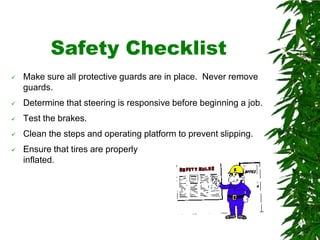
Safety ChecklistMake sure all protective guards are in place.  Never remove guards.
Determine that steering is responsive before beginning a job.
Test the brakes.
Clean the steps and operating platform to prevent slipping.
Ensure that tires are properly inflated.Safety ChecklistCheck for correct tightness of bolts.
Ensure a Slow Moving Vehicle (SMV) sign is installed and visible.
Ensure flashing warning signs are present and operating when traveling on roadways.Once installed, never remove guards, lights or signs.  Ignoring these simple items can cause accidents.
Remember…Never remove guards, flashing lights or Slow Moving Vehicle signs—even if they are bothering you.Trivia #3:  Employers reported 6.2 million non-fatal injuries and illnesses among mowers during 1996, and 5.8 million of those cases resulted in either lost work time, medical treatment or a job transfer, according to the Bureau of Labor Statistics.
Protective GearHearing protection, such as earplugs or muffs, is suggested for prolonged noise exposure. Gloves can't always prevent a finger amputation, but they can guard against cuts, abrasions, chemicals and other skin irritants. Wear gloves that fit and wear the right type of glove for the job. Long pants should be worn to protect against hazards such as flying debris, skin irritants and burns from exhaust.
Protective GearDust masks will prevent inhalation of dust and other particles in the air. Do not use when working with chemicals, toxic gases, and or when there is an oxygen deficiency. Safety glasses should be worn, but give only frontal protection against thrown objects. If you wear glasses, ensure they have impact-resistant lenses.
Protective GearRemember to wear the right type of personal protective equipment for the job, keep the items clean and sanitary, and replace any items that wear out or become broken.
Remember…Wear personal protective equipment for ears, eyes, hands, nose, legs and feet.Keep the items clean and sanitary.Tape and repair any items that wear out or become broken.Trivia #4:  Most Mower accidents occur between April and October, with June being the peak accident month.
Operating ProceduresThere are 3 kinds of procedures for safely operating mowers:General Safety ProceduresOperating on Uneven GroundAvoiding Thrown Object Hazards
General Safety GuidelinesThese procedures may sound like common sense, but they are often abused by operators and can result in minor or major injuries.
General Safety GuidelinesOnly the operator is allowed on the equipment.  No passengers allowed!
General Safety GuidelinesWhen leaving the seat, the operator should disengage the PTO, engage the brake, stop the engine, and wait for all parts to stop before dismounting. The operator should not adjust any mechanism of the equipment while the mower is running, but should follow the above procedures, making sure all parts have stopped moving.
General Safety GuidelinesWhen driving between mowing jobs, crossing a road, path or sidewalk, or when not using the mower, the operator should disengage the PTO to stop the mower blade. Operators should not mow in conditions where traction or stability is questionable. If uncertain, test drive a section with the PTO off.
General Safety GuidelinesNever refuel equipment while the engine is running or extremely hot. A fire or explosion could result.
Remember…Disengaging the Power Take Off (PTO), putting on the brake, stopping the engine, and waiting for all parts to stop moving before getting off the mower, are good common sense rules to follow.Trivia #5:  Over half of tractor/mower-related deaths result from overturns. Most go over sideways; some go over backward. Chances of survival are better if your tractor/mower is equipped with a rollover protective structure (ROPS) and a seat belt.
Operating on Uneven GroundOperating on uneven ground is the number one cause of accidents due to rolling of the machine. Since not all machinery is equipped with ROPS, mower operators have been killed or severely injured by improper operation on uneven ground. Even when ROPS is used, operators remain at risk and therefore should evaluate each situation on the safest way to mow.
Operating on Uneven GroundIf an area is too sloped or the ground is deemed too uneven to operate the mower safely, use a weedeater or pushmower.
Operating on Uneven GroundBefore mowing on even ground, prepare the machine:Lock the differential for better traction on slopes and in slippery places.
If available, install rear and/or front wheel weights to increase stability, steering, and traction. Refer to the machine's operating manual for installing these.Operating on Uneven GroundWhen mowing on uneven ground. . .Slow down the travel speed so that you can see and react to hazards in your path. Overturns are four times more likely to occur when speed is doubled.
Be on the alert for holes and ditches covered by grass or debris. A wheel may drop and cause an overturn. And . . .

Mower safety

  • 1.
  • 2.
  • 3.
    Getting StartedNot everyoneknows how to operate a mower safely. In fact, what most people view as common sense can lead to accidents later. Although accidents are less for mowers than some other areas, a number of injuries, even death, may occur if safety practices are ignored or abused. The purpose of this training is to help you become a SAFE mower operator. Let's get started.
  • 4.
    Terms used inthis training program:Power Take Off or PTO is the area of the machine where rotating torque is directly transferred to another machine or tool. In the mower case, the rotating torque is used to turn the mower blades. Roll Over Protection System or ROPS is attached to some vehicle frames to help prevent the vehicle from upsetting more than 90 degrees, and prevent the occupant from being crushed if an upset does occur. Deadman Switch is a device that will automatically turn the machine off if the operator should leave the driver's seat for any reason. It may also be used in the case of an equipment malfunction to turn the machine off.
  • 5.
    Remember…ROPSstands for RollOver Protection System.Trivia #1: Although there are few accidents with mowers, a number of injuries occur when mowers are in use. These accidents are caused by driving too fast, operating unsafely on uneven ground, operating a mower that has not been mechanically maintained, and pushing the mower beyond safe operating limits.
  • 6.
    Pre-Operation ProceduresIf problemscan be identified before stepping into the driver's seat, needless accidents can be prevented and the equipment will remain properly maintained. Pre-Operation procedures can be broken down into three areas. These are:Guidelines for getting familiar with your equipment
  • 7.
    Using a safetychecklist
  • 8.
    Personal protective equipmentPre-OperationProceduresGuidelines for getting familiar with your equipment:Read the operator’s manual first
  • 9.
    Make all necessaryadjustments before turning on the machine
  • 10.
    Observe and questiona skilled operator until comfortable with procedures.
  • 11.
    Practice operating inan open area first.Remember…Observe and question a skilled operator until you are comfortable with the procedures.Trivia #2: Overturns have the highest fatality rate for unintentional injuries involving tractors that occur on the farm, according to reports from 31 states covering about 66% of the farm tractors in the United States. In 1995, overturns accounted for 55% of all on-the-farm fatalities reported, with an annual rate of 5.5 deaths per 100,000 tractors.(National Safety Council Accidents Facts, p137) .
  • 12.
    Safety ChecklistMake sureall protective guards are in place. Never remove guards.
  • 13.
    Determine that steeringis responsive before beginning a job.
  • 14.
  • 15.
    Clean the stepsand operating platform to prevent slipping.
  • 16.
    Ensure that tiresare properly inflated.Safety ChecklistCheck for correct tightness of bolts.
  • 17.
    Ensure a SlowMoving Vehicle (SMV) sign is installed and visible.
  • 18.
    Ensure flashing warningsigns are present and operating when traveling on roadways.Once installed, never remove guards, lights or signs. Ignoring these simple items can cause accidents.
  • 19.
    Remember…Never remove guards,flashing lights or Slow Moving Vehicle signs—even if they are bothering you.Trivia #3: Employers reported 6.2 million non-fatal injuries and illnesses among mowers during 1996, and 5.8 million of those cases resulted in either lost work time, medical treatment or a job transfer, according to the Bureau of Labor Statistics.
  • 20.
    Protective GearHearing protection,such as earplugs or muffs, is suggested for prolonged noise exposure. Gloves can't always prevent a finger amputation, but they can guard against cuts, abrasions, chemicals and other skin irritants. Wear gloves that fit and wear the right type of glove for the job. Long pants should be worn to protect against hazards such as flying debris, skin irritants and burns from exhaust.
  • 21.
    Protective GearDust maskswill prevent inhalation of dust and other particles in the air. Do not use when working with chemicals, toxic gases, and or when there is an oxygen deficiency. Safety glasses should be worn, but give only frontal protection against thrown objects. If you wear glasses, ensure they have impact-resistant lenses.
  • 22.
    Protective GearRemember towear the right type of personal protective equipment for the job, keep the items clean and sanitary, and replace any items that wear out or become broken.
  • 23.
    Remember…Wear personal protectiveequipment for ears, eyes, hands, nose, legs and feet.Keep the items clean and sanitary.Tape and repair any items that wear out or become broken.Trivia #4: Most Mower accidents occur between April and October, with June being the peak accident month.
  • 24.
    Operating ProceduresThere are3 kinds of procedures for safely operating mowers:General Safety ProceduresOperating on Uneven GroundAvoiding Thrown Object Hazards
  • 25.
    General Safety GuidelinesTheseprocedures may sound like common sense, but they are often abused by operators and can result in minor or major injuries.
  • 26.
    General Safety GuidelinesOnlythe operator is allowed on the equipment. No passengers allowed!
  • 27.
    General Safety GuidelinesWhenleaving the seat, the operator should disengage the PTO, engage the brake, stop the engine, and wait for all parts to stop before dismounting. The operator should not adjust any mechanism of the equipment while the mower is running, but should follow the above procedures, making sure all parts have stopped moving.
  • 28.
    General Safety GuidelinesWhendriving between mowing jobs, crossing a road, path or sidewalk, or when not using the mower, the operator should disengage the PTO to stop the mower blade. Operators should not mow in conditions where traction or stability is questionable. If uncertain, test drive a section with the PTO off.
  • 29.
    General Safety GuidelinesNeverrefuel equipment while the engine is running or extremely hot. A fire or explosion could result.
  • 30.
    Remember…Disengaging the PowerTake Off (PTO), putting on the brake, stopping the engine, and waiting for all parts to stop moving before getting off the mower, are good common sense rules to follow.Trivia #5: Over half of tractor/mower-related deaths result from overturns. Most go over sideways; some go over backward. Chances of survival are better if your tractor/mower is equipped with a rollover protective structure (ROPS) and a seat belt.
  • 31.
    Operating on UnevenGroundOperating on uneven ground is the number one cause of accidents due to rolling of the machine. Since not all machinery is equipped with ROPS, mower operators have been killed or severely injured by improper operation on uneven ground. Even when ROPS is used, operators remain at risk and therefore should evaluate each situation on the safest way to mow.
  • 32.
    Operating on UnevenGroundIf an area is too sloped or the ground is deemed too uneven to operate the mower safely, use a weedeater or pushmower.
  • 33.
    Operating on UnevenGroundBefore mowing on even ground, prepare the machine:Lock the differential for better traction on slopes and in slippery places.
  • 34.
    If available, installrear and/or front wheel weights to increase stability, steering, and traction. Refer to the machine's operating manual for installing these.Operating on Uneven GroundWhen mowing on uneven ground. . .Slow down the travel speed so that you can see and react to hazards in your path. Overturns are four times more likely to occur when speed is doubled.
  • 35.
    Be on thealert for holes and ditches covered by grass or debris. A wheel may drop and cause an overturn. And . . .