EDUCATION
  in Britain
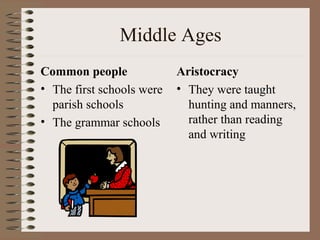
Middle Ages
Common people              Aristocracy
• The first schools were   • They were taught
  parish schools             hunting and manners,
• The grammar schools        rather than reading
                             and writing
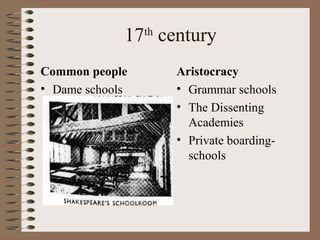
17 century
                 th


Common people         Aristocracy
• Dame schools        • Grammar schools
                      • The Dissenting
                        Academies
                      • Private boarding-
                        schools
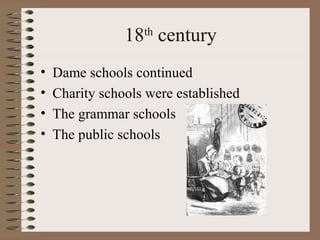
18 century
                   th


•   Dame schools continued
•   Charity schools were established
•   The grammar schools
•   The public schools
19 century
                   th


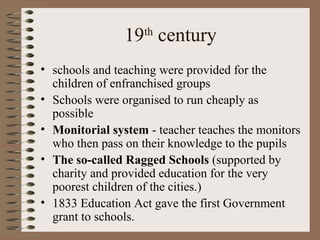
• schools and teaching were provided for the
  children of enfranchised groups
• Schools were organised to run cheaply as
  possible
• Monitorial system - teacher teaches the monitors
  who then pass on their knowledge to the pupils
• The so-called Ragged Schools (supported by
  charity and provided education for the very
  poorest children of the cities.)
• 1833 Education Act gave the first Government
  grant to schools.
20 century
                   th

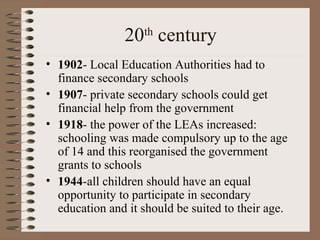
• 1902- Local Education Authorities had to
  finance secondary schools
• 1907- private secondary schools could get
  financial help from the government
• 1918- the power of the LEAs increased:
  schooling was made compulsory up to the age
  of 14 and this reorganised the government
  grants to schools
• 1944-all children should have an equal
  opportunity to participate in secondary
  education and it should be suited to their age.
The actions in Parliament
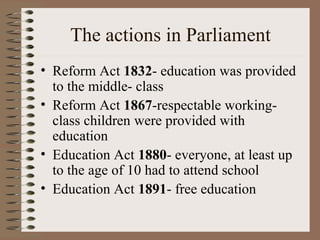
• Reform Act 1832- education was provided
  to the middle- class
• Reform Act 1867-respectable working-
  class children were provided with
  education
• Education Act 1880- everyone, at least up
  to the age of 10 had to attend school
• Education Act 1891- free education
British Education System
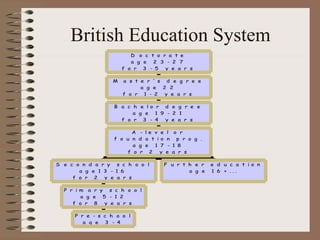
                        D o c t o r a t e
                        a g e 2 3 - 2 7
                     f o r 3 - 5   y e a r s

                 M   a s t e r ' s d e g r e e
                           a g e 2 2
                     f o r 1 - 2   y e a r s

                  B a c h e lo r d e g r e e
                        a g e 1 9 - 2 1
                    f o r 3 - 4  y e a r s

                        A    - le v e   l o r
                  f o u n   d a t i o   n p r o g .
                        a   g e 1 7      - 1 8
                      f o   r 2     y   e a r s

S e c o n d a r y s c h o o l           F u r t h e r   e d u c a t i o n
       a g e 1 3 - 1 6                          a g e   1 6 + ...
     f o r 2   y e a r s

  P r i m a r y s c h o o l
        a g e 5 - 1 2
     f o r 8   y e a r s

     P r e - s c h o o l
        a g e 3 - 4
School education
• primary education
     up to age eleven
• secondary education
     up to age sixteen
Private education
• Government does not support these
  schools financially.
• People must pay for their education
• Choice: day and boarding schools, single-
  sex schools
• 2,400 schools in Britain
Further education
• Is for people over sixteen taking
  courses to enter into higher education.
• Provides continued general education
  for people of all ages.
• Used to study academic subjects and
  explore recreational activities as well
  as to develop and upgrade work skills.
Higher education
• All UK post-school courses above GCE
  Advanced level or Scottish Higher
  standard.
• Courses are available at universities,
  colleges and institutions of higher
  education.
Universities
• There are 88 universities in the UK.
• A private university (Buckingham).
• A school which is devoted entirely to
  distance learning (the Open University).
• Most famous Universities in Britain are
  Cambridge and Oxford.
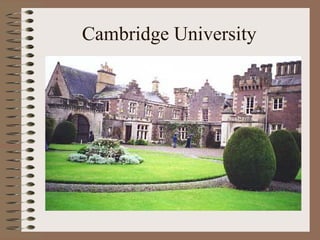
Cambridge University
Facts about Cambridge
• Students: over 16,500 (over100 nationalities)
• Staff consists of 7,000 people
• Divisions: Humanities, Life and Environmental
  Sciences, Mathematical and Physical Sciences,
  Medical Sciences, Social Sciences
• Chancellor: The Duke of Edinburgh
• Members of Cambridge have won over 60 Nobel
  Prizes
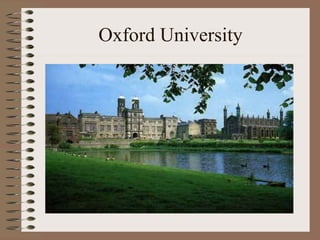
Oxford University
Facts about Oxford
• Students: over 16, 500 (130nationalities)
• Academic community includes 426 people
• Divisions: Humanities, Life and Environmental
  Sciences, Mathematical and Physical Sciences,
  Medical Sciences, Social Sciences
• Oxford was named the most innovative
  University
• Chancellor: Roy Jenkins
Distance education
• Learners are separated from the institution
• Learning takes place outside the education
  establishment.
• Students learn where and when it suits
  them, at their own pace.
• Studies and private and professional
  commitments can be combined
Teacher education
• Schools have responsibility for
  planning and managing teacher
  training courses and for the selection,
  training and assessment of students.
Education in great britain

Education in great britain

  • 1.
    EDUCATION inBritain
  • 2.
    Middle Ages Common people Aristocracy • The first schools were • They were taught parish schools hunting and manners, • The grammar schools rather than reading and writing
  • 3.
    17 century th Common people Aristocracy • Dame schools • Grammar schools • The Dissenting Academies • Private boarding- schools
  • 4.
    18 century th • Dame schools continued • Charity schools were established • The grammar schools • The public schools
  • 5.
    19 century th • schools and teaching were provided for the children of enfranchised groups • Schools were organised to run cheaply as possible • Monitorial system - teacher teaches the monitors who then pass on their knowledge to the pupils • The so-called Ragged Schools (supported by charity and provided education for the very poorest children of the cities.) • 1833 Education Act gave the first Government grant to schools.
  • 6.
    20 century th • 1902- Local Education Authorities had to finance secondary schools • 1907- private secondary schools could get financial help from the government • 1918- the power of the LEAs increased: schooling was made compulsory up to the age of 14 and this reorganised the government grants to schools • 1944-all children should have an equal opportunity to participate in secondary education and it should be suited to their age.
  • 7.
    The actions inParliament • Reform Act 1832- education was provided to the middle- class • Reform Act 1867-respectable working- class children were provided with education • Education Act 1880- everyone, at least up to the age of 10 had to attend school • Education Act 1891- free education
  • 8.
    British Education System D o c t o r a t e a g e 2 3 - 2 7 f o r 3 - 5 y e a r s M a s t e r ' s d e g r e e a g e 2 2 f o r 1 - 2 y e a r s B a c h e lo r d e g r e e a g e 1 9 - 2 1 f o r 3 - 4 y e a r s A - le v e l o r f o u n d a t i o n p r o g . a g e 1 7 - 1 8 f o r 2 y e a r s S e c o n d a r y s c h o o l F u r t h e r e d u c a t i o n a g e 1 3 - 1 6 a g e 1 6 + ... f o r 2 y e a r s P r i m a r y s c h o o l a g e 5 - 1 2 f o r 8 y e a r s P r e - s c h o o l a g e 3 - 4
  • 9.
    School education • primaryeducation up to age eleven • secondary education up to age sixteen
  • 10.
    Private education • Governmentdoes not support these schools financially. • People must pay for their education • Choice: day and boarding schools, single- sex schools • 2,400 schools in Britain
  • 11.
    Further education • Isfor people over sixteen taking courses to enter into higher education. • Provides continued general education for people of all ages. • Used to study academic subjects and explore recreational activities as well as to develop and upgrade work skills.
  • 12.
    Higher education • AllUK post-school courses above GCE Advanced level or Scottish Higher standard. • Courses are available at universities, colleges and institutions of higher education.
  • 13.
    Universities • There are88 universities in the UK. • A private university (Buckingham). • A school which is devoted entirely to distance learning (the Open University). • Most famous Universities in Britain are Cambridge and Oxford.
  • 14.
  • 15.
    Facts about Cambridge •Students: over 16,500 (over100 nationalities) • Staff consists of 7,000 people • Divisions: Humanities, Life and Environmental Sciences, Mathematical and Physical Sciences, Medical Sciences, Social Sciences • Chancellor: The Duke of Edinburgh • Members of Cambridge have won over 60 Nobel Prizes
  • 16.
  • 17.
    Facts about Oxford •Students: over 16, 500 (130nationalities) • Academic community includes 426 people • Divisions: Humanities, Life and Environmental Sciences, Mathematical and Physical Sciences, Medical Sciences, Social Sciences • Oxford was named the most innovative University • Chancellor: Roy Jenkins
  • 18.
    Distance education • Learnersare separated from the institution • Learning takes place outside the education establishment. • Students learn where and when it suits them, at their own pace. • Studies and private and professional commitments can be combined
  • 19.
    Teacher education • Schoolshave responsibility for planning and managing teacher training courses and for the selection, training and assessment of students.

Editor's Notes

  • #3 The parish schools offered elementary education to the children of ordinary parents who wanted to get on in life. Schools were mostly religious and children were taught to read, learn prayers and psalms . (Nicholas Orme, English Schools in the Middle Ages 1973 ) Some of the school were less religious- a school in Rotherham in Yorkshire founded in 1483 by the Archbishop of York . There was taught mostly accountancy and grammar. At the grammar schools the pupils, drawn from the wealthier sections of town society, were expected to be able to read and write before they were admitted. They then went on to learn Latin grammar and compose Latin verse. Schooling was not free nor was it easy. The holidays were short, the school days were long often beginning at six in the morning and continuing until six in the evening with short breaks for food, the classes were large with up to a hundred pupils being taught in one room, and the masters believed whole-heartedly in corporal punishment. Aristocracy: boys were aent away from home. Girls were not normally educated except that often they too were sent away from home to learn how to behave and care for a household. In the middle ages children often had to receive cruel punishment.
  • #4 The Dame schools were paid by the parish and usually run by women, there were taught children up to the age 7 reading, knitting and spinning. The grammar schools were firmly established in the market towns, most of them continuing to exist into the 20th century. There was provided further education in writing, Latin and Greek and even mathematics in the grammar schools. The Puritans, expelled from the Church of England, set up their own schools, the Dissenting Academies where the religious teaching reflected their own beliefs. During the 17th century some of the most famous private boarding-schools, known today as public schools, were founded for the sons of the aristocracy who then went on to one of the Oxford colleges. There were no places for girls in the grammar schools, the public schools or the universities .
  • #5 C harity schools were established which by the end of the century provided an education for a quarter of a million pupils that stressed religion, moral teaching and vocational training. The public schools became the scenes of bullying and savage corporal punishment .
  • #10 compulsory education begins at 4-5. pre-school education is available for ages two to four/five through playgroups and nursery schools . there is little or no special subject teaching Secondary - Between the ages 14 and 16 pupils study for their GCSE (General Certificate of Secondary Education) exam. Pupils must take English language, Maths and Science for GCSE, as well as a half GCSE in foreign language and Technology. In addition they must be taught Physical Education, Religious Education and Sex Education. (they don’t take exams in these subjects). At the age of 16 pupils can leave school. If pupils stay on they take A (advanced) levels. Pupils take A-levels in traditional subjects, such as French or History.
  • #18 Innovative University. M odern Oxford leads the way in creating jobs, wealth, skills and innovation for the 21st century. Oxford's overall resear ch income rose to £142 million. Winner of the UK's 'Most Innovative University' Competition