Academic EnglishAcademic English
SOFD course forSOFD course for
intermediate studentsintermediate students
Alejandro CuradoAlejandro Curado
Ignacio FernándezIgnacio Fernández
Jean PoitrasJean Poitras
May 2018May 2018
What is academic writing?What is academic writing?
Written vs. oral AcademicWritten vs. oral Academic
EnglishEnglish
VIDEOVIDEO
Activity:Activity:
Listen to the following presentation and make a list of theListen to the following presentation and make a list of the
differences MENTIONED between SPEAKING and Academicdifferences MENTIONED between SPEAKING and Academic
English WRITING?English WRITING?
Which are most important to you?Which are most important to you?
1.1.
2.2.
3.3.
4.4.
5.5.
6.6.
……
Academic Writing in English: aAcademic Writing in English: a
surveysurvey
How often do I write in English?How often do I write in English?
For how long?For how long?
For what purposes? Writing what?For what purposes? Writing what?
What are the main difficulties?What are the main difficulties?
– Format, spelling, punctuation…Format, spelling, punctuation…
– Grammatical: passive voice, tenses, modal verbs,Grammatical: passive voice, tenses, modal verbs,
prepositions,prepositions,
– Organization: logical progression of content, connectingOrganization: logical progression of content, connecting
ideas between paragraphs, in the same paragraph, …ideas between paragraphs, in the same paragraph, …
– Vocabulary: specialised terms, fixed expressions, …Vocabulary: specialised terms, fixed expressions, …
– Style: condensing information, using shorter sentences,Style: condensing information, using shorter sentences,
using the appropriate tone…using the appropriate tone…
Read to learn style, not onlyRead to learn style, not only
contentcontent
How do they introduce their argument?
What words do they use to signpost, or
make judgements? Are their sentences
long or short? How do they show when
they disagree? What goes in the
introduction?
Build up an idea of what is normal. You
are expected to write using the same
words and forms – so borrow their
vocabulary and phrases! (This is not
plagiarism.)
What you write is …. a genreWhat you write is …. a genre
It is the RESULT or PRODUCT of your writing.It is the RESULT or PRODUCT of your writing.
It is a TYPE OF COMMUNICATIVE EVENT: you want to tellIt is a TYPE OF COMMUNICATIVE EVENT: you want to tell
something to an intended audience (very much like a novelist orsomething to an intended audience (very much like a novelist or
journalist)journalist)
You give a name to it which expresses not the medium but theYou give a name to it which expresses not the medium but the
purpose of what you write.purpose of what you write.
– A letter is not a genre (means), whereas a LETTER OFA letter is not a genre (means), whereas a LETTER OF
APPLICATION is (purpose).APPLICATION is (purpose).
GENRES are ways to do things through language. Speech actGENRES are ways to do things through language. Speech act
theory: How to do things with words, Austin.theory: How to do things with words, Austin.
– Minister: (Groom) will you take (Bride) to be your lawfulMinister: (Groom) will you take (Bride) to be your lawful
wife, will you love her, honor and keep her in sickness and inwife, will you love her, honor and keep her in sickness and in
health and forsaking all others keep only unto her so long ashealth and forsaking all others keep only unto her so long as
you both shall live. Response: I will.you both shall live. Response: I will.
What written genres are youWhat written genres are you
interested in?interested in?
Research articleResearch article
AbstractsAbstracts
Different kinds of letters (letter of submissiDifferent kinds of letters (letter of submission,on,
answer to the review letter,.)answer to the review letter,.)
Different kinds of emailsDifferent kinds of emails
ReportReport
Bionote, resumBionote, resumés, CVsés, CVs
Application for a grant or a scholarshipApplication for a grant or a scholarship
……
Who is/are your reader(s)?Who is/are your reader(s)?
Focus on detail:Focus on detail:
--Scientific research (e.g., previous)--Scientific research (e.g., previous)
– Writing (Be specific! Article “the” vs.Writing (Be specific! Article “the” vs.
abstraction)abstraction)
Always have in mind your intendedAlways have in mind your intended
audienceaudience
– What are their interestsWhat are their interests
– What are the conventions / genre / topicWhat are the conventions / genre / topic
area?area?
Reading-to-writing Activity (Identifying cohesion in text):Reading-to-writing Activity (Identifying cohesion in text):
HTTP://WWW2.ELC.POLYU.EDU.HK/CILL/ICOSA/WRITING/ORGANIZATION/PARAGRAPHHTTP://WWW2.ELC.POLYU.EDU.HK/CILL/ICOSA/WRITING/ORGANIZATION/PARAGRAPH
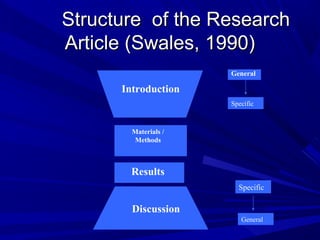
Structure of the ResearchStructure of the Research
Article (Swales, 1990)Article (Swales, 1990)
Introduction
Materials /
Methods
Specific
Results
Discussion
Introduction
General
General
Specific
The introduction: key elementThe introduction: key element
in RAin RA
Move 1 Establishing a research territory
a: by showing that the general research area is important, central,
interesting, problematic, or relevant in some way (optional).
b: by introducing and reviewing items of previous research in the
area (obligatory)
Move 2 Establishing a niche
a: by indicating a gap in the previous research, raising a question
about it, or extending previous knowledge in some way
(obligatory)
Move 3 Occupying the niche
a: by outlining purposes or stating the nature of the present
research (obligatory)
b: by announcing principal findings (optional)
c: by indicating structure of the RP (optional)
 
Over the past few decades, mental lexicons have been integrated
in cognitive models in order to study aphasic pathologies. Such
methods have become obvious matter in Neurolinguistics. A
significant contrastive analysis with mental lexicons is the so-called
lexicon-free model (Patterson et al, 2006), where the processing of
auditory language consists in phonological and semantic
processing without a lexical representation (Jefferis et al, 2007).
Lexical decision tasks can be analysed as semantic decision tasks,
and performance or functionality would vary according to the
accuracy of semantic processing. It is also observed in lexicon-free
models that lexical and semantic processes tend to disassociate
depending on individual subjects.
This paper deals with a case study of lexical and semantic tasks
done with a subject that suffers from word meaning interception. In
this type of pathology, the subject is not capable of accessing the
meaning of words in the aural phase for their processing, whereas
the subject is capable of accessing the pre-semantic phonological
aspect as well as written comprehension of such words. As
examined in the next section, significant findings from previous
research on lexicon-free models point to similar observations.
Over the past few decades, mental lexicons have been integrated
in cognitive models in order to study aphasic pathologies. Such
methods have become obvious matter in Neurolinguistics.
significant contrastive analysis with mental lexicons is the so-called
lexicon-free model (Patterson et al, 2006), where the processing of
auditory language consists in phonological and semantic
processing without a lexical representation (Jefferis et al, 2007).
Lexical decision tasks can be analysed as semantic decision tasks,
and performance or functionality would vary according to the
accuracy of semantic processing. It is also observed in lexicon-free
models that lexical and semantic processes tend to disassociate
depending on individual subjects.
This paper deals with a case study of lexical and semantic tasks
done with a subject that suffers from word meaning interception. In
this type of pathology, the subject is not capable of accessing the
meaning of words in the aural phase for their processing, whereas
the subject is capable of accessing the pre-semantic phonological
aspect as well as written comprehension of such words. As
examined in the next section, significant findings from previous
research on lexicon-free models point to similar observations.
ELEMENTS OF RAELEMENTS OF RA
INTRODUCTIONS (2INTRODUCTIONS (2ndnd
part)part)
Claiming centrality (Move 1)Claiming centrality (Move 1)
Recently, there has been a growing interest in…Recently, there has been a growing interest in…
The possibility of …has generated wide interest in…The possibility of …has generated wide interest in…
The development of …is a classic problem in…The development of …is a classic problem in…
The development of …has led to the hope that…The development of …has led to the hope that…
The …has become an important aspect of..The …has become an important aspect of..
A central issue in…is…A central issue in…is…
The…has been extensively studied in recent years.The…has been extensively studied in recent years.
Many investigators have recently turned to …Many investigators have recently turned to …
The relationship between… has been investigated byThe relationship between… has been investigated by
many researchers.many researchers.
Several recent studies have focused on…Several recent studies have focused on…
> Which VERB TENSE tends to be used?> Which VERB TENSE tends to be used?
>State a>State a powerful openingpowerful opening in your field?in your field?
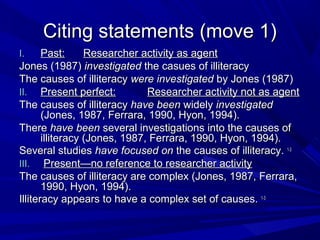
Citing statements (move 1)Citing statements (move 1)
I.I. Past:Past: Researcher activity as agentResearcher activity as agent
Jones (1987)Jones (1987) investigatedinvestigated the casues of illiteracythe casues of illiteracy
The causes of illiteracyThe causes of illiteracy were investigatedwere investigated by Jones (1987)by Jones (1987)
II.II. Present perfect:Present perfect: Researcher activity not as agentResearcher activity not as agent
The causes of illiteracyThe causes of illiteracy have beenhave been widelywidely investigatedinvestigated
(Jones, 1987, Ferrara, 1990, Hyon, 1994).(Jones, 1987, Ferrara, 1990, Hyon, 1994).
ThereThere have beenhave been several investigations into the causes ofseveral investigations into the causes of
illiteracy (Jones, 1987, Ferrara, 1990, Hyon, 1994).illiteracy (Jones, 1987, Ferrara, 1990, Hyon, 1994).
Several studiesSeveral studies have focused onhave focused on the causes of illiteracy.the causes of illiteracy. 1-31-3
III.III. Present—no reference to researcher activityPresent—no reference to researcher activity
The causes of illiteracy are complex (Jones, 1987, Ferrara,The causes of illiteracy are complex (Jones, 1987, Ferrara,
1990, Hyon, 1994).1990, Hyon, 1994).
Illiteracy appears to have a complex set of causes.Illiteracy appears to have a complex set of causes. 1-31-3

Presentation alex

  • 1.
    Academic EnglishAcademic English SOFDcourse forSOFD course for intermediate studentsintermediate students Alejandro CuradoAlejandro Curado Ignacio FernándezIgnacio Fernández Jean PoitrasJean Poitras May 2018May 2018
  • 2.
    What is academicwriting?What is academic writing?
  • 3.
    Written vs. oralAcademicWritten vs. oral Academic EnglishEnglish
  • 4.
    VIDEOVIDEO Activity:Activity: Listen to thefollowing presentation and make a list of theListen to the following presentation and make a list of the differences MENTIONED between SPEAKING and Academicdifferences MENTIONED between SPEAKING and Academic English WRITING?English WRITING? Which are most important to you?Which are most important to you? 1.1. 2.2. 3.3. 4.4. 5.5. 6.6. ……
  • 5.
    Academic Writing inEnglish: aAcademic Writing in English: a surveysurvey How often do I write in English?How often do I write in English? For how long?For how long? For what purposes? Writing what?For what purposes? Writing what? What are the main difficulties?What are the main difficulties? – Format, spelling, punctuation…Format, spelling, punctuation… – Grammatical: passive voice, tenses, modal verbs,Grammatical: passive voice, tenses, modal verbs, prepositions,prepositions, – Organization: logical progression of content, connectingOrganization: logical progression of content, connecting ideas between paragraphs, in the same paragraph, …ideas between paragraphs, in the same paragraph, … – Vocabulary: specialised terms, fixed expressions, …Vocabulary: specialised terms, fixed expressions, … – Style: condensing information, using shorter sentences,Style: condensing information, using shorter sentences, using the appropriate tone…using the appropriate tone…
  • 6.
    Read to learnstyle, not onlyRead to learn style, not only contentcontent How do they introduce their argument? What words do they use to signpost, or make judgements? Are their sentences long or short? How do they show when they disagree? What goes in the introduction? Build up an idea of what is normal. You are expected to write using the same words and forms – so borrow their vocabulary and phrases! (This is not plagiarism.)
  • 7.
    What you writeis …. a genreWhat you write is …. a genre It is the RESULT or PRODUCT of your writing.It is the RESULT or PRODUCT of your writing. It is a TYPE OF COMMUNICATIVE EVENT: you want to tellIt is a TYPE OF COMMUNICATIVE EVENT: you want to tell something to an intended audience (very much like a novelist orsomething to an intended audience (very much like a novelist or journalist)journalist) You give a name to it which expresses not the medium but theYou give a name to it which expresses not the medium but the purpose of what you write.purpose of what you write. – A letter is not a genre (means), whereas a LETTER OFA letter is not a genre (means), whereas a LETTER OF APPLICATION is (purpose).APPLICATION is (purpose). GENRES are ways to do things through language. Speech actGENRES are ways to do things through language. Speech act theory: How to do things with words, Austin.theory: How to do things with words, Austin. – Minister: (Groom) will you take (Bride) to be your lawfulMinister: (Groom) will you take (Bride) to be your lawful wife, will you love her, honor and keep her in sickness and inwife, will you love her, honor and keep her in sickness and in health and forsaking all others keep only unto her so long ashealth and forsaking all others keep only unto her so long as you both shall live. Response: I will.you both shall live. Response: I will.
  • 8.
    What written genresare youWhat written genres are you interested in?interested in? Research articleResearch article AbstractsAbstracts Different kinds of letters (letter of submissiDifferent kinds of letters (letter of submission,on, answer to the review letter,.)answer to the review letter,.) Different kinds of emailsDifferent kinds of emails ReportReport Bionote, resumBionote, resumés, CVsés, CVs Application for a grant or a scholarshipApplication for a grant or a scholarship ……
  • 9.
    Who is/are yourreader(s)?Who is/are your reader(s)? Focus on detail:Focus on detail: --Scientific research (e.g., previous)--Scientific research (e.g., previous) – Writing (Be specific! Article “the” vs.Writing (Be specific! Article “the” vs. abstraction)abstraction) Always have in mind your intendedAlways have in mind your intended audienceaudience – What are their interestsWhat are their interests – What are the conventions / genre / topicWhat are the conventions / genre / topic area?area?
  • 10.
    Reading-to-writing Activity (Identifyingcohesion in text):Reading-to-writing Activity (Identifying cohesion in text): HTTP://WWW2.ELC.POLYU.EDU.HK/CILL/ICOSA/WRITING/ORGANIZATION/PARAGRAPHHTTP://WWW2.ELC.POLYU.EDU.HK/CILL/ICOSA/WRITING/ORGANIZATION/PARAGRAPH
  • 11.
    Structure of theResearchStructure of the Research Article (Swales, 1990)Article (Swales, 1990) Introduction Materials / Methods Specific Results Discussion Introduction General General Specific
  • 12.
    The introduction: keyelementThe introduction: key element in RAin RA Move 1 Establishing a research territory a: by showing that the general research area is important, central, interesting, problematic, or relevant in some way (optional). b: by introducing and reviewing items of previous research in the area (obligatory) Move 2 Establishing a niche a: by indicating a gap in the previous research, raising a question about it, or extending previous knowledge in some way (obligatory) Move 3 Occupying the niche a: by outlining purposes or stating the nature of the present research (obligatory) b: by announcing principal findings (optional) c: by indicating structure of the RP (optional)  
  • 13.
    Over the pastfew decades, mental lexicons have been integrated in cognitive models in order to study aphasic pathologies. Such methods have become obvious matter in Neurolinguistics. A significant contrastive analysis with mental lexicons is the so-called lexicon-free model (Patterson et al, 2006), where the processing of auditory language consists in phonological and semantic processing without a lexical representation (Jefferis et al, 2007). Lexical decision tasks can be analysed as semantic decision tasks, and performance or functionality would vary according to the accuracy of semantic processing. It is also observed in lexicon-free models that lexical and semantic processes tend to disassociate depending on individual subjects. This paper deals with a case study of lexical and semantic tasks done with a subject that suffers from word meaning interception. In this type of pathology, the subject is not capable of accessing the meaning of words in the aural phase for their processing, whereas the subject is capable of accessing the pre-semantic phonological aspect as well as written comprehension of such words. As examined in the next section, significant findings from previous research on lexicon-free models point to similar observations. Over the past few decades, mental lexicons have been integrated in cognitive models in order to study aphasic pathologies. Such methods have become obvious matter in Neurolinguistics. significant contrastive analysis with mental lexicons is the so-called lexicon-free model (Patterson et al, 2006), where the processing of auditory language consists in phonological and semantic processing without a lexical representation (Jefferis et al, 2007). Lexical decision tasks can be analysed as semantic decision tasks, and performance or functionality would vary according to the accuracy of semantic processing. It is also observed in lexicon-free models that lexical and semantic processes tend to disassociate depending on individual subjects. This paper deals with a case study of lexical and semantic tasks done with a subject that suffers from word meaning interception. In this type of pathology, the subject is not capable of accessing the meaning of words in the aural phase for their processing, whereas the subject is capable of accessing the pre-semantic phonological aspect as well as written comprehension of such words. As examined in the next section, significant findings from previous research on lexicon-free models point to similar observations.
  • 14.
    ELEMENTS OF RAELEMENTSOF RA INTRODUCTIONS (2INTRODUCTIONS (2ndnd part)part)
  • 15.
    Claiming centrality (Move1)Claiming centrality (Move 1) Recently, there has been a growing interest in…Recently, there has been a growing interest in… The possibility of …has generated wide interest in…The possibility of …has generated wide interest in… The development of …is a classic problem in…The development of …is a classic problem in… The development of …has led to the hope that…The development of …has led to the hope that… The …has become an important aspect of..The …has become an important aspect of.. A central issue in…is…A central issue in…is… The…has been extensively studied in recent years.The…has been extensively studied in recent years. Many investigators have recently turned to …Many investigators have recently turned to … The relationship between… has been investigated byThe relationship between… has been investigated by many researchers.many researchers. Several recent studies have focused on…Several recent studies have focused on… > Which VERB TENSE tends to be used?> Which VERB TENSE tends to be used? >State a>State a powerful openingpowerful opening in your field?in your field?
  • 16.
    Citing statements (move1)Citing statements (move 1) I.I. Past:Past: Researcher activity as agentResearcher activity as agent Jones (1987)Jones (1987) investigatedinvestigated the casues of illiteracythe casues of illiteracy The causes of illiteracyThe causes of illiteracy were investigatedwere investigated by Jones (1987)by Jones (1987) II.II. Present perfect:Present perfect: Researcher activity not as agentResearcher activity not as agent The causes of illiteracyThe causes of illiteracy have beenhave been widelywidely investigatedinvestigated (Jones, 1987, Ferrara, 1990, Hyon, 1994).(Jones, 1987, Ferrara, 1990, Hyon, 1994). ThereThere have beenhave been several investigations into the causes ofseveral investigations into the causes of illiteracy (Jones, 1987, Ferrara, 1990, Hyon, 1994).illiteracy (Jones, 1987, Ferrara, 1990, Hyon, 1994). Several studiesSeveral studies have focused onhave focused on the causes of illiteracy.the causes of illiteracy. 1-31-3 III.III. Present—no reference to researcher activityPresent—no reference to researcher activity The causes of illiteracy are complex (Jones, 1987, Ferrara,The causes of illiteracy are complex (Jones, 1987, Ferrara, 1990, Hyon, 1994).1990, Hyon, 1994). Illiteracy appears to have a complex set of causes.Illiteracy appears to have a complex set of causes. 1-31-3