Continuous improvement in practiceAgile Mëtteg – June 17th, 2010
OBJECTIVES & AGENDAObjectivesThis session will give you a quick overview of agile values and principles. It will then focus on a key aspect (continuous improvement) and provide you with practical examples and techniques to help your team learn and become more efficient.AgendaIntroduction of Agile PartnerThe attendeesIntroduction to the values of Agile Software Development Overview of Scrum and Lean principles  Continuous improvement and agile retrospectives Techniques and tips for conducting retrospectives  Q&A June 17th, 2010Agile Mëtteg - Continuous improvement in practice2
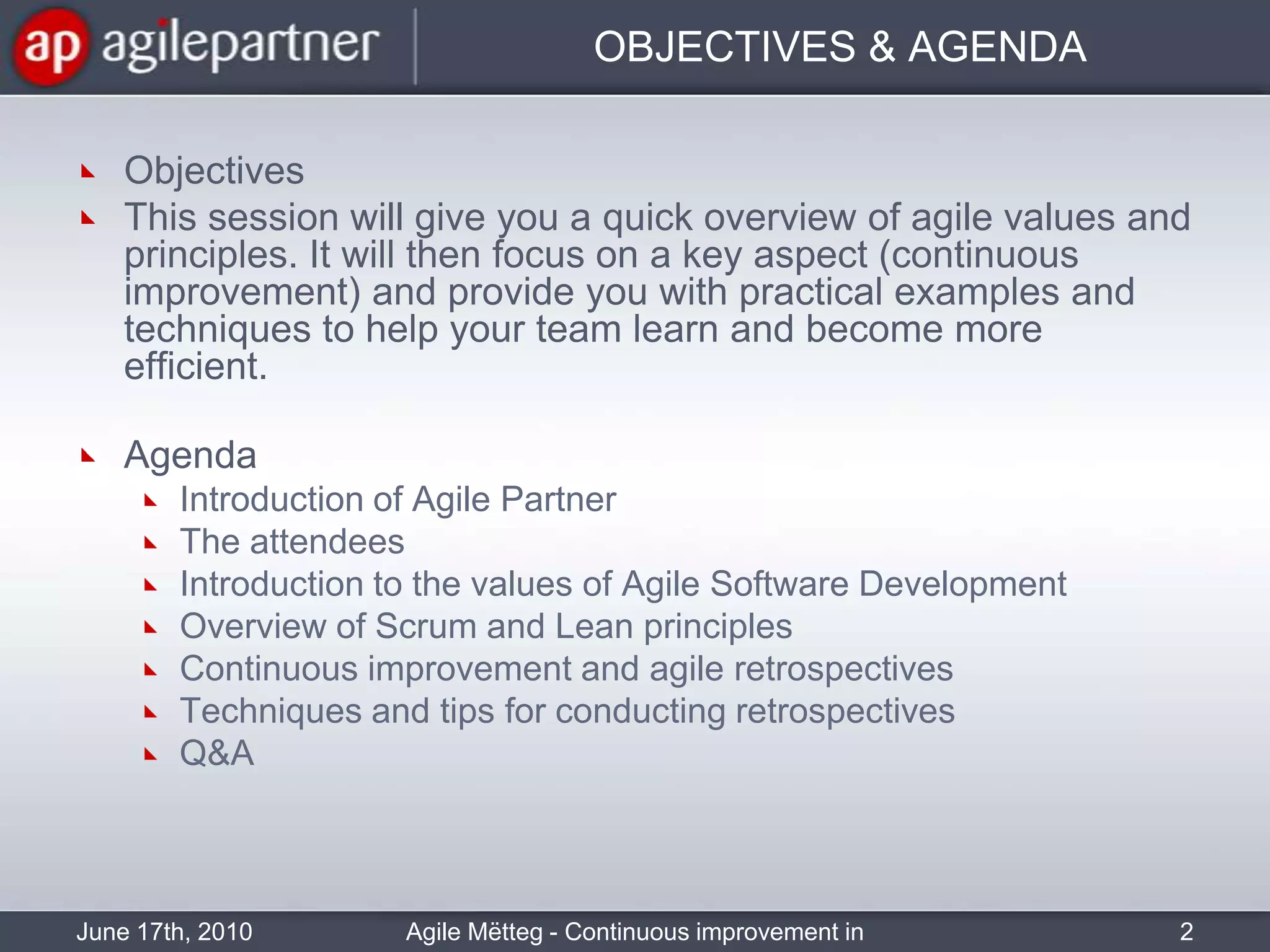
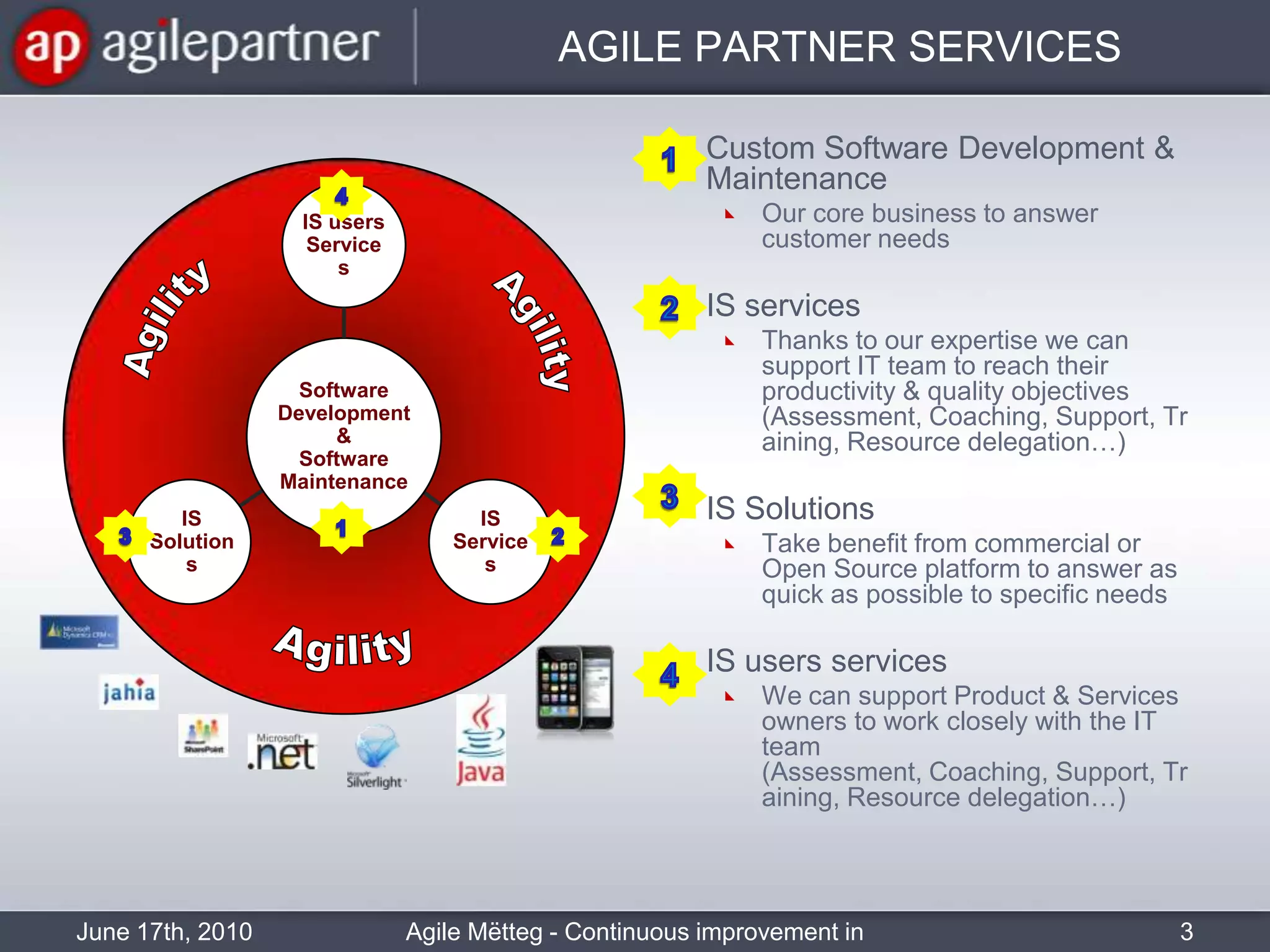
AGILE PARTNER SERVICESIS users ServicesCustom Software Development & MaintenanceOur core business to answer customer needsIS servicesThanks to our expertise we can support IT team to reach their productivity & quality objectives (Assessment, Coaching, Support, Training, Resource delegation…)IS SolutionsTake benefit from commercial or Open Source platform to answer as quick as possible to specific needsIS users servicesWe can support Product & Services owners to work closely with the IT team (Assessment, Coaching, Support, Training, Resource delegation…)14Software Development & SoftwareMaintenance2ISSolutionsIS ServicesAgilityAgility123AgilityJune 17th, 2010Agile Mëtteg - Continuous improvement in practice334
Let’s get acquaintedJune 17th, 2010Agile Mëtteg - Continuous improvement in practice4
PRESENTATION OF THE ATTENDEESWho are you ?What is your role ?What do you know about agility ?What are your expectations ?June 17th, 2010Agile Mëtteg - Continuous improvement in practice5
AGILITY – IT’s a mindsetJune 17th, 2010Agile Mëtteg - Continuous improvement in practice6
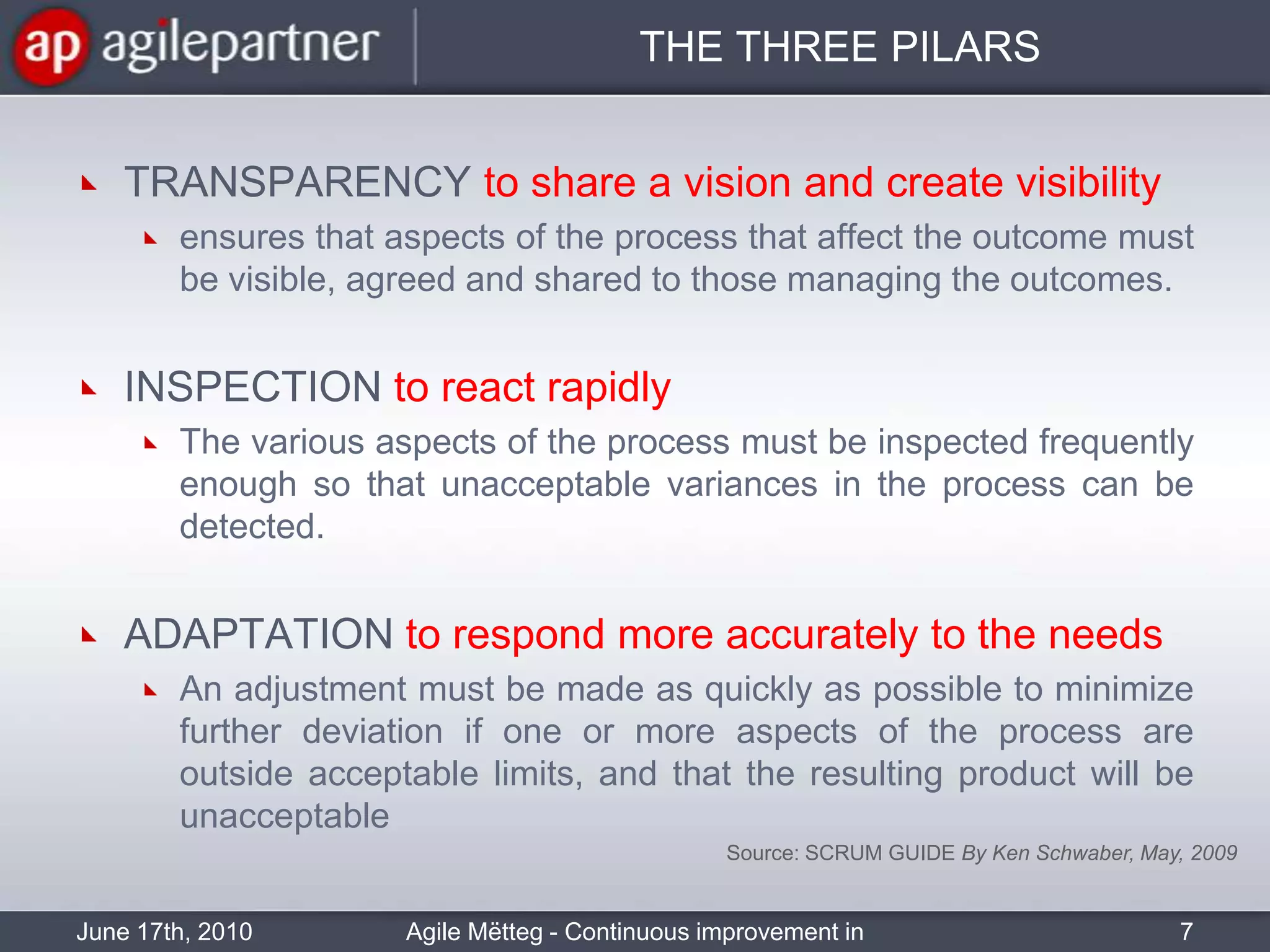
THE THREE PILARSTRANSPARENCY to share a vision and create visibilityensures that aspects of the process that affect the outcome must be visible, agreed and shared to those managing the outcomes.INSPECTION to react rapidlyThe various aspects of the process must be inspected frequently enough so that unacceptable variances in the process can be detected.ADAPTATION to respond more accurately to the needsAn adjustment must be made as quickly as possible to minimize further deviation if one or more aspects of the process are outside acceptable limits, and that the resulting product will be unacceptable June 17th, 2010Agile Mëtteg - Continuous improvement in practice7Source: SCRUM GUIDE By Ken Schwaber, May, 2009
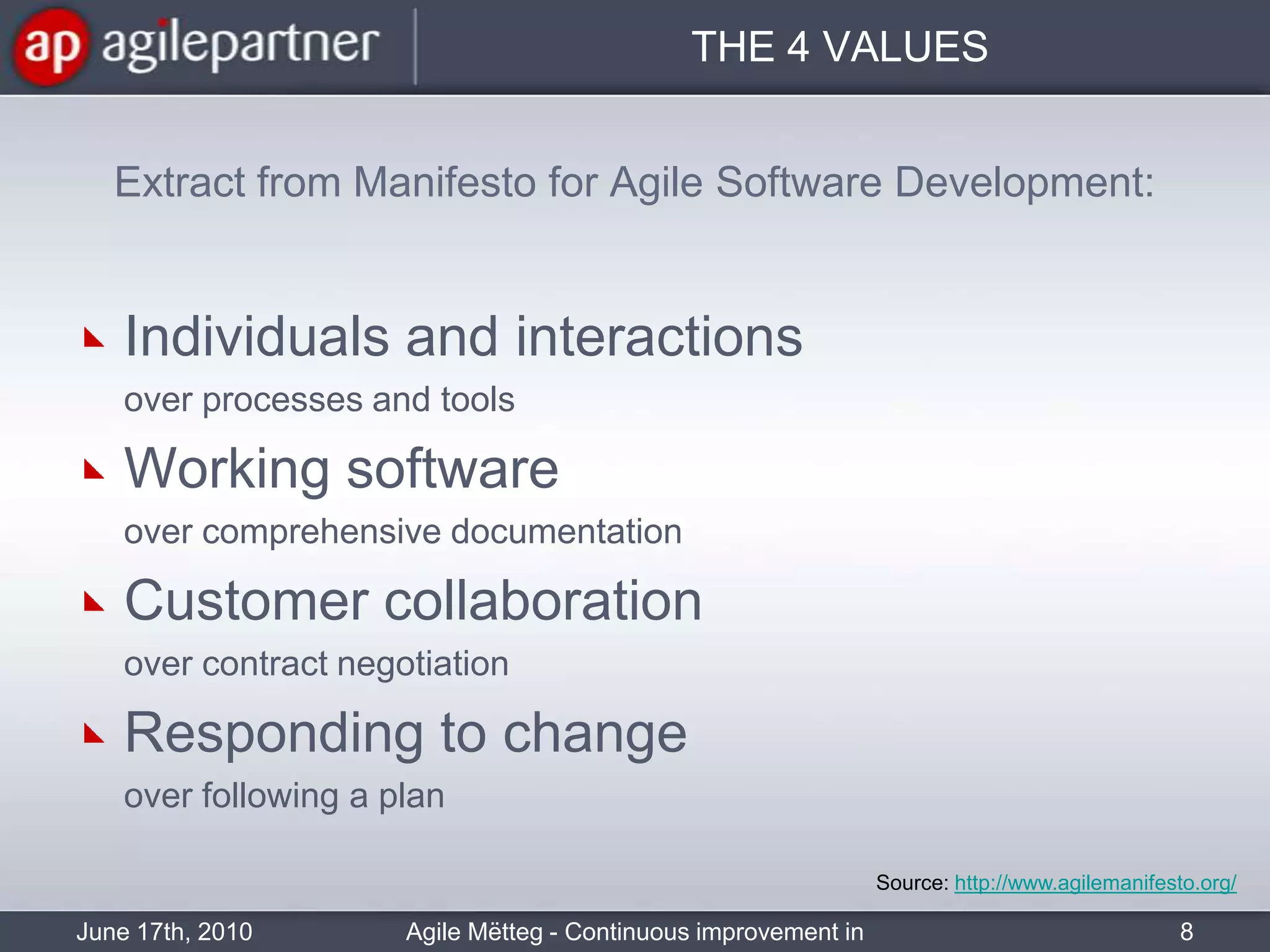
THE 4 VALUESExtract from Manifesto for Agile Software Development:Individuals and interactions 	over processes and toolsWorking software 	over comprehensive documentationCustomer collaboration	over contract negotiationResponding to change 	over following a planJune 17th, 2010Agile Mëtteg - Continuous improvement in practice8Source: http://www.agilemanifesto.org/
LEAN  SW DEV: 7 PRINCIPLES	1. Eliminate WasteFocus: Is the task useful to reach the objectives	2. Build Quality In     	Focus: Quality is a day to day attitude	3. Create Knowledge   	Focus: Learn from experiences to be more efficient after	4. Defer Commitment  	Focus: Take decision as soon as you have relevant information	5. Deliver Fast  	Focus: Reduce lead time to correct defect	6. Respect People   	Focus: Prefer to work as a Team instead of as a Group	7. Optimize The WholeFocus: Evaluate / Measure Value stream to optimize on right levelSource: Poppendieck.LLC June 17th, 20109Agile Mëtteg - Continuous improvement in practice
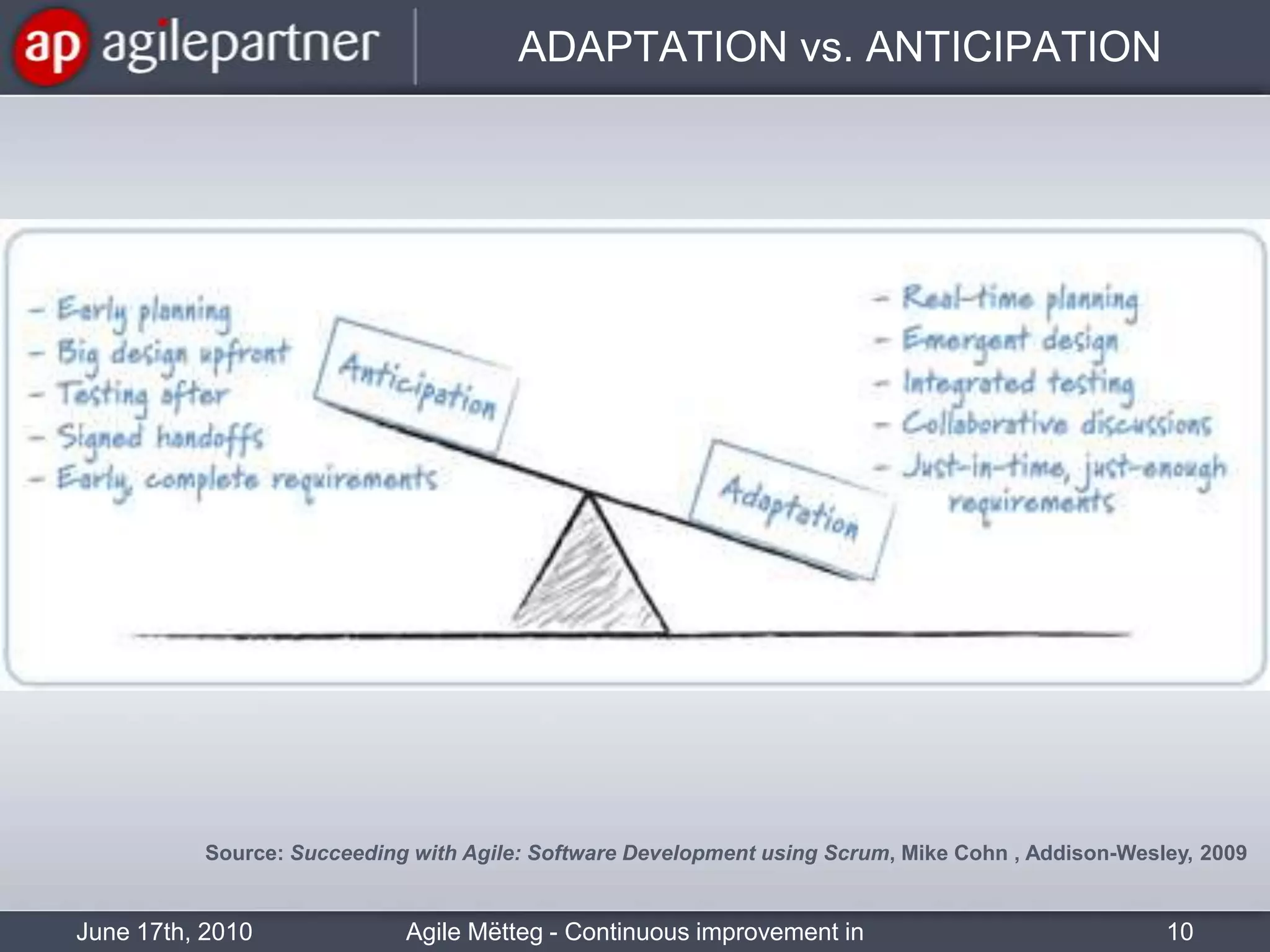
ADAPTATION vs. ANTICIPATIONSource: Succeeding with Agile: Software Development using Scrum, Mike Cohn , Addison-Wesley, 2009June 17th, 201010Agile Mëtteg - Continuous improvement in practice
Overview of Scrum and KANBANJune 17th, 2010Agile Mëtteg - Continuous improvement in practice11
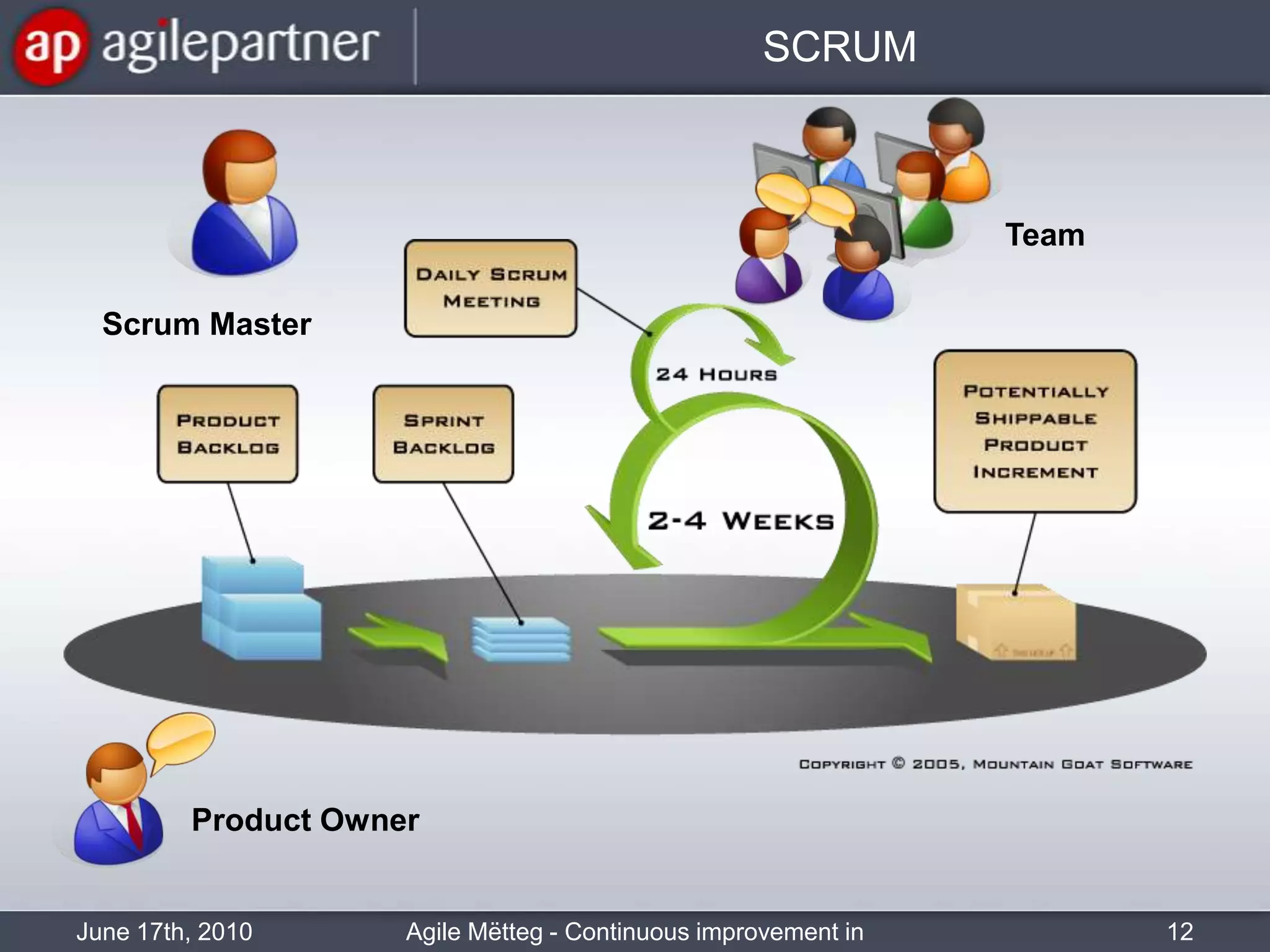
SCRUMTeamScrum MasterProduct OwnerJune 17th, 201012Agile Mëtteg - Continuous improvement in practice
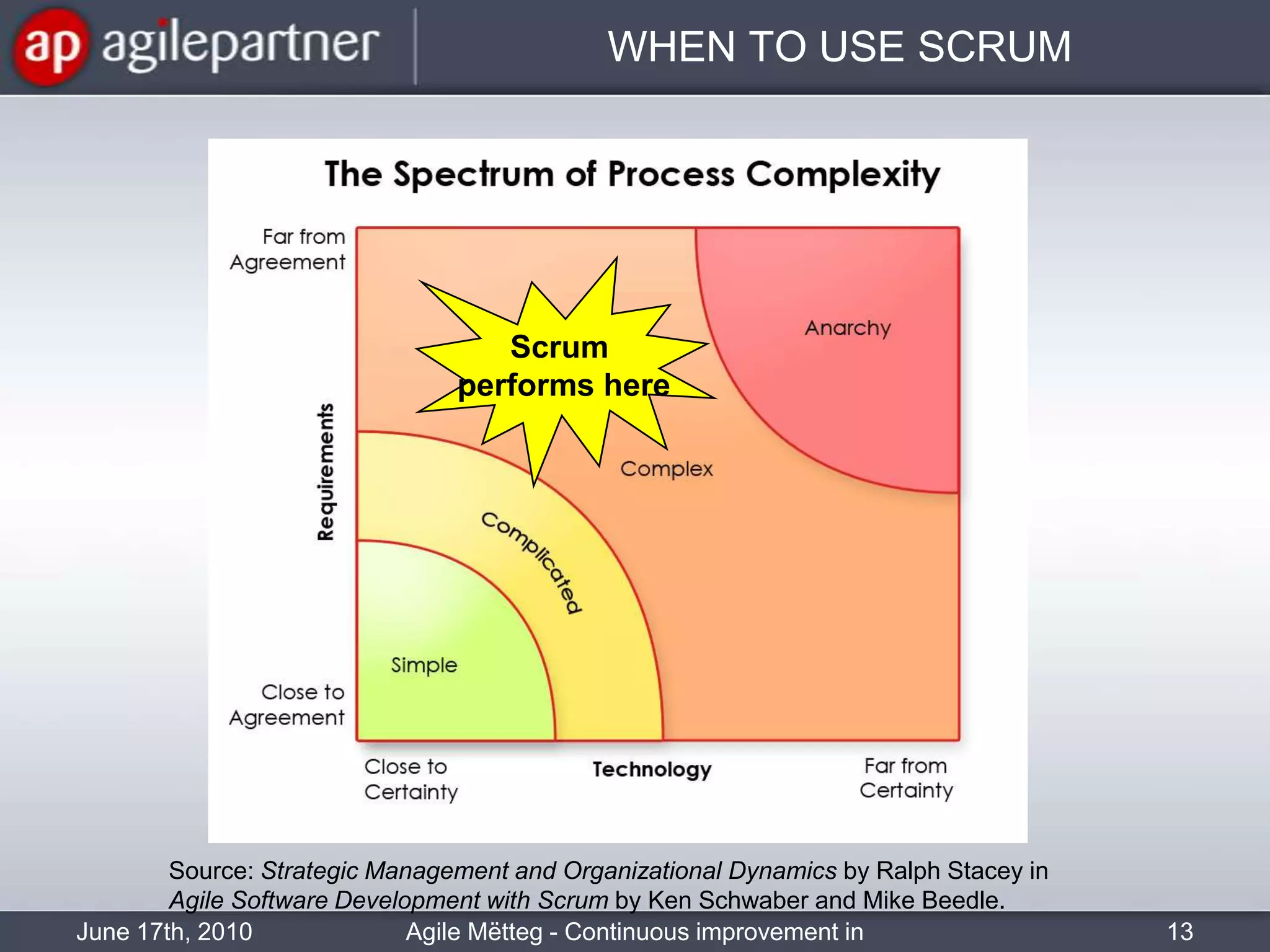
WHEN TO USE SCRUMScrumperformshereSource: Strategic Management and Organizational Dynamics by Ralph Stacey in Agile Software Development with Scrum by Ken Schwaber and Mike Beedle.June 17th, 201013Agile Mëtteg - Continuous improvement in practice
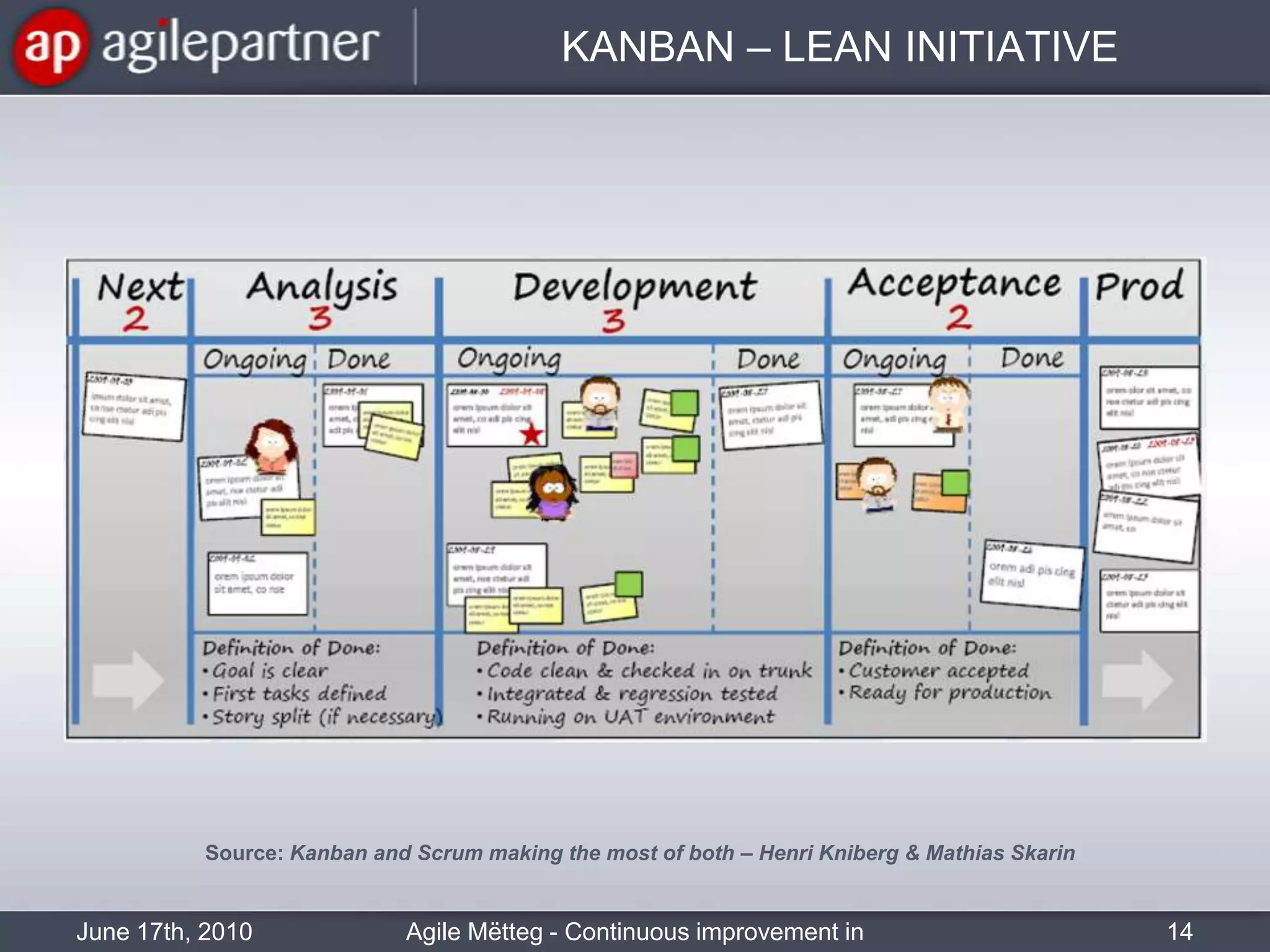
KANBAN – LEAN INITIATIVEJune 17th, 2010Agile Mëtteg - Continuous improvement in practice14Source: Kanban and Scrum making the most of both – Henri Kniberg & Mathias Skarin
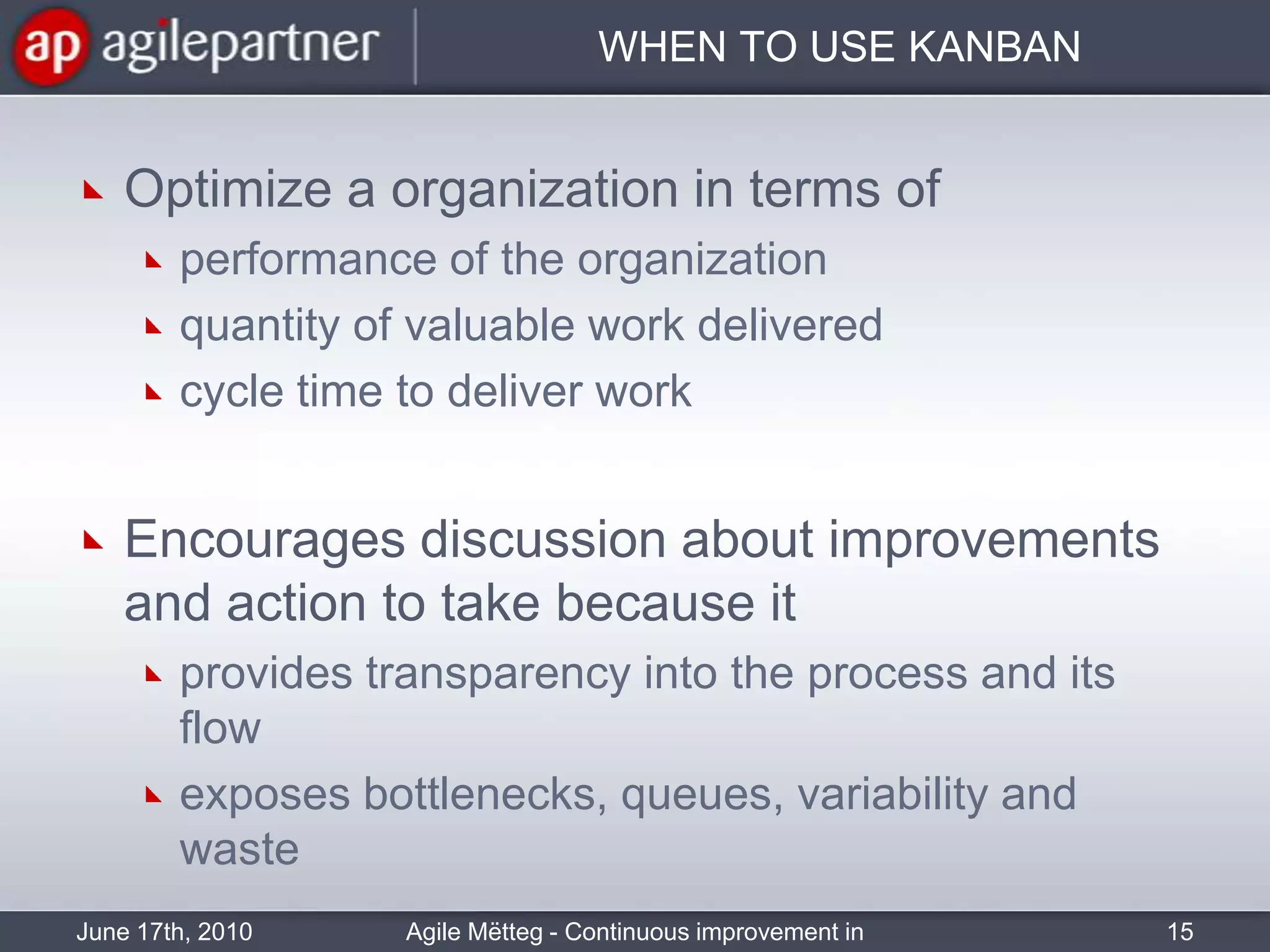
WHEN TO USE KANBANOptimize a organization in terms ofperformance of the organizationquantity of valuable work delivered cycle time to deliver workEncourages discussion about improvements and action to take because itprovides transparency into the process and its flowexposes bottlenecks, queues, variability and wasteJune 17th, 2010Agile Mëtteg - Continuous improvement in practice15
Continuous improvement and agile retrospectivesJune 17th, 2010Agile Mëtteg - Continuous improvement in practice16
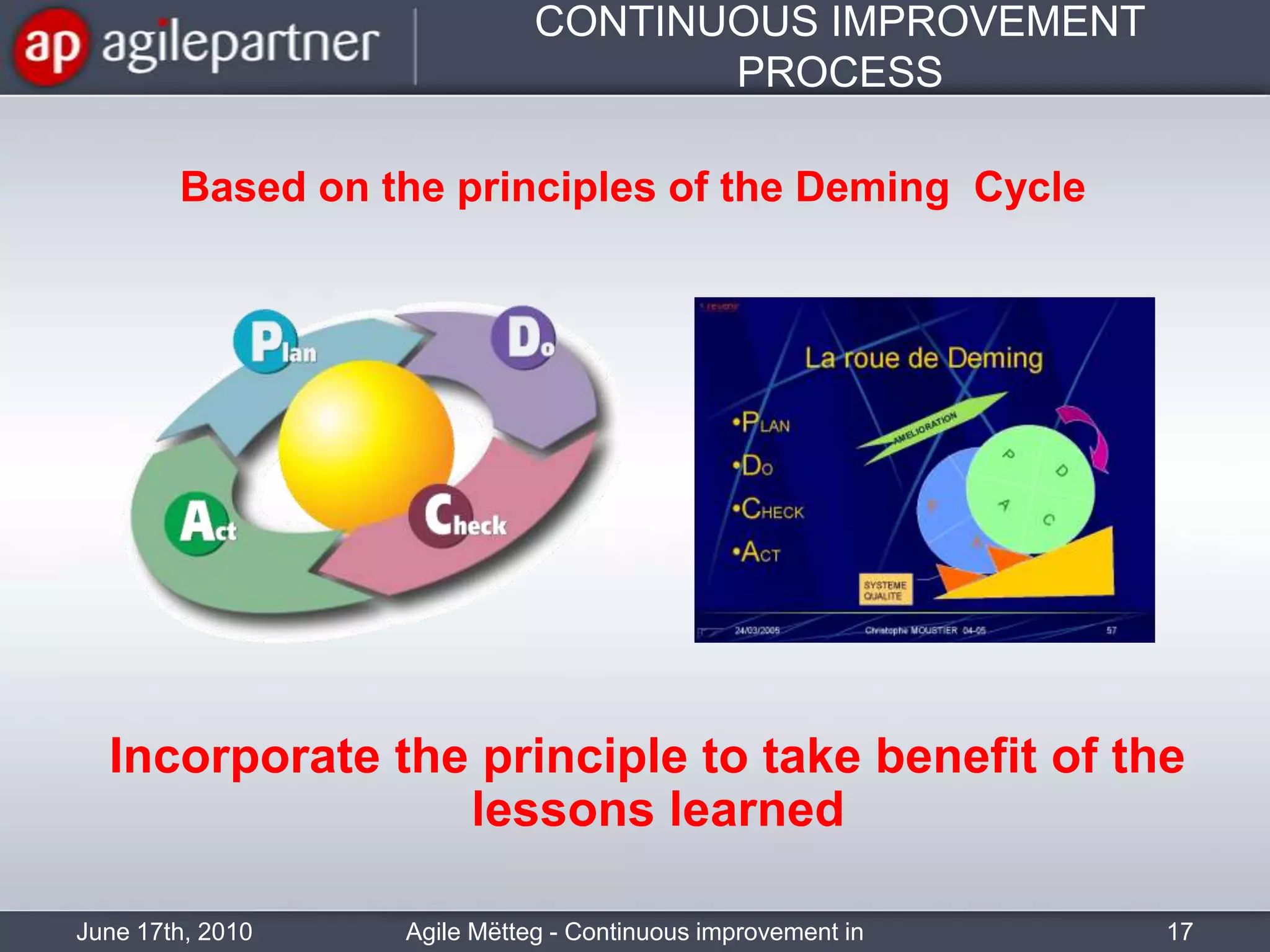
CONTINUOUS IMPROVEMENT PROCESSJune 17th, 2010Agile Mëtteg - Continuous improvement in practice17Based on the principles of the Deming  CycleIncorporate the principle to take benefit of the lessons learned
Continuousimprovementis not onlyrelated to agility.Examples of techniques used in continuousimprovement to analyzeproblemsencounteredduring a project :The « five WHY »« Project post mortem » review« Fishbone » diagramWho has alreadyused one of these techniques ?June 17th, 2010Agile Mëtteg - Continuous improvement in practice18
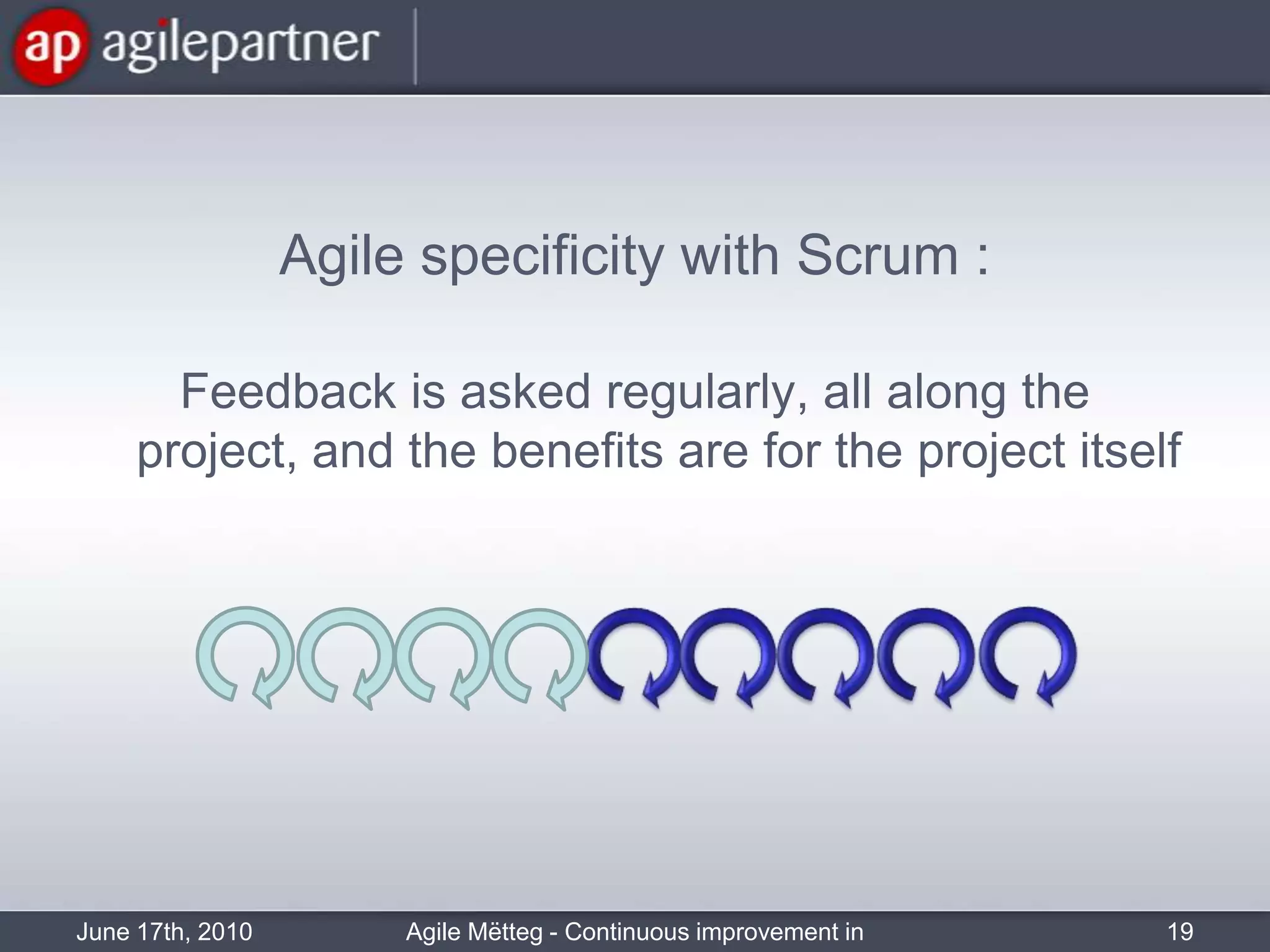
Agile specificitywithScrum : Feedback isaskedregularly, all along the project, and the benefits are for the projectitselfJune 17th, 2010Agile Mëtteg - Continuous improvement in practice19
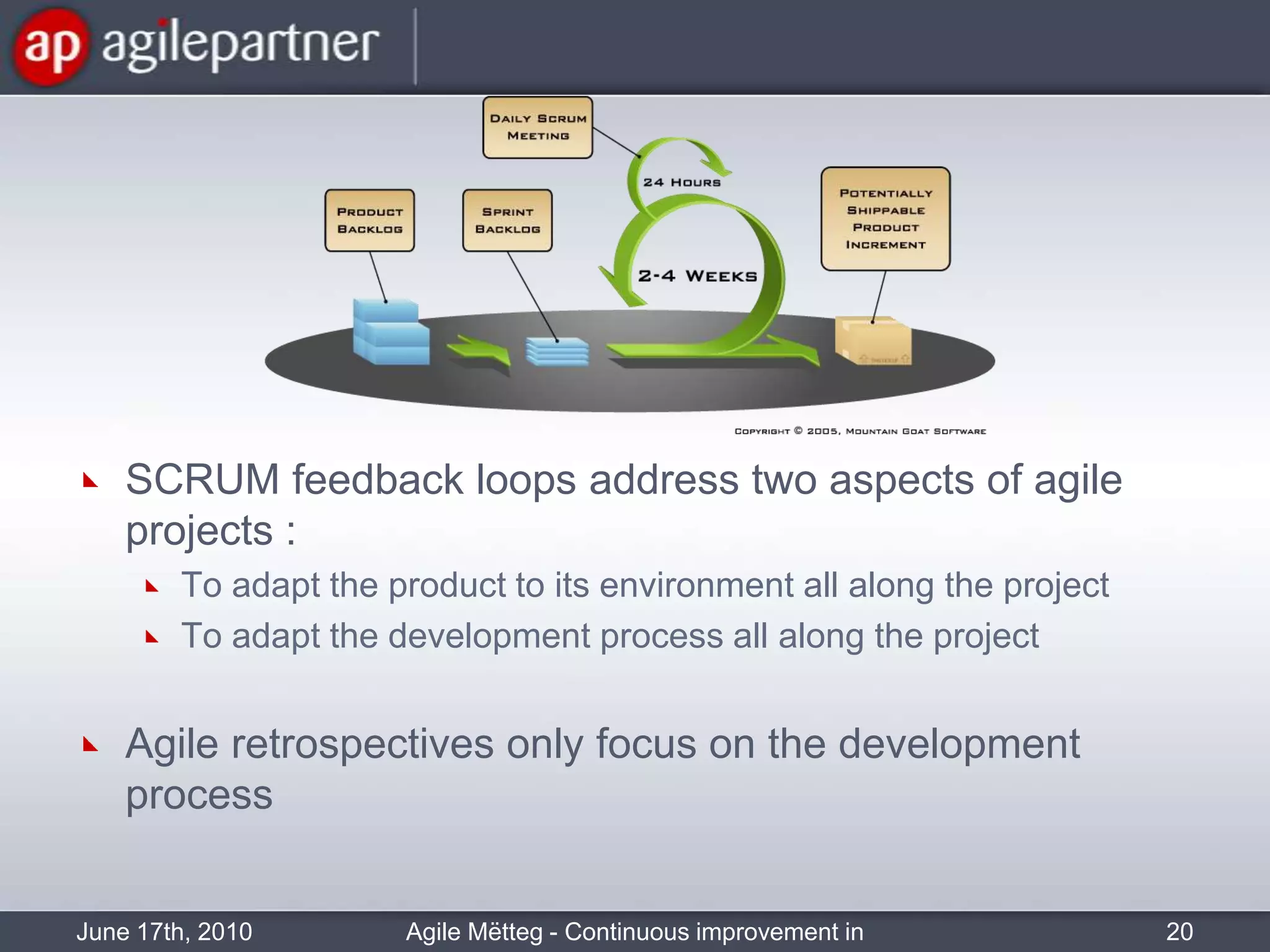
SCRUM feedback loopsaddresstwo aspects of agile projects :To adapt the product to itsenvironment all along the projectTo adapt the developmentprocess all along the projectAgile retrospectivesonly focus on the developmentprocessJune 17th, 2010Agile Mëtteg - Continuous improvement in practice20
Techniques and tips for conducting retrospectivesJune 17th, 2010Agile Mëtteg - Continuous improvement in practice21
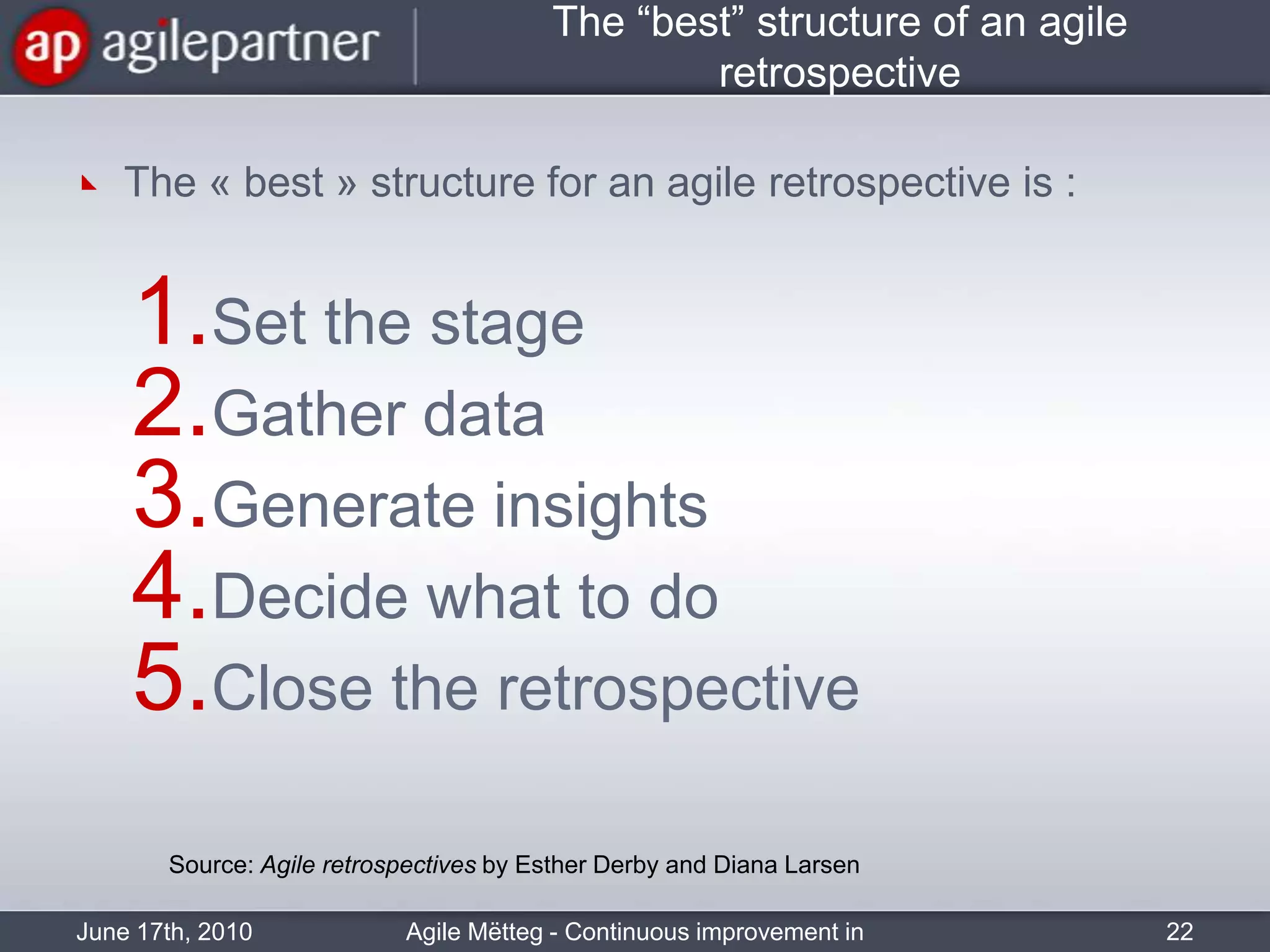
The “best” structure of an agile retrospectiveThe « best » structure for an agile retrospectiveis :Set the stageGather dataGenerate insightsDecidewhat to doClose the retrospectiveJune 17th, 2010Agile Mëtteg - Continuous improvement in practiceSource: Agile retrospectives by Esther Derby and Diana Larsen22
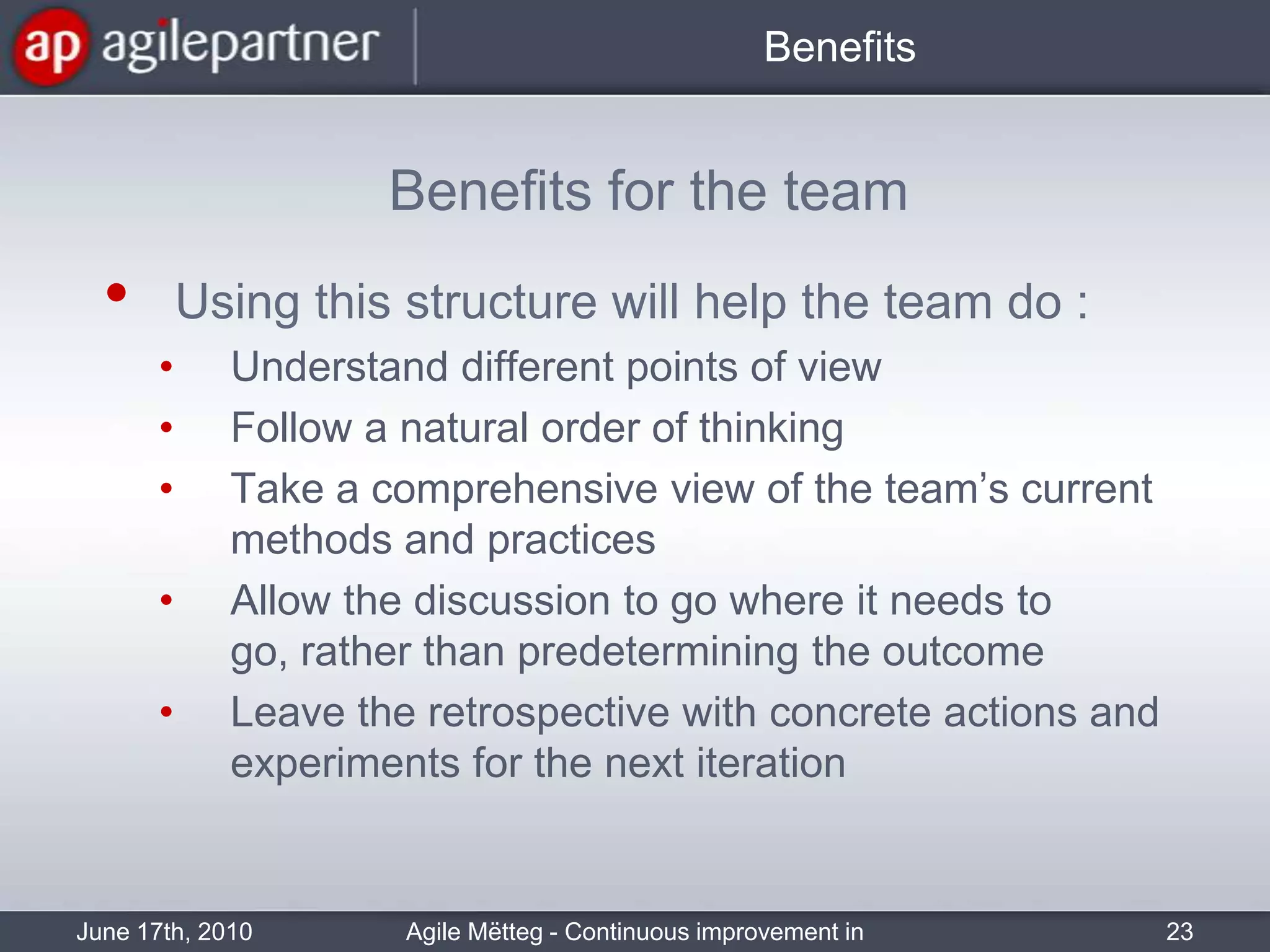
BenefitsBenefits for the teamUsingthis structure will help the team do :
Understanddifferent points of view
Follow a naturalorder of thinking
Take a comprehensiveview of the team’scurrentmethods and practices
Allow the discussion to go whereitneeds to go, ratherthanpredetermining the outcome
Leave the retrospectivewithconcrete actions and experiments for the nextiterationJune 17th, 2010Agile Mëtteg - Continuous improvement in practice23
CASE STUDYLet’s make the retrospective of this seminar !June 17th, 2010Agile Mëtteg - Continuous improvement in practice24
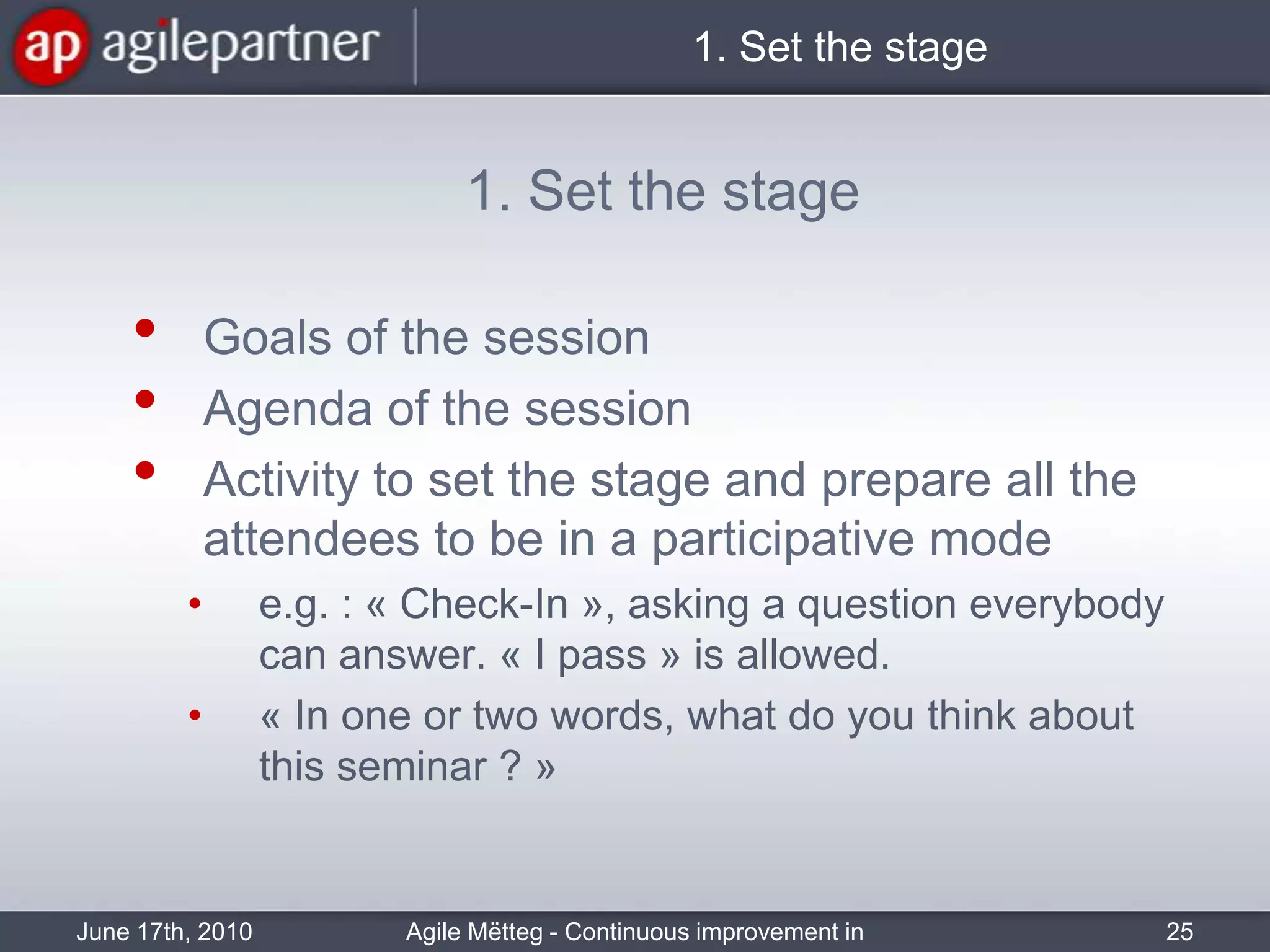
1. Set the stage1. Set the stageGoals of the session
Agenda of the session
Activity to set the stage and prepare all the attendees to be in a participative mode
e.g. : « Check-In », asking a question everybodycananswer. « I pass » isallowed.
« In one or twowords, what do youthink about thisseminar ? »June 17th, 2010Agile Mëtteg - Continuous improvement in practice25
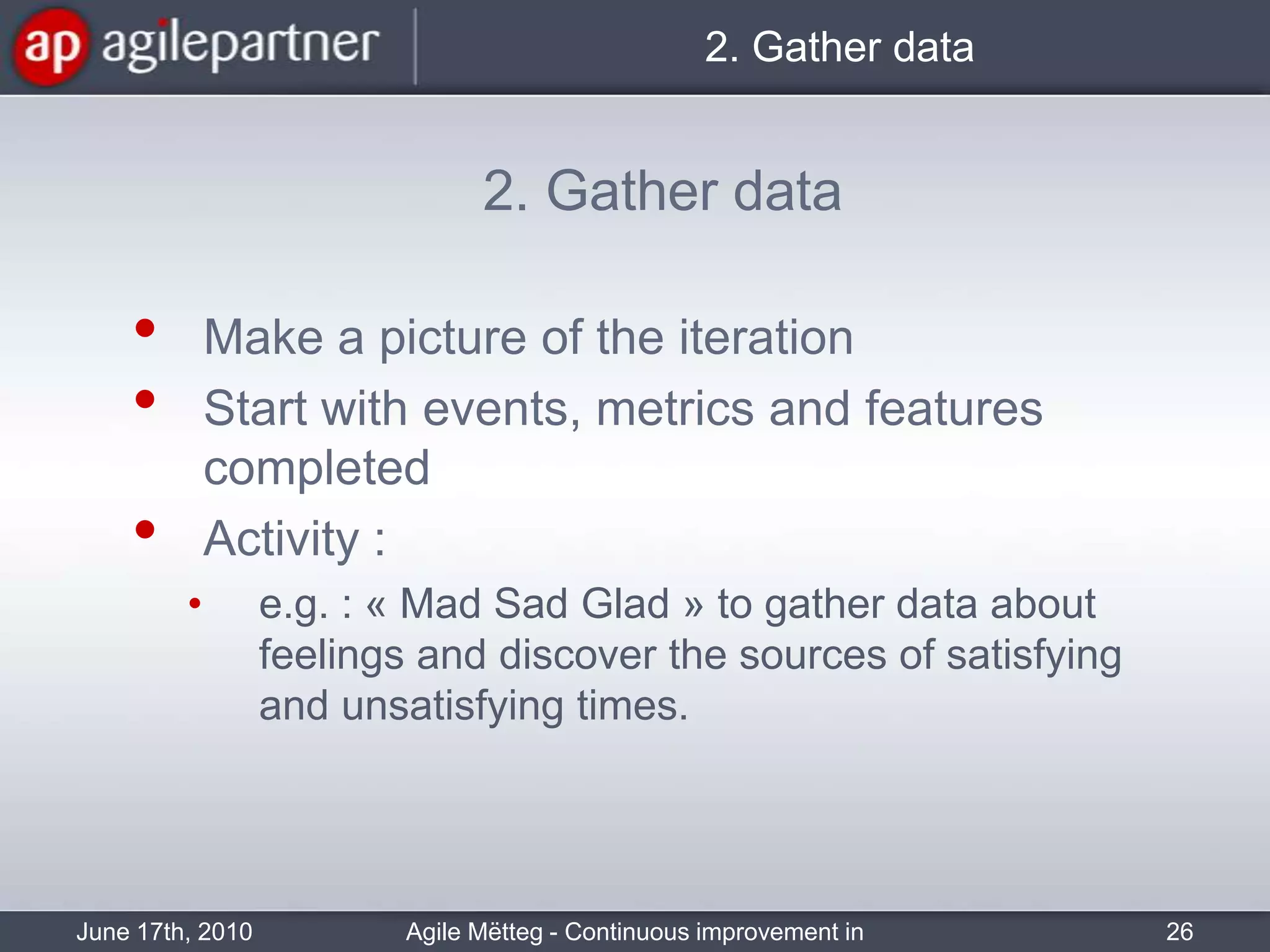
2. Gather data2. Gather dataMake a picture of the iteration
Start withevents, metrics and featurescompleted

Agile Mëtteg series - Session 4

  • 1.
    Continuous improvement inpracticeAgile Mëtteg – June 17th, 2010
  • 2.
    OBJECTIVES & AGENDAObjectivesThissession will give you a quick overview of agile values and principles. It will then focus on a key aspect (continuous improvement) and provide you with practical examples and techniques to help your team learn and become more efficient.AgendaIntroduction of Agile PartnerThe attendeesIntroduction to the values of Agile Software Development Overview of Scrum and Lean principles  Continuous improvement and agile retrospectives Techniques and tips for conducting retrospectives  Q&A June 17th, 2010Agile Mëtteg - Continuous improvement in practice2
  • 3.
    AGILE PARTNER SERVICESISusers ServicesCustom Software Development & MaintenanceOur core business to answer customer needsIS servicesThanks to our expertise we can support IT team to reach their productivity & quality objectives (Assessment, Coaching, Support, Training, Resource delegation…)IS SolutionsTake benefit from commercial or Open Source platform to answer as quick as possible to specific needsIS users servicesWe can support Product & Services owners to work closely with the IT team (Assessment, Coaching, Support, Training, Resource delegation…)14Software Development & SoftwareMaintenance2ISSolutionsIS ServicesAgilityAgility123AgilityJune 17th, 2010Agile Mëtteg - Continuous improvement in practice334
  • 4.
    Let’s get acquaintedJune17th, 2010Agile Mëtteg - Continuous improvement in practice4
  • 5.
    PRESENTATION OF THEATTENDEESWho are you ?What is your role ?What do you know about agility ?What are your expectations ?June 17th, 2010Agile Mëtteg - Continuous improvement in practice5
  • 6.
    AGILITY – IT’sa mindsetJune 17th, 2010Agile Mëtteg - Continuous improvement in practice6
  • 7.
    THE THREE PILARSTRANSPARENCYto share a vision and create visibilityensures that aspects of the process that affect the outcome must be visible, agreed and shared to those managing the outcomes.INSPECTION to react rapidlyThe various aspects of the process must be inspected frequently enough so that unacceptable variances in the process can be detected.ADAPTATION to respond more accurately to the needsAn adjustment must be made as quickly as possible to minimize further deviation if one or more aspects of the process are outside acceptable limits, and that the resulting product will be unacceptable June 17th, 2010Agile Mëtteg - Continuous improvement in practice7Source: SCRUM GUIDE By Ken Schwaber, May, 2009
  • 8.
    THE 4 VALUESExtractfrom Manifesto for Agile Software Development:Individuals and interactions over processes and toolsWorking software over comprehensive documentationCustomer collaboration over contract negotiationResponding to change over following a planJune 17th, 2010Agile Mëtteg - Continuous improvement in practice8Source: http://www.agilemanifesto.org/
  • 9.
    LEAN SWDEV: 7 PRINCIPLES 1. Eliminate WasteFocus: Is the task useful to reach the objectives 2. Build Quality In      Focus: Quality is a day to day attitude 3. Create Knowledge    Focus: Learn from experiences to be more efficient after 4. Defer Commitment   Focus: Take decision as soon as you have relevant information 5. Deliver Fast   Focus: Reduce lead time to correct defect 6. Respect People   Focus: Prefer to work as a Team instead of as a Group 7. Optimize The WholeFocus: Evaluate / Measure Value stream to optimize on right levelSource: Poppendieck.LLC June 17th, 20109Agile Mëtteg - Continuous improvement in practice
  • 10.
    ADAPTATION vs. ANTICIPATIONSource:Succeeding with Agile: Software Development using Scrum, Mike Cohn , Addison-Wesley, 2009June 17th, 201010Agile Mëtteg - Continuous improvement in practice
  • 11.
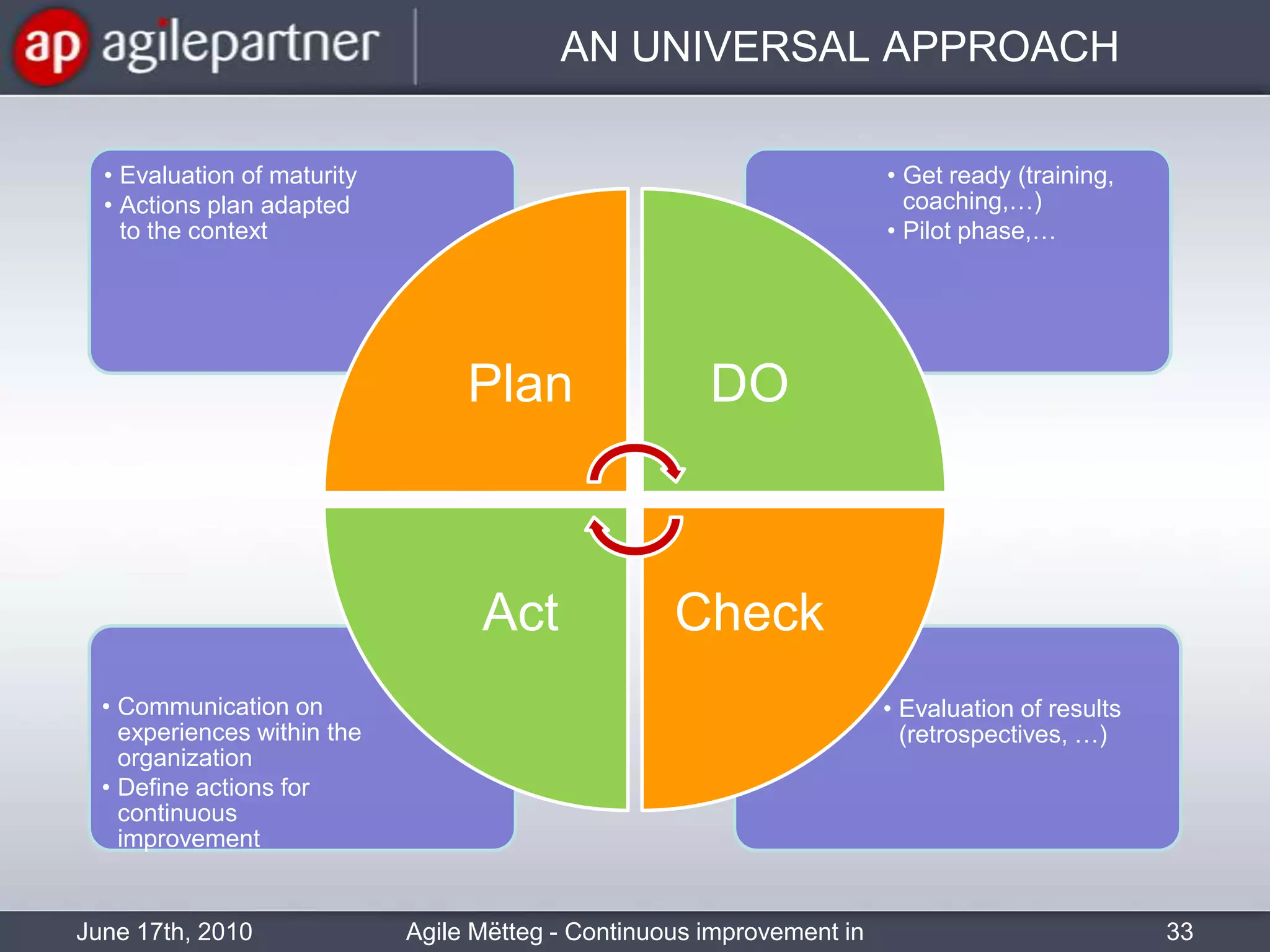
    Overview of Scrum andKANBANJune 17th, 2010Agile Mëtteg - Continuous improvement in practice11
  • 12.
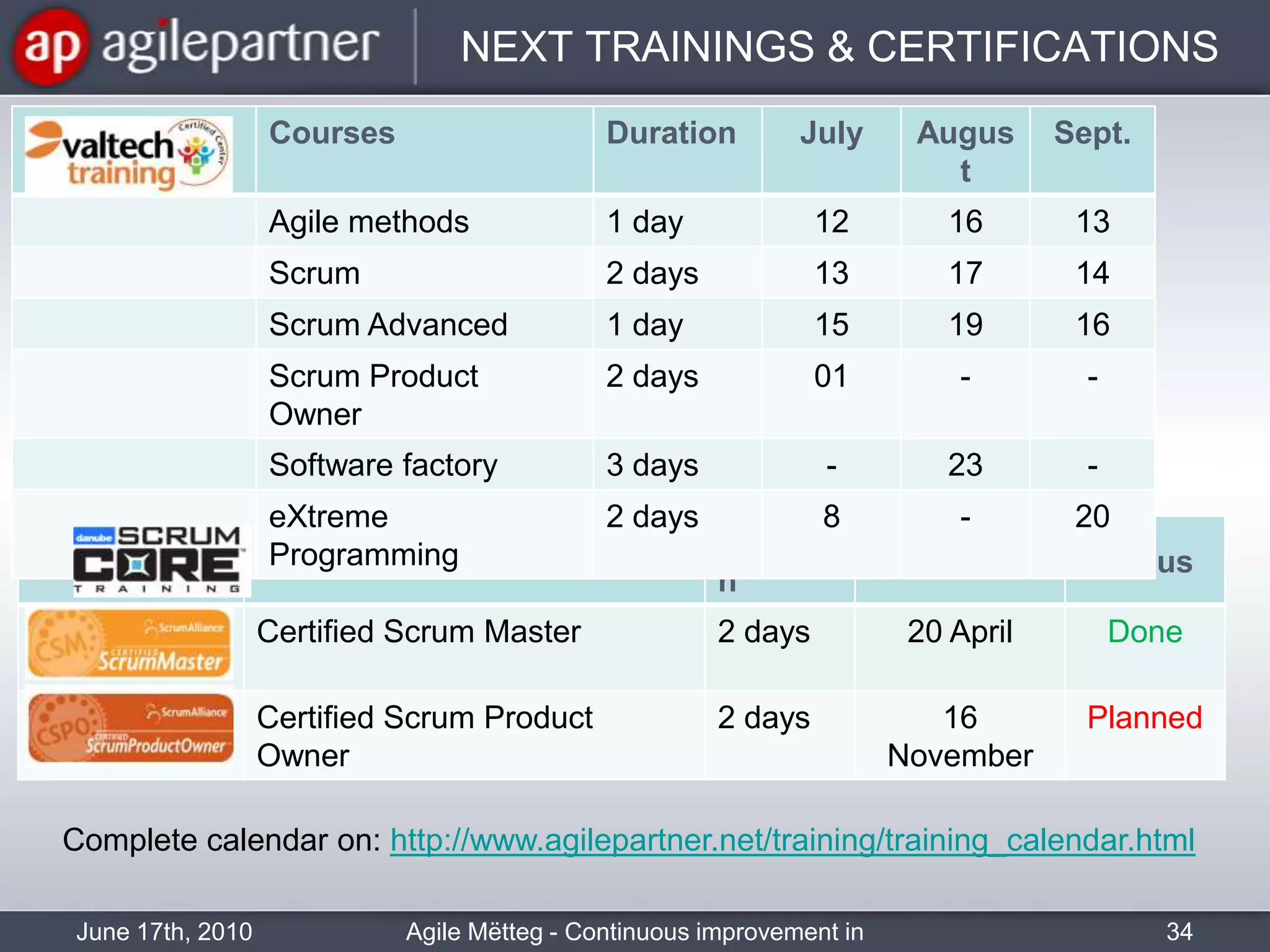
    SCRUMTeamScrum MasterProduct OwnerJune17th, 201012Agile Mëtteg - Continuous improvement in practice
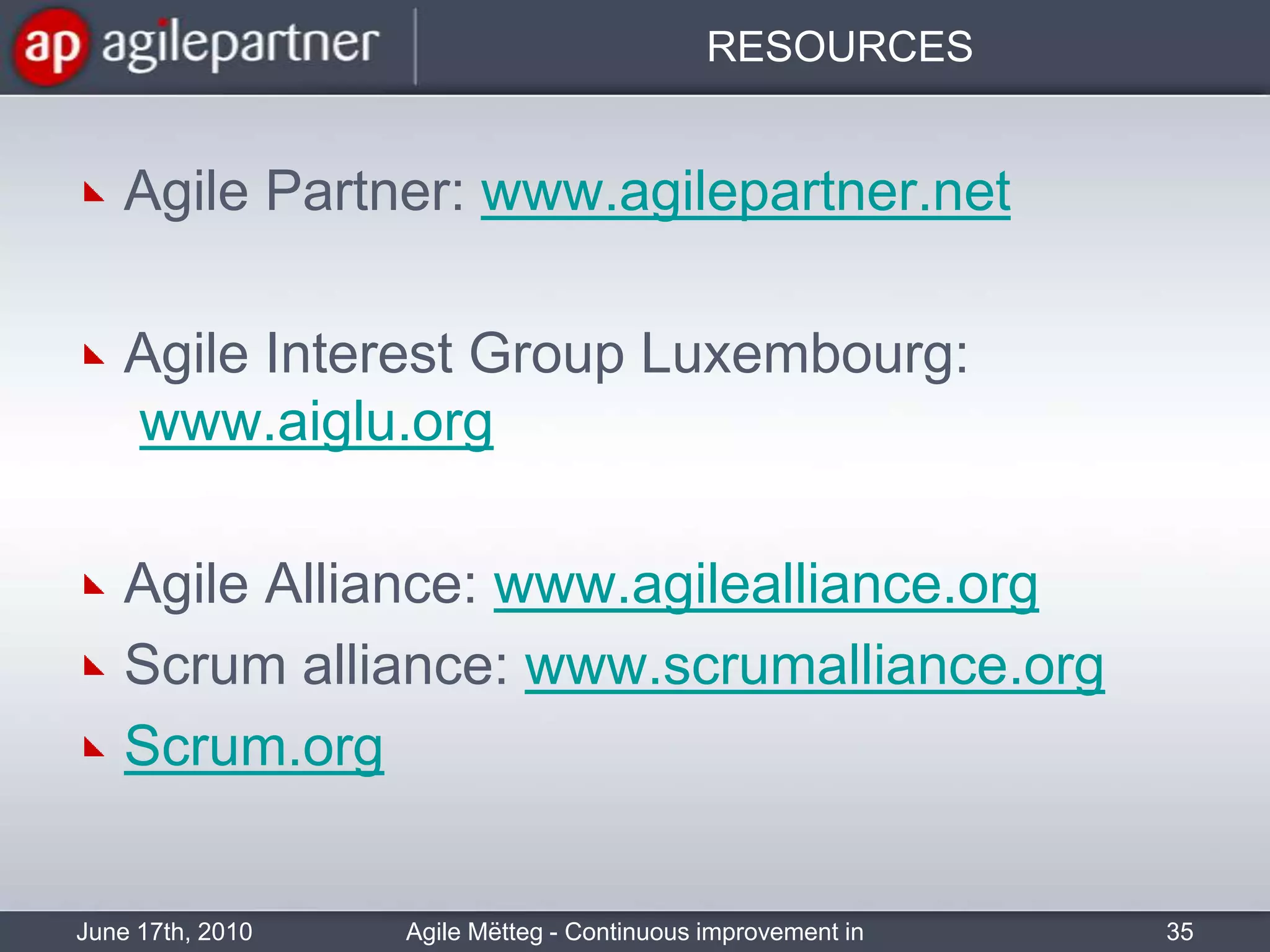
  • 13.
    WHEN TO USESCRUMScrumperformshereSource: Strategic Management and Organizational Dynamics by Ralph Stacey in Agile Software Development with Scrum by Ken Schwaber and Mike Beedle.June 17th, 201013Agile Mëtteg - Continuous improvement in practice
  • 14.
    KANBAN – LEANINITIATIVEJune 17th, 2010Agile Mëtteg - Continuous improvement in practice14Source: Kanban and Scrum making the most of both – Henri Kniberg & Mathias Skarin
  • 15.
    WHEN TO USEKANBANOptimize a organization in terms ofperformance of the organizationquantity of valuable work delivered cycle time to deliver workEncourages discussion about improvements and action to take because itprovides transparency into the process and its flowexposes bottlenecks, queues, variability and wasteJune 17th, 2010Agile Mëtteg - Continuous improvement in practice15
  • 16.
    Continuous improvement andagile retrospectivesJune 17th, 2010Agile Mëtteg - Continuous improvement in practice16
  • 17.
    CONTINUOUS IMPROVEMENT PROCESSJune17th, 2010Agile Mëtteg - Continuous improvement in practice17Based on the principles of the Deming CycleIncorporate the principle to take benefit of the lessons learned
  • 18.
    Continuousimprovementis not onlyrelatedto agility.Examples of techniques used in continuousimprovement to analyzeproblemsencounteredduring a project :The « five WHY »« Project post mortem » review« Fishbone » diagramWho has alreadyused one of these techniques ?June 17th, 2010Agile Mëtteg - Continuous improvement in practice18
  • 19.
    Agile specificitywithScrum :Feedback isaskedregularly, all along the project, and the benefits are for the projectitselfJune 17th, 2010Agile Mëtteg - Continuous improvement in practice19
  • 20.
    SCRUM feedback loopsaddresstwoaspects of agile projects :To adapt the product to itsenvironment all along the projectTo adapt the developmentprocess all along the projectAgile retrospectivesonly focus on the developmentprocessJune 17th, 2010Agile Mëtteg - Continuous improvement in practice20
  • 21.
    Techniques and tipsfor conducting retrospectivesJune 17th, 2010Agile Mëtteg - Continuous improvement in practice21
  • 22.
    The “best” structureof an agile retrospectiveThe « best » structure for an agile retrospectiveis :Set the stageGather dataGenerate insightsDecidewhat to doClose the retrospectiveJune 17th, 2010Agile Mëtteg - Continuous improvement in practiceSource: Agile retrospectives by Esther Derby and Diana Larsen22
  • 23.
    BenefitsBenefits for theteamUsingthis structure will help the team do :
  • 24.
  • 25.
  • 26.
    Take a comprehensiveviewof the team’scurrentmethods and practices
  • 27.
    Allow the discussionto go whereitneeds to go, ratherthanpredetermining the outcome
  • 28.
    Leave the retrospectivewithconcreteactions and experiments for the nextiterationJune 17th, 2010Agile Mëtteg - Continuous improvement in practice23
  • 29.
    CASE STUDYLet’s makethe retrospective of this seminar !June 17th, 2010Agile Mëtteg - Continuous improvement in practice24
  • 30.
    1. Set thestage1. Set the stageGoals of the session
  • 31.
  • 32.
    Activity to setthe stage and prepare all the attendees to be in a participative mode
  • 33.
    e.g. : « Check-In »,asking a question everybodycananswer. « I pass » isallowed.
  • 34.
    « In one ortwowords, what do youthink about thisseminar ? »June 17th, 2010Agile Mëtteg - Continuous improvement in practice25
  • 35.
    2. Gather data2.Gather dataMake a picture of the iteration
  • 36.
    Start withevents, metricsand featurescompleted
  • 37.
  • 38.
    e.g. : « MadSadGlad »to gather data about feelings and discover the sources of satisfying and unsatisfying times.June 17th, 2010Agile Mëtteg - Continuous improvement in practice26
  • 39.
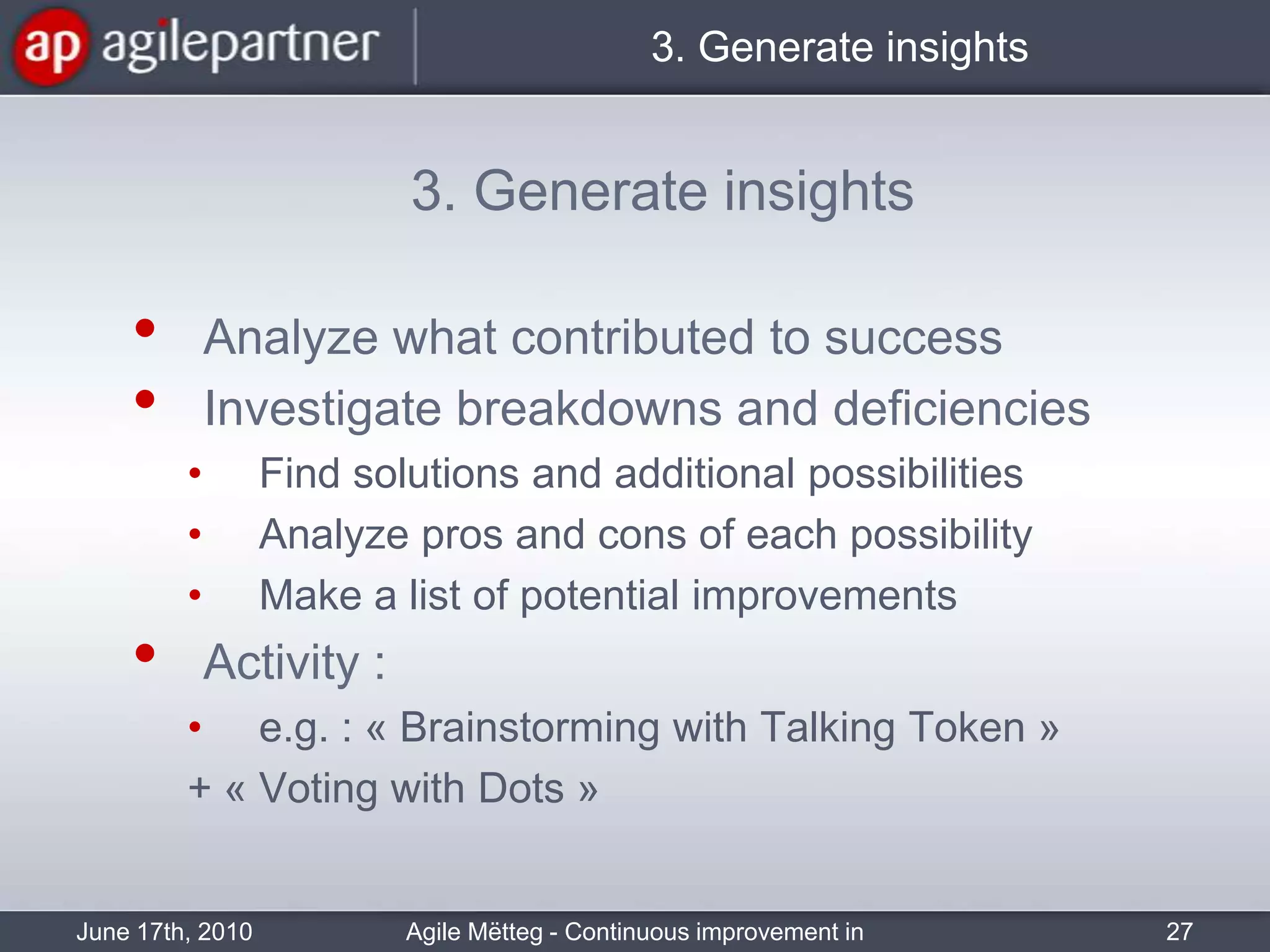
    3. Generate insights3.Generate insightsAnalyzewhatcontributed to success
  • 40.
  • 41.
    Find solutions andadditionalpossibilities
  • 42.
    Analyze pros andcons of eachpossibility
  • 43.
    Make a listof potentialimprovements
  • 44.
  • 45.
    e.g. : « BrainstormingwithTalkingToken »+ « Votingwith Dots »June 17th, 2010Agile Mëtteg - Continuous improvement in practice27
  • 46.
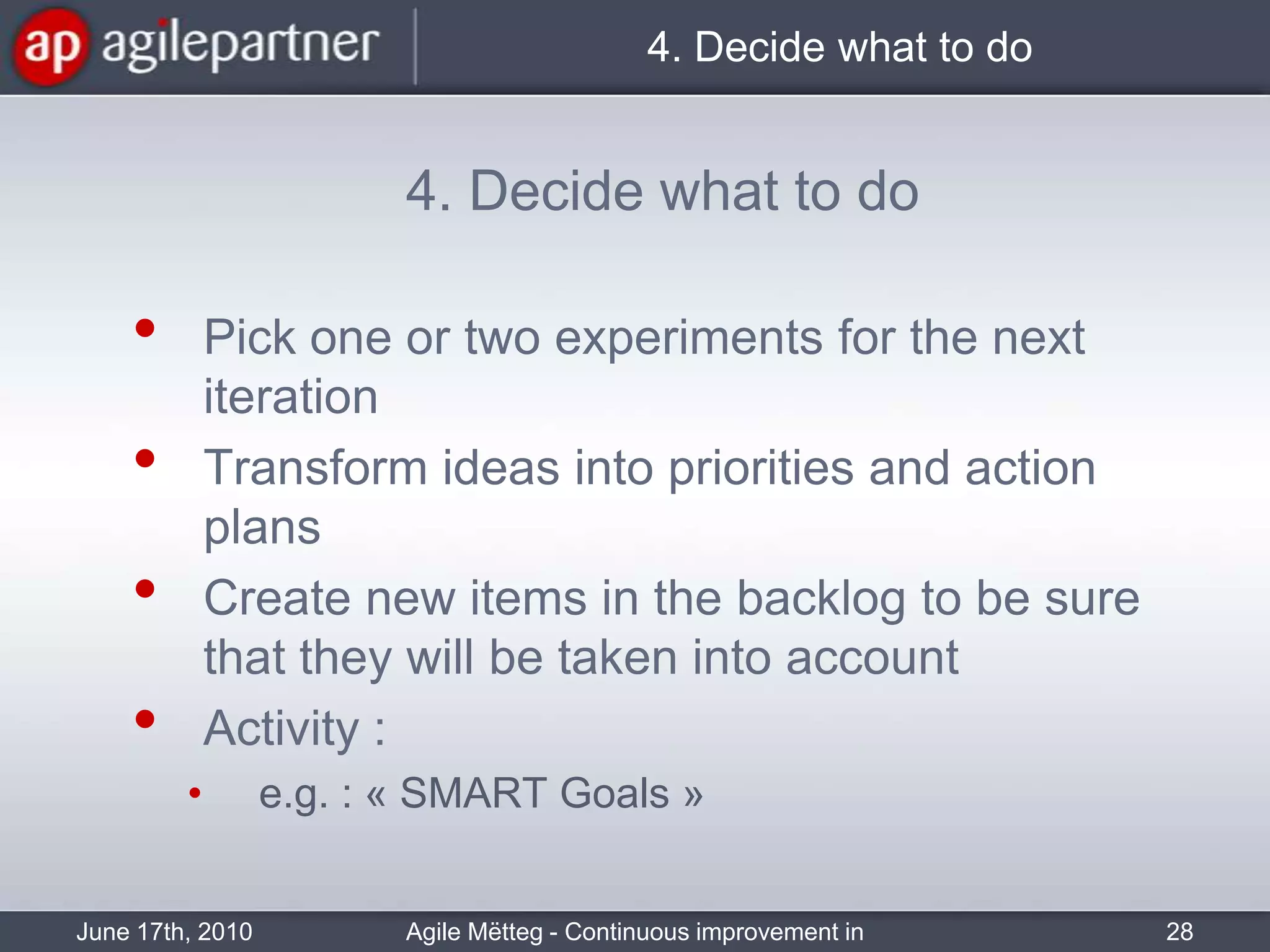
    4. Decide whatto do4. Decide what to doPick one or twoexperiments for the nextiteration
  • 47.
  • 48.
    Create new itemsin the backlog to be sure thattheywillbetakenintoaccount
  • 49.
  • 50.
    e.g. : « SMARTGoals »June 17th, 2010Agile Mëtteg - Continuous improvement in practice28
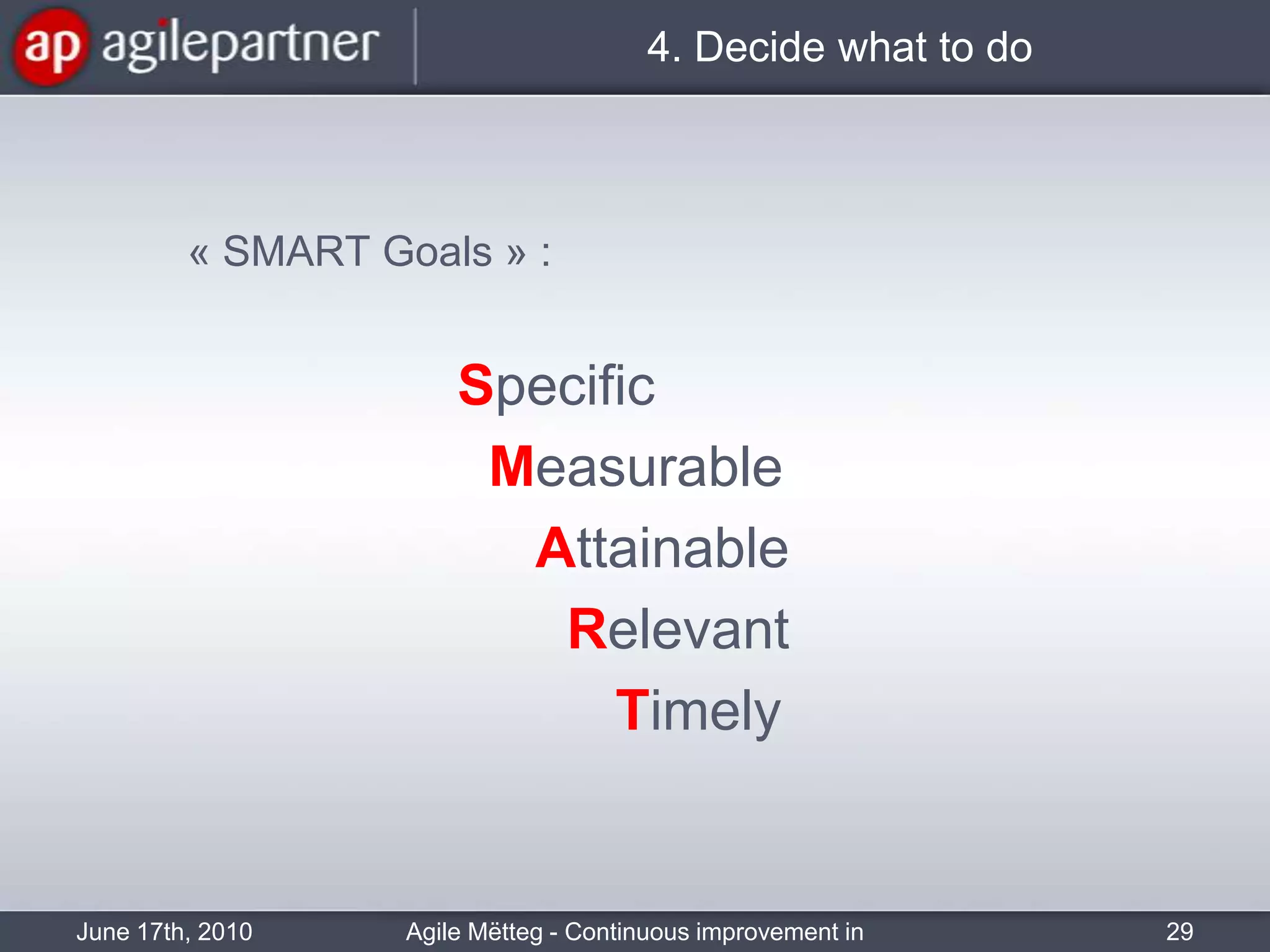
  • 51.
    4. Decide whatto do« SMART Goals » :SpecificMeasurableAttainable RelevantTimelyJune 17th, 2010Agile Mëtteg - Continuous improvement in practice29
  • 52.
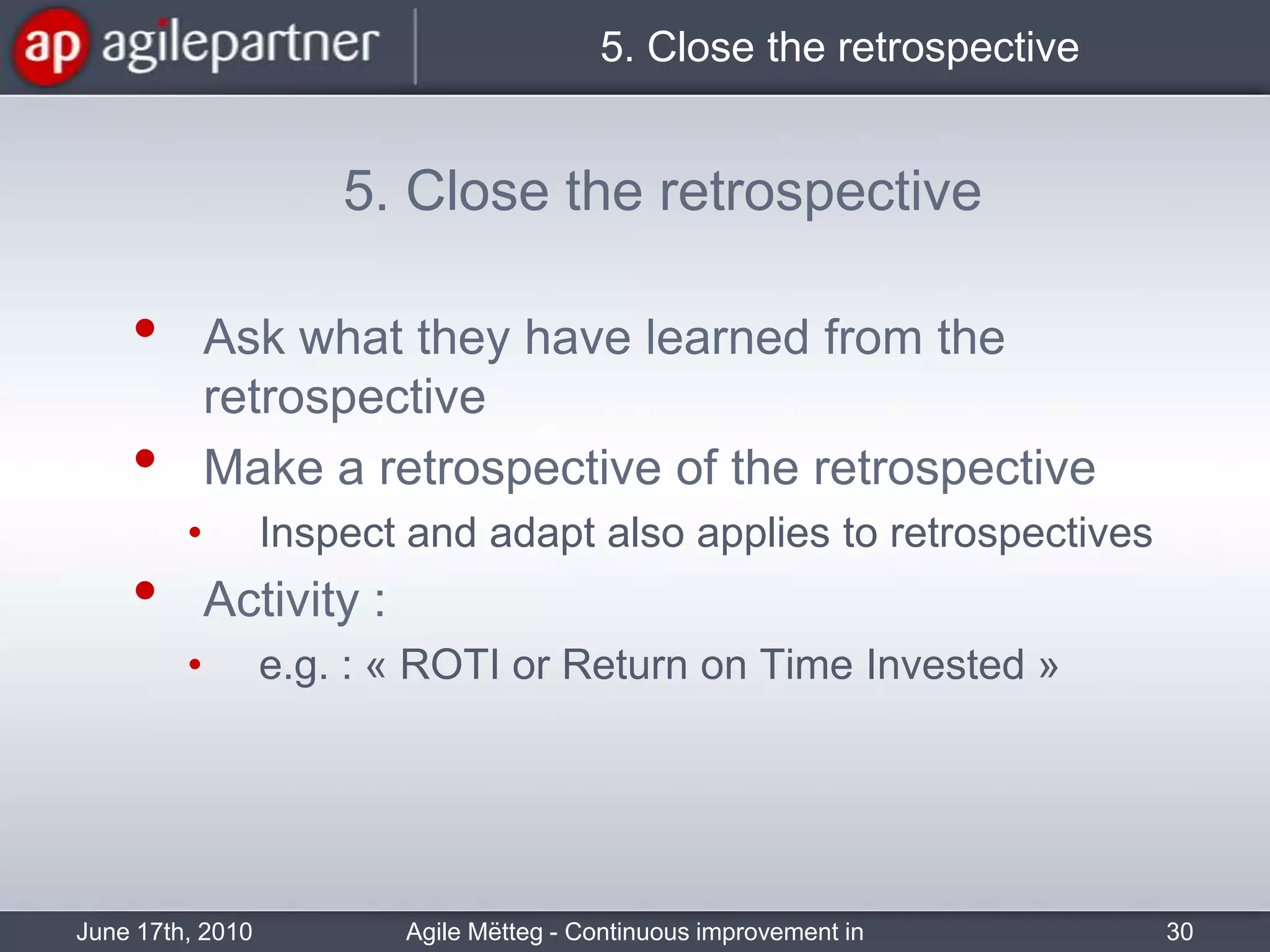
    5. Close theretrospective5. Close the retrospectiveAskwhatthey have learnedfrom the retrospective
  • 53.
    Make a retrospectiveof the retrospective
  • 54.
  • 55.
  • 56.
    e.g. : « ROTIor Return on Time Invested »June 17th, 2010Agile Mëtteg - Continuous improvement in practice30
  • 57.
    CONCLUSIONJune 17th, 2010AgileMëtteg - Continuous improvement in practice31
  • 58.
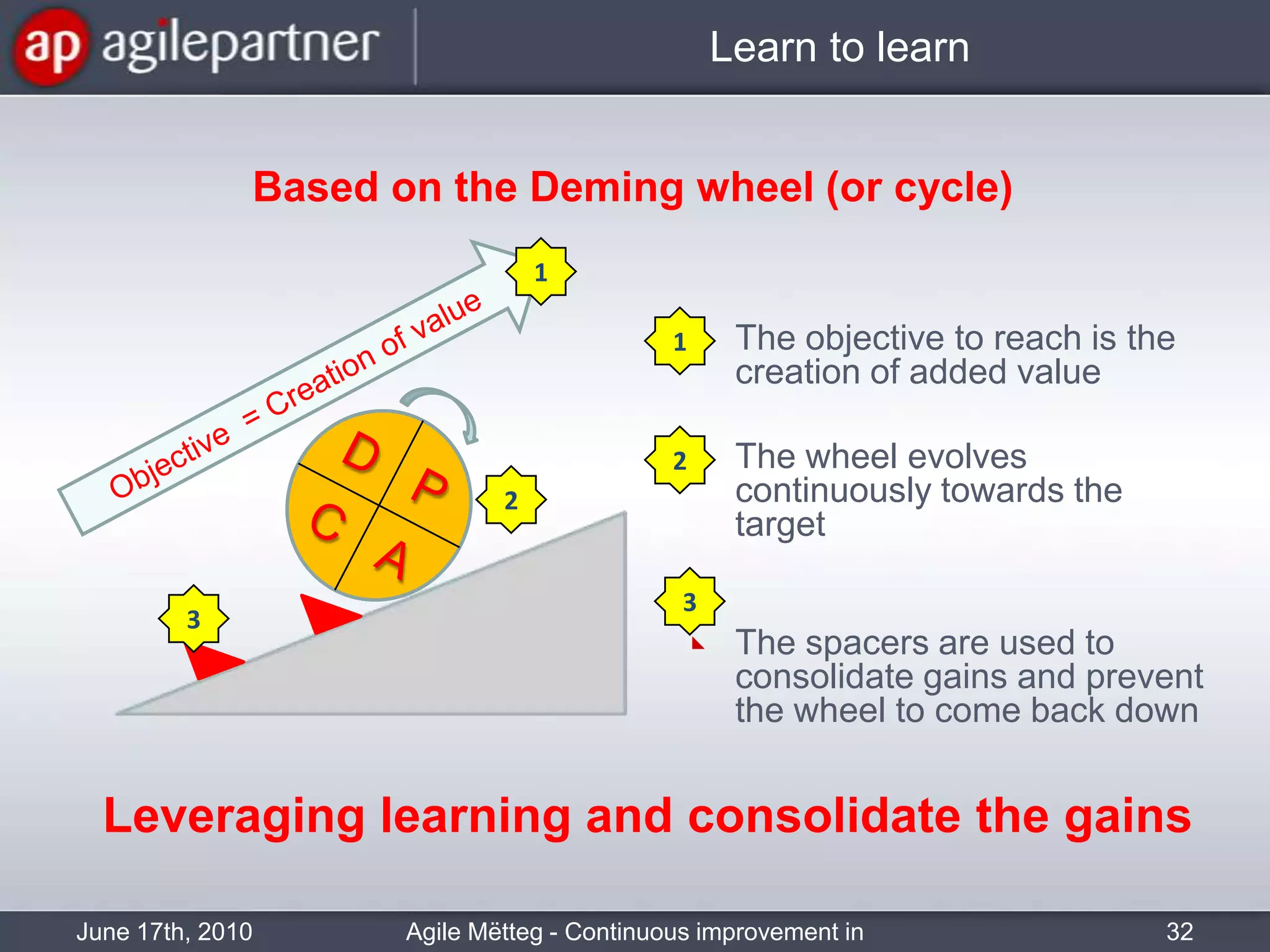
    Learn to learnJune17th, 2010Agile Mëtteg - Continuous improvement in practice32Based on the Deming wheel (or cycle)11DThe objective to reachis the creation of added valueThe wheel evolves continuously towards the targetThe spacers are used to consolidate gains and prevent the wheel to come back down PObjective = Creation of valueCA2233Leveraging learning and consolidate the gains
  • 59.
    AN UNIVERSAL APPROACHJune17th, 2010Agile Mëtteg - Continuous improvement in practice33
  • 60.
    NEXT TRAININGS &CERTIFICATIONSJune 17th, 2010Agile Mëtteg - Continuous improvement in practice34Complete calendar on: http://www.agilepartner.net/training/training_calendar.html
  • 61.
    RESOURCESAgile Partner: www.agilepartner.netAgileInterest Group Luxembourg:www.aiglu.orgAgile Alliance: www.agilealliance.orgScrum alliance: www.scrumalliance.orgScrum.orgJune 17th, 2010Agile Mëtteg - Continuous improvement in practice35
  • 62.
    CONTACTSThank YouJune 17th,2010Agile Mëtteg - Continuous improvement in practice36

Editor's Notes

  • #15 Visualize the workflow1) Split the work into pieces, write each item on a card and put on the wall2) Use named columns to illustrate where each item is in the workflow.3) Limit Work In Progress (WIP) - assign explicit limits to how many items may be in progress at each workflow state4) Measure the lead time (average time to complete one item, sometimes called “cycle time”), optimize the process to makelead time as small and predictable as possible
  • #21 Adapt the product : the reviewAdapt the process : the retrospective
  • #25 Tatoe (Japanese): example; simile; metaphor; allegory; parable
  • #26 Goal of the session : help us improveour sessionAgenda : temps restant -10 à 15 min
  • #29 SMART goals : SpecificMeasurableAttainableRelevantTimely
  • #30 SMART goals : SpecificMeasurableAttainableRelevantTimely
  • #31 Sur une échelle de 0 à 4