The approach to
the critically ill
patient
Objectives
The rational of ABCDE
The process of primary & secondary survey
Recognition of life threatening events
Treatment of life-threatening conditions
Handover
2
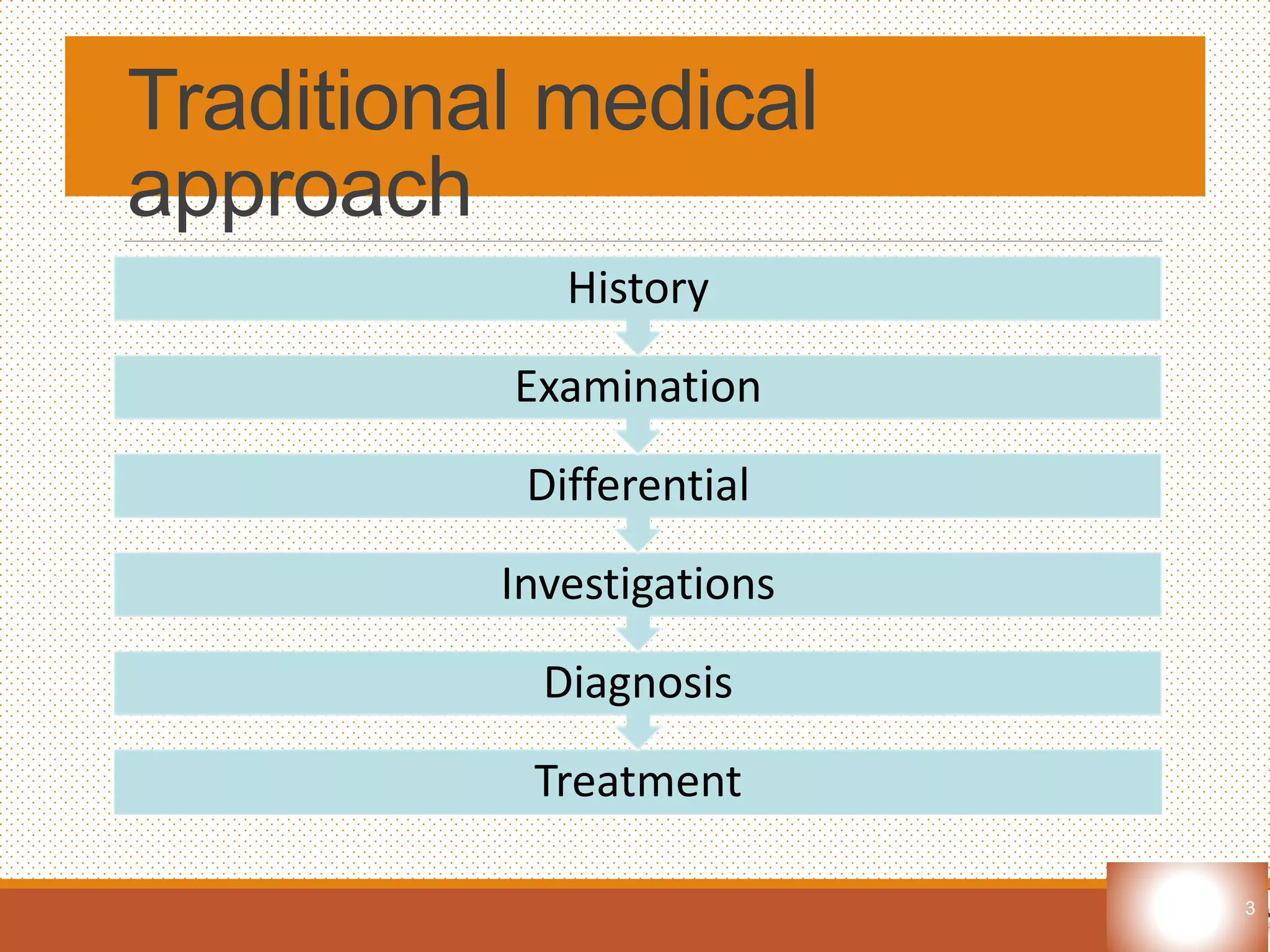
Traditional medical
approach
Treatment
Diagnosis
Investigations
Differential
Examination
History
3
3
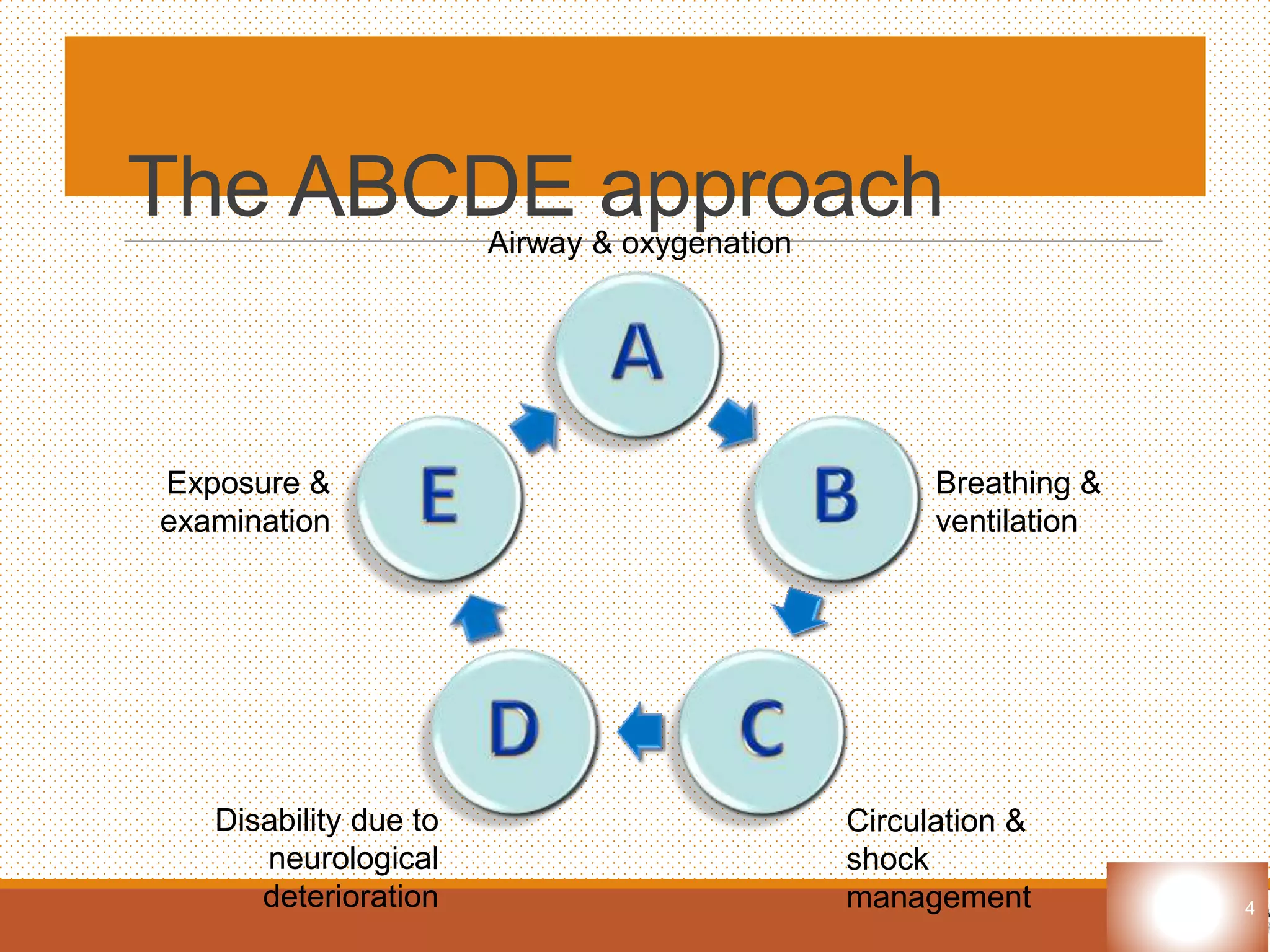
The ABCDE approach
A
B
C
D
E
Airway & oxygenation
Breathing &
ventilation
Circulation &
shock
management
Disability due to
neurological
deterioration
Exposure &
examination
4
4
The principles
Perform primary ABCDE survey (5 min)
Instigate treatment for life threatening conditions as you find them
Reassess when any treatment is completed
Perform more detailed secondary ABCDE survey including investigations
If condition deteriorates repeat primary survey
5
5
The primary survey
ABCDE assessment looking for immediately life threatening conditions
Rapid intervention usually includes max O2, IV access, fluid challenge +/-
specific treatment
Should take no longer than 5 min
Can be repeated as many times as necessary
Get experienced help as soon as you need it
If you have a team delegate jobs
6
6
The secondary survey
Performed when patient more stable
Get a brief relevant HPC & Hx
More detailed examination of patient (ABCDE)
Order investigations to aid diagnosis
IF PATIENT DETERIORATES RETURN TO PRIMARY SURVEY
7
7
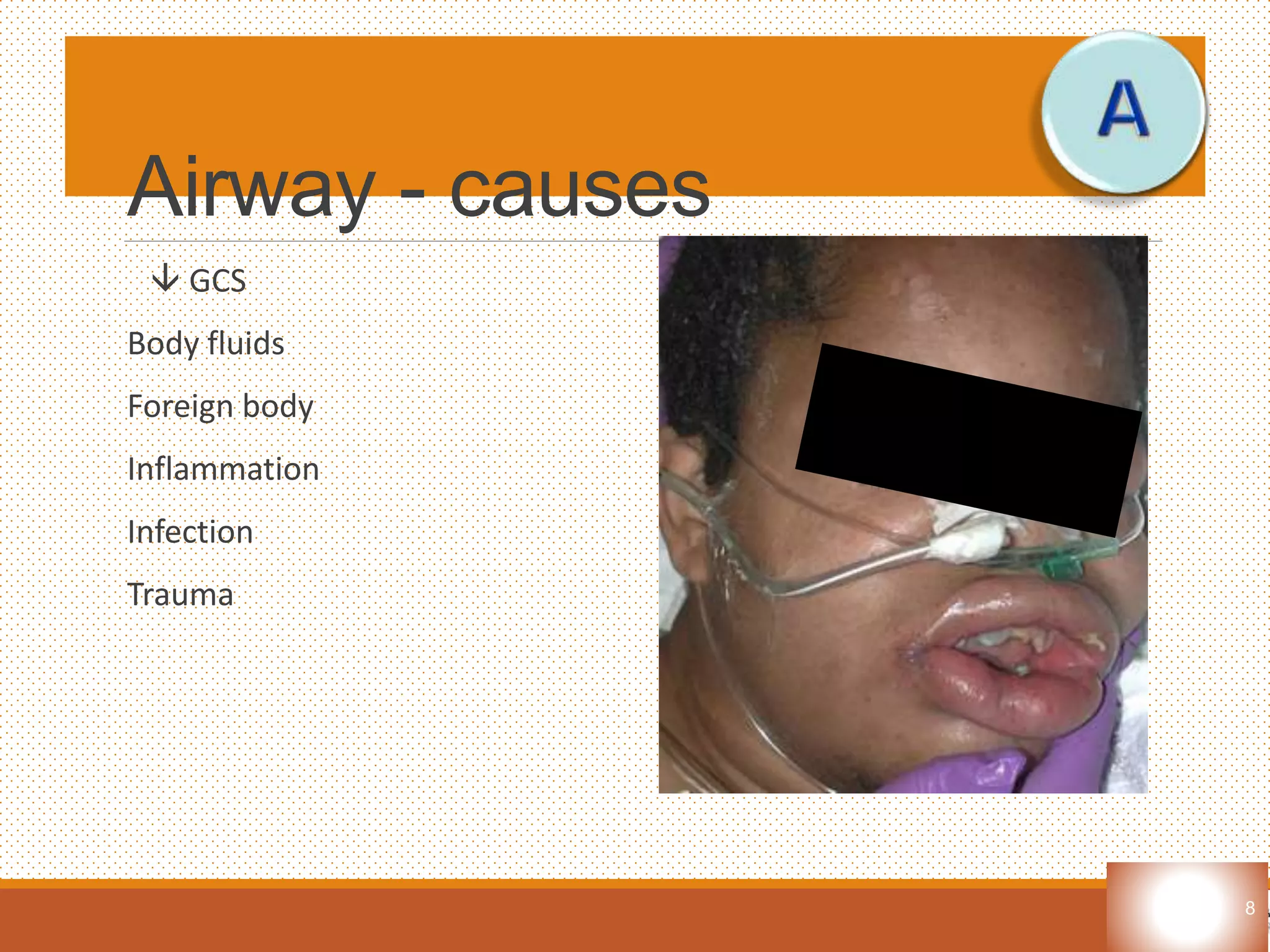
Airway - causes
 GCS
Body fluids
Foreign body
Inflammation
Infection
Trauma
8
8
Airway - assessment
Unresponsive
Added sounds
◦ Snoring, gurgling, wheeze, stridor
Tracheal tug
Accessory muscles
See-saw respiratory pattern
9
9
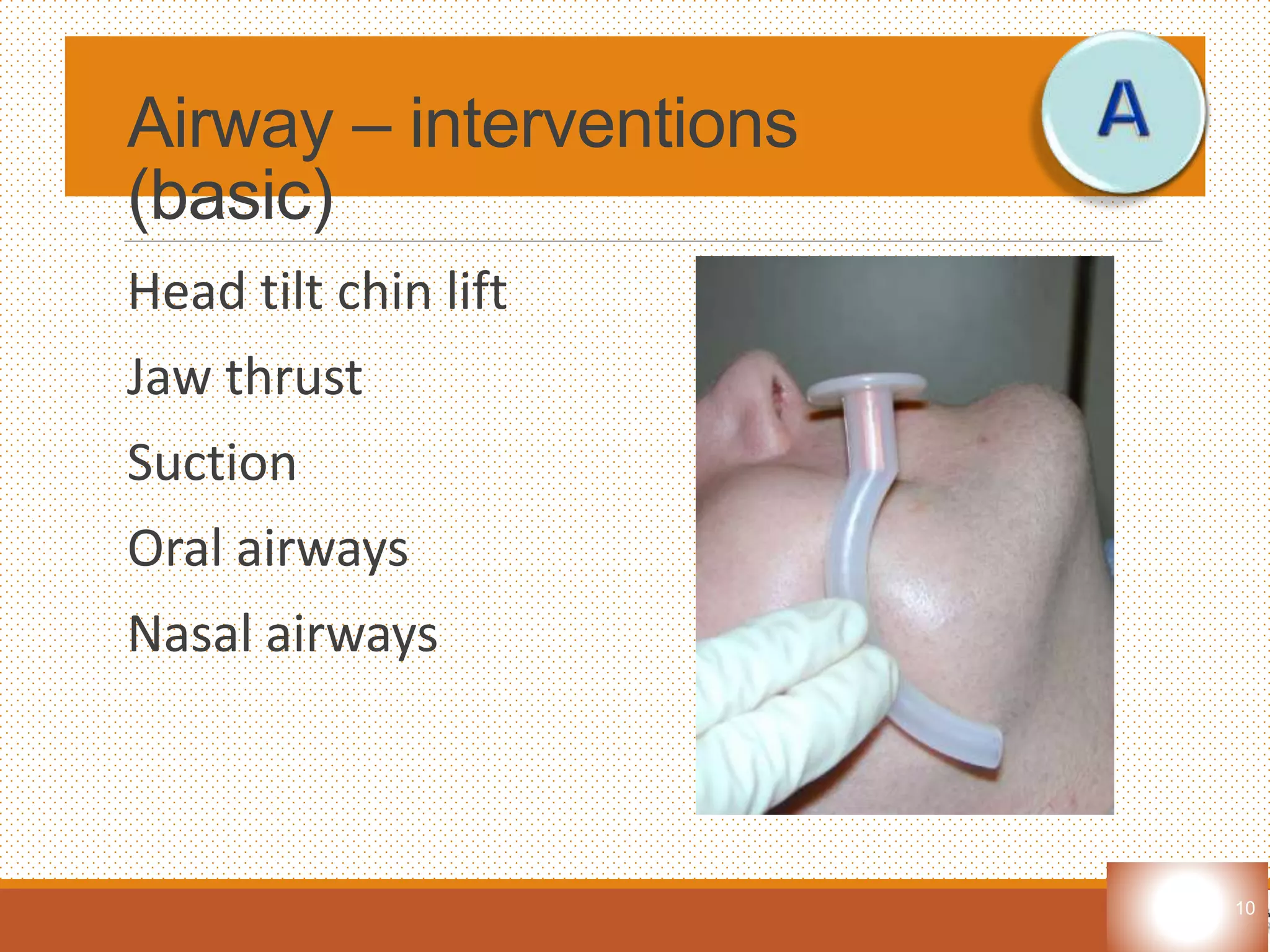
Airway – interventions
(basic)
Head tilt chin lift
Jaw thrust
Suction
Oral airways
Nasal airways
10
10
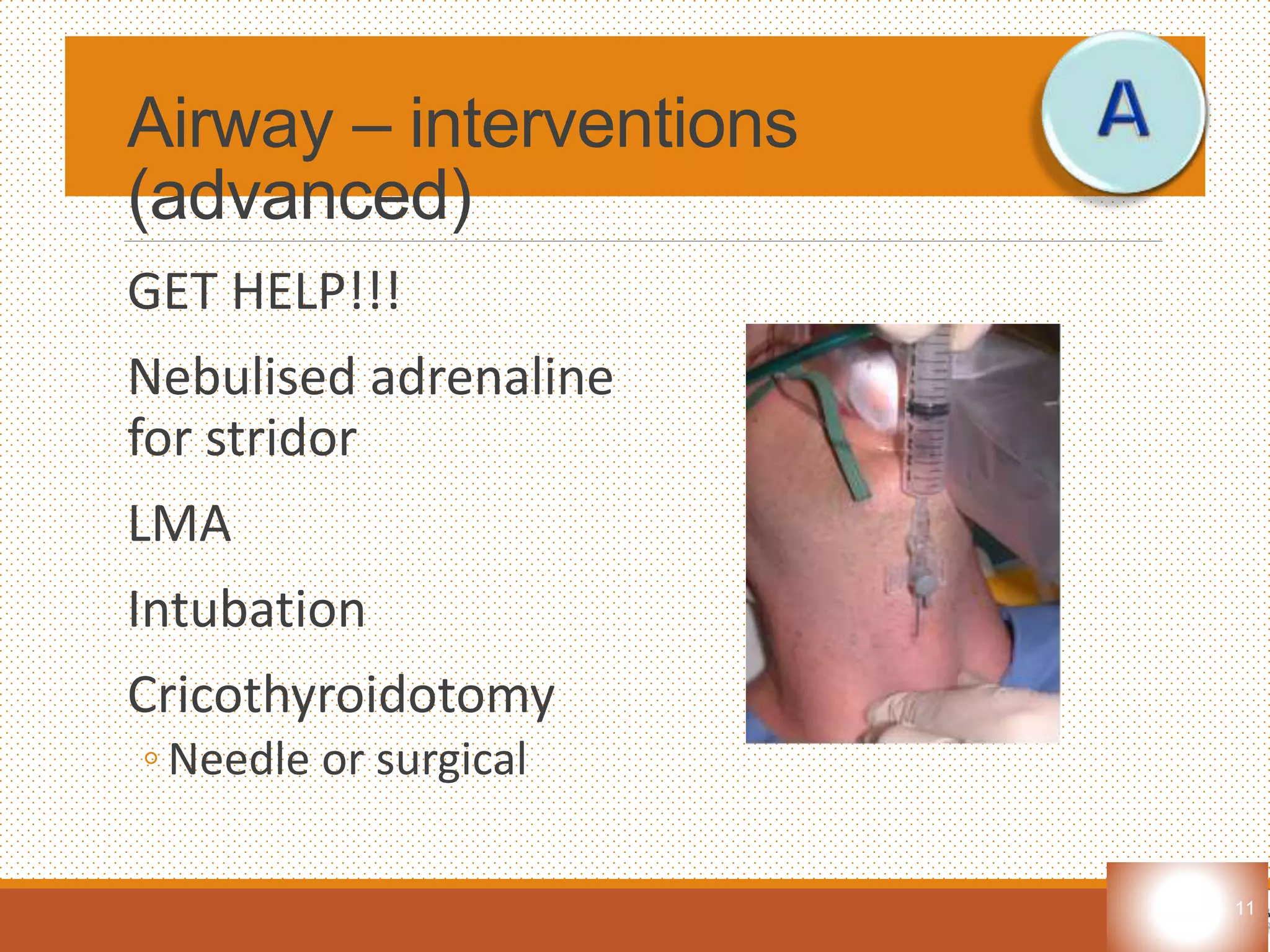
Airway – interventions
(advanced)
GET HELP!!!
Nebulised adrenaline
for stridor
LMA
Intubation
Cricothyroidotomy
◦ Needle or surgical
11
11
Once airway open...
Give 15 litres of
oxygen to all patients
via a non-rebreathing
mask
For COPD patients re-
assess after the
primary survey has
been complete &
keep Sats 90-93%
12
112
Breathing - causes
 GCS
Resp depressions
Muscle weakness
Exhaustion
Asthma
COPD
Infection
Pulmonary oedema
Pulmonary embolus
ARDS
Pneumothorax
Haemothorax
Open pneumothorax
Flail chest
13
13
Breathing - assessment
Look
◦ Rate (<10 or >20), symmetry, effort, SpO2, colour
Listen
◦ Taking: sentences, phrases, words
◦ Bilateral air entry, wheeze, silent chest other added sounds
Feel
◦ Central trachea, Percussion, expansion
14
14
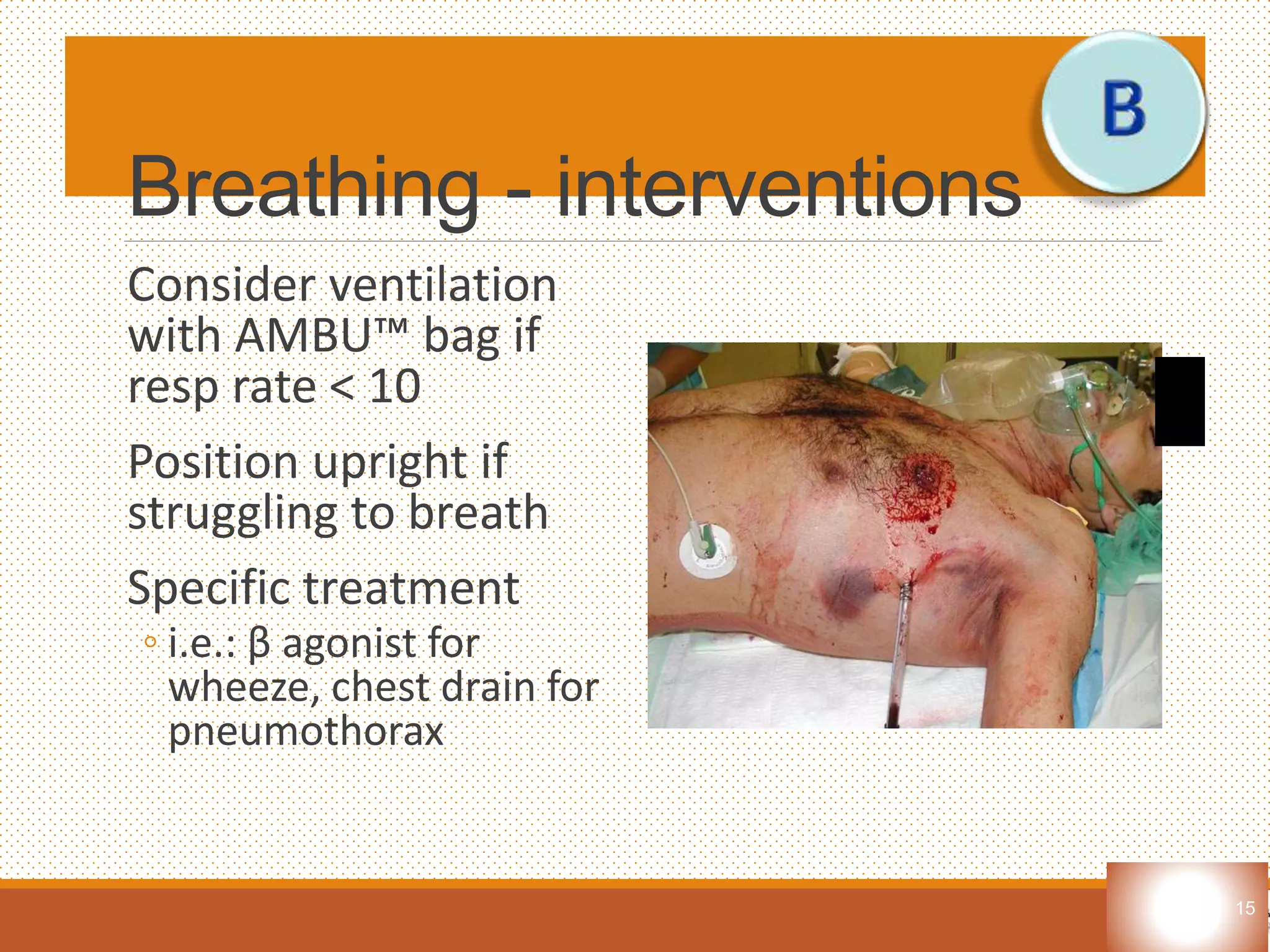
Breathing - interventions
Consider ventilation
with AMBU™ bag if
resp rate < 10
Position upright if
struggling to breath
Specific treatment
◦ i.e.: β agonist for
wheeze, chest drain for
pneumothorax
15
15
Circulation - assessment
Look at colour
Examine peripheries
Pulse, BP & CRT
Hypotension (late sign)
◦ sBP< 100mmHg
◦ sBP < 20mmHg below pts norm
 Urine output
Consider compensation mechanisms
16
16
Circulation – shock
Loss of volume
◦ Hypovolaemia
Pump failure
◦ Myocardial & non-myocardial causes
Vasodilatation
◦ Sepsis, anaphylaxis, neurogenic
BP = HR x SV x SVR
Inadequate tissue perfusion
17
17
Circulation - interventions
Position supine with legs raised
◦ Left lateral tilt in pregnancy
IV access - 16G or larger x2
◦ +/- bloods if new cannula
Fluid challenge
◦ colloid or crystalloid?
ECG Monitoring
Specific treatment
18
18
Disability - causes
Inadequate perfusion of the brain
Sedative side effects of drugs
 BM
Toxins and poisons
CVA
 ICP
19
19
Disability - assessment
AVPU (or GCS)
◦Alert, responds to Voice, responds to Pain,
Unresponsive
Pupil size/response
Posture
BM
Pain relief
20
200
Disability - interventions
Optimise airway, breathing & circulation
Treat underlying cause
◦ i.e.: naloxone for opiate toxicity
◦ Caution if reversing benzo’s
Treat  BM
◦ 100ml of 10% dextrose (or 20ml of 50% dextrose)
Control seizures
Seek expert help for CVA or ICP
21
211
Exposure
Remove clothes and examine head to toe front and back
◦ Haemorrhage (inc concealed), rashes, swelling etc
Keep warm (unless post cardiac arrest)
Maintain dignity
22
222
Secondary survey
Repeat ABCDE in more detail
History
Order investigations
◦ ABG, CXR, 12 lead ECG, Specific bloods
Management plan
Referral
Handover
23
233
ITUATION
ACKGROUND
SSESSMENT
ECCOMENDATION
Handover
24
244
Situation
Check you are talking o the right person
State your name & department
I am calling about... (patient)
The reason I am calling is...
25
255
Background
Admission diagnosis and date of admission
Relevant medical history
Brief summary of treatment to date
26
266
Assessment
• The assessment of the patient using the ABCDE approach
27
277
Recommendation
I would like you to...
Determine the time scale
Is there anything else I should do?
Record the name and contact number of your contact
28
288
Questions
29
299
Summary
Assess ABCDE in turn
Instigate treatments for life-threatening problems as you find them
Reassess following treatment
If anything changes go back to A
30
30

Abcde approach-to-the-critically-ill-patient

  • 1.
    The approach to thecritically ill patient
  • 2.
    Objectives The rational ofABCDE The process of primary & secondary survey Recognition of life threatening events Treatment of life-threatening conditions Handover 2
  • 3.
  • 4.
    The ABCDE approach A B C D E Airway& oxygenation Breathing & ventilation Circulation & shock management Disability due to neurological deterioration Exposure & examination 4 4
  • 5.
    The principles Perform primaryABCDE survey (5 min) Instigate treatment for life threatening conditions as you find them Reassess when any treatment is completed Perform more detailed secondary ABCDE survey including investigations If condition deteriorates repeat primary survey 5 5
  • 6.
    The primary survey ABCDEassessment looking for immediately life threatening conditions Rapid intervention usually includes max O2, IV access, fluid challenge +/- specific treatment Should take no longer than 5 min Can be repeated as many times as necessary Get experienced help as soon as you need it If you have a team delegate jobs 6 6
  • 7.
    The secondary survey Performedwhen patient more stable Get a brief relevant HPC & Hx More detailed examination of patient (ABCDE) Order investigations to aid diagnosis IF PATIENT DETERIORATES RETURN TO PRIMARY SURVEY 7 7
  • 8.
    Airway - causes GCS Body fluids Foreign body Inflammation Infection Trauma 8 8
  • 9.
    Airway - assessment Unresponsive Addedsounds ◦ Snoring, gurgling, wheeze, stridor Tracheal tug Accessory muscles See-saw respiratory pattern 9 9
  • 10.
    Airway – interventions (basic) Headtilt chin lift Jaw thrust Suction Oral airways Nasal airways 10 10
  • 11.
    Airway – interventions (advanced) GETHELP!!! Nebulised adrenaline for stridor LMA Intubation Cricothyroidotomy ◦ Needle or surgical 11 11
  • 12.
    Once airway open... Give15 litres of oxygen to all patients via a non-rebreathing mask For COPD patients re- assess after the primary survey has been complete & keep Sats 90-93% 12 112
  • 13.
    Breathing - causes GCS Resp depressions Muscle weakness Exhaustion Asthma COPD Infection Pulmonary oedema Pulmonary embolus ARDS Pneumothorax Haemothorax Open pneumothorax Flail chest 13 13
  • 14.
    Breathing - assessment Look ◦Rate (<10 or >20), symmetry, effort, SpO2, colour Listen ◦ Taking: sentences, phrases, words ◦ Bilateral air entry, wheeze, silent chest other added sounds Feel ◦ Central trachea, Percussion, expansion 14 14
  • 15.
    Breathing - interventions Considerventilation with AMBU™ bag if resp rate < 10 Position upright if struggling to breath Specific treatment ◦ i.e.: β agonist for wheeze, chest drain for pneumothorax 15 15
  • 16.
    Circulation - assessment Lookat colour Examine peripheries Pulse, BP & CRT Hypotension (late sign) ◦ sBP< 100mmHg ◦ sBP < 20mmHg below pts norm  Urine output Consider compensation mechanisms 16 16
  • 17.
    Circulation – shock Lossof volume ◦ Hypovolaemia Pump failure ◦ Myocardial & non-myocardial causes Vasodilatation ◦ Sepsis, anaphylaxis, neurogenic BP = HR x SV x SVR Inadequate tissue perfusion 17 17
  • 18.
    Circulation - interventions Positionsupine with legs raised ◦ Left lateral tilt in pregnancy IV access - 16G or larger x2 ◦ +/- bloods if new cannula Fluid challenge ◦ colloid or crystalloid? ECG Monitoring Specific treatment 18 18
  • 19.
    Disability - causes Inadequateperfusion of the brain Sedative side effects of drugs  BM Toxins and poisons CVA  ICP 19 19
  • 20.
    Disability - assessment AVPU(or GCS) ◦Alert, responds to Voice, responds to Pain, Unresponsive Pupil size/response Posture BM Pain relief 20 200
  • 21.
    Disability - interventions Optimiseairway, breathing & circulation Treat underlying cause ◦ i.e.: naloxone for opiate toxicity ◦ Caution if reversing benzo’s Treat  BM ◦ 100ml of 10% dextrose (or 20ml of 50% dextrose) Control seizures Seek expert help for CVA or ICP 21 211
  • 22.
    Exposure Remove clothes andexamine head to toe front and back ◦ Haemorrhage (inc concealed), rashes, swelling etc Keep warm (unless post cardiac arrest) Maintain dignity 22 222
  • 23.
    Secondary survey Repeat ABCDEin more detail History Order investigations ◦ ABG, CXR, 12 lead ECG, Specific bloods Management plan Referral Handover 23 233
  • 24.
  • 25.
    Situation Check you aretalking o the right person State your name & department I am calling about... (patient) The reason I am calling is... 25 255
  • 26.
    Background Admission diagnosis anddate of admission Relevant medical history Brief summary of treatment to date 26 266
  • 27.
    Assessment • The assessmentof the patient using the ABCDE approach 27 277
  • 28.
    Recommendation I would likeyou to... Determine the time scale Is there anything else I should do? Record the name and contact number of your contact 28 288
  • 29.
  • 30.
    Summary Assess ABCDE inturn Instigate treatments for life-threatening problems as you find them Reassess following treatment If anything changes go back to A 30 30