Connecting mathematics and
numeracy to improve learning for
Aboriginal students
(Make it Count)
STEVE THORNTON
Charles Darwin University
JOANNE STATTON
Alberton Primary School
MathematisingMathematising
and Contextualisingand Contextualising
Much of the present
teaching of mathematics,
particularly in the primary
years, has Aboriginal
students doing
mathematics that is not
related to their world and
their everyday
experiences. As a result,
by the time many
Aboriginal students have
reached the latter years
of primary school they
have been alienated from
mathematics.
Matthews, Howard & Perry, 2003
Make it Count Aims
Document and share effective models
of teacher professional development,
whole school change and community
engagement in relation to
mathematics and numeracy
Develop whole school approaches to
mathematics and numeracy that result
in markedly improved achievement by
Indigenous students
Build and participate in networks and
professional learning communities and
act as catalyst and support for action
by others.
Alberton clusterAlberton cluster
Why can’t we draw
all day?
Andrew’s challenge to Iain
The Alberton model
• The integrated, cross-age literacy and
numeracy model, year 3 to 5
• Looking for a way of understanding what
we were doing
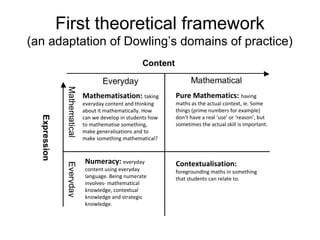
First theoretical framework
(an adaptation of Dowling’s domains of practice)
Mathematisation: taking
everyday content and thinking
about it mathematically. How
can we develop in students how
to mathematise something,
make generalisations and to
make something mathematical?
Pure Mathematics: having
maths as the actual context, ie. Some
things (prime numbers for example)
don’t have a real ‘use’ or ‘reason’, but
sometimes the actual skill is important.
Numeracy: everyday
content using everyday
language. Being numerate
involves- mathematical
knowledge, contextual
knowledge and strategic
knowledge.
Contextualisation:
foregrounding maths in something
that students can relate to.
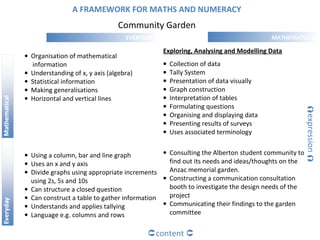
• Consulting the Alberton student community to
find out its needs and ideas/thoughts on the
Anzac memorial garden.
• Constructing a communication consultation
booth to investigate the design needs of the
project
• Communicating their findings to the garden
committee
• Using a column, bar and line graph
• Uses an x and y axis
• Divide graphs using appropriate increments
using 2s, 5s and 10s
• Can structure a closed question
• Can construct a table to gather information
• Understands and applies tallying
• Language e.g. columns and rows
• Organisation of mathematical
information
• Understanding of x, y axis (algebra)
• Statistical information
• Making generalisations
• Horizontal and vertical lines
EVERYDAY
A FRAMEWORK FOR MATHS AND NUMERACY
Community Garden
content 

expression

Exploring, Analysing and Modelling Data
• Collection of data
• Tally System
• Presentation of data visually
• Graph construction
• Interpretation of tables
• Formulating questions
• Organising and displaying data
• Presenting results of surveys
• Uses associated terminology
MATHEMATICAL
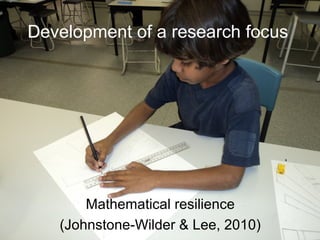
Development of a research focus
Mathematical resilience
(Johnstone-Wilder & Lee, 2010)
Transfer
Still looking for a way to collect and monitor this.
The Alberton cluster question
and model
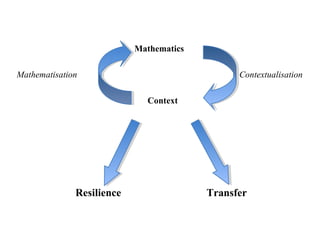
What is the role of
mathematisation
and
contextualisation in
developing
mathematical
resilience and
promoting transfer
of learning among
Indigenous
students?
The Alberton cluster question
Mathematics
Context
ContextualisationMathematisation
Resilience Transfer
Looked like: Sounded like: Felt like:
• Head on the desk,
book on the floor
• Tears
• Sometimes removing
self from group
• Refusal to participate
in certain tasks
• Face in hands
• Crawling into a corner
• Only chose to learn
with the teacher
• “ I need help” before
beginning or even
sitting down
• “I need to go to the
toilet”
• “I can’t do this”
• “I don’t know what to
do”
• *crying*
• No risk taking
• Safe zone
• Confused
• Low resilience
• Fear of making a
mistake
• Giving up before
beginning
• Avoidance
• Did not enjoy learning
Some early observations
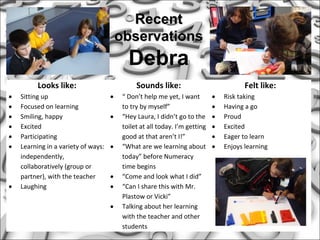
Debra
Looks like: Sounds like: Felt like:
• Sitting up
• Focused on learning
• Smiling, happy
• Excited
• Participating
• Learning in a variety of ways:
independently,
collaboratively (group or
partner), with the teacher
• Laughing
• “ Don’t help me yet, I want
to try by myself”
• “Hey Laura, I didn’t go to the
toilet at all today. I’m getting
good at that aren’t I!”
• “What are we learning about
today” before Numeracy
time begins
• “Come and look what I did”
• “Can I share this with Mr.
Plastow or Vicki”
• Talking about her learning
with the teacher and other
students
• Risk taking
• Having a go
• Proud
• Excited
• Eager to learn
• Enjoys learning
RecentRecent
observationsobservations
Debra
This is Leroy.
The Leroy Story
Leroy starts the lesson with
the premise that everything
will be OK. He is organised and
he is ready to begin.
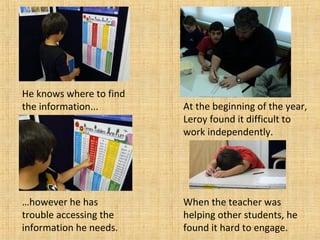
He knows where to find
the information...
…however he has
trouble accessing the
information he needs.
At the beginning of the year,
Leroy found it difficult to
work independently.
When the teacher was
helping other students, he
found it hard to engage.
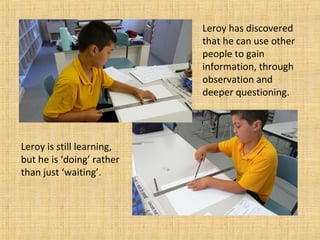
Leroy has discovered
that he can use other
people to gain
information, through
observation and
deeper questioning.
Leroy is still learning,
but he is ‘doing’ rather
than just ‘waiting’.
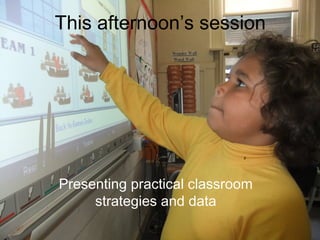
This afternoon’s session
Presenting practical classroom
strategies and data

Mathematisation and Contextualisation

  • 1.
    Connecting mathematics and numeracyto improve learning for Aboriginal students (Make it Count) STEVE THORNTON Charles Darwin University JOANNE STATTON Alberton Primary School MathematisingMathematising and Contextualisingand Contextualising
  • 2.
    Much of thepresent teaching of mathematics, particularly in the primary years, has Aboriginal students doing mathematics that is not related to their world and their everyday experiences. As a result, by the time many Aboriginal students have reached the latter years of primary school they have been alienated from mathematics. Matthews, Howard & Perry, 2003
  • 3.
    Make it CountAims Document and share effective models of teacher professional development, whole school change and community engagement in relation to mathematics and numeracy Develop whole school approaches to mathematics and numeracy that result in markedly improved achievement by Indigenous students Build and participate in networks and professional learning communities and act as catalyst and support for action by others.
  • 4.
  • 6.
    Why can’t wedraw all day?
  • 7.
  • 8.
    The Alberton model •The integrated, cross-age literacy and numeracy model, year 3 to 5 • Looking for a way of understanding what we were doing
  • 9.
    First theoretical framework (anadaptation of Dowling’s domains of practice) Mathematisation: taking everyday content and thinking about it mathematically. How can we develop in students how to mathematise something, make generalisations and to make something mathematical? Pure Mathematics: having maths as the actual context, ie. Some things (prime numbers for example) don’t have a real ‘use’ or ‘reason’, but sometimes the actual skill is important. Numeracy: everyday content using everyday language. Being numerate involves- mathematical knowledge, contextual knowledge and strategic knowledge. Contextualisation: foregrounding maths in something that students can relate to.
  • 10.
    • Consulting theAlberton student community to find out its needs and ideas/thoughts on the Anzac memorial garden. • Constructing a communication consultation booth to investigate the design needs of the project • Communicating their findings to the garden committee • Using a column, bar and line graph • Uses an x and y axis • Divide graphs using appropriate increments using 2s, 5s and 10s • Can structure a closed question • Can construct a table to gather information • Understands and applies tallying • Language e.g. columns and rows • Organisation of mathematical information • Understanding of x, y axis (algebra) • Statistical information • Making generalisations • Horizontal and vertical lines EVERYDAY A FRAMEWORK FOR MATHS AND NUMERACY Community Garden content   expression  Exploring, Analysing and Modelling Data • Collection of data • Tally System • Presentation of data visually • Graph construction • Interpretation of tables • Formulating questions • Organising and displaying data • Presenting results of surveys • Uses associated terminology MATHEMATICAL
  • 11.
    Development of aresearch focus Mathematical resilience (Johnstone-Wilder & Lee, 2010)
  • 12.
    Transfer Still looking fora way to collect and monitor this.
  • 13.
    The Alberton clusterquestion and model
  • 14.
    What is therole of mathematisation and contextualisation in developing mathematical resilience and promoting transfer of learning among Indigenous students? The Alberton cluster question
  • 15.
  • 16.
    Looked like: Soundedlike: Felt like: • Head on the desk, book on the floor • Tears • Sometimes removing self from group • Refusal to participate in certain tasks • Face in hands • Crawling into a corner • Only chose to learn with the teacher • “ I need help” before beginning or even sitting down • “I need to go to the toilet” • “I can’t do this” • “I don’t know what to do” • *crying* • No risk taking • Safe zone • Confused • Low resilience • Fear of making a mistake • Giving up before beginning • Avoidance • Did not enjoy learning Some early observations Debra
  • 17.
    Looks like: Soundslike: Felt like: • Sitting up • Focused on learning • Smiling, happy • Excited • Participating • Learning in a variety of ways: independently, collaboratively (group or partner), with the teacher • Laughing • “ Don’t help me yet, I want to try by myself” • “Hey Laura, I didn’t go to the toilet at all today. I’m getting good at that aren’t I!” • “What are we learning about today” before Numeracy time begins • “Come and look what I did” • “Can I share this with Mr. Plastow or Vicki” • Talking about her learning with the teacher and other students • Risk taking • Having a go • Proud • Excited • Eager to learn • Enjoys learning RecentRecent observationsobservations Debra
  • 18.
    This is Leroy. TheLeroy Story Leroy starts the lesson with the premise that everything will be OK. He is organised and he is ready to begin.
  • 19.
    He knows whereto find the information... …however he has trouble accessing the information he needs. At the beginning of the year, Leroy found it difficult to work independently. When the teacher was helping other students, he found it hard to engage.
  • 20.
    Leroy has discovered thathe can use other people to gain information, through observation and deeper questioning. Leroy is still learning, but he is ‘doing’ rather than just ‘waiting’.
  • 21.
    This afternoon’s session Presentingpractical classroom strategies and data

Editor's Notes

  • #3 What we noticed at school prior to Make it Count Not related to world. Teacher planning from books. Difference between regular maths and Make it Count maths.
  • #4 Add logo with hyperlink to website
  • #5 Talk a bit about each site Map
  • #12 Insert the 5 slides from Northfield