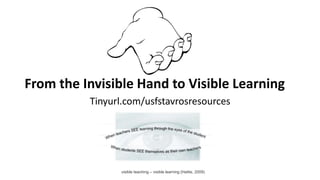
From the Invisible Hand to Visible Learning
Tinyurl.com/usfstavrosresources
visible teaching – visible learning (Hattie, 2009)
Image from: https://12jungev.wordpress.com/tag/invisible-hand/
LAFS.1112.RH.1.1:
Read Closely and Cite
Evidence:
"As every individual, therefore, endeavours as much
as he can both to employ his capital in the support of
domestic industry, and so to direct that industry that
its produce may be of the greatest value; every
individual necessarily labours to render the annual
revenue of the society as great as he can. He
generally, indeed, neither intends to promote the
public interest, nor knows how much he is promoting
it. By preferring the support of domestic to that of
foreign industry, he intends only his own security;
and by directing that industry in such a manner as its
produce may be of the greatest value, he intends
only his own gain, and he is in this, as in many other
cases, led by an invisible hand to promote an end
which was no part of his intention. Nor is it always
the worse for the society that it was no part of it. By
pursuing his own interest he frequently promotes
that of the society more effectually than when he
really intends to promote it."
This is a much-cited passage
from The Wealth of
Nations, in which Adam
Smith discusses the ‘the
Invisible Hand.’ What is this
Invisible Hand, as described
by Adam Smith? Cite
evidence from the text to
support your conclusions.
Adam Smith
An Inquiry into the Nature and Causes
of the Wealth of Nations par. IV.2.9
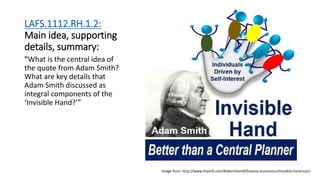
LAFS.1112.RH.1.2:
Main idea, supporting
details, summary:
"What is the central idea of
the quote from Adam Smith?
What are key details that
Adam Smith discussed as
integral components of the
‘Invisible Hand?’”
Image from: http://www.rhamill.com/RobertHamill/finance-economics/invisible-hand-scar/
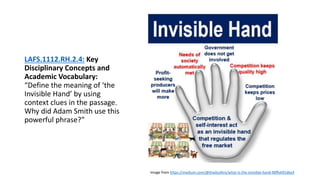
LAFS.1112.RH.2.4: Key
Disciplinary Concepts and
Academic Vocabulary:
“Define the meaning of ‘the
Invisible Hand’ by using
context clues in the passage.
Why did Adam Smith use this
powerful phrase?”
Image from https://medium.com/@thadcollins/what-is-the-invisible-hand-98ffe691d6a3
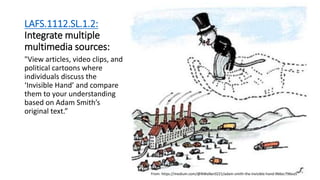
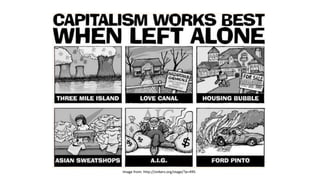
LAFS.1112.SL.1.2:
Integrate multiple
multimedia sources:
"View articles, video clips, and
political cartoons where
individuals discuss the
‘Invisible Hand’ and compare
them to your understanding
based on Adam Smith’s
original text.”
From: https://medium.com/@NWalker0221/adam-smith-the-invisible-hand-966ec796ea5
Image from: http://sinkers.org/stage/?p=495
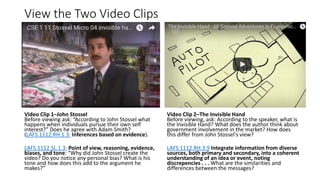
View the Two Video Clips
Video Clip 1–John Stossel
Before viewing ask: “According to John Stossel what
happens when individuals pursue their own self
interest?” Does he agree with Adam Smith?
(LAFS.1112.RH.1.3: Inferences based on evidence).
LAFS.1112.SL.1.3: Point of view, reasoning, evidence,
biases, and tone: “Why did John Stossel create the
video? Do you notice any personal bias? What is his
tone and how does this add to the argument he
makes?”
Video Clip 2–The Invisible Hand
Before viewing, ask: According to the speaker, what is
the Invisible Hand? What does the author think about
government involvement in the market? How does
this differ from John Stossel's view?
LAFS.1112.RH.3.9 Integrate information from diverse
sources, both primary and secondary, into a coherent
understanding of an idea or event, noting
discrepencies . . . What are the similarities and
differences between the messages?
Deeper Learning Through Speaking, Listening & “Writing”
(Discussions, Debates, Drawings & Demonstrations)
• LAFS.1112.SL.1.2: Integrate multiple
multimedia sources: "View articles, video
clips, and political cartoons where
individuals discuss the ‘Invisible Hand’
and compare them to your understanding
based on Adam Smith’s original text.”
• LAFS.1112.SL.1.1: Collaborative
conversations: “After viewing the two
videos, discuss how the speakers view the
Invisible Hand." "Consider what Adam
Smith said about the Invisible Hand.
Discuss how the articles/videos used the
term. How is it similar/different?”
• LAFS.1112.SL.2.4 Present evidence clearly,
including alternative
perspectives: “Consider the Invisible
Hand as illustrated by John Stossel and
the 60 second video and discuss their
differing perspectives on the involvement
of government in the market economy.”
• LAFS.1112.WHST.1.2 ”Write” informative or
explanatory texts . . . What are the
costs/benefits of the invisible hand?
• LAFS.1112.WHST.2.6 Use technology, including
the Internet, to produce, publish, and
update individual or shared writing
products Create a social media post about
the invisible hand.
• LAFS.1112.WHST.3.8 Gather relevant
information from multiple authoritative
print and digital sources, using advanced
searches effectively . . . Gather reliable
sources that both supports and refutes your
claim.
• LAFS.1112.WHST.3.9 Draw evidence from
informational texts to support analysis,
reflection, and research . . . Draw evidence
from reliable sources to entertain, inform,
persuade . . .
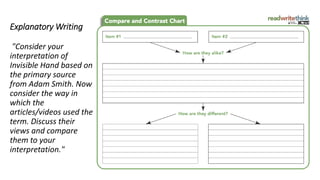
Explanatory Writing
"Consider your
interpretation of
Invisible Hand based on
the primary source
from Adam Smith. Now
consider the way in
which the
articles/videos used the
term. Discuss their
views and compare
them to your
interpretation."
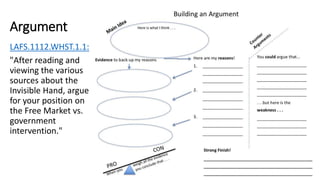
Argument
LAFS.1112.WHST.1.1:
"After reading and
viewing the various
sources about the
Invisible Hand, argue
for your position on
the Free Market vs.
government
intervention."
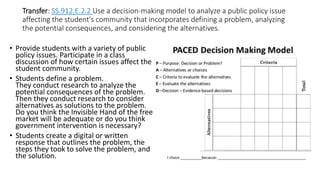
Transfer: SS.912.E.2.2 Use a decision-making model to analyze a public policy issue
affecting the student's community that incorporates defining a problem, analyzing
the potential consequences, and considering the alternatives.
• Provide students with a variety of public
policy issues. Participate in a class
discussion of how certain issues affect the
student community.
• Students define a problem.
They conduct research to analyze the
potential consequences of the problem.
Then they conduct research to consider
alternatives as solutions to the problem.
Do you think the Invisible Hand of the free
market will be adequate or do you think
government intervention is necessary?
• Students create a digital or written
response that outlines the problem, the
steps they took to solve the problem, and
the solution.

Invisible hand

  • 1.
    From the InvisibleHand to Visible Learning Tinyurl.com/usfstavrosresources visible teaching – visible learning (Hattie, 2009)
  • 2.
  • 3.
    LAFS.1112.RH.1.1: Read Closely andCite Evidence: "As every individual, therefore, endeavours as much as he can both to employ his capital in the support of domestic industry, and so to direct that industry that its produce may be of the greatest value; every individual necessarily labours to render the annual revenue of the society as great as he can. He generally, indeed, neither intends to promote the public interest, nor knows how much he is promoting it. By preferring the support of domestic to that of foreign industry, he intends only his own security; and by directing that industry in such a manner as its produce may be of the greatest value, he intends only his own gain, and he is in this, as in many other cases, led by an invisible hand to promote an end which was no part of his intention. Nor is it always the worse for the society that it was no part of it. By pursuing his own interest he frequently promotes that of the society more effectually than when he really intends to promote it." This is a much-cited passage from The Wealth of Nations, in which Adam Smith discusses the ‘the Invisible Hand.’ What is this Invisible Hand, as described by Adam Smith? Cite evidence from the text to support your conclusions. Adam Smith An Inquiry into the Nature and Causes of the Wealth of Nations par. IV.2.9
  • 4.
    LAFS.1112.RH.1.2: Main idea, supporting details,summary: "What is the central idea of the quote from Adam Smith? What are key details that Adam Smith discussed as integral components of the ‘Invisible Hand?’” Image from: http://www.rhamill.com/RobertHamill/finance-economics/invisible-hand-scar/
  • 5.
    LAFS.1112.RH.2.4: Key Disciplinary Conceptsand Academic Vocabulary: “Define the meaning of ‘the Invisible Hand’ by using context clues in the passage. Why did Adam Smith use this powerful phrase?” Image from https://medium.com/@thadcollins/what-is-the-invisible-hand-98ffe691d6a3
  • 6.
    LAFS.1112.SL.1.2: Integrate multiple multimedia sources: "Viewarticles, video clips, and political cartoons where individuals discuss the ‘Invisible Hand’ and compare them to your understanding based on Adam Smith’s original text.” From: https://medium.com/@NWalker0221/adam-smith-the-invisible-hand-966ec796ea5
  • 7.
  • 8.
    View the TwoVideo Clips Video Clip 1–John Stossel Before viewing ask: “According to John Stossel what happens when individuals pursue their own self interest?” Does he agree with Adam Smith? (LAFS.1112.RH.1.3: Inferences based on evidence). LAFS.1112.SL.1.3: Point of view, reasoning, evidence, biases, and tone: “Why did John Stossel create the video? Do you notice any personal bias? What is his tone and how does this add to the argument he makes?” Video Clip 2–The Invisible Hand Before viewing, ask: According to the speaker, what is the Invisible Hand? What does the author think about government involvement in the market? How does this differ from John Stossel's view? LAFS.1112.RH.3.9 Integrate information from diverse sources, both primary and secondary, into a coherent understanding of an idea or event, noting discrepencies . . . What are the similarities and differences between the messages?
  • 9.
    Deeper Learning ThroughSpeaking, Listening & “Writing” (Discussions, Debates, Drawings & Demonstrations) • LAFS.1112.SL.1.2: Integrate multiple multimedia sources: "View articles, video clips, and political cartoons where individuals discuss the ‘Invisible Hand’ and compare them to your understanding based on Adam Smith’s original text.” • LAFS.1112.SL.1.1: Collaborative conversations: “After viewing the two videos, discuss how the speakers view the Invisible Hand." "Consider what Adam Smith said about the Invisible Hand. Discuss how the articles/videos used the term. How is it similar/different?” • LAFS.1112.SL.2.4 Present evidence clearly, including alternative perspectives: “Consider the Invisible Hand as illustrated by John Stossel and the 60 second video and discuss their differing perspectives on the involvement of government in the market economy.” • LAFS.1112.WHST.1.2 ”Write” informative or explanatory texts . . . What are the costs/benefits of the invisible hand? • LAFS.1112.WHST.2.6 Use technology, including the Internet, to produce, publish, and update individual or shared writing products Create a social media post about the invisible hand. • LAFS.1112.WHST.3.8 Gather relevant information from multiple authoritative print and digital sources, using advanced searches effectively . . . Gather reliable sources that both supports and refutes your claim. • LAFS.1112.WHST.3.9 Draw evidence from informational texts to support analysis, reflection, and research . . . Draw evidence from reliable sources to entertain, inform, persuade . . .
  • 10.
    Explanatory Writing "Consider your interpretationof Invisible Hand based on the primary source from Adam Smith. Now consider the way in which the articles/videos used the term. Discuss their views and compare them to your interpretation."
  • 11.
    Argument LAFS.1112.WHST.1.1: "After reading and viewingthe various sources about the Invisible Hand, argue for your position on the Free Market vs. government intervention."
  • 12.
    Transfer: SS.912.E.2.2 Usea decision-making model to analyze a public policy issue affecting the student's community that incorporates defining a problem, analyzing the potential consequences, and considering the alternatives. • Provide students with a variety of public policy issues. Participate in a class discussion of how certain issues affect the student community. • Students define a problem. They conduct research to analyze the potential consequences of the problem. Then they conduct research to consider alternatives as solutions to the problem. Do you think the Invisible Hand of the free market will be adequate or do you think government intervention is necessary? • Students create a digital or written response that outlines the problem, the steps they took to solve the problem, and the solution.