U R I N A L Y S I S
Chapter 30
Deborah Walker, ARNP, BSN, MN
1
Urine Formation
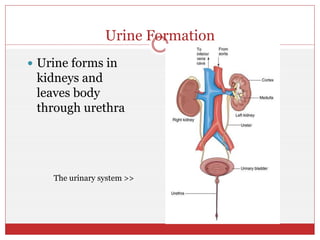
 Urine forms in
kidneys and
leaves body
through urethra
The urinary system >>
Urine Formation
 How body excretes water and gets rid of waste
 Waste can become toxic if not removed
 Two kidneys eliminate soluble waste products of
metabolism
 Click here for an animation
Deborah Walker, ARNP, BSN, MN
3
Urine Formation
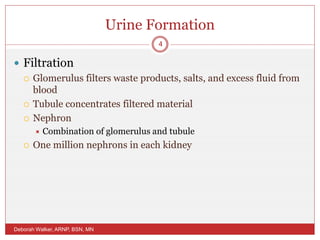
 Filtration
 Glomerulus filters waste products, salts, and excess fluid from
blood
 Tubule concentrates filtered material
 Nephron
 Combination of glomerulus and tubule
 One million nephrons in each kidney
Deborah Walker, ARNP, BSN, MN
4
Urine Formation
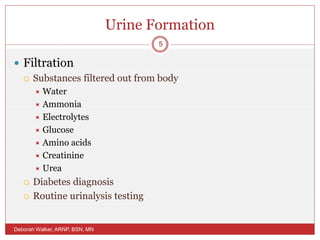
 Filtration
 Substances filtered out from body
 Water
 Ammonia
 Electrolytes
 Glucose
 Amino acids
 Creatinine
 Urea
 Diabetes diagnosis
 Routine urinalysis testing
Deborah Walker, ARNP, BSN, MN
5
Urine Formation
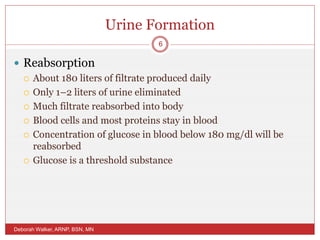
 Reabsorption
 About 180 liters of filtrate produced daily
 Only 1–2 liters of urine eliminated
 Much filtrate reabsorbed into body
 Blood cells and most proteins stay in blood
 Concentration of glucose in blood below 180 mg/dl will be
reabsorbed
 Glucose is a threshold substance
Deborah Walker, ARNP, BSN, MN
6
Urine Formation
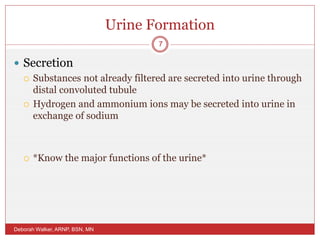
 Secretion
 Substances not already filtered are secreted into urine through
distal convoluted tubule
 Hydrogen and ammonium ions may be secreted into urine in
exchange of sodium
 *Know the major functions of the urine*
Deborah Walker, ARNP, BSN, MN
7
Urine Composition
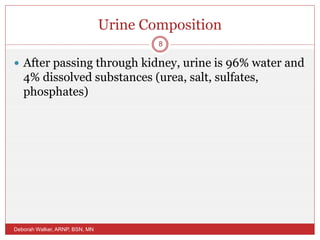
 After passing through kidney, urine is 96% water and
4% dissolved substances (urea, salt, sulfates,
phosphates)
Deborah Walker, ARNP, BSN, MN
8
Urine Composition
 Abnormal constituents of urine
 WBC
 Fat
 Glucose
 Casts
 Bile
 Hemoglobin and RBC
Deborah Walker, ARNP, BSN, MN
9
Urine Composition
 Changes in urine production
 Amount of urine excreted can rise or fall
 Urine color can change
 Urine appearance can vary
Deborah Walker, ARNP, BSN, MN
10
Urine Composition
 Changes in urine production
 Urine odor can change
 Cells can be present in urine
 Chemical constituents in urine can change
 Urine concentration (specific gravity) may vary
Deborah Walker, ARNP, BSN, MN
11
Safety
 Standard precautions
 Transmission-based precautions
 Biohazard precautions
 Proper disposal of urine
Deborah Walker, ARNP, BSN, MN
12
Quality Control
 Regulatory agencies
 Written testing protocols
 Maintained testing records
 Recalibration of instruments
Deborah Walker, ARNP, BSN, MN
13
Quality Control
 Documentation of daily control testing must be kept
at least 3 years
 Commercially available urine control samples
 Run positive and negative controls each day on all
tests
Deborah Walker, ARNP, BSN, MN
14
CLIA 88
 Appropriate training in methodology of test being
performed
 Understanding of urine testing quality control
procedures
 Proficiency in the use of instrumentation; being able
to troubleshoot problems
Deborah Walker, ARNP, BSN, MN
15
CLIA 88
 Knowledge of stability and proper storage of reagents
 Awareness of factors that influence test results
 Knowledge of how to verify test results
 CLIA categorizes microscopic exam as a PPMP
Deborah Walker, ARNP, BSN, MN
16
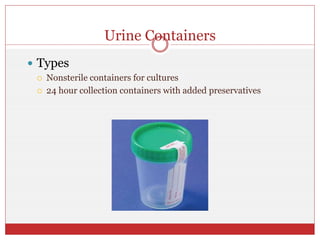
Urine Containers
 Types
 Nonsterile containers for cultures
 24 hour collection containers with added preservatives
Urine Containers
 Label container immediately after specimen
collection
 Patient’s name, age, gender, identifying number
 Date and time of collection
 Physician’s name
 Label the cup, not the lid
Deborah Walker, ARNP, BSN, MN
18
Urine Collection
 Urinalysis is the most frequently performed
procedure done in the medical office lab
 Giving patient instructions
Deborah Walker, ARNP, BSN, MN
19
Urine Collection
 Click to play the video
Deborah Walker, ARNP, BSN, MN
20
Urine Collection
 Urine specimen types
 Random (spot) specimen
 Obtained at any time
 Most common
 If concentrated specimen preferred, first specimen of day is most
concentrated
Deborah Walker, ARNP, BSN, MN
21
Urine Collection
 Urine specimen types
 Fasting/timed specimens
 Used when physician wants to measure substance without
interference from food intake
 Length of fast varies
 Give patient written directions
 Use regular urinalysis container
Deborah Walker, ARNP, BSN, MN
22
Urine Collection
 Urine specimen types
 24-hour specimen
 Circadian rhythm and intake of food and water determine
concentration of substances at different times during day/night
 Requested when quantitative tests for different substances are
desired
 Expressed in units per 24 hours
 Use of preservatives and refrigeration
 Sometimes use 2-hour or 12-hour collection instead
Deborah Walker, ARNP, BSN, MN
23
Urine Collection
 Urine specimen types
 Catheterized specimen
 Insert sterile tube directly into bladder through urethra
 Not contaminated
 Can cause infection if not done correctly
 Use only when other methods are contraindicated or show
repeated positive testing for bacteria
Deborah Walker, ARNP, BSN, MN
24
Urine Collection
 Collection methods
 Random collection
 Clean-catch method; midstream collection
 Catheterized
Deborah Walker, ARNP, BSN, MN
25
Examination of Urine
 Best when fresh, even still warm
 Test within 30 minutes, or refrigerate
Deborah Walker, ARNP, BSN, MN
26
Routine Urinalysis Procedure
 Physical examination of urine
 Assess volume of urine specimen, making sure specimen is
sufficient for testing
 Note any unusual urine odor
 Measure specific gravity of specimen
 Normal specific gravity (SG) of urine varies slightly, but 1.005-
1.030 (some may say 1.000-1.035)
Deborah Walker, ARNP, BSN, MN
27
Routine Urinalysis Procedure
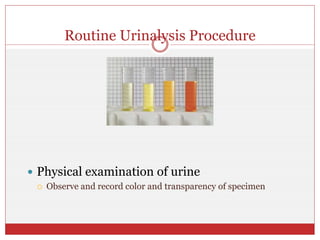
 Physical examination of urine
 Observe and record color and transparency of specimen
Measuring Specific Gravity
 Urinometer
 Measures specific gravity
 Reading the meniscus
 Take temperature of urine into account
Deborah Walker, ARNP, BSN, MN
29
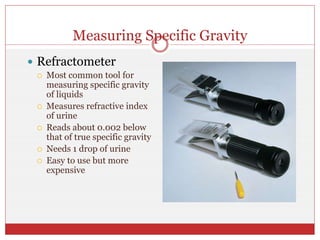
Measuring Specific Gravity
 Refractometer
 Most common tool for
measuring specific gravity
of liquids
 Measures refractive index
of urine
 Reads about 0.002 below
that of true specific gravity
 Needs 1 drop of urine
 Easy to use but more
expensive
Routine Urinalysis Procedure
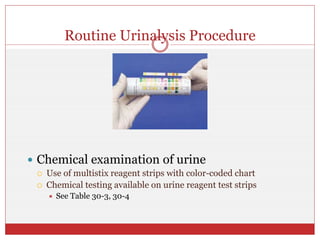
 Chemical examination of urine
 Use of multistix reagent strips with color-coded chart
 Chemical testing available on urine reagent test strips
 See Table 30-3, 30-4
Routine Urinalysis Procedure
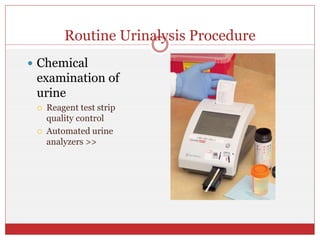
 Chemical
examination of
urine
 Reagent test strip
quality control
 Automated urine
analyzers >>
Routine Urinalysis Procedure
 Microscopic examination of urine sediment
 Classified as PPMP
 Sediment is forced to the bottom of centrifuged tube
 Helps determine kidney disease, disorders of urinary tract, and
systemic disease
 Need fresh urine
 Use of urine color atlas
 Use of urine stains
Deborah Walker, ARNP, BSN, MN
33
Preparing for Microscopic
Examination
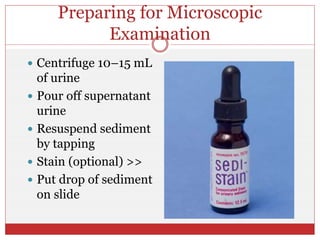
 Centrifuge 10–15 mL
of urine
 Pour off supernatant
urine
 Resuspend sediment
by tapping
 Stain (optional) >>
 Put drop of sediment
on slide
Urine Sediment Cells and
Microorganisms
 RBC
 WBC
 Renal epithelial cells
 Bacteria
 Yeast-most common is
candida albicans
 Parasites- most
common is
Trichomonas
 Sperm
 Artifacts
 Squamous epithelial
cells- skin cells;
normal; report as few,
moderate, or many
Deborah Walker, ARNP, BSN, MN
35
Crystals in Urine Sediment
 Require little attention
 Form as urine specimens stand
 Uric acid, cystine, and sulfa drug crystals can
indicate disease states
Deborah Walker, ARNP, BSN, MN
36
Casts in Urine Sediment
 Important to note
 Formed when protein accumulates and precipitates
in kidney tubules
 Appearance of casts
 Hyaline cast most common kind seen
 Granular casts and cellular casts also seen
 Takes an experienced eye to identify
Deborah Walker, ARNP, BSN, MN
37
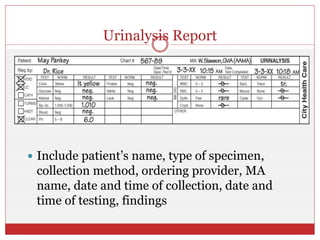
Urinalysis Report
 Include patient’s name, type of specimen,
collection method, ordering provider, MA
name, date and time of collection, date and
time of testing, findings
Drug Screening
 Becoming more common for employment
 Test itself is CLIA waived, but detailed protocols
must be followed
 Chain of custody
Deborah Walker, ARNP, BSN, MN
39
Medical Terminology
 Part VII Urinary System handouts
Deborah Walker, ARNP, BSN, MN
40

Chapter 30 Urinalysis.ppt

  • 1.
    U R IN A L Y S I S Chapter 30 Deborah Walker, ARNP, BSN, MN 1
  • 2.
    Urine Formation  Urineforms in kidneys and leaves body through urethra The urinary system >>
  • 3.
    Urine Formation  Howbody excretes water and gets rid of waste  Waste can become toxic if not removed  Two kidneys eliminate soluble waste products of metabolism  Click here for an animation Deborah Walker, ARNP, BSN, MN 3
  • 4.
    Urine Formation  Filtration Glomerulus filters waste products, salts, and excess fluid from blood  Tubule concentrates filtered material  Nephron  Combination of glomerulus and tubule  One million nephrons in each kidney Deborah Walker, ARNP, BSN, MN 4
  • 5.
    Urine Formation  Filtration Substances filtered out from body  Water  Ammonia  Electrolytes  Glucose  Amino acids  Creatinine  Urea  Diabetes diagnosis  Routine urinalysis testing Deborah Walker, ARNP, BSN, MN 5
  • 6.
    Urine Formation  Reabsorption About 180 liters of filtrate produced daily  Only 1–2 liters of urine eliminated  Much filtrate reabsorbed into body  Blood cells and most proteins stay in blood  Concentration of glucose in blood below 180 mg/dl will be reabsorbed  Glucose is a threshold substance Deborah Walker, ARNP, BSN, MN 6
  • 7.
    Urine Formation  Secretion Substances not already filtered are secreted into urine through distal convoluted tubule  Hydrogen and ammonium ions may be secreted into urine in exchange of sodium  *Know the major functions of the urine* Deborah Walker, ARNP, BSN, MN 7
  • 8.
    Urine Composition  Afterpassing through kidney, urine is 96% water and 4% dissolved substances (urea, salt, sulfates, phosphates) Deborah Walker, ARNP, BSN, MN 8
  • 9.
    Urine Composition  Abnormalconstituents of urine  WBC  Fat  Glucose  Casts  Bile  Hemoglobin and RBC Deborah Walker, ARNP, BSN, MN 9
  • 10.
    Urine Composition  Changesin urine production  Amount of urine excreted can rise or fall  Urine color can change  Urine appearance can vary Deborah Walker, ARNP, BSN, MN 10
  • 11.
    Urine Composition  Changesin urine production  Urine odor can change  Cells can be present in urine  Chemical constituents in urine can change  Urine concentration (specific gravity) may vary Deborah Walker, ARNP, BSN, MN 11
  • 12.
    Safety  Standard precautions Transmission-based precautions  Biohazard precautions  Proper disposal of urine Deborah Walker, ARNP, BSN, MN 12
  • 13.
    Quality Control  Regulatoryagencies  Written testing protocols  Maintained testing records  Recalibration of instruments Deborah Walker, ARNP, BSN, MN 13
  • 14.
    Quality Control  Documentationof daily control testing must be kept at least 3 years  Commercially available urine control samples  Run positive and negative controls each day on all tests Deborah Walker, ARNP, BSN, MN 14
  • 15.
    CLIA 88  Appropriatetraining in methodology of test being performed  Understanding of urine testing quality control procedures  Proficiency in the use of instrumentation; being able to troubleshoot problems Deborah Walker, ARNP, BSN, MN 15
  • 16.
    CLIA 88  Knowledgeof stability and proper storage of reagents  Awareness of factors that influence test results  Knowledge of how to verify test results  CLIA categorizes microscopic exam as a PPMP Deborah Walker, ARNP, BSN, MN 16
  • 17.
    Urine Containers  Types Nonsterile containers for cultures  24 hour collection containers with added preservatives
  • 18.
    Urine Containers  Labelcontainer immediately after specimen collection  Patient’s name, age, gender, identifying number  Date and time of collection  Physician’s name  Label the cup, not the lid Deborah Walker, ARNP, BSN, MN 18
  • 19.
    Urine Collection  Urinalysisis the most frequently performed procedure done in the medical office lab  Giving patient instructions Deborah Walker, ARNP, BSN, MN 19
  • 20.
    Urine Collection  Clickto play the video Deborah Walker, ARNP, BSN, MN 20
  • 21.
    Urine Collection  Urinespecimen types  Random (spot) specimen  Obtained at any time  Most common  If concentrated specimen preferred, first specimen of day is most concentrated Deborah Walker, ARNP, BSN, MN 21
  • 22.
    Urine Collection  Urinespecimen types  Fasting/timed specimens  Used when physician wants to measure substance without interference from food intake  Length of fast varies  Give patient written directions  Use regular urinalysis container Deborah Walker, ARNP, BSN, MN 22
  • 23.
    Urine Collection  Urinespecimen types  24-hour specimen  Circadian rhythm and intake of food and water determine concentration of substances at different times during day/night  Requested when quantitative tests for different substances are desired  Expressed in units per 24 hours  Use of preservatives and refrigeration  Sometimes use 2-hour or 12-hour collection instead Deborah Walker, ARNP, BSN, MN 23
  • 24.
    Urine Collection  Urinespecimen types  Catheterized specimen  Insert sterile tube directly into bladder through urethra  Not contaminated  Can cause infection if not done correctly  Use only when other methods are contraindicated or show repeated positive testing for bacteria Deborah Walker, ARNP, BSN, MN 24
  • 25.
    Urine Collection  Collectionmethods  Random collection  Clean-catch method; midstream collection  Catheterized Deborah Walker, ARNP, BSN, MN 25
  • 26.
    Examination of Urine Best when fresh, even still warm  Test within 30 minutes, or refrigerate Deborah Walker, ARNP, BSN, MN 26
  • 27.
    Routine Urinalysis Procedure Physical examination of urine  Assess volume of urine specimen, making sure specimen is sufficient for testing  Note any unusual urine odor  Measure specific gravity of specimen  Normal specific gravity (SG) of urine varies slightly, but 1.005- 1.030 (some may say 1.000-1.035) Deborah Walker, ARNP, BSN, MN 27
  • 28.
    Routine Urinalysis Procedure Physical examination of urine  Observe and record color and transparency of specimen
  • 29.
    Measuring Specific Gravity Urinometer  Measures specific gravity  Reading the meniscus  Take temperature of urine into account Deborah Walker, ARNP, BSN, MN 29
  • 30.
    Measuring Specific Gravity Refractometer  Most common tool for measuring specific gravity of liquids  Measures refractive index of urine  Reads about 0.002 below that of true specific gravity  Needs 1 drop of urine  Easy to use but more expensive
  • 31.
    Routine Urinalysis Procedure Chemical examination of urine  Use of multistix reagent strips with color-coded chart  Chemical testing available on urine reagent test strips  See Table 30-3, 30-4
  • 32.
    Routine Urinalysis Procedure Chemical examination of urine  Reagent test strip quality control  Automated urine analyzers >>
  • 33.
    Routine Urinalysis Procedure Microscopic examination of urine sediment  Classified as PPMP  Sediment is forced to the bottom of centrifuged tube  Helps determine kidney disease, disorders of urinary tract, and systemic disease  Need fresh urine  Use of urine color atlas  Use of urine stains Deborah Walker, ARNP, BSN, MN 33
  • 34.
    Preparing for Microscopic Examination Centrifuge 10–15 mL of urine  Pour off supernatant urine  Resuspend sediment by tapping  Stain (optional) >>  Put drop of sediment on slide
  • 35.
    Urine Sediment Cellsand Microorganisms  RBC  WBC  Renal epithelial cells  Bacteria  Yeast-most common is candida albicans  Parasites- most common is Trichomonas  Sperm  Artifacts  Squamous epithelial cells- skin cells; normal; report as few, moderate, or many Deborah Walker, ARNP, BSN, MN 35
  • 36.
    Crystals in UrineSediment  Require little attention  Form as urine specimens stand  Uric acid, cystine, and sulfa drug crystals can indicate disease states Deborah Walker, ARNP, BSN, MN 36
  • 37.
    Casts in UrineSediment  Important to note  Formed when protein accumulates and precipitates in kidney tubules  Appearance of casts  Hyaline cast most common kind seen  Granular casts and cellular casts also seen  Takes an experienced eye to identify Deborah Walker, ARNP, BSN, MN 37
  • 38.
    Urinalysis Report  Includepatient’s name, type of specimen, collection method, ordering provider, MA name, date and time of collection, date and time of testing, findings
  • 39.
    Drug Screening  Becomingmore common for employment  Test itself is CLIA waived, but detailed protocols must be followed  Chain of custody Deborah Walker, ARNP, BSN, MN 39
  • 40.
    Medical Terminology  PartVII Urinary System handouts Deborah Walker, ARNP, BSN, MN 40