G235: Critical
Perspectives in Media

Theoretical Evaluation
         of Production

 1b) Media Language
Aims/Objectives
•   To reinforce the basic media language
    that create meaning in texts.
•   To have a basic understanding of how
    to evaluate your coursework against
    the media language that you used.
What is meant by media
          language?
• For moving image, the language of film
  and television is defined by how
  camera, editing, sound and mise-en-
  scene create meaning

• Basically, how did you create meaning
  in your music video (this encompasses
  narrative, genre, representation and
  audience)
Importance of media language
• Every medium has its own ‘language’ – or
  combination of languages – that it uses to
  communicate meaning. Television, for
  example, uses verbal and written language
  as well as the languages of moving images
  and sound.
• We call these ‘languages’ because they use
  familiar codes and conventions that are
  generally understood.
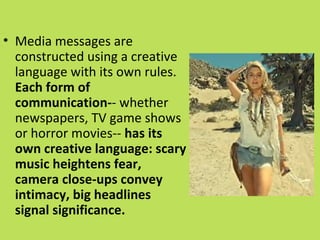
• Media messages are
  constructed using a creative
  language with its own rules.
  Each form of
  communication-- whether
  newspapers, TV game shows
  or horror movies-- has its
  own creative language: scary
  music heightens fear,
  camera close-ups convey
  intimacy, big headlines
  signal significance.
Codes and Conventions in Music
           Videos
• Andrew Goodwin
  – Thought Beats
  – Narrative and Performance (repeatability)
  – Star Image (also Dyer)
  – Relation of visuals to a song (illustration,
    amplification, disjuncture)
  – Technical aspects (camera, editing, effects etc)
Codes and conventions in Music
           Videos
   Carol Vernallis (2001)
• Vernalis’ theory centres around 4 key
  concepts that all relate to the way the music
  video is constructed (how it creates
  meaning). They are:
• 1. Narrative
• 2. Editing
• 3. Camera Movement and framing
• 4. Diegesis
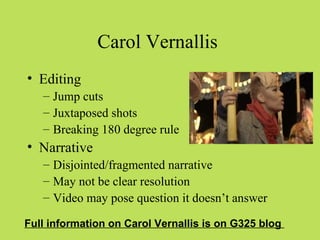
Carol Vernallis
• Editing
   – Jump cuts
   – Juxtaposed shots
   – Breaking 180 degree rule
• Narrative
   – Disjointed/fragmented narrative
   – May not be clear resolution
   – Video may pose question it doesn’t answer

Full information on Carol Vernallis is on G325 blog
Carol Vernallis
     – Camera movement and framing
         • Camera moves in time with the music
         • Close ups and master shots often used

     – Diegesis (the world of the music video)
         •   Diegesis revealed slowly
         •   Character or objects move in time with the music
         •   Some frames more important than others
         •   There may be gaps in the audience’s understanding
             of the diegesis – in time and space,music,
             performance and narrative

Full information on Carol Vernallis is on G325 blog
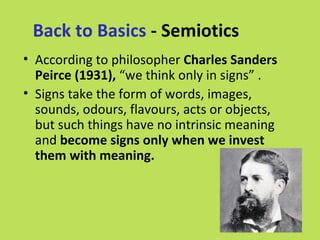
Back to Basics - Semiotics
• According to philosopher Charles Sanders
  Peirce (1931), “we think only in signs” .
• Signs take the form of words, images,
  sounds, odours, flavours, acts or objects,
  but such things have no intrinsic meaning
  and become signs only when we invest
  them with meaning.
• Definition: using ‘media
  language’.
• “Nothing is a sign unless it is
  interpreted as a sign” (Peirce, 1931).
• Anything can be a sign as long as
  someone interprets it as 'signifying'
  something - referring to or standing for
  something other than itself. It is this
  meaningful use of signs which is at the
  heart of the concerns of semiotics.
Basically this essay is a lot
like TV Drama– what is your
  preferred macro meaning
  (your preferred meaning –
Hall, 1980) and how did you
     create it using micro
          elements?
Link?
• Evaluating media language is an
  evaluation of all the micro elements
  and how they have created meaning
  to inform us about genre, narrative,
  representations/ ideology, targeting
  of audiences (through micro
  elements).
• This therefore requires us to use
  semiotic terminology to explain our
  encoding of elements and codes and
  conventions within our texts.
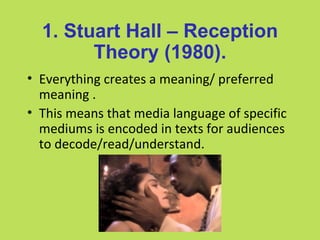
1. Stuart Hall – Reception
        Theory (1980).
• Everything creates a meaning/ preferred
  meaning .
• This means that media language of specific
  mediums is encoded in texts for audiences
  to decode/read/understand.
Task 1.
• Detail what the macro meanings were
  within your text (preferred meanings
  and ideologies behind representations,
  or about genre, narrative).
• What micro signs do you think you
  used in terms of the codes and
  conventions of your medium to create
  meaning? Make a list for each of the
  macro meanings you can think of.
2. Umberto Eco (1981)
• Texts can have open meanings
  (ambiguous, not easy for the audience
  to understand).
• Texts can have closed meaning (easy
  for the audience to understand).
• WHICH ONE IS YOURS? AND WHO IS
  IT AIMED AT?
Task 2.
• Identify how you created an open or
  closed meaning for your audience.
• How did you use the micro elements
  and to create structure and create this
  for your audience?
3. Medium Specific Theory
• With this question it would then be wise
  to identify that you understand the
  meaning of the form you have created:
• 1. Music video – postmodern text
  (Goodwin, 1992 + McDougall, 2009)
• 2. Goodwin – 5 aspects to a music
  video
• 3. Carol Vernallis (2001)
Task 3.
• Using some of the theory – how does
  your product conform to the theorists
  assumptions?
• What meaning is created?
• What other texts have you based this
  on?
Terminology: Charles Sanders
  Pierce (1931) – Three types of
              sign...
• Icon/iconic: a mode in which the signifier is
  perceived as resembling or imitating the
  signified (recognizably looking, sounding,
  feeling, tasting or smelling like it) - being
  similar in possessing some of its qualities:
  e.g. a portrait, a cartoon, a scale-model,
  onomatopoeia, metaphors, 'realistic'
  sounds in 'programme music', sound
  effects in radio drama, a dubbed film
  soundtrack, imitative gestures;
• Index/indexical: a mode in which the signifier
  is not arbitrary but is directly connected in
  some way (physically or causally) to the
  signified - this link can be observed or inferred:
  e.g. 'natural signs' (smoke, thunder, footprints,
  echoes, non-synthetic odours and flavours),
  medical symptoms (pain, a rash, pulse-rate),
  measuring instruments (weathercock,
  thermometer, clock, spirit-level).
• Symbol/symbolic: a mode in which the
  signifier does not resemble the signified but
  which is fundamentally arbitrary or purely
  conventional - so that the relationship must
  be learnt: e.g. language in general (plus
  specific languages, alphabetical letters,
  punctuation marks, words, phrases and
  sentences), numbers, morse code, traffic
  lights, national flags.
Using terminology - Denotation,
Connotation and Myth: Roland
        Barthes (1967)
• In semiotics, denotation and connotation
  are terms describing the relationship
  between the signifier and its signified, and
  an analytic distinction is made between
  two types of signifieds: a denotative
  signified and a connotative signified.
  Meaning includes both denotation and
  connotation. Myth are the ideologies
  behind it.
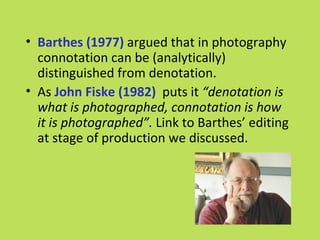
• Barthes (1977) argued that in photography
  connotation can be (analytically)
  distinguished from denotation.
• As John Fiske (1982) puts it “denotation is
  what is photographed, connotation is how
  it is photographed”. Link to Barthes’ editing
  at stage of production we discussed.
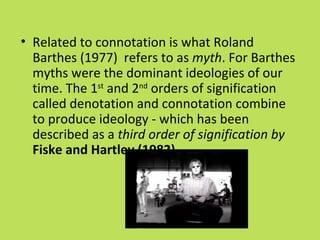
• Related to connotation is what Roland
  Barthes (1977) refers to as myth. For Barthes
  myths were the dominant ideologies of our
  time. The 1st and 2nd orders of signification
  called denotation and connotation combine
  to produce ideology - which has been
  described as a third order of signification by
  Fiske and Hartley (1982).
NOTES: Micro Elements: Mise-
          en-Scene
• Mise-en-scène constitutes the key aspect of
  the pre-production phase of the film and
  can be taken to include all aspects of
  production design and Cinematography.
• Mise-en-Scene creates the diegetic world/
  diegesis - the fictional space and time
  implied by the narrative, i.e. the world in
  which the story takes place.
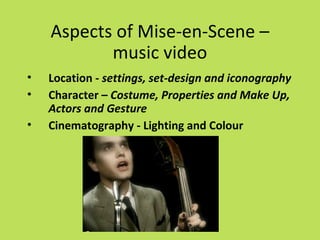
Aspects of Mise-en-Scene –
           music video
•   Location - settings, set-design and iconography
•   Character – Costume, Properties and Make Up,
    Actors and Gesture
•   Cinematography - Lighting and Colour
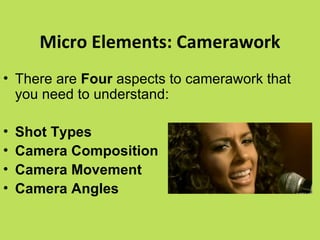
Micro Elements: Camerawork
• There are Four aspects to camerawork that
  you need to understand:

•   Shot Types
•   Camera Composition
•   Camera Movement
•   Camera Angles
Summary
• How does your music video construct
  meaning for the audience?
• Think about
  signs/connotations/ideologies
• Also consider how you used/challenged
  typical codes and conventions of music
  videos to construct meaning? (did you
  play with genre/narrative conventions? )
• If any
  genre/narrative/audience/representation
  theory is applicable then use it!
Essay Question
• Analyse one of your media productions in
  relation to media language.

• Structure
• -Intro
• -P-D-Q format with the focus on the ‘D’
- Aim to use at least 5 theories in your answer.
- For each theory there may be 2-3 examples from your
  production.
• - Conclusion

Media language1

  • 1.
    G235: Critical Perspectives inMedia Theoretical Evaluation of Production 1b) Media Language
  • 2.
    Aims/Objectives • To reinforce the basic media language that create meaning in texts. • To have a basic understanding of how to evaluate your coursework against the media language that you used.
  • 3.
    What is meantby media language? • For moving image, the language of film and television is defined by how camera, editing, sound and mise-en- scene create meaning • Basically, how did you create meaning in your music video (this encompasses narrative, genre, representation and audience)
  • 4.
    Importance of medialanguage • Every medium has its own ‘language’ – or combination of languages – that it uses to communicate meaning. Television, for example, uses verbal and written language as well as the languages of moving images and sound. • We call these ‘languages’ because they use familiar codes and conventions that are generally understood.
  • 5.
    • Media messagesare constructed using a creative language with its own rules. Each form of communication-- whether newspapers, TV game shows or horror movies-- has its own creative language: scary music heightens fear, camera close-ups convey intimacy, big headlines signal significance.
  • 6.
    Codes and Conventionsin Music Videos • Andrew Goodwin – Thought Beats – Narrative and Performance (repeatability) – Star Image (also Dyer) – Relation of visuals to a song (illustration, amplification, disjuncture) – Technical aspects (camera, editing, effects etc)
  • 7.
    Codes and conventionsin Music Videos Carol Vernallis (2001) • Vernalis’ theory centres around 4 key concepts that all relate to the way the music video is constructed (how it creates meaning). They are: • 1. Narrative • 2. Editing • 3. Camera Movement and framing • 4. Diegesis
  • 8.
    Carol Vernallis • Editing – Jump cuts – Juxtaposed shots – Breaking 180 degree rule • Narrative – Disjointed/fragmented narrative – May not be clear resolution – Video may pose question it doesn’t answer Full information on Carol Vernallis is on G325 blog
  • 9.
    Carol Vernallis – Camera movement and framing • Camera moves in time with the music • Close ups and master shots often used – Diegesis (the world of the music video) • Diegesis revealed slowly • Character or objects move in time with the music • Some frames more important than others • There may be gaps in the audience’s understanding of the diegesis – in time and space,music, performance and narrative Full information on Carol Vernallis is on G325 blog
  • 10.
    Back to Basics- Semiotics • According to philosopher Charles Sanders Peirce (1931), “we think only in signs” . • Signs take the form of words, images, sounds, odours, flavours, acts or objects, but such things have no intrinsic meaning and become signs only when we invest them with meaning.
  • 11.
    • Definition: using‘media language’. • “Nothing is a sign unless it is interpreted as a sign” (Peirce, 1931). • Anything can be a sign as long as someone interprets it as 'signifying' something - referring to or standing for something other than itself. It is this meaningful use of signs which is at the heart of the concerns of semiotics.
  • 12.
    Basically this essayis a lot like TV Drama– what is your preferred macro meaning (your preferred meaning – Hall, 1980) and how did you create it using micro elements?
  • 13.
    Link? • Evaluating medialanguage is an evaluation of all the micro elements and how they have created meaning to inform us about genre, narrative, representations/ ideology, targeting of audiences (through micro elements). • This therefore requires us to use semiotic terminology to explain our encoding of elements and codes and conventions within our texts.
  • 14.
    1. Stuart Hall– Reception Theory (1980). • Everything creates a meaning/ preferred meaning . • This means that media language of specific mediums is encoded in texts for audiences to decode/read/understand.
  • 15.
    Task 1. • Detailwhat the macro meanings were within your text (preferred meanings and ideologies behind representations, or about genre, narrative). • What micro signs do you think you used in terms of the codes and conventions of your medium to create meaning? Make a list for each of the macro meanings you can think of.
  • 16.
    2. Umberto Eco(1981) • Texts can have open meanings (ambiguous, not easy for the audience to understand). • Texts can have closed meaning (easy for the audience to understand). • WHICH ONE IS YOURS? AND WHO IS IT AIMED AT?
  • 17.
    Task 2. • Identifyhow you created an open or closed meaning for your audience. • How did you use the micro elements and to create structure and create this for your audience?
  • 18.
    3. Medium SpecificTheory • With this question it would then be wise to identify that you understand the meaning of the form you have created: • 1. Music video – postmodern text (Goodwin, 1992 + McDougall, 2009) • 2. Goodwin – 5 aspects to a music video • 3. Carol Vernallis (2001)
  • 19.
    Task 3. • Usingsome of the theory – how does your product conform to the theorists assumptions? • What meaning is created? • What other texts have you based this on?
  • 20.
    Terminology: Charles Sanders Pierce (1931) – Three types of sign... • Icon/iconic: a mode in which the signifier is perceived as resembling or imitating the signified (recognizably looking, sounding, feeling, tasting or smelling like it) - being similar in possessing some of its qualities: e.g. a portrait, a cartoon, a scale-model, onomatopoeia, metaphors, 'realistic' sounds in 'programme music', sound effects in radio drama, a dubbed film soundtrack, imitative gestures;
  • 21.
    • Index/indexical: amode in which the signifier is not arbitrary but is directly connected in some way (physically or causally) to the signified - this link can be observed or inferred: e.g. 'natural signs' (smoke, thunder, footprints, echoes, non-synthetic odours and flavours), medical symptoms (pain, a rash, pulse-rate), measuring instruments (weathercock, thermometer, clock, spirit-level).
  • 22.
    • Symbol/symbolic: amode in which the signifier does not resemble the signified but which is fundamentally arbitrary or purely conventional - so that the relationship must be learnt: e.g. language in general (plus specific languages, alphabetical letters, punctuation marks, words, phrases and sentences), numbers, morse code, traffic lights, national flags.
  • 23.
    Using terminology -Denotation, Connotation and Myth: Roland Barthes (1967) • In semiotics, denotation and connotation are terms describing the relationship between the signifier and its signified, and an analytic distinction is made between two types of signifieds: a denotative signified and a connotative signified. Meaning includes both denotation and connotation. Myth are the ideologies behind it.
  • 24.
    • Barthes (1977)argued that in photography connotation can be (analytically) distinguished from denotation. • As John Fiske (1982) puts it “denotation is what is photographed, connotation is how it is photographed”. Link to Barthes’ editing at stage of production we discussed.
  • 25.
    • Related toconnotation is what Roland Barthes (1977) refers to as myth. For Barthes myths were the dominant ideologies of our time. The 1st and 2nd orders of signification called denotation and connotation combine to produce ideology - which has been described as a third order of signification by Fiske and Hartley (1982).
  • 26.
    NOTES: Micro Elements:Mise- en-Scene • Mise-en-scène constitutes the key aspect of the pre-production phase of the film and can be taken to include all aspects of production design and Cinematography. • Mise-en-Scene creates the diegetic world/ diegesis - the fictional space and time implied by the narrative, i.e. the world in which the story takes place.
  • 27.
    Aspects of Mise-en-Scene– music video • Location - settings, set-design and iconography • Character – Costume, Properties and Make Up, Actors and Gesture • Cinematography - Lighting and Colour
  • 28.
    Micro Elements: Camerawork •There are Four aspects to camerawork that you need to understand: • Shot Types • Camera Composition • Camera Movement • Camera Angles
  • 29.
    Summary • How doesyour music video construct meaning for the audience? • Think about signs/connotations/ideologies • Also consider how you used/challenged typical codes and conventions of music videos to construct meaning? (did you play with genre/narrative conventions? ) • If any genre/narrative/audience/representation theory is applicable then use it!
  • 30.
    Essay Question • Analyseone of your media productions in relation to media language. • Structure • -Intro • -P-D-Q format with the focus on the ‘D’ - Aim to use at least 5 theories in your answer. - For each theory there may be 2-3 examples from your production. • - Conclusion