
2 0 1 9 — M U T A T I O N S — 2 0 2 0 — P R O J E C T S A N D H O R I Z O N S
2019 — Mutations — 2020
PROJECTS AND HORIZONS
2 0 1 9 — M U T A T I O N S — 2 0 2 0 — P R O J E C T S A N D H O R I Z O N S
n 2019, the environment became the French
people’s leading concern. Over the past few
months, the appeals and initiatives heard in suc-
cession have considerably raised awareness in the
population and economic players. While the IPCC
reports continue to confirm, year after year, the
diagnosis laid out by scientists, broad swathes of
society are now taking up the issue.
The first are the students: with their “Manifesto
for an Ecological Awakening“, they are determined
to influence businesses’ strategies. Secondly,
the citizens: as they take to the streets in de-
monstrations in all regions of the world, France
has inaugurated the Citizen Convention for the
Climate, an original exercise to chart the course
for an ecological transition that takes social issues
into account. Political leaders, too, have taken
measures, through such initiatives as the Climate
Plan for the European Union, which must support
the Member States in implementing their policies.
Last but not least, companies, through their volun-
tary commitments, are taking the road to carbon
neutrality by 2050, and are calling attention to the
risks in the event of inaction.
Because it concerns systemic issues and an
inescapable, irresistible transition – if we are to
continue enjoying the same standard of living –
this dynamic is an integral part of the decade now
opening. It will see companies take on a funda-
mental role, as they will be asked to shape, build
and implement solutions for territories, cities and
inhabitants.
It is thus only natural that the challenge of the
ecological transition has become a structuring
component for all of Leonard’s activities.
Through our ability to keep watch and call atten-
tion to what matters, we give a voice to those who
think and make the future of cities and infrastruc-
tures; through our foresight activities, we bring
perspectives into alignment and etch out enthu-
sing futures; through our innovative programmes,
we support entrepreneurs and innovators, to build
together the solutions for which the situation calls.
This yearbook  is a retrospective exercise; it offers a
glimpse of our achievements over the past months
- intrapreneurial projects, start-up programmes,
experiments or prospective explorations, to list
only a few - as well as the transformations un-
derway in the businesses and markets of cities and
infrastructures (innovations, new uses and new
expectations). It gives a feel for the dynamic in the
Leonard community and the abundance of pro-
jects it is building. And more than anything else,
this  yearbook  has an aim for the period ahead:
to call upon the players of our future cities and
infrastructures, inviting them to contribute to the
demanding but thrilling adventure which Leonard
has set in motion.
I hope you will become convinced of this as you
read on.
Something
changed in 2019
3
By Julien Villalongue,
Director of Leonard
I
2 0 1 9 — M U T A T I O N S — 2 0 2 0 — P R O J E C T S A N D H O R I Z O N SB A C K T O 2 0 1 9
2019: 12 dates to build
the future of cities
and infrastructures
16 APRIL
After the fire at the Cathedral of
Notre-Dame de Paris, how is the
reconstruction shaping up?
Inthenightfrom15to16April,Notre-Damede
Parislostitsmedievalroofandtheemblematic
spire created by Eugène Viollet-le-Duc in the
19th
century. The rest of the weakened buil-
ding was saved by the fire-fighters. And what
now? “We will rebuild Notre-Dame“, Emmanuel
Macron exclaimed from the outset. Support
pouredin–VINCIofferingaskillssponsorship.
But towards what reconstruction? The Venice
CharterandtheHeritageCodesetaframework
that leaves room for interpretation: recons-
truction true to the original, modernisation,
etc. And discussion is heated. One thing is for
sure: twenty-first-century technology will play
adecisivepart.Droneinspectionsarerounding
out the full scan of the structure, carried out
in 2010 by historian Andrew Tallon, also sup-
plemented by a BIM model of the cathedral
by specialist ArtGP. Acoustic modelling has
also been summoned: the concert recordings
madein2013havebeenusedtoproducea3D
acoustic model of the building, which will be
valuable in understanding the geometric and
material choices made.
28 MAY
The Paris ring road is seeking a new
destiny
In its report on the future of the Paris
Ring Road, the Paris Council’s Information
and Assessment Task Force recommends
reducing the maximum speed to 50 km/h,
drastically downscaling traffic, freeing up
one lane for public transport, etc. All of
these suggestions serve a single idea: to
turn these 35 kilometres of express lanes
from a highly-polluting saturated ring road
that cuts the hypercentre off from the other
areas of Grand Paris into an urban boulevard,
open to each element of the city. With the
municipal elections just around the corner,
there is full consensus around the need to
adapt this automotive infrastructure to the
environmental and urbanistic needs of the
Paris metropolis. The endeavour also fits into
an equally transformative vision, on the scale
ofGrandParis.Inresponsetotheinternational
consultation organised by the Greater Paris
Metropolitan Forum, Leonard and its partners,
with the “New Deal for Grand Paris Express
Lanes“ project, propose to reduce traffic on
the city's expressways by 50% by 2050, while
moving more passengers on dedicated public
transport routes.
6
25 SEPTEMBER
The world’s largest airport terminal
opens to the public in China
With 100 million passengers per year,
Beijing Airport (2nd world-wide in terms of
international traffic) was starting to feel tight.
Enter Terminal 1 of the new Daixin airport,
set south of the capital city and offering
capacity for 45 million passengers per year.
The complex, the work of ADP Engineering,
architect Zaha Hadid and the Beijing Institute
of Architectural Design, was completed in
4 years. A record-breaking feat, in which a
700,000 square metre single-roofed building
(with a 5km facade), 4 runways and 268 air-
craft parking spaces were seemingly conjured
up out of nowhere, smack in the middle of
the countryside. To reduce passenger journey
times, the various terminals are served ver-
tically on 7 levels, limiting the distance from
the centre of the terminal to a boarding gate
toamaximumof600metres.Anunderground
metro and train station services the city
centre in about twenty minutes.
27 SEPTEMBER
The French Senate says yes to expanded
producer responsibility in construction
The Bill “against Waste and for a Circular
Economy“,passedatfirstreadingintheSenate,
provides for six new sectors carrying extended
producerresponsibility(EPR).Constructionisone
ofthem.Whathangsinthebalance?Animpro-
ved waste recovery rate. In 2014, the said rate
reached 61% (covering inert waste), according
to Ademe figures – bearing in mind that 41.6
million units of waste were produced in total in
2018.AfteritsfinalvotebytheParliament, ifthe
NationalAssemblyapprovesthetext,thesector
will be able to count on free collection of its
sortedandrecoverablesitewaste,fromJanuary
2022 on. In exchange, however, producers will
have to pay an eco-tax. Eco-organisations,
producers and artisan sector representatives
came together to discuss possible procedures.
WasteMarketPlace,astart-updevelopedbythe
Leonard Intrapreneurs programme, is pushing
theissueforward:alreadytoday,itconnectssite
managers up with specialised management
centres, simplifying waste management and
reporting,and,intheprocess,guaranteeing15%
savingsonaverage.In2019,WasteMarketplace
processed 20,000 tonnes of waste, enabling an
80% recovery rate.
7
2 0 1 9 — M U T A T I O N S — 2 0 2 0 — P R O J E C T S A N D H O R I Z O N S
30 SEPTEMBER
Coworking unicorn WeWork makes a
failed IPO
Initially geared at the self-employed, but
now popular with large corporations, this
co-working operator has emerged as one of
the more compelling responses to changes
in the working world today. WeWork, a U.S.
unicorn financed by such players as SoftBank,
promisedtousheritintoanewera,combining
cutting-edge technology and high levels of
service. However, the dizzying promises and
visions outlined by its founder and CEO, the
exuberant Adam Neumann, combined with
his opaque management practices, ultimately
turned off investors, alarmed by the actual
results and prospects announced by the com-
pany. The failed float in any case offers an idea
of the limitations of an otherwise extremely
dynamic sector... and thus one likely to leave
heads spinning.
9 OCTOBER
The Île-de-France Region launches its
MaaS project
In 2020, Île-de-France Mobilités intends
to offer passengers a one-stop application
for planning and paying for their journey,
including multiple transport options: public
transport, bikes, taxis, VTC, carpooling, shared
vehicles, etc.). According to the Île-de-France
transport authority, this “Mobility as a Service“
(MaaS) solution will require the creation of a
“neutral and open“ multi-modal information
platform. The RATP could become the first
operator to test-run a “MaaX“ (mobility as an
experience) offer, open to 2,000 Île-de-France
residents, and including a dozen mobility
service providers.
8
B A C K T O 2 0 1 9
29 OCTOBER
In Venice, aqua alta puts inhabitants
and heritage to the test
At the Punta della Salute observation station,
the water had reached 156 cm. A level unseen
since December 2008. Already at that time,
the fragility of “La Serenissima“, which is
submerged when the high tides crossed
the 3 natural passes of the lagoon, stirred
regrets that the 78 mobile dykes of the MOSE
(ModuloSperimentaleElettromeccanico) project,
designed to protect more than 15% of the
city in the event of significant flooding, were
not yet operational. Alas, in 2019, the project
was still far from complete, leaving the city
to contend alone with the inexorable rising
waters. More than ever this year, the resilience
of Venice and the Venetians was put to the
test.
1ER NOVEMBER
New Delhi holds its breath
In some neighbourhoods, air pollution is 20
times the maximum allowed by the World
Health Organization. New Delhi authorities
have declared a health emergency in the
Indian capital. Construction sites have been
halted, traffic is limited and thousands of
schools are closed. Other Indian cities are
regularly hit by critical air pollution episodes:
the country is said to be home to 15 of the
20 most polluted cities in the world. Burning,
exhaust gases and construction site dusts
are the main causes. The authorities have
developed an extensive metro network, a
ring highway that is supposed to limit heavy
goods vehicle traffic in the city centre; taxis
and buses are asked to do without diesel,
and alternating traffic is regularly used. All
of these are tremendous efforts, but still not
commensurate with the growth of India’s
metropolises and economy.
9
2 0 1 9 — M U T A T I O N S — 2 0 2 0 — P R O J E C T S A N D H O R I Z O N S
3 NOVEMBER
Official launch of the Olympic Games
construction site
In Saint-Ouen (Seine-Saint-Denis), the French
Prime Minister officially opened the construc-
tion of the 2024 Olympic and Paralympic
Games village, which will host more than
15,000 athletes on 52 hectares. What made
the difference between Paris and the other
prospective host cities? Its commitment
to prioritise energy- and material-efficient
projects (respecting the carbon neutrality
pathway by 2050), design reusable struc-
tures, develop sustainable mobility solutions
benefiting the inhabitants of the metropolis,
and make developments conducive to the
protection of biodiversity. After the Games,
the Village will be converted into housing,
shops, amenities and green spaces.
7 NOVEMBER
The “Triangle of Gonesse“ will not be
home to EuropaCity
The leisure and business centre project, which
was supposed to welcome 30 million visitors
a year from 2027 in the Val d’Oise, will not
see the light of day. Despite promises of job
creation for this disadvantaged area and
pledges by developers to fully compensate for
the artificialised land, the French Presidency
ultimately came to the realisation that the
structure would have become a symbol
of mass consumption in conflict with the
aspirations of the time. The existing 80 hec-
tares of cereal crops will thus not give way
to a complex of leisure facilities, hotels and
shops. Their fate is still uncertain, however,
and depends on the plans for the commercial
activity zone of which EuropaCity was the
figurehead. The decision to forego this very
large project could also have an impact on
the route of the future Line 17 of the Grand
Paris metro and the fate of Gonesse station,
scheduled to begin operating in 2027.
10
B A C K T O 2 0 1 9
7 NOVEMBER
23,000 tonnes of concrete ready to
accommodate nuclear fusion
In Cadarache (Bouches-du-Rhône), the shell
work on the ITER project has been completed.
In 5 years’ time, VINCI and its partners have
managed to finish the infrastructure that will
house a “tokamak“, the revolutionary tore-
shaped reactor capable of encasing plasma
heated to 150 million degrees, resulting
from the fusion of hydrogen nuclei. The 35
countries championing this very ambitious
undertaking plan to conduct the first reactor
tests in 2025. Just what is their aim? To prove
that it is possible to produce more electrical
power (500 MW) than is needed to “switch
on“ the plasma (50W).
15 NOVEMBER
Sidewalk Labs details its smart
neighbourhood for Toronto
Across an expanse of just under 5 hectares,
the Toronto docks are the most advanced
testing ground for Sidewalk Labs, Alphabet's
smart city branch. The neighbourhood
is intended as a model of energy savings,
waste management, smooth transport and
intelligent services, all thanks to digital tech-
nology. Waterfront Toronto, the consortium
representing the local authorities, managed to
have Sidewalk Labs scale back its ambitions -
the area in question, in particular, was reduced
from 77 to 5 hectares - and has required that
it provide guarantees on the preservation of
citizens’ personal data. In its new version,
Sidewalk Labs confirms that the “sensitive“
and active infrastructure will help preserve
the environment while improving quality of
living.
11
2 0 1 9 — M U T A T I O N S — 2 0 2 0 — P R O J E C T S A N D H O R I Z O N SS U M M A R Y
12
Realisations
14
The intrapreneurs fast
track: looking to make an
impact
20
Start-up and scale-up,
something for everyone
30
Artificial intelligence
finds its way into jobs
with the AI program
34
“The future of
mobilities dwells on the
infrastructure“
38
New Deal: putting
express lanes to work
for the mobilities of the
future
40
Building Beyond #2:
an inspiring journey
across the scales of cities
and territories
1
10
2 88
Predictions
42
Trans-
formations
3
11
44
The words that will have
us talking tomorrow
48
The environment, inviting
itself into every equation
54
Mutant cities: assemblies
and infrastructures adapt
62
Work 3.0: the great
metamorphosis of
locations and links
68
When the future makes
use of traditional
materials
74
Open data and AI: the
nervous system of smart
cities is taking shape
80
Construction Tech:
machines, invaluable
accomplices on
construction sites
2 0 1 9 — M U T A T I O N S — 2 0 2 0 — P R O J E C T S A N D H O R I Z O N S
Realisa-
tions
1
Illustration :RaulAguiar
2 0 1 9 — M U T A T I O N S — 2 0 2 0 — P R O J E C T S A N D H O R I Z O N S
The intrapreneurs fast
track: looking to make
an impact
14
For the 4th
year, Leonard's Intrapreneurs
fast track is tapping the creativity of VINCI
company employees. In 2020, 9 projects
went into incubation, to put their viability
and potential for impact to the test.
Fourmonthsofincubationandfourmonthsof
acceleration: that’s how much time Leonard
gives Intrapraneur fast track participants to
turn an idea into a viable project and make
the entrepreneurial spirit and methods their
own. Shortly after being admitted to the
programme, the projects are exposed to
feedback and analysis from their peers and
mentors, during “rush week“. After the initial
4-month incubation period, an acceleration
committee steps in to select the projects that
willbeendowedwiththeresourcesneededto
quickly reach operational capacity. With each
new year, the programme establishes itself all
the more surely as a powerful springboard
for the projects and career paths of talented
people with innovative solutions, in all the
Group’s businesses.
On 10 September 2019, the
selection committee picked 9 projects from
70 applications.
Projects in the making
7 projects connected with the Group’s
businesses were selected from more than
70 applications to receive support during the
incubation phase. This 4th
graduating class
will be dedicated in particular to issues in
and around decarbonisation, the protection
of water resources and the circular economy.
A project with a social and solidarity-building
dimensionandultimatelyintendedtobecome
Leonard’s aim is
to support projects
led by employees
who are committed
to a carbon-neutral
approach or with a
strong social impact.
R E A L I S A T I O N S
15
a social joint venture rounds out the year’s
undertakings. Operating under the name
“La ressourcerie du BTP“, it will serve as a
solution to facilitate diagnostics, clean-up
and material recovery after construction site
projects, giving priority to participants in
employment integration programmes.
The new offers deployed via
the intrapreneurs fast track
will hit the market in 2020
One of the projects that has completed the
acceleration phase, “Synapse“, by Alexandre
Cousin, will offer digital automation and
optimisation tools to the market from as early
as 2020, using “generative design“ to solve
engineering problems. Synapse’s solutions
make it possible to reduce the environmen-
tal footprint of buildings in any number of
contexts, from the installation of foundations
to outfitting hospitals or accommodations,
and determining site boundaries.
“SunMind“,aprojectchampionedbyMaxime
Varin and Barbara Kemmat, helps develop
and finance photovoltaic power stations in
prosumer mode, and provides users with
competitive electricity. If you want to “unlock
your solar potential“, wait no longer: contact
them at www.sunmind.co!
Lastly, the social joint venture “TIM“, created
by VINCI Facilities and Vitamin-t, will
enable any company to request technical
maintenance skills. Services will be provided
by participants in an employment integration
programme.
These projects supplement the portfolio of
projects supported by Leonard via VINCI’s
intrapreneurs fast track:
Resallience, the design office dedicated to
improvinginfrastructureresiliencetoclimate
change (resallience.com)
Waste MarketPlace, an app that enables any
sitemanagertoquicklyorderaskipforwaste
disposal (wastemarketplace.fr)
Rehalib offers interactive virtual tours of
accommodations (rehalib.fr)
AVUS, the 3D modelling platform for viewing
underground networks in augmented reality
(avus.tech)
Trust [In]: the digital recruitment firm
integrated into the VINCI Group, which is
launching an offer dedicated to high-level
athletes in 2020.
2017-2019: a look back
3 classes of intrapreneurs
32 projects supported
8 new business units or activities
created
32 internal and 32 external men-
tors mobilised
2 0 1 9 — M U T A T I O N S — 2 0 2 0 — P R O J E C T S A N D H O R I Z O N S
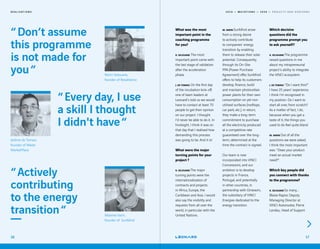
“ Don’t assume
this programme
is not made for
you “
“ Every day, I use
a skill I thought
I didn't have “
“ Actively
contributing
to the energy
transition “
16
Karim Selouane,
founder of Resallience
Jérôme de Tomasi,
founder of Waste
MarketPlace
Maxime Varin,
founder of SunMind
R E A L I S A T I O N S
What was the most
important point in the
coaching programme
for you?
K. SELOUANE The most
important point came with
the last stage of validation
after the acceleration
phase.
J. DE TOMASI On the first day
of the incubation kick-off,
one of team leaders at
Leonard's told us we would
have to contact at least 70
people to get their opinion
on our project. I thought
I’d never be able to do it. In
hindsight, I think it was on
that day that I realised how
demanding this process
was going to be. And it is!
What were the major
turning points for your
project ?
K. SELOUANE The major
turning points were the
internationalisation of
contracts and projects
in Africa, Europe, the
Caribbean and Asia. I would
also say the visibility and
requests from all over the
world, in particular with the
United Nations.
M. VARIN SunMind arose
from a strong desire
to actively contribute
to companies' energy
transition by enabling
them to release their solar
potential. Consequently,
through its On-Site
PPA (Power Purchase
Agreement) offer, SunMind
offers to help its customers
develop, finance, build
and maintain photovoltaic
power plants for their own
consumption on yet non-
utilised surfaces (rooftops,
car park, etc.); in return,
they make a long-term
commitment to purchase
all the electricity produced
at a competitive rate
guaranteed over the long-
term, determined at the
time the contract is signed.
Our team is now
incorporated into VINCI
Concessions, and our
ambition is to develop
projects in France,
Portugal, and potentially
in other countries, in
partnership with Omexom,
the subsidiary of VINCI
Energies dedicated to the
energy transition.
17
Which decisive
questions did the
programme prompt you
to ask yourself?
K. SELOUANE The programme
raised questions in me
about my intrapreneurial
project’s ability to integrate
the VINCI ecosystem.
J. DE TOMASI “Do I want this?“
I have 25 years’ experience.
I think I’m recognised in
my position. Do I want to
start all over, from scratch?
As a matter of fact, I do,
because when you get a
taste of it, the things you
used to do feel quite bland.
M. VARIN Out of all the
questions we were asked,
I think the most important
was: “Does your product
meet an actual market
need?“.
Which key people did
you connect with thanks
to the programme?
K. SELOUANE So many...:
Blaise Rapior, Deputy
Managing Director at
VINCI Autoroutes; Pierre
Landau, Head of Support
2 0 1 9 — M U T A T I O N S — 2 0 2 0 — P R O J E C T S A N D H O R I Z O N S
18
R E A L I S A T I O N S
prevents the solitude of
the entrepreneur and that
changes everything.
M. VARIN The programme
first enabled me to set out
on this entrepreneurial
adventure: “Go forward,
and the road will rise to
meet you“, as the proverb
goes. Leonard reaches out
to us to take the first step,
then acts as a safeguard,
so that we don’t lose our
way once this first step has
been taken. Leonard also
gave us the chance us to
meet a large number of
start-ups. My take-away
from that experience is that
most successful start-ups
- beyond the “original good
idea“ - are the ones that
are able to execute their
roadmap most effectively.
How did it benefit your
project?
K. SELOUANE It gave it
legitimacy. I was able to
fully develop a project that
was both technical and
business-oriented, yet
not necessarily part of the
Group’s strategy.
Group’s various subsidiaries,
whom I would certainly not
have met without Leonard.
What did the
programme enable you
to do personally?
K. SELOUANE The programme
gave me the chance to
meet with counterparts
from totally different
projects, backgrounds and
outlooks, driven by the
same desire to put together
ideas and projects for the
Group that really matter
to them and take them all
the way.
J. DE TOMASI The programme
made me realise that I
could do something other
than what I knew how
to do. I am cultivating
contacts and networking
like never before. Every
day, or almost, I use a skill
I thought I didn't have.
And as far as the project is
concerned, the programme
is a great accelerator. I
would never have reached
this point without the
method we were taught at
the outset, which was very
important, and the support
we received afterwards. It
and Prospective at
VINCI Autoroutes; Jean-
Serge Boissavit, VINCI
Construction Development
Director; Jérôme Stubler,
President of VINCI
Construction, with the
close assistance of Nathalie
Martin Sorvillo, Head of
Innovative Programs at
Leonard.
J. DE TOMASI An external
mentor, very remote (or so
I thought) from my project.
Yet she is the one who told
me I needed to simplify,
and made me realise that
was vital. The programme
also helped me work up
the guts to approach VINCI
CEO Xavier Huillard on the
topic of intrapreneurship.
I talked with him briefly,
twice, and his response
was the same both times:
doggedness. He’s so right!
M. VARIN The programme
put me in contact with
some key people at VINCI
Energies, particularly within
the Omexom brand, who
are now key partners to
SunMind. More generally
speaking, the programme
gave me the chance to meet
many employees from the
19
How has your everyday
life as a VINCI employee
changed?
K. SELOUANE I'm now in
interaction with an
extremely diverse and
varied range of entity
managers, people from all
VINCI entities, in France
and internationally.
J. DE TOMASI Everything has
changed: I used to head
of a team of 50 people, I
started alone and there
are 5 of us, counting the
trainees a year later. I used
to be dedicated to one task
in an organisation. I am
now a jack-of-all-trades -
and when it is no one’s job,
which happens every day,
it’s mine.
M. VARIN I did my
acceleration period, splitting
my time between the
creation of SunMind and
my job as Project Manager
in the Development
Department at VCCS, 50/50.
What is the next key
stage in your project?
K. SELOUANE The next stage,
for Resallience, is to create
a legal entity within VINCI
in order to speed up its
development.
J. DE TOMASI External
fund-raising to finance
national development and
see VINCI Construction
become a minority
shareholder.
M. VARIN We have several
next steps: we want to
finalise “permitting“ phase
of our first project this year,
to structure a dedicated
team, and speed up our
commercial development
on our prosumer offer
using third-party financing
(On-Site PPA). We also
want to build a range
of “pooled solar power
plants“: in practical terms,
this involves developing
large-scale ground-based
power plants, the entire
production of which will be
sold to companies over the
long term through “Off-Site
Corporate PPA“. Though
these types of contracts
are still in their infancy in
France, we believe that
they will actively contribute
to the strong growth
expected in photovoltaics
in the coming years.
What would you say to a
VINCI employee who is
hesitant about applying
for the programme?
K. SELOUANE I would say,
“Think through every
aspect of your project,
consider the business
issues, then contact the
Leonard team to talk about
them. And whatever the
case, don't assume that the
programme is not for you.“
J. DE TOMASI Don’t hesitate,
the experience is fulfilling,
refreshing, and even often
unsettling and thrilling, but
boy does it feel good!
M. VARIN I would say, “Grab
a sheet of paper as soon
you have finished reading
this yearbook, and write a
few lines about the project
you have in you, but have
not yet formally structured,
and give it a name“. Then,
I would add, “Talk about
this to people around you
tomorrow, and document
your idea for a few days“. If
after all that, the person is
still confident in the idea, I
would say, “Go apply for the
intrapreneurs fast track!“
2 0 1 9 — M U T A T I O N S — 2 0 2 0 — P R O J E C T S A N D H O R I Z O N S
20
R E A L I S A T I O N S
Start-up and scale-up,
something for everyone
This autumn, Leonard launched the
first European accelerator dedicated to
start-ups and scale-ups specialised in
construction, mobility, real estate, retail,
sustainable and smart cities to bring out
the European entrepreneurial leaders of
tomorrow.
Starting from 9 December, Leonard hosted
6 “early stage“ start-ups as part of its SEED
programme. They benefit from:
tailored support to speed up their business
and in particular the assistance of the Centre
for Professional Development at Stanford
University,
a network of mentors and experts selec-
ted specially for their ability to foster the
businesses’ development,
contactswithemployeesofVINCIcompanies.
One week later, 11 companies joined the
CATALYST programme, aimed at speeding up
cooperation between VINCI and start-ups
or scale-ups in the commercial deployment
phase. They will benefit from:
a preferred contact person on the Leonard
teamtointeractwithVINCIentitiesfromfirst
contact up to the contract signature,
privileged access to VINCI decision-makers,
integration into the Leonard event cycle,
for international start-ups, easier access
conditions to the French and European
markets.
Leonarddrewupitsselectionwiththesupport
of its investment, institutional and academic
partners in France and abroad, particularly in
Spain, Germany, the United Kingdom, Canada
and the United States, all throughout 2019.
21
An incubator backed
by a major: is this the
formula which the
construction, real estate
and energy markets
need today, to take on
the challenges of our
time?
Disruptive innovations
are emerging more and
more regularly at the
initiative of start-ups in
VINCI's historic business
lines - a phenomenon
that had been observed
in the energy sector for
many years, but which
until very recently was
very infrequent in the real
estate or construction
sectors. What is striking
today is the explosion in
the number of start-ups
that create solutions for
the planning, construction
and operation of buildings
or infrastructures. Using
ConTech (technology
construction) as an
example, a sector focused
on the constructive
process, global investment
doubled from 2017 to
2018 to more than $6
billion and is expected
to exceed $10 billion in
2019. The programmes
supported by Leonard help
capture and deploy these
innovations, whether they
come from our employees
or from start-ups outside
the Group.
What motivated the
creation of the SEED and
CATALYST programmes?
Leonard, since its creation,
has been working to detect,
support and deploy start-
ups external to the Group.
The SEED and CATALYST
programmes were
designed to lend structure
respectively around a
start-up accelerator in the
start-up phase, with SEED,
and around a collaboration
programme for start-ups in
commercial deployment,
with CATALYST.
“ Breakthrough innovations
are emerging on our
markets “
Guillaume Bazouin,
Open Innovation  Startups
at Leonard
2 0 1 9 — M U T A T I O N S — 2 0 2 0 — P R O J E C T S A N D H O R I Z O N S
22
R E A L I S A T I O N S
How are the
participating start-ups
selected?
More than 400 start-
ups around the world
submitted their
applications to be part
of the first SEED and
CATALYST programmes.
Leonard’s teams first
assessed the quality of
the candidate start-ups,
focusing on their viability,
the quality of their team,
their level of maturity and
the robustness of their
financing. Thereafter, the
selection was finalised on
the basis of discussions
with a wide range of Group
specialists, who enabled us
to determine how well the
proposed projects would
apply to our businesses.
What are the ties
between these two
programmes and the
Leonard Intrapreneurs
fast track?
Through intrapreneurship,
any Group employee can
come up with a business
project and ultimately
bring it to life, in a new
undertaking. Very often,
the subjects identified by
our intrapreneurs are also
identified by start-ups
outside the Group (and vice
versa). When this kind of
“co-emergence“ occurs,
it is also a good indicator
of how relevant an idea is.
Each overlap denotes an
opportunity for internal/
external collaboration
and co-developments to
be explored in order to
maximise the chances of
a breakthrough innovation
making it to the market. And
if you lend any credence
to Thomas Edison, genius
is one per cent inspiration
and ninety-nine per cent
perspiration...
What are the features
specific to SEED and
CATALYST, compared
to other incubation
programmes?
The bedrock with this
type of programme is the
quality of the sourcing, in
other words, the offer’s
attractiveness. To be
competitive within the
multitude of accelerators,
incubators, start-ups and
the like, the offer must be
clear and differentiated.
With SEED, we enable
recently-formed start-ups
to validate their value
proposition with VINCI
employees who could
become their customers
in the future. We offer
entrepreneurship training
in partnership with
Stanford University in
California to prepare them
as best possible for their
first fund-raising exercise,
and we host them for six
months on our premises.
Each start-up receives
over €30,000 to support
its first months of growth.
Leonard ups the value of its
programme by making an
equity investment in each
SEED start-up.
CATALYST, in contrast, is not
an investment programme,
but a support programme
for start-ups, scale-ups or
SMEs that develop relevant,
mature and scalable offers
for the VINCI Group. The
start-ups that we target are
really in need of a player
that knows how to help
them build their networks
and successfully move
through those first stages
of interaction, with the
right players, and within
a Group as decentralized
as ours. We put the keys
in their hands, and thus
enable them to save
valuable time.
What are the benefits for
the start-ups receiving
support? And for VINCI?
The SEED programme
helps anchor VINCI Group
right at the heart of the
ecosystem of new players
now inventing the future of
cities and infrastructures.
We fill a gap on the global
market with an offer that
enables early-stage start-
ups to put their offers to the
test with our operational
teams, before they attempt
their first fundraising. These
start-ups have no exclusive
ties to VINCI, but will have
grown with us - and we
with them.
As to the CATALYST
programme, its aim is to
speed up and streamline
the launch of partnerships
between start-ups and the
VINCI Group. For VINCI, it
means access to the best
products and services
developed by start-ups
anywhere in the world, to
enhance our own offers or
develop new ones.
What are the two
programmes’ objectives
for this year?
The aim for 2019 was
indeed to launch these
programmes. In 2020, the
aim will be to show traction
externally, with the start-
ups, and internally, with our
employees.
For SEED, this traction will
be achieved if the start-ups
we support manage to
raise funds from venture
capital investment funds to
continue their adventure.
For CATALYST, it will be
about showing that the
products and services
supported by the start-ups
entering the programme
are widely adopted by our
employees. On the scale of
the CAC40, less than 5% of
pilot projects with a start-up
ultimately give rise to a
long-term relationship. With
CATALYST, we want to boost
that success rate to 50%!
23
Disruptive innovations are
emerging more and more
regularly at the initiative
of start-ups in VINCI's historic
business lines
2 0 1 9 — M U T A T I O N S — 2 0 2 0 — P R O J E C T S A N D H O R I Z O N S
24
R E A L I S A T I O N S
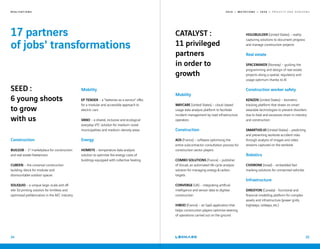
SEED :
6 young shoots
to grow
with us
Construction
BUILD2B – 1st
marketplace for construction
and real estate freelancers
CUBEEN – the universal construction
building-block for modular and
dismountable outdoor spaces
SOLIQUID – a unique large-scale and off-
site 3d printing solution for limitless and
optimised prefabrication in the AEC industry
Mobility
EP TENDER – a “batteries as a service“ offer,
for a modular and accessible approach to
electric cars
VANO – a shared, inclusive and ecological
everyday VTC solution for medium-sized
municipalities and medium-density areas
Energy
HOMEYS – temperature data analysis
solution to optimise the energy costs of
buildings equipped with collective heating
17 partners
of jobs' transformations
HOLOBUILDER (United States) – reality
capturing solutions to document progress
and manage construction projects
Real estate
SPACEMAKER (Norway) – guiding the
programming and design of real estate
projects along a spatial, regulatory and
usage optimum thanks to AI
Construction worker safety
KENZEN (United States) – biometric
tracking platform that draws on smart
wearable technologies to prevent disorders
due to heat and excessive strain in industry
and construction
SMARTVID.IO (United States) – predicting
and preventing worksite accident risks
through analysis of images and video
streams captured on the worksite
Robotics
CIVDRONE (Israel) – embedded fast
marking solutions for unmanned vehicles
Infrastructure
DIREXYON (Canada) - functional and
financial modelling platform for complex
assets and infrastructure (power grids,
highways, railways, etc.)
25
CATALYST :
11 privileged
partners
in order to
growth
Mobility
WAYCARE (United States) – cloud-based
usage data analysis platform to facilitate
incident management by road infrastructure
operators
Construction
AOS (France) – software optimising the
entire subcontractor consultation process for
construction sector players
COMBO SOLUTIONS (France) – publisher
of Vizcab, an automated life cycle analysis
solution for managing energy  carbon
targets
CONVERGE (UK) – integrating artificial
intelligence and sensor data to digitise
construction
HIBOO (France) – an SaaS application that
helps construction players optimise steering
of operations carried out on the ground
2 0 1 9 — M U T A T I O N S — 2 0 2 0 — P R O J E C T S A N D H O R I Z O N S
26
R E A L I S A T I O N S
“ SEED is a comprehensive
programme that meets
the priority needs
of young start-ups “
What got you inspired
and made you want
to set out on the
entrepreneurial
adventure?
Living in a medium-sized
city, I am familiar with
the everyday mobility
issues specific to them.
My knowledge of the
digital sector meant that
I was able to identify new
technological solutions
available at a lower cost,
which can be used to
deliver a new solution to
these territories.
What made the SEED
Programme a good fit for
your project?
SEED is a comprehensive
programme that meets
the priority needs of
young start-ups: funding,
which helps them towards
the creation of their first
prototype; a location that
is conducive to innovation
and fruitful interactions,
particularly around the
themes of the sustainable
city; support from the
VINCI Group, which offers
us its business skills,
Hugues Hansen, founder of VanO
credibility with decision-
makers and opportunities
for partnership; and lastly,
support and training
by external French or
international experts,
so that we can learn
from the experience of
others. Capitalising on
all these complementary
experiences at once, we are
able to come to the right
decisions in the shortest
possible time.
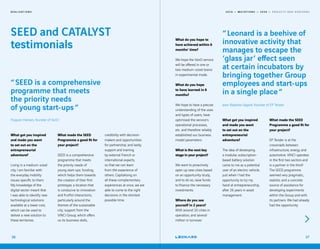
SEED and CATALYST
testimonials
What got you inspired
and made you want
to set out on the
entrepreneurial
adventure?
The idea of developing
a modular, subscription-
based battery solution
came to me as a potential
user of an electric vehicle,
just when I had the
opportunity to try my
hand at entrepreneurship,
after 26 years in asset
management.
“ Leonard is a beehive of
innovative activity that
manages to escape the
‘glass jar’ effect seen
at certain incubators by
bringing together Group
employees and start-ups
in a single place “
Jean-Baptiste Segard, founder of EP Tender
27
What made the SEED
Programme a good fit for
your project?
EP Tender is at the
crossroads between
infrastructure, energy and
automotive. VINCI operates
in the first two sectors and
is a partner in the third!
The SEED programme
seemed very pragmatic,
realistic and a concrete
source of assistance for
developing experiments
within the Group and with
its partners. We had already
had the opportunity
What do you hope to
have achieved within 6
months' time?
We hope the VanO service
will be offered in one or
two medium-sized towns
in experimental mode.
What do you hope
to have learned in 6
months?
We hope to have a precise
understanding of the uses
and types of users, have
optimised the service’s
operational processes,
etc. and therefore reliably
established our business
model parameters.
What is the next key
stage in your project?
We want to proactively
open up new cities based
on an opportunity study,
and to do so, raise funds
to finance the necessary
investments.
Where do you see
yourself in 2 years?
With around 10 cities in
operation, and several
million in turnover.
2 0 1 9 — M U T A T I O N S — 2 0 2 0 — P R O J E C T S A N D H O R I Z O N S
2 0 1 9 — M U T A T I O N S — 2 0 2 0 — P R O J E C T S A N D H O R I Z O N SR E A L I S A T I O N S
to create a first small Proof
of Concept with Renault
and VINCI. SEED is a very
good way to extend that
and turn it into a success.
Why is it important to
be part of a community
of innovators in VINCI’s
business lines?
I am impressed with
the beehive at Leonard,
which is just teeming
with innovation activities,
and also brings together
Group employees and
start-ups in a single spot.
There is always a risk that
an incubator will turn out
to be nothing but a “glass
jar“, for communication
purposes and nothing
else. Leonard’s immersive
aspect makes that
impossible, and becomes a
success enabler.
What do you hope to
have achieved 6 months
from now?
Consensus on our business
plan/business model and
an operational action plan
for pilot tests.
What do you hope
to have learned in 6
months?
Excellent knowledge of
VINCI Autoroutes and
VINCI Energies, the
operational capacity to
cooperate with a large
group, and a compelling
equity story!
What is the next key
stage in your project?
I want to finalise the
business plan and submit
an application for EIC
Accelerator financing in
May 2020 so as to build
pilots, including major
players in the sector (one
of which will, of course, be
VINCI).
Where do you see
yourself in 2 years?
We will be at the very
start of our industrial
production phase and
the commercial launch
for the general public,
with the active support
of manufacturers, and
we hope VINCI will be an
industrial partner. Our main
problem by that time will
be satisfy the considerable
potential demand and
have a structure capable
of supporting our mind-
boggling growth should we
become a success.
30
“ We work with large US companies
and are just starting to expand
internationally “
Josh Kanner, founder of Smartvid.io
What was the
inspiration behind your
project?
Our team has been putting
a range of technologies to
work in the construction
sector for 15 years now,
and it was in this capacity
that we identified the
potential that AI had to
improve safety in the
sector.
How did you find out
about the CATALYST
Programme?
I met Ludivine Serrière,
one of the program’s
representatives, at the
BuiltWorks conference in
Los Angeles. We work with
large US companies and
are just starting to expand
internationally.
How do you benefit
from being part of
a community of
innovators?
We are eager to learn the
best way to work in Europe
from this community.
More specifically with the
Leonard and VINCI teams,
we hope to have fruitful
conversations about how
safety is approached at
the personal level, and
based on construction site
photos.
What do you hope to
have achieved within 6
months' time?
We would like to meet
with operations managers
and directors in charge
of risk to explore how
our predictive modules
can be integrated into
VINCI’s systems. We want
to launch demonstration
projects, to show that our
AI, “Vinnie“, can help VINCI
reduce the risk of accidents
at its sites. We would
also like to find a name in
French for “Vinnie“!
2 0 1 9 — M U T A T I O N S — 2 0 2 0 — P R O J E C T S A N D H O R I Z O N S
31
2 0 1 9 — M U T A T I O N S — 2 0 2 0 — P R O J E C T S A N D H O R I Z O N S
Artificial intelligence finds
its way into jobs with
the AI program
For VINCI, artificial intelligence (AI) is no
longer a trend that has everyone talking,
but a tool to be mobilised on every front,
thanks to the support of a programme and
experts facilitated by Leonard.
Artificial intelligence, still a research object,
is also establishing itself now as a tool
capable of bringing value to an ever wider
range of activities. The thinking: with the
democratisation of computing power
and the commoditisation of algorithms,
infrastructures and models, investing in AI
becomes an accessible and agile option to
improve a business, optimise a process or
anticipate a market transformation.
This assumes, however, that the planned
use case is properly qualified and that the
appropriate data are available. How can we
be sure that AI will be the right tool? How
can we assess the quality and quantity of
data needed? What type of model should
we head towards?
The safest answers to these questions are
those offered by AI specialists. However, they
only take on all their full value if developers
and data processing experts work as closely
as possible with business experts. Otherwise,
how can we ensure that the AI implemented
delivers relevant, reliable and transparent
information? Only business can answer this
question.
This is the raison d’être of the AI programme:
to offer, for 5 months, specialised support
to the employees across VINCI’s various
entities who believe that AI can equip them
with growth drivers.
Led by Bruno Daunay and Quentin Panissod,
inspired by the conclusions of the prospec-
tive task force on AI organised in 2018 by
Leonard, the programme is premised on the
idea of collaborative effort and synergies
between projects, and relies on close inte-
raction between project teams that remain in
VINCI’s Business Units, and confirmed data
scientists who take on the role of coaches.
32
R E A L I S A T I O N S
The programme, in practice:
Application (2.5 months)
+ Qualification (1 month)
One or more employees identify a use
case involving or capable of integrating AI,
and have data that can be used or at least
accessed–theproject’spotentialisassessed
by Leonard's AI experts, who will help to
clarify the use case. For the first month, the
project teams, with Leonard teams' support:
will carry out
•	a market study on the existing solutions,
•	a study on the state-of-the-art in existing
models,
•	an in-depth study of infrastructures to
develop the solution,
•	a summary of the benefits of developing
the solution, themselves or otherwise;
will undertake both practical and theore-
tical courses followed by hands-on work
on issues in artificial intelligence in order
to upskill;
master a first structured database that can
be presented to an AI algorithm.
“ The AI programme
is designed to enable
upskilling for all VINCI
employees, whether
they already have skills
relating to this
technology or not, and
whatever their project.
It is because the
solutions are
developed by the field
teams that AI can be
better understood
and spread within the
Group.
With each course that
ends, multiple teams
have been trained and
are autonomous on the
technology. This is the
best way to ensure the
future of VINCI in its
decentralised model. “
—
Bruno Daunay,
co-director of Leonard's
artificial intelligence
programme
33
2 0 1 9 — M U T A T I O N S — 2 0 2 0 — P R O J E C T S A N D H O R I Z O N S
Incubation (4 month)
The project team is supported by a coach on
a daily basis to make its idea reality. The first
models are implemented and the parameters
are refined in accordance with the objec-
tives to be achieved. Weekly development
sprints are used to help achieve goals set by
coaches. If the skills of the project team are
notsufficient,coursesandhands-onworkare
assigned to ensure that they gain the neces-
sary skills. Lastly, the project team is given
access to the networks of experts from the
Group and the Leonard infrastructures and
events. At the end of the journey, the models,
infrastructure and economic relevance are
refined. The project team then needs only
industrialise its solution according to the
pre-established plan in collaboration with
the coach as it is now autonomous.
Implementation within the Group
In 2019, AI was mobilised to...
… run predictive maintenance on the LGV
tracks (Lisea-Mesea) / VINCI Concessions
… optimise aircraft taxi time / VINCI Airports
… characterise visitor satisfaction at airports
/ VINCI Airports
… carry out generative design for the ins-
tallation of fire extinguishing networks /
VINCI Energies
… carry out generative design for construc-
tion and / VINCI Construction – Synapse
… conduct predictive maintenance of
German motorways / Via-IMC
… perform automatic map generation for
historic monuments / Pateu et Robert
… analyse site performance / Dodin
Campenon Bernard
R E A L I S A T I O N S
34
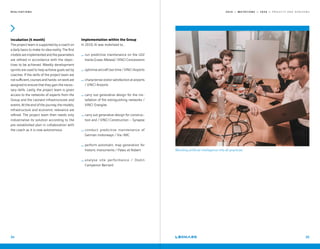
Blending artificial intelligence into all practices
35
2 0 1 9 — M U T A T I O N S — 2 0 2 0 — P R O J E C T S A N D H O R I Z O N SE X P L O R A T I O N S
“The future of
mobilities dwells on the
infrastructure“
The enthusiasm around
self-driving car projects
may have initially
created the impression
that these vehicles
would soon be all over
our cities’ streets. Now,
however, it is caution
that prevails in drivers’
discourse. Should this
be seen as a sign that
the technology is losing
steam?
That is not the opinion I
hold, though the challenges
are real. Investments
are continuing to roll in,
with several carmakers
committing billions of
euros. The mainstream
press can create
misleading impressions, for
instance, when it heralded
the end of the autonomous
vehicle dream after the
fatal accident involving an
Lane-side sensors can
offer an additional
source of perception
that complements
that of autonomous
vehicles, improving
their understanding
of their environment
and improving the
overall safety of the
system. Pierre Delaigue,
Director of Autonomous,
Connected and Electric
Mobility Projects at
Leonard, explains.
Uber vehicle – remember,
however, that Uber
resumed its trials from the
end of 2018. Some of the
difficulties of autonomous
vehicles, both technical
and economic, may have
been underestimated in
some corners. However,
what we are seeing today
is more an acceleration on
the part of manufacturers
or major players in
the sector to maintain
their roadmaps than a
slowdown, in particular
through investments or
capital consolidation to
pool their efforts. Most
manufacturers are now
considering Level 3
vehicles, to be released for
sale around 2020-2021,
and Level 4 around 2025.
In Japan, the first Level 3
vehicle was sold in October
2019.
36
Infrastructure will play a
decisive part in the extent
to which these goals are
achieved, especially when it
comes to Level 4.
Where will these Level
3 and 4 autonomous
vehicles drive?
The future of the individual
autonomous vehicle
will first play out on the
motorway. Motorways are
a controlled environment,
free of tricky intersections,
and on which speeds are
usually quite even. You
can also expect to see
low-speed shuttles, at
dedicated or supervised
sites. France, with Navya
and Easymile, is well
positioned in this area. Pilot
deployments can be found
almost all over the world, in
more than 100 locations.
VINCI is contributing to
the “SAM“ consortium
(dedicated to the Safety
and Acceptability of
driving and autonomous
Mobility), which
responded to a call for
national experimental
projects. What is it?
The EVRA (Experimentation
of the autonomous road
vehicle) call for proposals
is aimed at speeding
up experimentation on
autonomous vehicles in
France to support the
French sector. The SAM
consortium was one of
the winners in this call for
projects and will conduct
13 experiments in France
between 2019 and 2022.
VINCI Autoroutes, with PSA
and Renault, is involved in
an experiment dedicated
to autonomous driving on
separate roads.
However, we started
the experiments before
launching this call for
proposals. Since 2017,
in partnership with PSA,
VINCI Autoroutes has
been testing cooperation
between autonomous
vehicles and motorways,
in particular in cases of
“singular routes“: toll
barriers, tunnels, objects on
the road, works, emergency
stops, etc.
Such experiments are
likely to be of interest to
many VINCI entities, as
they involve combinations
of expertise. Leonard
serves as a “kickstarter“
for these subjects, which
can then be transferred to
various operational entities
belonging to VINCI Group.
The future of the
individual autonomous
vehicle will first play
out on the motorway.
37
2 0 1 9 — M U T A T I O N S — 2 0 2 0 — P R O J E C T S A N D H O R I Z O N S
What does
infrastructure bring to
the autonomous vehicle?
Today, the autonomous
vehicle hands the
power back to the
driver when faced with
a unique situation.
However, infrastructure
can characterise the
uniqueness upstream,
helping the vehicle
anticipate and stay in
autonomous mode, and
thus providing the user
with a safer, continuous
autonomous experience.
That's what we're testing
now. In July 2019, we
provided evidence of this
on the A11 highway in
cases of work zone bypass
and emergency braking.
As part of SAM, we will
capitalise on these first
developments and start
working with Renault as
well. The idea is to come
up with an “offboard
perception“ unit, supported
by the infrastructure.
Sensors in vehicles only
see up to about 200
metres ahead of them;
at 130 km/h, that is not
enough to make the right
decisions and anticipate
the right manoeuvres.
We are thus designing
roadside perception
solutions – a perception
that is “extended“ beyond
the vehicle’s field of vision,
when scaled to a stretch of
highway.
E X P L O R A T I O N S
38
How does the
infrastructure put this
off-board perception to
work?
We use the equipment
already present: cameras
already installed on the
network, whose images
are analysed by computer
vision, drawing on the
skills of Cyclope.ai, a
specialist subsidiary of
VINCI Autoroutes. The key
is to provide the vehicle
with qualified information,
guaranteed to be highly-
reliable. This could start
with specific points on the
network, such as highway
on-ramps and exits.
Off-board perception would
help in those situations
where a vehicle has to
cut into a lane, or where
a curve might be hiding
other vehicles.
Does the infrastructure
need 5G to assist the
vehicle?
5G offers real value for
certain services that
need, for example,
reduced latency and high
bandwidth. However,
our current experiments
work without 5G;
several communication
technologies, both on short
and long distances, exist
and can be used today. It
depends on the intended
application. If we are
aiming at “remote driving“,
where the infrastructure
literally drives the vehicles,
then 5G will probably be an
advantage when sending
instructions to the vehicles
with very low latencies, in
dedicated frequency bands
and entailing high service
levels.
In practice, we are
agnostic when it comes to
communication technology
selection. Similarly,
we want to develop
interoperable solutions
between manufacturers,
and ultimately between
motorway operators.
Will the infrastructure
help broaden the
potential audience for
autonomous vehicles?
Yes, because it will help
meet two challenges.
Firstly, that of safety: the
infrastructure, drawing
on connectivity and
off-board perception, will
help achieve the safety
levels required to deploy
Level 4 systems which
cannot rely on the driver
as a backup in the event
of a problem. The overall
vehicle-infrastructure
driving system will be safer.
Secondly, the cost: the
embedded technologies
planned for the vehicles
are currently expensive,
especially with Level
4. If off-boarded and
incorporated into the
infrastructure, relying
on VINCI Energies' and
Eurovia's competencies,
their costs will be shared,
and autonomous mobility
will, by and large, be more
accessible to the largest
possible population.
39
2 0 1 9 — M U T A T I O N S — 2 0 2 0 — P R O J E C T S A N D H O R I Z O N SP R O J E C T
New Deal: putting express
lanes to work for the
mobilities of the future
The “New Deal for the express lanes of
Grand Paris“, a project on which urban
planners, architects, engineers, environ-
mental and mobility experts are working
together, proposes to reduce car traffic
all the while increasing the number of
people transported on the Île-de-France
motorway network and to return part of
the roads to public spaces and low-impact
mobility. A realistic revolution for the Île-
de-France motorway infrastructure.
As the 2020 French municipal elections
approach, institutions and candidates are
coming out with more and more proposals,
varying in their radicality, for the future of
the Paris ring road, an infrastructure that
is as vitally important as it is unloved. This
rush of proposals points to the urgency of
creatinganewdestinyfortheexpresswaythat
encircles the capital, which over the years has
become a paragon of congestion, pollution
and urban disconnection, often presented as
an anachronism — at a time when the capital
region's need for mobility has never been
greater!
However, there can be no beneficial forward-
looking discussion unless it is extended
beyondtheall-too-famousringroad.Nothing
on the ring road will change until the 250,000
solo drivers (“auto singletons“) who travel 10
to 40 km each day to reach the heart of the
capital region, are provided with a satisfactory
alternative public transit offer. To offer Paris a
newroadmobilityplan,weneedtorethinkthe
futureofalloftheParisRegion'sexpressways.
A project designed from the
outskirts to the centre
What could the future look like for the
1,000 kilometres of the Paris Region's
motorway network?
ItwastoanswerthisquestionthattheGreater
Paris Metropolitan Forum opened an inter-
national consultation in 2018. Four teams
were chosen to contribute the debate. One
of them was the “New Deal for the express
lanes of Grand Paris“, made up of Leonard,
the Seura Agency founded by architect and
urban planner David Mangin, the Barcelona
urban planners and landscapers led by Jornet
Llop Pastor and Carlo Ratti Associati (at MIT,
40
Carlo Ratti heads the Senseable City Lab). A
thoroughly multidisciplinary team of urban
planners, architects, engineers, and experts
in mobility, the environment and traffic ana-
lysis... together for a realistic revolution going
against the grain of conventional wisdom.
And just what was its central idea? To reinvent
the role of the network of motorways that
leads from the outer edges of Grand Paris to
thecapital,ratherthanforcingthemunicipali-
ties at the outskirts to bear the consequences
of the traffic restrictions adopted within the
city’s boundaries. A novel vision, matched by
a strong ambition, as the team behind the
New Deal for Grand Paris wishes to achieve
a 50% reduction in road traffic by 2050, while
increasing total mobility capacity and freeing
uphalfofthecurrentexpresswaysurfacearea.
Three stages, unfolding from
2020 to 2050
How? By putting road infrastructure to work
for shared mobility, and connecting it to the
currentandfuturerailnetwork,inthreestages.
Between 2020 and 2024, there would be
some 200 coach lines connecting the road
system with the Grand Paris Express and RER
networks, via hubs - in reality, actual squares,
anchored in the regions - offering mobility
services, shops, offices and more.
Then, until 2030, public transport networks
(coaches, shuttles, car-sharing) on the road
could be deployed on dedicated lanes on the
Francilienne, the A86 highway and the main
radial roads, providing access to stations via
24 interconnection terminals with the Grand
Paris Express rail network.
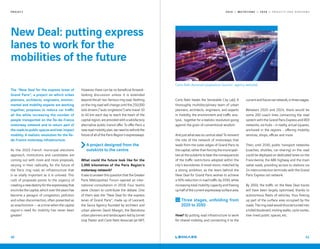
By 2050, the traffic on the New Deal tracks
will have been largely optimised, thanks to
autonomous fleets of vehicles, thus freeing
up part of the surface area occupied by the
roads.Theringroadwouldthusbeturnedinto
a lulled boulevard, inviting walks, cycle routes,
tree-lined public spaces, etc.
Carlo Ratti Associati proposition (source : agency website)
41
2 0 1 9 — M U T A T I O N S — 2 0 2 0 — P R O J E C T S A N D H O R I Z O N SM E E T I N G S
Building Beyond #2:
an inspiring journey across
the scales of cities
and territories
In the face of today's technological, eco-
logical, social and economic challenges,
cities and territories are re-examining the
scales on which they think, design and
interact. For the second edition of this
festival unlike any other, experts, artists
and entrepreneurs came to shed light on
the city and its infrastructures, in all their
dimensions.
Time, space, populations and beyond... Cities,
territoriesandinfrastructurescomeaboutand
evolve at a multitude of scales, each bearing
its own history and its latent challenges to
be overcome. A historian, architect, town
planner or designer, for instance, will work
with these on a daily basis, separately or in
combination. The geologist, creator of video
games,orevensciencefictionwriter,however,
has the power to illuminate them with new,
sometimes provocative, and always enriching
perspectives.
Such was the premise for the 24 sessions
organised as part of the Building Beyond
festival, a combination of prospective explo-
rations, pitches for innovative solutions,
expert discussions and fun workshops. It
was a successful gamble, as more than 1,000
people flocked to the event to talk with the
50 speakers brought together by Leonard,
LaFabriquedelaCitéandtheVINCIFoundation.
Experts and laymen came together for an
intense day of discussion around the shif-
ting boundaries of the city, the spaces to be
conquered, and the ecological and climatic
impactoftheurbanfabric...Here’sasampling.
Sénamé Koffi Agbodjinou, Togolese archi-
tect, founder of L’Africaine d’Architecture
laid claim to a “wisdom in the inter-
connectionbetweenthewholeand
theparts,wherethesystemadapts
and nourishes the environment in
which it is inserted“.
“The methodologies used by
archaeologists now apply to
construction“, said Yves Ubelmann,
co-founder of the start-up Iconem, which
specialises in digital site preservation
thanks to photogrammetry.
42
Intervention : Will Paleo-inspiration
be the foundation for future buil-
ding? with Loïc Bertrand, Founder and
Director of IPANEMA, the first laboratory
fully-dedicated to this field of research.
According to Marian Goodell, CEO of
Burning Man, the legendary festival in
the Nevada desert, her organisation and
Ubisoft share the same goal:“Creating
worlds for those who don’t have
one“.
Intervention : From Burning Man to
Assassin's Creed: Inventing the City,
with Raphaël Lacoste, Artistic Director at
Ubisoft.
“As much as foresight is based
on what is predictable, science
fiction is asked to invent the
unforeseeable“ said Catherine Dufour,
science fiction author and member of the
writers’ collective Zanzibar.
Intervention :Fromforesighttoaction:
when science fiction helps invent
the urban world,, with Mathieu Baudin,
director of the Institute for Desirable
Futures and Catherine Dufour.
“The basement is a reservoir of
opportunities for repositioning
infrastructures that require large
areas of land and for relocating
production“, said Achille Bourdon,
co-founder of the Syvil architecture studio
Syvil (behind the project).
Intervention : Underground or up in
the air: is it about choosing ver-
sus building? Didier Mignery, founder
of Upfactor, Pand Patrick Supiot, CEO of
VINCI Immobilier, Bruno Barocca, lecturer
attheUniversitéParis-EstMarneLaVallée,
Marion Girodo, architect at the Agence
Seura and author of the book Mangroves
urbaines.
“Paris is not fated to be a “mineral
city“,[…]itmustbeabletobecome
something completely different,
for example, if we strip the cour-
tyards of their paving stones and
turn them into gardens“, insisted
Marion Waller, Deputy Director of Jean-
Louis Missika's firm, in charge of urban
planning at Paris City Hall.
Intervention : Defining the city in
the age of the anthropocene, with
Bastien Kerspern, founder of the design
studio Design Friction, and Jean-Marc
Fourès, PhD candidate in geography at
Ladyss and specialist in road ecology.
43
The reversed building by Atelier Syvil
(source: Syvil website)
2 0 1 9 — M U T A T I O N S — 2 0 2 0 — P R O J E C T S A N D H O R I Z O N S
Trans-
formations
2
Illustration :ArielDavis
2 0 1 9 — M U T A T I O N S — 2 0 2 0 — P R O J E C T S A N D H O R I Z O N S
Leave-
no-trace
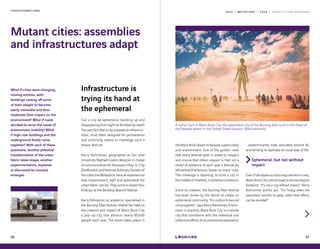
It's been 15 years since the first “Burning
Man“ contestants were invited not to leave
anything behind. This “leave-no-trace“
instruction is a challenge: the 80,000
festival-goers have to stay in an arid desert,
Black Rock, in the state of Nevada. And yet:
“Black Rock City“, a pop-up city of tempo-
rary housing and infrastructure, returns to
dust every year. Thus proving, albeit with
fragile evidence – the “Burners“ live only
for a few days on site – that a light and
ephemeral (but not necessarily resource-ef-
ficient) city is possible.
T O M O R R O W
46
Climate fiction
In the past, the sub-genres of fiction
eagerly waiting to immerse us in the
day-to-day realities of cities just a few
hours into the future went by such names
as hard-SF, cyberpunk, steampunk, etc.
Here’s a new one for you: “cli-fi“, and it
has proven a hit, in this decade dominated
by climate issues. Kim Stanley Robinson’s
novels feature prominent position, while
American novella writer Paolo Bacigalupi
is considered the defining writer in most
recent times. Running counter to the trend
of collapsology, the literature crafted around
the imaginary of the climate gives everyone
a chance to experience as their own -
without a tremor, and sometimes with
triumph - the life trajectories of characters
changed by a few additional degrees.
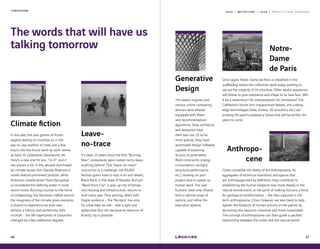
The words that will have us
talking tomorrow
Once again, Notre-Dame de Paris is sheathed in the
scaffolding where the craftsmen work today, working to
secure the integrity of its structure. Other works sequences
will follow, to give substance and shape to its new face. Will
it be a restoration? An interpretation? An innovation? The
Cathedral’s future stirs impassioned debate, and cutting-
edge technologies (lidar, drones, 3D acoustics, etc.) are
probing the past to prepare a future that will be written for
years to come.
Generative
Design
The search engines and
various online comparing
devices were already
equipped with filters
and recommendation
algorithms. Now, architects
and designers have
their own too. Or to be
more precise, they have
automated design software,
capable of exploring
dozens of parameters
(field constraints, energy
consumption, sunlight,
structural performance,
etc.), drawing on past
project data to speed up
human work. The said
humans need only choose
from a narrow range of
options, and refine the
execution options.
Anthropo-
cene
Notre-
Dame
de Paris
Cities crystallise the reality of the anthropocene. As
aggregates of technical inventions and spaces that
are anthropogenised by definition, they contribute to
establishing the human footprint ever more deeply in the
natural environment, to the point of making humans a force
for geological transformation – the idea captured in the
term anthropocene. Cities, however, are also likely to help
lighten the footprint of human activity on the planet, by
becoming less resource-intensive and more sustainable.
The concept of anthropocene can then guide a pacified
relationship between the urban and the natural world.
47
2 0 1 9 — M U T A T I O N S — 2 0 2 0 — P R O J E C T S A N D H O R I Z O N S
Congestion, pollution, greenhouse gas
emissions, and beyond.... Motorways,
expressways and the Paris ring road
are poisoning the future of the Grand
Paris metropolis. And unless they are
thoroughly reinvented, that poison will
spread. The elected officials of the Grand
Paris Metropolitan Forum made that
reinvention into a challenge — taken up
by the teams at Leonard, Seura (David
Mangin), Jornet Llop Pastor and Carlo
Ratti Associati with their “New Deal“
project. They propose to transform
the metropolis’ roadway heritage into
three stages between 2020 and 2050,
ultimately reducing car traffic by 50%,
and supplementing the Grand Paris
Express’ mobility offer with roads, and
making part of the road network “soft“.
Zombies are far more than
celluloid or pixel monsters.
Two films infested with
the undead recently made
a place for themselves at
the Cannes Film Festival.
And spectres long been of
interest to anthropologists.
But they might also find a
way to serve the resilience
of cities. Zombie invasions
and the behaviours they
induce have inspired extre-
mely useful mathematical
modelling, which has ser-
ved as the foundation for
work by such institutions
as the Centre for Disease
Control and Prevention
in the United States. And
the energy reserves which
survival uncovers offer a
valuable line of thinking for
questioning the ability of
human infrastructures and
organisations to overcome
extreme climatic episodes
or industrial disasters.
Zombies
New Deal
48
T O M O R R O W
Protecting, channelling,
evacuating… When cities
consider rainwater and
surface water, their first
response is usually defensive.
The “sponge city“ concept,
first formulated in the
1970s and supported by
a national programme in
China since 2014, is more
about acceptance. Under
this policy, cities and their
green infrastructures must
be designed to absorb
exceptional rainfall, equipped
with zones and materials
that can accommodate
overrun, at least temporarily.
Rainfall gardens and other
porous surfaces must be
in place, to absorb 70%
of torrential rain in local
urban areas by 2030. Cities
everywhere, from the
Caribbean to Copenhagen,
have since followed suit.
Spongification has a bright
future ahead.
Noise
Manage-
ment
Sponge
City
Bio-
inspiration
“Learn from nature; that is where your future lies,“ Leonardo da
Vinci once said. The concept of biomimicry extends well
back in history. Its application to construction, however,
is just now taking off. Beyond aesthetic or metaphorical
inspiration (Singapore's Helix Bridge, for example, embodies
a strand of DNA; Montpellier's White Tree is inspired
by flower petals), nature serves as a guide to architects,
engineers and planners, as they design artificial processes
and ecosystems. The aim: to mobilise shapes and materials
so that they act in ways similar to certain living systems
(flowers, termite colonies, etc.), in order to save material and
energy, improve resistance to heat, better conserve humidity,
streamline movements, etc.
Noise can be a form of pollution. For urban planners, builders
and infrastructure operators, it is now also a valuable source
of information. When well-placed on a construction site,
scattered across neighbourhoods or along a road network,
acoustic sensors can warn of hazards, prevent accidents, and
help measure the effects of modifications. A growing number
of experiments and projects combining acoustics, IoT and
machine learning attest to this.	
49
2 0 1 9 — M U T A T I O N S — 2 0 2 0 — P R O J E C T S A N D H O R I Z O N ST R A N S F O R M A T I O N S
50
The environment, inviting
itself into every equation
Reducing the
carbon footprint
The challenge
Cities are home to half of the world’s
population and emit 75% of energy-related
greenhouse gases (GHGs). The urbanisation
expectedbetween2020and2050willexceed
thatrecordedinallofhumanhistory.InFrance,
emissions from cities account for 67% of
emissions nationwide. The top 10 cities alone
account for 16% of emissions, 33% of which
come from construction, 17% from industry
and16%fromtransport,accordingtothereport
“The Climate Challenge of Cities“ published
jointly by EcoAct and WWF France.
Generallyspeaking,thecarbonbillforthebuil-
ding and construction sector remains consi-
derable, due to the CO2
emissions stemming
fromtheproductionandtransportofmaterials.
Producing one tonne of clinker, a constituent
component of cement, emits 0.89 tonnes of
CO2
; producing one tonne of steel produces
1.32 tonnes of CO2
(source:  zerowaste).
From pressing climate
issues to peak pollution
levels, record flooding and
beyond, the urban fabric
is facing environmental
challenges of unprecedented
magnitude and potential
consequences in the event
of inaction. However, more
or less all over the world,
a resistance movement is
taking shape and structuring
and transforming the way we
design and operate cities and
infrastructures
Cities produce 75% of ener-
gy-related greenhouse gases
(GHG) (source: Unsplash)
51
This brings the importance of recycling and
reuse into crystal-clear focus, for a sector
which,in2015inFrance,accordingtoADEME,
produced 227.6 million tonnes of waste.
The answers
Structures bearing the low carbon label are
more frequently seen in new construction
projects than in rehabilitation projects. Yet,
the carbon footprint of a renovated building
can be better than that of a new building,
recalls Armelle Langlois, Director of the
Sustainable Performance Division at VINCI
Construction France. Using the LCA method,
the shell structure of renovated buildings
can be reused, thus saving around 300 kg
of carbon equivalent per square metre. And
the method used to calculate the carbon
footprint on a renovation project is essentially
the same as for a new building, says Hélène
Genin,DelegateGeneraloftheAssociationfor
the Development of Low-Carbon Buildings,
which awards the BBCA label. This label takes
into account the carbon footprint of building
operation (heating, air conditioning), CO2
storage capacity and material reuse – a key
point in renovation. In 2018, it was allocated
to around forty buildings, with 3 operations
being awarded the “BBCA Renovation“ label.
To comply with the new requirements,
builders and contracting authorities are
working together to change practices and
encourage more virtuous and reasonable
reuse of materials. The Circolab association,
ofwhichVINCIConstructionFranceisafoun-
ding member, brings together contracting
authorities to reuse and recycle construction
waste. Also encouraging this paradigm shift
are the methods used to calculate the carbon
footprint of an operation: any replacement
of elements (carpets, parquet flooring, etc.)
now further adds to the carbon balance,
which must include the carbon footprint
of new materials, the depreciation time of
replaced materials and the waste produced.
What needs to be done now is prove that
reused materials can be as competitive as
new materials. Action might also be needed
to allay the fears of insurers, which are still
reluctant to cover reused materials despite
their traceability.
However, before reuse even comes into the
picture, the effort to reduce the carbon foot-
print begins with design material selection.
Exact data is still lacking to make the best
decisions at the time of construction and
renovation. The FDES (environmental and
health declaration form in France) for many
productsstillonlylisttheoreticalvalues.BBCA
is already advocating for the publication of
exact data, so as to measure a building's car-
bon footprint as closely as possible. Simplicity
and clarity: there are two watchwords which
sector players should use as their guides in
the future!
2 0 1 9 — M U T A T I O N S — 2 0 2 0 — P R O J E C T S A N D H O R I Z O N S
Seeking protec-
tion from rising
waters
The challenge
Thesepastfewyears,flooding,coastalerosion,
storms and hurricanes have affected many a
community. While felt locally, these events
are part of a more global development, likely
to reinforce their effects: the rise in average
sea level, which the latest IPCC report esti-
mates will amount to anywhere between +26
and +77 cm by 2100 in the most optimistic
scenario – or even more if the famous target
of “+1.5°C“ is not met, as appears most likely.
Insurers report that “weather-related claims“
reached record highs in 2018 in France. And
their cost is expected to double by 2040.
FromNewYorktoMiami,BangkoktoCalcutta,
Lagos, and Jakarta, the risk of flooding will
become increasingly critical for coastal cities
large or small, which are already home to one
quarter of the world’s population.
The answers
Faced with this threat, territories are getting
organised to improve their capacity to resist
and adapt to shocks. However, we still need
to find funding. Many organisations, such as
the New Zealand Deep South Challenge, have
started to think about the topic, particularly
T R A N S F O R M A T I O N S
52
Urgent messages
“In France, with the technologies
known to us today, we can achieve
carbon neutrality by 2050. However,
this implies a massive transforma-
tion of society, which will be very
different from the one we are expe-
riencing today!“
-
David Laurent, manager of the Climate
and Corporate Resources for the
Environment Division
“How to bring about a shift in
governments and companies?
Activists effectively use ‘name and
shame‘. A sense of pride can also
generate good results“
-
Cynthia Fleury, philosopher
14 October, opening session
of the cycle of meetings dedicated
to the environmental challenges.
53
the role insurance companies could play. In
areas highly-exposed to rising sea levels,
insurers become more selective about the
types of risks they will cover. Public policy
is also taking up the issue. In France, in
post-Xynthia Normandy, a wide (and expen-
sive) range of protective reinforcement mea-
sures has already been implemented through
the Coastal Risk Prevention Plan.
The responses developed for infrastructures
arebeingdeployedalongtwomainlines:miti-
gation(avertingorreducingtheeffectsofsee-
minglyunmanageableevents)andadaptation
(best managing these unavoidable situations:
strengtheningprotectiveinfrastructuressuch
as levees, foregoing construction in flood
zones, developing habitats built to withstand
climatic hazards or planning ex ante recons-
truction). From the technical standpoint, as
suggested by the Island Institute, improving
the built environment through traditional
approaches (retaining walls, raising levels,
increasing the diameter of the ducts) is not
enough, and the search for innovative solu-
tions often proves decisive. The design firm
Resallience was founded in 2018 for precisely
this purpose, and works to adapt projects,
infrastructures and their uses to climate
change.
In Europe, Rotterdam is one of the capitals of
resilience. The continent's leading port city
hasdevelopedastrategytoensureitbecomes
climate-proof by 2025. And, contrary to the
protection afforded by its impressive storm
barrier built in 1997, the city has changed
paradigm: it now seeks to “make do with“ its
environment, as suggested by its iconic “floa-
ting farm“ built on water, the first emanation
of what will ultimately be an entire floating
neighbourhood. In San Francisco, landscape
architect Kristina Hill also offers homes on
“stacked“ foundations, using wetlands and
beaches as buffer zones, and thus adapt
the Bay Area to rising waters. Her message
is that infrastructure must adapt to living
systems, not vice versa. This, in turn, helps
align the interests of property developers and
environmentalists.
To take up the challenge, innovation will be
needed: in the field of urban development,
in the architectural audacity shown (e.g., in
Belfast, the pivoting louvres and water-resis-
tant materials), but also in road infrastructure
protection (Eurovia reservoir road), building
adaptation consulting in the reconstruction
or in the proactive supervision of buildings
and infrastructures (Sixense).
2 0 1 9 — M U T A T I O N S — 2 0 2 0 — P R O J E C T S A N D H O R I Z O N S
Improving air
quality
The challenge
Fineparticles,carbonmonoxide,repeatedepi-
sodesofpollutionandbeyond....Airpollutionis
not only a health issue but also an eminently
urbanissue,withtheconcentrationofcartraffic
encouraging the multiplication of crisis epi-
sodes.Airpollutionisresponsiblefor48,000to
67,000 deaths per year in France and is consi-
dered by the European Commission to be the
“Number One health problem connected with the
environment“. This observation is not limited to
the smog-filled streets of the world’s cities --
indoor and underground air is just as polluted
or even more polluted, and is said to be the
cause of 20,000 premature deaths in France.
The answers
Measuring and purifying indoor air
Lamia Mallet, a chemical engineer and air
quality specialist, is the founder of Cozy Air.
This start-up offers a device that includes a
sensor for each pollutant and each gas that
is not directly harmful but likely to cause
disturbances, such as CO2
. This device tar-
gets office spaces where, connected to other
equipment – in particular air-conditioning
systems – it can detect pollutants to adapt
ventilation and maintenance according to a
range of indicators.
Modelling the circulation of pollutants
“The problem with air is that it is invisible“, sum-
marises Frédéric Mahé, Innovation Manager
at Aria Technologies, a modelling company,
which provides data to all players working on
the issue of air quality. The company is one of
the key players in the DIAMS project run by
the Aix-Marseille metropolis. “However,thanks
to modelling, you can not only make it visible,
you can make it understandable“. Streets, for
instance, can be more polluted due to the
proximity of buildings, preventing the disper-
sion of pollution and thus forming a ‘canyon
effect’ that can be easily identified by Aria
Technologies’ analysis tools.
Depolluting the air with a treatment
station
Jaouad Zemourri, a former physics professor,
founded Starklab, an air pollution removal
company. Its product, the “Terroa“, remo-
ves pollution from the air by bringing it into
contact with water brought to the boil. The
particles thus change from a poorly control-
lable mass of polluted air to a small volume
of treatable water. This process can also be
used to recover precious materials, such as
goldparticles.Thestationcanprocesssmoke,
recyclecertainproducts,oreveninjecttreated
water back into industry. The product is cur-
rently in the experimental phase and can
process up to 1 million cubic metres for an
area of 15 metres by 2 metres.
T R A N S F O R M A T I O N S
54
Filtering pollutants using
microorganisms
The solution put forward by MVAW
Technologies, a company founded by
Frenchman Vincent Fesquet, offers an air
treatment process that uses a substrate filled
withmicro-organisms,alsocapableoffiltering
fine particles. This substrate can be deployed
on furniture as well as on façades, and then
be planted over.
Raising awareness
Jean-Louis Fréchin, designer and founder of
NoDesign, makes his contribution with AirO,
a badge composed of sensors and a screen.
When the sensors detect excessive air pol-
lution, the screen displays messages as sur-
prising as they are eloquent: “It stinks“, “We’re
suffocating“, “Run for your life!“ ... The mecha-
nism is designed to bring the issue out into
the open. It comes with an application that
identifies pollution levels around a number of
plotted areas, with an explanation of what is
measured.Theideaistocreateascalablemap
of air pollution, both indoors and outdoors.
Urgent messages
“Thepublicauthoritieshaveadirect
effect on only about 20% of emis-
sions. It is the remaining 80% that
needs to be secured, by mobilising
inhabitants, building owners, pri-
vate users, etc.“
-
Karine Bidart, Director General, Paris
Climate Agency
“The commitment of metropolises
to the climate can become a talking
point for territorial marketing. For
thistohappen,acommonmethodo-
logy is needed to organise the mea-
surement of these commitments
andcreateaglobalknock-oneffect.“
-
Cécile Maisonneuve,
President of La Fabrique de la Cité
18 November, Round Table, “Can cities
meet the climate challenge? “
55
2 0 1 9 — M U T A T I O N S — 2 0 2 0 — P R O J E C T S A N D H O R I Z O N ST R A N S F O R M A T I O N S
Mutant cities: assemblies
and infrastructures adapt
56
Infrastructure is
trying its hand at
the ephemeral
Can a city be ephemeral, building up and
disappearing from sight as dictated by need?
Theveryfactthatacityisbasedoninfrastruc-
tures, most often designed for permanence
and continuity, seems to challenge such a
theory. And yet.
Kerry Rohrmeier, geographer at San Jose
University;RaphaëlCoutin,designerincharge
ofcommunicationfortheprojectPlug-in-City
(Eindhoven); and Antoine Aubinais, founder of
the collective Bellastock, have all experienced
how impermanent, light and ephemeral the
urban fabric can be. They came to share their
findings at the Building Beyond festival.
Kerry Rohreimer, an academic specialised in
the Burning Man festival, shared her take on
the creation and impact of Black Rock City,
a pop-up city that attracts nearly 80,000
people each year. The event takes place in
What if cities were changing,
moving entities, with
buildings casting off some
of their weight to become
easily moveable and thus
moderate their impact on the
environment? What if roads
decided to serve the cause of
autonomous mobility? What
if high-rise buildings and the
underground finally came
together? With each of these
questions, another potential
transformation of the urban
fabric takes shape, another
experimentation, explored
or discussed by Leonard,
emerges.
57
theBlackRockDesertinNevada,aparticularly
arid environment. One of the golden rules
that every festival-goer is asked to respect
and ensure that others respect is that not a
shred of evidence of each year’s festival be
leftbehind(thefamous“leave-no-trace“rule).
The challenge is daunting: to build a city in
themiddleofnowhere,inextremeconditions.
Since its creation, the Burning Man festival
has been driven by the desire to create an
ephemeral community. “It is a place to live and
camptogether“, says Kerry Rohreimer, in sum-
mary. In practice, Black Rock City is a canvas
city that transforms with the individual and
collective efforts of its provisional population
- predominantly male, educated, around 30,
and tending to replicate its usual way of life.
Ephemeral, but not without
impact
Even if the leave no trace requirement is met,
BlackRockCitycannotboastazeroecological
footprint. “It’s not a city without impact,“ Kerry
Rohreimer points out. “On Friday, when the
population reaches its peak, urban heat effects
can be recorded“.
A statue built in Black Rock City, the ephemeral city of the Burning Man built in the heart of
the Nevada desert in the United States (source: Wikicommons)
2 0 1 9 — M U T A T I O N S — 2 0 2 0 — P R O J E C T S A N D H O R I Z O N ST R A N S F O R M A T I O N S
58
Coming up with temporary urban develop-
ments can, nonetheless, go hand in hand
with the desire to reduce their impact on the
environment to the minimum. This was the
approach behind the “neighbourhood house“
Plug-In City, brainchild of Raphaël Coutin,
and erected in a wasteland in Eindhoven, the
Netherlands, from containers and re-use
materials. Combining the ephemeral with
low-impact is also the aspiration guiding the
architecturalcollectiveBellastock,whichspe-
cialises in building from recycled materials.
In the eyes of Raphaël Coutin and Antoine
Aubinais, founder of Bellastock, the success
of their projects depends, first and foremost,
on working in collaboration with local social
players to implement their projects. This is
how Plug-in City became the first modular
structure used as social housing, set in ful-
ly-outfitted containers, in the Netherlands.
Bellastock’s experiments are largely inspired
by an experimental architecture festival:
Melting Botte. For 4 days, architects and
professionals work together to build and
inhabit ephemeral structures made of hay
boots, the theme for 2019.
Lightweight infrastructure is
first and foremost social
The mutual assistance and cohesion to which
these projects give rise are much more than
mere by-products of their interventions.
Bellastockmakesaconcertedefforttoactivate
therelationshipsbetweenitsprojectsandtheir
neighbourhood, in order to involve individuals
Festival Melting Bottes - 2019
(source : Bellastock website)
in responsible approaches to urban spatial
design.“Re-employmentcanprogresstechnically,
but if we do not bring the culture forward at the
same time, we will ultimately come up against a
wall“,warnsAntoineAubinais.WithPlug-inCity,
the aim is to do a service to the environment
and the neighbourhood by creating shared
living spaces in old, depopulated wastelands.
And though the ephemeral nature has paved
the way… Raphaël Coutin and his team do not
intend to stop at this: “We are thinking beyond
thetwoorthreeyearsofexperimentationuptonow,
about how these spaces will evolve in the future of
construction“.
Whether in the middle of the desert, or sur-
rounded by haystacks, pop-up experiments
contributetoraisingawarenessofconstruction
techniques, likely to empower construction
players and citizens, and have a lasting impact
on their behaviour. Each is a lesson in the
resilience of cities in the long term!
The autonomous
vehicle, paving its
own way
Reserved – or at least priority – lanes have
long been an effective way of promoting
certain modes of mobility, whether they are
set aside only for electric vehicles (an option
recentlyconsideredinFrance)orcarpools(the
“much-toutedhigh-occupancyvehiclelanes“,
or “carpool lanes“).
When it comes to autonomous mobility, the
endeavours tend to be either baby steps or
huge futuristic leaps. In 2017 already, while in
France an autonomous car was demonstra-
ting a passage through the motorway toll at
Saint-Arnoult,aspartofapartnershipbetween
VINCI and PSA two Berkeley University stu-
dents were being awarded the Infrastructure
Vision 2050 design challenge award for their
futuristic concept, the “hyperlane“. This four
lanes wide “motorway platform“ would be
reserved for autonomous vehicles only. This
concept, inspired by the ad hoc network
created in Japan for the Shinkansen, nurtures
the dream of driverless vehicles running full
speed ahead to bring users and goods to
their destination, without the slightest hitch
or bottleneck. According to the two master-
minds behind this concept and their propo-
nents, the only thing missing now is funding.
In China, the authorities have funded a new
sectionofmotorwayonwhichtwooftheeight
lanes (one in each direction) will be reser-
ved for autonomous vehicles. The stretch is
planned to connect Beijing up with the new
city of Xiongan sometime in 2020, in what is
known to be the most urbanised megalopolis
in northern China. The 100 km-long stretch,
where speeds will be limited to 120 or even
100 km/h, boasts a number of smart features,
including tolls, according to its developer. The
connectedinfrastructure,designedto“retrieve
vehicle data and road-related information“, is
expected to improve traffic and safety, as well
as provide faster access to Xiongan.
In Canada, one local political candidate has
promised to open dedicated lanes to testing,
then to “real-life“ autonomous vehicle traffic
betweenCalgaryandEdmonton.InWisconsin,
north of Chicago, a project has been initiated
to redevelop the emergency stop strips of a
few sections of the famous Interstate 94, a
motorway built in the 1950s and extending
more than 2,500 km, and make them exclu-
sive to autonomous heavy goods vehicles.
These could connect the nearby airport to
the mega flat-screen factory which Foxconn
is building in the Milwaukee area, making no
secret of its platooning dreams.
59
2 0 1 9 — M U T A T I O N S — 2 0 2 0 — P R O J E C T S A N D H O R I Z O N S
Embedded intelligence as a
means of speeding up
autonomy
In France, in April 2019, the government
kickedoffaseriesof16experiments,following
itscallforprojectsentitled“Experimentations
with the autonomous road vehicle“ (EVRA). It
includes the use of paved roads dedicated to
autonomous transport: from 2019 to 2022, in
the Nantes conurbation, 7 km of a disused
former railway will thus be devoted to ope-
rational testing on an autonomous public
transport service. Also worthy of note is the
“New Deal for the express lanes of Grand
Paris“ project, involving Leonard, the Seura
Agency, Jornet Loop Pastor and Carlo Ratti
Associati: this ambitious project to reinvent
the motorways of Île-de-France will make
certain lanes open only to autonomous
vehicles in 2050 (see p.38).
Now, all that remains to be done is build
the capacity to achieve the best possible
combination between vehicle and road.
Much of the challenge will be taken up by
the SAM Consortium, which includes VINCI
Autoroutes: it will conduct 13 of the 16 expe-
riments planned between 2019 and 2022.
The VINCI Autoroutes teams, in partnership
with PSA and Renault, and in connection
with VINCI Energies and Eurovia are explo-
ring opportunities for collaboration between
infrastructures and autonomous vehicles by
developing off-board perception functions
on the infrastructure and a V2I (Vehicle-to-
Infrastructure) data exchange platform for
T R A N S F O R M A T I O N S
60
Magnetic induction, enabling
electric vehicles
The increasing electrification of the
vehicle fleet sets out two impera-
tives: ensuring sufficient range so
that vehicles can complete long
journeys,andguaranteeingthepos-
sibility of easily recharging them at
any point on the territory.
Level 3 individual autonomous vehicles and
Level 4 shared autonomous mobility services
(read the interview with Pierre Delaigue, p.30).
The deployment of a network of sensors on
road infrastructures - in order to round out
the equipment of the vehicles themselves
- will help significantly reduce situations in
which 100% on-board systems are unable
to correctly perceive and analyse the driving
environment. The result will be a symbiosis
which,althoughparadoxical,becomesthekey
to the large-scale deployment of this tech-
nology: the more autonomous the vehicle
- that is, the greater its level of autonomy -
the more dependent it will be on the
infrastructure. Moreover, this logic is not
limited to the exchange of information: it
could also apply to the supply of energy to
autonomous - and non-autonomous - elec-
tric vehicles (read box).
The future of
cities, hesitating
between sky and
sub-surface
“What if, for whatever reason (climate, social,
conflict), we had to choose between developing
our cities in the air or below ground?“
It was with this question that the debate
organisedbyLeonardinJuneopenedup.Why?
To question two visions of the city: on the
one hand, a high-rise city that keeps arching
higher, forming purified skylines; on the other,
an underground city extending beneath the
surface of the ground.
The debate pitted advocates of the above-
ground against proponents of the sub-sur-
face, for two successive face-offs. The former
were represented by Didier Mignery, founder
of Upfactor and Patrick Supiot, Managing
DirectorofVINCIImmobilier.Teeingoffagainst
them were Achille Bourdon, co-founder of
architecture studio Syvil (which originated
the “Inverted Building“ project) and Bruno
Barocca, lecturer at Paris-Est Marne La
Vallée University. Marion Girodo, architect
and author of the book Mangroves urbaines
concluded the discussions.
61
[following]
Today, it is mainly the increase in
battery capacity (and therefore in
battery weight) and the number
of fast charging points that serve
these needs. However, infrastruc-
ture could solve the equation more
effectively. Motorway pavements
can be redeveloped to house induc-
tion loops, capable of delivering the
currents needed by the engines of
electric vehicles in circulation. As a
result, batteries will only be called
upon during non-motorway travel,
for the shortest parts of long-dis-
tance journeys. What’s more: “the
sizing of the electricity transmis-
sionanddistributioninfrastructures
wouldinprinciplebelessrestrictive
than with high-power charging sta-
tions located at a set geographical
point“, predicts Arnaud Banner,
Technical and Innovation Director
of Omexom, a VINCI Energies brand
specialising in electricity distribu-
tion. The concept will be tested on
a full-scale basis by Eurovia, on sec-
tions where test vehicles will travel
at 130 km/h.
2 0 1 9 — M U T A T I O N S — 2 0 2 0 — P R O J E C T S A N D H O R I Z O N S
Ecology as the central dimen-
sion of the underground city
The discussions started out by looking at the
environmental issues at stake. According to
Didier Mignery, the increased height of buil-
dings in large cities (within Paris, more than
10,000 roofs are “raisable“) is part of a reno-
vation and rehabilitation strategy: it enables
owners to finance the thermal renovation of
their building, as well as to install new, more
ecological features, such as roof gardens.
Although, as Achille Bourdon pointed out,
“underground spaces are not intended to be used
as dwellings“, they can also be used in other
ways, to the benefit of ecology: “underground
space is a reservoir of opportunities to reposition
infrastructuresthatrequirelargeexpansesofland
and to relocate production“. The basement of
Place de la Concorde houses, for example, a
parcel sorting centre and a cold production
factory can be found under the Philharmonie
de Paris concert complex. It is in this sense
that underground spaces could be developed
towards the ideal of a productive city, for exa-
mple, to serve as storage spaces. This would
contribute to relocating some production
facilities – and reducing pollution due to
transport by as much – as well as limit the
construction of warehouses in the immediate
vicinity of cities, as they destroy arable land
and artificialise soils.
“You can ignore everything, your whole life, of a city by crossing it every day in its underground “
- Urban Mangroves by David Mangin and Marion Girodo (source: Moniteur website)
T R A N S F O R M A T I O N S
62
High-rise, between densifi-
cation and demonstration of
power
The explosion in population density is one
of the most terrifying prospects arising from
the world's growing urbanization, especially
whereitisconcentratedinhigh-risebuildings.
However, appearances can be deceptive,
and it is helpful to maintain the distinction
between“actual“and“perceived“density.The
latter is more a function of the quality of the
city's transport networks and services than
of the number of inhabitants: a city that is
densebutwellservedbyanefficienttransport
network will not be perceived as such. Patrick
Supiot particularly emphasised “the need for a
multi-functionalcity“.IntheLaDéfensedistrict,
for example, residential and tertiary functions
(homes and offices) are intertwined, thus
reducing density problems, as these spaces
can end up being used at any time of day.
The city above and the city below ground can
takeonmanyforms:incontrasttoLaDéfense,
where construction promotes an integrated
design of urban space, the towers of some
vertical cities in the United Arab Emirates
(such as the Burj Khalifa in Dubai) often serve
as demonstrations of power, uncoupled from
the goal of a harmonious and ecologically
virtuouscity.Similarly,BrunoBarrocadeplored
“thelackofplanningaroundundergroundspaces
inFrance,whichcontributestoaone-dimensional
vision of a space considered hostile and lacking
in diversity, doomed to serve as a transit corridor
at best“.
63
Mangroves, a vehicle for
reconciliation?
Clearly, the two positions are in reality com-
plementary: although uses are becoming
more complex, the underground and the
elevated do not fulfil the same functions.
The two spaces are constantly intertwined in
what Marion Girodo calls “urban mangroves“,
a concept drawn from her study of Montreal,
Paris and Singapore. These urban systems
are made up of underground, overhead
elements and a number of interfaces, such
as the space that connects the metro and
department stores between the Opéra
Garnier,Saint-LazarestationandAuberstation
in Paris. These mangroves, modelled on the
world'smajormetropolises,offeranewwayof
understanding the oppositions and intimate
ties between the underground and the peaks.
The explosion in
population density
is one of the most
terrifying prospects
arising from the
world's growing
urbanization. However,
appearances can be
deceptive, and it is
helpful to maintain
the distinction
between “actual“ and
“perceived“ density.
2 0 1 9 — M U T A T I O N S — 2 0 2 0 — P R O J E C T S A N D H O R I Z O N ST R A N S F O R M A T I O N S
62
Work 3.0: the great
metamorphosis of
locations and links
When digital
transformation
causes work to
mutate
Horizontal, learning, platform-based… The
work experience is changing profoundly,
and with it, so are people’s relationships
to their companies as places that accom-
modate and organise work.
The 4th
Industrial Revolution, resulting from
the rise of technologies and digital, is sha-
king up every area of activity, to the point of
reshaping the very concept of work. “Whatwe
areexperiencingislessanemploymentcrisisthan
a revolution in labour“, asserts Denis Pennel,
Managing Director of the World Employment
Confederation. More intangible, diffuse and
flexible than before, the concept is mutating,
and causing all its traditional trappings
to do the same: office spaces, managerial
relationships, skills, etc.
From the advent of third
places to the spread of
the flex office, from the
platformisation of labour to
slashers and temporary work
2.0, from the robotisation
of tasks to the learning
company, employer brands,
demand for horizontal
management relations,
and the list goes on... This
autumn, labour experts and
professionals from every
sector gathered to explore
the future of work during 5
sessions, specially organised
by Leonard. We look back at
some of the key concepts,
and take apart the flex office
phenomenon.
63
Employees aspire to greater flexibility in the
way they organise their working hours, as well
as to greater horizontality and transversality
in managerial relations. Initiatives to “libe-
rate“ companies - by enabling decisions and
responsibilities to be more broadly shared
- remain limited. However, the decline of
“paternalist“ management, built on exacting
standards and tight control, is a reality, giving
waytooneinwhichthemanagermustinspire
or coach. More prosaically, the expectations
of employees - especially the youngest - no
longer revolve solely around remuneration
or opportunities to move up in the company,
but now also include the chance to regularly
receive training, change jobs and companies,
and have guarantees on this increased capa-
city for mobility. Such is the price to pay today
for employers looking for truly-committed
workers: employees continue to hold work as
avalueinhighesteem,andappreciateoreven
seek out lifelong learning and change - provi-
ded that they come with support. According
to a January 2019 Domplus-BVA survey, 80%
of workers under 35 expect their employers
to offer them healthcare benefits, and 60% to
offer them assistance to better achieve their
work-life balance.
Theemergenceofteleworkingandalternative
workplaces(alsocalled“thirdplaces“)appears
to be one of the most visible manifestations
of this rise in professional mobility and the
metamorphosis of the link between workers
and companies, with currently more than
18% of French employees working remotely,
and almost 2,000 co-working spaces listed
in 2019 in France. Sociologist Arnaud Vallin
emphasises, in this respect, that the fading
distinction between place of living (personal)
and place of work should prompt companies
to “invest“ now more than ever in the fields
of mutual insurance, provident insurance
and social benefits (such as meal vouchers).
Does this mean that employers are entering
the private sphere, though? No, because this
is about flexibility in work organisation – to
encourage teleworking, compressed working
hours, shared time, etc.
Platformisation making its
mark on every sector
Today, more than 4 million people in France
aremulti-activeworkers,7millionareactively
looking for a job, 3 million part-time workers
areactivelylookingforsupplementarysources
of income, and 56% of workers would like to
be self-employed, provided they can hold on
to their mutual insurance and unemployment
insurance. The upshot is that platforms and
temporary workers are on the rise. In France,
in 2017, platforms provided work to about
1% of the working population, according to
Olivia Montel, a research officer at DARES.
The construction sector is no stranger to
this metamorphosis: the repair and DIY work
performed by micro-entrepreneurs or even
everyday individuals for paying customers
was first reshaped by consumer platforms
such as LeBonCoin. And there were already
150 platforms in the sector in France as of
2018. These are gradually branching out
2 0 1 9 — M U T A T I O N S — 2 0 2 0 — P R O J E C T S A N D H O R I Z O N ST R A N S F O R M A T I O N S
64
into all building trades (purchase or rental
of equipment, administrative procedures,
architectural design, etc.).
But not all occupations fit easily into this era
of “liquid“ work, where skills and workplaces
multiplythroughoutindividuals’workinglives.
AstudybyrecruitmentplatformIndeedpubli-
shedin2017foundthatofficelocationremains
a crucial factor to 42% of workers. It should
be noted, more broadly, that degree level also
influences what new workers hope to get out
of the working world. Managers, for instance,
put emphasis on aspects related to personal
development, such as the atmosphere in the
workplace, while economic factors remain
central to the concerns of the less qualified.
Age also plays a part: it is the youngest wor-
kers whom one sees increasingly insistent on
finding meaning in their work, rejecting tasks
carried out in an industrial or overly Taylorist
manner, and an interest in “projects“ rather
than long assignments.
Lastly, the size of companies plays an
important part in workers’ new aspirations.
Evolving in a small company, according to
the Domplus-BVA study, ultimately translates
into greater fulfilment for 44% of the workers
surveyed by BVA. There is thus a real tension
between the lure of teleworking for a large
corporation and the attractiveness of small
structures,whereworkerscomeatleastocca-
sionally. The anonymity of employees at large
structures facilitates teleworking, whereas
small structures require more cohesion and
solidarity on a daily basis.
(source : Kinnarps)
65
Does the flex
office deliver on
its promises?
Open, transparent and pleasing to the eye,
flex offices are said to offer optimised pre-
mises and improve employee productivity.
Is this actually true?
“Themajorityofworkersareintheprovinces,wor-
kingforcompanieswithfewerthan10people,and
in traditional offices: 33% are in individual offices
and 33% in collective offices.“ The results of the
Actineo survey, published in March 2019,
paints the picture of an ultimately traditional
working environment. But it also notes the
rise of nomadism in workers’ practices, with
nearly 39% using at least one “third place“.
In this landscape, the flex office continues
to be in the minority (14% of workers), but
is supporting this move towards greater
flexibility in working spaces.
This new form of workplace, which puts an
end to designated offices by offering open
and modular spaces, seems to respond to a
woe shared by a large number of companies:
workstation vacancy, which amounts to 45%
on average (Unwired and Regus, 2011). A
statistic that is anything but insignificant,
considering that work premises are the
second largest expense for companies. The
redevelopment of workspaces in “flex“ mode
thusappearstomeetatwo-foldobjective:first
of all, it enables greater spatial optimisation,
and secondly, contributes to better employee
productivity.
Doesthismeanthattheflexofficeisdelivering
on its promises? Beyond the flexibility which
these new premises can offer, what impact
do they have on employee well-being? Alain
d’Iribarnes, Dominique Lozay, Pierre Bouchet,
William Bouyer and Laurent Assouly came
together at Leonard:Paris on 24 September
to discuss the potential of these new
workspaces.
The speakers immediately dispelled the
widely-held idea of a Paris-centric phe-
nomenon. “The demand for a flex office is the
sameeverywhereinFrance,regardlessofregionor
company size. And large corporations are not the
onlyusers:smallcompaniesandthepublicsector
are also interested. Case in point: La Poste“, said
WilliamBouyer,manageroftheÎle-de-France
branch of Kinnarps, a Swedish specialist in
office furniture.
TheconclusionsoftheActineosurvey,recalled
by Alain d’Iribarnes (Chairman of Actineo's
Scientific Board), support this observation,
emphasising the more general and profound
change in the workplace: “We are at a historic
turning point in the unity of time and place, with
workplacesmushrooming.Today,weneedtothink
in terms of ‘flows’, not ‘stocks’. “ This dispersion
of workplaces (at home,in co-working spaces
or in other employer spaces) is coupled with
a transformation of the very structure of
2 0 1 9 — M U T A T I O N S — 2 0 2 0 — P R O J E C T S A N D H O R I Z O N ST R A N S F O R M A T I O N S
66
employment in France, explains Dominique
Lozay, Director of the think tank New Ways of
Working : “We have gone from a legacy model
of the company operating with 100% permanent
contracts to a much more complex ecosystem,
involving a greater proportion of outsourcing,
fixed-term contracts, subcontractors, etc. This is
decisive for the shaping of space.“
The flex office is intended as a response to
this physical and social fragmentation in
companies, fostering flows and relations
between employees. The office is no longer
justaplacetowork-itisbecoming“aresource
atmanagement’sservice“,inthewordsofPierre
Bouchet, co-founder of Le Génie des Lieux, a
consulting firm specialised in spatially-based
organisation. “Space is a managerial resource
servingcreativity.Itisaparametertobeconceived
ofcollaborativelysothatitanditsmanyusescan
be better understood, by organisations and by all
the players in the transformation process.“
Beware of the side effects
Modern, comfortable and attractive, flex
offices promote cross-functionality of inte-
raction and employee creativity, thanks to
deliberately open layouts, alternating free
offices and enclosed spaces that can be
reserved for meetings. However, the social
decompartmentalisation caused by these
spaces (superiors and subordinates find
themselves working side by side) does not do
Technicolor's headquarters in Paris (source : Le Génie des Lieux)
67
awaywithhierarchyitself,andmayevenmake
wage inequalities less acceptable according
to sociologist Laurent Assouly : “Sitting next to
someone who seems ‘normal’ to you, but earns
fivetimesmoreisaproblem.Itisanirk,bornofthe
democratisation and ‘normalisation’ associated
withtheflexoffice.“ Worse, it is said that greater
spatial closeness leads not to greater fluidity
in interaction, but an increase in written
contact: “It is an illusion to think that people
are writing fewer e-mails thanks to the greater
proximity enabled by flex mode. The opposite is
true: the number of emails is increasing while
face-to-face is decreasing.“
Sowillflexultimatelymakeusregretourgood
old open spaces? In Laurent Assouly’s view,
flex spaces make a very attractive proposal -
which conceals shortcomings unique to their
(excessively) high flexibility: “The traditional
office provides a form of security. There is one less
thing to think about when you know what's in
front of you, behind you, next door, etc., rather
than having to acclimate to it every day. To the
contrary,withflexofficescomesalossofterritorial
referencepoints,andthefeelingofbecomingalien
to one's company. “
To limit unwanted side effects, it was the
speakers’ shared opinion that teams need to
be supported in this time of change, based on
their needs at the time of design. Dominique
Lozay rightly pointed out that the flex office
is a tool, but not a miracle solution. Alone, it
cannot solve the problems inherent to the
managerial structure: “Thereisacertainmana-
gerialcowardiceinbelievingthattheflexofficewill
change the working methods of employees by
takingdownsilos...Youcanputanaccountantnext
to an engineer or marketing specialist, but that
doesn’tnecessarilymeanthey’llworktogether! “.
In other words, companies that want to
switch to flex mode won't be able to rely
on “Instagram-worthy“ designs for it to be
fully embraced by employees. As Dominique
Lozay says, “the flex office must be the result of
a managerial project“: education, a corporate
visionandco-constructionwiththeteamswill
all be essential ingredients for creating fully
functional workspaces... Without replicating
the failings of the open space.
To limit
unwanted side
effects, it was
the speakers’
shared opinion
that teams need
to be supported
in this time of
change, based
on their needs
at the time of
design.
2 0 1 9 — M U T A T I O N S — 2 0 2 0 — P R O J E C T S A N D H O R I Z O N ST R A N S F O R M A T I O N S
When the future makes
use of traditional
materials
Concrete is
getting ready for
carbon neutrality
1st
July 2020, the Environmental Regulation
(known as “RE 2020“), taking over from the
current thermal regulations “RT 2012“, will
require that the total impact of construction
at all stages of a building’s life be calculated
and reviewed, from the choice of the raw
materials used to the building operation
and the demolition process. It will no lon-
ger be enough to reduce buildings’ energy
consumption - soon, the overall impact of
construction on the environment will need to
be analysed. Where materials are concerned,
this life cycle analysis (LCA) will include in the
carbon footprint the impact of the manufac-
ture of materials, as well as that of all building
equipment.
NathalieMehu,HeadofSustainableSolutions
at VINCI Construction France, emphasises in
this regard that 60% of a building's emissions
are generated during its construction phase,
In the future as in the past, the
range of materials available
and how they have been
mastered determine to a
large extent the technical and
environmental performance
levels of construction sites. As
new and tougher regulations
on greenhouse gas emissions
emerge and the circular
economy becomes the law,
“Concrete the Almighty“ is
reinventing itself, willingly
adding wood to its mix, while
architects and builders are
revisiting the lessons of the
past.
68
and out of this, 40% comes from the mate-
rials used for the structure. The remaining
emissions during the construction phase are
generated by equipment (lift, heating, distri-
bution ducts, electrical wires, etc.). Secondary
elements, the effects of which are anything
but incidental! Is it back to the drawing board
for builders? Decisions previously made later
in projects will now need to be settled very
early on (which floor coverings to use, which
cladding to install, etc.) so as to keep the
impact of their materials to a minimum.
Anne-Sophie Perrissin-Fabert, Director of the
HQE-GBC Alliance, furthermore points out
that the choice of materials is not the only
factor in reducing the carbon footprint. It is
also important to address the issue of space
optimisation. Pooling and optimising square
metres can help reduce a building’s carbon
footprint. For example, what about the office
carparksthatareusedonlyduringthedayand
leftbarrenatnight?Wouldn’titmakesenseto
share them with the neighbouring residential
building, giving the space over to its tenants?
Cutting the carbon footprint
by a factor of 5
The fact remains that concrete, the lion in the
construction jungle, with its 4 billion tonnes
peryear,usesabinder-cement,theproduction
of which is responsible for 5 to 6% of global
CO2
emissions…Reducingitscarbonfootprint
is thus a priority. Can this construction staple,
with its great diversity and high durability
potential, often manufactured locally, comply
withfutureregulations?Withoutadoubt,says
François Cussigh, concrete expert at VINCI
Construction France.
Thecementindustrydoeshavetheambitious
target of halving its carbon footprint by 2050.
To achieve this, several major angles are
emerging: new formulas (geopolymers, clays),
CO2
capture, alternative fuels and recycling of
waste from demolition, slag concretes from
waste from the steel industry, etc. More and
more frequently, there are experiments to
design new concretes are multiplying, with
solutions emitting less but offering the same
resistance profile - including some inspired
by ancient concretes, lime and volcanic ash
mixtures designed by the Romans.
In Vendée, the Hoffmann Green Cement
Technologies plant has established itself as
the leading green cement plant in France.
Here, the cement produced is free of clinker,
notorious for requiring significant amounts of
energy.ThenationalprojectFastCarbisaimed
69
60% of a building's
emissions are
generated during its
construction phase, and
out of this, 40% comes
from the materials used
for the structure.
2 0 1 9 — M U T A T I O N S — 2 0 2 0 — P R O J E C T S A N D H O R I Z O N ST R A N S F O R M A T I O N S
atdevelopingacceleratedcarbonationofrecy-
cled concrete aggregates. In other words, the
aim is to promote recycling while reducing
concrete’s CO2
impact.
Then, the aim will be to scale up the most
promising innovations. “Obviously, we need to
moveawayfromtheusualformulations,butabove
all,withthenewones,weneedtopassmechanical
strengthand100-yeardurabilitytests,andadjust
the standards accordingly, so that this benefits
everyone“, recommends François Cussigh.
Beyond the environment, innovation affects
all aspects of the material’s life. Through the
Cement Lab, many start-ups have demons-
tratedhowdynamicthesectoristoday.Basilisk,
ayoungcompanybornintheNetherlands,has
developed a self-healing concrete. It contains
microorganisms capable of producing
limestone and therefore of repairing cracks
entirely on its own. Disruptive Technologies, a
Norwegian start-up, uses sensors to monitor
essentialdatasuchastemperatureorchanges
in capacity… Dataswati leverages data and
artificial intelligence to optimise complex
production processes. Where cement is
concerned,thismakesitpossibletoanticipate
thequalityofthematerialbeingproduced,and
also optimise each stage, from the use of fuel
to the grinding of the clinker.
Wood construction:
the ideal alternative?
Let's hear from Mathieu Desaubliaux,
a pre-project engineer at Arbonis, a
VINCI Construction subsidiary specia-
lised in wood construction.
“In addition to concrete, wood offers
an attractive avenue for reducing a
structure’s carbon impact, conside-
ring that 1 m3
of wood amounts to
one tonne of CO2
absorbed by the
tree, stored up to the time of com-
bustion.
In practice, it is above all transport
that expands the carbon footprint
when building from wood; the use
of local wood is thus key to rever-
sing this trend. For a long time,
manufacturers looked to Northern
Europe to source their softwood
lumber, the form of wood mainly
used in the sector. To reduce this
source of emissions, Arbonis is
conducting tests using hardwoods,
which make up most of France's fo-
rests: glued laminated timber made
of beech or poplar, CLT oak, etc. If
they prove conclusive, the carbon
footprint of wood construction
would be greatly improved.“
70
Paleo-inspiration:
conjuring up
future structures
by drawing on the
past
Will architects and builders soon take the
Imhotep oath, the same way doctors take the
Hippocraticoath?Thatpredictionwillprobably
remain fiction. Nonetheless, it does refer to a
very real tendency to look deep into the past
for the new keys to sustainable construction:
71
Rotterdam harbor basin self-repairs using developed technology
by the start-up Basilisk (source: Basilisk website)
“paleo-inspiration“, the spirit by which the
propositions of ancient times are plumbed for
answers to the great architectural challenges
of the future.
Understood as the inspiration which objects
and works of heritage awaken, paleo-ins-
piration has already earned its stripes as a
scientific discipline with the study of ageless
materials and their structure. Founder and
Director of IPANEMA, the first laboratory
entirely dedicated to this field of research,
Loïc Bertrand testifies to the incredible
2 0 1 9 — M U T A T I O N S — 2 0 2 0 — P R O J E C T S A N D H O R I Z O N ST R A N S F O R M A T I O N S
preservation capacity of certain materials.
Case in point: that Mayan blue still visible on
sixth-centuryMexicanstatuettes.“Thedye,an
unstable organic compound, owes its durability
to the way it attaches to the clay matrix“, the
researcher explains. Wouldn't it make sense
to use the same matrix again to attach other
colours? The same thought comes to mind
looking at this millennial Mesopotamian nail
topped with a fossilised textile mesh. As to
the ultra-resistant concretes from Trajan’s
Market in Rome, they have yet to reveal all
their secrets. “The properties displayed by these
materials can be reused to create those of the
present and future“, Loïc Bertrand states, poin-
ting to the importance of understanding how
these remains have persisted into the present
insuchcondition.“Experimentswithaccelerated
ageing do a fairly poor job at reproducing natural
ageing processes“, he acknowledges. Should
inspirationhavetowaitforscientificvalidation
before kicking in?
Letting the environment guide
construction
Not if you ask Sename Koffi Agbodjinou,
designer of future constructions inspired
by African tradition. The Togolese architect
refers to the teaching of Professor Joseph
Davidovits, who claimed that the Egyptians
“did not cut the stone for their pyramids, and
instead produced it in situ in formwork, calling on
softchemistry“.Thoughcontroversialandnever
confirmed, the theory nonetheless describes
a process that is interesting both in principle
Realization by the African
architect platform founded
by Koffi Agbodjinou
(source: website of the
platform)
72 73
and in spirit. Against a civilisational approach
in which a new structure imposes its law on
the environment in which it is erected, the
founderoftheplatformL'Africained'Architecture
calls for “wisdom in interconnecting the whole
and the parts, so that the system adapts and
nourishestheenvironmentintowhichitisfit“.This
thinking has been brought to life in the school
construction project in progress in the north
of Togo, “combining mixed materials designed
using age-old techniques“.
Following in the footsteps of urban planner
AldovanEyck,inspiredbythetraditionalDogon
people's housing model where the material
andbuildingsarenot‘divisible’fromthesocial
structure“, Sename Koffi Agbodjinou argues
in favour of letting this type of cosmography
shape the city of the future. A smart city? Let’s
picture it, worlds away from current thinking
“where smart cities do not make smart citizens,
andspiritsindividualsawayfromthegroupviathe
Internet to force them to consume“. In his view,
Africa’s population growth should encourage
the development of an urban conception in
line with “the world system that interlinks and
createssocialties“.Tothetightly-meshedtech-
nical city, born of post-industrial tradition and
the overwhelming needs of urbanity, Séname
Koffi Agbodjinou responds with a proposal to
distributethepowertobuildtotheinhabitants
of the city. All at once, shared memory beco-
mes the creator of shared space.
Will archaeologists and builders now set their
work in a new continuity? “The methodologies
usedbyarchaeologistsnowapplytoconstruction“,
affirms Yves Ubelmann, co-founder of the
start-up Iconem, which specialises in digital
sitepreservationusingphotogrammetry.“The
archaeologist needs to understand the scale
on which he is working, and the evolution
over time, in other words the sedimentation.“
This same effort will be required of builders
who want to break with the “industrial frenzy“
which Senamé Koffi Agbodjinou casts aside
and, at their own scale, recreate heritage.
A smart city?
Let’s picture
it, worlds away
from current
thinking “where
smart cities
do not make
smart citizens,
and spirits
individuals away
from the group
via the Internet
to force them
to consume“.
2 0 1 9 — M U T A T I O N S — 2 0 2 0 — P R O J E C T S A N D H O R I Z O N ST R A N S F O R M A T I O N S
Open data and AI: the
nervous system of smart
cities is taking shape
AI, a city builder
Alongside the growing phenomenon of urba-
nisation, artificial intelligence, with its ability
toaggregateandanalysemassiveamountsof
data, appears the ideal tool for improving the
cityoftoday-aplacewheretheenvironmental
challengesandsocialissuesofthetwenty-first
century are concentrated - and building the
city of tomorrow.
The realm of possibilities for “urban AI“ pro-
mises benefits for many areas: fighting crime
in Rio, optimising energy in Seoul, ensuring
smoother road traffic flow in New York and
preserving urban biodiversity in London.
Montreal has even created an open-air lab,
just one aim of which is to experiment with AI
inanurbansetting.UrbanprojectsinvolvingAI
areproliferatingallovertheworld.Proofofthis
enthusiasmiseasytofind:smartcityuseswill
amount to several hundred billion dollars in
2020,accordingtofiguresfromthefirmGrand
View Research, published in 2016 - meaning
annual growth of 13.6% since that time.
Taking the pulse of cities,
understanding the flows
within them, modelling
their metabolism, down
to each building’s energy
regime; and even taking
control of their arteries:
such are the emerging
capabilities of urban
artificial intelligence (AI).
76
Ahead of AI development, many cities have
initiated an Open Data policy. To wit, since
2009,theSanFranciscodataportalDataSFhas
beenusedtocreatemorethan60applications
aimed at making life easier for city dwellers.
The city of San Francisco is also using AI to
achieve its goal of becoming a zero-waste
city by 2020. This is technology put to good
use. AI serves a vision, an ideal. In Europe, the
largest cities have been opening up their data
for some ten years or so. Now, medium-sized
cities are realising the benefits which they
could derive from doing the same, and more
andmorearedesigningadatastrategyoftheir
own every year.
To better identify the potential of artificial
intelligence to meet the urban challenges
of tomorrow, Hubert Béroche, apprentice
entrepreneur at EM Lyon, launched Smart
World, a world tour of smart cities, with the
support of Leonard. For six months, through
the prism of 12 cities, he called on more than
60AIexperts,businesses,planners,architects
and philosophers, to find out how AI is used
to solve urban problems. We offer a focus on
3 cities explored in this overview of urban AI.
Montreal – A new eye
on urban flows
Formorethan3years,theCityofMontrealhas
had its own AI unit (for Business Intelligence
andArtificialIntelligence),18peoplestrong.Its
plansincludedevelopingAItodetectunexpec-
tedobstaclestoeverydaymobility.“Whenworks
are planned, for instance, the authorities provide
for deviations. However, in some cases, there are
vehicles obstructing them. Major traffic jams can
build up in no time. We want to use automatic
imagerecognitiontodetecttheseobstructionsand
be able to offer an alternative route to Montreal
drivers“, explains Martin Guy-Richard, director
of the AI Unit. In the longer term, the City of
Montrealhasidentified13priorityareaswhere
it wishes to mobilise AI over the next 5 years.
Theseincludeprojectsfocusedontheanalysis
of crowd movements (detection of anomalies,
people taken ill, violence, etc.), automatic
transcription (to optimise the efficiency of
emergency call centres) and automatic reco-
gnition of city archives.
77
Screenshot of
the DataSF platform
2 0 1 9 — M U T A T I O N S — 2 0 2 0 — P R O J E C T S A N D H O R I Z O N S
New York – Open data, a
driver for reducing the energy
consumption of buildings
David Hsu, Professor of Urban and
Environmental Planning at MIT and a resear-
cherattheMITEnergyInitiative,Cambridge,is
alsointerestedinvisualisingenergydatafrom
buildings. “In 2009, New York City implemented
two enactments [Local Law 84 then Local Law 87]
requiring certain buildings to make their energy
data public“. In the case of New York, this
approach is all the more interesting because
1% of buildings consume nearly 55% of the
city’s energy. “I then analysed the effect of
this data sharing on the energy consumption of
buildings.TheresultsIfoundwerequitesurprising:
in the 3 years following this regulation, the city’s
energy consumption decreased by 11%“. Two
behavioural phenomena help shed light on
this result. First of all, the ability to track one’s
ownenergyconsumptionleadstoaprocessof
self-moderation. Furthermore, having access
to data from other buildings generates a
marketeffect(toremaincompetitive,buildings
must have good energy performance).
T R A N S F O R M A T I O N S
CityScope, augmented reality simulation tool created by the MIT Media Lab
(source: laboratory website)
78
No AI is needed to view this data. It can,
however, be used to understand and model
theenergyconsumptionofbuildings.Because,
all too often, buildings don't work the way
they were designed. The use of energy data
by AI makes it possible to identify patterns
of consumption and highlight contextual
examples from which buildings can greatly
benefit,eachdependingonitscharacteristics.
Andorra – The beating heart of
the neighbourhoods comes to
the fore
CityScope is an urban development platform
that combines a Lego model and software
designed to assess in real time the changes
(social, economic, demographic, etc.) brought
about when any single building block - repre-
senting a part of the city's infrastructure - is
moved.Now,theplatformhasbeenputtouse
byAndorra.“Wewantedtounderstandwhysome
places were full of activity, lively and why others
were not“ says Ariel Noyman, PhD student at
the MIT Media Lab City Science Group, which
designedtheuniquetool.Thefirststepforthe
teams at the City Science Group consisted of
collecting behavioural data. “The Principality
has a single telecoms operator. As a result, we
were able, with a high level of granularity (2m to
3m), to analyse the movements of a large part of
the Andorran population (70,000 data points per
second for a population of 76,000 inhabitants)“.
This dataset was then combined with other
information relating to Andorra’s infrastruc-
turesanddevelopments.ItisherethatAIsteps
in, to bring to light correlations based on the
79
data collected and changes to the model. “We
noticedthatplacesinthevicinityofschoolsarenot
very busy. In contrast, religious structures tend to
enhancethevitalityofpublicspaces.Furthermore,
we observed a positive correlation between the
cultural diversity of a place and its vitality“.
The realm
of possibilities
for “urban
AI“ promises
benefits for
many areas:
fighting crime in
Rio, optimising
energy in
Seoul, ensuring
smoother road
traffic flow in
New York and
preserving urban
biodiversity
in London.
2 0 1 9 — M U T A T I O N S — 2 0 2 0 — P R O J E C T S A N D H O R I Z O N S
Just how far will
AI carry us?
Autonomous cars, public transport, applica-
tions, etc. Artificial intelligence has found its
way into every mode of transport and each
stage of urban travel. For the second confe-
rence of its series on artificial intelligence, on
Tuesday 2 April, Leonard addressed the issue
of mobility with players having chosen on AI
to address their mobility challenges.
Paul-Matthew Zamsky, Director of Strategic
Partnerships at Waycare, sees artificial
intelligence as a great way to improve traffic
conditions on the road. He also emphasises
that infrastructures operate on a longer time
scale, difficult to align with the constant evo-
lution of cities: “It takes 10 years to create an
infrastructure for 2 million people. Yet by the time
the works have been completed, the population
is grown. “ As he explains it, machine learning
makesitpossibletoanticipatethesechanges,
by making combined use of data from the
infrastructure and that generated by vehicles
in circulation.
An Israeli company based in particular in the
United States, Waycare uses AI and predic-
tive analysis to help municipalities to better
managetrafficandmakeroadssafer.Theriseof
connected cars means more data is available;
used wisely, it offers new possibilities in road
management. Infrastructure managers and
localauthoritiescananticipatetrafficdynamics
ondifferentthoroughfare,optimiseworksand
routes for certain categories of vehicles (such
asambulances),etc.Allofwhichwillultimately
improvesafetyandbettermanagecongestion.
In Las Vegas, for example, Waycare states that
ithasreducedaccidentsonaparticularlybusy
stretch of highway by 17%.
The road is also the playground for Cyclope.ai,
astart-upcreatedbyVINCIAutoroutesin2017
to develop AI solutions applied to images for
road infrastructure operators. What is the
objective? To use images to better unders-
tand mobility flows. Emmanuel Daubricourt,
ProductLeadatCyclope.ai,pointedoutthatthe
start-uphasdevelopedtwoAI-basedsoftware
in particular: TollSense and TunnelWatch,
aimed respectively at automating toll classi-
fication and improving road safety in tunnels.
T R A N S F O R M A T I O N S
80
Fully informed
mobility as
an ideal? A
hyper-qualified
database,
accessible
to all.
81
Some data are still missing in
action
How can we achieve this greater unders-
tanding of mobility flows, and heightened
flexibility in infrastructures? All the speakers
agreedthatdataliesatthecoreoftheartificial
intelligence reactor.
BertrandBilloud,HeadofCommunicationand
Marketing of Kisio Digital, emphasises the
importance of data quality, a crucial issue that
continues to be poorly perceived by mobility
players. This work, however, is essential in
order to bring “the right information to the right
person at the right time“, by also including
factors that have no direct connection with
transport,butmayaffectusers'travelchoices:
weather, passenger disability, etc. However,
it also takes into account pollution or even
odours, each of these factors potentially
helping further optimise travellers' mobility
choices once referenced in applications.
Fully informed mobility as an ideal? A
hyper-qualified database, accessible to all.
There are still many obstacles to achieving
such an objective: regulatory constraints, lack
of cooperation between the players, lack of
developers, difficulties in obtaining material
information,particularlyfromtheroadnetwork,
etc.Thepathtofluidmobilityispromising,but
remains fraught with obstacles.
The rise of
connected cars
means more
data is available;
used wisely,
it offers new
possibilities
in road
management.
Infrastructure
managers and
local authorities
can anticipate
traffic dynamics
on different
thoroughfare,
optimise works
and routes
for certain
categories of
vehicles (such
as ambulances),
etc.
2 0 1 9 — M U T A T I O N S — 2 0 2 0 — P R O J E C T S A N D H O R I Z O N ST R A N S F O R M A T I O N S
82
Construction Tech:
machines, invaluable
accomplices on
construction sites
Rebuilding true
to the original,
a technical
challenge
ThefireatNotre-DamedeParissetoffaseries
of emotional responses and stirring testimo-
nials. It also triggered inevitable controversy
andreopenedalong-standingdispute:in1850,
Eugène-Emmanuel Viollet-le-Duc himself
had chosen to affix a 96-metre spire to the
roof of Notre-Dame, setting a precedent for
possible “additions“ to the treasured cathe-
dral. Architectural competitions were opened.
One, initiated by media platform GoArchitect,
has received proposals from more than 200
architects from 56 countries. Amid all the stir,
it would be easy to forget that deterioration
and destruction are part of the life cycle of
any building. Wear, accidents or changes in
use bring about maintenance, reconstruction
or demolition work. Most often considered a
necessary fact of life, such action takes on a
Technology takes hold
of the unseen: the
past that is no longer,
destroyed or damaged,
underground secrets, etc.
It also takes on dangerous
tasks, augmenting
or standing in for
operators, improving
performance and limiting
risks. Without a doubt,
“Construction Tech“ has
found its place in the
field.
83
muchmorepoliticaldimensionwhenhistorical
monuments are involved. They wield symbols
and representations that are sometimes
divergent and often complex to reconcile.
This context makes it difficult to determine
the best technical response, from traditional
heritagerestorationtotheuseofcontemporary
construction processes.
We went back in time, in search of inspiration.
ThechurchOurLadyofDresden,theStariMost
bridge in Mostar (Bosnia-Herzegovina) or the
SungnyemunGateinSeoulareallexamplesof
“like-for-like“ reconstruction. In each of these
cases, the aim was heritage preservation:
keeping alive the building, its materials and
techniques in their ideal state. And though
not a reconstruction endeavour, the medieval
construction site at Château de Guédelon
followsthissameprinciples.Conceivedofasan
educationalproject,itisbasedonconstruction
site logs passed down through history and
uses only medieval processes. This historical
accuracy is in line with the principles of the
International Charter on the Conservation and
RestorationofUNESCOMonumentsandSites.
This document specifies that, “the intention in
restoring monuments is to safeguard them no less
as works of art than as historical evidence“.
Takeninitabsoluteterms,beingtruetohistory
could also imply “not touching a thing“. It is
the most radical option and is often chosen
with buildings that have sustained damage in
war. In this specific case, the aim is to preserve
the memory of the event, more so than the
integrity of the building. The gutted bell tower
of the Church of Remembrance in Berlin and
theGenbakuDomeinHiroshimaaretwosuch
sensitive testimonies in favour of peace. That
being, even these extreme cases cannot do
withoutsometechnicalintervention,designed
to be as discreet as possible. For instance, the
HiroshimaPeaceMemorialhasbeenreinforced
withepoxyresinsandsteelreinforcements,and
is also subject to inspection every three years..
Traditional methods alone will
not rebuild Notre-Dame de
Paris
Much to the dismay of the romantic, there is
littlechancethattheivywillbelefttogrowover
Notre-Dame or that the sun will be invited to
hitthegoldencrossstillstandinginthecentre
of the nave. The cathedral will be rebuilt. And
even if it were to be rebuilt like-for-like, there
is little chance that the construction process
will call solely on traditional methods.
Even before the first stone is set, the cathedral
will be able to benefit from structural analysis
using cutting-edge technologies. The firm
Uavia has offered a drone inspection tool
capable of identifying external damage with
pinpoint accuracy. As to the product known
as Cyclone, made by Leica Geosystems, it
features point cloud technology from which
3D models can be built. In 2010, the historian
Andrew Tallon had scanned the entirety of
Notre-Dame’s structure using the device.
2 0 1 9 — M U T A T I O N S — 2 0 2 0 — P R O J E C T S A N D H O R I Z O N ST R A N S F O R M A T I O N S
84
The reconstruction phase itself will consist of
a multitude of technical decisions, depending
largely on the challenges specific to each
project.Mosthistoricbuildingsarefull-fledged
kaleidoscopes,anditremainsdifficulttoidentify
anysinglemomentintimeatwhichtocapture
animageforrestoration.Moreover,like-for-like
oftentranslatesintoutopia.Thechiefarchitect
of Notre-Dame de Paris, Benjamin Mouton,
has emphasised the difficulty of such an
undertaking and stressed the importance of
recovering the general silhouette rather than
anexactreplica.WhentheBrittanyParliament
in Rennes was rebuilt, the architects opted for
a combination of glued laminated timber and
metal beams, for “structuralreasonsaswellasin
thenameofspeed“,explainedMarie-LineQuéro,
Cultural and Heritage Services Engineer at the
BrittanyRegionalDirectorateofCulturalAffairs,
tothedailyLeMonde.Incontrast,withChâteau
deLunéville,thedecisionwasmadeinfavourof
traditionalmaterialssuchasoakandsolidfir,to
reproduce a precisely documented 18th cen-
tury framework. The Collège des Bernardins,
whichbearsanewroofentirelymadeofmetal,
andtheCathedralofReims,whoseframework
isconcrete,aretwofurtherexcellentexamples
of successful modernisation.
Highly-inspired emerging
technologies
Then there remains the intractable topic of
the “contemporary architectural gesture“
requested by Emmanuel Macron. From
opportunistic architectural visions to frat
house jokes across the Internet, it has cer-
tainly stirred up its share of interpretations.
It was also an opportunity for building
professionals to advertise contemporary or
emergingtechnologies-withvaryingdegrees
of skill. Architect Jean-Michel Wilmotte, for
instance, offered up a carbon spire, a metal
framework and a roof made of titanium,
The tool Leica Cyclone
Register 360
(source : Leica Geosystems)
85
a particularly durable material. André Joffre,
founder of design office Tecsol, told the
economic newspaper Les Echos of his vision
for a solar roof. The Dutch company concr3de
offered to reconstruct certain components
through 3D printing, using stone and ash
from the fire. As to Studio NAB, it suggests
a green, educational roof in tribute to the
famous “forest“ structure, now destroyed.
While none of these projects seems very
realistic given the conservatism that pre-
vails after accidents of this kind, they do a
valuable service in bringing to the attention
of the general public an exciting array of new
processes and techniques!
These many examples attest to the multi-
plicity of options and sensitivities when it
comes to the reconstruction of monuments.
Clearly, there is not a single “correct“ solution.
A foray into new modelling technologies,
however, offers avenues that could work out
to everyone’s satisfaction. Once digitised,
the most visited or most fragile monuments
can soon be visited virtually. Specialising in
3D digitisation of heritage sites, Iconem has
already worked at such locations as Angkor
or Aleppo. Concerning Notre-Dame de Paris,
ArtGP had already looked into the matter and
now has an extremely precise model of the
cathedral's “forest“ to offer.
Just like in the world of archives, old stones
might achieve immortality in a hard drive!
“Dig, baby, dig!“:
using technology
to build and
take advantage
of underground
space
Underground structures are now the central
component in downturn development pro-
jects.Theyprovideanswerstotheproblemsof
mobilityandaccesstosaturatedhypercentres,
where individual cars find it increasingly diffi-
culttofindtheirplace.Thesesameissuesalso
apply to water networks, waste disposal and
energy storage. This market, traditionally held
by European civil engineering companies, is
feeling pressure from two ends: on the one
hand, from the influx of large Chinese compa-
nies backed with considerable resources, and
on the other, companies looking to transform
the profession, like Elon Musk’s Boring
Company. Together at the Building Beyond
Festival, Marc Hasenohr (Tunnel Factory),
Sébastien Magat (AVUS) and Jean-Ghislain
LaFonta(Sixense)tookstockofdevelopments
in the sector.
Marc Hasenohr, director of VINCI
Construction's Tunnel Factory, reminded
2 0 1 9 — M U T A T I O N S — 2 0 2 0 — P R O J E C T S A N D H O R I Z O N S
audiencesthatanRDteamhostedbyLeonard
has been specially tasked with developing
solutions along 4 lines: differentiating the
offer,reducingrisksduringworks,steppingup
safety for both craftsmen and local residents,
and lastly, optimising costs. Three innovation
drivers are being given priority: equipment
automation, geotechnics and the integration
of data science.
The innovative developments that have
come about in geotechnics make it possible
to systematise reconnaissance techniques
and give the TBM an expanded vision of its
underground environment. Data scientists,
meanwhile,havetakenadvantageoffeedback
gathered over 20 years of work to develop
algorithms capable of predicting phenomena
and the laws of behaviour of machines and
the field.
Holograms to view underground
networks
Sébastien Magat, founder of AVUS
and intrapreneuratLeonard,hashad
to deal, throughout his experience
at various sites with issues due to
the lack of accuracy and reliability
of information connected with in-
ground networks. Because of these
drawbacks, nearly 60,000 incidents
are recorded per year, along with
damage amounting to €100 million
annually, not to mention the incon-
venience caused to local residents
and injuries caused by the breakage.
With these figures to back him up,
Sébastien launched AVUS as part of
the Leonard Intrapreneurs fast track,
a solution that models information on
underground spaces in augmented
reality. AVUS takes into account all the
information available on the site and
corrects it in real time. It proceeds to
forma3Dmodel,whichcanbeviewed
via an augmented reality application.
This information is collected in three
stages: the aggregated version of the
informationsentbytheclient(allexis-
ting plans a priori), the geo-detection
analysis results, and lastly, the infor-
mation from the trench-digging. The
resulting 3D model is of impressive
precision, with a margin of error of
around five centimetres in all three
dimensions of space.
With this tool, AVUS can support the
development of autonomous equip-
ment, facilitates maintenance, plan-
ning and design for structures, as well
as the response to emergencies in the
event of natural disaster. The techno-
logy has already proved its worth in
several operations, for example on a
thermal heating installation site built
by SOGEA, in Paris.
T R A N S F O R M A T I O N S
86
Sixense develops monitoring tools for major
urban projects (source: Sixense)
Sixense: from space to seismic
waves, monitoring the subsurface
in real time
Sixense, the world leader in moni-
toring large urban projects, puts to
work four technologies to produce
high-precision monitoring of the
ground: in real time, on construction
sites, using sensors; monitoring
of ground movements from space;
seismic analysis of subsoil and a
software platform that aggregates
and makes all of the aforemen-
tioned data readable.
The real-time monitoring deploys
sensors in various parts of the site
– the ground, boreholes, buildings
– and has them communicate with
each other to record a multitude
of data: ground and structure
deformation, and the impacts for
local residents (noise, vibrations,
pollution).
The monitoring of soil movements
from space, made possible thanks
to Atlas technology, is based on
satellite imagery to produce a his-
tory of soil movements on a surface
that exceeds that of the site itself.
This technology is extremely accu-
rate (the margin of error is three
millimetres).
The images are updated every 10 to
11 days – a timeframe soon to be
shortened to 1 day.
The subsurface seismic analysis
technique developed by Sixense,
called Sissterra, offers a kind of
urban subsurface radio, analysing
the city’s natural vibrations. Lastly,
all this information is integrated
into the Beyond platform, which
retrieves, aggregates and transforms
the data so that it is readable in
real-time, as the digital modelling
translates the information collected
into images.
87
2 0 1 9 — M U T A T I O N S — 2 0 2 0 — P R O J E C T S A N D H O R I Z O N S
Augmented reality,
assisted driving,
and remote ope-
ration: machines’
great awakening
The autonomous cabless truck developed by Volvo (source: transportinfo.fr)
T R A N S F O R M A T I O N S
88
Whenever talk turns to the future of vehicles,
whatever the type, one topic never fails to
comes up: autonomy. The rule applies in
the construction and public works sectors
as well, and most builders are hard at work
on the subject. Yet, despite rapid progress,
the complete autonomy of construction
equipment remains, as elsewhere, a relatively
distant prospect. Fortunately, innovation does
not stop at this horizon and advances are
multiplying in the fields of remote operation,
driving assistance, or partial autonomy.
The first real-world self-driving truck –
designed by Volvo – will be put to work at the
BrønnøyKalkmineinNorway.Doesthismean
that the technology is set to spread rapidly?
Notexactly,saysEurovia'sHeadofEquipment,
DidierThevenard.“Minesofferaconduciveenvi-
ronment.Theoperatingcyclesarerunonsettracks,
and it is more a matter of guiding the equipment
through space, rather than setting it free. On
densely-packed sites, the level of interactivity is
very high. In open environments, however, there
is no repetitiveness to provide a framework, and
we are not ready to release autonomous vehicles
there.“ Manufacturers' media impact should
thus be taken with the same caution as in
the field of “consumer“ autonomous vehicles.
Machines turned drones
That being as it may, on-board technologies
are profoundly changing the way worksite
machinery is used. Sensors are proliferating
andenablingthedevelopmentofhigh-perfor-
mancedriverassistancesystems.Atthelatest
BAUMA, the Technical University of Munich
was commended for a driving assistance
system that can drawn on augmented reality,
holograms or virtual mock-ups, for instance,
to limit errors and increase operator perfor-
mance. The virtualisation of the cockpit is
also opening up new prospects. “The machine
isbecomingadrone“,explainsDidierThevenard.
As to remote control for construction equip-
ment, it opens the door to a whole range of
89
potential new uses. Operators will be able to
control multiple devices at once, while the
movements of machines and men should
be limited. “The only shortcoming today is in
the quality of the command system -- we need
an extremely reliable communication network“,
explains Didier Thevenard. Manufacturers are
already at work to overcome that weakness,
like Doosan, a Korean manufacturer that has
joined forces with LG to maximise the power
of 5G for remote operation.
Whilethecontributionofnewdrivingtechno-
logies does influence the overall performance
ofsitemachinery,themainbeneficiaryremains
the operator. “Today, operators sit at the heart of
the system“, explains Didier Thevenard. The
majorgainhastodowithsafety.Betteralerted
andsupportedbybatteriesofsensors,theyare
able to largely limit the number of accidents
arising. Similarly, remote operation makes it
possible to limit risk-taking, particularly at
demolition sites.
The role of operators has also been transfor-
med. “They are more and more in supervisory
positions and less involved in the driving“,
summarises Didier Thevenard. Freed from
certaindirectingtasks,agentscanfocusonthe
effectiveness of their work. Similarly, machine
operators released from the cockpit can place
themselves right at the structures.
2 0 1 9 — M U T A T I O N S — 2 0 2 0 — P R O J E C T S A N D H O R I Z O N S
Predic-
tions
3
Illustration :ConxitaHerrero
2 0 1 9 — M U T A T I O N S — 2 0 2 0 — P R O J E C T S A N D H O R I Z O N S
90
P R E D I C T I O N S
Datacenters heat
up the city
Initiatedafewyearsbackbyahandfulofstart-
ups at the level of individual homes or com-
mercial premises, heating made possible by
therecoveryofheatfromcomputerprocessors
is becoming widespread. Datacenters relo-
catedtodowntownareasareactingasthermal
power plants.
Pop-up venues
put down roots
The temporary occupation of unused urban
spaces – to create art shows, organise
workshops, set up gardens, shops, etc. – has
becomesuchasuccessthatalawisnowope-
ning up the possibility for some projects to
become permanent parts of the landscape.
The night makes
a comeback
More and more large metropolitan areas are
joining small municipalities in their return to
the dark days. In the name of health, biodi-
versity and energy efficiency, urban lighting
is switched off across large expanses, from
midnight to 7 a.m.
Automation hurt
by global
warming
With heatwave episodes growing longer, the
command electronics of multiple metro lines,
sensitive to high temperatures, have begun
to falter. In some metropolises, drivers return
home via the automated lines.
91
Using accessories
and make-up to
trick cameras
On the sidewalks of the metropolises most
heavily-equipped with surveillance cameras,
the trend has turned to scarves, make-up and
accessories, including for men. Passers-by
have learned which patterns and embellish-
ments thwart facial recognition algorithms.
I run, you run, we
all run to work
Takealookattheboulevards,aroundbusiness
districts, or in suburban activity zones, and
you’ll see the first showers and “express“
changing rooms popping up. Running has
managed to establish itself as a commute
mode like any other.
Pedestrians
have road safety
rules too
It is no longer enough to use the crosswalk.
The new pedestrian road rules also specify
how to behave when approaching the lanes
reserved for autonomous vehicles and
low-impact mobility.
Publication direction : Leonard
Editorial and graphic design : Usbek  Rica
Texts : François Lassagne
Cover : Alvaro Bernis
About
Leonard is the VINCI Group’s foresight and innovation platform.
Construction, mobility, real estate, energy, sustainable city: we support
projects that invent the future of cities and territories.
Find us on leonard.vinci.com and @WeAreLeonard
Watch, events, news, join our community by suscribing
to our newsletter: bit.ly/Leonard_NL
Meet us at Leonard:Paris!
6, place du colonel Bourgoin
75012 Paris - France
contact.leonard@vinci.com

Yearbook 2019 - Leonard

  • 1.
    2 0 19 — M U T A T I O N S — 2 0 2 0 — P R O J E C T S A N D H O R I Z O N S 2019 — Mutations — 2020 PROJECTS AND HORIZONS
  • 2.
    2 0 19 — M U T A T I O N S — 2 0 2 0 — P R O J E C T S A N D H O R I Z O N S
  • 3.
    2 0 19 — M U T A T I O N S — 2 0 2 0 — P R O J E C T S A N D H O R I Z O N S n 2019, the environment became the French people’s leading concern. Over the past few months, the appeals and initiatives heard in suc- cession have considerably raised awareness in the population and economic players. While the IPCC reports continue to confirm, year after year, the diagnosis laid out by scientists, broad swathes of society are now taking up the issue. The first are the students: with their “Manifesto for an Ecological Awakening“, they are determined to influence businesses’ strategies. Secondly, the citizens: as they take to the streets in de- monstrations in all regions of the world, France has inaugurated the Citizen Convention for the Climate, an original exercise to chart the course for an ecological transition that takes social issues into account. Political leaders, too, have taken measures, through such initiatives as the Climate Plan for the European Union, which must support the Member States in implementing their policies. Last but not least, companies, through their volun- tary commitments, are taking the road to carbon neutrality by 2050, and are calling attention to the risks in the event of inaction. Because it concerns systemic issues and an inescapable, irresistible transition – if we are to continue enjoying the same standard of living – this dynamic is an integral part of the decade now opening. It will see companies take on a funda- mental role, as they will be asked to shape, build and implement solutions for territories, cities and inhabitants. It is thus only natural that the challenge of the ecological transition has become a structuring component for all of Leonard’s activities. Through our ability to keep watch and call atten- tion to what matters, we give a voice to those who think and make the future of cities and infrastruc- tures; through our foresight activities, we bring perspectives into alignment and etch out enthu- sing futures; through our innovative programmes, we support entrepreneurs and innovators, to build together the solutions for which the situation calls. This yearbook  is a retrospective exercise; it offers a glimpse of our achievements over the past months - intrapreneurial projects, start-up programmes, experiments or prospective explorations, to list only a few - as well as the transformations un- derway in the businesses and markets of cities and infrastructures (innovations, new uses and new expectations). It gives a feel for the dynamic in the Leonard community and the abundance of pro- jects it is building. And more than anything else, this  yearbook  has an aim for the period ahead: to call upon the players of our future cities and infrastructures, inviting them to contribute to the demanding but thrilling adventure which Leonard has set in motion. I hope you will become convinced of this as you read on. Something changed in 2019 3 By Julien Villalongue, Director of Leonard I
  • 4.
    2 0 19 — M U T A T I O N S — 2 0 2 0 — P R O J E C T S A N D H O R I Z O N SB A C K T O 2 0 1 9 2019: 12 dates to build the future of cities and infrastructures 16 APRIL After the fire at the Cathedral of Notre-Dame de Paris, how is the reconstruction shaping up? Inthenightfrom15to16April,Notre-Damede Parislostitsmedievalroofandtheemblematic spire created by Eugène Viollet-le-Duc in the 19th century. The rest of the weakened buil- ding was saved by the fire-fighters. And what now? “We will rebuild Notre-Dame“, Emmanuel Macron exclaimed from the outset. Support pouredin–VINCIofferingaskillssponsorship. But towards what reconstruction? The Venice CharterandtheHeritageCodesetaframework that leaves room for interpretation: recons- truction true to the original, modernisation, etc. And discussion is heated. One thing is for sure: twenty-first-century technology will play adecisivepart.Droneinspectionsarerounding out the full scan of the structure, carried out in 2010 by historian Andrew Tallon, also sup- plemented by a BIM model of the cathedral by specialist ArtGP. Acoustic modelling has also been summoned: the concert recordings madein2013havebeenusedtoproducea3D acoustic model of the building, which will be valuable in understanding the geometric and material choices made. 28 MAY The Paris ring road is seeking a new destiny In its report on the future of the Paris Ring Road, the Paris Council’s Information and Assessment Task Force recommends reducing the maximum speed to 50 km/h, drastically downscaling traffic, freeing up one lane for public transport, etc. All of these suggestions serve a single idea: to turn these 35 kilometres of express lanes from a highly-polluting saturated ring road that cuts the hypercentre off from the other areas of Grand Paris into an urban boulevard, open to each element of the city. With the municipal elections just around the corner, there is full consensus around the need to adapt this automotive infrastructure to the environmental and urbanistic needs of the Paris metropolis. The endeavour also fits into an equally transformative vision, on the scale ofGrandParis.Inresponsetotheinternational consultation organised by the Greater Paris Metropolitan Forum, Leonard and its partners, with the “New Deal for Grand Paris Express Lanes“ project, propose to reduce traffic on the city's expressways by 50% by 2050, while moving more passengers on dedicated public transport routes. 6 25 SEPTEMBER The world’s largest airport terminal opens to the public in China With 100 million passengers per year, Beijing Airport (2nd world-wide in terms of international traffic) was starting to feel tight. Enter Terminal 1 of the new Daixin airport, set south of the capital city and offering capacity for 45 million passengers per year. The complex, the work of ADP Engineering, architect Zaha Hadid and the Beijing Institute of Architectural Design, was completed in 4 years. A record-breaking feat, in which a 700,000 square metre single-roofed building (with a 5km facade), 4 runways and 268 air- craft parking spaces were seemingly conjured up out of nowhere, smack in the middle of the countryside. To reduce passenger journey times, the various terminals are served ver- tically on 7 levels, limiting the distance from the centre of the terminal to a boarding gate toamaximumof600metres.Anunderground metro and train station services the city centre in about twenty minutes. 27 SEPTEMBER The French Senate says yes to expanded producer responsibility in construction The Bill “against Waste and for a Circular Economy“,passedatfirstreadingintheSenate, provides for six new sectors carrying extended producerresponsibility(EPR).Constructionisone ofthem.Whathangsinthebalance?Animpro- ved waste recovery rate. In 2014, the said rate reached 61% (covering inert waste), according to Ademe figures – bearing in mind that 41.6 million units of waste were produced in total in 2018.AfteritsfinalvotebytheParliament, ifthe NationalAssemblyapprovesthetext,thesector will be able to count on free collection of its sortedandrecoverablesitewaste,fromJanuary 2022 on. In exchange, however, producers will have to pay an eco-tax. Eco-organisations, producers and artisan sector representatives came together to discuss possible procedures. WasteMarketPlace,astart-updevelopedbythe Leonard Intrapreneurs programme, is pushing theissueforward:alreadytoday,itconnectssite managers up with specialised management centres, simplifying waste management and reporting,and,intheprocess,guaranteeing15% savingsonaverage.In2019,WasteMarketplace processed 20,000 tonnes of waste, enabling an 80% recovery rate. 7
  • 5.
    2 0 19 — M U T A T I O N S — 2 0 2 0 — P R O J E C T S A N D H O R I Z O N S 30 SEPTEMBER Coworking unicorn WeWork makes a failed IPO Initially geared at the self-employed, but now popular with large corporations, this co-working operator has emerged as one of the more compelling responses to changes in the working world today. WeWork, a U.S. unicorn financed by such players as SoftBank, promisedtousheritintoanewera,combining cutting-edge technology and high levels of service. However, the dizzying promises and visions outlined by its founder and CEO, the exuberant Adam Neumann, combined with his opaque management practices, ultimately turned off investors, alarmed by the actual results and prospects announced by the com- pany. The failed float in any case offers an idea of the limitations of an otherwise extremely dynamic sector... and thus one likely to leave heads spinning. 9 OCTOBER The Île-de-France Region launches its MaaS project In 2020, Île-de-France Mobilités intends to offer passengers a one-stop application for planning and paying for their journey, including multiple transport options: public transport, bikes, taxis, VTC, carpooling, shared vehicles, etc.). According to the Île-de-France transport authority, this “Mobility as a Service“ (MaaS) solution will require the creation of a “neutral and open“ multi-modal information platform. The RATP could become the first operator to test-run a “MaaX“ (mobility as an experience) offer, open to 2,000 Île-de-France residents, and including a dozen mobility service providers. 8 B A C K T O 2 0 1 9 29 OCTOBER In Venice, aqua alta puts inhabitants and heritage to the test At the Punta della Salute observation station, the water had reached 156 cm. A level unseen since December 2008. Already at that time, the fragility of “La Serenissima“, which is submerged when the high tides crossed the 3 natural passes of the lagoon, stirred regrets that the 78 mobile dykes of the MOSE (ModuloSperimentaleElettromeccanico) project, designed to protect more than 15% of the city in the event of significant flooding, were not yet operational. Alas, in 2019, the project was still far from complete, leaving the city to contend alone with the inexorable rising waters. More than ever this year, the resilience of Venice and the Venetians was put to the test. 1ER NOVEMBER New Delhi holds its breath In some neighbourhoods, air pollution is 20 times the maximum allowed by the World Health Organization. New Delhi authorities have declared a health emergency in the Indian capital. Construction sites have been halted, traffic is limited and thousands of schools are closed. Other Indian cities are regularly hit by critical air pollution episodes: the country is said to be home to 15 of the 20 most polluted cities in the world. Burning, exhaust gases and construction site dusts are the main causes. The authorities have developed an extensive metro network, a ring highway that is supposed to limit heavy goods vehicle traffic in the city centre; taxis and buses are asked to do without diesel, and alternating traffic is regularly used. All of these are tremendous efforts, but still not commensurate with the growth of India’s metropolises and economy. 9
  • 6.
    2 0 19 — M U T A T I O N S — 2 0 2 0 — P R O J E C T S A N D H O R I Z O N S 3 NOVEMBER Official launch of the Olympic Games construction site In Saint-Ouen (Seine-Saint-Denis), the French Prime Minister officially opened the construc- tion of the 2024 Olympic and Paralympic Games village, which will host more than 15,000 athletes on 52 hectares. What made the difference between Paris and the other prospective host cities? Its commitment to prioritise energy- and material-efficient projects (respecting the carbon neutrality pathway by 2050), design reusable struc- tures, develop sustainable mobility solutions benefiting the inhabitants of the metropolis, and make developments conducive to the protection of biodiversity. After the Games, the Village will be converted into housing, shops, amenities and green spaces. 7 NOVEMBER The “Triangle of Gonesse“ will not be home to EuropaCity The leisure and business centre project, which was supposed to welcome 30 million visitors a year from 2027 in the Val d’Oise, will not see the light of day. Despite promises of job creation for this disadvantaged area and pledges by developers to fully compensate for the artificialised land, the French Presidency ultimately came to the realisation that the structure would have become a symbol of mass consumption in conflict with the aspirations of the time. The existing 80 hec- tares of cereal crops will thus not give way to a complex of leisure facilities, hotels and shops. Their fate is still uncertain, however, and depends on the plans for the commercial activity zone of which EuropaCity was the figurehead. The decision to forego this very large project could also have an impact on the route of the future Line 17 of the Grand Paris metro and the fate of Gonesse station, scheduled to begin operating in 2027. 10 B A C K T O 2 0 1 9 7 NOVEMBER 23,000 tonnes of concrete ready to accommodate nuclear fusion In Cadarache (Bouches-du-Rhône), the shell work on the ITER project has been completed. In 5 years’ time, VINCI and its partners have managed to finish the infrastructure that will house a “tokamak“, the revolutionary tore- shaped reactor capable of encasing plasma heated to 150 million degrees, resulting from the fusion of hydrogen nuclei. The 35 countries championing this very ambitious undertaking plan to conduct the first reactor tests in 2025. Just what is their aim? To prove that it is possible to produce more electrical power (500 MW) than is needed to “switch on“ the plasma (50W). 15 NOVEMBER Sidewalk Labs details its smart neighbourhood for Toronto Across an expanse of just under 5 hectares, the Toronto docks are the most advanced testing ground for Sidewalk Labs, Alphabet's smart city branch. The neighbourhood is intended as a model of energy savings, waste management, smooth transport and intelligent services, all thanks to digital tech- nology. Waterfront Toronto, the consortium representing the local authorities, managed to have Sidewalk Labs scale back its ambitions - the area in question, in particular, was reduced from 77 to 5 hectares - and has required that it provide guarantees on the preservation of citizens’ personal data. In its new version, Sidewalk Labs confirms that the “sensitive“ and active infrastructure will help preserve the environment while improving quality of living. 11
  • 7.
    2 0 19 — M U T A T I O N S — 2 0 2 0 — P R O J E C T S A N D H O R I Z O N SS U M M A R Y 12 Realisations 14 The intrapreneurs fast track: looking to make an impact 20 Start-up and scale-up, something for everyone 30 Artificial intelligence finds its way into jobs with the AI program 34 “The future of mobilities dwells on the infrastructure“ 38 New Deal: putting express lanes to work for the mobilities of the future 40 Building Beyond #2: an inspiring journey across the scales of cities and territories 1 10 2 88 Predictions 42 Trans- formations 3 11 44 The words that will have us talking tomorrow 48 The environment, inviting itself into every equation 54 Mutant cities: assemblies and infrastructures adapt 62 Work 3.0: the great metamorphosis of locations and links 68 When the future makes use of traditional materials 74 Open data and AI: the nervous system of smart cities is taking shape 80 Construction Tech: machines, invaluable accomplices on construction sites
  • 8.
    2 0 19 — M U T A T I O N S — 2 0 2 0 — P R O J E C T S A N D H O R I Z O N S Realisa- tions 1 Illustration :RaulAguiar
  • 9.
    2 0 19 — M U T A T I O N S — 2 0 2 0 — P R O J E C T S A N D H O R I Z O N S The intrapreneurs fast track: looking to make an impact 14 For the 4th year, Leonard's Intrapreneurs fast track is tapping the creativity of VINCI company employees. In 2020, 9 projects went into incubation, to put their viability and potential for impact to the test. Fourmonthsofincubationandfourmonthsof acceleration: that’s how much time Leonard gives Intrapraneur fast track participants to turn an idea into a viable project and make the entrepreneurial spirit and methods their own. Shortly after being admitted to the programme, the projects are exposed to feedback and analysis from their peers and mentors, during “rush week“. After the initial 4-month incubation period, an acceleration committee steps in to select the projects that willbeendowedwiththeresourcesneededto quickly reach operational capacity. With each new year, the programme establishes itself all the more surely as a powerful springboard for the projects and career paths of talented people with innovative solutions, in all the Group’s businesses. On 10 September 2019, the selection committee picked 9 projects from 70 applications. Projects in the making 7 projects connected with the Group’s businesses were selected from more than 70 applications to receive support during the incubation phase. This 4th graduating class will be dedicated in particular to issues in and around decarbonisation, the protection of water resources and the circular economy. A project with a social and solidarity-building dimensionandultimatelyintendedtobecome Leonard’s aim is to support projects led by employees who are committed to a carbon-neutral approach or with a strong social impact. R E A L I S A T I O N S 15 a social joint venture rounds out the year’s undertakings. Operating under the name “La ressourcerie du BTP“, it will serve as a solution to facilitate diagnostics, clean-up and material recovery after construction site projects, giving priority to participants in employment integration programmes. The new offers deployed via the intrapreneurs fast track will hit the market in 2020 One of the projects that has completed the acceleration phase, “Synapse“, by Alexandre Cousin, will offer digital automation and optimisation tools to the market from as early as 2020, using “generative design“ to solve engineering problems. Synapse’s solutions make it possible to reduce the environmen- tal footprint of buildings in any number of contexts, from the installation of foundations to outfitting hospitals or accommodations, and determining site boundaries. “SunMind“,aprojectchampionedbyMaxime Varin and Barbara Kemmat, helps develop and finance photovoltaic power stations in prosumer mode, and provides users with competitive electricity. If you want to “unlock your solar potential“, wait no longer: contact them at www.sunmind.co! Lastly, the social joint venture “TIM“, created by VINCI Facilities and Vitamin-t, will enable any company to request technical maintenance skills. Services will be provided by participants in an employment integration programme. These projects supplement the portfolio of projects supported by Leonard via VINCI’s intrapreneurs fast track: Resallience, the design office dedicated to improvinginfrastructureresiliencetoclimate change (resallience.com) Waste MarketPlace, an app that enables any sitemanagertoquicklyorderaskipforwaste disposal (wastemarketplace.fr) Rehalib offers interactive virtual tours of accommodations (rehalib.fr) AVUS, the 3D modelling platform for viewing underground networks in augmented reality (avus.tech) Trust [In]: the digital recruitment firm integrated into the VINCI Group, which is launching an offer dedicated to high-level athletes in 2020. 2017-2019: a look back 3 classes of intrapreneurs 32 projects supported 8 new business units or activities created 32 internal and 32 external men- tors mobilised
  • 10.
    2 0 19 — M U T A T I O N S — 2 0 2 0 — P R O J E C T S A N D H O R I Z O N S “ Don’t assume this programme is not made for you “ “ Every day, I use a skill I thought I didn't have “ “ Actively contributing to the energy transition “ 16 Karim Selouane, founder of Resallience Jérôme de Tomasi, founder of Waste MarketPlace Maxime Varin, founder of SunMind R E A L I S A T I O N S What was the most important point in the coaching programme for you? K. SELOUANE The most important point came with the last stage of validation after the acceleration phase. J. DE TOMASI On the first day of the incubation kick-off, one of team leaders at Leonard's told us we would have to contact at least 70 people to get their opinion on our project. I thought I’d never be able to do it. In hindsight, I think it was on that day that I realised how demanding this process was going to be. And it is! What were the major turning points for your project ? K. SELOUANE The major turning points were the internationalisation of contracts and projects in Africa, Europe, the Caribbean and Asia. I would also say the visibility and requests from all over the world, in particular with the United Nations. M. VARIN SunMind arose from a strong desire to actively contribute to companies' energy transition by enabling them to release their solar potential. Consequently, through its On-Site PPA (Power Purchase Agreement) offer, SunMind offers to help its customers develop, finance, build and maintain photovoltaic power plants for their own consumption on yet non- utilised surfaces (rooftops, car park, etc.); in return, they make a long-term commitment to purchase all the electricity produced at a competitive rate guaranteed over the long- term, determined at the time the contract is signed. Our team is now incorporated into VINCI Concessions, and our ambition is to develop projects in France, Portugal, and potentially in other countries, in partnership with Omexom, the subsidiary of VINCI Energies dedicated to the energy transition. 17 Which decisive questions did the programme prompt you to ask yourself? K. SELOUANE The programme raised questions in me about my intrapreneurial project’s ability to integrate the VINCI ecosystem. J. DE TOMASI “Do I want this?“ I have 25 years’ experience. I think I’m recognised in my position. Do I want to start all over, from scratch? As a matter of fact, I do, because when you get a taste of it, the things you used to do feel quite bland. M. VARIN Out of all the questions we were asked, I think the most important was: “Does your product meet an actual market need?“. Which key people did you connect with thanks to the programme? K. SELOUANE So many...: Blaise Rapior, Deputy Managing Director at VINCI Autoroutes; Pierre Landau, Head of Support
  • 11.
    2 0 19 — M U T A T I O N S — 2 0 2 0 — P R O J E C T S A N D H O R I Z O N S 18 R E A L I S A T I O N S prevents the solitude of the entrepreneur and that changes everything. M. VARIN The programme first enabled me to set out on this entrepreneurial adventure: “Go forward, and the road will rise to meet you“, as the proverb goes. Leonard reaches out to us to take the first step, then acts as a safeguard, so that we don’t lose our way once this first step has been taken. Leonard also gave us the chance us to meet a large number of start-ups. My take-away from that experience is that most successful start-ups - beyond the “original good idea“ - are the ones that are able to execute their roadmap most effectively. How did it benefit your project? K. SELOUANE It gave it legitimacy. I was able to fully develop a project that was both technical and business-oriented, yet not necessarily part of the Group’s strategy. Group’s various subsidiaries, whom I would certainly not have met without Leonard. What did the programme enable you to do personally? K. SELOUANE The programme gave me the chance to meet with counterparts from totally different projects, backgrounds and outlooks, driven by the same desire to put together ideas and projects for the Group that really matter to them and take them all the way. J. DE TOMASI The programme made me realise that I could do something other than what I knew how to do. I am cultivating contacts and networking like never before. Every day, or almost, I use a skill I thought I didn't have. And as far as the project is concerned, the programme is a great accelerator. I would never have reached this point without the method we were taught at the outset, which was very important, and the support we received afterwards. It and Prospective at VINCI Autoroutes; Jean- Serge Boissavit, VINCI Construction Development Director; Jérôme Stubler, President of VINCI Construction, with the close assistance of Nathalie Martin Sorvillo, Head of Innovative Programs at Leonard. J. DE TOMASI An external mentor, very remote (or so I thought) from my project. Yet she is the one who told me I needed to simplify, and made me realise that was vital. The programme also helped me work up the guts to approach VINCI CEO Xavier Huillard on the topic of intrapreneurship. I talked with him briefly, twice, and his response was the same both times: doggedness. He’s so right! M. VARIN The programme put me in contact with some key people at VINCI Energies, particularly within the Omexom brand, who are now key partners to SunMind. More generally speaking, the programme gave me the chance to meet many employees from the 19 How has your everyday life as a VINCI employee changed? K. SELOUANE I'm now in interaction with an extremely diverse and varied range of entity managers, people from all VINCI entities, in France and internationally. J. DE TOMASI Everything has changed: I used to head of a team of 50 people, I started alone and there are 5 of us, counting the trainees a year later. I used to be dedicated to one task in an organisation. I am now a jack-of-all-trades - and when it is no one’s job, which happens every day, it’s mine. M. VARIN I did my acceleration period, splitting my time between the creation of SunMind and my job as Project Manager in the Development Department at VCCS, 50/50. What is the next key stage in your project? K. SELOUANE The next stage, for Resallience, is to create a legal entity within VINCI in order to speed up its development. J. DE TOMASI External fund-raising to finance national development and see VINCI Construction become a minority shareholder. M. VARIN We have several next steps: we want to finalise “permitting“ phase of our first project this year, to structure a dedicated team, and speed up our commercial development on our prosumer offer using third-party financing (On-Site PPA). We also want to build a range of “pooled solar power plants“: in practical terms, this involves developing large-scale ground-based power plants, the entire production of which will be sold to companies over the long term through “Off-Site Corporate PPA“. Though these types of contracts are still in their infancy in France, we believe that they will actively contribute to the strong growth expected in photovoltaics in the coming years. What would you say to a VINCI employee who is hesitant about applying for the programme? K. SELOUANE I would say, “Think through every aspect of your project, consider the business issues, then contact the Leonard team to talk about them. And whatever the case, don't assume that the programme is not for you.“ J. DE TOMASI Don’t hesitate, the experience is fulfilling, refreshing, and even often unsettling and thrilling, but boy does it feel good! M. VARIN I would say, “Grab a sheet of paper as soon you have finished reading this yearbook, and write a few lines about the project you have in you, but have not yet formally structured, and give it a name“. Then, I would add, “Talk about this to people around you tomorrow, and document your idea for a few days“. If after all that, the person is still confident in the idea, I would say, “Go apply for the intrapreneurs fast track!“
  • 12.
    2 0 19 — M U T A T I O N S — 2 0 2 0 — P R O J E C T S A N D H O R I Z O N S 20 R E A L I S A T I O N S Start-up and scale-up, something for everyone This autumn, Leonard launched the first European accelerator dedicated to start-ups and scale-ups specialised in construction, mobility, real estate, retail, sustainable and smart cities to bring out the European entrepreneurial leaders of tomorrow. Starting from 9 December, Leonard hosted 6 “early stage“ start-ups as part of its SEED programme. They benefit from: tailored support to speed up their business and in particular the assistance of the Centre for Professional Development at Stanford University, a network of mentors and experts selec- ted specially for their ability to foster the businesses’ development, contactswithemployeesofVINCIcompanies. One week later, 11 companies joined the CATALYST programme, aimed at speeding up cooperation between VINCI and start-ups or scale-ups in the commercial deployment phase. They will benefit from: a preferred contact person on the Leonard teamtointeractwithVINCIentitiesfromfirst contact up to the contract signature, privileged access to VINCI decision-makers, integration into the Leonard event cycle, for international start-ups, easier access conditions to the French and European markets. Leonarddrewupitsselectionwiththesupport of its investment, institutional and academic partners in France and abroad, particularly in Spain, Germany, the United Kingdom, Canada and the United States, all throughout 2019. 21 An incubator backed by a major: is this the formula which the construction, real estate and energy markets need today, to take on the challenges of our time? Disruptive innovations are emerging more and more regularly at the initiative of start-ups in VINCI's historic business lines - a phenomenon that had been observed in the energy sector for many years, but which until very recently was very infrequent in the real estate or construction sectors. What is striking today is the explosion in the number of start-ups that create solutions for the planning, construction and operation of buildings or infrastructures. Using ConTech (technology construction) as an example, a sector focused on the constructive process, global investment doubled from 2017 to 2018 to more than $6 billion and is expected to exceed $10 billion in 2019. The programmes supported by Leonard help capture and deploy these innovations, whether they come from our employees or from start-ups outside the Group. What motivated the creation of the SEED and CATALYST programmes? Leonard, since its creation, has been working to detect, support and deploy start- ups external to the Group. The SEED and CATALYST programmes were designed to lend structure respectively around a start-up accelerator in the start-up phase, with SEED, and around a collaboration programme for start-ups in commercial deployment, with CATALYST. “ Breakthrough innovations are emerging on our markets “ Guillaume Bazouin, Open Innovation Startups at Leonard
  • 13.
    2 0 19 — M U T A T I O N S — 2 0 2 0 — P R O J E C T S A N D H O R I Z O N S 22 R E A L I S A T I O N S How are the participating start-ups selected? More than 400 start- ups around the world submitted their applications to be part of the first SEED and CATALYST programmes. Leonard’s teams first assessed the quality of the candidate start-ups, focusing on their viability, the quality of their team, their level of maturity and the robustness of their financing. Thereafter, the selection was finalised on the basis of discussions with a wide range of Group specialists, who enabled us to determine how well the proposed projects would apply to our businesses. What are the ties between these two programmes and the Leonard Intrapreneurs fast track? Through intrapreneurship, any Group employee can come up with a business project and ultimately bring it to life, in a new undertaking. Very often, the subjects identified by our intrapreneurs are also identified by start-ups outside the Group (and vice versa). When this kind of “co-emergence“ occurs, it is also a good indicator of how relevant an idea is. Each overlap denotes an opportunity for internal/ external collaboration and co-developments to be explored in order to maximise the chances of a breakthrough innovation making it to the market. And if you lend any credence to Thomas Edison, genius is one per cent inspiration and ninety-nine per cent perspiration... What are the features specific to SEED and CATALYST, compared to other incubation programmes? The bedrock with this type of programme is the quality of the sourcing, in other words, the offer’s attractiveness. To be competitive within the multitude of accelerators, incubators, start-ups and the like, the offer must be clear and differentiated. With SEED, we enable recently-formed start-ups to validate their value proposition with VINCI employees who could become their customers in the future. We offer entrepreneurship training in partnership with Stanford University in California to prepare them as best possible for their first fund-raising exercise, and we host them for six months on our premises. Each start-up receives over €30,000 to support its first months of growth. Leonard ups the value of its programme by making an equity investment in each SEED start-up. CATALYST, in contrast, is not an investment programme, but a support programme for start-ups, scale-ups or SMEs that develop relevant, mature and scalable offers for the VINCI Group. The start-ups that we target are really in need of a player that knows how to help them build their networks and successfully move through those first stages of interaction, with the right players, and within a Group as decentralized as ours. We put the keys in their hands, and thus enable them to save valuable time. What are the benefits for the start-ups receiving support? And for VINCI? The SEED programme helps anchor VINCI Group right at the heart of the ecosystem of new players now inventing the future of cities and infrastructures. We fill a gap on the global market with an offer that enables early-stage start- ups to put their offers to the test with our operational teams, before they attempt their first fundraising. These start-ups have no exclusive ties to VINCI, but will have grown with us - and we with them. As to the CATALYST programme, its aim is to speed up and streamline the launch of partnerships between start-ups and the VINCI Group. For VINCI, it means access to the best products and services developed by start-ups anywhere in the world, to enhance our own offers or develop new ones. What are the two programmes’ objectives for this year? The aim for 2019 was indeed to launch these programmes. In 2020, the aim will be to show traction externally, with the start- ups, and internally, with our employees. For SEED, this traction will be achieved if the start-ups we support manage to raise funds from venture capital investment funds to continue their adventure. For CATALYST, it will be about showing that the products and services supported by the start-ups entering the programme are widely adopted by our employees. On the scale of the CAC40, less than 5% of pilot projects with a start-up ultimately give rise to a long-term relationship. With CATALYST, we want to boost that success rate to 50%! 23 Disruptive innovations are emerging more and more regularly at the initiative of start-ups in VINCI's historic business lines
  • 14.
    2 0 19 — M U T A T I O N S — 2 0 2 0 — P R O J E C T S A N D H O R I Z O N S 24 R E A L I S A T I O N S SEED : 6 young shoots to grow with us Construction BUILD2B – 1st marketplace for construction and real estate freelancers CUBEEN – the universal construction building-block for modular and dismountable outdoor spaces SOLIQUID – a unique large-scale and off- site 3d printing solution for limitless and optimised prefabrication in the AEC industry Mobility EP TENDER – a “batteries as a service“ offer, for a modular and accessible approach to electric cars VANO – a shared, inclusive and ecological everyday VTC solution for medium-sized municipalities and medium-density areas Energy HOMEYS – temperature data analysis solution to optimise the energy costs of buildings equipped with collective heating 17 partners of jobs' transformations HOLOBUILDER (United States) – reality capturing solutions to document progress and manage construction projects Real estate SPACEMAKER (Norway) – guiding the programming and design of real estate projects along a spatial, regulatory and usage optimum thanks to AI Construction worker safety KENZEN (United States) – biometric tracking platform that draws on smart wearable technologies to prevent disorders due to heat and excessive strain in industry and construction SMARTVID.IO (United States) – predicting and preventing worksite accident risks through analysis of images and video streams captured on the worksite Robotics CIVDRONE (Israel) – embedded fast marking solutions for unmanned vehicles Infrastructure DIREXYON (Canada) - functional and financial modelling platform for complex assets and infrastructure (power grids, highways, railways, etc.) 25 CATALYST : 11 privileged partners in order to growth Mobility WAYCARE (United States) – cloud-based usage data analysis platform to facilitate incident management by road infrastructure operators Construction AOS (France) – software optimising the entire subcontractor consultation process for construction sector players COMBO SOLUTIONS (France) – publisher of Vizcab, an automated life cycle analysis solution for managing energy carbon targets CONVERGE (UK) – integrating artificial intelligence and sensor data to digitise construction HIBOO (France) – an SaaS application that helps construction players optimise steering of operations carried out on the ground
  • 15.
    2 0 19 — M U T A T I O N S — 2 0 2 0 — P R O J E C T S A N D H O R I Z O N S 26 R E A L I S A T I O N S “ SEED is a comprehensive programme that meets the priority needs of young start-ups “ What got you inspired and made you want to set out on the entrepreneurial adventure? Living in a medium-sized city, I am familiar with the everyday mobility issues specific to them. My knowledge of the digital sector meant that I was able to identify new technological solutions available at a lower cost, which can be used to deliver a new solution to these territories. What made the SEED Programme a good fit for your project? SEED is a comprehensive programme that meets the priority needs of young start-ups: funding, which helps them towards the creation of their first prototype; a location that is conducive to innovation and fruitful interactions, particularly around the themes of the sustainable city; support from the VINCI Group, which offers us its business skills, Hugues Hansen, founder of VanO credibility with decision- makers and opportunities for partnership; and lastly, support and training by external French or international experts, so that we can learn from the experience of others. Capitalising on all these complementary experiences at once, we are able to come to the right decisions in the shortest possible time. SEED and CATALYST testimonials What got you inspired and made you want to set out on the entrepreneurial adventure? The idea of developing a modular, subscription- based battery solution came to me as a potential user of an electric vehicle, just when I had the opportunity to try my hand at entrepreneurship, after 26 years in asset management. “ Leonard is a beehive of innovative activity that manages to escape the ‘glass jar’ effect seen at certain incubators by bringing together Group employees and start-ups in a single place “ Jean-Baptiste Segard, founder of EP Tender 27 What made the SEED Programme a good fit for your project? EP Tender is at the crossroads between infrastructure, energy and automotive. VINCI operates in the first two sectors and is a partner in the third! The SEED programme seemed very pragmatic, realistic and a concrete source of assistance for developing experiments within the Group and with its partners. We had already had the opportunity What do you hope to have achieved within 6 months' time? We hope the VanO service will be offered in one or two medium-sized towns in experimental mode. What do you hope to have learned in 6 months? We hope to have a precise understanding of the uses and types of users, have optimised the service’s operational processes, etc. and therefore reliably established our business model parameters. What is the next key stage in your project? We want to proactively open up new cities based on an opportunity study, and to do so, raise funds to finance the necessary investments. Where do you see yourself in 2 years? With around 10 cities in operation, and several million in turnover. 2 0 1 9 — M U T A T I O N S — 2 0 2 0 — P R O J E C T S A N D H O R I Z O N S
  • 16.
    2 0 19 — M U T A T I O N S — 2 0 2 0 — P R O J E C T S A N D H O R I Z O N SR E A L I S A T I O N S to create a first small Proof of Concept with Renault and VINCI. SEED is a very good way to extend that and turn it into a success. Why is it important to be part of a community of innovators in VINCI’s business lines? I am impressed with the beehive at Leonard, which is just teeming with innovation activities, and also brings together Group employees and start-ups in a single spot. There is always a risk that an incubator will turn out to be nothing but a “glass jar“, for communication purposes and nothing else. Leonard’s immersive aspect makes that impossible, and becomes a success enabler. What do you hope to have achieved 6 months from now? Consensus on our business plan/business model and an operational action plan for pilot tests. What do you hope to have learned in 6 months? Excellent knowledge of VINCI Autoroutes and VINCI Energies, the operational capacity to cooperate with a large group, and a compelling equity story! What is the next key stage in your project? I want to finalise the business plan and submit an application for EIC Accelerator financing in May 2020 so as to build pilots, including major players in the sector (one of which will, of course, be VINCI). Where do you see yourself in 2 years? We will be at the very start of our industrial production phase and the commercial launch for the general public, with the active support of manufacturers, and we hope VINCI will be an industrial partner. Our main problem by that time will be satisfy the considerable potential demand and have a structure capable of supporting our mind- boggling growth should we become a success. 30 “ We work with large US companies and are just starting to expand internationally “ Josh Kanner, founder of Smartvid.io What was the inspiration behind your project? Our team has been putting a range of technologies to work in the construction sector for 15 years now, and it was in this capacity that we identified the potential that AI had to improve safety in the sector. How did you find out about the CATALYST Programme? I met Ludivine Serrière, one of the program’s representatives, at the BuiltWorks conference in Los Angeles. We work with large US companies and are just starting to expand internationally. How do you benefit from being part of a community of innovators? We are eager to learn the best way to work in Europe from this community. More specifically with the Leonard and VINCI teams, we hope to have fruitful conversations about how safety is approached at the personal level, and based on construction site photos. What do you hope to have achieved within 6 months' time? We would like to meet with operations managers and directors in charge of risk to explore how our predictive modules can be integrated into VINCI’s systems. We want to launch demonstration projects, to show that our AI, “Vinnie“, can help VINCI reduce the risk of accidents at its sites. We would also like to find a name in French for “Vinnie“! 2 0 1 9 — M U T A T I O N S — 2 0 2 0 — P R O J E C T S A N D H O R I Z O N S 31
  • 17.
    2 0 19 — M U T A T I O N S — 2 0 2 0 — P R O J E C T S A N D H O R I Z O N S Artificial intelligence finds its way into jobs with the AI program For VINCI, artificial intelligence (AI) is no longer a trend that has everyone talking, but a tool to be mobilised on every front, thanks to the support of a programme and experts facilitated by Leonard. Artificial intelligence, still a research object, is also establishing itself now as a tool capable of bringing value to an ever wider range of activities. The thinking: with the democratisation of computing power and the commoditisation of algorithms, infrastructures and models, investing in AI becomes an accessible and agile option to improve a business, optimise a process or anticipate a market transformation. This assumes, however, that the planned use case is properly qualified and that the appropriate data are available. How can we be sure that AI will be the right tool? How can we assess the quality and quantity of data needed? What type of model should we head towards? The safest answers to these questions are those offered by AI specialists. However, they only take on all their full value if developers and data processing experts work as closely as possible with business experts. Otherwise, how can we ensure that the AI implemented delivers relevant, reliable and transparent information? Only business can answer this question. This is the raison d’être of the AI programme: to offer, for 5 months, specialised support to the employees across VINCI’s various entities who believe that AI can equip them with growth drivers. Led by Bruno Daunay and Quentin Panissod, inspired by the conclusions of the prospec- tive task force on AI organised in 2018 by Leonard, the programme is premised on the idea of collaborative effort and synergies between projects, and relies on close inte- raction between project teams that remain in VINCI’s Business Units, and confirmed data scientists who take on the role of coaches. 32 R E A L I S A T I O N S The programme, in practice: Application (2.5 months) + Qualification (1 month) One or more employees identify a use case involving or capable of integrating AI, and have data that can be used or at least accessed–theproject’spotentialisassessed by Leonard's AI experts, who will help to clarify the use case. For the first month, the project teams, with Leonard teams' support: will carry out • a market study on the existing solutions, • a study on the state-of-the-art in existing models, • an in-depth study of infrastructures to develop the solution, • a summary of the benefits of developing the solution, themselves or otherwise; will undertake both practical and theore- tical courses followed by hands-on work on issues in artificial intelligence in order to upskill; master a first structured database that can be presented to an AI algorithm. “ The AI programme is designed to enable upskilling for all VINCI employees, whether they already have skills relating to this technology or not, and whatever their project. It is because the solutions are developed by the field teams that AI can be better understood and spread within the Group. With each course that ends, multiple teams have been trained and are autonomous on the technology. This is the best way to ensure the future of VINCI in its decentralised model. “ — Bruno Daunay, co-director of Leonard's artificial intelligence programme 33
  • 18.
    2 0 19 — M U T A T I O N S — 2 0 2 0 — P R O J E C T S A N D H O R I Z O N S Incubation (4 month) The project team is supported by a coach on a daily basis to make its idea reality. The first models are implemented and the parameters are refined in accordance with the objec- tives to be achieved. Weekly development sprints are used to help achieve goals set by coaches. If the skills of the project team are notsufficient,coursesandhands-onworkare assigned to ensure that they gain the neces- sary skills. Lastly, the project team is given access to the networks of experts from the Group and the Leonard infrastructures and events. At the end of the journey, the models, infrastructure and economic relevance are refined. The project team then needs only industrialise its solution according to the pre-established plan in collaboration with the coach as it is now autonomous. Implementation within the Group In 2019, AI was mobilised to... … run predictive maintenance on the LGV tracks (Lisea-Mesea) / VINCI Concessions … optimise aircraft taxi time / VINCI Airports … characterise visitor satisfaction at airports / VINCI Airports … carry out generative design for the ins- tallation of fire extinguishing networks / VINCI Energies … carry out generative design for construc- tion and / VINCI Construction – Synapse … conduct predictive maintenance of German motorways / Via-IMC … perform automatic map generation for historic monuments / Pateu et Robert … analyse site performance / Dodin Campenon Bernard R E A L I S A T I O N S 34 Blending artificial intelligence into all practices 35
  • 19.
    2 0 19 — M U T A T I O N S — 2 0 2 0 — P R O J E C T S A N D H O R I Z O N SE X P L O R A T I O N S “The future of mobilities dwells on the infrastructure“ The enthusiasm around self-driving car projects may have initially created the impression that these vehicles would soon be all over our cities’ streets. Now, however, it is caution that prevails in drivers’ discourse. Should this be seen as a sign that the technology is losing steam? That is not the opinion I hold, though the challenges are real. Investments are continuing to roll in, with several carmakers committing billions of euros. The mainstream press can create misleading impressions, for instance, when it heralded the end of the autonomous vehicle dream after the fatal accident involving an Lane-side sensors can offer an additional source of perception that complements that of autonomous vehicles, improving their understanding of their environment and improving the overall safety of the system. Pierre Delaigue, Director of Autonomous, Connected and Electric Mobility Projects at Leonard, explains. Uber vehicle – remember, however, that Uber resumed its trials from the end of 2018. Some of the difficulties of autonomous vehicles, both technical and economic, may have been underestimated in some corners. However, what we are seeing today is more an acceleration on the part of manufacturers or major players in the sector to maintain their roadmaps than a slowdown, in particular through investments or capital consolidation to pool their efforts. Most manufacturers are now considering Level 3 vehicles, to be released for sale around 2020-2021, and Level 4 around 2025. In Japan, the first Level 3 vehicle was sold in October 2019. 36 Infrastructure will play a decisive part in the extent to which these goals are achieved, especially when it comes to Level 4. Where will these Level 3 and 4 autonomous vehicles drive? The future of the individual autonomous vehicle will first play out on the motorway. Motorways are a controlled environment, free of tricky intersections, and on which speeds are usually quite even. You can also expect to see low-speed shuttles, at dedicated or supervised sites. France, with Navya and Easymile, is well positioned in this area. Pilot deployments can be found almost all over the world, in more than 100 locations. VINCI is contributing to the “SAM“ consortium (dedicated to the Safety and Acceptability of driving and autonomous Mobility), which responded to a call for national experimental projects. What is it? The EVRA (Experimentation of the autonomous road vehicle) call for proposals is aimed at speeding up experimentation on autonomous vehicles in France to support the French sector. The SAM consortium was one of the winners in this call for projects and will conduct 13 experiments in France between 2019 and 2022. VINCI Autoroutes, with PSA and Renault, is involved in an experiment dedicated to autonomous driving on separate roads. However, we started the experiments before launching this call for proposals. Since 2017, in partnership with PSA, VINCI Autoroutes has been testing cooperation between autonomous vehicles and motorways, in particular in cases of “singular routes“: toll barriers, tunnels, objects on the road, works, emergency stops, etc. Such experiments are likely to be of interest to many VINCI entities, as they involve combinations of expertise. Leonard serves as a “kickstarter“ for these subjects, which can then be transferred to various operational entities belonging to VINCI Group. The future of the individual autonomous vehicle will first play out on the motorway. 37
  • 20.
    2 0 19 — M U T A T I O N S — 2 0 2 0 — P R O J E C T S A N D H O R I Z O N S What does infrastructure bring to the autonomous vehicle? Today, the autonomous vehicle hands the power back to the driver when faced with a unique situation. However, infrastructure can characterise the uniqueness upstream, helping the vehicle anticipate and stay in autonomous mode, and thus providing the user with a safer, continuous autonomous experience. That's what we're testing now. In July 2019, we provided evidence of this on the A11 highway in cases of work zone bypass and emergency braking. As part of SAM, we will capitalise on these first developments and start working with Renault as well. The idea is to come up with an “offboard perception“ unit, supported by the infrastructure. Sensors in vehicles only see up to about 200 metres ahead of them; at 130 km/h, that is not enough to make the right decisions and anticipate the right manoeuvres. We are thus designing roadside perception solutions – a perception that is “extended“ beyond the vehicle’s field of vision, when scaled to a stretch of highway. E X P L O R A T I O N S 38 How does the infrastructure put this off-board perception to work? We use the equipment already present: cameras already installed on the network, whose images are analysed by computer vision, drawing on the skills of Cyclope.ai, a specialist subsidiary of VINCI Autoroutes. The key is to provide the vehicle with qualified information, guaranteed to be highly- reliable. This could start with specific points on the network, such as highway on-ramps and exits. Off-board perception would help in those situations where a vehicle has to cut into a lane, or where a curve might be hiding other vehicles. Does the infrastructure need 5G to assist the vehicle? 5G offers real value for certain services that need, for example, reduced latency and high bandwidth. However, our current experiments work without 5G; several communication technologies, both on short and long distances, exist and can be used today. It depends on the intended application. If we are aiming at “remote driving“, where the infrastructure literally drives the vehicles, then 5G will probably be an advantage when sending instructions to the vehicles with very low latencies, in dedicated frequency bands and entailing high service levels. In practice, we are agnostic when it comes to communication technology selection. Similarly, we want to develop interoperable solutions between manufacturers, and ultimately between motorway operators. Will the infrastructure help broaden the potential audience for autonomous vehicles? Yes, because it will help meet two challenges. Firstly, that of safety: the infrastructure, drawing on connectivity and off-board perception, will help achieve the safety levels required to deploy Level 4 systems which cannot rely on the driver as a backup in the event of a problem. The overall vehicle-infrastructure driving system will be safer. Secondly, the cost: the embedded technologies planned for the vehicles are currently expensive, especially with Level 4. If off-boarded and incorporated into the infrastructure, relying on VINCI Energies' and Eurovia's competencies, their costs will be shared, and autonomous mobility will, by and large, be more accessible to the largest possible population. 39
  • 21.
    2 0 19 — M U T A T I O N S — 2 0 2 0 — P R O J E C T S A N D H O R I Z O N SP R O J E C T New Deal: putting express lanes to work for the mobilities of the future The “New Deal for the express lanes of Grand Paris“, a project on which urban planners, architects, engineers, environ- mental and mobility experts are working together, proposes to reduce car traffic all the while increasing the number of people transported on the Île-de-France motorway network and to return part of the roads to public spaces and low-impact mobility. A realistic revolution for the Île- de-France motorway infrastructure. As the 2020 French municipal elections approach, institutions and candidates are coming out with more and more proposals, varying in their radicality, for the future of the Paris ring road, an infrastructure that is as vitally important as it is unloved. This rush of proposals points to the urgency of creatinganewdestinyfortheexpresswaythat encircles the capital, which over the years has become a paragon of congestion, pollution and urban disconnection, often presented as an anachronism — at a time when the capital region's need for mobility has never been greater! However, there can be no beneficial forward- looking discussion unless it is extended beyondtheall-too-famousringroad.Nothing on the ring road will change until the 250,000 solo drivers (“auto singletons“) who travel 10 to 40 km each day to reach the heart of the capital region, are provided with a satisfactory alternative public transit offer. To offer Paris a newroadmobilityplan,weneedtorethinkthe futureofalloftheParisRegion'sexpressways. A project designed from the outskirts to the centre What could the future look like for the 1,000 kilometres of the Paris Region's motorway network? ItwastoanswerthisquestionthattheGreater Paris Metropolitan Forum opened an inter- national consultation in 2018. Four teams were chosen to contribute the debate. One of them was the “New Deal for the express lanes of Grand Paris“, made up of Leonard, the Seura Agency founded by architect and urban planner David Mangin, the Barcelona urban planners and landscapers led by Jornet Llop Pastor and Carlo Ratti Associati (at MIT, 40 Carlo Ratti heads the Senseable City Lab). A thoroughly multidisciplinary team of urban planners, architects, engineers, and experts in mobility, the environment and traffic ana- lysis... together for a realistic revolution going against the grain of conventional wisdom. And just what was its central idea? To reinvent the role of the network of motorways that leads from the outer edges of Grand Paris to thecapital,ratherthanforcingthemunicipali- ties at the outskirts to bear the consequences of the traffic restrictions adopted within the city’s boundaries. A novel vision, matched by a strong ambition, as the team behind the New Deal for Grand Paris wishes to achieve a 50% reduction in road traffic by 2050, while increasing total mobility capacity and freeing uphalfofthecurrentexpresswaysurfacearea. Three stages, unfolding from 2020 to 2050 How? By putting road infrastructure to work for shared mobility, and connecting it to the currentandfuturerailnetwork,inthreestages. Between 2020 and 2024, there would be some 200 coach lines connecting the road system with the Grand Paris Express and RER networks, via hubs - in reality, actual squares, anchored in the regions - offering mobility services, shops, offices and more. Then, until 2030, public transport networks (coaches, shuttles, car-sharing) on the road could be deployed on dedicated lanes on the Francilienne, the A86 highway and the main radial roads, providing access to stations via 24 interconnection terminals with the Grand Paris Express rail network. By 2050, the traffic on the New Deal tracks will have been largely optimised, thanks to autonomous fleets of vehicles, thus freeing up part of the surface area occupied by the roads.Theringroadwouldthusbeturnedinto a lulled boulevard, inviting walks, cycle routes, tree-lined public spaces, etc. Carlo Ratti Associati proposition (source : agency website) 41
  • 22.
    2 0 19 — M U T A T I O N S — 2 0 2 0 — P R O J E C T S A N D H O R I Z O N SM E E T I N G S Building Beyond #2: an inspiring journey across the scales of cities and territories In the face of today's technological, eco- logical, social and economic challenges, cities and territories are re-examining the scales on which they think, design and interact. For the second edition of this festival unlike any other, experts, artists and entrepreneurs came to shed light on the city and its infrastructures, in all their dimensions. Time, space, populations and beyond... Cities, territoriesandinfrastructurescomeaboutand evolve at a multitude of scales, each bearing its own history and its latent challenges to be overcome. A historian, architect, town planner or designer, for instance, will work with these on a daily basis, separately or in combination. The geologist, creator of video games,orevensciencefictionwriter,however, has the power to illuminate them with new, sometimes provocative, and always enriching perspectives. Such was the premise for the 24 sessions organised as part of the Building Beyond festival, a combination of prospective explo- rations, pitches for innovative solutions, expert discussions and fun workshops. It was a successful gamble, as more than 1,000 people flocked to the event to talk with the 50 speakers brought together by Leonard, LaFabriquedelaCitéandtheVINCIFoundation. Experts and laymen came together for an intense day of discussion around the shif- ting boundaries of the city, the spaces to be conquered, and the ecological and climatic impactoftheurbanfabric...Here’sasampling. Sénamé Koffi Agbodjinou, Togolese archi- tect, founder of L’Africaine d’Architecture laid claim to a “wisdom in the inter- connectionbetweenthewholeand theparts,wherethesystemadapts and nourishes the environment in which it is inserted“. “The methodologies used by archaeologists now apply to construction“, said Yves Ubelmann, co-founder of the start-up Iconem, which specialises in digital site preservation thanks to photogrammetry. 42 Intervention : Will Paleo-inspiration be the foundation for future buil- ding? with Loïc Bertrand, Founder and Director of IPANEMA, the first laboratory fully-dedicated to this field of research. According to Marian Goodell, CEO of Burning Man, the legendary festival in the Nevada desert, her organisation and Ubisoft share the same goal:“Creating worlds for those who don’t have one“. Intervention : From Burning Man to Assassin's Creed: Inventing the City, with Raphaël Lacoste, Artistic Director at Ubisoft. “As much as foresight is based on what is predictable, science fiction is asked to invent the unforeseeable“ said Catherine Dufour, science fiction author and member of the writers’ collective Zanzibar. Intervention :Fromforesighttoaction: when science fiction helps invent the urban world,, with Mathieu Baudin, director of the Institute for Desirable Futures and Catherine Dufour. “The basement is a reservoir of opportunities for repositioning infrastructures that require large areas of land and for relocating production“, said Achille Bourdon, co-founder of the Syvil architecture studio Syvil (behind the project). Intervention : Underground or up in the air: is it about choosing ver- sus building? Didier Mignery, founder of Upfactor, Pand Patrick Supiot, CEO of VINCI Immobilier, Bruno Barocca, lecturer attheUniversitéParis-EstMarneLaVallée, Marion Girodo, architect at the Agence Seura and author of the book Mangroves urbaines. “Paris is not fated to be a “mineral city“,[…]itmustbeabletobecome something completely different, for example, if we strip the cour- tyards of their paving stones and turn them into gardens“, insisted Marion Waller, Deputy Director of Jean- Louis Missika's firm, in charge of urban planning at Paris City Hall. Intervention : Defining the city in the age of the anthropocene, with Bastien Kerspern, founder of the design studio Design Friction, and Jean-Marc Fourès, PhD candidate in geography at Ladyss and specialist in road ecology. 43 The reversed building by Atelier Syvil (source: Syvil website)
  • 23.
    2 0 19 — M U T A T I O N S — 2 0 2 0 — P R O J E C T S A N D H O R I Z O N S Trans- formations 2 Illustration :ArielDavis
  • 24.
    2 0 19 — M U T A T I O N S — 2 0 2 0 — P R O J E C T S A N D H O R I Z O N S Leave- no-trace It's been 15 years since the first “Burning Man“ contestants were invited not to leave anything behind. This “leave-no-trace“ instruction is a challenge: the 80,000 festival-goers have to stay in an arid desert, Black Rock, in the state of Nevada. And yet: “Black Rock City“, a pop-up city of tempo- rary housing and infrastructure, returns to dust every year. Thus proving, albeit with fragile evidence – the “Burners“ live only for a few days on site – that a light and ephemeral (but not necessarily resource-ef- ficient) city is possible. T O M O R R O W 46 Climate fiction In the past, the sub-genres of fiction eagerly waiting to immerse us in the day-to-day realities of cities just a few hours into the future went by such names as hard-SF, cyberpunk, steampunk, etc. Here’s a new one for you: “cli-fi“, and it has proven a hit, in this decade dominated by climate issues. Kim Stanley Robinson’s novels feature prominent position, while American novella writer Paolo Bacigalupi is considered the defining writer in most recent times. Running counter to the trend of collapsology, the literature crafted around the imaginary of the climate gives everyone a chance to experience as their own - without a tremor, and sometimes with triumph - the life trajectories of characters changed by a few additional degrees. The words that will have us talking tomorrow Once again, Notre-Dame de Paris is sheathed in the scaffolding where the craftsmen work today, working to secure the integrity of its structure. Other works sequences will follow, to give substance and shape to its new face. Will it be a restoration? An interpretation? An innovation? The Cathedral’s future stirs impassioned debate, and cutting- edge technologies (lidar, drones, 3D acoustics, etc.) are probing the past to prepare a future that will be written for years to come. Generative Design The search engines and various online comparing devices were already equipped with filters and recommendation algorithms. Now, architects and designers have their own too. Or to be more precise, they have automated design software, capable of exploring dozens of parameters (field constraints, energy consumption, sunlight, structural performance, etc.), drawing on past project data to speed up human work. The said humans need only choose from a narrow range of options, and refine the execution options. Anthropo- cene Notre- Dame de Paris Cities crystallise the reality of the anthropocene. As aggregates of technical inventions and spaces that are anthropogenised by definition, they contribute to establishing the human footprint ever more deeply in the natural environment, to the point of making humans a force for geological transformation – the idea captured in the term anthropocene. Cities, however, are also likely to help lighten the footprint of human activity on the planet, by becoming less resource-intensive and more sustainable. The concept of anthropocene can then guide a pacified relationship between the urban and the natural world. 47
  • 25.
    2 0 19 — M U T A T I O N S — 2 0 2 0 — P R O J E C T S A N D H O R I Z O N S Congestion, pollution, greenhouse gas emissions, and beyond.... Motorways, expressways and the Paris ring road are poisoning the future of the Grand Paris metropolis. And unless they are thoroughly reinvented, that poison will spread. The elected officials of the Grand Paris Metropolitan Forum made that reinvention into a challenge — taken up by the teams at Leonard, Seura (David Mangin), Jornet Llop Pastor and Carlo Ratti Associati with their “New Deal“ project. They propose to transform the metropolis’ roadway heritage into three stages between 2020 and 2050, ultimately reducing car traffic by 50%, and supplementing the Grand Paris Express’ mobility offer with roads, and making part of the road network “soft“. Zombies are far more than celluloid or pixel monsters. Two films infested with the undead recently made a place for themselves at the Cannes Film Festival. And spectres long been of interest to anthropologists. But they might also find a way to serve the resilience of cities. Zombie invasions and the behaviours they induce have inspired extre- mely useful mathematical modelling, which has ser- ved as the foundation for work by such institutions as the Centre for Disease Control and Prevention in the United States. And the energy reserves which survival uncovers offer a valuable line of thinking for questioning the ability of human infrastructures and organisations to overcome extreme climatic episodes or industrial disasters. Zombies New Deal 48 T O M O R R O W Protecting, channelling, evacuating… When cities consider rainwater and surface water, their first response is usually defensive. The “sponge city“ concept, first formulated in the 1970s and supported by a national programme in China since 2014, is more about acceptance. Under this policy, cities and their green infrastructures must be designed to absorb exceptional rainfall, equipped with zones and materials that can accommodate overrun, at least temporarily. Rainfall gardens and other porous surfaces must be in place, to absorb 70% of torrential rain in local urban areas by 2030. Cities everywhere, from the Caribbean to Copenhagen, have since followed suit. Spongification has a bright future ahead. Noise Manage- ment Sponge City Bio- inspiration “Learn from nature; that is where your future lies,“ Leonardo da Vinci once said. The concept of biomimicry extends well back in history. Its application to construction, however, is just now taking off. Beyond aesthetic or metaphorical inspiration (Singapore's Helix Bridge, for example, embodies a strand of DNA; Montpellier's White Tree is inspired by flower petals), nature serves as a guide to architects, engineers and planners, as they design artificial processes and ecosystems. The aim: to mobilise shapes and materials so that they act in ways similar to certain living systems (flowers, termite colonies, etc.), in order to save material and energy, improve resistance to heat, better conserve humidity, streamline movements, etc. Noise can be a form of pollution. For urban planners, builders and infrastructure operators, it is now also a valuable source of information. When well-placed on a construction site, scattered across neighbourhoods or along a road network, acoustic sensors can warn of hazards, prevent accidents, and help measure the effects of modifications. A growing number of experiments and projects combining acoustics, IoT and machine learning attest to this. 49
  • 26.
    2 0 19 — M U T A T I O N S — 2 0 2 0 — P R O J E C T S A N D H O R I Z O N ST R A N S F O R M A T I O N S 50 The environment, inviting itself into every equation Reducing the carbon footprint The challenge Cities are home to half of the world’s population and emit 75% of energy-related greenhouse gases (GHGs). The urbanisation expectedbetween2020and2050willexceed thatrecordedinallofhumanhistory.InFrance, emissions from cities account for 67% of emissions nationwide. The top 10 cities alone account for 16% of emissions, 33% of which come from construction, 17% from industry and16%fromtransport,accordingtothereport “The Climate Challenge of Cities“ published jointly by EcoAct and WWF France. Generallyspeaking,thecarbonbillforthebuil- ding and construction sector remains consi- derable, due to the CO2 emissions stemming fromtheproductionandtransportofmaterials. Producing one tonne of clinker, a constituent component of cement, emits 0.89 tonnes of CO2 ; producing one tonne of steel produces 1.32 tonnes of CO2 (source:  zerowaste). From pressing climate issues to peak pollution levels, record flooding and beyond, the urban fabric is facing environmental challenges of unprecedented magnitude and potential consequences in the event of inaction. However, more or less all over the world, a resistance movement is taking shape and structuring and transforming the way we design and operate cities and infrastructures Cities produce 75% of ener- gy-related greenhouse gases (GHG) (source: Unsplash) 51 This brings the importance of recycling and reuse into crystal-clear focus, for a sector which,in2015inFrance,accordingtoADEME, produced 227.6 million tonnes of waste. The answers Structures bearing the low carbon label are more frequently seen in new construction projects than in rehabilitation projects. Yet, the carbon footprint of a renovated building can be better than that of a new building, recalls Armelle Langlois, Director of the Sustainable Performance Division at VINCI Construction France. Using the LCA method, the shell structure of renovated buildings can be reused, thus saving around 300 kg of carbon equivalent per square metre. And the method used to calculate the carbon footprint on a renovation project is essentially the same as for a new building, says Hélène Genin,DelegateGeneraloftheAssociationfor the Development of Low-Carbon Buildings, which awards the BBCA label. This label takes into account the carbon footprint of building operation (heating, air conditioning), CO2 storage capacity and material reuse – a key point in renovation. In 2018, it was allocated to around forty buildings, with 3 operations being awarded the “BBCA Renovation“ label. To comply with the new requirements, builders and contracting authorities are working together to change practices and encourage more virtuous and reasonable reuse of materials. The Circolab association, ofwhichVINCIConstructionFranceisafoun- ding member, brings together contracting authorities to reuse and recycle construction waste. Also encouraging this paradigm shift are the methods used to calculate the carbon footprint of an operation: any replacement of elements (carpets, parquet flooring, etc.) now further adds to the carbon balance, which must include the carbon footprint of new materials, the depreciation time of replaced materials and the waste produced. What needs to be done now is prove that reused materials can be as competitive as new materials. Action might also be needed to allay the fears of insurers, which are still reluctant to cover reused materials despite their traceability. However, before reuse even comes into the picture, the effort to reduce the carbon foot- print begins with design material selection. Exact data is still lacking to make the best decisions at the time of construction and renovation. The FDES (environmental and health declaration form in France) for many productsstillonlylisttheoreticalvalues.BBCA is already advocating for the publication of exact data, so as to measure a building's car- bon footprint as closely as possible. Simplicity and clarity: there are two watchwords which sector players should use as their guides in the future!
  • 27.
    2 0 19 — M U T A T I O N S — 2 0 2 0 — P R O J E C T S A N D H O R I Z O N S Seeking protec- tion from rising waters The challenge Thesepastfewyears,flooding,coastalerosion, storms and hurricanes have affected many a community. While felt locally, these events are part of a more global development, likely to reinforce their effects: the rise in average sea level, which the latest IPCC report esti- mates will amount to anywhere between +26 and +77 cm by 2100 in the most optimistic scenario – or even more if the famous target of “+1.5°C“ is not met, as appears most likely. Insurers report that “weather-related claims“ reached record highs in 2018 in France. And their cost is expected to double by 2040. FromNewYorktoMiami,BangkoktoCalcutta, Lagos, and Jakarta, the risk of flooding will become increasingly critical for coastal cities large or small, which are already home to one quarter of the world’s population. The answers Faced with this threat, territories are getting organised to improve their capacity to resist and adapt to shocks. However, we still need to find funding. Many organisations, such as the New Zealand Deep South Challenge, have started to think about the topic, particularly T R A N S F O R M A T I O N S 52 Urgent messages “In France, with the technologies known to us today, we can achieve carbon neutrality by 2050. However, this implies a massive transforma- tion of society, which will be very different from the one we are expe- riencing today!“ - David Laurent, manager of the Climate and Corporate Resources for the Environment Division “How to bring about a shift in governments and companies? Activists effectively use ‘name and shame‘. A sense of pride can also generate good results“ - Cynthia Fleury, philosopher 14 October, opening session of the cycle of meetings dedicated to the environmental challenges. 53 the role insurance companies could play. In areas highly-exposed to rising sea levels, insurers become more selective about the types of risks they will cover. Public policy is also taking up the issue. In France, in post-Xynthia Normandy, a wide (and expen- sive) range of protective reinforcement mea- sures has already been implemented through the Coastal Risk Prevention Plan. The responses developed for infrastructures arebeingdeployedalongtwomainlines:miti- gation(avertingorreducingtheeffectsofsee- minglyunmanageableevents)andadaptation (best managing these unavoidable situations: strengtheningprotectiveinfrastructuressuch as levees, foregoing construction in flood zones, developing habitats built to withstand climatic hazards or planning ex ante recons- truction). From the technical standpoint, as suggested by the Island Institute, improving the built environment through traditional approaches (retaining walls, raising levels, increasing the diameter of the ducts) is not enough, and the search for innovative solu- tions often proves decisive. The design firm Resallience was founded in 2018 for precisely this purpose, and works to adapt projects, infrastructures and their uses to climate change. In Europe, Rotterdam is one of the capitals of resilience. The continent's leading port city hasdevelopedastrategytoensureitbecomes climate-proof by 2025. And, contrary to the protection afforded by its impressive storm barrier built in 1997, the city has changed paradigm: it now seeks to “make do with“ its environment, as suggested by its iconic “floa- ting farm“ built on water, the first emanation of what will ultimately be an entire floating neighbourhood. In San Francisco, landscape architect Kristina Hill also offers homes on “stacked“ foundations, using wetlands and beaches as buffer zones, and thus adapt the Bay Area to rising waters. Her message is that infrastructure must adapt to living systems, not vice versa. This, in turn, helps align the interests of property developers and environmentalists. To take up the challenge, innovation will be needed: in the field of urban development, in the architectural audacity shown (e.g., in Belfast, the pivoting louvres and water-resis- tant materials), but also in road infrastructure protection (Eurovia reservoir road), building adaptation consulting in the reconstruction or in the proactive supervision of buildings and infrastructures (Sixense).
  • 28.
    2 0 19 — M U T A T I O N S — 2 0 2 0 — P R O J E C T S A N D H O R I Z O N S Improving air quality The challenge Fineparticles,carbonmonoxide,repeatedepi- sodesofpollutionandbeyond....Airpollutionis not only a health issue but also an eminently urbanissue,withtheconcentrationofcartraffic encouraging the multiplication of crisis epi- sodes.Airpollutionisresponsiblefor48,000to 67,000 deaths per year in France and is consi- dered by the European Commission to be the “Number One health problem connected with the environment“. This observation is not limited to the smog-filled streets of the world’s cities -- indoor and underground air is just as polluted or even more polluted, and is said to be the cause of 20,000 premature deaths in France. The answers Measuring and purifying indoor air Lamia Mallet, a chemical engineer and air quality specialist, is the founder of Cozy Air. This start-up offers a device that includes a sensor for each pollutant and each gas that is not directly harmful but likely to cause disturbances, such as CO2 . This device tar- gets office spaces where, connected to other equipment – in particular air-conditioning systems – it can detect pollutants to adapt ventilation and maintenance according to a range of indicators. Modelling the circulation of pollutants “The problem with air is that it is invisible“, sum- marises Frédéric Mahé, Innovation Manager at Aria Technologies, a modelling company, which provides data to all players working on the issue of air quality. The company is one of the key players in the DIAMS project run by the Aix-Marseille metropolis. “However,thanks to modelling, you can not only make it visible, you can make it understandable“. Streets, for instance, can be more polluted due to the proximity of buildings, preventing the disper- sion of pollution and thus forming a ‘canyon effect’ that can be easily identified by Aria Technologies’ analysis tools. Depolluting the air with a treatment station Jaouad Zemourri, a former physics professor, founded Starklab, an air pollution removal company. Its product, the “Terroa“, remo- ves pollution from the air by bringing it into contact with water brought to the boil. The particles thus change from a poorly control- lable mass of polluted air to a small volume of treatable water. This process can also be used to recover precious materials, such as goldparticles.Thestationcanprocesssmoke, recyclecertainproducts,oreveninjecttreated water back into industry. The product is cur- rently in the experimental phase and can process up to 1 million cubic metres for an area of 15 metres by 2 metres. T R A N S F O R M A T I O N S 54 Filtering pollutants using microorganisms The solution put forward by MVAW Technologies, a company founded by Frenchman Vincent Fesquet, offers an air treatment process that uses a substrate filled withmicro-organisms,alsocapableoffiltering fine particles. This substrate can be deployed on furniture as well as on façades, and then be planted over. Raising awareness Jean-Louis Fréchin, designer and founder of NoDesign, makes his contribution with AirO, a badge composed of sensors and a screen. When the sensors detect excessive air pol- lution, the screen displays messages as sur- prising as they are eloquent: “It stinks“, “We’re suffocating“, “Run for your life!“ ... The mecha- nism is designed to bring the issue out into the open. It comes with an application that identifies pollution levels around a number of plotted areas, with an explanation of what is measured.Theideaistocreateascalablemap of air pollution, both indoors and outdoors. Urgent messages “Thepublicauthoritieshaveadirect effect on only about 20% of emis- sions. It is the remaining 80% that needs to be secured, by mobilising inhabitants, building owners, pri- vate users, etc.“ - Karine Bidart, Director General, Paris Climate Agency “The commitment of metropolises to the climate can become a talking point for territorial marketing. For thistohappen,acommonmethodo- logy is needed to organise the mea- surement of these commitments andcreateaglobalknock-oneffect.“ - Cécile Maisonneuve, President of La Fabrique de la Cité 18 November, Round Table, “Can cities meet the climate challenge? “ 55
  • 29.
    2 0 19 — M U T A T I O N S — 2 0 2 0 — P R O J E C T S A N D H O R I Z O N ST R A N S F O R M A T I O N S Mutant cities: assemblies and infrastructures adapt 56 Infrastructure is trying its hand at the ephemeral Can a city be ephemeral, building up and disappearing from sight as dictated by need? Theveryfactthatacityisbasedoninfrastruc- tures, most often designed for permanence and continuity, seems to challenge such a theory. And yet. Kerry Rohrmeier, geographer at San Jose University;RaphaëlCoutin,designerincharge ofcommunicationfortheprojectPlug-in-City (Eindhoven); and Antoine Aubinais, founder of the collective Bellastock, have all experienced how impermanent, light and ephemeral the urban fabric can be. They came to share their findings at the Building Beyond festival. Kerry Rohreimer, an academic specialised in the Burning Man festival, shared her take on the creation and impact of Black Rock City, a pop-up city that attracts nearly 80,000 people each year. The event takes place in What if cities were changing, moving entities, with buildings casting off some of their weight to become easily moveable and thus moderate their impact on the environment? What if roads decided to serve the cause of autonomous mobility? What if high-rise buildings and the underground finally came together? With each of these questions, another potential transformation of the urban fabric takes shape, another experimentation, explored or discussed by Leonard, emerges. 57 theBlackRockDesertinNevada,aparticularly arid environment. One of the golden rules that every festival-goer is asked to respect and ensure that others respect is that not a shred of evidence of each year’s festival be leftbehind(thefamous“leave-no-trace“rule). The challenge is daunting: to build a city in themiddleofnowhere,inextremeconditions. Since its creation, the Burning Man festival has been driven by the desire to create an ephemeral community. “It is a place to live and camptogether“, says Kerry Rohreimer, in sum- mary. In practice, Black Rock City is a canvas city that transforms with the individual and collective efforts of its provisional population - predominantly male, educated, around 30, and tending to replicate its usual way of life. Ephemeral, but not without impact Even if the leave no trace requirement is met, BlackRockCitycannotboastazeroecological footprint. “It’s not a city without impact,“ Kerry Rohreimer points out. “On Friday, when the population reaches its peak, urban heat effects can be recorded“. A statue built in Black Rock City, the ephemeral city of the Burning Man built in the heart of the Nevada desert in the United States (source: Wikicommons)
  • 30.
    2 0 19 — M U T A T I O N S — 2 0 2 0 — P R O J E C T S A N D H O R I Z O N ST R A N S F O R M A T I O N S 58 Coming up with temporary urban develop- ments can, nonetheless, go hand in hand with the desire to reduce their impact on the environment to the minimum. This was the approach behind the “neighbourhood house“ Plug-In City, brainchild of Raphaël Coutin, and erected in a wasteland in Eindhoven, the Netherlands, from containers and re-use materials. Combining the ephemeral with low-impact is also the aspiration guiding the architecturalcollectiveBellastock,whichspe- cialises in building from recycled materials. In the eyes of Raphaël Coutin and Antoine Aubinais, founder of Bellastock, the success of their projects depends, first and foremost, on working in collaboration with local social players to implement their projects. This is how Plug-in City became the first modular structure used as social housing, set in ful- ly-outfitted containers, in the Netherlands. Bellastock’s experiments are largely inspired by an experimental architecture festival: Melting Botte. For 4 days, architects and professionals work together to build and inhabit ephemeral structures made of hay boots, the theme for 2019. Lightweight infrastructure is first and foremost social The mutual assistance and cohesion to which these projects give rise are much more than mere by-products of their interventions. Bellastockmakesaconcertedefforttoactivate therelationshipsbetweenitsprojectsandtheir neighbourhood, in order to involve individuals Festival Melting Bottes - 2019 (source : Bellastock website) in responsible approaches to urban spatial design.“Re-employmentcanprogresstechnically, but if we do not bring the culture forward at the same time, we will ultimately come up against a wall“,warnsAntoineAubinais.WithPlug-inCity, the aim is to do a service to the environment and the neighbourhood by creating shared living spaces in old, depopulated wastelands. And though the ephemeral nature has paved the way… Raphaël Coutin and his team do not intend to stop at this: “We are thinking beyond thetwoorthreeyearsofexperimentationuptonow, about how these spaces will evolve in the future of construction“. Whether in the middle of the desert, or sur- rounded by haystacks, pop-up experiments contributetoraisingawarenessofconstruction techniques, likely to empower construction players and citizens, and have a lasting impact on their behaviour. Each is a lesson in the resilience of cities in the long term! The autonomous vehicle, paving its own way Reserved – or at least priority – lanes have long been an effective way of promoting certain modes of mobility, whether they are set aside only for electric vehicles (an option recentlyconsideredinFrance)orcarpools(the “much-toutedhigh-occupancyvehiclelanes“, or “carpool lanes“). When it comes to autonomous mobility, the endeavours tend to be either baby steps or huge futuristic leaps. In 2017 already, while in France an autonomous car was demonstra- ting a passage through the motorway toll at Saint-Arnoult,aspartofapartnershipbetween VINCI and PSA two Berkeley University stu- dents were being awarded the Infrastructure Vision 2050 design challenge award for their futuristic concept, the “hyperlane“. This four lanes wide “motorway platform“ would be reserved for autonomous vehicles only. This concept, inspired by the ad hoc network created in Japan for the Shinkansen, nurtures the dream of driverless vehicles running full speed ahead to bring users and goods to their destination, without the slightest hitch or bottleneck. According to the two master- minds behind this concept and their propo- nents, the only thing missing now is funding. In China, the authorities have funded a new sectionofmotorwayonwhichtwooftheeight lanes (one in each direction) will be reser- ved for autonomous vehicles. The stretch is planned to connect Beijing up with the new city of Xiongan sometime in 2020, in what is known to be the most urbanised megalopolis in northern China. The 100 km-long stretch, where speeds will be limited to 120 or even 100 km/h, boasts a number of smart features, including tolls, according to its developer. The connectedinfrastructure,designedto“retrieve vehicle data and road-related information“, is expected to improve traffic and safety, as well as provide faster access to Xiongan. In Canada, one local political candidate has promised to open dedicated lanes to testing, then to “real-life“ autonomous vehicle traffic betweenCalgaryandEdmonton.InWisconsin, north of Chicago, a project has been initiated to redevelop the emergency stop strips of a few sections of the famous Interstate 94, a motorway built in the 1950s and extending more than 2,500 km, and make them exclu- sive to autonomous heavy goods vehicles. These could connect the nearby airport to the mega flat-screen factory which Foxconn is building in the Milwaukee area, making no secret of its platooning dreams. 59
  • 31.
    2 0 19 — M U T A T I O N S — 2 0 2 0 — P R O J E C T S A N D H O R I Z O N S Embedded intelligence as a means of speeding up autonomy In France, in April 2019, the government kickedoffaseriesof16experiments,following itscallforprojectsentitled“Experimentations with the autonomous road vehicle“ (EVRA). It includes the use of paved roads dedicated to autonomous transport: from 2019 to 2022, in the Nantes conurbation, 7 km of a disused former railway will thus be devoted to ope- rational testing on an autonomous public transport service. Also worthy of note is the “New Deal for the express lanes of Grand Paris“ project, involving Leonard, the Seura Agency, Jornet Loop Pastor and Carlo Ratti Associati: this ambitious project to reinvent the motorways of Île-de-France will make certain lanes open only to autonomous vehicles in 2050 (see p.38). Now, all that remains to be done is build the capacity to achieve the best possible combination between vehicle and road. Much of the challenge will be taken up by the SAM Consortium, which includes VINCI Autoroutes: it will conduct 13 of the 16 expe- riments planned between 2019 and 2022. The VINCI Autoroutes teams, in partnership with PSA and Renault, and in connection with VINCI Energies and Eurovia are explo- ring opportunities for collaboration between infrastructures and autonomous vehicles by developing off-board perception functions on the infrastructure and a V2I (Vehicle-to- Infrastructure) data exchange platform for T R A N S F O R M A T I O N S 60 Magnetic induction, enabling electric vehicles The increasing electrification of the vehicle fleet sets out two impera- tives: ensuring sufficient range so that vehicles can complete long journeys,andguaranteeingthepos- sibility of easily recharging them at any point on the territory. Level 3 individual autonomous vehicles and Level 4 shared autonomous mobility services (read the interview with Pierre Delaigue, p.30). The deployment of a network of sensors on road infrastructures - in order to round out the equipment of the vehicles themselves - will help significantly reduce situations in which 100% on-board systems are unable to correctly perceive and analyse the driving environment. The result will be a symbiosis which,althoughparadoxical,becomesthekey to the large-scale deployment of this tech- nology: the more autonomous the vehicle - that is, the greater its level of autonomy - the more dependent it will be on the infrastructure. Moreover, this logic is not limited to the exchange of information: it could also apply to the supply of energy to autonomous - and non-autonomous - elec- tric vehicles (read box). The future of cities, hesitating between sky and sub-surface “What if, for whatever reason (climate, social, conflict), we had to choose between developing our cities in the air or below ground?“ It was with this question that the debate organisedbyLeonardinJuneopenedup.Why? To question two visions of the city: on the one hand, a high-rise city that keeps arching higher, forming purified skylines; on the other, an underground city extending beneath the surface of the ground. The debate pitted advocates of the above- ground against proponents of the sub-sur- face, for two successive face-offs. The former were represented by Didier Mignery, founder of Upfactor and Patrick Supiot, Managing DirectorofVINCIImmobilier.Teeingoffagainst them were Achille Bourdon, co-founder of architecture studio Syvil (which originated the “Inverted Building“ project) and Bruno Barocca, lecturer at Paris-Est Marne La Vallée University. Marion Girodo, architect and author of the book Mangroves urbaines concluded the discussions. 61 [following] Today, it is mainly the increase in battery capacity (and therefore in battery weight) and the number of fast charging points that serve these needs. However, infrastruc- ture could solve the equation more effectively. Motorway pavements can be redeveloped to house induc- tion loops, capable of delivering the currents needed by the engines of electric vehicles in circulation. As a result, batteries will only be called upon during non-motorway travel, for the shortest parts of long-dis- tance journeys. What’s more: “the sizing of the electricity transmis- sionanddistributioninfrastructures wouldinprinciplebelessrestrictive than with high-power charging sta- tions located at a set geographical point“, predicts Arnaud Banner, Technical and Innovation Director of Omexom, a VINCI Energies brand specialising in electricity distribu- tion. The concept will be tested on a full-scale basis by Eurovia, on sec- tions where test vehicles will travel at 130 km/h.
  • 32.
    2 0 19 — M U T A T I O N S — 2 0 2 0 — P R O J E C T S A N D H O R I Z O N S Ecology as the central dimen- sion of the underground city The discussions started out by looking at the environmental issues at stake. According to Didier Mignery, the increased height of buil- dings in large cities (within Paris, more than 10,000 roofs are “raisable“) is part of a reno- vation and rehabilitation strategy: it enables owners to finance the thermal renovation of their building, as well as to install new, more ecological features, such as roof gardens. Although, as Achille Bourdon pointed out, “underground spaces are not intended to be used as dwellings“, they can also be used in other ways, to the benefit of ecology: “underground space is a reservoir of opportunities to reposition infrastructuresthatrequirelargeexpansesofland and to relocate production“. The basement of Place de la Concorde houses, for example, a parcel sorting centre and a cold production factory can be found under the Philharmonie de Paris concert complex. It is in this sense that underground spaces could be developed towards the ideal of a productive city, for exa- mple, to serve as storage spaces. This would contribute to relocating some production facilities – and reducing pollution due to transport by as much – as well as limit the construction of warehouses in the immediate vicinity of cities, as they destroy arable land and artificialise soils. “You can ignore everything, your whole life, of a city by crossing it every day in its underground “ - Urban Mangroves by David Mangin and Marion Girodo (source: Moniteur website) T R A N S F O R M A T I O N S 62 High-rise, between densifi- cation and demonstration of power The explosion in population density is one of the most terrifying prospects arising from the world's growing urbanization, especially whereitisconcentratedinhigh-risebuildings. However, appearances can be deceptive, and it is helpful to maintain the distinction between“actual“and“perceived“density.The latter is more a function of the quality of the city's transport networks and services than of the number of inhabitants: a city that is densebutwellservedbyanefficienttransport network will not be perceived as such. Patrick Supiot particularly emphasised “the need for a multi-functionalcity“.IntheLaDéfensedistrict, for example, residential and tertiary functions (homes and offices) are intertwined, thus reducing density problems, as these spaces can end up being used at any time of day. The city above and the city below ground can takeonmanyforms:incontrasttoLaDéfense, where construction promotes an integrated design of urban space, the towers of some vertical cities in the United Arab Emirates (such as the Burj Khalifa in Dubai) often serve as demonstrations of power, uncoupled from the goal of a harmonious and ecologically virtuouscity.Similarly,BrunoBarrocadeplored “thelackofplanningaroundundergroundspaces inFrance,whichcontributestoaone-dimensional vision of a space considered hostile and lacking in diversity, doomed to serve as a transit corridor at best“. 63 Mangroves, a vehicle for reconciliation? Clearly, the two positions are in reality com- plementary: although uses are becoming more complex, the underground and the elevated do not fulfil the same functions. The two spaces are constantly intertwined in what Marion Girodo calls “urban mangroves“, a concept drawn from her study of Montreal, Paris and Singapore. These urban systems are made up of underground, overhead elements and a number of interfaces, such as the space that connects the metro and department stores between the Opéra Garnier,Saint-LazarestationandAuberstation in Paris. These mangroves, modelled on the world'smajormetropolises,offeranewwayof understanding the oppositions and intimate ties between the underground and the peaks. The explosion in population density is one of the most terrifying prospects arising from the world's growing urbanization. However, appearances can be deceptive, and it is helpful to maintain the distinction between “actual“ and “perceived“ density.
  • 33.
    2 0 19 — M U T A T I O N S — 2 0 2 0 — P R O J E C T S A N D H O R I Z O N ST R A N S F O R M A T I O N S 62 Work 3.0: the great metamorphosis of locations and links When digital transformation causes work to mutate Horizontal, learning, platform-based… The work experience is changing profoundly, and with it, so are people’s relationships to their companies as places that accom- modate and organise work. The 4th Industrial Revolution, resulting from the rise of technologies and digital, is sha- king up every area of activity, to the point of reshaping the very concept of work. “Whatwe areexperiencingislessanemploymentcrisisthan a revolution in labour“, asserts Denis Pennel, Managing Director of the World Employment Confederation. More intangible, diffuse and flexible than before, the concept is mutating, and causing all its traditional trappings to do the same: office spaces, managerial relationships, skills, etc. From the advent of third places to the spread of the flex office, from the platformisation of labour to slashers and temporary work 2.0, from the robotisation of tasks to the learning company, employer brands, demand for horizontal management relations, and the list goes on... This autumn, labour experts and professionals from every sector gathered to explore the future of work during 5 sessions, specially organised by Leonard. We look back at some of the key concepts, and take apart the flex office phenomenon. 63 Employees aspire to greater flexibility in the way they organise their working hours, as well as to greater horizontality and transversality in managerial relations. Initiatives to “libe- rate“ companies - by enabling decisions and responsibilities to be more broadly shared - remain limited. However, the decline of “paternalist“ management, built on exacting standards and tight control, is a reality, giving waytooneinwhichthemanagermustinspire or coach. More prosaically, the expectations of employees - especially the youngest - no longer revolve solely around remuneration or opportunities to move up in the company, but now also include the chance to regularly receive training, change jobs and companies, and have guarantees on this increased capa- city for mobility. Such is the price to pay today for employers looking for truly-committed workers: employees continue to hold work as avalueinhighesteem,andappreciateoreven seek out lifelong learning and change - provi- ded that they come with support. According to a January 2019 Domplus-BVA survey, 80% of workers under 35 expect their employers to offer them healthcare benefits, and 60% to offer them assistance to better achieve their work-life balance. Theemergenceofteleworkingandalternative workplaces(alsocalled“thirdplaces“)appears to be one of the most visible manifestations of this rise in professional mobility and the metamorphosis of the link between workers and companies, with currently more than 18% of French employees working remotely, and almost 2,000 co-working spaces listed in 2019 in France. Sociologist Arnaud Vallin emphasises, in this respect, that the fading distinction between place of living (personal) and place of work should prompt companies to “invest“ now more than ever in the fields of mutual insurance, provident insurance and social benefits (such as meal vouchers). Does this mean that employers are entering the private sphere, though? No, because this is about flexibility in work organisation – to encourage teleworking, compressed working hours, shared time, etc. Platformisation making its mark on every sector Today, more than 4 million people in France aremulti-activeworkers,7millionareactively looking for a job, 3 million part-time workers areactivelylookingforsupplementarysources of income, and 56% of workers would like to be self-employed, provided they can hold on to their mutual insurance and unemployment insurance. The upshot is that platforms and temporary workers are on the rise. In France, in 2017, platforms provided work to about 1% of the working population, according to Olivia Montel, a research officer at DARES. The construction sector is no stranger to this metamorphosis: the repair and DIY work performed by micro-entrepreneurs or even everyday individuals for paying customers was first reshaped by consumer platforms such as LeBonCoin. And there were already 150 platforms in the sector in France as of 2018. These are gradually branching out
  • 34.
    2 0 19 — M U T A T I O N S — 2 0 2 0 — P R O J E C T S A N D H O R I Z O N ST R A N S F O R M A T I O N S 64 into all building trades (purchase or rental of equipment, administrative procedures, architectural design, etc.). But not all occupations fit easily into this era of “liquid“ work, where skills and workplaces multiplythroughoutindividuals’workinglives. AstudybyrecruitmentplatformIndeedpubli- shedin2017foundthatofficelocationremains a crucial factor to 42% of workers. It should be noted, more broadly, that degree level also influences what new workers hope to get out of the working world. Managers, for instance, put emphasis on aspects related to personal development, such as the atmosphere in the workplace, while economic factors remain central to the concerns of the less qualified. Age also plays a part: it is the youngest wor- kers whom one sees increasingly insistent on finding meaning in their work, rejecting tasks carried out in an industrial or overly Taylorist manner, and an interest in “projects“ rather than long assignments. Lastly, the size of companies plays an important part in workers’ new aspirations. Evolving in a small company, according to the Domplus-BVA study, ultimately translates into greater fulfilment for 44% of the workers surveyed by BVA. There is thus a real tension between the lure of teleworking for a large corporation and the attractiveness of small structures,whereworkerscomeatleastocca- sionally. The anonymity of employees at large structures facilitates teleworking, whereas small structures require more cohesion and solidarity on a daily basis. (source : Kinnarps) 65 Does the flex office deliver on its promises? Open, transparent and pleasing to the eye, flex offices are said to offer optimised pre- mises and improve employee productivity. Is this actually true? “Themajorityofworkersareintheprovinces,wor- kingforcompanieswithfewerthan10people,and in traditional offices: 33% are in individual offices and 33% in collective offices.“ The results of the Actineo survey, published in March 2019, paints the picture of an ultimately traditional working environment. But it also notes the rise of nomadism in workers’ practices, with nearly 39% using at least one “third place“. In this landscape, the flex office continues to be in the minority (14% of workers), but is supporting this move towards greater flexibility in working spaces. This new form of workplace, which puts an end to designated offices by offering open and modular spaces, seems to respond to a woe shared by a large number of companies: workstation vacancy, which amounts to 45% on average (Unwired and Regus, 2011). A statistic that is anything but insignificant, considering that work premises are the second largest expense for companies. The redevelopment of workspaces in “flex“ mode thusappearstomeetatwo-foldobjective:first of all, it enables greater spatial optimisation, and secondly, contributes to better employee productivity. Doesthismeanthattheflexofficeisdelivering on its promises? Beyond the flexibility which these new premises can offer, what impact do they have on employee well-being? Alain d’Iribarnes, Dominique Lozay, Pierre Bouchet, William Bouyer and Laurent Assouly came together at Leonard:Paris on 24 September to discuss the potential of these new workspaces. The speakers immediately dispelled the widely-held idea of a Paris-centric phe- nomenon. “The demand for a flex office is the sameeverywhereinFrance,regardlessofregionor company size. And large corporations are not the onlyusers:smallcompaniesandthepublicsector are also interested. Case in point: La Poste“, said WilliamBouyer,manageroftheÎle-de-France branch of Kinnarps, a Swedish specialist in office furniture. TheconclusionsoftheActineosurvey,recalled by Alain d’Iribarnes (Chairman of Actineo's Scientific Board), support this observation, emphasising the more general and profound change in the workplace: “We are at a historic turning point in the unity of time and place, with workplacesmushrooming.Today,weneedtothink in terms of ‘flows’, not ‘stocks’. “ This dispersion of workplaces (at home,in co-working spaces or in other employer spaces) is coupled with a transformation of the very structure of
  • 35.
    2 0 19 — M U T A T I O N S — 2 0 2 0 — P R O J E C T S A N D H O R I Z O N ST R A N S F O R M A T I O N S 66 employment in France, explains Dominique Lozay, Director of the think tank New Ways of Working : “We have gone from a legacy model of the company operating with 100% permanent contracts to a much more complex ecosystem, involving a greater proportion of outsourcing, fixed-term contracts, subcontractors, etc. This is decisive for the shaping of space.“ The flex office is intended as a response to this physical and social fragmentation in companies, fostering flows and relations between employees. The office is no longer justaplacetowork-itisbecoming“aresource atmanagement’sservice“,inthewordsofPierre Bouchet, co-founder of Le Génie des Lieux, a consulting firm specialised in spatially-based organisation. “Space is a managerial resource servingcreativity.Itisaparametertobeconceived ofcollaborativelysothatitanditsmanyusescan be better understood, by organisations and by all the players in the transformation process.“ Beware of the side effects Modern, comfortable and attractive, flex offices promote cross-functionality of inte- raction and employee creativity, thanks to deliberately open layouts, alternating free offices and enclosed spaces that can be reserved for meetings. However, the social decompartmentalisation caused by these spaces (superiors and subordinates find themselves working side by side) does not do Technicolor's headquarters in Paris (source : Le Génie des Lieux) 67 awaywithhierarchyitself,andmayevenmake wage inequalities less acceptable according to sociologist Laurent Assouly : “Sitting next to someone who seems ‘normal’ to you, but earns fivetimesmoreisaproblem.Itisanirk,bornofthe democratisation and ‘normalisation’ associated withtheflexoffice.“ Worse, it is said that greater spatial closeness leads not to greater fluidity in interaction, but an increase in written contact: “It is an illusion to think that people are writing fewer e-mails thanks to the greater proximity enabled by flex mode. The opposite is true: the number of emails is increasing while face-to-face is decreasing.“ Sowillflexultimatelymakeusregretourgood old open spaces? In Laurent Assouly’s view, flex spaces make a very attractive proposal - which conceals shortcomings unique to their (excessively) high flexibility: “The traditional office provides a form of security. There is one less thing to think about when you know what's in front of you, behind you, next door, etc., rather than having to acclimate to it every day. To the contrary,withflexofficescomesalossofterritorial referencepoints,andthefeelingofbecomingalien to one's company. “ To limit unwanted side effects, it was the speakers’ shared opinion that teams need to be supported in this time of change, based on their needs at the time of design. Dominique Lozay rightly pointed out that the flex office is a tool, but not a miracle solution. Alone, it cannot solve the problems inherent to the managerial structure: “Thereisacertainmana- gerialcowardiceinbelievingthattheflexofficewill change the working methods of employees by takingdownsilos...Youcanputanaccountantnext to an engineer or marketing specialist, but that doesn’tnecessarilymeanthey’llworktogether! “. In other words, companies that want to switch to flex mode won't be able to rely on “Instagram-worthy“ designs for it to be fully embraced by employees. As Dominique Lozay says, “the flex office must be the result of a managerial project“: education, a corporate visionandco-constructionwiththeteamswill all be essential ingredients for creating fully functional workspaces... Without replicating the failings of the open space. To limit unwanted side effects, it was the speakers’ shared opinion that teams need to be supported in this time of change, based on their needs at the time of design.
  • 36.
    2 0 19 — M U T A T I O N S — 2 0 2 0 — P R O J E C T S A N D H O R I Z O N ST R A N S F O R M A T I O N S When the future makes use of traditional materials Concrete is getting ready for carbon neutrality 1st July 2020, the Environmental Regulation (known as “RE 2020“), taking over from the current thermal regulations “RT 2012“, will require that the total impact of construction at all stages of a building’s life be calculated and reviewed, from the choice of the raw materials used to the building operation and the demolition process. It will no lon- ger be enough to reduce buildings’ energy consumption - soon, the overall impact of construction on the environment will need to be analysed. Where materials are concerned, this life cycle analysis (LCA) will include in the carbon footprint the impact of the manufac- ture of materials, as well as that of all building equipment. NathalieMehu,HeadofSustainableSolutions at VINCI Construction France, emphasises in this regard that 60% of a building's emissions are generated during its construction phase, In the future as in the past, the range of materials available and how they have been mastered determine to a large extent the technical and environmental performance levels of construction sites. As new and tougher regulations on greenhouse gas emissions emerge and the circular economy becomes the law, “Concrete the Almighty“ is reinventing itself, willingly adding wood to its mix, while architects and builders are revisiting the lessons of the past. 68 and out of this, 40% comes from the mate- rials used for the structure. The remaining emissions during the construction phase are generated by equipment (lift, heating, distri- bution ducts, electrical wires, etc.). Secondary elements, the effects of which are anything but incidental! Is it back to the drawing board for builders? Decisions previously made later in projects will now need to be settled very early on (which floor coverings to use, which cladding to install, etc.) so as to keep the impact of their materials to a minimum. Anne-Sophie Perrissin-Fabert, Director of the HQE-GBC Alliance, furthermore points out that the choice of materials is not the only factor in reducing the carbon footprint. It is also important to address the issue of space optimisation. Pooling and optimising square metres can help reduce a building’s carbon footprint. For example, what about the office carparksthatareusedonlyduringthedayand leftbarrenatnight?Wouldn’titmakesenseto share them with the neighbouring residential building, giving the space over to its tenants? Cutting the carbon footprint by a factor of 5 The fact remains that concrete, the lion in the construction jungle, with its 4 billion tonnes peryear,usesabinder-cement,theproduction of which is responsible for 5 to 6% of global CO2 emissions…Reducingitscarbonfootprint is thus a priority. Can this construction staple, with its great diversity and high durability potential, often manufactured locally, comply withfutureregulations?Withoutadoubt,says François Cussigh, concrete expert at VINCI Construction France. Thecementindustrydoeshavetheambitious target of halving its carbon footprint by 2050. To achieve this, several major angles are emerging: new formulas (geopolymers, clays), CO2 capture, alternative fuels and recycling of waste from demolition, slag concretes from waste from the steel industry, etc. More and more frequently, there are experiments to design new concretes are multiplying, with solutions emitting less but offering the same resistance profile - including some inspired by ancient concretes, lime and volcanic ash mixtures designed by the Romans. In Vendée, the Hoffmann Green Cement Technologies plant has established itself as the leading green cement plant in France. Here, the cement produced is free of clinker, notorious for requiring significant amounts of energy.ThenationalprojectFastCarbisaimed 69 60% of a building's emissions are generated during its construction phase, and out of this, 40% comes from the materials used for the structure.
  • 37.
    2 0 19 — M U T A T I O N S — 2 0 2 0 — P R O J E C T S A N D H O R I Z O N ST R A N S F O R M A T I O N S atdevelopingacceleratedcarbonationofrecy- cled concrete aggregates. In other words, the aim is to promote recycling while reducing concrete’s CO2 impact. Then, the aim will be to scale up the most promising innovations. “Obviously, we need to moveawayfromtheusualformulations,butabove all,withthenewones,weneedtopassmechanical strengthand100-yeardurabilitytests,andadjust the standards accordingly, so that this benefits everyone“, recommends François Cussigh. Beyond the environment, innovation affects all aspects of the material’s life. Through the Cement Lab, many start-ups have demons- tratedhowdynamicthesectoristoday.Basilisk, ayoungcompanybornintheNetherlands,has developed a self-healing concrete. It contains microorganisms capable of producing limestone and therefore of repairing cracks entirely on its own. Disruptive Technologies, a Norwegian start-up, uses sensors to monitor essentialdatasuchastemperatureorchanges in capacity… Dataswati leverages data and artificial intelligence to optimise complex production processes. Where cement is concerned,thismakesitpossibletoanticipate thequalityofthematerialbeingproduced,and also optimise each stage, from the use of fuel to the grinding of the clinker. Wood construction: the ideal alternative? Let's hear from Mathieu Desaubliaux, a pre-project engineer at Arbonis, a VINCI Construction subsidiary specia- lised in wood construction. “In addition to concrete, wood offers an attractive avenue for reducing a structure’s carbon impact, conside- ring that 1 m3 of wood amounts to one tonne of CO2 absorbed by the tree, stored up to the time of com- bustion. In practice, it is above all transport that expands the carbon footprint when building from wood; the use of local wood is thus key to rever- sing this trend. For a long time, manufacturers looked to Northern Europe to source their softwood lumber, the form of wood mainly used in the sector. To reduce this source of emissions, Arbonis is conducting tests using hardwoods, which make up most of France's fo- rests: glued laminated timber made of beech or poplar, CLT oak, etc. If they prove conclusive, the carbon footprint of wood construction would be greatly improved.“ 70 Paleo-inspiration: conjuring up future structures by drawing on the past Will architects and builders soon take the Imhotep oath, the same way doctors take the Hippocraticoath?Thatpredictionwillprobably remain fiction. Nonetheless, it does refer to a very real tendency to look deep into the past for the new keys to sustainable construction: 71 Rotterdam harbor basin self-repairs using developed technology by the start-up Basilisk (source: Basilisk website) “paleo-inspiration“, the spirit by which the propositions of ancient times are plumbed for answers to the great architectural challenges of the future. Understood as the inspiration which objects and works of heritage awaken, paleo-ins- piration has already earned its stripes as a scientific discipline with the study of ageless materials and their structure. Founder and Director of IPANEMA, the first laboratory entirely dedicated to this field of research, Loïc Bertrand testifies to the incredible
  • 38.
    2 0 19 — M U T A T I O N S — 2 0 2 0 — P R O J E C T S A N D H O R I Z O N ST R A N S F O R M A T I O N S preservation capacity of certain materials. Case in point: that Mayan blue still visible on sixth-centuryMexicanstatuettes.“Thedye,an unstable organic compound, owes its durability to the way it attaches to the clay matrix“, the researcher explains. Wouldn't it make sense to use the same matrix again to attach other colours? The same thought comes to mind looking at this millennial Mesopotamian nail topped with a fossilised textile mesh. As to the ultra-resistant concretes from Trajan’s Market in Rome, they have yet to reveal all their secrets. “The properties displayed by these materials can be reused to create those of the present and future“, Loïc Bertrand states, poin- ting to the importance of understanding how these remains have persisted into the present insuchcondition.“Experimentswithaccelerated ageing do a fairly poor job at reproducing natural ageing processes“, he acknowledges. Should inspirationhavetowaitforscientificvalidation before kicking in? Letting the environment guide construction Not if you ask Sename Koffi Agbodjinou, designer of future constructions inspired by African tradition. The Togolese architect refers to the teaching of Professor Joseph Davidovits, who claimed that the Egyptians “did not cut the stone for their pyramids, and instead produced it in situ in formwork, calling on softchemistry“.Thoughcontroversialandnever confirmed, the theory nonetheless describes a process that is interesting both in principle Realization by the African architect platform founded by Koffi Agbodjinou (source: website of the platform) 72 73 and in spirit. Against a civilisational approach in which a new structure imposes its law on the environment in which it is erected, the founderoftheplatformL'Africained'Architecture calls for “wisdom in interconnecting the whole and the parts, so that the system adapts and nourishestheenvironmentintowhichitisfit“.This thinking has been brought to life in the school construction project in progress in the north of Togo, “combining mixed materials designed using age-old techniques“. Following in the footsteps of urban planner AldovanEyck,inspiredbythetraditionalDogon people's housing model where the material andbuildingsarenot‘divisible’fromthesocial structure“, Sename Koffi Agbodjinou argues in favour of letting this type of cosmography shape the city of the future. A smart city? Let’s picture it, worlds away from current thinking “where smart cities do not make smart citizens, andspiritsindividualsawayfromthegroupviathe Internet to force them to consume“. In his view, Africa’s population growth should encourage the development of an urban conception in line with “the world system that interlinks and createssocialties“.Tothetightly-meshedtech- nical city, born of post-industrial tradition and the overwhelming needs of urbanity, Séname Koffi Agbodjinou responds with a proposal to distributethepowertobuildtotheinhabitants of the city. All at once, shared memory beco- mes the creator of shared space. Will archaeologists and builders now set their work in a new continuity? “The methodologies usedbyarchaeologistsnowapplytoconstruction“, affirms Yves Ubelmann, co-founder of the start-up Iconem, which specialises in digital sitepreservationusingphotogrammetry.“The archaeologist needs to understand the scale on which he is working, and the evolution over time, in other words the sedimentation.“ This same effort will be required of builders who want to break with the “industrial frenzy“ which Senamé Koffi Agbodjinou casts aside and, at their own scale, recreate heritage. A smart city? Let’s picture it, worlds away from current thinking “where smart cities do not make smart citizens, and spirits individuals away from the group via the Internet to force them to consume“.
  • 39.
    2 0 19 — M U T A T I O N S — 2 0 2 0 — P R O J E C T S A N D H O R I Z O N ST R A N S F O R M A T I O N S Open data and AI: the nervous system of smart cities is taking shape AI, a city builder Alongside the growing phenomenon of urba- nisation, artificial intelligence, with its ability toaggregateandanalysemassiveamountsof data, appears the ideal tool for improving the cityoftoday-aplacewheretheenvironmental challengesandsocialissuesofthetwenty-first century are concentrated - and building the city of tomorrow. The realm of possibilities for “urban AI“ pro- mises benefits for many areas: fighting crime in Rio, optimising energy in Seoul, ensuring smoother road traffic flow in New York and preserving urban biodiversity in London. Montreal has even created an open-air lab, just one aim of which is to experiment with AI inanurbansetting.UrbanprojectsinvolvingAI areproliferatingallovertheworld.Proofofthis enthusiasmiseasytofind:smartcityuseswill amount to several hundred billion dollars in 2020,accordingtofiguresfromthefirmGrand View Research, published in 2016 - meaning annual growth of 13.6% since that time. Taking the pulse of cities, understanding the flows within them, modelling their metabolism, down to each building’s energy regime; and even taking control of their arteries: such are the emerging capabilities of urban artificial intelligence (AI). 76 Ahead of AI development, many cities have initiated an Open Data policy. To wit, since 2009,theSanFranciscodataportalDataSFhas beenusedtocreatemorethan60applications aimed at making life easier for city dwellers. The city of San Francisco is also using AI to achieve its goal of becoming a zero-waste city by 2020. This is technology put to good use. AI serves a vision, an ideal. In Europe, the largest cities have been opening up their data for some ten years or so. Now, medium-sized cities are realising the benefits which they could derive from doing the same, and more andmorearedesigningadatastrategyoftheir own every year. To better identify the potential of artificial intelligence to meet the urban challenges of tomorrow, Hubert Béroche, apprentice entrepreneur at EM Lyon, launched Smart World, a world tour of smart cities, with the support of Leonard. For six months, through the prism of 12 cities, he called on more than 60AIexperts,businesses,planners,architects and philosophers, to find out how AI is used to solve urban problems. We offer a focus on 3 cities explored in this overview of urban AI. Montreal – A new eye on urban flows Formorethan3years,theCityofMontrealhas had its own AI unit (for Business Intelligence andArtificialIntelligence),18peoplestrong.Its plansincludedevelopingAItodetectunexpec- tedobstaclestoeverydaymobility.“Whenworks are planned, for instance, the authorities provide for deviations. However, in some cases, there are vehicles obstructing them. Major traffic jams can build up in no time. We want to use automatic imagerecognitiontodetecttheseobstructionsand be able to offer an alternative route to Montreal drivers“, explains Martin Guy-Richard, director of the AI Unit. In the longer term, the City of Montrealhasidentified13priorityareaswhere it wishes to mobilise AI over the next 5 years. Theseincludeprojectsfocusedontheanalysis of crowd movements (detection of anomalies, people taken ill, violence, etc.), automatic transcription (to optimise the efficiency of emergency call centres) and automatic reco- gnition of city archives. 77 Screenshot of the DataSF platform
  • 40.
    2 0 19 — M U T A T I O N S — 2 0 2 0 — P R O J E C T S A N D H O R I Z O N S New York – Open data, a driver for reducing the energy consumption of buildings David Hsu, Professor of Urban and Environmental Planning at MIT and a resear- cherattheMITEnergyInitiative,Cambridge,is alsointerestedinvisualisingenergydatafrom buildings. “In 2009, New York City implemented two enactments [Local Law 84 then Local Law 87] requiring certain buildings to make their energy data public“. In the case of New York, this approach is all the more interesting because 1% of buildings consume nearly 55% of the city’s energy. “I then analysed the effect of this data sharing on the energy consumption of buildings.TheresultsIfoundwerequitesurprising: in the 3 years following this regulation, the city’s energy consumption decreased by 11%“. Two behavioural phenomena help shed light on this result. First of all, the ability to track one’s ownenergyconsumptionleadstoaprocessof self-moderation. Furthermore, having access to data from other buildings generates a marketeffect(toremaincompetitive,buildings must have good energy performance). T R A N S F O R M A T I O N S CityScope, augmented reality simulation tool created by the MIT Media Lab (source: laboratory website) 78 No AI is needed to view this data. It can, however, be used to understand and model theenergyconsumptionofbuildings.Because, all too often, buildings don't work the way they were designed. The use of energy data by AI makes it possible to identify patterns of consumption and highlight contextual examples from which buildings can greatly benefit,eachdependingonitscharacteristics. Andorra – The beating heart of the neighbourhoods comes to the fore CityScope is an urban development platform that combines a Lego model and software designed to assess in real time the changes (social, economic, demographic, etc.) brought about when any single building block - repre- senting a part of the city's infrastructure - is moved.Now,theplatformhasbeenputtouse byAndorra.“Wewantedtounderstandwhysome places were full of activity, lively and why others were not“ says Ariel Noyman, PhD student at the MIT Media Lab City Science Group, which designedtheuniquetool.Thefirststepforthe teams at the City Science Group consisted of collecting behavioural data. “The Principality has a single telecoms operator. As a result, we were able, with a high level of granularity (2m to 3m), to analyse the movements of a large part of the Andorran population (70,000 data points per second for a population of 76,000 inhabitants)“. This dataset was then combined with other information relating to Andorra’s infrastruc- turesanddevelopments.ItisherethatAIsteps in, to bring to light correlations based on the 79 data collected and changes to the model. “We noticedthatplacesinthevicinityofschoolsarenot very busy. In contrast, religious structures tend to enhancethevitalityofpublicspaces.Furthermore, we observed a positive correlation between the cultural diversity of a place and its vitality“. The realm of possibilities for “urban AI“ promises benefits for many areas: fighting crime in Rio, optimising energy in Seoul, ensuring smoother road traffic flow in New York and preserving urban biodiversity in London.
  • 41.
    2 0 19 — M U T A T I O N S — 2 0 2 0 — P R O J E C T S A N D H O R I Z O N S Just how far will AI carry us? Autonomous cars, public transport, applica- tions, etc. Artificial intelligence has found its way into every mode of transport and each stage of urban travel. For the second confe- rence of its series on artificial intelligence, on Tuesday 2 April, Leonard addressed the issue of mobility with players having chosen on AI to address their mobility challenges. Paul-Matthew Zamsky, Director of Strategic Partnerships at Waycare, sees artificial intelligence as a great way to improve traffic conditions on the road. He also emphasises that infrastructures operate on a longer time scale, difficult to align with the constant evo- lution of cities: “It takes 10 years to create an infrastructure for 2 million people. Yet by the time the works have been completed, the population is grown. “ As he explains it, machine learning makesitpossibletoanticipatethesechanges, by making combined use of data from the infrastructure and that generated by vehicles in circulation. An Israeli company based in particular in the United States, Waycare uses AI and predic- tive analysis to help municipalities to better managetrafficandmakeroadssafer.Theriseof connected cars means more data is available; used wisely, it offers new possibilities in road management. Infrastructure managers and localauthoritiescananticipatetrafficdynamics ondifferentthoroughfare,optimiseworksand routes for certain categories of vehicles (such asambulances),etc.Allofwhichwillultimately improvesafetyandbettermanagecongestion. In Las Vegas, for example, Waycare states that ithasreducedaccidentsonaparticularlybusy stretch of highway by 17%. The road is also the playground for Cyclope.ai, astart-upcreatedbyVINCIAutoroutesin2017 to develop AI solutions applied to images for road infrastructure operators. What is the objective? To use images to better unders- tand mobility flows. Emmanuel Daubricourt, ProductLeadatCyclope.ai,pointedoutthatthe start-uphasdevelopedtwoAI-basedsoftware in particular: TollSense and TunnelWatch, aimed respectively at automating toll classi- fication and improving road safety in tunnels. T R A N S F O R M A T I O N S 80 Fully informed mobility as an ideal? A hyper-qualified database, accessible to all. 81 Some data are still missing in action How can we achieve this greater unders- tanding of mobility flows, and heightened flexibility in infrastructures? All the speakers agreedthatdataliesatthecoreoftheartificial intelligence reactor. BertrandBilloud,HeadofCommunicationand Marketing of Kisio Digital, emphasises the importance of data quality, a crucial issue that continues to be poorly perceived by mobility players. This work, however, is essential in order to bring “the right information to the right person at the right time“, by also including factors that have no direct connection with transport,butmayaffectusers'travelchoices: weather, passenger disability, etc. However, it also takes into account pollution or even odours, each of these factors potentially helping further optimise travellers' mobility choices once referenced in applications. Fully informed mobility as an ideal? A hyper-qualified database, accessible to all. There are still many obstacles to achieving such an objective: regulatory constraints, lack of cooperation between the players, lack of developers, difficulties in obtaining material information,particularlyfromtheroadnetwork, etc.Thepathtofluidmobilityispromising,but remains fraught with obstacles. The rise of connected cars means more data is available; used wisely, it offers new possibilities in road management. Infrastructure managers and local authorities can anticipate traffic dynamics on different thoroughfare, optimise works and routes for certain categories of vehicles (such as ambulances), etc.
  • 42.
    2 0 19 — M U T A T I O N S — 2 0 2 0 — P R O J E C T S A N D H O R I Z O N ST R A N S F O R M A T I O N S 82 Construction Tech: machines, invaluable accomplices on construction sites Rebuilding true to the original, a technical challenge ThefireatNotre-DamedeParissetoffaseries of emotional responses and stirring testimo- nials. It also triggered inevitable controversy andreopenedalong-standingdispute:in1850, Eugène-Emmanuel Viollet-le-Duc himself had chosen to affix a 96-metre spire to the roof of Notre-Dame, setting a precedent for possible “additions“ to the treasured cathe- dral. Architectural competitions were opened. One, initiated by media platform GoArchitect, has received proposals from more than 200 architects from 56 countries. Amid all the stir, it would be easy to forget that deterioration and destruction are part of the life cycle of any building. Wear, accidents or changes in use bring about maintenance, reconstruction or demolition work. Most often considered a necessary fact of life, such action takes on a Technology takes hold of the unseen: the past that is no longer, destroyed or damaged, underground secrets, etc. It also takes on dangerous tasks, augmenting or standing in for operators, improving performance and limiting risks. Without a doubt, “Construction Tech“ has found its place in the field. 83 muchmorepoliticaldimensionwhenhistorical monuments are involved. They wield symbols and representations that are sometimes divergent and often complex to reconcile. This context makes it difficult to determine the best technical response, from traditional heritagerestorationtotheuseofcontemporary construction processes. We went back in time, in search of inspiration. ThechurchOurLadyofDresden,theStariMost bridge in Mostar (Bosnia-Herzegovina) or the SungnyemunGateinSeoulareallexamplesof “like-for-like“ reconstruction. In each of these cases, the aim was heritage preservation: keeping alive the building, its materials and techniques in their ideal state. And though not a reconstruction endeavour, the medieval construction site at Château de Guédelon followsthissameprinciples.Conceivedofasan educationalproject,itisbasedonconstruction site logs passed down through history and uses only medieval processes. This historical accuracy is in line with the principles of the International Charter on the Conservation and RestorationofUNESCOMonumentsandSites. This document specifies that, “the intention in restoring monuments is to safeguard them no less as works of art than as historical evidence“. Takeninitabsoluteterms,beingtruetohistory could also imply “not touching a thing“. It is the most radical option and is often chosen with buildings that have sustained damage in war. In this specific case, the aim is to preserve the memory of the event, more so than the integrity of the building. The gutted bell tower of the Church of Remembrance in Berlin and theGenbakuDomeinHiroshimaaretwosuch sensitive testimonies in favour of peace. That being, even these extreme cases cannot do withoutsometechnicalintervention,designed to be as discreet as possible. For instance, the HiroshimaPeaceMemorialhasbeenreinforced withepoxyresinsandsteelreinforcements,and is also subject to inspection every three years.. Traditional methods alone will not rebuild Notre-Dame de Paris Much to the dismay of the romantic, there is littlechancethattheivywillbelefttogrowover Notre-Dame or that the sun will be invited to hitthegoldencrossstillstandinginthecentre of the nave. The cathedral will be rebuilt. And even if it were to be rebuilt like-for-like, there is little chance that the construction process will call solely on traditional methods. Even before the first stone is set, the cathedral will be able to benefit from structural analysis using cutting-edge technologies. The firm Uavia has offered a drone inspection tool capable of identifying external damage with pinpoint accuracy. As to the product known as Cyclone, made by Leica Geosystems, it features point cloud technology from which 3D models can be built. In 2010, the historian Andrew Tallon had scanned the entirety of Notre-Dame’s structure using the device.
  • 43.
    2 0 19 — M U T A T I O N S — 2 0 2 0 — P R O J E C T S A N D H O R I Z O N ST R A N S F O R M A T I O N S 84 The reconstruction phase itself will consist of a multitude of technical decisions, depending largely on the challenges specific to each project.Mosthistoricbuildingsarefull-fledged kaleidoscopes,anditremainsdifficulttoidentify anysinglemomentintimeatwhichtocapture animageforrestoration.Moreover,like-for-like oftentranslatesintoutopia.Thechiefarchitect of Notre-Dame de Paris, Benjamin Mouton, has emphasised the difficulty of such an undertaking and stressed the importance of recovering the general silhouette rather than anexactreplica.WhentheBrittanyParliament in Rennes was rebuilt, the architects opted for a combination of glued laminated timber and metal beams, for “structuralreasonsaswellasin thenameofspeed“,explainedMarie-LineQuéro, Cultural and Heritage Services Engineer at the BrittanyRegionalDirectorateofCulturalAffairs, tothedailyLeMonde.Incontrast,withChâteau deLunéville,thedecisionwasmadeinfavourof traditionalmaterialssuchasoakandsolidfir,to reproduce a precisely documented 18th cen- tury framework. The Collège des Bernardins, whichbearsanewroofentirelymadeofmetal, andtheCathedralofReims,whoseframework isconcrete,aretwofurtherexcellentexamples of successful modernisation. Highly-inspired emerging technologies Then there remains the intractable topic of the “contemporary architectural gesture“ requested by Emmanuel Macron. From opportunistic architectural visions to frat house jokes across the Internet, it has cer- tainly stirred up its share of interpretations. It was also an opportunity for building professionals to advertise contemporary or emergingtechnologies-withvaryingdegrees of skill. Architect Jean-Michel Wilmotte, for instance, offered up a carbon spire, a metal framework and a roof made of titanium, The tool Leica Cyclone Register 360 (source : Leica Geosystems) 85 a particularly durable material. André Joffre, founder of design office Tecsol, told the economic newspaper Les Echos of his vision for a solar roof. The Dutch company concr3de offered to reconstruct certain components through 3D printing, using stone and ash from the fire. As to Studio NAB, it suggests a green, educational roof in tribute to the famous “forest“ structure, now destroyed. While none of these projects seems very realistic given the conservatism that pre- vails after accidents of this kind, they do a valuable service in bringing to the attention of the general public an exciting array of new processes and techniques! These many examples attest to the multi- plicity of options and sensitivities when it comes to the reconstruction of monuments. Clearly, there is not a single “correct“ solution. A foray into new modelling technologies, however, offers avenues that could work out to everyone’s satisfaction. Once digitised, the most visited or most fragile monuments can soon be visited virtually. Specialising in 3D digitisation of heritage sites, Iconem has already worked at such locations as Angkor or Aleppo. Concerning Notre-Dame de Paris, ArtGP had already looked into the matter and now has an extremely precise model of the cathedral's “forest“ to offer. Just like in the world of archives, old stones might achieve immortality in a hard drive! “Dig, baby, dig!“: using technology to build and take advantage of underground space Underground structures are now the central component in downturn development pro- jects.Theyprovideanswerstotheproblemsof mobilityandaccesstosaturatedhypercentres, where individual cars find it increasingly diffi- culttofindtheirplace.Thesesameissuesalso apply to water networks, waste disposal and energy storage. This market, traditionally held by European civil engineering companies, is feeling pressure from two ends: on the one hand, from the influx of large Chinese compa- nies backed with considerable resources, and on the other, companies looking to transform the profession, like Elon Musk’s Boring Company. Together at the Building Beyond Festival, Marc Hasenohr (Tunnel Factory), Sébastien Magat (AVUS) and Jean-Ghislain LaFonta(Sixense)tookstockofdevelopments in the sector. Marc Hasenohr, director of VINCI Construction's Tunnel Factory, reminded
  • 44.
    2 0 19 — M U T A T I O N S — 2 0 2 0 — P R O J E C T S A N D H O R I Z O N S audiencesthatanRDteamhostedbyLeonard has been specially tasked with developing solutions along 4 lines: differentiating the offer,reducingrisksduringworks,steppingup safety for both craftsmen and local residents, and lastly, optimising costs. Three innovation drivers are being given priority: equipment automation, geotechnics and the integration of data science. The innovative developments that have come about in geotechnics make it possible to systematise reconnaissance techniques and give the TBM an expanded vision of its underground environment. Data scientists, meanwhile,havetakenadvantageoffeedback gathered over 20 years of work to develop algorithms capable of predicting phenomena and the laws of behaviour of machines and the field. Holograms to view underground networks Sébastien Magat, founder of AVUS and intrapreneuratLeonard,hashad to deal, throughout his experience at various sites with issues due to the lack of accuracy and reliability of information connected with in- ground networks. Because of these drawbacks, nearly 60,000 incidents are recorded per year, along with damage amounting to €100 million annually, not to mention the incon- venience caused to local residents and injuries caused by the breakage. With these figures to back him up, Sébastien launched AVUS as part of the Leonard Intrapreneurs fast track, a solution that models information on underground spaces in augmented reality. AVUS takes into account all the information available on the site and corrects it in real time. It proceeds to forma3Dmodel,whichcanbeviewed via an augmented reality application. This information is collected in three stages: the aggregated version of the informationsentbytheclient(allexis- ting plans a priori), the geo-detection analysis results, and lastly, the infor- mation from the trench-digging. The resulting 3D model is of impressive precision, with a margin of error of around five centimetres in all three dimensions of space. With this tool, AVUS can support the development of autonomous equip- ment, facilitates maintenance, plan- ning and design for structures, as well as the response to emergencies in the event of natural disaster. The techno- logy has already proved its worth in several operations, for example on a thermal heating installation site built by SOGEA, in Paris. T R A N S F O R M A T I O N S 86 Sixense develops monitoring tools for major urban projects (source: Sixense) Sixense: from space to seismic waves, monitoring the subsurface in real time Sixense, the world leader in moni- toring large urban projects, puts to work four technologies to produce high-precision monitoring of the ground: in real time, on construction sites, using sensors; monitoring of ground movements from space; seismic analysis of subsoil and a software platform that aggregates and makes all of the aforemen- tioned data readable. The real-time monitoring deploys sensors in various parts of the site – the ground, boreholes, buildings – and has them communicate with each other to record a multitude of data: ground and structure deformation, and the impacts for local residents (noise, vibrations, pollution). The monitoring of soil movements from space, made possible thanks to Atlas technology, is based on satellite imagery to produce a his- tory of soil movements on a surface that exceeds that of the site itself. This technology is extremely accu- rate (the margin of error is three millimetres). The images are updated every 10 to 11 days – a timeframe soon to be shortened to 1 day. The subsurface seismic analysis technique developed by Sixense, called Sissterra, offers a kind of urban subsurface radio, analysing the city’s natural vibrations. Lastly, all this information is integrated into the Beyond platform, which retrieves, aggregates and transforms the data so that it is readable in real-time, as the digital modelling translates the information collected into images. 87
  • 45.
    2 0 19 — M U T A T I O N S — 2 0 2 0 — P R O J E C T S A N D H O R I Z O N S Augmented reality, assisted driving, and remote ope- ration: machines’ great awakening The autonomous cabless truck developed by Volvo (source: transportinfo.fr) T R A N S F O R M A T I O N S 88 Whenever talk turns to the future of vehicles, whatever the type, one topic never fails to comes up: autonomy. The rule applies in the construction and public works sectors as well, and most builders are hard at work on the subject. Yet, despite rapid progress, the complete autonomy of construction equipment remains, as elsewhere, a relatively distant prospect. Fortunately, innovation does not stop at this horizon and advances are multiplying in the fields of remote operation, driving assistance, or partial autonomy. The first real-world self-driving truck – designed by Volvo – will be put to work at the BrønnøyKalkmineinNorway.Doesthismean that the technology is set to spread rapidly? Notexactly,saysEurovia'sHeadofEquipment, DidierThevenard.“Minesofferaconduciveenvi- ronment.Theoperatingcyclesarerunonsettracks, and it is more a matter of guiding the equipment through space, rather than setting it free. On densely-packed sites, the level of interactivity is very high. In open environments, however, there is no repetitiveness to provide a framework, and we are not ready to release autonomous vehicles there.“ Manufacturers' media impact should thus be taken with the same caution as in the field of “consumer“ autonomous vehicles. Machines turned drones That being as it may, on-board technologies are profoundly changing the way worksite machinery is used. Sensors are proliferating andenablingthedevelopmentofhigh-perfor- mancedriverassistancesystems.Atthelatest BAUMA, the Technical University of Munich was commended for a driving assistance system that can drawn on augmented reality, holograms or virtual mock-ups, for instance, to limit errors and increase operator perfor- mance. The virtualisation of the cockpit is also opening up new prospects. “The machine isbecomingadrone“,explainsDidierThevenard. As to remote control for construction equip- ment, it opens the door to a whole range of 89 potential new uses. Operators will be able to control multiple devices at once, while the movements of machines and men should be limited. “The only shortcoming today is in the quality of the command system -- we need an extremely reliable communication network“, explains Didier Thevenard. Manufacturers are already at work to overcome that weakness, like Doosan, a Korean manufacturer that has joined forces with LG to maximise the power of 5G for remote operation. Whilethecontributionofnewdrivingtechno- logies does influence the overall performance ofsitemachinery,themainbeneficiaryremains the operator. “Today, operators sit at the heart of the system“, explains Didier Thevenard. The majorgainhastodowithsafety.Betteralerted andsupportedbybatteriesofsensors,theyare able to largely limit the number of accidents arising. Similarly, remote operation makes it possible to limit risk-taking, particularly at demolition sites. The role of operators has also been transfor- med. “They are more and more in supervisory positions and less involved in the driving“, summarises Didier Thevenard. Freed from certaindirectingtasks,agentscanfocusonthe effectiveness of their work. Similarly, machine operators released from the cockpit can place themselves right at the structures.
  • 46.
    2 0 19 — M U T A T I O N S — 2 0 2 0 — P R O J E C T S A N D H O R I Z O N S Predic- tions 3 Illustration :ConxitaHerrero
  • 47.
    2 0 19 — M U T A T I O N S — 2 0 2 0 — P R O J E C T S A N D H O R I Z O N S 90 P R E D I C T I O N S Datacenters heat up the city Initiatedafewyearsbackbyahandfulofstart- ups at the level of individual homes or com- mercial premises, heating made possible by therecoveryofheatfromcomputerprocessors is becoming widespread. Datacenters relo- catedtodowntownareasareactingasthermal power plants. Pop-up venues put down roots The temporary occupation of unused urban spaces – to create art shows, organise workshops, set up gardens, shops, etc. – has becomesuchasuccessthatalawisnowope- ning up the possibility for some projects to become permanent parts of the landscape. The night makes a comeback More and more large metropolitan areas are joining small municipalities in their return to the dark days. In the name of health, biodi- versity and energy efficiency, urban lighting is switched off across large expanses, from midnight to 7 a.m. Automation hurt by global warming With heatwave episodes growing longer, the command electronics of multiple metro lines, sensitive to high temperatures, have begun to falter. In some metropolises, drivers return home via the automated lines. 91 Using accessories and make-up to trick cameras On the sidewalks of the metropolises most heavily-equipped with surveillance cameras, the trend has turned to scarves, make-up and accessories, including for men. Passers-by have learned which patterns and embellish- ments thwart facial recognition algorithms. I run, you run, we all run to work Takealookattheboulevards,aroundbusiness districts, or in suburban activity zones, and you’ll see the first showers and “express“ changing rooms popping up. Running has managed to establish itself as a commute mode like any other. Pedestrians have road safety rules too It is no longer enough to use the crosswalk. The new pedestrian road rules also specify how to behave when approaching the lanes reserved for autonomous vehicles and low-impact mobility.
  • 49.
    Publication direction : Leonard Editorialand graphic design : Usbek Rica Texts : François Lassagne Cover : Alvaro Bernis About Leonard is the VINCI Group’s foresight and innovation platform. Construction, mobility, real estate, energy, sustainable city: we support projects that invent the future of cities and territories. Find us on leonard.vinci.com and @WeAreLeonard Watch, events, news, join our community by suscribing to our newsletter: bit.ly/Leonard_NL Meet us at Leonard:Paris! 6, place du colonel Bourgoin 75012 Paris - France contact.leonard@vinci.com