Name : VISHVA GAJJAR
ROLL. NO: 45
EMAIL ID: vishvagajjar27@gmail.com
SMT. S.B.GARDI DEPARTMENT OF ENGLISH
Bhavnagar University
Paper - 3
Literary Theory and Criticism : Western – 1
Selected Critical terms and its reflection on
cherry picked literary texts
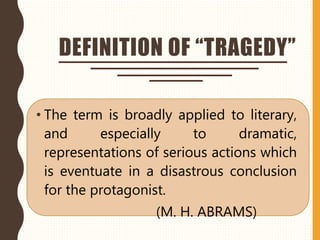
DEFINITION OF “TRAGEDY”
• The term is broadly applied to literary,
and especially to dramatic,
representations of serious actions which
is eventuate in a disastrous conclusion
for the protagonist.
(M. H. ABRAMS)
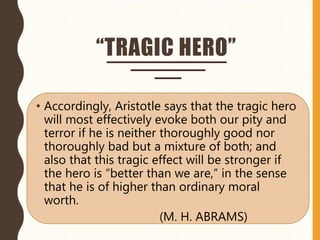
“TRAGIC HERO”
• Accordingly, Aristotle says that the tragic hero
will most effectively evoke both our pity and
terror if he is neither thoroughly good nor
thoroughly bad but a mixture of both; and
also that this tragic effect will be stronger if
the hero is “better than we are,” in the sense
that he is of higher than ordinary moral
worth.
(M. H. ABRAMS)
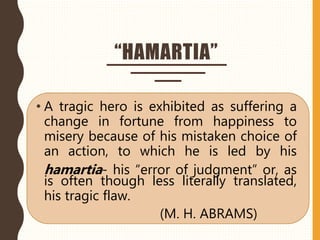
“HAMARTIA”
• A tragic hero is exhibited as suffering a
change in fortune from happiness to
misery because of his mistaken choice of
an action, to which he is led by his
hamartia- his “error of judgment” or, as
is often though less literally translated,
his tragic flaw.
(M. H. ABRAMS)
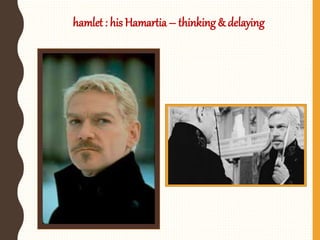
hamlet : his Hamartia – thinking & delaying
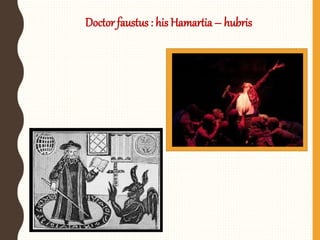
Doctor faustus : his Hamartia – hubris
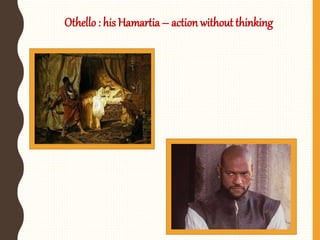
Othello : his Hamartia – action without thinking
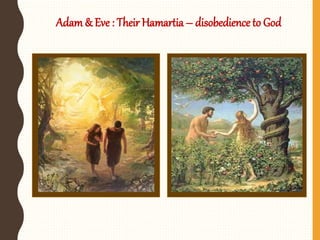
Adam& Eve : Their Hamartia – disobedience to God
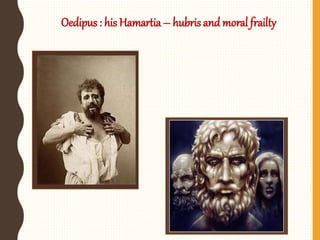
Oedipus : his Hamartia – hubris and moral frailty
Vishva paper 3

Vishva paper 3

  • 1.
    Name : VISHVAGAJJAR ROLL. NO: 45 EMAIL ID: vishvagajjar27@gmail.com SMT. S.B.GARDI DEPARTMENT OF ENGLISH Bhavnagar University Paper - 3 Literary Theory and Criticism : Western – 1 Selected Critical terms and its reflection on cherry picked literary texts
  • 2.
    DEFINITION OF “TRAGEDY” •The term is broadly applied to literary, and especially to dramatic, representations of serious actions which is eventuate in a disastrous conclusion for the protagonist. (M. H. ABRAMS)
  • 3.
    “TRAGIC HERO” • Accordingly,Aristotle says that the tragic hero will most effectively evoke both our pity and terror if he is neither thoroughly good nor thoroughly bad but a mixture of both; and also that this tragic effect will be stronger if the hero is “better than we are,” in the sense that he is of higher than ordinary moral worth. (M. H. ABRAMS)
  • 4.
    “HAMARTIA” • A tragichero is exhibited as suffering a change in fortune from happiness to misery because of his mistaken choice of an action, to which he is led by his hamartia- his “error of judgment” or, as is often though less literally translated, his tragic flaw. (M. H. ABRAMS)
  • 5.
    hamlet : hisHamartia – thinking & delaying
  • 6.
    Doctor faustus :his Hamartia – hubris
  • 7.
    Othello : hisHamartia – action without thinking
  • 8.
    Adam& Eve :Their Hamartia – disobedience to God
  • 9.
    Oedipus : hisHamartia – hubris and moral frailty