The Humorous Function of
Proper Names in "Harry Potter"
Name: Vishva Gajjar
Paper No.: The New Literature
Email: vishvagajjar27@gmail.com
Department of English (MKBU)
Humor
:
• Humor is the tendency of experiences to provoke laughter and
provoke amusement.
• The term derives from the humoral medicine of the ancient
Greeks, which taught that the balance of fluids in the human
body.
• The element of humor is often reflected in children fiction to grab
the attention and to keep them engaged.
• Humor and laughter are more than just an enjoyable part of life, it
would seem from research that humor has some positivity,
emotional and relational consequences.
Humor and Harry
Potter:
• The proper names in the Harry Potter series serve not only
their primary identifying-differential function, but also a wide
range of other purposes. One of them is to make the reader
laugh.
• Here, the names does not only signify the humor but, they also
define the character.
• Thomas Veatch’s words:
“Humor occurs when it seems that things are normal while at the
same time something seems wrong”.
Example
s:
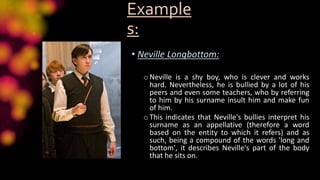
• Neville Longbottom:
oNeville is a shy boy, who is clever and works
hard. Nevertheless, he is bullied by a lot of his
peers and even some teachers, who by referring
to him by his surname insult him and make fun
of him.
oThis indicates that Neville's bullies interpret his
surname as an appellative (therefore a word
based on the entity to which it refers) and as
such, being a compound of the words 'long and
bottom', it describes Neville's part of the body
that he sits on.
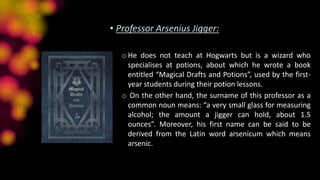
• Professor Arsenius Jigger:
oHe does not teach at Hogwarts but is a wizard who
specialises at potions, about which he wrote a book
entitled “Magical Drafts and Potions”, used by the first-
year students during their potion lessons.
o On the other hand, the surname of this professor as a
common noun means: “a very small glass for measuring
alcohol; the amount a jigger can hold, about 1.5
ounces”. Moreover, his first name can be said to be
derived from the Latin word arsenicum which means
arsenic.
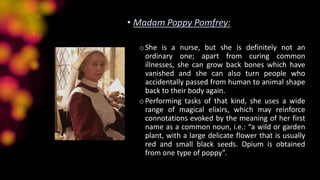
• Madam Poppy Pomfrey:
oShe is a nurse, but she is definitely not an
ordinary one; apart from curing common
illnesses, she can grow back bones which have
vanished and she can also turn people who
accidentally passed from human to animal shape
back to their body again.
oPerforming tasks of that kind, she uses a wide
range of magical elixirs, which may reinforce
connotations evoked by the meaning of her first
name as a common noun, i.e.: “a wild or garden
plant, with a large delicate flower that is usually
red and small black seeds. Opium is obtained
from one type of poppy”.
• The desire to highlight some particular
characteristics of the nicknamed person.
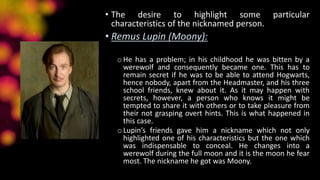
• Remus Lupin (Moony):
oHe has a problem; in his childhood he was bitten by a
werewolf and consequently became one. This has to
remain secret if he was to be able to attend Hogwarts,
hence nobody, apart from the Headmaster, and his three
school friends, knew about it. As it may happen with
secrets, however, a person who knows it might be
tempted to share it with others or to take pleasure from
their not grasping overt hints. This is what happened in
this case.
oLupin’s friends gave him a nickname which not only
highlighted one of his characteristics but the one which
was indispensable to conceal. He changes into a
werewolf during the full moon and it is the moon he fear
most. The nickname he got was Moony.
• Feelings one has for the nicknamed person.
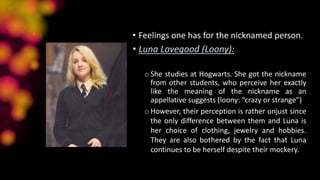
• Luna Lovegood (Loony):
oShe studies at Hogwarts. She got the nickname
from other students, who perceive her exactly
like the meaning of the nickname as an
appellative suggests (loony: “crazy or strange”)
oHowever, their perception is rather unjust since
the only difference between them and Luna is
her choice of clothing, jewelry and hobbies.
They are also bothered by the fact that Luna
continues to be herself despite their mockery.
Conclusio
n:
• To conclude, the above presented examples prove that
among the onomastic material of Harry Potter series,
there are some first names, surnames and nicknames
which serve the humorous function and the humorous
element contained in them appear due to the
incongruities present in the reader’s interpretation.
Works Cited:
• contributors, Wikipedia. Humour. 18 2 2020. Web. 21 2 2020.
<https://en.wikipedia.org/w/index.php?title=Humour&oldid=9413997
08>.
• Gibka, Martyna. "The Humorous Function of Proper Names in Harry
Potter." 2016. academia.edu. Web. 21 2 2020.
<https://www.academia.edu/34535015/The_Humorous_Function_of_
Proper_Names_in_Harry_Potter_>.
• Key themes in children's literature. 5 4 2009. Web. 21 2 2020.
<http://trevorcairney.blogspot.com/2009/04/key-themes-in-childrens-
literature.html>.
Thank
You

Function of Proper Names in "Harry Potter"

  • 1.
    The Humorous Functionof Proper Names in "Harry Potter" Name: Vishva Gajjar Paper No.: The New Literature Email: vishvagajjar27@gmail.com Department of English (MKBU)
  • 2.
    Humor : • Humor isthe tendency of experiences to provoke laughter and provoke amusement. • The term derives from the humoral medicine of the ancient Greeks, which taught that the balance of fluids in the human body. • The element of humor is often reflected in children fiction to grab the attention and to keep them engaged. • Humor and laughter are more than just an enjoyable part of life, it would seem from research that humor has some positivity, emotional and relational consequences.
  • 3.
    Humor and Harry Potter: •The proper names in the Harry Potter series serve not only their primary identifying-differential function, but also a wide range of other purposes. One of them is to make the reader laugh. • Here, the names does not only signify the humor but, they also define the character. • Thomas Veatch’s words: “Humor occurs when it seems that things are normal while at the same time something seems wrong”.
  • 4.
    Example s: • Neville Longbottom: oNevilleis a shy boy, who is clever and works hard. Nevertheless, he is bullied by a lot of his peers and even some teachers, who by referring to him by his surname insult him and make fun of him. oThis indicates that Neville's bullies interpret his surname as an appellative (therefore a word based on the entity to which it refers) and as such, being a compound of the words 'long and bottom', it describes Neville's part of the body that he sits on.
  • 5.
    • Professor ArseniusJigger: oHe does not teach at Hogwarts but is a wizard who specialises at potions, about which he wrote a book entitled “Magical Drafts and Potions”, used by the first- year students during their potion lessons. o On the other hand, the surname of this professor as a common noun means: “a very small glass for measuring alcohol; the amount a jigger can hold, about 1.5 ounces”. Moreover, his first name can be said to be derived from the Latin word arsenicum which means arsenic.
  • 6.
    • Madam PoppyPomfrey: oShe is a nurse, but she is definitely not an ordinary one; apart from curing common illnesses, she can grow back bones which have vanished and she can also turn people who accidentally passed from human to animal shape back to their body again. oPerforming tasks of that kind, she uses a wide range of magical elixirs, which may reinforce connotations evoked by the meaning of her first name as a common noun, i.e.: “a wild or garden plant, with a large delicate flower that is usually red and small black seeds. Opium is obtained from one type of poppy”.
  • 7.
    • The desireto highlight some particular characteristics of the nicknamed person. • Remus Lupin (Moony): oHe has a problem; in his childhood he was bitten by a werewolf and consequently became one. This has to remain secret if he was to be able to attend Hogwarts, hence nobody, apart from the Headmaster, and his three school friends, knew about it. As it may happen with secrets, however, a person who knows it might be tempted to share it with others or to take pleasure from their not grasping overt hints. This is what happened in this case. oLupin’s friends gave him a nickname which not only highlighted one of his characteristics but the one which was indispensable to conceal. He changes into a werewolf during the full moon and it is the moon he fear most. The nickname he got was Moony.
  • 8.
    • Feelings onehas for the nicknamed person. • Luna Lovegood (Loony): oShe studies at Hogwarts. She got the nickname from other students, who perceive her exactly like the meaning of the nickname as an appellative suggests (loony: “crazy or strange”) oHowever, their perception is rather unjust since the only difference between them and Luna is her choice of clothing, jewelry and hobbies. They are also bothered by the fact that Luna continues to be herself despite their mockery.
  • 9.
    Conclusio n: • To conclude,the above presented examples prove that among the onomastic material of Harry Potter series, there are some first names, surnames and nicknames which serve the humorous function and the humorous element contained in them appear due to the incongruities present in the reader’s interpretation.
  • 10.
    Works Cited: • contributors,Wikipedia. Humour. 18 2 2020. Web. 21 2 2020. <https://en.wikipedia.org/w/index.php?title=Humour&oldid=9413997 08>. • Gibka, Martyna. "The Humorous Function of Proper Names in Harry Potter." 2016. academia.edu. Web. 21 2 2020. <https://www.academia.edu/34535015/The_Humorous_Function_of_ Proper_Names_in_Harry_Potter_>. • Key themes in children's literature. 5 4 2009. Web. 21 2 2020. <http://trevorcairney.blogspot.com/2009/04/key-themes-in-childrens- literature.html>.
  • 11.