Cataloging Cultural Objects
CCO in Action
Work Context
Establish the logical focus of each Work Record, whether it
is a single item, a work made up of several parts [or related
works], or a physical group or collection of works. (See CCO
CCO pages 3-6)
Part One: Focus on the Work
What is the Work?
Defining a (complex) work:
• Are all components created in the same time span?
• Are all components by the same person(s)?
• Do all components have the same title?
• Are the components still together? (Has the work been
split apart?)
If the answer to any of the above is “No”, it suggests
you have more than one work
Cataloging is always about choices
Determining what the work is, and the relationships between collection, work,
and image records requires thought and planning influenced by:
 Scope of a given collection or project
 Promoting access and understanding user needs
 Needed presentation of part/whole relationships
 Depth of cataloging (“specificity and exhaustivity”)
 Expertise of catalogers, time constraints and availability of information
What is a “minimum record”?
 CCO (a content standard) makes recommendations (including the need for
both work and image records)
 Most structural standards also make recommendations (Title is usually
required)
 The local decisions will take into account scope (of projects or special
collections) and user needs
 Promote good access by striving to meet “who, what, where, when”
Catalog Once; Export What is Needed
When we talk about “Best” Practices, we are talking about efficiency, quality
control and future viability (not right or wrong)
• Use a relational database/tool if possible
• Develop automated processes, like the use of XSLT or calculations to output
data manipulated or repurposed for various uses
• Understand that these approaches can be very cost-effective---they can pay
for themselves in time, labor and quality of results
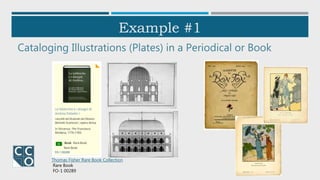
Example #1
Cataloging Illustrations (Plates) in a Periodical or Book
Thomas Fisher Rare Book Collection
Rare Book
FO-1 00289
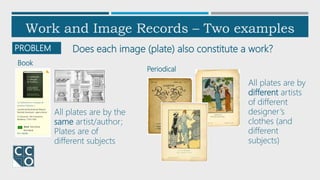
Work and Image Records – Two examples
PROBLEM Does each image (plate) also constitute a work?
Book
All plates are by the
same artist/author;
Plates are of
different subjects
Periodical
All plates are by
different artists
of different
designer’s
clothes (and
different
subjects)
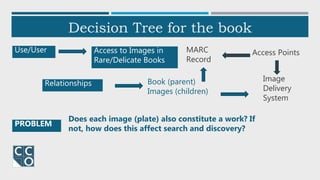
Decision Tree for the book
Use/User Access to Images in
Rare/Delicate Books
Access Points
MARC
Record
Image
Delivery
System
Relationships Book (parent)
Images (children)
PROBLEM
Does each image (plate) also constitute a work? If
not, how does this affect search and discovery?
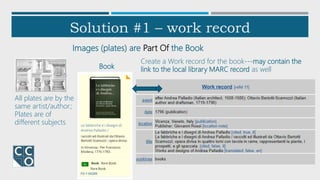
Solution #1 – work record
Images (plates) are Part Of the Book
Book
All plates are by the
same artist/author;
Plates are of
different subjects
Create a Work record for the book---may contain the
link to the local library MARC record as well
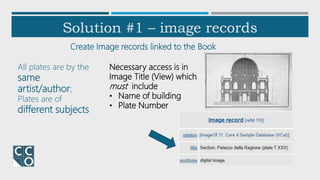
Solution #1 – image records
Create Image records linked to the Book
All plates are by the
same
artist/author;
Plates are of
different subjects
Necessary access is in
Image Title (View) which
must include
• Name of building
• Plate Number
TEST Solution #1
How does this solution work in your delivery system?
• Is the book/work discoverable with all the attached
(linked) images? Across multiple collections (if
applicable)?
• Will the individual images come up with searches by
the building name? Architect’s name?
• Have you set your system’s search
parameters/indexing correctly for all cases? (For
example: setting Description to not be keyword
searched because of false hits?)
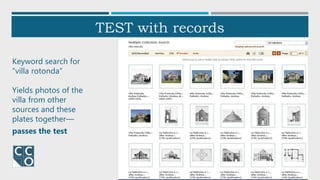
TEST with records
Keyword search for
“villa rotonda”
Yields photos of the
villa from other
sources and these
plates together—
passes the test
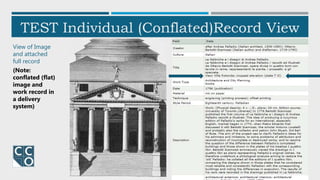
TEST Individual (Conflated)Record View
View of Image
and attached
full record
(Note:
conflated (flat)
image and
work record in
a delivery
system)
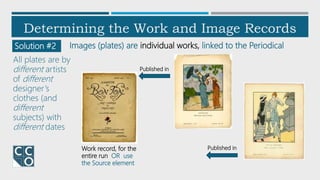
Determining the Work and Image Records
Solution #2 Images (plates) are individual works, linked to the Periodical
Work record, for the
entire run OR use
the Source element
Published in
Published in
All plates are by
different artists
of different
designer’s
clothes (and
different
subjects) with
different dates
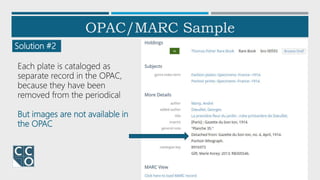
OPAC/MARC Sample
Solution #2
Each plate is cataloged as
separate record in the OPAC,
because they have been
removed from the periodical
But images are not available in
the OPAC
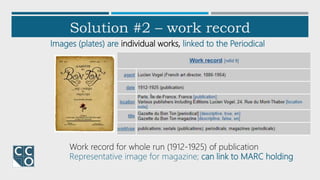
Solution #2 – work record
Images (plates) are individual works, linked to the Periodical
Work record for whole run (1912-1925) of publication
Representative image for magazine; can link to MARC holding
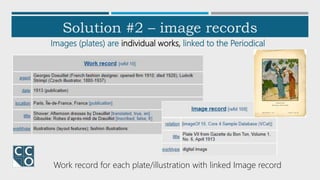
Solution #2 – image records
Images (plates) are individual works, linked to the Periodical
Work record for each plate/illustration with linked Image record
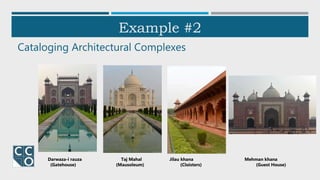
TEST Solution #2
Keyword search for
"Gazette du Bon Ton"
Yields all the images
associated with the
periodical, and also
searchable by
individual creators—
passes the test
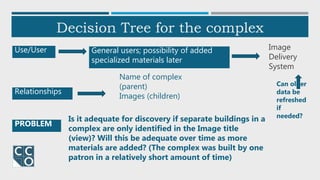
Example #2
Cataloging Architectural Complexes
Darwaza-i rauza Taj Mahal Jilau khana Mehman khana
(Gatehouse) (Mausoleum) (Cloisters) (Guest House)
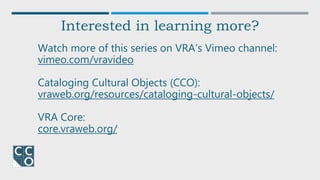
Decision Tree for the complex
Use/User General users; possibility of added
specialized materials later
Image
Delivery
System
Relationships
Name of complex
(parent)
Images (children)
PROBLEM
Is it adequate for discovery if separate buildings in a
complex are only identified in the Image title
(view)? Will this be adequate over time as more
materials are added? (The complex was built by one
patron in a relatively short amount of time)
Can older
data be
refreshed
if
needed?
A Solution
Create Image Records linked to the Work Record for the “Taj Mahal [Complex]”
What is the “work in hand”?
In other words what/ how many images
are you cataloging? Do you have
information about the less famous
component parts?
Will your solution allow search and
discovery of those via the Image title,
and worktype?
Are all your repeating worktypes carried
into your delivery system?
Watch more of this series on VRA’s Vimeo channel:
vimeo.com/vravideo
Cataloging Cultural Objects (CCO):
vraweb.org/resources/cataloging-cultural-objects/
VRA Core:
core.vraweb.org/
Interested in learning more?
Cataloging Cultural Objects
This video series was developed by the
CCO Sub-committee of the
VRA Cataloging and Metadata Standards Committee
 Arden Kirkland, sub-committee chair
 Jonathan Cartledge
 Sheryl Frisch
 Susan Jane Williams
Credits

CCO in Action: Work Context

  • 1.
    Cataloging Cultural Objects CCOin Action Work Context
  • 2.
    Establish the logicalfocus of each Work Record, whether it is a single item, a work made up of several parts [or related works], or a physical group or collection of works. (See CCO CCO pages 3-6) Part One: Focus on the Work
  • 3.
    What is theWork? Defining a (complex) work: • Are all components created in the same time span? • Are all components by the same person(s)? • Do all components have the same title? • Are the components still together? (Has the work been split apart?) If the answer to any of the above is “No”, it suggests you have more than one work
  • 4.
    Cataloging is alwaysabout choices Determining what the work is, and the relationships between collection, work, and image records requires thought and planning influenced by:  Scope of a given collection or project  Promoting access and understanding user needs  Needed presentation of part/whole relationships  Depth of cataloging (“specificity and exhaustivity”)  Expertise of catalogers, time constraints and availability of information
  • 5.
    What is a“minimum record”?  CCO (a content standard) makes recommendations (including the need for both work and image records)  Most structural standards also make recommendations (Title is usually required)  The local decisions will take into account scope (of projects or special collections) and user needs  Promote good access by striving to meet “who, what, where, when”
  • 6.
    Catalog Once; ExportWhat is Needed When we talk about “Best” Practices, we are talking about efficiency, quality control and future viability (not right or wrong) • Use a relational database/tool if possible • Develop automated processes, like the use of XSLT or calculations to output data manipulated or repurposed for various uses • Understand that these approaches can be very cost-effective---they can pay for themselves in time, labor and quality of results
  • 7.
    Example #1 Cataloging Illustrations(Plates) in a Periodical or Book Thomas Fisher Rare Book Collection Rare Book FO-1 00289
  • 8.
    Work and ImageRecords – Two examples PROBLEM Does each image (plate) also constitute a work? Book All plates are by the same artist/author; Plates are of different subjects Periodical All plates are by different artists of different designer’s clothes (and different subjects)
  • 9.
    Decision Tree forthe book Use/User Access to Images in Rare/Delicate Books Access Points MARC Record Image Delivery System Relationships Book (parent) Images (children) PROBLEM Does each image (plate) also constitute a work? If not, how does this affect search and discovery?
  • 10.
    Solution #1 –work record Images (plates) are Part Of the Book Book All plates are by the same artist/author; Plates are of different subjects Create a Work record for the book---may contain the link to the local library MARC record as well
  • 11.
    Solution #1 –image records Create Image records linked to the Book All plates are by the same artist/author; Plates are of different subjects Necessary access is in Image Title (View) which must include • Name of building • Plate Number
  • 12.
    TEST Solution #1 Howdoes this solution work in your delivery system? • Is the book/work discoverable with all the attached (linked) images? Across multiple collections (if applicable)? • Will the individual images come up with searches by the building name? Architect’s name? • Have you set your system’s search parameters/indexing correctly for all cases? (For example: setting Description to not be keyword searched because of false hits?)
  • 13.
    TEST with records Keywordsearch for “villa rotonda” Yields photos of the villa from other sources and these plates together— passes the test
  • 14.
    TEST Individual (Conflated)RecordView View of Image and attached full record (Note: conflated (flat) image and work record in a delivery system)
  • 15.
    Determining the Workand Image Records Solution #2 Images (plates) are individual works, linked to the Periodical Work record, for the entire run OR use the Source element Published in Published in All plates are by different artists of different designer’s clothes (and different subjects) with different dates
  • 16.
    OPAC/MARC Sample Solution #2 Eachplate is cataloged as separate record in the OPAC, because they have been removed from the periodical But images are not available in the OPAC
  • 17.
    Solution #2 –work record Images (plates) are individual works, linked to the Periodical Work record for whole run (1912-1925) of publication Representative image for magazine; can link to MARC holding
  • 18.
    Solution #2 –image records Images (plates) are individual works, linked to the Periodical Work record for each plate/illustration with linked Image record
  • 19.
    TEST Solution #2 Keywordsearch for "Gazette du Bon Ton" Yields all the images associated with the periodical, and also searchable by individual creators— passes the test
  • 20.
    Example #2 Cataloging ArchitecturalComplexes Darwaza-i rauza Taj Mahal Jilau khana Mehman khana (Gatehouse) (Mausoleum) (Cloisters) (Guest House)
  • 21.
    Decision Tree forthe complex Use/User General users; possibility of added specialized materials later Image Delivery System Relationships Name of complex (parent) Images (children) PROBLEM Is it adequate for discovery if separate buildings in a complex are only identified in the Image title (view)? Will this be adequate over time as more materials are added? (The complex was built by one patron in a relatively short amount of time) Can older data be refreshed if needed?
  • 22.
    A Solution Create ImageRecords linked to the Work Record for the “Taj Mahal [Complex]” What is the “work in hand”? In other words what/ how many images are you cataloging? Do you have information about the less famous component parts? Will your solution allow search and discovery of those via the Image title, and worktype? Are all your repeating worktypes carried into your delivery system?
  • 23.
    Watch more ofthis series on VRA’s Vimeo channel: vimeo.com/vravideo Cataloging Cultural Objects (CCO): vraweb.org/resources/cataloging-cultural-objects/ VRA Core: core.vraweb.org/ Interested in learning more?
  • 24.
    Cataloging Cultural Objects Thisvideo series was developed by the CCO Sub-committee of the VRA Cataloging and Metadata Standards Committee  Arden Kirkland, sub-committee chair  Jonathan Cartledge  Sheryl Frisch  Susan Jane Williams Credits

Editor's Notes

  • #2 In this series, we will explore what constitutes a work, how different works can be related, and how collections, both physical and virtual, can be represented. One of the basic tenants of CCO is that both a work and an image record is required. VRA Core 4 is a standard which uses this structure, and so our examples will use VRA Core 4 as a starting point.
  • #4 Defining what constitutes a single work record, and when it needs to be split into multiple records with part/whole relationships is a common task. When you find that different components have different time frames, creators, titles or are in different repositories, then you may require more than one work record, plus a relationship.
  • #5 Cataloging always represents choices based on your local needs and users. These are mitigating factors, but the goal is always that the asset can be easily found by users of differing levels of expertise.
  • #6 Using standards is highly desirable, and it is always possible to create minimum records within a given standard framework. Adopting a relatively rich standard framework, even if you are not currently using all the elements or fields, allows your data to be expanded over time, if that becomes desirable.
  • #7 There is no one “right” way to catalog, rather, best practices are about efficiency. Consistency in data entry and field values through the use of standards means you will be able to automate processes, reliably manipulate data for different uses, and more easily remediate and migrate your data. In other words, make sure your data has continued value over time.
  • #8 We’re going to look at the problem of cataloging plates or illustrations in books or periodicals, as an example of thinking through cataloging decision making and testing user access.
  • #9 In the case on the left, we have plates in a rare book. They are all by the same artist or author. They are of different subjects. On the right we have plates in a fashion periodical, all by different artists, representing different fashion designers, of different types of clothing.
  • #10 Let’s look at a decision process for the book, thinking about access points for the user. This book happens to be in a rare book collection, with a MARC record, but with no online images.
  • #11 The images are obviously part of the book. How could we represent this in an image delivery system? The MARC record can be used as a reference, or a link as well.
  • #12 All of the plates reference works by Palladio. Because all of the images are also by the same author or artist, done at the same time, they can be represented by a single work record, with more specific information in each image record. Note that with this approach it is vital to standardize that information, in this case building name, and plate number in each Image Title (the caption).
  • #13 Think through the test of this structure; will it be discoverable? Will this work well with other cataloging solutions you have used? With other images of buildings by Palladio? In this case will it come up with the building name, architect’s name as well as the book title and author?
  • #14 It is always a good idea to run a test, if only a single record, loaded into your local delivery system. Searching on “villa rotunda” shows that images of the actual building do come up, along with the plates from the book—it passes the test as a viable cataloging solution.
  • #15 Note that although both CCO and VRA Core 4 require image and work records, in a display system these are mapped and flattened into one display record. If you do not have a relational database, you can still construct a flat record template that corresponds to standards; while not recommended, this may work for some collections, or as a short term solution.
  • #16 In our second solution, each plate must be cataloged as a separate work, because of different dates, fashion designers, and illustrators. The plates can be linked to a work record for the entire run of the periodical, or by using the periodical as the Source element for the plate.
  • #17 This happens to match the MARC record, because in this library, the plates have been removed and are accessed as separate sheets. But, again, no image is available in the OPAC.
  • #18 Using a place holder image, a work record can be created for the whole run of the periodical, this can link to a MARC record. The relationship to the illustration work record is “published in”.
  • #19 Here, what is represented in the Image Title is the Plate number, Volume, Issue and Date. The title, illustrator, and fashion designer appears in the Work record.
  • #20 Again, loading a test in a delivery system and searching by “Gazette du Bon Ton” turns up all the plates, and searching on individual artists and designers also works. It passes the test.
  • #21 Here we will look at a literal “complex” record. What is key with this decision process is thinking about the possibility of adding more images in the future, and whether our decision will be adaptable over time. Here we are looking at multiple buildings at the Taj Mahal site.
  • #22 Decisions with this material might be made by local curricula and graduate or undergraduate users. A major issue with cataloging for all delivery systems is whether data can be updated and refreshed, as new images are added to existing work records over time. This has to be factored into decision trees.
  • #23 Many of us catalog the “work in hand”—preparing groups of images as needed immediately in teaching. In other words, it will affect our decision today if we only have two images of the gatehouse and 20 of the Taj itself. Here a pragmatic solution is to create a record with the title “Taj Mahal [Complex]” and the gatehouse information in the Image Title for now. It will be possible to have this [Complex] record carry forward in time as the Parent record with the ability to create Child records for the other buildings in the future, as “part of” the complex.