Transcoding Quality Prediction for Adaptive Video Streaming
Vignesh V Menon1, Reza Farahani1, Prajit T Rajendran2, Mohammad Ghanbari3, Hermann
Hellwagner1, Christian Timmerer1
1
Christian Doppler Laboratory ATHENA, Alpen-Adria-Universität, Klagenfurt, Austria
2
CEA, List, F-91120 Palaiseau, Université Paris-Saclay, France
3
School of Computer Science and Electronic Engineering, University of Essex, UK
08 May 2023
Transcoding Quality Prediction for Adaptive Video Streaming 1
Outline
1 Introduction
2 M-stage transcoding model
3 TQPM Architecture
4 Evaluation
5 Conclusions
Transcoding Quality Prediction for Adaptive Video Streaming 2
Introduction
Introduction
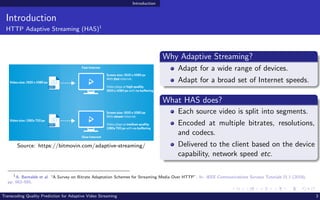
HTTP Adaptive Streaming (HAS)1
Source: https://bitmovin.com/adaptive-streaming/
Why Adaptive Streaming?
Adapt for a wide range of devices.
Adapt for a broad set of Internet speeds.
What HAS does?
Each source video is split into segments.
Encoded at multiple bitrates, resolutions,
and codecs.
Delivered to the client based on the device
capability, network speed etc.
1
A. Bentaleb et al. “A Survey on Bitrate Adaptation Schemes for Streaming Media Over HTTP”. In: IEEE Communications Surveys Tutorials 21.1 (2019),
pp. 562–585.
Transcoding Quality Prediction for Adaptive Video Streaming 3
Introduction
Motivation
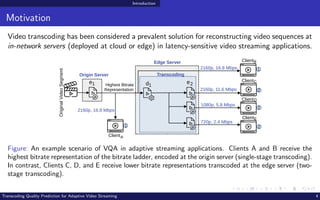
Video transcoding has been considered a prevalent solution for reconstructing video sequences at
in-network servers (deployed at cloud or edge) in latency-sensitive video streaming applications.
e
Original
Video
Segment
Highest Bitrate
Representation
1 d1 2
e
2160p, 16.8 Mbps
2160p, 16.8 Mbps
2160p, 11.6 Mbps
1080p, 5.8 Mbps
720p, 2.4 Mbps
Origin Server
Edge Server
ClientA
Client
Client
Client
B
D
Client
C
E
Transcoding
1
1
2
2
2
Figure: An example scenario of VQA in adaptive streaming applications. Clients A and B receive the
highest bitrate representation of the bitrate ladder, encoded at the origin server (single-stage transcoding).
In contrast, Clients C, D, and E receive lower bitrate representations transcoded at the edge server (two-
stage transcoding).
Transcoding Quality Prediction for Adaptive Video Streaming 4
Introduction
Motivation
Features
Quality Scores Processor
Input
Video
Reconstructed
Video
Video Processing
Features
Figure: Workflow of state-of-the-art VQA methods.
VQA is cumbersome in most video streaming applications where:
The original input video segment is not available as the reference at the destination
The final reconstructed video segment is not available at the source
Slow quality-based decision-making is not acceptable for online latency-sensitive services.
Transcoding Quality Prediction for Adaptive Video Streaming 5
M-stage transcoding model
e d e d e d
Input
Video
Segment
Reconstructed
Video
Segment
M-Stage Transcoding System Model
...
b
~
1 b
~
2 b
~
M
1 1 2 2 M M
Stage 1 Stage 2 Stage M
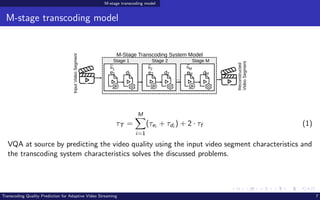
Figure: M-stage transcoding model considered in this paper. Here, ei and di represent the encoding and
decoding in ith
stage of transcoding, while b̃i denotes the target bitrate of ei where i ∈ [1, M].
The generalized M-stage transcoding model for HAS consists of a series of M encoders and
M decoders in a chain.
M=1 transcoding corresponds to the single-stage transcoding while M=2 transcoding corre-
sponds to the two-stage transcoding.
Transcoding Quality Prediction for Adaptive Video Streaming 6
M-stage transcoding model
e d e d e d
Input
Video
Segment
Reconstructed
Video
Segment
M-Stage Transcoding System Model
...
b
~
1 b
~
2 b
~
M
1 1 2 2 M M
Stage 1 Stage 2 Stage M
τT =
M
X
i=1
(τei + τdi
) + 2 · τf (1)
VQA at source by predicting the video quality using the input video segment characteristics and
the transcoding system characteristics solves the discussed problems.
Transcoding Quality Prediction for Adaptive Video Streaming 7
TQPM Architecture
TQPM Architecture
...
...
...
E
h
L L L
h h
E E
1
1
1
T
T
X
X1 T
Video
Quality
Prediction
Model bM
~
V
^
b2
~ b1
~
...
Input
Video
Segment
E T
b1
~
b2
~
.
.
.
bM
~
[T x (M+3)]
I
II
I Input Video Segment Characteristics
II M-Stage Transcoding Model Characteristics
~
Figure: TQPM architecture
The TQPM architecture comprises three steps:
input video segment characterization
transcoding model Characterization
video quality prediction
Transcoding Quality Prediction for Adaptive Video Streaming 8
TQPM Architecture Phase 1: Input video segment characterization
Input video segment characterization
Compute texture energy per block
A DCT-based energy function is used to determine the block-wise feature of each frame
defined as:
Hk =
w−1
X
i=0
w−1
X
j=0
e|( ij
wh
)2−1|
|DCT(i, j)| (2)
where wxw is the size of the block, and DCT(i, j) is the (i, j)th DCT component when
i + j > 0, and 0 otherwise.
The energy values of blocks in a frame are averaged to determine the energy per frame.2,3
Es =
K−1
X
k=0
Hs,k
K · w2
(3)
2
Michael King, Zinovi Tauber, and Ze-Nian Li. “A New Energy Function for Segmentation and Compression”. In: 2007 IEEE International Conference on
Multimedia and Expo. 2007, pp. 1647–1650. doi: 10.1109/ICME.2007.4284983.
3
Vignesh V Menon et al. “Efficient Content-Adaptive Feature-Based Shot Detection for HTTP Adaptive Streaming”. In: 2021 IEEE International Conference
on Image Processing (ICIP). 2021, pp. 2174–2178. doi: 10.1109/ICIP42928.2021.9506092.
Transcoding Quality Prediction for Adaptive Video Streaming 9
TQPM Architecture Phase 1: Input video segment characterization
Input video segment characterization
hs: SAD of the block level energy values of frame s to that of the previous frame s − 1.
hs =
K−1
X
k=0
| Hs,k, Hs−1,k |
K · w2
(4)
where K denotes the number of blocks in frame s.
The luminescence of non-overlapping blocks k of sth frame is defined as:
Ls,k =
p
DCT(0, 0) (5)
The block-wise luminescence is averaged per frame denoted as Ls as shown below.4
Ls =
K−1
X
k=0
Ls,k
K · w2
(6)
4
Vignesh V Menon et al. “VCA: Video Complexity Analyzer”. In: Proceedings of the 13th ACM Multimedia Systems Conference. MMSys ’22. Athlone,
Ireland: Association for Computing Machinery, 2022, 259–264. isbn: 9781450392839. doi: 10.1145/3524273.3532896. url:
https://doi.org/10.1145/3524273.3532896.
Transcoding Quality Prediction for Adaptive Video Streaming 10
TQPM Architecture Phase 1: Input video segment characterization
Input video segment characterization
The video segment is divided into T chunks with a fixed number of frames (i.e., fc) in each
chunk. The averages of the E, h, and L features of each chunk are computed to obtain the
reduced reference representation of the input video segment, expressed as:
X = {x1, x2, .., xT } (7)
where, xi is the feature set of every ith chunk, represented as :
xi = [Ei , hi , Li ] ∀i ∈ [1, T] (8)
Transcoding Quality Prediction for Adaptive Video Streaming 11
TQPM Architecture Phase 2: Transcoding model Characterization
Phase 2: Transcoding model Characterization
e d e d e d
Input
Video
Segment
Reconstructed
Video
Segment
M-Stage Transcoding System Model
...
b
~
1 b
~
2 b
~
M
1 1 2 2 M M
Stage 1 Stage 2 Stage M
The settings of the encoders in the M-stage transcoding process, except the target bitrate-
resolution pair, are assumed identical.5
The resolutions corresponding to the target bitrates in the bitrate ladder are also assumed
to be fixed.
The transcoding model can be characterized as follows:
B̃ = [b̃1, b̃2, .., b̃M] (9)
where b̃i represents the target bitrate of the ei encoder.
5
Vignesh V Menon et al. “EMES: Efficient Multi-Encoding Schemes for HEVC-Based Adaptive Bitrate Streaming”. In: ACM Trans. Multimedia Comput.
Commun. Appl. 19.3s (2023). issn: 1551-6857. doi: 10.1145/3575659. url: https://doi.org/10.1145/3575659.
Transcoding Quality Prediction for Adaptive Video Streaming 12
TQPM Architecture Phase 3: Video quality prediction
Phase 3: Video quality prediction
B̃ is appended to xi , which is determined during the input video segment characterization phase,
to obtain:
˜
xi = [xi |B̃]T
∀˜
xi ∈ X̃, i ∈ [1, T] (10)
The predicted quality v̂b̃M |..|b̃1
can be presented as:
v̂b̃M |..|b̃1
= f (X̃) (11)
The feature sequences in the series X̃ are input to the LSTM model, which predicts visual quality
v̂ for the corresponding input video segment and chain of encoders in the transcoding process.
Transcoding Quality Prediction for Adaptive Video Streaming 13
Evaluation Experimental Setup
Experimental Setup
Dataset : JVET,6 MCML,7 SJTU,8 Berlin,9 UVG,10 BVI11
Framerate : 30fps
Encoder : x265 v3.5
Preset : ultrafast
Table: Representations considered in this paper.
Representation ID 01 02 03 04 05 06 07 08 09 10 11 12
r (width in pixels) 360 432 540 540 540 720 720 1080 1080 1440 2160 2160
b (in Mbps) 0.145 0.300 0.600 0.900 1.600 2.400 3.400 4.500 5.800 8.100 11.600 16.800
E, h, L features are extracted using VCAv2.0.
6
Jill Boyce et al. JVET-J1010: JVET common test conditions and software reference configurations. July 2018.
7
Manri Cheon and Jong-Seok Lee. “Subjective and Objective Quality Assessment of Compressed 4K UHD Videos for Immersive Experience”. In: IEEE
Transactions on Circuits and Systems for Video Technology 28.7 (2018), pp. 1467–1480. doi: 10.1109/TCSVT.2017.2683504.
8
Li Song et al. “The SJTU 4K Video Sequence Dataset”. In: Fifth International Workshop on Quality of Multimedia Experience (QoMEX2013) (July 2013).
9
B. Bross et al. “AHG4 Multiformat Berlin Test Sequences”. In: JVET-Q0791. 2020.
10
Alexandre Mercat, Marko Viitanen, and Jarno Vanne. “UVG Dataset: 50/120fps 4K Sequences for Video Codec Analysis and Development”. In: Proceedings
of the 11th ACM Multimedia Systems Conference. New York, NY, USA: Association for Computing Machinery, 2020, 297–302. isbn: 9781450368452. url:
https://doi.org/10.1145/3339825.3394937.
11
Alex Mackin, Fan Zhang, and David R. Bull. “A study of subjective video quality at various frame rates”. In: 2015 IEEE International Conference on Image
Processing (ICIP). 2015, pp. 3407–3411. doi: 10.1109/ICIP.2015.7351436.
Transcoding Quality Prediction for Adaptive Video Streaming 14
Evaluation Experimental Results
Experimental Results
20 30 40 50
Actual PSNR (in dB)
20
30
40
50
Predicted
PSNR
(in
dB)
(a)
10 20 30 40
Actual SSIM (in dB)
10
20
30
40
Predicted
SSIM
(in
dB)
(b)
0 25 50 75 100
Actual VMAF
0
20
40
60
80
100
Predicted
VMAF
JND threshold
(c)
20 30 40 50
Actual PSNR (in dB)
20
30
40
50
Predicted
PSNR
(in
dB)
(d)
10 20 30 40
Actual SSIM (in dB)
10
20
30
40
Predicted
SSIM
(in
dB)
(e)
0 25 50 75 100
Actual VMAF
0
20
40
60
80
100
Predicted
VMAF
JND threshold
(f)
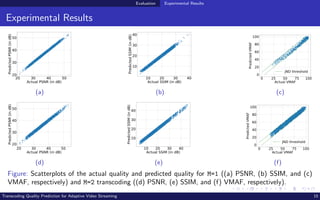
Figure: Scatterplots of the actual quality and predicted quality for M=1 ((a) PSNR, (b) SSIM, and (c)
VMAF, respectively) and M=2 transcoding ((d) PSNR, (e) SSIM, and (f) VMAF, respectively).
Transcoding Quality Prediction for Adaptive Video Streaming 15
Evaluation Experimental Results
Experimental Results
Table: Prediction accuracy of TQPM when M=1 and M=2, respectively, for b̃1 representations considered in
this paper encoded using x265 HEVC encoder.
PSNR prediction SSIM prediction VMAF prediction
M=1 M=2 M=1 M=2 M=1 M=2
b̃1 R2 MAE R2 MAE R2 MAE R2 MAE R2 MAE R2 MAE
b1 360p 0.145 Mbps 0.82 1.20 dB - - 0.89 1.08 dB - - 0.87 3.35 - -
b2 432p 0.300 Mbps 0.83 1.19 dB 0.84 1.37 dB 0.89 1.14 dB 0.87 1.34 dB 0.87 3.51 0.76 3.38
b3 540p 0.600 Mbps 0.83 1.19 dB 0.85 1.28 dB 0.88 1.18 dB 0.85 1.21 dB 0.90 4.05 0.84 3.55
b4 540p 0.900 Mbps 0.83 1.19 dB 0.83 1.22 dB 0.86 1.17 dB 0.86 1.11 dB 0.90 3.83 0.89 3.53
b5 540p 1.600 Mbps 0.82 1.22 dB 0.82 1.15 dB 0.84 1.19 dB 0.85 1.38 dB 0.90 3.45 0.90 3.44
b6 720p 2.400 Mbps 0.83 1.26 dB 0.83 1.28 dB 0.82 1.18 dB 0.83 1.57 dB 0.88 2.88 0.91 3.45
b7 720p 3.400 Mbps 0.81 1.30 dB 0.85 1.23 dB 0.83 1.20 dB 0.82 1.35 dB 0.84 2.89 0.94 3.03
b8 1080p 4.500 Mbps 0.84 1.28 dB 0.83 1.28 dB 0.88 1.23 dB 0.82 1.34 dB 0.87 2.28 0.95 3.03
b9 1080p 5.800 Mbps 0.86 1.31 dB 0.87 1.42 dB 0.83 1.29 dB 0.86 1.30 dB 0.87 2.23 0.95 3.34
b10 1440p 8.100 Mbps 0.84 1.39 dB 0.81 1.41 dB 0.87 1.29 dB 0.87 1.32 dB 0.85 2.73 0.96 2.96
b11 2160p 11.600 Mbps 0.79 1.50 dB 0.82 1.31 dB 0.88 1.17 dB 0.84 1.32 dB 0.82 2.58 0.96 3.02
b12 2160p 16.800 Mbps 0.84 1.49 dB 0.79 1.26 dB 0.88 1.19 dB 0.86 1.35 dB 0.86 2.38 0.96 2.99
Average 0.83 1.31 dB 0.84 1.32 dB 0.85 1.19 dB 0.86 1.33 dB 0.87 3.01 0.91 3.25
The average processing time of TQPM for a 4s segment is 0.328s.
Transcoding Quality Prediction for Adaptive Video Streaming 16
Conclusions
Conclusions
This paper proposed TQPM, an online transcoding quality prediction model for video stream-
ing applications.
The proposed LSTM-based model uses DCT-energy-based features as reduced reference
to characterize the input video segment, which is used to predict the visual quality of an
M-stage transcoding process.
The performance of TQPM is validated by the Apple HLS bitrate ladder encoding and
transcoding using the x265 open-source HEVC encoder.
On average, for single-stage transcoding, TQPM predicts PSNR, SSIM, and VMAF with an
MAE of 1.31 dB, 1.19 dB, and 3.01, respectively.
Furthermore, PSNR, SSIM, and VMAF are predicted for two-stage transcoding with an
average MAE of 1.32 dB, 1.33 dB, and 3.25, respectively.
Transcoding Quality Prediction for Adaptive Video Streaming 17
Conclusions
Future Directions
In the future, transcoding between bitrate ladder representations of various codecs shall be
investigated.
Another future direction is defining a decision-making component based on the proposed
model in an end-to-end live streaming system.
Transcoding Quality Prediction for Adaptive Video Streaming 18
Q & A
Q & A
Thank you for your attention!
Vignesh V Menon (vignesh.menon@aau.at)
VCA
Transcoding Quality Prediction for Adaptive Video Streaming 19

TQPM.pdf

  • 1.
    Transcoding Quality Predictionfor Adaptive Video Streaming Vignesh V Menon1, Reza Farahani1, Prajit T Rajendran2, Mohammad Ghanbari3, Hermann Hellwagner1, Christian Timmerer1 1 Christian Doppler Laboratory ATHENA, Alpen-Adria-Universität, Klagenfurt, Austria 2 CEA, List, F-91120 Palaiseau, Université Paris-Saclay, France 3 School of Computer Science and Electronic Engineering, University of Essex, UK 08 May 2023 Transcoding Quality Prediction for Adaptive Video Streaming 1
  • 2.
    Outline 1 Introduction 2 M-stagetranscoding model 3 TQPM Architecture 4 Evaluation 5 Conclusions Transcoding Quality Prediction for Adaptive Video Streaming 2
  • 3.
    Introduction Introduction HTTP Adaptive Streaming(HAS)1 Source: https://bitmovin.com/adaptive-streaming/ Why Adaptive Streaming? Adapt for a wide range of devices. Adapt for a broad set of Internet speeds. What HAS does? Each source video is split into segments. Encoded at multiple bitrates, resolutions, and codecs. Delivered to the client based on the device capability, network speed etc. 1 A. Bentaleb et al. “A Survey on Bitrate Adaptation Schemes for Streaming Media Over HTTP”. In: IEEE Communications Surveys Tutorials 21.1 (2019), pp. 562–585. Transcoding Quality Prediction for Adaptive Video Streaming 3
  • 4.
    Introduction Motivation Video transcoding hasbeen considered a prevalent solution for reconstructing video sequences at in-network servers (deployed at cloud or edge) in latency-sensitive video streaming applications. e Original Video Segment Highest Bitrate Representation 1 d1 2 e 2160p, 16.8 Mbps 2160p, 16.8 Mbps 2160p, 11.6 Mbps 1080p, 5.8 Mbps 720p, 2.4 Mbps Origin Server Edge Server ClientA Client Client Client B D Client C E Transcoding 1 1 2 2 2 Figure: An example scenario of VQA in adaptive streaming applications. Clients A and B receive the highest bitrate representation of the bitrate ladder, encoded at the origin server (single-stage transcoding). In contrast, Clients C, D, and E receive lower bitrate representations transcoded at the edge server (two- stage transcoding). Transcoding Quality Prediction for Adaptive Video Streaming 4
  • 5.
    Introduction Motivation Features Quality Scores Processor Input Video Reconstructed Video VideoProcessing Features Figure: Workflow of state-of-the-art VQA methods. VQA is cumbersome in most video streaming applications where: The original input video segment is not available as the reference at the destination The final reconstructed video segment is not available at the source Slow quality-based decision-making is not acceptable for online latency-sensitive services. Transcoding Quality Prediction for Adaptive Video Streaming 5
  • 6.
    M-stage transcoding model M-stagetranscoding model e d e d e d Input Video Segment Reconstructed Video Segment M-Stage Transcoding System Model ... b ~ 1 b ~ 2 b ~ M 1 1 2 2 M M Stage 1 Stage 2 Stage M Figure: M-stage transcoding model considered in this paper. Here, ei and di represent the encoding and decoding in ith stage of transcoding, while b̃i denotes the target bitrate of ei where i ∈ [1, M]. The generalized M-stage transcoding model for HAS consists of a series of M encoders and M decoders in a chain. M=1 transcoding corresponds to the single-stage transcoding while M=2 transcoding corre- sponds to the two-stage transcoding. Transcoding Quality Prediction for Adaptive Video Streaming 6
  • 7.
    M-stage transcoding model M-stagetranscoding model e d e d e d Input Video Segment Reconstructed Video Segment M-Stage Transcoding System Model ... b ~ 1 b ~ 2 b ~ M 1 1 2 2 M M Stage 1 Stage 2 Stage M τT = M X i=1 (τei + τdi ) + 2 · τf (1) VQA at source by predicting the video quality using the input video segment characteristics and the transcoding system characteristics solves the discussed problems. Transcoding Quality Prediction for Adaptive Video Streaming 7
  • 8.
    TQPM Architecture TQPM Architecture ... ... ... E h LL L h h E E 1 1 1 T T X X1 T Video Quality Prediction Model bM ~ V ^ b2 ~ b1 ~ ... Input Video Segment E T b1 ~ b2 ~ . . . bM ~ [T x (M+3)] I II I Input Video Segment Characteristics II M-Stage Transcoding Model Characteristics ~ Figure: TQPM architecture The TQPM architecture comprises three steps: input video segment characterization transcoding model Characterization video quality prediction Transcoding Quality Prediction for Adaptive Video Streaming 8
  • 9.
    TQPM Architecture Phase1: Input video segment characterization Input video segment characterization Compute texture energy per block A DCT-based energy function is used to determine the block-wise feature of each frame defined as: Hk = w−1 X i=0 w−1 X j=0 e|( ij wh )2−1| |DCT(i, j)| (2) where wxw is the size of the block, and DCT(i, j) is the (i, j)th DCT component when i + j > 0, and 0 otherwise. The energy values of blocks in a frame are averaged to determine the energy per frame.2,3 Es = K−1 X k=0 Hs,k K · w2 (3) 2 Michael King, Zinovi Tauber, and Ze-Nian Li. “A New Energy Function for Segmentation and Compression”. In: 2007 IEEE International Conference on Multimedia and Expo. 2007, pp. 1647–1650. doi: 10.1109/ICME.2007.4284983. 3 Vignesh V Menon et al. “Efficient Content-Adaptive Feature-Based Shot Detection for HTTP Adaptive Streaming”. In: 2021 IEEE International Conference on Image Processing (ICIP). 2021, pp. 2174–2178. doi: 10.1109/ICIP42928.2021.9506092. Transcoding Quality Prediction for Adaptive Video Streaming 9
  • 10.
    TQPM Architecture Phase1: Input video segment characterization Input video segment characterization hs: SAD of the block level energy values of frame s to that of the previous frame s − 1. hs = K−1 X k=0 | Hs,k, Hs−1,k | K · w2 (4) where K denotes the number of blocks in frame s. The luminescence of non-overlapping blocks k of sth frame is defined as: Ls,k = p DCT(0, 0) (5) The block-wise luminescence is averaged per frame denoted as Ls as shown below.4 Ls = K−1 X k=0 Ls,k K · w2 (6) 4 Vignesh V Menon et al. “VCA: Video Complexity Analyzer”. In: Proceedings of the 13th ACM Multimedia Systems Conference. MMSys ’22. Athlone, Ireland: Association for Computing Machinery, 2022, 259–264. isbn: 9781450392839. doi: 10.1145/3524273.3532896. url: https://doi.org/10.1145/3524273.3532896. Transcoding Quality Prediction for Adaptive Video Streaming 10
  • 11.
    TQPM Architecture Phase1: Input video segment characterization Input video segment characterization The video segment is divided into T chunks with a fixed number of frames (i.e., fc) in each chunk. The averages of the E, h, and L features of each chunk are computed to obtain the reduced reference representation of the input video segment, expressed as: X = {x1, x2, .., xT } (7) where, xi is the feature set of every ith chunk, represented as : xi = [Ei , hi , Li ] ∀i ∈ [1, T] (8) Transcoding Quality Prediction for Adaptive Video Streaming 11
  • 12.
    TQPM Architecture Phase2: Transcoding model Characterization Phase 2: Transcoding model Characterization e d e d e d Input Video Segment Reconstructed Video Segment M-Stage Transcoding System Model ... b ~ 1 b ~ 2 b ~ M 1 1 2 2 M M Stage 1 Stage 2 Stage M The settings of the encoders in the M-stage transcoding process, except the target bitrate- resolution pair, are assumed identical.5 The resolutions corresponding to the target bitrates in the bitrate ladder are also assumed to be fixed. The transcoding model can be characterized as follows: B̃ = [b̃1, b̃2, .., b̃M] (9) where b̃i represents the target bitrate of the ei encoder. 5 Vignesh V Menon et al. “EMES: Efficient Multi-Encoding Schemes for HEVC-Based Adaptive Bitrate Streaming”. In: ACM Trans. Multimedia Comput. Commun. Appl. 19.3s (2023). issn: 1551-6857. doi: 10.1145/3575659. url: https://doi.org/10.1145/3575659. Transcoding Quality Prediction for Adaptive Video Streaming 12
  • 13.
    TQPM Architecture Phase3: Video quality prediction Phase 3: Video quality prediction B̃ is appended to xi , which is determined during the input video segment characterization phase, to obtain: ˜ xi = [xi |B̃]T ∀˜ xi ∈ X̃, i ∈ [1, T] (10) The predicted quality v̂b̃M |..|b̃1 can be presented as: v̂b̃M |..|b̃1 = f (X̃) (11) The feature sequences in the series X̃ are input to the LSTM model, which predicts visual quality v̂ for the corresponding input video segment and chain of encoders in the transcoding process. Transcoding Quality Prediction for Adaptive Video Streaming 13
  • 14.
    Evaluation Experimental Setup ExperimentalSetup Dataset : JVET,6 MCML,7 SJTU,8 Berlin,9 UVG,10 BVI11 Framerate : 30fps Encoder : x265 v3.5 Preset : ultrafast Table: Representations considered in this paper. Representation ID 01 02 03 04 05 06 07 08 09 10 11 12 r (width in pixels) 360 432 540 540 540 720 720 1080 1080 1440 2160 2160 b (in Mbps) 0.145 0.300 0.600 0.900 1.600 2.400 3.400 4.500 5.800 8.100 11.600 16.800 E, h, L features are extracted using VCAv2.0. 6 Jill Boyce et al. JVET-J1010: JVET common test conditions and software reference configurations. July 2018. 7 Manri Cheon and Jong-Seok Lee. “Subjective and Objective Quality Assessment of Compressed 4K UHD Videos for Immersive Experience”. In: IEEE Transactions on Circuits and Systems for Video Technology 28.7 (2018), pp. 1467–1480. doi: 10.1109/TCSVT.2017.2683504. 8 Li Song et al. “The SJTU 4K Video Sequence Dataset”. In: Fifth International Workshop on Quality of Multimedia Experience (QoMEX2013) (July 2013). 9 B. Bross et al. “AHG4 Multiformat Berlin Test Sequences”. In: JVET-Q0791. 2020. 10 Alexandre Mercat, Marko Viitanen, and Jarno Vanne. “UVG Dataset: 50/120fps 4K Sequences for Video Codec Analysis and Development”. In: Proceedings of the 11th ACM Multimedia Systems Conference. New York, NY, USA: Association for Computing Machinery, 2020, 297–302. isbn: 9781450368452. url: https://doi.org/10.1145/3339825.3394937. 11 Alex Mackin, Fan Zhang, and David R. Bull. “A study of subjective video quality at various frame rates”. In: 2015 IEEE International Conference on Image Processing (ICIP). 2015, pp. 3407–3411. doi: 10.1109/ICIP.2015.7351436. Transcoding Quality Prediction for Adaptive Video Streaming 14
  • 15.
    Evaluation Experimental Results ExperimentalResults 20 30 40 50 Actual PSNR (in dB) 20 30 40 50 Predicted PSNR (in dB) (a) 10 20 30 40 Actual SSIM (in dB) 10 20 30 40 Predicted SSIM (in dB) (b) 0 25 50 75 100 Actual VMAF 0 20 40 60 80 100 Predicted VMAF JND threshold (c) 20 30 40 50 Actual PSNR (in dB) 20 30 40 50 Predicted PSNR (in dB) (d) 10 20 30 40 Actual SSIM (in dB) 10 20 30 40 Predicted SSIM (in dB) (e) 0 25 50 75 100 Actual VMAF 0 20 40 60 80 100 Predicted VMAF JND threshold (f) Figure: Scatterplots of the actual quality and predicted quality for M=1 ((a) PSNR, (b) SSIM, and (c) VMAF, respectively) and M=2 transcoding ((d) PSNR, (e) SSIM, and (f) VMAF, respectively). Transcoding Quality Prediction for Adaptive Video Streaming 15
  • 16.
    Evaluation Experimental Results ExperimentalResults Table: Prediction accuracy of TQPM when M=1 and M=2, respectively, for b̃1 representations considered in this paper encoded using x265 HEVC encoder. PSNR prediction SSIM prediction VMAF prediction M=1 M=2 M=1 M=2 M=1 M=2 b̃1 R2 MAE R2 MAE R2 MAE R2 MAE R2 MAE R2 MAE b1 360p 0.145 Mbps 0.82 1.20 dB - - 0.89 1.08 dB - - 0.87 3.35 - - b2 432p 0.300 Mbps 0.83 1.19 dB 0.84 1.37 dB 0.89 1.14 dB 0.87 1.34 dB 0.87 3.51 0.76 3.38 b3 540p 0.600 Mbps 0.83 1.19 dB 0.85 1.28 dB 0.88 1.18 dB 0.85 1.21 dB 0.90 4.05 0.84 3.55 b4 540p 0.900 Mbps 0.83 1.19 dB 0.83 1.22 dB 0.86 1.17 dB 0.86 1.11 dB 0.90 3.83 0.89 3.53 b5 540p 1.600 Mbps 0.82 1.22 dB 0.82 1.15 dB 0.84 1.19 dB 0.85 1.38 dB 0.90 3.45 0.90 3.44 b6 720p 2.400 Mbps 0.83 1.26 dB 0.83 1.28 dB 0.82 1.18 dB 0.83 1.57 dB 0.88 2.88 0.91 3.45 b7 720p 3.400 Mbps 0.81 1.30 dB 0.85 1.23 dB 0.83 1.20 dB 0.82 1.35 dB 0.84 2.89 0.94 3.03 b8 1080p 4.500 Mbps 0.84 1.28 dB 0.83 1.28 dB 0.88 1.23 dB 0.82 1.34 dB 0.87 2.28 0.95 3.03 b9 1080p 5.800 Mbps 0.86 1.31 dB 0.87 1.42 dB 0.83 1.29 dB 0.86 1.30 dB 0.87 2.23 0.95 3.34 b10 1440p 8.100 Mbps 0.84 1.39 dB 0.81 1.41 dB 0.87 1.29 dB 0.87 1.32 dB 0.85 2.73 0.96 2.96 b11 2160p 11.600 Mbps 0.79 1.50 dB 0.82 1.31 dB 0.88 1.17 dB 0.84 1.32 dB 0.82 2.58 0.96 3.02 b12 2160p 16.800 Mbps 0.84 1.49 dB 0.79 1.26 dB 0.88 1.19 dB 0.86 1.35 dB 0.86 2.38 0.96 2.99 Average 0.83 1.31 dB 0.84 1.32 dB 0.85 1.19 dB 0.86 1.33 dB 0.87 3.01 0.91 3.25 The average processing time of TQPM for a 4s segment is 0.328s. Transcoding Quality Prediction for Adaptive Video Streaming 16
  • 17.
    Conclusions Conclusions This paper proposedTQPM, an online transcoding quality prediction model for video stream- ing applications. The proposed LSTM-based model uses DCT-energy-based features as reduced reference to characterize the input video segment, which is used to predict the visual quality of an M-stage transcoding process. The performance of TQPM is validated by the Apple HLS bitrate ladder encoding and transcoding using the x265 open-source HEVC encoder. On average, for single-stage transcoding, TQPM predicts PSNR, SSIM, and VMAF with an MAE of 1.31 dB, 1.19 dB, and 3.01, respectively. Furthermore, PSNR, SSIM, and VMAF are predicted for two-stage transcoding with an average MAE of 1.32 dB, 1.33 dB, and 3.25, respectively. Transcoding Quality Prediction for Adaptive Video Streaming 17
  • 18.
    Conclusions Future Directions In thefuture, transcoding between bitrate ladder representations of various codecs shall be investigated. Another future direction is defining a decision-making component based on the proposed model in an end-to-end live streaming system. Transcoding Quality Prediction for Adaptive Video Streaming 18
  • 19.
    Q & A Q& A Thank you for your attention! Vignesh V Menon (vignesh.menon@aau.at) VCA Transcoding Quality Prediction for Adaptive Video Streaming 19