THE FEDERAL UNIVERSITY OF TECHNOLOGY,
AKURE, ONDO STATE, NIGERIA.
SEMINAR PRESENTATION ON
SKARN DEPOSITS
BY:
OBI, VICTOR CHIZOBA
IN PARTIAL FUFILMENT OF THE
REQUIREMENT FOR THE AWARD OF THE
DEGREE OF BACHELOR OF TECHNOLOGY,
APPLIED GEOLOGY
OCTOBER, 2017.
1
Presentation Outline
2
• Aim
• Objectives
INTRODUCTION
• Definition and Composition
• Formation
• Classification
• Profile and speculations in Nigeria
CASE STUDY
• The Geology of Antamina Cu-Zn Skarn deposit, Peru
• Industrial importance of Skarn deposits
CONCLUSION AND RECOMMENDATION
3
AIM
•To Understand and discuss the basic theories and
principles of skarn deposits.
OBJECTIVES
• To define skarn and its classifications;
• To discuss the mineral deposits associated with skarns;
• To highlight possible occurences in Nigeria.
INTRODUCTION: DEFINITION AND COMPOSITION
4
A METASOMATIC ROCK
SKARN IS
FORMED BY CHEMICAL ALTERATION OF
CARBONATE (DOLOSTONE AND LIMESTONE)SKARN IS
ARE METALLIC DEPOSITS ASSOCIATED WITH
SKARN ROCK FORMING MINERALS.
SKARN
DEPOSITS
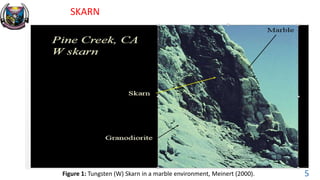
5Figure 1: Tungsten (W) Skarn in a marble environment, Meinert (2000).
SKARN
MINERAL COMPOSITION
6
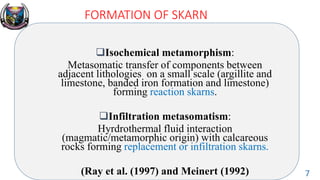
FORMATION OF SKARN
7
Isochemical metamorphism:
Metasomatic transfer of components between
adjacent lithologies on a small scale (argillite and
limestone, banded iron formation and limestone)
forming reaction skarns.
Infiltration metasomatism:
Hyrdrothermal fluid interaction
(magmatic/metamorphic origin) with calcareous
rocks forming replacement or infiltration skarns.
(Ray et al. (1997) and Meinert (1992)
8
FORMATION OF SKARN
ISOCHEMICAL METAMORPHISM
 INTRUSION OF MAGMA (900⁰C – 700⁰C
 METAMORPHIC RECRYSTALLIZATION,
FLUID CIRCULATION AND LOCAL
BIMETASOMATISM FORMING
REACTION SKARNS AND SKARNOIDS
FROM IMPURE LITHOLOGIES
Figure 2: Isochemical Metamorphism, Modified after Meinert (1992, 1995).
9
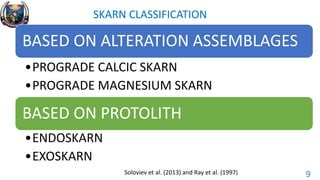
SKARN CLASSIFICATION
Soloviev et al. (2013) and Ray et al. (1997)
BASED ON ALTERATION ASSEMBLAGES
•PROGRADE CALCIC SKARN
•PROGRADE MAGNESIUM SKARN
BASED ON PROTOLITH
•ENDOSKARN
•EXOSKARN
EXPLORATION GUIDES FOR SKARN
DEPOSITS
GEOCHEMICAL STUDIES
GEOPHYSICAL STUDIES
10
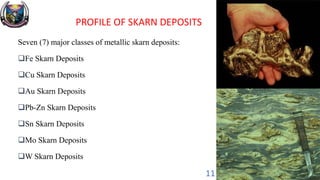
Seven (7) major classes of metallic skarn deposits:
Fe Skarn Deposits
Cu Skarn Deposits
Au Skarn Deposits
Pb-Zn Skarn Deposits
Sn Skarn Deposits
Mo Skarn Deposits
W Skarn Deposits
PROFILE OF SKARN DEPOSITS
11
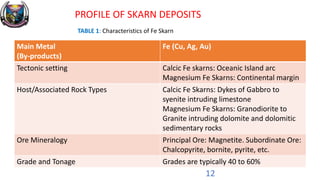
PROFILE OF SKARN DEPOSITS
12
Main Metal
(By-products)
Fe (Cu, Ag, Au)
Tectonic setting Calcic Fe skarns: Oceanic Island arc
Magnesium Fe Skarns: Continental margin
Host/Associated Rock Types Calcic Fe Skarns: Dykes of Gabbro to
syenite intruding limestone
Magnesium Fe Skarns: Granodiorite to
Granite intruding dolomite and dolomitic
sedimentary rocks
Ore Mineralogy Principal Ore: Magnetite. Subordinate Ore:
Chalcopyrite, bornite, pyrite, etc.
Grade and Tonage Grades are typically 40 to 60%
TABLE 1: Characteristics of Fe Skarn
13
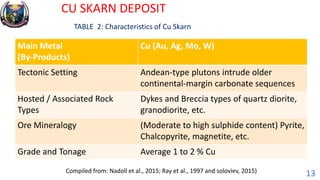
CU SKARN DEPOSIT
Main Metal
(By-Products)
Cu (Au, Ag, Mo, W)
Tectonic Setting Andean-type plutons intrude older
continental-margin carbonate sequences
Hosted / Associated Rock
Types
Dykes and Breccia types of quartz diorite,
granodiorite, etc.
Ore Mineralogy (Moderate to high sulphide content) Pyrite,
Chalcopyrite, magnetite, etc.
Grade and Tonage Average 1 to 2 % Cu
Compiled from: Nadoll et al., 2015; Ray et al., 1997 and soloviev, 2015)
TABLE 2: Characteristics of Cu Skarn
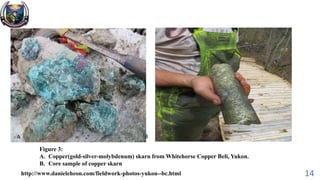
14http://www.danieleheon.com/fieldwork-photos-yukon--bc.html
A B
Figure 3:
A. Copper(gold-silver-molybdenum) skarn from Whitehorse Copper Beli, Yukon.
B. Core sample of copper skarn
15
Tin (Cassiterite) Deposits in The Younger Granites Complex of
Nigeria.
Schist Belts of Nigeria.
OCCURRENCES (OR SPECULATIONS) OF SKARN
IN NIGERIA
16
Marble occurrences (Schist Belts) in the Precambrian
Basement Complex of Nigeria.
lifeinplanetlight.wordpress.com
Figure 4: Model for Marble formation from Contact Metamorphism
17
CASE STUDY
THE GEOLOGY OF THE ANTAMINA COPPER-ZINC SKARN
DEPOSIT, PERU.
 It is located in the eastern part of the Western Cordillera of
north Peru at 9° 32’ south and 77° 03’ west, at an altitude
between 4,200 and 4,800 meters.
Antamina is hosted by Mesozoic carbonates that are within a
fold and thrust belt in the eastern part of the Western
Cordillera.
Antamina is hosted by Cretaceous sedimentary rocks that
comprise carbonates overlying a sandstone-shale-coal sequence.
18
DEPOSIT GEOLOGY
Figure 5: Geological sketch map of the Antamina deposit, Peru (After, Stewart D. Redwood)
19
CASE STUDY
Figure 6: Cross Section 20, 200N showing skarn zonation (After, Stewart D. Redwood)
20
MINERALIZATION
 The skarn is dominantly garnet.
The metals are also zoned, with copper in the brown garnet and
copper-zinc in the green garnet.
The core intrusion actually comprises a series of quartz monzonite
porphyry intrusions that can be divided into early, middle, and late
phases.
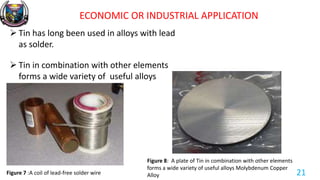
ECONOMIC OR INDUSTRIAL APPLICATION
 Tin has long been used in alloys with lead
as solder.
 Tin in combination with other elements
forms a wide variety of useful alloys
Figure 7 :A coil of lead-free solder wire
Figure 8: A plate of Tin in combination with other elements
forms a wide variety of useful alloys Molybdenum Copper
Alloy 21
22
ECONOMIC OR INDUSTRIAL APPLICATIONS
(CONTD)
 Tungsten is mainly used in the production of hard materials based on tungsten carbide
 Lead has been used for bullets since their invention in the middle Ages
 Lead is still used in statues and sculptures (Fig. 10), including for armatures
Figure 9: Tungsten carbide ring (jewelry) Figure 10: A 17th –century gold-plated lead sculpture
ECONOMIC OR INDUSTRIAL APPLICATIONS
(CONTD)
23
 Gold is usually alloyed with base metals for use in jewelry because of the softness of pure (24k)
 Copper is used to make copper fittings
Figure 12: Moche gold necklaceFigure 11: Copper fittings
24
ECONOMIC OR INDUSTRIAL APPLICATIONS
(CONTD)
 Copper wire is used in power generation, power transmission, power distribution,
telecommunications, electronics circuitry, and countless types of electrical equipment
 ARCHITECTURAL PURPOSES
Figure 14: Copper roof on the Minneapolis city hall, with patinaFigure 13: Copper electrical busbars distributing
coated power to a large building
 Skarn, as a metasomatic rock is a product of hydrothermal alteration of
calcium- and magnesium-rich carbonate rocks. Its formation is associated
with the concentrations of metallic deposits (skarn deposits).
 The Younger Granites Complex and marble-bearing Schist Belts are the
possible locations of skarn occurrences in Nigeria. The marble-bearing
schist belts in the country are likely to be host to exoskarns rich in Fe, Cu,
Au and Mo skarn deposits.
CONCLUSION
25
RECOMMENDATION
I employ that more researches be executed as far as exploring and exploiting
skarn deposits is concerned in Nigeria especially in the Younger Granites of
Nigeria which is in a non-rifted extensional environment, is likely to have
been associated with the hydrothermal system in a skarn environment
Secondly, marbles, in the Schist Belts of Nigeria, formed by contact
metamorphism, have been discovered to be sharing similar protoliths and
agents of metamorphism with skarn; hence, the possibility of skarn
occurrences in the marble-bearing schist belts in the country is probable
26
REFERENCE
26
 Meinert L. D., 1992, Skarn and Skarn Deposits: Geoscience Canada 19 (4), 145-162.
 Ray, G.E, Dawson, G.L. and Simpson, R., 1988, Geology, geochemistry and metallogenic zoning
in the Hedley Gold-Skarn camp, 1987, Paper 1988-1, p. 59-80.
 Soloviev, S. G., 2015, Geology, mineralization, and fluid inclusion characteristics of the
Kumbel oxidized W–Cu–Mo skarn and Au–W stockwork deposit in Kyrgyzstan, Tien Shan:
Mineralium Deposita 25 (2), 187-220.
 Nadoll, P., Mauk J. L., Leveile R. A. and Koenig A. E., 2015, Geochemistry of magnetite from
porphyry Cu and skarn deposits in the Southwestern United States: Mineralium Deposita 50 (4), 493-
515.
 Soloviev, S. G., Kryazhev, S. G. and Dvurechenskaya, S. S., 2013, Geology, mineralization, stable
isotope geochemistry, and fluid inclusion characteristics of the Novogodnee–Monto oxidized Au–
(Cu) skarn and porphyry deposit, Polar Ural, Russia: Mineralium Deposita 48 (5), 603-627.
 http://www.danieleheon.com/fieldwork-photos-yukon--bc.html
 Stewart D. Redwood and Shanks: International Geology Review, v. 12, p. 761-858.
Thank You!!!

SKARN DEPOSITS

  • 1.
    THE FEDERAL UNIVERSITYOF TECHNOLOGY, AKURE, ONDO STATE, NIGERIA. SEMINAR PRESENTATION ON SKARN DEPOSITS BY: OBI, VICTOR CHIZOBA IN PARTIAL FUFILMENT OF THE REQUIREMENT FOR THE AWARD OF THE DEGREE OF BACHELOR OF TECHNOLOGY, APPLIED GEOLOGY OCTOBER, 2017. 1
  • 2.
    Presentation Outline 2 • Aim •Objectives INTRODUCTION • Definition and Composition • Formation • Classification • Profile and speculations in Nigeria CASE STUDY • The Geology of Antamina Cu-Zn Skarn deposit, Peru • Industrial importance of Skarn deposits CONCLUSION AND RECOMMENDATION
  • 3.
    3 AIM •To Understand anddiscuss the basic theories and principles of skarn deposits. OBJECTIVES • To define skarn and its classifications; • To discuss the mineral deposits associated with skarns; • To highlight possible occurences in Nigeria.
  • 4.
    INTRODUCTION: DEFINITION ANDCOMPOSITION 4 A METASOMATIC ROCK SKARN IS FORMED BY CHEMICAL ALTERATION OF CARBONATE (DOLOSTONE AND LIMESTONE)SKARN IS ARE METALLIC DEPOSITS ASSOCIATED WITH SKARN ROCK FORMING MINERALS. SKARN DEPOSITS
  • 5.
    5Figure 1: Tungsten(W) Skarn in a marble environment, Meinert (2000). SKARN
  • 6.
  • 7.
    FORMATION OF SKARN 7 Isochemicalmetamorphism: Metasomatic transfer of components between adjacent lithologies on a small scale (argillite and limestone, banded iron formation and limestone) forming reaction skarns. Infiltration metasomatism: Hyrdrothermal fluid interaction (magmatic/metamorphic origin) with calcareous rocks forming replacement or infiltration skarns. (Ray et al. (1997) and Meinert (1992)
  • 8.
    8 FORMATION OF SKARN ISOCHEMICALMETAMORPHISM  INTRUSION OF MAGMA (900⁰C – 700⁰C  METAMORPHIC RECRYSTALLIZATION, FLUID CIRCULATION AND LOCAL BIMETASOMATISM FORMING REACTION SKARNS AND SKARNOIDS FROM IMPURE LITHOLOGIES Figure 2: Isochemical Metamorphism, Modified after Meinert (1992, 1995).
  • 9.
    9 SKARN CLASSIFICATION Soloviev etal. (2013) and Ray et al. (1997) BASED ON ALTERATION ASSEMBLAGES •PROGRADE CALCIC SKARN •PROGRADE MAGNESIUM SKARN BASED ON PROTOLITH •ENDOSKARN •EXOSKARN
  • 10.
    EXPLORATION GUIDES FORSKARN DEPOSITS GEOCHEMICAL STUDIES GEOPHYSICAL STUDIES 10
  • 11.
    Seven (7) majorclasses of metallic skarn deposits: Fe Skarn Deposits Cu Skarn Deposits Au Skarn Deposits Pb-Zn Skarn Deposits Sn Skarn Deposits Mo Skarn Deposits W Skarn Deposits PROFILE OF SKARN DEPOSITS 11
  • 12.
    PROFILE OF SKARNDEPOSITS 12 Main Metal (By-products) Fe (Cu, Ag, Au) Tectonic setting Calcic Fe skarns: Oceanic Island arc Magnesium Fe Skarns: Continental margin Host/Associated Rock Types Calcic Fe Skarns: Dykes of Gabbro to syenite intruding limestone Magnesium Fe Skarns: Granodiorite to Granite intruding dolomite and dolomitic sedimentary rocks Ore Mineralogy Principal Ore: Magnetite. Subordinate Ore: Chalcopyrite, bornite, pyrite, etc. Grade and Tonage Grades are typically 40 to 60% TABLE 1: Characteristics of Fe Skarn
  • 13.
    13 CU SKARN DEPOSIT MainMetal (By-Products) Cu (Au, Ag, Mo, W) Tectonic Setting Andean-type plutons intrude older continental-margin carbonate sequences Hosted / Associated Rock Types Dykes and Breccia types of quartz diorite, granodiorite, etc. Ore Mineralogy (Moderate to high sulphide content) Pyrite, Chalcopyrite, magnetite, etc. Grade and Tonage Average 1 to 2 % Cu Compiled from: Nadoll et al., 2015; Ray et al., 1997 and soloviev, 2015) TABLE 2: Characteristics of Cu Skarn
  • 14.
    14http://www.danieleheon.com/fieldwork-photos-yukon--bc.html A B Figure 3: A.Copper(gold-silver-molybdenum) skarn from Whitehorse Copper Beli, Yukon. B. Core sample of copper skarn
  • 15.
    15 Tin (Cassiterite) Depositsin The Younger Granites Complex of Nigeria. Schist Belts of Nigeria. OCCURRENCES (OR SPECULATIONS) OF SKARN IN NIGERIA
  • 16.
    16 Marble occurrences (SchistBelts) in the Precambrian Basement Complex of Nigeria. lifeinplanetlight.wordpress.com Figure 4: Model for Marble formation from Contact Metamorphism
  • 17.
    17 CASE STUDY THE GEOLOGYOF THE ANTAMINA COPPER-ZINC SKARN DEPOSIT, PERU.  It is located in the eastern part of the Western Cordillera of north Peru at 9° 32’ south and 77° 03’ west, at an altitude between 4,200 and 4,800 meters. Antamina is hosted by Mesozoic carbonates that are within a fold and thrust belt in the eastern part of the Western Cordillera. Antamina is hosted by Cretaceous sedimentary rocks that comprise carbonates overlying a sandstone-shale-coal sequence.
  • 18.
    18 DEPOSIT GEOLOGY Figure 5:Geological sketch map of the Antamina deposit, Peru (After, Stewart D. Redwood)
  • 19.
    19 CASE STUDY Figure 6:Cross Section 20, 200N showing skarn zonation (After, Stewart D. Redwood)
  • 20.
    20 MINERALIZATION  The skarnis dominantly garnet. The metals are also zoned, with copper in the brown garnet and copper-zinc in the green garnet. The core intrusion actually comprises a series of quartz monzonite porphyry intrusions that can be divided into early, middle, and late phases.
  • 21.
    ECONOMIC OR INDUSTRIALAPPLICATION  Tin has long been used in alloys with lead as solder.  Tin in combination with other elements forms a wide variety of useful alloys Figure 7 :A coil of lead-free solder wire Figure 8: A plate of Tin in combination with other elements forms a wide variety of useful alloys Molybdenum Copper Alloy 21
  • 22.
    22 ECONOMIC OR INDUSTRIALAPPLICATIONS (CONTD)  Tungsten is mainly used in the production of hard materials based on tungsten carbide  Lead has been used for bullets since their invention in the middle Ages  Lead is still used in statues and sculptures (Fig. 10), including for armatures Figure 9: Tungsten carbide ring (jewelry) Figure 10: A 17th –century gold-plated lead sculpture
  • 23.
    ECONOMIC OR INDUSTRIALAPPLICATIONS (CONTD) 23  Gold is usually alloyed with base metals for use in jewelry because of the softness of pure (24k)  Copper is used to make copper fittings Figure 12: Moche gold necklaceFigure 11: Copper fittings
  • 24.
    24 ECONOMIC OR INDUSTRIALAPPLICATIONS (CONTD)  Copper wire is used in power generation, power transmission, power distribution, telecommunications, electronics circuitry, and countless types of electrical equipment  ARCHITECTURAL PURPOSES Figure 14: Copper roof on the Minneapolis city hall, with patinaFigure 13: Copper electrical busbars distributing coated power to a large building
  • 25.
     Skarn, asa metasomatic rock is a product of hydrothermal alteration of calcium- and magnesium-rich carbonate rocks. Its formation is associated with the concentrations of metallic deposits (skarn deposits).  The Younger Granites Complex and marble-bearing Schist Belts are the possible locations of skarn occurrences in Nigeria. The marble-bearing schist belts in the country are likely to be host to exoskarns rich in Fe, Cu, Au and Mo skarn deposits. CONCLUSION 25
  • 26.
    RECOMMENDATION I employ thatmore researches be executed as far as exploring and exploiting skarn deposits is concerned in Nigeria especially in the Younger Granites of Nigeria which is in a non-rifted extensional environment, is likely to have been associated with the hydrothermal system in a skarn environment Secondly, marbles, in the Schist Belts of Nigeria, formed by contact metamorphism, have been discovered to be sharing similar protoliths and agents of metamorphism with skarn; hence, the possibility of skarn occurrences in the marble-bearing schist belts in the country is probable 26
  • 27.
    REFERENCE 26  Meinert L.D., 1992, Skarn and Skarn Deposits: Geoscience Canada 19 (4), 145-162.  Ray, G.E, Dawson, G.L. and Simpson, R., 1988, Geology, geochemistry and metallogenic zoning in the Hedley Gold-Skarn camp, 1987, Paper 1988-1, p. 59-80.  Soloviev, S. G., 2015, Geology, mineralization, and fluid inclusion characteristics of the Kumbel oxidized W–Cu–Mo skarn and Au–W stockwork deposit in Kyrgyzstan, Tien Shan: Mineralium Deposita 25 (2), 187-220.  Nadoll, P., Mauk J. L., Leveile R. A. and Koenig A. E., 2015, Geochemistry of magnetite from porphyry Cu and skarn deposits in the Southwestern United States: Mineralium Deposita 50 (4), 493- 515.  Soloviev, S. G., Kryazhev, S. G. and Dvurechenskaya, S. S., 2013, Geology, mineralization, stable isotope geochemistry, and fluid inclusion characteristics of the Novogodnee–Monto oxidized Au– (Cu) skarn and porphyry deposit, Polar Ural, Russia: Mineralium Deposita 48 (5), 603-627.  http://www.danieleheon.com/fieldwork-photos-yukon--bc.html  Stewart D. Redwood and Shanks: International Geology Review, v. 12, p. 761-858.
  • 28.

Editor's Notes

  • #7 Essential minerals: garnet, pyroxene, calcic amphibole, quartz, calcite, olivine, phlogopite, spinel, plagioclase felspar. Accessory minerals: titanite, apatite, allanite, tourmaline, topaz, corundum, fluorite, barite, strontianite, tantalite and anglesite. Secondary minerals: gypsum, hematite, goethite, pyrolusite, axinite, biotite, prehnite, actinolite, chlorite, stipnomelane, sericite, albite, copiapite, roemerite, epsomite, Ore minerals: magnetite, chalcopyrite, pyrite, native gold, arsenopyrite, pyrrhotite, galena, sphalerite, cassiterite, scheelite and molybdenite
  • #10 If the fluids are undersaturated in Si, too high in CO2, or too low in temperature, the wollastonite-rich zone is not developed. Essential minerals: garnet, clinopyroxene, epidote, calcic amphibole and wollastonite.
  • #16 Endoskarn signature, presence of greisens and its associated high-fluorine activities. The earlier skarn deposits in the igneous rock environment may have been destroyed by the greisen-stage alteration
  • #17 Endoskarn signature, presence of greisens and its associated high-fluorine activities. The earlier skarn deposits in the igneous rock environment may have been destroyed by the greisen-stage alteration
  • #26 The most abundant metal determines the skarn deposit type and this is also governed by the source of the hydrothermal fluid, tectonic setting of emplacement, structures on the protolith and the composition of the protolith. Endoskarn is much likely to occur in the igneous environment (Younger Granites Complex) with the associated greisens and high fluorine activities (suitable conditions for Sn Skarn Deposits).