MAHATMA JYOTIBA PHULE ROHILKHAND
UNIVERSITY
BAREILLY
DEPARTMENT
OF
ELECTRONICS & INSTRUMENTATION ENGINEERING
SEMINAR PRESENTATION
ON
PLCs
PRESENTED BY:-
UTTAM KR. YADAV
20EI43
PRESENTED TO:-
MUKUL GUPTA
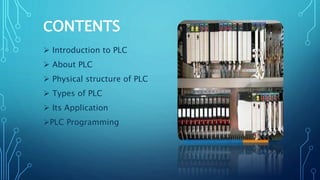
CONTENTS
 Introduction to PLC
 About PLC
 Physical structure of PLC
 Types of PLC
 Its Application
PLC Programming
INTRODUCTION
PLCs were invented by Dick Morley in 1964.
 It is a specialized industrial computer used in manufacturing
and automation processes to control machinery and processes.
It plays a crucial role in a wide range of industries, including
manufacturing, automotive, energy, and many others.
PLCs are designed to perform specific tasks, monitor inputs,
make decisions based on programmed logic, and control outputs
to automate processes and machinery.
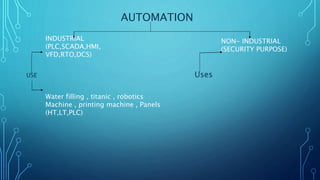
AUTOMATION
INDUSTRIAL
(PLC,SCADA,HMI,
VFD,RTO,DCS)
NON- INDUSTRIAL
(SECURITY PURPOSE)
USE
Water filling , titanic , robotics
Machine , printing machine , Panels
(HT,LT,PLC)
Uses
ABOUT PLC
• Input Devices
• Components
• Programmability
• Logic and control
• Output control
• communications
• Maintenance and troubleshooting
BLOCK DIAGRAM OF PLC
PHYSICAL STRUCTURE OF PLC
The structure of a PLC is almost similar to a computer’s
architecture.
It continuously monitors the input values from various input
sensing devices (e.g. accelerometer, weight scale, hardwired
signals, etc.)
It produces corresponding output depending on the nature of
production and industry
PARTS OF PLC
Rack or chassis
Power Supply Module
Central Processing Unit (CPU)
Input & Output Module
Communication Interface Module
TYPES OF PLC
 Compact PLC
Within a single case, there would be many modules. It has a fixed
number of I/O modules and external I/O cards. So, it does not have
the capability to expand the modules. Every input and output
would be decided by the manufacturer.
 Modular PLC
This type of PLC permits multiple expansion through “modules”,
hence referred to as Modular PLC. I/O components can be
increased. It is easier to use because each component is
independent of each other.
• PLC are divided into three types based on output namely Relay
output, Transistor output, and Triac Output PLC
• According to the physical size, a PLC is divided into Mini,
Micro, and Nano PLC.
APPLICATIONS OF PLC
1.Process Automation Plants (e.g. mining, oil &gas)
2.Glass Industry
3.Paper Industry
4.Cement Manufacturing
5.In boilers – Thermal Power Plants
PLC VS SCADA
THANK YOU

PLC SEMINAR PRESENTATION.pptx

  • 1.
    MAHATMA JYOTIBA PHULEROHILKHAND UNIVERSITY BAREILLY DEPARTMENT OF ELECTRONICS & INSTRUMENTATION ENGINEERING SEMINAR PRESENTATION ON PLCs PRESENTED BY:- UTTAM KR. YADAV 20EI43 PRESENTED TO:- MUKUL GUPTA
  • 2.
    CONTENTS  Introduction toPLC  About PLC  Physical structure of PLC  Types of PLC  Its Application PLC Programming
  • 3.
    INTRODUCTION PLCs were inventedby Dick Morley in 1964.  It is a specialized industrial computer used in manufacturing and automation processes to control machinery and processes. It plays a crucial role in a wide range of industries, including manufacturing, automotive, energy, and many others. PLCs are designed to perform specific tasks, monitor inputs, make decisions based on programmed logic, and control outputs to automate processes and machinery.
  • 4.
    AUTOMATION INDUSTRIAL (PLC,SCADA,HMI, VFD,RTO,DCS) NON- INDUSTRIAL (SECURITY PURPOSE) USE Waterfilling , titanic , robotics Machine , printing machine , Panels (HT,LT,PLC) Uses
  • 5.
    ABOUT PLC • InputDevices • Components • Programmability • Logic and control • Output control • communications • Maintenance and troubleshooting
  • 6.
  • 7.
    PHYSICAL STRUCTURE OFPLC The structure of a PLC is almost similar to a computer’s architecture. It continuously monitors the input values from various input sensing devices (e.g. accelerometer, weight scale, hardwired signals, etc.) It produces corresponding output depending on the nature of production and industry
  • 8.
    PARTS OF PLC Rackor chassis Power Supply Module Central Processing Unit (CPU) Input & Output Module Communication Interface Module
  • 9.
    TYPES OF PLC Compact PLC Within a single case, there would be many modules. It has a fixed number of I/O modules and external I/O cards. So, it does not have the capability to expand the modules. Every input and output would be decided by the manufacturer.  Modular PLC This type of PLC permits multiple expansion through “modules”, hence referred to as Modular PLC. I/O components can be increased. It is easier to use because each component is independent of each other. • PLC are divided into three types based on output namely Relay output, Transistor output, and Triac Output PLC • According to the physical size, a PLC is divided into Mini, Micro, and Nano PLC.
  • 10.
    APPLICATIONS OF PLC 1.ProcessAutomation Plants (e.g. mining, oil &gas) 2.Glass Industry 3.Paper Industry 4.Cement Manufacturing 5.In boilers – Thermal Power Plants
  • 11.
  • 12.