©Ian Sommerville 1995/2000 (Modified by Spiros Mancoridis 1999) Software Engineering, 6th edition. Chapters 1,3 Slide 1
Software Engineering
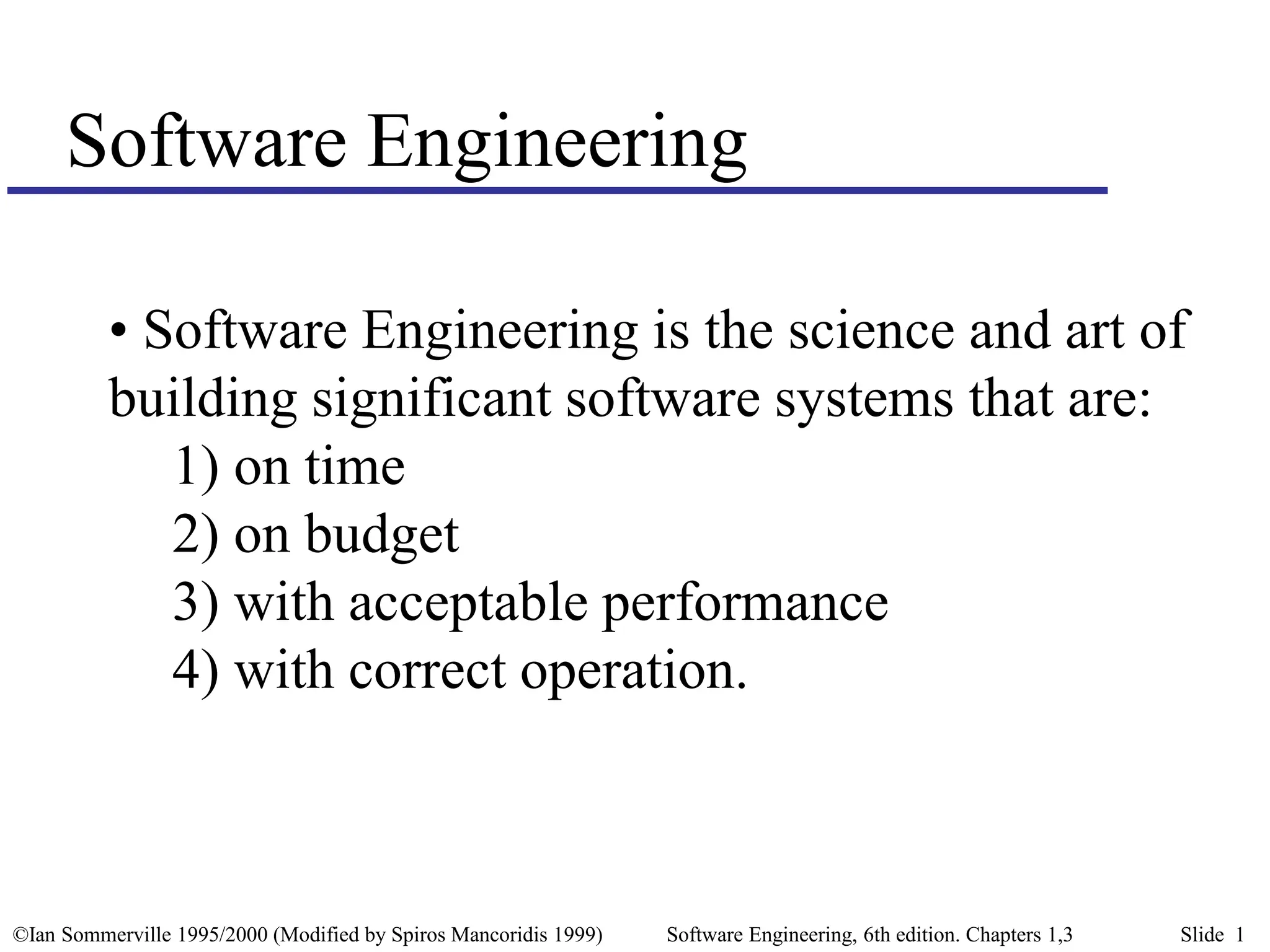
• Software Engineering is the science and art of
building significant software systems that are:
1) on time
2) on budget
3) with acceptable performance
4) with correct operation.
©Ian Sommerville 1995/2000 (Modified by Spiros Mancoridis 1999) Software Engineering, 6th edition. Chapters 1,3 Slide 2
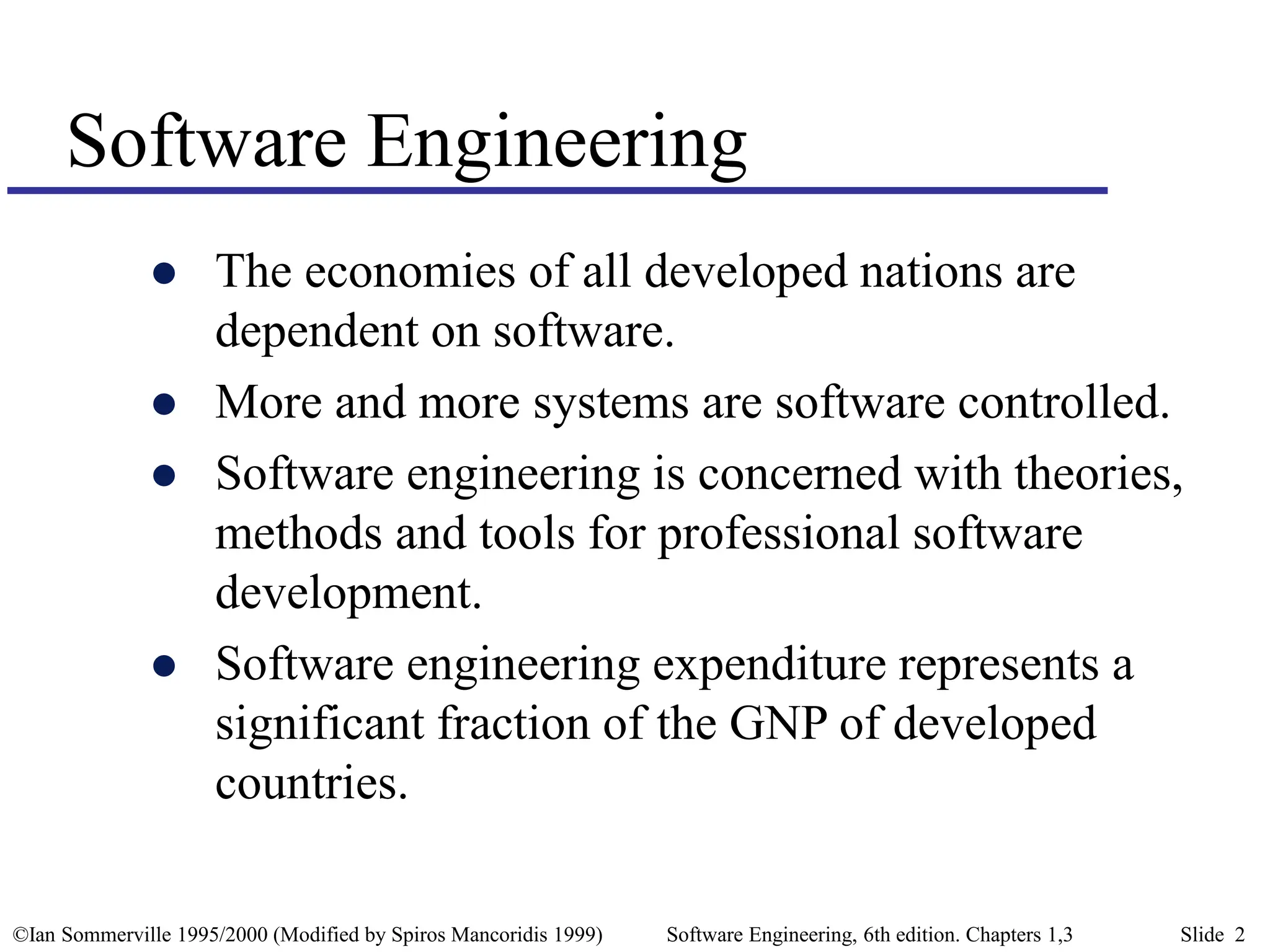
 The economies of all developed nations are
dependent on software.
 More and more systems are software controlled.
 Software engineering is concerned with theories,
methods and tools for professional software
development.
 Software engineering expenditure represents a
significant fraction of the GNP of developed
countries.
Software Engineering
©Ian Sommerville 1995/2000 (Modified by Spiros Mancoridis 1999) Software Engineering, 6th edition. Chapters 1,3 Slide 3
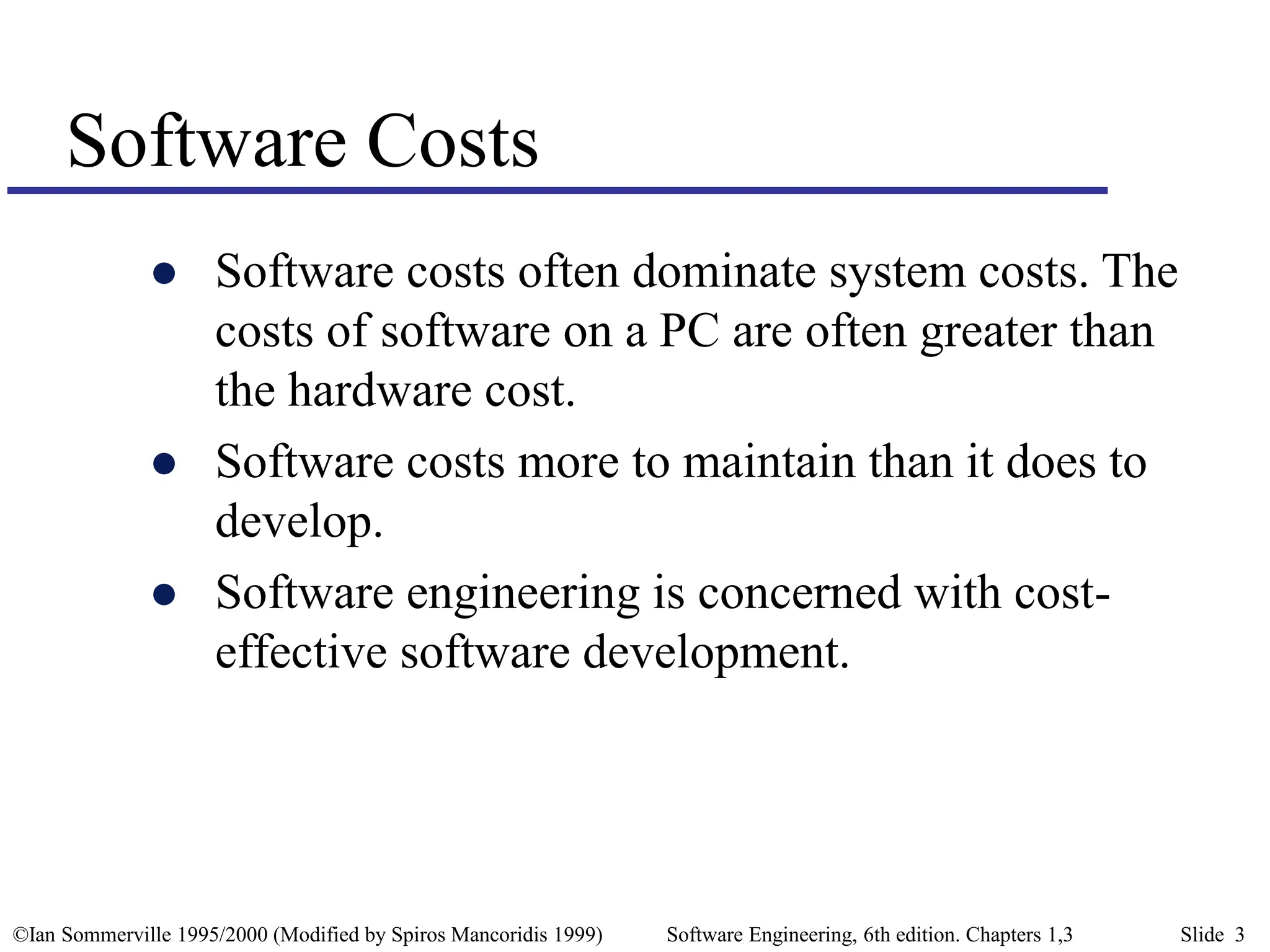
 Software costs often dominate system costs. The
costs of software on a PC are often greater than
the hardware cost.
 Software costs more to maintain than it does to
develop.
 Software engineering is concerned with cost-
effective software development.
Software Costs
©Ian Sommerville 1995/2000 (Modified by Spiros Mancoridis 1999) Software Engineering, 6th edition. Chapters 1,3 Slide 4
Software Products
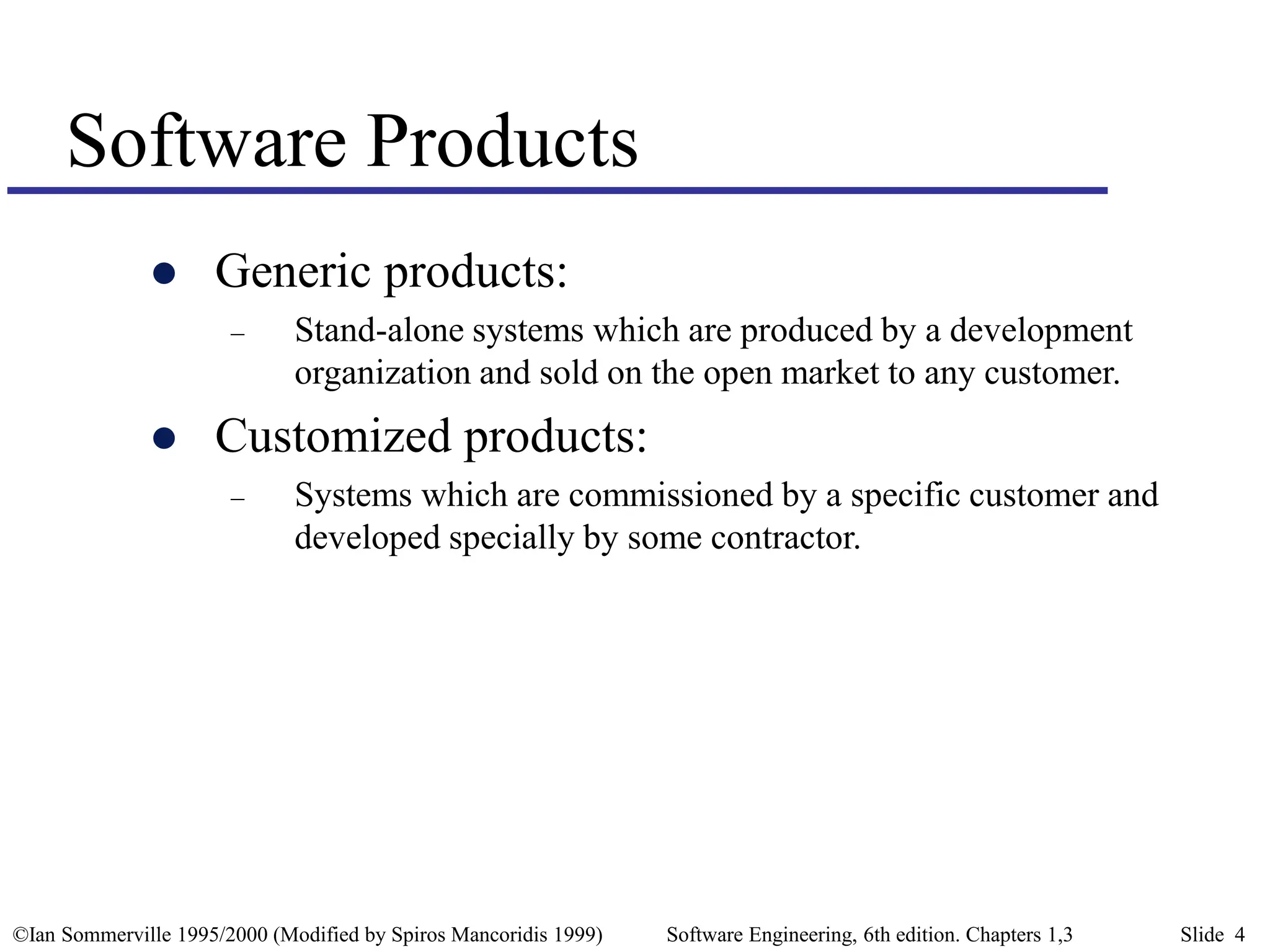
 Generic products:
– Stand-alone systems which are produced by a development
organization and sold on the open market to any customer.
 Customized products:
– Systems which are commissioned by a specific customer and
developed specially by some contractor.
©Ian Sommerville 1995/2000 (Modified by Spiros Mancoridis 1999) Software Engineering, 6th edition. Chapters 1,3 Slide 5
Software Product Attributes
 Maintainability
 Dependability
 Efficiency
 Usability
©Ian Sommerville 1995/2000 (Modified by Spiros Mancoridis 1999) Software Engineering, 6th edition. Chapters 1,3 Slide 6
Importance of Product Characteristics
 The relative importance of these characteristics
depends on the product and the environment in
which it is to be used.
 In some cases, some attributes may dominate
– In safety-critical real-time systems, key attributes may be
dependability and efficiency.
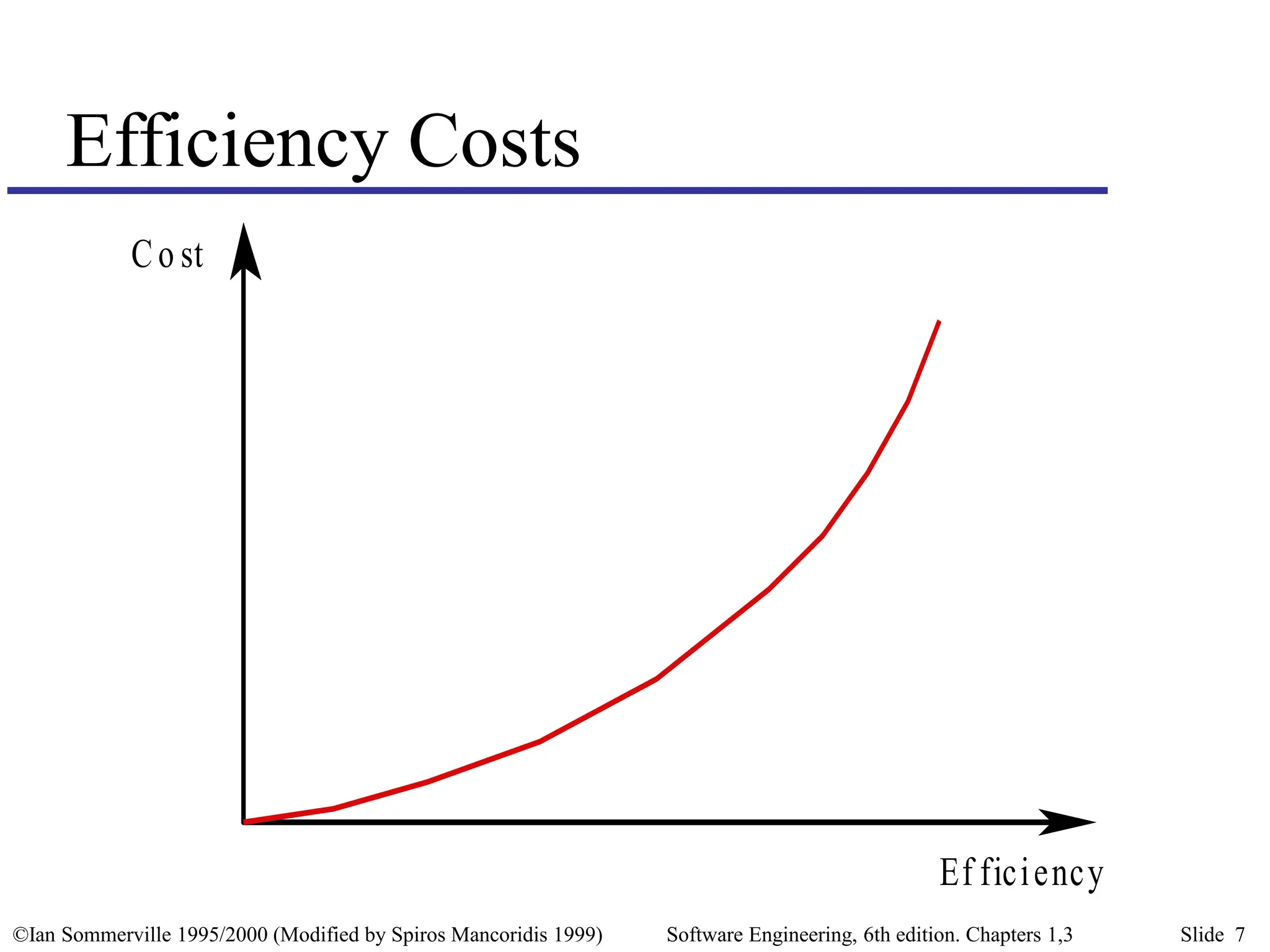
 Costs tend to rise exponentially if very high
levels of any one attribute are required.
©Ian Sommerville 1995/2000 (Modified by Spiros Mancoridis 1999) Software Engineering, 6th edition. Chapters 1,3 Slide 7
Efficiency Costs
Co st
Ef ficiency
©Ian Sommerville 1995/2000 (Modified by Spiros Mancoridis 1999) Software Engineering, 6th edition. Chapters 1,3 Slide 8
The Software Process
 Structured set of activities required to develop a
software system
– Specification
– Design
– Validation
– Evolution
 Activities vary depending on the organization
and the type of system being developed.
 Must be explicitly modeled if it is to be
managed.
©Ian Sommerville 1995/2000 (Modified by Spiros Mancoridis 1999) Software Engineering, 6th edition. Chapters 1,3 Slide 9
Engineering Process Model
 Specification: Set out the requirements and
constraints on the system.
 Design: Produce a model of the system.
 Manufacture: Build the system.
 Test: Check the system meets the required
specifications.
 Install: Deliver the system to the customer and
ensure it is operational.
 Maintain: Repair faults in the system as they
are discovered.
©Ian Sommerville 1995/2000 (Modified by Spiros Mancoridis 1999) Software Engineering, 6th edition. Chapters 1,3 Slide 10
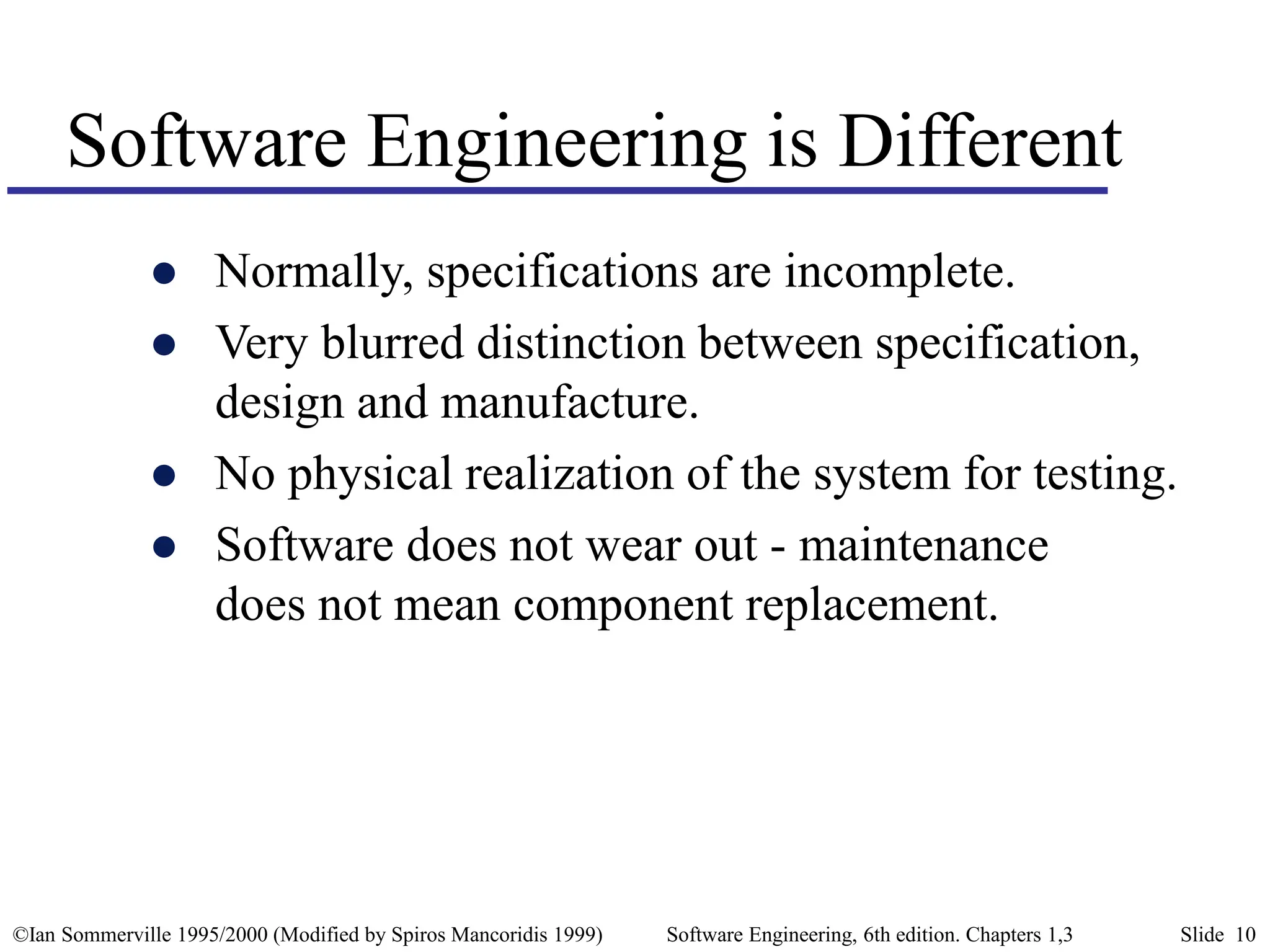
Software Engineering is Different
 Normally, specifications are incomplete.
 Very blurred distinction between specification,
design and manufacture.
 No physical realization of the system for testing.
 Software does not wear out - maintenance
does not mean component replacement.
©Ian Sommerville 1995/2000 (Modified by Spiros Mancoridis 1999) Software Engineering, 6th edition. Chapters 1,3 Slide 11
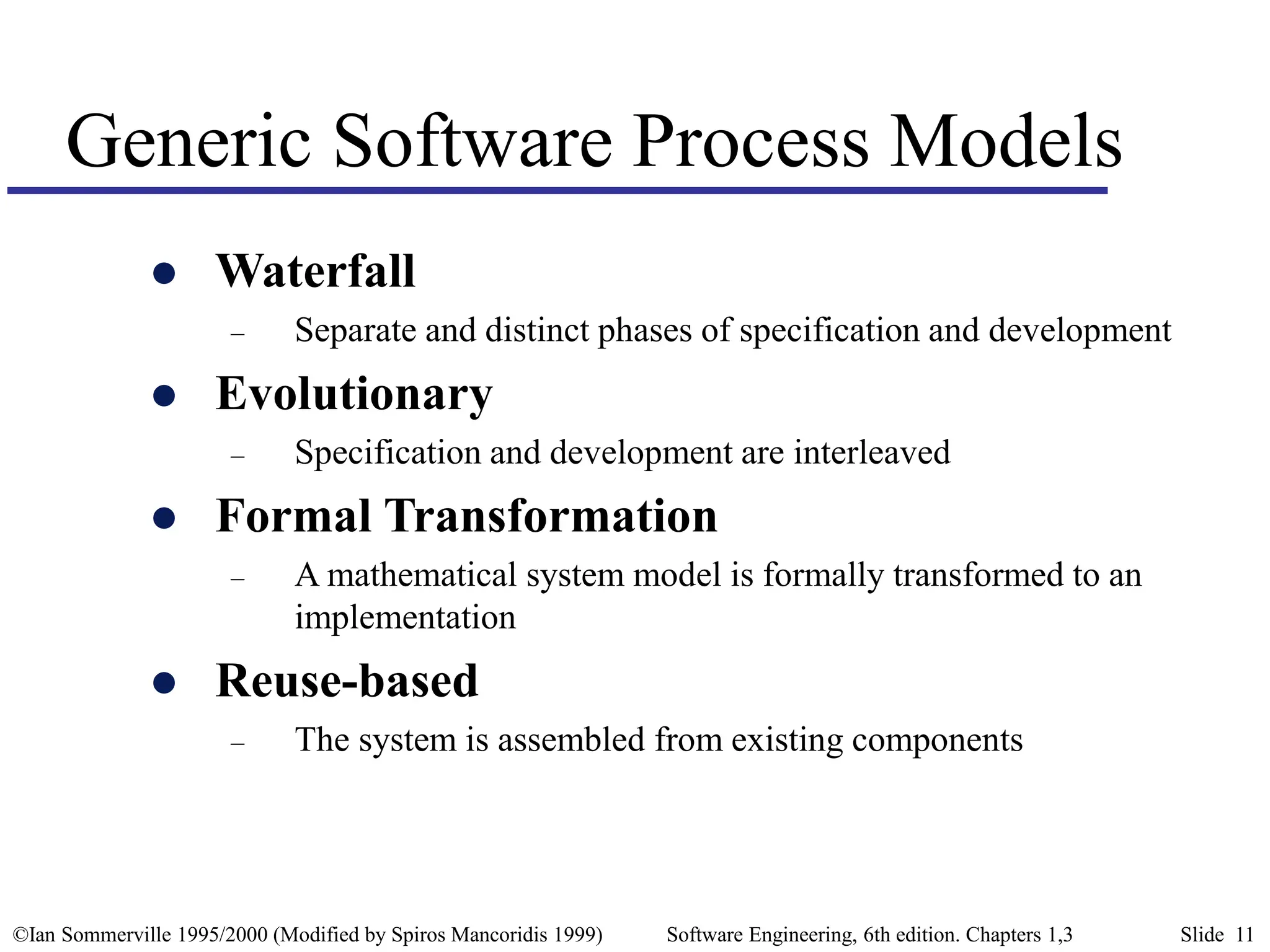
Generic Software Process Models
 Waterfall
– Separate and distinct phases of specification and development
 Evolutionary
– Specification and development are interleaved
 Formal Transformation
– A mathematical system model is formally transformed to an
implementation
 Reuse-based
– The system is assembled from existing components
©Ian Sommerville 1995/2000 (Modified by Spiros Mancoridis 1999) Software Engineering, 6th edition. Chapters 1,3 Slide 12
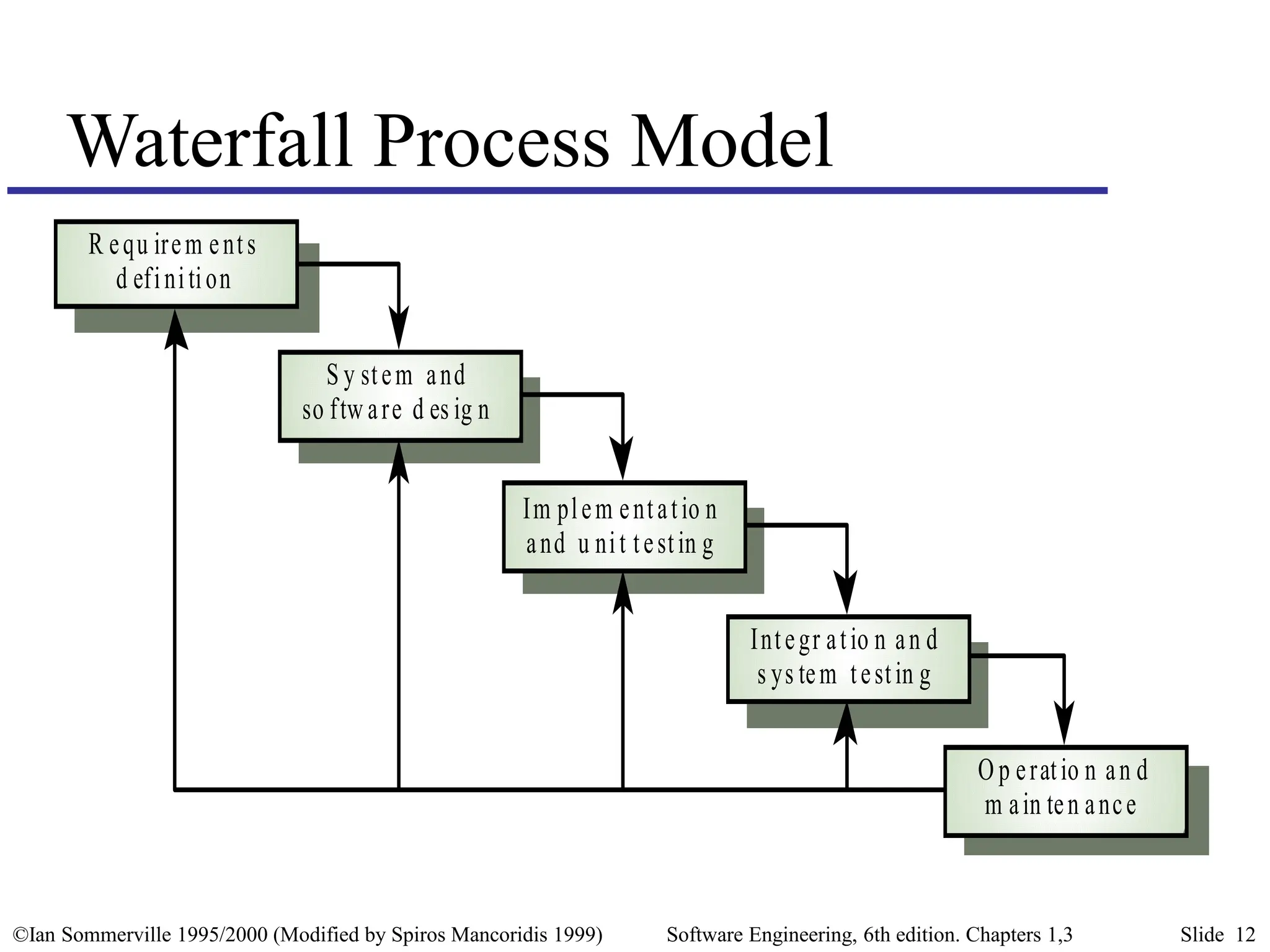
Waterfall Process Model
R equ irem ents
d efinition
S y stem and
so ftw are d es ig n
Im plem entatio n
and u nit testin g
Integr atio n an d
s ys tem testin g
O p eratio n an d
m ain ten ance
©Ian Sommerville 1995/2000 (Modified by Spiros Mancoridis 1999) Software Engineering, 6th edition. Chapters 1,3 Slide 13
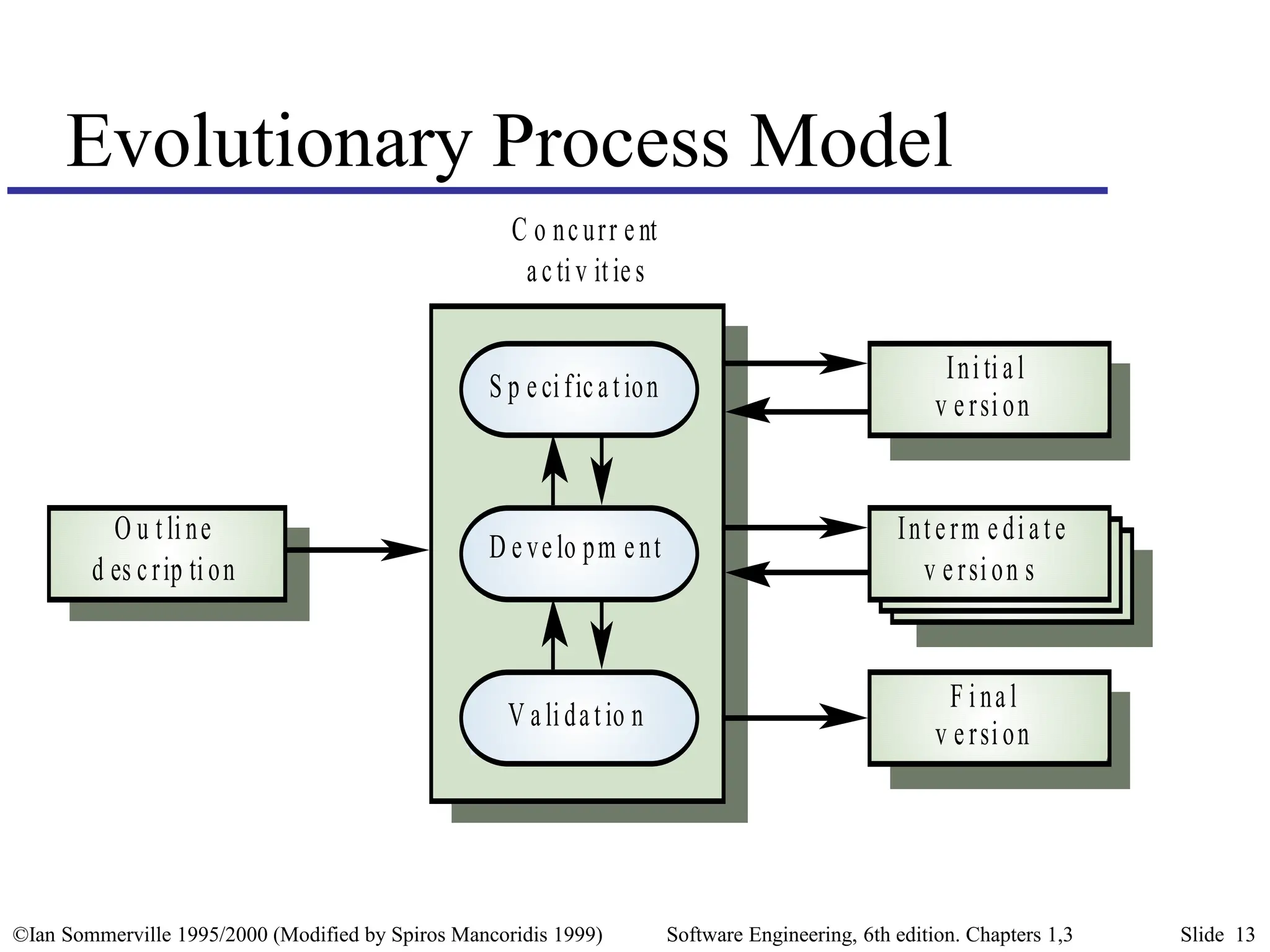
Evolutionary Process Model
V alidatio n
F inal
v ersion
D evelo pm ent
Interm ediate
v ersion s
S p ecification
Initial
v ersion
O u tline
d es crip tion
C o ncurr ent
activ ities
©Ian Sommerville 1995/2000 (Modified by Spiros Mancoridis 1999) Software Engineering, 6th edition. Chapters 1,3 Slide 14
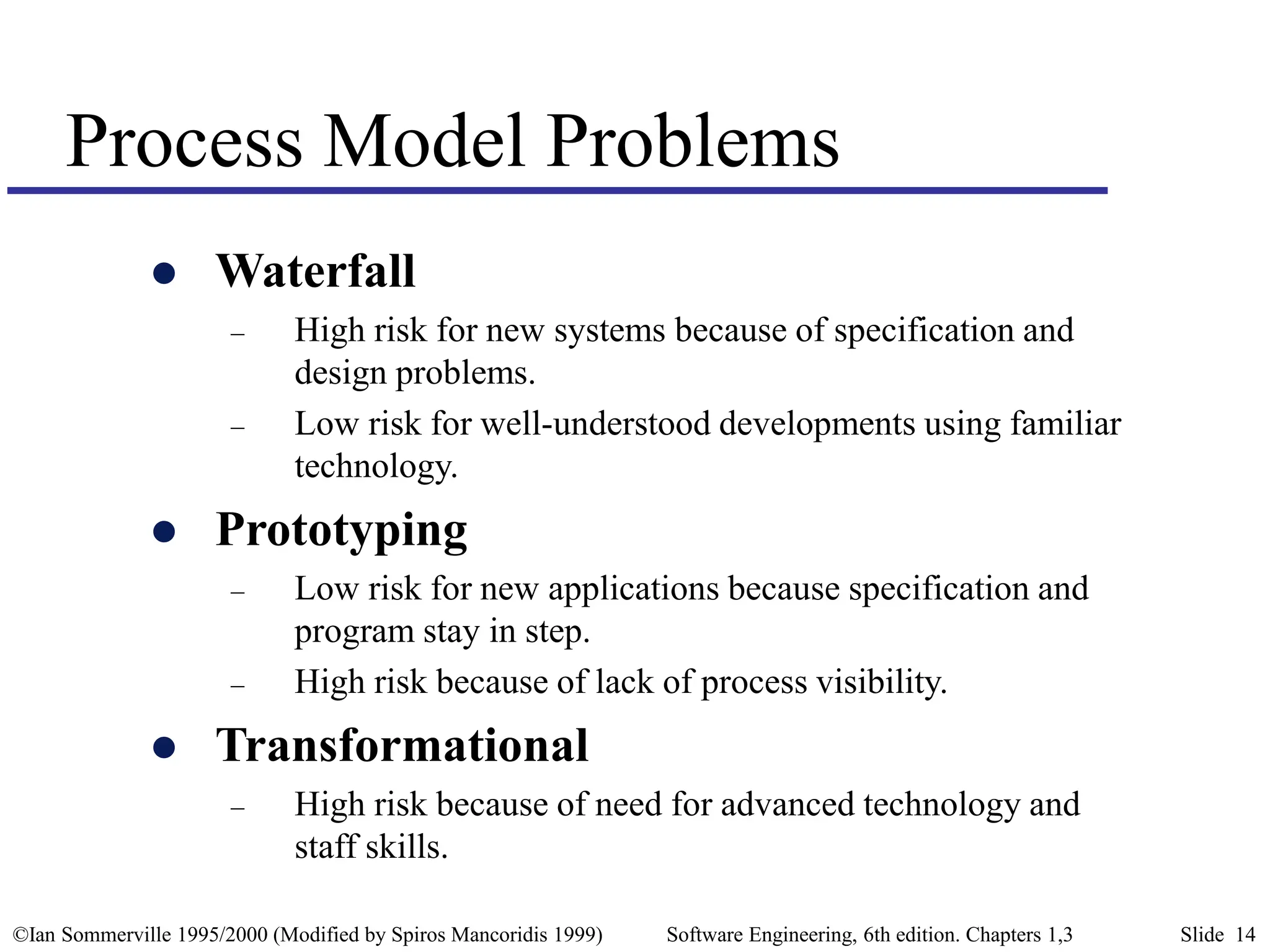
Process Model Problems
 Waterfall
– High risk for new systems because of specification and
design problems.
– Low risk for well-understood developments using familiar
technology.
 Prototyping
– Low risk for new applications because specification and
program stay in step.
– High risk because of lack of process visibility.
 Transformational
– High risk because of need for advanced technology and
staff skills.
©Ian Sommerville 1995/2000 (Modified by Spiros Mancoridis 1999) Software Engineering, 6th edition. Chapters 1,3 Slide 15
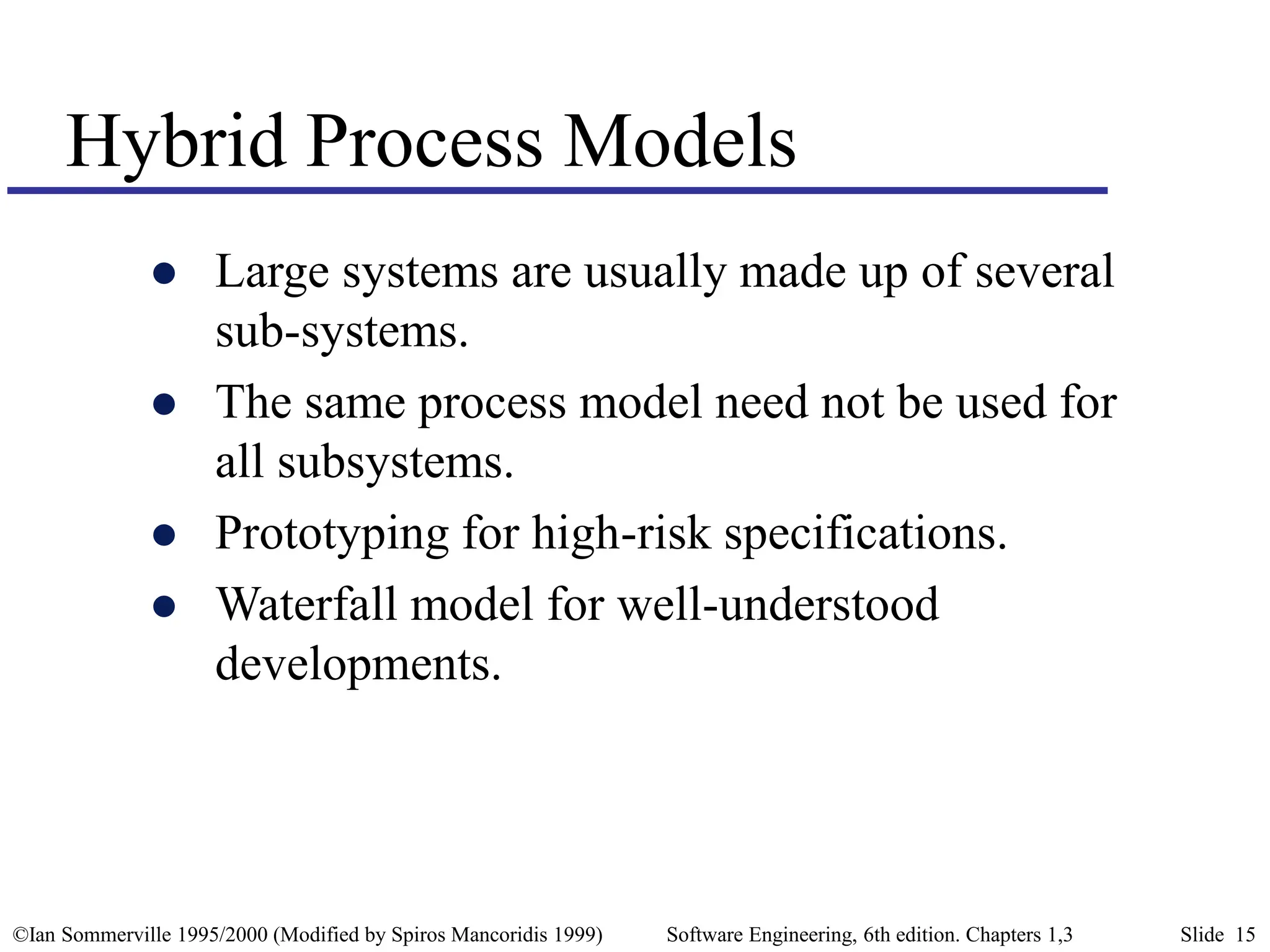
Hybrid Process Models
 Large systems are usually made up of several
sub-systems.
 The same process model need not be used for
all subsystems.
 Prototyping for high-risk specifications.
 Waterfall model for well-understood
developments.
©Ian Sommerville 1995/2000 (Modified by Spiros Mancoridis 1999) Software Engineering, 6th edition. Chapters 1,3 Slide 16
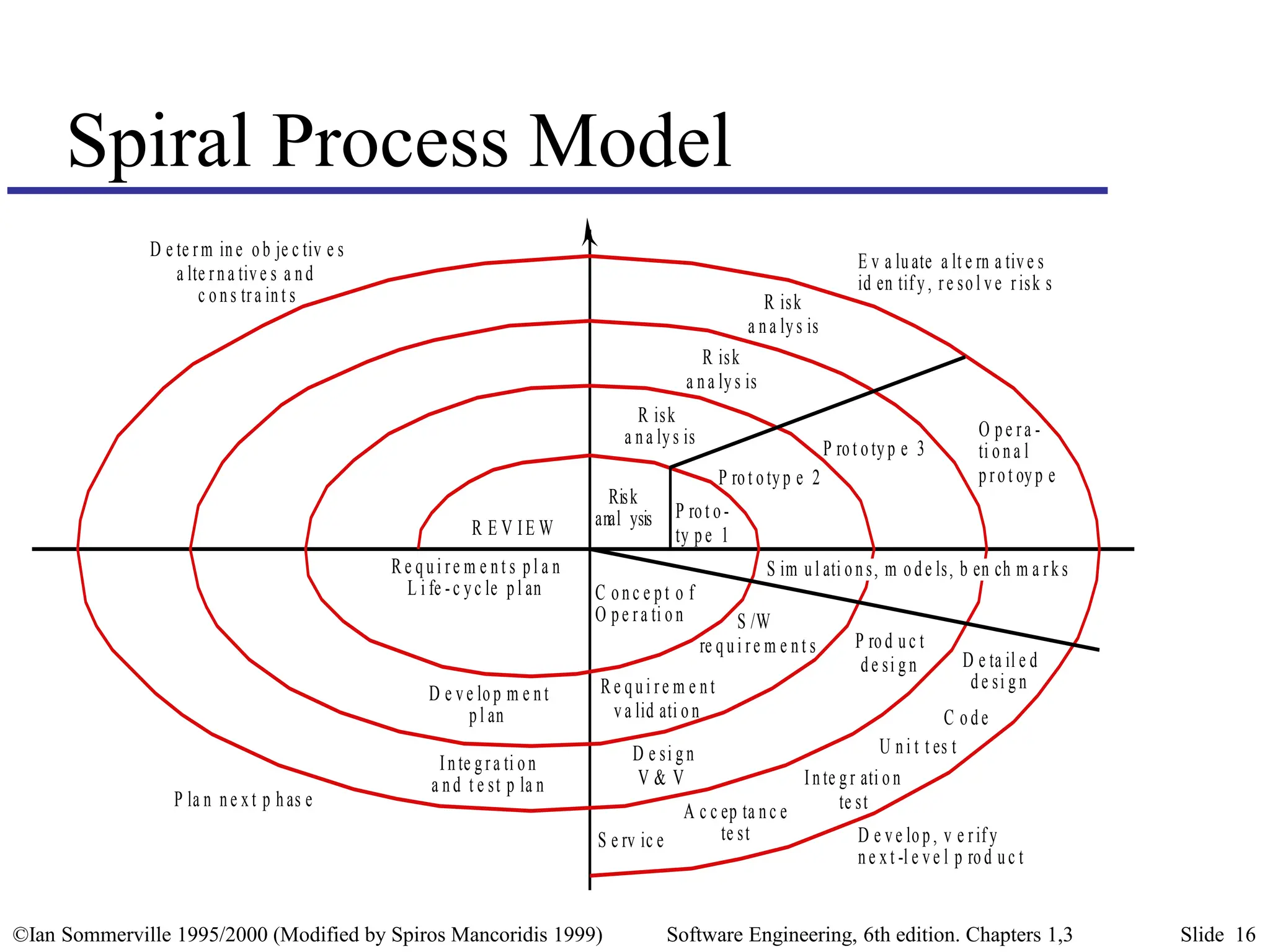
Spiral Process Model
R isk
a na lys is
R isk
a na lys is
R isk
a na lys is
Risk
anal ysis P rot o-
ty pe 1
P rot otyp e 2
P rot otyp e 3
O pe ra -
ti ona l
prot oyp e
C onc e pt o f
O pe ra ti on
S im ul ati ons, m ode ls, b en ch m a rks
S /W
re qui re m e nt s
R e qui re m e nt
va lid ati on
D e si gn
V & V
P rod uc t
de si gn D e ta il e d
de si gn
C ode
U ni t t es t
Inte gr ati on
te st
A c c ep ta nc e
te st
S e rv ic e D e ve lop, v e rify
ne xt -l e ve l p rod uc t
E v a luate a lt e rn a tive s
id en tify, re sol ve risk s
D e te rm ine ob je c tiv e s
a lte rna tive s a nd
c ons tra int s
P la n ne xt p has e
Inte gra ti on
a nd t e st p la n
D e ve lop m e nt
pl an
R e qui re m e nt s pl a n
L i fe -c yc le pl an
R E V IE W
©Ian Sommerville 1995/2000 (Modified by Spiros Mancoridis 1999) Software Engineering, 6th edition. Chapters 1,3 Slide 17
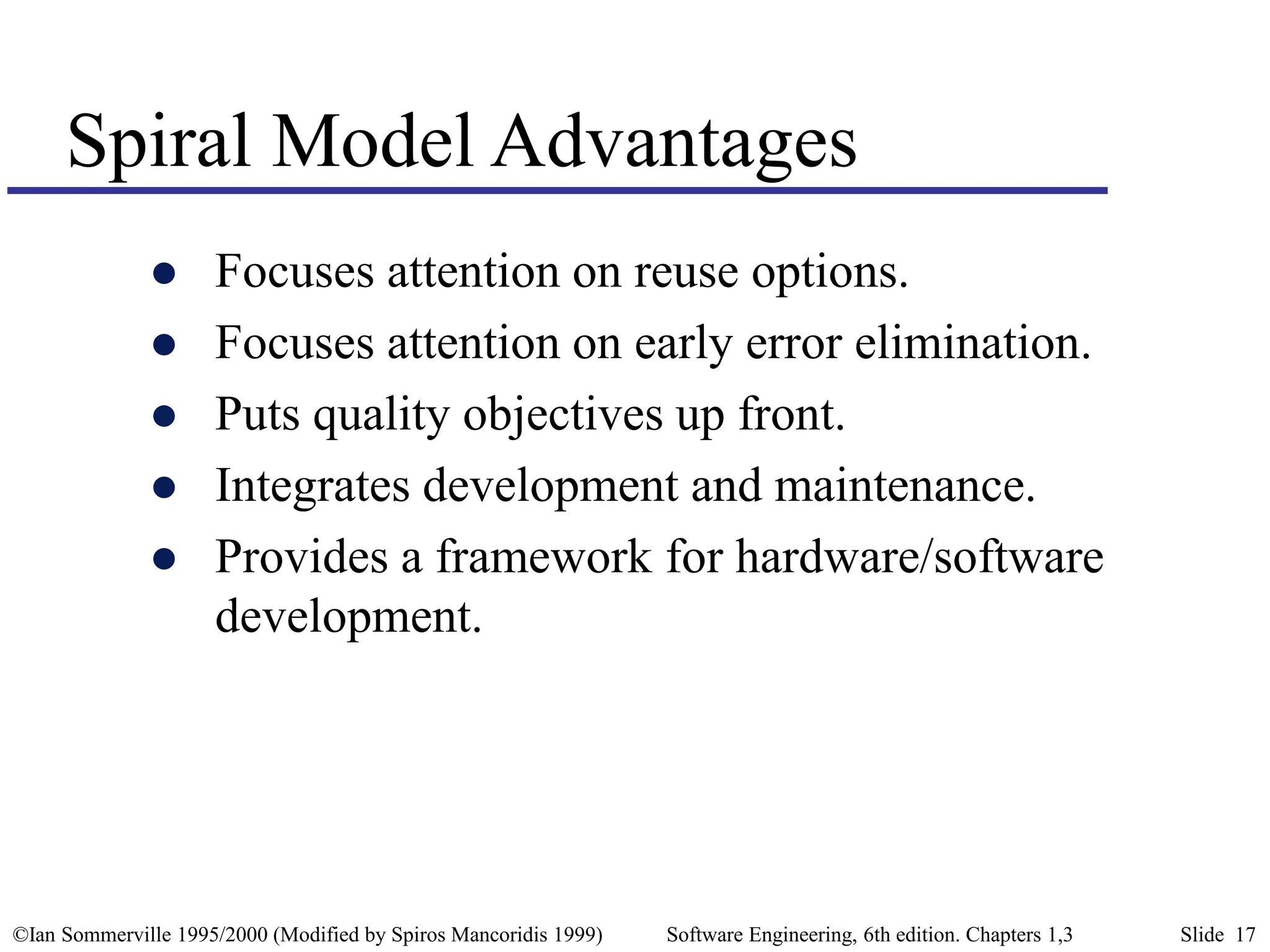
Spiral Model Advantages
 Focuses attention on reuse options.
 Focuses attention on early error elimination.
 Puts quality objectives up front.
 Integrates development and maintenance.
 Provides a framework for hardware/software
development.
©Ian Sommerville 1995/2000 (Modified by Spiros Mancoridis 1999) Software Engineering, 6th edition. Chapters 1,3 Slide 18
Spiral Model Problems
 Contractual development often specifies
process model and deliverables in advance.
 Requires risk assessment expertise.
©Ian Sommerville 1995/2000 (Modified by Spiros Mancoridis 1999) Software Engineering, 6th edition. Chapters 1,3 Slide 19
Process Visibility
 Software systems are intangible so managers
need documents to assess progress.
 Waterfall model is still the most widely used
model.
©Ian Sommerville 1995/2000 (Modified by Spiros Mancoridis 1999) Software Engineering, 6th edition. Chapters 1,3 Slide 20
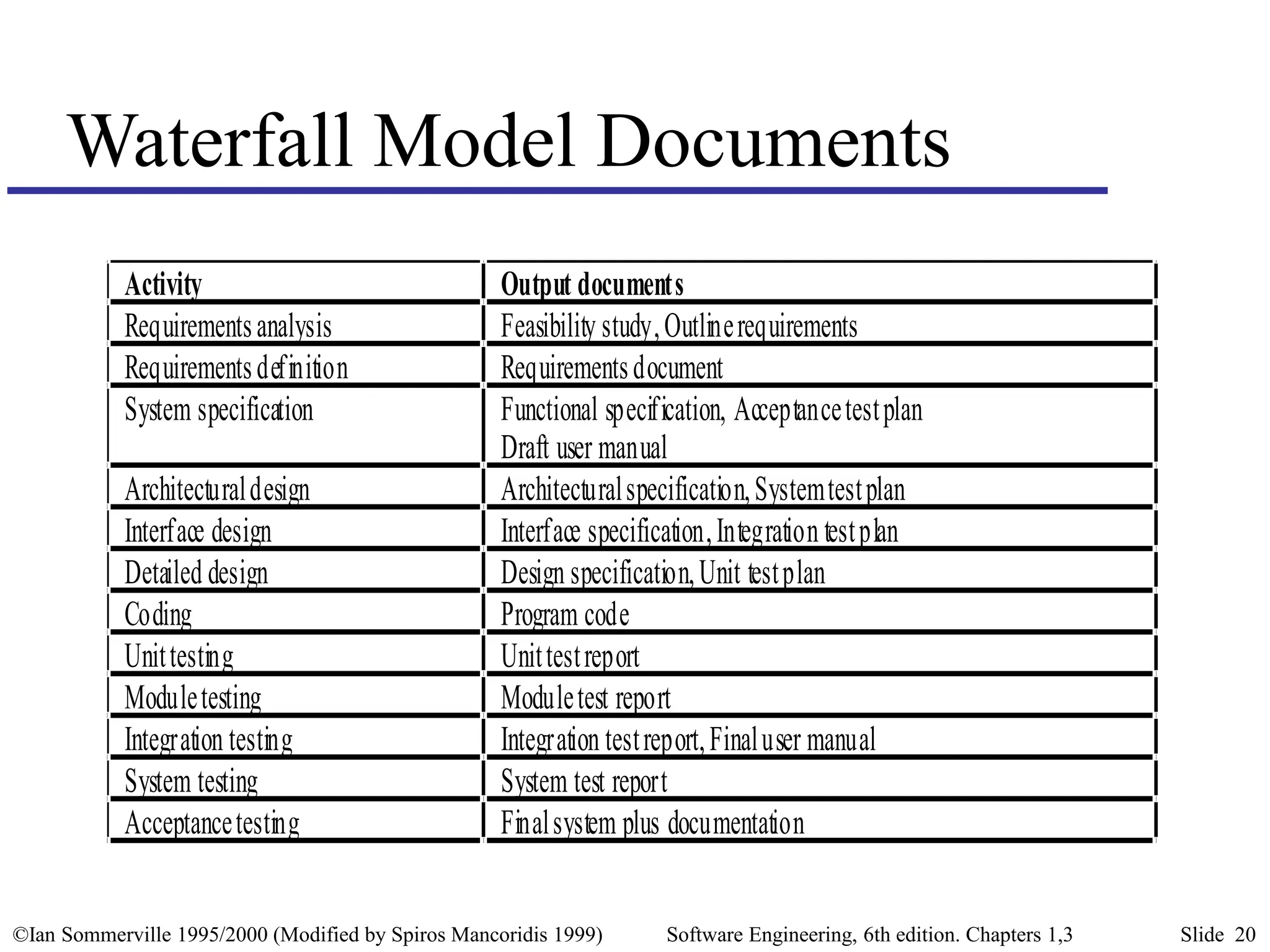
Waterfall Model Documents
Activity Output documents
Requirementsanalysis Feasibility study,Outlinerequirements
Requirementsdefinition Requirementsdocument
System specification Functional specification, Acceptancetestplan
Draft user manual
Architecturaldesign Architecturalspecification,Systemtestplan
Interface design Interface specification,Integration testplan
Detailed design Design specification,Unit testplan
Coding Program code
Unittesting Unittestreport
Moduletesting Moduletest report
Integration testing Integration testreport,Finaluser manual
System testing System test report
Acceptancetesting Finalsystem plus documentation
©Ian Sommerville 1995/2000 (Modified by Spiros Mancoridis 1999) Software Engineering, 6th edition. Chapters 1,3 Slide 21
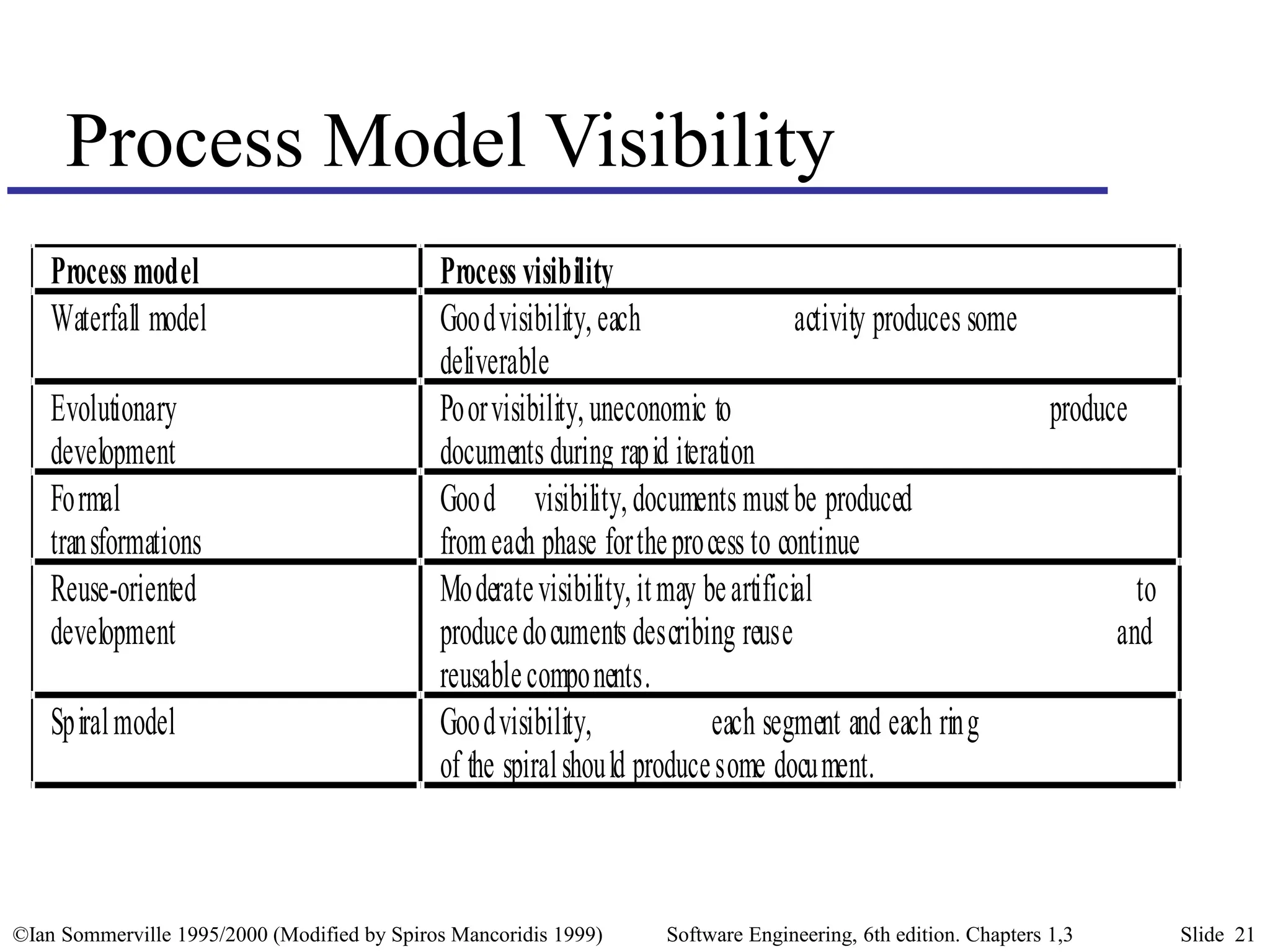
Process Model Visibility
Process model Process visibility
Waterfall model Goodvisibility,each activity produces some
deliverable
Evolutionary
development
Poorvisibility,uneconomic to produce
documents during rapid iteration
Formal
transformations
Good visibility,documents mustbe produced
fromeach phase fortheprocess to continue
Reuse-oriented
development
Moderatevisibility,itmay beartificial to
producedocuments describing reuse and
reusablecomponents.
Spiralmodel Goodvisibility, each segment and each ring
of the spiralshould producesome document.
©Ian Sommerville 1995/2000 (Modified by Spiros Mancoridis 1999) Software Engineering, 6th edition. Chapters 1,3 Slide 22
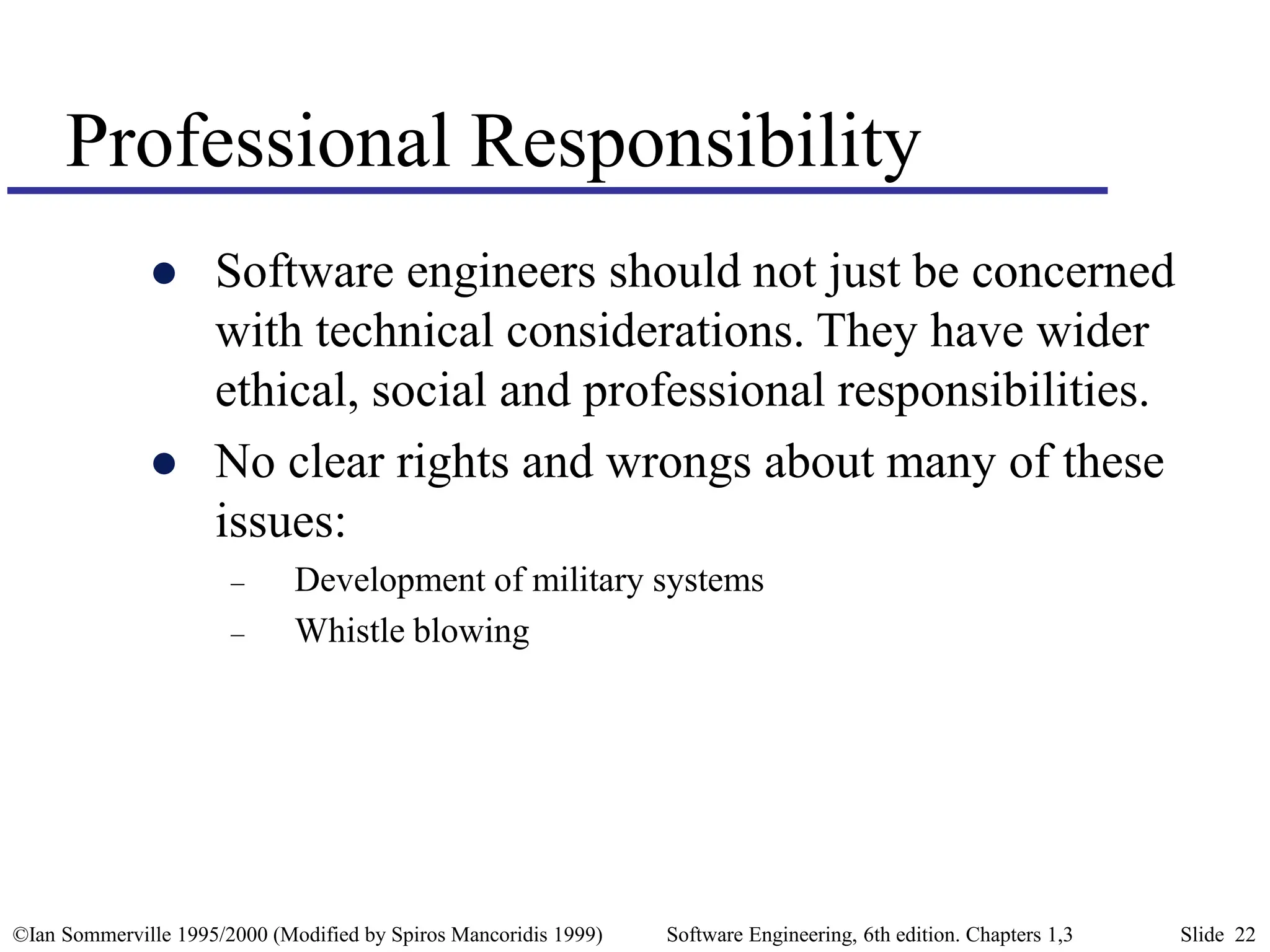
Professional Responsibility
 Software engineers should not just be concerned
with technical considerations. They have wider
ethical, social and professional responsibilities.
 No clear rights and wrongs about many of these
issues:
– Development of military systems
– Whistle blowing
©Ian Sommerville 1995/2000 (Modified by Spiros Mancoridis 1999) Software Engineering, 6th edition. Chapters 1,3 Slide 23
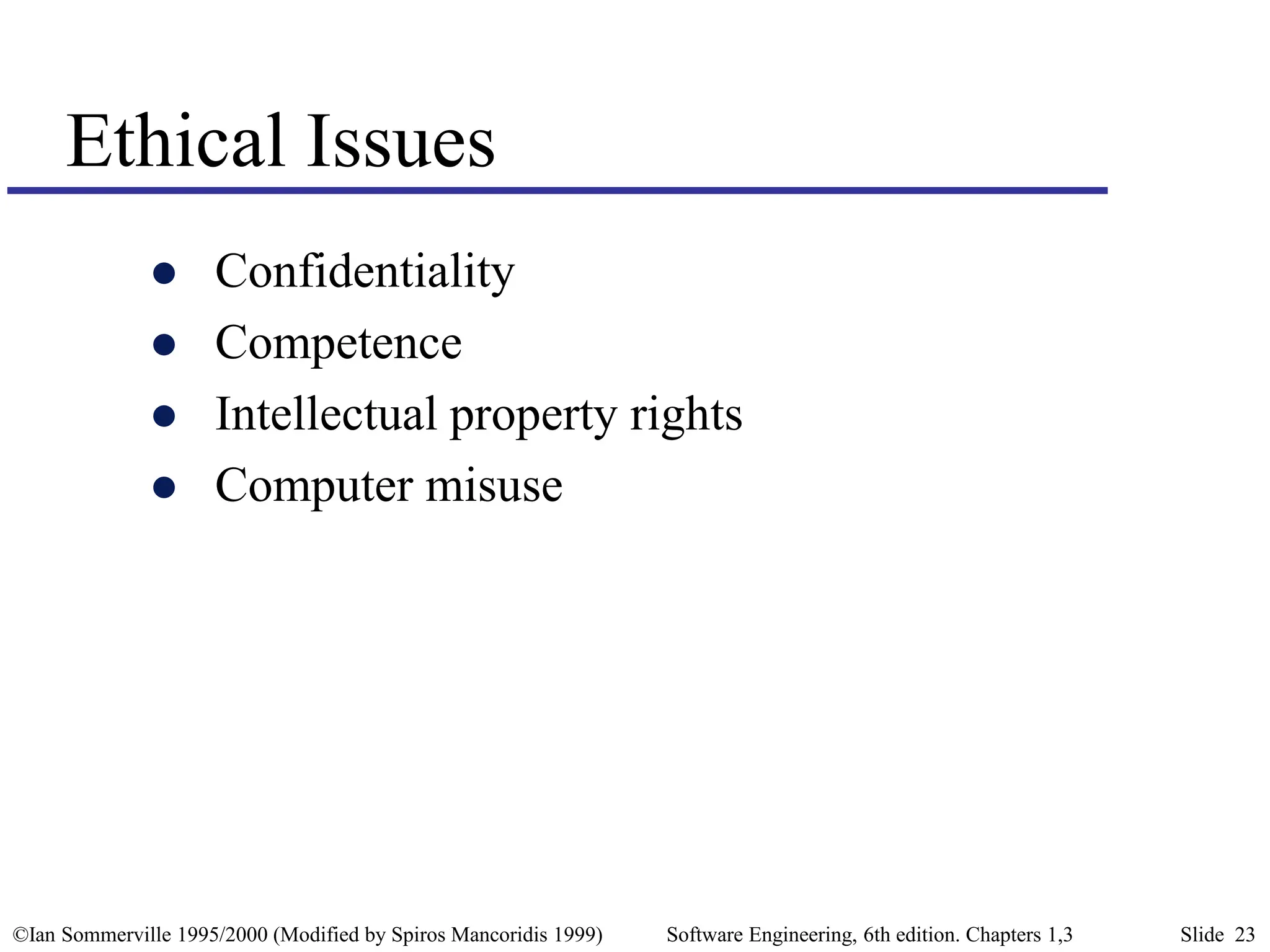
Ethical Issues
 Confidentiality
 Competence
 Intellectual property rights
 Computer misuse

Software Engineering

  • 1.
    ©Ian Sommerville 1995/2000(Modified by Spiros Mancoridis 1999) Software Engineering, 6th edition. Chapters 1,3 Slide 1 Software Engineering • Software Engineering is the science and art of building significant software systems that are: 1) on time 2) on budget 3) with acceptable performance 4) with correct operation.
  • 2.
    ©Ian Sommerville 1995/2000(Modified by Spiros Mancoridis 1999) Software Engineering, 6th edition. Chapters 1,3 Slide 2  The economies of all developed nations are dependent on software.  More and more systems are software controlled.  Software engineering is concerned with theories, methods and tools for professional software development.  Software engineering expenditure represents a significant fraction of the GNP of developed countries. Software Engineering
  • 3.
    ©Ian Sommerville 1995/2000(Modified by Spiros Mancoridis 1999) Software Engineering, 6th edition. Chapters 1,3 Slide 3  Software costs often dominate system costs. The costs of software on a PC are often greater than the hardware cost.  Software costs more to maintain than it does to develop.  Software engineering is concerned with cost- effective software development. Software Costs
  • 4.
    ©Ian Sommerville 1995/2000(Modified by Spiros Mancoridis 1999) Software Engineering, 6th edition. Chapters 1,3 Slide 4 Software Products  Generic products: – Stand-alone systems which are produced by a development organization and sold on the open market to any customer.  Customized products: – Systems which are commissioned by a specific customer and developed specially by some contractor.
  • 5.
    ©Ian Sommerville 1995/2000(Modified by Spiros Mancoridis 1999) Software Engineering, 6th edition. Chapters 1,3 Slide 5 Software Product Attributes  Maintainability  Dependability  Efficiency  Usability
  • 6.
    ©Ian Sommerville 1995/2000(Modified by Spiros Mancoridis 1999) Software Engineering, 6th edition. Chapters 1,3 Slide 6 Importance of Product Characteristics  The relative importance of these characteristics depends on the product and the environment in which it is to be used.  In some cases, some attributes may dominate – In safety-critical real-time systems, key attributes may be dependability and efficiency.  Costs tend to rise exponentially if very high levels of any one attribute are required.
  • 7.
    ©Ian Sommerville 1995/2000(Modified by Spiros Mancoridis 1999) Software Engineering, 6th edition. Chapters 1,3 Slide 7 Efficiency Costs Co st Ef ficiency
  • 8.
    ©Ian Sommerville 1995/2000(Modified by Spiros Mancoridis 1999) Software Engineering, 6th edition. Chapters 1,3 Slide 8 The Software Process  Structured set of activities required to develop a software system – Specification – Design – Validation – Evolution  Activities vary depending on the organization and the type of system being developed.  Must be explicitly modeled if it is to be managed.
  • 9.
    ©Ian Sommerville 1995/2000(Modified by Spiros Mancoridis 1999) Software Engineering, 6th edition. Chapters 1,3 Slide 9 Engineering Process Model  Specification: Set out the requirements and constraints on the system.  Design: Produce a model of the system.  Manufacture: Build the system.  Test: Check the system meets the required specifications.  Install: Deliver the system to the customer and ensure it is operational.  Maintain: Repair faults in the system as they are discovered.
  • 10.
    ©Ian Sommerville 1995/2000(Modified by Spiros Mancoridis 1999) Software Engineering, 6th edition. Chapters 1,3 Slide 10 Software Engineering is Different  Normally, specifications are incomplete.  Very blurred distinction between specification, design and manufacture.  No physical realization of the system for testing.  Software does not wear out - maintenance does not mean component replacement.
  • 11.
    ©Ian Sommerville 1995/2000(Modified by Spiros Mancoridis 1999) Software Engineering, 6th edition. Chapters 1,3 Slide 11 Generic Software Process Models  Waterfall – Separate and distinct phases of specification and development  Evolutionary – Specification and development are interleaved  Formal Transformation – A mathematical system model is formally transformed to an implementation  Reuse-based – The system is assembled from existing components
  • 12.
    ©Ian Sommerville 1995/2000(Modified by Spiros Mancoridis 1999) Software Engineering, 6th edition. Chapters 1,3 Slide 12 Waterfall Process Model R equ irem ents d efinition S y stem and so ftw are d es ig n Im plem entatio n and u nit testin g Integr atio n an d s ys tem testin g O p eratio n an d m ain ten ance
  • 13.
    ©Ian Sommerville 1995/2000(Modified by Spiros Mancoridis 1999) Software Engineering, 6th edition. Chapters 1,3 Slide 13 Evolutionary Process Model V alidatio n F inal v ersion D evelo pm ent Interm ediate v ersion s S p ecification Initial v ersion O u tline d es crip tion C o ncurr ent activ ities
  • 14.
    ©Ian Sommerville 1995/2000(Modified by Spiros Mancoridis 1999) Software Engineering, 6th edition. Chapters 1,3 Slide 14 Process Model Problems  Waterfall – High risk for new systems because of specification and design problems. – Low risk for well-understood developments using familiar technology.  Prototyping – Low risk for new applications because specification and program stay in step. – High risk because of lack of process visibility.  Transformational – High risk because of need for advanced technology and staff skills.
  • 15.
    ©Ian Sommerville 1995/2000(Modified by Spiros Mancoridis 1999) Software Engineering, 6th edition. Chapters 1,3 Slide 15 Hybrid Process Models  Large systems are usually made up of several sub-systems.  The same process model need not be used for all subsystems.  Prototyping for high-risk specifications.  Waterfall model for well-understood developments.
  • 16.
    ©Ian Sommerville 1995/2000(Modified by Spiros Mancoridis 1999) Software Engineering, 6th edition. Chapters 1,3 Slide 16 Spiral Process Model R isk a na lys is R isk a na lys is R isk a na lys is Risk anal ysis P rot o- ty pe 1 P rot otyp e 2 P rot otyp e 3 O pe ra - ti ona l prot oyp e C onc e pt o f O pe ra ti on S im ul ati ons, m ode ls, b en ch m a rks S /W re qui re m e nt s R e qui re m e nt va lid ati on D e si gn V & V P rod uc t de si gn D e ta il e d de si gn C ode U ni t t es t Inte gr ati on te st A c c ep ta nc e te st S e rv ic e D e ve lop, v e rify ne xt -l e ve l p rod uc t E v a luate a lt e rn a tive s id en tify, re sol ve risk s D e te rm ine ob je c tiv e s a lte rna tive s a nd c ons tra int s P la n ne xt p has e Inte gra ti on a nd t e st p la n D e ve lop m e nt pl an R e qui re m e nt s pl a n L i fe -c yc le pl an R E V IE W
  • 17.
    ©Ian Sommerville 1995/2000(Modified by Spiros Mancoridis 1999) Software Engineering, 6th edition. Chapters 1,3 Slide 17 Spiral Model Advantages  Focuses attention on reuse options.  Focuses attention on early error elimination.  Puts quality objectives up front.  Integrates development and maintenance.  Provides a framework for hardware/software development.
  • 18.
    ©Ian Sommerville 1995/2000(Modified by Spiros Mancoridis 1999) Software Engineering, 6th edition. Chapters 1,3 Slide 18 Spiral Model Problems  Contractual development often specifies process model and deliverables in advance.  Requires risk assessment expertise.
  • 19.
    ©Ian Sommerville 1995/2000(Modified by Spiros Mancoridis 1999) Software Engineering, 6th edition. Chapters 1,3 Slide 19 Process Visibility  Software systems are intangible so managers need documents to assess progress.  Waterfall model is still the most widely used model.
  • 20.
    ©Ian Sommerville 1995/2000(Modified by Spiros Mancoridis 1999) Software Engineering, 6th edition. Chapters 1,3 Slide 20 Waterfall Model Documents Activity Output documents Requirementsanalysis Feasibility study,Outlinerequirements Requirementsdefinition Requirementsdocument System specification Functional specification, Acceptancetestplan Draft user manual Architecturaldesign Architecturalspecification,Systemtestplan Interface design Interface specification,Integration testplan Detailed design Design specification,Unit testplan Coding Program code Unittesting Unittestreport Moduletesting Moduletest report Integration testing Integration testreport,Finaluser manual System testing System test report Acceptancetesting Finalsystem plus documentation
  • 21.
    ©Ian Sommerville 1995/2000(Modified by Spiros Mancoridis 1999) Software Engineering, 6th edition. Chapters 1,3 Slide 21 Process Model Visibility Process model Process visibility Waterfall model Goodvisibility,each activity produces some deliverable Evolutionary development Poorvisibility,uneconomic to produce documents during rapid iteration Formal transformations Good visibility,documents mustbe produced fromeach phase fortheprocess to continue Reuse-oriented development Moderatevisibility,itmay beartificial to producedocuments describing reuse and reusablecomponents. Spiralmodel Goodvisibility, each segment and each ring of the spiralshould producesome document.
  • 22.
    ©Ian Sommerville 1995/2000(Modified by Spiros Mancoridis 1999) Software Engineering, 6th edition. Chapters 1,3 Slide 22 Professional Responsibility  Software engineers should not just be concerned with technical considerations. They have wider ethical, social and professional responsibilities.  No clear rights and wrongs about many of these issues: – Development of military systems – Whistle blowing
  • 23.
    ©Ian Sommerville 1995/2000(Modified by Spiros Mancoridis 1999) Software Engineering, 6th edition. Chapters 1,3 Slide 23 Ethical Issues  Confidentiality  Competence  Intellectual property rights  Computer misuse