VELAMMAL ENGINEERING COLLEGE
An Autonomous Institution, Affiliated to Anna University Chennai, & Approved by AICTE Delhi
Department of Computer Science and
Engineering
UNIT 1 - LINEARDATASTRUCTURES–
LIST
Dr.M.Usha, AP
List ADT
Mrs. G. Sumathi
Assistant Professor
Velammal Engineering College
Chennai
Agenda
• Introduction to Data Structures
• List ADT
• Issues in Array Implementation
• Linked List Representation
• Types
• Applications of Linked List
Introduction to Data Structures
Data
Values or set of values
of different data types
such as int, float, etc.,
Way of organizing and
storing information so
that it is easy to use
Structure
Data + Structure
Way of organizing and
storing data on a computer
so that it can be used easily
and effectively
Introduction to Data Structures
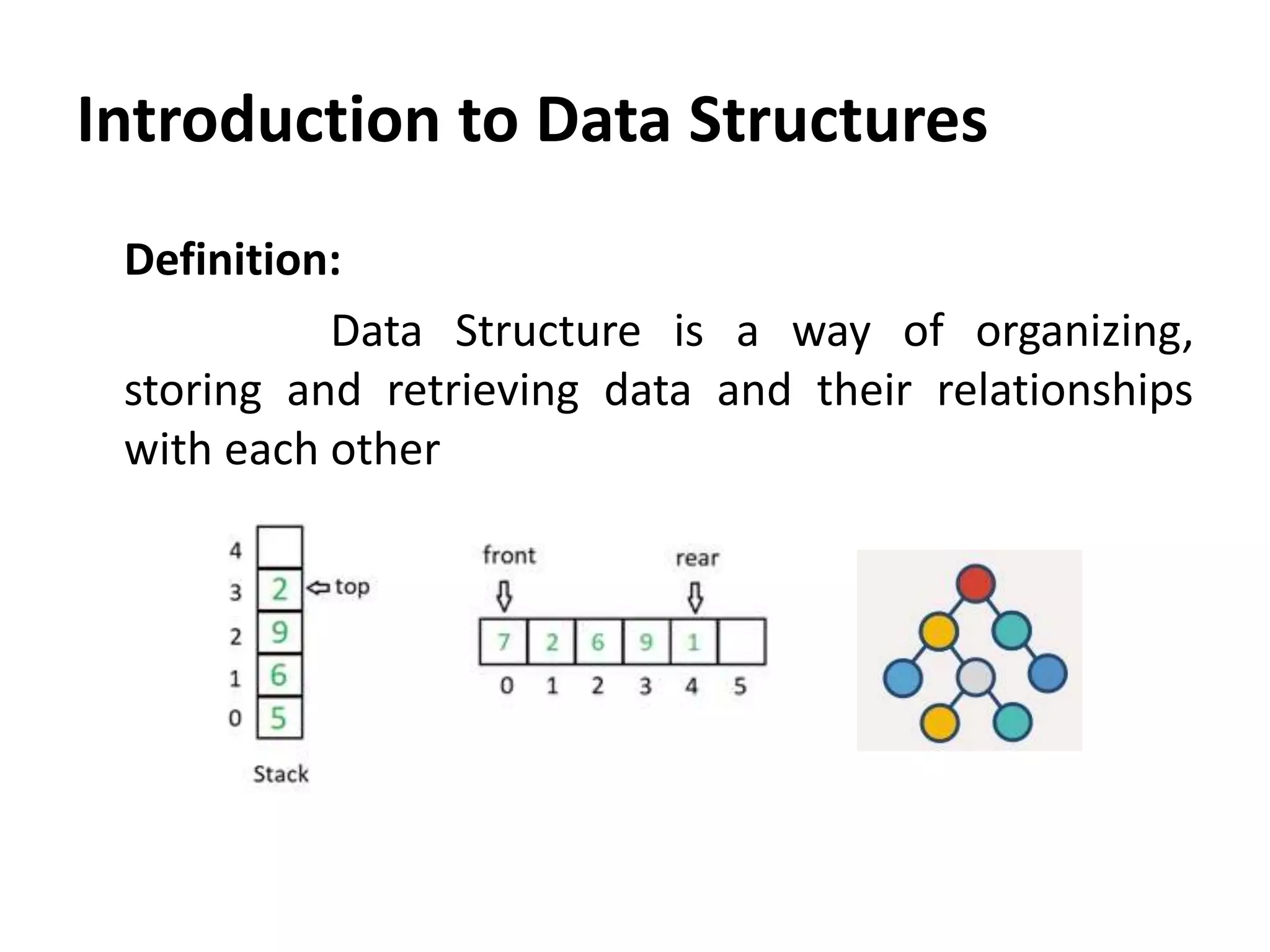
Definition:
Data Structure is a way of organizing,
storing and retrieving data and their relationships
with each other
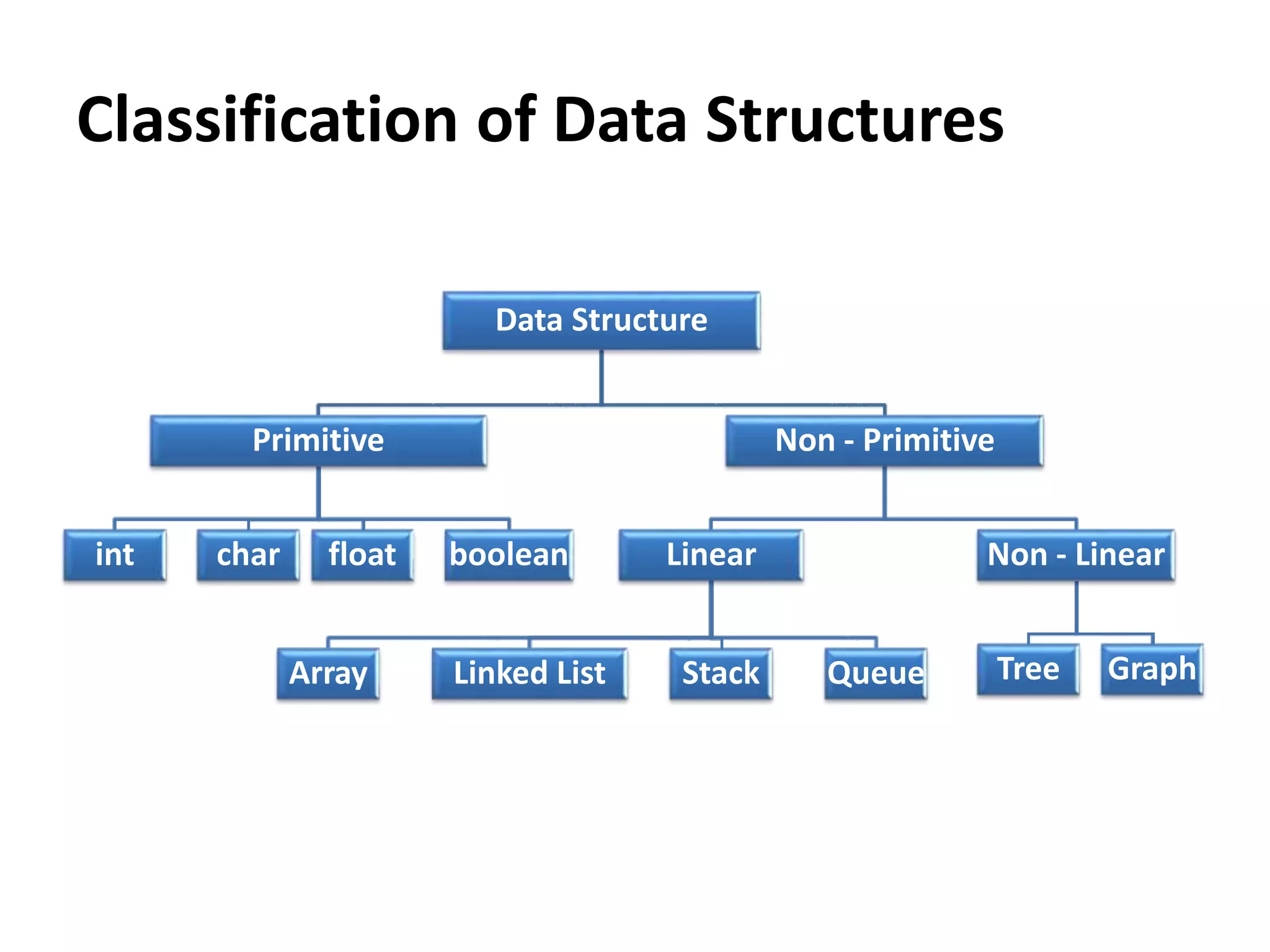
Classification of Data Structures
Data Structure
Primitive
int char float boolean
Non - Primitive
Linear
Array Linked List Stack Queue
Non - Linear
Tree Graph
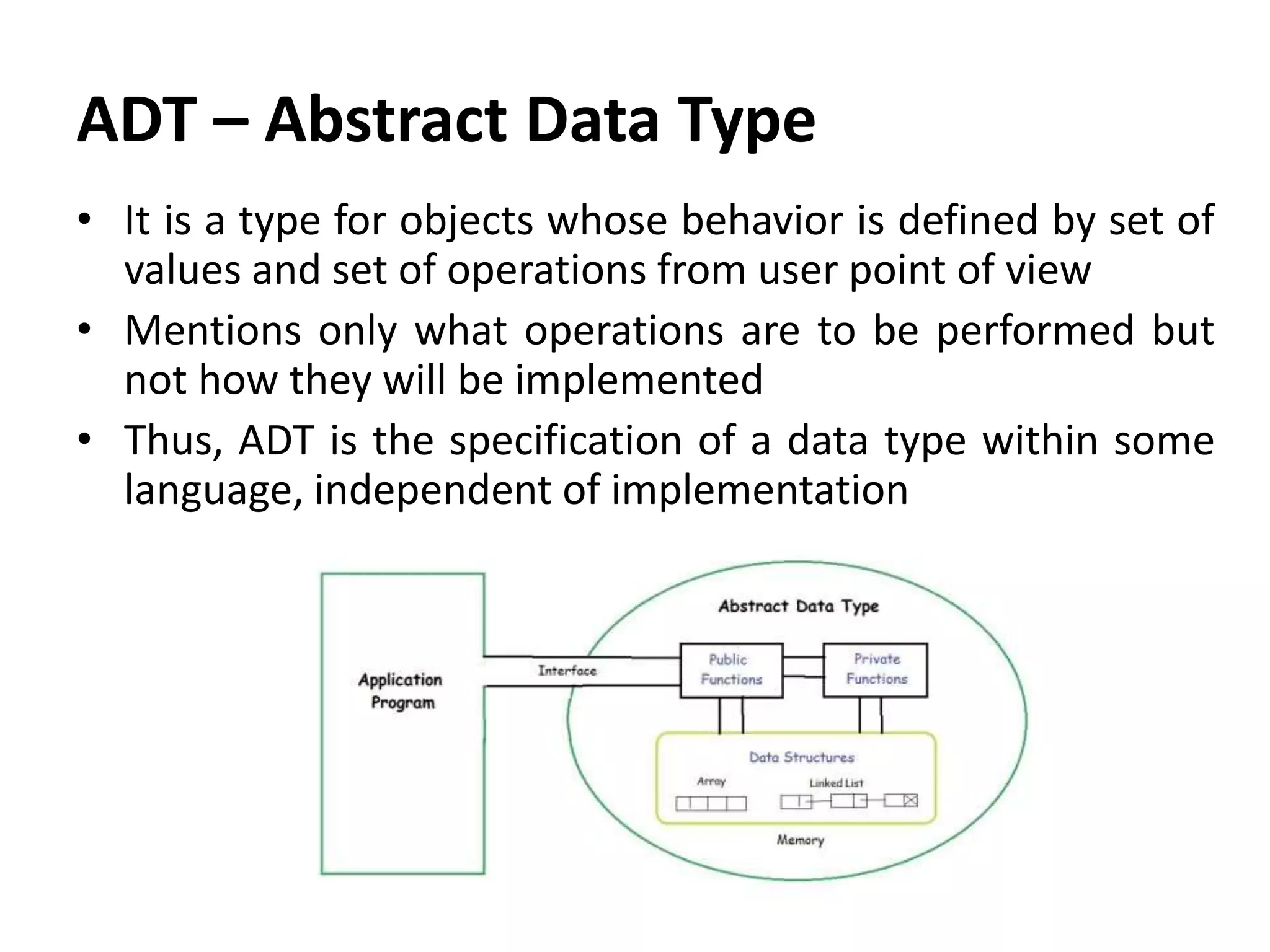
• It is a type for objects whose behavior is defined by set of
values and set of operations from user point of view
• Mentions only what operations are to be performed but
not how they will be implemented
• Thus, ADT is the specification of a data type within some
language, independent of implementation
ADT – Abstract Data Type
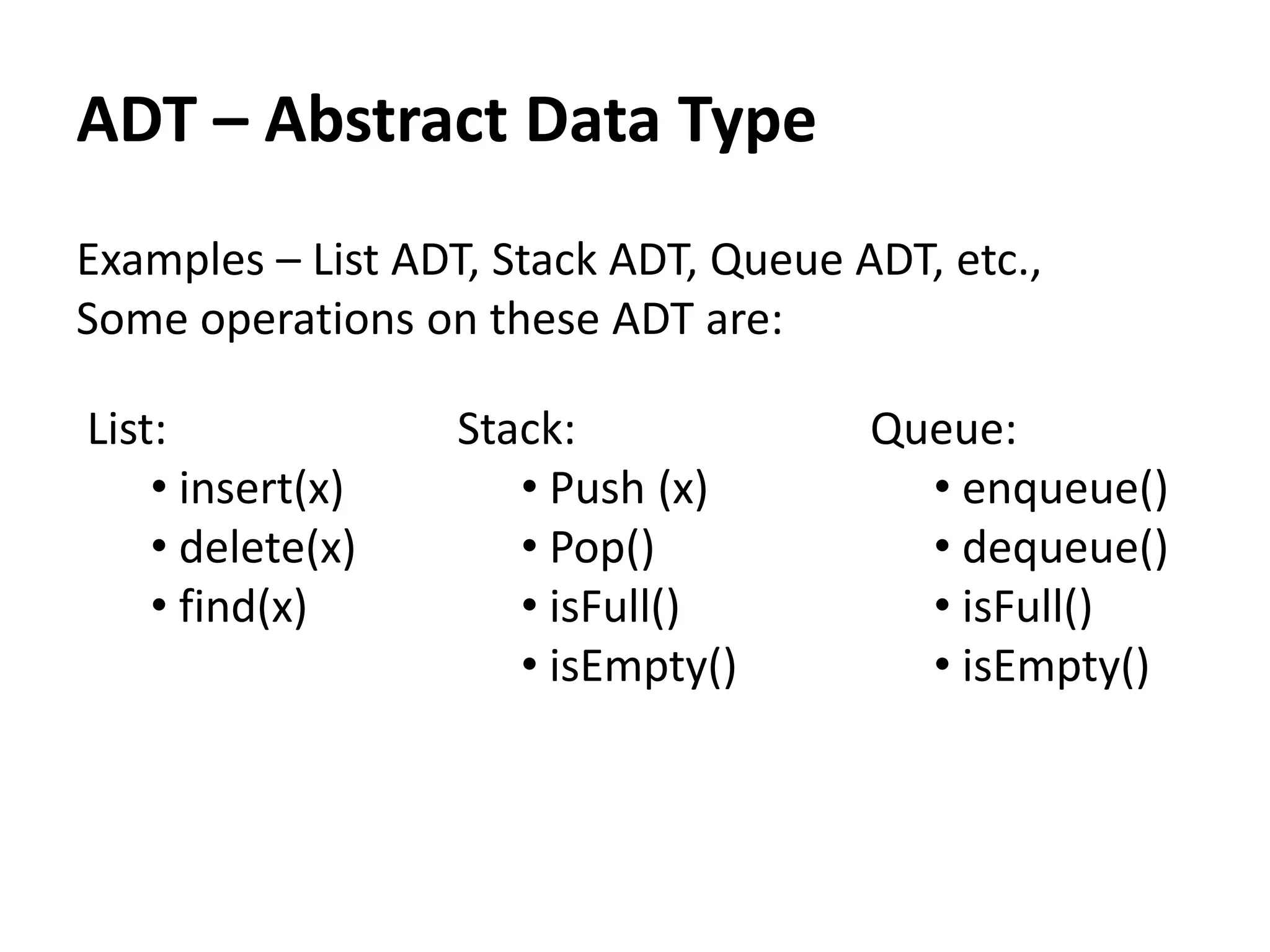
Examples – List ADT, Stack ADT, Queue ADT, etc.,
Some operations on these ADT are:
List:
• insert(x)
• delete(x)
• find(x)
Stack:
• Push (x)
• Pop()
• isFull()
• isEmpty()
Queue:
• enqueue()
• dequeue()
• isFull()
• isEmpty()
ADT – Abstract Data Type
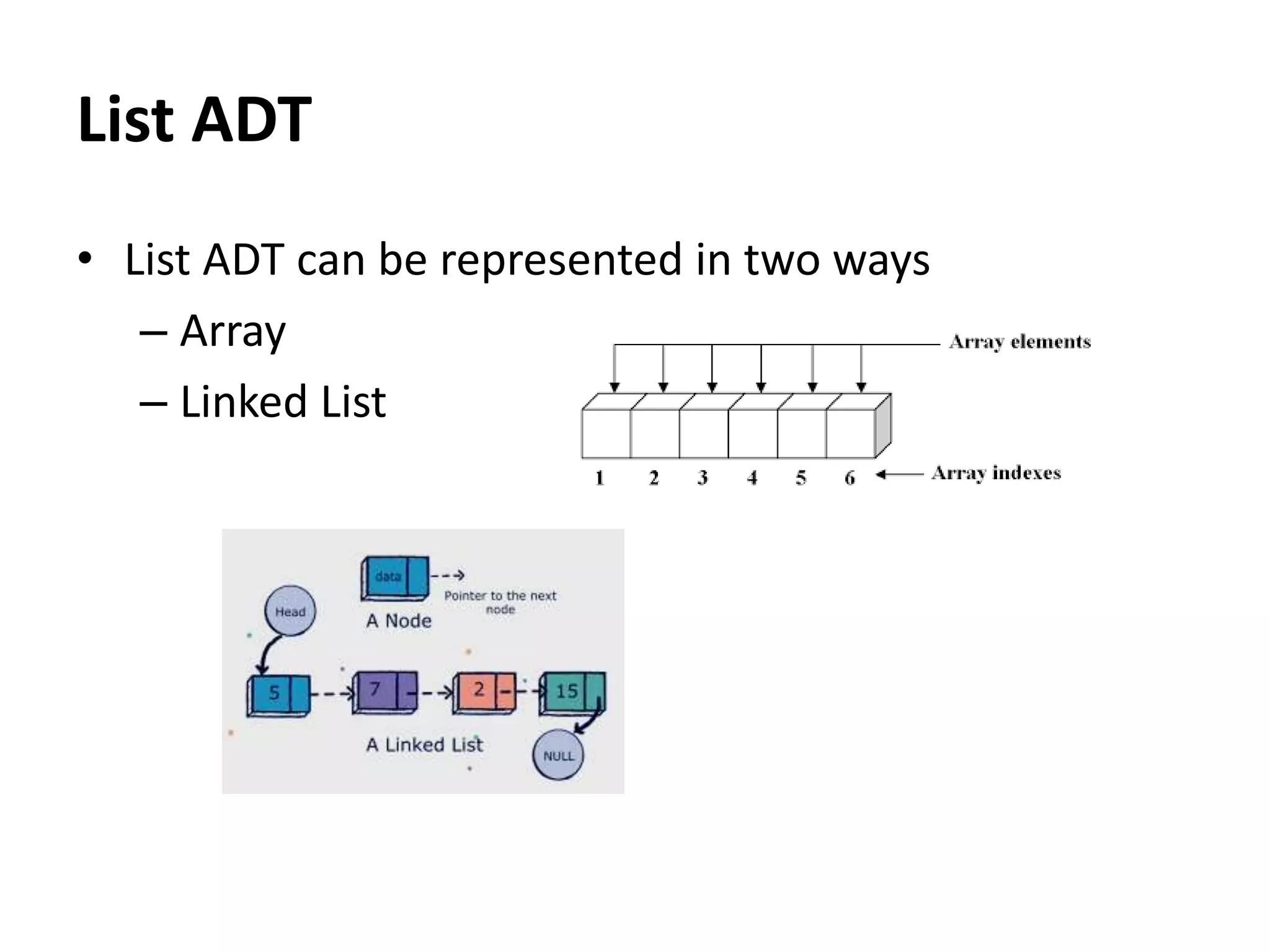
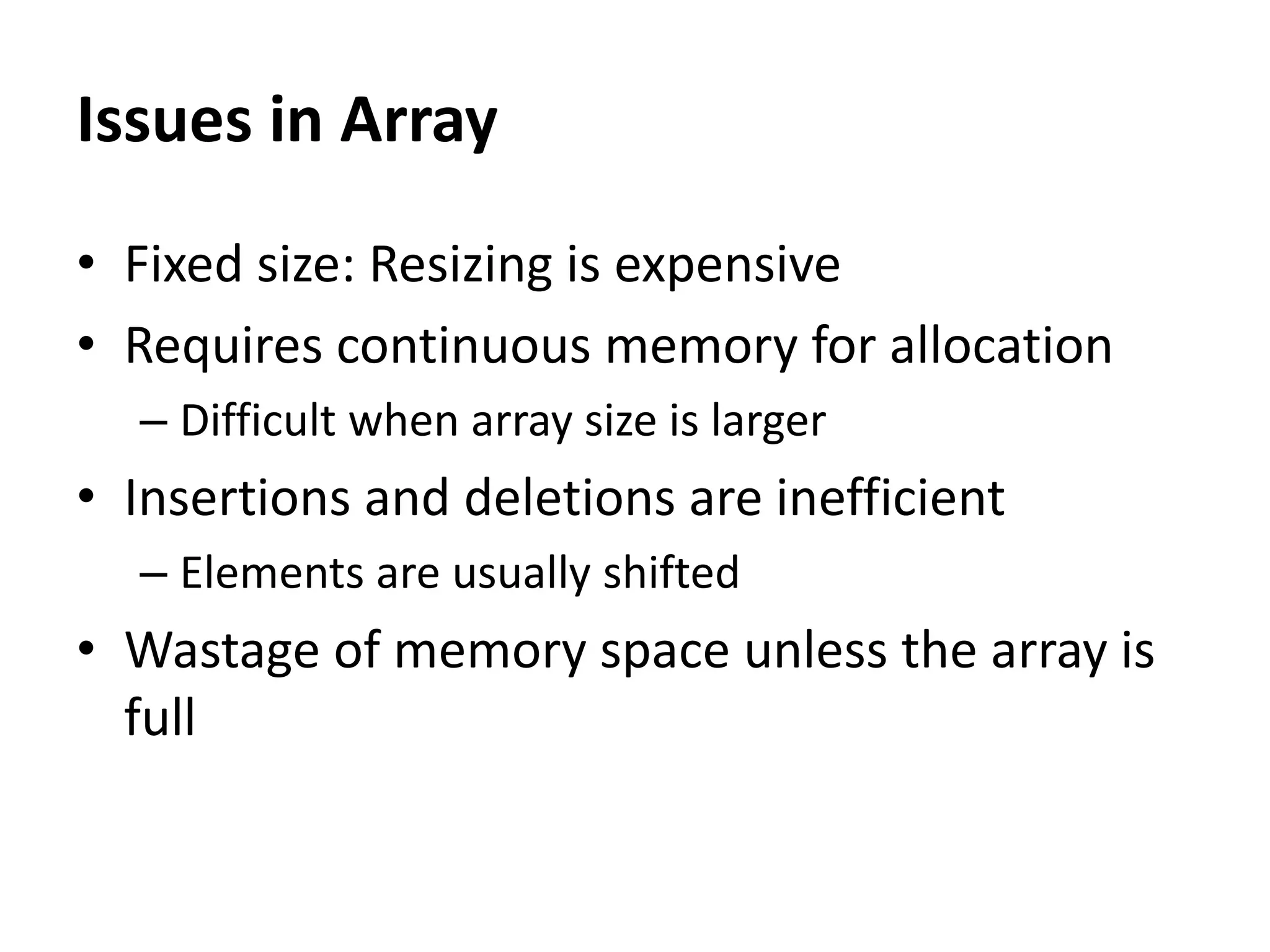
• List ADT can be represented in two ways
– Array
– Linked List
List ADT
• Collection of elements of same data type
• Elements in an array is stored in adjacent memory
location
Syntax:
• datatype arrayname [size]
• Eg: int a [50];
Operations:
• insertion()
• deletion()
• search()
Array ADT
• Fixed size: Resizing is expensive
• Requires continuous memory for allocation
– Difficult when array size is larger
• Insertions and deletions are inefficient
– Elements are usually shifted
• Wastage of memory space unless the array is
full
Issues in Array
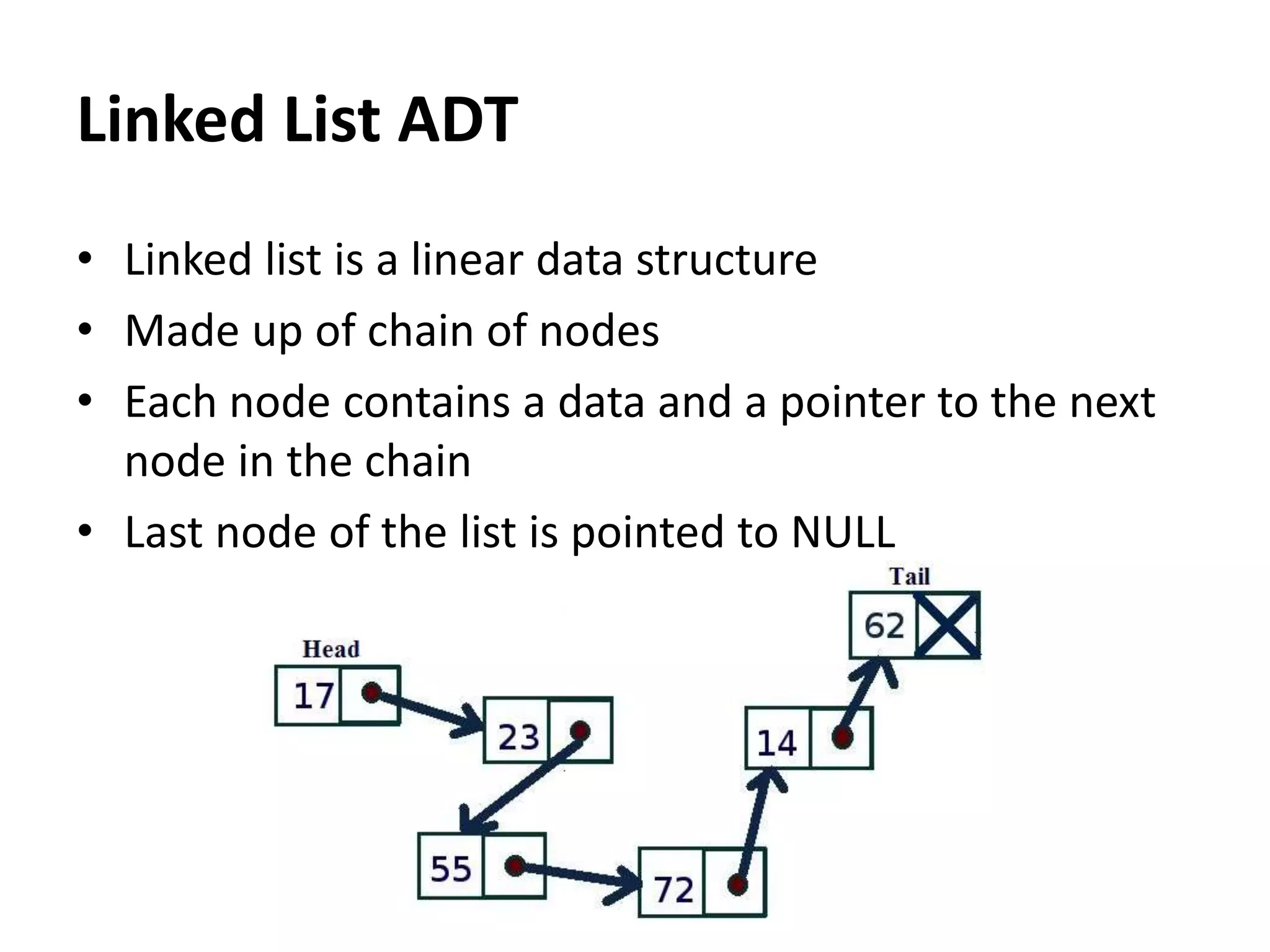
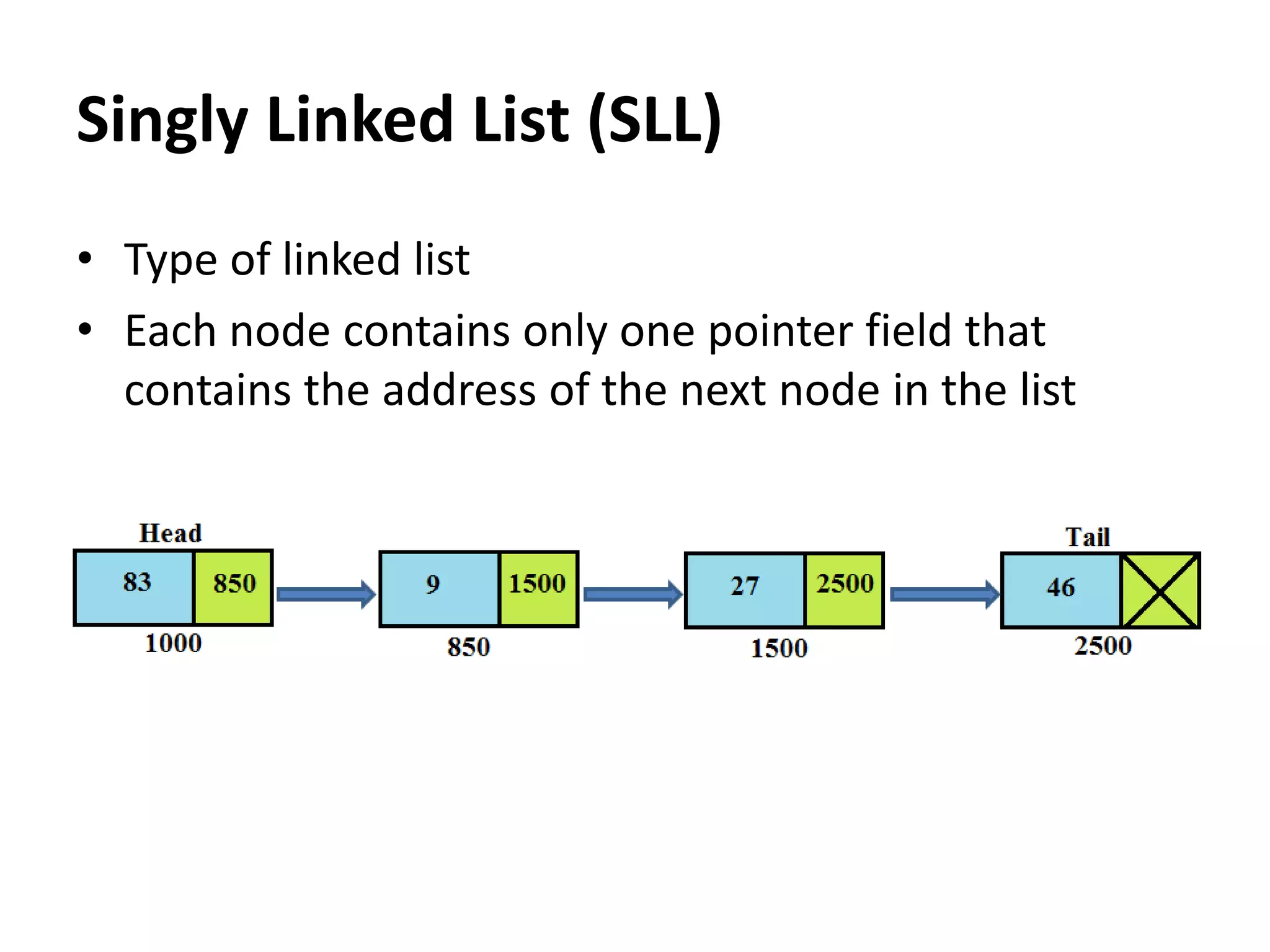
• Linked list is a linear data structure
• Made up of chain of nodes
• Each node contains a data and a pointer to the next
node in the chain
• Last node of the list is pointed to NULL
Linked List ADT
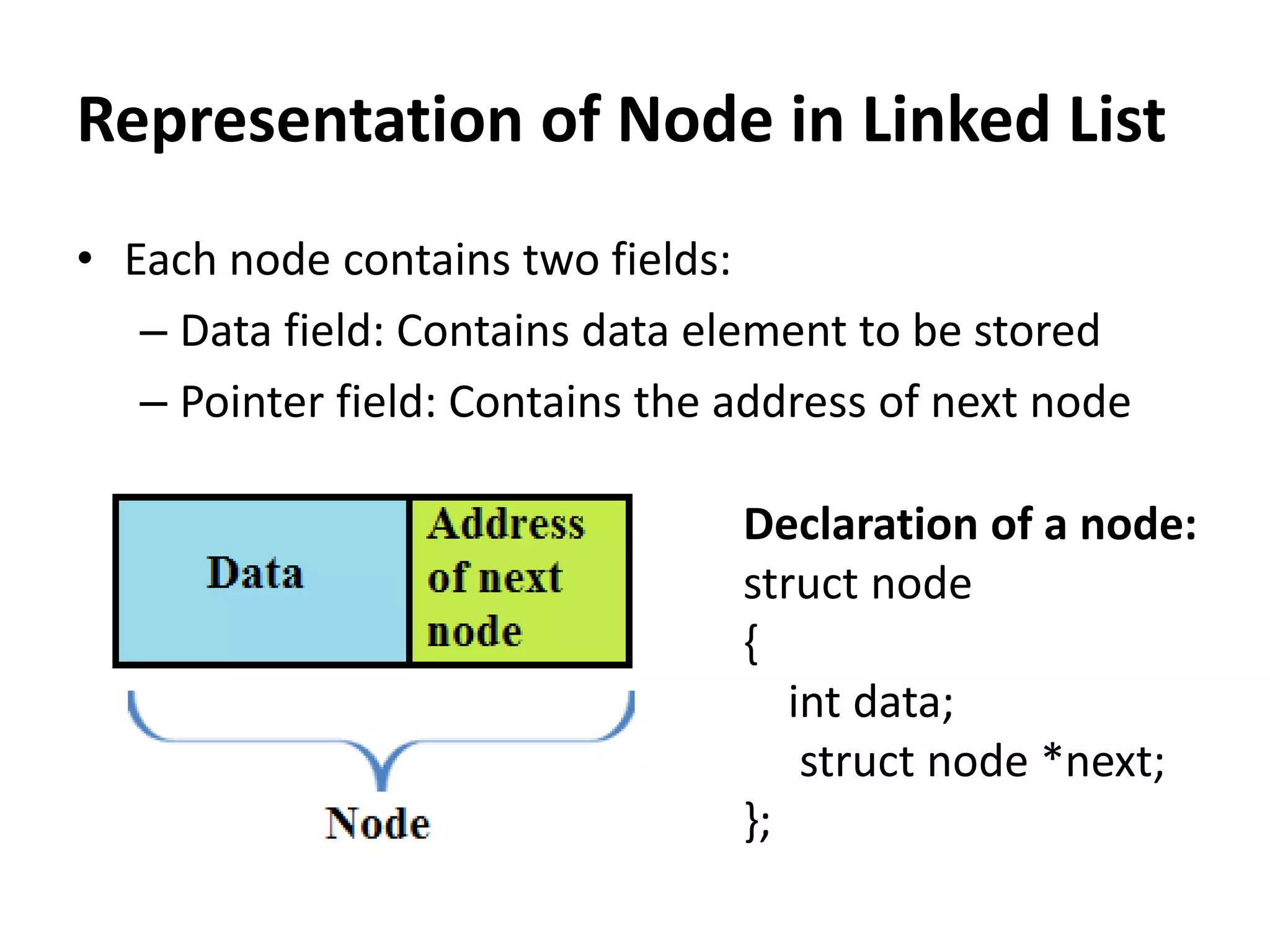
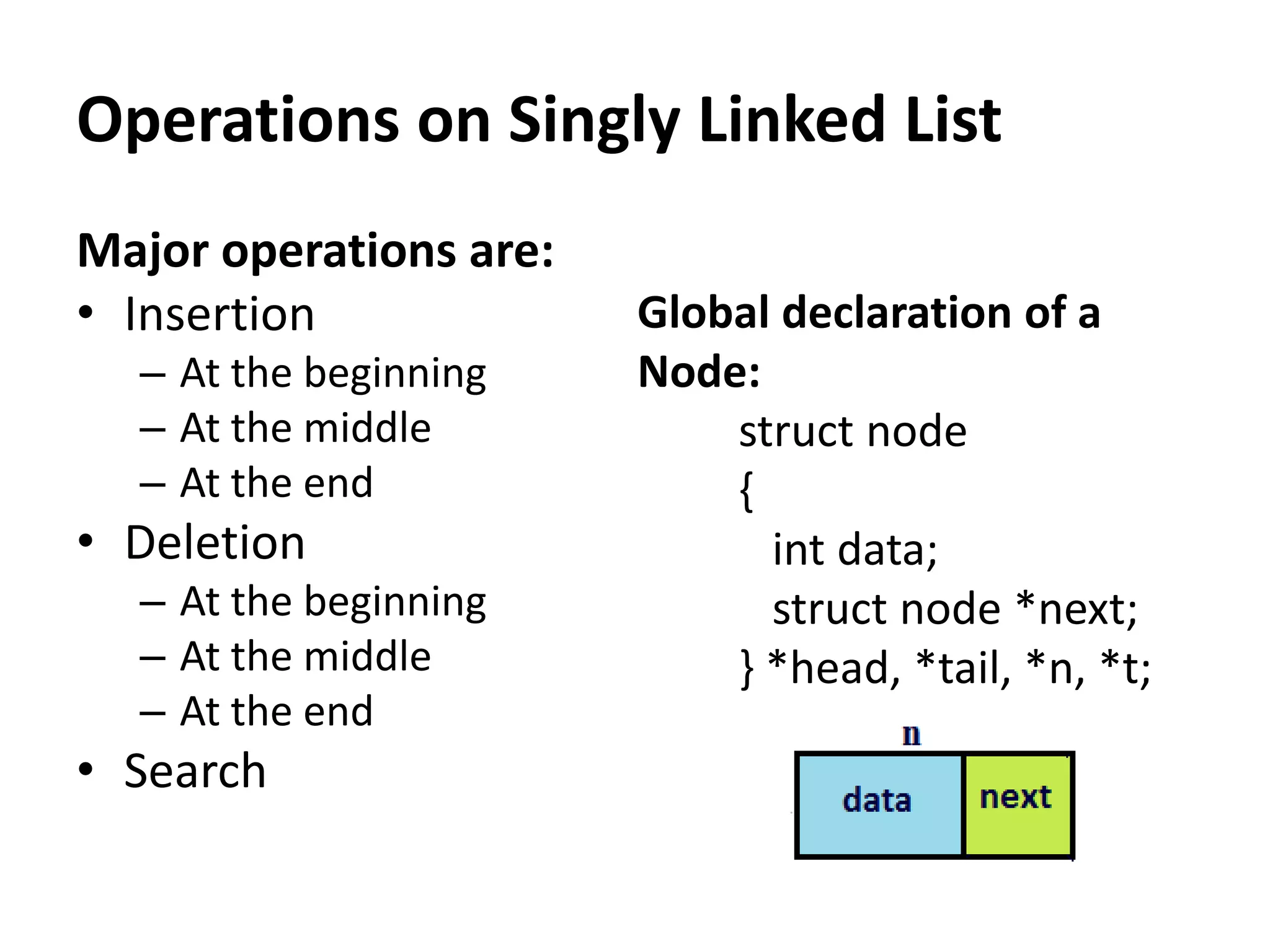
• Each node contains two fields:
– Data field: Contains data element to be stored
– Pointer field: Contains the address of next node
Representation of Node in Linked List
Declaration of a node:
struct node
{
int data;
struct node *next;
};
• Singly linked list
• Doubly linked list
• Circular linked list
Types of Linked List
• Type of linked list
• Each node contains only one pointer field that
contains the address of the next node in the list
Singly Linked List (SLL)
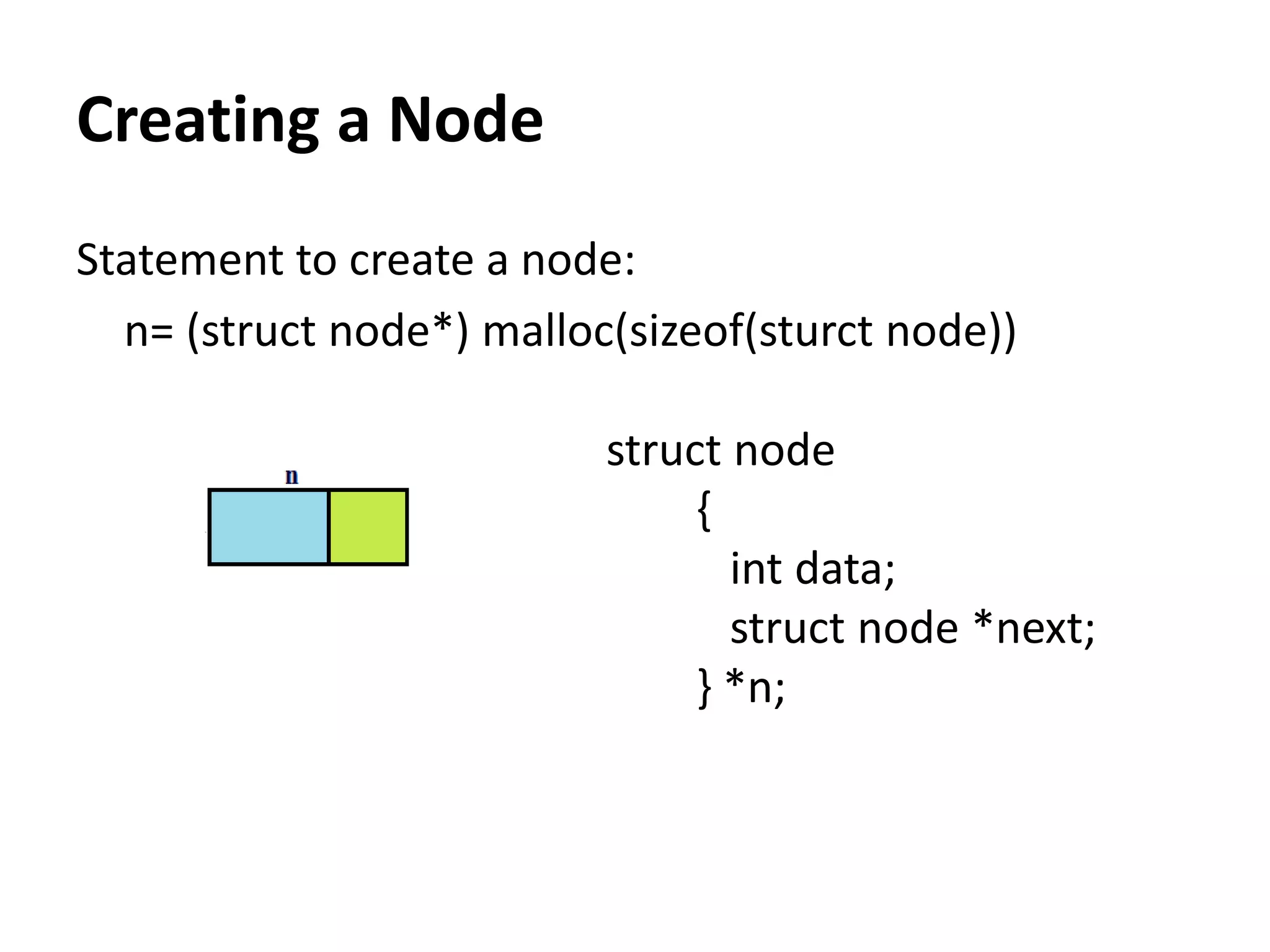
Statement to create a node:
n= (struct node*) malloc(sizeof(sturct node))
Creating a Node
struct node
{
int data;
struct node *next;
} *n;
Major operations are:
• Insertion
– At the beginning
– At the middle
– At the end
• Deletion
– At the beginning
– At the middle
– At the end
• Search
Operations on Singly Linked List
Global declaration of a
Node:
struct node
{
int data;
struct node *next;
} *head, *tail, *n, *t;
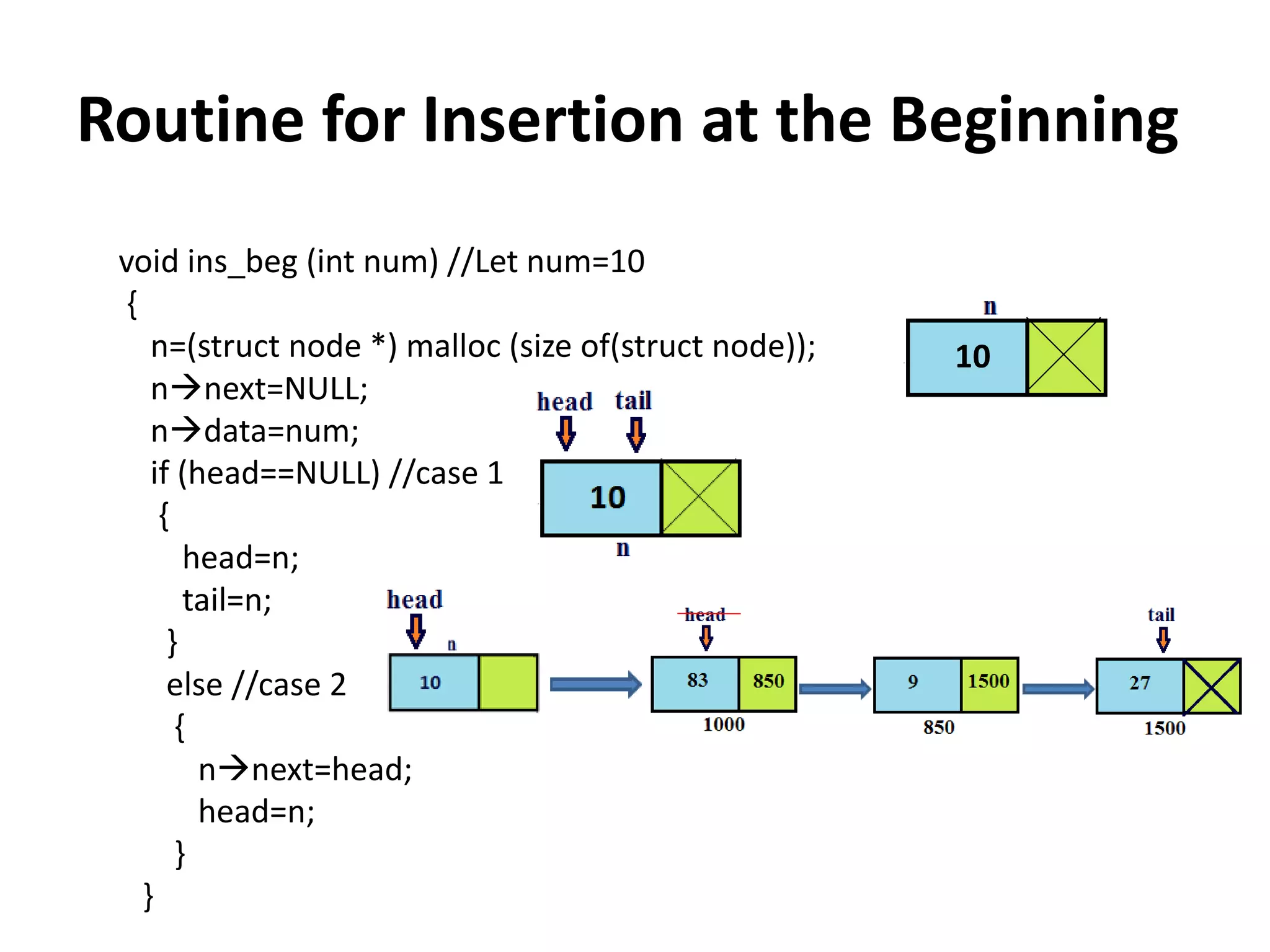
Routine for Insertion at the Beginning
void ins_beg (int num) //Let num=10
{
n=(struct node *) malloc (size of(struct node));
nnext=NULL;
ndata=num;
if (head==NULL) //case 1
{
head=n;
tail=n;
}
else //case 2
{
nnext=head;
head=n;
}
}
10
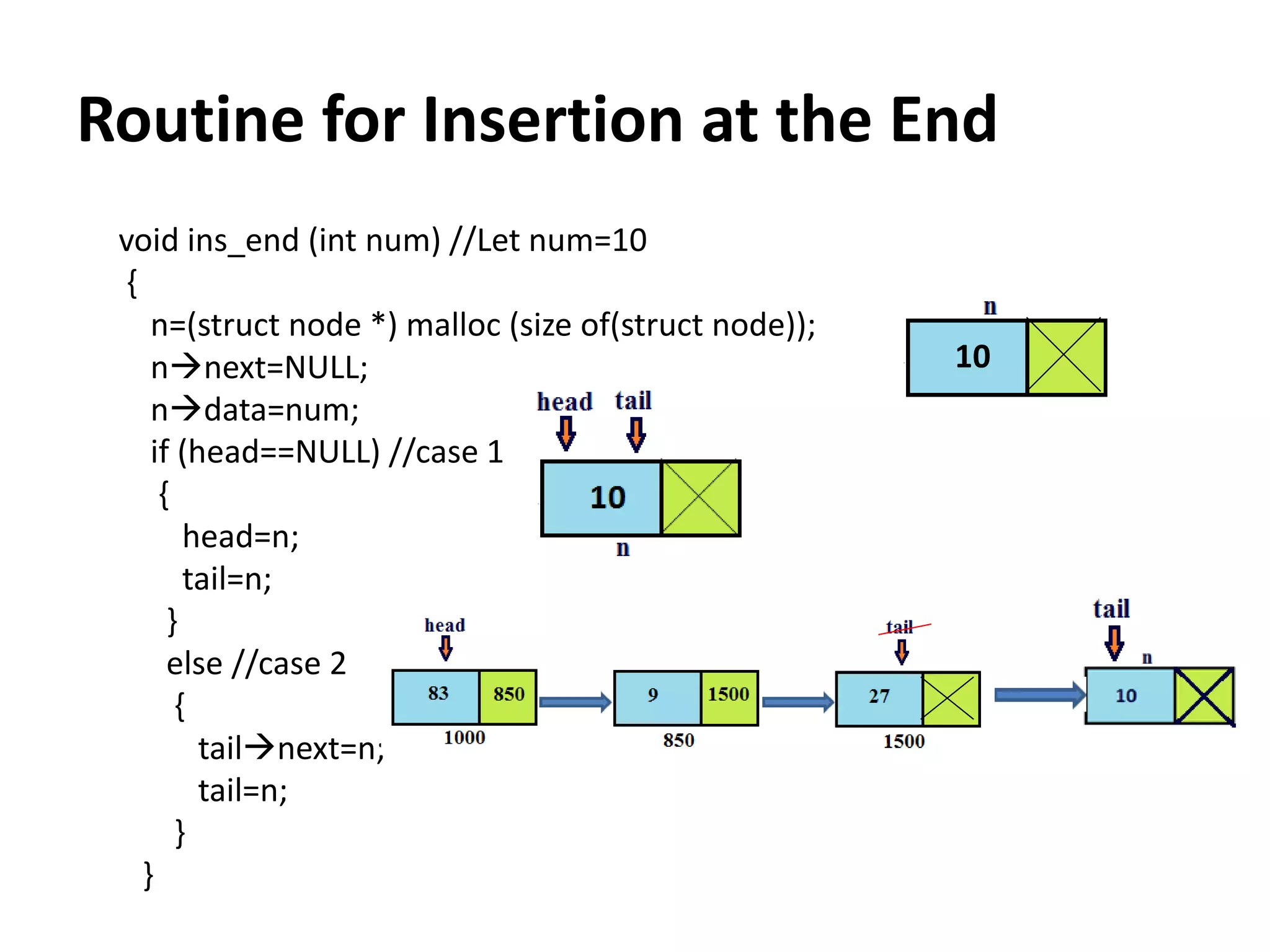
Routine for Insertion at the End
void ins_end (int num) //Let num=10
{
n=(struct node *) malloc (size of(struct node));
nnext=NULL;
ndata=num;
if (head==NULL) //case 1
{
head=n;
tail=n;
}
else //case 2
{
tailnext=n;
tail=n;
}
}
10
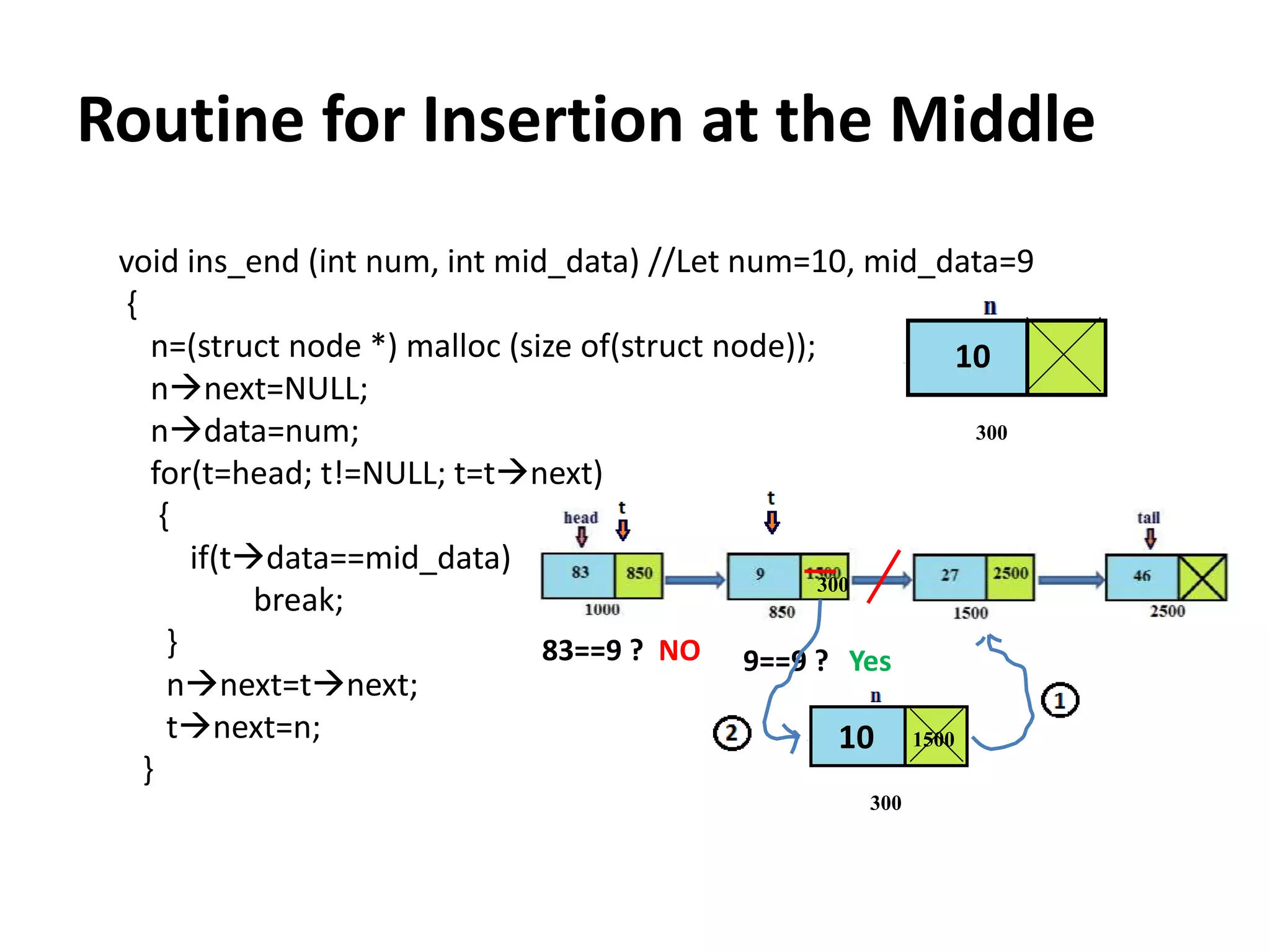
Routine for Insertion at the Middle
void ins_end (int num, int mid_data) //Let num=10, mid_data=9
{
n=(struct node *) malloc (size of(struct node));
nnext=NULL;
ndata=num;
for(t=head; t!=NULL; t=tnext)
{
if(tdata==mid_data)
break;
}
nnext=tnext;
tnext=n;
}
10
83==9 ? NO 9==9 ? Yes
10
300
300
1500
300
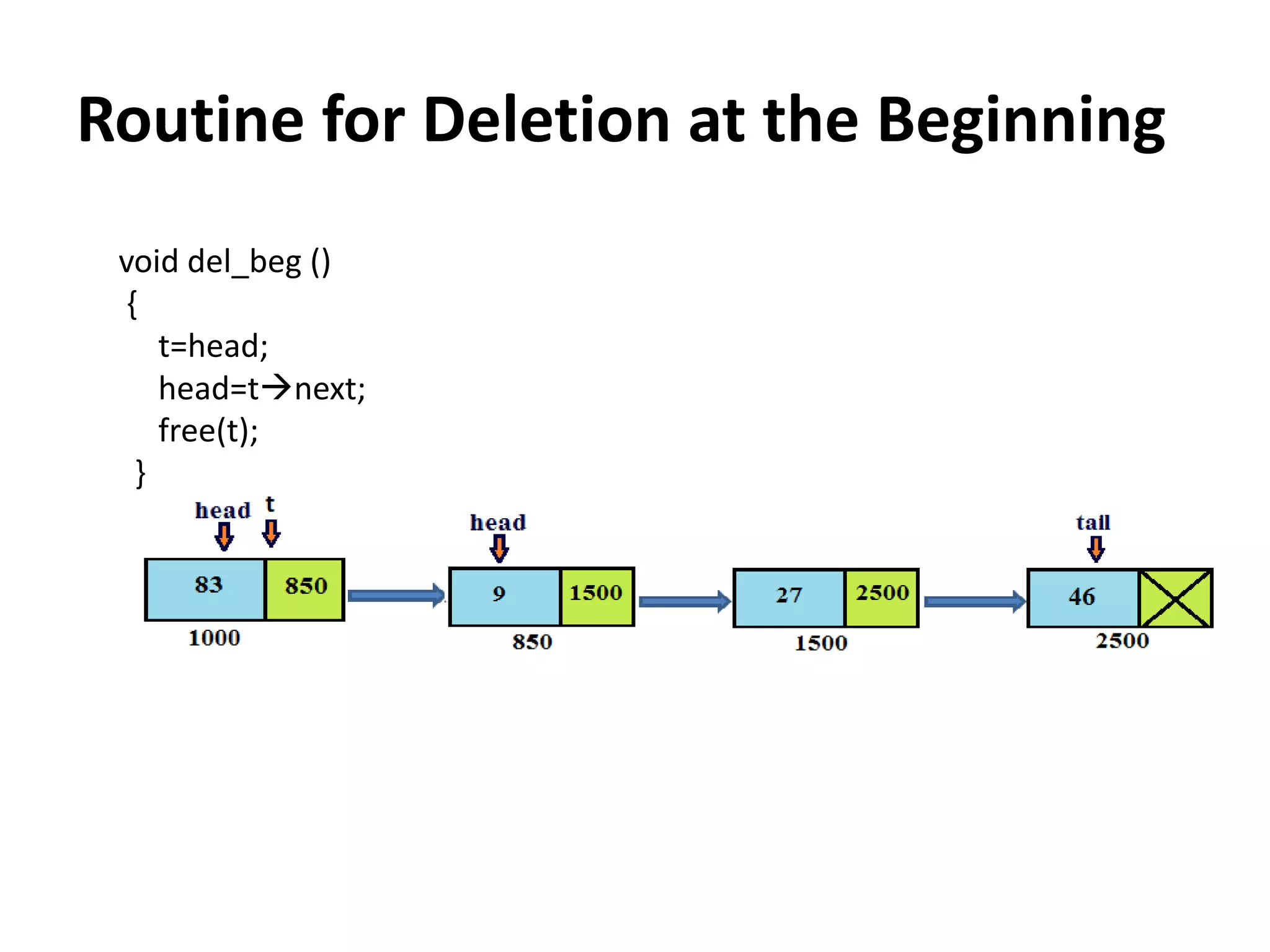
Routine for Deletion at the Beginning
void del_beg ()
{
t=head;
head=tnext;
free(t);
}
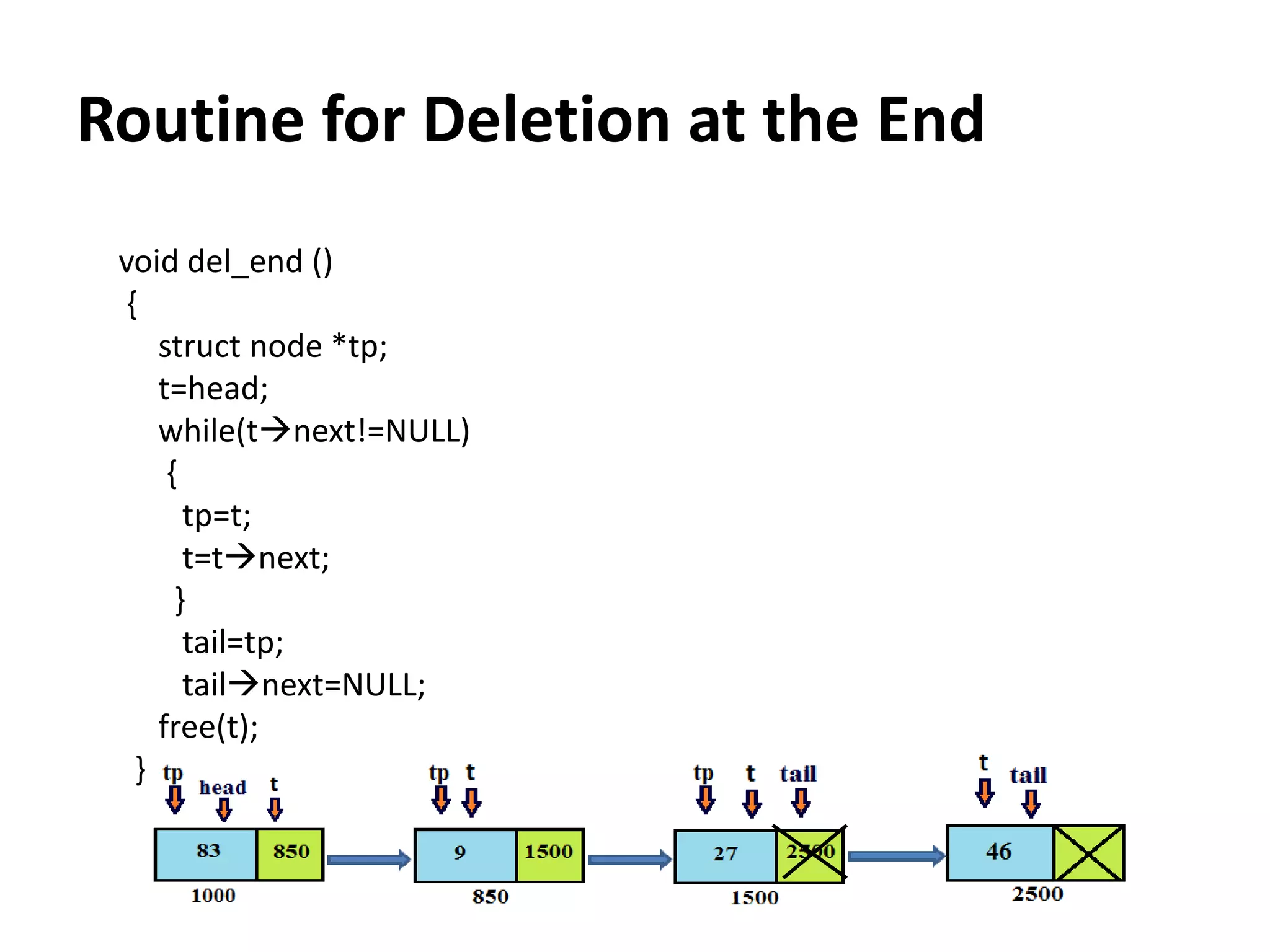
Routine for Deletion at the End
void del_end ()
{
struct node *tp;
t=head;
while(tnext!=NULL)
{
tp=t;
t=tnext;
}
tail=tp;
tailnext=NULL;
free(t);
}
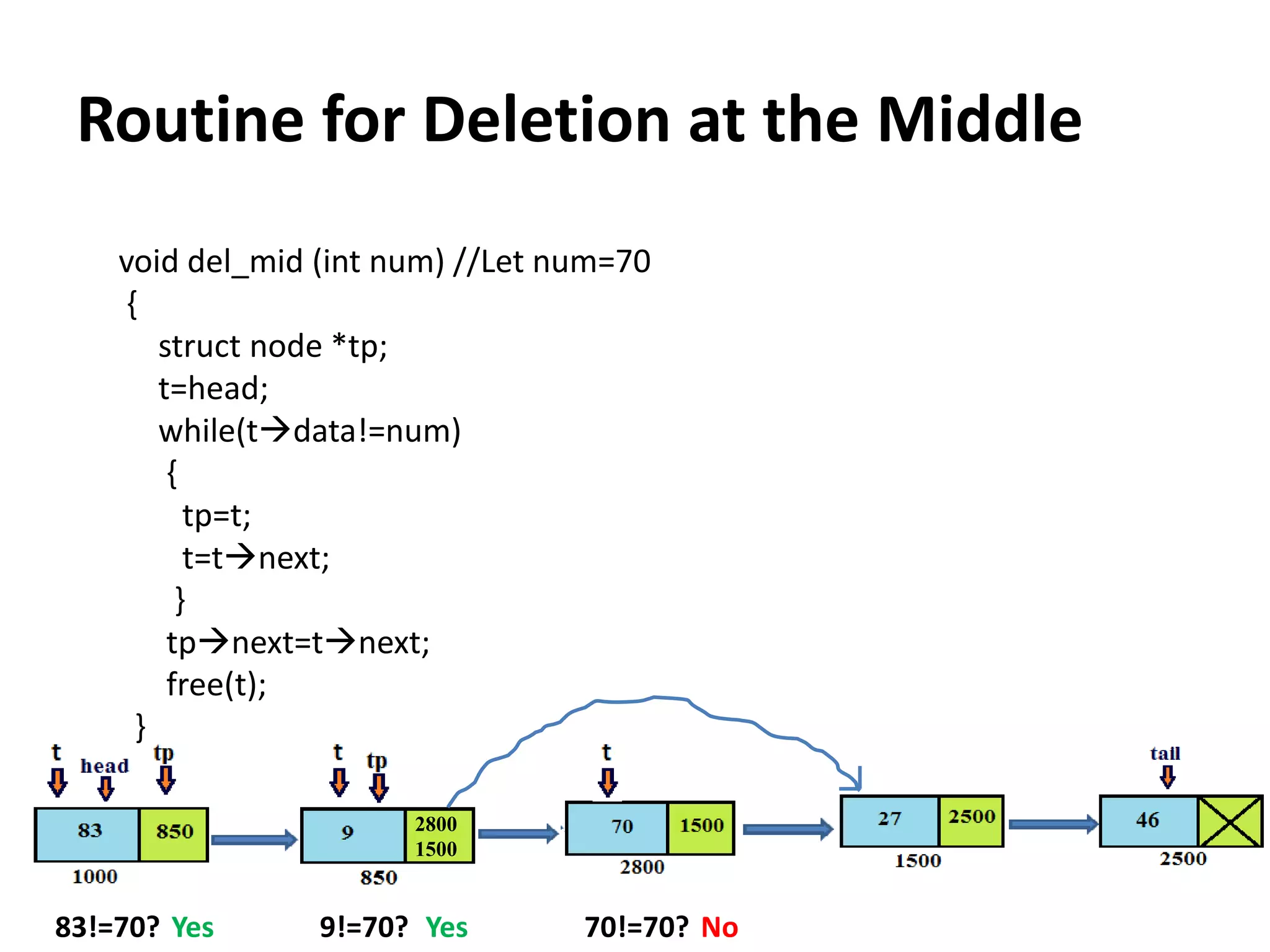
Routine for Deletion at the Middle
void del_mid (int num) //Let num=70
{
struct node *tp;
t=head;
while(tdata!=num)
{
tp=t;
t=tnext;
}
tpnext=tnext;
free(t);
}
2800
83!=70? Yes 9!=70? Yes 70!=70? No
1500
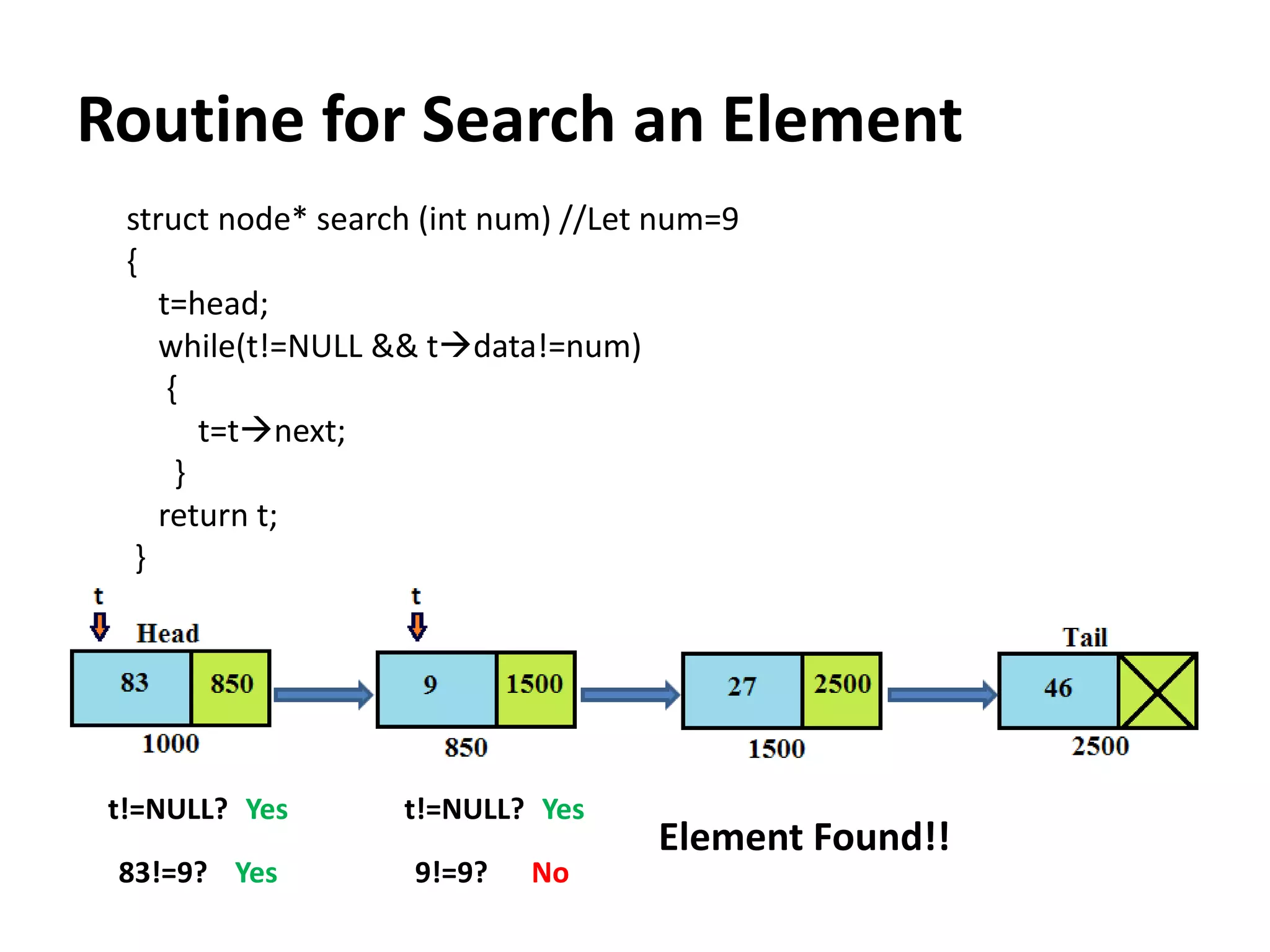
Routine for Search an Element
struct node* search (int num) //Let num=9
{
t=head;
while(t!=NULL && tdata!=num)
{
t=tnext;
}
return t;
}
t!=NULL? Yes
83!=9? Yes
t!=NULL? Yes
9!=9? No
Element Found!!
Linked List – Advantages & Disadvantages
Advantages:
• No wastage of memory
– Memory allocated and deallocated as per
requirement
• Efficient insertion and deletion operations
Disadvantages:
• Occupies more space than array to store a data
– Due to the need of a pointer to the next node
• Does not support random or direct access
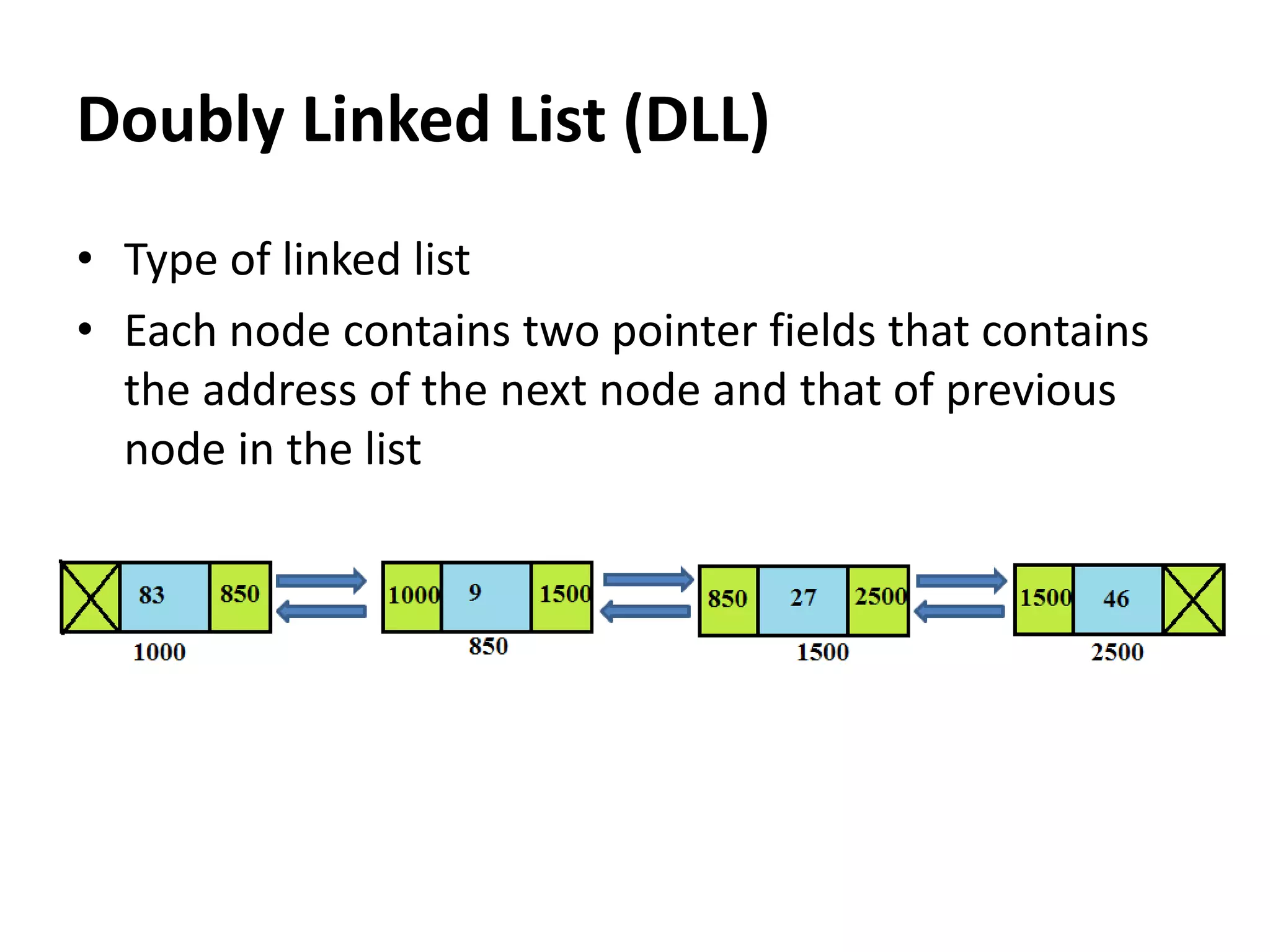
Doubly Linked List (DLL)
• Type of linked list
• Each node contains two pointer fields that contains
the address of the next node and that of previous
node in the list
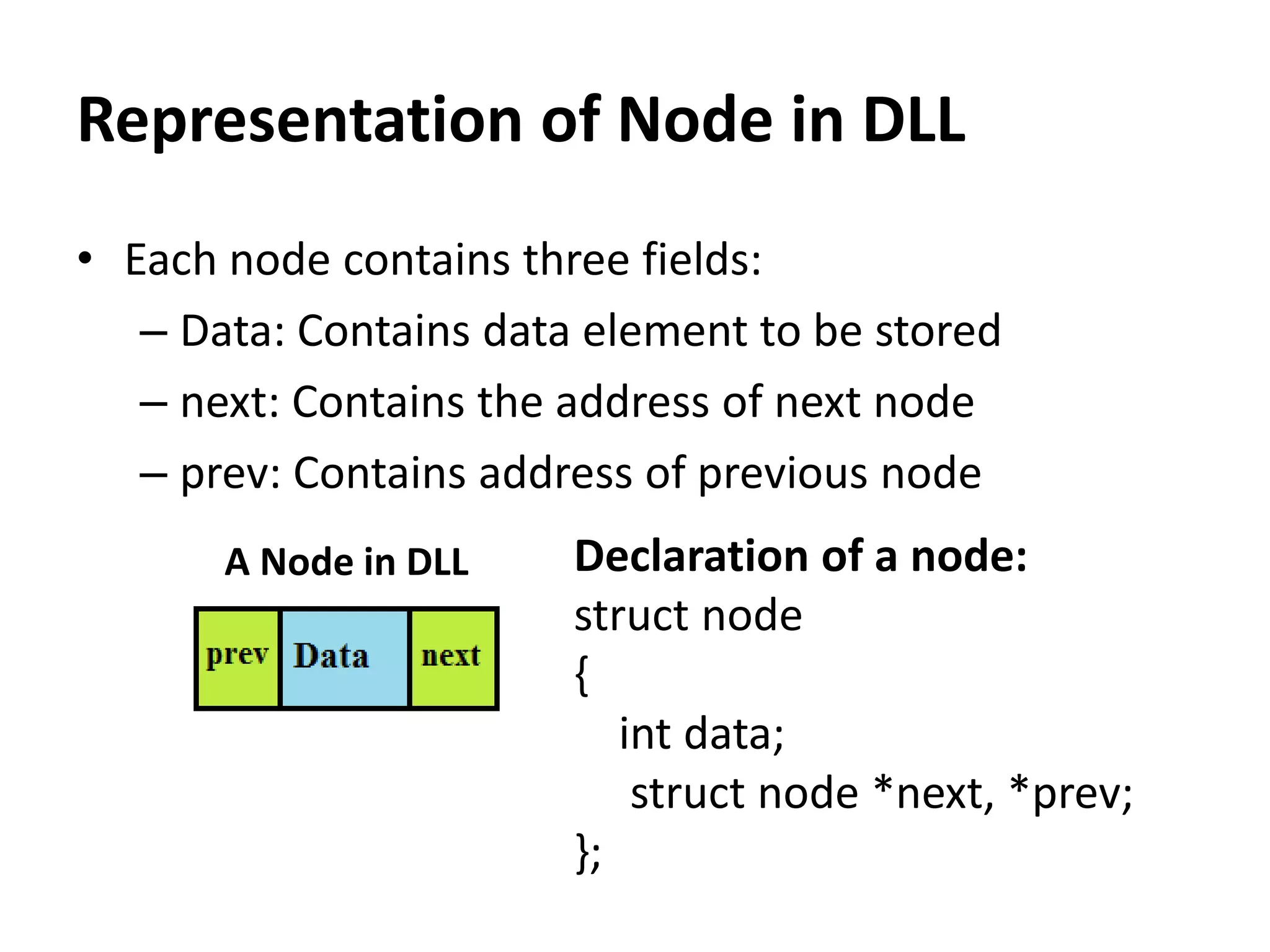
• Each node contains three fields:
– Data: Contains data element to be stored
– next: Contains the address of next node
– prev: Contains address of previous node
Representation of Node in DLL
Declaration of a node:
struct node
{
int data;
struct node *next, *prev;
};
A Node in DLL
Major operations are:
• Insertion
– At the beginning
– At the middle
– At the end
• Deletion
– At the beginning
– At the middle
– At the end
• Search
Operations on Doubly Linked List
Global declaration of a Node:
struct node
{
int data;
struct node *next, prev;
} *head, *tail, *n, *t;
Routine for Insertion at the Beginning
void ins_beg_dll (int num) //Let num=70
{
n=(struct node *) malloc(size of(struct node));
nnext=NULL;
nprev=NULL;
ndata=num;
if(head==NULL) //case 1
{
head=n;
tail=n;
}
else //case 2
{
nnext=head;
headprev=n;
head=n;
}
}
70
500
1000
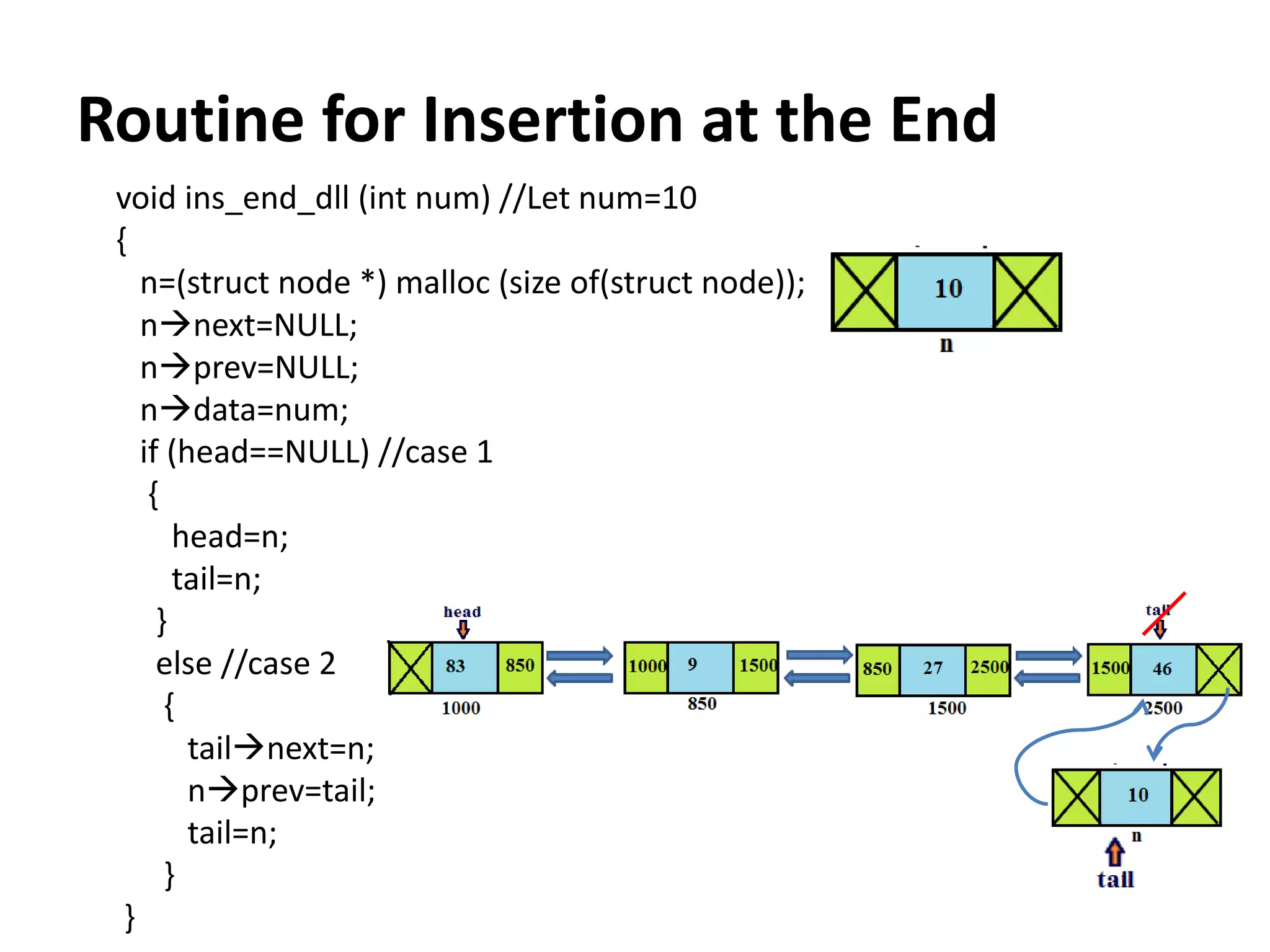
void ins_end_dll (int num) //Let num=10
{
n=(struct node *) malloc (size of(struct node));
nnext=NULL;
nprev=NULL;
ndata=num;
if (head==NULL) //case 1
{
head=n;
tail=n;
}
else //case 2
{
tailnext=n;
nprev=tail;
tail=n;
}
}
Routine for Insertion at the End
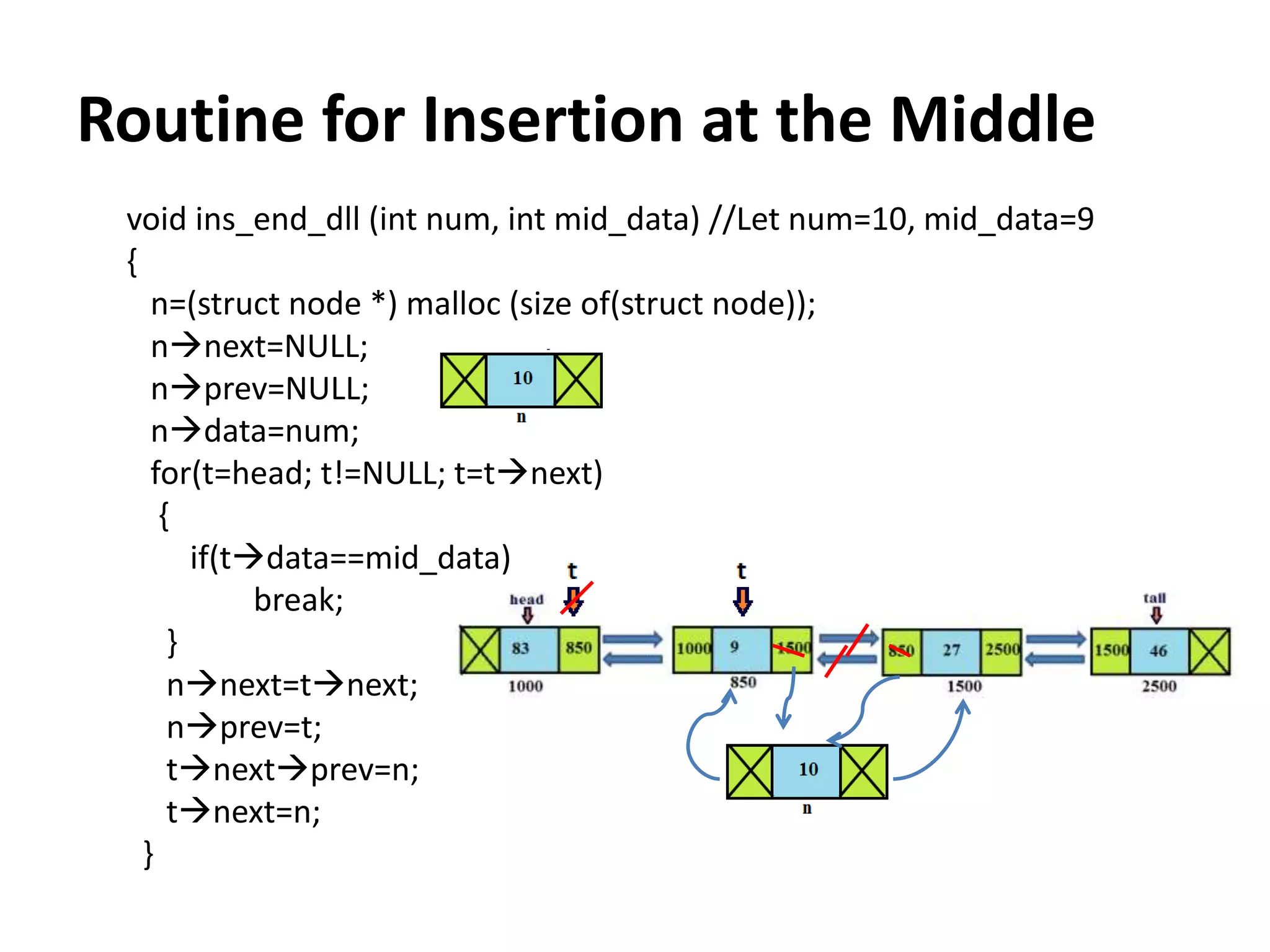
void ins_end_dll (int num, int mid_data) //Let num=10, mid_data=9
{
n=(struct node *) malloc (size of(struct node));
nnext=NULL;
nprev=NULL;
ndata=num;
for(t=head; t!=NULL; t=tnext)
{
if(tdata==mid_data)
break;
}
nnext=tnext;
nprev=t;
tnextprev=n;
tnext=n;
}
Routine for Insertion at the Middle
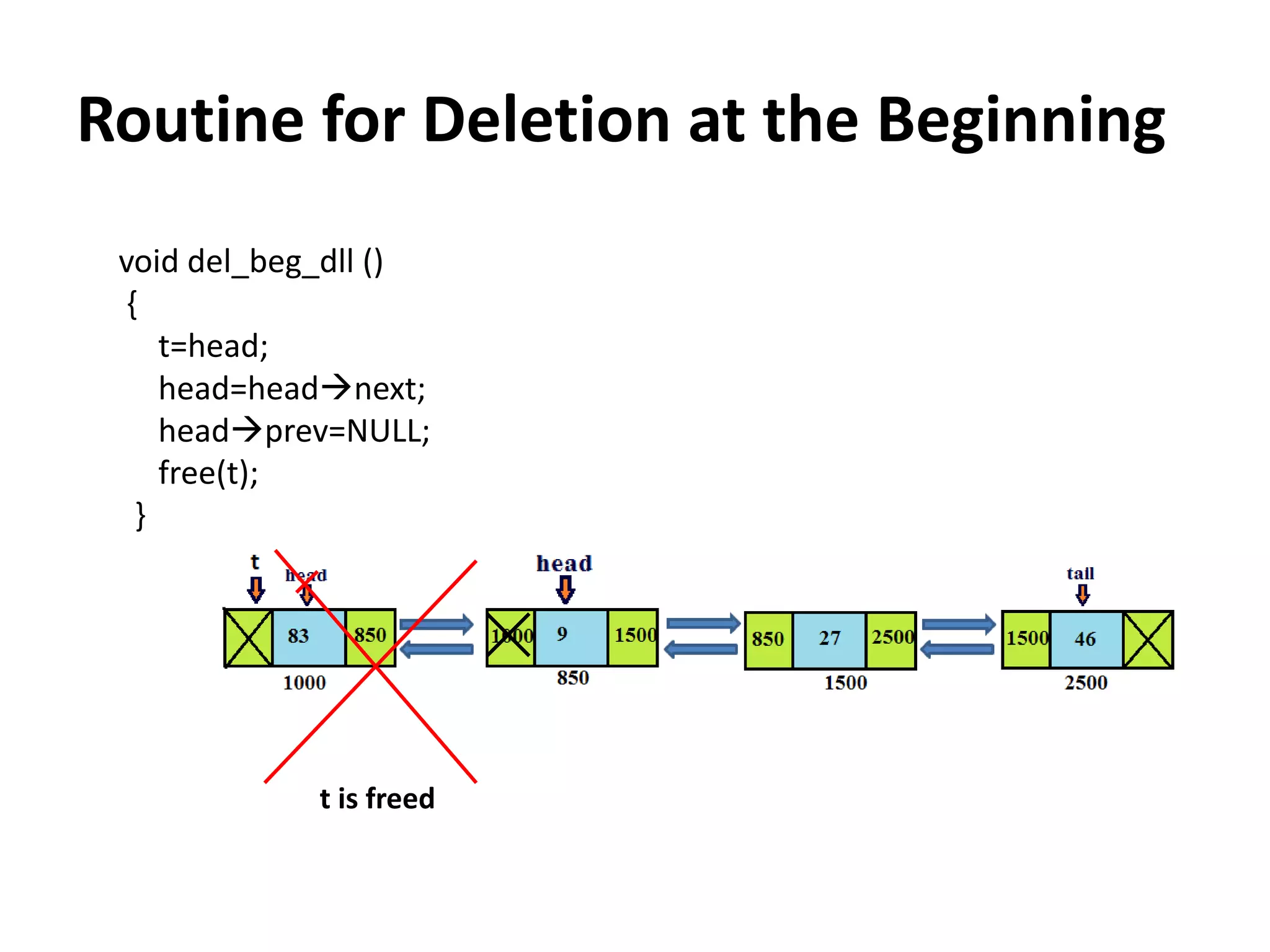
void del_beg_dll ()
{
t=head;
head=headnext;
headprev=NULL;
free(t);
}
Routine for Deletion at the Beginning
t is freed
Routine for Deletion at the End
void del_end_dll ()
{
t=head;
while(tnext!=NULL)
{
t=tnext;
}
tail=tailprev;//tail=tprev;
tailnext=NULL;
free(t);
}
Routine for Deletion at the Middle
void del_mid_dll (int num) //Let num=9
{
t=head;
while(tdata!=num)
{
tp=t;
t=tnext;
}
tprevnext=tnext;
tnextprev=tprev;
free(t);
}
Routine for Search an Element
struct node* search_dll (int num) //Let num=9
{
t=head;
while(t!=NULL && tdata!=num)
{
t=tnext;
}
return t;
}
Element Found!!
t is returned
Advantages:
• Can traverse in both directions
• Operations in the middle of the list can be done
efficiently
– No need of extra pointer (tp) to track the previous
node
• Reversing the list is easy
Disadvantage:
• Space required to store a data is even more higher
than SLL
– Due to the use of two pointers
DLL – Advantages & Disadvantages
• Type of linked list
• The last node will be pointing to the first node
• It can be either singly or doubly linked
Circular Linked List (CLL)
Global declaration of a node:
struct node
{
int data;
struct node *next, *prev;
}*head,*n,*t;
100
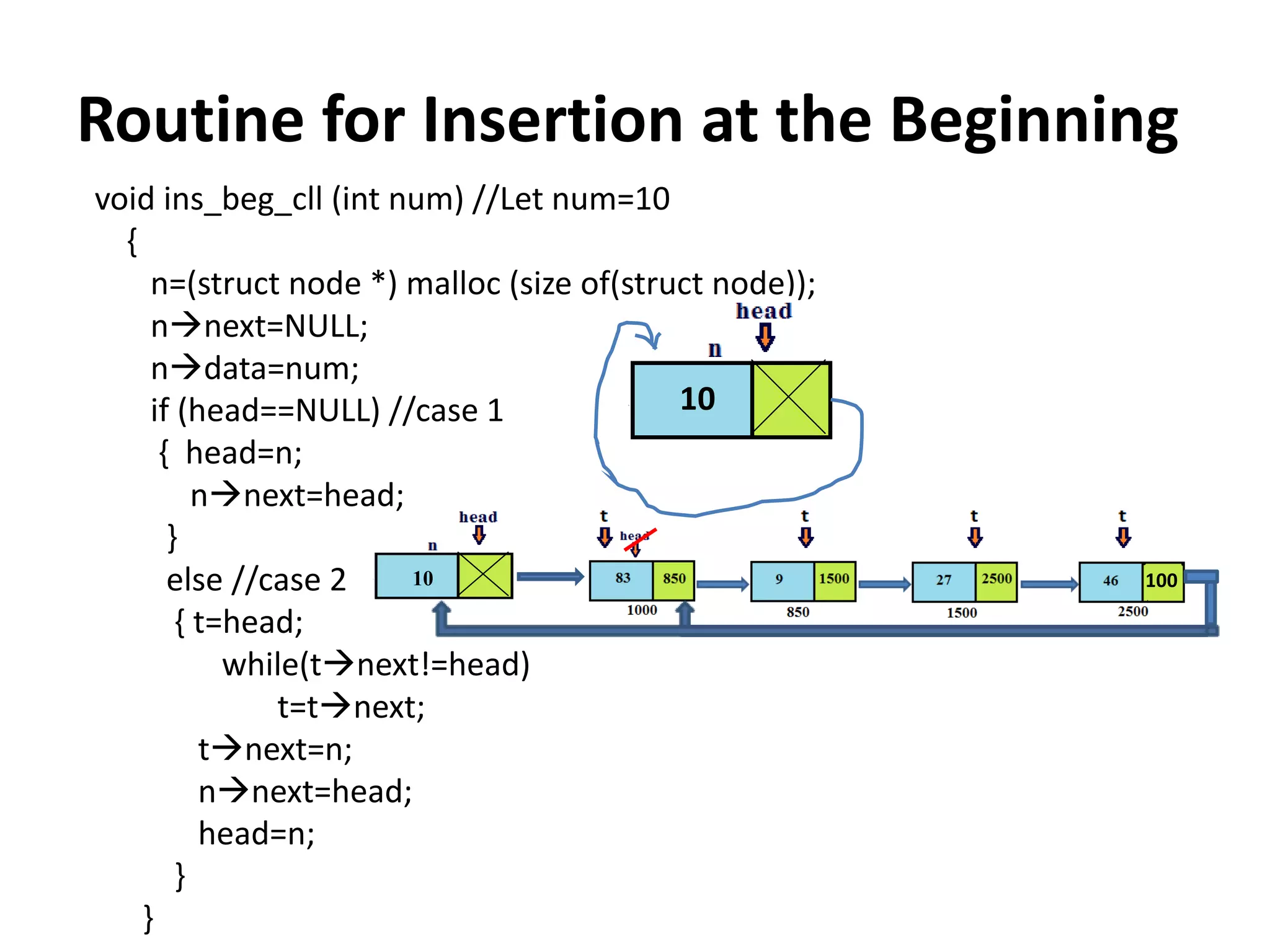
Routine for Insertion at the Beginning
void ins_beg_cll (int num) //Let num=10
{
n=(struct node *) malloc (size of(struct node));
nnext=NULL;
ndata=num;
if (head==NULL) //case 1
{ head=n;
nnext=head;
}
else //case 2
{ t=head;
while(tnext!=head)
t=tnext;
tnext=n;
nnext=head;
head=n;
}
}
10
10 100
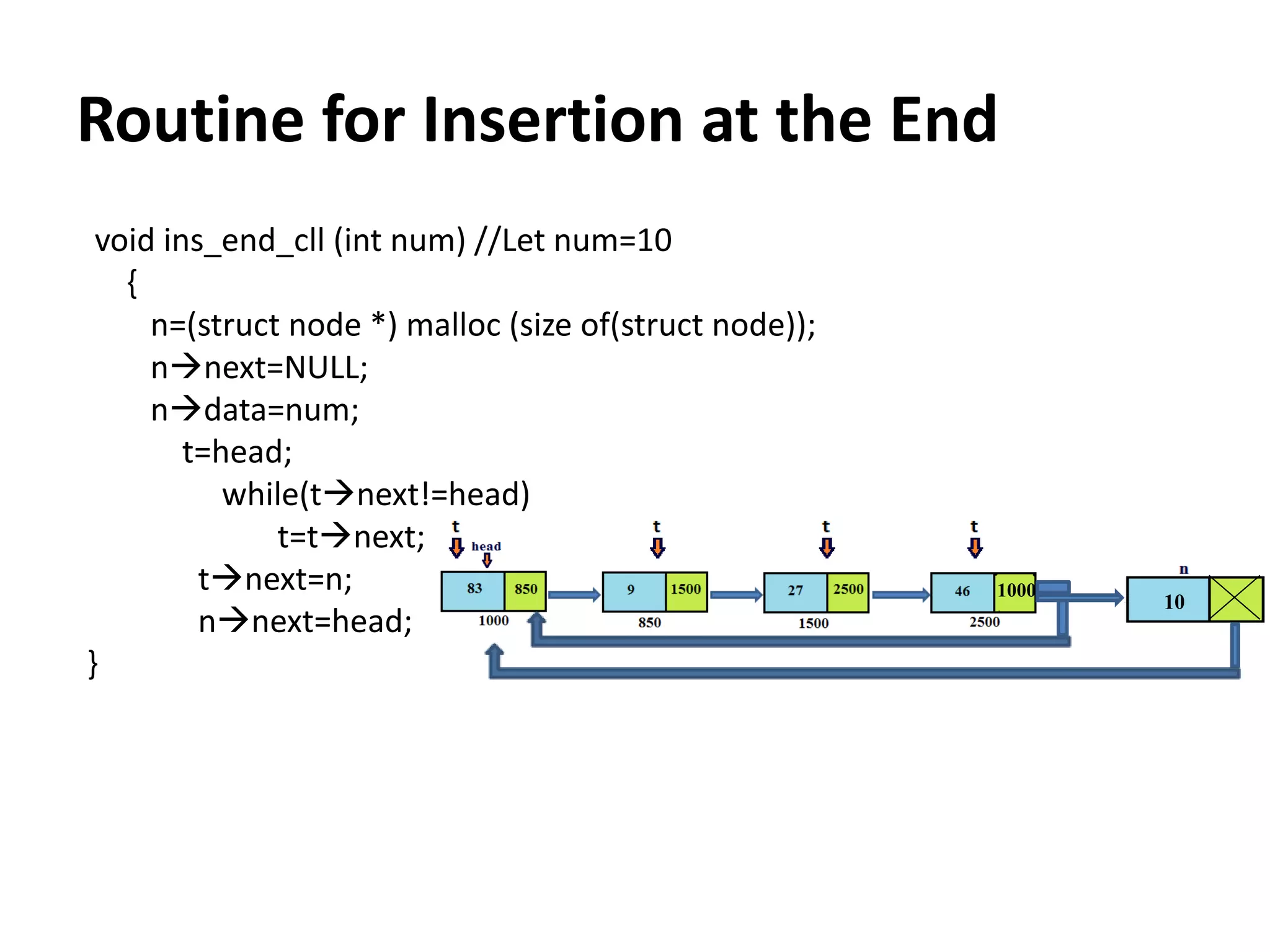
Routine for Insertion at the End
void ins_end_cll (int num) //Let num=10
{
n=(struct node *) malloc (size of(struct node));
nnext=NULL;
ndata=num;
t=head;
while(tnext!=head)
t=tnext;
tnext=n;
nnext=head;
}
10
1000
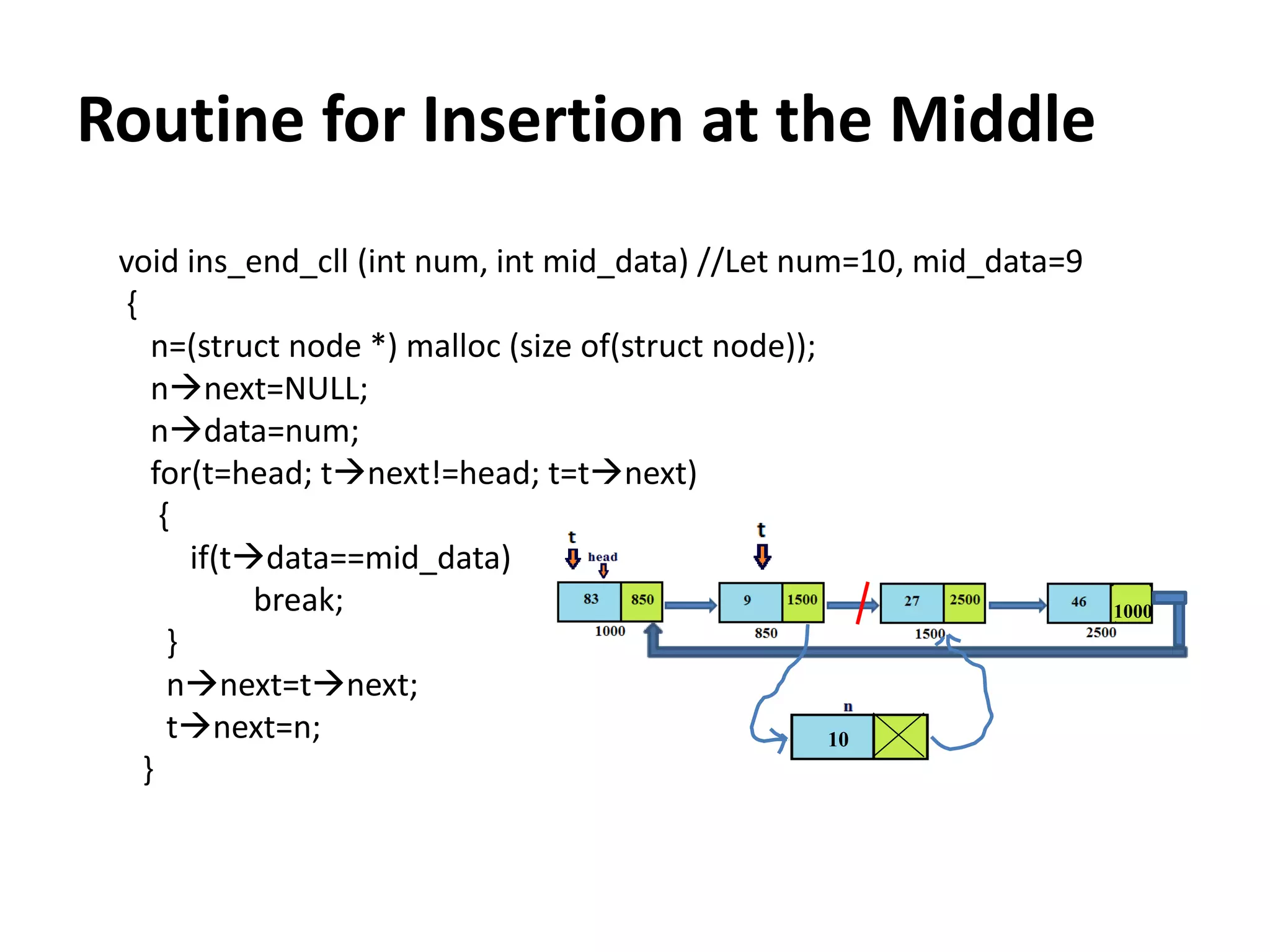
Routine for Insertion at the Middle
void ins_end_cll (int num, int mid_data) //Let num=10, mid_data=9
{
n=(struct node *) malloc (size of(struct node));
nnext=NULL;
ndata=num;
for(t=head; tnext!=head; t=tnext)
{
if(tdata==mid_data)
break;
}
nnext=tnext;
tnext=n;
}
10
1000
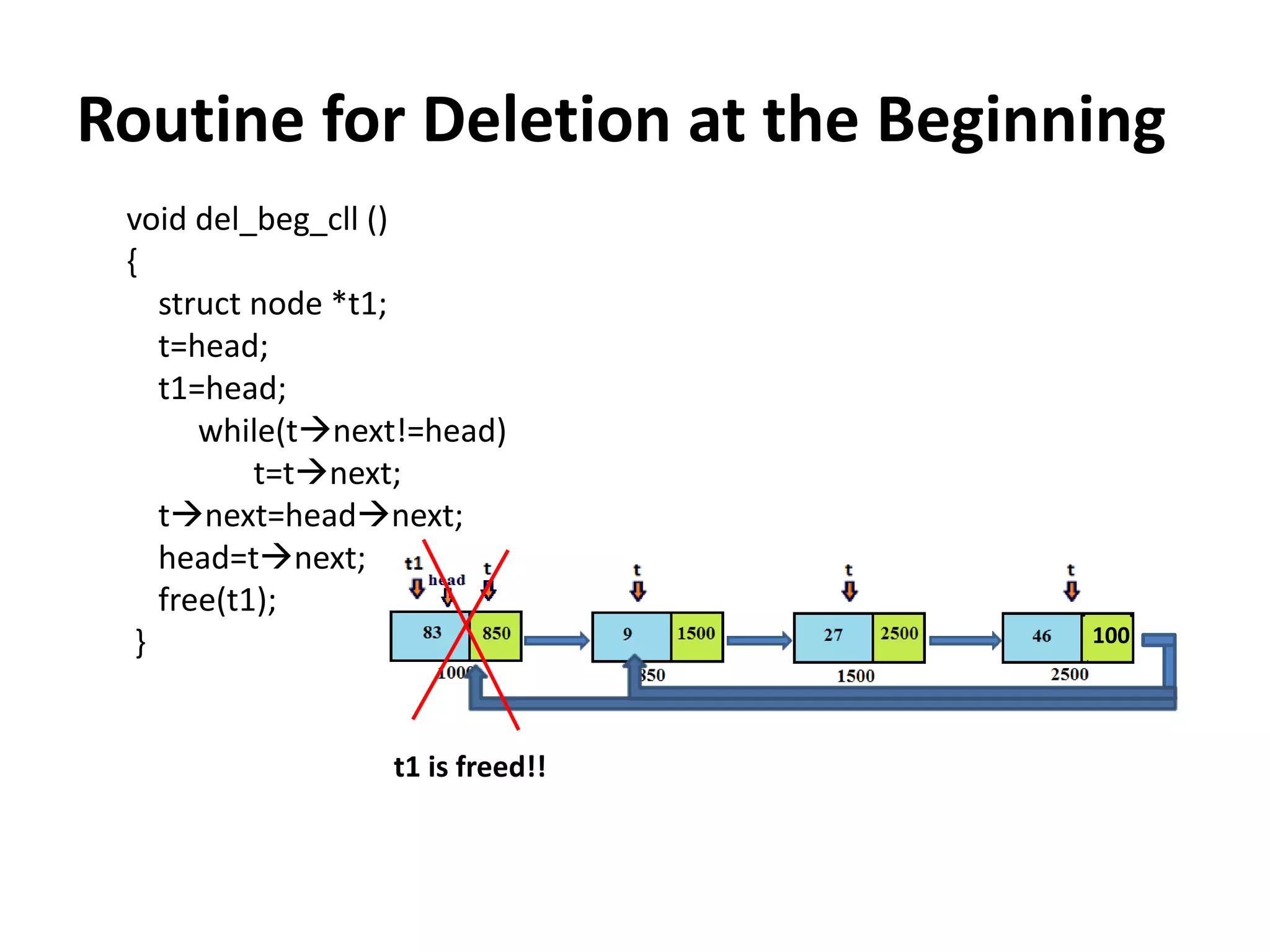
Routine for Deletion at the Beginning
void del_beg_cll ()
{
struct node *t1;
t=head;
t1=head;
while(tnext!=head)
t=tnext;
tnext=headnext;
head=tnext;
free(t1);
} 100
t1 is freed!!
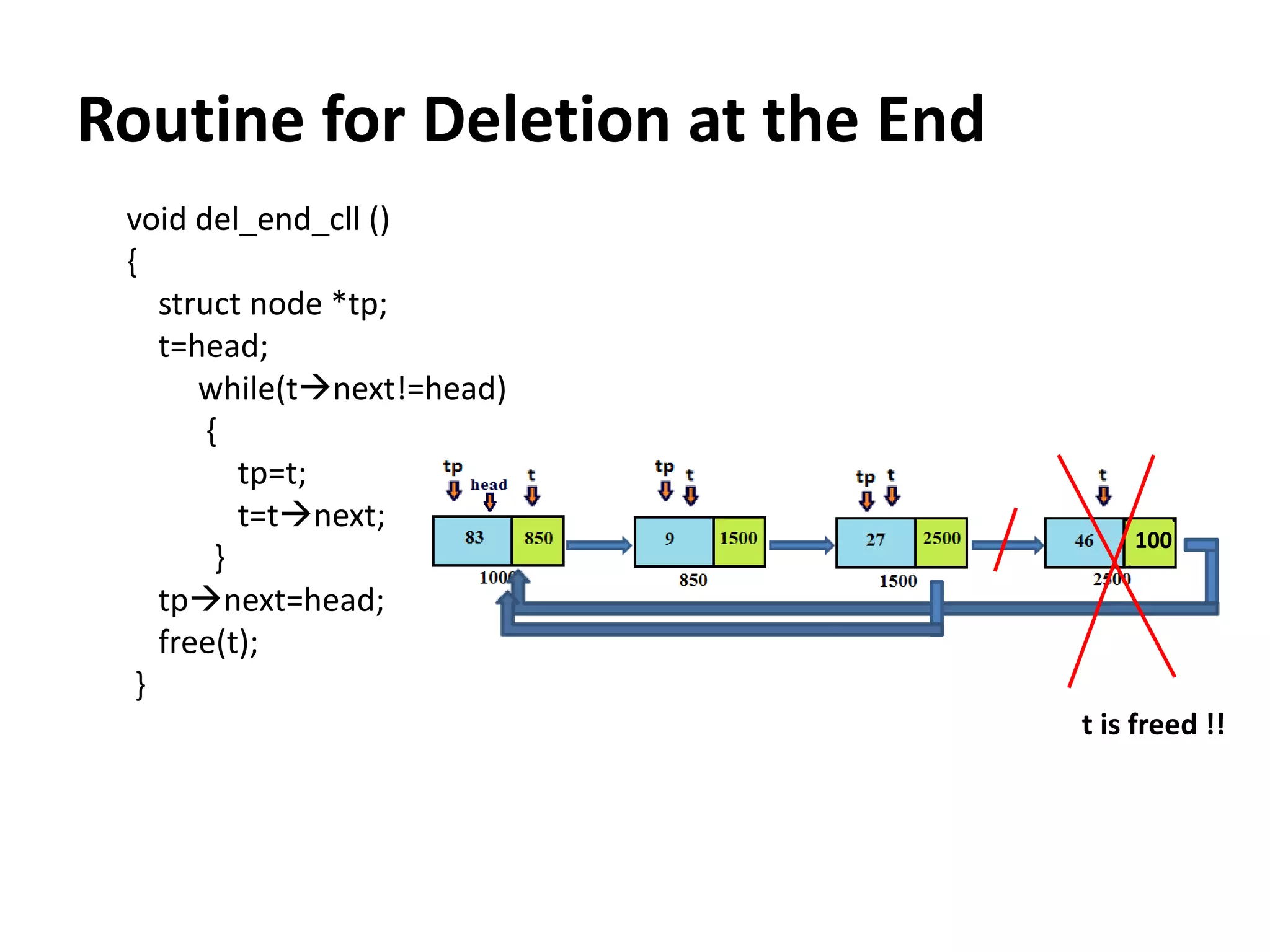
Routine for Deletion at the End
void del_end_cll ()
{
struct node *tp;
t=head;
while(tnext!=head)
{
tp=t;
t=tnext;
}
tpnext=head;
free(t);
}
100
t is freed !!
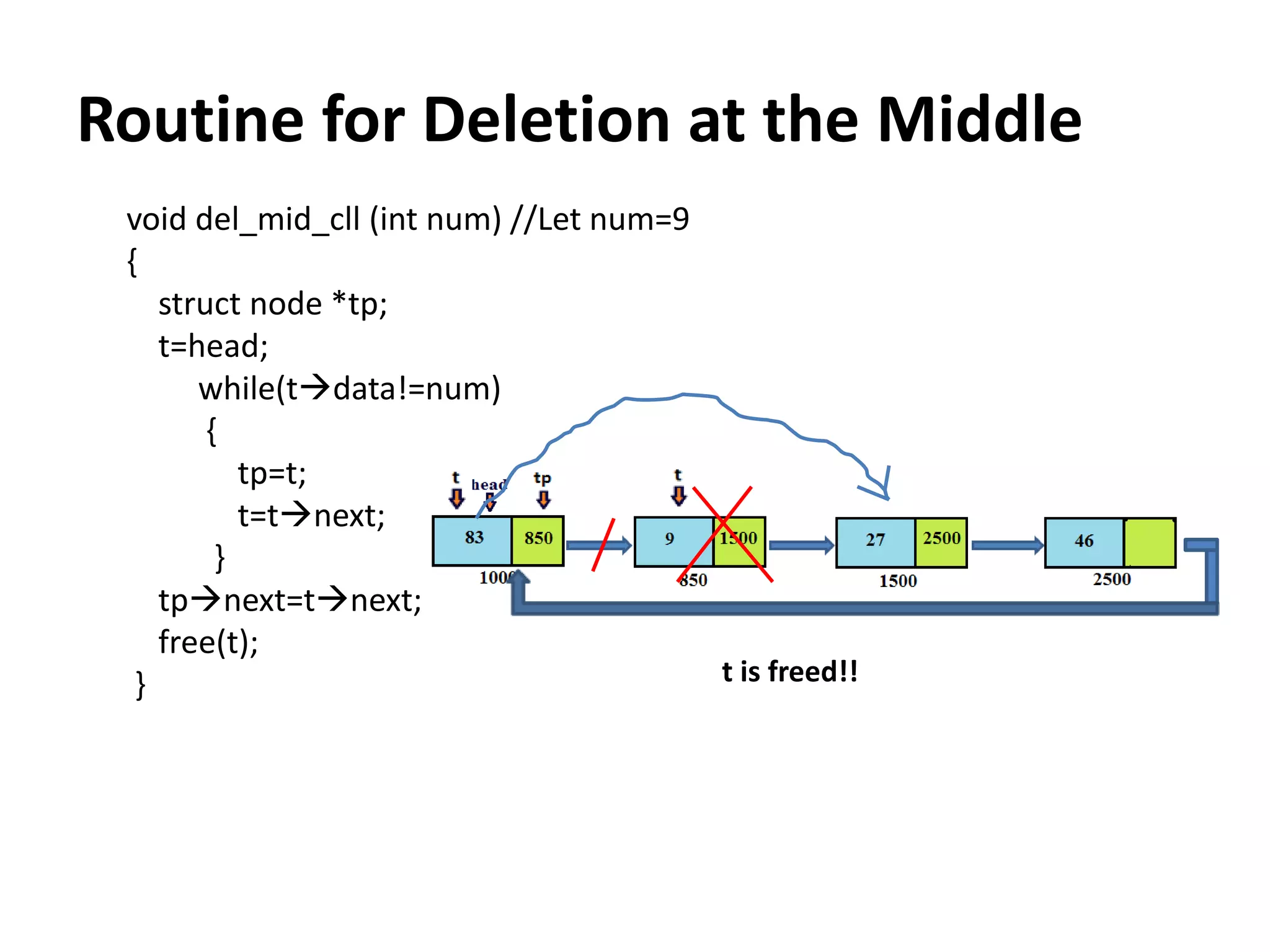
Routine for Deletion at the Middle
void del_mid_cll (int num) //Let num=9
{
struct node *tp;
t=head;
while(tdata!=num)
{
tp=t;
t=tnext;
}
tpnext=tnext;
free(t);
} t is freed!!
Routine for Search
struct node* search_cll (int num) //Let num=9
{
t=head;
while(tnext!=head && tdata!=num)
{
t=tnext;
}
return t;
}
Advantage:
• Comparing to SLL, moving to any node from a node is
possible
Disadvantages:
• Reversing a list is complex compared to linear linked
list
• If proper care is not taken in managing the pointers,
it leads to infinite loop
• Moving to previous node is difficult, as it is needed
to complete an entire circle
CLL – Advantages & Disadvantages
Applications of List
Lists can be used to
• Sort elements
• Implement stack and queue
• Represent graph (adjacent list representation)
• Implement hash table
• Implement multiprocessing of applications
• Manipulate polynomial equations
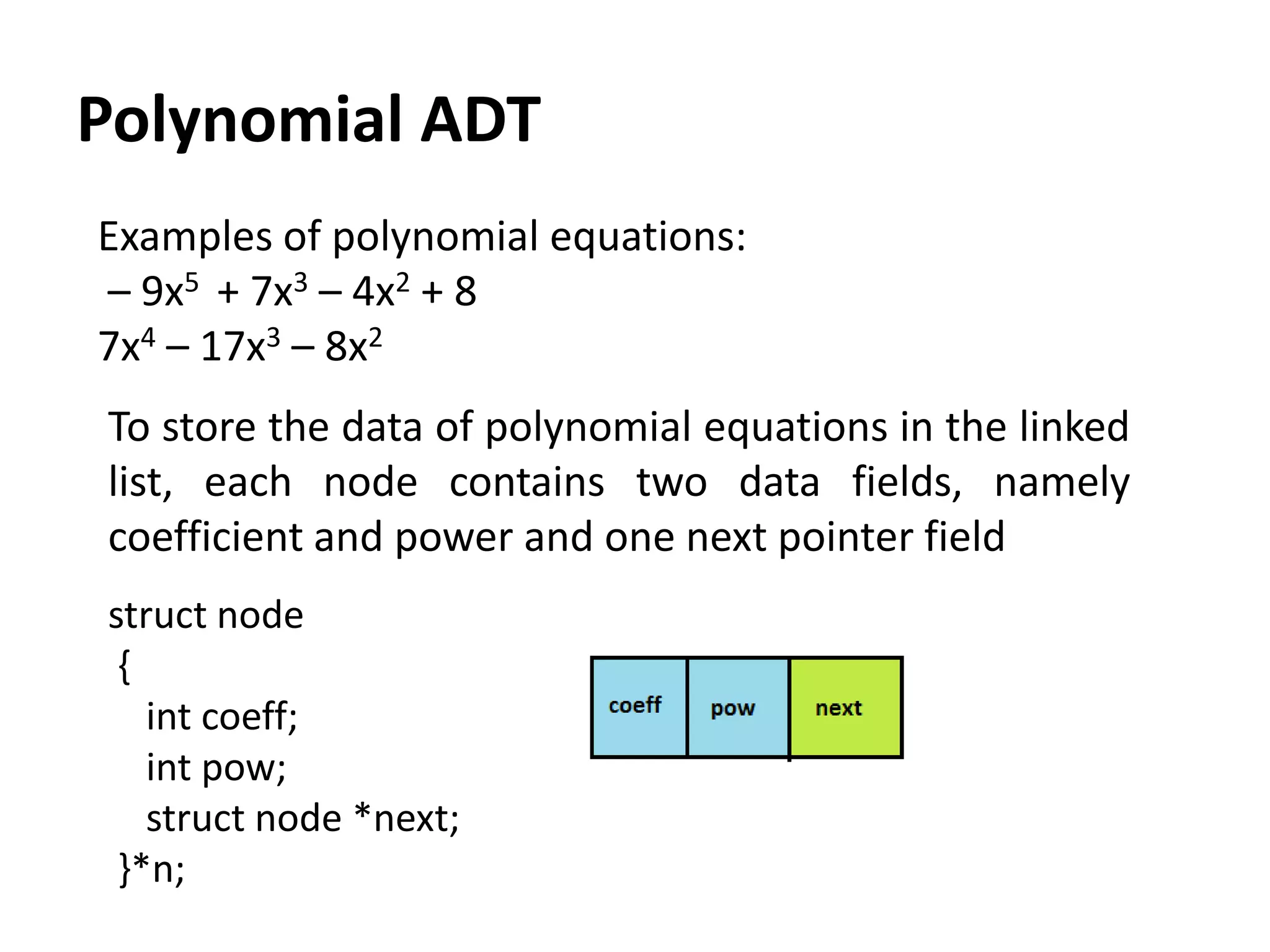
Polynomial ADT
struct node
{
int coeff;
int pow;
struct node *next;
}*n;
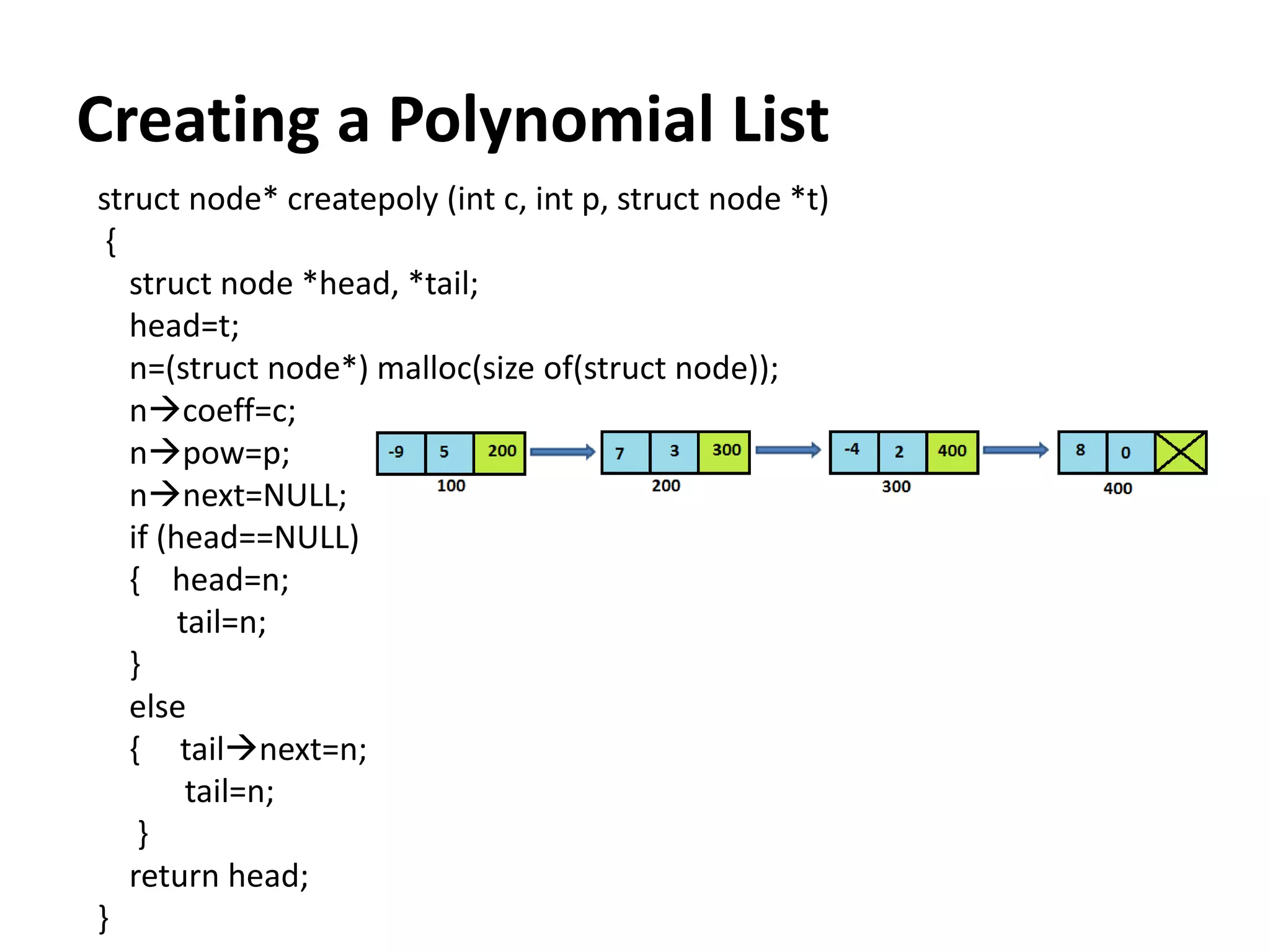
Examples of polynomial equations:
– 9x5 + 7x3 – 4x2 + 8
7x4 – 17x3 – 8x2
To store the data of polynomial equations in the linked
list, each node contains two data fields, namely
coefficient and power and one next pointer field
Creating a Polynomial List
struct node* createpoly (int c, int p, struct node *t)
{
struct node *head, *tail;
head=t;
n=(struct node*) malloc(size of(struct node));
ncoeff=c;
npow=p;
nnext=NULL;
if (head==NULL)
{ head=n;
tail=n;
}
else
{ tailnext=n;
tail=n;
}
return head;
}
Polynomial Addition
Void addpoly (struct node *poly1, struct node *poly2, struct node *poly)
{
while(ploy1!=NULL && poly2!=NULL)
{
if(poly1pow>poly2pow)
{
polypow=ploy1pow;
polycoeff=poly1coeff;
ploy1=poly1next;
}
else if(poly1pow < poly2pow)
{
polypow=ploy2pow;
polycoeff=poly2coeff;
ploy2=poly2next;
}
else
{ polypow=ploy1pow;
polycoeff=poly1coeff + poly2coeff;
ploy1=poly1next;
ploy2=poly2next;
}
}
while(poly1 != NULL || poly2 != NULL)
{ if (poly1 != NULL)
{ polypow=ploy1pow;
polycoeff=poly1coeff;
ploy1=poly1next;
}
if (poly2 != NULL)
{ polypow=ploy2pow;
polycoeff=poly2coeff;
ploy2=poly2next;
}
}
}
Polynomial Addition Contd.,
Queries ??
Thank You!!!

Unit 1 LINEAR DATA STRUCTURES

  • 1.
    VELAMMAL ENGINEERING COLLEGE AnAutonomous Institution, Affiliated to Anna University Chennai, & Approved by AICTE Delhi Department of Computer Science and Engineering UNIT 1 - LINEARDATASTRUCTURES– LIST Dr.M.Usha, AP
  • 2.
    List ADT Mrs. G.Sumathi Assistant Professor Velammal Engineering College Chennai
  • 3.
    Agenda • Introduction toData Structures • List ADT • Issues in Array Implementation • Linked List Representation • Types • Applications of Linked List
  • 4.
    Introduction to DataStructures Data Values or set of values of different data types such as int, float, etc., Way of organizing and storing information so that it is easy to use Structure Data + Structure Way of organizing and storing data on a computer so that it can be used easily and effectively
  • 5.
    Introduction to DataStructures Definition: Data Structure is a way of organizing, storing and retrieving data and their relationships with each other
  • 6.
    Classification of DataStructures Data Structure Primitive int char float boolean Non - Primitive Linear Array Linked List Stack Queue Non - Linear Tree Graph
  • 7.
    • It isa type for objects whose behavior is defined by set of values and set of operations from user point of view • Mentions only what operations are to be performed but not how they will be implemented • Thus, ADT is the specification of a data type within some language, independent of implementation ADT – Abstract Data Type
  • 8.
    Examples – ListADT, Stack ADT, Queue ADT, etc., Some operations on these ADT are: List: • insert(x) • delete(x) • find(x) Stack: • Push (x) • Pop() • isFull() • isEmpty() Queue: • enqueue() • dequeue() • isFull() • isEmpty() ADT – Abstract Data Type
  • 9.
    • List ADTcan be represented in two ways – Array – Linked List List ADT
  • 10.
    • Collection ofelements of same data type • Elements in an array is stored in adjacent memory location Syntax: • datatype arrayname [size] • Eg: int a [50]; Operations: • insertion() • deletion() • search() Array ADT
  • 11.
    • Fixed size:Resizing is expensive • Requires continuous memory for allocation – Difficult when array size is larger • Insertions and deletions are inefficient – Elements are usually shifted • Wastage of memory space unless the array is full Issues in Array
  • 12.
    • Linked listis a linear data structure • Made up of chain of nodes • Each node contains a data and a pointer to the next node in the chain • Last node of the list is pointed to NULL Linked List ADT
  • 13.
    • Each nodecontains two fields: – Data field: Contains data element to be stored – Pointer field: Contains the address of next node Representation of Node in Linked List Declaration of a node: struct node { int data; struct node *next; };
  • 14.
    • Singly linkedlist • Doubly linked list • Circular linked list Types of Linked List
  • 15.
    • Type oflinked list • Each node contains only one pointer field that contains the address of the next node in the list Singly Linked List (SLL)
  • 16.
    Statement to createa node: n= (struct node*) malloc(sizeof(sturct node)) Creating a Node struct node { int data; struct node *next; } *n;
  • 17.
    Major operations are: •Insertion – At the beginning – At the middle – At the end • Deletion – At the beginning – At the middle – At the end • Search Operations on Singly Linked List Global declaration of a Node: struct node { int data; struct node *next; } *head, *tail, *n, *t;
  • 18.
    Routine for Insertionat the Beginning void ins_beg (int num) //Let num=10 { n=(struct node *) malloc (size of(struct node)); nnext=NULL; ndata=num; if (head==NULL) //case 1 { head=n; tail=n; } else //case 2 { nnext=head; head=n; } } 10
  • 19.
    Routine for Insertionat the End void ins_end (int num) //Let num=10 { n=(struct node *) malloc (size of(struct node)); nnext=NULL; ndata=num; if (head==NULL) //case 1 { head=n; tail=n; } else //case 2 { tailnext=n; tail=n; } } 10
  • 20.
    Routine for Insertionat the Middle void ins_end (int num, int mid_data) //Let num=10, mid_data=9 { n=(struct node *) malloc (size of(struct node)); nnext=NULL; ndata=num; for(t=head; t!=NULL; t=tnext) { if(tdata==mid_data) break; } nnext=tnext; tnext=n; } 10 83==9 ? NO 9==9 ? Yes 10 300 300 1500 300
  • 21.
    Routine for Deletionat the Beginning void del_beg () { t=head; head=tnext; free(t); }
  • 22.
    Routine for Deletionat the End void del_end () { struct node *tp; t=head; while(tnext!=NULL) { tp=t; t=tnext; } tail=tp; tailnext=NULL; free(t); }
  • 23.
    Routine for Deletionat the Middle void del_mid (int num) //Let num=70 { struct node *tp; t=head; while(tdata!=num) { tp=t; t=tnext; } tpnext=tnext; free(t); } 2800 83!=70? Yes 9!=70? Yes 70!=70? No 1500
  • 24.
    Routine for Searchan Element struct node* search (int num) //Let num=9 { t=head; while(t!=NULL && tdata!=num) { t=tnext; } return t; } t!=NULL? Yes 83!=9? Yes t!=NULL? Yes 9!=9? No Element Found!!
  • 25.
    Linked List –Advantages & Disadvantages Advantages: • No wastage of memory – Memory allocated and deallocated as per requirement • Efficient insertion and deletion operations Disadvantages: • Occupies more space than array to store a data – Due to the need of a pointer to the next node • Does not support random or direct access
  • 26.
    Doubly Linked List(DLL) • Type of linked list • Each node contains two pointer fields that contains the address of the next node and that of previous node in the list
  • 27.
    • Each nodecontains three fields: – Data: Contains data element to be stored – next: Contains the address of next node – prev: Contains address of previous node Representation of Node in DLL Declaration of a node: struct node { int data; struct node *next, *prev; }; A Node in DLL
  • 28.
    Major operations are: •Insertion – At the beginning – At the middle – At the end • Deletion – At the beginning – At the middle – At the end • Search Operations on Doubly Linked List Global declaration of a Node: struct node { int data; struct node *next, prev; } *head, *tail, *n, *t;
  • 29.
    Routine for Insertionat the Beginning void ins_beg_dll (int num) //Let num=70 { n=(struct node *) malloc(size of(struct node)); nnext=NULL; nprev=NULL; ndata=num; if(head==NULL) //case 1 { head=n; tail=n; } else //case 2 { nnext=head; headprev=n; head=n; } } 70 500 1000
  • 30.
    void ins_end_dll (intnum) //Let num=10 { n=(struct node *) malloc (size of(struct node)); nnext=NULL; nprev=NULL; ndata=num; if (head==NULL) //case 1 { head=n; tail=n; } else //case 2 { tailnext=n; nprev=tail; tail=n; } } Routine for Insertion at the End
  • 31.
    void ins_end_dll (intnum, int mid_data) //Let num=10, mid_data=9 { n=(struct node *) malloc (size of(struct node)); nnext=NULL; nprev=NULL; ndata=num; for(t=head; t!=NULL; t=tnext) { if(tdata==mid_data) break; } nnext=tnext; nprev=t; tnextprev=n; tnext=n; } Routine for Insertion at the Middle
  • 32.
  • 33.
    Routine for Deletionat the End void del_end_dll () { t=head; while(tnext!=NULL) { t=tnext; } tail=tailprev;//tail=tprev; tailnext=NULL; free(t); }
  • 34.
    Routine for Deletionat the Middle void del_mid_dll (int num) //Let num=9 { t=head; while(tdata!=num) { tp=t; t=tnext; } tprevnext=tnext; tnextprev=tprev; free(t); }
  • 35.
    Routine for Searchan Element struct node* search_dll (int num) //Let num=9 { t=head; while(t!=NULL && tdata!=num) { t=tnext; } return t; } Element Found!! t is returned
  • 36.
    Advantages: • Can traversein both directions • Operations in the middle of the list can be done efficiently – No need of extra pointer (tp) to track the previous node • Reversing the list is easy Disadvantage: • Space required to store a data is even more higher than SLL – Due to the use of two pointers DLL – Advantages & Disadvantages
  • 37.
    • Type oflinked list • The last node will be pointing to the first node • It can be either singly or doubly linked Circular Linked List (CLL) Global declaration of a node: struct node { int data; struct node *next, *prev; }*head,*n,*t; 100
  • 38.
    Routine for Insertionat the Beginning void ins_beg_cll (int num) //Let num=10 { n=(struct node *) malloc (size of(struct node)); nnext=NULL; ndata=num; if (head==NULL) //case 1 { head=n; nnext=head; } else //case 2 { t=head; while(tnext!=head) t=tnext; tnext=n; nnext=head; head=n; } } 10 10 100
  • 39.
    Routine for Insertionat the End void ins_end_cll (int num) //Let num=10 { n=(struct node *) malloc (size of(struct node)); nnext=NULL; ndata=num; t=head; while(tnext!=head) t=tnext; tnext=n; nnext=head; } 10 1000
  • 40.
    Routine for Insertionat the Middle void ins_end_cll (int num, int mid_data) //Let num=10, mid_data=9 { n=(struct node *) malloc (size of(struct node)); nnext=NULL; ndata=num; for(t=head; tnext!=head; t=tnext) { if(tdata==mid_data) break; } nnext=tnext; tnext=n; } 10 1000
  • 41.
    Routine for Deletionat the Beginning void del_beg_cll () { struct node *t1; t=head; t1=head; while(tnext!=head) t=tnext; tnext=headnext; head=tnext; free(t1); } 100 t1 is freed!!
  • 42.
    Routine for Deletionat the End void del_end_cll () { struct node *tp; t=head; while(tnext!=head) { tp=t; t=tnext; } tpnext=head; free(t); } 100 t is freed !!
  • 43.
    Routine for Deletionat the Middle void del_mid_cll (int num) //Let num=9 { struct node *tp; t=head; while(tdata!=num) { tp=t; t=tnext; } tpnext=tnext; free(t); } t is freed!!
  • 44.
    Routine for Search structnode* search_cll (int num) //Let num=9 { t=head; while(tnext!=head && tdata!=num) { t=tnext; } return t; }
  • 45.
    Advantage: • Comparing toSLL, moving to any node from a node is possible Disadvantages: • Reversing a list is complex compared to linear linked list • If proper care is not taken in managing the pointers, it leads to infinite loop • Moving to previous node is difficult, as it is needed to complete an entire circle CLL – Advantages & Disadvantages
  • 46.
    Applications of List Listscan be used to • Sort elements • Implement stack and queue • Represent graph (adjacent list representation) • Implement hash table • Implement multiprocessing of applications • Manipulate polynomial equations
  • 47.
    Polynomial ADT struct node { intcoeff; int pow; struct node *next; }*n; Examples of polynomial equations: – 9x5 + 7x3 – 4x2 + 8 7x4 – 17x3 – 8x2 To store the data of polynomial equations in the linked list, each node contains two data fields, namely coefficient and power and one next pointer field
  • 48.
    Creating a PolynomialList struct node* createpoly (int c, int p, struct node *t) { struct node *head, *tail; head=t; n=(struct node*) malloc(size of(struct node)); ncoeff=c; npow=p; nnext=NULL; if (head==NULL) { head=n; tail=n; } else { tailnext=n; tail=n; } return head; }
  • 49.
    Polynomial Addition Void addpoly(struct node *poly1, struct node *poly2, struct node *poly) { while(ploy1!=NULL && poly2!=NULL) { if(poly1pow>poly2pow) { polypow=ploy1pow; polycoeff=poly1coeff; ploy1=poly1next; } else if(poly1pow < poly2pow) { polypow=ploy2pow; polycoeff=poly2coeff; ploy2=poly2next; }
  • 50.
    else { polypow=ploy1pow; polycoeff=poly1coeff +poly2coeff; ploy1=poly1next; ploy2=poly2next; } } while(poly1 != NULL || poly2 != NULL) { if (poly1 != NULL) { polypow=ploy1pow; polycoeff=poly1coeff; ploy1=poly1next; } if (poly2 != NULL) { polypow=ploy2pow; polycoeff=poly2coeff; ploy2=poly2next; } } } Polynomial Addition Contd.,
  • 51.
  • 52.

Editor's Notes

  • #25 If element not found, t=NULL, so NULL will be returned
  • #40 In CLL, ins at begin and ins at end are almost same with a difference that n will not be assigned as head in ins at end
  • #47 Multiprocessing of applications – all the applications will be stored in nodes of the list. OS has a fixed time for running each application