Introduction To Data Structures
And
List ADT
7/30/2024
1
2
Agenda
• Introduction to Data Structures
• List ADT
• Issues in Array Implementation
• Linked List Representation
• Types
• Applications of Linked List
7/30/2024
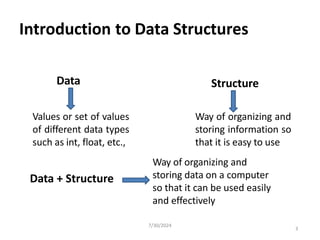
Introduction to Data Structures
Structure
Way of organizing and
storing information so
that it is easy to use
Way of organizing and
storing data on a computer
so that it can be used easily
and effectively
Data
Values or set of values
of different data types
such as int, float, etc.,
Data + Structure
7/30/2024
3
Introduction to Data Structures
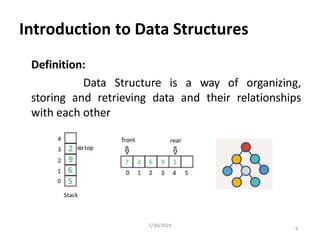
Definition:
Data Structure is a way of organizing,
storing and retrieving data and their relationships
with each other
7/30/2024
4
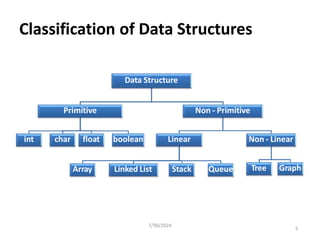
Classification of Data Structures
Data Structure
Primitive
int char float boolean
Non - Primitive
Linear
Array Linked List Stack Queue
Non - Linear
Tree Graph
7/30/2024
5
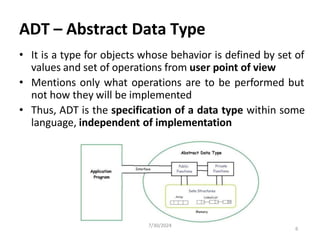
• It is a type for objects whose behavior is defined by set of
values and set of operations from user point of view
• Mentions only what operations are to be performed but
not how they will be implemented
• Thus, ADT is the specification of a data type within some
language, independent of implementation
ADT – Abstract Data Type
7/30/2024
6
7/30/2024
7
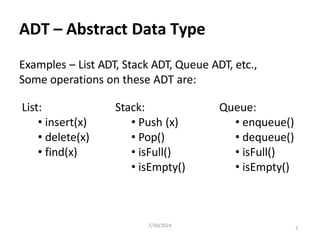
Examples – List ADT, Stack ADT, Queue ADT, etc.,
Some operations on these ADT are:
List:
• insert(x)
• delete(x)
• find(x)
Stack:
• Push (x)
• Pop()
• isFull()
• isEmpty()
Queue:
• enqueue()
• dequeue()
• isFull()
• isEmpty()
ADT – Abstract Data Type
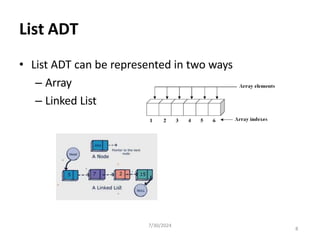
• List ADT can be represented in two ways
– Array
– Linked List
List ADT
7/30/2024
8
7/30/2024
9
• Collection of elements of same data type
• Elements in an array is stored in adjacent memory
location
Syntax:
• datatype arrayname [size]
• Eg: int a [50];
Operations:
• insertion()
• deletion()
• search()
Array ADT
7/30/2024
10
• Fixed size: Resizing is expensive
• Requires continuous memory for allocation
– Difficult when array size is larger
• Insertions and deletions are inefficient
– Elements are usually shifted
• Wastage of memory space unless the array is
full
Issues in Array
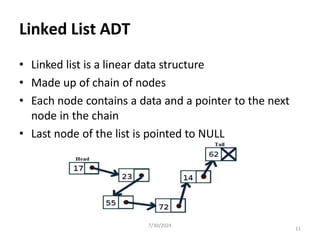
• Linked list is a linear data structure
• Made up of chain of nodes
• Each node contains a data and a pointer to the next
node in the chain
• Last node of the list is pointed to NULL
Linked List ADT
7/30/2024
11
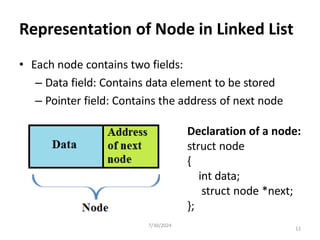
Representation of Node in Linked List
• Each node contains two fields:
– Data field: Contains data element to be stored
– Pointer field: Contains the address of next node
Declaration of a node:
struct node
{
int data;
struct node *next;
};
7/30/2024
12
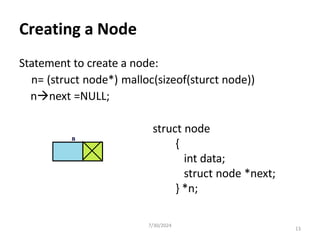
Statement to create a node:
n= (struct node*) malloc(sizeof(sturct node))
nnext =NULL;
struct node
{
int data;
struct node *next;
} *n;
Creating a Node
7/30/2024
13
7/30/2024
14
• Singly linked list
• Doubly linked list
• Circular linked list
Types of Linked List
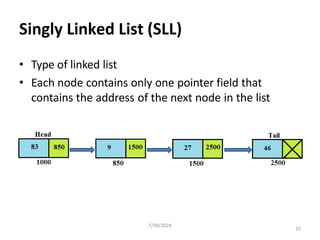
• Type of linked list
• Each node contains only one pointer field that
contains the address of the next node in the list
Singly Linked List (SLL)
7/30/2024
15
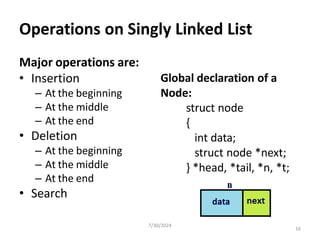
Major operations are:
• Insertion
– At the beginning
– At the middle
– At the end
• Deletion
– At the beginning
– At the middle
– At the end
• Search
Operations on Singly Linked List
Global declaration of a
Node:
struct node
{
int data;
struct node *next;
} *head, *tail, *n, *t;
7/30/2024
16
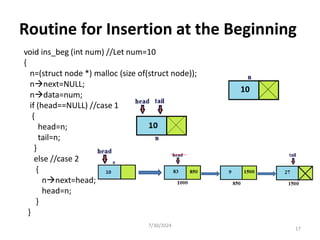
Routine for Insertion at the Beginning
void ins_beg (int num) //Let num=10
{
n=(struct node *) malloc (size of(struct node));
nnext=NULL;
ndata=num;
if (head==NULL) //case 1
{
head=n;
tail=n;
}
else //case 2
{
nnext=head;
head=n;
}
}
10
7/30/2024
17
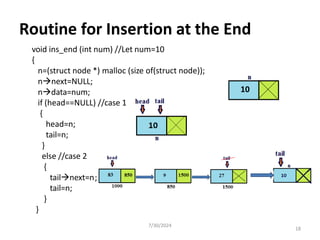
Routine for Insertion at the End
void ins_end (int num) //Let num=10
{
n=(struct node *) malloc (size of(struct node));
nnext=NULL;
;
ndata=num;
if (head==NULL) //case 1
{
head=n;
tail=n;
}
else //case 2
{
tailnext=n
tail=n;
}
}
10
7/30/2024
18
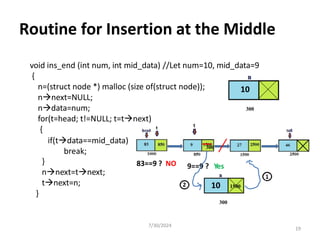
Routine for Insertion at the Middle
void ins_end (int num, int mid_data) //Let num=10, mid_data=9
{
n=(struct node *) malloc (size of(struct node));
nnext=NULL;
ndata=num;
for(t=head; t!=NULL; t=tnext)
{
if(tdata==mid_data)
break;
}
nnext=tnext;
tnext=n;
}
10
83==9 ? NO 9==9 ? Yes
10
300
7/30/2024
19
300
1500
300
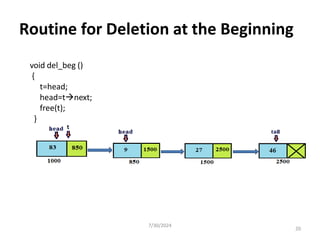
Routine for Deletion at the Beginning
void del_beg ()
{
t=head;
head=tnext;
free(t);
}
7/30/2024
20
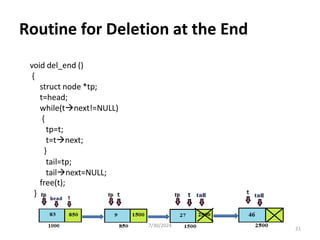
Routine for Deletion at the End
void del_end ()
{
struct node *tp;
t=head;
while(tnext!=NULL)
{
tp=t;
t=tnext;
}
tail=tp;
tailnext=NULL;
free(t);
}
7/30/2024
21
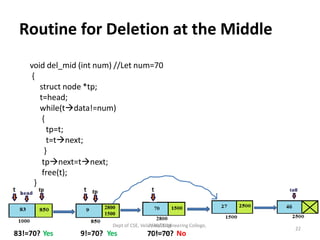
Routine for Deletion at the Middle
void del_mid (int num) //Let num=70
{
struct node *tp;
t=head;
while(tdata!=num)
{
tp=t;
t=tnext;
}
tpnext=tnext;
free(t);
}
2800
1500
Dept of CSE, Velammal Engineering College,
22
7C
0h
!e
=
n7
na
0
i ?
83!=70? Yes 9!=70? Yes No
7/30/2024
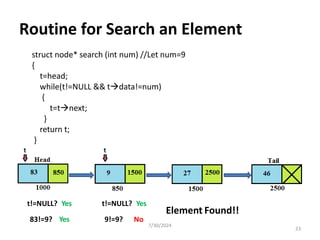
Routine for Search an Element
struct node* search (int num) //Let num=9
{
t=head;
while(t!=NULL && tdata!=num)
{
t=tnext;
}
return t;
}
t!=NULL? Yes
83!=9? Yes
7/30/2024
23
t!=NULL? Yes
9!=9? No
Element Found!!
7/30/2024
24
Linked List – Advantages & Disadvantages
Advantages:
• No wastage of memory
– Memory allocated and deallocated as per
requirement
• Efficient insertion and deletion operations
Disadvantages:
• Occupies more space than array to store a data
– Due to the need of a pointer to the next node
• Does not support random or direct access
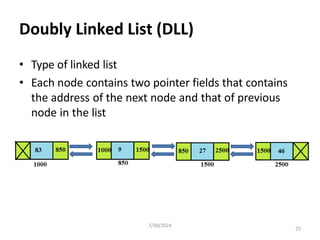
Doubly Linked List (DLL)
• Type of linked list
• Each node contains two pointer fields that contains
the address of the next node and that of previous
node in the list
7/30/2024
25
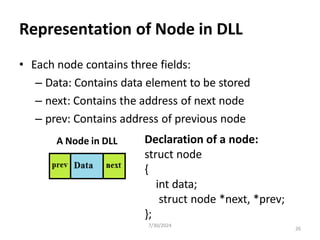
• Each node contains three fields:
– Data: Contains data element to be stored
– next: Contains the address of next node
– prev: Contains address of previous node
Representation of Node in DLL
Declaration of a node:
struct node
{
int data;
struct node *next, *prev;
};
A Node in DLL
7/30/2024
26
Major operations are:
• Insertion
– At the beginning
– At the middle
– At the end
• Deletion
– At the beginning
– At the middle
– At the end
• Search
Operations on Doubly Linked List
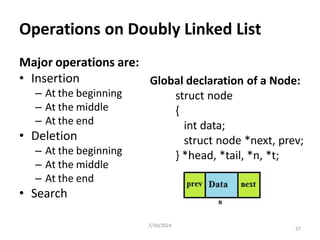
Global declaration of a Node:
struct node
{
int data;
struct node *next, prev;
} *head, *tail, *n, *t;
7/30/2024
27
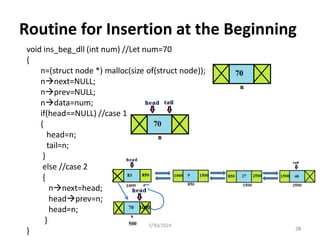
Routine for Insertion at the Beginning
void ins_beg_dll (int num) //Let num=70
{
n=(struct node *) malloc(size of(struct node));
nnext=NULL;
nprev=NULL;
ndata=num;
if(head==NULL) //case 1
{
head=n;
tail=n;
}
else //case 2
{
nnext=head;
headprev=n;
head=n;
70
1000
} 500 7/30/2024
29
} 28
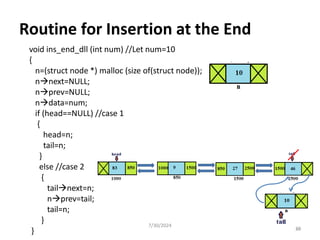
void ins_end_dll (int num) //Let num=10
{
n=(struct node *) malloc (size of(struct node));
nnext=NULL;
nprev=NULL;
ndata=num;
if (head==NULL) //case 1
{
head=n;
tail=n;
}
else //case 2
{
tailnext=n;
nprev=tail;
tail=n;
}
Routine for Insertion at the End
7/30/2024
30
} 29
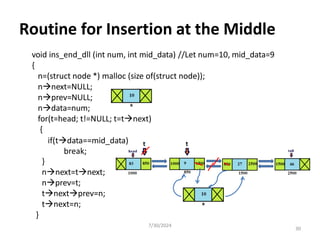
void ins_end_dll (int num, int mid_data) //Let num=10, mid_data=9
{
n=(struct node *) malloc (size of(struct node));
nnext=NULL;
nprev=NULL;
ndata=num;
for(t=head; t!=NULL; t=tnext)
{
if(tdata==mid_data)
break;
}
nnext=tnext;
nprev=t;
tnextprev=n;
tnext=n;
}
Routine for Insertion at the Middle
7/30/2024
30
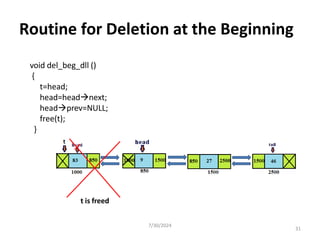
void del_beg_dll ()
{
t=head;
head=headnext;
headprev=NULL;
free(t);
}
Routine for Deletion at the Beginning
t is freed
7/30/2024
31
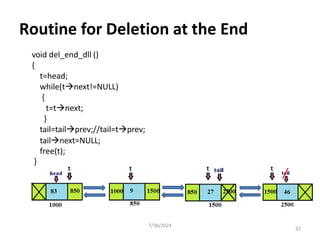
Routine for Deletion at the End
void del_end_dll ()
{
t=head;
while(tnext!=NULL)
{
t=tnext;
}
tail=tailprev;//tail=tprev;
tailnext=NULL;
free(t);
}
7/30/2024
32
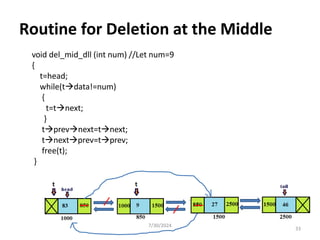
Routine for Deletion at the Middle
void del_mid_dll (int num) //Let num=9
{
t=head;
while(tdata!=num)
{
t=tnext;
}
tprevnext=tnext;
tnextprev=tprev;
free(t);
}
7/30/2024
33
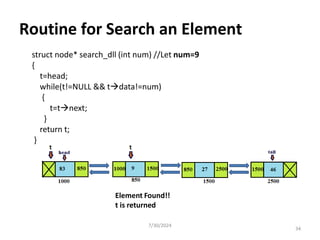
Routine for Search an Element
struct node* search_dll (int num) //Let num=9
{
t=head;
while(t!=NULL && tdata!=num)
{
t=tnext;
}
return t;
}
Element Found!!
t is returned
7/30/2024
34
Due to the use of two pointers
Dept of CSE, Velammal Engineering College,
35
Chennai
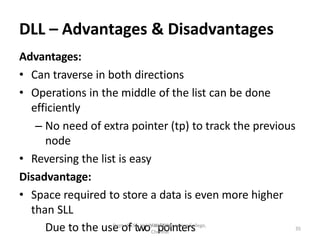
Advantages:
• Can traverse in both directions
• Operations in the middle of the list can be done
efficiently
– No need of extra pointer (tp) to track the previous
node
• Reversing the list is easy
Disadvantage:
• Space required to store a data is even more higher
than SLL
DLL – Advantages & Disadvantages
7/30/2024
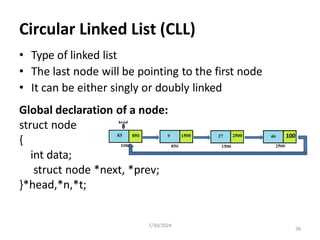
• Type of linked list
• The last node will be pointing to the first node
• It can be either singly or doubly linked
Circular Linked List (CLL)
Global declaration of a node:
struct node
{
int data;
struct node *next, *prev;
}*head,*n,*t;
100
7/30/2024
36
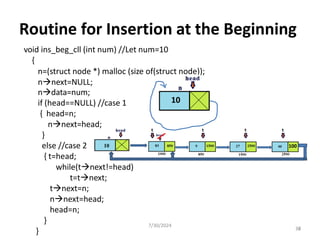
Routine for Insertion at the Beginning
void ins_beg_cll (int num) //Let num=10
{
n=(struct node *) malloc (size of(struct node));
nnext=NULL;
ndata=num;
if (head==NULL) //case 1
{ head=n;
nnext=head;
}
else //case 2
{ t=head;
while(tnext!=head)
t=tnext;
tnext=n;
nnext=head;
head=n;
}
10
10 100
7/30/2024
38
} 37
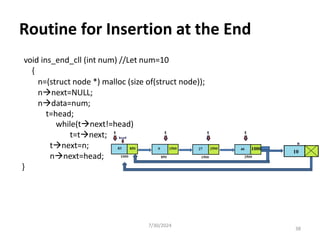
Routine for Insertion at the End
void ins_end_cll (int num) //Let num=10
{
n=(struct node *) malloc (size of(struct node));
nnext=NULL;
ndata=num;
t=head;
while(tnext!=head)
t=tnext;
tnext=n;
nnext=head;
}
10
1000
7/30/2024
38
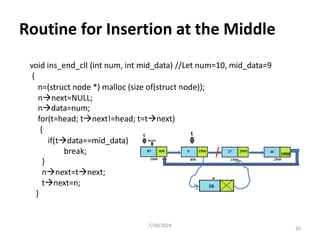
Routine for Insertion at the Middle
void ins_end_cll (int num, int mid_data) //Let num=10, mid_data=9
{
n=(struct node *) malloc (size of(struct node));
nnext=NULL;
ndata=num;
for(t=head; tnext!=head; t=tnext)
{
if(tdata==mid_data)
break;
}
nnext=tnext;
tnext=n;
}
10
1000
7/30/2024
39
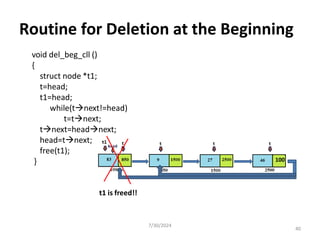
Routine for Deletion at the Beginning
void del_beg_cll ()
{
struct node *t1;
t=head;
t1=head;
while(tnext!=head)
t=tnext;
tnext=headnext;
head=tnext;
free(t1);
} 100
t1 is freed!!
7/30/2024
40
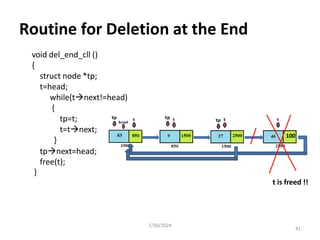
Routine for Deletion at the End
void del_end_cll ()
{
struct node *tp;
t=head;
while(tnext!=head)
{
tp=t;
t=tnext;
}
tpnext=head;
free(t);
}
100
t is freed !!
7/30/2024
41
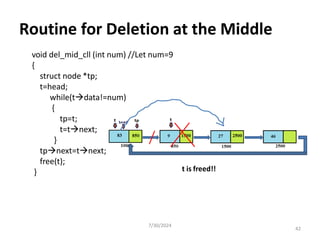
Routine for Deletion at the Middle
void del_mid_cll (int num) //Let num=9
{
struct node *tp;
t=head;
while(tdata!=num)
{
tp=t;
t=tnext;
}
tpnext=tnext;
free(t);
} t is freed!!
7/30/2024
42
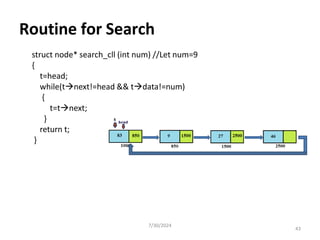
Routine for Search
struct node* search_cll (int num) //Let num=9
{
t=head;
while(tnext!=head && tdata!=num)
{
t=tnext;
}
return t;
}
7/30/2024
43
7/30/2024
44
Advantage:
• Comparing to SLL, moving to any node from a node is
possible
Disadvantages:
• Reversing a list is complex compared to linear linked
list
• If proper care is not taken in managing the pointers,
it leads to infinite loop
• Moving to previous node is difficult, as it is needed
to complete an entire circle
CLL – Advantages & Disadvantages
7/30/2024
45
Applications of List
Lists can be used to
• Sort elements
• Implement stack and queue
• Represent graph (adjacent list representation)
• Implement hash table
• Implement multiprocessing of applications
• Manipulate polynomial equations
Polynomial ADT
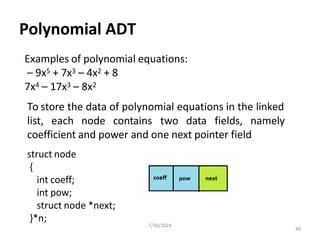
Examples of polynomial equations:
– 9x5 + 7x3 – 4x2 + 8
7x4 – 17x3 – 8x2
To store the data of polynomial equations in the linked
list, each node contains two data fields, namely
coefficient and power and one next pointer field
struct node
{
int coeff;
int pow;
struct node *next;
}*n;
7/30/2024
46
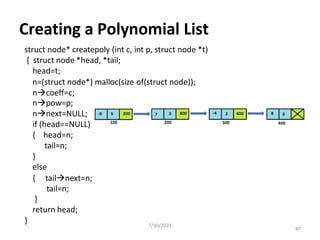
Creating a Polynomial List
struct node* createpoly (int c, int p, struct node *t)
{ struct node *head, *tail;
head=t;
n=(struct node*) malloc(size of(struct node));
ncoeff=c;
npow=p;
nnext=NULL;
if (head==NULL)
{ head=n;
tail=n;
}
else
{ tailnext=n;
tail=n;
}
return head;
} 7/30/2024
47
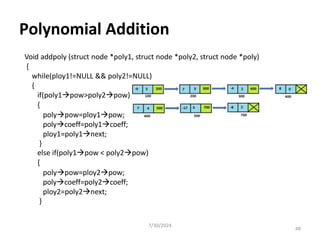
Polynomial Addition
Void addpoly (struct node *poly1, struct node *poly2, struct node *poly)
{
while(ploy1!=NULL && poly2!=NULL)
{
if(poly1pow>poly2pow)
{
polypow=ploy1pow;
polycoeff=poly1coeff;
ploy1=poly1next;
}
else if(poly1pow < poly2pow)
{
polypow=ploy2pow;
polycoeff=poly2coeff;
ploy2=poly2next;
}
7/30/2024
48
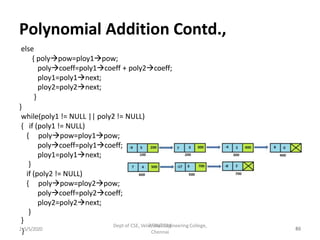
else
{ polypow=ploy1pow;
polycoeff=poly1coeff + poly2coeff;
ploy1=poly1next;
ploy2=poly2next;
}
}
while(poly1 != NULL || poly2 != NULL)
{ if (poly1 != NULL)
{ polypow=ploy1pow;
polycoeff=poly1coeff;
ploy1=poly1next;
}
if (poly2 != NULL)
{ polypow=ploy2pow;
polycoeff=poly2coeff;
ploy2=poly2next;
}
Polynomial Addition Contd.,
}
2
}5/5/2020 50
Dept of CSE, Velammal Engineering College,
Chennai
7/30/2024
49
7/30/2024
50
Thank You!!!

Linked List Data structure using C programming and all the detailed information has been provided

  • 1.
    Introduction To DataStructures And List ADT 7/30/2024 1
  • 2.
    2 Agenda • Introduction toData Structures • List ADT • Issues in Array Implementation • Linked List Representation • Types • Applications of Linked List 7/30/2024
  • 3.
    Introduction to DataStructures Structure Way of organizing and storing information so that it is easy to use Way of organizing and storing data on a computer so that it can be used easily and effectively Data Values or set of values of different data types such as int, float, etc., Data + Structure 7/30/2024 3
  • 4.
    Introduction to DataStructures Definition: Data Structure is a way of organizing, storing and retrieving data and their relationships with each other 7/30/2024 4
  • 5.
    Classification of DataStructures Data Structure Primitive int char float boolean Non - Primitive Linear Array Linked List Stack Queue Non - Linear Tree Graph 7/30/2024 5
  • 6.
    • It isa type for objects whose behavior is defined by set of values and set of operations from user point of view • Mentions only what operations are to be performed but not how they will be implemented • Thus, ADT is the specification of a data type within some language, independent of implementation ADT – Abstract Data Type 7/30/2024 6
  • 7.
    7/30/2024 7 Examples – ListADT, Stack ADT, Queue ADT, etc., Some operations on these ADT are: List: • insert(x) • delete(x) • find(x) Stack: • Push (x) • Pop() • isFull() • isEmpty() Queue: • enqueue() • dequeue() • isFull() • isEmpty() ADT – Abstract Data Type
  • 8.
    • List ADTcan be represented in two ways – Array – Linked List List ADT 7/30/2024 8
  • 9.
    7/30/2024 9 • Collection ofelements of same data type • Elements in an array is stored in adjacent memory location Syntax: • datatype arrayname [size] • Eg: int a [50]; Operations: • insertion() • deletion() • search() Array ADT
  • 10.
    7/30/2024 10 • Fixed size:Resizing is expensive • Requires continuous memory for allocation – Difficult when array size is larger • Insertions and deletions are inefficient – Elements are usually shifted • Wastage of memory space unless the array is full Issues in Array
  • 11.
    • Linked listis a linear data structure • Made up of chain of nodes • Each node contains a data and a pointer to the next node in the chain • Last node of the list is pointed to NULL Linked List ADT 7/30/2024 11
  • 12.
    Representation of Nodein Linked List • Each node contains two fields: – Data field: Contains data element to be stored – Pointer field: Contains the address of next node Declaration of a node: struct node { int data; struct node *next; }; 7/30/2024 12
  • 13.
    Statement to createa node: n= (struct node*) malloc(sizeof(sturct node)) nnext =NULL; struct node { int data; struct node *next; } *n; Creating a Node 7/30/2024 13
  • 14.
    7/30/2024 14 • Singly linkedlist • Doubly linked list • Circular linked list Types of Linked List
  • 15.
    • Type oflinked list • Each node contains only one pointer field that contains the address of the next node in the list Singly Linked List (SLL) 7/30/2024 15
  • 16.
    Major operations are: •Insertion – At the beginning – At the middle – At the end • Deletion – At the beginning – At the middle – At the end • Search Operations on Singly Linked List Global declaration of a Node: struct node { int data; struct node *next; } *head, *tail, *n, *t; 7/30/2024 16
  • 17.
    Routine for Insertionat the Beginning void ins_beg (int num) //Let num=10 { n=(struct node *) malloc (size of(struct node)); nnext=NULL; ndata=num; if (head==NULL) //case 1 { head=n; tail=n; } else //case 2 { nnext=head; head=n; } } 10 7/30/2024 17
  • 18.
    Routine for Insertionat the End void ins_end (int num) //Let num=10 { n=(struct node *) malloc (size of(struct node)); nnext=NULL; ; ndata=num; if (head==NULL) //case 1 { head=n; tail=n; } else //case 2 { tailnext=n tail=n; } } 10 7/30/2024 18
  • 19.
    Routine for Insertionat the Middle void ins_end (int num, int mid_data) //Let num=10, mid_data=9 { n=(struct node *) malloc (size of(struct node)); nnext=NULL; ndata=num; for(t=head; t!=NULL; t=tnext) { if(tdata==mid_data) break; } nnext=tnext; tnext=n; } 10 83==9 ? NO 9==9 ? Yes 10 300 7/30/2024 19 300 1500 300
  • 20.
    Routine for Deletionat the Beginning void del_beg () { t=head; head=tnext; free(t); } 7/30/2024 20
  • 21.
    Routine for Deletionat the End void del_end () { struct node *tp; t=head; while(tnext!=NULL) { tp=t; t=tnext; } tail=tp; tailnext=NULL; free(t); } 7/30/2024 21
  • 22.
    Routine for Deletionat the Middle void del_mid (int num) //Let num=70 { struct node *tp; t=head; while(tdata!=num) { tp=t; t=tnext; } tpnext=tnext; free(t); } 2800 1500 Dept of CSE, Velammal Engineering College, 22 7C 0h !e = n7 na 0 i ? 83!=70? Yes 9!=70? Yes No 7/30/2024
  • 23.
    Routine for Searchan Element struct node* search (int num) //Let num=9 { t=head; while(t!=NULL && tdata!=num) { t=tnext; } return t; } t!=NULL? Yes 83!=9? Yes 7/30/2024 23 t!=NULL? Yes 9!=9? No Element Found!!
  • 24.
    7/30/2024 24 Linked List –Advantages & Disadvantages Advantages: • No wastage of memory – Memory allocated and deallocated as per requirement • Efficient insertion and deletion operations Disadvantages: • Occupies more space than array to store a data – Due to the need of a pointer to the next node • Does not support random or direct access
  • 25.
    Doubly Linked List(DLL) • Type of linked list • Each node contains two pointer fields that contains the address of the next node and that of previous node in the list 7/30/2024 25
  • 26.
    • Each nodecontains three fields: – Data: Contains data element to be stored – next: Contains the address of next node – prev: Contains address of previous node Representation of Node in DLL Declaration of a node: struct node { int data; struct node *next, *prev; }; A Node in DLL 7/30/2024 26
  • 27.
    Major operations are: •Insertion – At the beginning – At the middle – At the end • Deletion – At the beginning – At the middle – At the end • Search Operations on Doubly Linked List Global declaration of a Node: struct node { int data; struct node *next, prev; } *head, *tail, *n, *t; 7/30/2024 27
  • 28.
    Routine for Insertionat the Beginning void ins_beg_dll (int num) //Let num=70 { n=(struct node *) malloc(size of(struct node)); nnext=NULL; nprev=NULL; ndata=num; if(head==NULL) //case 1 { head=n; tail=n; } else //case 2 { nnext=head; headprev=n; head=n; 70 1000 } 500 7/30/2024 29 } 28
  • 29.
    void ins_end_dll (intnum) //Let num=10 { n=(struct node *) malloc (size of(struct node)); nnext=NULL; nprev=NULL; ndata=num; if (head==NULL) //case 1 { head=n; tail=n; } else //case 2 { tailnext=n; nprev=tail; tail=n; } Routine for Insertion at the End 7/30/2024 30 } 29
  • 30.
    void ins_end_dll (intnum, int mid_data) //Let num=10, mid_data=9 { n=(struct node *) malloc (size of(struct node)); nnext=NULL; nprev=NULL; ndata=num; for(t=head; t!=NULL; t=tnext) { if(tdata==mid_data) break; } nnext=tnext; nprev=t; tnextprev=n; tnext=n; } Routine for Insertion at the Middle 7/30/2024 30
  • 31.
  • 32.
    Routine for Deletionat the End void del_end_dll () { t=head; while(tnext!=NULL) { t=tnext; } tail=tailprev;//tail=tprev; tailnext=NULL; free(t); } 7/30/2024 32
  • 33.
    Routine for Deletionat the Middle void del_mid_dll (int num) //Let num=9 { t=head; while(tdata!=num) { t=tnext; } tprevnext=tnext; tnextprev=tprev; free(t); } 7/30/2024 33
  • 34.
    Routine for Searchan Element struct node* search_dll (int num) //Let num=9 { t=head; while(t!=NULL && tdata!=num) { t=tnext; } return t; } Element Found!! t is returned 7/30/2024 34
  • 35.
    Due to theuse of two pointers Dept of CSE, Velammal Engineering College, 35 Chennai Advantages: • Can traverse in both directions • Operations in the middle of the list can be done efficiently – No need of extra pointer (tp) to track the previous node • Reversing the list is easy Disadvantage: • Space required to store a data is even more higher than SLL DLL – Advantages & Disadvantages 7/30/2024
  • 36.
    • Type oflinked list • The last node will be pointing to the first node • It can be either singly or doubly linked Circular Linked List (CLL) Global declaration of a node: struct node { int data; struct node *next, *prev; }*head,*n,*t; 100 7/30/2024 36
  • 37.
    Routine for Insertionat the Beginning void ins_beg_cll (int num) //Let num=10 { n=(struct node *) malloc (size of(struct node)); nnext=NULL; ndata=num; if (head==NULL) //case 1 { head=n; nnext=head; } else //case 2 { t=head; while(tnext!=head) t=tnext; tnext=n; nnext=head; head=n; } 10 10 100 7/30/2024 38 } 37
  • 38.
    Routine for Insertionat the End void ins_end_cll (int num) //Let num=10 { n=(struct node *) malloc (size of(struct node)); nnext=NULL; ndata=num; t=head; while(tnext!=head) t=tnext; tnext=n; nnext=head; } 10 1000 7/30/2024 38
  • 39.
    Routine for Insertionat the Middle void ins_end_cll (int num, int mid_data) //Let num=10, mid_data=9 { n=(struct node *) malloc (size of(struct node)); nnext=NULL; ndata=num; for(t=head; tnext!=head; t=tnext) { if(tdata==mid_data) break; } nnext=tnext; tnext=n; } 10 1000 7/30/2024 39
  • 40.
    Routine for Deletionat the Beginning void del_beg_cll () { struct node *t1; t=head; t1=head; while(tnext!=head) t=tnext; tnext=headnext; head=tnext; free(t1); } 100 t1 is freed!! 7/30/2024 40
  • 41.
    Routine for Deletionat the End void del_end_cll () { struct node *tp; t=head; while(tnext!=head) { tp=t; t=tnext; } tpnext=head; free(t); } 100 t is freed !! 7/30/2024 41
  • 42.
    Routine for Deletionat the Middle void del_mid_cll (int num) //Let num=9 { struct node *tp; t=head; while(tdata!=num) { tp=t; t=tnext; } tpnext=tnext; free(t); } t is freed!! 7/30/2024 42
  • 43.
    Routine for Search structnode* search_cll (int num) //Let num=9 { t=head; while(tnext!=head && tdata!=num) { t=tnext; } return t; } 7/30/2024 43
  • 44.
    7/30/2024 44 Advantage: • Comparing toSLL, moving to any node from a node is possible Disadvantages: • Reversing a list is complex compared to linear linked list • If proper care is not taken in managing the pointers, it leads to infinite loop • Moving to previous node is difficult, as it is needed to complete an entire circle CLL – Advantages & Disadvantages
  • 45.
    7/30/2024 45 Applications of List Listscan be used to • Sort elements • Implement stack and queue • Represent graph (adjacent list representation) • Implement hash table • Implement multiprocessing of applications • Manipulate polynomial equations
  • 46.
    Polynomial ADT Examples ofpolynomial equations: – 9x5 + 7x3 – 4x2 + 8 7x4 – 17x3 – 8x2 To store the data of polynomial equations in the linked list, each node contains two data fields, namely coefficient and power and one next pointer field struct node { int coeff; int pow; struct node *next; }*n; 7/30/2024 46
  • 47.
    Creating a PolynomialList struct node* createpoly (int c, int p, struct node *t) { struct node *head, *tail; head=t; n=(struct node*) malloc(size of(struct node)); ncoeff=c; npow=p; nnext=NULL; if (head==NULL) { head=n; tail=n; } else { tailnext=n; tail=n; } return head; } 7/30/2024 47
  • 48.
    Polynomial Addition Void addpoly(struct node *poly1, struct node *poly2, struct node *poly) { while(ploy1!=NULL && poly2!=NULL) { if(poly1pow>poly2pow) { polypow=ploy1pow; polycoeff=poly1coeff; ploy1=poly1next; } else if(poly1pow < poly2pow) { polypow=ploy2pow; polycoeff=poly2coeff; ploy2=poly2next; } 7/30/2024 48
  • 49.
    else { polypow=ploy1pow; polycoeff=poly1coeff +poly2coeff; ploy1=poly1next; ploy2=poly2next; } } while(poly1 != NULL || poly2 != NULL) { if (poly1 != NULL) { polypow=ploy1pow; polycoeff=poly1coeff; ploy1=poly1next; } if (poly2 != NULL) { polypow=ploy2pow; polycoeff=poly2coeff; ploy2=poly2next; } Polynomial Addition Contd., } 2 }5/5/2020 50 Dept of CSE, Velammal Engineering College, Chennai 7/30/2024 49
  • 50.