The Golden Equation:
Product + Market + Team = Deal
Tim Dick, General Partner

Page 1
The Missing Link…
A few weeks ago, I was asked to speak to a venture
accelerator cohort on financing. I thought about doing
Termsheets: The Good, The Bad & The Ugly that has
proven so popular, but that didn’t seem to fit the bill.
Then I got stuck, because financing is usually discussed as
an a la carte element of startup development similar to
getting first product out or making a key hire.
But it’s not…

Copyright © 2009-2013 Startup Capital Ventures

Page 2
The Secret…
Financing Is A Byproduct Of
Startup Development…
…Development Brings Financing,
Not The Other Way Around

Copyright © 2009-2013 Startup Capital Ventures

Page 3
Agenda

Product + Market + Team
= Deal

Page 4
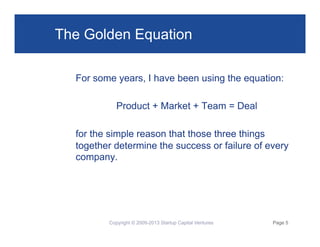
The Golden Equation
For some years, I have been using the equation:
Product + Market + Team = Deal
for the simple reason that those three things
together determine the success or failure of every
company.

Copyright © 2009-2013 Startup Capital Ventures

Page 5
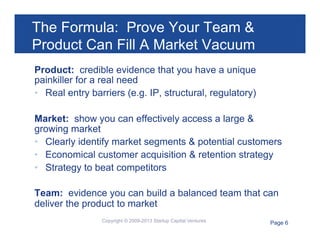
The Formula: Prove Your Team &
Product Can Fill A Market Vacuum
Product: credible evidence that you have a unique
painkiller for a real need
•  Real entry barriers (e.g. IP, structural, regulatory)
Market: show you can effectively access a large &
growing market
•  Clearly identify market segments & potential customers
•  Economical customer acquisition & retention strategy
•  Strategy to beat competitors
Team: evidence you can build a balanced team that can
deliver the product to market
Copyright © 2009-2013 Startup Capital Ventures

Page 6
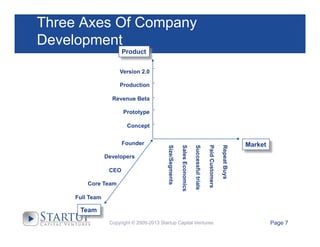
Three Axes Of Company
Development
Product
Version 2.0
Production
Revenue Beta
Prototype
Concept

Repeat Buys

Paid Customers

Core Team

Successful trials

CEO

Sales Economics

Developers

Size/Segments

Founder

Market

Full Team

Team
Copyright © 2009-2013 Startup Capital Ventures

Page 7
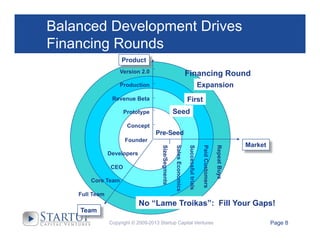
Balanced Development Drives
Financing Rounds
Product
Version 2.0

Financing Round
Expansion

Production

First

Revenue Beta

Seed

Prototype
Concept

Pre-Seed!
Founder
Repeat Buys

Team

Paid Customers

Full Team

Successful trials

Core Team

Sales Economics

CEO

Size/Segments

Developers

Market

No “Lame Troikas”: Fill Your Gaps!
Copyright © 2009-2013 Startup Capital Ventures

Page 8
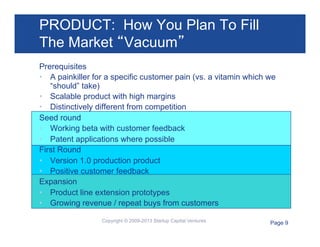
PRODUCT: How You Plan To Fill
The Market “Vacuum”
Prerequisites
•  A painkiller for a specific customer pain (vs. a vitamin which we
“should” take)
•  Scalable product with high margins
•  Distinctively different from competition
Seed round
•  Working beta with customer feedback
•  Patent applications where possible
First Round
•  Version 1.0 production product
•  Positive customer feedback
Expansion
•  Product line extension prototypes
•  Growing revenue / repeat buys from customers
Copyright © 2009-2013 Startup Capital Ventures

Page 9
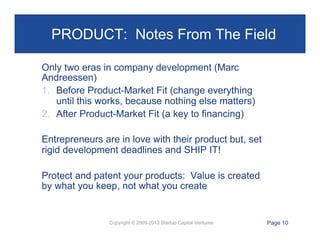
PRODUCT: Notes From The Field
Only two eras in company development (Marc
Andreessen)
1.  Before Product-Market Fit (change everything
until this works, because nothing else matters)
2.  After Product-Market Fit (a key to financing)
Entrepreneurs are in love with their product but, set
rigid development deadlines and SHIP IT!
Protect and patent your products: Value is created
by what you keep, not what you create

Copyright © 2009-2013 Startup Capital Ventures

Page 10
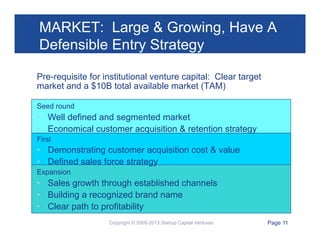
MARKET: Large & Growing, Have A
Defensible Entry Strategy
Pre-requisite for institutional venture capital: Clear target
market and a $10B total available market (TAM)
Seed round

•  Well defined and segmented market
•  Economical customer acquisition & retention strategy
First

•  Demonstrating customer acquisition cost & value
•  Defined sales force strategy
Expansion

•  Sales growth through established channels
•  Building a recognized brand name
•  Clear path to profitability
Copyright © 2009-2013 Startup Capital Ventures

Page 11
MARKET: Notes From The Field
The #1 company-killer is lack of market (Andy Rachleff,
Benchmark Capital):
•  When a great team meets a lousy market, market wins
•  When a lousy team meets a great market, market wins
•  When a great team meets a great market, something special
happens
Startups need to show breakeven potential on revenue of $100M
in 5-7 years because only 1-2 out of 10 deals hits
•  Credibility fail: “$300M revenue in two years with one round!”
Selling into a declining market is almost impossible
Identify competitors’ positions as you explain how you can win
against them
•  Credibility fail: “We have no competitors”
Copyright © 2009-2013 Startup Capital Ventures

Page 12"
TEAM: Balance Is Critical, Fill The
Gaps
• 

Prerequisites
–  Committed founders
–  Domain experts in the product, service, or technology

• 

Seed round
–  Original product/technology developers
–  Some general management & sales talent

• 

First Round
–  Experienced sales and marketing teams
–  Fundable CEO with relevant experience

• 

Expansion Round
–  Strong, balanced team
–  Solid sales force
–  Experienced CFO as the business become metrics-driven
Copyright © 2009-2013 Startup Capital Ventures

Page 13
TEAM: Leverage Your Team With
Great Partners
Build a GREAT board for “the voice of experience” and the ability
to open doors
•  “It’s hard to see the picture if you’re inside the frame” - Eugene
Kleiner
•  USE YOUR BOARD! – they have been there & have great
networks
•  Weekly board updates and monthly board meetings correlate
highly with startup success
Entrepreneur-focused partners can help you more than you think
•  The right law firm will help you do more than incorporate
•  PR Firm - little companies need big voices & good messages
•  Accounting firm: startups need conservative books
•  Some banks understand entrepreneurs (e.g. SVB, CPB)
Copyright © 2009-2013 Startup Capital Ventures

Page 14
Agenda

Product + Market + Team
= Deal

Page 15
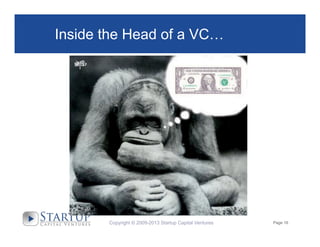
Inside the Head of a VC…

Copyright © 2009-2013 Startup Capital Ventures

Page 16
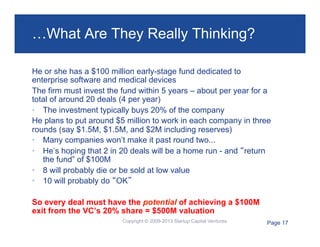
…What Are They Really Thinking?
He or she has a $100 million early-stage fund dedicated to
enterprise software and medical devices
The firm must invest the fund within 5 years – about per year for a
total of around 20 deals (4 per year)
•  The investment typically buys 20% of the company
He plans to put around $5 million to work in each company in three
rounds (say $1.5M, $1.5M, and $2M including reserves)
•  Many companies won’t make it past round two...
•  He’s hoping that 2 in 20 deals will be a home run - and “return
the fund” of $100M
•  8 will probably die or be sold at low value
•  10 will probably do “OK”
So every deal must have the potential of achieving a $100M
exit from the VC’s 20% share = $500M valuation
Copyright © 2009-2013 Startup Capital Ventures

Page 17
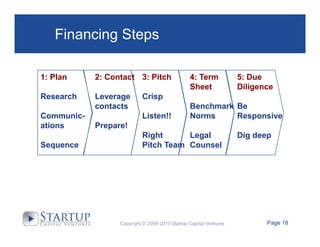
Financing Steps
1: Plan

2: Contact 3: Pitch

Research

Leverage
contacts

Communications
Sequence

4: Term
Sheet

5: Due
Diligence

Crisp
Listen!!

Benchmark Be
Norms
Responsive

Prepare!
Right
Legal
Pitch Team Counsel

Copyright © 2009-2013 Startup Capital Ventures

Dig deep

Page 18
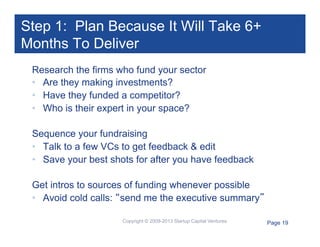
Step 1: Plan Because It Will Take 6+
Months To Deliver
Research the firms who fund your sector
•  Are they making investments?
•  Have they funded a competitor?
•  Who is their expert in your space?
Sequence your fundraising
•  Talk to a few VCs to get feedback & edit
•  Save your best shots for after you have feedback
Get intros to sources of funding whenever possible
•  Avoid cold calls: “send me the executive summary”
Copyright © 2009-2013 Startup Capital Ventures

Page 19
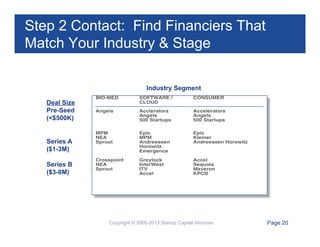
Step 2 Contact: Find Financiers That
Match Your Industry & Stage
Industry Segment
Deal Size
Pre-Seed
(<$500K)

Series A
($1-3M)
Series B
($3-8M)

BIO-MED

SOFTWARE /
CLOUD

CONSUMER

Angels

Acclerators
Angels
500 Startups

Accelerators
Angels
500 Startups

MPM
NEA
Sprout

Epic
MPM
Andreessen
Horowitz
Emergence

Epic
Kleiner
Andreessen Horowitz

Crosspoint
NEA
Sprout

Greylock
InterWest
ITV
Accel

Accel
Sequoia
Maveron
KPCB

Copyright © 2009-2013 Startup Capital Ventures

Page 20
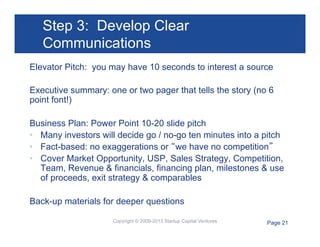
Step 3: Develop Clear
Communications
Elevator Pitch: you may have 10 seconds to interest a source
Executive summary: one or two pager that tells the story (no 6
point font!)
Business Plan: Power Point 10-20 slide pitch
•  Many investors will decide go / no-go ten minutes into a pitch
•  Fact-based: no exaggerations or “we have no competition”
•  Cover Market Opportunity, USP, Sales Strategy, Competition,
Team, Revenue & financials, financing plan, milestones & use
of proceeds, exit strategy & comparables
Back-up materials for deeper questions
Copyright © 2009-2013 Startup Capital Ventures

Page 21
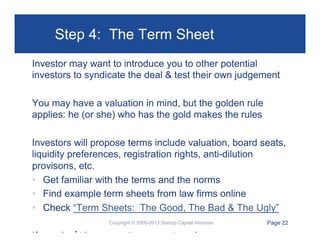
Step 4: The Term Sheet
Investor may want to introduce you to other potential
investors to syndicate the deal & test their own judgement
You may have a valuation in mind, but the golden rule
applies: he (or she) who has the gold makes the rules
Investors will propose terms include valuation, board seats,
liquidity preferences, registration rights, anti-dilution
provisons, etc.
•  Get familiar with the terms and the norms
•  Find example term sheets from law firms online
•  Check “Term Sheets: The Good, The Bad & The Ugly”
Copyright © 2009-2013 Startup Capital Ventures

If you don’t have an attorney, get one!

Page 22
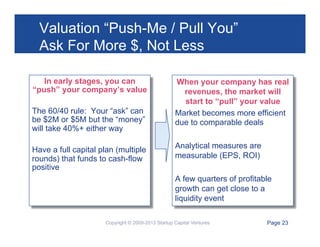
Valuation “Push-Me / Pull You”
Ask For More $, Not Less
In early stages, you can
“push” your company’s value
The 60/40 rule: Your “ask” can
be $2M or $5M but the “money”
will take 40%+ either way
Have a full capital plan (multiple
rounds) that funds to cash-flow
positive

When your company has real
revenues, the market will
start to “pull” your value
Market becomes more efficient
due to comparable deals
Analytical measures are
measurable (EPS, ROI)
A few quarters of profitable
growth can get close to a
liquidity event

Copyright © 2009-2013 Startup Capital Ventures

Page 23
Step 5: Due Diligence
Lead investor does this for syndicate
Will want to get comfortable with you and your team
VC will study and learn your space, want to talk with your
customers, see all paperwork, etc.
Follow up promptly and thoroughly with all data requests
•  Have your books in order and be prepared to provide all
contracts, investor lists, references, and as much time as
the investor wants

Copyright © 2009-2013 Startup Capital Ventures

Page 24
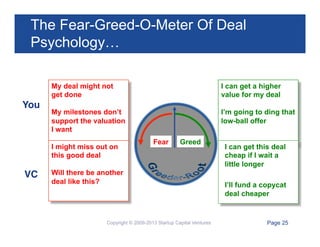
The Fear-Greed-O-Meter Of Deal
Psychology…
My deal might not
get done

You!
!
!
!
!
!
VC!

I can get a higher
value for my deal

My milestones don’t
support the valuation
I want

I’m going to ding that
low-ball offer

I might miss out on
this good deal

Fear

Greed

Will there be another
deal like this?

Copyright © 2009-2013 Startup Capital Ventures

I can get this deal
cheap if I wait a
little longer
I’ll fund a copycat
deal cheaper

Page 25
“Meat’s Not Meat ‘Til It’s In The Pan”

Painting: Charles Russell
The Author
Tim is a partner at Startup Capital Ventures where he sits / sat on the Boards
of SilverTail Systems, (acquired EMC), TagArray (acquired MXIM), Adama
Materials, and TuneIn.
He has raised over $300M in capital with $1.2B in exit value. Tim previously
founded Hawaii Superferry, Grassroots.com (acquired by Edelman),
WorldPages.com, (NYSE: WPZ then acquired by BT). He has advised and
invested in companies including match.com (first angel investor, acquired by
IAC), Accept.com (acquired AMZN).
Previously, Tim was a principal at the Boston Consulting Group (BCG) where
he advised clients including Microsoft and Disney. Earlier he was an
engineer at Beckman Instruments, where he developed the first electronic
speech synthesizer for use ICUs, and the world's first instrument-on-a-chip.
A believer in social responsibility, Tim co-founded TRUSTe.com the internet’s
privacy standard. He is currently chair of Entrepreneurs Foundation of
Hawaii and a board member of HiBEAM. He sponsors the student program
at Hawaii Venture Capital Association
Tim holds an MBA from Stanford and a BSEE from the University of
California

Page 27

The Golden Equation: Product + Market + Team = Deal

  • 1.
    The Golden Equation: Product+ Market + Team = Deal Tim Dick, General Partner Page 1
  • 2.
    The Missing Link… Afew weeks ago, I was asked to speak to a venture accelerator cohort on financing. I thought about doing Termsheets: The Good, The Bad & The Ugly that has proven so popular, but that didn’t seem to fit the bill. Then I got stuck, because financing is usually discussed as an a la carte element of startup development similar to getting first product out or making a key hire. But it’s not… Copyright © 2009-2013 Startup Capital Ventures Page 2
  • 3.
    The Secret… Financing IsA Byproduct Of Startup Development… …Development Brings Financing, Not The Other Way Around Copyright © 2009-2013 Startup Capital Ventures Page 3
  • 4.
    Agenda Product + Market+ Team = Deal Page 4
  • 5.
    The Golden Equation Forsome years, I have been using the equation: Product + Market + Team = Deal for the simple reason that those three things together determine the success or failure of every company. Copyright © 2009-2013 Startup Capital Ventures Page 5
  • 6.
    The Formula: ProveYour Team & Product Can Fill A Market Vacuum Product: credible evidence that you have a unique painkiller for a real need •  Real entry barriers (e.g. IP, structural, regulatory) Market: show you can effectively access a large & growing market •  Clearly identify market segments & potential customers •  Economical customer acquisition & retention strategy •  Strategy to beat competitors Team: evidence you can build a balanced team that can deliver the product to market Copyright © 2009-2013 Startup Capital Ventures Page 6
  • 7.
    Three Axes OfCompany Development Product Version 2.0 Production Revenue Beta Prototype Concept Repeat Buys Paid Customers Core Team Successful trials CEO Sales Economics Developers Size/Segments Founder Market Full Team Team Copyright © 2009-2013 Startup Capital Ventures Page 7
  • 8.
    Balanced Development Drives FinancingRounds Product Version 2.0 Financing Round Expansion Production First Revenue Beta Seed Prototype Concept Pre-Seed! Founder Repeat Buys Team Paid Customers Full Team Successful trials Core Team Sales Economics CEO Size/Segments Developers Market No “Lame Troikas”: Fill Your Gaps! Copyright © 2009-2013 Startup Capital Ventures Page 8
  • 9.
    PRODUCT: How YouPlan To Fill The Market “Vacuum” Prerequisites •  A painkiller for a specific customer pain (vs. a vitamin which we “should” take) •  Scalable product with high margins •  Distinctively different from competition Seed round •  Working beta with customer feedback •  Patent applications where possible First Round •  Version 1.0 production product •  Positive customer feedback Expansion •  Product line extension prototypes •  Growing revenue / repeat buys from customers Copyright © 2009-2013 Startup Capital Ventures Page 9
  • 10.
    PRODUCT: Notes FromThe Field Only two eras in company development (Marc Andreessen) 1.  Before Product-Market Fit (change everything until this works, because nothing else matters) 2.  After Product-Market Fit (a key to financing) Entrepreneurs are in love with their product but, set rigid development deadlines and SHIP IT! Protect and patent your products: Value is created by what you keep, not what you create Copyright © 2009-2013 Startup Capital Ventures Page 10
  • 11.
    MARKET: Large &Growing, Have A Defensible Entry Strategy Pre-requisite for institutional venture capital: Clear target market and a $10B total available market (TAM) Seed round •  Well defined and segmented market •  Economical customer acquisition & retention strategy First •  Demonstrating customer acquisition cost & value •  Defined sales force strategy Expansion •  Sales growth through established channels •  Building a recognized brand name •  Clear path to profitability Copyright © 2009-2013 Startup Capital Ventures Page 11
  • 12.
    MARKET: Notes FromThe Field The #1 company-killer is lack of market (Andy Rachleff, Benchmark Capital): •  When a great team meets a lousy market, market wins •  When a lousy team meets a great market, market wins •  When a great team meets a great market, something special happens Startups need to show breakeven potential on revenue of $100M in 5-7 years because only 1-2 out of 10 deals hits •  Credibility fail: “$300M revenue in two years with one round!” Selling into a declining market is almost impossible Identify competitors’ positions as you explain how you can win against them •  Credibility fail: “We have no competitors” Copyright © 2009-2013 Startup Capital Ventures Page 12"
  • 13.
    TEAM: Balance IsCritical, Fill The Gaps •  Prerequisites –  Committed founders –  Domain experts in the product, service, or technology •  Seed round –  Original product/technology developers –  Some general management & sales talent •  First Round –  Experienced sales and marketing teams –  Fundable CEO with relevant experience •  Expansion Round –  Strong, balanced team –  Solid sales force –  Experienced CFO as the business become metrics-driven Copyright © 2009-2013 Startup Capital Ventures Page 13
  • 14.
    TEAM: Leverage YourTeam With Great Partners Build a GREAT board for “the voice of experience” and the ability to open doors •  “It’s hard to see the picture if you’re inside the frame” - Eugene Kleiner •  USE YOUR BOARD! – they have been there & have great networks •  Weekly board updates and monthly board meetings correlate highly with startup success Entrepreneur-focused partners can help you more than you think •  The right law firm will help you do more than incorporate •  PR Firm - little companies need big voices & good messages •  Accounting firm: startups need conservative books •  Some banks understand entrepreneurs (e.g. SVB, CPB) Copyright © 2009-2013 Startup Capital Ventures Page 14
  • 15.
    Agenda Product + Market+ Team = Deal Page 15
  • 16.
    Inside the Headof a VC… Copyright © 2009-2013 Startup Capital Ventures Page 16
  • 17.
    …What Are TheyReally Thinking? He or she has a $100 million early-stage fund dedicated to enterprise software and medical devices The firm must invest the fund within 5 years – about per year for a total of around 20 deals (4 per year) •  The investment typically buys 20% of the company He plans to put around $5 million to work in each company in three rounds (say $1.5M, $1.5M, and $2M including reserves) •  Many companies won’t make it past round two... •  He’s hoping that 2 in 20 deals will be a home run - and “return the fund” of $100M •  8 will probably die or be sold at low value •  10 will probably do “OK” So every deal must have the potential of achieving a $100M exit from the VC’s 20% share = $500M valuation Copyright © 2009-2013 Startup Capital Ventures Page 17
  • 18.
    Financing Steps 1: Plan 2:Contact 3: Pitch Research Leverage contacts Communications Sequence 4: Term Sheet 5: Due Diligence Crisp Listen!! Benchmark Be Norms Responsive Prepare! Right Legal Pitch Team Counsel Copyright © 2009-2013 Startup Capital Ventures Dig deep Page 18
  • 19.
    Step 1: PlanBecause It Will Take 6+ Months To Deliver Research the firms who fund your sector •  Are they making investments? •  Have they funded a competitor? •  Who is their expert in your space? Sequence your fundraising •  Talk to a few VCs to get feedback & edit •  Save your best shots for after you have feedback Get intros to sources of funding whenever possible •  Avoid cold calls: “send me the executive summary” Copyright © 2009-2013 Startup Capital Ventures Page 19
  • 20.
    Step 2 Contact:Find Financiers That Match Your Industry & Stage Industry Segment Deal Size Pre-Seed (<$500K) Series A ($1-3M) Series B ($3-8M) BIO-MED SOFTWARE / CLOUD CONSUMER Angels Acclerators Angels 500 Startups Accelerators Angels 500 Startups MPM NEA Sprout Epic MPM Andreessen Horowitz Emergence Epic Kleiner Andreessen Horowitz Crosspoint NEA Sprout Greylock InterWest ITV Accel Accel Sequoia Maveron KPCB Copyright © 2009-2013 Startup Capital Ventures Page 20
  • 21.
    Step 3: DevelopClear Communications Elevator Pitch: you may have 10 seconds to interest a source Executive summary: one or two pager that tells the story (no 6 point font!) Business Plan: Power Point 10-20 slide pitch •  Many investors will decide go / no-go ten minutes into a pitch •  Fact-based: no exaggerations or “we have no competition” •  Cover Market Opportunity, USP, Sales Strategy, Competition, Team, Revenue & financials, financing plan, milestones & use of proceeds, exit strategy & comparables Back-up materials for deeper questions Copyright © 2009-2013 Startup Capital Ventures Page 21
  • 22.
    Step 4: TheTerm Sheet Investor may want to introduce you to other potential investors to syndicate the deal & test their own judgement You may have a valuation in mind, but the golden rule applies: he (or she) who has the gold makes the rules Investors will propose terms include valuation, board seats, liquidity preferences, registration rights, anti-dilution provisons, etc. •  Get familiar with the terms and the norms •  Find example term sheets from law firms online •  Check “Term Sheets: The Good, The Bad & The Ugly” Copyright © 2009-2013 Startup Capital Ventures If you don’t have an attorney, get one! Page 22
  • 23.
    Valuation “Push-Me /Pull You” Ask For More $, Not Less In early stages, you can “push” your company’s value The 60/40 rule: Your “ask” can be $2M or $5M but the “money” will take 40%+ either way Have a full capital plan (multiple rounds) that funds to cash-flow positive When your company has real revenues, the market will start to “pull” your value Market becomes more efficient due to comparable deals Analytical measures are measurable (EPS, ROI) A few quarters of profitable growth can get close to a liquidity event Copyright © 2009-2013 Startup Capital Ventures Page 23
  • 24.
    Step 5: DueDiligence Lead investor does this for syndicate Will want to get comfortable with you and your team VC will study and learn your space, want to talk with your customers, see all paperwork, etc. Follow up promptly and thoroughly with all data requests •  Have your books in order and be prepared to provide all contracts, investor lists, references, and as much time as the investor wants Copyright © 2009-2013 Startup Capital Ventures Page 24
  • 25.
    The Fear-Greed-O-Meter OfDeal Psychology… My deal might not get done You! ! ! ! ! ! VC! I can get a higher value for my deal My milestones don’t support the valuation I want I’m going to ding that low-ball offer I might miss out on this good deal Fear Greed Will there be another deal like this? Copyright © 2009-2013 Startup Capital Ventures I can get this deal cheap if I wait a little longer I’ll fund a copycat deal cheaper Page 25
  • 26.
    “Meat’s Not Meat‘Til It’s In The Pan” Painting: Charles Russell
  • 27.
    The Author Tim isa partner at Startup Capital Ventures where he sits / sat on the Boards of SilverTail Systems, (acquired EMC), TagArray (acquired MXIM), Adama Materials, and TuneIn. He has raised over $300M in capital with $1.2B in exit value. Tim previously founded Hawaii Superferry, Grassroots.com (acquired by Edelman), WorldPages.com, (NYSE: WPZ then acquired by BT). He has advised and invested in companies including match.com (first angel investor, acquired by IAC), Accept.com (acquired AMZN). Previously, Tim was a principal at the Boston Consulting Group (BCG) where he advised clients including Microsoft and Disney. Earlier he was an engineer at Beckman Instruments, where he developed the first electronic speech synthesizer for use ICUs, and the world's first instrument-on-a-chip. A believer in social responsibility, Tim co-founded TRUSTe.com the internet’s privacy standard. He is currently chair of Entrepreneurs Foundation of Hawaii and a board member of HiBEAM. He sponsors the student program at Hawaii Venture Capital Association Tim holds an MBA from Stanford and a BSEE from the University of California Page 27