Reliable Plant 2015 Conference Proceedings |
Lubricant Contamination – The Uninvited Guest
Forms of Contamination and Methods for Remediation
Robert O. Crowder, Ph.D.
Lubrication and hydraulic fluids are central to the operation of industrial equipment. They provide
cooling, sealing, lubrication, and sometimes even the motive power itself. In order to keep them and
the equipment they protect functioning well, it is necessary to deal with the uninvited guest:
Contamination. Others have estimated that “over 70% of equipment failures can be attributed to
contamination.”1
Contamination is a catch-all for anything in the oil that isn’t supposed to be there. In
order to understand what it is, where it comes from, and most importantly, how to deal with it, it’s
necessary to take a closer look at the various kinds.
In most lubrication and hydraulic fluids that contamination takes primarily three forms: Particulate,
Water, and Gases.
Particulate Contamination
The first form of contamination is particulate. It is a catchall term for any solid particles in the fluid
not part of the original formulation. This particulate can consist of metal particles, silica, oxidation
products, polymeric materials, and even degradation particles from the oil itself. These particles come
from a variety of sources both inside and outside the equipment. Particulate contamination is measured
in the form of the number of particles per milliliter of fluid.
In order to count the number of particles, a size range needs to be determined. The three most
common are particles bigger than 4 micron, particles bigger than 6 micron, and particles bigger than 14
micron in size. Obviously a fluid will have far more particles bigger than 4 micron, than it will particles
bigger than 14 micron. To make things slightly more confusing, these particle counts are usually
expressed as an ISO code number. To determine which ISO code number a given particle count
represents, Table 1 can be used:
Table 1: ISO 4406:1999 Cleanliness Code
ISO Code Number
Number of Particles per Milliliter
More Than Up To (including)
25 160,000 320,000
24 80,000 160,000
23 40,000 80,000
22 20,000 40,000
21 10,000 20,000
| Reliable Plant 2015 Conference Proceedings
20 5,000 10,000
19 2,500 5,000
18 1,300 2,500
17 640 1,300
16 320 640
15 160 320
14 80 160
13 40 80
12 20 40
11 10 20
10 5 10
9 2.5 5
8 1.3 2.5
7 0.64 1.3
6 0.32 0.64
5 0.16 0.32
For instance a particle count of 50 particles per ml would correspond to an ISO code of 13 (more
than 40, but less than or equal to 80). These codes are usually expressed in threes, for greater than 4
micron, greater than 6 micron and greater than 14 micron. For example, 150,000 particles greater than
4 micron, 23,000 greater than 6 micron, and 690 greater than 14 micron would produce the ISO
cleanliness code of 24/22/17. Some care must be taken because particle counts are occasionally
reported per 100 ml rather than per ml, so the count must be divided by 100 before using the above
chart.
Obviously, cleaner is better, but not all equipment has the same requirements. Equipment should
come from the manufacturer with a recommendation for the oil cleanliness, based upon
lubrication/hydraulic fluid function and mechanical clearances. In general, for equipment like servo
valves in hydraulic equipment with tight tolerances, cleanliness is more critical than for low-speed
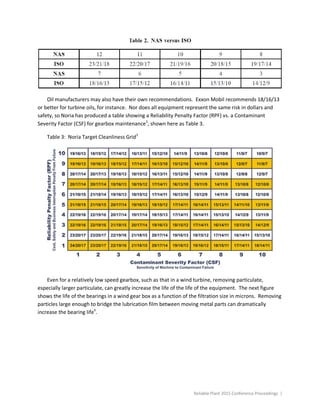
gearboxes. For instance GE recommends NAS class 5 (equivalent to ISO 16/14/11) for critical oil systems
in their gas turbines and NAS class 8 (19/17/14) for controlled oil system fluids2
. NAS 1638 is an
alternate cleanliness standard developed for aerospace components in the US and is still used in some
cases. GE published a useful conversion table, shown here as table 2, although it’s important to realize
that NAS covers many more categories and thus the conversion below is an approximation.
Reliable Plant 2015 Conference Proceedings |
Oil manufacturers may also have their own recommendations. Exxon Mobil recommends 18/16/13
or better for turbine oils, for instance. Nor does all equipment represent the same risk in dollars and
safety, so Noria has produced a table showing a Reliability Penalty Factor (RPF) vs. a Contaminant
Severity Factor (CSF) for gearbox maintenance3
, shown here as Table 3.
Table 3: Noria Target Cleanliness Grid3
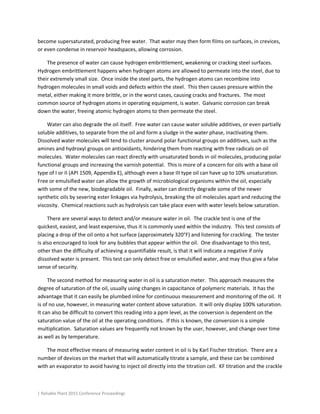
Even for a relatively low speed gearbox, such as that in a wind turbine, removing particulate,
especially larger particulate, can greatly increase the life of the life of the equipment. The next figure
shows the life of the bearings in a wind gear box as a function of the filtration size in microns. Removing
particles large enough to bridge the lubrication film between moving metal parts can dramatically
increase the bearing life4
.
| Reliable Plant 2015 Conference Proceedings
A handy tool for understanding the source of particulate contamination is a metals analysis. This is a
common portion of an oil analysis which uses ICP-AES to determine which elements are present in the
oil (ASTM D5185). Some metals such as iron, chromium, nickel, copper, and aluminum tend to
represent machinery wear. They are likely generated within the equipment, and if present in rapidly
increasing quantities, are an indication of possible problems. Elements such as zinc, phosphorous,
magnesium, and molybdenum tend to represent additives present in new oil. Elements such as sodium,
potassium, and especially silicon tend to indicate contamination from the outside environment and
should focus attention to addressing the ingression.
Particulate Remediation
Filtration is obviously the most common method for dealing with particulate contamination. The
filtration chosen needs to be appropriate for achieving the required cleanliness levels. A filtration
system with a nominal 50 micron element will likely only have an effect on the largest particles, as
represented by the first number of the ISO code. If the goal is to achieve lower counts at the 4 and 6
micron range, media with nominal pore sizes in those ranges need to be used. Such elements tend to
Reliable Plant 2015 Conference Proceedings |
have higher pressure drops, and thus may be used in ways other than full flow, such as a kidney loop.
These filtration elements need to be monitored and replaced as required to maintain effectiveness.
Another important approach for dealing with particulate contamination is to address the source. If
the oil analysis (ICP-AES data) indicates high concentrations of wear metals, the lubrication fluids should
be examined for viscosity and water. If the fluid is no longer the correct viscosity, the lubrication ability
may be severely impaired, requiring replacement. Water, especially free water, can reduce the
lubrication ability, cause corrosion, hydrogen embrittlement, and reduce the additive package
effectiveness, leading to equipment wear and increased particulate. Water as a contaminant will also
be addressed in the next section. Particulate contamination, can also lead to increased particulate, as
particles wear on metal parts and bridge the lubrication gap.
Particulate contamination from the outside environment can come into the system through
reservoir, or gearbox “breathing” as a result of liquid level changes or temperature changes. Filtration
at the breather is a minimum to prevent excessive environmental particulate contamination. If the
media is designed to be hydrophobic, it can also prevent water droplets from entering the reservoir or
gearbox, although a simple filter will not prevent the intrusion of water vapor. A new approach is to use
an Active Breather System, wherein clean dry air is used to continuously blanket the headspace of the
reservoir or gearbox, continuously exiting the breather. This air can be supplied by a coalescer and
membrane air dryer, ensuring that contaminated environmental air is never pulled into the system.
Water Contamination
The second form of contamination is water. This kind of contamination can take the form of visible,
separated, free water, emulsified water (cloudy oil), or dissolved water (clear oil). Everyone
understands that water is immiscible with oil (with the exception of certain base VI type oils), and will
separate out, either as a layer of liquid water on the bottom of a reservoir, or as an emulsion in the oil
making it cloudy or hazy. What many people don’t realize is that water is found in a third form in
lubrication and hydraulic fluids, which is fully dissolved. Thus an oil sample may be completely clear, yet
contain relatively high levels of water.
There are a number of areas in which water is harmful in lubrication and hydraulic systems. As
discussed in the last section, water can be a source of particulate contamination by causing a breakdown
of the lubricity of the fluids. In this way, water prevents the fluids from forming the protective
lubrication layer between moving metal parts, such as bearings, allowing metal to metal contact and
producing wear.
Water can also lead to corrosion of steel parts. This is especially true if the TAN (acid level) in the oil
is allowed to rise. Even if the moisture level in the oil is below saturation, a condition that would
normally prevent the water from contributing to corrosion, solubility is a strong function of
temperature. In other words, once the oil cools, during equipment downtime, in a reservoir, after
passing through a heat-exchanger, or simply due to environmental temperature fluctuations, the oil may
| Reliable Plant 2015 Conference Proceedings
become supersaturated, producing free water. That water may then form films on surfaces, in crevices,
or even condense in reservoir headspaces, allowing corrosion.
The presence of water can cause hydrogen embrittlement, weakening or cracking steel surfaces.
Hydrogen embrittlement happens when hydrogen atoms are allowed to permeate into the steel, due to
their extremely small size. Once inside the steel parts, the hydrogen atoms can recombine into
hydrogen molecules in small voids and defects within the steel. This then causes pressure within the
metal, either making it more brittle, or in the worst cases, causing cracks and fractures. The most
common source of hydrogen atoms in operating equipment, is water. Galvanic corrosion can break
down the water, freeing atomic hydrogen atoms to then permeate the steel.
Water can also degrade the oil itself. Free water can cause water soluble additives, or even partially
soluble additives, to separate from the oil and form a sludge in the water phase, inactivating them.
Dissolved water molecules will tend to cluster around polar functional groups on additives, such as the
amines and hydroxyl groups on antioxidants, hindering them from reacting with free radicals on oil
molecules. Water molecules can react directly with unsaturated bonds in oil molecules, producing polar
functional groups and increasing the varnish potential. This is more of a concern for oils with a base oil
type of I or II (API 1509, Appendix E), although even a base III type oil can have up to 10% unsaturation.
Free or emulsified water can allow the growth of microbiological organisms within the oil, especially
with some of the new, biodegradable oil. Finally, water can directly degrade some of the newer
synthetic oils by severing ester linkages via hydrolysis, breaking the oil molecules apart and reducing the
viscosity. Chemical reactions such as hydrolysis can take place even with water levels below saturation.
There are several ways to detect and/or measure water in oil. The crackle test is one of the
quickest, easiest, and least expensive, thus it is commonly used within the industry. This test consists of
placing a drop of the oil onto a hot surface (approximately 320°F) and listening for crackling. The tester
is also encouraged to look for any bubbles that appear within the oil. One disadvantage to this test,
other than the difficulty of achieving a quantifiable result, is that it will indicate a negative if only
dissolved water is present. This test can only detect free or emulsified water, and may thus give a false
sense of security.
The second method for measuring water in oil is a saturation meter. This approach measures the
degree of saturation of the oil, usually using changes in capacitance of polymeric materials. It has the
advantage that it can easily be plumbed inline for continuous measurement and monitoring of the oil. It
is of no use, however, in measuring water content above saturation. It will only display 100% saturation.
It can also be difficult to convert this reading into a ppm level, as the conversion is dependent on the
saturation value of the oil at the operating conditions. If this is known, the conversion is a simple
multiplication. Saturation values are frequently not known by the user, however, and change over time
as well as by temperature.
The most effective means of measuring water content in oil is by Karl Fischer titration. There are a
number of devices on the market that will automatically titrate a sample, and these can be combined
with an evaporator to avoid having to inject oil directly into the titration cell. KF titration and the crackle
Reliable Plant 2015 Conference Proceedings |
test can both be selected as part of an oil analysis package by outside laboratories. KF titration will
produce an absolute water content from a value down in the ppm range up to a couple of percent. It
will also measure the moisture content above and below the saturation value of the oil.
All of this brings up the question of what are saturation values for oil? How much water can oil hold
before it becomes supersaturated and cloudy? It is not uncommon to see tables and charts that claim
to show saturation values for various oil types at different temperatures. While there are trends in oil
type, such as transformer oils having very low saturation values, other oils can display a wide range of
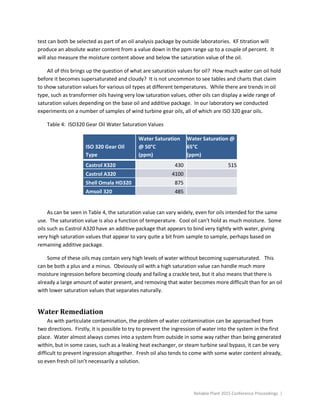
saturation values depending on the base oil and additive package. In our laboratory we conducted
experiments on a number of samples of wind turbine gear oils, all of which are ISO 320 gear oils.
Table 4: ISO320 Gear Oil Water Saturation Values
ISO 320 Gear Oil
Type
Water Saturation
@ 50°C
(ppm)
Water Saturation @
65°C
(ppm)
Castrol X320 430 515
Castrol A320 4100
Shell Omala HD320 875
Amsoil 320 485
As can be seen in Table 4, the saturation value can vary widely, even for oils intended for the same
use. The saturation value is also a function of temperature. Cool oil can’t hold as much moisture. Some
oils such as Castrol A320 have an additive package that appears to bind very tightly with water, giving
very high saturation values that appear to vary quite a bit from sample to sample, perhaps based on
remaining additive package.
Some of these oils may contain very high levels of water without becoming supersaturated. This
can be both a plus and a minus. Obviously oil with a high saturation value can handle much more
moisture ingression before becoming cloudy and failing a crackle test, but it also means that there is
already a large amount of water present, and removing that water becomes more difficult than for an oil
with lower saturation values that separates naturally.
Water Remediation
As with particulate contamination, the problem of water contamination can be approached from
two directions. Firstly, it is possible to try to prevent the ingression of water into the system in the first
place. Water almost always comes into a system from outside in some way rather than being generated
within, but in some cases, such as a leaking heat exchanger, or steam turbine seal bypass, it can be very
difficult to prevent ingression altogether. Fresh oil also tends to come with some water content already,
so even fresh oil isn’t necessarily a solution.
| Reliable Plant 2015 Conference Proceedings
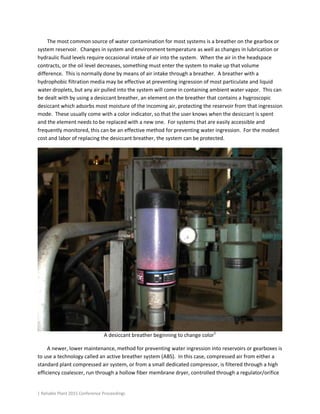
The most common source of water contamination for most systems is a breather on the gearbox or
system reservoir. Changes in system and environment temperature as well as changes in lubrication or
hydraulic fluid levels require occasional intake of air into the system. When the air in the headspace
contracts, or the oil level decreases, something must enter the system to make up that volume
difference. This is normally done by means of air intake through a breather. A breather with a
hydrophobic filtration media may be effective at preventing ingression of most particulate and liquid
water droplets, but any air pulled into the system will come in containing ambient water vapor. This can
be dealt with by using a desiccant breather, an element on the breather that contains a hygroscopic
desiccant which adsorbs most moisture of the incoming air, protecting the reservoir from that ingression
mode. These usually come with a color indicator, so that the user knows when the desiccant is spent
and the element needs to be replaced with a new one. For systems that are easily accessible and
frequently monitored, this can be an effective method for preventing water ingression. For the modest
cost and labor of replacing the desiccant breather, the system can be protected.
A desiccant breather beginning to change color5
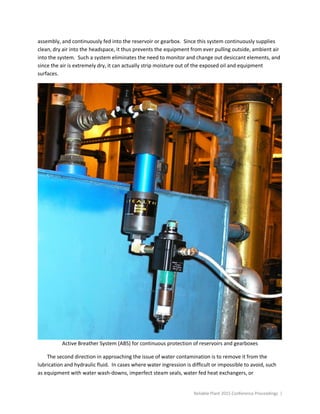
A newer, lower maintenance, method for preventing water ingression into reservoirs or gearboxes is
to use a technology called an active breather system (ABS). In this case, compressed air from either a
standard plant compressed air system, or from a small dedicated compressor, is filtered through a high
efficiency coalescer, run through a hollow fiber membrane dryer, controlled through a regulator/orifice
Reliable Plant 2015 Conference Proceedings |
assembly, and continuously fed into the reservoir or gearbox. Since this system continuously supplies
clean, dry air into the headspace, it thus prevents the equipment from ever pulling outside, ambient air
into the system. Such a system eliminates the need to monitor and change out desiccant elements, and
since the air is extremely dry, it can actually strip moisture out of the exposed oil and equipment
surfaces.
Active Breather System (ABS) for continuous protection of reservoirs and gearboxes
The second direction in approaching the issue of water contamination is to remove it from the
lubrication and hydraulic fluid. In cases where water ingression is difficult or impossible to avoid, such
as equipment with water wash-downs, imperfect steam seals, water fed heat exchangers, or
| Reliable Plant 2015 Conference Proceedings
environmental exposure, this may be the only approach. In this case, there are a number of solutions on
the market to strip moisture out of the oil once it is there.
The most basic approach to remove free water from oil is to use a large reservoir with a significant
residence time. Unless there is a stable emulsion, any free water will tend to settle to the bottom of the
reservoir and can be periodically drained off. This approach has a couple of advantages. Firstly, there
are frequently reservoirs associated with large equipment. Secondly, such reservoirs tend to be at a
slightly lower temperature than the equipment itself, reducing water solubility, and enhancing the
phase separation. The obvious disadvantages are that the draining must be done periodically, usually
manually. In the meantime, water sits on the bottom of the reservoir, allowing corrosion and keeping
the remaining oil saturated. And in the end, this approach can never remove moisture below the
saturation level.
The second method is to use an absorbent or adsorbent material. A desiccant such as molecular
sieves can be used with oil just as it can be used with air, to remove moisture from the oil. The most
common form of this approach is a filtration element made from a cellulose media. Not only does such
a media filter the oil, but since the media is hydrophilic, it acts to pull some of the moisture out of the
oil, at least until it becomes saturated. Cellulose elements are very effective at removing free and
emulsified water, and if they are fresh enough, may even remove some of the dissolved water although
they do not attract moisture as strongly as other materials such as molecular sieves. Once a cellulose
element become saturated, however, it will no longer remove water and may in fact add it back to any
subsaturated oil. Thus for this approach to be effective, the elements need to be regularly monitored
and changed out for fresh. In high moisture situations, this may require frequent change outs. Also, this
approach requires disposing of oily filtration elements.
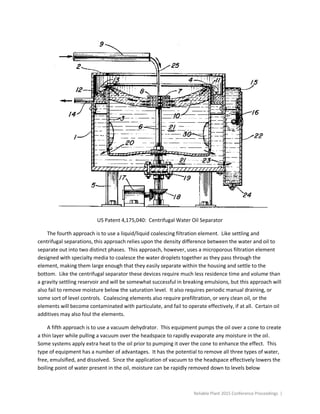
The third approach is to use a centrifugal separator to separate the two distinct phases based upon
density differences. This approach is similar to the settling reservoir, but has the advantage of being
much faster and allowing for smaller volumes and residence times. It also has the advantage of being
able to break most emulsions through the high g-forces. The downsides of such equipment are that it
requires level controls, involves moving parts and seals, and like gravity settling, will never pull the
moisture level below saturation.
Reliable Plant 2015 Conference Proceedings |
US Patent 4,175,040: Centrifugal Water Oil Separator
The fourth approach is to use a liquid/liquid coalescing filtration element. Like settling and
centrifugal separations, this approach relies upon the density difference between the water and oil to
separate out into two distinct phases. This approach, however, uses a microporous filtration element
designed with specialty media to coalesce the water droplets together as they pass through the
element, making them large enough that they easily separate within the housing and settle to the
bottom. Like the centrifugal separator these devices require much less residence time and volume than
a gravity settling reservoir and will be somewhat successful in breaking emulsions, but this approach will
also fail to remove moisture below the saturation level. It also requires periodic manual draining, or
some sort of level controls. Coalescing elements also require prefiltration, or very clean oil, or the
elements will become contaminated with particulate, and fail to operate effectively, if at all. Certain oil
additives may also foul the elements.
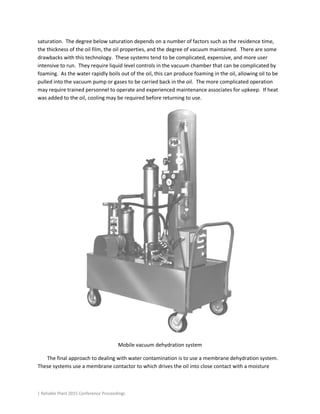
A fifth approach is to use a vacuum dehydrator. This equipment pumps the oil over a cone to create
a thin layer while pulling a vacuum over the headspace to rapidly evaporate any moisture in the oil.
Some systems apply extra heat to the oil prior to pumping it over the cone to enhance the effect. This
type of equipment has a number of advantages. It has the potential to remove all three types of water,
free, emulsified, and dissolved. Since the application of vacuum to the headspace effectively lowers the
boiling point of water present in the oil, moisture can be rapidly removed down to levels below
| Reliable Plant 2015 Conference Proceedings
saturation. The degree below saturation depends on a number of factors such as the residence time,
the thickness of the oil film, the oil properties, and the degree of vacuum maintained. There are some
drawbacks with this technology. These systems tend to be complicated, expensive, and more user
intensive to run. They require liquid level controls in the vacuum chamber that can be complicated by
foaming. As the water rapidly boils out of the oil, this can produce foaming in the oil, allowing oil to be
pulled into the vacuum pump or gases to be carried back in the oil. The more complicated operation
may require trained personnel to operate and experienced maintenance associates for upkeep. If heat
was added to the oil, cooling may be required before returning to use.
Mobile vacuum dehydration system
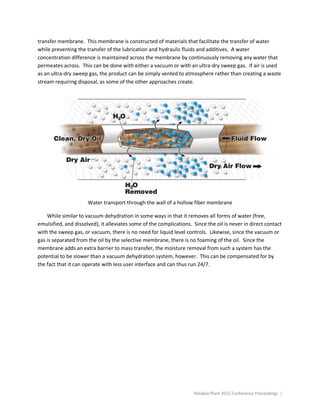
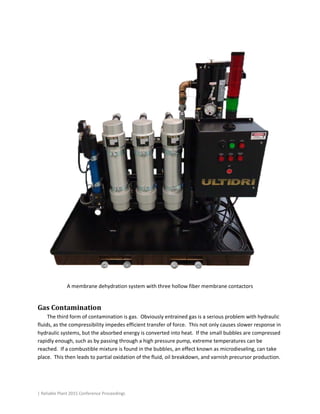
The final approach to dealing with water contamination is to use a membrane dehydration system.
These systems use a membrane contactor to which drives the oil into close contact with a moisture
Reliable Plant 2015 Conference Proceedings |
transfer membrane. This membrane is constructed of materials that facilitate the transfer of water
while preventing the transfer of the lubrication and hydraulic fluids and additives. A water
concentration difference is maintained across the membrane by continuously removing any water that
permeates across. This can be done with either a vacuum or with an ultra-dry sweep gas. If air is used
as an ultra-dry sweep gas, the product can be simply vented to atmosphere rather than creating a waste
stream requiring disposal, as some of the other approaches create.
Water transport through the wall of a hollow fiber membrane
While similar to vacuum dehydration in some ways in that it removes all forms of water (free,
emulsified, and dissolved), it alleviates some of the complications. Since the oil is never in direct contact
with the sweep gas, or vacuum, there is no need for liquid level controls. Likewise, since the vacuum or
gas is separated from the oil by the selective membrane, there is no foaming of the oil. Since the
membrane adds an extra barrier to mass transfer, the moisture removal from such a system has the
potential to be slower than a vacuum dehydration system, however. This can be compensated for by
the fact that it can operate with less user interface and can thus run 24/7.
| Reliable Plant 2015 Conference Proceedings
A membrane dehydration system with three hollow fiber membrane contactors
Gas Contamination
The third form of contamination is gas. Obviously entrained gas is a serious problem with hydraulic
fluids, as the compressibility impedes efficient transfer of force. This not only causes slower response in
hydraulic systems, but the absorbed energy is converted into heat. If the small bubbles are compressed
rapidly enough, such as by passing through a high pressure pump, extreme temperatures can be
reached. If a combustible mixture is found in the bubbles, an effect known as microdieseling, can take
place. This then leads to partial oxidation of the fluid, oil breakdown, and varnish precursor production.
Reliable Plant 2015 Conference Proceedings |
Even in more moderate pressure systems, air entrainment can cause problems. These include
cavitation in pumps, reduction of lubricity and thermal conductivity, and oxidation. Cavitation can take
place in pumps where the low pressure suction creates small bubbles that then collapse as the pump
pressurizes the liquid. This process not only reduces the efficiency of the pump and cause noise, it can
actually damage the pump over time.
Entrained gas bubbles can be very difficult to avoid in lubrication and hydraulic systems, as there is
inevitably contact with air at some point in the system, if only in a reservoir. Even if the system is
designed well enough not to ever pull air into a pump suction or allow bypass through a seal, any oil
exposed to air will become saturated with oxygen and nitrogen at the exposure pressure. If the
pressure on the oil later decreases, such as on the suction side of a pump or by passing through a
control orifice, the gas can come out of solution forming small bubbles. Equipment such as gearboxes
are ideal environments for mixing air and oil.
Gas Remediation
Gas contamination is difficult to avoid, as there are almost always points of contact between fluids
and air, if not other gases, in equipment. Thus the focus tends to be on remediation rather than
preventing ingression.
Gravitational settling of one form or the other is the primary method of separation. Considerable
work has gone on over the years to improve the “Air Release” of oils. This can be done by work on the
additive package, reducing molecules that can act as surfactants and including those that act as
defoaming agents. The process of air release is complicated by increasing viscosity, requiring longer
times for separation.
This separation process can take place in a reservoir, especially if it is well designed. Poorly
designed reservoirs return oil above the liquid surface causing air entrainment, or draw oil from the
same portion of the reservoir to which they return it, whereas well designed ones avoid these pitfalls. It
is important to note that any process that removes gas by settling will leave the oil saturated with the
gas. This process can never go below saturation.
Another location for gas separation is filtration. Filtration elements not only allow some residence
time for separation, but the media itself may aid in breaking the fluid surface tension and allowing
bubbles to collect and separate. These will then accumulate within the filter housing until vented.
These gather along with whatever air was introduced when the filter element was last changed. Ideally
housings are vented after filter change-out, but this frequently doesn’t happen and such housings are
rarely vented thereafter. This means that any oil passing through the filter housing will become
saturated with oxygen and nitrogen at the pressure of the housing, usually well above ambient.
Vacuum dehydration discussed under the water section is obviously very effective at removing
entrained, and even dissolved, air. Since the equipment creates a thin film of oil in a vacuum
environment, entrained air rapidly escapes along with the moisture. Dissolved air will tend, at a slower
rate, to evolve from the surface of the film into the vacuum environment.
| Reliable Plant 2015 Conference Proceedings
Membrane dehydration, also discussed in the last section, can potentially aid in gas removal. Pulling
a vacuum on the outside of the membrane creates a driving force for gases to diffuse across the
membrane out of the oil along with any water. Even if the system is operated using a dry sweep air
instead of vacuum, the sweep air is usually operated at a lower pressure than the oil, maintaining a
driving force for entrained and dissolved air to diffuse across the membrane and leave the oil. As long
as a membrane is chosen that allows for the transmission of nitrogen and oxygen (or other gases) as
well as water vapor, this may be an appropriate solution.
Conclusions
Contamination in fluid systems is a very involved topic and this paper is intended only as a general
introduction to the topic. There are a variety of approaches discussed here to cope with contamination
and prevent damage to expensive, and vital equipment. Choosing the right approach means having a
basic understanding of the requirements of the system, potential contamination sources, and the pluses
and minuses of different remediation options. Whenever possible, it is obviously best to prevent the
ingression of contamination in the first place, but this may not always be possible.
1 From “Part I - Oil Cleanliness: The Key To Equipment Reliability” in Maintenance Technology.
http://www.maintenancetechnology.com/2007/09/part-i-oil-cleanliness-the-key-to-equipment-
reliability/
2 GEK 110483b: Cleanliness Requirements for Power Plant Installation, Commissioning, and
Maintenance
3 “Reducing Gearbox Oil Contamination Levels, Machinery Lubrication 2011-03-14 by Matt
Spurlock http://www.machinerylubrication.com/Read/28393/gearbox-oil-contamination.
4 Oil cleanliness in Wind Power Gearboxes – Elforsk rapport 12:52 Jan Ukonsaari and Hans Moller,
October 2012
http://www.google.com/url?sa=t&rct=j&q=&esrc=s&frm=1&source=web&cd=5&ved=0CDcQFjA
E&url=http%3A%2F%2Felforsk.se%2FRapporter%2F%3Fdownload%3Dreport%26rid%3D12_52_
&ei=hFLRVIznHYHcggTW_IKgCw&usg=AFQjCNEAYXEisAX1JaJh67yPZZlXnPVMeg&bvm=bv.85076
809,d.eXY
5 Desiccant Breathers Prevent Bulk Fluids Moisture from Damaging Machine Components
http://caterpillarinformation.blogspot.com/2011/10/desiccant-breathers-prevent-bulk-
fluids.html

Contamination in lubricants

  • 1.
    Reliable Plant 2015Conference Proceedings | Lubricant Contamination – The Uninvited Guest Forms of Contamination and Methods for Remediation Robert O. Crowder, Ph.D. Lubrication and hydraulic fluids are central to the operation of industrial equipment. They provide cooling, sealing, lubrication, and sometimes even the motive power itself. In order to keep them and the equipment they protect functioning well, it is necessary to deal with the uninvited guest: Contamination. Others have estimated that “over 70% of equipment failures can be attributed to contamination.”1 Contamination is a catch-all for anything in the oil that isn’t supposed to be there. In order to understand what it is, where it comes from, and most importantly, how to deal with it, it’s necessary to take a closer look at the various kinds. In most lubrication and hydraulic fluids that contamination takes primarily three forms: Particulate, Water, and Gases. Particulate Contamination The first form of contamination is particulate. It is a catchall term for any solid particles in the fluid not part of the original formulation. This particulate can consist of metal particles, silica, oxidation products, polymeric materials, and even degradation particles from the oil itself. These particles come from a variety of sources both inside and outside the equipment. Particulate contamination is measured in the form of the number of particles per milliliter of fluid. In order to count the number of particles, a size range needs to be determined. The three most common are particles bigger than 4 micron, particles bigger than 6 micron, and particles bigger than 14 micron in size. Obviously a fluid will have far more particles bigger than 4 micron, than it will particles bigger than 14 micron. To make things slightly more confusing, these particle counts are usually expressed as an ISO code number. To determine which ISO code number a given particle count represents, Table 1 can be used: Table 1: ISO 4406:1999 Cleanliness Code ISO Code Number Number of Particles per Milliliter More Than Up To (including) 25 160,000 320,000 24 80,000 160,000 23 40,000 80,000 22 20,000 40,000 21 10,000 20,000
  • 2.
    | Reliable Plant2015 Conference Proceedings 20 5,000 10,000 19 2,500 5,000 18 1,300 2,500 17 640 1,300 16 320 640 15 160 320 14 80 160 13 40 80 12 20 40 11 10 20 10 5 10 9 2.5 5 8 1.3 2.5 7 0.64 1.3 6 0.32 0.64 5 0.16 0.32 For instance a particle count of 50 particles per ml would correspond to an ISO code of 13 (more than 40, but less than or equal to 80). These codes are usually expressed in threes, for greater than 4 micron, greater than 6 micron and greater than 14 micron. For example, 150,000 particles greater than 4 micron, 23,000 greater than 6 micron, and 690 greater than 14 micron would produce the ISO cleanliness code of 24/22/17. Some care must be taken because particle counts are occasionally reported per 100 ml rather than per ml, so the count must be divided by 100 before using the above chart. Obviously, cleaner is better, but not all equipment has the same requirements. Equipment should come from the manufacturer with a recommendation for the oil cleanliness, based upon lubrication/hydraulic fluid function and mechanical clearances. In general, for equipment like servo valves in hydraulic equipment with tight tolerances, cleanliness is more critical than for low-speed gearboxes. For instance GE recommends NAS class 5 (equivalent to ISO 16/14/11) for critical oil systems in their gas turbines and NAS class 8 (19/17/14) for controlled oil system fluids2 . NAS 1638 is an alternate cleanliness standard developed for aerospace components in the US and is still used in some cases. GE published a useful conversion table, shown here as table 2, although it’s important to realize that NAS covers many more categories and thus the conversion below is an approximation.
  • 3.
    Reliable Plant 2015Conference Proceedings | Oil manufacturers may also have their own recommendations. Exxon Mobil recommends 18/16/13 or better for turbine oils, for instance. Nor does all equipment represent the same risk in dollars and safety, so Noria has produced a table showing a Reliability Penalty Factor (RPF) vs. a Contaminant Severity Factor (CSF) for gearbox maintenance3 , shown here as Table 3. Table 3: Noria Target Cleanliness Grid3 Even for a relatively low speed gearbox, such as that in a wind turbine, removing particulate, especially larger particulate, can greatly increase the life of the life of the equipment. The next figure shows the life of the bearings in a wind gear box as a function of the filtration size in microns. Removing particles large enough to bridge the lubrication film between moving metal parts can dramatically increase the bearing life4 .
  • 4.
    | Reliable Plant2015 Conference Proceedings A handy tool for understanding the source of particulate contamination is a metals analysis. This is a common portion of an oil analysis which uses ICP-AES to determine which elements are present in the oil (ASTM D5185). Some metals such as iron, chromium, nickel, copper, and aluminum tend to represent machinery wear. They are likely generated within the equipment, and if present in rapidly increasing quantities, are an indication of possible problems. Elements such as zinc, phosphorous, magnesium, and molybdenum tend to represent additives present in new oil. Elements such as sodium, potassium, and especially silicon tend to indicate contamination from the outside environment and should focus attention to addressing the ingression. Particulate Remediation Filtration is obviously the most common method for dealing with particulate contamination. The filtration chosen needs to be appropriate for achieving the required cleanliness levels. A filtration system with a nominal 50 micron element will likely only have an effect on the largest particles, as represented by the first number of the ISO code. If the goal is to achieve lower counts at the 4 and 6 micron range, media with nominal pore sizes in those ranges need to be used. Such elements tend to
  • 5.
    Reliable Plant 2015Conference Proceedings | have higher pressure drops, and thus may be used in ways other than full flow, such as a kidney loop. These filtration elements need to be monitored and replaced as required to maintain effectiveness. Another important approach for dealing with particulate contamination is to address the source. If the oil analysis (ICP-AES data) indicates high concentrations of wear metals, the lubrication fluids should be examined for viscosity and water. If the fluid is no longer the correct viscosity, the lubrication ability may be severely impaired, requiring replacement. Water, especially free water, can reduce the lubrication ability, cause corrosion, hydrogen embrittlement, and reduce the additive package effectiveness, leading to equipment wear and increased particulate. Water as a contaminant will also be addressed in the next section. Particulate contamination, can also lead to increased particulate, as particles wear on metal parts and bridge the lubrication gap. Particulate contamination from the outside environment can come into the system through reservoir, or gearbox “breathing” as a result of liquid level changes or temperature changes. Filtration at the breather is a minimum to prevent excessive environmental particulate contamination. If the media is designed to be hydrophobic, it can also prevent water droplets from entering the reservoir or gearbox, although a simple filter will not prevent the intrusion of water vapor. A new approach is to use an Active Breather System, wherein clean dry air is used to continuously blanket the headspace of the reservoir or gearbox, continuously exiting the breather. This air can be supplied by a coalescer and membrane air dryer, ensuring that contaminated environmental air is never pulled into the system. Water Contamination The second form of contamination is water. This kind of contamination can take the form of visible, separated, free water, emulsified water (cloudy oil), or dissolved water (clear oil). Everyone understands that water is immiscible with oil (with the exception of certain base VI type oils), and will separate out, either as a layer of liquid water on the bottom of a reservoir, or as an emulsion in the oil making it cloudy or hazy. What many people don’t realize is that water is found in a third form in lubrication and hydraulic fluids, which is fully dissolved. Thus an oil sample may be completely clear, yet contain relatively high levels of water. There are a number of areas in which water is harmful in lubrication and hydraulic systems. As discussed in the last section, water can be a source of particulate contamination by causing a breakdown of the lubricity of the fluids. In this way, water prevents the fluids from forming the protective lubrication layer between moving metal parts, such as bearings, allowing metal to metal contact and producing wear. Water can also lead to corrosion of steel parts. This is especially true if the TAN (acid level) in the oil is allowed to rise. Even if the moisture level in the oil is below saturation, a condition that would normally prevent the water from contributing to corrosion, solubility is a strong function of temperature. In other words, once the oil cools, during equipment downtime, in a reservoir, after passing through a heat-exchanger, or simply due to environmental temperature fluctuations, the oil may
  • 6.
    | Reliable Plant2015 Conference Proceedings become supersaturated, producing free water. That water may then form films on surfaces, in crevices, or even condense in reservoir headspaces, allowing corrosion. The presence of water can cause hydrogen embrittlement, weakening or cracking steel surfaces. Hydrogen embrittlement happens when hydrogen atoms are allowed to permeate into the steel, due to their extremely small size. Once inside the steel parts, the hydrogen atoms can recombine into hydrogen molecules in small voids and defects within the steel. This then causes pressure within the metal, either making it more brittle, or in the worst cases, causing cracks and fractures. The most common source of hydrogen atoms in operating equipment, is water. Galvanic corrosion can break down the water, freeing atomic hydrogen atoms to then permeate the steel. Water can also degrade the oil itself. Free water can cause water soluble additives, or even partially soluble additives, to separate from the oil and form a sludge in the water phase, inactivating them. Dissolved water molecules will tend to cluster around polar functional groups on additives, such as the amines and hydroxyl groups on antioxidants, hindering them from reacting with free radicals on oil molecules. Water molecules can react directly with unsaturated bonds in oil molecules, producing polar functional groups and increasing the varnish potential. This is more of a concern for oils with a base oil type of I or II (API 1509, Appendix E), although even a base III type oil can have up to 10% unsaturation. Free or emulsified water can allow the growth of microbiological organisms within the oil, especially with some of the new, biodegradable oil. Finally, water can directly degrade some of the newer synthetic oils by severing ester linkages via hydrolysis, breaking the oil molecules apart and reducing the viscosity. Chemical reactions such as hydrolysis can take place even with water levels below saturation. There are several ways to detect and/or measure water in oil. The crackle test is one of the quickest, easiest, and least expensive, thus it is commonly used within the industry. This test consists of placing a drop of the oil onto a hot surface (approximately 320°F) and listening for crackling. The tester is also encouraged to look for any bubbles that appear within the oil. One disadvantage to this test, other than the difficulty of achieving a quantifiable result, is that it will indicate a negative if only dissolved water is present. This test can only detect free or emulsified water, and may thus give a false sense of security. The second method for measuring water in oil is a saturation meter. This approach measures the degree of saturation of the oil, usually using changes in capacitance of polymeric materials. It has the advantage that it can easily be plumbed inline for continuous measurement and monitoring of the oil. It is of no use, however, in measuring water content above saturation. It will only display 100% saturation. It can also be difficult to convert this reading into a ppm level, as the conversion is dependent on the saturation value of the oil at the operating conditions. If this is known, the conversion is a simple multiplication. Saturation values are frequently not known by the user, however, and change over time as well as by temperature. The most effective means of measuring water content in oil is by Karl Fischer titration. There are a number of devices on the market that will automatically titrate a sample, and these can be combined with an evaporator to avoid having to inject oil directly into the titration cell. KF titration and the crackle
  • 7.
    Reliable Plant 2015Conference Proceedings | test can both be selected as part of an oil analysis package by outside laboratories. KF titration will produce an absolute water content from a value down in the ppm range up to a couple of percent. It will also measure the moisture content above and below the saturation value of the oil. All of this brings up the question of what are saturation values for oil? How much water can oil hold before it becomes supersaturated and cloudy? It is not uncommon to see tables and charts that claim to show saturation values for various oil types at different temperatures. While there are trends in oil type, such as transformer oils having very low saturation values, other oils can display a wide range of saturation values depending on the base oil and additive package. In our laboratory we conducted experiments on a number of samples of wind turbine gear oils, all of which are ISO 320 gear oils. Table 4: ISO320 Gear Oil Water Saturation Values ISO 320 Gear Oil Type Water Saturation @ 50°C (ppm) Water Saturation @ 65°C (ppm) Castrol X320 430 515 Castrol A320 4100 Shell Omala HD320 875 Amsoil 320 485 As can be seen in Table 4, the saturation value can vary widely, even for oils intended for the same use. The saturation value is also a function of temperature. Cool oil can’t hold as much moisture. Some oils such as Castrol A320 have an additive package that appears to bind very tightly with water, giving very high saturation values that appear to vary quite a bit from sample to sample, perhaps based on remaining additive package. Some of these oils may contain very high levels of water without becoming supersaturated. This can be both a plus and a minus. Obviously oil with a high saturation value can handle much more moisture ingression before becoming cloudy and failing a crackle test, but it also means that there is already a large amount of water present, and removing that water becomes more difficult than for an oil with lower saturation values that separates naturally. Water Remediation As with particulate contamination, the problem of water contamination can be approached from two directions. Firstly, it is possible to try to prevent the ingression of water into the system in the first place. Water almost always comes into a system from outside in some way rather than being generated within, but in some cases, such as a leaking heat exchanger, or steam turbine seal bypass, it can be very difficult to prevent ingression altogether. Fresh oil also tends to come with some water content already, so even fresh oil isn’t necessarily a solution.
  • 8.
    | Reliable Plant2015 Conference Proceedings The most common source of water contamination for most systems is a breather on the gearbox or system reservoir. Changes in system and environment temperature as well as changes in lubrication or hydraulic fluid levels require occasional intake of air into the system. When the air in the headspace contracts, or the oil level decreases, something must enter the system to make up that volume difference. This is normally done by means of air intake through a breather. A breather with a hydrophobic filtration media may be effective at preventing ingression of most particulate and liquid water droplets, but any air pulled into the system will come in containing ambient water vapor. This can be dealt with by using a desiccant breather, an element on the breather that contains a hygroscopic desiccant which adsorbs most moisture of the incoming air, protecting the reservoir from that ingression mode. These usually come with a color indicator, so that the user knows when the desiccant is spent and the element needs to be replaced with a new one. For systems that are easily accessible and frequently monitored, this can be an effective method for preventing water ingression. For the modest cost and labor of replacing the desiccant breather, the system can be protected. A desiccant breather beginning to change color5 A newer, lower maintenance, method for preventing water ingression into reservoirs or gearboxes is to use a technology called an active breather system (ABS). In this case, compressed air from either a standard plant compressed air system, or from a small dedicated compressor, is filtered through a high efficiency coalescer, run through a hollow fiber membrane dryer, controlled through a regulator/orifice
  • 9.
    Reliable Plant 2015Conference Proceedings | assembly, and continuously fed into the reservoir or gearbox. Since this system continuously supplies clean, dry air into the headspace, it thus prevents the equipment from ever pulling outside, ambient air into the system. Such a system eliminates the need to monitor and change out desiccant elements, and since the air is extremely dry, it can actually strip moisture out of the exposed oil and equipment surfaces. Active Breather System (ABS) for continuous protection of reservoirs and gearboxes The second direction in approaching the issue of water contamination is to remove it from the lubrication and hydraulic fluid. In cases where water ingression is difficult or impossible to avoid, such as equipment with water wash-downs, imperfect steam seals, water fed heat exchangers, or
  • 10.
    | Reliable Plant2015 Conference Proceedings environmental exposure, this may be the only approach. In this case, there are a number of solutions on the market to strip moisture out of the oil once it is there. The most basic approach to remove free water from oil is to use a large reservoir with a significant residence time. Unless there is a stable emulsion, any free water will tend to settle to the bottom of the reservoir and can be periodically drained off. This approach has a couple of advantages. Firstly, there are frequently reservoirs associated with large equipment. Secondly, such reservoirs tend to be at a slightly lower temperature than the equipment itself, reducing water solubility, and enhancing the phase separation. The obvious disadvantages are that the draining must be done periodically, usually manually. In the meantime, water sits on the bottom of the reservoir, allowing corrosion and keeping the remaining oil saturated. And in the end, this approach can never remove moisture below the saturation level. The second method is to use an absorbent or adsorbent material. A desiccant such as molecular sieves can be used with oil just as it can be used with air, to remove moisture from the oil. The most common form of this approach is a filtration element made from a cellulose media. Not only does such a media filter the oil, but since the media is hydrophilic, it acts to pull some of the moisture out of the oil, at least until it becomes saturated. Cellulose elements are very effective at removing free and emulsified water, and if they are fresh enough, may even remove some of the dissolved water although they do not attract moisture as strongly as other materials such as molecular sieves. Once a cellulose element become saturated, however, it will no longer remove water and may in fact add it back to any subsaturated oil. Thus for this approach to be effective, the elements need to be regularly monitored and changed out for fresh. In high moisture situations, this may require frequent change outs. Also, this approach requires disposing of oily filtration elements. The third approach is to use a centrifugal separator to separate the two distinct phases based upon density differences. This approach is similar to the settling reservoir, but has the advantage of being much faster and allowing for smaller volumes and residence times. It also has the advantage of being able to break most emulsions through the high g-forces. The downsides of such equipment are that it requires level controls, involves moving parts and seals, and like gravity settling, will never pull the moisture level below saturation.
  • 11.
    Reliable Plant 2015Conference Proceedings | US Patent 4,175,040: Centrifugal Water Oil Separator The fourth approach is to use a liquid/liquid coalescing filtration element. Like settling and centrifugal separations, this approach relies upon the density difference between the water and oil to separate out into two distinct phases. This approach, however, uses a microporous filtration element designed with specialty media to coalesce the water droplets together as they pass through the element, making them large enough that they easily separate within the housing and settle to the bottom. Like the centrifugal separator these devices require much less residence time and volume than a gravity settling reservoir and will be somewhat successful in breaking emulsions, but this approach will also fail to remove moisture below the saturation level. It also requires periodic manual draining, or some sort of level controls. Coalescing elements also require prefiltration, or very clean oil, or the elements will become contaminated with particulate, and fail to operate effectively, if at all. Certain oil additives may also foul the elements. A fifth approach is to use a vacuum dehydrator. This equipment pumps the oil over a cone to create a thin layer while pulling a vacuum over the headspace to rapidly evaporate any moisture in the oil. Some systems apply extra heat to the oil prior to pumping it over the cone to enhance the effect. This type of equipment has a number of advantages. It has the potential to remove all three types of water, free, emulsified, and dissolved. Since the application of vacuum to the headspace effectively lowers the boiling point of water present in the oil, moisture can be rapidly removed down to levels below
  • 12.
    | Reliable Plant2015 Conference Proceedings saturation. The degree below saturation depends on a number of factors such as the residence time, the thickness of the oil film, the oil properties, and the degree of vacuum maintained. There are some drawbacks with this technology. These systems tend to be complicated, expensive, and more user intensive to run. They require liquid level controls in the vacuum chamber that can be complicated by foaming. As the water rapidly boils out of the oil, this can produce foaming in the oil, allowing oil to be pulled into the vacuum pump or gases to be carried back in the oil. The more complicated operation may require trained personnel to operate and experienced maintenance associates for upkeep. If heat was added to the oil, cooling may be required before returning to use. Mobile vacuum dehydration system The final approach to dealing with water contamination is to use a membrane dehydration system. These systems use a membrane contactor to which drives the oil into close contact with a moisture
  • 13.
    Reliable Plant 2015Conference Proceedings | transfer membrane. This membrane is constructed of materials that facilitate the transfer of water while preventing the transfer of the lubrication and hydraulic fluids and additives. A water concentration difference is maintained across the membrane by continuously removing any water that permeates across. This can be done with either a vacuum or with an ultra-dry sweep gas. If air is used as an ultra-dry sweep gas, the product can be simply vented to atmosphere rather than creating a waste stream requiring disposal, as some of the other approaches create. Water transport through the wall of a hollow fiber membrane While similar to vacuum dehydration in some ways in that it removes all forms of water (free, emulsified, and dissolved), it alleviates some of the complications. Since the oil is never in direct contact with the sweep gas, or vacuum, there is no need for liquid level controls. Likewise, since the vacuum or gas is separated from the oil by the selective membrane, there is no foaming of the oil. Since the membrane adds an extra barrier to mass transfer, the moisture removal from such a system has the potential to be slower than a vacuum dehydration system, however. This can be compensated for by the fact that it can operate with less user interface and can thus run 24/7.
  • 14.
    | Reliable Plant2015 Conference Proceedings A membrane dehydration system with three hollow fiber membrane contactors Gas Contamination The third form of contamination is gas. Obviously entrained gas is a serious problem with hydraulic fluids, as the compressibility impedes efficient transfer of force. This not only causes slower response in hydraulic systems, but the absorbed energy is converted into heat. If the small bubbles are compressed rapidly enough, such as by passing through a high pressure pump, extreme temperatures can be reached. If a combustible mixture is found in the bubbles, an effect known as microdieseling, can take place. This then leads to partial oxidation of the fluid, oil breakdown, and varnish precursor production.
  • 15.
    Reliable Plant 2015Conference Proceedings | Even in more moderate pressure systems, air entrainment can cause problems. These include cavitation in pumps, reduction of lubricity and thermal conductivity, and oxidation. Cavitation can take place in pumps where the low pressure suction creates small bubbles that then collapse as the pump pressurizes the liquid. This process not only reduces the efficiency of the pump and cause noise, it can actually damage the pump over time. Entrained gas bubbles can be very difficult to avoid in lubrication and hydraulic systems, as there is inevitably contact with air at some point in the system, if only in a reservoir. Even if the system is designed well enough not to ever pull air into a pump suction or allow bypass through a seal, any oil exposed to air will become saturated with oxygen and nitrogen at the exposure pressure. If the pressure on the oil later decreases, such as on the suction side of a pump or by passing through a control orifice, the gas can come out of solution forming small bubbles. Equipment such as gearboxes are ideal environments for mixing air and oil. Gas Remediation Gas contamination is difficult to avoid, as there are almost always points of contact between fluids and air, if not other gases, in equipment. Thus the focus tends to be on remediation rather than preventing ingression. Gravitational settling of one form or the other is the primary method of separation. Considerable work has gone on over the years to improve the “Air Release” of oils. This can be done by work on the additive package, reducing molecules that can act as surfactants and including those that act as defoaming agents. The process of air release is complicated by increasing viscosity, requiring longer times for separation. This separation process can take place in a reservoir, especially if it is well designed. Poorly designed reservoirs return oil above the liquid surface causing air entrainment, or draw oil from the same portion of the reservoir to which they return it, whereas well designed ones avoid these pitfalls. It is important to note that any process that removes gas by settling will leave the oil saturated with the gas. This process can never go below saturation. Another location for gas separation is filtration. Filtration elements not only allow some residence time for separation, but the media itself may aid in breaking the fluid surface tension and allowing bubbles to collect and separate. These will then accumulate within the filter housing until vented. These gather along with whatever air was introduced when the filter element was last changed. Ideally housings are vented after filter change-out, but this frequently doesn’t happen and such housings are rarely vented thereafter. This means that any oil passing through the filter housing will become saturated with oxygen and nitrogen at the pressure of the housing, usually well above ambient. Vacuum dehydration discussed under the water section is obviously very effective at removing entrained, and even dissolved, air. Since the equipment creates a thin film of oil in a vacuum environment, entrained air rapidly escapes along with the moisture. Dissolved air will tend, at a slower rate, to evolve from the surface of the film into the vacuum environment.
  • 16.
    | Reliable Plant2015 Conference Proceedings Membrane dehydration, also discussed in the last section, can potentially aid in gas removal. Pulling a vacuum on the outside of the membrane creates a driving force for gases to diffuse across the membrane out of the oil along with any water. Even if the system is operated using a dry sweep air instead of vacuum, the sweep air is usually operated at a lower pressure than the oil, maintaining a driving force for entrained and dissolved air to diffuse across the membrane and leave the oil. As long as a membrane is chosen that allows for the transmission of nitrogen and oxygen (or other gases) as well as water vapor, this may be an appropriate solution. Conclusions Contamination in fluid systems is a very involved topic and this paper is intended only as a general introduction to the topic. There are a variety of approaches discussed here to cope with contamination and prevent damage to expensive, and vital equipment. Choosing the right approach means having a basic understanding of the requirements of the system, potential contamination sources, and the pluses and minuses of different remediation options. Whenever possible, it is obviously best to prevent the ingression of contamination in the first place, but this may not always be possible. 1 From “Part I - Oil Cleanliness: The Key To Equipment Reliability” in Maintenance Technology. http://www.maintenancetechnology.com/2007/09/part-i-oil-cleanliness-the-key-to-equipment- reliability/ 2 GEK 110483b: Cleanliness Requirements for Power Plant Installation, Commissioning, and Maintenance 3 “Reducing Gearbox Oil Contamination Levels, Machinery Lubrication 2011-03-14 by Matt Spurlock http://www.machinerylubrication.com/Read/28393/gearbox-oil-contamination. 4 Oil cleanliness in Wind Power Gearboxes – Elforsk rapport 12:52 Jan Ukonsaari and Hans Moller, October 2012 http://www.google.com/url?sa=t&rct=j&q=&esrc=s&frm=1&source=web&cd=5&ved=0CDcQFjA E&url=http%3A%2F%2Felforsk.se%2FRapporter%2F%3Fdownload%3Dreport%26rid%3D12_52_ &ei=hFLRVIznHYHcggTW_IKgCw&usg=AFQjCNEAYXEisAX1JaJh67yPZZlXnPVMeg&bvm=bv.85076 809,d.eXY 5 Desiccant Breathers Prevent Bulk Fluids Moisture from Damaging Machine Components http://caterpillarinformation.blogspot.com/2011/10/desiccant-breathers-prevent-bulk- fluids.html