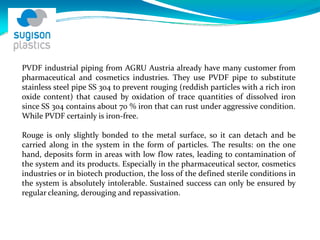
ADVANTAGES USING 
PVDF PIPING SYSTEM            VS        STAINLESS STEEL 
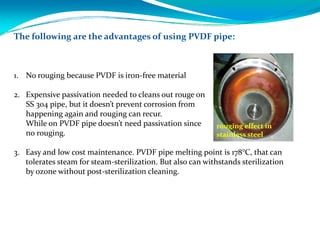
PVDF industrial piping from AGRU Austria already have many customer from
pharmaceutical and cosmetics industries. They use PVDF pipe to substitute
stainless steel pipe SS 304 to prevent rouging (reddish particles with a rich iron
oxide content) that caused by oxidation of trace quantities of dissolved iron
since SS 304 contains about 70 % iron that can rust under aggressive condition.
While PVDF certainly is iron‐free.
Rouge is only slightly bonded to the metal surface, so it can detach and be
carried along in the system in the form of particles. The results: on the one
hand, deposits form in areas with low flow rates, leading to contamination of
the system and its products. Especially in the pharmaceutical sector, cosmetics
industries or in biotech production, the loss of the defined sterile conditions in
the system is absolutely intolerable. Sustained success can only be ensured by
regular cleaning, derouging and repassivation.
The following are the advantages of using PVDF pipe:
1. No rouging because PVDF is iron‐free material 
2. Expensive passivation needed to cleans out rouge on 
SS 304 pipe, but it doesn’t prevent corrosion from 
happening again and rouging can recur. 
While on PVDF pipe doesn’t need passivation since 
no rouging.
3. Easy and low cost maintenance. PVDF pipe melting point is 178°C, that can
tolerates steam for steam‐sterilization. But also can withstands sterilization
by ozone without post‐sterilization cleaning.
rouging effect in 
stainless steel
4. PVDF is the hardest fluoropolymers and has among the highest tensile
strength in this family of plastics. It even has better abrasion resistance,
often referred to as particulation, than stainless steel. Particulation is
measured by the amount of polymer abraded from a surface by a rotating
wheel. PVDF's particulation is 5‐10 mg/1,000 cycles of rotation, while that
for SS 304 is about 50 mg/1,000 cycles.
5. PVDF have excellent chemical resistance including to deionized water, 
high thermal stability and they resist degradation by sunlight. Also, since they 
have low coefficients of slip, microorganisms (notably, fungi and bacteria) 
generally do not grow on them. On the contrary, metal surfaces cannot easily be 
smoothed out to a degree that can compete with plastics. 
6. PVDF is highly pure and contains no additives. Thus, nothing will leach out. 
PVDF and PP plastic systems are inherently superior to stainless steel in that 
they are manufactured from 100 % pure resin.
By this explanation, we can say that using PVDF pipe is more profitable than SS 304 
pipe because low material cost, low maintenance cost, long service life, and the 
most important is production shutdown prevention that caused by rough.
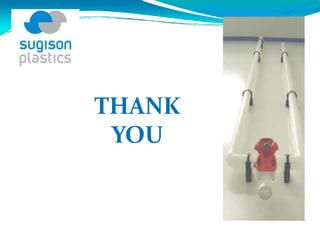
THANK 
YOU

Pvdf piping system vs stainless steel

  • 1.
  • 2.
    PVDF industrial pipingfrom AGRU Austria already have many customer from pharmaceutical and cosmetics industries. They use PVDF pipe to substitute stainless steel pipe SS 304 to prevent rouging (reddish particles with a rich iron oxide content) that caused by oxidation of trace quantities of dissolved iron since SS 304 contains about 70 % iron that can rust under aggressive condition. While PVDF certainly is iron‐free. Rouge is only slightly bonded to the metal surface, so it can detach and be carried along in the system in the form of particles. The results: on the one hand, deposits form in areas with low flow rates, leading to contamination of the system and its products. Especially in the pharmaceutical sector, cosmetics industries or in biotech production, the loss of the defined sterile conditions in the system is absolutely intolerable. Sustained success can only be ensured by regular cleaning, derouging and repassivation.
  • 3.
    The following are the advantages of using PVDF pipe: 1. No rouging because PVDF is iron‐free material  2. Expensive passivationneeded to cleans out rouge on  SS 304 pipe, but it doesn’t prevent corrosion from  happening again and rouging can recur.  While on PVDF pipe doesn’t need passivation since  no rouging. 3. Easy and low cost maintenance. PVDF pipe melting point is 178°C, that can tolerates steam for steam‐sterilization. But also can withstands sterilization by ozone without post‐sterilization cleaning. rouging effect in  stainless steel
  • 4.
    4. PVDF isthe hardest fluoropolymers and has among the highest tensile strength in this family of plastics. It even has better abrasion resistance, often referred to as particulation, than stainless steel. Particulation is measured by the amount of polymer abraded from a surface by a rotating wheel. PVDF's particulation is 5‐10 mg/1,000 cycles of rotation, while that for SS 304 is about 50 mg/1,000 cycles. 5. PVDF have excellent chemical resistance including to deionized water,  high thermal stability and they resist degradation by sunlight. Also, since they  have low coefficients of slip, microorganisms (notably, fungi and bacteria)  generally do not grow on them. On the contrary, metal surfaces cannot easily be  smoothed out to a degree that can compete with plastics.  6. PVDF is highly pure and contains no additives. Thus, nothing will leach out.  PVDF and PP plastic systems are inherently superior to stainless steel in that  they are manufactured from 100 % pure resin. By this explanation, we can say that using PVDF pipe is more profitable than SS 304  pipe because low material cost, low maintenance cost, long service life, and the  most important is production shutdown prevention that caused by rough.
  • 5.