1
Chapter 1
INTRODUCTION
1.1 Power generating station and types
A power generating station is basically an industrial location that is utilized for the
generation and distribution of electric power in mass scale, usually in the order of
several 1000 Watts. These are generally located at the sub-urban regions or several
kilometres away from the cities or the load centres, because of its requisites like huge
land and water demand, along with several operating constraints like the waste
disposal etc. For this reason, a power generating station has to not only take care of
efficient generation but also the fact that the power is transmitted efficiently over the
entire distance and that’s why, the transformer switch yard to regulate transmission
voltage also becomes an integral part of the power plant.
At the centre of it, however, nearly all power generating stations has an AC generator
or an alternator, which is basically a rotating machine that is equipped to convert
energy from the mechanical domain (rotating turbine) into electrical domain by
creating relative motion between a magnetic field and the conductors.
Power generating station fig no 1.1
2
Air pollution emission fig 1.1.2
1.2 Types of Power Station
A power plant can be of several types depending mainly on the type of fuel used.
Since for the purpose of bulk power generation, only thermal, nuclear and hydro
power comes handy, therefore a power generating station can be broadly classified in
the 3 above mentioned types. Let us have a look in these types of power stations in
details.
1.2.1 Thermal Power Station
A thermal power station or a coal fired thermal power plant is by far, the most
conventional method of generating electric power with reasonably high efficiency. It
uses coal as the primary fuel to boil the water available to superheated steam for
driving the steam turbine. The steam turbine is then mechanically coupled to an
alternator rotor, the rotation of which results in the generation of electric power.
3
Generally in India, bituminous coal or brown coal are used as fuel of boiler which has
volatile content ranging from 8 to 33% and ash content 5 to 16 %. To enhance the
thermal efficiency of the plant, the coal is used in the boiler in its pulverized form.
In coal fired thermal power plant, steam is obtained in very high pressure inside the
steam boiler by burning the pulverized coal. This steam is then super heated in the
super heater to extreme high temperature. This super heated steam is then allowed to
enter into the turbine, as the turbine blades are rotated by the pressure of the steam.
The turbine is mechanically coupled with alternator in a way that its rotor will rotate
with the rotation of turbine blades. After entering into the turbine, the steam pressure
suddenly falls leading to corresponding increase in the steam volume. After having
imparted energy into the turbine rotors, the steam is made to pass out of the turbine
blades into the steam condenser of turbine. In the condenser, cold water at ambient
temperature is circulated with the help of pump which leads to the condensation of the
low pressure wet steam.
Then this condensed water is further supplied to low pressure water heater where the
low pressure steam increases the temperature of this feed water, it is again heated in
high pressure. This outlines the basic working methodology of a thermal power plant.
Advantages of Thermal Power Plants
 Fuel used i.e. coal is quite cheaper.
 Initial cost is less as compared to other generating stations.
 It requires less space as compared to hydro-electric power stations.
Disadvantages of Thermal Power Plants
 It pollutes atmosphere due to production of smoke & fumes.
 Running cost of the power plant is more than hydro electric plant.
1.2.2 Nuclear Power Station
The nuclear power generating stations are similar to the thermal stations in more ways
than one. However, the exception here is that, radioactive elements like uranium and
thorium are used as the primary fuel in place of coal. Also in a nuclear station the
furnace and the boiler are replaced by the nuclear reactor and the heat exchanger
tubes. For the process of nuclear power generation, the radioactive fuels are made to
4
undergo fission reaction within the nuclear reactors. The fission reaction propagates
like a controlled chain reaction and is accompanied by unprecedented amount of
energy produced, which is manifested in the form of heat. This heat is then transferred
to the water present in the heat exchanger tubes. As a result, super heated steam at
very high temperature is produced. Once the process of steam formation is
accomplished, the remaining process is exactly similar to a thermal power plant, as
this steam will further drive the turbine blades to generate electricity.
1.2.3 Hydro-Electric Power Station
1. In Hydro-electric plants the energy of the falling water is utilized to drive the
turbine which in turn runs the generator to produce electricity. Rain falling
upon the earth’s surface has potential energy relative to the oceans towards
which it flows. This energy is converted to shaft work where the water falls
through an appreciable vertical distance. The hydraulic power is therefore a
naturally available renewable energy given by the equation:
P = g ρ QH
Where, g = acceleration due to gravity = 9.81 m/sec 2
ρ = density of water = 1000 kg/m 3
H = height of fall of water.
Advantages of Hydro Electric Power Station
 It requires no fuel; water is used for generation of electrical energy.
 It is neat and clean energy generation.
 Construction is simple, less maintenance is required.
 It helps in irrigation and flood control also.
Disadvantages Hydro Electric Power Station
 It involves high capital cost due to dam construction.
 Availability of water depends upon weather conditions.
 It requires high transmission cost as the plant is located in hilly areas.
5
1.3 Types of Power Generation
As mentioned above, depending on the type of fuel used, the power generating
stations as well as the types of power generation are classified. Therefore the 3 major
classifications for power production in reasonably large scale are:-
1. Thermal power generation.
2. Nuclear power generation.
3. Hydro-electric power generation.
Apart from these major types of power generations, we can resort to small scale
generation techniques as well, to serve the discrete demands. These are often referred
to as the alternative methods or non conventional energy of power generation and can
be classified as:-
1. Solar power generation. (making use of the available solar energy)
2. Geo-thermal power generation. (Energy available in the Earth’s crust)
3. Tidal power generation.
4. Wind power generation (energy available from the wind turbines)
These alternative sources of generation has been given due importance in the last few
decades owing to the depleting amount of the natural fuels available to us. In the
centuries to come, a stage might be reached when several countries across the globe
would run out of their entire reserve for fossil fuels. The only way forward would then
lie in the mercy of these alternative sources of energy which might play an
instrumental role in shaping the energy supplies of the future. For this reason these
might rightfully be referred as the energy of the future.
Chapter 2
Pollution due to power generation
Burning Coal in a power plant produces a number of pollutants. Some of these
pollutants are specific to the type of fuel or is part of the combustion process or
6
related to the design and configuration of the plant. This article highlights the major
pollutants discharged from the power plant
2.1 Carbon Dioxide (CO2)
CO2 was thought of as a product of combustion and not as a pollutant. Kyoto
protocol, effects of Green
House gases and global warming issues have changed the way we look at CO2.
CO2 has turned to be the major greenhouse gas. A fossil fuel power plant is the major
contributor of CO2.
One MJ of heat input produces 0.1 kg of CO2. The only way to eliminate CO2 is to
capture it before leaving to atmosphere. After capturing it has to be stored
permanently or sequestered. Commercially viable capture and sequestration systems
are yet to be in place. Till such time the only way is to
 Improve the power plant efficiency so that the reduced coal consumption reduces
CO2 per kwhr.
 Switch over from Fossil based energy sources to renewable sources like wind,
solar or hydro power.
 Reduce Deforestation and increase Afforestation to absorb the excess CO2
produced.
2.2 Sulphur Dioxide (SO2)
This is a product of Combustion and depends on the amount of Sulphur in Coal. This
is also referred to as SOx.
Sulphur in Coal ranges for 0.1 % to 3.5% depending on type and rank. During
combustion Sulfur combines with Oxygen to form SO2.
Power plants are the largest emitters of SO2. In the presence of other gases SO2 forms
Sulphuric acid and can precipitate down as acid rain leading to destruction of eco
systems.
Use of low Sulphur coals is the best ways to reduce the SO2 emissions.
Desulphurisation plants downstream of the boilers also reduce emissions. Fluidized
bed combustion of coal is another effective method to reduce SO2 emissions.
7
2.3 Ash
Ash is the residue after the combustion. A 500 MW coal fired power plant burning
Coal with around 20 % Ash, collects ash to the tune of Two Million Tons in Five
years. Cement plants may utilize a small portion of the ash. Disposing bulk of it on a
long term basis can raise major environmental issues.
 Ash contains toxic elements that can percolate into the drinking water system.
 The wind, breach of dykes or ash spills can carry away the ash particles to
surrounding areas causing harm to humans and vegetation
2.4 Particulate Matter
Power plants have elaborate arrangements to collect the ash. A small quantity still
goes out through the stack and is categorized as Particulate Matter emission.
The very tall stacks in power plants disperse this ash over a very wide area reducing
the concentration levels to human acceptable levels at ground levels.
The particles of size less than 2.5 microns called PM 2.5 is of great concern since
these are responsible for respiratory illness in humans.
2.5 Nitrogen Oxides (NOx)
Nitrogen in fuel and in the air reacts with Oxygen at high temperatures to form
various oxides of Nitrogen collectively called NOX. Fossil fuel power plants are the
second largest emitter of NOX.
This is a hazardous pollutant creating visual and respiratory problems. Also
NOX combines with water to form acid rain, smog, and ground ozone.
Design changes in combustion technology have helped in reducing the
NOX emissions. Methods like Selective Catalytic Reactors are used in power plants to
meet the emission regulations.
8
2.6 Impact on water
The water requirement for a coal-based power plant is about 0.005-0.18 m3/kwh. At
STPS, the water requirement has been marginally reduced from about 0.18 m3/kWh
to 0.15 m3/kwh after the installation of a treatment facility for the ash pond decant.
Still the water requirement of 0.15 m3/kwh = 150 Liters per Unit of electricity is very
high compared to the domestic requirement of water of a big city.
Ash pond decant contains harmful heavy metals like B, As, Hg which have a tendency
to leach out over a period of time. Due to this the ground water gets polluted and
becomes unsuitable for domestic use. At Ramagundam STPS leakage of the ash pond
decants was noticed into a small natural channel. This is harmful to the fisheries and
other aquatic biota in the water body. Similar findings were noted for Chandrapur.
The exposure of employees to high noise levels is very high in the coal based thermal
power plant. Moreover, the increased transportation activities due to the operation of
the power plant leads to an increase in noise levels in the adjacent localities.
2.7 Impact on land
The land requirement per mega watt of installed capacity for coal, gas and
hydroelectric power plants is 0.1-4.7 ha. 0.26 Ha. And 6.6 ha. respectively. In case of
coal based power plants the land requirement is generally near the area to the coal
mines. While in the case of gas-based it is any suitable land where the pipeline can be
taken economically. Land requirement of hydroelectric power plants is generally hilly
terrain and valleys. 321 ha., 2616 ha. and 74 ha. of land were used to dispose flyash
from the coal based plants at Ramagundam, Chandrapur and Gandhinagar
respectively. Thus large area of land is required for coal based thermal power plant.
Due to this, natural soil properties changes. It becomes more alkaline due to the
alkaline nature of fly ash.
9
2.8 Biological & thermal impact
The effect on biological environment can be divided into two parts, viz. the effect on
flora and the effect on fauna. Effect on flora is due to two main reasons, land
acquisition and due to flue gas emissions. Land acquisition leads to loss of habitat of
many species. The waste-water being at higher temperature (by 4-5oC) when
discharged can harm the local aquatic biota. The primary effects of thermal pollution
are direct thermal shocks, changes in dissolved oxygen, and the redistribution of
organisms in the local community. Because water can absorb thermal energy with
only small changes in temperature, most aquatic organisms have developed enzyme
systems that operate in only narrow ranges of temperature. These stenothermic
organisms can be killed by sudden temperature changes that are beyond the tolerance
limits of their metabolic systems. Periodic heat treatments used to keep the cooling
system clear of fouling organisms that clog the intake pipes can cause fish mortality
2.9 Socio-economic impact
The effect of power plants on the socio-economic environment is based on three
parameters, viz. Resettlement and Rehabilitation (R & R), effect on local civic
amenities and work related hazards to employees of the power plants. The
development of civic amenities due to the setting up of any power project is directly
proportional to the size of the project. The same has been observed to be the highest
for the coal based plants followed by the natural gas based plant and lastly the
hydroelectric plant. The coal based plant has the highest number of accidents due to
hazardous working conditions. A similar study was undertaken by Agrawal &
Agrawal3 (1989) in order to assess the impact of air pollutants on vegetation around
Obra thermal power plant (1550 MW) in the Mirzapur district of Uttar Pradesh. 5
study sites were selected northeast (prevailing wind) of the thermal power plant.
Responses of plants to pollutants in terms of presence of foliar injury symptoms and
changes in chlorophyll, ascorbic acid and S content were noted. These changes were
correlated with ambient SOx and suspended particulate matter (SPM) concentrations
and the amount of dust settled on leaf surfaces. The SOx and SPM concentrations
were quite high in the immediate vicinity of the power plant. There also exists a direct
10
relationship between the concentration of SPM in air and amount of dust deposited on
leaf surfaces. In a lichen diversity assessment carried out around a coal-based thermal
power plant by Bajpai ET al.4, (2010) indicated the increase in lichen abundance.
Distributions of heavy metals from power plant were observed in all directions.
Manohar et al.5, (1989) have carried out the study on effects of thermal power plant
emissions on atmospheric electrical parameters, as emissions from industrial stacks
may not only cause environmental and health problems but also cause substantial
deviation in the fair weather atmospheric electric parameters. Observations of the
surface atmospheric electric field, point discharge current and wind in the vicinity of a
thermal power plant were found to be affected. Warhate6 (2009) has studied the
impact of coal mining on Air, Water & Soil on the surrounding area of coal mining at
Wani dist. Yavatmal. Environmental segments namely air, water & soil in this area
are affected within 10-15 Kms from the source. Human beings, animal kingdom,
plants & soil are extensively affected within 5 Kms of the source
Chapter 3
Nuclear Pollution and its Impact on Environment
Any undesirable effect caused to the environment due to radioactive substances or
radiations is called nuclear pollution. Major source is the Nuclear power plants. If
traces of the radioactive substances are present in the water that is released from the
plant, it will cause nuclear pollution. Emission of radiations can also cause this kind
of pollution.
It affects almost all life forms in the surrounding environment. From planktons to
Human beings nothing is spared. To be more specific, the radiations can cause
mutations that lead to cancer, and the dose of radiation or the level of pollution
determines lethality or how deadly it is.
However, nuclear pollution is extremely hazardous in nature. It occurs as a result of
nuclear explosions that are performed while conducting nuclear tests. These nuclear
tests are carried out to invent better nuclear weapons. The explosions cause release of
15 to 20% radioactive material into the stratosphere.
11
On entering this layer, they start falling into the earth’s atmosphere. This fall can take
anywhere from 6months to several years. 5% of these radioactive particles enter
troposphere, which is the lowest layer of the atmosphere.
3.1 Nuclear Radiation:
Radiation is really nothing more than the emission of energy waves through space, as
well as through physical objects. Usually these energy waves are electromagnetic
radiation which is classified into Radio waves, Infrared waves, visible light,
Ultraviolet waves, X-ray, Gamma rays and Cosmic rays.
The actual radioactivity is a result of radioactive decay. The three types of radiation
with varying abilities to penetrate objects or bodies are: Alpha, Beta, and Gamma
radiation. You can shield yourself from alpha radiation by something as flimsy as a
sheet of paper. Beta rays need six millimetres of aluminium and gamma rays are
stopped by dense material only, like lead.
These travel easily through an inch of lead. And the higher you are in the Earth’s
atmosphere the more exposed you are to these rays because the further they travel into
our atmosphere the more they are slowed down. Astronauts are exposed to high levels
of cosmic radiation.
3.2 Disasters and Impacts:
It is considered to be the worst nuclear power plant disaster in history and the only
level 7 event on the International Nuclear Event Scale. It resulted in a severe release
of radioactivity following a massive power excursion that destroyed the reactor.
Most fatalities from the accident were caused by radiation poisoning. On April 26,
1986 at 01:23 a.m. (UTC+3), reactor number four at the Chernobyl plant, near Pripyat
in the Ukrainian Soviet Socialist Republic, had a fatal meltdown.
Further explosions and the resulting fire sent a plume of highly radioactive fallout into
the atmosphere and over an extensive geographical area, including the nearby town of
12
Pripyat. Four hundred times more fallout was released than had been by the atomic
bombing of Hiroshima. The plume drifted over large parts of the western Soviet
Union, Eastern Europe, Western Europe, and Northern Europe. Rain contaminated
with radioactive material fell as far away as Ireland.
Large areas in Ukraine, Belarus, and Russia were badly contaminated, resulting in the
evacuation and resettlement of over 336,000 people. According to official post-Soviet
data, about 60% of the radioactive fallout landed in Belarus.
Chapter 4
Environmental Impacts of Hydroelectric Power
Hydroelectric power includes both massive hydroelectric dams and small run-of-the-
river plants. Large-scale hydroelectric dams continue to be built in many parts of the
world (including China and Brazil), but it is unlikely that new facilities will be added
to the existing U.S. fleet in the future.
4.1 Land Use
The size of the reservoir created by a hydroelectric project can vary widely,
depending largely on the size of the hydroelectric generators and the topography of
the land. Hydroelectric plants in flat areas tend to require much more land than those
in hilly areas or canyons where deeper reservoirs can hold more volume of water in a
smaller space.
13
Hydroelectric Power fig no 4.1
4.2 Wildlife Impacts
Dammed reservoirs are used for multiple purposes, such as agricultural irrigation,
flood control, and recreation, so not all wildlife impacts associated with dams can be
directly attributed to hydroelectric power. However, hydroelectric facilities can still
have a major impact on aquatic ecosystems. For example, though there are a variety
of methods to minimize the impact (including fish ladders and in-take screens), fish
and other organisms can be injured and killed by turbine blades.
Apart from direct contact, there can also be wildlife impacts both within the dammed
reservoirs and downstream from the facility. Reservoir water is usually more stagnant
than normal river water. As a result, the reservoir will have higher than normal
amounts of sediments and nutrients, which can cultivate an excess of algae and other
aquatic weeds. These weeds can crowd out other river animal and plant-life, and they
must be controlled through manual harvesting or by introducing fish that eat these
plants.
14
4.3 Life-cycle Global Warming Emissions
Global warming emissions are produced during the installation and dismantling of
hydroelectric power plants, but recent research suggests that emissions during a
facility’s operation can also be significant. Such emissions vary greatly depending on
the size of the reservoir and the nature of the land that was flooded by the reservoir.
Small run-of-the-river plants emit between 0.01 and 0.03 pounds of carbon dioxide
equivalent per kilowatt-hour. Life-cycle emissions from large-scale hydroelectric
plants built in semi-arid regions are also modest: approximately 0.06 pounds of
carbon dioxide equivalent per kilowatt-hour. However, estimates for life-cycle global
warming emissions from hydroelectric plants built in tropical areas or temperate peat
lands are much higher. After the area is flooded, the vegetation and soil in these areas
decomposes and releases both carbon dioxide and methane. The exact amount of
emissions depends greatly on site-specific characteristics. However, current estimates
suggest that life-cycle emissions can be over 0.5 pounds of carbon dioxide equivalent
per kilowatt-hour.
Chapter 5
Environmental Impacts of Solar Power
The sun provides a tremendous resource for generating clean and sustainable
electricity without toxic pollution or global warming emissions.
The potential environmental impacts associated with solar power — land use and
habitat loss, water use, and the use of hazardous materials in manufacturing — can
vary greatly depending on the technology, which includes two broad categories:
photovoltaic (PV) solar cells or concentrating solar thermal plants (CSP).
The scale of the system — ranging from small, distributed rooftop PV arrays to large
utility-scale PV and CSP projects — also plays a significant role in the level of
environmental impact.
15
5.1 Land Use
Solar Power fig no 5.1
Depending on their location, larger utility-scale solar facilities can raise concerns
about land degradation and habitat loss. A total land area requirement varies
depending on the technology, the topography of the site, and the intensity of the solar
resource. Estimates for utility-scale PV systems range from 3.5 to 10 acres per
megawatt, while estimates for CSP facilities are between 4 and 16.5 acres per
megawatt
5.2 Water Use
Solar PV cells do not use water for generating electricity. However, as in all
manufacturing processes, some water is used to manufacture solar PV components.
Concentrating solar thermal plants (CSP), like all thermal electric plants, require
water for cooling. Water use depends on the plant design, plant location, and the type
of cooling system.
CSP plants that use wet-recalculating technology with cooling towers withdraw
between 600 and 650 gallons of water per megawatt-hour of electricity produced.
CSP plants with once-through cooling technology have higher levels of water
withdrawal, but lower total water consumption (because water is not lost as steam).
Dry-cooling technology can reduce water use at CSP plants by approximately 90
percent. However, the tradeoffs to these water savings are higher costs and lower
16
efficiencies. In addition, dry-cooling technology is significantly less effective at
temperatures above 100 degrees Fahrenheit.
5.3 Hazardous Materials
The PV cell manufacturing process includes a number of hazardous materials, most of
which are used to clean and purify the semiconductor surface. These chemicals,
similar to those used in the general semiconductor industry, include hydrochloric acid,
sulphuric acid, nitric acid, hydrogen fluoride, 1,1,1-trichloroethane, and acetone. The
amount and type of chemicals used depends on the type of cell, the amount of
cleaning that is needed, and the size of silicon wafer. Workers also face risks
associated with inhaling silicon dust. Thus, PV manufactures must follow U.S. laws to
ensure that workers are not harmed by exposure to these chemicals and that
manufacturing waste products are disposed of properly.
5.4 Life-Cycle Global Warming Emissions
While there are no global warming emissions associated with generating electricity
from solar energy, there are emissions associated with other stages of the solar life-
cycle, including manufacturing, materials transportation, installation, maintenance,
and decommissioning and dismantlement. Most estimates of life-cycle emissions for
photovoltaic systems are between 0.07 and 0.18 pounds of carbon dioxide equivalent
per kilowatt-hour.
Most estimates for concentrating solar power range from 0.08 to 0.2 pounds of carbon
dioxide equivalent per kilowatt-hour.
Chapter 6
Pollution due to Geo-thermal power generation
Geothermal electricity generation does involve a small amount of geothermal
pollution in that the steam coming up from below ground carries some toxic gases,
but in most plants these gases, as well as the steam, are condensed and re-injected into
the ground so the effect on the environment is negligible. There are no CO2 emissions
from geothermal energy so it is a much better source of electricity than coal or natural
17
gas or nuclear (or even large-scale hydro generation which requires the flooding of
large areas of land).
Geothermal heating and cooling only causes pollution to the extent that the electricity
source required to run a geothermal heat pump may come from a polluting source
such as coal. However, the amount of electricity used for geothermal heating and
cooling is typically about a quarter the electricity that would be required to heat or
cool the same space with electrical heaters and conventional air conditioning. And if
you install a home geothermal heat pump and buy your electricity from a green
electricity supplier, then you don’t have to worry about either geothermal pollution
from the heat pump system, or pollution from the electricity used to run it.
One way geothermal power plants avoid this problem is by installing Hydrogen
Sulphide Abatement Systems, which can remove up to 99.9 percent of the hydrogen
sulphide that would be released into the atmosphere. It is estimated that geothermal
dry-steam power plants produce only 0.0002 lbs/MWh of hydrogen sulphide and
about 0.35 lbs/MWh for flash power plants.
6.1 Environmental Impacts of Geothermal Energy
The most widely developed type of geothermal power plant (known as hydrothermal
plants) are located near geologic “hot spots” where hot molten rock is close to the
earth’s crust and produces hot water. In other regions enhanced geothermal systems
(or hot dry rock geothermal), which involve drilling into Earth’s surface to reach
deeper geothermal resources, can allow broader access to geothermal energy.
6.1.1 Water Quality and Use
Geothermal power plants can have impacts on both water quality and consumption.
Hot water pumped from underground reservoirs often contains high levels of sulfur,
salt, and other minerals. Most geothermal facilities have closed-loop water systems, in
which extracted water is pumped directly, back into the geothermal reservoir after it
has been used for heat or electricity production. In such systems, the water is
contained within steel well casings cemented to the surrounding rock. There have
been no reported cases of water contamination from geothermal sites in the United
State.
18
Water is also used by geothermal plants for cooling and re-injection. All U.S.
geothermal power facilities use wet-recalculating technology with cooling towers.
Depending on the cooling technology used, geothermal plants can require between
1,700 and 4,000 gallons of water per megawatt-hour. However, most geothermal
plants can use either geothermal fluid or freshwater for cooling; the use of geothermal
fluids rather than freshwater clearly reduces the plants overall water impact.
6.1.2 Air Emissions
The distinction between open- and closed-loop systems is important with respect to
air emissions. In closed-loop systems, gases removed from the well are not exposed to
the atmosphere and are injected back into the ground after giving up their heat, so air
emissions are minimal. In contrast, open-loop systems emit hydrogen sulphide,
carbon dioxide, ammonia, methane, and boron. Hydrogen sulphide, which has a
distinctive “rotten egg” smell, is the most common emission
6.1.3 Life-Cycle Global Warming Emissions
In open-loop geothermal systems, approximately 10 percent of the air emissions are
carbon dioxide, and a smaller amount of emissions are methane, a more potent global
warming gas. Estimates of global warming emissions for open-loop systems are
approximately 0.1 pounds of carbon dioxide equivalent per kilowatt-hour. In closed-
loop systems, these gases are not released into the atmosphere, but there are a still
some emissions associated with plant construction and surrounding infrastructure.
Chapter 7
Tidal Power- Environmental Impacts
Tidal power is being billed as a safe, clean, environmentally friendly alternative to
fossil fuels, but there are different kinds of tidal power. Find out how each one
interacts with the natural world and what the benefits and drawbacks are
7.1 Limitations
While tidal power is far more predictable than solar or wind, its periodic nature can
still be an issue (unless the design allows for reversible flow, power is only generated
19
during half of the tidal cycle, and, even if it can generate power in both directions, the
relative pauses between spring and neap tides will not generate significant power),
and placement of systems for optimal power still depend on the surrounding
geography, since confined watercourses experience greater fluctuations in height and
current.
According to Bernoulli’s principle, the velocity of a fluid flow and the cross-sectional
area of the aperture through which it flows are inversely proportional; this holds in the
case of water, even though it is not nearly as compressible as air. Further, in the case
of barrage tidal power systems, the aperture size has a strong influence on the overall
cost of the project. Thus, confined inlets and the like are an ideal location to consider.
7.2 Environmental Impacts
As for environmental impacts, some of the non-monetary costs associated with
barrage systems include destruction of habitat, interruption of organisms’ travel
routes, potential electromagnetic interference (in the case of species that can sense
electric fields), and potential acoustic pollution. In addition, hydroelectric systems are
well-known for killing fish, and the waste heat that ends up in the water reduces its
capacity to store dissolved oxygen, harming not only fish, but all organisms in the
affected area.
Chapter 8
Environmental Impacts of Wind Power
Harnessing power from the wind is one of the cleanest and most sustainable ways to
generate electricity as it produces no toxic pollution or global warming emissions.
Wind is also abundant, inexhaustible, and affordable, which makes it a viable and
large-scale alternative to fossil fuels.
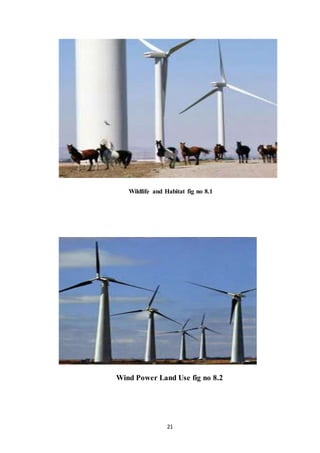
8.1 Land Use
The land use impact of wind power facilities varies substantially depending on the
site: wind turbines placed in flat areas typically use more land than those located in
20
hilly areas. However, wind turbines do not occupy all of this land; they must be
spaced approximately 5 to 10 rotor diameters apart (a rotor diameter is the diameter of
the wind turbine blades). Thus, the turbines themselves and the surrounding
infrastructure (including roads and transmission lines) occupy a small portion of the
total area of a wind facility.
A survey by the National Renewable Energy Laboratory of large wind facilities in the
United States found that they use between 30 and 141 acres per megawatt of power
output capacity (a typical new utility-scale wind turbine is about 2 megawatts).
However, less than 1 acre per megawatt is disturbed permanently and less than 3.5
acres per megawatt are disturbed temporarily during construction. The remainder of
the land can be used for a variety of other productive purposes, including livestock
grazing, agriculture, highways, and hiking trails. Alternatively, wind facilities can be
sited on brown fields (abandoned or underused industrial land) or other commercial
and industrial locations, which significantly reduces concerns about land use
8.2Wildlife and Habitat
The impact of wind turbines on wildlife, most notably on birds and bats, has been
widely document and studied. A recent National Wind Coordinating Committee
(NWCC) review of peer-reviewed research found evidence of bird and bat deaths
from collisions with wind turbines and due to changes in air pressure caused by the
spinning turbines, as well as from habitat disruption. The NWCC concluded that these
impacts are relatively low and do not pose a threat to species populations.
21
Wildlife and Habitat fig no 8.1
Wind Power Land Use fig no 8.2
22
Chapter 9
Pollution Control
We have methods that allow us to remove many of the solids, liquids, and gases
emitted from coal and other fossil fuel fired power plants but adding these pollution
control devices costs money. Governments and other organizations can enforce limits
on effluents or encourage/require the use of pollution control technology.
9.1 Pollution Reduction Technology:
 Flue Gas Combustion Modification
Modifying the oxygen content and/or the temperature of combustion can reduce the
concentration of volatile organic compounds and partially oxidized nitrogen
compounds.
 Electrostatic Precipitators
Solid or liquid particles supported in the effluent gas stream can pick up a charge and
be trapped in an electrically charged filtering device..
 Flue Gas De-acidifier
Nitric and sulphuric acids are formed in fossil fuel combustion. These can be removed
with wet scrubbers or by reaction with solid basic oxides.
Regulation
State and federal governments have the ability to regulate the industries within their
borders. Regulation relies on analytical chemistry to effluent quantities and
concentrations of polluting substances in the air.
23
Summery
A power generating station is basically an industrial location that is utilized for the
generation and distribution of electric power in mass scale, usually in the order of
several 1000 Watts. At the centre of it, however, nearly all power generating stations
has an AC generator or an alternator which is basically a rotating machine that is
equipped to convert energy from the mechanical domain (rotating turbine) into
electrical domain by creating relative motion between a magnetic field and the
conductors.
Then this condensed water is further supplied to low pressure water heater where the
low pressure steam increases the temperature of this feed water, it is again heated in
high pressure. This outlines the basic working methodology of a thermal power plant.
The nuclear power generating stations are similar to the thermal stations in more ways
than one. However, the exception here is that, radioactive elements like uranium and
thorium are used as the primary fuel in place of coal.
In Hydro-electric plants the energy of the falling water is utilized to drive the turbine
which in turn runs the generator to produce electricity. Rain falling upon the earth’s
surface has potential energy relative to the oceans towards which it flows
The effect on biological environment can be divided into two parts, viz. the effect on
flora and the effect on fauna. Effect on flora is due to two main reasons, land
acquisition and due to flue gas emissions. Land acquisition leads to loss of habitat of
many species. The waste-water being at higher temperature (by 4-5oC) when
discharged can harm the local aquatic biota.
The impact of wind turbines on wildlife, most notably on birds and bats, has been
widely document and studied. A recent National Wind Coordinating Committee
(NWCC) review of peer-reviewed research found evidence of bird and bat deaths
from collisions with wind turbines and due to changes in air pressure caused by the
spinning turbines, as well as from habitat disruption.
24
REFERENCES
1.0 https://en.wikipedia.org/wiki/Environmental_impact_of_electricity_generation
2.0 http://butane.chem.uiuc.edu/pshapley/environmental/l17/1.html
3.0 https://www.sourcewatch.org/index.php/Air_pollution_from_coal-
fired_power_plants

Pollution due to power generation (1)

  • 1.
    1 Chapter 1 INTRODUCTION 1.1 Powergenerating station and types A power generating station is basically an industrial location that is utilized for the generation and distribution of electric power in mass scale, usually in the order of several 1000 Watts. These are generally located at the sub-urban regions or several kilometres away from the cities or the load centres, because of its requisites like huge land and water demand, along with several operating constraints like the waste disposal etc. For this reason, a power generating station has to not only take care of efficient generation but also the fact that the power is transmitted efficiently over the entire distance and that’s why, the transformer switch yard to regulate transmission voltage also becomes an integral part of the power plant. At the centre of it, however, nearly all power generating stations has an AC generator or an alternator, which is basically a rotating machine that is equipped to convert energy from the mechanical domain (rotating turbine) into electrical domain by creating relative motion between a magnetic field and the conductors. Power generating station fig no 1.1
  • 2.
    2 Air pollution emissionfig 1.1.2 1.2 Types of Power Station A power plant can be of several types depending mainly on the type of fuel used. Since for the purpose of bulk power generation, only thermal, nuclear and hydro power comes handy, therefore a power generating station can be broadly classified in the 3 above mentioned types. Let us have a look in these types of power stations in details. 1.2.1 Thermal Power Station A thermal power station or a coal fired thermal power plant is by far, the most conventional method of generating electric power with reasonably high efficiency. It uses coal as the primary fuel to boil the water available to superheated steam for driving the steam turbine. The steam turbine is then mechanically coupled to an alternator rotor, the rotation of which results in the generation of electric power.
  • 3.
    3 Generally in India,bituminous coal or brown coal are used as fuel of boiler which has volatile content ranging from 8 to 33% and ash content 5 to 16 %. To enhance the thermal efficiency of the plant, the coal is used in the boiler in its pulverized form. In coal fired thermal power plant, steam is obtained in very high pressure inside the steam boiler by burning the pulverized coal. This steam is then super heated in the super heater to extreme high temperature. This super heated steam is then allowed to enter into the turbine, as the turbine blades are rotated by the pressure of the steam. The turbine is mechanically coupled with alternator in a way that its rotor will rotate with the rotation of turbine blades. After entering into the turbine, the steam pressure suddenly falls leading to corresponding increase in the steam volume. After having imparted energy into the turbine rotors, the steam is made to pass out of the turbine blades into the steam condenser of turbine. In the condenser, cold water at ambient temperature is circulated with the help of pump which leads to the condensation of the low pressure wet steam. Then this condensed water is further supplied to low pressure water heater where the low pressure steam increases the temperature of this feed water, it is again heated in high pressure. This outlines the basic working methodology of a thermal power plant. Advantages of Thermal Power Plants  Fuel used i.e. coal is quite cheaper.  Initial cost is less as compared to other generating stations.  It requires less space as compared to hydro-electric power stations. Disadvantages of Thermal Power Plants  It pollutes atmosphere due to production of smoke & fumes.  Running cost of the power plant is more than hydro electric plant. 1.2.2 Nuclear Power Station The nuclear power generating stations are similar to the thermal stations in more ways than one. However, the exception here is that, radioactive elements like uranium and thorium are used as the primary fuel in place of coal. Also in a nuclear station the furnace and the boiler are replaced by the nuclear reactor and the heat exchanger tubes. For the process of nuclear power generation, the radioactive fuels are made to
  • 4.
    4 undergo fission reactionwithin the nuclear reactors. The fission reaction propagates like a controlled chain reaction and is accompanied by unprecedented amount of energy produced, which is manifested in the form of heat. This heat is then transferred to the water present in the heat exchanger tubes. As a result, super heated steam at very high temperature is produced. Once the process of steam formation is accomplished, the remaining process is exactly similar to a thermal power plant, as this steam will further drive the turbine blades to generate electricity. 1.2.3 Hydro-Electric Power Station 1. In Hydro-electric plants the energy of the falling water is utilized to drive the turbine which in turn runs the generator to produce electricity. Rain falling upon the earth’s surface has potential energy relative to the oceans towards which it flows. This energy is converted to shaft work where the water falls through an appreciable vertical distance. The hydraulic power is therefore a naturally available renewable energy given by the equation: P = g ρ QH Where, g = acceleration due to gravity = 9.81 m/sec 2 ρ = density of water = 1000 kg/m 3 H = height of fall of water. Advantages of Hydro Electric Power Station  It requires no fuel; water is used for generation of electrical energy.  It is neat and clean energy generation.  Construction is simple, less maintenance is required.  It helps in irrigation and flood control also. Disadvantages Hydro Electric Power Station  It involves high capital cost due to dam construction.  Availability of water depends upon weather conditions.  It requires high transmission cost as the plant is located in hilly areas.
  • 5.
    5 1.3 Types ofPower Generation As mentioned above, depending on the type of fuel used, the power generating stations as well as the types of power generation are classified. Therefore the 3 major classifications for power production in reasonably large scale are:- 1. Thermal power generation. 2. Nuclear power generation. 3. Hydro-electric power generation. Apart from these major types of power generations, we can resort to small scale generation techniques as well, to serve the discrete demands. These are often referred to as the alternative methods or non conventional energy of power generation and can be classified as:- 1. Solar power generation. (making use of the available solar energy) 2. Geo-thermal power generation. (Energy available in the Earth’s crust) 3. Tidal power generation. 4. Wind power generation (energy available from the wind turbines) These alternative sources of generation has been given due importance in the last few decades owing to the depleting amount of the natural fuels available to us. In the centuries to come, a stage might be reached when several countries across the globe would run out of their entire reserve for fossil fuels. The only way forward would then lie in the mercy of these alternative sources of energy which might play an instrumental role in shaping the energy supplies of the future. For this reason these might rightfully be referred as the energy of the future. Chapter 2 Pollution due to power generation Burning Coal in a power plant produces a number of pollutants. Some of these pollutants are specific to the type of fuel or is part of the combustion process or
  • 6.
    6 related to thedesign and configuration of the plant. This article highlights the major pollutants discharged from the power plant 2.1 Carbon Dioxide (CO2) CO2 was thought of as a product of combustion and not as a pollutant. Kyoto protocol, effects of Green House gases and global warming issues have changed the way we look at CO2. CO2 has turned to be the major greenhouse gas. A fossil fuel power plant is the major contributor of CO2. One MJ of heat input produces 0.1 kg of CO2. The only way to eliminate CO2 is to capture it before leaving to atmosphere. After capturing it has to be stored permanently or sequestered. Commercially viable capture and sequestration systems are yet to be in place. Till such time the only way is to  Improve the power plant efficiency so that the reduced coal consumption reduces CO2 per kwhr.  Switch over from Fossil based energy sources to renewable sources like wind, solar or hydro power.  Reduce Deforestation and increase Afforestation to absorb the excess CO2 produced. 2.2 Sulphur Dioxide (SO2) This is a product of Combustion and depends on the amount of Sulphur in Coal. This is also referred to as SOx. Sulphur in Coal ranges for 0.1 % to 3.5% depending on type and rank. During combustion Sulfur combines with Oxygen to form SO2. Power plants are the largest emitters of SO2. In the presence of other gases SO2 forms Sulphuric acid and can precipitate down as acid rain leading to destruction of eco systems. Use of low Sulphur coals is the best ways to reduce the SO2 emissions. Desulphurisation plants downstream of the boilers also reduce emissions. Fluidized bed combustion of coal is another effective method to reduce SO2 emissions.
  • 7.
    7 2.3 Ash Ash isthe residue after the combustion. A 500 MW coal fired power plant burning Coal with around 20 % Ash, collects ash to the tune of Two Million Tons in Five years. Cement plants may utilize a small portion of the ash. Disposing bulk of it on a long term basis can raise major environmental issues.  Ash contains toxic elements that can percolate into the drinking water system.  The wind, breach of dykes or ash spills can carry away the ash particles to surrounding areas causing harm to humans and vegetation 2.4 Particulate Matter Power plants have elaborate arrangements to collect the ash. A small quantity still goes out through the stack and is categorized as Particulate Matter emission. The very tall stacks in power plants disperse this ash over a very wide area reducing the concentration levels to human acceptable levels at ground levels. The particles of size less than 2.5 microns called PM 2.5 is of great concern since these are responsible for respiratory illness in humans. 2.5 Nitrogen Oxides (NOx) Nitrogen in fuel and in the air reacts with Oxygen at high temperatures to form various oxides of Nitrogen collectively called NOX. Fossil fuel power plants are the second largest emitter of NOX. This is a hazardous pollutant creating visual and respiratory problems. Also NOX combines with water to form acid rain, smog, and ground ozone. Design changes in combustion technology have helped in reducing the NOX emissions. Methods like Selective Catalytic Reactors are used in power plants to meet the emission regulations.
  • 8.
    8 2.6 Impact onwater The water requirement for a coal-based power plant is about 0.005-0.18 m3/kwh. At STPS, the water requirement has been marginally reduced from about 0.18 m3/kWh to 0.15 m3/kwh after the installation of a treatment facility for the ash pond decant. Still the water requirement of 0.15 m3/kwh = 150 Liters per Unit of electricity is very high compared to the domestic requirement of water of a big city. Ash pond decant contains harmful heavy metals like B, As, Hg which have a tendency to leach out over a period of time. Due to this the ground water gets polluted and becomes unsuitable for domestic use. At Ramagundam STPS leakage of the ash pond decants was noticed into a small natural channel. This is harmful to the fisheries and other aquatic biota in the water body. Similar findings were noted for Chandrapur. The exposure of employees to high noise levels is very high in the coal based thermal power plant. Moreover, the increased transportation activities due to the operation of the power plant leads to an increase in noise levels in the adjacent localities. 2.7 Impact on land The land requirement per mega watt of installed capacity for coal, gas and hydroelectric power plants is 0.1-4.7 ha. 0.26 Ha. And 6.6 ha. respectively. In case of coal based power plants the land requirement is generally near the area to the coal mines. While in the case of gas-based it is any suitable land where the pipeline can be taken economically. Land requirement of hydroelectric power plants is generally hilly terrain and valleys. 321 ha., 2616 ha. and 74 ha. of land were used to dispose flyash from the coal based plants at Ramagundam, Chandrapur and Gandhinagar respectively. Thus large area of land is required for coal based thermal power plant. Due to this, natural soil properties changes. It becomes more alkaline due to the alkaline nature of fly ash.
  • 9.
    9 2.8 Biological &thermal impact The effect on biological environment can be divided into two parts, viz. the effect on flora and the effect on fauna. Effect on flora is due to two main reasons, land acquisition and due to flue gas emissions. Land acquisition leads to loss of habitat of many species. The waste-water being at higher temperature (by 4-5oC) when discharged can harm the local aquatic biota. The primary effects of thermal pollution are direct thermal shocks, changes in dissolved oxygen, and the redistribution of organisms in the local community. Because water can absorb thermal energy with only small changes in temperature, most aquatic organisms have developed enzyme systems that operate in only narrow ranges of temperature. These stenothermic organisms can be killed by sudden temperature changes that are beyond the tolerance limits of their metabolic systems. Periodic heat treatments used to keep the cooling system clear of fouling organisms that clog the intake pipes can cause fish mortality 2.9 Socio-economic impact The effect of power plants on the socio-economic environment is based on three parameters, viz. Resettlement and Rehabilitation (R & R), effect on local civic amenities and work related hazards to employees of the power plants. The development of civic amenities due to the setting up of any power project is directly proportional to the size of the project. The same has been observed to be the highest for the coal based plants followed by the natural gas based plant and lastly the hydroelectric plant. The coal based plant has the highest number of accidents due to hazardous working conditions. A similar study was undertaken by Agrawal & Agrawal3 (1989) in order to assess the impact of air pollutants on vegetation around Obra thermal power plant (1550 MW) in the Mirzapur district of Uttar Pradesh. 5 study sites were selected northeast (prevailing wind) of the thermal power plant. Responses of plants to pollutants in terms of presence of foliar injury symptoms and changes in chlorophyll, ascorbic acid and S content were noted. These changes were correlated with ambient SOx and suspended particulate matter (SPM) concentrations and the amount of dust settled on leaf surfaces. The SOx and SPM concentrations were quite high in the immediate vicinity of the power plant. There also exists a direct
  • 10.
    10 relationship between theconcentration of SPM in air and amount of dust deposited on leaf surfaces. In a lichen diversity assessment carried out around a coal-based thermal power plant by Bajpai ET al.4, (2010) indicated the increase in lichen abundance. Distributions of heavy metals from power plant were observed in all directions. Manohar et al.5, (1989) have carried out the study on effects of thermal power plant emissions on atmospheric electrical parameters, as emissions from industrial stacks may not only cause environmental and health problems but also cause substantial deviation in the fair weather atmospheric electric parameters. Observations of the surface atmospheric electric field, point discharge current and wind in the vicinity of a thermal power plant were found to be affected. Warhate6 (2009) has studied the impact of coal mining on Air, Water & Soil on the surrounding area of coal mining at Wani dist. Yavatmal. Environmental segments namely air, water & soil in this area are affected within 10-15 Kms from the source. Human beings, animal kingdom, plants & soil are extensively affected within 5 Kms of the source Chapter 3 Nuclear Pollution and its Impact on Environment Any undesirable effect caused to the environment due to radioactive substances or radiations is called nuclear pollution. Major source is the Nuclear power plants. If traces of the radioactive substances are present in the water that is released from the plant, it will cause nuclear pollution. Emission of radiations can also cause this kind of pollution. It affects almost all life forms in the surrounding environment. From planktons to Human beings nothing is spared. To be more specific, the radiations can cause mutations that lead to cancer, and the dose of radiation or the level of pollution determines lethality or how deadly it is. However, nuclear pollution is extremely hazardous in nature. It occurs as a result of nuclear explosions that are performed while conducting nuclear tests. These nuclear tests are carried out to invent better nuclear weapons. The explosions cause release of 15 to 20% radioactive material into the stratosphere.
  • 11.
    11 On entering thislayer, they start falling into the earth’s atmosphere. This fall can take anywhere from 6months to several years. 5% of these radioactive particles enter troposphere, which is the lowest layer of the atmosphere. 3.1 Nuclear Radiation: Radiation is really nothing more than the emission of energy waves through space, as well as through physical objects. Usually these energy waves are electromagnetic radiation which is classified into Radio waves, Infrared waves, visible light, Ultraviolet waves, X-ray, Gamma rays and Cosmic rays. The actual radioactivity is a result of radioactive decay. The three types of radiation with varying abilities to penetrate objects or bodies are: Alpha, Beta, and Gamma radiation. You can shield yourself from alpha radiation by something as flimsy as a sheet of paper. Beta rays need six millimetres of aluminium and gamma rays are stopped by dense material only, like lead. These travel easily through an inch of lead. And the higher you are in the Earth’s atmosphere the more exposed you are to these rays because the further they travel into our atmosphere the more they are slowed down. Astronauts are exposed to high levels of cosmic radiation. 3.2 Disasters and Impacts: It is considered to be the worst nuclear power plant disaster in history and the only level 7 event on the International Nuclear Event Scale. It resulted in a severe release of radioactivity following a massive power excursion that destroyed the reactor. Most fatalities from the accident were caused by radiation poisoning. On April 26, 1986 at 01:23 a.m. (UTC+3), reactor number four at the Chernobyl plant, near Pripyat in the Ukrainian Soviet Socialist Republic, had a fatal meltdown. Further explosions and the resulting fire sent a plume of highly radioactive fallout into the atmosphere and over an extensive geographical area, including the nearby town of
  • 12.
    12 Pripyat. Four hundredtimes more fallout was released than had been by the atomic bombing of Hiroshima. The plume drifted over large parts of the western Soviet Union, Eastern Europe, Western Europe, and Northern Europe. Rain contaminated with radioactive material fell as far away as Ireland. Large areas in Ukraine, Belarus, and Russia were badly contaminated, resulting in the evacuation and resettlement of over 336,000 people. According to official post-Soviet data, about 60% of the radioactive fallout landed in Belarus. Chapter 4 Environmental Impacts of Hydroelectric Power Hydroelectric power includes both massive hydroelectric dams and small run-of-the- river plants. Large-scale hydroelectric dams continue to be built in many parts of the world (including China and Brazil), but it is unlikely that new facilities will be added to the existing U.S. fleet in the future. 4.1 Land Use The size of the reservoir created by a hydroelectric project can vary widely, depending largely on the size of the hydroelectric generators and the topography of the land. Hydroelectric plants in flat areas tend to require much more land than those in hilly areas or canyons where deeper reservoirs can hold more volume of water in a smaller space.
  • 13.
    13 Hydroelectric Power figno 4.1 4.2 Wildlife Impacts Dammed reservoirs are used for multiple purposes, such as agricultural irrigation, flood control, and recreation, so not all wildlife impacts associated with dams can be directly attributed to hydroelectric power. However, hydroelectric facilities can still have a major impact on aquatic ecosystems. For example, though there are a variety of methods to minimize the impact (including fish ladders and in-take screens), fish and other organisms can be injured and killed by turbine blades. Apart from direct contact, there can also be wildlife impacts both within the dammed reservoirs and downstream from the facility. Reservoir water is usually more stagnant than normal river water. As a result, the reservoir will have higher than normal amounts of sediments and nutrients, which can cultivate an excess of algae and other aquatic weeds. These weeds can crowd out other river animal and plant-life, and they must be controlled through manual harvesting or by introducing fish that eat these plants.
  • 14.
    14 4.3 Life-cycle GlobalWarming Emissions Global warming emissions are produced during the installation and dismantling of hydroelectric power plants, but recent research suggests that emissions during a facility’s operation can also be significant. Such emissions vary greatly depending on the size of the reservoir and the nature of the land that was flooded by the reservoir. Small run-of-the-river plants emit between 0.01 and 0.03 pounds of carbon dioxide equivalent per kilowatt-hour. Life-cycle emissions from large-scale hydroelectric plants built in semi-arid regions are also modest: approximately 0.06 pounds of carbon dioxide equivalent per kilowatt-hour. However, estimates for life-cycle global warming emissions from hydroelectric plants built in tropical areas or temperate peat lands are much higher. After the area is flooded, the vegetation and soil in these areas decomposes and releases both carbon dioxide and methane. The exact amount of emissions depends greatly on site-specific characteristics. However, current estimates suggest that life-cycle emissions can be over 0.5 pounds of carbon dioxide equivalent per kilowatt-hour. Chapter 5 Environmental Impacts of Solar Power The sun provides a tremendous resource for generating clean and sustainable electricity without toxic pollution or global warming emissions. The potential environmental impacts associated with solar power — land use and habitat loss, water use, and the use of hazardous materials in manufacturing — can vary greatly depending on the technology, which includes two broad categories: photovoltaic (PV) solar cells or concentrating solar thermal plants (CSP). The scale of the system — ranging from small, distributed rooftop PV arrays to large utility-scale PV and CSP projects — also plays a significant role in the level of environmental impact.
  • 15.
    15 5.1 Land Use SolarPower fig no 5.1 Depending on their location, larger utility-scale solar facilities can raise concerns about land degradation and habitat loss. A total land area requirement varies depending on the technology, the topography of the site, and the intensity of the solar resource. Estimates for utility-scale PV systems range from 3.5 to 10 acres per megawatt, while estimates for CSP facilities are between 4 and 16.5 acres per megawatt 5.2 Water Use Solar PV cells do not use water for generating electricity. However, as in all manufacturing processes, some water is used to manufacture solar PV components. Concentrating solar thermal plants (CSP), like all thermal electric plants, require water for cooling. Water use depends on the plant design, plant location, and the type of cooling system. CSP plants that use wet-recalculating technology with cooling towers withdraw between 600 and 650 gallons of water per megawatt-hour of electricity produced. CSP plants with once-through cooling technology have higher levels of water withdrawal, but lower total water consumption (because water is not lost as steam). Dry-cooling technology can reduce water use at CSP plants by approximately 90 percent. However, the tradeoffs to these water savings are higher costs and lower
  • 16.
    16 efficiencies. In addition,dry-cooling technology is significantly less effective at temperatures above 100 degrees Fahrenheit. 5.3 Hazardous Materials The PV cell manufacturing process includes a number of hazardous materials, most of which are used to clean and purify the semiconductor surface. These chemicals, similar to those used in the general semiconductor industry, include hydrochloric acid, sulphuric acid, nitric acid, hydrogen fluoride, 1,1,1-trichloroethane, and acetone. The amount and type of chemicals used depends on the type of cell, the amount of cleaning that is needed, and the size of silicon wafer. Workers also face risks associated with inhaling silicon dust. Thus, PV manufactures must follow U.S. laws to ensure that workers are not harmed by exposure to these chemicals and that manufacturing waste products are disposed of properly. 5.4 Life-Cycle Global Warming Emissions While there are no global warming emissions associated with generating electricity from solar energy, there are emissions associated with other stages of the solar life- cycle, including manufacturing, materials transportation, installation, maintenance, and decommissioning and dismantlement. Most estimates of life-cycle emissions for photovoltaic systems are between 0.07 and 0.18 pounds of carbon dioxide equivalent per kilowatt-hour. Most estimates for concentrating solar power range from 0.08 to 0.2 pounds of carbon dioxide equivalent per kilowatt-hour. Chapter 6 Pollution due to Geo-thermal power generation Geothermal electricity generation does involve a small amount of geothermal pollution in that the steam coming up from below ground carries some toxic gases, but in most plants these gases, as well as the steam, are condensed and re-injected into the ground so the effect on the environment is negligible. There are no CO2 emissions from geothermal energy so it is a much better source of electricity than coal or natural
  • 17.
    17 gas or nuclear(or even large-scale hydro generation which requires the flooding of large areas of land). Geothermal heating and cooling only causes pollution to the extent that the electricity source required to run a geothermal heat pump may come from a polluting source such as coal. However, the amount of electricity used for geothermal heating and cooling is typically about a quarter the electricity that would be required to heat or cool the same space with electrical heaters and conventional air conditioning. And if you install a home geothermal heat pump and buy your electricity from a green electricity supplier, then you don’t have to worry about either geothermal pollution from the heat pump system, or pollution from the electricity used to run it. One way geothermal power plants avoid this problem is by installing Hydrogen Sulphide Abatement Systems, which can remove up to 99.9 percent of the hydrogen sulphide that would be released into the atmosphere. It is estimated that geothermal dry-steam power plants produce only 0.0002 lbs/MWh of hydrogen sulphide and about 0.35 lbs/MWh for flash power plants. 6.1 Environmental Impacts of Geothermal Energy The most widely developed type of geothermal power plant (known as hydrothermal plants) are located near geologic “hot spots” where hot molten rock is close to the earth’s crust and produces hot water. In other regions enhanced geothermal systems (or hot dry rock geothermal), which involve drilling into Earth’s surface to reach deeper geothermal resources, can allow broader access to geothermal energy. 6.1.1 Water Quality and Use Geothermal power plants can have impacts on both water quality and consumption. Hot water pumped from underground reservoirs often contains high levels of sulfur, salt, and other minerals. Most geothermal facilities have closed-loop water systems, in which extracted water is pumped directly, back into the geothermal reservoir after it has been used for heat or electricity production. In such systems, the water is contained within steel well casings cemented to the surrounding rock. There have been no reported cases of water contamination from geothermal sites in the United State.
  • 18.
    18 Water is alsoused by geothermal plants for cooling and re-injection. All U.S. geothermal power facilities use wet-recalculating technology with cooling towers. Depending on the cooling technology used, geothermal plants can require between 1,700 and 4,000 gallons of water per megawatt-hour. However, most geothermal plants can use either geothermal fluid or freshwater for cooling; the use of geothermal fluids rather than freshwater clearly reduces the plants overall water impact. 6.1.2 Air Emissions The distinction between open- and closed-loop systems is important with respect to air emissions. In closed-loop systems, gases removed from the well are not exposed to the atmosphere and are injected back into the ground after giving up their heat, so air emissions are minimal. In contrast, open-loop systems emit hydrogen sulphide, carbon dioxide, ammonia, methane, and boron. Hydrogen sulphide, which has a distinctive “rotten egg” smell, is the most common emission 6.1.3 Life-Cycle Global Warming Emissions In open-loop geothermal systems, approximately 10 percent of the air emissions are carbon dioxide, and a smaller amount of emissions are methane, a more potent global warming gas. Estimates of global warming emissions for open-loop systems are approximately 0.1 pounds of carbon dioxide equivalent per kilowatt-hour. In closed- loop systems, these gases are not released into the atmosphere, but there are a still some emissions associated with plant construction and surrounding infrastructure. Chapter 7 Tidal Power- Environmental Impacts Tidal power is being billed as a safe, clean, environmentally friendly alternative to fossil fuels, but there are different kinds of tidal power. Find out how each one interacts with the natural world and what the benefits and drawbacks are 7.1 Limitations While tidal power is far more predictable than solar or wind, its periodic nature can still be an issue (unless the design allows for reversible flow, power is only generated
  • 19.
    19 during half ofthe tidal cycle, and, even if it can generate power in both directions, the relative pauses between spring and neap tides will not generate significant power), and placement of systems for optimal power still depend on the surrounding geography, since confined watercourses experience greater fluctuations in height and current. According to Bernoulli’s principle, the velocity of a fluid flow and the cross-sectional area of the aperture through which it flows are inversely proportional; this holds in the case of water, even though it is not nearly as compressible as air. Further, in the case of barrage tidal power systems, the aperture size has a strong influence on the overall cost of the project. Thus, confined inlets and the like are an ideal location to consider. 7.2 Environmental Impacts As for environmental impacts, some of the non-monetary costs associated with barrage systems include destruction of habitat, interruption of organisms’ travel routes, potential electromagnetic interference (in the case of species that can sense electric fields), and potential acoustic pollution. In addition, hydroelectric systems are well-known for killing fish, and the waste heat that ends up in the water reduces its capacity to store dissolved oxygen, harming not only fish, but all organisms in the affected area. Chapter 8 Environmental Impacts of Wind Power Harnessing power from the wind is one of the cleanest and most sustainable ways to generate electricity as it produces no toxic pollution or global warming emissions. Wind is also abundant, inexhaustible, and affordable, which makes it a viable and large-scale alternative to fossil fuels. 8.1 Land Use The land use impact of wind power facilities varies substantially depending on the site: wind turbines placed in flat areas typically use more land than those located in
  • 20.
    20 hilly areas. However,wind turbines do not occupy all of this land; they must be spaced approximately 5 to 10 rotor diameters apart (a rotor diameter is the diameter of the wind turbine blades). Thus, the turbines themselves and the surrounding infrastructure (including roads and transmission lines) occupy a small portion of the total area of a wind facility. A survey by the National Renewable Energy Laboratory of large wind facilities in the United States found that they use between 30 and 141 acres per megawatt of power output capacity (a typical new utility-scale wind turbine is about 2 megawatts). However, less than 1 acre per megawatt is disturbed permanently and less than 3.5 acres per megawatt are disturbed temporarily during construction. The remainder of the land can be used for a variety of other productive purposes, including livestock grazing, agriculture, highways, and hiking trails. Alternatively, wind facilities can be sited on brown fields (abandoned or underused industrial land) or other commercial and industrial locations, which significantly reduces concerns about land use 8.2Wildlife and Habitat The impact of wind turbines on wildlife, most notably on birds and bats, has been widely document and studied. A recent National Wind Coordinating Committee (NWCC) review of peer-reviewed research found evidence of bird and bat deaths from collisions with wind turbines and due to changes in air pressure caused by the spinning turbines, as well as from habitat disruption. The NWCC concluded that these impacts are relatively low and do not pose a threat to species populations.
  • 21.
    21 Wildlife and Habitatfig no 8.1 Wind Power Land Use fig no 8.2
  • 22.
    22 Chapter 9 Pollution Control Wehave methods that allow us to remove many of the solids, liquids, and gases emitted from coal and other fossil fuel fired power plants but adding these pollution control devices costs money. Governments and other organizations can enforce limits on effluents or encourage/require the use of pollution control technology. 9.1 Pollution Reduction Technology:  Flue Gas Combustion Modification Modifying the oxygen content and/or the temperature of combustion can reduce the concentration of volatile organic compounds and partially oxidized nitrogen compounds.  Electrostatic Precipitators Solid or liquid particles supported in the effluent gas stream can pick up a charge and be trapped in an electrically charged filtering device..  Flue Gas De-acidifier Nitric and sulphuric acids are formed in fossil fuel combustion. These can be removed with wet scrubbers or by reaction with solid basic oxides. Regulation State and federal governments have the ability to regulate the industries within their borders. Regulation relies on analytical chemistry to effluent quantities and concentrations of polluting substances in the air.
  • 23.
    23 Summery A power generatingstation is basically an industrial location that is utilized for the generation and distribution of electric power in mass scale, usually in the order of several 1000 Watts. At the centre of it, however, nearly all power generating stations has an AC generator or an alternator which is basically a rotating machine that is equipped to convert energy from the mechanical domain (rotating turbine) into electrical domain by creating relative motion between a magnetic field and the conductors. Then this condensed water is further supplied to low pressure water heater where the low pressure steam increases the temperature of this feed water, it is again heated in high pressure. This outlines the basic working methodology of a thermal power plant. The nuclear power generating stations are similar to the thermal stations in more ways than one. However, the exception here is that, radioactive elements like uranium and thorium are used as the primary fuel in place of coal. In Hydro-electric plants the energy of the falling water is utilized to drive the turbine which in turn runs the generator to produce electricity. Rain falling upon the earth’s surface has potential energy relative to the oceans towards which it flows The effect on biological environment can be divided into two parts, viz. the effect on flora and the effect on fauna. Effect on flora is due to two main reasons, land acquisition and due to flue gas emissions. Land acquisition leads to loss of habitat of many species. The waste-water being at higher temperature (by 4-5oC) when discharged can harm the local aquatic biota. The impact of wind turbines on wildlife, most notably on birds and bats, has been widely document and studied. A recent National Wind Coordinating Committee (NWCC) review of peer-reviewed research found evidence of bird and bat deaths from collisions with wind turbines and due to changes in air pressure caused by the spinning turbines, as well as from habitat disruption.
  • 24.