Physics 122B
Electricity and Magnetism
Martin Savage
Lecture 16 (Knight: 31.9,10 & 32.1)
Grounding, RC Circuits, Magnetism
May 7, 2007
1/22/2023 Physics 122B - Lecture 17 2
Lecture 17 Announcements
 Lecture HW Assignment #5 has been
posted on Tycho and is due at 10 PM on
Wednesday.
 Check Tycho for your exam scores. If
there are missing parts, you may not have
put your name on your paper. See Helen
Gribble, C136 PAB, to fix such problems.
1/22/2023 Physics 122B - Lecture 17 3
Example:
Analyzing a Complex Circuit (2)
1/22/2023 Physics 122B - Lecture 17 4
Maximum Power Transfer
E
r
R
Question: For a battery with EMF E and
internal resistance r, what value should an
adjustable external load resistance R have
to make the power dissipated in R as large
as possible?
I
r R


E
 
2 2
2
2
R
R
P I R R
r R r R
 
  
 

  
E E
     
2 2
2
2 3 3
2 0
R
dP R r R
dR r R r R r R

   
  
E E
E
PR is a maximum when r-R = 0 or r=R. In other words, energy
can be drawn from the battery at the greatest rate when the external
load resistance matches the internal resistance of the battery. This is
called load matching. It is very important in transferring energy and
signals with minimum loss. But note that only ½ of the energy gets to R.
I
1/22/2023 Physics 122B - Lecture 17 5
Grounding and GFI
Modern power wiring includes a “ground” line, the
round 3rd wire of an electrical plug. The ground point
defines a point of zero potential, which is normally
connected directly to the Earth (Vearth=0). The
operation of any circuit depends only on potential
differences, so it should not be affected by the
presence or absence of a ground connection.
Because the ground connection is connected at
only one point, no current should flow through the
ground connection. However, if some other part of a
circuit is accidentally grounded, current is likely to
flow through the ground line.
GFI (ground fault interruption) circuits, widely
used, e.g., in bathroom wiring, detect current flow in
the ground line and interrupt power automatically
when it occurs. This has prevented many accidental
electrocutions.
1/22/2023 Physics 122B - Lecture 17 6
Light Fixture
V=0
1/22/2023 Physics 122B - Lecture 17 7
Example:
A Grounded Circuit
The circuit shown is grounded at
the junction between the two
resistors rather than at the bottom.
Find the potential at each corner
of the circuit.
10 V
0.5 A
8 12
I
R
  
  
E
1
V (8 )(0.5 A) 4 V
   
2
V (12 )(0.5 A) 6 V
   
1/22/2023 Physics 122B - Lecture 17 8
RC Circuits
C R 0
Q Q dQ
V V IR R
C C dt
       
1
dQ
dt
Q RC
 
0
1
f
i
Q t
Q
dQ
dt
Q RC
 
 
ln f
i
Q t
Q RC
  exp
f
i
Q t
Q RC
 
 
 
 
/
t RC
f i
Q Qe

Exponential decay!
I = - dQ/dt
1/22/2023 Physics 122B - Lecture 17 9
RC Exponential Decay
/ /
0 0
( ) t RC t
Q t Q e Q e 
 
  0
/ /
0 0
( )
( )
t
RC
t RC t
Q
dQ t
I t e
dt RC
I e I e 

 
 
 
1/ 1/2.71828 0.367879
e  
Define RC time constant:   RC
I0 Q0/RC
1/22/2023 Physics 122B - Lecture 17 10
Charging Capacitors:
Early and Late
Initially, when a switch closes there is a potential difference of 0 V
across an uncharged capacitor. After a long time, the capacitor reaches
its maximum charge and there is no current flow through the capacitor.
Therefore, at t=0 the capacitor behaves like a short circuit (R=0), and at
t=∞ the capacitor behaves like at open circuit (R=∞).
Example:
Circuit at t=0 at t=∞
Calculate initial currents.
IB = 100 V/8  = 12.5 A
Calculate final potentials.
12.5 A
10 A
2.5 A
100 V
0 V
100 V
100 V
1/22/2023 Physics 122B - Lecture 17 11
Example: Exponential
Decay in a RC Circuit
The switch has been in position
``a’’ for a long time. It is changed to
position ``b’’ at t=0.
What are the charge is the
capacitor and the current through the
resistor at t=5.0 ms?
-6
(10 )(1.0 10 F) 10 s
RC
 m
    
-6 -6
0 (1.0 10 F)(9.0 V) 9.0 10 C
C
Q C V
     
-6
0
0
(9.0 10 C)
0.90 A
(10 s)
Q
I
RC m

  
/ -6
0
(5 s) (9.0 10 C)exp( .5) 5.5 C
t RC
Q Q e
m m

    
/
0
(5 s) (0.90 A)exp( .5) 0.55 A
t RC
I I e
m 
   
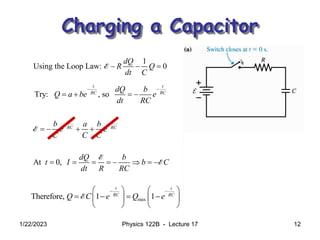
1/22/2023 Physics 122B - Lecture 17 12
Charging a Capacitor
1
Using the Loop Law: 0
dQ
R Q
dt C
  
E
Try: , so
t t
RC RC
dQ b
Q a be e
dt RC
 
   
t t
RC RC
b a b
e e a C
C C C
 
     
E E
At 0,
dQ b
t I b C
dt R RC
       
E
E
max
Therefore, 1 1
t t
RC RC
Q C e Q e
 
   
   
   
   
E
1/22/2023 Physics 122B - Lecture 17 13
Question
The time constant for the discharge of the capacitor is:
(a) 5 s; (b) 4 s; (c) 2 s; (d) 1 s; (e) the capacitor does not discharge
because the resistors cancel.
1/22/2023 Physics 122B - Lecture 17 14
Plumber’s RC Analogy*
P1 P2
Pump
Pump = Battery
Valve = Switch
Constriction = Resistor
Capacitor= Rubber Diaphragm
Pressure = Potential
Water Flow = Current
Constriction
Valve
Rubber
Diaphragm
The “plumber’s analogy” of an RC circuit is a
pump (=battery) pumping water in a closed
loop of pipe that includes a valve (=switch), a
constriction (=resistor), and a rubber
diaphragm. When the valve starts the flow,
the diaphragm stretches until the pressure
difference across the pump (P1-P3) equals
that across the diaphragm (P2-P3).
P3
1/22/2023 Physics 122B - Lecture 17 15
Chapter 31 Summary (1)
1/22/2023 Physics 122B - Lecture 17 16
Chapter 31 Summary (2)
1/22/2023 Physics 122B - Lecture 17 17
Chapter 31 Summary (3)
1/22/2023 Physics 122B - Lecture 17 18
Tape a bar magnet to a cork
and allow it to float in a dish of
water.
The magnet turns and aligns
itself with the north-south
direction.
The end of the magnet that
points north is called the
magnet’s north-seeking pole, or
simply its north pole. The
other end is the south pole.
Experiments with Magnetism:
Experiment 1
1/22/2023 Physics 122B - Lecture 17 19
Experiments with Magnetism:
Experiment 2
Bring the north poles of two bar magnets near to each other. Then
bring the north pole of one bar magnet near the south pole of another
bar magnet.
When the two north poles are brought near, a repulsive force
between them is observed. When the a north and a south pole are
brought near, an attractive force between them is observed.
1/22/2023 Physics 122B - Lecture 17 20
Experiments with Magnetism:
Experiment 3
Bring the north pole of a bar magnet near a compass needle.
When the north pole is brought near, the north-seeking pole of the
compass needle points away from the magnet’s north pole. Apparently
the compass needle is itself a little bar magnet.
1/22/2023 Physics 122B - Lecture 17 21
Experiments with Magnetism:
Experiment 4
Use a hacksaw to cut a bar magnet in half. Can you isolate the north
pole and the south pole on separate pieces?
No. When the bar is cut in half two new (but weaker) bar magnets
are formed, each with a north pole and a south pole. The same result
would be found, even if the magnet was sub-divided down to the
microscopic level.
1/22/2023 Physics 122B - Lecture 17 22
Experiments with Magnetism:
Experiment 5
Bring a bar magnet near an assortment of objects.
Some of the objects, e.g. paper clips, will be attracted to
the magnet. Other objects, e.g., glass beads, aluminum foil,
copper tacks, will be unaffected. The objects that are
attracted to the magnet are equally attracted by the north
and south poles of the bar magnet
1/22/2023 Physics 122B - Lecture 17 23
Experiments with Magnetism:
Experiment 6
Bring a magnet near the
electrode of an electroscope.
There is no observed effect,
whether the electroscope is
charged or discharged and
whether the north or the south
pole of the magnet is used.
1/22/2023 Physics 122B - Lecture 17 24
Conclusions from Experiments
1. Magnetism is not the same as electricity. Magnetic poles
are similar to charges but have important differences.
2. Magnetism is a long range force. The compass needle
responds to the bar magnet from some distance away.
3. Magnets have two poles, “north” (N) and “south” (S). Like
poles repel and opposite poles attract.
4. Poles of a magnet can be identified with a compass. A
north magnet pole (N) attracts the south-seeking end of
the compass needle (which is a south pole).
5. Some materials (e.g., iron) stick to magnets and others do
not. The materials that are attracted are called magnetic
materials. Magnetic materials are attracted by either
pole of a magnet. This is similar in some ways to the
attraction of neutral objects by an electrically charged
rod by induced polarization.
1/22/2023 Physics 122B - Lecture 17 25
Monopoles and Dipoles
Every magnet that has ever
been observed is a magnetic
dipole, containing separated
north and south poles. Attempts
to isolate one pole from the
other fail.
It is theoretically possible to have magnetic monopoles, i.e., isolated
magnetic poles with a “north” or “south” magnetic charge. Search have
been conducted, but no such object has ever been found in nature. For
the purposes of this course, we will assume that isolated magnetic
monopoles do not exist, but we will point out the places in the formalism
where they would go if they did exist.
1/22/2023 Physics 122B - Lecture 17 26
Lecture 17 Announcements
 Lecture HW Assignment #5 has been
posted on Tycho and is due at 10 PM on
Wednesday.
 Check Tycho for your exam scores. If
there are missing parts, you may not have
put your name on your paper. See Helen
Gribble, C136 PAB, to fix such problems.

Phys122B_L17_mjs.ppt

  • 1.
    Physics 122B Electricity andMagnetism Martin Savage Lecture 16 (Knight: 31.9,10 & 32.1) Grounding, RC Circuits, Magnetism May 7, 2007
  • 2.
    1/22/2023 Physics 122B- Lecture 17 2 Lecture 17 Announcements  Lecture HW Assignment #5 has been posted on Tycho and is due at 10 PM on Wednesday.  Check Tycho for your exam scores. If there are missing parts, you may not have put your name on your paper. See Helen Gribble, C136 PAB, to fix such problems.
  • 3.
    1/22/2023 Physics 122B- Lecture 17 3 Example: Analyzing a Complex Circuit (2)
  • 4.
    1/22/2023 Physics 122B- Lecture 17 4 Maximum Power Transfer E r R Question: For a battery with EMF E and internal resistance r, what value should an adjustable external load resistance R have to make the power dissipated in R as large as possible? I r R   E   2 2 2 2 R R P I R R r R r R            E E       2 2 2 2 3 3 2 0 R dP R r R dR r R r R r R         E E E PR is a maximum when r-R = 0 or r=R. In other words, energy can be drawn from the battery at the greatest rate when the external load resistance matches the internal resistance of the battery. This is called load matching. It is very important in transferring energy and signals with minimum loss. But note that only ½ of the energy gets to R. I
  • 5.
    1/22/2023 Physics 122B- Lecture 17 5 Grounding and GFI Modern power wiring includes a “ground” line, the round 3rd wire of an electrical plug. The ground point defines a point of zero potential, which is normally connected directly to the Earth (Vearth=0). The operation of any circuit depends only on potential differences, so it should not be affected by the presence or absence of a ground connection. Because the ground connection is connected at only one point, no current should flow through the ground connection. However, if some other part of a circuit is accidentally grounded, current is likely to flow through the ground line. GFI (ground fault interruption) circuits, widely used, e.g., in bathroom wiring, detect current flow in the ground line and interrupt power automatically when it occurs. This has prevented many accidental electrocutions.
  • 6.
    1/22/2023 Physics 122B- Lecture 17 6 Light Fixture V=0
  • 7.
    1/22/2023 Physics 122B- Lecture 17 7 Example: A Grounded Circuit The circuit shown is grounded at the junction between the two resistors rather than at the bottom. Find the potential at each corner of the circuit. 10 V 0.5 A 8 12 I R       E 1 V (8 )(0.5 A) 4 V     2 V (12 )(0.5 A) 6 V    
  • 8.
    1/22/2023 Physics 122B- Lecture 17 8 RC Circuits C R 0 Q Q dQ V V IR R C C dt         1 dQ dt Q RC   0 1 f i Q t Q dQ dt Q RC     ln f i Q t Q RC   exp f i Q t Q RC         / t RC f i Q Qe  Exponential decay! I = - dQ/dt
  • 9.
    1/22/2023 Physics 122B- Lecture 17 9 RC Exponential Decay / / 0 0 ( ) t RC t Q t Q e Q e      0 / / 0 0 ( ) ( ) t RC t RC t Q dQ t I t e dt RC I e I e         1/ 1/2.71828 0.367879 e   Define RC time constant:   RC I0 Q0/RC
  • 10.
    1/22/2023 Physics 122B- Lecture 17 10 Charging Capacitors: Early and Late Initially, when a switch closes there is a potential difference of 0 V across an uncharged capacitor. After a long time, the capacitor reaches its maximum charge and there is no current flow through the capacitor. Therefore, at t=0 the capacitor behaves like a short circuit (R=0), and at t=∞ the capacitor behaves like at open circuit (R=∞). Example: Circuit at t=0 at t=∞ Calculate initial currents. IB = 100 V/8  = 12.5 A Calculate final potentials. 12.5 A 10 A 2.5 A 100 V 0 V 100 V 100 V
  • 11.
    1/22/2023 Physics 122B- Lecture 17 11 Example: Exponential Decay in a RC Circuit The switch has been in position ``a’’ for a long time. It is changed to position ``b’’ at t=0. What are the charge is the capacitor and the current through the resistor at t=5.0 ms? -6 (10 )(1.0 10 F) 10 s RC  m      -6 -6 0 (1.0 10 F)(9.0 V) 9.0 10 C C Q C V       -6 0 0 (9.0 10 C) 0.90 A (10 s) Q I RC m     / -6 0 (5 s) (9.0 10 C)exp( .5) 5.5 C t RC Q Q e m m       / 0 (5 s) (0.90 A)exp( .5) 0.55 A t RC I I e m     
  • 12.
    1/22/2023 Physics 122B- Lecture 17 12 Charging a Capacitor 1 Using the Loop Law: 0 dQ R Q dt C    E Try: , so t t RC RC dQ b Q a be e dt RC       t t RC RC b a b e e a C C C C         E E At 0, dQ b t I b C dt R RC         E E max Therefore, 1 1 t t RC RC Q C e Q e                   E
  • 13.
    1/22/2023 Physics 122B- Lecture 17 13 Question The time constant for the discharge of the capacitor is: (a) 5 s; (b) 4 s; (c) 2 s; (d) 1 s; (e) the capacitor does not discharge because the resistors cancel.
  • 14.
    1/22/2023 Physics 122B- Lecture 17 14 Plumber’s RC Analogy* P1 P2 Pump Pump = Battery Valve = Switch Constriction = Resistor Capacitor= Rubber Diaphragm Pressure = Potential Water Flow = Current Constriction Valve Rubber Diaphragm The “plumber’s analogy” of an RC circuit is a pump (=battery) pumping water in a closed loop of pipe that includes a valve (=switch), a constriction (=resistor), and a rubber diaphragm. When the valve starts the flow, the diaphragm stretches until the pressure difference across the pump (P1-P3) equals that across the diaphragm (P2-P3). P3
  • 15.
    1/22/2023 Physics 122B- Lecture 17 15 Chapter 31 Summary (1)
  • 16.
    1/22/2023 Physics 122B- Lecture 17 16 Chapter 31 Summary (2)
  • 17.
    1/22/2023 Physics 122B- Lecture 17 17 Chapter 31 Summary (3)
  • 18.
    1/22/2023 Physics 122B- Lecture 17 18 Tape a bar magnet to a cork and allow it to float in a dish of water. The magnet turns and aligns itself with the north-south direction. The end of the magnet that points north is called the magnet’s north-seeking pole, or simply its north pole. The other end is the south pole. Experiments with Magnetism: Experiment 1
  • 19.
    1/22/2023 Physics 122B- Lecture 17 19 Experiments with Magnetism: Experiment 2 Bring the north poles of two bar magnets near to each other. Then bring the north pole of one bar magnet near the south pole of another bar magnet. When the two north poles are brought near, a repulsive force between them is observed. When the a north and a south pole are brought near, an attractive force between them is observed.
  • 20.
    1/22/2023 Physics 122B- Lecture 17 20 Experiments with Magnetism: Experiment 3 Bring the north pole of a bar magnet near a compass needle. When the north pole is brought near, the north-seeking pole of the compass needle points away from the magnet’s north pole. Apparently the compass needle is itself a little bar magnet.
  • 21.
    1/22/2023 Physics 122B- Lecture 17 21 Experiments with Magnetism: Experiment 4 Use a hacksaw to cut a bar magnet in half. Can you isolate the north pole and the south pole on separate pieces? No. When the bar is cut in half two new (but weaker) bar magnets are formed, each with a north pole and a south pole. The same result would be found, even if the magnet was sub-divided down to the microscopic level.
  • 22.
    1/22/2023 Physics 122B- Lecture 17 22 Experiments with Magnetism: Experiment 5 Bring a bar magnet near an assortment of objects. Some of the objects, e.g. paper clips, will be attracted to the magnet. Other objects, e.g., glass beads, aluminum foil, copper tacks, will be unaffected. The objects that are attracted to the magnet are equally attracted by the north and south poles of the bar magnet
  • 23.
    1/22/2023 Physics 122B- Lecture 17 23 Experiments with Magnetism: Experiment 6 Bring a magnet near the electrode of an electroscope. There is no observed effect, whether the electroscope is charged or discharged and whether the north or the south pole of the magnet is used.
  • 24.
    1/22/2023 Physics 122B- Lecture 17 24 Conclusions from Experiments 1. Magnetism is not the same as electricity. Magnetic poles are similar to charges but have important differences. 2. Magnetism is a long range force. The compass needle responds to the bar magnet from some distance away. 3. Magnets have two poles, “north” (N) and “south” (S). Like poles repel and opposite poles attract. 4. Poles of a magnet can be identified with a compass. A north magnet pole (N) attracts the south-seeking end of the compass needle (which is a south pole). 5. Some materials (e.g., iron) stick to magnets and others do not. The materials that are attracted are called magnetic materials. Magnetic materials are attracted by either pole of a magnet. This is similar in some ways to the attraction of neutral objects by an electrically charged rod by induced polarization.
  • 25.
    1/22/2023 Physics 122B- Lecture 17 25 Monopoles and Dipoles Every magnet that has ever been observed is a magnetic dipole, containing separated north and south poles. Attempts to isolate one pole from the other fail. It is theoretically possible to have magnetic monopoles, i.e., isolated magnetic poles with a “north” or “south” magnetic charge. Search have been conducted, but no such object has ever been found in nature. For the purposes of this course, we will assume that isolated magnetic monopoles do not exist, but we will point out the places in the formalism where they would go if they did exist.
  • 26.
    1/22/2023 Physics 122B- Lecture 17 26 Lecture 17 Announcements  Lecture HW Assignment #5 has been posted on Tycho and is due at 10 PM on Wednesday.  Check Tycho for your exam scores. If there are missing parts, you may not have put your name on your paper. See Helen Gribble, C136 PAB, to fix such problems.