Open Principles in GeoEducation
Suchith Anand
EuroGeo 2017, Amsterdam
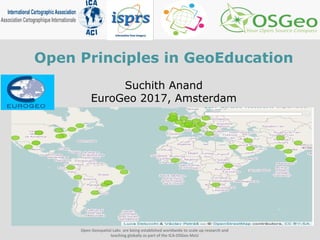
Open Geospatial Labs are being established worldwide to scale up research and
teaching globally as part of the ICA-OSGeo MoU
alt.ac.uk
Some reflections
Serendipity
alt.ac.uk
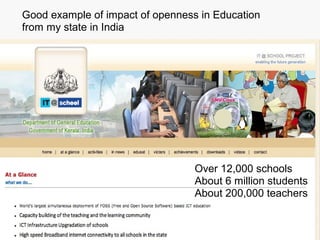
Over 12,000 schools
About 6 million students
About 200,000 teachers
Good example of impact of openness in Education
from my state in India
Geospatial Technology –
Why?
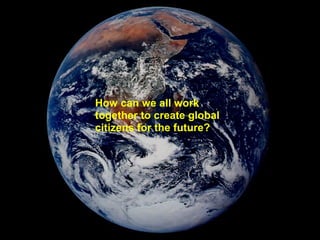
How can we all work
together to create global
citizens for the future?
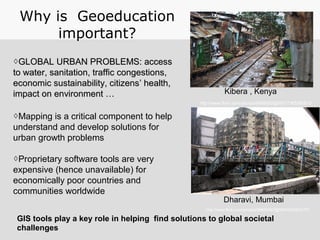
◊GLOBAL URBAN PROBLEMS: accessGLOBAL URBAN PROBLEMS: access
to water, sanitation, traffic congestions,to water, sanitation, traffic congestions,
economic sustainability, citizenseconomic sustainability, citizens’ health,’ health,
impact on environment …impact on environment …
◊Mapping is a critical component to help
understand and develop solutions for
urban growth problems
◊Proprietary software tools are very
expensive (hence unavailable) for
economically poor countries and
communities worldwide
Why is Geoeducation
important?
Kibera , Kenya
Dharavi, Mumbai
http://www.flickr.com/photos/56685562@N00/2340042701
http://www.flickr.com/photos/8485582@N07/7365580810
GIS tools play a key role in helping find solutions to global societal
challenges
Why? Data needs to be easily understood by all to
make better informed decisions at all levels
Purpose - Using this layer to compare with health expenditures to see if there's a visual relationship
with the percent of forest area and health care costs. Looking to see if health care costs rise as forest
are percent lowers.
alt.ac.uk
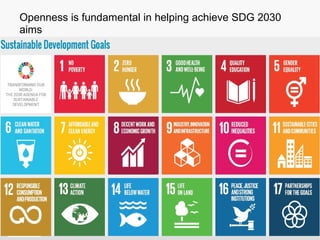
Why is Openness Important?
Openness is fundamental in helping achieve SDG 2030
aims
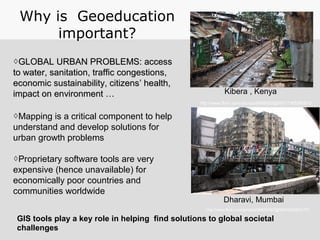
◊GLOBAL URBAN PROBLEMS: accessGLOBAL URBAN PROBLEMS: access
to water, sanitation, traffic congestions,to water, sanitation, traffic congestions,
economic sustainability, citizenseconomic sustainability, citizens’ health,’ health,
impact on environment …impact on environment …
◊Mapping is a critical component to help
understand and develop solutions for
urban growth problems
◊Proprietary software tools are very
expensive (hence unavailable) for
economically poor countries and
communities worldwide
Why is Geoeducation
important?
Kibera , Kenya
Dharavi, Mumbai
http://www.flickr.com/photos/56685562@N00/2340042701
http://www.flickr.com/photos/8485582@N07/7365580810
GIS tools play a key role in helping find solutions to global societal
challenges
Making Geospatial
education and
opportunities
accessible to all
“Geo for All”
alt.ac.uk
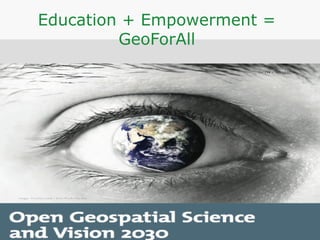
Education + Empowerment =
GeoForAll
There are many dimensions to “Open”
• Open source software.
• Open data.
• Open standards.
• Open access to research publications.
• Open education resources
But fundamentally GeoForAll is based on Open
Principles
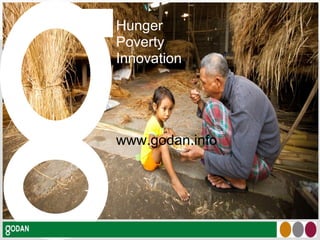
An example of the impact of Openness - GODAN
Impact is the positive changes to the lives of people
Hunger
Poverty
Innovation
www.godan.info
Hunger
• For the first time in human history, the knowledge to end hunger exists on Earth
• 800 million people struggle with debilitating hunger and malnutrition
• We need to find solutions beyond MORE food. Nutritionally sensitive agriculture is essential
for global public health and wellbeing
• We are convinced that the solution to closing this unacceptable hunger gap lies
within harnessing and opening agriculture and nutrition data
• “location” relevant data plays an important role
 
 
How can we all work
together to create global
citizens for the future?
Nepal Earthquake 2015 – GeoForAll colleagues globally came
together to help with relief efforts
We are especially grateful for the work and relief efforts done after the terrible earthquakes by our colleagues in OSG
Kathmandu University lead by Dr Shashish Maharjan. Their whole team along with many students and volunteers
were key in helping the recovery efforts. They have been carrying out many activities from piloting of household
Nepal Earthquake 2015 – GeoForAll colleagues
globally came together to help with relief efforts
https://www.uni-heidelberg.de/presse/meldungen/2015/m20150505_emergency-route-
planner-for-nepal-on-the-internet.html
Nepal Earthquake 2015 – GeoForAll colleagues globally
came together to help with relief efforts
How can we all work
together to create global
citizens for the future?
alt.ac.uk
Education + Empowerment = 
Geo4All 
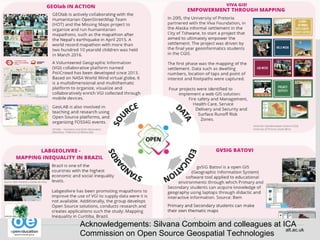
Acknowledgements: Silvana Comboim and colleagues at ICA
Commission on Open Source Geospatial Technologies
https://www.wired.com/2015/05/the-open-source-maps-
that-made-rescues-in-nepal-possible/
Example of an excellent Initiative led by
Prof. Maria Brovelli , Patrick Hogan and
colleagues
http://eurochallenge.como.polimi.it
http://aworldbridge.com/real-time-projects/nasa-europa-
challenge/nasa-europa-challenge-2016/
http://www.gofundme.com/ufgpg5n
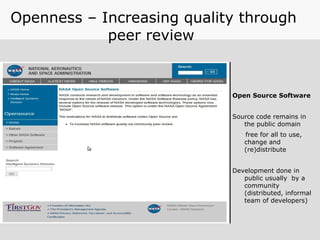
Openness – Increasing quality through 
peer review 
Open Source Software
Source code remains in 
the public domain
      free for all to use, 
change and 
(re)distribute
Development done in 
public usually  by a 
community 
(distributed, informal 
team of developers)
How can we all work
together to create global
citizens for the future?
June 2010
“Geo for All” started from very humble beginnings
Aim – Build research and teaching infrastructure worldwide
Problem – No initial funding!
Biggest Strength – amazing support from colleagues and students
Open Source Geospatial Lab founding meeting at UoN
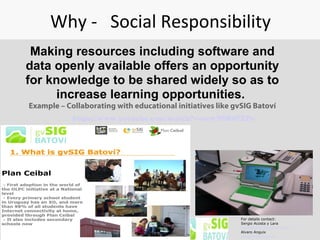
Why - Social Responsibility
Making resources including software and
data openly available offers an opportunity
for knowledge to be shared widely so as to
increase learning opportunities.
Example – Collaborating with educational initiatives like gvSIG Batoví
For details contact:
Sergio Acosta y Lara
sacosta@dntopografia.gub.uy
Alvaro Anguix
aanguix@gvsig.com
https://www.youtube.com/watch?v=orwN9K07XPo  
Thanks to Elżbieta Wołoszyńska-
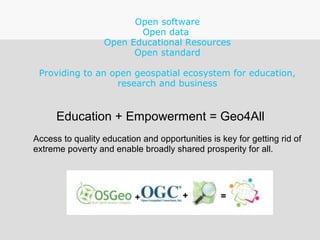
Open software
Open data
Open Educational Resources
Open standard
Providing to an open geospatial ecosystem for education,
research and business
Education + Empowerment = Geo4All
Access to quality education and opportunities is key for getting rid of
extreme poverty and enable broadly shared prosperity for all.
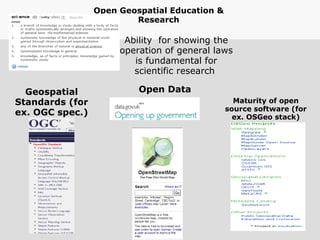
Open Geospatial Education &
Research
Geospatial
Standards (for
ex. OGC spec.)
Maturity of open
source software (for
ex. OSGeo stack)
Open Data
Ability for showing the
operation of general laws
is fundamental for
scientific research
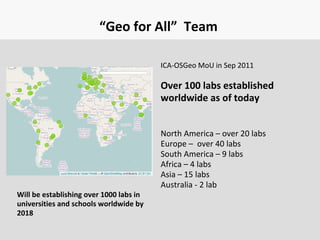
“Geo for All” Team
ICA-OSGeo MoU in Sep 2011
Over 100 labs established
worldwide as of today
North America – over 20 labs
Europe – over 40 labs
South America – 9 labs
Africa – 4 labs
Asia – 15 labs
Australia - 2 lab
Will be establishing over 1000 labs in
universities and schools worldwide by
2018
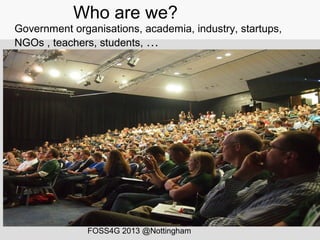
Who are we?
Government organisations, academia, industry, startups,
NGOs , teachers, students, …
FOSS4G 2013 @Nottingham
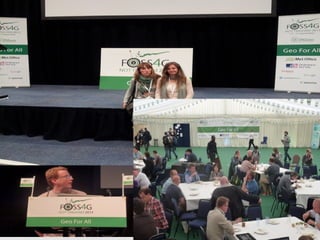
We are Global community
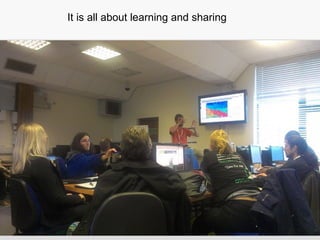
It is all about learning and sharing
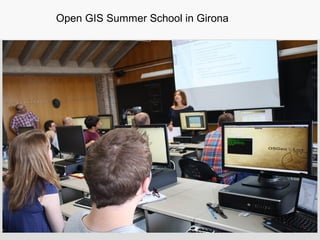
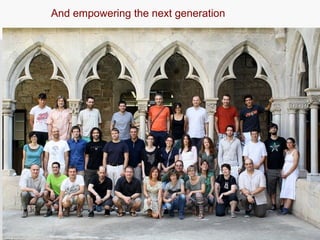
Open GIS Summer School in Girona
And empowering the next generation
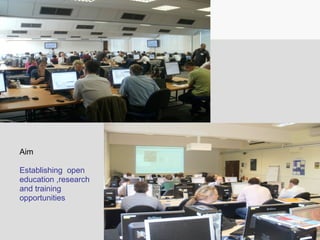
Aim
Establishing open
education ,research
and training
opportunities
We are Multi disciplinary
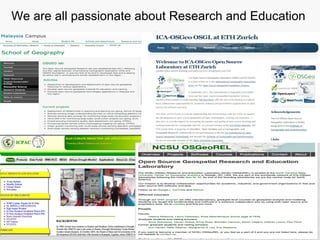
We are all passionate about Research and Education
Science is NOT a Black Box
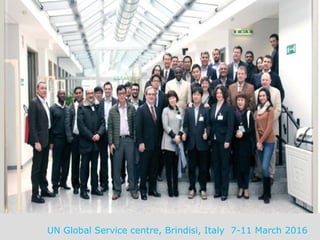
UN Global Service centre, Brindisi, Italy 7-11 March 2016
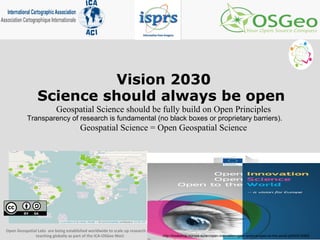
Vision 2030
Science should always be open
Geospatial Science should be fully build on Open Principles
Transparency of research is fundamental (no black boxes or proprietary barriers).
Geospatial Science = Open Geospatial Science
Open Geospatial Labs are being established worldwide to scale up research and
teaching globally as part of the ICA-OSGeo MoU http://bookshop.europa.eu/en/open-innovation-open-science-open-to-the-world-pbKI0416263
Represents the
individual content
creator on the World
Wide Web
Why- Open Geospatial Science
 helps in empowerment of staff
and students
 capacity building
 developing creative and open
minds in students which is critical
for building open innovation
 contributes to building up Open
Knowledge for the benefit of the
whole society and for our future
generations.
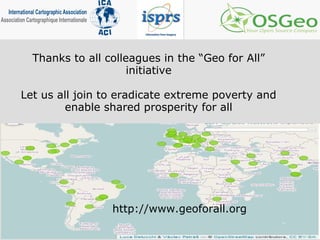
Thanks to all colleagues in the “Geo for All”
initiative
Let us all join to eradicate extreme poverty and
enable shared prosperity for all
http://www.geoforall.org
Why - Social Responsibility
Making resources including software and
data openly available offers an opportunity
for knowledge to be shared widely so as to
increase learning opportunities.
Example – Collaborating with educational initiatives like gvSIG Batoví
For details contact:
Sergio Acosta y Lara
sacosta@dntopografia.gub.uy
Alvaro Anguix
aanguix@gvsig.com
https://www.youtube.com/watch?v=orwN9K07XPo  
Open Principles in GeoEducation

Open Principles in GeoEducation

  • 1.
    Open Principles inGeoEducation Suchith Anand EuroGeo 2017, Amsterdam Open Geospatial Labs are being established worldwide to scale up research and teaching globally as part of the ICA-OSGeo MoU
  • 2.
  • 3.
    alt.ac.uk Over 12,000 schools About6 million students About 200,000 teachers Good example of impact of openness in Education from my state in India
  • 4.
  • 5.
    How can weall work together to create global citizens for the future?
  • 6.
    ◊GLOBAL URBAN PROBLEMS:accessGLOBAL URBAN PROBLEMS: access to water, sanitation, traffic congestions,to water, sanitation, traffic congestions, economic sustainability, citizenseconomic sustainability, citizens’ health,’ health, impact on environment …impact on environment … ◊Mapping is a critical component to help understand and develop solutions for urban growth problems ◊Proprietary software tools are very expensive (hence unavailable) for economically poor countries and communities worldwide Why is Geoeducation important? Kibera , Kenya Dharavi, Mumbai http://www.flickr.com/photos/56685562@N00/2340042701 http://www.flickr.com/photos/8485582@N07/7365580810 GIS tools play a key role in helping find solutions to global societal challenges
  • 7.
    Why? Data needsto be easily understood by all to make better informed decisions at all levels Purpose - Using this layer to compare with health expenditures to see if there's a visual relationship with the percent of forest area and health care costs. Looking to see if health care costs rise as forest are percent lowers.
  • 8.
    alt.ac.uk Why is OpennessImportant? Openness is fundamental in helping achieve SDG 2030 aims
  • 9.
    ◊GLOBAL URBAN PROBLEMS:accessGLOBAL URBAN PROBLEMS: access to water, sanitation, traffic congestions,to water, sanitation, traffic congestions, economic sustainability, citizenseconomic sustainability, citizens’ health,’ health, impact on environment …impact on environment … ◊Mapping is a critical component to help understand and develop solutions for urban growth problems ◊Proprietary software tools are very expensive (hence unavailable) for economically poor countries and communities worldwide Why is Geoeducation important? Kibera , Kenya Dharavi, Mumbai http://www.flickr.com/photos/56685562@N00/2340042701 http://www.flickr.com/photos/8485582@N07/7365580810 GIS tools play a key role in helping find solutions to global societal challenges
  • 10.
  • 11.
  • 12.
    There are manydimensions to “Open” • Open source software. • Open data. • Open standards. • Open access to research publications. • Open education resources But fundamentally GeoForAll is based on Open Principles
  • 13.
    An example ofthe impact of Openness - GODAN Impact is the positive changes to the lives of people
  • 14.
  • 15.
    Hunger • For thefirst time in human history, the knowledge to end hunger exists on Earth • 800 million people struggle with debilitating hunger and malnutrition • We need to find solutions beyond MORE food. Nutritionally sensitive agriculture is essential for global public health and wellbeing • We are convinced that the solution to closing this unacceptable hunger gap lies within harnessing and opening agriculture and nutrition data • “location” relevant data plays an important role    
  • 16.
    How can weall work together to create global citizens for the future?
  • 17.
    Nepal Earthquake 2015– GeoForAll colleagues globally came together to help with relief efforts We are especially grateful for the work and relief efforts done after the terrible earthquakes by our colleagues in OSG Kathmandu University lead by Dr Shashish Maharjan. Their whole team along with many students and volunteers were key in helping the recovery efforts. They have been carrying out many activities from piloting of household
  • 18.
    Nepal Earthquake 2015– GeoForAll colleagues globally came together to help with relief efforts
  • 19.
  • 20.
    How can weall work together to create global citizens for the future?
  • 21.
    alt.ac.uk Education + Empowerment =  Geo4All  Acknowledgements: Silvana Comboimand colleagues at ICA Commission on Open Source Geospatial Technologies
  • 22.
  • 23.
    Example of anexcellent Initiative led by Prof. Maria Brovelli , Patrick Hogan and colleagues http://eurochallenge.como.polimi.it
  • 25.
  • 26.
  • 27.
    How can weall work together to create global citizens for the future?
  • 28.
    June 2010 “Geo forAll” started from very humble beginnings Aim – Build research and teaching infrastructure worldwide Problem – No initial funding! Biggest Strength – amazing support from colleagues and students Open Source Geospatial Lab founding meeting at UoN
  • 29.
    Why - SocialResponsibility Making resources including software and data openly available offers an opportunity for knowledge to be shared widely so as to increase learning opportunities. Example – Collaborating with educational initiatives like gvSIG Batoví For details contact: Sergio Acosta y Lara sacosta@dntopografia.gub.uy Alvaro Anguix aanguix@gvsig.com https://www.youtube.com/watch?v=orwN9K07XPo  
  • 30.
    Thanks to ElżbietaWołoszyńska-
  • 31.
    Open software Open data OpenEducational Resources Open standard Providing to an open geospatial ecosystem for education, research and business Education + Empowerment = Geo4All Access to quality education and opportunities is key for getting rid of extreme poverty and enable broadly shared prosperity for all.
  • 32.
    Open Geospatial Education& Research Geospatial Standards (for ex. OGC spec.) Maturity of open source software (for ex. OSGeo stack) Open Data Ability for showing the operation of general laws is fundamental for scientific research
  • 33.
    “Geo for All”Team ICA-OSGeo MoU in Sep 2011 Over 100 labs established worldwide as of today North America – over 20 labs Europe – over 40 labs South America – 9 labs Africa – 4 labs Asia – 15 labs Australia - 2 lab Will be establishing over 1000 labs in universities and schools worldwide by 2018
  • 34.
    Who are we? Governmentorganisations, academia, industry, startups, NGOs , teachers, students, … FOSS4G 2013 @Nottingham
  • 35.
    We are Globalcommunity
  • 38.
    It is allabout learning and sharing
  • 39.
    Open GIS SummerSchool in Girona
  • 40.
    And empowering thenext generation
  • 41.
  • 42.
    We are Multidisciplinary
  • 43.
    We are allpassionate about Research and Education
  • 44.
    Science is NOTa Black Box
  • 48.
    UN Global Servicecentre, Brindisi, Italy 7-11 March 2016
  • 51.
    Vision 2030 Science shouldalways be open Geospatial Science should be fully build on Open Principles Transparency of research is fundamental (no black boxes or proprietary barriers). Geospatial Science = Open Geospatial Science Open Geospatial Labs are being established worldwide to scale up research and teaching globally as part of the ICA-OSGeo MoU http://bookshop.europa.eu/en/open-innovation-open-science-open-to-the-world-pbKI0416263
  • 52.
    Represents the individual content creatoron the World Wide Web Why- Open Geospatial Science  helps in empowerment of staff and students  capacity building  developing creative and open minds in students which is critical for building open innovation  contributes to building up Open Knowledge for the benefit of the whole society and for our future generations.
  • 53.
    Thanks to allcolleagues in the “Geo for All” initiative Let us all join to eradicate extreme poverty and enable shared prosperity for all http://www.geoforall.org
  • 54.
    Why - SocialResponsibility Making resources including software and data openly available offers an opportunity for knowledge to be shared widely so as to increase learning opportunities. Example – Collaborating with educational initiatives like gvSIG Batoví For details contact: Sergio Acosta y Lara sacosta@dntopografia.gub.uy Alvaro Anguix aanguix@gvsig.com https://www.youtube.com/watch?v=orwN9K07XPo  

Editor's Notes

  • #15 Godan exists to respond to particular challenges and foster innovations to meet them
  • #16 For the first time in human history, the knowledge to end hunger exists on Earth   Experts tell us that we currently produce enough food on planet Earth to adequately feed the world population.  Yet, nearly 800 million people struggle with debilitating hunger and malnutrition in every corner of the globe, one in every nine people, with the majority being women and children. Global populations are set to increase to 9-10 billion by 2050. We need to find solutions beyond MORE food. Nutritionally sensitive agriculture is essential for global public health and wellbeing We are convinced that the solution to closing an unacceptable hunger gap lies within harnessing & opening agriculture and nutrition data