Performance Appraisal
By : SUBROTO
Performance Appraisal
(Meaning)
• Finding out the effectiveness by Management
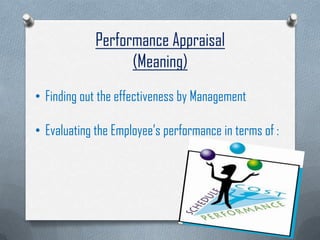
• Evaluating the Employee’s performance in terms of :
Performance Appraisal
(Definition)
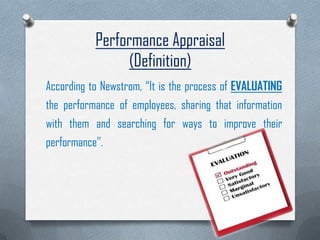
According to Newstrom, “It is the process of EVALUATING
the performance of employees, sharing that information
with them and searching for ways to improve their
performance’’.
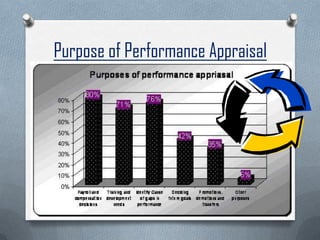
Purpose of Performance Appraisal
• Goal: Maintain Organizational Productivity
• Results: Organization
Productivity Individual Performance
• Methods: Individual Performance Goals
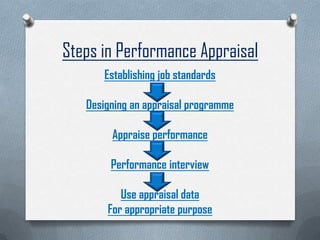
Steps in Performance Appraisal
Establishing job standards
Designing an appraisal programme
Appraise performance
Performance interview
Use appraisal data
For appropriate purpose
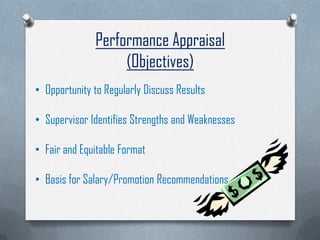
Performance Appraisal
(Objectives)
• Opportunity to Regularly Discuss Results
• Supervisor Identifies Strengths and Weaknesses
• Fair and Equitable Format
• Basis for Salary/Promotion Recommendations
Process of Performance Appraisal
Setting performance
goals and objectives
Determining key
competencies
Measurement of
performance against
the goals and
objectives
Measurement of
performance against
key competencies,
Feedback of results.
Amendment to goals
and objectives
Reasons for Performance Appraisal
 Compensation "Pay for Performance"
 Job Performance Improvements
 Feedback to Subordinates
 Documentation for Decisions
 Goal Setting - Later Evaluation
 Promotion Decisions
 Identify Training Needs
 HR Planning
When to do Performance Appraisal?
How to do Performance Appraisal?
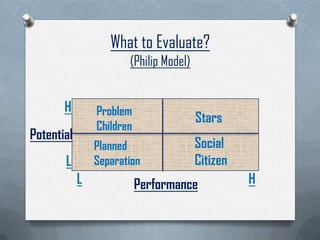
What to Evaluate?
(Philip Model)
Problem
Children
Planned
Separation
Stars
Social
Citizen
H
L H
L
Potential
Performance
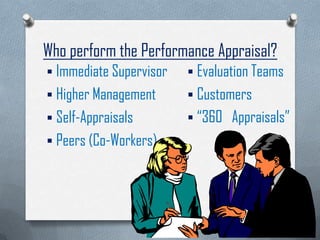
Who perform the Performance Appraisal?
 Immediate Supervisor
 Higher Management
 Self-Appraisals
 Peers (Co-Workers)
 Evaluation Teams
 Customers
 “360 Appraisals”
Supervisor Appraisal
Appraised by Manager
Self-Appraisal
Subordinate Appraisal
Peer Appraisal
Team Appraisal
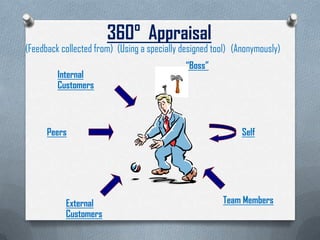
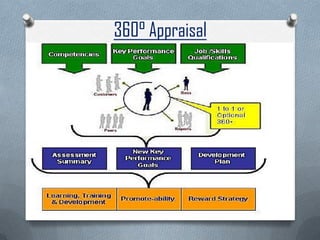
360° Appraisal
Internal
Customers
“Boss”
Peers
External
Customers
Team Members
Self
(Feedback collected from) (Using a specially designed tool) (Anonymously)
Benefits of Performance Appraisal
Individual Benefits
Benefit to the Line/
Manager/Supervisor/Team Leader
Benefits to the organization
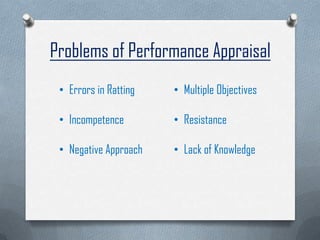
Problems of Performance Appraisal
• Errors in Ratting
• Incompetence
• Negative Approach
• Multiple Objectives
• Resistance
• Lack of Knowledge
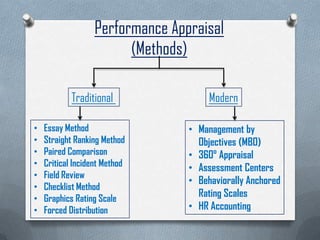
Performance Appraisal
(Methods)
Traditional Modern
• Essay Method
• Straight Ranking Method
• Paired Comparison
• Critical Incident Method
• Field Review
• Checklist Method
• Graphics Rating Scale
• Forced Distribution
• Management by
Objectives (MBO)
• 360° Appraisal
• Assessment Centers
• Behaviorally Anchored
Rating Scales
• HR Accounting
Traditional Methods
Essay Method
Straight Ranking Method
Paired comparison
Critical Incident Method
Field Review
Checklist Method
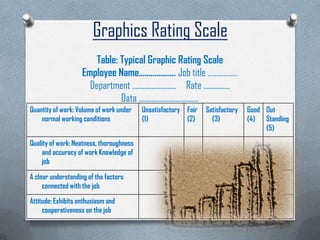
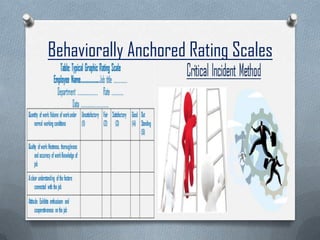
Graphics Rating Scale
Quantity of work: Volume of work under
normal working conditions
Unsatisfactory
(1)
Fair
(2)
Satisfactory
(3)
Good
(4)
Out
Standing
(5)
Quality of work: Neatness, thoroughness
and accuracy of work Knowledge of
job
A clear understanding of the factors
connected with the job
Attitude: Exhibits enthusiasm and
cooperativeness on the job
Table: Typical Graphic Rating Scale
Employee Name................... Job title .................
Department ......................... Rate ...............
Data ..................................
Forced Distribution
Modern Method
Management by Objectives
(MBO)
360° Appraisal
Assessment Centers
Behaviorally Anchored Rating Scales
HR Accounting
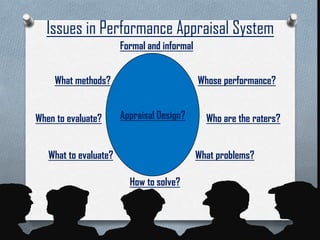
Issues in Performance Appraisal System
Appraisal Design?
Formal and informal
Whose performance?
Who are the raters?
What problems?
How to solve?
What to evaluate?
When to evaluate?
What methods?
A good process is the
foundation of your success”
Performance appraisal

Performance appraisal