CONFIDENTIAL
*DILIsym®, NAFLDsym®, MITOsym®, ADMET Predictor®, GastroPlus® and SimPops® are registered trademarks, and SimCohorts™,
IPFsym™, RADAsym™, and RENAsym™ are trademarks, of DILIsym Services Inc. and/or SLP for computer modeling software and for
consulting services.
DILIsym Services is a Member of the
Simulations Plus Family
2
Cheminformatics, PBPK modeling
Quantitative Systems Pharmacology and Toxicology
(QSP/QST)
Pharmacometrics
We apply modeling and simulation to support all phases of drug development
QSP/QST MODELING
3
What is QSP / QST?
“QSP is defined as an approach to translational medicine that combines
computational and experimental methods to elucidate, validate, and apply new
pharmacological concepts to the development an use of small molecule and
biologic drugs. QSP will provide an integrated “systems level” approach to
determining mechanisms of action of new and existing drugs in preclinical and
animal models and in patients….”
QST combines QSP methodologies with the discipline of toxicology to address
potential or existing issues of drug safety in animal models and in patients.
4
NIH White Paper 2011
Introduction
to DILIsym
Services
QSP/QST
Modeling
Case Study:
Lixivaptan
Case Study:
Kv7
Summary
QSP/QST Modeling Applications
in Multiple Areas
5
Introduction
to DILIsym
Services
QSP/QST
Modeling
Case Study:
Lixivaptan
Case Study:
Kv7
Summary
DILIsym Predicts DILI via the Intersection
of Exposure, Mechanisms, and
Inter-Patient Variability
6
Relevant Liver
Biochemistry
DILI
Mechanisms
Exposure
DILI
Introduction
to DILIsym
Services
QSP/QST
Modeling
Case Study:
Lixivaptan
Case Study:
Kv7
Summary
DILIsym Software Overview
• Multiple species:
human, rat, mouse,
and dog
- Population variability
• The three primary
acinar zones of liver
represented
• Essential cellular
processes represented
to multiple scales in
interacting sub-models
• Over 70 detailed
representations of
optimization or
validation compounds
with 80% success
• Single and
combination drug
therapies
7
Introduction
to DILIsym
Services
QSP/QST
Modeling
Case Study:
Lixivaptan
Case Study:
Kv7
Summary
DILIsym Utilizes Various Data Types
to Inform Modeling and Simulation
8
Simulated Protocol and Patients
• Dosing Protocols
- Fasting/fed state, meal times
• Anthropometric data
- Body weight, age, ethnicity
• Comorbidities / comedication data
- Type 2 diabetes, NASH, acetaminophen
PBPK Prediction of In Vivo Exposure
• Compound Properties
- Tissue partition coefficients
• Tissue penetration studies
- Liver to blood ratio
• Pharmacokinetic data
- Absorption, extra-hepatic clearance, metabolites
• in vitro data
- Metabolite synthesis, active uptake
Modeling & Simulation
In vitro Mechanistic DILI Data
Clinical Data
Toxicity Parameter Values
• Oxidative stress
- Direct and reactive metabolite-mediated
• Mitochondrial toxicity
- ETC inhibition
- Uncoupling
• Bile acid / phospholipid transporter inhibition
- BSEP, MRP3 and 4, NTCP, (MDR3)
• Bilirubin transport/metabolism
- OATP1B1, OATP1B3, UGT1A1, MRP2, MRP3
Exposure Data
Simulations and Assays inform:
• Prediction of DILI risk
• Participating DILI mechanisms
• Characteristics of patients at risk for DILI
• Drug dosing paradigms
• DILI monitoring strategies
Introduction
to DILIsym
Services
QSP/QST
Modeling
Case Study:
Lixivaptan
Case Study:
Kv7
Summary
DILIsym Development is Funded and Directed
by the DILI-sim Initiative
9
Multiple Industry Partners World-class Scientific Advisory Board
Select Sample of Current Companies
Licensing DILIsym
Dr. Kevin Park
University of Liverpool
Dr. Robert Roth
Michigan State University
Dr. Frank Sistare
Merck (retired)
Dr. Neil Kaplowitz
University of Southern California
Dr. Paul B. Watkins
University of North Carolina
Dr. Jack Uetrecht
University of Toronto
Dr. David Pisetsky
Duke University
Introduction
to DILIsym
Services
QSP/QST
Modeling
Case Study:
Lixivaptan
Case Study:
Kv7
Summary
Recent DILIsym Publications
10
Introduction
to DILIsym
Services
QSP/QST
Modeling
Case Study:
Lixivaptan
Case Study:
Kv7
Summary
CASE STUDY: LIXIVAPTAN
Investigation of a Next-in-Class Drug For Potential Differentiation on Liver Safety
11
Lixivaptan Background
• Lixivaptan is Palladio Bio’s selective,
competitive vasopressin V2 receptor
antagonist
• Palladio Biosciences acquired
lixivaptan and intends to reposition
lixivaptan for the treatment of
Autosomal-Dominant Polycystic
Kidney Disease (ADPKD)
12
Introduction
to DILIsym
Services
QSP/QST
Modeling
Case Study:
Lixivaptan
Case Study:
Kv7
Summary
Lixivaptan DILIsym Project
DILI Background
• An approved compound in the same class had no DILI signals in
hyponatremia, but signals were observed in ADPKD patients
• Lixivaptan has had no DILI signals in hyponatremia
Question
• Will lixivaptan experience similar DILI liability as the competitor in ADPKD
patients?
Approach
• Develop a mechanistic representation of lixivaptan in DILIsym, a QST
model of drug-induced liver injury (DILI), to assess the potential for liver
toxicity with the intended dosing for lixivaptan
13
Introduction
to DILIsym
Services
QSP/QST
Modeling
Case Study:
Lixivaptan
Case Study:
Kv7
Summary
Toxicity Parameter Values for Lixivaptan,
Three Metabolites, and Tolvaptan (competitor)
14
Mechanism
DILIsym
Parameter
Unit
Value****
Lixivaptan WAY-138451 WAY-141624 WAY-138758 Tolvaptan**
Mitochondrial
Dysfunction
Coefficient for
ETC inhibition
µM 535 250 N/A N/A 729
Oxidative Stress
RNS/ROS
production rate
constant
mL/nmol/hr 5.45 x 10⁻⁴ 2.12 x 10⁻³ N/A N/A N/A
Bile Acid
Transporter
Inhibition
BSEP inhibition
constant
µM 15* 8.6* 39.5* 5.6* 10***
NTCP inhibition
constant
µM 19* N/A 85.8* 8.9* N/A
Basolateral
inhibition
constant**
µM 70* 54* 16.3* 4* N/A
* Values are IC50 values; mode of inhibition was not measured in vitro
** Tolvaptan parameters are taken from in vitro experiments undertaken for this research. Previously published DILIsym parameters are available in Woodhead et al., Tox. Sci. 2017
*** IC50 value for tolvaptan was measured for this research. A Ki value was measured for the previously published tolvaptan work; the published value is somewhat higher than the value reported
here. However, personal communication with the experimentalists suggested that the initial IC50 value calculated in that experiment was not substantially different from that measured here.
**** Comparisons of parameter values should be undertaken with caution, as they must be placed in context with exposure for their full usefulness.
Introduction
to DILIsym
Services
QSP/QST
Modeling
Case Study:
Lixivaptan
Case Study:
Kv7
Summary
CONFIDENTIAL
Lixivaptan Simulations Predict
Minimal Liver Safety Signals at Clinical Dose
• Lixivaptan simulated in SimPops
of N = 285
• No ALT elevations simulated in
100 mg BID 60-day simulation
– Consistent with observed clinical
similarity to placebo (validation)
• No ALT elevations simulated in
200/100 split daily dosing
scenario for 12 weeks
– Maximum intended clinical
dosing for ADPKD
15
Simulation Results
Introduction
to DILIsym
Services
QSP/QST
Modeling
Case Study:
Lixivaptan
Case Study:
Kv7
Summary
CONFIDENTIAL
Post-hoc Analysis of Exposure vs. Predicted Toxicity
Identified Safety Threshold
• ALT elevations are correlated with total
lixivaptan exposure
• Project established exposure threshold below
which lixivaptan is safe (AUC0-7 days< 350 µg*h/ml)
16
Lixivaptan 400mg BID, 7 days (n = 285)
Lixivaptan plasma AUC (0-inf) (µg*h/ml)
2x ULN
3x ULN
0
5
10
15
20
25
30
0-15
15-30
30-45
45-60
60-75
75-90
90-105
105-120
120-135
135-150
150-165
165-180
180-195
195-210
210-225
225-240
240-255
255-270
270-285
285-300
300-315
315-330
330-345
345-360
360-375
375-390
390-405
405-420
420-435
435-450
450-465
465-480
480-495
495-510
510-525
400mg BID
100mg BID
N
38
Lixivaptan plasma AUC(0-7 Day) (µg*h/ml)
Lixivaptan 100 mg BID
N = 72
Lixivaptan 400 mg BID
N = 67
• Existing data indicate
lixivaptan exposure
rarely exceeds the
exposure threshold
• Intended clinical dose
not expected to exceed
threshold
Introduction
to DILIsym
Services
QSP/QST
Modeling
Case Study:
Lixivaptan
Case Study:
Kv7
Summary
Clinical Data and
Simulation Results
17
Palladio
Biosciences
WebsiteIntroduction
to DILIsym
Services
QSP/QST
Modeling
Case Study:
Lixivaptan
Case Study:
Kv7
Summary
CASE STUDY: KV7
Mechanistic Investigation of a Compound that was Clean in Rats but Showed Evidence of
Hepatotoxicity in Humans
18
Kv7 DILIsym Project
DILI Background
• PF-04895162 is a small molecule that was being developed for epilepsy based on
its ability to open Kv7.2/7.3 potassium channels
• PF-04895162 was clean in rat toxicity studies but liver safety signals were seen in
healthy human subjects
Question
• Can mechanisms of toxicity represented in DILIsym account for the observed
species difference?
Approach
• Develop a mechanistic representation of PF-04895162 in DILIsym for simulated
rats and simulated humans to determine if the experimental findings are
reproduced
19
Introduction
to DILIsym
Services
QSP/QST
Modeling
Case Study:
Lixivaptan
Case Study:
Kv7
Summary
Species-Specific In Vitro Data Informed
Parameter Values for Toxicity
20
Mechanisms
of Toxicity
Bile acid
transporter
inhibition
Mitochondrial
dysfunction
Preclinical and
Clinical Data
RAT DATA HUMAN DATA
Introduction
to DILIsym
Services
QSP/QST
Modeling
Case Study:
Lixivaptan
Case Study:
Kv7
Summary
Generaux 2019
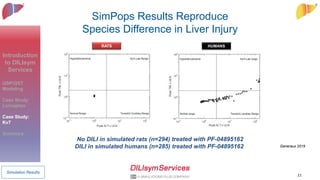
SimPops Results Reproduce
Species Difference in Liver Injury
21
Simulation Results
RATS HUMANS
No DILI in simulated rats (n=294) treated with PF-04895162
DILI in simulated humans (n=285) treated with PF-04895162 Generaux 2019
Introduction
to DILIsym
Services
QSP/QST
Modeling
Case Study:
Lixivaptan
Case Study:
Kv7
Summary
Analysis of Simulation Results Provided
Mechanistic Insights into Toxicity
22
Simulation Results
Variables used to create alternate simulated
patients were investigated to identify predictors
of DILI susceptibility
Re-running simulations with each
mechanism off reveals DILI is dependent
on both mechanisms of toxicity
Introduction
to DILIsym
Services
QSP/QST
Modeling
Case Study:
Lixivaptan
Case Study:
Kv7
Summary
Generaux 2019
SUMMARY
23
DILIsym Services Develops and Applies QSP / QST
Models To Support Drug Development
• Modeling applies ordinary differential equations (ODEs) to mathematically
represent biological processes and their interactions with compounds
• DILIsym is the flagship platform and has been used to evaluate dozens of
compounds, supporting internal decision-making as well as regulatory discussions
• NAFLDsym has been applied to evaluate multiple compounds for therapeutic
efficacy
• Ongoing efforts underway to expand offerings in drug safety and efficacy
• DILIsym Services offers the opportunity to impact and improve drug development,
ultimately getting better, safer medicines to patients who need them
24
Introduction
to DILIsym
Services
QSP/QST
Modeling
Case Study:
Lixivaptan
Case Study:
Kv7
Summary
Introduction
to DILIsym
Services
QSP/QST
Modeling
Case Study:
Lixivaptan
Case Study:
Kv7
Summary
.
The DILIsym Services Team
25
Jeff Woodhead
Senior Scientist
RTP, NC
Brett Howell
President
RTP, NC
Bud Nelson
Director of
Operations
RTP, NC
Grant Generaux
Senior Scientist
Philadelphia, PA
Diane Longo
Senior Scientist
Arlington, VA
Shawn O’Connor
CEO, Simulations Plus Inc.
Lancaster, CA
Zack Kenz
Scientist II
Dubuque, Iowa
Lisl Shoda
Principal Scientist
Director of Immunology
Bay Area, CA
Christina Battista
Scientist II
Buffalo, NY
Paul B. Watkins
DILI-sim Initiative Founder and
Scientific Advisory Board Chair
RTP, NC
Vinal Lakhani
Scientist I
RTP, NC
Corey Berry
Senior Software
Engineer
RTP, NC
Yeshi
Gebremichael
Scientist II
RTP, NC
Scott Q Siler
Chief Scientific Officer
Bay Area, CA
Patti Steele
Executive Assistant
RTP, NC
Shailendra Tallapaka
Scientist I
RTP, NC
Nader Hamzavi
Postdoctoral Fellow
RTP, NC
Kyunghee Yang
Senior Scientist
Lawrence, KS
Pallavi Bhargava
Postdoctoral Fellow
RTP, NC
Michael Liu
Senior Scientist
RTP, NC
Sergey Ermakov
Principal Scientist
Bay Area, CA
Lara Clemens
Postdoctoral Fellow
RTP, NC James Beaudoin
Scientist I
RTP, NC
Come Meet Us in Person!
DILIsym, Modeling Drug-Induced Liver Injury and Beyond
Zack Kenz, PhD, Scientist II
Wednesday, August 19th, from 2:30-3:00pm EDT
QST Applications, Use of Data and Species Differences
Christina Battista, PhD, Scientist II
Wednesday, August 19th, from 3:00-3:30pm EDT
26
Lisl Shoda, PhD
Principal Scientist
Director of Immunology
Christina Battista, PhD
Scientist II
Zackary Kenz, PhD
Scientist II
Introduction
to DILIsym
Services
QSP/QST
Modeling
Case Study:
Lixivaptan
Case Study:
Kv7
Summary

Introduction to DILIsym Services, Inc.

  • 1.
    CONFIDENTIAL *DILIsym®, NAFLDsym®, MITOsym®,ADMET Predictor®, GastroPlus® and SimPops® are registered trademarks, and SimCohorts™, IPFsym™, RADAsym™, and RENAsym™ are trademarks, of DILIsym Services Inc. and/or SLP for computer modeling software and for consulting services.
  • 2.
    DILIsym Services isa Member of the Simulations Plus Family 2 Cheminformatics, PBPK modeling Quantitative Systems Pharmacology and Toxicology (QSP/QST) Pharmacometrics We apply modeling and simulation to support all phases of drug development
  • 3.
  • 4.
    What is QSP/ QST? “QSP is defined as an approach to translational medicine that combines computational and experimental methods to elucidate, validate, and apply new pharmacological concepts to the development an use of small molecule and biologic drugs. QSP will provide an integrated “systems level” approach to determining mechanisms of action of new and existing drugs in preclinical and animal models and in patients….” QST combines QSP methodologies with the discipline of toxicology to address potential or existing issues of drug safety in animal models and in patients. 4 NIH White Paper 2011 Introduction to DILIsym Services QSP/QST Modeling Case Study: Lixivaptan Case Study: Kv7 Summary
  • 5.
    QSP/QST Modeling Applications inMultiple Areas 5 Introduction to DILIsym Services QSP/QST Modeling Case Study: Lixivaptan Case Study: Kv7 Summary
  • 6.
    DILIsym Predicts DILIvia the Intersection of Exposure, Mechanisms, and Inter-Patient Variability 6 Relevant Liver Biochemistry DILI Mechanisms Exposure DILI Introduction to DILIsym Services QSP/QST Modeling Case Study: Lixivaptan Case Study: Kv7 Summary
  • 7.
    DILIsym Software Overview •Multiple species: human, rat, mouse, and dog - Population variability • The three primary acinar zones of liver represented • Essential cellular processes represented to multiple scales in interacting sub-models • Over 70 detailed representations of optimization or validation compounds with 80% success • Single and combination drug therapies 7 Introduction to DILIsym Services QSP/QST Modeling Case Study: Lixivaptan Case Study: Kv7 Summary
  • 8.
    DILIsym Utilizes VariousData Types to Inform Modeling and Simulation 8 Simulated Protocol and Patients • Dosing Protocols - Fasting/fed state, meal times • Anthropometric data - Body weight, age, ethnicity • Comorbidities / comedication data - Type 2 diabetes, NASH, acetaminophen PBPK Prediction of In Vivo Exposure • Compound Properties - Tissue partition coefficients • Tissue penetration studies - Liver to blood ratio • Pharmacokinetic data - Absorption, extra-hepatic clearance, metabolites • in vitro data - Metabolite synthesis, active uptake Modeling & Simulation In vitro Mechanistic DILI Data Clinical Data Toxicity Parameter Values • Oxidative stress - Direct and reactive metabolite-mediated • Mitochondrial toxicity - ETC inhibition - Uncoupling • Bile acid / phospholipid transporter inhibition - BSEP, MRP3 and 4, NTCP, (MDR3) • Bilirubin transport/metabolism - OATP1B1, OATP1B3, UGT1A1, MRP2, MRP3 Exposure Data Simulations and Assays inform: • Prediction of DILI risk • Participating DILI mechanisms • Characteristics of patients at risk for DILI • Drug dosing paradigms • DILI monitoring strategies Introduction to DILIsym Services QSP/QST Modeling Case Study: Lixivaptan Case Study: Kv7 Summary
  • 9.
    DILIsym Development isFunded and Directed by the DILI-sim Initiative 9 Multiple Industry Partners World-class Scientific Advisory Board Select Sample of Current Companies Licensing DILIsym Dr. Kevin Park University of Liverpool Dr. Robert Roth Michigan State University Dr. Frank Sistare Merck (retired) Dr. Neil Kaplowitz University of Southern California Dr. Paul B. Watkins University of North Carolina Dr. Jack Uetrecht University of Toronto Dr. David Pisetsky Duke University Introduction to DILIsym Services QSP/QST Modeling Case Study: Lixivaptan Case Study: Kv7 Summary
  • 10.
    Recent DILIsym Publications 10 Introduction toDILIsym Services QSP/QST Modeling Case Study: Lixivaptan Case Study: Kv7 Summary
  • 11.
    CASE STUDY: LIXIVAPTAN Investigationof a Next-in-Class Drug For Potential Differentiation on Liver Safety 11
  • 12.
    Lixivaptan Background • Lixivaptanis Palladio Bio’s selective, competitive vasopressin V2 receptor antagonist • Palladio Biosciences acquired lixivaptan and intends to reposition lixivaptan for the treatment of Autosomal-Dominant Polycystic Kidney Disease (ADPKD) 12 Introduction to DILIsym Services QSP/QST Modeling Case Study: Lixivaptan Case Study: Kv7 Summary
  • 13.
    Lixivaptan DILIsym Project DILIBackground • An approved compound in the same class had no DILI signals in hyponatremia, but signals were observed in ADPKD patients • Lixivaptan has had no DILI signals in hyponatremia Question • Will lixivaptan experience similar DILI liability as the competitor in ADPKD patients? Approach • Develop a mechanistic representation of lixivaptan in DILIsym, a QST model of drug-induced liver injury (DILI), to assess the potential for liver toxicity with the intended dosing for lixivaptan 13 Introduction to DILIsym Services QSP/QST Modeling Case Study: Lixivaptan Case Study: Kv7 Summary
  • 14.
    Toxicity Parameter Valuesfor Lixivaptan, Three Metabolites, and Tolvaptan (competitor) 14 Mechanism DILIsym Parameter Unit Value**** Lixivaptan WAY-138451 WAY-141624 WAY-138758 Tolvaptan** Mitochondrial Dysfunction Coefficient for ETC inhibition µM 535 250 N/A N/A 729 Oxidative Stress RNS/ROS production rate constant mL/nmol/hr 5.45 x 10⁻⁴ 2.12 x 10⁻³ N/A N/A N/A Bile Acid Transporter Inhibition BSEP inhibition constant µM 15* 8.6* 39.5* 5.6* 10*** NTCP inhibition constant µM 19* N/A 85.8* 8.9* N/A Basolateral inhibition constant** µM 70* 54* 16.3* 4* N/A * Values are IC50 values; mode of inhibition was not measured in vitro ** Tolvaptan parameters are taken from in vitro experiments undertaken for this research. Previously published DILIsym parameters are available in Woodhead et al., Tox. Sci. 2017 *** IC50 value for tolvaptan was measured for this research. A Ki value was measured for the previously published tolvaptan work; the published value is somewhat higher than the value reported here. However, personal communication with the experimentalists suggested that the initial IC50 value calculated in that experiment was not substantially different from that measured here. **** Comparisons of parameter values should be undertaken with caution, as they must be placed in context with exposure for their full usefulness. Introduction to DILIsym Services QSP/QST Modeling Case Study: Lixivaptan Case Study: Kv7 Summary
  • 15.
    CONFIDENTIAL Lixivaptan Simulations Predict MinimalLiver Safety Signals at Clinical Dose • Lixivaptan simulated in SimPops of N = 285 • No ALT elevations simulated in 100 mg BID 60-day simulation – Consistent with observed clinical similarity to placebo (validation) • No ALT elevations simulated in 200/100 split daily dosing scenario for 12 weeks – Maximum intended clinical dosing for ADPKD 15 Simulation Results Introduction to DILIsym Services QSP/QST Modeling Case Study: Lixivaptan Case Study: Kv7 Summary
  • 16.
    CONFIDENTIAL Post-hoc Analysis ofExposure vs. Predicted Toxicity Identified Safety Threshold • ALT elevations are correlated with total lixivaptan exposure • Project established exposure threshold below which lixivaptan is safe (AUC0-7 days< 350 µg*h/ml) 16 Lixivaptan 400mg BID, 7 days (n = 285) Lixivaptan plasma AUC (0-inf) (µg*h/ml) 2x ULN 3x ULN 0 5 10 15 20 25 30 0-15 15-30 30-45 45-60 60-75 75-90 90-105 105-120 120-135 135-150 150-165 165-180 180-195 195-210 210-225 225-240 240-255 255-270 270-285 285-300 300-315 315-330 330-345 345-360 360-375 375-390 390-405 405-420 420-435 435-450 450-465 465-480 480-495 495-510 510-525 400mg BID 100mg BID N 38 Lixivaptan plasma AUC(0-7 Day) (µg*h/ml) Lixivaptan 100 mg BID N = 72 Lixivaptan 400 mg BID N = 67 • Existing data indicate lixivaptan exposure rarely exceeds the exposure threshold • Intended clinical dose not expected to exceed threshold Introduction to DILIsym Services QSP/QST Modeling Case Study: Lixivaptan Case Study: Kv7 Summary Clinical Data and Simulation Results
  • 17.
  • 18.
    CASE STUDY: KV7 MechanisticInvestigation of a Compound that was Clean in Rats but Showed Evidence of Hepatotoxicity in Humans 18
  • 19.
    Kv7 DILIsym Project DILIBackground • PF-04895162 is a small molecule that was being developed for epilepsy based on its ability to open Kv7.2/7.3 potassium channels • PF-04895162 was clean in rat toxicity studies but liver safety signals were seen in healthy human subjects Question • Can mechanisms of toxicity represented in DILIsym account for the observed species difference? Approach • Develop a mechanistic representation of PF-04895162 in DILIsym for simulated rats and simulated humans to determine if the experimental findings are reproduced 19 Introduction to DILIsym Services QSP/QST Modeling Case Study: Lixivaptan Case Study: Kv7 Summary
  • 20.
    Species-Specific In VitroData Informed Parameter Values for Toxicity 20 Mechanisms of Toxicity Bile acid transporter inhibition Mitochondrial dysfunction Preclinical and Clinical Data RAT DATA HUMAN DATA Introduction to DILIsym Services QSP/QST Modeling Case Study: Lixivaptan Case Study: Kv7 Summary Generaux 2019
  • 21.
    SimPops Results Reproduce SpeciesDifference in Liver Injury 21 Simulation Results RATS HUMANS No DILI in simulated rats (n=294) treated with PF-04895162 DILI in simulated humans (n=285) treated with PF-04895162 Generaux 2019 Introduction to DILIsym Services QSP/QST Modeling Case Study: Lixivaptan Case Study: Kv7 Summary
  • 22.
    Analysis of SimulationResults Provided Mechanistic Insights into Toxicity 22 Simulation Results Variables used to create alternate simulated patients were investigated to identify predictors of DILI susceptibility Re-running simulations with each mechanism off reveals DILI is dependent on both mechanisms of toxicity Introduction to DILIsym Services QSP/QST Modeling Case Study: Lixivaptan Case Study: Kv7 Summary Generaux 2019
  • 23.
  • 24.
    DILIsym Services Developsand Applies QSP / QST Models To Support Drug Development • Modeling applies ordinary differential equations (ODEs) to mathematically represent biological processes and their interactions with compounds • DILIsym is the flagship platform and has been used to evaluate dozens of compounds, supporting internal decision-making as well as regulatory discussions • NAFLDsym has been applied to evaluate multiple compounds for therapeutic efficacy • Ongoing efforts underway to expand offerings in drug safety and efficacy • DILIsym Services offers the opportunity to impact and improve drug development, ultimately getting better, safer medicines to patients who need them 24 Introduction to DILIsym Services QSP/QST Modeling Case Study: Lixivaptan Case Study: Kv7 Summary
  • 25.
    Introduction to DILIsym Services QSP/QST Modeling Case Study: Lixivaptan CaseStudy: Kv7 Summary . The DILIsym Services Team 25 Jeff Woodhead Senior Scientist RTP, NC Brett Howell President RTP, NC Bud Nelson Director of Operations RTP, NC Grant Generaux Senior Scientist Philadelphia, PA Diane Longo Senior Scientist Arlington, VA Shawn O’Connor CEO, Simulations Plus Inc. Lancaster, CA Zack Kenz Scientist II Dubuque, Iowa Lisl Shoda Principal Scientist Director of Immunology Bay Area, CA Christina Battista Scientist II Buffalo, NY Paul B. Watkins DILI-sim Initiative Founder and Scientific Advisory Board Chair RTP, NC Vinal Lakhani Scientist I RTP, NC Corey Berry Senior Software Engineer RTP, NC Yeshi Gebremichael Scientist II RTP, NC Scott Q Siler Chief Scientific Officer Bay Area, CA Patti Steele Executive Assistant RTP, NC Shailendra Tallapaka Scientist I RTP, NC Nader Hamzavi Postdoctoral Fellow RTP, NC Kyunghee Yang Senior Scientist Lawrence, KS Pallavi Bhargava Postdoctoral Fellow RTP, NC Michael Liu Senior Scientist RTP, NC Sergey Ermakov Principal Scientist Bay Area, CA Lara Clemens Postdoctoral Fellow RTP, NC James Beaudoin Scientist I RTP, NC
  • 26.
    Come Meet Usin Person! DILIsym, Modeling Drug-Induced Liver Injury and Beyond Zack Kenz, PhD, Scientist II Wednesday, August 19th, from 2:30-3:00pm EDT QST Applications, Use of Data and Species Differences Christina Battista, PhD, Scientist II Wednesday, August 19th, from 3:00-3:30pm EDT 26 Lisl Shoda, PhD Principal Scientist Director of Immunology Christina Battista, PhD Scientist II Zackary Kenz, PhD Scientist II Introduction to DILIsym Services QSP/QST Modeling Case Study: Lixivaptan Case Study: Kv7 Summary