Natural hazards
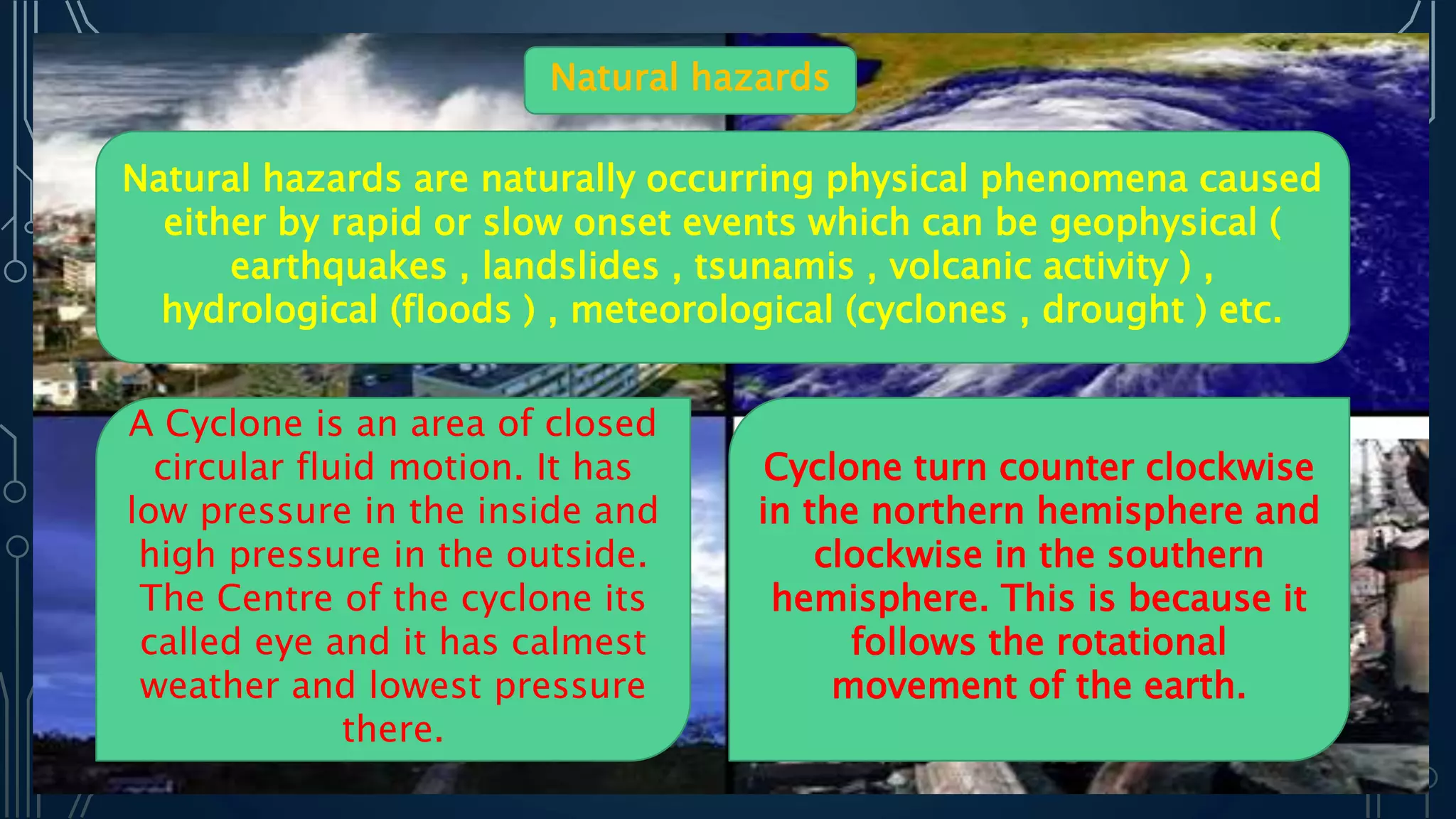
Natural hazards are naturally occurring physical phenomena caused
either by rapid or slow onset events which can be geophysical (
earthquakes , landslides , tsunamis , volcanic activity ) ,
hydrological (floods ) , meteorological (cyclones , drought ) etc.
A Cyclone is an area of closed
circular fluid motion. It has
low pressure in the inside and
high pressure in the outside.
The Centre of the cyclone its
called eye and it has calmest
weather and lowest pressure
there.
Cyclone turn counter clockwise
in the northern hemisphere and
clockwise in the southern
hemisphere. This is because it
follows the rotational
movement of the earth.
Overview of Aila
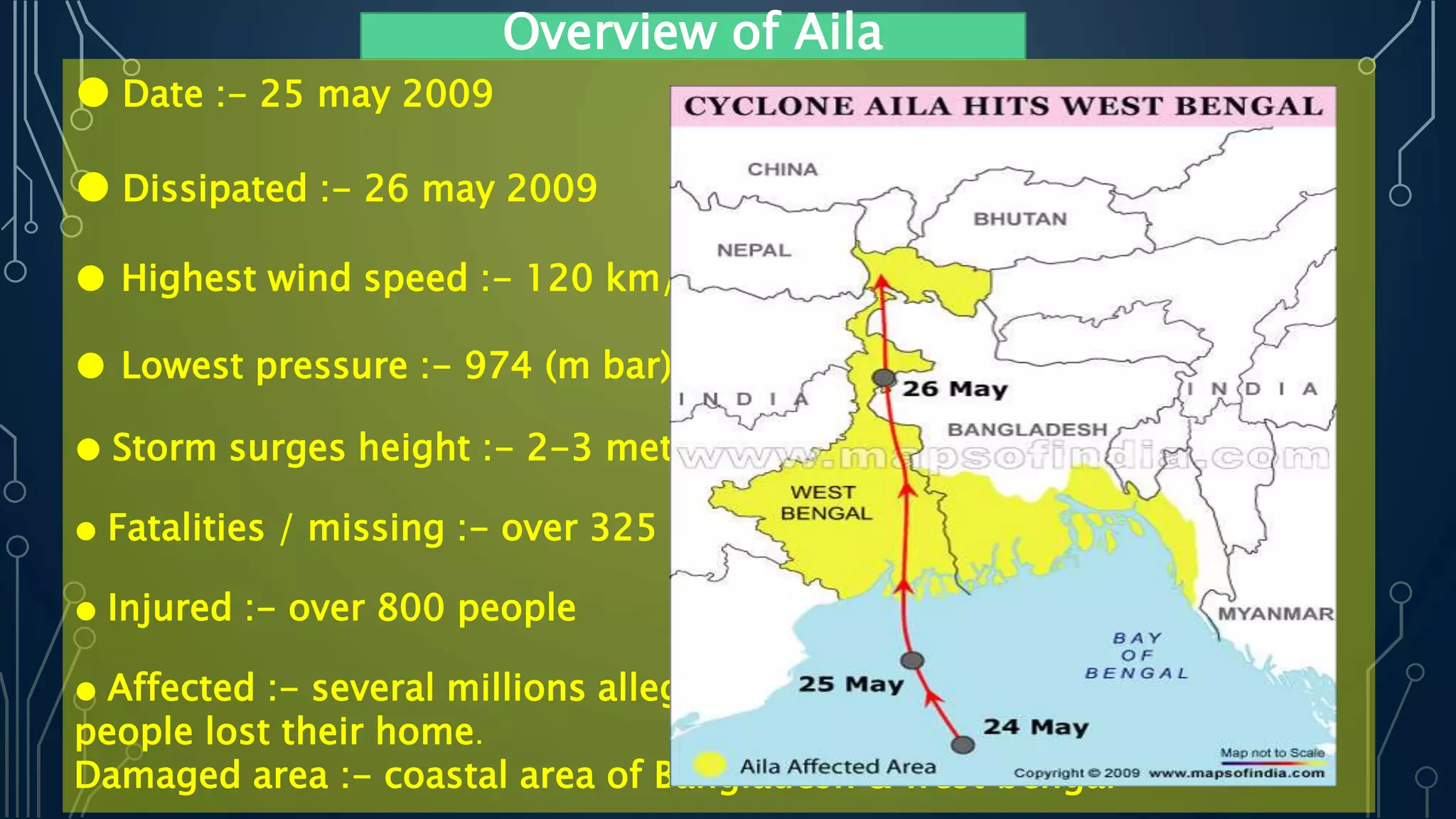
● Date :- 25 may 2009
● Dissipated :- 26 may 2009
● Highest wind speed :- 120 km/ hr
● Lowest pressure :- 974 (m bar)
● Storm surges height :- 2-3 metre
● Fatalities / missing :- over 325 people
● Injured :- over 800 people
● Affected :- several millions allegedly were affected and nearly 50000
people lost their home.
Damaged area :- coastal area of Bangladesh & west bengal
Meteorological history
On 21 may 2009 , the Joint Typhoon warning
Centre reported a tropical disturbance had
persisted about 950 kilometers to the south
of Kolkata , in india and had developed.
Later the day RSMC New Delhi reported
That the deep depression had intensified
into a cyclonic storm and had been named
as Aila located about 350 kilometers to the
south west of Sagar island.
On 22 may 2009 , the disturbance further
developed with a tropical cyclone formation
alert being issued early the next day by JTWC
as the low level circulation Centre had
become strong and more defined.
Aila became a severe cyclonic storm on may
25 and made landfall at its peak intensity.
• Officials in India evacuated thousands of residents from coastal
areas ahead of Cyclone Aila.
• In addition, several warning alerts were issued before the
cyclone hit Kolkata; however, no alarm bells were rung.
• In the Bhola District of Bangladesh, an estimated 500,000
people evacuated to higher areas and shelters as Aila neared
landfall.
• Tourists were advised to stay in their hotels due to the short
amount of time to prepare for the storm.
PREPARATIONS
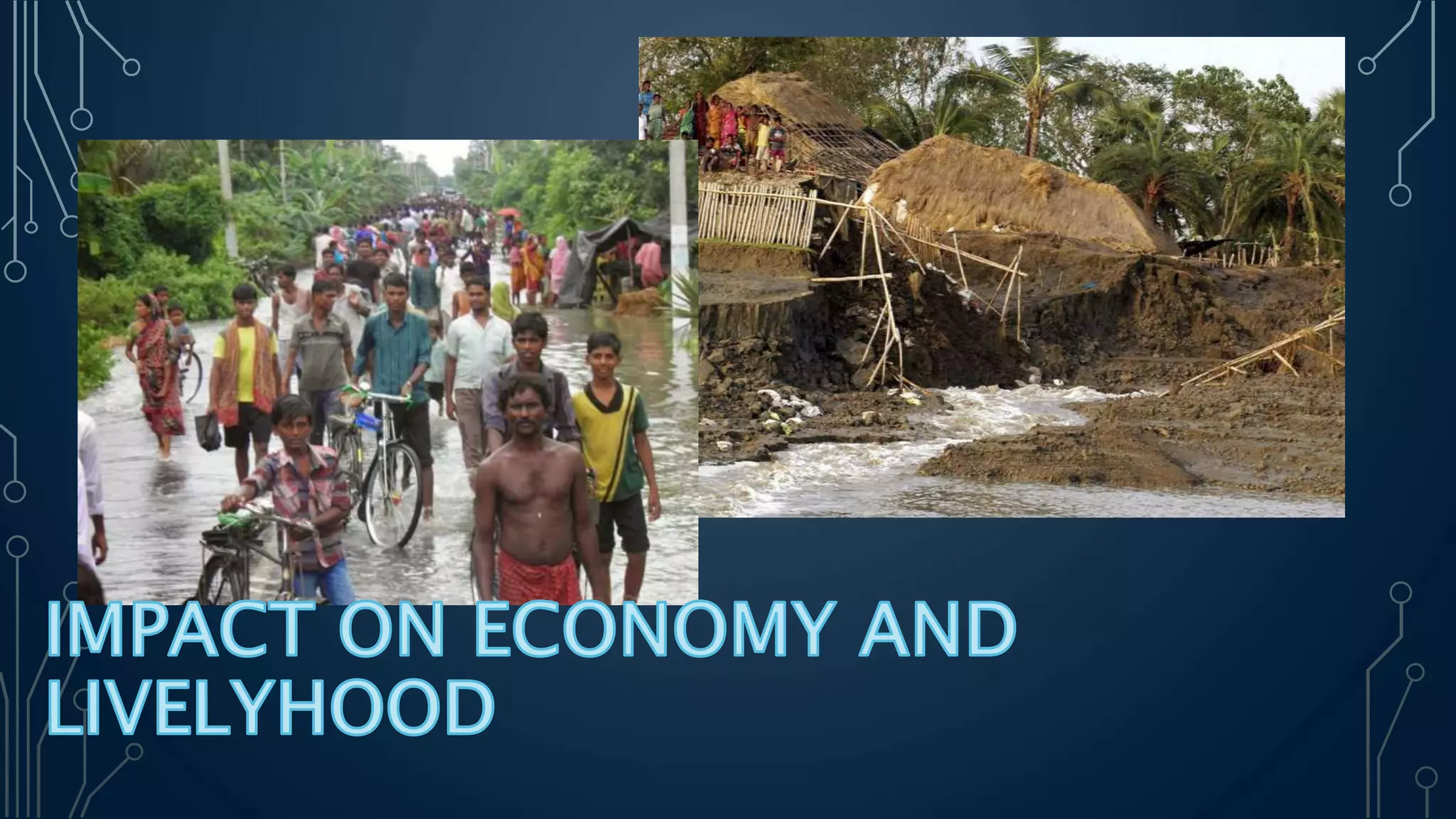
Damage on structures
Several river bursted their banks
Farmland and fishery
equipment's were devastated
Road network were
destroyed
Heavily affected areas were
without electricity for more
than 24 hours
Communication and water supply system
became defective
according to REPORTS FROM BBC NEWS………
Cyclone Aila was not a strong storm, but its heavy rains
and storm surges were enough to swamp the Mouths of
the Ganges River in Bangladesh and India. Some islands
in the Bay of Bengal and the mangrove forests of the
Sundarbans region were inundated and still cut off from
relief and rescue workers as of May 29, 2009. Clean
drinking water was an acute problem: tidal surges
continued to wash salty water inland over damaged
levees, and salt water cannot be decontaminated with
regular water purification tablets.
The destruction countIndia
At least 149 people were killed.
More than 15,000 people in
eight villages were reportedly
isolated from relief crews .
More than 100,000 people were
left homeless as a result of Aila.
At least 100 river embankments
were breached by storm surge .
At least 150,000 people were
left homeless.
Throughout the state, an
estimated 40,000 homes were
destroyed and 132,000 others
were damaged.
At least 350,000 people affected
by Aila.
Approximately 600,000 thatched homes
were damaged.
8,800 km (5,500 mi) of roads were
destroyed.
1,000 km (620 mi) of embankments, and
123,000 hectares (300,000 acres) of land
were damaged .
Approximately 9.3 million people were
affected by the cyclone, of which
1 million were rendered homeless.
Total damage amounted to
18.85 billion taka (US$269.28 million).
More than 400,000 people were
reportedly isolated by severe flooding in
coastal regions of Bangladesh.
Port officials stated that more than 500
fishermen had gone missing .
An estimated 58,950 animals were killed
by the storm with up to 50,000 deer
missing.
Bangladesh
ENVIRONMENTAL IMPACT ON
SUNDARBANS
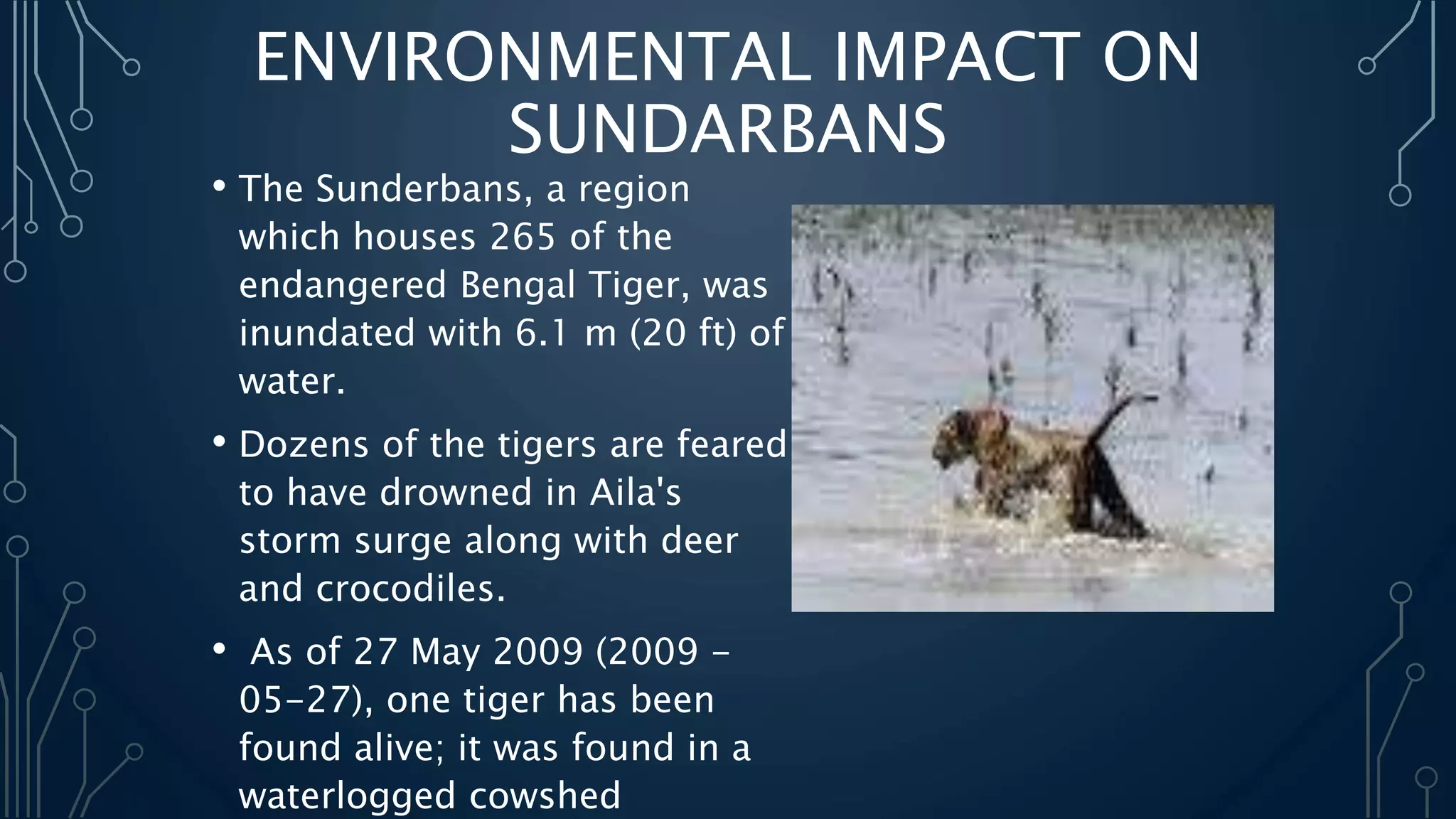
• The Sunderbans, a region
which houses 265 of the
endangered Bengal Tiger, was
inundated with 6.1 m (20 ft) of
water.
• Dozens of the tigers are feared
to have drowned in Aila's
storm surge along with deer
and crocodiles.
• As of 27 May 2009 (2009 -
05-27), one tiger has been
found alive; it was found in a
waterlogged cowshed
• Apart from the human tragedy, the
cyclone and subsequent floods has
badly affected the mangrove forests of
Sunderbans and presumably caused a
sizable damage to its animal life by
sweeping away a large number of highly
endangered Bengal tigers, crocodiles,
wild boars and spotted deer.
• Additionally the forest remains under an
estimated 2.4 m (7.9 ft) of water. On 27
May, conservationists have begun a
search for the tigers throughout the
forest.
• The search teams were supplied with
fresh drinking water for the tigers as
their natural water source was
• The loss of faunal diversity is difficult to assess. However the survey team
observed many numerous dead frogs, snakes, fishes, ground hogs and other
wildlife along with domestic animals floating on water especially in Dacope, Koyra
and Paikgacha.
• It can be assumed that because of the saline waterlogged conditions, an anoxic
condition is prevailing in the affected area might cause a colossal loss of the soil
living organisms.
• Many floral diversity are also affected like Jackfruit, Litchi, mango and mangrove
varieties are dying in the area. Officials from the Forest Department, Sundarbans
West Division, informed the survey team that, a large number of trees were
uprooted; seized logs of Sundari trees swept away by 10-12 feet high tidal surge
whipped up by Aila. The Divisional Forest Officer (Sundarbans West Division) also
told the survey team that at least 35% of forest camps in the west part of the
• Kacha houses incurred comparatively more damage than pucca and
semi-pucca houses.
• Transport sector accounted for the majority of additional damage.
• Other losses include the destruction of household goods, agricultural
tools(e.g. ploughs), and fishing tools (e.g. boats, nets, etc.).
LOSS OF PERMANENT ASSETS AND INFRASTRUCTURE
ACUTE SHORTAGE AND POOR ACCESS
SAFE DRINKING WATER
 increase in salinity in surface water
 destruction or absence of sanitation facilities
 problems with the distribution of water supplies
IMPACT ON FOOD SECURITY
• Due to destruction of agricultural crops local markets were severely damaged and communities faced
difficulties in buying food. Physical access to markets had been disrupted in some of the worst affected
areas.
• People were buying less due to income loss caused by fall in agricultural and fishing activities and price
increase of essential food commodities in the local market since Aila hit.
• Income loss significantly affected the labor market and subsequently diminished employment
opportunities.
• Due to the loss of livelihoods and decreases in income, poor households typically reduced their food
purchases and compromise their food consumption habit by having fewer meals per day, less quantity food
per meal and less nutrient‐rich food items, which resulted in under‐nutrition and deficiencies in essential
micronutrient. People became more vulnerable to diseases and that broke out post Aila condition. The
situation is even worse for children under two years of age who were extremely vulnerable to the effects of
poor food quality and quantity.
IMPACT ON HEALTH AND EDUCATION
 Outbreak of several diseases.
 Dependency on untrained indigenous medical practitioners.
 Most pregnant women living on the embankments are delivering their babies in their shelters
on the embankments, with the assistance of a Traditional Birth Attendant, if available.
 According to the Disaster Management Bureau, cyclone Aila destroyed 445 educational
institutions and partially damaged 4,588 across all affected districts, impacting
approximately 500,000 children in Bangladesh.
 In Khulna, the number of examinee of HSC in August, second terminal examination of
Primary Education in August and Secondary Education in September has been decreased
9.3%, 34.3% and 22.7% respectively.
• DISPLACEMENTS AND MIGRATION OF THE INHABITANTS
• Due to destruction of the embankments people living there were forced to
migrate to the lower regions away from the embankments. But due to tidal surges
they had to come back to the embankment during the time of tide.
• Absence of income facilities, lack of household capital and no place to live
dragged most of the affected families to the points closer to the towns.
• Most of them remain unemployed, other started working as rikshaw van puller,
housemaid, rice mill labour, agricultural labour, hawker.
IMPACT UPON SOCIAL RELATIONS
People humiliating government officials in demand of adequate relief .
People migrating from the affected areas are causing chaos in the areas where
they have taken refuge. They built temporary shelters often occupying other’s
land. Pressure also increased in job market. Certain increase in population in the
refugee areas are causing health and sanitation problems. All these are heaping
the conflicts between the locals and the migrants.
DEALING WITH THE DESTRUCTION
THE RELIEF PROCEDURE
• Action taken by Indian state and central
government
• Army And National Disaster Response Force
were deployed to the state for relief operations.
Helicopters were used to provide food to the
affected population.
• The Government of India released Indian rupee
10,000,000 (US $209,775) in relief funds to the
affected areas on 26 May.
• Several naval relief teams were deployed to the
Sunderban region where an estimated 400,000
people were marooned by flooding.
• Roughly 100 relief camps were established in
West Bengal shortly after the storm passed.
Action taken by Government of Bangladesh
• Immediately following the storm, a 33-member team
of the Bangladesh Navy was deployed to the affected
regions.
• The Red Cross also quickly responded, supplying
water purifying tablets and other relief items. About
ten tonnes of rice and 100,000 (US$1,450) in
immediate relief funds were allocated. The
government later allocated Tk. 1.2 million
(US$17,143) and 1,000 tonnes of rice for the
affected areas. These amounts further increased to
Tk. 12.3 million (US$175,714) and 2,500 tonnes of
rice.
SUPPORT PROVIDED BY INTERNATIONAL
AGENCIESSeveral International agencies came forward to aid the Aila affected victims to provide both short term
and long term relief assistance. The International Federation of Red Cross and Red Crescent Societies
(IFRC) which the world's largest humanitarian network provided their assistance to both India and Bangladesh
during and after disasters and health emergencies to meet the needs and improve the lives of vulnerable
people. They provided assistance in post Aila condition by
• rebuilding destroyed homes
• building or repairing water and sanitation facilities
• helping people regain their livelihoods and earn an income.
• The project also reduced people’s vulnerability to future disasters by designing more resilient housing,
raising awareness in communities about potential hazards and improving the ability of communities to
respond to disasters in the future.
APPROACHES TAKEN FOR STRENGTHENING
COMMUNITY RESILIENCE
1. STRUCTURAL MEASURES
• Strengthening coastal embankments and
infrastructure: Bangladesh has over 7500 km of embankments built along
its rivers and coastal areas (UN, 2010). Coastal embankments serve to
protect coastal communities and other productive resources.
• Providing basic support services
Greater efforts should be made to improve safe water infrastructure in at
risk areas, including saline water treatment services. Additionally, the
provision of (minimum standard) sanitation systems and health services
would greatly improve the lives of those in affected areas.
• Non-structural Measures
Strengthening the cyclone early warning system: It has been proven that
early warning systems and access to cyclone shelters have helped to
reduce the number of deaths from cyclones (Mallick et al., 2011).
• Supporting long-term income generation activities: Following the
aftermath of cyclone Sidr and Aila, much of the recovery effort focused
on short term and periodic relief activities (e.g. providing food, shelter,
and drinking water etc.). In anticipation of future cyclones and other
extreme events, additional long-term recovery measures are needed to
help restore and maintain livelihoods and adapt
to the lasting impacts of these disasters.
• Conservation of productive ecosystem services: At present, Bangladesh’s
largest mangrove forest, the Sundarbans serve as breeding and nursing
grounds for many marine flora and fauna.Therefore, conservation of the
Sundarbans and other coastal mangrove ecosystems should be another
• Capacity building of local institutions: At the District and Panchayat level, a
comprehensive assessment should be undertaken to determine current levels
of local governmental and institutional capacity to respond quickly and
effectively to extreme events
• lastly
• Addressing under-lying causes of vulnerability: Globally, empirical evidence
shows that poverty is a major factor in determining the resilience and
vulnerability of
communities (Wisner at al., 2004). In many coastal communities with
significant exposure
to extreme events, poverty is widespread; providing better access to
education, sanitation,
and health care will help to enhance the resilience and minimise loss and
damage
associated with climate change impacts of the poor. To this end, vulnerable
REFERENCES
• Farhana S. (2011). Suitability of pond sand filters as safe drinking water solution in storm surge prone areas of bangladesh:
a case study of post-aila situation in shyamnagar, satkhira district, khulna.
• Sharmin S.; Naznin R. (2013). Impacts of Cyclone Aila on Educational Institutions: A Study of South-Western Bangladesh.
Springer.
• Mitra A.; Haldar P.; Banerjee K. (2010). Changes of selected hydrological parameters in Hooghly estuary in response to a
severe tropical cyclone (Aila), Indian Journal of Geo-Marine Sciences, Vol. 40(1). pp 32-36.
• ADRA (April 2011). Impact Evaluation of the Post Aila Recovery Project in Sundarbans, West Bengal, India: Executive
Summary.
• Hasan, M., (july, 2010). Climate induced displacement:case study of cyclone Aila in the southwest coastal region of
Bangladesh.
• Mallick, B; Rahaman K. R.; Vogt J. (2011). Coastal livelihood and physical infrastructure in Bangladesh after cyclone Aila,
Springer.
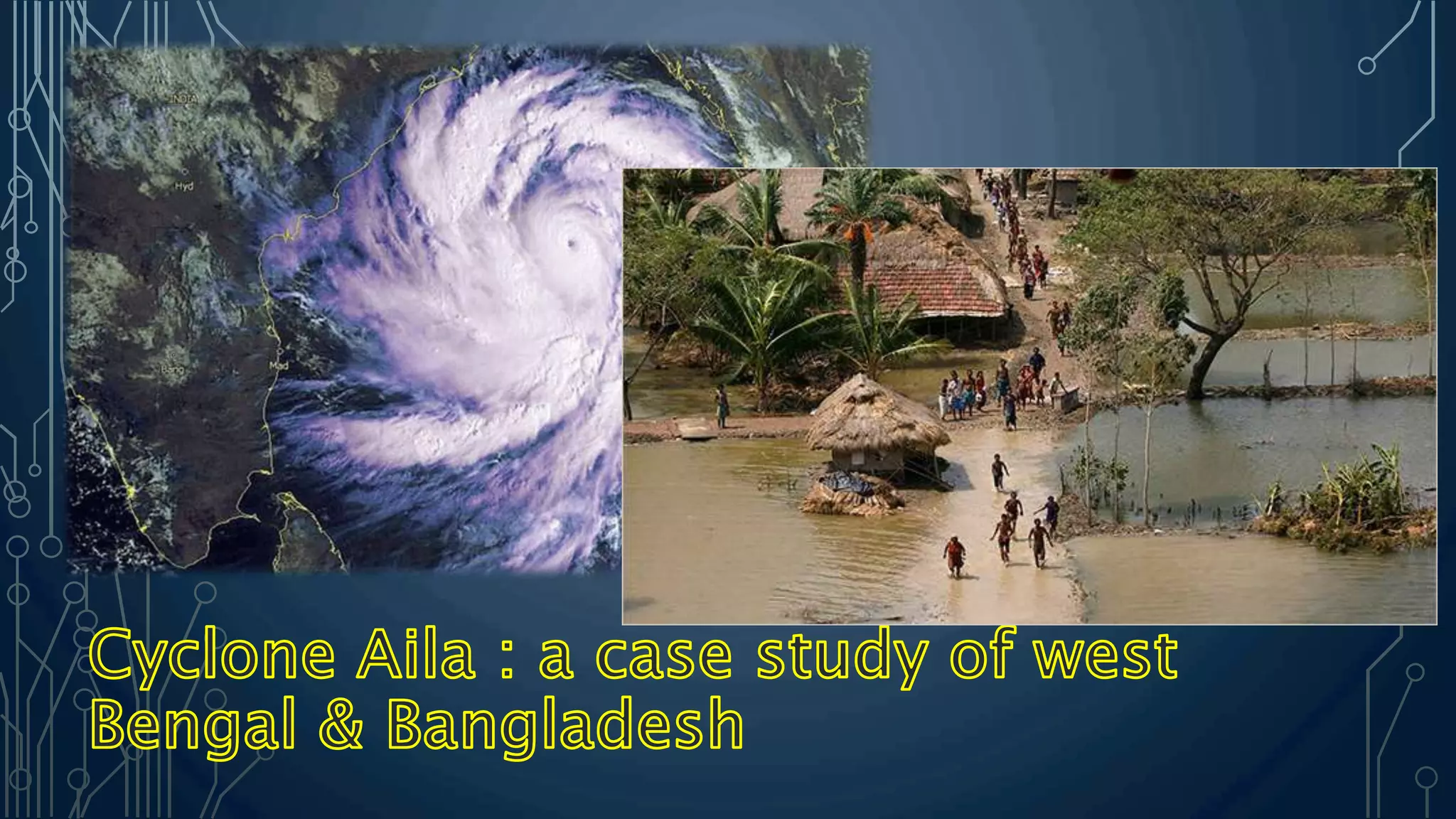
Cyclone Aila

Cyclone Aila

  • 2.
    Natural hazards Natural hazardsare naturally occurring physical phenomena caused either by rapid or slow onset events which can be geophysical ( earthquakes , landslides , tsunamis , volcanic activity ) , hydrological (floods ) , meteorological (cyclones , drought ) etc. A Cyclone is an area of closed circular fluid motion. It has low pressure in the inside and high pressure in the outside. The Centre of the cyclone its called eye and it has calmest weather and lowest pressure there. Cyclone turn counter clockwise in the northern hemisphere and clockwise in the southern hemisphere. This is because it follows the rotational movement of the earth.
  • 3.
    Overview of Aila ●Date :- 25 may 2009 ● Dissipated :- 26 may 2009 ● Highest wind speed :- 120 km/ hr ● Lowest pressure :- 974 (m bar) ● Storm surges height :- 2-3 metre ● Fatalities / missing :- over 325 people ● Injured :- over 800 people ● Affected :- several millions allegedly were affected and nearly 50000 people lost their home. Damaged area :- coastal area of Bangladesh & west bengal
  • 4.
    Meteorological history On 21may 2009 , the Joint Typhoon warning Centre reported a tropical disturbance had persisted about 950 kilometers to the south of Kolkata , in india and had developed. Later the day RSMC New Delhi reported That the deep depression had intensified into a cyclonic storm and had been named as Aila located about 350 kilometers to the south west of Sagar island. On 22 may 2009 , the disturbance further developed with a tropical cyclone formation alert being issued early the next day by JTWC as the low level circulation Centre had become strong and more defined. Aila became a severe cyclonic storm on may 25 and made landfall at its peak intensity.
  • 5.
    • Officials inIndia evacuated thousands of residents from coastal areas ahead of Cyclone Aila. • In addition, several warning alerts were issued before the cyclone hit Kolkata; however, no alarm bells were rung. • In the Bhola District of Bangladesh, an estimated 500,000 people evacuated to higher areas and shelters as Aila neared landfall. • Tourists were advised to stay in their hotels due to the short amount of time to prepare for the storm. PREPARATIONS
  • 6.
    Damage on structures Severalriver bursted their banks Farmland and fishery equipment's were devastated Road network were destroyed Heavily affected areas were without electricity for more than 24 hours Communication and water supply system became defective
  • 7.
    according to REPORTSFROM BBC NEWS……… Cyclone Aila was not a strong storm, but its heavy rains and storm surges were enough to swamp the Mouths of the Ganges River in Bangladesh and India. Some islands in the Bay of Bengal and the mangrove forests of the Sundarbans region were inundated and still cut off from relief and rescue workers as of May 29, 2009. Clean drinking water was an acute problem: tidal surges continued to wash salty water inland over damaged levees, and salt water cannot be decontaminated with regular water purification tablets.
  • 9.
    The destruction countIndia Atleast 149 people were killed. More than 15,000 people in eight villages were reportedly isolated from relief crews . More than 100,000 people were left homeless as a result of Aila. At least 100 river embankments were breached by storm surge . At least 150,000 people were left homeless. Throughout the state, an estimated 40,000 homes were destroyed and 132,000 others were damaged. At least 350,000 people affected by Aila. Approximately 600,000 thatched homes were damaged. 8,800 km (5,500 mi) of roads were destroyed. 1,000 km (620 mi) of embankments, and 123,000 hectares (300,000 acres) of land were damaged . Approximately 9.3 million people were affected by the cyclone, of which 1 million were rendered homeless. Total damage amounted to 18.85 billion taka (US$269.28 million). More than 400,000 people were reportedly isolated by severe flooding in coastal regions of Bangladesh. Port officials stated that more than 500 fishermen had gone missing . An estimated 58,950 animals were killed by the storm with up to 50,000 deer missing. Bangladesh
  • 10.
    ENVIRONMENTAL IMPACT ON SUNDARBANS •The Sunderbans, a region which houses 265 of the endangered Bengal Tiger, was inundated with 6.1 m (20 ft) of water. • Dozens of the tigers are feared to have drowned in Aila's storm surge along with deer and crocodiles. • As of 27 May 2009 (2009 - 05-27), one tiger has been found alive; it was found in a waterlogged cowshed
  • 11.
    • Apart fromthe human tragedy, the cyclone and subsequent floods has badly affected the mangrove forests of Sunderbans and presumably caused a sizable damage to its animal life by sweeping away a large number of highly endangered Bengal tigers, crocodiles, wild boars and spotted deer. • Additionally the forest remains under an estimated 2.4 m (7.9 ft) of water. On 27 May, conservationists have begun a search for the tigers throughout the forest. • The search teams were supplied with fresh drinking water for the tigers as their natural water source was
  • 12.
    • The lossof faunal diversity is difficult to assess. However the survey team observed many numerous dead frogs, snakes, fishes, ground hogs and other wildlife along with domestic animals floating on water especially in Dacope, Koyra and Paikgacha. • It can be assumed that because of the saline waterlogged conditions, an anoxic condition is prevailing in the affected area might cause a colossal loss of the soil living organisms. • Many floral diversity are also affected like Jackfruit, Litchi, mango and mangrove varieties are dying in the area. Officials from the Forest Department, Sundarbans West Division, informed the survey team that, a large number of trees were uprooted; seized logs of Sundari trees swept away by 10-12 feet high tidal surge whipped up by Aila. The Divisional Forest Officer (Sundarbans West Division) also told the survey team that at least 35% of forest camps in the west part of the
  • 14.
    • Kacha housesincurred comparatively more damage than pucca and semi-pucca houses. • Transport sector accounted for the majority of additional damage. • Other losses include the destruction of household goods, agricultural tools(e.g. ploughs), and fishing tools (e.g. boats, nets, etc.). LOSS OF PERMANENT ASSETS AND INFRASTRUCTURE ACUTE SHORTAGE AND POOR ACCESS SAFE DRINKING WATER  increase in salinity in surface water  destruction or absence of sanitation facilities  problems with the distribution of water supplies
  • 15.
    IMPACT ON FOODSECURITY • Due to destruction of agricultural crops local markets were severely damaged and communities faced difficulties in buying food. Physical access to markets had been disrupted in some of the worst affected areas. • People were buying less due to income loss caused by fall in agricultural and fishing activities and price increase of essential food commodities in the local market since Aila hit. • Income loss significantly affected the labor market and subsequently diminished employment opportunities. • Due to the loss of livelihoods and decreases in income, poor households typically reduced their food purchases and compromise their food consumption habit by having fewer meals per day, less quantity food per meal and less nutrient‐rich food items, which resulted in under‐nutrition and deficiencies in essential micronutrient. People became more vulnerable to diseases and that broke out post Aila condition. The situation is even worse for children under two years of age who were extremely vulnerable to the effects of poor food quality and quantity.
  • 16.
    IMPACT ON HEALTHAND EDUCATION  Outbreak of several diseases.  Dependency on untrained indigenous medical practitioners.  Most pregnant women living on the embankments are delivering their babies in their shelters on the embankments, with the assistance of a Traditional Birth Attendant, if available.  According to the Disaster Management Bureau, cyclone Aila destroyed 445 educational institutions and partially damaged 4,588 across all affected districts, impacting approximately 500,000 children in Bangladesh.  In Khulna, the number of examinee of HSC in August, second terminal examination of Primary Education in August and Secondary Education in September has been decreased 9.3%, 34.3% and 22.7% respectively.
  • 17.
    • DISPLACEMENTS ANDMIGRATION OF THE INHABITANTS • Due to destruction of the embankments people living there were forced to migrate to the lower regions away from the embankments. But due to tidal surges they had to come back to the embankment during the time of tide. • Absence of income facilities, lack of household capital and no place to live dragged most of the affected families to the points closer to the towns. • Most of them remain unemployed, other started working as rikshaw van puller, housemaid, rice mill labour, agricultural labour, hawker.
  • 18.
    IMPACT UPON SOCIALRELATIONS People humiliating government officials in demand of adequate relief . People migrating from the affected areas are causing chaos in the areas where they have taken refuge. They built temporary shelters often occupying other’s land. Pressure also increased in job market. Certain increase in population in the refugee areas are causing health and sanitation problems. All these are heaping the conflicts between the locals and the migrants.
  • 19.
    DEALING WITH THEDESTRUCTION THE RELIEF PROCEDURE • Action taken by Indian state and central government • Army And National Disaster Response Force were deployed to the state for relief operations. Helicopters were used to provide food to the affected population. • The Government of India released Indian rupee 10,000,000 (US $209,775) in relief funds to the affected areas on 26 May. • Several naval relief teams were deployed to the Sunderban region where an estimated 400,000 people were marooned by flooding. • Roughly 100 relief camps were established in West Bengal shortly after the storm passed.
  • 20.
    Action taken byGovernment of Bangladesh • Immediately following the storm, a 33-member team of the Bangladesh Navy was deployed to the affected regions. • The Red Cross also quickly responded, supplying water purifying tablets and other relief items. About ten tonnes of rice and 100,000 (US$1,450) in immediate relief funds were allocated. The government later allocated Tk. 1.2 million (US$17,143) and 1,000 tonnes of rice for the affected areas. These amounts further increased to Tk. 12.3 million (US$175,714) and 2,500 tonnes of rice.
  • 21.
    SUPPORT PROVIDED BYINTERNATIONAL AGENCIESSeveral International agencies came forward to aid the Aila affected victims to provide both short term and long term relief assistance. The International Federation of Red Cross and Red Crescent Societies (IFRC) which the world's largest humanitarian network provided their assistance to both India and Bangladesh during and after disasters and health emergencies to meet the needs and improve the lives of vulnerable people. They provided assistance in post Aila condition by • rebuilding destroyed homes • building or repairing water and sanitation facilities • helping people regain their livelihoods and earn an income. • The project also reduced people’s vulnerability to future disasters by designing more resilient housing, raising awareness in communities about potential hazards and improving the ability of communities to respond to disasters in the future.
  • 22.
    APPROACHES TAKEN FORSTRENGTHENING COMMUNITY RESILIENCE 1. STRUCTURAL MEASURES • Strengthening coastal embankments and infrastructure: Bangladesh has over 7500 km of embankments built along its rivers and coastal areas (UN, 2010). Coastal embankments serve to protect coastal communities and other productive resources. • Providing basic support services Greater efforts should be made to improve safe water infrastructure in at risk areas, including saline water treatment services. Additionally, the provision of (minimum standard) sanitation systems and health services would greatly improve the lives of those in affected areas.
  • 23.
    • Non-structural Measures Strengtheningthe cyclone early warning system: It has been proven that early warning systems and access to cyclone shelters have helped to reduce the number of deaths from cyclones (Mallick et al., 2011). • Supporting long-term income generation activities: Following the aftermath of cyclone Sidr and Aila, much of the recovery effort focused on short term and periodic relief activities (e.g. providing food, shelter, and drinking water etc.). In anticipation of future cyclones and other extreme events, additional long-term recovery measures are needed to help restore and maintain livelihoods and adapt to the lasting impacts of these disasters. • Conservation of productive ecosystem services: At present, Bangladesh’s largest mangrove forest, the Sundarbans serve as breeding and nursing grounds for many marine flora and fauna.Therefore, conservation of the Sundarbans and other coastal mangrove ecosystems should be another
  • 24.
    • Capacity buildingof local institutions: At the District and Panchayat level, a comprehensive assessment should be undertaken to determine current levels of local governmental and institutional capacity to respond quickly and effectively to extreme events • lastly • Addressing under-lying causes of vulnerability: Globally, empirical evidence shows that poverty is a major factor in determining the resilience and vulnerability of communities (Wisner at al., 2004). In many coastal communities with significant exposure to extreme events, poverty is widespread; providing better access to education, sanitation, and health care will help to enhance the resilience and minimise loss and damage associated with climate change impacts of the poor. To this end, vulnerable
  • 25.
    REFERENCES • Farhana S.(2011). Suitability of pond sand filters as safe drinking water solution in storm surge prone areas of bangladesh: a case study of post-aila situation in shyamnagar, satkhira district, khulna. • Sharmin S.; Naznin R. (2013). Impacts of Cyclone Aila on Educational Institutions: A Study of South-Western Bangladesh. Springer. • Mitra A.; Haldar P.; Banerjee K. (2010). Changes of selected hydrological parameters in Hooghly estuary in response to a severe tropical cyclone (Aila), Indian Journal of Geo-Marine Sciences, Vol. 40(1). pp 32-36. • ADRA (April 2011). Impact Evaluation of the Post Aila Recovery Project in Sundarbans, West Bengal, India: Executive Summary. • Hasan, M., (july, 2010). Climate induced displacement:case study of cyclone Aila in the southwest coastal region of Bangladesh. • Mallick, B; Rahaman K. R.; Vogt J. (2011). Coastal livelihood and physical infrastructure in Bangladesh after cyclone Aila, Springer.