


Ultra Performance
      Liquid
Chromatography
         Prepared by:
    SHAIMAA OBAID AHMADEEN

     Supervised by:
 DR / NOuRAH AL ZOMAN
Presentation's outlines:
• Introduction
• Definition
• UPLC vs HPLC
• efficiency of UPLC
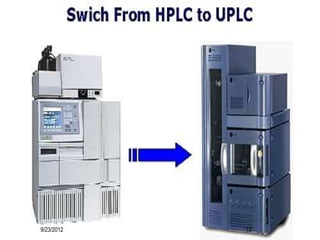
• Switching from HPLC to UPLC
• Examples showing different UPLC
instruments
• Applications of UPLC in pharmacy
• Conclusion
 9/23/2012                   2
Introduction :
   The pharmaceutical industry is
 under intense pressure to increase
productivity and put new drugs onto
  the market in a shorter period of
    time. Analytical chemists are
  challenged to find faster ways of
   delivering quality data across a
range of project needs. A number of
 approaches are being employed to
 9/23/2012                3
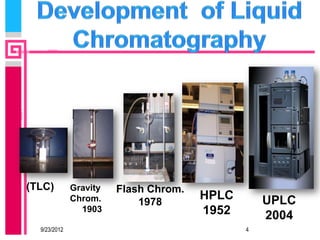
(TLC)         Gravity   Flash Chrom.
              Chrom.        1978
                                       HPLC       UPLC
                1903                   1952       2004
  9/23/2012                                   4
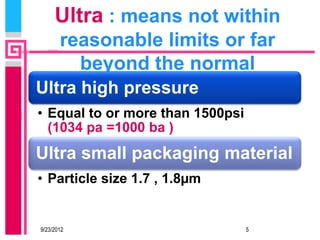
Ultra : means not within
       reasonable limits or far
         beyond the normal
Ultra high pressure
• Equal to or more than 1500psi
  (1034 pa =1000 ba )
Ultra small packaging material
• Particle size 1.7 , 1.8µm


9/23/2012                         5
Definition :
 UPLC is a chromatographic technique that can
 separate a mixture of compounds, and is used
  in biochemistry and analytical chemistry to
   identify, quantify and purify the individual
  components of the mixture. Utilizing a small
packaging particle size's columns and ultra high
                 pack pressure

 9/23/2012                           6
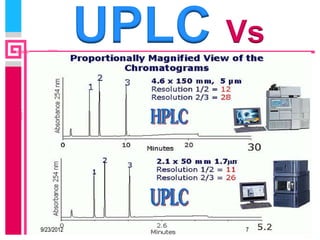
UPLC Vs
             HPLC

9/23/2012         7
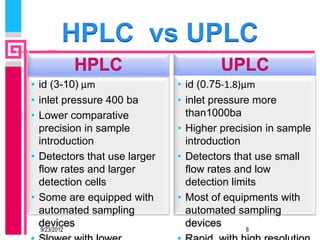
HPLC vs UPLC
         HPLC                          UPLC
• id (3-10) µm                • id (0.75-1.8)µm
• inlet pressure 400 ba       • inlet pressure more
• Lower comparative             than1000ba
  precision in sample         • Higher precision in sample
  introduction                  introduction
• Detectors that use larger   • Detectors that use small
  flow rates and larger         flow rates and low
  detection cells               detection limits
• Some are equipped with      • Most of equipments with
  automated sampling            automated sampling
  devices
   9/23/2012
                                devices       8
Why is UPLC more
        efficient
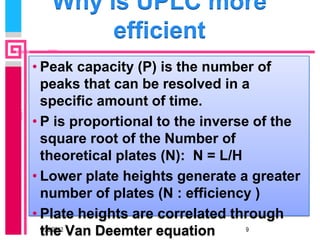
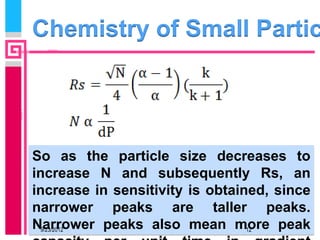
• Peak capacity (P) is the number of
  peaks that can be resolved in a
  specific amount of time.
• P is proportional to the inverse of the
  square root of the Number of
  theoretical plates (N): N = L/H
• Lower plate heights generate a greater
  number of plates (N : efficiency )
• Plate heights are correlated through
  the Van Deemter equation
  9/23/2012                       9
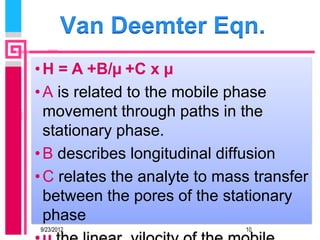
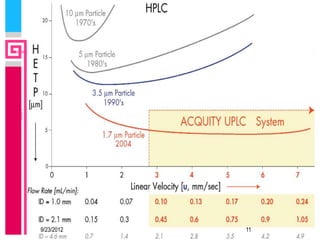
Van Deemter Eqn.
• H = A +B/µ +C x µ
• A is related to the mobile phase
  movement through paths in the
  stationary phase.
• B describes longitudinal diffusion
• C relates the analyte to mass transfer
  between the pores of the stationary
  phase
9/23/2012                     10
9/23/2012   11
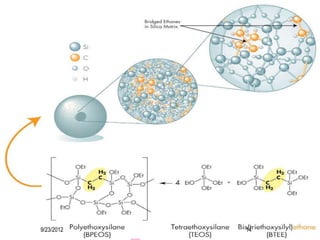
Chemistry of Small Partic


So as the particle size decreases to
increase N and subsequently Rs, an
increase in sensitivity is obtained, since
narrower peaks are taller peaks.
Narrower peaks also mean more peak
  9/23/2012                      12
9/23/2012   13
9/23/2012   14
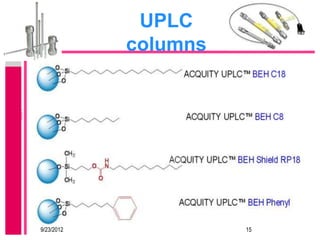
UPLC
            columns


9/23/2012             15
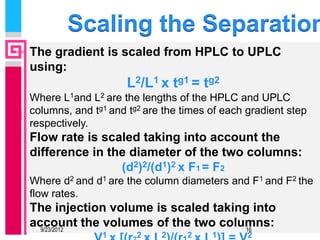
Scaling the Separation
The gradient is scaled from HPLC to UPLC
using:
                     L2/L1 x tg1 = tg2
Where L1and L2 are the lengths of the HPLC and UPLC
columns, and tg1 and tg2 are the times of each gradient step
respectively.
Flow rate is scaled taking into account the
difference in the diameter of the two columns:
                (d2)2/(d1)2 x F1 = F2
Where d2 and d1 are the column diameters and F1 and F2 the
flow rates.
The injection volume is scaled taking into
account the volumes of the two columns:
  9/23/2012                          16
               1       2    2     2    1       2
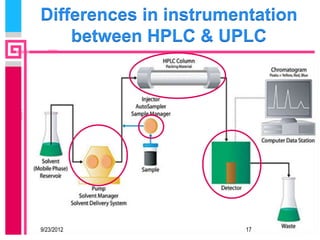
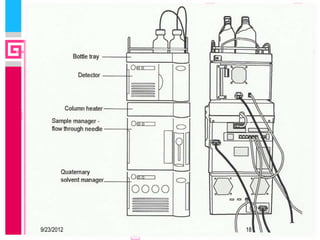
Differences in instrumentation
    between HPLC & UPLC


9/23/2012              17
9/23/2012   18
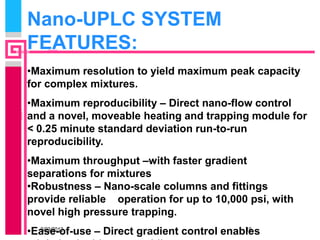
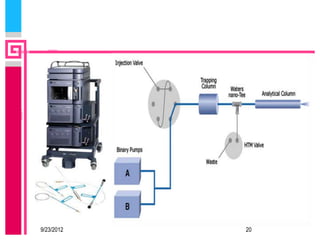
Nano-UPLC SYSTEM
FEATURES:
•Maximum resolution to yield maximum peak capacity
for complex mixtures.
•Maximum reproducibility – Direct nano-flow control
and a novel, moveable heating and trapping module for
< 0.25 minute standard deviation run-to-run
reproducibility.
•Maximum throughput –with faster gradient
separations for mixtures
•Robustness – Nano-scale columns and fittings
provide reliable operation for up to 10,000 psi, with
novel high pressure trapping.
•Ease-of-use – Direct gradient control enables
  9/23/2012                                19
9/23/2012   20
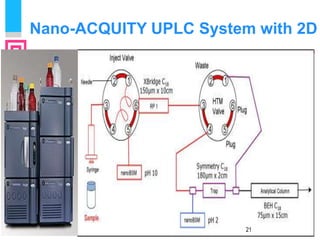
Nano-ACQUITY UPLC System with 2D


 9/23/2012              21
Hydrogen Deuterium Exchange (HD-x) is an experimental
technique to obtain structural data on proteins. It relies on
the accurate measurement of the degree of labeling of the
protein by deuterated hydrogen.


 9/23/2012                                     22
9/23/2012   23
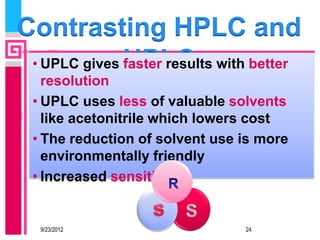
Contrasting HPLC and
 • UPLC gives UPLC with better
              faster results
   resolution
 • UPLC uses less of valuable solvents
   like acetonitrile which lowers cost
 • The reduction of solvent use is more
   environmentally friendly
 • Increased sensitivity


  9/23/2012                     24
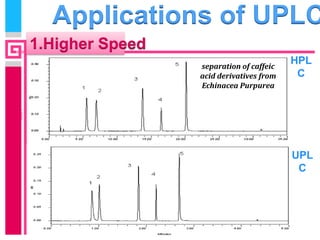
Applications of UPLC
1.Higher Speed
                 separation of caffeic
                                         HPL
                 acid derivatives from    C
                 Echinacea Purpurea


                                         UPL
                                          C


 9/23/2012                   25
9/23/2012   26
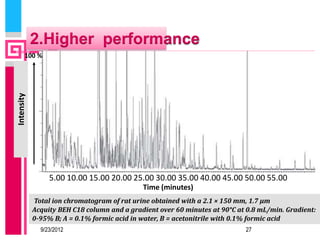
2.Higher performance
       100 %
Intensity


                 5.00 10.00 15.00 20.00 25.00 30.00 35.00 40.00 45.00 50.00 55.00
                                             Time (minutes)
            Total ion chromatogram of rat urine obtained with a 2.1 × 150 mm, 1.7 μm
            Acquity BEH C18 column and a gradient over 60 minutes at 90°C at 0.8 mL/min. Gradient:
            0-95% B; A = 0.1% formic acid in water, B = acetonitrile with 0.1% formic acid
              9/23/2012                                                     27
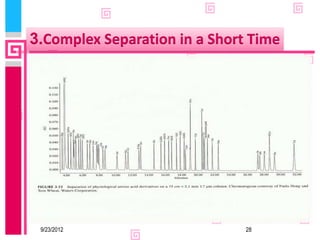
3.Complex Separation in a Short Time


 9/23/2012                     28
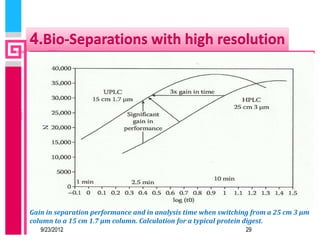
4.Bio-Separations with high resolution


Gain in separation performance and in analysis time when switching from a 25 cm 3 μm
column to a 15 cm 1.7 μm column. Calculation for a typical protein digest.
   9/23/2012                                                    29
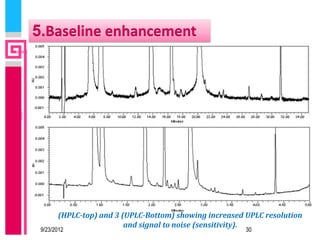
5.Baseline enhancement


       (HPLC-top) and 3 (UPLC-Bottom) showing increased UPLC resolution
                         and signal to noise (sensitivity).
 9/23/2012                                              30
Conclusion :
(UPLC) is a relatively new technique
giving new possibilities in liquid
chromatography :
• Decreasing time of analysis.
• Decreasing solvent consumption.
• Increasing the resolution.
• Increasing the sensitivity.
UPLC chromatographic system is
designed in a special way:
• to withstand high system back-pressures
• Special analytical columns packed with 1.7 μm
  particles are used
• The quality control analyses of various
   9/23/2012                           31
9/23/2012   32

UPLC

  • 1.
    Ultra Performance Liquid Chromatography Prepared by: SHAIMAA OBAID AHMADEEN Supervised by: DR / NOuRAH AL ZOMAN
  • 2.
    Presentation's outlines: • Introduction •Definition • UPLC vs HPLC • efficiency of UPLC • Switching from HPLC to UPLC • Examples showing different UPLC instruments • Applications of UPLC in pharmacy • Conclusion 9/23/2012 2
  • 3.
    Introduction : The pharmaceutical industry is under intense pressure to increase productivity and put new drugs onto the market in a shorter period of time. Analytical chemists are challenged to find faster ways of delivering quality data across a range of project needs. A number of approaches are being employed to 9/23/2012 3
  • 4.
    (TLC) Gravity Flash Chrom. Chrom. 1978 HPLC UPLC 1903 1952 2004 9/23/2012 4
  • 5.
    Ultra : meansnot within reasonable limits or far beyond the normal Ultra high pressure • Equal to or more than 1500psi (1034 pa =1000 ba ) Ultra small packaging material • Particle size 1.7 , 1.8µm 9/23/2012 5
  • 6.
    Definition : UPLCis a chromatographic technique that can separate a mixture of compounds, and is used in biochemistry and analytical chemistry to identify, quantify and purify the individual components of the mixture. Utilizing a small packaging particle size's columns and ultra high pack pressure 9/23/2012 6
  • 7.
    UPLC Vs HPLC 9/23/2012 7
  • 8.
    HPLC vs UPLC HPLC UPLC • id (3-10) µm • id (0.75-1.8)µm • inlet pressure 400 ba • inlet pressure more • Lower comparative than1000ba precision in sample • Higher precision in sample introduction introduction • Detectors that use larger • Detectors that use small flow rates and larger flow rates and low detection cells detection limits • Some are equipped with • Most of equipments with automated sampling automated sampling devices 9/23/2012 devices 8
  • 9.
    Why is UPLCmore efficient • Peak capacity (P) is the number of peaks that can be resolved in a specific amount of time. • P is proportional to the inverse of the square root of the Number of theoretical plates (N): N = L/H • Lower plate heights generate a greater number of plates (N : efficiency ) • Plate heights are correlated through the Van Deemter equation 9/23/2012 9
  • 10.
    Van Deemter Eqn. •H = A +B/µ +C x µ • A is related to the mobile phase movement through paths in the stationary phase. • B describes longitudinal diffusion • C relates the analyte to mass transfer between the pores of the stationary phase 9/23/2012 10
  • 11.
  • 12.
    Chemistry of SmallPartic So as the particle size decreases to increase N and subsequently Rs, an increase in sensitivity is obtained, since narrower peaks are taller peaks. Narrower peaks also mean more peak 9/23/2012 12
  • 13.
  • 14.
  • 15.
    UPLC columns 9/23/2012 15
  • 16.
    Scaling the Separation Thegradient is scaled from HPLC to UPLC using: L2/L1 x tg1 = tg2 Where L1and L2 are the lengths of the HPLC and UPLC columns, and tg1 and tg2 are the times of each gradient step respectively. Flow rate is scaled taking into account the difference in the diameter of the two columns: (d2)2/(d1)2 x F1 = F2 Where d2 and d1 are the column diameters and F1 and F2 the flow rates. The injection volume is scaled taking into account the volumes of the two columns: 9/23/2012 16 1 2 2 2 1 2
  • 17.
    Differences in instrumentation between HPLC & UPLC 9/23/2012 17
  • 18.
  • 19.
    Nano-UPLC SYSTEM FEATURES: •Maximum resolutionto yield maximum peak capacity for complex mixtures. •Maximum reproducibility – Direct nano-flow control and a novel, moveable heating and trapping module for < 0.25 minute standard deviation run-to-run reproducibility. •Maximum throughput –with faster gradient separations for mixtures •Robustness – Nano-scale columns and fittings provide reliable operation for up to 10,000 psi, with novel high pressure trapping. •Ease-of-use – Direct gradient control enables 9/23/2012 19
  • 20.
  • 21.
    Nano-ACQUITY UPLC Systemwith 2D 9/23/2012 21
  • 22.
    Hydrogen Deuterium Exchange(HD-x) is an experimental technique to obtain structural data on proteins. It relies on the accurate measurement of the degree of labeling of the protein by deuterated hydrogen. 9/23/2012 22
  • 23.
  • 24.
    Contrasting HPLC and • UPLC gives UPLC with better faster results resolution • UPLC uses less of valuable solvents like acetonitrile which lowers cost • The reduction of solvent use is more environmentally friendly • Increased sensitivity 9/23/2012 24
  • 25.
    Applications of UPLC 1.HigherSpeed separation of caffeic HPL acid derivatives from C Echinacea Purpurea UPL C 9/23/2012 25
  • 26.
  • 27.
    2.Higher performance 100 % Intensity 5.00 10.00 15.00 20.00 25.00 30.00 35.00 40.00 45.00 50.00 55.00 Time (minutes) Total ion chromatogram of rat urine obtained with a 2.1 × 150 mm, 1.7 μm Acquity BEH C18 column and a gradient over 60 minutes at 90°C at 0.8 mL/min. Gradient: 0-95% B; A = 0.1% formic acid in water, B = acetonitrile with 0.1% formic acid 9/23/2012 27
  • 28.
    3.Complex Separation ina Short Time 9/23/2012 28
  • 29.
    4.Bio-Separations with highresolution Gain in separation performance and in analysis time when switching from a 25 cm 3 μm column to a 15 cm 1.7 μm column. Calculation for a typical protein digest. 9/23/2012 29
  • 30.
    5.Baseline enhancement (HPLC-top) and 3 (UPLC-Bottom) showing increased UPLC resolution and signal to noise (sensitivity). 9/23/2012 30
  • 31.
    Conclusion : (UPLC) isa relatively new technique giving new possibilities in liquid chromatography : • Decreasing time of analysis. • Decreasing solvent consumption. • Increasing the resolution. • Increasing the sensitivity. UPLC chromatographic system is designed in a special way: • to withstand high system back-pressures • Special analytical columns packed with 1.7 μm particles are used • The quality control analyses of various 9/23/2012 31
  • 32.