

TORU-LOTA
TREE,BST,HEAP,GRAPH
TREE
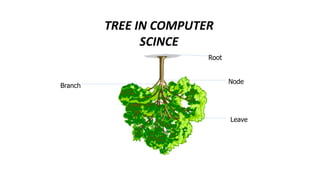
TREE IN COMPUTER
SCINCE
Root
Node
Leave
Branch
Root: node without parent (A)
Siblings: nodes share the same
parent
Internal node: node with at least
one child.
External node (leaf ): node
without children
Ancestors of a node: parent,
grandparent, grand-grandparent,
etc.
Descendant of a node: child,
grandchild, grand-grandchild, etc.
Depth of a node: number of
ancestors
Height of a tree: maximum depth
of any node
Degree of a node: the number of
its children
Degree of a tree: the maximum
number of its node.
Tree Operation
BINARY SEARCH TREE
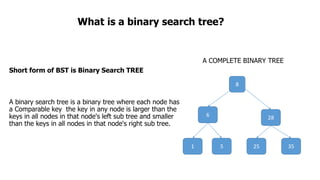
Short form of BST is Binary Search TREE
A binary search tree is a binary tree where each node has
a Comparable key the key in any node is larger than the
keys in all nodes in that node's left sub tree and smaller
than the keys in all nodes in that node's right sub tree.
8
6 28
1 5 3525
A COMPLETE BINARY TREE
What is a binary search tree?
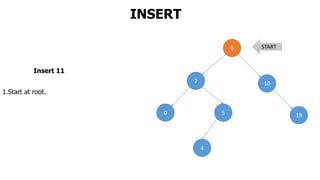
INSERT
Insert 11
1.Start at root.
6
2 10
0 5 19
4
START
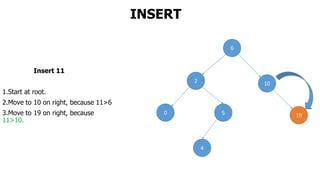
INSERT
Insert 11
1.Start at root.
2.Move to 10 on right, because 11>6
6
2 10
0 5 19
4
INSERT
Insert 11
1.Start at root.
2.Move to 10 on right, because 11>6
3.Move to 19 on right, because
11>10.
6
2 10
0 5 19
4
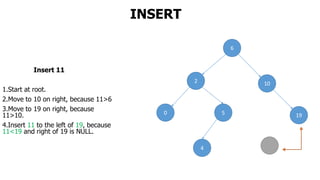
INSERT
Insert 11
1.Start at root.
2.Move to 10 on right, because 11>6
3.Move to 19 on right, because
11>10.
4.Insert 11 to the left of 19, because
11<19 and right of 19 is NULL.
6
2 10
0 5 19
4
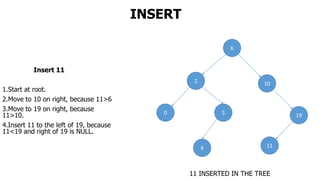
INSERT
Insert 11
1.Start at root.
2.Move to 10 on right, because 11>6
3.Move to 19 on right, because
11>10.
4.Insert 11 to the left of 19, because
11<19 and right of 19 is NULL.
6
2 10
0 5 19
4 11
INSERT
Insert 11
1.Start at root.
2.Move to 10 on right, because 11>6
3.Move to 19 on right, because
11>10.
4.Insert 11 to the left of 19, because
11<19 and right of 19 is NULL.
6
2 10
0 5 19
4 11
11 INSERTED IN THE TREE
DELETE
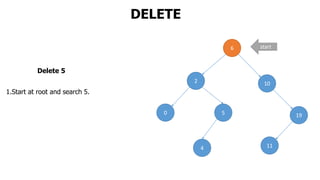
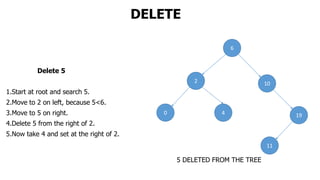
Delete 5
1.Start at root and search 5.
6
2 10
0 5 19
4 11
start
DELETE
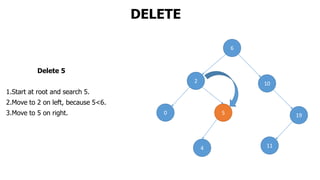
Delete 5
1.Start at root and search 5.
2.Move to 2 on left, because 5<6.
6
2 10
0 5 19
4 11
DELETE
Delete 5
1.Start at root and search 5.
2.Move to 2 on left, because 5<6.
3.Move to 5 on right.
6
2 10
0 5 19
4 11
DELETE
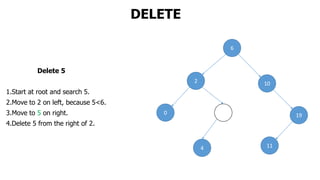
Delete 5
1.Start at root and search 5.
2.Move to 2 on left, because 5<6.
3.Move to 5 on right.
4.Delete 5 from the right of 2.
6
2 10
0 19
4 11
DELETE
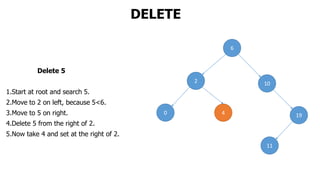
Delete 5
1.Start at root and search 5.
2.Move to 2 on left, because 5<6.
3.Move to 5 on right.
4.Delete 5 from the right of 2.
5.Now take 4 and set at the right of 2.
6
2 10
0 4 19
11
DELETE
Delete 5
1.Start at root and search 5.
2.Move to 2 on left, because 5<6.
3.Move to 5 on right.
4.Delete 5 from the right of 2.
5.Now take 4 and set at the right of 2.
6
2 10
0 4 19
11
5 DELETED FROM THE TREE
TRAVERSING
Preorder:
1.Visit the Root
2.Traverse the Left subtree
3.Traverse The Right subtree
7>1>0>3>2>5>4>6>9>8>10
In order:
1.Traverse the Left subtree.
2.Visit the Root.
3.Traverse the Right subtree.
Post Order :
1.Traverse the Left subtree
2. Traverse the Right subtree.
3.Visit the Root.
7
1 9
0 3
8 10
52
64
7,1,0,3,2,5,4,6,9,8,10
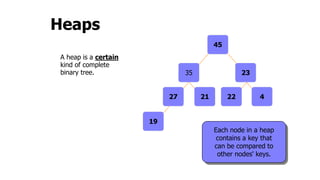
Heaps
A heap is a certain
kind of complete
binary tree.
Each node in a heap
contains a key that
can be compared to
other nodes' keys.
19
4222127
23
45
35
Types of Heaps:
• There are two types of heaps
1. Max Heap
2. Min Heap
23
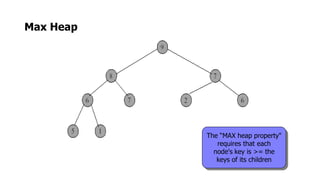
Max Heap
The “MAX heap property"
requires that each
node's key is >= the
keys of its children
24
Min Heap
The “Min heap property"
requires that each
node's key is <= the
keys of its children
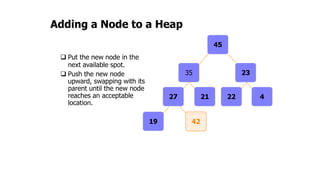
Adding a Node to a Heap
 Put the new node in the
next available spot.
 Push the new node
upward, swapping with its
parent until the new node
reaches an acceptable
location.
19
4222127
23
45
35
42
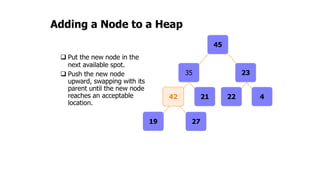
Adding a Node to a Heap
 Put the new node in the
next available spot.
 Push the new node
upward, swapping with its
parent until the new node
reaches an acceptable
location.
19
4222142
23
45
35
27
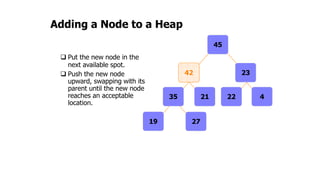
Adding a Node to a Heap
 Put the new node in the
next available spot.
 Push the new node
upward, swapping with its
parent until the new node
reaches an acceptable
location.
19
4222135
23
45
42
27
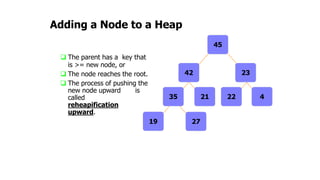
Adding a Node to a Heap
 The parent has a key that
is >= new node, or
 The node reaches the root.
 The process of pushing the
new node upward is
called
reheapification
upward.
19
4222135
23
45
42
27
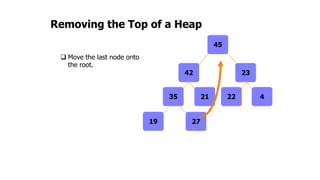
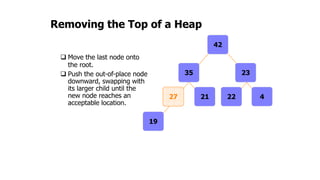
Removing the Top of a Heap
 Move the last node onto
the root.
19
4222135
23
45
42
27
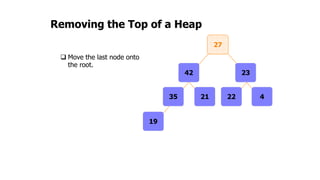
Removing the Top of a Heap
 Move the last node onto
the root.
19
4222135
23
27
42
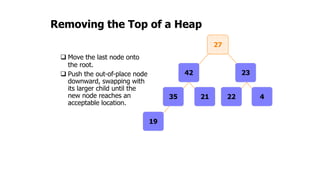
Removing the Top of a Heap
 Move the last node onto
the root.
 Push the out-of-place node
downward, swapping with
its larger child until the
new node reaches an
acceptable location.
19
4222135
23
27
42
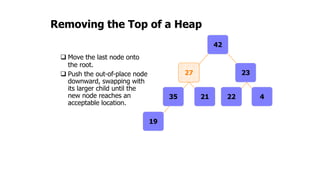
Removing the Top of a Heap
 Move the last node onto
the root.
 Push the out-of-place node
downward, swapping with
its larger child until the
new node reaches an
acceptable location.
19
4222135
23
42
27
Removing the Top of a Heap
 Move the last node onto
the root.
 Push the out-of-place node
downward, swapping with
its larger child until the
new node reaches an
acceptable location.
19
4222127
23
42
35
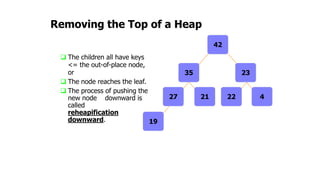
Removing the Top of a Heap
 The children all have keys
<= the out-of-place node,
or
 The node reaches the leaf.
 The process of pushing the
new node downward is
called
reheapification
downward. 19
4222127
23
42
35
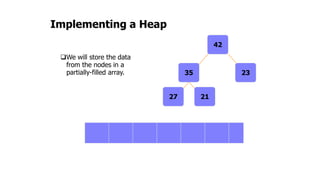
Implementing a Heap
We will store the data
from the nodes in a
partially-filled array.
An array of data
2127
23
42
35
Implementing a Heap
• Data from the root goes in
the first location of
the array.
An array of data
2127
23
42
35
42
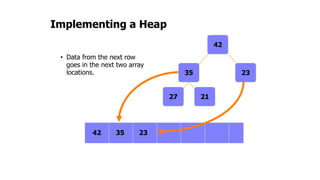
Implementing a Heap
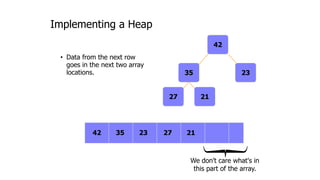
• Data from the next row
goes in the next two array
locations.
An array of data
2127
23
42
35
42 35 23
Implementing a Heap
• Data from the next row
goes in the next two array
locations.
An array of data
2127
23
42
35
42 35 23 27 21
Implementing a Heap
• Data from the next row
goes in the next two array
locations.
An array of data
2127
23
42
35
42 35 23 27 21
We don't care what's in
this part of the array.
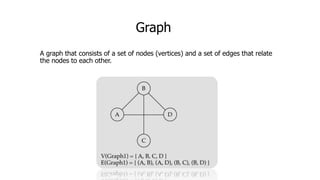
Graph
A graph that consists of a set of nodes (vertices) and a set of edges that relate
the nodes to each other.
 Degree: The number of edge of a node is called degree of that node.
 Connected Graph: A graph said to be connected if and only if there is a
simple path between two nodes.
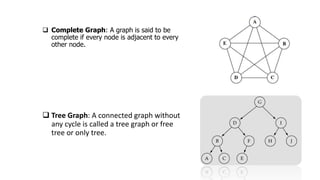
 Complete Graph: A graph is said to be
complete if every node is adjacent to every
other node.
 Tree Graph: A connected graph without
any cycle is called a tree graph or free
tree or only tree.
 Cycle: Cycle is a closed simple path with
length three or more.
Here,ACDA is a cycle in this Graph.
 Labeled Graph: A graph is said to be
labeled if its edegs are assigned data.
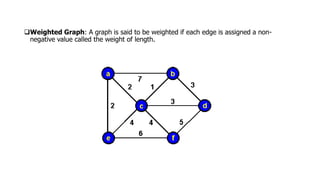
Weighted Graph: A graph is said to be weighted if each edge is assigned a non-
negative value called the weight of length.
GRAPH
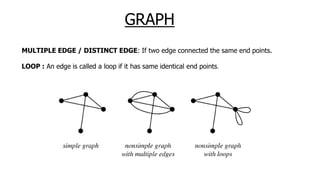
MULTIPLE EDGE / DISTINCT EDGE: If two edge connected the same end points.
LOOP : An edge is called a loop if it has same identical end points.
DIRECTED GRAPG
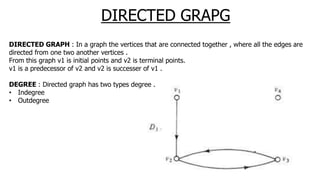
DIRECTED GRAPH : In a graph the vertices that are connected together , where all the edges are
directed from one two another vertices .
From this graph v1 is initial points and v2 is terminal points.
v1 is a predecessor of v2 and v2 is successer of v1 .
DEGREE : Directed graph has two types degree .
• Indegree
• Outdegree
DIRECTED GRAPH
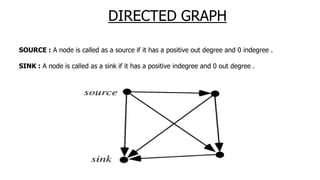
SOURCE : A node is called as a source if it has a positive out degree and 0 indegree .
SINK : A node is called as a sink if it has a positive indegree and 0 out degree .
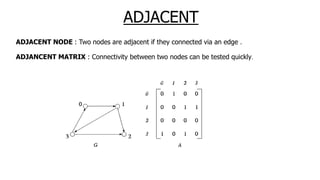
ADJACENT NODE : Two nodes are adjacent if they connected via an edge .
ADJANCENT MATRIX : Connectivity between two nodes can be tested quickly.
ADJACENT
ADJACENT
ADJACENT LIST : Adjacent node can be represented also adjacent list.
• 0 -> 1
• 1 -> 2 , 3
• 2 ->
• 3 -> 0 , 2
THANK YOU

TREE BST HEAP GRAPH

  • 1.
  • 2.
  • 3.
  • 4.
    Root: node withoutparent (A) Siblings: nodes share the same parent Internal node: node with at least one child. External node (leaf ): node without children Ancestors of a node: parent, grandparent, grand-grandparent, etc. Descendant of a node: child, grandchild, grand-grandchild, etc. Depth of a node: number of ancestors Height of a tree: maximum depth of any node Degree of a node: the number of its children Degree of a tree: the maximum number of its node.
  • 5.
  • 6.
  • 7.
    Short form ofBST is Binary Search TREE A binary search tree is a binary tree where each node has a Comparable key the key in any node is larger than the keys in all nodes in that node's left sub tree and smaller than the keys in all nodes in that node's right sub tree. 8 6 28 1 5 3525 A COMPLETE BINARY TREE What is a binary search tree?
  • 8.
    INSERT Insert 11 1.Start atroot. 6 2 10 0 5 19 4 START
  • 9.
    INSERT Insert 11 1.Start atroot. 2.Move to 10 on right, because 11>6 6 2 10 0 5 19 4
  • 10.
    INSERT Insert 11 1.Start atroot. 2.Move to 10 on right, because 11>6 3.Move to 19 on right, because 11>10. 6 2 10 0 5 19 4
  • 11.
    INSERT Insert 11 1.Start atroot. 2.Move to 10 on right, because 11>6 3.Move to 19 on right, because 11>10. 4.Insert 11 to the left of 19, because 11<19 and right of 19 is NULL. 6 2 10 0 5 19 4
  • 12.
    INSERT Insert 11 1.Start atroot. 2.Move to 10 on right, because 11>6 3.Move to 19 on right, because 11>10. 4.Insert 11 to the left of 19, because 11<19 and right of 19 is NULL. 6 2 10 0 5 19 4 11
  • 13.
    INSERT Insert 11 1.Start atroot. 2.Move to 10 on right, because 11>6 3.Move to 19 on right, because 11>10. 4.Insert 11 to the left of 19, because 11<19 and right of 19 is NULL. 6 2 10 0 5 19 4 11 11 INSERTED IN THE TREE
  • 14.
    DELETE Delete 5 1.Start atroot and search 5. 6 2 10 0 5 19 4 11 start
  • 15.
    DELETE Delete 5 1.Start atroot and search 5. 2.Move to 2 on left, because 5<6. 6 2 10 0 5 19 4 11
  • 16.
    DELETE Delete 5 1.Start atroot and search 5. 2.Move to 2 on left, because 5<6. 3.Move to 5 on right. 6 2 10 0 5 19 4 11
  • 17.
    DELETE Delete 5 1.Start atroot and search 5. 2.Move to 2 on left, because 5<6. 3.Move to 5 on right. 4.Delete 5 from the right of 2. 6 2 10 0 19 4 11
  • 18.
    DELETE Delete 5 1.Start atroot and search 5. 2.Move to 2 on left, because 5<6. 3.Move to 5 on right. 4.Delete 5 from the right of 2. 5.Now take 4 and set at the right of 2. 6 2 10 0 4 19 11
  • 19.
    DELETE Delete 5 1.Start atroot and search 5. 2.Move to 2 on left, because 5<6. 3.Move to 5 on right. 4.Delete 5 from the right of 2. 5.Now take 4 and set at the right of 2. 6 2 10 0 4 19 11 5 DELETED FROM THE TREE
  • 20.
    TRAVERSING Preorder: 1.Visit the Root 2.Traversethe Left subtree 3.Traverse The Right subtree 7>1>0>3>2>5>4>6>9>8>10 In order: 1.Traverse the Left subtree. 2.Visit the Root. 3.Traverse the Right subtree. Post Order : 1.Traverse the Left subtree 2. Traverse the Right subtree. 3.Visit the Root. 7 1 9 0 3 8 10 52 64 7,1,0,3,2,5,4,6,9,8,10
  • 21.
    Heaps A heap isa certain kind of complete binary tree. Each node in a heap contains a key that can be compared to other nodes' keys. 19 4222127 23 45 35
  • 22.
    Types of Heaps: •There are two types of heaps 1. Max Heap 2. Min Heap
  • 23.
    23 Max Heap The “MAXheap property" requires that each node's key is >= the keys of its children
  • 24.
    24 Min Heap The “Minheap property" requires that each node's key is <= the keys of its children
  • 25.
    Adding a Nodeto a Heap  Put the new node in the next available spot.  Push the new node upward, swapping with its parent until the new node reaches an acceptable location. 19 4222127 23 45 35 42
  • 26.
    Adding a Nodeto a Heap  Put the new node in the next available spot.  Push the new node upward, swapping with its parent until the new node reaches an acceptable location. 19 4222142 23 45 35 27
  • 27.
    Adding a Nodeto a Heap  Put the new node in the next available spot.  Push the new node upward, swapping with its parent until the new node reaches an acceptable location. 19 4222135 23 45 42 27
  • 28.
    Adding a Nodeto a Heap  The parent has a key that is >= new node, or  The node reaches the root.  The process of pushing the new node upward is called reheapification upward. 19 4222135 23 45 42 27
  • 29.
    Removing the Topof a Heap  Move the last node onto the root. 19 4222135 23 45 42 27
  • 30.
    Removing the Topof a Heap  Move the last node onto the root. 19 4222135 23 27 42
  • 31.
    Removing the Topof a Heap  Move the last node onto the root.  Push the out-of-place node downward, swapping with its larger child until the new node reaches an acceptable location. 19 4222135 23 27 42
  • 32.
    Removing the Topof a Heap  Move the last node onto the root.  Push the out-of-place node downward, swapping with its larger child until the new node reaches an acceptable location. 19 4222135 23 42 27
  • 33.
    Removing the Topof a Heap  Move the last node onto the root.  Push the out-of-place node downward, swapping with its larger child until the new node reaches an acceptable location. 19 4222127 23 42 35
  • 34.
    Removing the Topof a Heap  The children all have keys <= the out-of-place node, or  The node reaches the leaf.  The process of pushing the new node downward is called reheapification downward. 19 4222127 23 42 35
  • 35.
    Implementing a Heap Wewill store the data from the nodes in a partially-filled array. An array of data 2127 23 42 35
  • 36.
    Implementing a Heap •Data from the root goes in the first location of the array. An array of data 2127 23 42 35 42
  • 37.
    Implementing a Heap •Data from the next row goes in the next two array locations. An array of data 2127 23 42 35 42 35 23
  • 38.
    Implementing a Heap •Data from the next row goes in the next two array locations. An array of data 2127 23 42 35 42 35 23 27 21
  • 39.
    Implementing a Heap •Data from the next row goes in the next two array locations. An array of data 2127 23 42 35 42 35 23 27 21 We don't care what's in this part of the array.
  • 40.
    Graph A graph thatconsists of a set of nodes (vertices) and a set of edges that relate the nodes to each other.
  • 41.
     Degree: Thenumber of edge of a node is called degree of that node.  Connected Graph: A graph said to be connected if and only if there is a simple path between two nodes.
  • 42.
     Complete Graph:A graph is said to be complete if every node is adjacent to every other node.  Tree Graph: A connected graph without any cycle is called a tree graph or free tree or only tree.
  • 43.
     Cycle: Cycleis a closed simple path with length three or more. Here,ACDA is a cycle in this Graph.  Labeled Graph: A graph is said to be labeled if its edegs are assigned data.
  • 44.
    Weighted Graph: Agraph is said to be weighted if each edge is assigned a non- negative value called the weight of length.
  • 45.
    GRAPH MULTIPLE EDGE /DISTINCT EDGE: If two edge connected the same end points. LOOP : An edge is called a loop if it has same identical end points.
  • 46.
    DIRECTED GRAPG DIRECTED GRAPH: In a graph the vertices that are connected together , where all the edges are directed from one two another vertices . From this graph v1 is initial points and v2 is terminal points. v1 is a predecessor of v2 and v2 is successer of v1 . DEGREE : Directed graph has two types degree . • Indegree • Outdegree
  • 47.
    DIRECTED GRAPH SOURCE :A node is called as a source if it has a positive out degree and 0 indegree . SINK : A node is called as a sink if it has a positive indegree and 0 out degree .
  • 48.
    ADJACENT NODE :Two nodes are adjacent if they connected via an edge . ADJANCENT MATRIX : Connectivity between two nodes can be tested quickly. ADJACENT
  • 49.
    ADJACENT ADJACENT LIST :Adjacent node can be represented also adjacent list. • 0 -> 1 • 1 -> 2 , 3 • 2 -> • 3 -> 0 , 2
  • 50.