Documents from The Future of Financial Services 2016
1
T h e F u t u r e o f
F i n a n c e | 2 0 1 6
sponsored by
Index
2
Understanding Exponentials /p.4
Will Weisman. Executive Director, Conferences, Singularity University.
What Does Money Want /p.8
Bob Pisani, CNBC “On-Air Stocks” Editor.
Machine Learning, AI and Big Data /p.12
Neil Jacobstein, AI & Robotics Co-Chair at SU, Former CEO of Teknowledge
Corporation.
Quantum Computing /p.17
Marcos López de Prado, Senior Managing Director, Guggenheim Partners.
Energy and Smart Networks /p.21
Ramez Naam, Energy & Environmental Systems Faculty, Singularity University.
Robotics /p.28
Rob Nail, Associate Founder & CEO, Singularity University.
Uber Yourself Before You Get Kodaked
/p.31
Rob Nail, Associate Founder & CEO, Singularity University.
An Interview with Ray Kurzweil /p.37
Ray Kurzwei, Director of Engineering at Google, Co-founder & Chancellor of SU.
Exponential Computing /p.41
Brad Templeton, Director, the EFF & Founder, ClariNet
The Death of Products, When Everything
Becomes a Service /p.45
Marco Annunziata, Chief Economist & Executive Director of Global Market Insight,
General Electric Company.
Business Decentralized /p.50
Brian Forde, Director of Digital Currency, MIT Media Lab.
Index
The Future of Finance
3
The Blockchain Panel /p.53
Bill Barhydt, Founder/CEO, Abra; Chairman, Boom Financial.
Realizing The Value Of FinTech Panel
/p.56
Amelia Dunlop, Principal, Deloitte Doblin.
Investing the Uninvested /p.58
Jane Barratt, Founder & CEO, GoldBean.
Future of Financial Services /p.60
Jesse McWaters, Project Lead, Disruptive Innovation in Financial Services, World
Economic Forum.
Becoming an Exponential Financial
Services Organization /p.64
Salim Ismail, Global Ambassador, Singularity University
Managing Exponential Risk, Rethinking
Insurance /p.68
Daniel Schreiber, CEO & Co-Founder, Lemonade
Understanding Exponentials
4
Understanding Exponentials
Will Weisman. Executive Director, Conferences, Singularity
University.
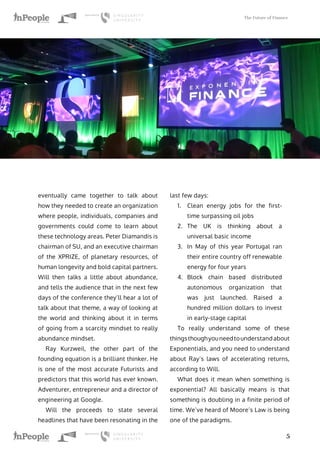
Will Weisman begin his
speech by welcoming everyone
to the third annual Exponential
Finance.
He also welcomes everyone
to NY city, and states that
the city has obviously played
an incredibly important role
in the history of the country,
and in the history of financial
services.
Willthenproceedstoexpand
on the history of Singularity
University. The foundation’s
mission is to educate, inspire
and empower leaders
to apply exponentially
accelerating technologies to
address the world’s largest
problems. Will says you can
think of them as part think
tank, part educator and part
new company accelerator.
They focus on eight primary
accelerating technologies, all
areas that have crossed over
to be information technologies
and are growing exponentially,
and obviously, they believe
they are going to be the
biggest drivers of disruption
going forward. Will then states
that it’s not just the technology
individually, but it’s all about
convergence. it’s how do these
disparate technologies come
together and then cause the
creation of new products and
services.
Continuing on his speech,
Will then explains why
Singularity University is also
about “Impact”, and names
what they call global grand
challenges, integrated by
eleven areas that they have
chosen to focus on. These are
areas where they see some of
the largest problems in the
world and where they think
technology can really have the
biggest impact.
ABOUT SU’S FOUNDING
HISTORY: founded in 2008
Ray Kurzweil and Peter
Diamandis came together at
a TED conference, where they
both started talking about
exponential technologies, the
changes that were happening,
and that we were about to
enter this period of rapid and
transformative growth. They
The Future of Finance
5
eventually came together to talk about
how they needed to create an organization
where people, individuals, companies and
governments could come to learn about
these technology areas. Peter Diamandis is
chairman of SU, and an executive chairman
of the XPRIZE, of planetary resources, of
human longevity and bold capital partners.
Will then talks a little about abundance,
and tells the audience that in the next few
days of the conference they’ll hear a lot of
talk about that theme, a way of looking at
the world and thinking about it in terms
of going from a scarcity mindset to really
abundance mindset.
Ray Kurzweil, the other part of the
founding equation is a brilliant thinker. He
is one of the most accurate Futurists and
predictors that this world has ever known.
Adventurer, entrepreneur and a director of
engineering at Google.
Will the proceeds to state several
headlines that have been resonating in the
last few days:
1.	 Clean energy jobs for the first-
time surpassing oil jobs
2.	 The UK is thinking about a
universal basic income
3.	 In May of this year Portugal ran
their entire country off renewable
energy for four years
4.	 Block chain based distributed
autonomous organization that
was just launched. Raised a
hundred million dollars to invest
in early-stage capital
To really understand some of these
things though you need to understand about
Exponentials, and you need to understand
about Ray’s laws of accelerating returns,
according to Will.
What does it mean when something is
exponential? All basically means is that
something is doubling in a finite period of
time. We’ve heard of Moore’s Law is being
one of the paradigms.
Understanding Exponentials
6
It’s a difficult concept for us to grasp.
If you think about when our brains went
through their major evolutionary changes,
it was hundreds of thousands of years
ago, in a very different world. The world
was very much linear and it was very much
local. The world was changing very slowly
and we focused on just the things that
were immediately around us. Fast forward
to today this is very much a global and
exponential world, so something happens
on one side of the globe and we hear about
it in minutes or seconds. Computers hear
about it in milliseconds. One of the key
things from this conference is hopefully
to help you think about and understand
exponential thinking so that you can start
to look at problems and start to think about
what the world might look like in the future
using this exponential thinking.
Will then proceeds to give examples
of exponential behavior on current
technologies, and talks about Ray’s law
of accelerating returns. Will says that
there have been examples since as early
as 1890’s, and we all know each of these
technologies have finite lifespan. What
basically happens is in the earliest days
things start off very slow, they reach a
point where the growth becomes visible
through rapid acceleration, and they reach
some finite maxim. What’s interesting is
that another technology that appears and
so it’s a city series of these nested s-curves
you can imagine it’s one technology
basically sitting on the shoulders of another
technology and together create that very
smooth curve. Will says that in 20-30
years, he’s going to have a thousand-dollar
computer that’s going to be as powerful as
the human brain, and by 2050, he may have
a thousand-dollar computer that’s going
to be as powerful as all human brains for
thousand dollars.
Will then continues with examples
to show how exponential growth has a
affected us. Starting in 1956 five megabytes
of storage cost you $120.000 dollars;
fast forward to 2014 and 28 megabytes
of storage costs you $99 dollars and
fast forward to today 120 gigabytes now
cost you $30 dollars on amazon. That’s
a 3000x performance improvement and
storage capabilities and 11 years and over
90 million since 1956. Will also mentions
GPUs technology, as well as the impact
in the advances of the optical camera has
made through the years.
“If you were lucky enough to be a
successful company and make it to the S&P
500 back in the early nineteen twenties,
you know you had a 67-year run […] the top
of the heap today that’s down to 15 years
and that’s shrinking dramatically. If you’re
lucky enough to make it to the 500 list,
that’s a very short life span. It’s predicted
that forty percent of those companies
might not even exist after 10 years so that
were entering…” states Will, and continues:
“One of my hopes from this conference is
that you’re going to come out of here with
a not being pessimistic not being feeling
kind of beat down, but feeling like this
is really an exciting time and what could
be disrupted stress is really an incredible
opportunity so part of that is embracing
The Future of Finance
7
this abundant mindset I mentioned”
Will then mentions the framework they
use that helps to understand the path of
exponential technologies and abundance:
1.	 First, what happens is something
becomes digitized, becomes an
information technology.
2.	 Then it starts growing very slowly,
it’s very deceptive, it doesn’t
seem like much is happening.
3.	 Then all the sudden disruptive
things start to happen. People
are surprised, and all the sudden
these new companies, new
technologies are coming on that
to potentially create stress and
challenge them.
4.	 That’s when we start to see these
companies’ products and services
start to dematerialize and to
monetize things moved to board
to becoming almost or 100% free.
5.	 Then ultimately, we see them get
democratize and readily available
to everyone.
Will completes the idea by showing
statistics about how the world is becoming
a safer place, and it’s according to him “the
best time to be alive”, and adds the fact
that we’re going to 3 billion new people
coming online in the next few years, so
almost a doubling of the number of brains
that are out there that are harnessing the
internet will be contributing to the solution
of world’s problems creating companies.
It’s really going to be an extraordinary
time. All of a sudden, you’ll start to see lots
of new customers for new companies.
Will finishes his speech by thanking
everyone who has attended, and
encouraging everyone to seize the
opportunity to be there.
Para profundizar,
recomendamos:
VIDEO CHARLA
https://www.youtube.com/
watch?v=2n6JO7KvHvM
HERRAMIENTAS
http://www.kurzweilai.net/the-law-of-
accelerating-returns
What Does Money Want
8
What Does Money Want
Bob Pisani, CNBC “On-Air Stocks” Editor.
Bob Pisani starts his speech
by saying how excited he is
for living in times like these,
and makes a special remark
about Artificial Intelligence. A
particularly profound moment
occurred during the GO battle
with Google’s Deepmind, the
GO champion said that the
machine made a move that did
not make sense to him, that was
not in any way comprehensible
at all, and only later when the
game was at its end did the
player realize that and move
was very profound that it threw
him off, and that it was largely
responsible for winning the
game.
Bob says he wanted to
highlight where we are and
maybe a little bit about
where we’re going right now,
commenting on the advances
Fintech has had in the last few
years. Regarding investment
in private FinTech, 1.8 billion
dollars in 2010, 19 billion dollars
in 2015. Bob then says that
what’s driving Fintech is very
simple: maintaining control
of the customer relationship,
making customer experience
as smooth and effortless as
possible, and cost cutting,
critical in a world of low
growth, low rates and low
profitability.
Then Bob goes on talking
about where is the Fintech
money going: “Mobile money
(money transfer, mobile
banking), consumer lending
(prosper, lending club), Small
business lending (cabbage,
circle up) and personal finance
management (robo-advisors
like Betterment or Wealthfront)
We are now into this in tech
revolution. It’s more difficult
than a lot of people thought
to build brands, build trust
and build relationship with
our customers. “The personal
finance management area, it’s
amazing what the potential
is for them; we haven’t even
scratched the surface in
this…” Bob continues. The
global mutual fund business
is about 30 trillion dollars the
global ETF industry is about
2.6 trillion in the US, and the
Robo-advisors business is 20
billion dollars right now, “that
under management and this
The Future of Finance
9
is less than one-tenth one percent of the
current market, this just gives you an idea”.
Peer-to-peer (p2p) lending: it’s small
so far 2015. It’s only 7% of the cumulative
lendingvolumesin2018.Anotherexampleis
Alibaba, the largest e-commerce company,
having more users than the population in
all of US. Their Gross Merchandise Value
is 500 billion dollars, “that’s the GDP of
Norway right now”, says Bob, commenting
on the characteristics Alipay brings to the
Chinese Market.
“Where’s the tipping point, where these
technologies start to really dominate
digital disruption?”
We know what digital disruption has
done to other businesses, you know what
did the music’s sales and video rentals,
but could this happen in FinTech where
you get these massive disruptions? Well,
the answer is yes, and the question is how
do we know what’s happening? “There are
very different ways of looking at this”, says
Bob, “but one thing that I’ve noticed is once
a technology starts to get somewhere in
the mid-teens in terms of its penetration,
when that happens in the digitally it
accelerates very quickly because that’s
enough for first early adopters, and then
you get widespread discussion from
people and it starts moving quicker from
there. This happened in all these industries.
That’s a tipping point.“
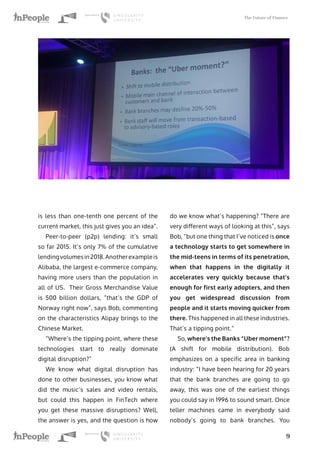
So, where’s the Banks “Uber moment”?
(A shift for mobile distribution). Bob
emphasizes on a specific area in banking
industry: “I have been hearing for 20 years
that the bank branches are going to go
away, this was one of the earliest things
you could say in 1996 to sound smart. Once
teller machines came in everybody said
nobody’s going to bank branches. You
What Does Money Want
10
know what happened actually? We have
seen modest declines in bank branches,
bank branches actually peaked in 2007.
There’s been some modest decline since
then. Now the question is will these
new technologies, once you get the
adoption a little heavier, will the bank
branches started coming down? Citigroup
estimated that if you started getting
massive adoption bank branches could
come down anywhere from twenty to
fifty percent. Nobody really knows, but
my thought is these banks are not going
to let those branches go that easy. If they
can cost justify them by turning their staff
into advisory based roles where you come
into the banks and they’re now selling you
a whole suite of services that conclude
not just mortgages but personal wealth
management”. And then reinforces the
idea: “For them to remain competitive,
banks need to get innovation before the
FinTech companies get scale”, quoting
Citigroup, but makes clear that the banks
are not rolling over. In the last few years
the big banks have been working on the
digital disruption area, and are not rolling
over. The good news, according to Bob,
is that disruptors are causing innovation
inside the banks. “They’re going to buy
a model as well, and you’re going to see
some consolidation going on in this area”.
BIG DATA: CHANGING THE WAY RISK
IS PRICED. There’s now new methods
of gathering data on consumers. Loyalty
cards, social networks, purchase data or
even browsing habits, and this eventually
supports faster, more accurate decisions.
“This is absolutely invaluable to a bank.”
BLOCKCHAINS. How do I know I got
something if it’s not in my hand? How
do I know I sent that money to Thailand?
How do I know that I truly sold that stock
to somebody? How do I know I own that
piece of real estate? Well we have an
elaborate system in the stock market call
clearing to tell that you did buy that stock,
and we have elaborate system regarding
real estate insurance mechanisms that
says that guarantees transactions, but the
blockchain can bypass all that. It is truly
revolutionary.
What’s coming according to Bob?
1.	 P2P, small businesses.
2.	 B2B will be the next wave.
3.	 Industrial Fintech, financial
transactions incorporated into the
IOT. Smart meters at home, that
could even negotiate the rates of,
for instance, energy.
“Cross Fintech with the IOT, and
you’ve got a lot of great potential”. Bob
continues… “When I talk at CNBC, when
we talk to people who are CEOs, who
run companies in the United States they
say regulation and compliance is a really
big headache and increasingly they’re
citing cybersecurity what there be some
application to take big data and apply it to
regulatory issues to find a better way to do
regulation and compliance…”
Bob then advances in his speech talking
about possible negative outcomes (at least
temporarily) for some of the disruptive
The Future of Finance
11
tendencies, understanding that there may
be things that could go wrong in Fintech.
“You are just moving money around, and
when money moves around stuff can go
wrong, models can collapse, stuff can get
stolen”, and continues “remember, the
FinTech business outside of the bank’s, is
remarkably lightly regulated… and you’re
going to see much more press pressure for
regulatory scrutiny, and that could change
things as well…”
Bob then talks about what happened to
Lending Club, just a couple months ago, the
CEO abruptly resigned. There were debts
that were misstated regarding its price, the
CEO properly disclosed investment, and
the buyers of the loans started to refuse, so
Lending Club had funding problems, and
the stock dropped almost 50% in a week.
“There’s nothing completely revolutionary
here, you’ve got people who want loans
and then you’ve got people who want to
buy the loans, if you don’t have somebody
that wants to buy the loans you’ve got a
funding problem here, so again nobody’s
repealing the laws of gravity here”.
Bob ends his speech by talking about the
tech-pessimists, focusing on the country’s
mood, and discouraging the pessimism
that’s being seen around, and encouraging
to believe in innovation. “I can’t help but to
be excited about the future, people need
to have more imagination, and the thought
leaders have to do something to counteract
the wave of pessimism...”
Para profundizar,
recomendamos:
VIDEO CHARLA
https://www.youtube.com/
watch?v=SyGQhzjxg7
HERRAMIENTAS
https://deepmind.com/
http://icg.citi.com/icg/citi_research/index.
jsp
https://www.lendingclub.com/
Machine Learning, AI and Big Data
12
Machine Learning, AI and Big
Data
Neil Jacobstein, AI & Robotics Co-Chair at SU, Former CEO of
Teknowledge Corporation.
AI spent the first six
decades of its history flying
below the radar and now
it has suddenly exploded
into public consciousness.
The MIT press published a
seminal work and artificial
intelligence applications and
manufacturing 14 years ago.
Manufacturing is a data and
knowledge driven process,
it’s all about manipulating
molecules and we still
can’t do atomically precise
manufacturing at scale in spite
of that historical trends and
materials and manufacturing
or clear increasing precision.
Decreasingcosts,increasing
flexibility, increasing speed,
in fact accelerating speed and
complexity is now free.
Thanks to the advances
in hardware, in algorithms,
in cheap sensors and then
access to data, things have
really changed so AI can now
contribute to manufacturing
faster actions and decisions:
1.	 Product and material
innovations
2.	 Improved efficiency
3.	 Higher accuracy
4.	 Lower costs
5.	 Increasing scale
It’s not just about improving
things on the manufacturing
floor but improving things
throughout the manufacturing
enterprise from design to
customer service, sales and
administration and quality
control.
General Electric has been
using AI in its manufacturing
process for three decades.
They’ve been using big data
to make smarter turbines, to
diagnose problems in their
train engines for decades.
Business Wire just published
a report a few weeks ago,
on a collaboration between
robot manufacturers FANUC,
Rockwell Automation, Cisco
and Preferred Networks, an
AI company. They’re all about
creating an advanced analytics
platform that improves overall
equipment efficiency on the
manufacturing floor.
Yale University has
The Future of Finance
13
published a series of articles on using
machine learning to provide integrated
optimization of semiconductor
manufacturing.
General Electric is all also providing
a software fabric to go over traditional
manufacturing floors to provide increases in
prediction responsiveness and connectivity
to take a standard manufacturing floor
of old-style equipment and turn it into
a software configurable manufacturing
engine.
IBM has graduated Watson from playing
jeopardy games and working in medicine to
Watson explorer for manufacturing a single
portal for integrating all of the information
from the manufacturing enterprise.
Search IBM Watson blog just a few
weeks ago, looking for the article on how
content analytics, text analytics and NLP
(natural language processing) has helped
auto manufacturers identify potential
product liability just by looking at Twitter
feeds and customer feedback.
There’s been an increasing pace of
AI investment and acquisition from 2011
through 2015, over three billion dollars
and VC funds were invested in cognitive
technology. During the same period over
a hundred of AI related companies either
merged or were acquired by the typical
players: Alphabet, IBM, Facebook, Amazon,
Apple
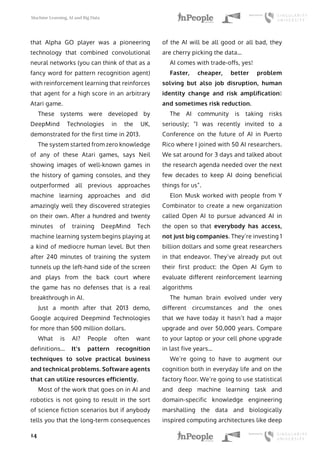
People often described AI as a game-
changing technology but it’s actually much
more than that. AI is disrupting the entire
field that we are operating on!
The achievement where ALPHA GO
won against the World Champion on Go
four games to one is a led the Korean
government to promise three billion
dollars for an AI R&D program aimed at
manufacturing.
The underlying technology behind
Machine Learning, AI and Big Data
14
that Alpha GO player was a pioneering
technology that combined convolutional
neural networks (you can think of that as a
fancy word for pattern recognition agent)
with reinforcement learning that reinforces
that agent for a high score in an arbitrary
Atari game.
These systems were developed by
DeepMind Technologies in the UK,
demonstrated for the first time in 2013.
The system started from zero knowledge
of any of these Atari games, says Neil
showing images of well-known games in
the history of gaming consoles, and they
outperformed all previous approaches
machine learning approaches and did
amazingly well they discovered strategies
on their own. After a hundred and twenty
minutes of training DeepMind Tech
machine learning system begins playing at
a kind of mediocre human level. But then
after 240 minutes of training the system
tunnels up the left-hand side of the screen
and plays from the back court where
the game has no defenses that is a real
breakthrough in AI.
Just a month after that 2013 demo,
Google acquired Deepmind Technologies
for more than 500 million dollars.
What is AI? People often want
definitions… It’s pattern recognition
techniques to solve practical business
and technical problems. Software agents
that can utilize resources efficiently.
Most of the work that goes on in AI and
robotics is not going to result in the sort
of science fiction scenarios but if anybody
tells you that the long-term consequences
of the AI will be all good or all bad, they
are cherry picking the data…
AI comes with trade-offs, yes!
Faster, cheaper, better problem
solving but also job disruption, human
identity change and risk amplification…
and sometimes risk reduction.
The AI community is taking risks
seriously; “I was recently invited to a
Conference on the future of AI in Puerto
Rico where I joined with 50 AI researchers.
We sat around for 3 days and talked about
the research agenda needed over the next
few decades to keep AI doing beneficial
things for us”.
Elon Musk worked with people from Y
Combinator to create a new organization
called Open AI to pursue advanced AI in
the open so that everybody has access,
not just big companies. They’re investing 1
billion dollars and some great researchers
in that endeavor. They’ve already put out
their first product: the Open AI Gym to
evaluate different reinforcement learning
algorithms
The human brain evolved under very
different circumstances and the ones
that we have today it hasn’t had a major
upgrade and over 50,000 years. Compare
to your laptop or your cell phone upgrade
in last five years…
We’re going to have to augment our
cognition both in everyday life and on the
factory floor. We’re going to use statistical
and deep machine learning task and
domain-specific knowledge engineering
marshalling the data and biologically
inspired computing architectures like deep
The Future of Finance
15
learning.
Deep learning is the champion
algorithm in machine learning has been
winning all the contests and one of the
things it does is hierarchical pattern
recognition. It can start with pixels and
then go to edges and then it begins to
recognize object parts at the next layer of
the hierarchy and finally objects and you
can add arbitrary numbers of layers, 152
or 300 or 1.000 and get amazing feature
discrimination.
DARPA (Defense Advanced Research
Projects Agency) has a new program called
probabilistic programming for advancing
machine learning and what that’s about
is opening up the black box of machine
learning algorithms and getting them to
play well with others particularly relevant
for the manufacturing floor where we
want to be able to use simulation and
optimization and get all these algorithms
to play together.
AI it’s not just better, faster, cheaper…
it’s different. AI allows us to expand the
range of the possible in the form of
practical business and manufacturing
problem solving.
Create an application oriented
AI toolbox! Download the Machine
Intelligence Landscape infographic, is
just lots of different examples of machine
learning companies and techniques, all
classified into different bins.
There’s a company called Nutonian
that you might want to track, they have a
machine learning product called Eureqa.
A company called Río Tinto was working
on powdered metal steel and they were
having trouble in their quality control. They
used Eureqa to analyze many different
variables involved in the powdered metal
manufacturing process and it turned out
that one of the variables that they just
threw in there for kicks turned out to be the
really important one causing their quality
control problems.
If you don’t have the bench strength in
your own company, you can extend your
bench strength by putting out your data in
the public and putting up some prizemoney
at Kaggle and the world’s greatest data
science teams will compete for the solution
to your problem.
Another way to increase your bench
strength is to use a company called x / 5
that curates a marketplace of qualified data
scientists they came out of the Harvard
Innovation lab and they allow you to just
put out your problem without revealing
your data and then pick a qualified data
scientist to work with you.
Let’s talk about some work implications
Oxford Business School had a study in 2013
of the next 10 to 20 years of the American
job market and they can be noted that 47%
of the most routine jobs in America would
be vulnerable to automation over the next
few decades. They updated their work over
the last few weeks. They put out a new
report called Technology at Work where
they looked at the entire world and they
concluded that developing countries have
an even bigger problem, they have more
people involved in routine work both in
factories and in administrative jobs, their
Machine Learning, AI and Big Data
16
risk is even higher!
That suggests we’re going to need to
team with AI strength that way we’ll get
best-in-class performance at least for some
deaths pure biases and decision-making
superfast operational velocity will be able
to team with a partner that works seven
days a week 24 hours a day, no vacation
or sick leave required, no healthcare
insurance but limited empathy, language
understanding and social grace.
The winning formula for working with AI
and robots for that matter humans plus a
is plus good business process that’s more
powerful than AI alone. We’re going to be
able to combine that power to increase our
productivity remarkably. We’re going to
build very smart systems.
“We’re going to reverse engineer the
human neocortex, make vast artificial
neocortex and make our factory floor
super smart.”
How to think outside the box? There
is no box, remember that AI is going to
change the balance of power between
big companies and small startups.
Some operational recommendations
to transform manufacturing products and
services:
1.	 To team humans plus AI best-
in-class business process is a
winning formula.
2.	 Utilize the power of machine and
deep learning, try all the free
tools that are out there, they’re
surprisingly powerful.
3.	 Leverage AI platforms and your
manufacturing operations, not
just in your customer facing
products and services.
4.	 Outsourced and increase your
bench strength with Kaggle and
other crowd services and be
proactive about security ethics
and product liability.
Para profundizar,
recomendamos:
VIDEO CHARLA
https://www.youtube.com/
watch?v=0lH706jQ8GQ
ARTÍCULOS
Manufacturing Automation Leaders
Collaborate: Optimizing Industrial
Production Through Analytics
http://www.businesswire.com/news/
home/20160418006725/en/Manufacturing-
Automation-Leaders-Collaborate-
Optimizing-Industrial-Production
How content analytics helps manufacturers
improve product safety and save lives
https://www.ibm.com/blogs/
watson/2016/04/content-analytics-helps-
manufacturers-improve-product-safety-
save-lives/
The Current State of Machine Intelligence
http://www.bloomberg.com/company/
announcements/current-state-machine-
intelligence/
HERRAMIENTAS
www.kaggle.com
https://deepmind.com/
http://www.nutonian.com/products/
eureqa/
The Future of Finance
17
Quantum Computing
Marcos López de Prado, Senior Managing Director, Guggenheim
Partners.
Marcos begins his speech
by asking: “How many of you
have heard about quantum
computing? and how many
of you have actually use a
quantum computer?”
The motivation for why
quantum computing is
important when you think
about the challenges that
financial research faces today.
Most of the financial research
that you’ll find are publishing
papers in journals, it’s a
research that is not based most
ofitonexperiencemeaningthat
most academics do not have
access to the only laboratory
that exists for finance. Think
of a physicist who has never
been able to drop the ball and
experience how gravity works,
or physicists who is thinking
about particles but has never
had the chance to experience
in an accelerator, so that is the
situation in finance.
The second problem,
according to Marcos, is models
tend to be very simplistic.
When you think about it,
financial markets are very
complex networks, much more
complex than for instance
climate or weather prediction,
because when you’re trying to
predict the weather you have to
model all these variables, but
the variables are not reacting
against you, they are not trying
to learn what you are learning
and acting in a different way to
counter to produce a counter
effect for countermeasures,
and that’s the second problem:
typical financial research
models are way too simple
for the kind of problems that
we have at hand.
What is the implication?
Most research that appears
in journals tends to be very
simplistic toy models that
are over-feed on data, they
are not experimental, they
are empirical. They measure
things but they don’t observe
reactions. In the end, the
president of the American
Finance Association has
acknowledged most research
findings in financial economics
are just false.
So, what can we do about it?
Quantum Computing
18
The biggest problem is computational
power. The models are simple because
people don’t have access to the
computational power needed to solve
difficult problems.
What finance needs to advance and to
solve meaningful problems in a reliable way
is a kind of machinery that other fields of
science used to solve their problems. There
is no Large Hadron Collider equivalent in
finance. Quantum Computing offers this
possibility.
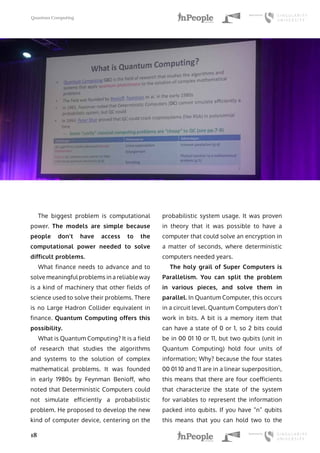
What is Quantum Computing? It is a field
of research that studies the algorithms
and systems to the solution of complex
mathematical problems. It was founded
in early 1980s by Feynman Benioff, who
noted that Deterministic Computers could
not simulate efficiently a probabilistic
problem. He proposed to develop the new
kind of computer device, centering on the
probabilistic system usage. It was proven
in theory that it was possible to have a
computer that could solve an encryption in
a matter of seconds, where deterministic
computers needed years.
The holy grail of Super Computers is
Parallelism. You can split the problem
in various pieces, and solve them in
parallel. In Quantum Computer, this occurs
in a circuit level. Quantum Computers don’t
work in bits. A bit is a memory item that
can have a state of 0 or 1, so 2 bits could
be in 00 01 10 or 11, but two qubits (unit in
Quantum Computing) hold four units of
information; Why? because the four states
00 01 10 and 11 are in a linear superposition,
this means that there are four coefficients
that characterize the state of the system
for variables to represent the information
packed into qubits. If you have “n” qubits
this means that you can hold two to the
The Future of Finance
19
power of “n” units of information, and
there is word “exponential finance”, the
exponential power of Quantum Computing.
There is a second very important fact
about quantum computers and it is the way
they solve problems. Marcos proceeds to
use a videogame called Angry birds as an
example for comparing how a computer
works, and show the difference with
quantum computing: “You see, when we
take a traditional computer let’s say that
we are playing a video game like angry
birds and you’re going to shoot that
bird over those pigs, right? What is the
computer doing? Is its solving a partial
differential equations system? Is it solving
a mathematical problem that represents
a physical phenomenon? What quantum
computers do is, they work the other way
around. They use physics to solve a math
problem, it is the anti-angry birds game, is
the game where you code a microchip to
behave like gravity and then you go and
throw the bird and see where it falls…”
When you think about it what is
essentially powerful bit about this paradigm
is that it replicates how the universe solves
mathematical problems. There are plenty of
very hard mathematical problems that the
universe and nature solves all the time, for
free, instantaneously. Quantum computer
is just a way of changing the problem, it is
asking nature to solve this problem for us.
“How do they look?” says Marcos,
showing a picture of a tiny microchip,
basically inside a fridge. That fridge
is for isolating the microchip from
electromagnetic fields, and cooling it to
a temperature of 15 micro Kelvin, which is
180 times colder than interstellar space.
Until five years ago, many people in
the physics community were very skeptic
about the power of computing and even
the possibility of one appearing which now
is kind of undeniable, says Marcos. In fact,
there are multiple commercial quantum
computers available.
“In the end, you have to think of
Quantum computing as a paradigm
breaker”, continues Marcos.
How can it be used for optimizing a
portfolio is trivial, but when you want to
compute the optimal portfolio, the optimal
trajectory of the portfolio over multiple
rebalances, that turns into a very hard
problem to solve for traditional computing.
Once we get larger supercomputers in a
few years we will be able to solve very large
scale portfolio optimization problems.
A second use case is a scenario analysis,
how many times you hear in the board
meeting the CIO asking for scenario
analysis? How many scenarios can you think
of? 10? 15? What if we allowed a quantum
computer to use its power to simulate the
portfolio under billions of scenarios?
The third use case could be Option
pricing according to Marcos. Pricing
becomes problematic when you end up in
path dependent processes, but this sort
of path dependency is not a problem to
one Quantum Computer because they
will evaluate a tremendous number of
alternative outcomes and derive the
price based on those. Fourth and last, is
Clustering. A classic problem where you are
Quantum Computing
20
trying to put together things that are similar,
and when you go into the dimensions of
one thousand instruments, the correlation
matrix is a heat map of the correlation
matrix with, which is essentially is going to
be garbage, but what if we use a classroom
algorithm to reduce the dimension of the
problem to a manageable size and take
these thousands of instruments and tells:
“You have 10 different instruments” after
contemplating all the data set. This could
have a huge impact on risk management,
for example.
Why is this relevant? There are many
reasons why quantum computing is
relevant and is going to change all of our
lives:
1.	 Feynman’s observation: Quantum
Computers are better suited than
deterministic computers to solve
Financial problems.
2.	 The end of Moore’s Law: The
size of transistors is reaching
its physical limit. We have been
living for the past 30 years an
incredible era, where computers
became more powerful. In 2012
we experienced the peak for
Transistors per dollar.
“The Digital computers era is about to
end, and we need something to replace
it, and the best candidate is Quantum
Computing. “Marcos then goes on
commenting on Artificial Intelligence
and Machine Learning, stating that
Quantum Computing could provide the
computational power we don’t currently
have to boost those technologies.
“Nobody really knows how a quantum
computer works because this quantum
mechanics, right? As soon as you try
to look into what is going to happen,
what is happening in the system, you are
perturbing the system and the system
changes its state, so I think it’s going to be
very interesting when we recognize that in
order to develop artificial intelligence we
need this kind of machinery that we don’t
truly understand…” Marcos reinforces.
PARA PROFUNDIZAR
RECOMENDAMOS
VIDEO CHARLA
https://www.youtube.com/
watch?v=kU7vk9jmQC8
CONTENIDO ADICIONAL DE MARCOS
http://www.quantresearch.info/Lectures.
htm
HERRAMIENTAS
www.Quantumforquants.org
The Future of Finance
21
Energy and Smart Networks
Ramez Naam, Energy & Environmental Systems Faculty,
Singularity University.
Ramez spent 13 years at
Microsoft, where he led teams
developing early versions of
Microsoft Outlook, Internet
Explorer, and the Bing
search engine. His career has
focused on bringing advanced
collaboration, communication,
and information retrieval
capabilities to roughly one
billion people around the
world, and took him to the
role of Partner and Director
of Program Management
within Microsoft, with deep
experience leading teams
working on cutting edge
technologies such as machine
learning, search, massive
scale services, and artificial
intelligence.
Ramez starts the speech
talking about the disruption of
energy, because energy despite
being a fairly static industry
for decades, it is now an
exponential industry with rapid
changes in technology. Ramez
says a few years ago, he wrote
a book about the challenges
of Natural Resources and
environment and the question:
“Can we innovate fast enough
to overcome them?”, and
what he found in doing the
research for that book is that
the technology progress in
the energy space is incredibly
rapid and far faster than most
people take for granted, and
if we play out those trends
and take the math seriously it
has staggering consequences.
Ramez also says he is a clean
tech investor, so he comes at
this from a perspective looking
at where they’re good deals,
where there are opportunities
to disrupt markets and also
build large new markets and
large new companies.
Wind power might look
like a stagnant 19th century
technology but it’s actually one
thathaschangedtremendously.
Over the last dozen years,
the amount of wind power
we have deployed to buy a
thousand percent (x10). That’s
not normal in the energy field,
and that happen for a number
of reasons: Policy pushing it
was a big one, but that policy
would not have been effective
Energyand Smart Networks
22
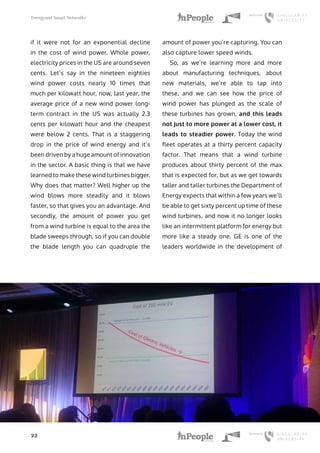
if it were not for an exponential decline
in the cost of wind power. Whole power,
electricity prices in the US are around seven
cents. Let’s say in the nineteen eighties
wind power costs nearly 10 times that
much per kilowatt hour, now, last year, the
average price of a new wind power long-
term contract in the US was actually 2.3
cents per kilowatt hour and the cheapest
were below 2 cents. That is a staggering
drop in the price of wind energy and it’s
been driven by a huge amount of innovation
in the sector. A basic thing is that we have
learned to make these wind turbines bigger.
Why does that matter? Well higher up the
wind blows more steadily and it blows
faster, so that gives you an advantage. And
secondly, the amount of power you get
from a wind turbine is equal to the area the
blade sweeps through, so if you can double
the blade length you can quadruple the
amount of power you’re capturing. You can
also capture lower speed winds.
So, as we’re learning more and more
about manufacturing techniques, about
new materials, we’re able to tap into
these, and we can see how the price of
wind power has plunged as the scale of
these turbines has grown, and this leads
not just to more power at a lower cost, it
leads to steadier power. Today the wind
fleet operates at a thirty percent capacity
factor. That means that a wind turbine
produces about thirty percent of the max
that is expected for, but as we get towards
taller and taller turbines the Department of
Energy expects that within a few years we’ll
be able to get sixty percent up time of these
wind turbines, and now it no longer looks
like an intermittent platform for energy but
more like a steady one. GE is one of the
leaders worldwide in the development of
The Future of Finance
23
these new wind turbines and innovating in
new ways like the GE space frame to build
them taller while transporting them.
Big data, machine learning, and so
on, that is also vital here because these
individual turbines are intermittent. What
was found is in cases like Colorado with
the excel utility there, using sensors on
the wind turbines collecting that data and
putting it into algorithms to do predictions
of which turbine was going to spin at
which speed, a few minutes from now, a
few hours from now, on a day from now,
allowed excel to triple the amount of wind
power they could put on their grid and that
saved them billions of dollars, because it is
the cheapest power they could buy in their
state.
As we mentioned before, higher up
the wind blows more steadily. Marc
Andreessen says software is eating the
world, and this is an example of that: A
prototype that’s not in production yet about
a blimp that has inside of it a small wind
turbine, and it is actually a drone, it flies
under computer power and it can hover
about 500 meters above the ground (three
times taller than the tallest wind turbines)
and tap into those high-speed winds and
then drop down in the case where the wind
is too high for it to be safe. Or as another
example there’s another drone from a
company called Makhani Power in the Bay
Area. It tilts back, takes off under computer
control, flies up to as high as a kilometer
up tapping into those high-speed steady
wins; You could never pay the capital
cost for a kilometer-tall tower but you
can pay the software costs to self-steer
this drone and then act as a giant wind
turbine in the sky. This company was
acquired by google two years ago, who
wants to bring it to production.
Another point to highlight is Solar
energy. There has been an incredible pace
of innovation in solar panels. They are
made of a chip and if we wanted to plaster
thousands of square miles with intel chips,
the cost for that would be Quadrillions
of dollars, it would be impossible. But,
like silicon wafers solar power has had a
ferocious and exponential cost decline
over the course of the last 30 years (it
has plunged by 200 times), that means
we’re now seeing solar energy winning
deals without subsidies in various parts of
the world. It happens especially in places
where the 1.3 billion people that don’t
have electricity today live and about three-
quarters of the world’s growth in energy
consumption over the next few decades
will be which is a relatively sunny area.
Regarding Cross-over, one physical case
worth mentioning is a natural gas plant in
the US the EIA estimates this cost seven and
a half cents per kilowatt hour if you build a
new one. In Chile we’ve had about a dozen
deals and an average price about six cents
per kilowatt hour without subsidies, China
(the Gobi Desert) also got six cents, India
an Ambar ultra-plant 4 gigawatt plant, an
enormous plant the size of four large coal
powered plants and capacity at about six
cents per kilowatt hour, and in the US six
months ago First Solar sold to Berkshire
Hathaway a 3.9 cents kw/h central in our
Energyand Smart Networks
24
deal and then last month the city of Palo
Alto bought solar from a company in LA at
3.6 cents kw/h. Now this is a subsidized
price, but back out all the subsidies about
5 cents per k/h and it’s still about a third
lower the price of new natural gas and
its producing at peak demand time. And
around the world is even better than that,
Mexico: the average price in their solar
auction last month was 5.1 cents, the
lowest price was 3.5 cents unsubsidized.
The price in the US in the last eight years
has plunged about 80%, just a phenomenal
pace of change.
In Dubai, one of the oil capitals of the
world, this 800 megawatt plant a giant
plant being built by Aqua Power (a Saudi
firm) and this price did with no subsidies
for this plant for the next tranche was 2.99
cents, about half the price of natural gas. In
the last three years, we’ve gone from solar
being completely uncompetitive to solar
in sunny parts of the world, to crushing
all other competitors as far as price goes
up and that has helped drive an enormous
explosion.
Wind power scaled by a thousand
percent 10x in a dozen years, Solar has
left that in the dust a 100 times growth in
13 years. For now, this explosion is unlike
anything that we’ve seen in energy.
This happens for a lot of reasons.
Manufacturing scale, one of the first
Exponential’s we ever saw is that the
price drops along the learning curve, and
this curve is quite ferocious, 20 to 25%
reduction in cost per doubling of scale,
and that’s going to keep on going for
quite some time. That allows the industry
to reinvest revenue in R&D to make more
and more efficient cells that capture more
of the sunlight that hits them, so the prices
are going to keep dropping. We are very
far from done yet and the prices that you
see in Dubai or Mexico will one day be
the prices in California, and then after that
they’ll be the prices in Middle America and
we will have the ability to extend the grid
to spread out but, what do you do if the Sun
isn’t shining or if the wind isn’t blowing?
These are still intermittent resources, no
matter how high their capacity factors are.
With good integration, you have a far
steadier output. Diversity, you can put
solar and wind together. We think now
that about 80% of electricity meet needs
in California can be met with no storage
just putting together solar and wind and
large-scale grid connections. There’s also
another kind of challenge that happens
because solar is getting so cheap so fast.
For a long time, the power prices that you
all a had been paying are highest in the
middle of the day, because that’s when
peak demand is (Supply and demand:
there’s more demand the middle of the day
in the late afternoon so prices are higher),
but as solar comes online or perhaps a
decade away from a point where the
middle of the day power prices in much
in America are at the lowest prices because
it’s a surplus of power right then and there.
INTERNET OF THINGS. You hear a lot
about smart power, and that’s what this
means is being clever about how and
The Future of Finance
25
when to use energy to match the prices
you want. Nest company bought by Google.
Why does google want a thermostat?
Because this is part of the smart grid. This
thermostat knows if someone is home
and it has a connection to the utility, and
if the utility sees that a very expensive
peak of power demand is coming late that
afternoon because it’s a hot day in Austin,
then they can reach out to these nests and
say “hey we want to avoid that peak run
the air conditioner a little harder a couple
hours early and then we won’t have to have
such a high peak demand”, and spin up
new power plants and the person at home
never notices this is happening and they
get a reward. They had a kickback from the
utility because this is a savings of tens of
billions of dollars potentially across the
country.
In Europe, it’s hot water heaters, so
these hot water heaters increasingly are
getting smart. They know when the power
cost is low; in Europe, it’s when wind power
peaks sometimes it might the price drops
to zero or negative, utilities will pay you to
take energy, and so these connected smart
water heaters know that and say we’ll take
that will save it up for the morning. Or data
centers, the world’s data centers use now
about 12% of electricity and growing; all
that IOT and cloud stuff it’s not for free,
it’s real and it exists in places like this, and
they’re becoming increasingly smart being
able to absorb load. Another example are
electric vehicles; if you have a Tesla you
already know that has programming to
go for low power prices or during the day
they sit at work and whether its own solar
panels at the workplace or just the solar
utility-scale attention to the grid, when
that price drops during the peak hours of
the day that car is sitting there and ready
to be charged and provide services of the
grid by being able to soak up the extra.
WATER. In West coast California
when there is a massive drought, we can
desalinate water. Desalinated acceleration
is expensive but about half the cost is
energy costs, so this is something you can
do when the energy gets the cheapest;
a desalination plant in Dubai consumes
12 gigawatts of power and desalination
about 500 million barrels of water gallons
of water per day. Mapping that the lowest
energy prices suddenly allows you the
flexibility didn’t have.
Ultimately though you need energy
storage. We all know who Elon Musk is.
He’s announcing the tesla Powerwall
battery, and the funny thing is Panasonic
makes that battery and it’s got a Tesla
casing on the outside; but it’s not some
technical breakthrough that got them
there it’s a long-term exponential trend.
A tripling in the amount of power you can
store program and a 10x reduction in the
cost of batteries over the course of the last
20 years and that keeps on going.
In Germany now it looks like with a small
battery, about half the size of the Powerwall,
and a small solar panel a German household
can provide about seventy percent of its
own energy in summer months. So, if your
utility and your business model is charging
Energyand Smart Networks
26
by volume, what happens to you in this
world? Businesses models are going to
have to change and now we start to see
utilities wanting to own that solar panel
so they can get it on both sides, and the
ones that flourish will do that but Tesla got
a billion dollars in pre-orders the first
week they announced the battery most
of them did not go to homes, 90% were for
this size battery which went to businesses,
commercial spaces, factories and utilities
and now every manufacturer in the world
that does solar is moving into the same
thing. Trina solar battery, the largest solar
company in the world, about a 1 megawatt
hour battery, and they go after some very
simple scenarios, even if you don’t care
about solar that’s probably the case that
you pay one price for energy at night that’s
very cheap and another price during the
day; in California that Delta is about 20
cents per kw/h. Guess what? A battery
is cheaper than that now, so you can fill
it up at night with cheap power and then
discharged it during the day instead of
using that expensive power.
Battery prices are not done coming
down. There is a whole range of different
forecasts about where battery prices would
go and these analysts (including the EIA)
said that there would be huge drops over
a 10 years’ period. Batteries also follow
the exponential learning curve, as they get
higher scale they drop in price and they do
so it basically the exact same pace as solar.
This leads to a crazy idea being that energy
going clean might actually be cheaper
than dirty energy, we’ve always assumed
The Future of Finance
27
that going clean meant higher prices,
but now we’re starting to see even very
conservative organizations say that it
might actually be cheaper.
The IEA says solar will be the dominant
form of electricity in midcentury and the
cost will be unbeatable for UBS. They said
renewables are now deflationary to energy
prices. We’ve coupled the cost of energy
to the ever-declining cost of technology.
It’s like your Kodak: you think these digital
cameras will never catch up. The world is
now to using more clean energy per year
than dirty energy, and we will never
look back.
The former Saudi oil minister once
said: “The stone age didn’t and for a
lack of stone, and the oil age will end
long before we run out of oil”. He’s
warning us that the world is going to
produce a technology replacement for
oil. Oil fluctuates by a two percent,
two million barrels per day difference
in supply demand has caused this huge
oil fluctuation that nobody predicted
it, but we are headed there and electric
vehicles (EVs) are going to get us there.
The IEA forecasted that we’d be selling
1,000 vehicles a year with a 200-mile
range by 2040, so you just can’t trust the
experts in this, trust the technology and
the innovators. And as the battery prices
come down we’ll sell more EVs which will
bring down the cost of batteries, which
will make EVs cheaper, and we’ll some
more EVs as a perfect virtuous cycle.
By 2030 they’ll be cheaper than the
cheapest car sold in the US. The long-
term price of oil is very cheap as our
demand drops.
PARA PROFUNDIZAR
RECOMENDAMOS
VIDEO CHARLA
https://www.youtube.com/
watch?v=O9FR5-aElWA
HERRAMIENTAS
https://www.iea.org/
http://www.iea.org/newsroom/
news/2016/november/world-energy-
outlook-2016.html
https://www.tesla.com/powerwall
https://nest.com/
Robotics
28
Robotics
Rob Nail, Associate Founder & CEO, Singularity University.
Rob begins his speech by
doing a quick overview of
the robotics space: “Robotics
as you can imagine doesn’t
have a lot of direct impact
on the finance space, but a
lot of indirect implications,
if you think about insurance
or maybe interesting retail
opportunities”.
Rob then continues by
announcing SU opened its
first innovation hub. A regional
innovation hub in Netherlands,
as part university’s strategy
to bring awareness about
exponential technologies
around the world. They’re
empowering their alumni base
to take some of this thinking
to develop their own content
and programming, and the
first manifestation of that is
in the Netherlands because of
their alumni base and some
interesting partnerships. Rob
then tells about an example
in the opening celebration
involving the archaic
regulations that limited the
Queen’s (who attended the
event) interaction with robots,
using said example to highlight
how the advances in technology
are quickly forcing a lot of
work to upgrade our thinking,
and our systems in general.
After that, Rob mentions three
key things that drive the pace
of robotics today: Moore’s law,
the sensors, and the way we
teach robots: “20 years ago,
to program a robot to do the
simplest of moves you would
have to write assembly code in
machine language and it would
take you weeks and months
to program a complicated
system. Today we have open
source libraries of code, we
have drag-and-drop software
tools a robotic operating
system where eight year
old kids can program pretty
complicated robots to chase
the cat and throw a ball at it
when you say a magic word. If
you get the Lego’s Mindstorm
Kit you can do exactly that this
weekend, different paradigm,
right?... “Anything that we do
physically that it has to be
safe, accurate, fast and cheap
is perfect for consideration
of Robotics”. But leading edge
robotics in terms of volume
The Future of Finance
29
and efficiency is not all. Right now, the
new face of manufacturing robots is Baxter
(rethink robotics), a robot that is aware
and interactive with the environment,
and allows you to walk it through the
steps to perform a task, learning from
what you taught it.
DARPA ROBOTICS CHALLENGE. The
Defense Advanced Research Projects
Agency was pretty scared of the what
happened with the Fukushima nuclear
power plant disaster several years ago. If
ever there was a situation where you have
to go in and solve the problem but you
really don’t want to send humans in its a
nuclear fallout situation, right? So they put
up a two-million-dollar prize to develop
robots that could do a disaster recovery and
they had eight discrete tasks to complete,
and about 20 teams that competed. Each
team had an hour to complete every one
of these tasks. Two and a half years ago,
no single team completed every task. This
year, the challenge gave the teams one
hour to complete 10 challenges, and three
teams completed the whole challenge.
Where it does get interesting mostly
for commercial applications is when you
simplify it. Rob then talks about Panasonic’s
exoskeleton that was just launched last
year in inventory management to heighten
human’s capabilities, and states that more
technologies are coming online every
day, for example, concierge or security
bots: Relay (Savioke), Navii (Fellow
Robots), K5 (Knighscope) or HOPI-R
(Panasonic). Imagine if you overlayed
this with some other technology around
facial expression or verbal analysis. Now
robots can understand emotional state
and act accordingly, and a whole new line
of interesting consumer-level products are
out on the market or being introduced this
year. Rob says his favorite is Pepper, which
is a robot introduced in Japan, marketed
specifically for the elderly, functioning as
a companion.
Some researches has come out over the
last couple years (specifically targeting
elderly) that suggests if your behavior
changes dramatically, it’s a very clear sign
of a declination of health or a change in
health status. You wouldn’t recognize if that
was you, but a robot would be tracking it
and noticing patterns. If all the devices
around us were information platforms
aware of their environment, what kind of
new correlations and interesting valuable
propositions can they provide to us?
Rob then goes on talking about how
there’s been a lot of research and concern
about the future of Jobs, largely because of
robots. There’s a research from Oxford on
2013 that says 47% of US jobs face a “high”
risk of being replaced by automation. The
rest of the researchers come online are a
little bit more conflicted: Millions of jobs
are going away, but new jobs are coming
online or transforming, because of
automation and robotics. If you see how
this plays out on an exponential curve,
that’s just going to keep happening more
and more, what’s the inevitable conclusion?
Technology, robotics and automation
will provide all the basics for us so that every
Robotics
30
physical task and activity will be provided
through them (Rob suggests 20 years in
a timeline for this to start happening).
Every physical task worldwide will be
an opportunity for robot usage. “Are we
prepared for that? No, we are not”. We still
live in a world where our economic system
is very much dependent on everyone
having a job. Rob ran some forums where
he invited some administrative positions in
the government and when this topic was
mentioned in the invitation, everyone’s
response was that it would be political
suicide to show up on an event where they
about how “everyone in the future does
not have a job”. If our politicians can’t even
entertain a different version of the future,
how are we going to get there?
Rob then comments on the voted
and rejected Universal Basic Income
experiment in Switzerland, highlighting
his interest in that kind of examples, in a
future where technology is going to play
a much bigger role. Rob says we need to
be running thousands and thousands of
experiments around the world to figure out
a new economic system, but he thinks most
importantly is how the mindset is required
to change. The future of abundance where
technology can provide the basics, and our
systems need to adapt fast and radically.
PARA PROFUNDIZAR
RECOMENDAMOS
VIDEO CHARLA
https://www.youtube.com/
watch?v=Mnc9F_bF6dM
UNIVERSAL BASIC INCOME
http://www.bbc.com/news/world-
europe-36454060
HERRAMIENTAS
http://www.savioke.com/
http://www.darpa.mil/program/darpa-
robotics-challenge
http://www.fellowrobots.com/
http://knightscope.com/
http://www.panasonic.com/global/
corporate/technology-design/r-and-d.html
The Future of Finance
31
Uber Yourself Before You Get
Kodaked
Rob Nail, Associate Founder & CEO, Singularity University.
Deloitte set up a program
called the innovation
partnership program with
Singularity University XPrize.
They established about three
years ago, and the reason he
brings this up is because over
those three years they had
30 of the largest companies
in the world, all fortune
500 corporations mostly
fortune 200 corporations, get
together in a membership
model where they bring them
up to singularity university
or X PRIZE headquarters and
spend three or four days with
executive teams literally that
the senior leaders of these
major organizations. There’s
no competitors in the same
room there, where companies
really started to realize that
their next 10 years, the level
of disruption that could take
place as well as a level of
opportunity that they could
capture was significant, and
you could almost see which
industries are moving faster
than others. More importantly
within each industry, you could
see certain companies that
were moving forward well
everybody else wasn’t paying
attention, so whether you
know it or not there is a level
of disruptive advantage that’s
starting to take place right
now.
Disrupt yourself before you
get disrupted. Uber yourself
before you get Kodak’d. The
notion is disruptive advantage
instead of competitive
advantage, so instead of trying
to do 10% improvement go for
ten times improvement. If you
look at certain organizations
like Google with Astro teller
who runs the Google X
program, he comes and talks
at the innovation partnership
program and he discusses this
notion of legitimately creating
a culture where you are trying
to go 10 times better not ten
percent because to go 10 times
better doesn’t take ten times
smarter people, it doesn’t take
ten times as more people, it
doesn’t take ten times the
Uber Yourself Before You Get Kodaked
32
amount of investment, but it’s ten times
better so the economics really pay off. The
other notion is the pace and magnitude of
change, and who can create that change.
The fact that we are surrounded by a world
of entrepreneurs that are really creating
new ecosystems, that are creating a level
of innovation we just haven’t seen before.
Marcus then says he’s going to talk
about “The future of the firm”. Particularly
in this time with everyone being connected
to the internet, with super computers in the
pockets, you have this crowd phenomenon
that’s happening. You have a labor force
that goes way beyond your four walls
as an organization. If you haven’t been
paying attention to the crowd movement,
you’re not designed as an exponential
organization.
In terms of industrialized crowdsourcing
think about this: what if you could get
access to anyone, anywhere in the world,
any time a day and at the scale that you
need. If any of you are in the HR side and
you’re thinking about the labor that your
organization needs, how are you going
to start to staff up around some of these
technologies? Having scale on demand is
very important in that model, to be able to
scale the expertise when you need it. If it
has a long shelf life great, but it has a short
shelf life you don’t have to let everybody
off, you can scale back and in scale up,
and that’s very important from having that
adaptable and agile framework.
And this is not just simple task, but
The Future of Finance
33
you can crowdsource people around the
world to do very complex things and very
open ended things, and the reason why
we’re seeing this happen now versus we
weren’t talking about this even 5 years ago
(or 10 years ago) is because it’s this trend
that’s happening where you’ve got cloud
internet computing, everyone you know
in the world is walking around with super
computers in their pockets, and then also
keep in mind the social aspect people,
especially Millennials. “My kids there are
more used to collaborating with people
that they don’t work in the same four walls
with, their growing up this way…” says
highlights Marcus. The Millennials are the
largest portion of the workforce in the US.
Other trend that’s happening which is
the delineation between current economic
conditions is creating an interesting
scenario where you have one group of
people worldwide that have too much
money and not enough time, and you
have another group that has not enough
money in too much time. It relates a little
bit to the inequality and income discussion.
This groups are connecting with each
other. The notion of using brains outside
of your departments, and the wisdom
of the world of the genius of the crowd
worldwide. You have got to keep in mind
that right now they have a lot of projects
that are happening that are underway,
like Google Loon, or the Facebook Drone
project that Mark Zuckerberg is working on,
you have all these efforts that are underway
to give everybody on the planet access to
the Internet, in many cases for free, so
it’s very realistic to think that in the next
five to ten years the experts are saying
we will have free Wi-Fi for everybody
on the planet or everybody will have
access. That’s going from 3 billion people
of the planet to 7 billion people that have
access to the internet; think about all these
minds that are now connected. If you don’t
have a strategy to tap into that wisdom, to
leverage all those minds across the world,
you’re going to lose against those that
have that strategy.
Who are the crowds? It could be external
crowds (these could be your consumers,
communities of interest, affinity groups,
scientific communities) or internal crowds,
have hundreds of thousands of people in
your own organization. When you hear
about these Crowds strategies, which is
a way to capture excess capacity, you
can use it without going outside your
organization, you can just harness the
wisdom of your entire crowd within your
own organization. And these are one in
the same, make no mistake about it that
you have people in your organization today
that a nights and weekends or perhaps even
in during the day when they’re working
for you there and on the web starting to
play in these crowd models. Especially
the younger generation that understands
how these models work. Whatever they’re
doing they can participate in these models,
and start making income outside of your
organization.Thesearerathersophisticated
groups, sometimes people think that these
crowd models are all the people the world
that don’t have regular jobs or can’t get jobs,
Uber Yourself Before You Get Kodaked
34
and that’s actually not the case. They’re
just competing on these crowd platforms
on nights and weekends. The interesting
thing is that some of the more prominent
crowdsourcing sites where you can crowd
source data scientists from around the
world, or developers from around the
world to make your next commercial. We’re
finding out that if you’re really talented, so
you graduated top of your class and you’re
just the best developer in your class, out
of school you can start to play in these
crowd models. They don’t go searching for
any job, they get into these models and
they’re making seven figures out of school
because they can just quickly win (a lot of
them are competition-based).
So, you’re finding that some of the
best people in the world are going into
these crowd models, which you can
take advantage of, and it’s important to
understand why this is actually a superior
model, the reason being is that the
smartest people in the world don’t work
in our companies, because there’s seven
billion people on the planet, the smartest
people world have to be somewhere out
there in the crowd. So, if you start to
compete against a company that’s using
the genius of the crowd or the wisdom of
the world, you’re going to put yourself in
a competition and you’re going to lose.
Breaking down these models you start
to see the type of incentive structure in
which these crowd platforms work:
1.	 Compensation. You can pay
people and they’ll work for you,
regardless of where they are in
the world, regardless of what time
of day it is, right compensation is
The Future of Finance
35
a big incentive.
2.	 Convenience. You also can make
things very convenient. Gig Walk,
for example, an app that when
they walk into a grocery store it
prompts and offers to pay for
information.
3.	 Gamification. Making a
competition in the game out of the
exercise to where people actually
fulfilled your need because
they actually thought they were
partaking in a game.
4.	 Credibility/Ego. A lot of these
models are competition based
models where the winner gets
recognized, or the group of
winners get recognized
5.	 Passion.
6.	 Competitive spirit. You’ll see a
lot of crowd sourcing sites use
competition to do it. It’s not
always about the money.
XPRIZE is now trying to use all of these
elements. It’s a non-profit focused on
taking on some of the world’s greatest
challenges. The world needs it solved, so
they basically designed an instrument that
they put out to the crowd. Marcus then
highlights the Qualcomm Tricorder XPRIZE,
a competition that offers 15 million dollars
to whoever can create a handheld device
that can give you the same diagnostics of
54 health markers, essentially having a
board-certified physician in your pocket.
According to Marcus, there’s a trifecta
that rules the models: Crowdsourcing,
sharing economy and excess capacity.
1.	 Excess capacity is alluding to
physical things, but can also
be interpreted as intellectual
capacity. A couch that you have
in your house, a bedroom, the
automobile, etc. AirBnb, Uber,
Couchsourfing.
2.	 Sharing economy. Everyone is
more inclined to share with each
other.
3.	 Crowdsourcing, as a way to
connect supply and demand.
If you go out into the ecosystems of
entrepreneurs and innovation ecosystems
around the world, this is what everybody
playbook. Who capitalize on all the excess
date of coming off when you’re in traffic?
Waze used that. That was their model,
excess capacity data that just wasn’t being
used, it was considered not even valuable.
What you should start asking yourself is
where do you have where is your consumer’s
product excess capacity, because it’s
going to be put into this model It’s absurd
idea to think that the spare bedroom in
your house is going to be used, and shared
in your clothing there is technology that’s
going to make it friendly to scan yourself
to understand your dimensions, that to be
able to use artificial intelligence machine
vision to figure out just by taking a picture
of your closet to start to inventory your
closet, and then get an Uber car to bring it
from your house to another house.
Someone’s is going to make an app for
people to take all the assets they don’t use,
or sub-use, and start sharing them in the
sharing economy. So, if you manufacture
Uber Yourself Before You Get Kodaked
36
anything or manufacture parts that go
into any of these things, you should
assume that you’re going to be out of the
mix.
Intellectual capital is being shared too.
Crowds sites using all that intellect to be
part of the crowd model, so you see sites
like Topcoder to developing and coding,
you have Medcast for doctors, you have
InCloudCounsel for legal, and even Tongal
for crowd commercials. Everything is
going to this model. Colgate-palmolive
did this in about three years ago. They
spent seventeen thousand dollars as the
prize money, put it out to 70,000 creative
people. They only had to pay if they like the
winner, so they picked a winner, gave him
$17.000 for the video, and it was so good it
became their 2012 Super Bowl ad.
PARA PROFUNDIZAR
RECOMENDAMOS
VIDEO CHARLA
https://www.youtube.com/
watch?v=ivZIt7BMnnM
HERRAMIENTAS
https://tongal.com/
https://www.airbnb.com
https://www.incloudcounsel.com/
https://www.couchsurfing.com/
http://www.mdb.gov.my/medcast/login/
https://www.topcoder.com/
The Future of Finance
37
An Interview with Ray
Kurzweil
Ray Kurzweil, Director of Engineering at Google, Co-founder &
Chancellor of SU.
Ray Kurzweil is director of
engineering at Google and
the co-founder and Chancellor
of Singularity University. He
is one of the world’s leading
inventors, thinkers and futurists
with a 30-year track record of
accurate predictions called the
Restless genius by the wall
street journal and the ultimate
thinking machine by Forbes
magazine, and was selected
one of the top entrepreneurs by
ink magazine which described
him as the rightful heir to
Thomas Edison. Bob Pisani
then continues to introduce
him until Ray himself joins the
conversation through a Beam,
a robot that contains a screen
which he can remotely operate.
Ray then goes on talking
about the law of accelerating
returns, mentioning a lot of
important events that have
been recently happening (such
as the GO championship for
AI, self-driving cars, image
recognition, and comments on
how he is currently writing a
new book, called “Singularity
is nearer”.
Ray continues talking about
AI: “There’s been tremendous
confidence in AI recently, so
much that people are now
concerned with the downsides.
We’ve gone from AI will never
work to “oh my god is going to
work and what does that mean
for Humanity””. Ray then goes
on talking about how in the last
few years the mathematical
advances allowed to create
more complex neural networks
regarding AI, and computation
in general. Ray states that is
amazing how the first chart
of the law of accelerating
returns (dated 1981) can now
reflect on how predictable
it was, and mentions that
they are effectively updating
the current chart. “Not only
predictable, but exponential”,
says Ray, highlighting the
fact that exponentials tend to
be very seductive in the way
that, at first, nothing seems
to be happening but half way
An Interview with Ray Kurzweil
38
through the project the growth turns truly
visible.
On the other hand, Ray mentions that
despite all evidence to the contrary,
people tend to be pessimistic towards
exponentials. Many people even think
things are getting worse. According to
Ray, what’s happening is that the advances
in communication technologies, allow
everyone to know everything with
little time apart, and no geographical
boundaries (For example violence or
environmental degradation). This is the
most peaceful time in human history,
says Ray, your chance of being killed is
dramatically less that it was centuries ago
when it was dire scarcity of resources. He
believes that the rise of democratization
has to do with the rise of communication
technologies, and so the world is getting
“dramatically better”. Life expectancy
in 1848 was 37 years, and with the gran
transformation in Health and Medical
Centers, we are now living that numbers
in the dust.
Bob and Ray then focus on the subject
of AI. They mention the GO Championship
withheld during that year, and the
breakthrough that’s been impacting public
consciousness about said subject. “The
machine had made a move that the player
did not understand but later described it
as beautiful; I don’t know how to describe
that but the Machine did something human
players did not think was going to happen
and later realized there was a beautiful
move, something happened there…”,
Bob says. Ray then boards the subject:
The Future of Finance
39
“Well it’s interesting, in the early eighties
I predicted the computer take the world
chess championship by 98, and it happened
in 97. That was really a victory for the
symbolic school of AI that at as many of
you realize it’s been these two competing
schools of artificial intelligence being able
to think things through logically, the so-
called symbolic school and the connection
in the school exemplified by neural Nets,
where computers basically emulate human
abilities at recognizing patterns... […] “In
my recent book I talked about how I believe
the neocortex works which is a connection/
system that is somewhat different
regarding the deep neural Networks, it’s
a hierarchy of modules that can recognize
a pattern. I estimate we have about 300
million of those modules and recreate the
hierarchy that recognizes with our own
thinking” Ray then continues talking about
the GO championship Bob had mentioned,
saying that in GO you would actually
have to deal with a sequence of moves
that expands radically, having hundreds
of moves available at each time, so the
levels of pattern recognition have to be
really deep to assess the board and know
logically if you are winning or losing, and
play accordingly. Recent breakthroughs
in AI technology give the computers the
ability to assess those situations. The
Google GO playing program perfected
itself by playing with itself to generate
the training data and then it could assess
the moves based on the outcome of these
simulated games.
Bob then addresses what he calls “the
new wave of the techno pessimists”.
People out there, saying “where’s my
jetpack”, coming out and arguing that
things haven’t changed that much. Ray
says that there has always been people
that can make arguments in the face of all
reason. We’ve seen the rise of internet,
computers, AI, robotics, and we are seeing
machines do things like driving cars, that
would make absurd to say that this have
not been transformative changes. “[…]
We have always used our machines to
extend our own reach and leverage our
muscles. Unaided human muscles couldn’t
create skyscrapers. We can now access
all of human knowledge with a few
keystrokes, how many people can do
their work without the brain extenders
we already have? These will become
more and more profound and more and
more intimately connected to us, so we’re
becoming smarter…”
65% of the jobs today in America didn’t
exist 25 years ago, let alone a hundred
years ago, and we keep increasing the
sophistication of jobs. We enhance our
intelligence not only with education, but
by merging with intelligent machines.
“Ultimately, we will connect our brains to
all this technology and extend our physical
and mental reach…”
Bob then mentions Genomics, the
potential to cure long-standing diseases
like cancer or diabetes, and continues
expressing his feelings about the potential
of all new technologies like quantum
computing or robotics, and questions Ray
about the best way to make people aware
An Interview with Ray Kurzweil
40
of all these positive changes. Ray then
goes on talking about the consequences of
the readiness that we have of information
around the world, as communications get
exponentially better, every time we plug
into the news you get to know what’s
negative or what disaster is happening right
now, and that influences our perception
vastly. Ray affirms that that’s one of the
things that keep the whole pessimistic
wave alive. “15 years ago, search engines
were just getting started, and know
thinking of a world without them sounds
like ancient history”, says Ray.
“We very quickly get used to the positive
things, looking at the future and change
is always threatening because we don’t
immediately have an answer…”
We’re moving up Maslow’s hierarchy, you
know people were just involved with basic
elements of survival centuries go. Because
we are geared towards survival, we tend
to be very alert to potential threats, to not
just existential threats but even threats to
our well-being, so for example it’s very
easy for the media to report how many jobs
have been lost. Bob mentions that since
the 2008 financial crisis, we’ve all become
behavioral economists essentially. Not just
life expectancy, but there are a lot of good
things happening. There are dozens of
new jobs that didn’t exist only a couple of
years ago, so humans keep going forward,
concludes Bob.
PARA PROFUNDIZAR
RECOMENDAMOS
VIDEO CHARLA
https://www.youtube.com/watch?v=-
lvAxU2PdpA
MEDIA ACERCA DE DEEPMIND Y EL
CAMPEONATO DE GO
https://www.youtube.com/channel/
UCP7jMXSY2xbc3KCAE0MHQ-A
HERRAMIENTAS
http://www.singularity.com/
http://howtocreateamind.com/
The Future of Finance
41
Exponential Computing
Brad Templeton, Director, the EFF & Founder, ClariNet
Brad begins his speech
saying he wants to talk about
how Moore’s law is digitizing
everything, and what’s
happening in computing right
now.
Brad start talking about
early adopters, which is the
first component he states
is necessary for innovation.
Early adopters are the first
consumers a certain new
line of technology have, and
they become the “fuel” for
innovation. Other necessary
component for innovation are
Open platforms, according
to Brad. “No matter what
company you are, the
smartest people in the world
don’t work for you”, and Open
platforms come here to break
through that wall by allowing
people to contribute what they
learned back to the world,
and even beat out Microsoft
spending billions of dollars
trying to do the same thing.
Brad then goes on talking
about how the internet was not
an invention but an accident;
the internet gives people the
illusion that it’s free, but it’s
nowhere near that, everyone
pays a part, and this allows
every idea to lift from the
ground and become a reality.
In the days of Netscape, they
put up a camera on their fish
tank, and around the world
everyone thought it was very
amusing to go and see fish on
the other side of the planet.
But had that been done on the
old ways the network where
you paid by the kilobyte for
everything you used, they’ve
gotten a big bill at the end
of the month and those guys
would have been called in to
their bosses office and say why
did I get this big bill so people
can look at our fish?
“All the intelligence of the
internet breaks the idea of
having intelligence in things,
and give the network the
intelligence it needs to be
smart.” That smart network
then allows anything, for
instance smartphones, to
innovate, to amplify the needs
technology covers. Brad then
goes forward stating that “If
your business, your city is
not software-based you may
Exponential Computing
42
not be a company soon. You now need
information of 2023 to make a plan for
2025, because the world is changing fast.”
NASA’s probe that have been sent to Pluto
arrived last year, and by the time it took to
get there Pluto was no longer a planet, but
when it arrived, new software was already
running in the probe that allowed it for
new types of image and signal processing,
things that weren’t even conceived by the
people who launched the probe into space.
That’s the value of software right there.
Brad then talks about how bandwidth
is widening its range and in the next few
years, the 4 billion people that are now
“disconnected” will be coming online,
and that certainly is a number that
can change how things are done. For
instance, virtual/augmented reality and
robotics may impact and even replace
travel, likewise Ray’s speech before Brad’s.
Facebook spent 2 billion dollars to acquire
the Oculus Rift, company which was
only 18 months old and it never ship the
product, and so you’ve also may have seen
some of the hype now about going beyond
this - what’s called augmented or mixed
reality where we actually bring things into
the world that you’re in as though they’re
real, and the most exciting company in this
space is one called Magic Leap. Brad then
talks about the advances this company
is accomplishing, and how soon this
technology is coming.
Magic Leap raised 1.4 billion dollars
to build this technology, the largest
The Future of Finance
43
private investment drowned in history.
Microsoft will be shipping to developers
their augmented reality glasses called
Holo-Lens sometime around 2016.
THE INTERNET OF THINGS (IOT).
Brad says the “internet” is the wrong
metaphor, this is more a convergence of
technologies making it happen. The three
technologies are sensors, computers and
networking, and are getting cheaper and
smaller every year. They’re getting to use
less power, which is highly important in a
world switching to renewable energy as
we move forward. If you bought a phone
recently, you’ve seen what happened to
sensors because every company advertise
it. Advances in computers have enable us to
prototype cheaply; Raspberry Pi, not only
really small, but it’s also $5 dollars. How will
the world change when supercomputing
shows up in that price tag? Regarding
networking, it’s interesting how many
formats and standards are out there. Very
long distance low power communication,
or Bluetooth energy format, which has
been in our phones for a couple of years
now. There’s a lot of hype around IOT
according to Brad, and highlights what are
the things that will become important in
the next couple of years, and for instance,
industrial application will give the ability
to gain value with just a really low cost of
investment and implementation of sensors
and networking. Supply chain companies
are another area where we should focus.
Brad also talks about wearables, and
makes the comparison on how on healthy
people, there’s still low value on most of
wearables or IOT related stuff, but there’s
a lot of potential when you have already
a condition, such as pill bottle caps that
know when you have taken the pills, and
can help someone track their medications,
or even wearables designed for their
condition.
“One thing I think we’re going to be
able to do with all these cheap sensors is
copy our friends here at Google…” Google
came up with a very interesting philosophy
of running a big server and instead of
buying enterprise-grade hard drives and
enterprise-grade everything as everyone
else was told to do they bought the cheapest
they could find in the marketplace and they
expected it to fail, and they designed it so
that it just failed and it made a notification,
and the drives had to be changes, but
costumers didn’t notice, because of how
the system was designed. They made the
cheap perform better that the best, and
allowed them to survive failure. “This is
one of the great lessons that Google has
taught the world…” says Brad.
Brad then goes on his speech to talk
about “Frictionless”. Making things so
that you don’t observe the user interface
anymore. Regarding Moore’s law, there’s
certain types of problems. If you have to
dig a ditch, and can hire 9 people, the
ditch should be faster, but what about
when you hire 1000 people? There’s a part
where we can’t make the ditch faster, and
that’s what happening with computers
right now. Brad says that we have to start
advancing towards quantum computing
Exponential Computing
44
can solve this type of problems, obeying
the laws of quantum mechanics we are all
familiar with. Problems like factoring
large numbers in a short time can really
change how things are viewed and done.
For instance, all of our internet security
is built around how it’s really hard for us
right now to do that, including financial
security.
The energy industry will change because
you’re not going to care about the power
in your vehicle anymore and you’re not
going to buy a car, you’re going to buy a
ride. And when you do that suddenly all
the energy equations change. A lot of cars
are going to move to being electric and
that means that the United States will stop
importing oil.
The value of real estate is driven by
location, and the meaning of distance and
location are going to change in a world
where self-driving rides are available for
twenty cents a kilometer less than a bus
ticket, that’s what transportation is going
to cost in the future.
Moore’s Law is going to come to
transportation. Retailers will change,
Northern Europe is building delivery robots
that will bring you anything in 30 minutes,
not just a pizza, for less than a dollar. What
if you can get anything in 30 minutes or
less than a dollar? Do you even need to
own things? What will this mean for the
retailers of the world?
PARA PROFUNDIZAR
RECOMENDAMOS
VIDEO CHARLA
https://www.youtube.com/
watch?v=G9gfNR0Eiyo
HERRAMIENTAS
https://www.raspberrypi.org/
https://www.microsoft.com/microsoft-
hololens/en-us
https://www.oculus.com/
The Future of Finance
45
The Death of Products,
When Everything Becomes a
Service
Marco Annunziata, Chief Economist & Executive Director of
Global Market Insight, General Electric Company.
Marco begins his speech
reinforcing what other
speakers haven been talking
about the negativity subject,
and he says he used to be
like that, so he understands
why people tend to be in that
posture. He joined General
Electric and started seeing
more of what is happening in
technology and that’s what he
says he wants to talk about:
How exponential change is
beginning to permeate in the
industrial industry, or what
he calls “The next industrial
revolution”. “This is going
to be as big as the previous
industrial revolution”, says
Marco, mentioning the impact
on the economy and jobs it is
going to have.
DIGITAL INDUSTRIAL
TRANSFORMATION. The
convergence of physical
and analytical technologies.
According to Marco, the
most important in defining
aspects are industrial assets
becoming intelligent inter-
connected devices, equipped
with electronic sensors,
resulting in insights of
enormous amounts of data
and allowing to understand
and operate with greater
efficiency. “You can now
understand a lot better how
a jet engine performs in
different flight conditions so
is it flying over the desert? Or
is it flying over the oceans?
What are the implications for
taking different flight paths?
Different strategies of taking
off and landing so as to save
fuel but also to improve the
maintenance, and here is one
thing which really changes:
you start understanding these
machines a lot better and move
from reactive maintenance
to preventive maintenance,
fixing things before they break
because you know what is
going to go wrong 80/90%
percent probability over the
The Death of Products, When Everything Becomes a Service
46
next two weeks…” This really gives you the
sense of how once an industrial asset that
becomes an intelligent input connected
device, the functionality changes and it
becomes something completely different.
The smartphone we carry around today is
completely different from the old phone,
or think of what we’ve seen with a Tesla:
you have a car that you drive back one
evening from the office to home, you park
it in your garage, and the morning after
the car drives you to work because at night
through software upgrade it’s become
self-driving. This is what it means to have
machines that through changes in software
changing integrated functionality.
Marco says his favorite example
regarding renewable energy are Wind
Turbines. There’s new intelligent and
interconnected wind turbines can react to
changes in weather. They can change the
inclination of its blades so it catches the
wind in a better way, but that’s only the
first step. The second step is to realize
that the way in which the first line of wind
turbines intercept the wind impacts not
just how much power they can produce, but
also how the wind then passes through the
second, and third line of turbines. What
happens with intelligent wind turbines
as the wind changes is that they literally
talk to each other, and they react in a way
which is coordinated so as to maximize the
power output for the wind farm as a whole;
The Future of Finance
47
here you have team playing by machines.
According to Marco, there is a reason
why economies have been so pessimistic
over the last few years even as digital
innovation has accelerated. Today industry
has been left behind; industrial productivity
used to be 4%, over the last five years it’s
going down to just 1%, and in the last few
quarters it’s been even lower. Until now,
the industrial world that has really missed
the train of visual innovation because it
needed more time for a critical mass of
these innovations to find their way into
industrial assets are now doing so. They
are starting to build digital twins, which are
essentially a software module of a generic
machine. “Think of what’s happening in
the consumer space, where services like
Amazon, Netflix or Facebook increasingly
know us, so they can recommend to us
what we would probably like to read or
to watch...” In the machine world that
means knowing exactly every specific
piece functioning and knowing in
advance how it will perform and adapt
in different circumstances, which means
you can optimize the performance and
reduce the risk of failure. “The important
implication of this is if you are a company
like General Electric, it shifts the focus
from assets and products to services in
outcomes because suddenly you’re no
longer thinking in terms of producing
a best-in-class machine and selling it
to a customer and then the customer
will do whatever they want, you’re
focusing on the idea that thanks to
these technologies what you’re really
selling to your customers is outcomes,
services and solutions…” It changes the
game to a significant extent and as this
concept starts to take hold across the
industrial world. In the consumer space,
we have companies like Uber and Airbnb
that have enormous valuation even though
they don’t really own any of the underlying
assets which are being used to deliver the
services they provide. Similarly, we have a
company like Apple which makes a large
amount of revenue out of its app services
even though it’s just creating a few apps,
so you’re moving to a world where even
though the physical assets that have always
been a vehicle for providing services, but
now the focus really shifts to the services
themselves.
Marco says that it’s going to be
interesting how this plays out, as
companies will no longer sell the machines
to the industry, but keep the ownership
and allow the use of the assets to the
customers, shifting the balance of risk.
What happens when you have a third
party that says “I can do this better”, and
proceeds to buy the industrial assets and
sell the use of them?
Marco then reinforces that if the world is
changing so much, maybe being big is not
enough. “You have to start investing more
in software, take digital technologies more
seriously… The first question you must ask
yourself when evaluating an investment
is: How seriously are we taking the digital
revolution? Are they investing in software?”
Resuming the topic about energy
discussed in previous conversation, Marco
The Death of Products, When Everything Becomes a Service
48
highlights how the digital and physical
technologies help the consumer role evolve
from one that just buys and consumes
energy, to someone that not only buys
and consumes, but can generate, store
and sell back to the grid energy, and this
puts in perspective the question: “How do
I help different players in the energy game
generate more value?”
Marco continues by saying
technological progress is getting the
traditional lighting business out of
business, and that they had to start
thinking differently and combining years of
research and knowledge to transcend said
traditional industry. What happens when
you can use the lighting system not only
to transmit electricity, but also data and
information. Lighting becomes the neural
network. Intelligent lighting by GE helps
each lightbulb become part of an enormous
system that can help on numerous tasks
across the globe, such as enhancing
safety along the streets, monitor weather
conditions or even pollution levels.
If you are entering this digital industrial
revolution where everything becomes his
service, what kind of play can you run?
1.	 Figure out what your set of
customers will be
2.	 Focus on what you are actually
selling
And how do you monetize this? With
a new generation of customer service
agreements where the value that you
bring to the customer is generated by a
combination of hardware and software.
Marco also highlights the importance of
maintaining the relationship with start-
ups, because big companies have to
start learning from companies that are
nimble and flexible in a rapid changing
environment.
BRILLIANT FACTORY. Evolving the
intelligent factory by applying sensors
and interconnect all the factory floor by
a smart network. Therefore, the factory
floor is connected in smarter ways to
the supply chain to distribution channels
in a way that allows you to recalculate
almost instantaneously, when something
happens, how you should we optimize the
flow of your supplies but also how you can
reorganize the work on your factory floor
to do this. It also has implications for the
way we work: “We’re seeing that a lot of
these technologies actually augmented
the ability of workers at different levels of
this distribution, so you have a specialized
recognition on a factory floor or going out
in the field to repair that machine, and this
person is now carrying around a portable
device (the equivalent of an iPad or a
wearable device) that aids in training and
day-to-day manual tasks.” The implication
of this is that the workers who are not a
computer scientist or engineers, will have
ever disposal match greater abilities which
will make them more productive and
greater productivity means the ability to
support the higher wages.
Marco continues: “I do feel that we are
at the point of the elbow of the exponential
growth curve were over the next five to
ten years you will see a larger number
The Future of Finance
49
of machines, industrial devices, smart
meters, cars, wind turbines, all becoming
interconnected in entering the year of the
digital revolution digital, and I think this
will give the answer to the paradox we’ve
seen so far: we all get extremely excited
about the improvements the changes that
we see in economic circles, we sit around
and look at the productivity statistics and
we see that productivity growth which is
what determines the standard of living in
individual countries in the world”.
According to Marco, it happens because
all these innovations mentioned that have
not yet scaled, are beginning to scale now.
They’re beginning to become the fuse now,
and this is what the game really gets more
intense and this is where you will see the
big advantages accruing.
Think of what happens next when
we start building the next generation
of machines, not only with their
functionalityinmindbybringingsoftware
to them that allow them to evolve, and
change their functionality. The next step
regarding a new generation of workforce
should combine expertise in terms of
software and mechanical engineers.
When we look at the industrial Internet
applications so the digital revolution of
industry this is going to apply two sectors
which account for close 50% of the global
economy, so it is huge and the potential
to generate the value for shareholders
and generate opportunities for financing
with attractive returns are going to be
enormous.
Marco then finishes his speech by
reminding everyone about the pessimistic
wave, and highlighting that not only people
are like that because of the innovation on
the communication industry and access to
information, but because they are ignoring
completely the fact that over the last 20
years the size of the global economy has
tripled. The number of people living in
poverty has been cut in half (that’s 1 billion
people lifted away from poverty) and we
miss the point that over the last five years
the rate of growth of the global economy
was higherthan the average of the 25 years
before the recession.
PARA PROFUNDIZAR
RECOMENDAMOS
VIDEO CHARLA
https://www.youtube.com/
watch?v=exBoL_TCUVw
GENERAL ELECTRIC ADDITIONAL INFORMATION
http://pressroom.gelighting.com/news/
ge-intelligent-lighting-to-transform-
retail-experience-through-qualcomm-
collaboration
https://www.ge.com/digital/industries/
intelligent-environments
https://www.ge.com/digital/brilliant-
manufacturing
Business Decentralized
50
Business Decentralized
Brian Forde, Director of Digital Currency, MIT Media Lab.
Brian begins his speech by
stating how important Internet
is for everyone. According
to the Commissioner for the
Digital Agenda in Europe,
Europeans would rather go
without coffee or sex then
without the internet, which
is interesting and probably
true, taking into account
everything we can and have to
use the internet to accomplish.
However, Brian highlights
that recent surveys, show that
Facebook and Google are not
trusted by their customers.
On the other hand, Brian also
mentions the trust problem in
wall street at 2008, and the
parallel surge of Bitcoin as a
digital currency.
To explain the concept, Brian
uses the example of concert
tickets and how most people
feel confident that it will work
as intended, but there’s a small
percentage that has trust issues
regarding that ticket. If we were
to apply the bitcoin concept
here, imagine if you could
leave a register online about
the transaction of the original
ticket, that once belonged to
a person or organization, and
now you are the rightful owner
of that ticket, and everyone
could see that. That’s how the
blockchain basically works,
decentralizing the ownership
of, for example, physical
assets. With cryptocurrencies,
it does not matter the
application you use, you can
send money using only one
identifier, and that concept
is called decentralized trust.
People don’t have to trust
any application, just trust the
protocol, as everything moves
through the same protocol.
Lowering friction in the
transfer on data, use of
network and distribution.
What’s happening with
blockchain and technology?
We start to reduce the friction
of changing institutions,
and then trust gains a more
important role. Bitcoin was
built for people, and not for
companies. The benefits of
a decentralized ledger far
out rate the private ledger
practices, where companies
interest comes first before
customer’s. In a decentralized
The Future of Finance
51
ledger, customers have the power.
The average North-American has
about 16 doctors in their lifetime, so
your electronic healthcare records are
distributed in 16 different databases.
Brian describes a project created by the
MIT Media Lab where they used a theory
on blockchain to start connecting all
those databases, and putting the control
of the information back into the hands of
the patients. Think about passing down
the information to families, of having
access to your grandparents’ medical
records, of securing the information in
a decentralized ledger that no longer
depends on databases administrated by
high amounts of organizations, each with
its own protocol.
Brian then talks about Facebook
building resiliency as part of their
strategy to gain trust. All that social and
personal information, what could happen
if Facebook just turned the switch off? You
have suddenly lost a lot of your time. That’s
what happens when you lose the ownership
of your own content and information.
Take video content for instance. We
centralized in Netflix, iTunes, and so
on. Now when you “buy” content, it’s
actually a lie, Brian says. You can’t sell
it, you can’t use another platform to
consume that content. It is even illegal
in the US to sell your iTunes tracks. You
don’t really own your content.
DAO: Decentralized Autonomous
Organization. According to Brian, it means
Crowdfunding meeting venture capital
bound by smart contracts.
Kickstarter or Indiegogo are examples
of crowdfunding platforms, where you
can support the start of a project or build
Business Decentralized
52
of a product, and get some non-monetary
reward (perhaps the product itself once
it launches). DAO has raised more 168
million dollars which now makes it the
biggest crowdfunding project ever, raised
by 20,000 with an estimate about 10,000
shareholders. How it works: You have a
proposal that from anyone who has bought
“ether” (shares) which basically gives you a
vote (the more ether or shares that you buy
the more votes that you have) and then you
have vigorous debate for about two weeks
or so, investors vote, and the project is
developed by a contractor or third party
to deliver this product that was proposed.
It’s all bound by smart contracts so its
highly secure for investors, and finally you
have your revenue share breakdown, and a
certain amount of profit will be returned to
the shareholders. This is happening faster
than we thought, and business models
start to get decentralized sooner too.
Think about the implications
regarding regulations, and how business
models are shaping up, surpassing
traditional models. What is the potential
of decentralizing investment model into
ether? All money raised can be withdrawn
if people vote to do so, they still own it,
and manage it as a democracy.
Brian the continues: “When you don’t
have a trust law model, institutions, or
even centralized computer protocols
or technology whom to trust, not even
governments, cryptocurrencies play a huge
role in the market…” If you have a company
spread throughout the world, you can see
the problem much quicker.
With the Internet, we saw a
communication exponentially increase
and similarly with cryptocurrencies like
Bitcoin, for example, we’ll see transactions
exponentially increase because we will do
it frictionless, significantly decreasing the
costs of transactions. “Eventually, says
Brian, we might say Europeans would
rather go without coffee or sex than without
Blockchain for the trust they get…”
PARA PROFUNDIZAR
RECOMENDAMOS
VIDEO CHARLA
https://www.youtube.com/
watch?v=SyGQhzjxg7c
HERRAMIENTAS
https://deepmind.com/
http://icg.citi.com/icg/citi_research/index.
jsp
https://www.lendingclub.com/
The Future of Finance
53
The Blockchain Panel
Bill Barhydt, Founder/CEO, Abra; Chairman, Boom Financial.
Bill Barhyt, Ben Milne (CEO
of DWOLLA, which provides
an online payment system
and mobile payment network
allowing developers to access
the US banking and payments
system directly via dwellers)
and Catheryne Nicholson,
Co-Founder & CEO of Block
cypher (which is like Amazon
web services for Blockchain)
integrate a panel focused on
Blockchain’s impact in Fintech.
Catherine states that
blockchain is the underlying
technology that powers a
cryptocurrency, such as bitcoin
or ethereum. “It’s mutable,
permitionless, anybody can
participate, and something
that has been tried many times
but has never succeeded until
now…” The first successful
cryptocurrency was bitcoin,
that although being essentially
non-perfect, gave the industry
a platform in which to succeed.
“Timing and necessity was
what made it successful…” says
Catheryne. Ben Milne then
continues: “it’s easy to think of
it as an immutable distributed
database, where each new
entry has a referent to the last
and vice versa.”
Ethereum is the 2nd largest
open blockchain, and the
primary goal is to create smart
contracts on blockchain, so
while Bitcoin was designed
solely as cryptocurrency,
ethereum is designed with
smart scripting language
which allows you to do those
contracts on the blockchain.
Why would people in on
Wall Street for example care
about ethereum? It allows
you to do all sorts of things
that typically required a
middleman, it enables you to
do that in a smart contract way
but do it on blockchain, so you
don’t necessarily have to have
a person or an entity be that
trusted party; it can execute
based on whatever parameters
you set forth within that
contract. Imagine a system
where any two parties on
the internet could effectively
enter one of those contracts
for difference with no central
clearing where you basically
make a bet that Apple stock
is going to go up or down and
The Blockchain Panel
54
at the settlement we simply received the
payout in any cryptocurrency. For people
who are in countries that don’t have
easy access to central centrally cleared
markets this type of model becomes super
interesting.
What are the key non-financial
applications of this technology? “The
applicationsfortheunderlyingtechnologies
like blockchain outside of Finance I think
are really interesting, because when you
take an immutable data base and you
make knowledge available to everybody in
the world for free, that’s pretty cool…” says
Ben. Catheryne then continues: “Identity
management on blockchain is it something
that has the potential to change…”
At some point blockchains are going to
be best tool for the job. Developers are
going to choose them, companies are going
to choose them, and they’re just going to
become a part of the experience, according
to Ben. However, Catheryne highlights that
blockchain disruptive main point is that you
have an entire network that’s validating
(not for free) every transaction. If you
remove the reward (Bitcoin for example),
what is the incentive for that entire
network to secure it on?
Bill continues moderating the panel
by stating that Bitcoin was invented with
one big objective in mind: the double
spin problem, two people spending the
same money. With a decentralized ledger,
that problem is certainly solved. Bitcoin’s
market capitalization is now about 9 billion
dollars.
What needs to evolve in this ecosystem
to make it more useful to people in general?
According to Catheryne, UX is one of the
things that needs to get improved to make
it more accessible, and then she brings up
the subject of scalability. Every “block” is
like a page on a letter, and there’s only a
certain number of transactions that will
fit inside that block, which is the size of a
megabyte. The problem is that when you
have millions and millions of transactions
floating around that must wait in a memory
pool before they can get mined and put
The Future of Finance
55
into that block, and that really limits its
potential.
After that, Bill, Ben and Catheryne give
the room for the audience to ask question
and clear some doubts:
1.	 Ben talks about a Fed issued
digital currency that is already
being tracked, and there definitely
is a digital system that drives the
entire economy, moving hundreds
of trillions of dollars a year. For
scalability and market adoption,
Ben talks about the current scarcity
of more chains for interoperability
to be viable, but he states we are
getting there.
2.	 Catheryne further explains
the subject of smart contracts,
which execute per parameters
set by the parties. There are a
lot of things that don’t require a
lawyer to be executed, and that
kind of tasks could be assigned
to the digital world, saving huge
amounts of time and money. Ben
then comments on consumer
protection, and how laws need to
be updated to follow this trend.
3.	 Catheryne talks about a new
proposal called SegWit, which
removes the part of the transaction
that’s repeated over and over, and
that would allow blocks in the
blockchain to be more efficient
regarding the size limit.
4.	 Ben comments on how the
big banks could block the
operation of blockchain, but he
says “Why would they?” Even
if their products are different
and competing, the market is
huge and that alone justifies
participating in the network,
rather than blocking. Other than
that, “open” blockchains are not
per se “stoppable”. You are just
allowed to participate.
5.	 Ben comments that the businesses
are the party that will benefit
the most in this “blockchain new
world” that is coming. Catheryne,
for instance, comments on how
wiring money internationally is
difficult and how blockchain could
help make that easy and efficient,
frictionless as one would say.
6.	 Bill then talks about how the
Us government is not stopping
cryptocurrency. Its purest form
is software, and the IRS is just
looking for a way to tax the income
generated through all the network
PARA PROFUNDIZAR
RECOMENDAMOS
VIDEO CHARLA
https://www.youtube.com/
watch?v=becWLAGTu6Q
HERRAMIENTAS
https://bitcoin.org/
https://www.ethereum.org/
https://www.blockcypher.com/
https://www.dwolla.com/
https://venmo.com/
Realizing The Value Of FinTech Panel
56
Realizing The Value Of
FinTech Panel
Amelia Dunlop, Principal, Deloitte Doblin.
There has been a sharp
rise in investment by financial
institutions in internal
Innovation Labs, Accelerators,
and other tools for finding
potential fintech partners.
When these tools succeed,
acquisitions, joint ventures, and
other partnering relationships
emerge. Building a relationship
that realizes the full value of
the entrepreneurial spirit of
the start-up and the scale of
the institution brings a new set
of questions and challenges.
Amelia Dunlop, Principal in
Doblin, Deloitte Consulting’s
innovation practice moderates
a panel discussion with
BlackRock Head of Innovation
globally in Strategic Product
Management, Lena Mass-
Cresnik and LearnVest CEO,
Alexa von Tobel.
A year ago, Business Insider
declared the headline that a
huge wave of startups was
coming to crush the big banks.
Amelia says that she wants
to state a story about how to
create value in the industry,
and not address the situation
as “David and Goliath”, as the
media tend to call it.
Alexa continues talking
about LearnVest, and how
they managed the investments
coming in I the last few years.
They built a cash flow based
financial planning in a way
where they’d cut every ounce of
humantimeoutsothatyoucould
have limited amount of human
time to service the masses. She
continues by saying that every
day they protect and nurture
the entrepreneurial spirit of
LearnVest, staying nimble and
pushing things quickly.
Lena then comments on
how BlackRock is a new
and innovative firm that
through both human robo-
advisors, help customers
with their financial planning.
In addition to tax efficient
portfolio management, mobile
and online solutions, and
applications online enrollment
and multi-custodian support.
Over the last several months
they’ve been focusing on
The Future of Finance
57
various partnerships and partnered with
firms like BBVA Compass, RBC wealth
management, as well as LPL Financial, all
looking for potential ways of applying the
technology in terms of future advisor.
After that, Alexa and Lena go on talking
about difficulties throughout the years
that may have surprised them. For Alexa,
the partnership that allowed LearnVest
to take off was the hardest obstacle yet,
including the whole process of uniting
both companies. Lena on the other hand,
working with financial institutions, pushing
the boundaries of the relations was a big
challenge, especially when it comes to
developing and creating hybrid solutions,
and then also comments on the growth that
has been happening in the Asia market, and
how all the US solutions they are talking
about are already being executed in that
market by other companies.
“Why do you even need a customer
to think about their financial life? You
could totally take that off” says Alexa.
In the same way that Google Maps now
tells you to go left and right, all you need
advisors along the way to get from one
place to the next. What does innovation
really do here? It makes things cheaper,
and gets rid of the friction. It makes it
easier to the customer.
Lena comments on that, saying that
65% of customers who said they want
digital advice or Robo advisor also said
that they want to have a relationship with
a financial advisor as well, and that’s in
what RB hits the sweetspot. Alexa then
continues talking about the next 20 years,
mentioning how the roles will switch of
even be replaced if the technology keeps
advancing at the rate it is doing.
PARA PROFUNDIZAR
RECOMENDAMOS
VIDEO CHARLA
https://www.youtube.com/
watch?v=L3PNSYDDHFE
HERRAMIENTAS
https://www.learnvest.com/
https://www.blackrock.com/
Investing the Uninvested
58
Investing the Uninvested
Jane Barratt, Founder & CEO, GoldBean.
In the big scheme of
investment advisors, Jane
spent 20 years in the digital
marketing and advertising
world. She says becoming an
investment advisor is a little
penance for those 20 years of
taking money out of people’s
pockets, but she thinks there
is a much bigger thought,
highlighting the mission with
Gold Bean, that is to bring new
investors into the marketplace.
There is a huge divide in
the US economy and globally
in terms of just people’s
understanding of money and
people’s understanding of how
to grow their money. Everybody
knows their numbers; there’s a
trillion dollars now in credit
card debt, a trillion dollars
in student loans, a trillion
dollars in order line, and these
are real numbers, but there’s
also a half a trillion dollars
spent every year on getting
money out of your pocket.
Jane says there is a real
opportunity to engage people
in a different way, making them
engage with their consumption
and money in a different way
as well. Jane recommends an
article that tells a story about
how nearly half of Americans
could not afford a $400-dollar
emergency payment.
“If you think just for a
second of the enormous loss
opportunity of people who
can’t take a risk, people who
can’t lead, people who don’t
want to put their hand up at
work for a new job because
they’ve got to get their next
paycheck because they have
to make their bills; if half the
population is struggling and
not being able to live up to the
huge potential, what does that
actually mean for the future of
the economy?”
Jane then goes on saying
there are three very distinct
profiles of people: the under
invested, the uninvested and
basically people who are
very underserved. Jane uses
examples to then explain each
profile, commenting on the
issues they must live with, and
how new players coming to the
industry could change that.
Why aren’t companies
looking at engaging with
The Future of Finance
59
their clients as well? They’re spending
half a trillion dollars every year to talk to
them, what else can they do? Jane says
they (GoldBean) have in the core basis of
their business that when people can look
at their data and see where their money is
going, and see the impact of their money
on the economy, it rewires their behavior.
It’s about just bringing this growth mindset,
per Jane. She reinforces that by seeing their
customers’ transaction data, they can see a
shift in behavior, and that’s why they start
to see people as assets in which companies
should start investing.
After that, Jane finishes her speech by
asking: “What can companies themselves
do? When you think of all the trillions of
dollars inside the economy, the exponential
opportunity of redeploying and rethinking
those trillions, what could it mean for our
society and for the future, and especially if
you can unlock that potential of people who
are stressed about money and not living up
to their own human potential, what would
that mean in terms of less financial stress?
More money in the economy, that’s the key
to abundance”.
PARA PROFUNDIZAR
RECOMENDAMOS
VIDEO CHARLA
https://www.youtube.com/
watch?v=TDkcTCjjGzs
HERRAMIENTAS
https://www.hellogoldbean.com/
https://www.theatlantic.com/
magazine/archive/2016/05/my-secret-
shame/476415//
https://venmo.com/
Future of Financial Services
60
Future of Financial Services
Jesse McWaters, Project Lead, Disruptive Innovation in Financial
Services, World Economic Forum.
Jesse begins his speech
by telling everyone what the
World Economic Forum does
in Davos, and mentions in
2014 they brought together a
group of 50 senior financial
services leaders and asked
them about what they thought
Fintech means for the future
of financial services, and the
answer was agreement across
the board: “Banks vs Fintech,
no contest”.
Then they came back a
year later, and the history was
entirely different. The banks
were now worried, as they
saw there was potential for
Fintech to take part from their
operations.
At last, in 2016 they held
the same conference, and the
discussion evolved yet again.
People felt they had figured
out the solution, it was the
opportunity to fix financial
services.
Jesse then mentions that
working with Deloitte as
their professional services
partner, they went out and
ran a 15-month process to try
and understand what FinTech
was all about, reaching out
to bankers, insurers, asset
managers and others, and
CEOs and founders of leading
FinTech companies. The result
of this work was a consolidated
framework; a taxonomy of
innovation and financial
services that focused on 11
clusters of innovation and did
deep dives into understanding
what are the innovations
driving these, and what if
scenarios for the evolution of
those ecosystems, and lastly
what are the implications
for Fintech for customer’s
regulators.
Four observations about
FinTech:
1.	 Fintech is not random.
It is deliberate and
predictable, and
it occurs where
customer friction
meets large profit
pools. Jesse mentions
TransferWise, as
good example of
Fintech occurring in
a large friction part
The Future of Finance
61
of the industry, allowing the
most transparent and cheapest
movements of money with a good
mobile customer focus.
2.	 Fintech is having the greatest
impact where business models
are platform based, data
intensive and capital light. When
you look at the crowdfunding,
platform or robo-advisors
based start-ups, they took huge
inspiration on Uber or AirBnb.
3.	 New entrants are employing
parallel strategies, competing
with incumbents while also
leveraging their infrastructure.
What is Apple good at? Delivering
great user experience.
4.	 Not all innovations are customer
facing, Fintech is also delivering
new capabilities and unexpected
efficiencies.
What does the future look like?
1.	 Scale. When you think of the
emergence of companies like
Fundapps and Kensho, when you
think of financial services software
as a service, that’s really shaking
up the traditional benefits that
very large incumbents have been
able to leave her out of their scale
and what it means is that small
and mid-sized players are going
to be able to go out and access a
highly sophisticated and scalable
suite of services that will be at the
very least table stakes and allow
them to focus much more minutely
on the areas that they’re really
good at.
2.	 Today if you think about the retail
universal banking experience a
huge part of that experience is
predicated on the fact that there
are enormous amount of frictions
around owning five different
financial products with five
different providers. What if digital
marketplaces and improved
product interconnectivity could
unbundle the traditional model
of universal retail banking? What
we’ve seen over the last 10-15
years is an enormous amount of
effort by financial institutions and
a huge amount of money put into
building customer centric services,
but the reality is if we’re honest
with ourselves those have not
met expectations most financial
institutions today would confess
they are still inherently product-
centric institutions, and there’s
an interesting inherent advantage
of a platform and amazon for
financial services if you will, but
lets you shop and cross compare
four different sort of products
that maybe even provides
recommendations.
3.	 Shifting payments behavior and
fragmented customer portfolios
could make traditional risk metrics
less effective. Think FICO today;
it’s really based on two things
about seventy percent of your
Future of Financial Services
62
FICO score is based on your use
of available credit facilities and
your repayment of those credit
facilities, but in the future, we’re
going to see more and more
fracturing of those credit facilities
and we’re going to see more and
more fracturing of the payment
experience as well it’s going to
make it more and more difficult for
traditional players to pull together
the right information in those FICO
scores.
4.	 Distributed ledger technologies
like blockchain could dramatically
reshape financial products and
processes.
5.	 The trusted and established
position of financial institutions
could allow them to deploy
identity-as-a-service as a core
offering.
6.	 Theemergenceofmachinelearning
and artificial intelligence may
automate unexpected practices
with transformative effects. Think
AI networks detecting fraudulent
patterns.
Jesse finishes his speech by stating three
questions that came up in Davos:
1.	 Can incumbent institutions rely
on regulators to help protect their
core businesses? Regulators have
really start to become aware of the
potential value of the innovation
that is being driven in FinTech.
There’s been a realization across
a large number of consumer and
security regulators globally that
know it has the potential to drive
competition, it has the potential
to improve customer services and
The Future of Finance
63
outcomes and ultimately have a
more efficient system.
2.	 What are the building blocks of
successful collaboration between
incumbent institutions and new
entrants? Financial institutions
recon that they are not built
to partner effectively with new
and exciting fintech ideas, and
are working on it.
3.	 How can financial institutions
attract and then nurture the right
talent to meet the challenges of
tomorrow? Citibank put out a
report recently that amongst other
things, calls for the potential that
over the next 10 years there will
be around 2.5 million workers in
financial services that might find
themselves redundant. The best
chess players in the world today
are not humans anymore. It’s
not just about people potentially
getting replaced in this process,
but you need a different type of
trader than you had before; one
who can work with an intelligent
system to ask the right questions
to synthesize interesting insights
and ultimately hopefully drive
better outcomes for the institution
and for its shareholders.
“It can be enormously tempting to treat
innovation and financial services as a 2016
priority, but there has been a fundamental
change in the structure of the industry and
unleashing of innovation that will itself set
off subsequent waves of innovation that
require financial institutions to become
inherently more agile entities and this
means this is this is not going to be an easy
transition but those who are successful in
it will better serve themselves and their
shareholders, they will better serve their
customers and they will better fulfill the
social license that we expect when we
when we grant financial institutions as a
society the ability to practice Innovation”
PARA PROFUNDIZAR
RECOMENDAMOS
VIDEO CHARLA
https://www.youtube.com/
watch?v=PI3yRi3OoW0
HERRAMIENTAS
http://www3.weforum.org/docs/WEF_
The_future__of_financial_services.pdf
https://transferwise.com/
https://www.fundapps.co/
https://www.kensho.com/
Becoming an Exponential Financial Services Organization
64
Becoming an Exponential
Financial Services
Organization
Salim Ismail, Global Ambassador, Singularity University
What do you do as an
existing organization? How
do you adapt to this pace of
change?
Salim starts his speech
by quoting his background
and saying that when you try
to do disruptive innovation,
the immune system of the
company will attack you. All
our organizations are built to
resist change and how to deal
with it.
We tend to look at the world
in three layers. Traditionally all
our economy has been driven
by very physical products, then
we have a product layer where
the product may be physical
like your Kindle or iPhone,
but all the revenue streams or
information based in digital
(for example, the subscription
model), and lastly there is a
purely digital model, where
you move information around.
According to Salim, there
is different things happening
in the economic side, or that
impact directly on it:
The volatility of the
environment is accelerating.
It used to take 20 years
to create a billion-dollar
market place, and we’re now
seeing that happen in one.
For instance, in Newspaper
and Music business revenue,
we’ve seen a 6x and 10x drop
respectively in the last 5 to 10
years. That’s happening in TV
right now, as new generations
are not watching TV anymore.
10 years ago, we had
around half a billion internet-
connected devices, right now
we are up to 12 billion, and a
prediction by Ericsson says
there will be 500 billion by the
end of the decade.
In 2003 the leading expert
and solar in the world said this:
“look at the cost of the physical
wiring and the glass and the
composite, you will never
drop below a dollar, that’s the
floor…” We just dropped below
30 cents per k/h.
Salim reinforces how all
these new technologies go
The Future of Finance
65
into the “exponential curve”, where the
domain goes digital, the cost comes
down, everything becomes open source,
communities form and then you see radical
disruption. According to him, we are about
to see an explosion of new products and
services come out, and the key to thinking
about this is when a technology or a set
of products or service become usable, then
it takes off. Robotics is now usable, you
don’t have to spend millions of instructions
to program prescriptive Robots, as it
adaptively learns. Energy is becoming
digital. Health is becoming digital.
Rob Ryan Hart invented a shake
that corresponds to 100% of the carbs,
nutrients, fats, minerals and vitamins
you need. You can drink this and not take
anything else; there has been people who
now lived on this for six months without
taking anything else. But that is not all, if
you are coming from a traditional mindset
35 years or older, your initial instinct
would be to patent that recipe and license
it out as a business bottle, but this younger
generation is different. They open-sourced
his recipe so anybody can go make this.
In fact, there is more than 2,000 variants
of the original recipe already. And what’s
his business model? Rob Hart said he will
iterate his recipe better than anyone else.
Food is now software.
Salim quotes a book by Chris Anderson
called “Free”, which he recommends for
people who don’t know too much about
the Freemium model, and then mention
another book, “Better than free”; this
time by Kevin Kelly, where he identifies
eight ways of adding value of the base
information is widely available, and this is
essentially the business models of a digital
age. He reinforces the concept by quoting
David Rose: “Any company designed for
success in the 20th century is doomed
to failure in the 21st”, referring to how
organization were built for scalability, and
not flexibility, adaptability and disruption.
After that, Salim goes on taking about
Local Motors, and how the disruptive model
of the automotive industry is shaping up. A
normal car costs about 3 Billion to design,
and LM charges only 3 Million. Typical cars
have around 25,000 parts, and LM ones
have around 50, and the manufacturing
space required to build a car is typically
a million square feet factory space, but a
LM car could be built on the stage of the
Becoming an Exponential Financial Services Organization
66
conference. How do you compete if you
are traditional car company when this is
possible?
There’s three components that go into
building an exponential organization per
Salim:
The first is a massive transformative
purpose: MTP. Google organizes the
world’s information.
Open happiness has been the recent
mantra of Coca-Cola. A tag line with a social
purpose behind has been increasingly
used by companies like Procter & Gamble
or Unilever.
Secondly, it’s SCALE: Staff on Demand,
Community & Crowd, Algorithms,
Leveraged Assets and Engagement.
Uber doesn’t own its own staff, TED uses
community, Google uses algorithms and so
on.
Lastly, ideas: Interface Processes,
Dashboards, Experimentation, Autonomy
and Social Technologies. Five internal
mechanisms to manage the internal control
framework and drive culture. Lean Startup
methodology decentralized organization
structure, for instance.
Salim states that using 4 out of the
10 (SCALE and IDEAS), you get a 10x
improvement in performance as an
organization. You can see how well your
organization adapts to the environment
with a survey SU has on its page.
Salim then goes on talking about the
book “Exponential Organizations”, and
the advice for large companies present in
around 40% of it. He highlights a couple
major pieces regarding that:
1.	 Transform leadership (Education,
Board Management, Diversity
and Leadership skills)
2.	 Mark Zuckerberg had all his
Facebook users drifting to
WhatsApp and invested 1/5th
of his market capital to getting
that start-up. That requires
huge amounts of flexibility.
Salim then says that you should
not try and do a radical business
transformation project on your
existing organization. “It’s too
difficult, it’s to political, and takes
way too long, costing a ton of
money. 70% of these business
transformation projects fails.
What you can do is take a small
team to the edge and build one
of these ExOs.”. Success in every
industry is becoming a Platform.
“Amazon has a really fascinating policy
where they found it’s really easy in any
big company to say no to an idea, so the
amazon had a policy called the institutional
yes: if you come to me inside amazon with
an idea, my default answer has to be yes.
If I want to say no I’d have to write a two-
page thesis as to why it’s a bad idea. This
creates friction, and allows a lot of ideas to
be tested all the way. Amazon Web Services
was one that nobody could say NO, being
totally different to the core business, and
is now one of the most successful products
of all time.
Salim then says that, regarding all
fortune 1000 companies over the last
couple of years he has been talking in
The Future of Finance
67
or participating in some kind of way,
about 80% of them are operating in a
denial mode, where they don’t know this
technology is coming or if they do they
don’t think it affects their industry, and
the other 20% have “some idea”. 15 out of
20 do nothing. 5% of big companies are
thinking the right way.
Why does the immune system deliver
this kind of response? Salim says that it is a
fundamental new model and no one knows
how to implement it. How the organizations
were created keep conditioning the
implementation of disruptive innovation.
PARA PROFUNDIZAR
RECOMENDAMOS
VIDEO CHARLA
https://www.youtube.com/watch?v=_Y-
O6xj-pb0
HERRAMIENTAS
http://exponentialorgs.com/
https://localmotors.com/
https://www.ted.com/
http://kk.org/thetechnium/better-than-fre/
Managing Exponential Risk, Rethinking Insurance
68
Managing Exponential Risk,
Rethinking Insurance
Daniel Schreiber, CEO & Co-Founder, Lemonade
Lemonade is set to launch
soon as the world’s first
insurance carrier designed
from the ground up for the
sharing economy.
Evolutionary psychology,
machine learning, behavioral
economics and game theory
are a couple of the theories
that Daniel says he wants to
focus on his speech, and begins
by saying that Insurance per
se is like the “Holy Trinity”:
Endless sums of money (Close
to a trillion in gross margin),
unspoiled by innovation
(Fortune 500 is made around
10% by insurance companies,
everything about this industry
screams 1900s, a lot of room
for innovation) and universally
reviled, as most Americans
would consider insurance a
“necessary evil” rather than a
social good. Most Americans
do not believe their insurance
company will pay them when
the day comes which is kind
of fundamental to the whole
business model, so when
you take the confidence of
those three it becomes very
attractive to investors and
entrepreneurs.
Daniel then goes on talking
about the way he sees this
opportunity in Insurance
industry, and mentions that
what he does is search for
where the “premium” dollars
go. A third of the dollars payed
goes into expenses category,
and the other 2/3rd goes to
what they call “loss ratio”,
and that’s being paid back
out in some fashion, such as
the loss of the asset under the
insurance. Daniel says that
there’s still a lot of potential
in what is not added up to that
loss ratio that can be collapsed
in some way, and there are
disciplines or technologies
that can help achieve that.
BEHAVIORAL ECONOMICS:
“If you tried to create a
system to bring out the worst
in humans, it would look a lot
like the insurance of today”
– Professor Dan Ariely, Chief
Behavioral Officer, Lemonade.
The Future of Finance
69
25% of americans say that it’s OK to
defraud your insurance company, and that’s
unnerving. 38% according to Wikipedia is
the cost that defrauding costs the industry.
Daniel mentions that money corrupts the
industry, and when you have a product that
you don’t believe in and when that that
product then becomes adversarial then
you end up with a product underused and
overpriced, with people resenting it.
“Insurance money make money by
declining pays” says Daniel, in an intent
to provoke reflection, and then explaining
how the point of equilibrium in the system
today is that everyone loses. But, could we
design a system with a different point of
equilibrium? Daniel believes that applying
reverse game theory can give you an
answer, knowing the result and trying to
design a game that achieves that result, and
that’s what they are doing at Lemonade.
EVOLUTIONARY PSYCHOLOGY. We
have an understanding that primates can’t
survive solo, and must trust their group. But
when one group meets another, is all about
war. Daniel says we are not as different
from that groups as we think of. Robin
Dunbar discovered a correlation between
primate brain size and the optimal group
size for getting this kind of behavior, and
the Dunbar number for human beings is
around 150 mark. You don’t need a coercive
policing, you don’t need tremendous
number of rules and law enforcement,
and behavior is dramatically better than
when you’re in a massive anonymous pool
of people. In Lemonade, they work very
closely with real communities and try to
architect insurance in a way that can be
meaningful and a Dunbar size group which
presents interesting challenges could done
by the law of small numbers.
The sharing economy is all about
rediscovering some of those elements
of basic community using technology to
reconstruct modes of interaction amongst
community members that once were
prevalent. Daniel goes on talking about how
GEICO and their affinity method decades
ago, and how the insurance companies
Managing Exponential Risk, Rethinking Insurance
70
had to made the decision between affinity
or growth. Do you want 25 customers, or
25,000?
Well, that’s true in the old economy
but it’s not really in new economy.
Facebook has 1.6billion people on it, and
has experience exponential growth buy
it has not sacrificed affinity. When you
log in, you see your community, the
reason that can do that is because the
marginal cost of spawning a new group
is $0; The marginal cost of setting for
your insurance company is not so much
$0 at all. Insurance has grown by diluting
affinity and by getting millions of masses
and a strange people into a pool and then
having all their psychological side effects
impact that “community”.
COLLAPSING FRAUD. Daniel comments
that in Lemonade, they have performed
a series of experiments working hard to
see how they can integrate the behavior
that people have in all other spheres of
their life into insurance, and measure
the financial impact that would have
terms of the financial impact and impact
on the experience, and how it can be
transformative.
“If you are starting from scratch,
you would never build an insurance
company the way insurance companies
today are built”. Encyclopedia Britannica
encountered Wikipedia, and it’s not simply
that Wikipedia cost zero and they cost
$1,000 dollars, if both were the same price
you would still use Wikipedia, and that is an
The Future of Finance
71
unusual disruption. This is not the kind of
disruption that we used to know in the 80s
and 90s, this is not a low-end destruction
just because it’s free or cheaper, this is
a higher disruption and costs nothing.
Wikipedia updates itself 10 times a second,
while the encyclopedia updated itself 15
times in 250 years.
As a community, Americans pay 50
billion dollars a year to people to sell
them insurance. In the state of New York
homeowner’s insurance commissioners
run at roughly 22%, which means that
you must increase your premiums by 25%
percent so you can skim 25% off the top
to give to the broker. It’s not hard to see
how you can start collapsing costs by using
technology to displace the experience.
The next big revolutions in insurance
will come in underwriting. Think about
the cellphone in your pocket and how
much data it has that potentially could
correlate to what kind of a risk you are.
Is it possible that the way you charge my
battery correlates to what kind of risk you
are? Is that if I you are never allowed to
drop beneath 90% you are a different kind
of risk averse person? And the person that
lets it drop to 3%? Is it possible that the
kind of apps that you choose to download,
the kind of phone you choose to buy, the
kind of times a day that you make phone
calls correlate? How fast you walk, how
fast you drive, how often you post a
Facebook update… could machine learning
find correlates between that that beat the
FICO school? The answer is yes. What kind
of organization is going to be able to get
that data? Organizations today are not
built around the trust that would allow you
to give them the data.
PARA PROFUNDIZAR
RECOMENDAMOS
VIDEO CHARLA
https://www.youtube.com/
watch?v=gZCxUdrvj5M
HERRAMIENTAS
https://www.lemonade.com/
Authors of this document
72
The Future of Finance.
2017 © InPeople Consulting.
© MatiasSicardi
Documents from
Digital Edition
Designed by
Reservados todos los derechos. No se permite la reproducción total o parcial de esta obra, ni su incorporación a un sistema informático, ni
su transmisión en cualquier forma o por cualquier medio (electrónico, mecánico, fotocopia, grabación u otros) sin autorización previa y por
escrito de los titulares del copyright. La infracción de dichos derechos puede constituir un delito contra la propiedad intelectual.
SEBASTIÁN INCHAUSPE
InPeople Consulting
sebastian.inchauspe@inpeople.biz
GUIDO CHIAPPERO
InPeople Consulting
guido.chiappero@inpeople.biz
LORENZO PREVE
UpsideRisks
lorenzopreve@upsiderisks.com
Authors of this document
The content on this document was based and/or contains specific ideas and subjects that
were presented by specialists on the field during the Exponential Finance 2016 Conference,
organized by Singularity University

The Future of Finance 2016

  • 1.
    Documents from TheFuture of Financial Services 2016 1 T h e F u t u r e o f F i n a n c e | 2 0 1 6 sponsored by
  • 2.
    Index 2 Understanding Exponentials /p.4 WillWeisman. Executive Director, Conferences, Singularity University. What Does Money Want /p.8 Bob Pisani, CNBC “On-Air Stocks” Editor. Machine Learning, AI and Big Data /p.12 Neil Jacobstein, AI & Robotics Co-Chair at SU, Former CEO of Teknowledge Corporation. Quantum Computing /p.17 Marcos López de Prado, Senior Managing Director, Guggenheim Partners. Energy and Smart Networks /p.21 Ramez Naam, Energy & Environmental Systems Faculty, Singularity University. Robotics /p.28 Rob Nail, Associate Founder & CEO, Singularity University. Uber Yourself Before You Get Kodaked /p.31 Rob Nail, Associate Founder & CEO, Singularity University. An Interview with Ray Kurzweil /p.37 Ray Kurzwei, Director of Engineering at Google, Co-founder & Chancellor of SU. Exponential Computing /p.41 Brad Templeton, Director, the EFF & Founder, ClariNet The Death of Products, When Everything Becomes a Service /p.45 Marco Annunziata, Chief Economist & Executive Director of Global Market Insight, General Electric Company. Business Decentralized /p.50 Brian Forde, Director of Digital Currency, MIT Media Lab. Index The Future of Finance
  • 3.
    The Future ofFinance 3 The Blockchain Panel /p.53 Bill Barhydt, Founder/CEO, Abra; Chairman, Boom Financial. Realizing The Value Of FinTech Panel /p.56 Amelia Dunlop, Principal, Deloitte Doblin. Investing the Uninvested /p.58 Jane Barratt, Founder & CEO, GoldBean. Future of Financial Services /p.60 Jesse McWaters, Project Lead, Disruptive Innovation in Financial Services, World Economic Forum. Becoming an Exponential Financial Services Organization /p.64 Salim Ismail, Global Ambassador, Singularity University Managing Exponential Risk, Rethinking Insurance /p.68 Daniel Schreiber, CEO & Co-Founder, Lemonade
  • 4.
    Understanding Exponentials 4 Understanding Exponentials WillWeisman. Executive Director, Conferences, Singularity University. Will Weisman begin his speech by welcoming everyone to the third annual Exponential Finance. He also welcomes everyone to NY city, and states that the city has obviously played an incredibly important role in the history of the country, and in the history of financial services. Willthenproceedstoexpand on the history of Singularity University. The foundation’s mission is to educate, inspire and empower leaders to apply exponentially accelerating technologies to address the world’s largest problems. Will says you can think of them as part think tank, part educator and part new company accelerator. They focus on eight primary accelerating technologies, all areas that have crossed over to be information technologies and are growing exponentially, and obviously, they believe they are going to be the biggest drivers of disruption going forward. Will then states that it’s not just the technology individually, but it’s all about convergence. it’s how do these disparate technologies come together and then cause the creation of new products and services. Continuing on his speech, Will then explains why Singularity University is also about “Impact”, and names what they call global grand challenges, integrated by eleven areas that they have chosen to focus on. These are areas where they see some of the largest problems in the world and where they think technology can really have the biggest impact. ABOUT SU’S FOUNDING HISTORY: founded in 2008 Ray Kurzweil and Peter Diamandis came together at a TED conference, where they both started talking about exponential technologies, the changes that were happening, and that we were about to enter this period of rapid and transformative growth. They
  • 5.
    The Future ofFinance 5 eventually came together to talk about how they needed to create an organization where people, individuals, companies and governments could come to learn about these technology areas. Peter Diamandis is chairman of SU, and an executive chairman of the XPRIZE, of planetary resources, of human longevity and bold capital partners. Will then talks a little about abundance, and tells the audience that in the next few days of the conference they’ll hear a lot of talk about that theme, a way of looking at the world and thinking about it in terms of going from a scarcity mindset to really abundance mindset. Ray Kurzweil, the other part of the founding equation is a brilliant thinker. He is one of the most accurate Futurists and predictors that this world has ever known. Adventurer, entrepreneur and a director of engineering at Google. Will the proceeds to state several headlines that have been resonating in the last few days: 1. Clean energy jobs for the first- time surpassing oil jobs 2. The UK is thinking about a universal basic income 3. In May of this year Portugal ran their entire country off renewable energy for four years 4. Block chain based distributed autonomous organization that was just launched. Raised a hundred million dollars to invest in early-stage capital To really understand some of these things though you need to understand about Exponentials, and you need to understand about Ray’s laws of accelerating returns, according to Will. What does it mean when something is exponential? All basically means is that something is doubling in a finite period of time. We’ve heard of Moore’s Law is being one of the paradigms.
  • 6.
    Understanding Exponentials 6 It’s adifficult concept for us to grasp. If you think about when our brains went through their major evolutionary changes, it was hundreds of thousands of years ago, in a very different world. The world was very much linear and it was very much local. The world was changing very slowly and we focused on just the things that were immediately around us. Fast forward to today this is very much a global and exponential world, so something happens on one side of the globe and we hear about it in minutes or seconds. Computers hear about it in milliseconds. One of the key things from this conference is hopefully to help you think about and understand exponential thinking so that you can start to look at problems and start to think about what the world might look like in the future using this exponential thinking. Will then proceeds to give examples of exponential behavior on current technologies, and talks about Ray’s law of accelerating returns. Will says that there have been examples since as early as 1890’s, and we all know each of these technologies have finite lifespan. What basically happens is in the earliest days things start off very slow, they reach a point where the growth becomes visible through rapid acceleration, and they reach some finite maxim. What’s interesting is that another technology that appears and so it’s a city series of these nested s-curves you can imagine it’s one technology basically sitting on the shoulders of another technology and together create that very smooth curve. Will says that in 20-30 years, he’s going to have a thousand-dollar computer that’s going to be as powerful as the human brain, and by 2050, he may have a thousand-dollar computer that’s going to be as powerful as all human brains for thousand dollars. Will then continues with examples to show how exponential growth has a affected us. Starting in 1956 five megabytes of storage cost you $120.000 dollars; fast forward to 2014 and 28 megabytes of storage costs you $99 dollars and fast forward to today 120 gigabytes now cost you $30 dollars on amazon. That’s a 3000x performance improvement and storage capabilities and 11 years and over 90 million since 1956. Will also mentions GPUs technology, as well as the impact in the advances of the optical camera has made through the years. “If you were lucky enough to be a successful company and make it to the S&P 500 back in the early nineteen twenties, you know you had a 67-year run […] the top of the heap today that’s down to 15 years and that’s shrinking dramatically. If you’re lucky enough to make it to the 500 list, that’s a very short life span. It’s predicted that forty percent of those companies might not even exist after 10 years so that were entering…” states Will, and continues: “One of my hopes from this conference is that you’re going to come out of here with a not being pessimistic not being feeling kind of beat down, but feeling like this is really an exciting time and what could be disrupted stress is really an incredible opportunity so part of that is embracing
  • 7.
    The Future ofFinance 7 this abundant mindset I mentioned” Will then mentions the framework they use that helps to understand the path of exponential technologies and abundance: 1. First, what happens is something becomes digitized, becomes an information technology. 2. Then it starts growing very slowly, it’s very deceptive, it doesn’t seem like much is happening. 3. Then all the sudden disruptive things start to happen. People are surprised, and all the sudden these new companies, new technologies are coming on that to potentially create stress and challenge them. 4. That’s when we start to see these companies’ products and services start to dematerialize and to monetize things moved to board to becoming almost or 100% free. 5. Then ultimately, we see them get democratize and readily available to everyone. Will completes the idea by showing statistics about how the world is becoming a safer place, and it’s according to him “the best time to be alive”, and adds the fact that we’re going to 3 billion new people coming online in the next few years, so almost a doubling of the number of brains that are out there that are harnessing the internet will be contributing to the solution of world’s problems creating companies. It’s really going to be an extraordinary time. All of a sudden, you’ll start to see lots of new customers for new companies. Will finishes his speech by thanking everyone who has attended, and encouraging everyone to seize the opportunity to be there. Para profundizar, recomendamos: VIDEO CHARLA https://www.youtube.com/ watch?v=2n6JO7KvHvM HERRAMIENTAS http://www.kurzweilai.net/the-law-of- accelerating-returns
  • 8.
    What Does MoneyWant 8 What Does Money Want Bob Pisani, CNBC “On-Air Stocks” Editor. Bob Pisani starts his speech by saying how excited he is for living in times like these, and makes a special remark about Artificial Intelligence. A particularly profound moment occurred during the GO battle with Google’s Deepmind, the GO champion said that the machine made a move that did not make sense to him, that was not in any way comprehensible at all, and only later when the game was at its end did the player realize that and move was very profound that it threw him off, and that it was largely responsible for winning the game. Bob says he wanted to highlight where we are and maybe a little bit about where we’re going right now, commenting on the advances Fintech has had in the last few years. Regarding investment in private FinTech, 1.8 billion dollars in 2010, 19 billion dollars in 2015. Bob then says that what’s driving Fintech is very simple: maintaining control of the customer relationship, making customer experience as smooth and effortless as possible, and cost cutting, critical in a world of low growth, low rates and low profitability. Then Bob goes on talking about where is the Fintech money going: “Mobile money (money transfer, mobile banking), consumer lending (prosper, lending club), Small business lending (cabbage, circle up) and personal finance management (robo-advisors like Betterment or Wealthfront) We are now into this in tech revolution. It’s more difficult than a lot of people thought to build brands, build trust and build relationship with our customers. “The personal finance management area, it’s amazing what the potential is for them; we haven’t even scratched the surface in this…” Bob continues. The global mutual fund business is about 30 trillion dollars the global ETF industry is about 2.6 trillion in the US, and the Robo-advisors business is 20 billion dollars right now, “that under management and this
  • 9.
    The Future ofFinance 9 is less than one-tenth one percent of the current market, this just gives you an idea”. Peer-to-peer (p2p) lending: it’s small so far 2015. It’s only 7% of the cumulative lendingvolumesin2018.Anotherexampleis Alibaba, the largest e-commerce company, having more users than the population in all of US. Their Gross Merchandise Value is 500 billion dollars, “that’s the GDP of Norway right now”, says Bob, commenting on the characteristics Alipay brings to the Chinese Market. “Where’s the tipping point, where these technologies start to really dominate digital disruption?” We know what digital disruption has done to other businesses, you know what did the music’s sales and video rentals, but could this happen in FinTech where you get these massive disruptions? Well, the answer is yes, and the question is how do we know what’s happening? “There are very different ways of looking at this”, says Bob, “but one thing that I’ve noticed is once a technology starts to get somewhere in the mid-teens in terms of its penetration, when that happens in the digitally it accelerates very quickly because that’s enough for first early adopters, and then you get widespread discussion from people and it starts moving quicker from there. This happened in all these industries. That’s a tipping point.“ So, where’s the Banks “Uber moment”? (A shift for mobile distribution). Bob emphasizes on a specific area in banking industry: “I have been hearing for 20 years that the bank branches are going to go away, this was one of the earliest things you could say in 1996 to sound smart. Once teller machines came in everybody said nobody’s going to bank branches. You
  • 10.
    What Does MoneyWant 10 know what happened actually? We have seen modest declines in bank branches, bank branches actually peaked in 2007. There’s been some modest decline since then. Now the question is will these new technologies, once you get the adoption a little heavier, will the bank branches started coming down? Citigroup estimated that if you started getting massive adoption bank branches could come down anywhere from twenty to fifty percent. Nobody really knows, but my thought is these banks are not going to let those branches go that easy. If they can cost justify them by turning their staff into advisory based roles where you come into the banks and they’re now selling you a whole suite of services that conclude not just mortgages but personal wealth management”. And then reinforces the idea: “For them to remain competitive, banks need to get innovation before the FinTech companies get scale”, quoting Citigroup, but makes clear that the banks are not rolling over. In the last few years the big banks have been working on the digital disruption area, and are not rolling over. The good news, according to Bob, is that disruptors are causing innovation inside the banks. “They’re going to buy a model as well, and you’re going to see some consolidation going on in this area”. BIG DATA: CHANGING THE WAY RISK IS PRICED. There’s now new methods of gathering data on consumers. Loyalty cards, social networks, purchase data or even browsing habits, and this eventually supports faster, more accurate decisions. “This is absolutely invaluable to a bank.” BLOCKCHAINS. How do I know I got something if it’s not in my hand? How do I know I sent that money to Thailand? How do I know that I truly sold that stock to somebody? How do I know I own that piece of real estate? Well we have an elaborate system in the stock market call clearing to tell that you did buy that stock, and we have elaborate system regarding real estate insurance mechanisms that says that guarantees transactions, but the blockchain can bypass all that. It is truly revolutionary. What’s coming according to Bob? 1. P2P, small businesses. 2. B2B will be the next wave. 3. Industrial Fintech, financial transactions incorporated into the IOT. Smart meters at home, that could even negotiate the rates of, for instance, energy. “Cross Fintech with the IOT, and you’ve got a lot of great potential”. Bob continues… “When I talk at CNBC, when we talk to people who are CEOs, who run companies in the United States they say regulation and compliance is a really big headache and increasingly they’re citing cybersecurity what there be some application to take big data and apply it to regulatory issues to find a better way to do regulation and compliance…” Bob then advances in his speech talking about possible negative outcomes (at least temporarily) for some of the disruptive
  • 11.
    The Future ofFinance 11 tendencies, understanding that there may be things that could go wrong in Fintech. “You are just moving money around, and when money moves around stuff can go wrong, models can collapse, stuff can get stolen”, and continues “remember, the FinTech business outside of the bank’s, is remarkably lightly regulated… and you’re going to see much more press pressure for regulatory scrutiny, and that could change things as well…” Bob then talks about what happened to Lending Club, just a couple months ago, the CEO abruptly resigned. There were debts that were misstated regarding its price, the CEO properly disclosed investment, and the buyers of the loans started to refuse, so Lending Club had funding problems, and the stock dropped almost 50% in a week. “There’s nothing completely revolutionary here, you’ve got people who want loans and then you’ve got people who want to buy the loans, if you don’t have somebody that wants to buy the loans you’ve got a funding problem here, so again nobody’s repealing the laws of gravity here”. Bob ends his speech by talking about the tech-pessimists, focusing on the country’s mood, and discouraging the pessimism that’s being seen around, and encouraging to believe in innovation. “I can’t help but to be excited about the future, people need to have more imagination, and the thought leaders have to do something to counteract the wave of pessimism...” Para profundizar, recomendamos: VIDEO CHARLA https://www.youtube.com/ watch?v=SyGQhzjxg7 HERRAMIENTAS https://deepmind.com/ http://icg.citi.com/icg/citi_research/index. jsp https://www.lendingclub.com/
  • 12.
    Machine Learning, AIand Big Data 12 Machine Learning, AI and Big Data Neil Jacobstein, AI & Robotics Co-Chair at SU, Former CEO of Teknowledge Corporation. AI spent the first six decades of its history flying below the radar and now it has suddenly exploded into public consciousness. The MIT press published a seminal work and artificial intelligence applications and manufacturing 14 years ago. Manufacturing is a data and knowledge driven process, it’s all about manipulating molecules and we still can’t do atomically precise manufacturing at scale in spite of that historical trends and materials and manufacturing or clear increasing precision. Decreasingcosts,increasing flexibility, increasing speed, in fact accelerating speed and complexity is now free. Thanks to the advances in hardware, in algorithms, in cheap sensors and then access to data, things have really changed so AI can now contribute to manufacturing faster actions and decisions: 1. Product and material innovations 2. Improved efficiency 3. Higher accuracy 4. Lower costs 5. Increasing scale It’s not just about improving things on the manufacturing floor but improving things throughout the manufacturing enterprise from design to customer service, sales and administration and quality control. General Electric has been using AI in its manufacturing process for three decades. They’ve been using big data to make smarter turbines, to diagnose problems in their train engines for decades. Business Wire just published a report a few weeks ago, on a collaboration between robot manufacturers FANUC, Rockwell Automation, Cisco and Preferred Networks, an AI company. They’re all about creating an advanced analytics platform that improves overall equipment efficiency on the manufacturing floor. Yale University has
  • 13.
    The Future ofFinance 13 published a series of articles on using machine learning to provide integrated optimization of semiconductor manufacturing. General Electric is all also providing a software fabric to go over traditional manufacturing floors to provide increases in prediction responsiveness and connectivity to take a standard manufacturing floor of old-style equipment and turn it into a software configurable manufacturing engine. IBM has graduated Watson from playing jeopardy games and working in medicine to Watson explorer for manufacturing a single portal for integrating all of the information from the manufacturing enterprise. Search IBM Watson blog just a few weeks ago, looking for the article on how content analytics, text analytics and NLP (natural language processing) has helped auto manufacturers identify potential product liability just by looking at Twitter feeds and customer feedback. There’s been an increasing pace of AI investment and acquisition from 2011 through 2015, over three billion dollars and VC funds were invested in cognitive technology. During the same period over a hundred of AI related companies either merged or were acquired by the typical players: Alphabet, IBM, Facebook, Amazon, Apple People often described AI as a game- changing technology but it’s actually much more than that. AI is disrupting the entire field that we are operating on! The achievement where ALPHA GO won against the World Champion on Go four games to one is a led the Korean government to promise three billion dollars for an AI R&D program aimed at manufacturing. The underlying technology behind
  • 14.
    Machine Learning, AIand Big Data 14 that Alpha GO player was a pioneering technology that combined convolutional neural networks (you can think of that as a fancy word for pattern recognition agent) with reinforcement learning that reinforces that agent for a high score in an arbitrary Atari game. These systems were developed by DeepMind Technologies in the UK, demonstrated for the first time in 2013. The system started from zero knowledge of any of these Atari games, says Neil showing images of well-known games in the history of gaming consoles, and they outperformed all previous approaches machine learning approaches and did amazingly well they discovered strategies on their own. After a hundred and twenty minutes of training DeepMind Tech machine learning system begins playing at a kind of mediocre human level. But then after 240 minutes of training the system tunnels up the left-hand side of the screen and plays from the back court where the game has no defenses that is a real breakthrough in AI. Just a month after that 2013 demo, Google acquired Deepmind Technologies for more than 500 million dollars. What is AI? People often want definitions… It’s pattern recognition techniques to solve practical business and technical problems. Software agents that can utilize resources efficiently. Most of the work that goes on in AI and robotics is not going to result in the sort of science fiction scenarios but if anybody tells you that the long-term consequences of the AI will be all good or all bad, they are cherry picking the data… AI comes with trade-offs, yes! Faster, cheaper, better problem solving but also job disruption, human identity change and risk amplification… and sometimes risk reduction. The AI community is taking risks seriously; “I was recently invited to a Conference on the future of AI in Puerto Rico where I joined with 50 AI researchers. We sat around for 3 days and talked about the research agenda needed over the next few decades to keep AI doing beneficial things for us”. Elon Musk worked with people from Y Combinator to create a new organization called Open AI to pursue advanced AI in the open so that everybody has access, not just big companies. They’re investing 1 billion dollars and some great researchers in that endeavor. They’ve already put out their first product: the Open AI Gym to evaluate different reinforcement learning algorithms The human brain evolved under very different circumstances and the ones that we have today it hasn’t had a major upgrade and over 50,000 years. Compare to your laptop or your cell phone upgrade in last five years… We’re going to have to augment our cognition both in everyday life and on the factory floor. We’re going to use statistical and deep machine learning task and domain-specific knowledge engineering marshalling the data and biologically inspired computing architectures like deep
  • 15.
    The Future ofFinance 15 learning. Deep learning is the champion algorithm in machine learning has been winning all the contests and one of the things it does is hierarchical pattern recognition. It can start with pixels and then go to edges and then it begins to recognize object parts at the next layer of the hierarchy and finally objects and you can add arbitrary numbers of layers, 152 or 300 or 1.000 and get amazing feature discrimination. DARPA (Defense Advanced Research Projects Agency) has a new program called probabilistic programming for advancing machine learning and what that’s about is opening up the black box of machine learning algorithms and getting them to play well with others particularly relevant for the manufacturing floor where we want to be able to use simulation and optimization and get all these algorithms to play together. AI it’s not just better, faster, cheaper… it’s different. AI allows us to expand the range of the possible in the form of practical business and manufacturing problem solving. Create an application oriented AI toolbox! Download the Machine Intelligence Landscape infographic, is just lots of different examples of machine learning companies and techniques, all classified into different bins. There’s a company called Nutonian that you might want to track, they have a machine learning product called Eureqa. A company called Río Tinto was working on powdered metal steel and they were having trouble in their quality control. They used Eureqa to analyze many different variables involved in the powdered metal manufacturing process and it turned out that one of the variables that they just threw in there for kicks turned out to be the really important one causing their quality control problems. If you don’t have the bench strength in your own company, you can extend your bench strength by putting out your data in the public and putting up some prizemoney at Kaggle and the world’s greatest data science teams will compete for the solution to your problem. Another way to increase your bench strength is to use a company called x / 5 that curates a marketplace of qualified data scientists they came out of the Harvard Innovation lab and they allow you to just put out your problem without revealing your data and then pick a qualified data scientist to work with you. Let’s talk about some work implications Oxford Business School had a study in 2013 of the next 10 to 20 years of the American job market and they can be noted that 47% of the most routine jobs in America would be vulnerable to automation over the next few decades. They updated their work over the last few weeks. They put out a new report called Technology at Work where they looked at the entire world and they concluded that developing countries have an even bigger problem, they have more people involved in routine work both in factories and in administrative jobs, their
  • 16.
    Machine Learning, AIand Big Data 16 risk is even higher! That suggests we’re going to need to team with AI strength that way we’ll get best-in-class performance at least for some deaths pure biases and decision-making superfast operational velocity will be able to team with a partner that works seven days a week 24 hours a day, no vacation or sick leave required, no healthcare insurance but limited empathy, language understanding and social grace. The winning formula for working with AI and robots for that matter humans plus a is plus good business process that’s more powerful than AI alone. We’re going to be able to combine that power to increase our productivity remarkably. We’re going to build very smart systems. “We’re going to reverse engineer the human neocortex, make vast artificial neocortex and make our factory floor super smart.” How to think outside the box? There is no box, remember that AI is going to change the balance of power between big companies and small startups. Some operational recommendations to transform manufacturing products and services: 1. To team humans plus AI best- in-class business process is a winning formula. 2. Utilize the power of machine and deep learning, try all the free tools that are out there, they’re surprisingly powerful. 3. Leverage AI platforms and your manufacturing operations, not just in your customer facing products and services. 4. Outsourced and increase your bench strength with Kaggle and other crowd services and be proactive about security ethics and product liability. Para profundizar, recomendamos: VIDEO CHARLA https://www.youtube.com/ watch?v=0lH706jQ8GQ ARTÍCULOS Manufacturing Automation Leaders Collaborate: Optimizing Industrial Production Through Analytics http://www.businesswire.com/news/ home/20160418006725/en/Manufacturing- Automation-Leaders-Collaborate- Optimizing-Industrial-Production How content analytics helps manufacturers improve product safety and save lives https://www.ibm.com/blogs/ watson/2016/04/content-analytics-helps- manufacturers-improve-product-safety- save-lives/ The Current State of Machine Intelligence http://www.bloomberg.com/company/ announcements/current-state-machine- intelligence/ HERRAMIENTAS www.kaggle.com https://deepmind.com/ http://www.nutonian.com/products/ eureqa/
  • 17.
    The Future ofFinance 17 Quantum Computing Marcos López de Prado, Senior Managing Director, Guggenheim Partners. Marcos begins his speech by asking: “How many of you have heard about quantum computing? and how many of you have actually use a quantum computer?” The motivation for why quantum computing is important when you think about the challenges that financial research faces today. Most of the financial research that you’ll find are publishing papers in journals, it’s a research that is not based most ofitonexperiencemeaningthat most academics do not have access to the only laboratory that exists for finance. Think of a physicist who has never been able to drop the ball and experience how gravity works, or physicists who is thinking about particles but has never had the chance to experience in an accelerator, so that is the situation in finance. The second problem, according to Marcos, is models tend to be very simplistic. When you think about it, financial markets are very complex networks, much more complex than for instance climate or weather prediction, because when you’re trying to predict the weather you have to model all these variables, but the variables are not reacting against you, they are not trying to learn what you are learning and acting in a different way to counter to produce a counter effect for countermeasures, and that’s the second problem: typical financial research models are way too simple for the kind of problems that we have at hand. What is the implication? Most research that appears in journals tends to be very simplistic toy models that are over-feed on data, they are not experimental, they are empirical. They measure things but they don’t observe reactions. In the end, the president of the American Finance Association has acknowledged most research findings in financial economics are just false. So, what can we do about it?
  • 18.
    Quantum Computing 18 The biggestproblem is computational power. The models are simple because people don’t have access to the computational power needed to solve difficult problems. What finance needs to advance and to solve meaningful problems in a reliable way is a kind of machinery that other fields of science used to solve their problems. There is no Large Hadron Collider equivalent in finance. Quantum Computing offers this possibility. What is Quantum Computing? It is a field of research that studies the algorithms and systems to the solution of complex mathematical problems. It was founded in early 1980s by Feynman Benioff, who noted that Deterministic Computers could not simulate efficiently a probabilistic problem. He proposed to develop the new kind of computer device, centering on the probabilistic system usage. It was proven in theory that it was possible to have a computer that could solve an encryption in a matter of seconds, where deterministic computers needed years. The holy grail of Super Computers is Parallelism. You can split the problem in various pieces, and solve them in parallel. In Quantum Computer, this occurs in a circuit level. Quantum Computers don’t work in bits. A bit is a memory item that can have a state of 0 or 1, so 2 bits could be in 00 01 10 or 11, but two qubits (unit in Quantum Computing) hold four units of information; Why? because the four states 00 01 10 and 11 are in a linear superposition, this means that there are four coefficients that characterize the state of the system for variables to represent the information packed into qubits. If you have “n” qubits this means that you can hold two to the
  • 19.
    The Future ofFinance 19 power of “n” units of information, and there is word “exponential finance”, the exponential power of Quantum Computing. There is a second very important fact about quantum computers and it is the way they solve problems. Marcos proceeds to use a videogame called Angry birds as an example for comparing how a computer works, and show the difference with quantum computing: “You see, when we take a traditional computer let’s say that we are playing a video game like angry birds and you’re going to shoot that bird over those pigs, right? What is the computer doing? Is its solving a partial differential equations system? Is it solving a mathematical problem that represents a physical phenomenon? What quantum computers do is, they work the other way around. They use physics to solve a math problem, it is the anti-angry birds game, is the game where you code a microchip to behave like gravity and then you go and throw the bird and see where it falls…” When you think about it what is essentially powerful bit about this paradigm is that it replicates how the universe solves mathematical problems. There are plenty of very hard mathematical problems that the universe and nature solves all the time, for free, instantaneously. Quantum computer is just a way of changing the problem, it is asking nature to solve this problem for us. “How do they look?” says Marcos, showing a picture of a tiny microchip, basically inside a fridge. That fridge is for isolating the microchip from electromagnetic fields, and cooling it to a temperature of 15 micro Kelvin, which is 180 times colder than interstellar space. Until five years ago, many people in the physics community were very skeptic about the power of computing and even the possibility of one appearing which now is kind of undeniable, says Marcos. In fact, there are multiple commercial quantum computers available. “In the end, you have to think of Quantum computing as a paradigm breaker”, continues Marcos. How can it be used for optimizing a portfolio is trivial, but when you want to compute the optimal portfolio, the optimal trajectory of the portfolio over multiple rebalances, that turns into a very hard problem to solve for traditional computing. Once we get larger supercomputers in a few years we will be able to solve very large scale portfolio optimization problems. A second use case is a scenario analysis, how many times you hear in the board meeting the CIO asking for scenario analysis? How many scenarios can you think of? 10? 15? What if we allowed a quantum computer to use its power to simulate the portfolio under billions of scenarios? The third use case could be Option pricing according to Marcos. Pricing becomes problematic when you end up in path dependent processes, but this sort of path dependency is not a problem to one Quantum Computer because they will evaluate a tremendous number of alternative outcomes and derive the price based on those. Fourth and last, is Clustering. A classic problem where you are
  • 20.
    Quantum Computing 20 trying toput together things that are similar, and when you go into the dimensions of one thousand instruments, the correlation matrix is a heat map of the correlation matrix with, which is essentially is going to be garbage, but what if we use a classroom algorithm to reduce the dimension of the problem to a manageable size and take these thousands of instruments and tells: “You have 10 different instruments” after contemplating all the data set. This could have a huge impact on risk management, for example. Why is this relevant? There are many reasons why quantum computing is relevant and is going to change all of our lives: 1. Feynman’s observation: Quantum Computers are better suited than deterministic computers to solve Financial problems. 2. The end of Moore’s Law: The size of transistors is reaching its physical limit. We have been living for the past 30 years an incredible era, where computers became more powerful. In 2012 we experienced the peak for Transistors per dollar. “The Digital computers era is about to end, and we need something to replace it, and the best candidate is Quantum Computing. “Marcos then goes on commenting on Artificial Intelligence and Machine Learning, stating that Quantum Computing could provide the computational power we don’t currently have to boost those technologies. “Nobody really knows how a quantum computer works because this quantum mechanics, right? As soon as you try to look into what is going to happen, what is happening in the system, you are perturbing the system and the system changes its state, so I think it’s going to be very interesting when we recognize that in order to develop artificial intelligence we need this kind of machinery that we don’t truly understand…” Marcos reinforces. PARA PROFUNDIZAR RECOMENDAMOS VIDEO CHARLA https://www.youtube.com/ watch?v=kU7vk9jmQC8 CONTENIDO ADICIONAL DE MARCOS http://www.quantresearch.info/Lectures. htm HERRAMIENTAS www.Quantumforquants.org
  • 21.
    The Future ofFinance 21 Energy and Smart Networks Ramez Naam, Energy & Environmental Systems Faculty, Singularity University. Ramez spent 13 years at Microsoft, where he led teams developing early versions of Microsoft Outlook, Internet Explorer, and the Bing search engine. His career has focused on bringing advanced collaboration, communication, and information retrieval capabilities to roughly one billion people around the world, and took him to the role of Partner and Director of Program Management within Microsoft, with deep experience leading teams working on cutting edge technologies such as machine learning, search, massive scale services, and artificial intelligence. Ramez starts the speech talking about the disruption of energy, because energy despite being a fairly static industry for decades, it is now an exponential industry with rapid changes in technology. Ramez says a few years ago, he wrote a book about the challenges of Natural Resources and environment and the question: “Can we innovate fast enough to overcome them?”, and what he found in doing the research for that book is that the technology progress in the energy space is incredibly rapid and far faster than most people take for granted, and if we play out those trends and take the math seriously it has staggering consequences. Ramez also says he is a clean tech investor, so he comes at this from a perspective looking at where they’re good deals, where there are opportunities to disrupt markets and also build large new markets and large new companies. Wind power might look like a stagnant 19th century technology but it’s actually one thathaschangedtremendously. Over the last dozen years, the amount of wind power we have deployed to buy a thousand percent (x10). That’s not normal in the energy field, and that happen for a number of reasons: Policy pushing it was a big one, but that policy would not have been effective
  • 22.
    Energyand Smart Networks 22 ifit were not for an exponential decline in the cost of wind power. Whole power, electricity prices in the US are around seven cents. Let’s say in the nineteen eighties wind power costs nearly 10 times that much per kilowatt hour, now, last year, the average price of a new wind power long- term contract in the US was actually 2.3 cents per kilowatt hour and the cheapest were below 2 cents. That is a staggering drop in the price of wind energy and it’s been driven by a huge amount of innovation in the sector. A basic thing is that we have learned to make these wind turbines bigger. Why does that matter? Well higher up the wind blows more steadily and it blows faster, so that gives you an advantage. And secondly, the amount of power you get from a wind turbine is equal to the area the blade sweeps through, so if you can double the blade length you can quadruple the amount of power you’re capturing. You can also capture lower speed winds. So, as we’re learning more and more about manufacturing techniques, about new materials, we’re able to tap into these, and we can see how the price of wind power has plunged as the scale of these turbines has grown, and this leads not just to more power at a lower cost, it leads to steadier power. Today the wind fleet operates at a thirty percent capacity factor. That means that a wind turbine produces about thirty percent of the max that is expected for, but as we get towards taller and taller turbines the Department of Energy expects that within a few years we’ll be able to get sixty percent up time of these wind turbines, and now it no longer looks like an intermittent platform for energy but more like a steady one. GE is one of the leaders worldwide in the development of
  • 23.
    The Future ofFinance 23 these new wind turbines and innovating in new ways like the GE space frame to build them taller while transporting them. Big data, machine learning, and so on, that is also vital here because these individual turbines are intermittent. What was found is in cases like Colorado with the excel utility there, using sensors on the wind turbines collecting that data and putting it into algorithms to do predictions of which turbine was going to spin at which speed, a few minutes from now, a few hours from now, on a day from now, allowed excel to triple the amount of wind power they could put on their grid and that saved them billions of dollars, because it is the cheapest power they could buy in their state. As we mentioned before, higher up the wind blows more steadily. Marc Andreessen says software is eating the world, and this is an example of that: A prototype that’s not in production yet about a blimp that has inside of it a small wind turbine, and it is actually a drone, it flies under computer power and it can hover about 500 meters above the ground (three times taller than the tallest wind turbines) and tap into those high-speed winds and then drop down in the case where the wind is too high for it to be safe. Or as another example there’s another drone from a company called Makhani Power in the Bay Area. It tilts back, takes off under computer control, flies up to as high as a kilometer up tapping into those high-speed steady wins; You could never pay the capital cost for a kilometer-tall tower but you can pay the software costs to self-steer this drone and then act as a giant wind turbine in the sky. This company was acquired by google two years ago, who wants to bring it to production. Another point to highlight is Solar energy. There has been an incredible pace of innovation in solar panels. They are made of a chip and if we wanted to plaster thousands of square miles with intel chips, the cost for that would be Quadrillions of dollars, it would be impossible. But, like silicon wafers solar power has had a ferocious and exponential cost decline over the course of the last 30 years (it has plunged by 200 times), that means we’re now seeing solar energy winning deals without subsidies in various parts of the world. It happens especially in places where the 1.3 billion people that don’t have electricity today live and about three- quarters of the world’s growth in energy consumption over the next few decades will be which is a relatively sunny area. Regarding Cross-over, one physical case worth mentioning is a natural gas plant in the US the EIA estimates this cost seven and a half cents per kilowatt hour if you build a new one. In Chile we’ve had about a dozen deals and an average price about six cents per kilowatt hour without subsidies, China (the Gobi Desert) also got six cents, India an Ambar ultra-plant 4 gigawatt plant, an enormous plant the size of four large coal powered plants and capacity at about six cents per kilowatt hour, and in the US six months ago First Solar sold to Berkshire Hathaway a 3.9 cents kw/h central in our
  • 24.
    Energyand Smart Networks 24 dealand then last month the city of Palo Alto bought solar from a company in LA at 3.6 cents kw/h. Now this is a subsidized price, but back out all the subsidies about 5 cents per k/h and it’s still about a third lower the price of new natural gas and its producing at peak demand time. And around the world is even better than that, Mexico: the average price in their solar auction last month was 5.1 cents, the lowest price was 3.5 cents unsubsidized. The price in the US in the last eight years has plunged about 80%, just a phenomenal pace of change. In Dubai, one of the oil capitals of the world, this 800 megawatt plant a giant plant being built by Aqua Power (a Saudi firm) and this price did with no subsidies for this plant for the next tranche was 2.99 cents, about half the price of natural gas. In the last three years, we’ve gone from solar being completely uncompetitive to solar in sunny parts of the world, to crushing all other competitors as far as price goes up and that has helped drive an enormous explosion. Wind power scaled by a thousand percent 10x in a dozen years, Solar has left that in the dust a 100 times growth in 13 years. For now, this explosion is unlike anything that we’ve seen in energy. This happens for a lot of reasons. Manufacturing scale, one of the first Exponential’s we ever saw is that the price drops along the learning curve, and this curve is quite ferocious, 20 to 25% reduction in cost per doubling of scale, and that’s going to keep on going for quite some time. That allows the industry to reinvest revenue in R&D to make more and more efficient cells that capture more of the sunlight that hits them, so the prices are going to keep dropping. We are very far from done yet and the prices that you see in Dubai or Mexico will one day be the prices in California, and then after that they’ll be the prices in Middle America and we will have the ability to extend the grid to spread out but, what do you do if the Sun isn’t shining or if the wind isn’t blowing? These are still intermittent resources, no matter how high their capacity factors are. With good integration, you have a far steadier output. Diversity, you can put solar and wind together. We think now that about 80% of electricity meet needs in California can be met with no storage just putting together solar and wind and large-scale grid connections. There’s also another kind of challenge that happens because solar is getting so cheap so fast. For a long time, the power prices that you all a had been paying are highest in the middle of the day, because that’s when peak demand is (Supply and demand: there’s more demand the middle of the day in the late afternoon so prices are higher), but as solar comes online or perhaps a decade away from a point where the middle of the day power prices in much in America are at the lowest prices because it’s a surplus of power right then and there. INTERNET OF THINGS. You hear a lot about smart power, and that’s what this means is being clever about how and
  • 25.
    The Future ofFinance 25 when to use energy to match the prices you want. Nest company bought by Google. Why does google want a thermostat? Because this is part of the smart grid. This thermostat knows if someone is home and it has a connection to the utility, and if the utility sees that a very expensive peak of power demand is coming late that afternoon because it’s a hot day in Austin, then they can reach out to these nests and say “hey we want to avoid that peak run the air conditioner a little harder a couple hours early and then we won’t have to have such a high peak demand”, and spin up new power plants and the person at home never notices this is happening and they get a reward. They had a kickback from the utility because this is a savings of tens of billions of dollars potentially across the country. In Europe, it’s hot water heaters, so these hot water heaters increasingly are getting smart. They know when the power cost is low; in Europe, it’s when wind power peaks sometimes it might the price drops to zero or negative, utilities will pay you to take energy, and so these connected smart water heaters know that and say we’ll take that will save it up for the morning. Or data centers, the world’s data centers use now about 12% of electricity and growing; all that IOT and cloud stuff it’s not for free, it’s real and it exists in places like this, and they’re becoming increasingly smart being able to absorb load. Another example are electric vehicles; if you have a Tesla you already know that has programming to go for low power prices or during the day they sit at work and whether its own solar panels at the workplace or just the solar utility-scale attention to the grid, when that price drops during the peak hours of the day that car is sitting there and ready to be charged and provide services of the grid by being able to soak up the extra. WATER. In West coast California when there is a massive drought, we can desalinate water. Desalinated acceleration is expensive but about half the cost is energy costs, so this is something you can do when the energy gets the cheapest; a desalination plant in Dubai consumes 12 gigawatts of power and desalination about 500 million barrels of water gallons of water per day. Mapping that the lowest energy prices suddenly allows you the flexibility didn’t have. Ultimately though you need energy storage. We all know who Elon Musk is. He’s announcing the tesla Powerwall battery, and the funny thing is Panasonic makes that battery and it’s got a Tesla casing on the outside; but it’s not some technical breakthrough that got them there it’s a long-term exponential trend. A tripling in the amount of power you can store program and a 10x reduction in the cost of batteries over the course of the last 20 years and that keeps on going. In Germany now it looks like with a small battery, about half the size of the Powerwall, and a small solar panel a German household can provide about seventy percent of its own energy in summer months. So, if your utility and your business model is charging
  • 26.
    Energyand Smart Networks 26 byvolume, what happens to you in this world? Businesses models are going to have to change and now we start to see utilities wanting to own that solar panel so they can get it on both sides, and the ones that flourish will do that but Tesla got a billion dollars in pre-orders the first week they announced the battery most of them did not go to homes, 90% were for this size battery which went to businesses, commercial spaces, factories and utilities and now every manufacturer in the world that does solar is moving into the same thing. Trina solar battery, the largest solar company in the world, about a 1 megawatt hour battery, and they go after some very simple scenarios, even if you don’t care about solar that’s probably the case that you pay one price for energy at night that’s very cheap and another price during the day; in California that Delta is about 20 cents per kw/h. Guess what? A battery is cheaper than that now, so you can fill it up at night with cheap power and then discharged it during the day instead of using that expensive power. Battery prices are not done coming down. There is a whole range of different forecasts about where battery prices would go and these analysts (including the EIA) said that there would be huge drops over a 10 years’ period. Batteries also follow the exponential learning curve, as they get higher scale they drop in price and they do so it basically the exact same pace as solar. This leads to a crazy idea being that energy going clean might actually be cheaper than dirty energy, we’ve always assumed
  • 27.
    The Future ofFinance 27 that going clean meant higher prices, but now we’re starting to see even very conservative organizations say that it might actually be cheaper. The IEA says solar will be the dominant form of electricity in midcentury and the cost will be unbeatable for UBS. They said renewables are now deflationary to energy prices. We’ve coupled the cost of energy to the ever-declining cost of technology. It’s like your Kodak: you think these digital cameras will never catch up. The world is now to using more clean energy per year than dirty energy, and we will never look back. The former Saudi oil minister once said: “The stone age didn’t and for a lack of stone, and the oil age will end long before we run out of oil”. He’s warning us that the world is going to produce a technology replacement for oil. Oil fluctuates by a two percent, two million barrels per day difference in supply demand has caused this huge oil fluctuation that nobody predicted it, but we are headed there and electric vehicles (EVs) are going to get us there. The IEA forecasted that we’d be selling 1,000 vehicles a year with a 200-mile range by 2040, so you just can’t trust the experts in this, trust the technology and the innovators. And as the battery prices come down we’ll sell more EVs which will bring down the cost of batteries, which will make EVs cheaper, and we’ll some more EVs as a perfect virtuous cycle. By 2030 they’ll be cheaper than the cheapest car sold in the US. The long- term price of oil is very cheap as our demand drops. PARA PROFUNDIZAR RECOMENDAMOS VIDEO CHARLA https://www.youtube.com/ watch?v=O9FR5-aElWA HERRAMIENTAS https://www.iea.org/ http://www.iea.org/newsroom/ news/2016/november/world-energy- outlook-2016.html https://www.tesla.com/powerwall https://nest.com/
  • 28.
    Robotics 28 Robotics Rob Nail, AssociateFounder & CEO, Singularity University. Rob begins his speech by doing a quick overview of the robotics space: “Robotics as you can imagine doesn’t have a lot of direct impact on the finance space, but a lot of indirect implications, if you think about insurance or maybe interesting retail opportunities”. Rob then continues by announcing SU opened its first innovation hub. A regional innovation hub in Netherlands, as part university’s strategy to bring awareness about exponential technologies around the world. They’re empowering their alumni base to take some of this thinking to develop their own content and programming, and the first manifestation of that is in the Netherlands because of their alumni base and some interesting partnerships. Rob then tells about an example in the opening celebration involving the archaic regulations that limited the Queen’s (who attended the event) interaction with robots, using said example to highlight how the advances in technology are quickly forcing a lot of work to upgrade our thinking, and our systems in general. After that, Rob mentions three key things that drive the pace of robotics today: Moore’s law, the sensors, and the way we teach robots: “20 years ago, to program a robot to do the simplest of moves you would have to write assembly code in machine language and it would take you weeks and months to program a complicated system. Today we have open source libraries of code, we have drag-and-drop software tools a robotic operating system where eight year old kids can program pretty complicated robots to chase the cat and throw a ball at it when you say a magic word. If you get the Lego’s Mindstorm Kit you can do exactly that this weekend, different paradigm, right?... “Anything that we do physically that it has to be safe, accurate, fast and cheap is perfect for consideration of Robotics”. But leading edge robotics in terms of volume
  • 29.
    The Future ofFinance 29 and efficiency is not all. Right now, the new face of manufacturing robots is Baxter (rethink robotics), a robot that is aware and interactive with the environment, and allows you to walk it through the steps to perform a task, learning from what you taught it. DARPA ROBOTICS CHALLENGE. The Defense Advanced Research Projects Agency was pretty scared of the what happened with the Fukushima nuclear power plant disaster several years ago. If ever there was a situation where you have to go in and solve the problem but you really don’t want to send humans in its a nuclear fallout situation, right? So they put up a two-million-dollar prize to develop robots that could do a disaster recovery and they had eight discrete tasks to complete, and about 20 teams that competed. Each team had an hour to complete every one of these tasks. Two and a half years ago, no single team completed every task. This year, the challenge gave the teams one hour to complete 10 challenges, and three teams completed the whole challenge. Where it does get interesting mostly for commercial applications is when you simplify it. Rob then talks about Panasonic’s exoskeleton that was just launched last year in inventory management to heighten human’s capabilities, and states that more technologies are coming online every day, for example, concierge or security bots: Relay (Savioke), Navii (Fellow Robots), K5 (Knighscope) or HOPI-R (Panasonic). Imagine if you overlayed this with some other technology around facial expression or verbal analysis. Now robots can understand emotional state and act accordingly, and a whole new line of interesting consumer-level products are out on the market or being introduced this year. Rob says his favorite is Pepper, which is a robot introduced in Japan, marketed specifically for the elderly, functioning as a companion. Some researches has come out over the last couple years (specifically targeting elderly) that suggests if your behavior changes dramatically, it’s a very clear sign of a declination of health or a change in health status. You wouldn’t recognize if that was you, but a robot would be tracking it and noticing patterns. If all the devices around us were information platforms aware of their environment, what kind of new correlations and interesting valuable propositions can they provide to us? Rob then goes on talking about how there’s been a lot of research and concern about the future of Jobs, largely because of robots. There’s a research from Oxford on 2013 that says 47% of US jobs face a “high” risk of being replaced by automation. The rest of the researchers come online are a little bit more conflicted: Millions of jobs are going away, but new jobs are coming online or transforming, because of automation and robotics. If you see how this plays out on an exponential curve, that’s just going to keep happening more and more, what’s the inevitable conclusion? Technology, robotics and automation will provide all the basics for us so that every
  • 30.
    Robotics 30 physical task andactivity will be provided through them (Rob suggests 20 years in a timeline for this to start happening). Every physical task worldwide will be an opportunity for robot usage. “Are we prepared for that? No, we are not”. We still live in a world where our economic system is very much dependent on everyone having a job. Rob ran some forums where he invited some administrative positions in the government and when this topic was mentioned in the invitation, everyone’s response was that it would be political suicide to show up on an event where they about how “everyone in the future does not have a job”. If our politicians can’t even entertain a different version of the future, how are we going to get there? Rob then comments on the voted and rejected Universal Basic Income experiment in Switzerland, highlighting his interest in that kind of examples, in a future where technology is going to play a much bigger role. Rob says we need to be running thousands and thousands of experiments around the world to figure out a new economic system, but he thinks most importantly is how the mindset is required to change. The future of abundance where technology can provide the basics, and our systems need to adapt fast and radically. PARA PROFUNDIZAR RECOMENDAMOS VIDEO CHARLA https://www.youtube.com/ watch?v=Mnc9F_bF6dM UNIVERSAL BASIC INCOME http://www.bbc.com/news/world- europe-36454060 HERRAMIENTAS http://www.savioke.com/ http://www.darpa.mil/program/darpa- robotics-challenge http://www.fellowrobots.com/ http://knightscope.com/ http://www.panasonic.com/global/ corporate/technology-design/r-and-d.html
  • 31.
    The Future ofFinance 31 Uber Yourself Before You Get Kodaked Rob Nail, Associate Founder & CEO, Singularity University. Deloitte set up a program called the innovation partnership program with Singularity University XPrize. They established about three years ago, and the reason he brings this up is because over those three years they had 30 of the largest companies in the world, all fortune 500 corporations mostly fortune 200 corporations, get together in a membership model where they bring them up to singularity university or X PRIZE headquarters and spend three or four days with executive teams literally that the senior leaders of these major organizations. There’s no competitors in the same room there, where companies really started to realize that their next 10 years, the level of disruption that could take place as well as a level of opportunity that they could capture was significant, and you could almost see which industries are moving faster than others. More importantly within each industry, you could see certain companies that were moving forward well everybody else wasn’t paying attention, so whether you know it or not there is a level of disruptive advantage that’s starting to take place right now. Disrupt yourself before you get disrupted. Uber yourself before you get Kodak’d. The notion is disruptive advantage instead of competitive advantage, so instead of trying to do 10% improvement go for ten times improvement. If you look at certain organizations like Google with Astro teller who runs the Google X program, he comes and talks at the innovation partnership program and he discusses this notion of legitimately creating a culture where you are trying to go 10 times better not ten percent because to go 10 times better doesn’t take ten times smarter people, it doesn’t take ten times as more people, it doesn’t take ten times the
  • 32.
    Uber Yourself BeforeYou Get Kodaked 32 amount of investment, but it’s ten times better so the economics really pay off. The other notion is the pace and magnitude of change, and who can create that change. The fact that we are surrounded by a world of entrepreneurs that are really creating new ecosystems, that are creating a level of innovation we just haven’t seen before. Marcus then says he’s going to talk about “The future of the firm”. Particularly in this time with everyone being connected to the internet, with super computers in the pockets, you have this crowd phenomenon that’s happening. You have a labor force that goes way beyond your four walls as an organization. If you haven’t been paying attention to the crowd movement, you’re not designed as an exponential organization. In terms of industrialized crowdsourcing think about this: what if you could get access to anyone, anywhere in the world, any time a day and at the scale that you need. If any of you are in the HR side and you’re thinking about the labor that your organization needs, how are you going to start to staff up around some of these technologies? Having scale on demand is very important in that model, to be able to scale the expertise when you need it. If it has a long shelf life great, but it has a short shelf life you don’t have to let everybody off, you can scale back and in scale up, and that’s very important from having that adaptable and agile framework. And this is not just simple task, but
  • 33.
    The Future ofFinance 33 you can crowdsource people around the world to do very complex things and very open ended things, and the reason why we’re seeing this happen now versus we weren’t talking about this even 5 years ago (or 10 years ago) is because it’s this trend that’s happening where you’ve got cloud internet computing, everyone you know in the world is walking around with super computers in their pockets, and then also keep in mind the social aspect people, especially Millennials. “My kids there are more used to collaborating with people that they don’t work in the same four walls with, their growing up this way…” says highlights Marcus. The Millennials are the largest portion of the workforce in the US. Other trend that’s happening which is the delineation between current economic conditions is creating an interesting scenario where you have one group of people worldwide that have too much money and not enough time, and you have another group that has not enough money in too much time. It relates a little bit to the inequality and income discussion. This groups are connecting with each other. The notion of using brains outside of your departments, and the wisdom of the world of the genius of the crowd worldwide. You have got to keep in mind that right now they have a lot of projects that are happening that are underway, like Google Loon, or the Facebook Drone project that Mark Zuckerberg is working on, you have all these efforts that are underway to give everybody on the planet access to the Internet, in many cases for free, so it’s very realistic to think that in the next five to ten years the experts are saying we will have free Wi-Fi for everybody on the planet or everybody will have access. That’s going from 3 billion people of the planet to 7 billion people that have access to the internet; think about all these minds that are now connected. If you don’t have a strategy to tap into that wisdom, to leverage all those minds across the world, you’re going to lose against those that have that strategy. Who are the crowds? It could be external crowds (these could be your consumers, communities of interest, affinity groups, scientific communities) or internal crowds, have hundreds of thousands of people in your own organization. When you hear about these Crowds strategies, which is a way to capture excess capacity, you can use it without going outside your organization, you can just harness the wisdom of your entire crowd within your own organization. And these are one in the same, make no mistake about it that you have people in your organization today that a nights and weekends or perhaps even in during the day when they’re working for you there and on the web starting to play in these crowd models. Especially the younger generation that understands how these models work. Whatever they’re doing they can participate in these models, and start making income outside of your organization.Thesearerathersophisticated groups, sometimes people think that these crowd models are all the people the world that don’t have regular jobs or can’t get jobs,
  • 34.
    Uber Yourself BeforeYou Get Kodaked 34 and that’s actually not the case. They’re just competing on these crowd platforms on nights and weekends. The interesting thing is that some of the more prominent crowdsourcing sites where you can crowd source data scientists from around the world, or developers from around the world to make your next commercial. We’re finding out that if you’re really talented, so you graduated top of your class and you’re just the best developer in your class, out of school you can start to play in these crowd models. They don’t go searching for any job, they get into these models and they’re making seven figures out of school because they can just quickly win (a lot of them are competition-based). So, you’re finding that some of the best people in the world are going into these crowd models, which you can take advantage of, and it’s important to understand why this is actually a superior model, the reason being is that the smartest people in the world don’t work in our companies, because there’s seven billion people on the planet, the smartest people world have to be somewhere out there in the crowd. So, if you start to compete against a company that’s using the genius of the crowd or the wisdom of the world, you’re going to put yourself in a competition and you’re going to lose. Breaking down these models you start to see the type of incentive structure in which these crowd platforms work: 1. Compensation. You can pay people and they’ll work for you, regardless of where they are in the world, regardless of what time of day it is, right compensation is
  • 35.
    The Future ofFinance 35 a big incentive. 2. Convenience. You also can make things very convenient. Gig Walk, for example, an app that when they walk into a grocery store it prompts and offers to pay for information. 3. Gamification. Making a competition in the game out of the exercise to where people actually fulfilled your need because they actually thought they were partaking in a game. 4. Credibility/Ego. A lot of these models are competition based models where the winner gets recognized, or the group of winners get recognized 5. Passion. 6. Competitive spirit. You’ll see a lot of crowd sourcing sites use competition to do it. It’s not always about the money. XPRIZE is now trying to use all of these elements. It’s a non-profit focused on taking on some of the world’s greatest challenges. The world needs it solved, so they basically designed an instrument that they put out to the crowd. Marcus then highlights the Qualcomm Tricorder XPRIZE, a competition that offers 15 million dollars to whoever can create a handheld device that can give you the same diagnostics of 54 health markers, essentially having a board-certified physician in your pocket. According to Marcus, there’s a trifecta that rules the models: Crowdsourcing, sharing economy and excess capacity. 1. Excess capacity is alluding to physical things, but can also be interpreted as intellectual capacity. A couch that you have in your house, a bedroom, the automobile, etc. AirBnb, Uber, Couchsourfing. 2. Sharing economy. Everyone is more inclined to share with each other. 3. Crowdsourcing, as a way to connect supply and demand. If you go out into the ecosystems of entrepreneurs and innovation ecosystems around the world, this is what everybody playbook. Who capitalize on all the excess date of coming off when you’re in traffic? Waze used that. That was their model, excess capacity data that just wasn’t being used, it was considered not even valuable. What you should start asking yourself is where do you have where is your consumer’s product excess capacity, because it’s going to be put into this model It’s absurd idea to think that the spare bedroom in your house is going to be used, and shared in your clothing there is technology that’s going to make it friendly to scan yourself to understand your dimensions, that to be able to use artificial intelligence machine vision to figure out just by taking a picture of your closet to start to inventory your closet, and then get an Uber car to bring it from your house to another house. Someone’s is going to make an app for people to take all the assets they don’t use, or sub-use, and start sharing them in the sharing economy. So, if you manufacture
  • 36.
    Uber Yourself BeforeYou Get Kodaked 36 anything or manufacture parts that go into any of these things, you should assume that you’re going to be out of the mix. Intellectual capital is being shared too. Crowds sites using all that intellect to be part of the crowd model, so you see sites like Topcoder to developing and coding, you have Medcast for doctors, you have InCloudCounsel for legal, and even Tongal for crowd commercials. Everything is going to this model. Colgate-palmolive did this in about three years ago. They spent seventeen thousand dollars as the prize money, put it out to 70,000 creative people. They only had to pay if they like the winner, so they picked a winner, gave him $17.000 for the video, and it was so good it became their 2012 Super Bowl ad. PARA PROFUNDIZAR RECOMENDAMOS VIDEO CHARLA https://www.youtube.com/ watch?v=ivZIt7BMnnM HERRAMIENTAS https://tongal.com/ https://www.airbnb.com https://www.incloudcounsel.com/ https://www.couchsurfing.com/ http://www.mdb.gov.my/medcast/login/ https://www.topcoder.com/
  • 37.
    The Future ofFinance 37 An Interview with Ray Kurzweil Ray Kurzweil, Director of Engineering at Google, Co-founder & Chancellor of SU. Ray Kurzweil is director of engineering at Google and the co-founder and Chancellor of Singularity University. He is one of the world’s leading inventors, thinkers and futurists with a 30-year track record of accurate predictions called the Restless genius by the wall street journal and the ultimate thinking machine by Forbes magazine, and was selected one of the top entrepreneurs by ink magazine which described him as the rightful heir to Thomas Edison. Bob Pisani then continues to introduce him until Ray himself joins the conversation through a Beam, a robot that contains a screen which he can remotely operate. Ray then goes on talking about the law of accelerating returns, mentioning a lot of important events that have been recently happening (such as the GO championship for AI, self-driving cars, image recognition, and comments on how he is currently writing a new book, called “Singularity is nearer”. Ray continues talking about AI: “There’s been tremendous confidence in AI recently, so much that people are now concerned with the downsides. We’ve gone from AI will never work to “oh my god is going to work and what does that mean for Humanity””. Ray then goes on talking about how in the last few years the mathematical advances allowed to create more complex neural networks regarding AI, and computation in general. Ray states that is amazing how the first chart of the law of accelerating returns (dated 1981) can now reflect on how predictable it was, and mentions that they are effectively updating the current chart. “Not only predictable, but exponential”, says Ray, highlighting the fact that exponentials tend to be very seductive in the way that, at first, nothing seems to be happening but half way
  • 38.
    An Interview withRay Kurzweil 38 through the project the growth turns truly visible. On the other hand, Ray mentions that despite all evidence to the contrary, people tend to be pessimistic towards exponentials. Many people even think things are getting worse. According to Ray, what’s happening is that the advances in communication technologies, allow everyone to know everything with little time apart, and no geographical boundaries (For example violence or environmental degradation). This is the most peaceful time in human history, says Ray, your chance of being killed is dramatically less that it was centuries ago when it was dire scarcity of resources. He believes that the rise of democratization has to do with the rise of communication technologies, and so the world is getting “dramatically better”. Life expectancy in 1848 was 37 years, and with the gran transformation in Health and Medical Centers, we are now living that numbers in the dust. Bob and Ray then focus on the subject of AI. They mention the GO Championship withheld during that year, and the breakthrough that’s been impacting public consciousness about said subject. “The machine had made a move that the player did not understand but later described it as beautiful; I don’t know how to describe that but the Machine did something human players did not think was going to happen and later realized there was a beautiful move, something happened there…”, Bob says. Ray then boards the subject:
  • 39.
    The Future ofFinance 39 “Well it’s interesting, in the early eighties I predicted the computer take the world chess championship by 98, and it happened in 97. That was really a victory for the symbolic school of AI that at as many of you realize it’s been these two competing schools of artificial intelligence being able to think things through logically, the so- called symbolic school and the connection in the school exemplified by neural Nets, where computers basically emulate human abilities at recognizing patterns... […] “In my recent book I talked about how I believe the neocortex works which is a connection/ system that is somewhat different regarding the deep neural Networks, it’s a hierarchy of modules that can recognize a pattern. I estimate we have about 300 million of those modules and recreate the hierarchy that recognizes with our own thinking” Ray then continues talking about the GO championship Bob had mentioned, saying that in GO you would actually have to deal with a sequence of moves that expands radically, having hundreds of moves available at each time, so the levels of pattern recognition have to be really deep to assess the board and know logically if you are winning or losing, and play accordingly. Recent breakthroughs in AI technology give the computers the ability to assess those situations. The Google GO playing program perfected itself by playing with itself to generate the training data and then it could assess the moves based on the outcome of these simulated games. Bob then addresses what he calls “the new wave of the techno pessimists”. People out there, saying “where’s my jetpack”, coming out and arguing that things haven’t changed that much. Ray says that there has always been people that can make arguments in the face of all reason. We’ve seen the rise of internet, computers, AI, robotics, and we are seeing machines do things like driving cars, that would make absurd to say that this have not been transformative changes. “[…] We have always used our machines to extend our own reach and leverage our muscles. Unaided human muscles couldn’t create skyscrapers. We can now access all of human knowledge with a few keystrokes, how many people can do their work without the brain extenders we already have? These will become more and more profound and more and more intimately connected to us, so we’re becoming smarter…” 65% of the jobs today in America didn’t exist 25 years ago, let alone a hundred years ago, and we keep increasing the sophistication of jobs. We enhance our intelligence not only with education, but by merging with intelligent machines. “Ultimately, we will connect our brains to all this technology and extend our physical and mental reach…” Bob then mentions Genomics, the potential to cure long-standing diseases like cancer or diabetes, and continues expressing his feelings about the potential of all new technologies like quantum computing or robotics, and questions Ray about the best way to make people aware
  • 40.
    An Interview withRay Kurzweil 40 of all these positive changes. Ray then goes on talking about the consequences of the readiness that we have of information around the world, as communications get exponentially better, every time we plug into the news you get to know what’s negative or what disaster is happening right now, and that influences our perception vastly. Ray affirms that that’s one of the things that keep the whole pessimistic wave alive. “15 years ago, search engines were just getting started, and know thinking of a world without them sounds like ancient history”, says Ray. “We very quickly get used to the positive things, looking at the future and change is always threatening because we don’t immediately have an answer…” We’re moving up Maslow’s hierarchy, you know people were just involved with basic elements of survival centuries go. Because we are geared towards survival, we tend to be very alert to potential threats, to not just existential threats but even threats to our well-being, so for example it’s very easy for the media to report how many jobs have been lost. Bob mentions that since the 2008 financial crisis, we’ve all become behavioral economists essentially. Not just life expectancy, but there are a lot of good things happening. There are dozens of new jobs that didn’t exist only a couple of years ago, so humans keep going forward, concludes Bob. PARA PROFUNDIZAR RECOMENDAMOS VIDEO CHARLA https://www.youtube.com/watch?v=- lvAxU2PdpA MEDIA ACERCA DE DEEPMIND Y EL CAMPEONATO DE GO https://www.youtube.com/channel/ UCP7jMXSY2xbc3KCAE0MHQ-A HERRAMIENTAS http://www.singularity.com/ http://howtocreateamind.com/
  • 41.
    The Future ofFinance 41 Exponential Computing Brad Templeton, Director, the EFF & Founder, ClariNet Brad begins his speech saying he wants to talk about how Moore’s law is digitizing everything, and what’s happening in computing right now. Brad start talking about early adopters, which is the first component he states is necessary for innovation. Early adopters are the first consumers a certain new line of technology have, and they become the “fuel” for innovation. Other necessary component for innovation are Open platforms, according to Brad. “No matter what company you are, the smartest people in the world don’t work for you”, and Open platforms come here to break through that wall by allowing people to contribute what they learned back to the world, and even beat out Microsoft spending billions of dollars trying to do the same thing. Brad then goes on talking about how the internet was not an invention but an accident; the internet gives people the illusion that it’s free, but it’s nowhere near that, everyone pays a part, and this allows every idea to lift from the ground and become a reality. In the days of Netscape, they put up a camera on their fish tank, and around the world everyone thought it was very amusing to go and see fish on the other side of the planet. But had that been done on the old ways the network where you paid by the kilobyte for everything you used, they’ve gotten a big bill at the end of the month and those guys would have been called in to their bosses office and say why did I get this big bill so people can look at our fish? “All the intelligence of the internet breaks the idea of having intelligence in things, and give the network the intelligence it needs to be smart.” That smart network then allows anything, for instance smartphones, to innovate, to amplify the needs technology covers. Brad then goes forward stating that “If your business, your city is not software-based you may
  • 42.
    Exponential Computing 42 not bea company soon. You now need information of 2023 to make a plan for 2025, because the world is changing fast.” NASA’s probe that have been sent to Pluto arrived last year, and by the time it took to get there Pluto was no longer a planet, but when it arrived, new software was already running in the probe that allowed it for new types of image and signal processing, things that weren’t even conceived by the people who launched the probe into space. That’s the value of software right there. Brad then talks about how bandwidth is widening its range and in the next few years, the 4 billion people that are now “disconnected” will be coming online, and that certainly is a number that can change how things are done. For instance, virtual/augmented reality and robotics may impact and even replace travel, likewise Ray’s speech before Brad’s. Facebook spent 2 billion dollars to acquire the Oculus Rift, company which was only 18 months old and it never ship the product, and so you’ve also may have seen some of the hype now about going beyond this - what’s called augmented or mixed reality where we actually bring things into the world that you’re in as though they’re real, and the most exciting company in this space is one called Magic Leap. Brad then talks about the advances this company is accomplishing, and how soon this technology is coming. Magic Leap raised 1.4 billion dollars to build this technology, the largest
  • 43.
    The Future ofFinance 43 private investment drowned in history. Microsoft will be shipping to developers their augmented reality glasses called Holo-Lens sometime around 2016. THE INTERNET OF THINGS (IOT). Brad says the “internet” is the wrong metaphor, this is more a convergence of technologies making it happen. The three technologies are sensors, computers and networking, and are getting cheaper and smaller every year. They’re getting to use less power, which is highly important in a world switching to renewable energy as we move forward. If you bought a phone recently, you’ve seen what happened to sensors because every company advertise it. Advances in computers have enable us to prototype cheaply; Raspberry Pi, not only really small, but it’s also $5 dollars. How will the world change when supercomputing shows up in that price tag? Regarding networking, it’s interesting how many formats and standards are out there. Very long distance low power communication, or Bluetooth energy format, which has been in our phones for a couple of years now. There’s a lot of hype around IOT according to Brad, and highlights what are the things that will become important in the next couple of years, and for instance, industrial application will give the ability to gain value with just a really low cost of investment and implementation of sensors and networking. Supply chain companies are another area where we should focus. Brad also talks about wearables, and makes the comparison on how on healthy people, there’s still low value on most of wearables or IOT related stuff, but there’s a lot of potential when you have already a condition, such as pill bottle caps that know when you have taken the pills, and can help someone track their medications, or even wearables designed for their condition. “One thing I think we’re going to be able to do with all these cheap sensors is copy our friends here at Google…” Google came up with a very interesting philosophy of running a big server and instead of buying enterprise-grade hard drives and enterprise-grade everything as everyone else was told to do they bought the cheapest they could find in the marketplace and they expected it to fail, and they designed it so that it just failed and it made a notification, and the drives had to be changes, but costumers didn’t notice, because of how the system was designed. They made the cheap perform better that the best, and allowed them to survive failure. “This is one of the great lessons that Google has taught the world…” says Brad. Brad then goes on his speech to talk about “Frictionless”. Making things so that you don’t observe the user interface anymore. Regarding Moore’s law, there’s certain types of problems. If you have to dig a ditch, and can hire 9 people, the ditch should be faster, but what about when you hire 1000 people? There’s a part where we can’t make the ditch faster, and that’s what happening with computers right now. Brad says that we have to start advancing towards quantum computing
  • 44.
    Exponential Computing 44 can solvethis type of problems, obeying the laws of quantum mechanics we are all familiar with. Problems like factoring large numbers in a short time can really change how things are viewed and done. For instance, all of our internet security is built around how it’s really hard for us right now to do that, including financial security. The energy industry will change because you’re not going to care about the power in your vehicle anymore and you’re not going to buy a car, you’re going to buy a ride. And when you do that suddenly all the energy equations change. A lot of cars are going to move to being electric and that means that the United States will stop importing oil. The value of real estate is driven by location, and the meaning of distance and location are going to change in a world where self-driving rides are available for twenty cents a kilometer less than a bus ticket, that’s what transportation is going to cost in the future. Moore’s Law is going to come to transportation. Retailers will change, Northern Europe is building delivery robots that will bring you anything in 30 minutes, not just a pizza, for less than a dollar. What if you can get anything in 30 minutes or less than a dollar? Do you even need to own things? What will this mean for the retailers of the world? PARA PROFUNDIZAR RECOMENDAMOS VIDEO CHARLA https://www.youtube.com/ watch?v=G9gfNR0Eiyo HERRAMIENTAS https://www.raspberrypi.org/ https://www.microsoft.com/microsoft- hololens/en-us https://www.oculus.com/
  • 45.
    The Future ofFinance 45 The Death of Products, When Everything Becomes a Service Marco Annunziata, Chief Economist & Executive Director of Global Market Insight, General Electric Company. Marco begins his speech reinforcing what other speakers haven been talking about the negativity subject, and he says he used to be like that, so he understands why people tend to be in that posture. He joined General Electric and started seeing more of what is happening in technology and that’s what he says he wants to talk about: How exponential change is beginning to permeate in the industrial industry, or what he calls “The next industrial revolution”. “This is going to be as big as the previous industrial revolution”, says Marco, mentioning the impact on the economy and jobs it is going to have. DIGITAL INDUSTRIAL TRANSFORMATION. The convergence of physical and analytical technologies. According to Marco, the most important in defining aspects are industrial assets becoming intelligent inter- connected devices, equipped with electronic sensors, resulting in insights of enormous amounts of data and allowing to understand and operate with greater efficiency. “You can now understand a lot better how a jet engine performs in different flight conditions so is it flying over the desert? Or is it flying over the oceans? What are the implications for taking different flight paths? Different strategies of taking off and landing so as to save fuel but also to improve the maintenance, and here is one thing which really changes: you start understanding these machines a lot better and move from reactive maintenance to preventive maintenance, fixing things before they break because you know what is going to go wrong 80/90% percent probability over the
  • 46.
    The Death ofProducts, When Everything Becomes a Service 46 next two weeks…” This really gives you the sense of how once an industrial asset that becomes an intelligent input connected device, the functionality changes and it becomes something completely different. The smartphone we carry around today is completely different from the old phone, or think of what we’ve seen with a Tesla: you have a car that you drive back one evening from the office to home, you park it in your garage, and the morning after the car drives you to work because at night through software upgrade it’s become self-driving. This is what it means to have machines that through changes in software changing integrated functionality. Marco says his favorite example regarding renewable energy are Wind Turbines. There’s new intelligent and interconnected wind turbines can react to changes in weather. They can change the inclination of its blades so it catches the wind in a better way, but that’s only the first step. The second step is to realize that the way in which the first line of wind turbines intercept the wind impacts not just how much power they can produce, but also how the wind then passes through the second, and third line of turbines. What happens with intelligent wind turbines as the wind changes is that they literally talk to each other, and they react in a way which is coordinated so as to maximize the power output for the wind farm as a whole;
  • 47.
    The Future ofFinance 47 here you have team playing by machines. According to Marco, there is a reason why economies have been so pessimistic over the last few years even as digital innovation has accelerated. Today industry has been left behind; industrial productivity used to be 4%, over the last five years it’s going down to just 1%, and in the last few quarters it’s been even lower. Until now, the industrial world that has really missed the train of visual innovation because it needed more time for a critical mass of these innovations to find their way into industrial assets are now doing so. They are starting to build digital twins, which are essentially a software module of a generic machine. “Think of what’s happening in the consumer space, where services like Amazon, Netflix or Facebook increasingly know us, so they can recommend to us what we would probably like to read or to watch...” In the machine world that means knowing exactly every specific piece functioning and knowing in advance how it will perform and adapt in different circumstances, which means you can optimize the performance and reduce the risk of failure. “The important implication of this is if you are a company like General Electric, it shifts the focus from assets and products to services in outcomes because suddenly you’re no longer thinking in terms of producing a best-in-class machine and selling it to a customer and then the customer will do whatever they want, you’re focusing on the idea that thanks to these technologies what you’re really selling to your customers is outcomes, services and solutions…” It changes the game to a significant extent and as this concept starts to take hold across the industrial world. In the consumer space, we have companies like Uber and Airbnb that have enormous valuation even though they don’t really own any of the underlying assets which are being used to deliver the services they provide. Similarly, we have a company like Apple which makes a large amount of revenue out of its app services even though it’s just creating a few apps, so you’re moving to a world where even though the physical assets that have always been a vehicle for providing services, but now the focus really shifts to the services themselves. Marco says that it’s going to be interesting how this plays out, as companies will no longer sell the machines to the industry, but keep the ownership and allow the use of the assets to the customers, shifting the balance of risk. What happens when you have a third party that says “I can do this better”, and proceeds to buy the industrial assets and sell the use of them? Marco then reinforces that if the world is changing so much, maybe being big is not enough. “You have to start investing more in software, take digital technologies more seriously… The first question you must ask yourself when evaluating an investment is: How seriously are we taking the digital revolution? Are they investing in software?” Resuming the topic about energy discussed in previous conversation, Marco
  • 48.
    The Death ofProducts, When Everything Becomes a Service 48 highlights how the digital and physical technologies help the consumer role evolve from one that just buys and consumes energy, to someone that not only buys and consumes, but can generate, store and sell back to the grid energy, and this puts in perspective the question: “How do I help different players in the energy game generate more value?” Marco continues by saying technological progress is getting the traditional lighting business out of business, and that they had to start thinking differently and combining years of research and knowledge to transcend said traditional industry. What happens when you can use the lighting system not only to transmit electricity, but also data and information. Lighting becomes the neural network. Intelligent lighting by GE helps each lightbulb become part of an enormous system that can help on numerous tasks across the globe, such as enhancing safety along the streets, monitor weather conditions or even pollution levels. If you are entering this digital industrial revolution where everything becomes his service, what kind of play can you run? 1. Figure out what your set of customers will be 2. Focus on what you are actually selling And how do you monetize this? With a new generation of customer service agreements where the value that you bring to the customer is generated by a combination of hardware and software. Marco also highlights the importance of maintaining the relationship with start- ups, because big companies have to start learning from companies that are nimble and flexible in a rapid changing environment. BRILLIANT FACTORY. Evolving the intelligent factory by applying sensors and interconnect all the factory floor by a smart network. Therefore, the factory floor is connected in smarter ways to the supply chain to distribution channels in a way that allows you to recalculate almost instantaneously, when something happens, how you should we optimize the flow of your supplies but also how you can reorganize the work on your factory floor to do this. It also has implications for the way we work: “We’re seeing that a lot of these technologies actually augmented the ability of workers at different levels of this distribution, so you have a specialized recognition on a factory floor or going out in the field to repair that machine, and this person is now carrying around a portable device (the equivalent of an iPad or a wearable device) that aids in training and day-to-day manual tasks.” The implication of this is that the workers who are not a computer scientist or engineers, will have ever disposal match greater abilities which will make them more productive and greater productivity means the ability to support the higher wages. Marco continues: “I do feel that we are at the point of the elbow of the exponential growth curve were over the next five to ten years you will see a larger number
  • 49.
    The Future ofFinance 49 of machines, industrial devices, smart meters, cars, wind turbines, all becoming interconnected in entering the year of the digital revolution digital, and I think this will give the answer to the paradox we’ve seen so far: we all get extremely excited about the improvements the changes that we see in economic circles, we sit around and look at the productivity statistics and we see that productivity growth which is what determines the standard of living in individual countries in the world”. According to Marco, it happens because all these innovations mentioned that have not yet scaled, are beginning to scale now. They’re beginning to become the fuse now, and this is what the game really gets more intense and this is where you will see the big advantages accruing. Think of what happens next when we start building the next generation of machines, not only with their functionalityinmindbybringingsoftware to them that allow them to evolve, and change their functionality. The next step regarding a new generation of workforce should combine expertise in terms of software and mechanical engineers. When we look at the industrial Internet applications so the digital revolution of industry this is going to apply two sectors which account for close 50% of the global economy, so it is huge and the potential to generate the value for shareholders and generate opportunities for financing with attractive returns are going to be enormous. Marco then finishes his speech by reminding everyone about the pessimistic wave, and highlighting that not only people are like that because of the innovation on the communication industry and access to information, but because they are ignoring completely the fact that over the last 20 years the size of the global economy has tripled. The number of people living in poverty has been cut in half (that’s 1 billion people lifted away from poverty) and we miss the point that over the last five years the rate of growth of the global economy was higherthan the average of the 25 years before the recession. PARA PROFUNDIZAR RECOMENDAMOS VIDEO CHARLA https://www.youtube.com/ watch?v=exBoL_TCUVw GENERAL ELECTRIC ADDITIONAL INFORMATION http://pressroom.gelighting.com/news/ ge-intelligent-lighting-to-transform- retail-experience-through-qualcomm- collaboration https://www.ge.com/digital/industries/ intelligent-environments https://www.ge.com/digital/brilliant- manufacturing
  • 50.
    Business Decentralized 50 Business Decentralized BrianForde, Director of Digital Currency, MIT Media Lab. Brian begins his speech by stating how important Internet is for everyone. According to the Commissioner for the Digital Agenda in Europe, Europeans would rather go without coffee or sex then without the internet, which is interesting and probably true, taking into account everything we can and have to use the internet to accomplish. However, Brian highlights that recent surveys, show that Facebook and Google are not trusted by their customers. On the other hand, Brian also mentions the trust problem in wall street at 2008, and the parallel surge of Bitcoin as a digital currency. To explain the concept, Brian uses the example of concert tickets and how most people feel confident that it will work as intended, but there’s a small percentage that has trust issues regarding that ticket. If we were to apply the bitcoin concept here, imagine if you could leave a register online about the transaction of the original ticket, that once belonged to a person or organization, and now you are the rightful owner of that ticket, and everyone could see that. That’s how the blockchain basically works, decentralizing the ownership of, for example, physical assets. With cryptocurrencies, it does not matter the application you use, you can send money using only one identifier, and that concept is called decentralized trust. People don’t have to trust any application, just trust the protocol, as everything moves through the same protocol. Lowering friction in the transfer on data, use of network and distribution. What’s happening with blockchain and technology? We start to reduce the friction of changing institutions, and then trust gains a more important role. Bitcoin was built for people, and not for companies. The benefits of a decentralized ledger far out rate the private ledger practices, where companies interest comes first before customer’s. In a decentralized
  • 51.
    The Future ofFinance 51 ledger, customers have the power. The average North-American has about 16 doctors in their lifetime, so your electronic healthcare records are distributed in 16 different databases. Brian describes a project created by the MIT Media Lab where they used a theory on blockchain to start connecting all those databases, and putting the control of the information back into the hands of the patients. Think about passing down the information to families, of having access to your grandparents’ medical records, of securing the information in a decentralized ledger that no longer depends on databases administrated by high amounts of organizations, each with its own protocol. Brian then talks about Facebook building resiliency as part of their strategy to gain trust. All that social and personal information, what could happen if Facebook just turned the switch off? You have suddenly lost a lot of your time. That’s what happens when you lose the ownership of your own content and information. Take video content for instance. We centralized in Netflix, iTunes, and so on. Now when you “buy” content, it’s actually a lie, Brian says. You can’t sell it, you can’t use another platform to consume that content. It is even illegal in the US to sell your iTunes tracks. You don’t really own your content. DAO: Decentralized Autonomous Organization. According to Brian, it means Crowdfunding meeting venture capital bound by smart contracts. Kickstarter or Indiegogo are examples of crowdfunding platforms, where you can support the start of a project or build
  • 52.
    Business Decentralized 52 of aproduct, and get some non-monetary reward (perhaps the product itself once it launches). DAO has raised more 168 million dollars which now makes it the biggest crowdfunding project ever, raised by 20,000 with an estimate about 10,000 shareholders. How it works: You have a proposal that from anyone who has bought “ether” (shares) which basically gives you a vote (the more ether or shares that you buy the more votes that you have) and then you have vigorous debate for about two weeks or so, investors vote, and the project is developed by a contractor or third party to deliver this product that was proposed. It’s all bound by smart contracts so its highly secure for investors, and finally you have your revenue share breakdown, and a certain amount of profit will be returned to the shareholders. This is happening faster than we thought, and business models start to get decentralized sooner too. Think about the implications regarding regulations, and how business models are shaping up, surpassing traditional models. What is the potential of decentralizing investment model into ether? All money raised can be withdrawn if people vote to do so, they still own it, and manage it as a democracy. Brian the continues: “When you don’t have a trust law model, institutions, or even centralized computer protocols or technology whom to trust, not even governments, cryptocurrencies play a huge role in the market…” If you have a company spread throughout the world, you can see the problem much quicker. With the Internet, we saw a communication exponentially increase and similarly with cryptocurrencies like Bitcoin, for example, we’ll see transactions exponentially increase because we will do it frictionless, significantly decreasing the costs of transactions. “Eventually, says Brian, we might say Europeans would rather go without coffee or sex than without Blockchain for the trust they get…” PARA PROFUNDIZAR RECOMENDAMOS VIDEO CHARLA https://www.youtube.com/ watch?v=SyGQhzjxg7c HERRAMIENTAS https://deepmind.com/ http://icg.citi.com/icg/citi_research/index. jsp https://www.lendingclub.com/
  • 53.
    The Future ofFinance 53 The Blockchain Panel Bill Barhydt, Founder/CEO, Abra; Chairman, Boom Financial. Bill Barhyt, Ben Milne (CEO of DWOLLA, which provides an online payment system and mobile payment network allowing developers to access the US banking and payments system directly via dwellers) and Catheryne Nicholson, Co-Founder & CEO of Block cypher (which is like Amazon web services for Blockchain) integrate a panel focused on Blockchain’s impact in Fintech. Catherine states that blockchain is the underlying technology that powers a cryptocurrency, such as bitcoin or ethereum. “It’s mutable, permitionless, anybody can participate, and something that has been tried many times but has never succeeded until now…” The first successful cryptocurrency was bitcoin, that although being essentially non-perfect, gave the industry a platform in which to succeed. “Timing and necessity was what made it successful…” says Catheryne. Ben Milne then continues: “it’s easy to think of it as an immutable distributed database, where each new entry has a referent to the last and vice versa.” Ethereum is the 2nd largest open blockchain, and the primary goal is to create smart contracts on blockchain, so while Bitcoin was designed solely as cryptocurrency, ethereum is designed with smart scripting language which allows you to do those contracts on the blockchain. Why would people in on Wall Street for example care about ethereum? It allows you to do all sorts of things that typically required a middleman, it enables you to do that in a smart contract way but do it on blockchain, so you don’t necessarily have to have a person or an entity be that trusted party; it can execute based on whatever parameters you set forth within that contract. Imagine a system where any two parties on the internet could effectively enter one of those contracts for difference with no central clearing where you basically make a bet that Apple stock is going to go up or down and
  • 54.
    The Blockchain Panel 54 atthe settlement we simply received the payout in any cryptocurrency. For people who are in countries that don’t have easy access to central centrally cleared markets this type of model becomes super interesting. What are the key non-financial applications of this technology? “The applicationsfortheunderlyingtechnologies like blockchain outside of Finance I think are really interesting, because when you take an immutable data base and you make knowledge available to everybody in the world for free, that’s pretty cool…” says Ben. Catheryne then continues: “Identity management on blockchain is it something that has the potential to change…” At some point blockchains are going to be best tool for the job. Developers are going to choose them, companies are going to choose them, and they’re just going to become a part of the experience, according to Ben. However, Catheryne highlights that blockchain disruptive main point is that you have an entire network that’s validating (not for free) every transaction. If you remove the reward (Bitcoin for example), what is the incentive for that entire network to secure it on? Bill continues moderating the panel by stating that Bitcoin was invented with one big objective in mind: the double spin problem, two people spending the same money. With a decentralized ledger, that problem is certainly solved. Bitcoin’s market capitalization is now about 9 billion dollars. What needs to evolve in this ecosystem to make it more useful to people in general? According to Catheryne, UX is one of the things that needs to get improved to make it more accessible, and then she brings up the subject of scalability. Every “block” is like a page on a letter, and there’s only a certain number of transactions that will fit inside that block, which is the size of a megabyte. The problem is that when you have millions and millions of transactions floating around that must wait in a memory pool before they can get mined and put
  • 55.
    The Future ofFinance 55 into that block, and that really limits its potential. After that, Bill, Ben and Catheryne give the room for the audience to ask question and clear some doubts: 1. Ben talks about a Fed issued digital currency that is already being tracked, and there definitely is a digital system that drives the entire economy, moving hundreds of trillions of dollars a year. For scalability and market adoption, Ben talks about the current scarcity of more chains for interoperability to be viable, but he states we are getting there. 2. Catheryne further explains the subject of smart contracts, which execute per parameters set by the parties. There are a lot of things that don’t require a lawyer to be executed, and that kind of tasks could be assigned to the digital world, saving huge amounts of time and money. Ben then comments on consumer protection, and how laws need to be updated to follow this trend. 3. Catheryne talks about a new proposal called SegWit, which removes the part of the transaction that’s repeated over and over, and that would allow blocks in the blockchain to be more efficient regarding the size limit. 4. Ben comments on how the big banks could block the operation of blockchain, but he says “Why would they?” Even if their products are different and competing, the market is huge and that alone justifies participating in the network, rather than blocking. Other than that, “open” blockchains are not per se “stoppable”. You are just allowed to participate. 5. Ben comments that the businesses are the party that will benefit the most in this “blockchain new world” that is coming. Catheryne, for instance, comments on how wiring money internationally is difficult and how blockchain could help make that easy and efficient, frictionless as one would say. 6. Bill then talks about how the Us government is not stopping cryptocurrency. Its purest form is software, and the IRS is just looking for a way to tax the income generated through all the network PARA PROFUNDIZAR RECOMENDAMOS VIDEO CHARLA https://www.youtube.com/ watch?v=becWLAGTu6Q HERRAMIENTAS https://bitcoin.org/ https://www.ethereum.org/ https://www.blockcypher.com/ https://www.dwolla.com/ https://venmo.com/
  • 56.
    Realizing The ValueOf FinTech Panel 56 Realizing The Value Of FinTech Panel Amelia Dunlop, Principal, Deloitte Doblin. There has been a sharp rise in investment by financial institutions in internal Innovation Labs, Accelerators, and other tools for finding potential fintech partners. When these tools succeed, acquisitions, joint ventures, and other partnering relationships emerge. Building a relationship that realizes the full value of the entrepreneurial spirit of the start-up and the scale of the institution brings a new set of questions and challenges. Amelia Dunlop, Principal in Doblin, Deloitte Consulting’s innovation practice moderates a panel discussion with BlackRock Head of Innovation globally in Strategic Product Management, Lena Mass- Cresnik and LearnVest CEO, Alexa von Tobel. A year ago, Business Insider declared the headline that a huge wave of startups was coming to crush the big banks. Amelia says that she wants to state a story about how to create value in the industry, and not address the situation as “David and Goliath”, as the media tend to call it. Alexa continues talking about LearnVest, and how they managed the investments coming in I the last few years. They built a cash flow based financial planning in a way where they’d cut every ounce of humantimeoutsothatyoucould have limited amount of human time to service the masses. She continues by saying that every day they protect and nurture the entrepreneurial spirit of LearnVest, staying nimble and pushing things quickly. Lena then comments on how BlackRock is a new and innovative firm that through both human robo- advisors, help customers with their financial planning. In addition to tax efficient portfolio management, mobile and online solutions, and applications online enrollment and multi-custodian support. Over the last several months they’ve been focusing on
  • 57.
    The Future ofFinance 57 various partnerships and partnered with firms like BBVA Compass, RBC wealth management, as well as LPL Financial, all looking for potential ways of applying the technology in terms of future advisor. After that, Alexa and Lena go on talking about difficulties throughout the years that may have surprised them. For Alexa, the partnership that allowed LearnVest to take off was the hardest obstacle yet, including the whole process of uniting both companies. Lena on the other hand, working with financial institutions, pushing the boundaries of the relations was a big challenge, especially when it comes to developing and creating hybrid solutions, and then also comments on the growth that has been happening in the Asia market, and how all the US solutions they are talking about are already being executed in that market by other companies. “Why do you even need a customer to think about their financial life? You could totally take that off” says Alexa. In the same way that Google Maps now tells you to go left and right, all you need advisors along the way to get from one place to the next. What does innovation really do here? It makes things cheaper, and gets rid of the friction. It makes it easier to the customer. Lena comments on that, saying that 65% of customers who said they want digital advice or Robo advisor also said that they want to have a relationship with a financial advisor as well, and that’s in what RB hits the sweetspot. Alexa then continues talking about the next 20 years, mentioning how the roles will switch of even be replaced if the technology keeps advancing at the rate it is doing. PARA PROFUNDIZAR RECOMENDAMOS VIDEO CHARLA https://www.youtube.com/ watch?v=L3PNSYDDHFE HERRAMIENTAS https://www.learnvest.com/ https://www.blackrock.com/
  • 58.
    Investing the Uninvested 58 Investingthe Uninvested Jane Barratt, Founder & CEO, GoldBean. In the big scheme of investment advisors, Jane spent 20 years in the digital marketing and advertising world. She says becoming an investment advisor is a little penance for those 20 years of taking money out of people’s pockets, but she thinks there is a much bigger thought, highlighting the mission with Gold Bean, that is to bring new investors into the marketplace. There is a huge divide in the US economy and globally in terms of just people’s understanding of money and people’s understanding of how to grow their money. Everybody knows their numbers; there’s a trillion dollars now in credit card debt, a trillion dollars in student loans, a trillion dollars in order line, and these are real numbers, but there’s also a half a trillion dollars spent every year on getting money out of your pocket. Jane says there is a real opportunity to engage people in a different way, making them engage with their consumption and money in a different way as well. Jane recommends an article that tells a story about how nearly half of Americans could not afford a $400-dollar emergency payment. “If you think just for a second of the enormous loss opportunity of people who can’t take a risk, people who can’t lead, people who don’t want to put their hand up at work for a new job because they’ve got to get their next paycheck because they have to make their bills; if half the population is struggling and not being able to live up to the huge potential, what does that actually mean for the future of the economy?” Jane then goes on saying there are three very distinct profiles of people: the under invested, the uninvested and basically people who are very underserved. Jane uses examples to then explain each profile, commenting on the issues they must live with, and how new players coming to the industry could change that. Why aren’t companies looking at engaging with
  • 59.
    The Future ofFinance 59 their clients as well? They’re spending half a trillion dollars every year to talk to them, what else can they do? Jane says they (GoldBean) have in the core basis of their business that when people can look at their data and see where their money is going, and see the impact of their money on the economy, it rewires their behavior. It’s about just bringing this growth mindset, per Jane. She reinforces that by seeing their customers’ transaction data, they can see a shift in behavior, and that’s why they start to see people as assets in which companies should start investing. After that, Jane finishes her speech by asking: “What can companies themselves do? When you think of all the trillions of dollars inside the economy, the exponential opportunity of redeploying and rethinking those trillions, what could it mean for our society and for the future, and especially if you can unlock that potential of people who are stressed about money and not living up to their own human potential, what would that mean in terms of less financial stress? More money in the economy, that’s the key to abundance”. PARA PROFUNDIZAR RECOMENDAMOS VIDEO CHARLA https://www.youtube.com/ watch?v=TDkcTCjjGzs HERRAMIENTAS https://www.hellogoldbean.com/ https://www.theatlantic.com/ magazine/archive/2016/05/my-secret- shame/476415// https://venmo.com/
  • 60.
    Future of FinancialServices 60 Future of Financial Services Jesse McWaters, Project Lead, Disruptive Innovation in Financial Services, World Economic Forum. Jesse begins his speech by telling everyone what the World Economic Forum does in Davos, and mentions in 2014 they brought together a group of 50 senior financial services leaders and asked them about what they thought Fintech means for the future of financial services, and the answer was agreement across the board: “Banks vs Fintech, no contest”. Then they came back a year later, and the history was entirely different. The banks were now worried, as they saw there was potential for Fintech to take part from their operations. At last, in 2016 they held the same conference, and the discussion evolved yet again. People felt they had figured out the solution, it was the opportunity to fix financial services. Jesse then mentions that working with Deloitte as their professional services partner, they went out and ran a 15-month process to try and understand what FinTech was all about, reaching out to bankers, insurers, asset managers and others, and CEOs and founders of leading FinTech companies. The result of this work was a consolidated framework; a taxonomy of innovation and financial services that focused on 11 clusters of innovation and did deep dives into understanding what are the innovations driving these, and what if scenarios for the evolution of those ecosystems, and lastly what are the implications for Fintech for customer’s regulators. Four observations about FinTech: 1. Fintech is not random. It is deliberate and predictable, and it occurs where customer friction meets large profit pools. Jesse mentions TransferWise, as good example of Fintech occurring in a large friction part
  • 61.
    The Future ofFinance 61 of the industry, allowing the most transparent and cheapest movements of money with a good mobile customer focus. 2. Fintech is having the greatest impact where business models are platform based, data intensive and capital light. When you look at the crowdfunding, platform or robo-advisors based start-ups, they took huge inspiration on Uber or AirBnb. 3. New entrants are employing parallel strategies, competing with incumbents while also leveraging their infrastructure. What is Apple good at? Delivering great user experience. 4. Not all innovations are customer facing, Fintech is also delivering new capabilities and unexpected efficiencies. What does the future look like? 1. Scale. When you think of the emergence of companies like Fundapps and Kensho, when you think of financial services software as a service, that’s really shaking up the traditional benefits that very large incumbents have been able to leave her out of their scale and what it means is that small and mid-sized players are going to be able to go out and access a highly sophisticated and scalable suite of services that will be at the very least table stakes and allow them to focus much more minutely on the areas that they’re really good at. 2. Today if you think about the retail universal banking experience a huge part of that experience is predicated on the fact that there are enormous amount of frictions around owning five different financial products with five different providers. What if digital marketplaces and improved product interconnectivity could unbundle the traditional model of universal retail banking? What we’ve seen over the last 10-15 years is an enormous amount of effort by financial institutions and a huge amount of money put into building customer centric services, but the reality is if we’re honest with ourselves those have not met expectations most financial institutions today would confess they are still inherently product- centric institutions, and there’s an interesting inherent advantage of a platform and amazon for financial services if you will, but lets you shop and cross compare four different sort of products that maybe even provides recommendations. 3. Shifting payments behavior and fragmented customer portfolios could make traditional risk metrics less effective. Think FICO today; it’s really based on two things about seventy percent of your
  • 62.
    Future of FinancialServices 62 FICO score is based on your use of available credit facilities and your repayment of those credit facilities, but in the future, we’re going to see more and more fracturing of those credit facilities and we’re going to see more and more fracturing of the payment experience as well it’s going to make it more and more difficult for traditional players to pull together the right information in those FICO scores. 4. Distributed ledger technologies like blockchain could dramatically reshape financial products and processes. 5. The trusted and established position of financial institutions could allow them to deploy identity-as-a-service as a core offering. 6. Theemergenceofmachinelearning and artificial intelligence may automate unexpected practices with transformative effects. Think AI networks detecting fraudulent patterns. Jesse finishes his speech by stating three questions that came up in Davos: 1. Can incumbent institutions rely on regulators to help protect their core businesses? Regulators have really start to become aware of the potential value of the innovation that is being driven in FinTech. There’s been a realization across a large number of consumer and security regulators globally that know it has the potential to drive competition, it has the potential to improve customer services and
  • 63.
    The Future ofFinance 63 outcomes and ultimately have a more efficient system. 2. What are the building blocks of successful collaboration between incumbent institutions and new entrants? Financial institutions recon that they are not built to partner effectively with new and exciting fintech ideas, and are working on it. 3. How can financial institutions attract and then nurture the right talent to meet the challenges of tomorrow? Citibank put out a report recently that amongst other things, calls for the potential that over the next 10 years there will be around 2.5 million workers in financial services that might find themselves redundant. The best chess players in the world today are not humans anymore. It’s not just about people potentially getting replaced in this process, but you need a different type of trader than you had before; one who can work with an intelligent system to ask the right questions to synthesize interesting insights and ultimately hopefully drive better outcomes for the institution and for its shareholders. “It can be enormously tempting to treat innovation and financial services as a 2016 priority, but there has been a fundamental change in the structure of the industry and unleashing of innovation that will itself set off subsequent waves of innovation that require financial institutions to become inherently more agile entities and this means this is this is not going to be an easy transition but those who are successful in it will better serve themselves and their shareholders, they will better serve their customers and they will better fulfill the social license that we expect when we when we grant financial institutions as a society the ability to practice Innovation” PARA PROFUNDIZAR RECOMENDAMOS VIDEO CHARLA https://www.youtube.com/ watch?v=PI3yRi3OoW0 HERRAMIENTAS http://www3.weforum.org/docs/WEF_ The_future__of_financial_services.pdf https://transferwise.com/ https://www.fundapps.co/ https://www.kensho.com/
  • 64.
    Becoming an ExponentialFinancial Services Organization 64 Becoming an Exponential Financial Services Organization Salim Ismail, Global Ambassador, Singularity University What do you do as an existing organization? How do you adapt to this pace of change? Salim starts his speech by quoting his background and saying that when you try to do disruptive innovation, the immune system of the company will attack you. All our organizations are built to resist change and how to deal with it. We tend to look at the world in three layers. Traditionally all our economy has been driven by very physical products, then we have a product layer where the product may be physical like your Kindle or iPhone, but all the revenue streams or information based in digital (for example, the subscription model), and lastly there is a purely digital model, where you move information around. According to Salim, there is different things happening in the economic side, or that impact directly on it: The volatility of the environment is accelerating. It used to take 20 years to create a billion-dollar market place, and we’re now seeing that happen in one. For instance, in Newspaper and Music business revenue, we’ve seen a 6x and 10x drop respectively in the last 5 to 10 years. That’s happening in TV right now, as new generations are not watching TV anymore. 10 years ago, we had around half a billion internet- connected devices, right now we are up to 12 billion, and a prediction by Ericsson says there will be 500 billion by the end of the decade. In 2003 the leading expert and solar in the world said this: “look at the cost of the physical wiring and the glass and the composite, you will never drop below a dollar, that’s the floor…” We just dropped below 30 cents per k/h. Salim reinforces how all these new technologies go
  • 65.
    The Future ofFinance 65 into the “exponential curve”, where the domain goes digital, the cost comes down, everything becomes open source, communities form and then you see radical disruption. According to him, we are about to see an explosion of new products and services come out, and the key to thinking about this is when a technology or a set of products or service become usable, then it takes off. Robotics is now usable, you don’t have to spend millions of instructions to program prescriptive Robots, as it adaptively learns. Energy is becoming digital. Health is becoming digital. Rob Ryan Hart invented a shake that corresponds to 100% of the carbs, nutrients, fats, minerals and vitamins you need. You can drink this and not take anything else; there has been people who now lived on this for six months without taking anything else. But that is not all, if you are coming from a traditional mindset 35 years or older, your initial instinct would be to patent that recipe and license it out as a business bottle, but this younger generation is different. They open-sourced his recipe so anybody can go make this. In fact, there is more than 2,000 variants of the original recipe already. And what’s his business model? Rob Hart said he will iterate his recipe better than anyone else. Food is now software. Salim quotes a book by Chris Anderson called “Free”, which he recommends for people who don’t know too much about the Freemium model, and then mention another book, “Better than free”; this time by Kevin Kelly, where he identifies eight ways of adding value of the base information is widely available, and this is essentially the business models of a digital age. He reinforces the concept by quoting David Rose: “Any company designed for success in the 20th century is doomed to failure in the 21st”, referring to how organization were built for scalability, and not flexibility, adaptability and disruption. After that, Salim goes on taking about Local Motors, and how the disruptive model of the automotive industry is shaping up. A normal car costs about 3 Billion to design, and LM charges only 3 Million. Typical cars have around 25,000 parts, and LM ones have around 50, and the manufacturing space required to build a car is typically a million square feet factory space, but a LM car could be built on the stage of the
  • 66.
    Becoming an ExponentialFinancial Services Organization 66 conference. How do you compete if you are traditional car company when this is possible? There’s three components that go into building an exponential organization per Salim: The first is a massive transformative purpose: MTP. Google organizes the world’s information. Open happiness has been the recent mantra of Coca-Cola. A tag line with a social purpose behind has been increasingly used by companies like Procter & Gamble or Unilever. Secondly, it’s SCALE: Staff on Demand, Community & Crowd, Algorithms, Leveraged Assets and Engagement. Uber doesn’t own its own staff, TED uses community, Google uses algorithms and so on. Lastly, ideas: Interface Processes, Dashboards, Experimentation, Autonomy and Social Technologies. Five internal mechanisms to manage the internal control framework and drive culture. Lean Startup methodology decentralized organization structure, for instance. Salim states that using 4 out of the 10 (SCALE and IDEAS), you get a 10x improvement in performance as an organization. You can see how well your organization adapts to the environment with a survey SU has on its page. Salim then goes on talking about the book “Exponential Organizations”, and the advice for large companies present in around 40% of it. He highlights a couple major pieces regarding that: 1. Transform leadership (Education, Board Management, Diversity and Leadership skills) 2. Mark Zuckerberg had all his Facebook users drifting to WhatsApp and invested 1/5th of his market capital to getting that start-up. That requires huge amounts of flexibility. Salim then says that you should not try and do a radical business transformation project on your existing organization. “It’s too difficult, it’s to political, and takes way too long, costing a ton of money. 70% of these business transformation projects fails. What you can do is take a small team to the edge and build one of these ExOs.”. Success in every industry is becoming a Platform. “Amazon has a really fascinating policy where they found it’s really easy in any big company to say no to an idea, so the amazon had a policy called the institutional yes: if you come to me inside amazon with an idea, my default answer has to be yes. If I want to say no I’d have to write a two- page thesis as to why it’s a bad idea. This creates friction, and allows a lot of ideas to be tested all the way. Amazon Web Services was one that nobody could say NO, being totally different to the core business, and is now one of the most successful products of all time. Salim then says that, regarding all fortune 1000 companies over the last couple of years he has been talking in
  • 67.
    The Future ofFinance 67 or participating in some kind of way, about 80% of them are operating in a denial mode, where they don’t know this technology is coming or if they do they don’t think it affects their industry, and the other 20% have “some idea”. 15 out of 20 do nothing. 5% of big companies are thinking the right way. Why does the immune system deliver this kind of response? Salim says that it is a fundamental new model and no one knows how to implement it. How the organizations were created keep conditioning the implementation of disruptive innovation. PARA PROFUNDIZAR RECOMENDAMOS VIDEO CHARLA https://www.youtube.com/watch?v=_Y- O6xj-pb0 HERRAMIENTAS http://exponentialorgs.com/ https://localmotors.com/ https://www.ted.com/ http://kk.org/thetechnium/better-than-fre/
  • 68.
    Managing Exponential Risk,Rethinking Insurance 68 Managing Exponential Risk, Rethinking Insurance Daniel Schreiber, CEO & Co-Founder, Lemonade Lemonade is set to launch soon as the world’s first insurance carrier designed from the ground up for the sharing economy. Evolutionary psychology, machine learning, behavioral economics and game theory are a couple of the theories that Daniel says he wants to focus on his speech, and begins by saying that Insurance per se is like the “Holy Trinity”: Endless sums of money (Close to a trillion in gross margin), unspoiled by innovation (Fortune 500 is made around 10% by insurance companies, everything about this industry screams 1900s, a lot of room for innovation) and universally reviled, as most Americans would consider insurance a “necessary evil” rather than a social good. Most Americans do not believe their insurance company will pay them when the day comes which is kind of fundamental to the whole business model, so when you take the confidence of those three it becomes very attractive to investors and entrepreneurs. Daniel then goes on talking about the way he sees this opportunity in Insurance industry, and mentions that what he does is search for where the “premium” dollars go. A third of the dollars payed goes into expenses category, and the other 2/3rd goes to what they call “loss ratio”, and that’s being paid back out in some fashion, such as the loss of the asset under the insurance. Daniel says that there’s still a lot of potential in what is not added up to that loss ratio that can be collapsed in some way, and there are disciplines or technologies that can help achieve that. BEHAVIORAL ECONOMICS: “If you tried to create a system to bring out the worst in humans, it would look a lot like the insurance of today” – Professor Dan Ariely, Chief Behavioral Officer, Lemonade.
  • 69.
    The Future ofFinance 69 25% of americans say that it’s OK to defraud your insurance company, and that’s unnerving. 38% according to Wikipedia is the cost that defrauding costs the industry. Daniel mentions that money corrupts the industry, and when you have a product that you don’t believe in and when that that product then becomes adversarial then you end up with a product underused and overpriced, with people resenting it. “Insurance money make money by declining pays” says Daniel, in an intent to provoke reflection, and then explaining how the point of equilibrium in the system today is that everyone loses. But, could we design a system with a different point of equilibrium? Daniel believes that applying reverse game theory can give you an answer, knowing the result and trying to design a game that achieves that result, and that’s what they are doing at Lemonade. EVOLUTIONARY PSYCHOLOGY. We have an understanding that primates can’t survive solo, and must trust their group. But when one group meets another, is all about war. Daniel says we are not as different from that groups as we think of. Robin Dunbar discovered a correlation between primate brain size and the optimal group size for getting this kind of behavior, and the Dunbar number for human beings is around 150 mark. You don’t need a coercive policing, you don’t need tremendous number of rules and law enforcement, and behavior is dramatically better than when you’re in a massive anonymous pool of people. In Lemonade, they work very closely with real communities and try to architect insurance in a way that can be meaningful and a Dunbar size group which presents interesting challenges could done by the law of small numbers. The sharing economy is all about rediscovering some of those elements of basic community using technology to reconstruct modes of interaction amongst community members that once were prevalent. Daniel goes on talking about how GEICO and their affinity method decades ago, and how the insurance companies
  • 70.
    Managing Exponential Risk,Rethinking Insurance 70 had to made the decision between affinity or growth. Do you want 25 customers, or 25,000? Well, that’s true in the old economy but it’s not really in new economy. Facebook has 1.6billion people on it, and has experience exponential growth buy it has not sacrificed affinity. When you log in, you see your community, the reason that can do that is because the marginal cost of spawning a new group is $0; The marginal cost of setting for your insurance company is not so much $0 at all. Insurance has grown by diluting affinity and by getting millions of masses and a strange people into a pool and then having all their psychological side effects impact that “community”. COLLAPSING FRAUD. Daniel comments that in Lemonade, they have performed a series of experiments working hard to see how they can integrate the behavior that people have in all other spheres of their life into insurance, and measure the financial impact that would have terms of the financial impact and impact on the experience, and how it can be transformative. “If you are starting from scratch, you would never build an insurance company the way insurance companies today are built”. Encyclopedia Britannica encountered Wikipedia, and it’s not simply that Wikipedia cost zero and they cost $1,000 dollars, if both were the same price you would still use Wikipedia, and that is an
  • 71.
    The Future ofFinance 71 unusual disruption. This is not the kind of disruption that we used to know in the 80s and 90s, this is not a low-end destruction just because it’s free or cheaper, this is a higher disruption and costs nothing. Wikipedia updates itself 10 times a second, while the encyclopedia updated itself 15 times in 250 years. As a community, Americans pay 50 billion dollars a year to people to sell them insurance. In the state of New York homeowner’s insurance commissioners run at roughly 22%, which means that you must increase your premiums by 25% percent so you can skim 25% off the top to give to the broker. It’s not hard to see how you can start collapsing costs by using technology to displace the experience. The next big revolutions in insurance will come in underwriting. Think about the cellphone in your pocket and how much data it has that potentially could correlate to what kind of a risk you are. Is it possible that the way you charge my battery correlates to what kind of risk you are? Is that if I you are never allowed to drop beneath 90% you are a different kind of risk averse person? And the person that lets it drop to 3%? Is it possible that the kind of apps that you choose to download, the kind of phone you choose to buy, the kind of times a day that you make phone calls correlate? How fast you walk, how fast you drive, how often you post a Facebook update… could machine learning find correlates between that that beat the FICO school? The answer is yes. What kind of organization is going to be able to get that data? Organizations today are not built around the trust that would allow you to give them the data. PARA PROFUNDIZAR RECOMENDAMOS VIDEO CHARLA https://www.youtube.com/ watch?v=gZCxUdrvj5M HERRAMIENTAS https://www.lemonade.com/
  • 72.
    Authors of thisdocument 72 The Future of Finance. 2017 © InPeople Consulting. © MatiasSicardi Documents from Digital Edition Designed by Reservados todos los derechos. No se permite la reproducción total o parcial de esta obra, ni su incorporación a un sistema informático, ni su transmisión en cualquier forma o por cualquier medio (electrónico, mecánico, fotocopia, grabación u otros) sin autorización previa y por escrito de los titulares del copyright. La infracción de dichos derechos puede constituir un delito contra la propiedad intelectual. SEBASTIÁN INCHAUSPE InPeople Consulting sebastian.inchauspe@inpeople.biz GUIDO CHIAPPERO InPeople Consulting guido.chiappero@inpeople.biz LORENZO PREVE UpsideRisks lorenzopreve@upsiderisks.com Authors of this document The content on this document was based and/or contains specific ideas and subjects that were presented by specialists on the field during the Exponential Finance 2016 Conference, organized by Singularity University