NICE Decision Support Unit
Dr Paul Tappenden
Senior Research Fellow
Acting DSU Director
http://www.nicedsu.org.uk/
14/05/2014 © The University of Sheffield
Background to DSU
• Established in 2002.
• Formal collaboration between the Universities of
Sheffield (lead), York and Leicester.
• Peripheral members at LSHTM, Brunel and Bristol.
• May also involve highly specialist expertise from
elsewhere.
• Expertise covers all key areas of HTA.
• Commissioned by NICE to provide a research and
training resource to support the Institute's
Technology Appraisal Programme.
Main strands of work
1. Appraisal-specific work
• Rapid evaluation of technical issues/analysis
around health economic evaluation/modelling
problems within specific technology appraisals
• An independent yet highly qualified voice
2. Methods development
• Ongoing role in developing Methods guidance for
NICE
• DSU Technical Support Documents
• Training for industry and NICE Appraisal Committee
members
• Other methods work
Appraisal-specific work
• ~7 appraisals per year
• Analysis of additional evidence submitted as part
of the appraisal process
• Cetuximab for 1st line metastatic colorectal cancer
• Lapatinib for metastatic breast cancer
• Provision of modelling expertise unavailable
elsewhere (software)
• Donepezil for Alzheimer’s Disease
• Evaluating Patient access schemes (PAS)
• Tocilizumab for Rheumatoid Arthritis
The NICE Methods Guide for
Technology Appraisal
• Setting the agenda for, organising and
facilitating the NICE methods guide for
technology appraisal
• Recent work includes managing the update to
the 2008 NICE methods guide – 6 workshops
covering issues around evidence synthesis,
utilities, uncertainty analysis, subgroups etc.
• Update due in 2011/2012
• Conduit for leading academic centres in HTA
DSU Technical Support Documents
(TSDs)
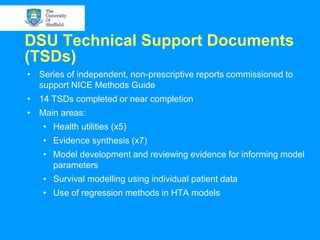
• Series of independent, non-prescriptive reports commissioned to
support NICE Methods Guide
• 14 TSDs completed or near completion
• Main areas:
• Health utilities (x5)
• Evidence synthesis (x7)
• Model development and reviewing evidence for informing model
parameters
• Survival modelling using individual patient data
• Use of regression methods in HTA models
Other DSU methods research
• Report and related publications demonstrating the
feasibility of applying Value of Information methods.
• Feasibility projects relating to computerised decision
support systems and orphan drugs
• Equity arguments applied to orphan drugs
• Discounting of costs and benefits
• The role of patient valuations of health states
• The incorporation of uncertainty into cost-effectiveness
models
• The incorporation of equity weights into cost
effectiveness models and decision making
Methods training
• Bridge between NICE and the pharmaceutical industry in
providing methods training
• “Masterclasses” held:
• Measurement and valuation of health-related quality
of life
• Network meta-analysis & indirect comparisons
• NICE Appraisal Process, modelling, what makes a
good submission, uncertainty analysis
Future updates
• Join our mailing list at :
http://www.nicedsu.org.uk

NICE Decision Support Unit

  • 1.
    NICE Decision SupportUnit Dr Paul Tappenden Senior Research Fellow Acting DSU Director http://www.nicedsu.org.uk/ 14/05/2014 © The University of Sheffield
  • 2.
    Background to DSU •Established in 2002. • Formal collaboration between the Universities of Sheffield (lead), York and Leicester. • Peripheral members at LSHTM, Brunel and Bristol. • May also involve highly specialist expertise from elsewhere. • Expertise covers all key areas of HTA. • Commissioned by NICE to provide a research and training resource to support the Institute's Technology Appraisal Programme.
  • 3.
    Main strands ofwork 1. Appraisal-specific work • Rapid evaluation of technical issues/analysis around health economic evaluation/modelling problems within specific technology appraisals • An independent yet highly qualified voice 2. Methods development • Ongoing role in developing Methods guidance for NICE • DSU Technical Support Documents • Training for industry and NICE Appraisal Committee members • Other methods work
  • 4.
    Appraisal-specific work • ~7appraisals per year • Analysis of additional evidence submitted as part of the appraisal process • Cetuximab for 1st line metastatic colorectal cancer • Lapatinib for metastatic breast cancer • Provision of modelling expertise unavailable elsewhere (software) • Donepezil for Alzheimer’s Disease • Evaluating Patient access schemes (PAS) • Tocilizumab for Rheumatoid Arthritis
  • 5.
    The NICE MethodsGuide for Technology Appraisal • Setting the agenda for, organising and facilitating the NICE methods guide for technology appraisal • Recent work includes managing the update to the 2008 NICE methods guide – 6 workshops covering issues around evidence synthesis, utilities, uncertainty analysis, subgroups etc. • Update due in 2011/2012 • Conduit for leading academic centres in HTA
  • 6.
    DSU Technical SupportDocuments (TSDs) • Series of independent, non-prescriptive reports commissioned to support NICE Methods Guide • 14 TSDs completed or near completion • Main areas: • Health utilities (x5) • Evidence synthesis (x7) • Model development and reviewing evidence for informing model parameters • Survival modelling using individual patient data • Use of regression methods in HTA models
  • 7.
    Other DSU methodsresearch • Report and related publications demonstrating the feasibility of applying Value of Information methods. • Feasibility projects relating to computerised decision support systems and orphan drugs • Equity arguments applied to orphan drugs • Discounting of costs and benefits • The role of patient valuations of health states • The incorporation of uncertainty into cost-effectiveness models • The incorporation of equity weights into cost effectiveness models and decision making
  • 8.
    Methods training • Bridgebetween NICE and the pharmaceutical industry in providing methods training • “Masterclasses” held: • Measurement and valuation of health-related quality of life • Network meta-analysis & indirect comparisons • NICE Appraisal Process, modelling, what makes a good submission, uncertainty analysis
  • 9.
    Future updates • Joinour mailing list at : http://www.nicedsu.org.uk